Slashdot Mirror
Domain: ca.gov
Stories and comments across the archive that link to ca.gov.
Comments · 2,038
-
Re:10.8 feet
10.8 feet is one second away at 7 mph. Too damn close -- company deserves a ticket.
Nonsense. If a pedestrian is walking down a sidewalk and I'm driving down the road in the lane closest to the sidewalk, I'll pass the pedestrian at a distance of closest approach of less than 10.8 feet.
Two things.
One, as my opinion, I agree with you. Driving in a road lane parallel to a sidewalk *should* not be a traffic violation, and again in my opinion no one deserves a ticket for that.
Two, going purely by what the SF law says, apparently that is a traffic violation.
So it isn't legal to drive on a road if that road has a side walk parallel to it on either side and at least one person is present.All traffic must stop until there are no pedestrians.
http://leginfo.legislature.ca.....
https://leginfo.legislature.ca...
https://leginfo.legislature.ca...Distance isn't a factor, it is simply the existence of a sidewalk or cross walk.
The law explicitly states a car can not be moving at all under those circumstances.Cruise should not present the argument they did nothing wrong, as the law is clear here. There was a pedestrian in the cross walk. The car was not fully stopped while on the same road.
Cruise instead should argue selective enforcement.
Why are they singled out? What about all the cars ahead and behind that were not ticketed for the same offense?Google Maps shows Harrison as 2.3 miles from the bridge to where it ends further up north.
The law states that entire 2.3 mile length of road can not legally have any moving vehicles on it at the time that pedestrian was in the cross walk. Did the other hundreds of vehicles get ticketed? Why not?Finally, you may think I'm being stupid in my interpretation of the law or intentionally facetious.
Perhaps a tiny bit on the last one, but by and large I'm only doing that to point out the physical impossibility to follow this law, and why such a law should be either rewritten or just stricken from the books completely.To actually follow the letter of the law, the moment you cross the bridge and end up on Harrison, as a driver you are required by law to somehow magically "see" 2.3 miles away through 5 major bends and plenty of minor ones, that all have buildings blocking line of sight.
Even if you did something like place a remote camera 2 miles away so you could see down that far, you being two miles back stopping in the road due to a pedestrian being on a sidewalk two miles away is ALSO a moving violation as you are not allowed to "park" within the inner lanes of the road.
So we have two contradictory laws. If your car is moving, you're violating the law. If your car is not moving, you are violating the law.
This is exactly why software can not be programmed to follow the law as both true and false branches of the IF statement result in a traffic violation.
I'd check the number of cars on average on a given street in a given day, and multiply that out over the years, then compare that to the number of tickets issued.
If the police claimed they can only ticket 1% of the violators, I'd question why they aren't doing so, as its a few billion to one they are not actually ticketing, not 100 to 1.This cop is clearly targeting Cruse and selectively enforcing the law, allowing billions of other people to get away with violating the law. Draw that into question and have the cop prove it isn't intentional (not likely) as well as show the fact even those cars following this law are breaking another and also not ticketed.
So unless they just send 10 tickets a day to every person with a registered vehicle, the law has not been enforced and so should remain that way.
-
Re:10.8 feet
10.8 feet is one second away at 7 mph. Too damn close -- company deserves a ticket.
Nonsense. If a pedestrian is walking down a sidewalk and I'm driving down the road in the lane closest to the sidewalk, I'll pass the pedestrian at a distance of closest approach of less than 10.8 feet.
Two things.
One, as my opinion, I agree with you. Driving in a road lane parallel to a sidewalk *should* not be a traffic violation, and again in my opinion no one deserves a ticket for that.
Two, going purely by what the SF law says, apparently that is a traffic violation.
So it isn't legal to drive on a road if that road has a side walk parallel to it on either side and at least one person is present.All traffic must stop until there are no pedestrians.
http://leginfo.legislature.ca.....
https://leginfo.legislature.ca...
https://leginfo.legislature.ca...Distance isn't a factor, it is simply the existence of a sidewalk or cross walk.
The law explicitly states a car can not be moving at all under those circumstances.Cruise should not present the argument they did nothing wrong, as the law is clear here. There was a pedestrian in the cross walk. The car was not fully stopped while on the same road.
Cruise instead should argue selective enforcement.
Why are they singled out? What about all the cars ahead and behind that were not ticketed for the same offense?Google Maps shows Harrison as 2.3 miles from the bridge to where it ends further up north.
The law states that entire 2.3 mile length of road can not legally have any moving vehicles on it at the time that pedestrian was in the cross walk. Did the other hundreds of vehicles get ticketed? Why not?Finally, you may think I'm being stupid in my interpretation of the law or intentionally facetious.
Perhaps a tiny bit on the last one, but by and large I'm only doing that to point out the physical impossibility to follow this law, and why such a law should be either rewritten or just stricken from the books completely.To actually follow the letter of the law, the moment you cross the bridge and end up on Harrison, as a driver you are required by law to somehow magically "see" 2.3 miles away through 5 major bends and plenty of minor ones, that all have buildings blocking line of sight.
Even if you did something like place a remote camera 2 miles away so you could see down that far, you being two miles back stopping in the road due to a pedestrian being on a sidewalk two miles away is ALSO a moving violation as you are not allowed to "park" within the inner lanes of the road.
So we have two contradictory laws. If your car is moving, you're violating the law. If your car is not moving, you are violating the law.
This is exactly why software can not be programmed to follow the law as both true and false branches of the IF statement result in a traffic violation.
I'd check the number of cars on average on a given street in a given day, and multiply that out over the years, then compare that to the number of tickets issued.
If the police claimed they can only ticket 1% of the violators, I'd question why they aren't doing so, as its a few billion to one they are not actually ticketing, not 100 to 1.This cop is clearly targeting Cruse and selectively enforcing the law, allowing billions of other people to get away with violating the law. Draw that into question and have the cop prove it isn't intentional (not likely) as well as show the fact even those cars following this law are breaking another and also not ticketed.
So unless they just send 10 tickets a day to every person with a registered vehicle, the law has not been enforced and so should remain that way.
-
Re:10.8 feet
10.8 feet is one second away at 7 mph. Too damn close -- company deserves a ticket.
Nonsense. If a pedestrian is walking down a sidewalk and I'm driving down the road in the lane closest to the sidewalk, I'll pass the pedestrian at a distance of closest approach of less than 10.8 feet.
Two things.
One, as my opinion, I agree with you. Driving in a road lane parallel to a sidewalk *should* not be a traffic violation, and again in my opinion no one deserves a ticket for that.
Two, going purely by what the SF law says, apparently that is a traffic violation.
So it isn't legal to drive on a road if that road has a side walk parallel to it on either side and at least one person is present.All traffic must stop until there are no pedestrians.
http://leginfo.legislature.ca.....
https://leginfo.legislature.ca...
https://leginfo.legislature.ca...Distance isn't a factor, it is simply the existence of a sidewalk or cross walk.
The law explicitly states a car can not be moving at all under those circumstances.Cruise should not present the argument they did nothing wrong, as the law is clear here. There was a pedestrian in the cross walk. The car was not fully stopped while on the same road.
Cruise instead should argue selective enforcement.
Why are they singled out? What about all the cars ahead and behind that were not ticketed for the same offense?Google Maps shows Harrison as 2.3 miles from the bridge to where it ends further up north.
The law states that entire 2.3 mile length of road can not legally have any moving vehicles on it at the time that pedestrian was in the cross walk. Did the other hundreds of vehicles get ticketed? Why not?Finally, you may think I'm being stupid in my interpretation of the law or intentionally facetious.
Perhaps a tiny bit on the last one, but by and large I'm only doing that to point out the physical impossibility to follow this law, and why such a law should be either rewritten or just stricken from the books completely.To actually follow the letter of the law, the moment you cross the bridge and end up on Harrison, as a driver you are required by law to somehow magically "see" 2.3 miles away through 5 major bends and plenty of minor ones, that all have buildings blocking line of sight.
Even if you did something like place a remote camera 2 miles away so you could see down that far, you being two miles back stopping in the road due to a pedestrian being on a sidewalk two miles away is ALSO a moving violation as you are not allowed to "park" within the inner lanes of the road.
So we have two contradictory laws. If your car is moving, you're violating the law. If your car is not moving, you are violating the law.
This is exactly why software can not be programmed to follow the law as both true and false branches of the IF statement result in a traffic violation.
I'd check the number of cars on average on a given street in a given day, and multiply that out over the years, then compare that to the number of tickets issued.
If the police claimed they can only ticket 1% of the violators, I'd question why they aren't doing so, as its a few billion to one they are not actually ticketing, not 100 to 1.This cop is clearly targeting Cruse and selectively enforcing the law, allowing billions of other people to get away with violating the law. Draw that into question and have the cop prove it isn't intentional (not likely) as well as show the fact even those cars following this law are breaking another and also not ticketed.
So unless they just send 10 tickets a day to every person with a registered vehicle, the law has not been enforced and so should remain that way.
-
Re:The actual cross-walk rules
The company in this case is making up a rule about the distance
from the pedestrian being critical (and asking us to trust it's
assessment that the ped was 10 feet away). The actually rules
have nothing to do with distance:https://www.dmv.ca.gov/portal/...
Respect the right-of-way of pedestrians. Always stop for any pedestrian crossing at corners or other crosswalks, even if the crosswalk is in the middle of the block, a
[...]
Remember, if a pedestrian makes eye contact with you, they are ready to cross the street. Yield to the pedestrian.At this point we don't really have enough information to know if the car was doing something an average human would recognize as wrong, or if it was a fairly typical scenario but the officer in question thought it would be cool to ticket a self-driving car so they actually applied the rule for once.
Can't their AI tell when someone is making eye-contact?
Japanese photo-booths have been able to find human eyes for years now.This is something that hasn't been discussed much but as a pedestrian and driver I extract a lot of information with eye contact and body language.
I think self-driving cars are going to need some mechanism for telling pedestrians "I see you" or "I think you've past so I'm about to accelerate", or telling another driver "even though I got to the 4-way first someone looks like they're going to use my cross-walk so you can have the right of way".
-
The actual cross-walk rules
The company in this case is making up a rule about the distance from the pedestrian being critical (and asking us to trust it's assessment that the ped was 10 feet away). The actually rules have nothing to do with distance:
https://www.dmv.ca.gov/portal/...
Respect the right-of-way of pedestrians. Always stop for any pedestrian crossing at corners or other crosswalks, even if the crosswalk is in the middle of the block, a [...] Remember, if a pedestrian makes eye contact with you, they are ready to cross the street. Yield to the pedestrian.
Can't their AI tell when someone is making eye-contact? Japanese photo-booths have been able to find human eyes for years now.
-
Re:They've always been ahead.
To get a sense of how far ahead Waymo is, take a look at the disengagements report Waymo published last year and then look at everyone else's. At least in California, Waymo has more miles driven than everyone else combined and their disengagement rate is much lower
It's hard to derive any useful conclusion solely from these numbers. It's not clear what the apples-to-apples bases of comparison are. Disengagements are self-reported and perhaps interpreted differently each company. Waymo says, "The vast majority of disengagements are not related to safety." Nvidia says, "Disengagements were when a driver completed a test, or assumed manual control of the vehicle due to discomfort." So, it is not clear whether the metric is uniform or even useful for evaluation of safety.
Second, as anyone who has driven behind a Google/Waymo car in Mountain View knows, those cars drive very conservatively, even to the point of annoying surrounding human drivers. It's not clear that the miles driven by the set of companies is comparable. A more aggressive set of driving scenarios and conditions would be more helpful for engineering feedback, but a less aggressive set of workloads would be better for marketing.
-
They've always been ahead.
To get a sense of how far ahead Waymo is, take a look at the disengagements report Waymo published last year and then look at everyone else's. At least in California, Waymo has more miles driven than everyone else combined and their disengagement rate is much lower
-
Re:Everything in California requires a cancer warn
I'm kind of curious, are doors in California required to have warnings along the lines of "Warning: outside contains sunlight, which is known to the state of California to cause cancer."?
Prop 65 is only about chemicals, but you never know where a new California proposition will take you...
Of course some sun-block lotions have been required to slap on this warning...
WARNING: This product contains benzophenone, a chemical known to the State of California to cause cancer.
-
Re:Cancer labels on cars?
Don't we need really fat 'cancer' labels on cars then - and I mean every car, even the electric ones (tires)?
No wait, they got an even fatter lobby.You jest, but you just can't get away from this stuff in california...
https://www.p65warnings.ca.gov... -
Re:Uber will just test them in California anyway.
It's about money, California will do anything to protect it's stream of revenue to dump into any libtard project moonbeam chooses, that's why Uber needs a permit.
Uhm, no, it's not about money, it's about safety.
An autonomous vehicle testing permit has an annual fee of $3600 and includes 10 test vehicles. Additional batches of 10 vehicles can be added at $50 a batch.
Currently there are about 50 companies testing about 300 cars total. 50 licences mean 500 cars if everyone is testing 10 cars. This is not the case (since there are less than 500 cars on the road), and you have some companies (e.g. Waymo) testing way more than 10, while others are probably testing one or two. So that's 50*3600 = $180,000 in application fees + a few hundred, maybe thousand, dollars more from the companies testing more than 10 vehicles.
This is hardly some sort of windfall for the government of California. The money probably doesn't cover the cost of developing the legislation, processing the applications, and monitoring the results.
-
Re:Uber hatred turned political a long time ago
Waymo claims 5600m between interventions. Maybe it's true, but until they are forced to release some data (say, via a fatality) I see no reason for believing a claim made by a company spokesperson.
It's public because California's regulations require it to be public. 352454 miles driven, 63 disengagements = once every 5600 miles. Read the report (pdf) yourself.
-
Re:I probably would have hit her
A human driver would assume that driving at the posted limit was safe for all but the most severe conditions (dense fog, or heavy snow, icy road, and night).
That driver would be incorrect:
"All speed limits are based on ideal driving conditions." (emphasis added)
This is evidence that driver education in the USA is inadequate.
-
Real Plan
Invest a little money into poor communities buying up properties tax free
Make new apartments and condo's reinvigorating a blight, tax free
Keep it on the books for 10 years, pricing all the poor people out, until its full of hipsters and yuppies, then sell for a massive profit and still not pay taxes on ithttp://dof.ca.gov/Forecasting/...
The federal tax bill passed at the end of December 2017 allows the Governor to designate eligible census tracts as Opportunity Zones. Investments made by individuals through special funds in these zones would be allowed to defer or eliminate federal taxes on capital gains.
-
Re:Be careful
Generally, this would be illegal: https://www.govdocs.com/can-em...
In California (and some other places), it's definitely illegal: https://www.dir.ca.gov/dlse/Ca...
-
Re: Jaywalking
Jaywalking is not illegal. It is discouraged.
In CA, US, the jaywalk ALWAYS has the right way. They are protected from âoeDeath Penalityâ It is the drivers fault in hitting anyone up to illegal homoside.
-
Re:More to come
Being better than the worst 5% of drivers would still make driverless cars far more dangerous than human drivers on average.
On average yes, but on average most drivers aren't crashing their cars. If the A.I. is consistently better than the worst 5% of drivers currently driving, that might be enough to dramatically reduce car accidents. I don't know what bar we need to hit to reduce the accident rate, but I'm not sure it's particularly high. There are a lot of drivers each day, but there aren't actually that many accidents as a proportion of the total number of drivers.
Let's consider Los Angeles, there are approximately 4 million commuters every day. I strongly suspect they have fewer than 200,000 accidents a day. In fact, it looks like there are around 220 serious car accidents in Los Angeles, on average, per day. If those accidents are largely attributable to the worst drivers, replacing all drivers with autonomous vehicles that are only better than the worst 5% would virtually eliminate accidents, because the those accidents would be largely caused by the worst 0.006% of drivers.
Now we can't be sure that all of those accidents are caused by poor driving, but these statistics indicate that more than a third of the accidents (162k) were attributed to speed (49k) or drunk driving (11k). I think that most people would agree that reducing the number of accidents by a third would be a pretty big improvement. If we look at this page that estimates that 80% of all traffic accidents are the result of driver inattention instead, then it's possible that relatively poor autonomous systems could still result in an 80% or higher reduction in accidents.
My point is that by limiting the worst behaviour on the roads we might trigger an unexpectedly disproportionate reduction in the rate and severity of accidents.
-
Re:Why not a fine
Yea, I'm really looking forward to renewing my driver's license into a REAL ID card.
Just so I have permission to travel within the borders of my own country (USA). -
Re:Stay sane
violent crime rate per 1,000 people:
San Jose : 3.21
San Francisco : 7.95So yea, you can fuck right off.
(ref: https://oag.ca.gov/crime/cjsc/... ) -
Re:And?
I work in education. We signed a statement, as part of our training, that holds us legally liable to report child abuse, child pornography, etc. we can be sued/fired if it occurs, we knew about it, and didn't report it. It's a California State Law, however, not federal
I think the point is, there are people outside law enforcement who are required to report certain things. https://www.cde.ca.gov/ls/ss/a... -
Re:Serious questions
I don't see private ownership of autonomous vehicles happening for precisely the reason stated above.
Most of the car manufacturer's have very disappointing miles driven and the only non-car company working on self-driving vehicles as a platform is Drive.AI.
Takata's bankrupty was caused by airbags being faulty. I can only image what happens when a consumer blames $AICompany for faulty sensors and has a recall.
-
Re:Transition to what?
I'm going to stop you right there because your assumption is completely and totally incorrect. So-called 'AI' as it currently exists, and for the forseeable future, is not in any way, shape, or form equivalent to a human being. We have NO IDEA how human brains are self-aware, capable of actual 'thought', capable of having a 'personality', etcetera, and so-called 'artificial intelligence' is not capable of these things;
Well how many jobs want that in an employee? Most jobs just want you to be a cog in the machinery, do whatever you were trained to do. You may not realize it if you work in a creative industry, but there's no progress to being a taxi driver you just drive people around. McD served Big Macs last year and will serve Big Macs next year. A lot of manufacturing, maintenance, retail, shipping, construction, processing, support etc. have people doing the same tasks over and over. Even education, if you consider that every year teachers start with a new class that doesn't know anything they taught last year.
We've already automated away a ton of routine jobs, the kind you can solve with trivial scripting and simple machinery. Now we're going for the more fuzzy, semi-routine jobs but they rarely take any real innovation. Take Waymo's 2017 disengagement figures for California that was recently released, on 352,545 miles driven they had 63 disengagements so once every 5600 miles. Near as I can tell humans make police-reported crashes once every 500k miles (3,131 billion miles / 6.3 million crashes), Waymo has driven 4 million miles now without any serious crashes. It's happening all without "real" AI.
-
Re: Top of first article nullifies your entire pos
I think anyone who commits a felony should be prosecuted - Democrats, Republicans and the rest.
Interestingly from your link it seems like more ineligible voters vote Democrat (64%) than Republican (18%) or independent/Libertarian (18%)
http://www.newsobserver.com/ne...
The 508 ineligible voters identified in the report are spread across the state, with 36 in Wake County, 34 in Durham and two in Orange. The report says that 64 percent were registered Democrats, 18 percent were registered Republicans and the rest were either unaffiliated or Libertarians.
Which tells me that Democrats benefit a lot more from voter fraud than anyone else, which is why they're so opposed to voter ID laws.
And why they support things like California's Motor Voter law (AB-1461) which auto adds anyone who applies for a driving licence to the voting rolls. California gives driving license to illegals. While AB-1461 doesn't explicitly allow them to vote it specifically indemnifies them against fraud charges if they do vote after they are added to to the rolls 'by accident' by the state.
https://leginfo.legislature.ca...
Existing law makes it a crime for a person to willfully cause, procure, or allow himself or herself or any other person to be registered as a voter, knowing that he or she or that other person is not entitled to registration. Existing law also makes it a crime to fraudulently vote or attempt to vote.
This bill would provide that if a person who is ineligible to vote becomes registered to vote by operation of the California New Motor Voter Program in the absence of a violation by that person of the crime described above, that person's registration shall be presumed to have been effected with official authorization and not the fault of that person. The bill would also provide that if a person who is ineligible to vote becomes registered to vote by operation of this program, and that person votes or attempts to vote in an election held after the effective date of the person's registration, that person shall be presumed to have acted with official authorization and is not guilty of fraudulently voting or attempting to vote, unless that person willfully votes or attempts to vote knowing that he or she is not entitled to vote.I.e. it doesn't legalize illegals voting but it does decriminalize it in the sense they can't be prosecuted. Presumably California Democrats will be telling non citizens it's 'fine' if they vote just like NC Democrats did. And then if the do vote, they can't be prosecuted and the state can just say it was a clerical error.
-
Not really a federal case
Federal labor law doesn't make political speech a protected class in employment.
California law, however, does.
His lawsuit is going to be a lot more complicated than the news media (and most people who read it) can comprehend.
-
Re:Stupidity rules
Ultimately, the SCOTUS decides constitutionality, not random citizens with a vision of how things would be if they were made Emperor.
Questions about the constitutionality of regulating arms has been decided by the SCOTUS several times , in some cases over a century ago:
* Presser v. Illinois (1886): The SCOTUS determined that states are able to regulate gun ownership - which is why we see state-approved firearms (ie. California's Roster of Handguns Certified for Sale )
* United States v. Miller (1939): The SCOTUS said "we cannot say that the Second Amendment guarantees the right to keep and bear such an instrument"; specific weapons can be regulated.Social Security is similarly declared constitutional.
Helvering v. Davis (1937): The SCOTUS determined Social Security providing the welfare of the people, and would almost certainly be used as a reason to allow universal healthcare.
Standing armies and navies aren't banned - they merely require Congress to renew authorization every two years.
-
Re:not for long.
Daily driver for commuting/work/shopping? EVs for sure, but let's try to charge them off wind/solar please? Otherwise you're shifting the efficiency problem from your engine bay to the grid. I hate smug EV drivers boasting about "clean" driving. They get all flustered when I point out that grid-charging has all sorts of issues from coal-fired electricity.
These arguments usually stem from taking a geographical "national average" for electricity generation and applying it to your "average EV". The problem is that EV adoption, population and miles driven aren't done on a geographically "average" scale.
Most EV's driven by commuters who rack up miles are done in the more affluent cities/States. Hell, CA has the bulk (nearly half) of EV's sold within the US. CA also happens to have very little coal generation with about 50% coming from natural gas:
http://www.energy.ca.gov/alman...
27% comes from renewables and 10% from nuclear. All 3 forms generate far less pollution compared to an ICE. The grid comes with its own issues, of course, including balancing base-load with peak load for EV charging (at night). But hopefully utility-scale batteries will alleviate that somewhat.
I think a similar scenario exists for WA, NY and even TX.
-
Re:For the people, by the people, of the people.
Not quite: you can keep the personalized plate, but you have to pay a fee to keep it (it's the California DMV: there's *always* a fee): https://www.dmv.ca.gov/portal/... However, if you keep 2 plates, the state will not ever issue another pair of plates with the same number (they don't want 2 vehicles with the same plates), so in the past, you just kept the plates.
-
Re: How is this different ...
Tesla is deliberately delaying the Model 3. CARB (California Air Resources Board) created a ZEV mandate. A certain percentage of each car company's sales have to be ZEV - zero emissions vehicles. Right now that's almost entirely EVs (Toyota has a hydrogen fuel cell vehicle on the market). The percentage increases each year - the details are a bit complex but bottom line it's about 2% for 2018. If an automaker fails to reach the required percentage, they have to buy ZEV credits from an automaker which exceeded it. If they fail that too, they are banned from selling cars in California and the approx dozen states which automatically adopt CARB's guidelines. That's about 1/3 of the U.S. by population.
Since Tesla produces only EVs, they always have excess ZEV credits. Part of their finances is selling those ZEV credits. But the closer the other automakers come to meeting their ZEV requirement in a year, the lower the price for ZEV credits. So if Tesla produces too many EVs in a year in which other car companies sold enough of their own EVs, they get little to nothing for their ZEV credits, and they have to bear a larger fraction of the Tesla 3 production cost themselves.
You can tell how well EVs are selling by how good the discounts are at the end of the year. 2015, sales were really poor (relative to the ZEV mandate that year) and there were incredible discounts on EVs (in California - the only state where CARB counts sales/leases). Dec 2015 I almost picked up a 3-year lease on an e-Golf for $79/mo, no money down (there was also a $49/mo with $1500 down offer, but that's more money overall). The EV deals in late 2017 were close to nonexistent, which is a pretty good indicator that the automakers were hitting their ZEV mandate percentages. That means there wasn't much of a market for ZEV credits in 2017, which meant Tesla had to delay Model 3 production to try to push some of those credits into 2018. And that's exactly what they did.
The problem for Tesla is that they set the pre-order price of their EVs based on assumptions for how much they'll receive for selling the ZEV credits. If the other automakers consistently hit their ZEV percentage every year (or come close to it), Tesla is in a world of trouble - all those Tesla 3 pre-orders could have been "sold" for less than what it cost to manufacture because they'd assumed selling the ZEV credit would've made up the difference. So paradoxically, the better EVs sell, the worse off Tesla is financially. -
Re:Which billionaire is funding this one?
Let's review: Wilson couldn't fix California, and neither could the Governator. But Governor Moonbeam did, and now the state is out of the hole, growing again, and projecting a surplus, all from RAISING TAXES.
To be a bit more clear: Wilson got close, significantly reducing the gap on the deficit in the weeks before the recall election. Also recall: California had been shaken down by Enron's manipulation of the newly (and badly) deregulated energy market, paying usurious electricity prices, completely eating up CA's budget surplus and more besides.
Then the special recall election happened, and Ah-nold got elected because everyone thought it would be cute -- not to mention a self-satisfying poke in the eye to the establishment -- to have a rank amateur running things (sound familiar?).
It's also worth noting that this is the second time that Governor "Moonbeam" has cleaned up the mess left behind by a bumbling B-grade movie actor.
-
Re:Two hours at 25mph is a shift?
I think that CARB already classifies the i3 with REx as a plugin hybrid. Those i3s get green carpool stickers, not the white stickers that EVs get.
-
Re:CA
So they run a $6BN surplus each year, yet have insane debt levels?
Their debt levels are not insane, but are rather normal. As of 2016, their state revenues were 155 billion a year, their state debt was 151 billion.
That's actually far better than say, the Federal Government, and is rather humdrum in comparison to say, your average person with a house that's mortgaged at several times their annual income.
But I get it, you just want to declare something without thinking, after all, if you just say it, people will nod and agree, without actually looking at the details.
Which is it, are they "banking" $6BN/yr or are they increasing their debt by spending more than they have? Hard to see how they are doing both simultaneously.
Ok, so you're too blind to comprehend the concept of a budgeting year, for whatever reason. Like being purposefully obtuse?
You know, that just makes you rude, it doesn't actually foster discussion.
Any idea what California does with their "surplus" each year? (Note - as soon as they spend it, it's no longer "surplus", it's "spending".)
What they decide to do with it, depends on their priorities, this year, Governor Brown is proposing to put it in the Rainy Day Fund (aka, their emergency piggy bank), which is part of Proposition 2 from 2014, as well as to pay down debt.
You can read this in the State Budget page.
-
CARB, not Tesla
CARB (California Air Resources Board) introduced a ZEV mandate. Zero Emissions Vehicle - mostly EVs though Toyota has a hydrogen vehicle on the market. It requires that a certain percentage of each automaker's sales be ZEVs each year. That percentage increases every year (currently about 2%, supposed to be about 15% by 2025). If an automaker fails to hit that percentage or buy enough credits from a company which has exceeded the percentage, it is banned from selling vehicles in California. And since about a dozen other states automatically adopt CARB's guidelines, that automaker would be banned from selling cars in about a third of the U.S. by population. This is why every automaker has developed an EV - none of them want to be banned from 1/3 of the U.S.
Tesla is actually subsidized by this. It always has ZEV credits, so its bottom line is buoyed by selling those to other automakers. That's also why production of the Tesla 3 has been so slow to ramp up. They won't want to produce more of them per year than they're able to sell credits for. If they can't sell the ZEV credit for a Tesla 3, they have to bear the full manufacturing costs for the vehicle themselves.
CARB actually first tried the ZEV mandate in 2000. That's why GM invested half a billion dollars developing the EV-1. Come late 1999, GM was the only automaker with a viable vehicle which could meet the ZEV mandate. They stood to make billions back selling the ZEV credits and licensing the technology to other car companies. But at the last minute the other automakers convinced CARB that technology wasn't yet ready to meet the ZEV mandate, and hybrids were the best technical solution for now. GM destroying all the EV-1s makes a lot more sense when you put it in this context. Overnight CARB turned GM's half billion dollar investment from a gold mine into money down the toilet, then had the temerity to ask GM if it could share the technology with California (so it could be given to other automakers). It's no wonder GM destroyed the EV-1s and buried the R&D so CARB couldn't get their hands on it.
Do note that this means whether or not EVs are economically viable remains to be seen (whether other automakers are feet-draggers, or if CARB is just pushing the market into unviable space). The mandate is an arbitrary bureaucrat-fixed percentage, not a market one. So if the market doesn't want to buy enough EVs to meet the mandate, automakers have to cut prices on EVs until enough of them sell (or are leased) to meet the mandate. That's why a couple years ago VW was offering a 3-year lease on an eGolf for $79/mo with no money down - they were short on ZEV credits that year. And that's why the best EV deals are in California - only EVs sold/leased in California count towards the ZEV mnadate. 2016 and 2017 didn't see as good deals, so EV sales seem closer on track with the ZEV mandate those years. But climbing from 2% to 15% in 7 years is a very steep increase in ZEV sales. If what the market wants deviates from the ZEV mandate, it will show up in the EV discounts. The greater the deviation, the steeper the EV discounts will be. -
Re:YAY for coal?
Around 50% of their internal generation is natural gas, one wonders where the long term solution for capturing green house gas emissions is, we've been emitting them for far longer than nuclear so we must clearly have a solution to continue using those plants right?
-
California is failing
California is currently failing in many respects.
The national economy is up around 3%, and California revenues are also up about 2.9 %.
That's about a 1:1 ratio, but CA grew at twice the rate of the economy in 2016. Their growth is significantly slowed since about two years ago. Also, that 2.9% increase in revenues is offset by about 2% increase in expenses, so it's not going to reduce their deficit a lot.
The CA population has lost about 930,000 people(*) according to census data (linked in the article), mostly middle class. The middle-class in CA have moved away to Arizona, Washington, and Texas leaving the poor and ultra-rich behind. Not completely, of course, but losing that much middle class has gotta put stress on the CA economy.
Their labor force shrank from 62.1% to 59.1% in that same time - a huge decrease to happen in just over a year.
CA is dead last (50th out of 50) in economic freedom.
Some analysts are suggesting that CA is already in a recession.
So... yeah. It's entirely reasonable to predict that California is facing very bad times in the near future.
And by extension, the California management.
(*) Don't bitch about linking to Breitbart. The link to the census bureau report is right there in the linked article.
-
Re:Finally
Political affiliation is not simply opinions spouted (whether conservative or liberal or centrist) but actual alignment with a party.
That's your own made up interpretation of "engaging or participating in politics":
https://leginfo.legislature.ca...
"No employer shall make, adopt, or enforce any rule, regulation, or policy: a) Forbidding or preventing employees from engaging or participating in politics or from becoming candidates for public office"
It's arguable whether what transpired at Google applies. I think a reasonable case can be made that Google allowed both a de-facto and a written policy of liberal political action within the company and punished those who expressed the opposite political opinion.
-
Re:Not a Protected Class
You are just plain wrong. http://leginfo.legislature.ca.... 1101. No employer shall make, adopt, or enforce any rule, regulation, or policy: (a) Forbidding or preventing employees from engaging or participating in politics or from becoming candidates for public office. (b) Controlling or directing, or tending to control or direct the political activities or affiliations of employees. 1102. No employer shall coerce or influence or attempt to coerce or influence his employees through or by means of threat of discharge or loss of employment to adopt or follow or refrain from adopting or following any particular course or line of political action or political activity.
-
Leasing EVs is generally cheaper than buying
To understand why, you have to understand the economics of EVs. The real economics - not the "EV sales are rising because more people want them" rose-tinted version its proponents like to believe.
EV sales are taking off because of CARB (California Air Resources Board). They have a ZEV mandate (zero emissions vehicles - mostly EVs though Toyota has a hydrogen vehicle on the market). Beginning in 2013 or 2014, CARB required a certain percentage of each manufacturer's vehicle sales to be ZEVs or PZEVs (partial ZEVs - basically plug-in hybrids). The percentage goes up every year. The formula is a bit complex but it's about 2% ZEVs for 2018, and supposed to reach over 15% by 2025.
If a manufacturer fails to reach this percentage, the manufacturer must buy ZEV credits from another manufacturer which exceeded its required quota. This is what keeps Tesla afloat. Since they only sell ZEVs, they always have excess credits which they sell to other manufacturers who didn't sell enough ZEVs. That's right - if you buy an ICE vehicle, you are likely subsidizing someone buying a $70,000 Tesla. This is also why Tesla is in no hurry to ramp up Tesla 3 production. They don't want to flood the ZEV credit market - that would devalue their own credits. So they're going to ramp up production just barely fast enough to keep up with how many credits other manufacturers need to buy to comply with CARB's requirement.
If the manufacturer fails to sell enough EVs or buy enough ZEV credits, they are banned from selling cars in California. Since about a dozen states automatically adopt CARB's rules, that ban would extend to about 1/3 of the U.S. by population. No manufacturer wants to be banned from that huge chunk of the market, so they do whatever they can to sell enough EVs to comply with CARB's ZEV mandate. This means sales, discounts, incentives, whatever it takes to get however many EVs they need into buyers' hands to satisfy CARB's requirements. This is why the EV deals are better in California than in other states - CARB only counts EVs which are sold in California. So California is where automakers offer the biggest EV incentives. I almost pulled the trigger on a 3-year e-Golf lease in 2016 for $500 down, $79/mo in Los Angeles (the Bay Area had zero down, $79/mo available).
Since EVs are not actually popular with buyers (at least not at the percentage the ZEV mandate requires), this means the manufacturers have to sell the vehicles at below true market value to generate sufficient sales (sometimes even below manufacturing cost). If they're going to do this, leasing it is preferable to selling it. With a sale, they've lost the entire manufacturing cost of the vehicle. With a lease, they at least get the materials for the vehicle back at the end, which they can then reuse or recycle. And if the blue book value of the EV is less at the end of the lease than was projected, they can write off the difference and get a tax deduction for the loss. Leasing also allows anyone to take advantage of the full $7500 federal tax credit. Being a tax credit, you have to owe at least $7500 in income taxes to take full advantage of it. Based on IRS tax stats, this means the buyer needs to make more than about $70,000/yr to take advantage of the full tax credit. But if you lease it, the tax credit goes to the car manufacturer, who pays a lot more than $7500 in taxes each year. So they can take advantage of the full credit and pass it on to the buyer. That means the real price for a leased EV for anyone making less than $70,000/yr is often less than for a purchased EV.
All this is why the blue book value of a used EV is so low. The ZEV mandate only applies to new vehicle sales, not used EVs. The incentives lower the price, effectively causing more new EVs to be sold or leased than would've at the correct market p -
Re:Voter ID
Correct me if I am wrong. You need a driver license or CA ID card number to register to vote in CA. In addition to the last four digits of SSN and DoB. I believe my mistake was reading the bullet points as or not and. http://registertovote.ca.gov/
How can I get an CA ID card or drivers license without going to the DMV?
Ok. So California has barriers to vote by having to prove you can legally vote. So why would it be an issue to have a voter ID if you have to prove you can legally vote as it stands now?
-
Re:Voter ID
There are 12.5 million illegal immigrants in the US. In California, they are given a drivers license which is enough to be able to vote.
Calling bullshit right there. You have to be a citizen before you can register to vote. A driver's license doesn't get you on the voter rolls.
I know this may be confusing, but you can do two different things at one place. The DMV can both issue licenses and register voters---and they can have different rules for each thing. Amazing, right?
Anyway, if you think I'm as full of bullshit as you are, feel free to read it yourself:
-
Re:Voter ID
How do they get to the polling station if they can't get to the DMV or have to work during polling hours?
Turns out electoral precincts are located far more conveniently than DMVs, turns out we have early voting, absentee ballots, in-person voting and legal rights that compel employers to allow you time to vote, among other things.
You want to make it the law that the State have to come to people's houses and issue them an ID, then you can compel ID.
You didn't think this through, did you.
Seems to be your problem, penny pooper. You're as confused as ever, and it turns out no, no, a driver's license is not sufficient to vote in California, the Secretary of State's Elections office actually processes that separately.
Maybe instead of being a useless parrot, you could take the time to be informed for once. Or did you use Wisdom as your Dump Stat in making your gully dwarf of a character?
-
Re:Earlier police failures...
Actually, as TFA points out, filing a false police report (which is esssentially what swatting is) *is* a felony in some juridictions but a misdemeanor in others. It's clearly a misdemeanor in California, but AFAICT can be either a misdemeanor *or* felony in Kansas depending on the severity. Since someone got killed, I'd guess this could fall into the felony category, in which case "Swautistic" could be going away for quite some time if prosecuted and found guilty in Kansas.
It looks like Kansas' felony murder statute only applies if the felony in question is classified as "inherently dangeorous", which means armed robbery, arson, or aggravated burglary. So while he could be prosecuted for a felony, he isn't on the hook for a first degree murder rap.
In states where felony murder includes any homicide caused by or in the process of any felony, and where filing a false report isa felony, a bad swatting could result in a sentence of life without parole.
-
Re:Earlier police failures...
Actually, as TFA points out, filing a false police report (which is esssentially what swatting is) *is* a felony in some juridictions but a misdemeanor in others. It's clearly a misdemeanor in California, but AFAICT can be either a misdemeanor *or* felony in Kansas depending on the severity. Since someone got killed, I'd guess this could fall into the felony category, in which case "Swautistic" could be going away for quite some time if prosecuted and found guilty in Kansas.
-
Re:Obvious Solution
If it turned out that were temporary, unmarked speed restrictions that drivers could only find at the department of transportation's homepage
I have an oversize towing permit (for a boat I own that's over 8.5 ft in width). The restrictions on where I can tow the oversized load changes every week, depending on freeway construction and closures. If I decide to tow my boat on the highway (almost never do, but if), it's my responsibility to check with the CalTrans website (weekly short-term restrictions) to make sure I'm allowed to do so on that route on that particular day. I did opt for email notification, so I receive the PDF by email each week. But it's still my responsibility to check the website before my trip in case there was a new closure added at the last-minute.
The same if I decide to go fishing at San Clemente Island. It's a Navy base, and the Navy sometimes conducts live fire exercises there. It's my responsibility to check which zones will be closed the day I decide to go there, and to stay outside closed zones. You see, unlike your analogy of a car on a road, you cannot put a "closed" sign in the air or on the water.
This is the sort of thing you want pulled from a single authoritative source. That way if the government decides to add a new restriction at the last minute, they only have to update that one source everyone pulls the info from. Pushing the info to every user doesn't work because it breaks every time someone changes their email address or phone number. You can use a push service to augment the system (like the weekly highway restrictions I receive). But the fundamental method of distribution has to be that every affected person knows they're supposed to check the single authoritative source for restrictions and closures. I suspect buried in the manual that came with drone which this guy never read, is a warning that they're supposed to check with the FAA for closures before flying. -
Re:Fuck Ajit Pai
You do realize that Republicans like illegal immigration, because it forces working class wages down, right? If someone lowered the boom on people illegally employing illegal immigrants, it would solve a lot of problems. The Republicans aren't about to do it.
The mainstream Republicans are weasels about immigration, but it was the Democrats who pushed abominations like the Motor Voter law
https://leginfo.legislature.ca...
Existing law makes it a crime for a person to willfully cause, procure, or allow himself or herself or any other person to be registered as a voter, knowing that he or she or that other person is not entitled to registration. Existing law also makes it a crime to fraudulently vote or attempt to vote.
This bill would provide that if a person who is ineligible to vote becomes registered to vote by operation of the California New Motor Voter Program in the absence of a violation by that person of the crime described above, that person's registration shall be presumed to have been effected with official authorization and not the fault of that person. The bill would also provide that if a person who is ineligible to vote becomes registered to vote by operation of this program, and that person votes or attempts to vote in an election held after the effective date of the person's registration, that person shall be presumed to have acted with official authorization and is not guilty of fraudulently voting or attempting to vote, unless that person willfully votes or attempts to vote knowing that he or she is not entitled to vote.I.e. they're adding illegals to the voter rolls and decriminalising them voting.
And Democrats are even now fighting Trump's Wall. The reason for this is that Hispanics voted 2:1 Democrat to Republican
https://www.nytimes.com/intera...
And you have people like this
https://www.theguardian.com/co...
Saying that real change will only be possible when whites are a minority. Which, thanks to their immigration policies will happen in 2043.
There will be no bans on hate speech. In the US, "hate speech" is a matter of personal opinion, and will continue to be
40% of Millennials support bans on hate speech.
http://www.pewresearch.org/fac...
Given the Democrats believe the constitution is a living document and have already managed to reinterpret it to make gay marriage a right, and Hillary believed that DC vs Heller was wrong and that the Second Amendment needs to be reinterpreted so that individuals do not have the right to bear arms, who's to say that the Democrats next major initiative might be to reinterpret the First Amendment to say that hate speech bans are fine?
Thank the GOP got in and got Gorsuch on the SCOTUS basically. Otherwise Hillary would have nominated someone who'd have blown away big chunks of the Bill of Rights so the Second Amendment ended up meaning what it does in NYC - you have the right to bear arms, so long as you're a cop, an ex cop, rich or know the right people. Actually NYC passed law against misgendering too, so the First Amendment means jack shit there too. I'm sure if Hillary had got in she'd have nominated a SCOTUS judge who've have pushed this crap on the rest of the country.
Not to mention she said 'the unborn person has no constitutional rights'. Which honestly sounds like the Democrat position prior to the civil war that slaves people had no rights.
Given a choice between the somew
-
Re:wtf
-
Re:Free stuff for poor people + No Borders
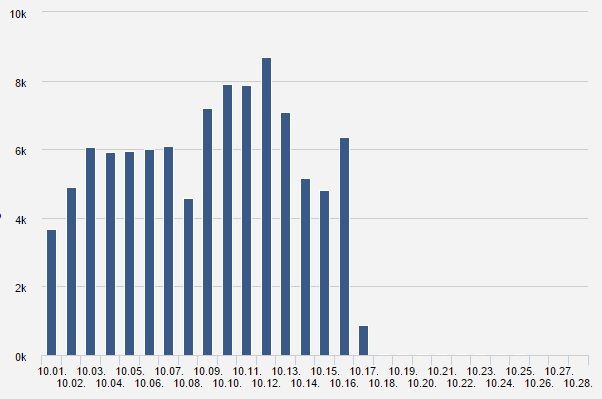
Here's a graph of the number of illegal immigrants crossing the Hungarian border. Guess what happened on the 18th of October?
http://media.breitbart.com/med...
Here's a graph of suicide attacks before and after the border fence. Suicide bombers being a particularly unwelcome form of illegal immigrant.
https://www.jewishvirtuallibra...
It's insane that foreigners need to go through multiple checks if they enter the US at an airport or port but if they walk across the border no one even knows who they are or what they're carrying.
http://www.nydailynews.com/new...
The only reason this is even controversial in US politics is because the Democrats know Hispanics vote 70%:30% for them and so they know letting in more Hispanics makes it easier for them to win.
They've even let illegals vote in CA thanks to the Motor Voter law. And if anyone objects the Democrats can call them 'racist'.
https://leginfo.legislature.ca...
Existing law makes it a crime for a person to willfully cause, procure, or allow himself or herself or any other person to be registered as a voter, knowing that he or she or that other person is not entitled to registration. Existing law also makes it a crime to fraudulently vote or attempt to vote.
This bill would provide that if a person who is ineligible to vote becomes registered to vote by operation of the California New Motor Voter Program in the absence of a violation by that person of the crime described above, that person's registration shall be presumed to have been effected with official authorization and not the fault of that person. The bill would also provide that if a person who is ineligible to vote becomes registered to vote by operation of this program, and that person votes or attempts to vote in an election held after the effective date of the person's registration, that person shall be presumed to have acted with official authorization and is not guilty of fraudulently voting or attempting to vote, unless that person willfully votes or attempts to vote knowing that he or she is not entitled to vote.
Plus of course illegals force down wages, and that helps the sort of companies who donate to the Democrats. I.e. they've decided that open borders is in their long term interest. And in their short term interest due to things like Motor Voter. And if anyone objects the Dems can call them 'racist'. I.e. it's in the Dems interest to have open borders. And not have a border wall.
-
Re:Taxes
Actually, gas taxes cover the costs of road subsidies and actually subsidize most other forms of transit. It's just that States tend to take the gas taxes and spend them on non-transit related things, then claim poverty about the crumbling roads. With a ~$0.77 per gallon tax, and assuming 12,000 miles average, and 14.5 million registered vehicles in the State of California, fuel taxes alone bring the State about $5.4 billion a year in taxes. Caltrans spends about $10 billion annually with 60% of that going to non-road-infrastructure maintenance. 30% of road taxes are currently going to fund a high speed rail line between Merced and Bakersfield, with no route identified from Bakersfield to LA. There is plenty of gas tax funding to cover roads, it's just that States love to spend that money on other things then plead poverty when it comes to roads.
If you want to put the taxes where they need to be, then tax weight. Weight damages roads, with the damage going as going as the 4th power. The average US vehicle weighs in at 4,000 pounds, and the average Tesla S clocks in around 5,000 pounds. Meaning the Tesla will do approximately 2.4 times more road damage than the average vehicle, but pays essentially zero for its infrastructure costs. The Tesla 3 is also heavier than the Chevy Bolt, Nissan Leaf, and BMW i3, and in fact is close to the weight of an average vehicle.
With the above calculations, and assuming the $10 billion Caltrans budget was covered by excise taxes, there should be a flat $0.06 per mile charge for all vehicles. If we were smart, we'd scale that tax based upon weight ratio to the average. A BMW i3, weighing in at 2800 pounds, would pay about $0.015 per mile for its excise tax. The Tesla model 3, and the average car - both being around 4000 pounds - would pay the $0.06 per mile. And a Tesla S, being a bit portly at 5000 pounds, would pay around $0.15 per mile. That would cover costs of infrastructure as well as scale it to where it belongs - weight, primarily, then mileage.
-
Re:Like it or not, it's the future
Electric cars aren't becoming an important market segment because of fuel cost. They're becoming an important market segment because CARB (the California agency which sets pollution regulations) is requiring a certain percentage of an automaker's car sales to be EVs, otherwise they'll be prohibited from selling cars in California. If they can't hit the required percentage, they have to buy EV credits from a company which has extra (which is what keeps Tesla afloat). Since about a dozen states automatically adopt CARB's rules, this would force the automaker out of about 1/3 of the U.S. by population. So they comply with CARB's rules whether or not they make financial or environmental sense.
I'm not saying this is a bad thing. Just understand that the EVs you see on the road are there entirely because of regulatory pressure. Not because they make economic sense. -
Uber drivers who are California residents - file!
All California drivers for Uber should file a complaint here with the AG:
https://www.oag.ca.gov/privacy/databreach/reportingMy complaint states:
Uber failed to notify thousands of California drivers for Uber of a PII data breach in violation of Calliforonia Civ. Code s.1798.82(a).
https://www.bloomberg.com/news/articles/2017-11-21/uber-concealed-cyberattack-that-exposed-57-million-people-s-data -
Re:Good luck getting a job before 16
California requires the school's permission. It doesn't look like it has to be the principal, just an authorized school official, but I'm not sure exactly who qualifies for that.
-
Re:Gotta love the USA
Only insofar as their regulations only apply intrastate and do not affect any interactions across state lines.
I don't suppose you have a source for that. Because here are two examples of states having regulations that specifically apply to interactions across state lines:
Hawaiian Plant Industry Division Regulations
CDFA Plant and Animal Laws and Regulations