Slashdot Mirror
Domain: catb.org
Stories and comments across the archive that link to catb.org.
Comments · 2,698
-
Re:NCR intellectual property...Interesting. SCO's complaint mentions SMP specifically..
"The only way that the pathway is an "eight-lane highway" for Linux to achieve the scalability, SMP support, fail-over capabilities and reliability of UNIX is by the improper extraction, use, and dissemination of the proprietary and confidential UNIX Software Code and libraries. Indeed, UNIX was able to achieve its status as the premiere operating system only after decades of hard work, beginning with the finest computer scientists at AT&T Bell Laboratories, plaintiff's predecessor in interest."
As you have alluded, ESR dismisses Unixware's implementation of SMP.Ironically, UnixWare did not get usable SMP on Intel until after Linux. The UnixWare implememtation was unstable until mid-1997; Linux got working SMP in 1996 with the release of 2.0.
SCO's complaint and ESR"s response do not mention any other parallel techniques besides SMP. Indeed, SCO implies that it regards other parallel techniques as inferior to SMP.[...]
SCO/Caldera's claim to own the scalability techniques certainly cannot be supported from the feature list of its own SCO OpenServer, a genetic Unix. The latest version[41] advertises SMP up to only 4 processors (a level which SCO's complaint dismisses as inadequate), no LVM, no NUMA, and no hot-swapping. That is, SCO/Caldera is alleging that IBM misappropriated from SCO technologies which do not appear in SCO's own product.
That is to say, it virtually never needs repair, it performs well under a wide variety of adverse circumstances, and it can be extended throughout an enterprise and across multiple processors to perform unified or disparate tasks in a seamless computing environment.
The machines you mention are massively parallel machines. Massive parallelism differs from symetric paralelism, chiefly in that in MPP, each processor has its own memory. The task to be performed is broken up into many subtasks and each processor completes that subtask simultaneously. sourceAlthough effective, massively parallel computing is far from seamless. Think of a MPP as a Beowulf with fast interconnects. It is not the seamless architecture that is described in SCO's complaint.
-
Re:This story continues to amaze me.
Well, here is a thing - I have found that there is a project underway to find as many instances as possible where acess to code that may have been copied was found, in order to prove that the IP for Unix has been nullified
See here for details. -
The Jargon File knows
Have you tried looking at The Jargon File's bibliography?
-
Re:Is that Something like MIPSMIPS == "Meaningless Indication of Processor Speed."
Unless, of course, you wish to believe the old folks who might otherwise tell you it stands for Millions of Instructions Per Second. Back in the good-old-days, before the current abundant crop of benchmarks, people tended to measure CPUs more simply. You used to hear arguments of "my RISC chip performs more cycles per second than your CISC chip" or "my CISC chip performs more work per cycle than your RISC chip." (Anyone else notice the passing of CISC and RISC from the lexicon?)
Personally, I think we need a unit to measure the accelerating number of benchmarks created every year. How about the Shtonestone?
And to stay on topic (not that it matters much on Slashdot), the name has been "computron" for years and years.
-
Re:Is that Something like MIPSMIPS == "Meaningless Indication of Processor Speed."
Unless, of course, you wish to believe the old folks who might otherwise tell you it stands for Millions of Instructions Per Second. Back in the good-old-days, before the current abundant crop of benchmarks, people tended to measure CPUs more simply. You used to hear arguments of "my RISC chip performs more cycles per second than your CISC chip" or "my CISC chip performs more work per cycle than your RISC chip." (Anyone else notice the passing of CISC and RISC from the lexicon?)
Personally, I think we need a unit to measure the accelerating number of benchmarks created every year. How about the Shtonestone?
And to stay on topic (not that it matters much on Slashdot), the name has been "computron" for years and years.
-
Re:I LOVE the 80's
Lol. WTF?!
-
heh...
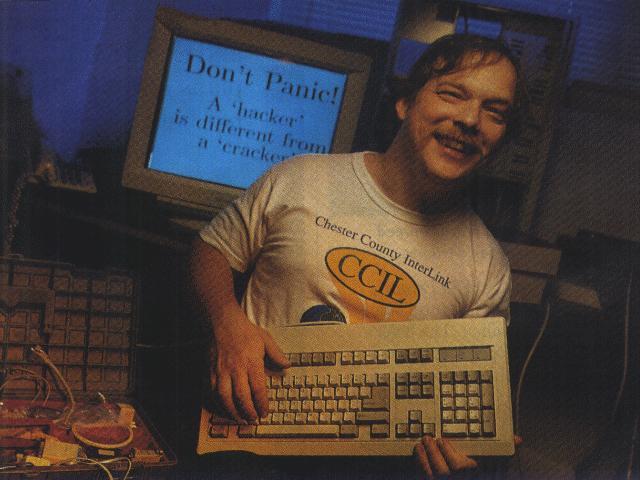
I bet he wishes he had never wore THIS shirt.
-
I LOVE the 80's
Is he playing air guitar on his keyboard??
-
RTFARTFA
The legal portion is precisely to answer your question.
-
ESR asking for your help in defeating SCOLittle off topic, but this coud make a huge dent in SCO's Case (if any).
Head over to ESR's No Secrets" home page, if you ever had access to UNIX source code that was not under NDA or NDA not enforced.
Quote:
I want to know if you have ever had read access to proprietary Unix source code (not just binaries and documentation) under circumstances where either no non-disclosure agreement was required or whatever non-disclosure agreement you had was not enforced.
-
Re:mentality not the religion
I don't know if you've noticed, in general, but most religion's add a lot of stress to people's lives, and to the world...To the extent that it tells people to stay calm, meditate an hour a day, and treat other people as though they were yourself, I don't consider it a religion.
The problem, as usual, is one of definition.
According to ESR's neopagan FAQ, "religion" comes from roots "re ligare", meaning "to rebind" to roots, to strengths, to the basics of things. In that sense, of rebinding, reconnecting, us to our true natures, I'm all for religion.
But in Western society, our experience of religion is very much formed by authoritarian dogma, so that we assume religion implies belief in supernatural entities and unquestioning faith. In that sense, I hold no truck with it.
It's worth noting that there are dogmatic Eastern practices and non-dogmatic Western ones (the Society of Friends, a.k.a. Quakers, leaps to mind), so it's not a strict East/West split by any means.
(BTW, for any neopagan geeks out there, I'll be presenting a workshop on "Zen Paganism" at the Starwood Festival again this year.)
-
Re:Employers' fault...
MVS = IBM Mainframe OS don't know what it stands for
Multiple Virtual Storage. There's a conceptual overview from the Unix geek viewpoint in ESR's upcoming book, The Art of Unix Programming . -
El Stupido...
Seems like a bad thing to implement an interface to a non-documented API for mission essential code.
The problem with this is that Microsloth can easily change their non-public interface without telling anyone and your code will break. Other than the lack of security implied by accessing things that are supposed to be secure, this interoperability issue will come back to haunt anyone who implements these 'tricks' IMHO.
Don't put this in mission essential code, or you will recieve a phone call late one night by your operations staff for unknown reasons...you have been warned. -
Am I the only one who noticed that...
The Washington Post calls them hackers and their activities hacking, while
-
Am I the only one who noticed that...
The Washington Post calls them hackers and their activities hacking, while
-
Re:Wheel of reincarnation
and here is the jargon file entry.
-
Quake cheats
Of course this isn't complete without a link back to these:
Quake Cheats
Slashdot article on the same -
Earliest "Imminent Death of the Net" sighting?
Okay, the earliest sightings of smileys were found. How long will it take us to agree on when the earliest reference to Imminent Death of the Net Predicted was? I found one dating to April 11, 1991. Does anyone know of an earlier one?
-
Proving once again ...
-
Turnabout is fair play
It would allow spam from any company you've done business with in the past 3 years
So, if I have a business, and I receive spam that clearly states that I have opted in, that would indicate that they had agreed to do business with me. That would make it legal for me to spam them. In fact I could have the entire readership of a website capable of generating the Slashdot Effect send them my reviews of free software. For ease of use, these reviews are always accompanied by full source, and binaries for all popular open source operating systems. I only review really big packages. -
Re:Agreed
No, but UN*X is. Maybe someone should mention this to esr, since you tend tosee *nix more than UN*X.
-
Re:I can think of one reason...
Clippit, the cute and loveable Office assistant. Let's see Linux' answer to that.
That's an easy one: we have ESR. -
Conlangsstudying something like Klingon, instead of some useless subject, like Portugese or Japanese.
Why not?
There are people that like to learn languages to speak and express themselves in those languages with people from other places. That is the people that will learn portuguese, japanese, swedish or other languages with a few million speakers.
But then, there is also another bunch of people that just likes languages. I.e., knowing how they work, why they work like that
The official meeting place for conlangers is CONLANG, a mailing-list that has been going strong since 1991. And for links, you have conlanglinks, with many resources to know more about conlanging or about languages in general. The audience of CONLANG is very diverse, but I'd dare to say that most of them are either programmers or language-related people (teachers, linguists, etc.)
Conlanging is fun. Really
Anyway, I can understand that I'm quite weird and that many people consider this a loss of time. But hey, even Eric Raymond likes it. Basically, if you like RP games and science-fiction and have somewhat of a creative streak, you very well could like conlanging.
My own conlang is named Unahoban, and a quite incomplete and sometimes incoherent grammar is here.
-
The English programming language
Maybe one day there will be an opening for a programmer who's fluent in English.
-
Re:I disagree - x++ vs ++x
The article we are discussing is about Java, so your point about operator overloading is irrelevent.
Earlier in this thread someone stated that x++ is supposed to be less efficient than ++x. I was detailed the reason why that is true in the case of objects in the presence of operator overloading. I also pointed out why it can be particularly detrimental because it is commonly used for incrementing interators in loops. Presumably, you are looping over a sizeable amount of data at least some of the time. That's the reason I brought up loops.
You are correct that in Java or C, with a decent optimizer, you should get the same instructions. In the absense of a good optimizer, the extra overhead is very small at worst. You would store the value prior to the increment and return that. Your optimizer can spot that the temporary that is generated for that is never used and remove it. The two versions look like this:
++x;
x = x+1;
x++;
tmp = x;
x = x+1;
return tmp;
The whole problem arises when the original value must be returned by the expression in a context where it is too difficult for the optimizer to make that temporary go away.
Part of my point was to illustrate why it makes only a slight difference, if at all, in C and Java because our discussion here is about Java. IMHO, operator overloading is a good thing, but it should not be overused. When the analogy to the behavior of plain old data is a good one, it enhances readability. I've seen operator+=() used for a function that appends an object to a collection. The fact that list += obj; is not equivalent to list = list + obj; is a strong argument against overloading either the + or += operator for a container. -
Re:I disagree - x++ vs ++x
The article we are discussing is about Java, so your point about operator overloading is irrelevent.
Earlier in this thread someone stated that x++ is supposed to be less efficient than ++x. I was detailed the reason why that is true in the case of objects in the presence of operator overloading. I also pointed out why it can be particularly detrimental because it is commonly used for incrementing interators in loops. Presumably, you are looping over a sizeable amount of data at least some of the time. That's the reason I brought up loops.
You are correct that in Java or C, with a decent optimizer, you should get the same instructions. In the absense of a good optimizer, the extra overhead is very small at worst. You would store the value prior to the increment and return that. Your optimizer can spot that the temporary that is generated for that is never used and remove it. The two versions look like this:
++x;
x = x+1;
x++;
tmp = x;
x = x+1;
return tmp;
The whole problem arises when the original value must be returned by the expression in a context where it is too difficult for the optimizer to make that temporary go away.
Part of my point was to illustrate why it makes only a slight difference, if at all, in C and Java because our discussion here is about Java. IMHO, operator overloading is a good thing, but it should not be overused. When the analogy to the behavior of plain old data is a good one, it enhances readability. I've seen operator+=() used for a function that appends an object to a collection. The fact that list += obj; is not equivalent to list = list + obj; is a strong argument against overloading either the + or += operator for a container. -
Re:Is it just me?I am generally suspicious when I come across any article written by a practitioner of a profession about how great, difficult, artistic, and demanding that profession is. This article seems to fall smack in the middle of this category.
Paul Graham is not the only one who has written such articles: check out Peter Seebach's Care and feeding of your hacker or ESR's How to become a hacker and you will find more such self-praise. The attitude seems to be : "I am a true hacker. I have talents that very few others in this world have. I don't write code, I do art. Fear me!"
Of course, you will find similar stuff in some other areas. One example that comes readily to mind is "The Portrait of the Artist an a Young Man" by Joyce. Religious priests, too, have been going on for millennia about how difficult it is to achieve the skills needed to obtain access to the gods. They even create excuses to be miserable,(taking vows of poverty/chastity etc) just so that they can persuade society of the difficulties they have to face, so they get respect from society, while doing no productive work.
We programmers have no such excuse. The utility of our work is recognized by others, we are paid for it. Then why do programmers have to disguise our work as "art" to gain respectability? Do we need to claim we are 'artists'? What is bad about being "Programmers", pure and simple?
-
Re:You can do this yourself....They made a rule that I couldn't run a mail server from my DSL connection...
Fetchmail running as a POP-to-SMTP gateway would have solved your problem.
-
Cathedral and the Bazaar
From The Cathedral and the Bazaar, by Eric S. Raymond:
"... To put it another way, you often don't really understand the problem until after the first time you implement a solution. The second time, maybe you know enough to do it right. So if you want to get it right, be ready to start over at least once [JB]."
Portions of that quote are borrowed from The Mythical Man-Month. More is available online -
Re:AI completeIt's defined at Foldoc
<pedantic>
Foldoc's reference is quoted from ESR's "Jargon File". (This fact foldoc does indirectly acknowledge).
</pedantic>So far as I can tell, the Jargon File's definition is canonical in the geek community. I believe it's the oldest, anyways; I recall seeing the definition in a early-90s text version.
-
False Representatives?
The Free Software Foundation is the Roman Catholic Church, and Richard Stallman is the Pope!
The article should have said "false prophets" because "Open Source Software" (and it's various denominations) is a religion with its zealots and believers, preaching (aka advocacy) its moral message (aka licenses) on others. The theological connection is unmistakeable, e.g., "The Ten Commandments for C" and "The Cathedral and the Bazaar". -
Re:Why?...I suppose you haven't heard of TMRC. Doing neat stuff with a trainset is our common geek tradition.
Observe the Jargon File's view of it:
TMRC:
By 1962, TMRC's legendary layout was already a marvel of complexity and has grown in the years since. All the features described here were still present when the old layout was decomissioned in 1998 just before the demolition of MIT Building 20, and will almost certainly be retained when the old layout is rebuilt (expected in 2003). The control system alone featured about 1200 relays. There were scram switches located at numerous places around the room that could be thwacked if something undesirable was about to occur, such as a train going full-bore at an obstruction. Another feature of the system was a digital clock on the dispatch board, which was itself something of a wonder in those bygone days before cheap LEDs and seven-segment displays. When someone hit a scram switch the clock stopped and the display was replaced with the word `FOO'; at TMRC the scram switches are therefore called `foo switches'.
Steven Levy, in his book "Hackers" (see the Bibliography in Appendix C), gives a stimulating account of those early years. TMRC's Signals and Power Committee included many of the early PDP-1 hackers and the people who later became the core of the MIT AI Lab staff. Thirty years later that connection is still very much alive, and this lexicon accordingly includes a number of entries from a recent revision of the TMRC dictionary.
TMRC has a web page at http://web.mit.edu/tmrc/www/. -
'Razor Blades, Not Razors' ModelAs the (former) SW OEM account liason (for a computer company that is now HP) to (a printer company that used to be IBM), I learned quite a bit on this subject.
First, printers and particularly inkjet printers, follow the Gillette 'sell razor blades, not razors' marketing model. They practicaly give you the printer as an ink burner. So they do all kinds of nifty stuff to make sure you have things to burn ink on, and you keep running down to CompUSA to plop down another $50 on an ink cartridge. The printer also comes with lots of nifty printing software to give you reasons to burn ink.
In our printers, the cartridge was intelligent, and would keep count (yes, the cartridge did) of the number of individual dots of ink for each color of ink emitted. Knowing the average dot capacity of the cartridge (for each color), we could predict when the cartridge was running low and (kindly) tell the user to go buy another cartridge, and would even provide a handy hyperlink to our online store. Better, we would track the printer's average dots/page and page/day statistics to tell them they had x days of printing left. Buy now!
So this comes to me as no surprise that they have put an expiration date on the printer cartridge. They will due it under the guise that its ensuring 'fresh ink supply' and to ensure 'highest quality printing'. But, in reality, its only another means to force the customer into buying yet more ink. Cha-ching!
My advice, shitcan the inkjet printer, go buy a good laser printer. The total cost-of-ownership is much less in the long run.
p.s. - giving the inkjet away is evil and rude and only perpetuates the problem.
-
Re:"What Linux Needs," my reiteration.
Of course, you could do
cat >
#!/bin/sh
exec $WEBBROWSER $*
ESR is pushing for the $BROWSER environment variable. See the BROWSER project.
Alan -
MemoriesAsk yourself whether either of these phrases mean anything to you. If so, you know that Spaf merely recognized the problem earlier.
-
show some initiative
It's open source, for pity's sake. Get your lazy butt in gear and write it yourself, it's really not that hard. That is, if you know the first thing about writing code and aren't just a selfish immature punk who expects freebie handouts. Scratch your own damn itch.
-
That's bizarre
Wait a minute... cathedral... bizarre... why does that sound so familiar
-
Re:What's next?
MacOS provides a well-organized and simple interface that allows you to get to the real reason you bought your computer: to do work.
.
.
Unix is just there. It is unadulterated, complicated power. Learn it if you need it or get one of the simpler GUI systems if you don't.
I'm actually kind of excited about the marriage of the macOS and UNIX, however the mac people are still doing some things seriously wrong.
I read a rant recently involving a 'lickable' interface, and the mail app that went with it. This so called application apparently sent some mail by turning it into a TIFF, and trying to send that with broken mime encoding. The user in question found the mail wonderfully easy to compose, the message looked beautiful, but the usability was destroyed when the mailing list refused to accept a 270K attachment image of 8k worth of text.
UNIX followed the bottom up approach. Create a rock stable base on which to build the interface. Mac followed the top down approach. Make the interface first, then build the base. Unfortunatly, UNIX never ended up with a good interface, and Apple never had much of a foundation.
Networking was nearly impossiblle, with fatal errors caused by such things as leaving the mouse button down too long
Putting a mac interface on a UNIX foundation goes a long way toward fixing both OS's, however many of the mac designers still make amazingly stupid design decisions for dubious gains in the usability and attractveness of the interface, as the mail client example demonstrates. Is the niceness you get from having a tiff of a mail message (I don't think it all that nice, but I can see that it would keep the 'art' of the message intact) all that good if you can't send it because of the amount of mail generated?
If they do it right, Mac/UNIX can completely blow pretty much all other commercial OS's out of the water, if they do it wrong, it has the potential to have all of the Mac's weaknesses, plus all of UNIX's weaknesses.
-
Maybe nobody knows who is Eric Raymond these days
Too much people writing things that were analysed over and over by many people, specialy Eric S. Raymond in his papers, specially "A Brief History of Hackerdom", "Cathedral and the Bazaar", "Homesteading the Noosphere", "The Magic Cauldron", and last but not the least "The Revenge of the Hackers". Even for those who already read the mentioned texts in the begining of 90s, they deserve to be read again since they have been updated by ESR.
Zandao. -
Filters, cats and pipesI don't have to keep buying filters, but that may just be a pipe dream." Anyone with cats knows the feeling.
That's right: filters, like cat, are most often used as part of a pipe.
*ducks*
-
Don't kid yourself.
The comment was meant to be a parody / paraphrasing of SCO's thinking.
The fact of the matter is that SCO has already heard the feelings of the Slashdot "legions"; Here, here, here, here, here, here and several more. They know exactly where the Slashdot "legions", as you say, stand and yet they choose to continue to lie about their intentions and press on with litigation. SCO could NOT care less what the Slashdot crowd thinks.
One last note: Don't kid yourself! Slashdot users have a much higher opinion of themselves and their "power"(buying or political) than the rest of the world does. I think that this quote might be best "stop taking arrows from the Slashdot kiddies and their spiritual kin", it was made by ESR. You can read it for yourself here. -
Re:A good game?
ESR model? You mean Eric the Gun Nut? Like I said, none of those things by itself means Gordon (oops, my bad: Morgan sounds like Gordon) isn't a scientist; it just seems a little stretched, especially since all of the other scientists are pure stereotypes and cower in fear if they even hear a loud sound. In fact, all of the characters are stereotypes--unthinkingly hostile Marine grunts; quiet, invisible, agile black ops; pansy (timid, not homosexual), white-lab-coated scientists; and bizarre, hostile aliens--except Gordon. A few less stereotypical NPC's would make it more interesting. Note that I'm not knocking the game; I wouldn't care enough to comment if I didn't love the game.
Also, if he's a PhD and fully part of the research, why do the other scientists have to hold his hand during the experiment? I guess he's probably the most junior member, so he does the grunt work. Having a PhD in a project of all PhD's wouldn't give you any status. -
Re:This could be sweet.
Any links to places that sell these LED's?
I've been googling, but haven't found anything yet (other than case-mod LED's).
One place to start: The LED Light.com. Fair warning: swallow that mouthful of {beverage} before reading the prices for the 120/240 volt "bulbs", unless you want to review input.
It will be interesting to see how long it takes 'em to start building units using Luxeons.
Also, do you just take these LED's and stick em in your light socket? Is it that easy?
Er, no, unless you count that brief glow as it becomes a friode. Normally you want to supply just enough power to do the job, which means you have to modify that 120/240V feed down to something the diodes can handle without smoking.
-
I don't believe in open source.
Never mind the GNU project was started 20 years ago. Never mind the Free Software Foundation was founded 18 years ago. Granted 20 years is a long time for something to exist when it is impossible but I don't believe in open source.
The people who work on that stuff are so enlightend that they can survive on water and code alone. How are us regular programmers supposed to survive? That's right they can't and to back up that assertation I'll say that I don't believe in open source.
Something is obviously wrong with Netcrafts statistics. Apache can not have a 60% marketshare because I don't believe in open source.
[/sarcasm][/frustration]
ESR has written a paper that "analyzes the the economics of open-source software. It includes some explosion of common myths about software production economics, a game-theoretical account of why open-source cooperation is stable, and a taxonomy of open-source business models." -
Lots of valid commentary/explanation....
...on this phenomenon at How To Ask Questions The Smart Way by ESR and Rick Moen
-
The second search superpower
... will apply the Chinese Army Techique?
-
Re:yea, but how?
Carefully consider this, it could make or break your business if you do not proceed carefully.
Take some time out to read:
The Magic Cauldron
Open Source: A Case for Business
Zope: How we reached the decision
Open Source as a Business StrategyThere is a lot more information on the topic, feel free to email me if you need a hand with anything
-
Re:computer terms
Actually, according to this page, "foobar" may actually have been the original form.
-
Jargon fileThe jargon file has an interesting entry on the Xerox PARC.
It says
Sadly, the prophets at PARC were without honor in their own company, so much so that it became a standard joke to describe PARC as a place that specialized in developing brilliant ideas for everyone else.
-
Re:that'll never happen
Why of course! After all, all bugs will presumably be heisenbugs