Slashdot Mirror
Domain: clarkvision.com
Stories and comments across the archive that link to clarkvision.com.
Comments · 55
-
Re:So what is it?
There is no real answer to this question, but to invent one, I'd say 35mm film usually seems to be better quality than 1080p, but somewhat worse quality than low-noise 4K shot with modern digital equipment. But it depends greatly on how the 35mm was originally shot.
An important factor is also if you're talking digital equivalent or film-to-digital resolution. The latter requires approximately double to accurately represent the full detail in the analog film. The people who have tested it says:
Digital 9.8 Mpixels, monochrome: Intensity detail similar to or slightly better than 35mm film detail. Color detail still lacking film. Note the lack of green in the digital image, especially in the closest grass clump just left of center. Also the brown dry grass tip at the lower left corner shows a lack of color in the 9.8 Mpixel digital compared to the 35mm film. The 9.8 mpxel image shows many fine lines which look like grass blades. Many are real, but some are not! Compare with the higher resolution images to see what is real.
35mm film: 4000 dpi scan is 3760 x 5640 pixels = 21.2 RGB Mpixels (64 MByte tif file).
Digital 17 Mpixels, monochrome: The intensity detail is now clearly better than the 35mm film, but the color detail is just beginning to be comparable. Note the dry grass in the lower left corner still appears washed out compared to the 35mm film and the 48 Mpixel image below.
Digital 48 Mpixels, monochrome: Quality similar to small medium format film. Most of the not real grass blades are gone (but not all). Color detail is very good.
So for photography you're beyond 4K (8MP) somewhere. For video however, though I can't find it right now there was a study that said typical film stock on a typical film camera from negative to release print was like 900 lpm. So a 1080p camera fully resolving 1080 lines would be equivalent or even a little better, but you'd want a 4K scan to get all the detail. But a native 4K video will have more detail than film ever had...
-
Re:Is there a limit?
> But the human eye has its limits too. What's the actual N, beyond which we, the humans -- even those with the sharpest eyes -- can no longer distinguish between N and 2N pixels per inch?
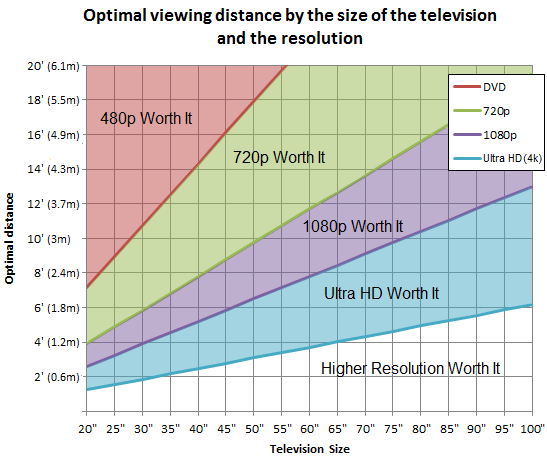
The TL:DR; version is: Use a 4K distance calculator
* Distance Graph (PNG)
The Long version: It's complicated
From a well known and respected Photography:
http://clarkvision.com/imagede...
How many megapixels equivalent does the eye have?
The eye is not a single frame snapshot camera. It is more like a video stream. The eye moves rapidly in small angular amounts and continually updates the image in one's brain to "paint" the detail. We also have two eyes, and our brains combine the signals to increase the resolution further. We also typically move our eyes around the scene to gather more information. Because of these factors, the eye plus brain assembles a higher resolution image than possible with the number of photoreceptors in the retina. So the megapixel equivalent numbers below refer to the spatial detail in an image that would be required to show what the human eye could see when you view a scene.
But if we do the math
Based on the above data for the resolution of the human eye, let's try a "small" example first. Consider a view in front of you that is 90 degrees by 90 degrees, like looking through an open window at a scene. The number of pixels would be
90 degrees * 60 arc-minutes/degree * 1/0.3 * 90 * 60 * 1/0.3 = 324,000,000 pixels (324 megapixels).
At any one moment, you actually do not perceive that many pixels, but your eye moves around the scene to see all the detail you want. But the human eye really sees a larger field of view, close to 180 degrees. Let's be conservative and use 120 degrees for the field of view. Then we would see
120 * 120 * 60 * 60 / (0.3 * 0.3) = 576 megapixels.
Another calculation estimates around ~2200 dpi.
http://wolfcrow.com/blog/notes...
Maximum Resolution of the Eye
So this is how it is. If a healthy adult brings any display screen or printed paper or whatever 4 inches (100 mm) from his or her face, the maximum resolution he/she can see at is 2190 ppi/dpi. It doesn't get any better than this for 99.99% of us, except maybe during pre-kindergarten years.
But the legally accepted norm of 20/20 vision only asks for 876 ppi/dpi at 4 inches!
But since we don't view things from 4 inches away
Cinema
The width of a cinema screen can vary from 30 to 70 feet (360' to 840', 9144 mm to 21,336 mm). The closest viewing distance recommended is about 40 feet (3x height) -- 12,192 mm. If one is projecting 2K on these screens, the ppi is about 2.4 ppi to 5.7 ppi. If one is projecting 4K, it is about 5 ppi to 11.4 ppi.Is this what the eye needs?
p@0.4 works out to be 1.4 mm or 18 ppi.
p@1 works out to be 3.5 mm or 7 ppi.As you can see, 4K comes very close to what the human eye can fully resolve in a cinema screen at average viewing distances. Obviously, many people sit in the front row, and they'd definitely appreciate higher resolution. Which is why we are moving towards:
8K and UHDTV
A 30 to 70 feet screen at 8K (8192 horizontal) gives me from 9.75 ppi to 22.8 ppi. This resolution beats what the eye can resolve at these distances. The future belongs to 8K.
But, to get 18 ppi (the best possible resolution) for a 70 feet screen, we'll need a horizontal resolution of 15120 or 16K. This is about 128 Megapixels. Is anybody working on this?
-
Re:Does Sony also provide...
The eye has higher effective resolution than Apple has led us to believe with their "retina" marketing. This article shows how human eye can see 530 ppi resolution in a 20 x 13.3-inch print viewed at 20 inches. http://clarkvision.com/imagede...
Which is hardly news in the print world. Most fonts are passable, but noticeably less than perfect at 600dpi. Some fonts still don't quite work right at 1200dpi. Of course, that's without anti-aliasing. Grayscale at 600 dpi can do a pretty good job of representing print if the anti-aliasing is well done.
-
Re:Process with moderation. Inform the viewer.
You are right, the combination of air pollution/light pollution may introduce colors. Atmospheric and space weather effects also do that. If you also like the night sky (as I do) you might have seen wide-field photos taken from pristine locations with high-performance equipment having a nearly daylight blue sky.
An interesting read: http://www.clarkvision.com/articles/color.of.the.night.sky/index.htmlClear skies!
-
Re:4k at viewing distance isn't that special
Nominal resolution of the human eye is 1 arc-minute (1/60 of a degree)
That is too low. See, e.g. this, which states that the resolvable pixel size is about 0.3-0.4 arc-minutes. Using 0.4 means that at 9 feet any 16:9 1080p screen larger than 28" has resolvable pixels. A 4k screen could be as large as 55" before the pixels are resolvable.
-
Re: approximately the resolution of an adult eye @
For an adult human, 400-600 is about the limit of what we can detect.
No.
For most average human adults, the limit is about 300 dpi.
Speaking as a graphic designer with over two decades of experience, there is a reason that graphic designers have always targeted a print resolution of 300 dpi for colour images.
How 400-600 entered the conversation is beyond me. The percentage of people who can visually tell the difference between a 300 dpi output and anything higher than that is very, very small. The number of people who can spot the difference at 400+ is not even a consideration for discussion.
When I was a graphic designer, I was told 300 dpi --- unless the image had type, in which case, 600. I've found some corroboration:
1. Experiments with Pixels Per Inch (PPI) on Printed Image Sharpness by Roger N. Clark
2. Guidelines for Author Supplied Electronic Text and Graphics
3. Digital Art GuidelinesApparently the eye is more forgiving when looking at photographs than at text.
-
Re:Can't escape the laws of physics
You just need to look at the higher resolution phones to realize what you're saying is bullshit (and those are ridiculously small 5" screens, although albeit you do look at it closer than a television). The so-called "retina" display by Apple is still far short of the maximum resolution we can see. Have you actually gone and looked at a 1080p display before deciding on your 720p monitor, or did you trust your flawed math and went with it? Here's the actual math with references to the visual acuity numbers.
-
Re:Human eye
Completely ridiculous. You've taken "angular resolution" to mean "angular pixel spacing". You would need more than one pixel for every 4 arcminutes in order to have an angular resolution of 4 arcminutes.
http://clarkvision.com/imagedetail/eye-resolution.html has a review of material which shows that the pixel spacing required would be around 0.3 to 0.4 arcminutes, a far cry from 4.
-
Re:Cool stuff
I would like to correct a mistake prevalent here and in the news summary: common camera's do NOT get 1 (or 2) stops of light information (the difference between black and white). In fact, camera's like the Canon 7D have about 11 stops of dynamic range [source] and professional video camera's like the Red One have about 13 1/2 stops of difference between black and white [source]. Still, as X stops means 2^X times the light difference, going from 13 1/2 to 20 stops is a pretty huge deal.
Another misconception: the amount of bits per channel only indicates precision, not dynamic range. Of course, when the researchers in the article created a 20 stops camera, they needed much better precision to get similar quality in the same range as the current camera's, which leads to the quoted 42 GB per minute uncompressed video stream.
(Please note: DSLR camera's like the Canon 7D can detect and save more dynamic range than is apparent from the JPG's they create and the extra information is saved in the RAW file, which allows you to change exposure settings at least 1 stop in post processing without (noticeable) drop in quality.)
-
Re:what we could get?
It's because implicit in this comparison is the statement "for a fixed field of view and resolution", which implies a focal length, and hence aperture size, which scale with with sensor size: See http://www.clarkvision.com/imagedetail/does.pixel.size.matter/#The_f_ratio_Myth. Large detectors are not intrinsically more sensitive, but for a given field of view and angular resolution, they collect more light than small sensors, going as the square of the its size.
-
Re:So, *will* it be missed?
Can you give any citations? There are pro photographers, those who make their living as photographers, who disagree with that. Here's wiki's article on digital vs film [wikipedia.org].
Perhaps you could read one of the only serious tests linked from the (very poor) Wikipedia article that you cite: Dynamic Range of an Image
Ken Rockwell, quoted in the wiki article, has the article Why We Love Film
Ken Rockwell is a hack with no credibility, and no test data to back up his statements. I don't know why anybody takes him seriously.
"I made this shot on a Contax G2 with a 21mm Zeiss lens at f/8 on Fuji Velvia 50, which was processed and scanned at the same time at NCPS. The dynamic range is so great that the hellacious sunbursts you see are just what's naturally coming off the diaphragm blade at f/8, as if 1,000 suns were shining in the lens in the two-minute exposure."
Well, that's an odd statement, because Velvia only has about 5 stops of dynamic range, compared to around 10 for modern digital cameras.
He further states "A frame of 35mm film, scanned cheaply at a good photo lab to a CD, is about equal to the resolution of a 25MP DSLR."
That is completely laughable. Even the best 35mm film exposures aren't capable of that resolution, especially not one that was "scanned cheaply."
You ask me for citations? Then tell me what Ken Rockwell's citations are. They don't exist.
-
Re:Film has many reasons to recommend
Using arguments such as 'this is nonsense' doesn't give you much backing here.
Where is "here," exactly?
A typical sunset pic will blow all three channels sequentially, be it film or digital. The difference is that when digital reaches 255 in the red channel,it doesn't go anyl further.
And when film reaches the limits of its dynamic range, it doesn't go any further, either.
In film, the characteristic curve has a shoulder, which tails back the clipping of it's channels, allowing for a smooth transition to white.
Yes, but that's not what we're talking about. We're talking about what happens when you go beyond that (very limited) shoulder.
Its a shame you didn't provide references.
OK then, I'll help you out. Try this for reference. An old digital camera, the Canon 1D Mk II shows over 10 stops of dynamic range, while color negative film has around 7 stops, and color slide film has around 5 stops.
What this means, is that your film is already at least 3 stops overexposed while the digital camera is still recording tonal detail. By "overexposed" here, we are talking about well past your "shoulder" which only applies to a minute range of values. The same applies to underexposure.
Your argument hinges on digital being technically superior, so that how the media behaves beyond its limits is not of any importance.
That doesn't make any sense. We were talking about what the limits are. Film reaches its limit well before digital fails.
-
Resolution of the human eye: about 570 Megapixels
Making many assumptions, the human eye has about 500 to 600 megapixels of resolution.
But determining visual acuity is nontrivial. Lots of physics, physiology, and neuroscience enter into it.
Visual acuity depends on a number of physical limitations set by the optics of the lens of the eye as well as the sampling on the retina.
For example, the point spread function of the lens roughly matches the sampling of the retinal mosaic (well, within a factor of 3 or so). A nicely evolved system!
Our eyes' acuity are influenced by
- Refractive error (out of focus lens, often correctable by glasses or contacts)
- Size of the pupil (physical optics tells us that a wide open iris will reduce diffraction)
- Illumination (brighter scenes give more photons, and our neuroprocessing can do more
- Time of exposure to the field
- Area of the retina exposed
- State of adaption of the eye (night [scotopic] vs day [photopic] vision.
- Eye motion & object motion in scene
See http://www.clarkvision.com/imagedetail/eye-resolution.html
For a good review of visual acuity, see:
http://webvision.med.utah.edu/KallSpatial.html -
Re:Blue print company
An interview rather than a scientific article, I admit,
Well, yeah. It's complete rubbish. The subject of the interview is highly biased, and doesn't provide any source for his claims. How about some actual data? This one is old, and shows digital cameras that are seven years old outperforming a quality film stock: link.
How about other aspects of image quality? Digital beats film hands-down when it comes to signal-to-noise ratio (grain).
But of course, film has a greater dynamic range than digital, doesn't it? Nope. Another myth.
-
Re:Blue print company
An interview rather than a scientific article, I admit,
Well, yeah. It's complete rubbish. The subject of the interview is highly biased, and doesn't provide any source for his claims. How about some actual data? This one is old, and shows digital cameras that are seven years old outperforming a quality film stock: link.
How about other aspects of image quality? Digital beats film hands-down when it comes to signal-to-noise ratio (grain).
But of course, film has a greater dynamic range than digital, doesn't it? Nope. Another myth.
-
Re:nevermind the blind -- bring on the androids
Hm, I wonder if it is really so - the high resolution part of the eye actually has quite high dynamic range . That is why photos of the scenes with high difference of darker and lighter areas look flat as compared to memory of the scene. Eye adapts, with more or less delay, depending if you look from light to dark or from dark to light, with more resolution/range then the current image formats. HDR (if not overexposed) actually looks more realistic if you concentrate on the details.
We have yet to see a camera with lenses as small as the pupil that will allow for reproduction of the photographed image on the same level of visual quality as the image stored in memory (good test would be that a memory of an scene and memory of looking at the photograph is of same visual quality).And regarding the resolution - VGA does not mean anything without angle of view. Eye has a resolution of 0.3 arc minutes minutes which VGA would cover if it was applied to approx 2 degrees of field of vision.
-
Re:Unnecessary then, unnecessary now
How is it your eye is incapable of discerning the difference between muddy and clear, but it's capable of watching a movie on the tiny iPhone screen?
I find the argument that the human eye doesn't have a very high resolution to be fairly ignorant given that the human eye can pick out details at a range where the highest quality digital cameras break down. We have a superior optical system in all but the most severely damaged or underdeveloped (through developmental or genetic disorder) eyes to any existing display technology. This guy does some good-old-fashioned book research and hand math to figure out that we can probably set a lower bound of 324MP on what the human eye can pick up across its central vision.
-
Re:Something lost
But there is no way that a Canon 5D Mark II can compete with even medium format film, let alone 4x5 sheet film.
Of course a 5D MkII will never compete with MF. It doesn't compete with it now; I don't think anyone expects it to compete with MF film sometime in the future. That's not even a fair comparison, really, because the 5D sensor is 35mm on the long side, whereas MF is 60mm on each side. Apples to apples, right? Googling for information (and ignoring the ever-controversial Mr. Rockwell) suggests that a 10Mp DSLR is better than 35mm film. Also, modern digital MF backs are comparable to 4x5 film, at least when printed at 40"x60" or less.
If you're feeling lazy, I found this link to be the most helpful: http://www.clarkvision.com/imagedetail/film.vs.digital.summary1.html . There is also an interesting comparison between 4x5 and a P45 digital MF back here: http://www.luminous-landscape.com/essays/Cramer.shtml, which is in rough agreement with the other article. In my worthless opinion, large format is mostly good for using movements and making contact prints. Aside from that, digital is probably better in every way, including quality.
That said, I think this photographer should have used at least a 1Ds MkIII or D3x. On the other hand, the only other presidential portrait that's even a photograph is Bush Jr's, and I'm not really sure how you compare "image quality" between photographs and paintings.
-
Re:Whoa There Chen
Digital already surpasses film for light sensitivity, I can shoot from ISO-50 to ISO-3200 with my sub $500 DSLR. It will be quite grainy at ISO-3200 but so will film. As the examples at this site show modern digitals also have a greater dynamic range then typical films. Also the existence of HDR imaging shows that in practice you can achieve significantly higher dynamic range using digital techniques than you could with film.
-
Re:Why don't we have more pictures of UFOs?
Yeah, if I had my SLR with a good long, big lens and good low-light film, or a $1000-ish DSLR, I could probably take some good pictures like you describe. Fortunately, Moore's Law should put those kinds of sensors in cell phones within a decade, then maybe we'll see something like you describe.
Unfortunately, current high quality CCDs are already almost perfect photon counters. The smaller you make the chip, the less surface area you get per pixel and the less photons you have per pixel. The less photons you have per pixel, the more noise the resulting image will have. If you want to have a small lens (and small camera) you have to use a small detector and as a concequence you cannot get very much photons per pixel. The smaller the camera, the worse the image quality. And it will only suffer the more the less light you have. Also notice that Moore's Law will not help here because it only helps with stuffing more on the same area of the chip and here we're limited by the surface area to count photons. The cost of making 1 cm^2 of silicon chip is pretty constant.
-
Re:Artificial NoseVision, that's easy, cameras have sharper resolution than our pathetic biological eyes. I wondered about this, so I decided to look it up. At http://www.clarkvision.com/imagedetail/eye-resolution.html the writer seems to sum up the topic pretty nicely. It seems that, while our eyes have probably been surpassed by technology when looking at resolution only (think http://www.gigapxl.org/ ), the image processing power of the brain exceeds any of our current technology. I guess our eyes aren't quite obsolete yet.
-
Re:It's more than just music
Mostly true, except it's still widely acknowledged that the dynamic range on digital camera sensors (yes, even the really expensive ones on the 1d series) is lacking compared to that of film.
Absolutely, positively 100% wrong. Here is an article that lays out some really good data.
From the article:
Conclusions
Digital cameras, like the Canon 1D Mark II, show a huge dynamic range compared to either print or slide film, at least for the films compared. -
Re:Resolution
On current displays yes its overkill, but on displays in 10 years or less it will be the standard, it takes a lot of pixels to cover your entire field of view. Some may argue we dont need this much resolution, but until we are approaching real life resolution and color depth, we will need more.
Display of the future approaching the human eyes capabilities.
60"-80" diameter hemisphere, it will probably be oval shaped, since our field of vision is.
2 GIGApixels (equal to about a 45000 x 45000 pixel image, 1000x the resolution of 1080 HD).
48 bit color (16 bits per channel).
12GB framebuffer size
@60fps = 720GB/s bandwidth
its only a matter of time...
based on information at
http://www.clarkvision.com/imagedetail/eye-resolut ion.html -
Re:Ah, you're right.
Check out:
http://www.clarkvision.com/imagedetail/does.pixel. size.matter/
The server seems a little flakey at the moment, but it is well worth it, even to just read the conclusions. -
Re:It's possible.
Various groups, doing quantitative tests, have found that this just isn't true. From here: http://www.clarkvision.com/imagedetail/film.vs.di
g ital.summary1.html, various tests have shown that the Canon 1D II captures about 11.6 stops, while the 10D does about 11. The 30D (I have one too) is supposed to have improved dynamic range over the 10D. In his test Kodak Gold print film showed 7 stops of information and Fujichrome Velvia 5.
Unfortunately it's hard to tell from the manufacturer's data what the dynamic range of the film actually is, since the curves they publish are averaged. As you can see from here: http://www.clarkvision.com/imagedetail/dynamicrang e2/ at low exposure values the films response becomes so noisy that it's unusable, far earlier than the characteristic curve would indicate.
For professional black and white film I can certainly see that it would perform close to digital, or perhaps provide an extra stop or two with heroic measures, but it's not night and day.
You could possibly be being led astray by the way you're comparing. When you use a RAW converter you're taking the 12-bit RAW file and squishing it into 8 bits. That seriously cuts down it's dynamic range. So what you're really looking at on screen is an 8-bit image compared to what... a print? the negative? That's not a fair comparison. -
Re:It's possible.
Various groups, doing quantitative tests, have found that this just isn't true. From here: http://www.clarkvision.com/imagedetail/film.vs.di
g ital.summary1.html, various tests have shown that the Canon 1D II captures about 11.6 stops, while the 10D does about 11. The 30D (I have one too) is supposed to have improved dynamic range over the 10D. In his test Kodak Gold print film showed 7 stops of information and Fujichrome Velvia 5.
Unfortunately it's hard to tell from the manufacturer's data what the dynamic range of the film actually is, since the curves they publish are averaged. As you can see from here: http://www.clarkvision.com/imagedetail/dynamicrang e2/ at low exposure values the films response becomes so noisy that it's unusable, far earlier than the characteristic curve would indicate.
For professional black and white film I can certainly see that it would perform close to digital, or perhaps provide an extra stop or two with heroic measures, but it's not night and day.
You could possibly be being led astray by the way you're comparing. When you use a RAW converter you're taking the 12-bit RAW file and squishing it into 8 bits. That seriously cuts down it's dynamic range. So what you're really looking at on screen is an 8-bit image compared to what... a print? the negative? That's not a fair comparison. -
Re:It's possible.
That's not really true. Have a look here: http://www.clarkvision.com/imagedetail/dynamicran
g e2/
Unfortunately the only negative film compared was Kodak Gold 200, but you can compare it's response curve (here: http://www.kodak.com/global/images/en/consumer/pro ducts/techInfo/e2329/f002_0618ac.gif) with other films. A good modern digital SLR has quite a bit more dynamic range than colour negative film, and on par or close to the very best black and white films. -
Why this will never be true
The results are surprising, with Nokia's latest handset, featuring a built-in 5-megapixel camera, taking more vibrant pictures in medium light conditions than a 10-megapixel dSLR.
That isn't even remotely what the article said. It said: "As you can see the top photo, taken in medium light conditions, is in focus and the colours are very vibrant, if not a little over saturated." and, "This difference in colour is likely due to the N95 processing the shot after it was taken."
Nowhere do they describe if the images actually represented a faithful reproduction of the colors of the objects, and they did not test under multiple lighting conditions, such as outdoors, under incandescent and fluorescent lights, etc. They also did not conduct any test which would demonstrate the camera's dynamic range, and they did not show us any 1:1 crop areas.
There's one simple site I point any of small but persistent who claim things like "film is superior to digital" (it hasn't been for at least a few years, in terms of resolution, signal to noise ratio, and dynamic range.) Clarkvision. The guy lays it all out in cold, hard science with good illustrative graphs and examples.
Does Pixel Size Matter? lays a real cold hard blow to all the idiots that claim dSLRs are overpriced or unjustified. They VASTLY outperform "point and shoot" cameras because the sensors are huge. Current dSLRs already approach the theoretical maximum sensitivity, SNR, etc. The bigger the sensor well, the more photons it collects- and the less electronic amplification is necessary. dSLRs have sensors the size of your phone's screen. Your phone's camera has a sensor around the size of an eraser. Not only does that cause a lot of noise problems, but it causes problems for aliasing filters (which spread light across the red, blue, and green sensor wells.) It's very easy to make a very good aliasing filter on a scale required for the very large pixels in a dSLR. Sensor wells in the point and shoots are so tiny that the filters really, really blur the image.
Practically, this means that if you and I stand next to each other and take a photo towards sunset, and then take both to a photo lab and get them printed, my (several year old dSLR) will blow your (current P&S) out of the water. My photo will have more detail because of better aliasing on the sensor and dramatically less noise (which doesn't have to be hidden with blurring). Nevermind that I can shoot a photo at 800 ISO and it'll have less noise than your camera at 100 ISO, which means I get several stops of sensitivity which I can use for, oh, a faster shutter speed so there's less motion blur, or a smaller aperture for greater depth of field.
-
Re:It isn't that simple.
Not that I am aware of:
http://www.clarkvision.com/imagedetail/eye-resolut ion.html
(the key point is that the resolution of the eye is important, but the portion of your field of view that the display fills is more important, and that varies with screen size and distance from the screen) -
Re:It isn't that simple.
Also, recommended viewing angle is 36 for THX, 30 for most others, so you're talking about roughly 2000 pixels, or twice 1080p exactly for THX at the recommended distance. Preferred distance varies by person as mentioned elsewhere, but the resolution standards were set with movies in mind.
However some of the language used that I read implies that 2 arc minutes for 2 pixels is the average over a larger area. http://www.clarkvision.com/imagedetail/eye-resolut ion.html - this guy claims the actual maximum is 0.3 arc minutes (and gives citations), which is significantly higher, so a THX sized screen could have a maximum of 7200 pixels across - beyond that it categorically does not matter (if you're not sitting closer than the recommended distance).
The biggest thing I think is being missed is that everyone's talking about subjective measurement of two devices sitting side by side. For most source material, even HD source material, there might not be any difference in real satisfaction between 720p and 1080i/p for more than 75% of the user base. (Emphasis on 'might', I have no data and it's hard to quantify 'satisfaction')
Hell, for standard TV signals, some HD screens look worse because SD CRTs tend to blur an image rather naturally whereas the god-awful hardware in the flat panel LCD/plasma botches the scaling. -
Picture Cooler
Another great free tool is called Picture Cooler. It rivals or exceeds Noise Ninja for certain images. Download it here: http://denoiser.shorturl.com/
But if you want images with less noise, try and buy a camera with a larger sensor. dSLR's have large sensors as do many Fuji cameras including their tiny P&S models. Most sensors on subcompact P&S cameras measure only 5.76x4.29mm (1/2.5"). Many of the smaller cameras by Fuji use a 1/1.8" sensor that measures 7.18x5.32mm.
A nice explanation of noise and sensor size is here: http://www.clarkvision.com/imagedetail/does.pixel. size.matter/ -
Re:you can scan anything at 4800 dpi
The data on Fuji Velvia film says that it captures 80 lpm. This is plenty more than 4000dpi. You are dead wrong about the Canon 1Ds and medium format film. Medium format wins on resolution...easily. The Canon MarkII can capture an image with less noise. Here is an executive summary of a very detailed analysis .
-
Re:Nice comparison
A 1024x768 image at 24bpp is 18,874,368 bits. Obviously if this article is correct our brain is doing compression. Say the max resolution of the human eye is 576 megapixels and the max bpp is 48. Therefore the largest image size would be 27.6 gb. This would be a compression ratio of 2765:1
-
Re:Film
I'm no expert in the field, but I'm pretty sure its in the region of 120 megapixels, but this site http://clarkvision.com/imagedetail/eye-resolution
. html begs to differ and states that it is in the region of 500 megapixels. This is based on a treatment of diffraction limited resolution based on theta = lamda/D (see here). But 500mp sounds is a HUGE amount and would require massive processing by the brain. This is a theoretical maximum of angular resolution based on perfect eyesight and a fully dilated pupil without abberation or imperfections. In the real world, we are unlikely to approach this figure by a long way. Even if the eye could resolve such small angles, we reach a limit based on the number of receptors (the rods and cones) which are somewhat less than 500 million - and according to this site http://kidshealth.org/kid/body/eye_noSW.html the number is around 120 - 130 million receptors so a resolution of around 120MP seems like a good ballpark estimate. You should bear in mind though, that we actually "see" very little of what we "detect". -
Re:Film
According to http://clarkvision.com/imagedetail/eye-resolution
. html, you need 200 pixels per degree to max out your vision.
Typical applications:
THX recommended FoV is 36 degrees, which means that your display would need a horizontal resolution of 7200 pixels. This display is half way there: http://www.gizmag.com/watermark.php?p=5257_2402061 2840.jpg
I just measured my 15" widescreen laptop as having a 45 degree FoV (at 18" away) which means that it would need a resolution of 9000 horizontal pixels. -
Re:FilmCall me a noob, but does anyone have any idea how much resolution the human eye can detect (per some unit of area, of course)?
I found this page interesting. Here's a quote:Consider a 20 x 13.3-inch print viewed at 20 inches. The Print subtends an angle of 53 x 35.3 degrees, thus requiring 53*60/.3 = 10600 x 35*60/.3 = 7000 pixels, for a total of ~74 megapixels to show detail at the limits of human visual acuity.
-
Re:Film
According to the quick google search I just did, somewhere in the neighborhood of 576 megapixels.
http://clarkvision.com/imagedetail/eye-resolution. html
I don't know how reliable these data are, though. There seems to be considerable hand waving between what the eye records and what the brain "sees" in that link. -
Re:Film
Some estimates put it at 300-500 megapixels, but it's really relative; the brain doesn't process all the eye sees.
-
Re:Where's the useful cut-off point?
This source agrees with you, and he lists 8M-pixel sensors in his article:
"It turns out that the noise in good modern digital cameras is dominated by photon counting statistics, not other sources."
This pretty much says thermal noise is not a factor. -
Re:A sign of change
Wrong again. The average 35mm SLR camera with an average roll of film still comes out with a resolution equivalent to a 25 megapixel digital shot, which you can't find anywhere.
Sorry but this 25 megapixel value you claim is untrue. Years ago I measured for myself some fine grain films and came out roughly to 15 megapixels. However here a fellow has measured this in a more scientific manner than I did. According to him the best film peaks at about 16 megapixels. Yet Canon make a 16.7 megapixel camera.
Here you can see that camera producing photos which are comparable to 4x5 MEDIUM FORMAT and certainly better than that film in 35mm format.
Here the older 11 megapixels version of that camera really shows how great digital can be with low noise and the resolution even at 11 megapixels is fantastic even against a 6x7!
Here is another.
Here is another again. Look at the detail of the tiles on the roof of the windmill.
Here the excellent contrast of digital stands out.
And here something which I expected, medium format transparency looking a lot better than the "35mm" digital.
Now consider that this 16.7 megapixel is at least comparable with some medium format images! 35mm film has no chance against the 16.7 megapixel digital.
That 25-30 megapixel number that is thrown around is a load of garbage.
PS, this is my current primary camera. There has certainly been no bias towards digital for me. However I imagine I'll be making the move in the next few years. Only because a Canon's best DSLR is WAY too expensive for me at the moment. -
Re:Resolution
This just isn't true. I've switched to digital as well, but the resolution of 35mm film is roughly 24 megapixels. This is still 3x the resolution of the best consumer digicams.
No it's not, it's actually closer to 16MP (and that's for ISO 50...which limits you pretty much to still subjects), but even assuming your 24MP figure, your argument doesn't hold up. Image quality is not simply a function of resolution...but a combination of resolution and noise.
For film, this "noise" is grain(still a big problem for film...this is largely a result of the quality of film that you use, but it's still high)...for digital the "noise" is called sensor noise(not so much a problem...and it's based on a fixed variable...the sensor). Here is a good comparison of film vs. digital and why digital SLR has surpassed 35mm...
If you want to save yourself the reading, the meat of the story is this...even an 8MP Point & Shoot digital has better image quality than a 35mm camera with ISO 50 Fuji Velvia film.... -
Re:price:500. 400 dollars? what do they want 300 f
The Canon 1Ds doesn't approach medium format film in absolute terms. It's a nice camera, but it's out of its league when you start comparing it to medium format, film or digital.
It might approach medium format if a photographer wasn't using it to it's full ability, and doing a better job maximizing the digital's capabilities, but this is really an operator-training issue and not an equipment one.
If you want to read a good professional assessment of film versus digital equivalent megapixels, read this:
http://clarkvision.com/imagedetail/film.vs.digital .1.html
A 35mm film frame, shot on Fuji Velvia, is considered to be equivalent to somewhere between 10 and 16 MP. So the Canon is quite possibly the first digital camera that actually approaches the limit of what 35mm film can do at its best -- but even then I take issue, since each pixel in the digital frame records one color, and then the software interpolates the missing values for the other two colors on each pixel (unless you have a camera with the Foveon sensor).
However for medium format film still has a clear advantage. Even Ektachrome -- which has something of a reputation for being grainy at times -- is going to give you somewhere in the neighborhood of 18MP; Velvia is way above that (granted the error does start to get large). To get a digital that can compete with medium-format film, you're well out of the 1Ds range and looking more at things like the 22MP Mamiya ZD. (Feel free to tell me how much that one costs -- the press release doesn't even mention a price.)
Digital definitely has gotten APS film beat, and it's closing in on what quality advantage 35mm still holds. But Medium format is still superior, and 4x5 and the larger medium-format pano formats have no competition at all. If you want really high quality digital at the upper end of the spectrum, you're better to shoot film and then scan it, either on a flatbed or a drum scanner, to get your file.
I'm not some film-photo Luddite -- I use a digital myself because I think the loss in quality is worth the gain in convenience. However I think it's important to objectively assess the difference in quality, and realize that for the price, film still has its advantages. -
Re:definately possible (calculations inside!)Ya might want to do a little research on color spaces if you believe that 8 bits per channel is okie-dokie. Maybe if this were stored in a high gamut color space, instead of we'd have something to really wag our tongues about. But just to give you an idea of what a standard CRT, displaying images using sRGB (not RGB! RGB has no standardized mapping to actual color wavelengths! (16.7 miiillion) colors can represent versus the full spectrum of human vision, check this out.
Also, for those wondering about the resolution of the human eye, Google comes to the rescue here. I found this excerpt particularly colorful (ha):Based on the above data for the resolution of the human eye, let's try a "small" example first. Consider a view in front of you that is 90 degrees by 90 degrees, like looking through an open window at a scene. The number of pixels would be
90 degrees * 60 arc-minutes/degree * 1/0.3 * 90 * 60 * 1/0.3 = 324,000,000 pixels (324 megapixels).
At any one moment, you actually do not perceive that many pixels, but your eye moves around the scene to see all the detail you want. But the human eye really sees a larger field of view, close to 180 degrees. Let's be conservative and use 120 degrees for the field of view. Then we would see
120 * 120 * 60 * 60 / (0.3 * 0.3) = 576 megapixels.
The full angle of human vision would require even more megapixels. This kind of image detail requires A large format camera to record.
Additionally (and on that page), in any given light level (the human eye adjusts, you know), we have a contrast ratio of 10,000:1. The full spectrum of what we can see 10 million to one.
So, no, 24 bits is not enough. Give me 12 bits, at least, and floating point at that. -
Re:Quality...
Really, I had always thought 16MP was the technical limitation of 35mm...and the effecive range goes further down the scale...plus, ISO 50 is only good for still subjects, for motion you need something closer to ISO 400 which shows even more grain...
Of course, as far as digital medium format cameras go...there's the Hassleblad H1D and here's a new 39MP camera back...which according to this table is somewhere around double the "Apparent Image Quality"...now even if you don't belive this guys calculations (which seem to hold true in the field, Medium Format ISO 50 only equates to about 50MP...which means a 39MP camera is definately getting into Medium Format quality... -
Re:uninformed ./ posts annoy meDigital is indeed good if it is a large volume of photographs that you are seeking to make. And its quality is [i]approaching[/i] that of many films, for example, 35mm B&W negative and 35mm color negative film. However, even a 16MP camera (the Canon EOS 1DS Mark II) is still short of 35mm transparency film -- and that is the provenance of the professional photographer and advanced amateurs.
See: Clarkvision: Film vs. Digital
Another place where digital fails miserably is in long exposure times. While film has reciprocity issues, those are accounted for mathematically, whereas digital noise is difficult to eradicate. Some may equate this to film graininess and that is true where ISO speeds are concerned. Instead, I am speaking of when exposures are many seconds. That is a simple "for-example" of a place where film remains superior...and there are others...consider infrared photography, which can be done in digital, save for the fact that most digital cameras filter out the IR light. A film camera only requires a different sort of film to become a very capable IR camera.
Another irritating thing to me is that non-pros assume that 35mm is the first camera of choice for a professional. Unless they are news or wildlife guys, this is not necessarily true. In fact, most studio-based pros use at least 120mm film cameras, and you can take the megapixels required to match film to the power of four. If they are using 5X7 view/field cameras, which is the minimum for a serious lanscapist, it is ^16 -- at minimum. And that is simple LPI acutance.
Further, the gigapixel digital photos are stitched for the most part, which comes with it's set of issues and challenges that far exceeds the capabilities of almost any point-and-shoot person. Fact is, most people have no clue about nodal point calibration, exposure matching and other gotchas that make the gigapixel photograph take literally days to execute and then assemble. Even a 100 MP cylindrical projection is a challenge to the casual amateur, and most of their works will not approach the level of so-called "fine-art" photographs.
Finally, you are 110% correct about color spaces. However, monitors that use the Adobe RGB color space are coming in to the market now, even if they are prohibitively expensive. Remaining in a single color space throughout the workflow will be a major boon to digital, and in 5-10 years I predict this to be the norm rather than the exception as it is today.
The bottom line is that it is wishful thinking to say that one technlogy will make the other "go away." Chemical photography will have it's uses far into the future and it will be quite some time before issues like noise, range and contrast are completely solved. Until then, guys like me will keep a plethora of cameras -- ranging from a Nikon D2X all the way to a fully manual Nikkormat -- in our camera bags. We are paid to capture images and I care not one whit which tool I use, but I do care passionately about whether or not I get on paper what it is that I set out to capture.
-
Re:The Screens?
Any such statement would have to include a distance from the
The human eye has a resolution of about
On a 33" 16:9 screen (which is the same height as a 27" 4:3 screen), sitting 8 feet away, you'd need about 120 dpi, or about 3450x1940 pixels. A 100 degree wide angle of view is about 20000 pixels for full resolution (although you don't really get full resolution except in a fairly small portion of your field of view - but a monitor would need to have full resolution wherever you might look). Vertical field of view is somewhat less then horizontal, so you could get by with only 16000 pixels vertically, for a total of about 320 mega-pixels for the ultimate display. Well, OK, not ultimate, you'd really want a full 360 degree spherical view for that...which would take about 825 mega-pixels (though you could get by with much less with a head-mounted display and head-tracking).
-
Thats not right. Read this linkClark Vision Link
Most nature photographers shoot Velvia, which give about 16mp photoquality. So a 6mp digital camera just wont cut it there. However this camera just might.
On a medium format, Velvia provides anywhere within 35 to 50 mp picture equivalent. After that the challenge is to find the right drum scanner. So these 35mm equivalent SLRs are still faraway from medium formats.
-
Lessons from the PastUsers forgot about PC audio when it became ubiquitous and as good enough to fool the user into thinking they were hearing real sounds. Other than adding conveniences like drive-rail mounted ports, what major improvements have been added to sound cards in the last 8-10 years? The industry has basically stopped true innovation since greater technology is no longer demanded by the consumer.
I think the more interesting question to examine is the video card side of this. At what point will video cards exceed the specifications required to make grahpics truely look like real life?
For example, people can actually pick out about 1,000,000 colors or so (IIRC). We got 24/32 bit color and that was the end of innovation in the length of color codes.
What is the resolution of standard human vision? Some quick researching brings us this information:Consider a 20 x 13.3-inch print viewed at 20 inches. The Print subtends an angle of 53 x 35.3 degrees, thus requiring 53*60/.3 = 10600 x 35*60/.3 = 7000 pixels, for a total of ~74 megapixels to show detail at the limits of human visual acuity.
Will we see the same languishing of the video card industry when the new offering can crank out 100fps at 10,600 x 7,000? We've already got the colors part down, resolution and poly counts will come soon enough. The monitors will have to follow suit of course but even current technology is giving some people a hard time:At a picture size of 7,680 by 4,320 pixels - that works out to 32 million pixels
This stuff is so exciting! If I didn't spend all my time focusing on my escort service business, I'd have to becoming a video-card-engineer-person-of-interest. -
Re:Human eye?
According to this:
Consider a 20 x 13.3-inch print viewed at 20 inches. The Print subtends an angle of 53 x 35.3 degrees, thus requiring 53*60/.3 = 10600 x 35*60/.3 = 7000 pixels, for a total of ~74 megapixels to show detail at the limits of human visual acuity. -
Re:And then what?if I could buy an 80" LCD display capable of 1920x1080, I'd probably never want for a better display.
Hah! Yeah right. 1920x1080 is nowhere near the resolution limits that human eye can discern. And then there's full FOV stereoscopic immersion. Mmmmmmm...
--