Slashdot Mirror
Domain: columbia.edu
Stories and comments across the archive that link to columbia.edu.
Comments · 1,401
-
New article by Eben Moglen
Eben Moglen just released the article The European Commission and Oracle-Sun.
-
Re:re Time for open discussion
Great theories often fall flat when the assumptions they are based on are incorrect. Weather is chaotic, climate is not. Climate is the long term statistics of weather and is insensitive to initial conditions.
A good test of a model is it's ability to predict unknown phenomena, climate models of the 80's predicted a phenomena that is now called "polar amplification", they also predicted that the stratosphere would cool from increased CO2 while the troposphere would warm, both trends have been observed by sattelites. Other predictions have also been observed.
Here are a few reasons why you may get modded as a troll
The Mathematical definition for chaos comes from Lorenz who spotted the principle while studying weather models, to insinuate climate scientists are unaware of these facts is simply ignorant*.
There is a whole branch of science that is a sort of cross between climate science and geology, it's called paleoclimatology, to insinuate climate scientists have somehow missed natural variation is also ignorant.
The radiative forcings that effect climate have been taken into account in models, without the AGW component the upward trend in tempratures dissapears. To suggest climate scientists somehow missed the giant ball of flames in the sky is ignorant.
Here is a link (scroll down to the embedded video), that uses finite element analysis and basic physical/chemical laws to correctly reconstruct past CLIMATE regardless of the initial RANDOM values that define the weather. All the various models I am aware of have the same ability. The video is somewhat simplistic since it does not show the ocean currents and other features of climate that it predicts but if you have ever looked at weather patterns you will clearly recognise that hurricanes are predicted in the correct places, other larger features are much more acurately simulated.
ignorant* = Not an insult and definitely curable, watching TED talks is an excellent place to start the road to recovery. -
Re:Global Warming Philosophy
Start recording temperatures in 1850, and in 1950 look at the trend. Do the same from 1950 onwards. Notice that CO2 increases IR absorption and is increasing in the atmosphere. Create a GCM and run it with and without the anthropogenic forcing.
You'd also need data for carbon dixoide concentration in the atmosphere and carbon dixoide due to human activities.
Download the program and the data from http://edgcm.columbia.edu/ and run it at home if you want to check.
Where's the source code for this?
Oh, don't believe that data? Use this, or this new one.
I see only temperature data here. Where is the corresponding carbon dixoide data. -
Re:Global Warming Philosophy
Start recording temperatures in 1850, and in 1950 look at the trend. Do the same from 1950 onwards. Notice that CO2 increases IR absorption and is increasing in the atmosphere. Create a GCM and run it with and without the anthropogenic forcing. Notice which one fits the data. Download the program and the data from http://edgcm.columbia.edu/ and run it at home if you want to check. Oh, don't believe that data? Use this, or this new one. Want to check the GCM? run against paloclimate proxies, or write from first principles and do it on paper like Arrhenius did.
-
Re:The Grotesquely Ugly Truth
Yes, there are a number of things wrong with that report. It's been fairly well discredited since June, although the analysis of what is wrong with it didn't receive a fraction of the coverage of the initial report itself (go figure). The first attention grabbing element of the report is that two provinces showed more than 100% turnout. Dramatic fraud it would seem. But in fact, Iranians are eligible to vote at any station. When you have places that a lot of people work, you get more than the number of people who are registered as from there voting there because they come in from outlying provinces. It's something that election worker in Iran could have explained and is the reason for this. But willfully or otherwise, the report does not provide this information. It just drops in a very loaded "fact" to make things sound obviously underhand. The rest of the report is basically a very long-winded way of saying Ahmadinejad is really popular and we don't think he should be. It ignores that exit polls and research conducted (by Western agencies) accorded very closely with the actual results and showed that Ahamdinejad really was that popular. It ignores why Ahmadinejad might have been popular. He instituted a number of programs which have really helped the rural poor in Iran. A lot.
There's a very thorough deconstruction of the report hosted here which is long but easily skimmed through if you like. Very much worth taking a look at. I can dig out some more information on pre-election polls by Western agencies that showed the strength of Ahmadinejad's support if you need me to. I hope the above is of interest, anyway.
You might also consider that the source of the report you quote is Chatham House. An English think tank that is very highly regarded by the British government whenever they want to prove something.
Anyway, I see I have been modded troll for my original post. I guess someone with mod points finds it incredulous that the government would manipulate public opinion in order to secure support for military action. -
Re:I bet
right now printer ink is a hell of a lot more expensive than human blood so it might still be a bit cheaper - http://www.stat.columbia.edu/~cook/movabletype/mlm/BloodInk.jpg
-
Re:I Second this
Yes, laser is great. I print only occasionally and got fed up with the "oh, you're powering the printer on, we need to waste a lot of ink before you print" routine. I got a really cheap Samsung used, refilled the starter toner cartridge for $10, and have been going fine ever since. I will never, ever use a fucking inkjet again, given that ink that costs more than human blood.
-
Re:ESR said it very well - Open Source Science
Transparency would be fantastic. I'd pay money if we could get such transparency. In fact, I'm doing a PhD and working with one such model right now. However, I have no idea how I would be transparent about what I'm doing. It's so complicated, and so overwhelming, that unless you're doing this for a living, it won't mean shit to you. Some general observations:
1) Just about nobody has the computing power to run a real, decent climate simulation. You really need a nice cluster to crank through stuff. Running a 6 year sea temperature simulation as a test of our newest model took me 4-5 days on our cluster. That's just temperature - nothing else. No pressure, biology, or any of the stuff dissolved in the ocean. And it's only for about a quarter of one ocean. Each year is about 30gb of data, for just the temperature at the longitude and latitudes and the different depths of the ocean. A "real" run, when we do one, takes a month on our cluster, and produces about a terabyte of data.
2) That data is just a big fucking dump of numbers. If you don't have an understanding of how the model works, and what the data structure is, it's meaningless. All the charts and graphs and all that other fancy stuff that people publish are the result of months and months of post-processing. Models don't dump out line graphs and pie charts - they dump out terabytes of numbers in things like four dimensional arrays. Of course, in this analysis, you run into the standard issues with statistics. What's statistically significant? How do you prove it? A lot of the conspiratorial public gets their shorts in a knot when they hear scientists discussing what's significant. It sounds like they're choosing the answers they want. In reality, most of the time, there's a lot of pressure put on publications to make absolutely sure that they can statistically prove what they're claiming. Given that you have the hardware to run a model, the chance you have the software and know-how to analyze the data is unlikely unless you do that sort of thing for a living.
3) The models are complicated as all hell. I'm nowhere understanding the one I'm using, even after a couple of walkthroughs by someone who knows it fairly well. There are hundreds of checks and balances for things. There are arrays of real, measured data, to force the model to stay within certain bounds. There are estimations for various boundaries, etc. It's a lot of black magic.
4) Analysis is ridiculously hard. The feedbacks within the climate system are insane. If someplace heats up, it may result in net cooling. If some other place cools, it might result in net warming. Even if you ran a model, and successfully analyzed the data, interpreting it is a bitch. So you get more clouds in your model. Do you have an understanding of how that will affect the earth? Clouds can trap heat, or reflect sunlight. It depends on the type of cloud, moisture content, and location. That's just the tip of the iceberg for climate feedback processes.
In short, transparency would be nice, but how do you overcome these barriers?
That said, there's plenty of transparency if you have the above things. Many models are available for download. Go look for them. Regardless of the black magic behind the models, there are plenty of studies which compare different climate models. Even if you don't know how they work under the hood, you can compare their results to each other, and to observations. Go look. There are hundreds of publications doing this.
Lastly, if you want to play around with a very simple climate model, check out the EdGCM from Columbia. It's missing 75% of what real climate models do, but it can give somewhat-reliable estimates over large areas. You should be able to tear through a 150 year climate simulation in day or so on a quad core desktop. It even does some basic analysis for you.
Climate modeling is god damn hard. While there are some bad eggs -
Didn't see any big issue myself
I just skimmed 50 text files that picked up on searches of a few phrases I made up. Certainly no scientific analysis. But from what I have seen, I don't see a conspiracy as suggested by the Air website which seems pretty wacky and unscientific and reactionary. Could be me but..
I met a researcher who contributed to one of the larger climate reports, and listened to his talk and that of other researchers. His key point, which everyone seemed to agree on, is that while there remains much to learn and there are various opinions, EVERY REPUTABLE SCIENTIST AGREES that temperatures are going up quickly. They only differ on how fast. The hockey stick graph is apparently correct. The only question is, will we have massive destruction of our way of life in the next 20-30 years or not. Basically by 2050 you want to be on high ground IIRC.
This man was from Melbourne. In the U.S. perhaps Lamont-Doherty is a good place to ask perhaps.
That said, I attended another much smaller group talk, this was a polar survey (joint Swedish and Japanese teams) and if I understand correctly, they found a flow of different temperature water from one hemisphere to another that was very significant. I think the answer is you have to find a scientist you feel you can trust as a person, and then ask his opinion. Don't start with a reactionary type who has just absorbed 176MB uncompressed of data.
People also seem to think remediation (focusing solar power, seeding clouds) is a scary idea. You don't know what input will mess with a chaotic system in feedback, is my understanding. And there is a risk of scary events like poison gas suddenly bubbling from under the oceans or other things. To me this means we must take major steps now just to reduce our input of greenhouse gases, as we cannot afford to wait until we understand it better. Not when our major cities are on COASTS.
-
Re:Noah's flood and a massive delugeYeah there are lots of stupid theories from Christian apologetics
Yeah, like those fundies at PBS!
Or those zealots at National Geographic!
Or all those bible thumpers at Columbia University! Buncha holy rollers!
-
Nonsense
-
Nonsense
-
Re:Lessons Learned 20 Years Ago at JPL/Nasa
I was referring to our own work on using neural networks for pattern recognition in images.
The research we were doing was in fact prompted by the well-documented success of neural networks in other nonlinear problems. One of the very first good examples of an applied adaptive neural network was in the standard modem of the time, which used a very small neural network to optimize the equalizer settings on each end.
Neural nets appear to have a lot more success with constructing nonlinear maps from subsets of Rn to Rm with n and m relatively small. Vision is not such a case as the input space n is very large. Once n and m get large you will require an exponentially large number of training samples, with the increased risk of falling into local minima (mitigated by simulated annealing or tunneling). In addition, if there is any inherent linearity in the problem an old-school Kalman filter may be less sexy but more useful.
Many of the success stories of neural nets are really of the "Stone Soup" variety, in which the neural network is the "Stone" and the meat-and-potatoes real work is in how to preprocess the data to reduce the dimensions n and m. One of the most amazing (non-neural) pattern-recognition apps that I have seen recently is the Shazam technology, which can identify a recorded song from 30 seconds of a (noisy) snippet. Their dimension-reducing logic involves hashes of spectrogram peak pairs. No neural nets to be seen, but absolutely brilliant and points to ways that similar things could be done in the visual domain. -
Boo to me
I forgot to provide the link:
I forgot to include the link: http://www.columbia.edu/dlc/wp/citi/citinoam21.html -
Re:Already happened
http://elbitz.net/home.php is good, but they only open up registering every now and then (I remember I waited like 2 months to get my user). In general, though I just use the same popular torrent sites for everything else I get for books, too and I've gotten 6.28GB that way. Also, appear to have just found a
O'Reilly online http://www.oreilly.com/openbook/ | http://sysadmin.oreilly.com/ Computer books and manuals http://www.hoganbooks.com/freebook/webbooks.html | http://www.informit.com/itlibrary/ | http://www.fore.com/support/manuals/home/home.htm | http://www.adobe.com/products/acrobat/webbuy/freebooks.html The Network Book http://www.cs.columbia.edu/netbook/ Some #bookwarez.efnet.irc links http://www.extrema.net/books/links.shtml Some #bookwarez.efnet.irc fiction http://194.58.154.90:4431/enscifi/ Pimpas online books (Indonesia) http://202.159.16.55/~pimpa2000 | http://202.159.15.46/~om-pimpa/buku Security, privacy and cryptography http://theory.lcs.mit.edu/~rivest/crypto-security.html | http://www.oberlin.edu/~brchkind/cyphernomicon/ My own misc online reading material http://www.eastcoastfx.com/docs/admin-guides/ | http://www.eastcoastfx.com/~jorn/reading/ Computer books http://solaris.inorg.chem.msu.ru/cs-books/ | http://sweetrude.net/~cab/books/ | http://alaska.mine.nu/books/ | http://poprocks.dyn.ns.ca/dave/books/ | http://58-160.skarland.uaf.edu/books/ | http://202.186.247.194/~ebook/ | http://hooligans.org/reference/ Linux documentation http://www.linuxdoc.org/docs.html FreeBSD documentation http://www.freebsd.org/tutorials/ Sun documentation http://osiris.imw.tu-clausthal.de:8888/ | http://uran.vvsu.ru:8888/ SGI documentation http://newton.unicc.chalmers.se/ebt-bin/nph-dweb/dynaweb;td=2 | http://techpubs.sgi.com/library/tpl/cgi-bin/init.cgi IBM Online Redbooks http://www.redbooks.ibm.com/ Digital Unix documentation http://www.unix.digital.com/faqs/publications/base_doc/DOCUMENTATION/V40D_HTML/V40D_HTML/LIBRARY.HTM Filesystem Hierarchy Standard http://www.pathname.com/fhs/2.0/fhs-toc.html | http://www.linuxbase.com/ UNIX stuff http://ww -
SIP Presence is old news
Actually SIP does support status messages (SIP Presence):
http://en.wikipedia.org/wiki/Session_Initiation_Protocol#Instant_messaging_.28IM.29_and_presence
http://www.cs.columbia.edu/sip/drafts_presence.html
Most hard & soft phones already make use of it. -
Re:Nuclear power is blue power
You guys are like Intelligent Design advocates,
As expected ad hominem attack. In the first line of your reply no less, clearly demonstrating the weakness of your argument.
The rest of your post is similarly misleading, and not worthwhile to debunk in detail.
Translation; You do not have a reasonable argument to answer these issues. Instead you resort to the same old superiority complex all nuclear fanboi's of your ilk share. When confronted with the evidence and facts your misleading statements fold, evidenced by the condescending remarks your replies are laced with, which are designed to produce an emotional response in an attempt to marginalise the validity of the arguments presented. How predicable you are, don't let the science or facts get in the way of good propaganda. spin spin spin shill shill shill
Your phytoplankton reference is the worst kind of scientific pandering. It's not CFCs that are the primary danger, but rather the acidification of the oceans caused by their absorption of CO2. We've already established that coal emits quite a bit more CO2.
I was wondering what assumptions you would make. Predictably, you tried to deflect the Nuclear Industries responsibilities. Whilst the externalities of the coal industry are serious issues the point is not equivalence of CO2 but the effect of UV on phytoplankton and zooplankton via depletion of the ozone layer. But you don't have to believe me just read the submissions made to the UN for the Montreal Protocol. Or of course Environmental effects of ozone depletion: 1998 Assessment.
Since the Nuclear industry is the number one industrial emitter of CFC's into the environment these oceanic effects can be directly attributed to the inability of the Nuclear Industry to act as a responsible global citizen. Your point about "plans" for new enrichment methods is irrelavent. CFC114 is used in the process, whether it is used to cool the beers of the technicians or comes in direct contact with the element. The FACT is CFC114 is used.
In brief, the noble (I don't know why you capitalized it) gas fission products are managed and harvested (as we've known how to do for 50 years --- read the date on that paper), not simply emitted into the atmosphere. Even if they were emitted, they have very short half-lives, and would contribute insignificantly the background radiation level.
You said: It produces zero emissions when in reality it produces isotope emissions. In Other Words You Were Lying. It is not lost on me that you had no answer for the question of radioactive isotope effluent, for example Tritium, which is highly mutagenic and does bioaccumulate and often leaks from primary to secondary cooling loops within reactors facilities to be released into whatever water source happens to be the coolant source. I am too lazy to list the plethora of other radioactive isotope emissions the Nuclear industry is responsible for at this stage.
Nevertheless, Yucca isn't bad. Even a 5.5 "aftershock" is hardly enough to damage a secure facility.
What part of The DOE's own 1982 Nuclear Waste policy Act reported that the Yucca Mountain's geology is "inappropriate to contain nuclear waste" don't you understand? You said: The area is seismically stable when it is clearly not. You said: There's no water table when the science gleaned from the DOE's own assessment clearly indicate an ingress of water in less than 50 years. In Other Words You Were Lying.
Nothing in the rest of you paragraph even indicates an understanding of my original
-
350 ppm
A target for the carbon dioxide concentration in the atmosphere that makes sense is 350 ppm: http://www.columbia.edu/~jeh1/2008/TargetCO2_20080407.pdf
This target is getting broader support: http://www.google.com/hostednews/afp/article/ALeqM5hacayDuUcngLmhNkplHB5VtG5GNw
This is a target which may require effort beyond just eliminating emissions. Building up carbon in soil either through modified methods of agriculture or the use of biochar may be the most cost effective way to remove carbon dioxide from the atmosphere. -
Number one emitter of CFC 114 in the US
Despite the Montreal Act, CFC114, which is also a greenhouse gas 20,000 times more potent than C02, is leaking from Paducah Uranium Enrichment facilities into the atmosphere through hundreds of kilometres of cooling pipes. The average is 1 million pounds (thats 453,592.27 kilograms) PER YEAR since the bans began. That is 8 618 255.03 kilograms (8 Megatons) of CFC114 *since* they were banned. That's the equivalent of 172,365,100,000 kilograms of carbon dioxide from the enrichment process alone and does not include the 1 Gigawatt of coal fired power used to run Paducah.
One thing that is not immediately obvious from the destruction this compound causes to the ozone layer is the eventual effect on Phytoplankton which creates more breathable oxygen than the Amazon. The assertion is examined in these links production of oxygen in the oceans is at least equal to the production on land if not a bit more
and Environmental effects of ozone depletion: 1998 Assessment. Sure it's 10 years old, but that's an extra 10 million pounds of CFC114 resultant from enrichment operating, I don't imaging it's got any better.
Going after nitrous oxide emissions is the proverbial trying to plug a hole in a dam with your fingers while it is bursting elsewhere. CFC 114 is still used for enrichment today, and the Nuclear industry is the number one industrial emitter of CFC's in the United States. We can expect up to 1 million pounds of CFC114 to leak into the atmosphere per year whilst enrichment continues.
-
Re:This stuff is so cool
Also, I've seen this picture before. Two questions: one, is it real. Two: please tell me the steering wheel is to avoid computer crashes.
http://www.snopes.com/inboxer/hoaxes/computer.asp
Although the photograph displayed could represent what some people in the early 1950s contemplated a "home computer" might look like (based on the technology of the day), it isn't, as the accompanying text claims, a RAND Corporation illustration from 1954 of a prototype "home computer." The picture is actually an entry submitted to a Fark.com image modification competition, taken from an original photo of a submarine maneuvering room console found on the U.S. Navy web site, converted to grayscale, and modified to replace a modern display panel and TV screen with pictures of a decades-old teletype/printer and television (as well as to add the gray-suited man to the left-hand side of the photo)
-
Re:Oracle and Sun combine and rename themeless as.
Try processing 100 million records a day in a telecoms
I agree, and your example would be a small telecom at that, if that's all it's processing! Power Point Lecture notes on telephone resilience based around incidents like on Sept 11, 2001 by Prof. Jonathan Liebenau (Columbia University) give the number of telephone calls per day for AT&T in 2001 at 300 million. There will be several usage record writes for each call, but let's be conservative and say only 2, one at the start of the call, and one at the end to give the time. So there are 600 million transactions. Most phone companies divide up the billing cycles among thedsays of the month to reduce stress on the system, and AT&T has according to some public records I looked at a while ago, something like 300,000,000 accounts (yep, three hundred million... and I'm low-balling it). So that is conservatively 30,000,000 bills to be processed each day, each requiring many database operations (but let's say 10 for arguments sake... but it might be as high as an order of magnitude higher given all the details that needs to be gathered and processed for each account). Etc. etc. etc. 900,000,000/(3600*24) ~ 10,400 transactions per second if you assume that all processing is evenly spaced through the day (and that number is likely very low compared to the actual number) Of course transactions are not ever evenly spaced through the day, so there will be periods will it will need to process much higher volumes (e.g. peak periods). Just a few of the other database operations I'm leaving out things like OLTPs for CSRs and customer web access, ETL's for data warehousing as well as the data warehousing reports, etc. etc. etc. And the key here is that most of these operations usually do not involve only simple look ups like for content serving. There is usually a lot of heavy processing going on the app side as well. FWIW, often they won't do a lot of processing in cursors on the DBs, they will move very large buffers of data onto the app servers for processing to reduce the DB load. The ability to dump large pages of a result set (as you work through the result set) into buffers for access/processing by app servers is something that Oracle does very well. I know JDBC essentially does this, but I'm talking about malloc type operations, not using a lot of intermediate code in an (albeit very good) api like JDBC and the various frameworks around it.
Granted, things like Call Usage and Mediation, OLTP, and DWH, et al all run on their own database servers (often multiple for each app) and application servers (again multiple servers for each), but this is a lot of processing going on and enterprises like these don't run them on giant server farms. Bottom line is that to get the processing horsepower with high availability without having to manage a tonne of servers, companies like these will use a smaller number of heavy machines. Something like HP Superdomes or equivalent. I say a smaller number, but given their cost, I'd also say it is still a significant number.
-
Re:Question:
There aren't too many buildingd in the middle of the ocean.
http://www.sciencentral.com/articles/view.php3?article_id=218392711
and there's an mp3 recording of it here:
http://www.ldeo.columbia.edu/news/2005/07_20_05.htm
So yes, you are guessing, but incorrectly. A bit of searching on the net shows this is not a rarity. My guess, is they all make sound but I'll leave that as an exercise for someone else to look up. -
Re:What gets me....
Ahem. Yah. I exaggerated a little, maybe. But, take a look around you. If you live in the US, east of the Mississippi, it is a pretty sure bet that you live on old forest land? Virgin forest, without houses, roads, factories, schools, and government buildings. Literally millions of trees have been cut down to make way for people. There should be a Google map or some such thing, showing how deforestation of the earth has progressed over the last - ohhh - 300 years maybe. Even the last 100 years would be alarming, if it could be graphically displayed. It would look much like the recession of ice age glaciers - almost solid green continents giving way to patchworks of green, grey, brown, with speckles of glass and metal scattered all through it.
Thanks to the population explosion throughout the world, even ancient lands like China are being deforested to make room for people to live. (Check out China's population throughout history) http://afe.easia.columbia.edu/china/geog/population.htm As recently as about 1850, the population of China was less than
We humans certainly don't do much to help the earth's vegetation to sustain itself. We burn it, we cut it up to build stuff, we chop it up for paper, we eat some of it, we even bulldoze it and bury it to make room for more houses, farms, or whatever.
Northern Illinois is home to dozens of factories that I visited as long ago as 1980. I drove through miles of farmland and forest back then, to get to those factories. Those same factories today sit among housing developments. Ditto for Texas, north of Dallas, as well as all of the Houston area.
Yes, we have deforested a very significant portion of the earth's surface. That contributes more to global warming, IMHO, than our wasteful use of fossil fuels.
And, people still demand that we expand our highway systems, build bypasses, and make it easier to drive to their favorite shopping center, where they can park on acres of paved parking lot.
If that doesn't make you think, I don't know what will.
-
Re:A bit of work to do first...
Two others come immediately to mind:
K-Theory board resigns, with some odd weirdness described here
The Eureka journal watch page has more info, but it needs some updating.
-
Re:BASIC is good.
The horny divorcee, huh (Remembering a classic, http://www.columbia.edu/~sss31/rainbow/prog.lang.html)
-
WordPerfect 5.1 Redux
So install it and quit complaining.
I wasn't complaining -- I was (worse yet) sighing wistfully
But seriously: thanks, I hadn't actually thought of installing it. But it might be a kick, for old time's sake. (Hell, I'm still fond of BattleZone, no matter how good the Quakes and Half-Lifes get.) And thanks for posting that link.
Well, yeah, that's all true. And I'd quickly run into these shortcomings and get fed up, if I spent much time reviving an archaic program.
Still, back in the day, it was the schiznitz.
-
Re:WordPerfect 5.1
So install it and quit complaining. It's easy enough to do under XP: http://www.columbia.edu/~em36/wpdos/windowsxp.html I have an old 286 laptop that the kids play with that has wp51 installed and as nice as it was 20 years ago (menus! woo-hoo!), the lack of copy-and paste between apps, an OS-based printer driver system, etc... makes it just that much more of an effort to use. Stick me in front of vi for coding anyday, but when I want to quickly create a document to print out that looks nice, I'll go with a modern word processor.
-
Re:So crap speeds?
there seems to be some gigantic gaps when enhanced services bit is highlighted from verizon, I'm sure out west the population might be sparse enough for them to not care, but still, eastern spots have people there.
and also, you've forgotten something, where do people typically live?
Your link compared with, Where aussies live. Notice that in order to not get 3g coverage, you basically have to be more than about 200km+ into absolute nothingness of desert, that's an effort.(alternatively just standing near faraday cage equivalent works)
Now This map (with enhanced etc selected when you get there, 3g does broadband, mms etc) vs US population distribution
From the looks of the maps you've linked, in the US the moment you drive out of a major city you've lost reception for data etc, but will pick it up again when you pass another town. with AU it seems to be the case that you can drive a fair way into nothingness before your reception dies.
-
Kermit?
http://www.columbia.edu/kermit/
It was designed to work under the worst conditions and with any type of machine on the planet.
It is old but still in use so it probably works really well. -
Re:Caps lock will be the end of unintended shoutin
The vt-52 placed the caps lock and control keys side by side, as did some of the later DEC Terminals.
-
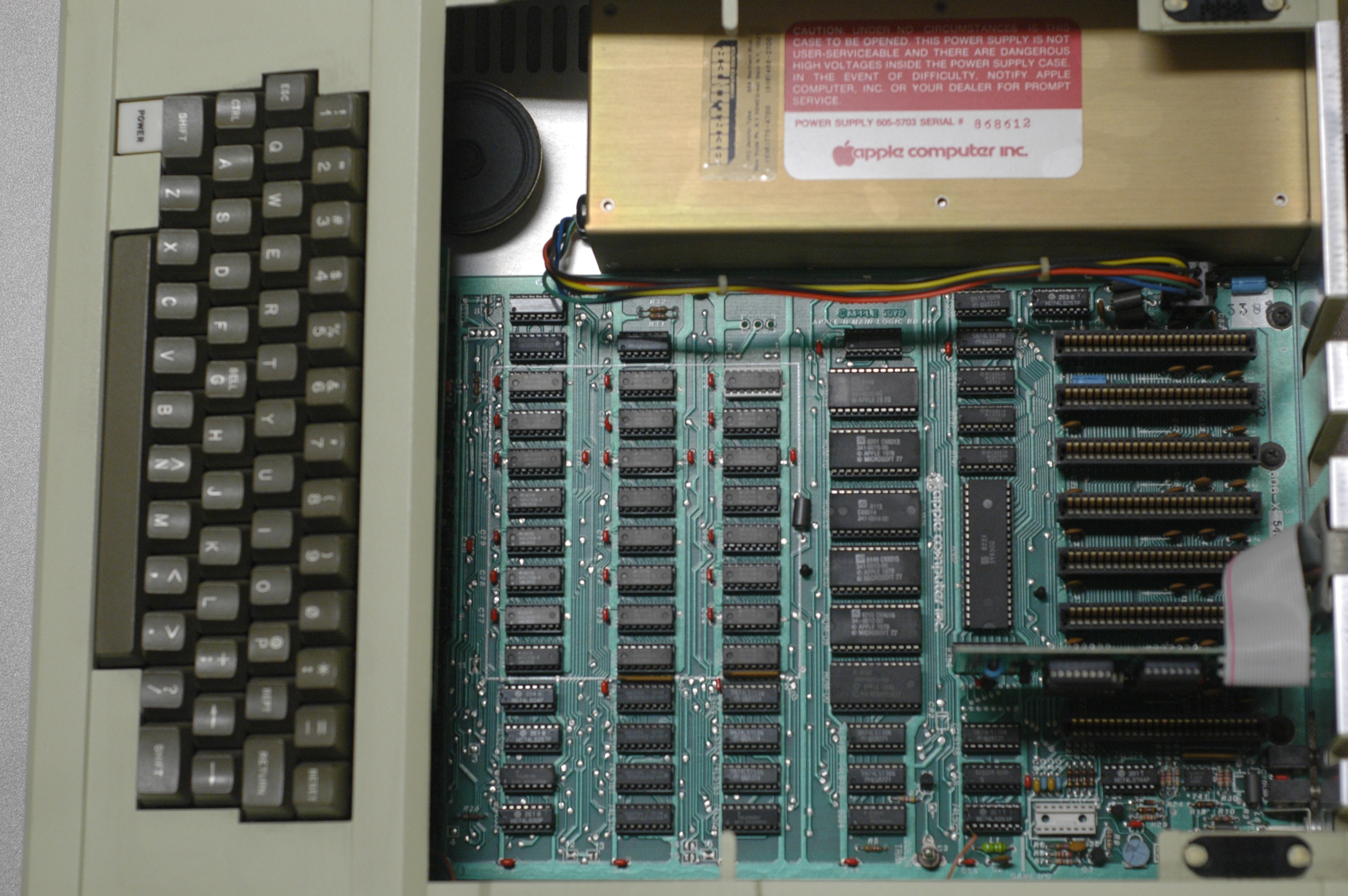
The Apple ][ RESET key above the Return key
is one I'd have to add to the list. Much anguish was had from that design, and sometimes the keyboard PCB would flex in a way so that pressing Return or another adjacent key would actually reset!
http://www1.cs.columbia.edu/~sedwards/apple2fpga/Apple-II-Guts.jpg
-
Re:Here, we obey the laws of physics
implies either a monochrome e-ink display or something with enough backlighting to overcome skylight
What about actual paper, using something like this? If we applied modern technology to that, we could probably get it down to a size that could be used with a laptop.
-
Your students will always need the other one.
Both are awful languages from a theoretical standpoint. Practically, the synthesis subset accepted by RTL tools renders them almost identical, although their spirits are actually quite different. VHDL is more verbose but has the more rigorous type system. I chose to teach it based more-or-less on a coin flip. Whatever you choose, your students' first employers will be using the other one, so it doesn't really matter. My class at Columbia can be found at http://www1.cs.columbia.edu/~sedwards/classes/2009/4840/
-
Re:Wait. What?
I'm not dead yet!
My Hazeltine 2000 isn't dead yet!
Also, I'm a boomer. Gen X look like a bunch of green kids from here.
-
dot-communism? read it's manifesto (from 2003)
Eben Moglen wrote a much more interesting take on this six years ago called "The dotCommunist Manifesto" http://emoglen.law.columbia.edu/my_pubs/dcm.html that is still worth reading. Though maybe read ""Die Gedanken Sind Frei": Free Software and the Struggle for Free Thought" http://emoglen.law.columbia.edu/publications/berlin-keynote.html instead.
-
dot-communism? read it's manifesto (from 2003)
Eben Moglen wrote a much more interesting take on this six years ago called "The dotCommunist Manifesto" http://emoglen.law.columbia.edu/my_pubs/dcm.html that is still worth reading. Though maybe read ""Die Gedanken Sind Frei": Free Software and the Struggle for Free Thought" http://emoglen.law.columbia.edu/publications/berlin-keynote.html instead.
-
Where's the philosophical/political context?
It boggles my mind that most of these comments ignore the very explicit political and philosophical goals of the FSF and GNU. So many are quick to "push politics aside" while reaping the benefits of battles won through hard, serious activism. How about actually reading RMS's writing (RTFRMS?), for a start?
The Wired article is pretty bad, which I expect, but the -
Re:Not important
Open Source (I think that is what it's about) is not communism, it is open source. Putting labels or trying to over-simplify things hinders correct thinking.
"Open source" was invented as a marketing term for free software and would not exist without the free software movement, which has had explicit political goals since its inception. From free software comes free culture, and free spectrum is hopefully on the way. If you're interested, Eben Moglen's writing and speeches cover these issues and much more (text/audio/video).
Whether coining and pushing "open source" has helped or hindered free software is subject to debate, but there's no doubt that stressing the business merits of sharing source code makes freedom a secondary concern. There are open source licenses that are not recognized by the FSF as free software licenses, and there are companies using the term "open source" for licenses that aren't recognized by the OSI.
Discussing philosophy and politics does not hinder "correct thinking"; discussions of philosophy and politics are an essential byproduct of human thinking and socializing. -
Re:Nothing
That must explain Tiananmen Square......
Sure does, when you think about it and realize that among a billion people, the million or so who were protesting were a MINORITY.
Capitalists don't control the Government. Capitalists have influence in the Government that outweighs their numbers but "control" is a bit of a stretch.
Then why do they get by with harming millions without being lynched? No, they've got control alright- both candidates in every election are already bought and paid for with campaign contributions- and who has the money to give campaign contributions? Those who have the money, give to both sides and have the right to lobby for favors afterward.
Actually it takes a bit more than that. Look up "permissive action links" the next time you lose sleep over the security of our nuclear weapons.
I decided to Look this up before responding, and what I found *will* make me sleep more securely at night, knowing that some undereducated private won't be the one able to do this. Unfortunately it doesn't quite negate what I said entirely- there is no such thing as a "tamper proof membrane", and theoretically one *could* indeed replace the control mechanism and detonator and still get some form of a yield (even though it would be far more likely to be a dirty bomb than a true nuclear detonation).
And that's relevant to my point in what way exactly? It seems that you are ignoring the point I was trying to make in favor of spouting liberal talking points.
The uniform code of military justice has a huge hole in it thanks to (and I actually call these CONSERVATIVE talking points, since any *real conservative* realizes that it is important to national security to adequately compensate one's military- this is the reason Saddam lost Gulf War I) the lack of compensation of the military. These aren't ideologues volunteering for the most part, they're people who have *NO* other option in our depressed economy. -
Bill Of Rights
Given how much of an authoritarian, centralizer, and advocate of the idea of broad implied government powers Hamilton turned out to be once the Constitution was in force (and, in fact, had already shown himself to be as a member of the Congress under the Articles of Confederation), one might reasonably take his rhetoric about why the Constitution shouldn't explicitly protect individual rights with a grain of salt.
Alexander Hamilton wasn't the only one to oppose Rights being included in the Constitution though. But he was an advocate of a strong central government as well. A good point is that he opposed slavery.
Falcon
-
Re:Prior Art
"Remember the IBM mainframes where you "upgraded" your hardware to have more disk space or memory by the Customer Engineer flipping a switch?"
I remember the "waltz-time" IBM 407 electromechanical accounting machines, "programmed" with a wired matrix board and very popular in university computing centers in the 1960s for tasks such as offline printing of punched-card decks in the 1960s.
They had extra circuitry added to them to make them skip every third processing cycle and run at 2/3 full speed, enabling IBM to sell them at a discounted price without annoying their full-price customers. So they'd go "Kagachunk, kagachunk, (pause), kagachunk, kagachunk, (pause), kagachunk, kagachunk, (pause)." I never personally did it or saw it done, but my understanding was that they could be restored to normal full-speed operation by cutting one wire.
Here's a good article. Wow, it looks new and shiny in that picture... the ones I knew always looked a little shopworn and shabby.
I assume, but do not know, that the RPG programming language was patterned on the operation of these machines.
-
The NYPD protects the UN building in many situati.
The NYPD protects the UN building when heightened security is needed, the NYPD has contact with many diplomats in NY while carrying out their patrols. Also the NYPD currently has hundreds of officers overseas thru the UN training local police forces in places like formerly UN mandated Kosovo. https://cranberry.cc.columbia.edu/cs/ContentServer?childpagename=Bronxbeat%2FJRN_Content_C%2FBBArticleDetail&c=JRN_Content_C&p=1165270050524&pagename=JRN%2FBBWrapper&cid=1175372074098
-
NAH
"A memorandum published by the DoD in March 1982 declared
that the adoption of TCP/IP as the DoD standard host-to-host
protocol was mandatory and would provide for "host-to-host
connectivity across network or subnetwork boundaries."Military requirements for interoperability, security,
reliability and [b]survability[/b] are sufficiently pressing to
have justified the development and adoption of TCP and IP in
the absence of satisfactory nongovernment protocol
standards."Emphasis mine.
http://www.columbia.edu/~rh120/other/tcpdigest_paper.txt -
Why no competition?
"no competitor will ever be able to compile the comprehensive online library Google aims to create"
Um, why not? If something is *out* of copyright entirely (not merely out of print, but actually in the public domain because the copyright term has expired) what exactly is stopping competitors from copying the same book and putting it on the web? I've seen plenty of examples of 19th-century books done that way -- people interested in those works sitting down with a scanner and laboriously scanning each page, then putting them on the web. Google a monopoly? Hardly, when every shmoe with a copy of the book and a scanner can duplicate it.
Oh, and university libraries are the *last* people that should be complaining about this, given that they're the ones with huge collections and they COULD HAVE DONE THE SAME THING decades ago, and still could now, if they wanted to serve their customers better. Years ago they should have gotten off their lazy posteriors and scanned *everything* in their library that is out of copyright. EVERYTHING. It means they could put the books in long-term storage (save money on shelf space), preserve the books better (no broken brittle paper or book bindings from further handling), and deliver copies of these old and rare works via interlibrary loan at far less expense and time (and wear-and-tear) than running them through a photocopier over and over again. At the very least they should be doing this only once, and then saving the copy digitally. It's freaking obvious.
Now they want to complain because google is doing their job for them? Sure, there's an important legal difference between "orphan works" and "copyright expired", but, really, why couldn't libraries have pushed for more flexibility with "orphan works" a long time ago? Some kind of broad, general license could have been negotiated. And why haven't they generally made all expired works available electronically, and let google walk into the market unchallenged?
There's hardly grounds for complaining about something they should have been doing a long time ago.
-
Why no competition?
"no competitor will ever be able to compile the comprehensive online library Google aims to create"
Um, why not? If something is *out* of copyright entirely (not merely out of print, but actually in the public domain because the copyright term has expired) what exactly is stopping competitors from copying the same book and putting it on the web? I've seen plenty of examples of 19th-century books done that way -- people interested in those works sitting down with a scanner and laboriously scanning each page, then putting them on the web. Google a monopoly? Hardly, when every shmoe with a copy of the book and a scanner can duplicate it.
Oh, and university libraries are the *last* people that should be complaining about this, given that they're the ones with huge collections and they COULD HAVE DONE THE SAME THING decades ago, and still could now, if they wanted to serve their customers better. Years ago they should have gotten off their lazy posteriors and scanned *everything* in their library that is out of copyright. EVERYTHING. It means they could put the books in long-term storage (save money on shelf space), preserve the books better (no broken brittle paper or book bindings from further handling), and deliver copies of these old and rare works via interlibrary loan at far less expense and time (and wear-and-tear) than running them through a photocopier over and over again. At the very least they should be doing this only once, and then saving the copy digitally. It's freaking obvious.
Now they want to complain because google is doing their job for them? Sure, there's an important legal difference between "orphan works" and "copyright expired", but, really, why couldn't libraries have pushed for more flexibility with "orphan works" a long time ago? Some kind of broad, general license could have been negotiated. And why haven't they generally made all expired works available electronically, and let google walk into the market unchallenged?
There's hardly grounds for complaining about something they should have been doing a long time ago.
-
Re:Not that it matters ...
No (obviously), but it would depend on how fast the water rises.
Besides just the pesky problem of the port, there's the infrastructure that goes with it.
For just one example, at 10', Manhattan would start looking like Venice. Tunnels, railways, and 3 major airports would become useless. There's a lot of infrastructure to rebuild elsewhere.
If you look around, a lot of airports and power plants are situated very close to sea level, on the waterfront. Airports use this for noise abatement (the planes can take off over the water to keep from annoying people). Nuclear plants require lots of sea water for cooling.
So, ports, sure they could be rebuilt. But have you ever watched what happens around the planning of new facilities? Years upon years of arguing points. People would argue about the environmental impact of the new facility, and the remains of the old facility.
I don't know what the thresholds are, but I'm sure once you reach a critical point (say 10'), more cities will have problems quicker. Say between 10' and 15', there could be not only one or two, but dozens of major coastal cities that would need to be rebuilt simultaneously.
Don't forget about fresh water reserves too. Water wells would start becoming contaminated with sea water too. You could rebuild the city near by, but can you restore their essential supplies like drinking water?
-
Re:Bloody hell!How is it irrational to point out that contraception will, over time, reduce the population by a few billion? We already have less-than-zero "growth" in much of the world (the "post-christian" countries). Or do you think it's okay to encourage people to have many children, to discourage them from practicing safe sex, and to indoctrinate them into believing that anyone who does so should be treated as a social outcast?
Just like Hitler, Herr Fuhrer Pope Ratzinger has an agenda to push that is NOT in the best interests of the people he's foisting it on - or of the rest of the planet. Also, contrary to what both another poster and the Pope claimed, condoms, wehn used properly, have a 97% per annum success rate. That's pretty close to the pill's 98% success rate - and the pill doesn't prevent STDs.
-
Re:Bloody hell!
Scientifically, condoms don't prevent pregnancy or aids. They only reduce the chances of getting either when engaging in sex.
When used as directed, condoms have an annual failure rate of 3%, and they're just as effective at preventing the transmission of HIV. Of course, this could just be propaganda from Columbia University - how DARE they disagree with Herr Fuhrer Pope Ratzinger?
Preventing a few billion from being born into poverty by effective contraception, and getting the planet to get below ZPG isn't, by any stretch of the imagination, being a Nazi. What the Pope did was. It's end effect is more people, more disease, and more poverty.
-
Re:Well it sounds better than
An excellent question!
It turns out that they fall. It's fascinating. Really. -
VLC