Slashdot Mirror
Domain: economist.com
Stories and comments across the archive that link to economist.com.
Comments · 2,721
-
Re:Makes you wonder
The German model of subsidising renewables is not without its problems
http://www.economist.com/business/displaystory.cfm?story_id=10961890
Most of Germany's electricity comes from coal-fired and nuclear plants. But the former are unpopular because of their relatively high greenhouse-gas emissions, and the latter because of the fear of a catastrophic accident. So in 1991 Germany adopted a renewable-energy law, now known as the EEG, which encourages investment by cross-subsidising renewable electricity fed into the grid. The law is popular with those who support the rapid introduction of new clean technology. Stefan Schurig of the World Future Council, a green think-tank in Hamburg, calls it "the best law of its kind worldwide".
The law says electricity produced from renewable sources must be purchased by utilities according to a generous "feed-in tariff" that sets higher-than-market rates and fixes them for 20 years. Roof-mounted photovoltaic systems installed in 2007, for example, can sell power at €0.49 per kilowatt-hour, or about seven times today's wholesale price, until 2027. The fixed rate allows investors to calculate returns and removes uncertainty over financing.
The utilities that buy power at these higher rates pass the extra costs back to their customers in the form of higher electricity bills. This added an average of 1 euro cent per kilowatt-hour to the price of electricity last year, increasing the typical household electricity bill by 5%, or €3 a month. For the country as a whole, the cost was €7.7 billion in 2007, up 38% on the year before. Enthusiasts consider that a small price to jump-start a new industry and start decarbonising the power supply.
Clouds on the horizon
But the government is not so sure. It has proposed a revision to the EEG, which calls for a shift away from solar and towards other forms of renewable energy, and offshore wind in particular. As things stand, the feed-in tariff for solar goes down by 5% every year. But new proposals call for a cut of 9.2% next year, and 7-8% thereafter.
The problem is not just the expense of the existing law. Cheerleaders for solar had hoped that the increased demand for panels would help manufacturers reduce unit costs, and thus make solar more competitive in the long run. Instead, the rush into solar has led to a shortage of the high-grade silicon used to make the cells, which has soared in price from $25 per kilogram in 2003 to around $400 today.
Indeed, such is the demand for solar panels in Germany that it has kept prices high globally. This is wonderful for manufacturers, but makes it more expensive to install solar capacity in sunnier parts of the world, where it would generate more electricity. The EEG's generous rates for solar amounted to "picking winners on a grand scale", says Dieter Helm, an expert on energy policy at the University of Oxford. A euro in cross-subsidies spent on wind power, rather than solar, produces more generating capacity and a larger reduction in carbon emissions.
Basically if you subsidise the wrong thing, you can potentially hurt more than you help. Picking the right things to subsidise is non trivial.
Hell if planned economies worked, India and the UK would have grown faster than free market places like the US in the 50's and 60's. Actually, despite being poorer, they grew more slowly until they implemented free market reforms.
Now traditionally greens seem to see economic growth as some kind of problem because it usually leads to more pollution, but in the case of the renewable energy industry, more growth actually means less pollution.
And actually the EEG is a fairly lightweight piece of government intervention, adding only 5% to bills.
To misquote Socrates "True knowledge exists in knowing that the Government knows nothing."
-
economist article on broadband
The Economist this week has an interesting article on subsidized broadband and its economic impact:
http://www.economist.com/opinion/displaystory.cfm?story_id=13024563
I do not necessarily agree or disagree with the opinions presented within the article; I just think it is an interesting and timely take on the topic. -
Re:This is not a problem with the Thai people
As I said before, its not the Thai monarch, they have no real power, the king is king in name only (a rich land owner that holds no real political power much like the queen of England). It's Thailand unstable democracy that keeps producing these laws, not its monarch...
Many reputable sources, including 'The Economist', (which is probably why it's been banned too), would beg to differ. See:
http://www.economist.com/world/asia/displayStory.cfm?story_id=12724800&source=hptextfeatureAn extract: 'Many Thais will squirm at what follows, and will prefer the fairy-tale version of the king's story. But the king's past actions are root causes of a conflict dividing the country, and need to be examined.'
-
Unflattering article on Economist.Com
read it here: http://www.economist.com/world/asia/displayStory.cfm?story_id=12724800&source=hptextfeature
Quote:
Bhumibol's tale, even if stripped of the mythology his courtiers have spent decades constructing around him, is exceptional. The American-born son of a half-Chinese commoner accidentally inherits a throne close to extinction and revives it, creating one of the world's most powerful and wealthy monarchies, and surely the only one of any significance to have gained in political power in modern times. The king's charisma, intelligence, talents (from playing the saxophone to rain-making, a science in which he holds a European patent) and deep concern for his people's welfare make him adored at home and admired around the world. His image perhaps reaches its zenith in 1992, after the army shoots dozens of pro-democracy protesters in Bangkok, when television shows both the army leader (and prime minister) Suchinda Kraprayoon and the protest leader, Chamlong Srimuang (now a PAD stalwart), kneeling in an audience with him. Shortly afterwards General Suchinda resigns, and the king is given credit for the restoration of democracy.I can see how this might piss of the Powers That Be..
-
Re:Shows the value of the "MSM"
Nobody said the MSM is perfect or even good, only that it's better than the alternative. Sort of like Democracy, which is terrible, but is still the best option.
However, the "MSM" covers a very large number of media sources, all over the world, in every town, and in every format (newspaper, magazine, TV, web, etc.). I've found many of those things you wish for, including in-depth policy analysis and well researched coverage that represents both sides. There is plenty of media that doesn't provide those things (I think because most of the public doesn't demand it), including Hannity, O'Reilly, and Olbermann too. I ignore them and read the quality stuff. Here are a few great MSM resources you might like:
* ProPublica - Investigative reporting covering the U.S.
* Council on Foreign Relations - International issues, especially try their Backgrounders, which are very well done.
* The Economist - Economics and finance, as well as international news and analysis.I support open source software, I contribute my time and money to many projects and have five FOSS applications open right now, but I think the Ubuntu story was pretty good; imperfect, but reasonable. I don't think Ubuntu is suitable for most end-users, due to the basic compatibility issues she described. I wish it were otherwise, but that doesn't change the news.
-
Re:Deletionists aiming for 'trusted user'
You're right, you've changed my viewpoint. As the saying goes, "when nothing more can be taken away."
Maybe I was simply offended by the trimming of an article on a Pokémon character.
-
Re:Purpose of the class
On the other hand, any notes taken by an undergrad in Econ 101 are likely to be un-insightful at best and at worst full of mistakes. They *might* be useful to the individual student who took them, especially if he or she has an unusual learning style, but I can almost guarantee that nothing was taught in that Econ 101 class that wouldn't be in any decent Econ textbook or freely available on the web. In fact, there is already a well known free online textbook of Economics, Introduction to Economic Analysis, maintained and made available by R. Preston McAfee of the California Institute of Technology. If you have more than a few nickles to rub together then I would also recommend Principles of Economics (4th edition) by N. Gregory Mankiw (which I own a copy of personally and have referenced on many occasions to dispel the economic double speak of our politicians). I also read the Economist on a semi-regular basis (it is also recommended in the back of the Mankiw textbook for further up to date and more specific reading concerning economic and political issues of the moment). I didn't save most of my notes from college because, frankly, they would not have been useful in my software development job AND they probably aren't very good quality reference materials either (assuming that anyone else would even want to decipher my hand written scrawl).
-
Re:The price point for a computer is now $299.
The new Economist just came out, with "Less is Moore - technology in the recession. "Many companies, it seems, would also prefer computers to get cheaper rather than more powerful."
Detroit faced the same problem when buyers stopped falling for "more car per car".
-
Re:Unfortunately...
I once read an article (the referenced article below is not it) about the theory that cancer is a stem cell gone awry. The reason, it seems to me, that cancer is so resistant to treatment is that stem cells are so resistant to being killed, and they'd have to be. Stem cells are responsible for the renewal of your tissues and possibly the growth of new tissue (ie: muscle mass) when needed. They have to live your entire life while still being able to divide in a controlled fashion. The referenced article touches on the experiment of injecting cancer cells that don't contain (suspected) stem cells into mice and how no tumors resulted, yet the cancerous stem cells did.
It seems to me that it's more like our current cancer treatments are like our cough medication. They do a lot with the symptoms and side effects, but do very little to address the root cause of the ailment.
Ref: http://www.economist.com/science/displaystory.cfm?story_id=12202589
-
"The Economist" on Polish Labor in Ireland
"The Economist" had an interesting article relative to this a while back: http://www.economist.com/world/europe/displaystory.cfm?story_id=12676787
Some interesting tidbits:
"BY THE best guesses of Polish diplomats, a couple of thousand Poles lived in Ireland at the start of 2004, including 200 emigres left from the second world war. Three years later Ireland was home to more than a quarter of a million Poles, according to consular estimates."
"A torrent of EU regional aid is about to hit the ex-communist countries: across eastern and central Europe there are plans for new airports, fast trains and motorways. Poland has stadiums to build for the European football championship in 2012. The Polish and Lithuanian governments are actively trawling for workers in Ireland."
-
Or just give the PTSD sufferers some
-
Re:Charitable contributions
Nice try but one person isn't "some atheists", it's "one atheist". One atheist who doesn't represent anyone but himself.
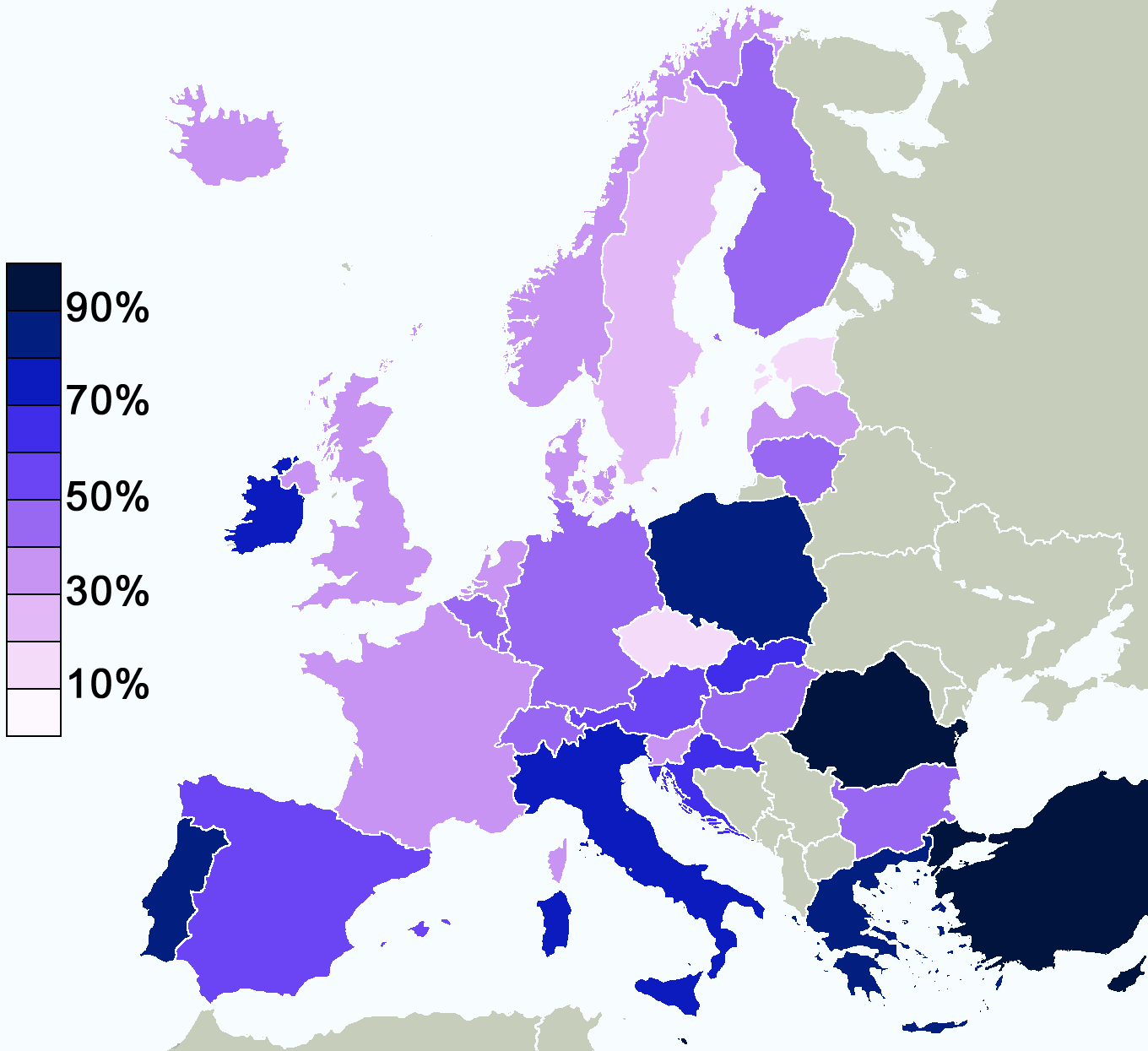
Besides some think-tank in USA called Center for Global Development recently ranked rich countries in their "commitment to fostering prosperity in the developing world".http://www.economist.com/markets/indicators/displaystory.cfm?story_id=12777735&fsrc=rss The top 5 are Netherlands, Sweden, Norway, Denmark, Ireland. If you take a look at this picture http://upload.wikimedia.org/wikipedia/commons/3/3e/Europe_belief_in_god.png you'll see that these have a very low number of people who believe in god. Compare this with USA which is ranked at 17 of 22 of the most commited countries. USA has a very high number (according to the statistics on the wikipedia article where I found that picture ~15% state they have no religion.
-
Re:3 baht is not excessive
Ghah, got "continue editing" and "submit" buttons mixed up. Anyway, all rates are taken from http://www.ubs.com/1/ShowMedia/ubs_ch/wealth_mgmt_ch?contentId=103982&name=eng.pdf and http://www.economist.com/finance/displaystory.cfm?story_id=11793125
-
From The Economist
Recent space solar power article from The Economist
http://www.economist.com/science/tq/displaystory.cfm?story_id=12673299
-
Re:I wish
I sort of wish I could at least find a news source or three that doesn't try to sell me the news by adding all sorts of ridiculous sensationalism. I just want facts, researched, well-written, reviewed, facts.
-
Re:Can somebody 'splain this?
We don't need it. But the system made people borrow more than they could.
s/system/government. Mandated standards for subprime lending (i.e., giving money to people who couldn't afford it) is one of the largest pieces, if not the largest, that caused the system to fall down.
Another key part of the puzzle was that banks tried to mitigate risk--hence the creation of these mortgage-backed securities. Some of these were designed to sidestep regulatory requirements.
There are also the depressed interest rates and exotic mortgages.
As long as the pie constantly grows there is no real problem, as the banks control all money.
If all the mortgages had been traditional mortgages, and banks only lent to those who could afford these mortgages (or even merely mostly lent), there would have been no problem. The loan interest provides a cushion for falling home values, and the inflexibility of mortgages would have made the accumulation of the vast asset price bubble untenable.
But the government stepped in, caused banks problems, and the banks got creative to ameliorate these problems.
*AND* we should destroy anyone who was involved in shortselling any commodity related to loans.
There's a great satirical article by The Economist which in a nutshell attacks those who attack shortselling. Why prevent people from speculating that prices will fall? If you do that, you might as well prevent people from speculating that prices will rise. After all, it's those damn people buying long (or, egads, naked longs!) that caused all these bubbles...
Better yet, how about we impound all those people who give financial advice based on what they read in their daily newspaper?
-
Re:No compatibility problems?
Then of course, would the Economist http://www.economist.com/ seriously consider whether proper formatting for mathematical, engineering, physics etc. formulas in a written document was all that important to a netbook. Seriously, this is all about a quick simple selection, a cheap fit for purpose notebook, costing a couple of hundred dollars and fully ready to go and, that will enable the majority of people from 6 to 60 to do all the basic daily tasks versus spending four times as much to do it the M$ way, extra hardware, Vista and M$ Office plus proprietary photo and video editing software etc.
-
From an Economist reader
The blurb may be a little misleading, since it seems to suggest that this is some kind of recommendation from the Economist, which doesn't do product reviews in general.
This is part of a (very interesting) collection of "end of year technology roundup" type articles (see for instance my favorite article on quieter tank treads). All the writer really says is "if you buy one of these the point is low cost and simplicity -- so don't be tempted to spend extra on Windows, or you might as well buy a laptop".
The author is actually kind of against the choice of Linux in a way, as he makes it sound like adding extra software is a royal pain: "Admittedly, installing third-party software can be a bit of a fiddle, and some of the advice available online threatens to lure users into the tangled depths of the Linux undergrowth, where few people will want to venture"...
JF
-
English orthography [it sucks]
When is gh ever pronounced F at the beginning of a word?
Here's a brief excerpt from The Economist magazine, 14 August 2008 (online at http://www.economist.com/world/britain/displaystory.cfm?story_id=11920829 but may require login).
You write potato, I write ghoughpteighbteau
The rules need updating, not scrapping
GHOTI and tchoghs may not immediately strike readers as staples of the British diet; and even those most enamoured of written English's idiosyncrasies may wince at this tendentious rendering of "fish and chips". Yet the spelling, easily derived from other words*, highlights the shortcomings of English orthography.
*Fish: gh as in tough, o as in women, ti as in nation (courtesy of GB Shaw). Chips: tch as in match, o as in women, gh as in hiccough. -
Ass calls female supporters "menopause section"He just lost a libel suit against The Economist for printing some articles describing how much of a shithead he is.
- FIVE years ago, this newspaper declared that Silvio Berlusconi was unfit to lead Italy
- Italy has enough problems already: does it really need Silvio Berlusconi once again?
- Italians may come to regret electing Silvio Berlusconi once again
- How many aspiring prime ministers could get away with describing older female supporters as their "menopause section"?
- Berlusconi fiddles, Italy burns
- Same old Silvio?
The Economist wins Berlusconi lawsuit
Sep 5th 2008 From Economist.com
In July 2001 Silvio Berlusconi, then prime minister of Italy, launched a lawsuit in Italy alleging that The Economist had defamed him in its article "An Italian Story", which appeared in our April 26th 2001 issue. The magazine cover bore the title: "Why Silvio Berlusconi is unfit to lead Italy". We are pleased to announce that the Court in Milan has issued a judgment rejecting all Mr Berlusconi's claims and requiring him to make a payment for costs to The Economist. The full judgment, in Italian, is available here. The Economist will not be making any further comment. Mr Berlusconi is once again prime minister of Italy.
-
Ass calls female supporters "menopause section"He just lost a libel suit against The Economist for printing some articles describing how much of a shithead he is.
- FIVE years ago, this newspaper declared that Silvio Berlusconi was unfit to lead Italy
- Italy has enough problems already: does it really need Silvio Berlusconi once again?
- Italians may come to regret electing Silvio Berlusconi once again
- How many aspiring prime ministers could get away with describing older female supporters as their "menopause section"?
- Berlusconi fiddles, Italy burns
- Same old Silvio?
The Economist wins Berlusconi lawsuit
Sep 5th 2008 From Economist.com
In July 2001 Silvio Berlusconi, then prime minister of Italy, launched a lawsuit in Italy alleging that The Economist had defamed him in its article "An Italian Story", which appeared in our April 26th 2001 issue. The magazine cover bore the title: "Why Silvio Berlusconi is unfit to lead Italy". We are pleased to announce that the Court in Milan has issued a judgment rejecting all Mr Berlusconi's claims and requiring him to make a payment for costs to The Economist. The full judgment, in Italian, is available here. The Economist will not be making any further comment. Mr Berlusconi is once again prime minister of Italy.
-
Ass calls female supporters "menopause section"He just lost a libel suit against The Economist for printing some articles describing how much of a shithead he is.
- FIVE years ago, this newspaper declared that Silvio Berlusconi was unfit to lead Italy
- Italy has enough problems already: does it really need Silvio Berlusconi once again?
- Italians may come to regret electing Silvio Berlusconi once again
- How many aspiring prime ministers could get away with describing older female supporters as their "menopause section"?
- Berlusconi fiddles, Italy burns
- Same old Silvio?
The Economist wins Berlusconi lawsuit
Sep 5th 2008 From Economist.com
In July 2001 Silvio Berlusconi, then prime minister of Italy, launched a lawsuit in Italy alleging that The Economist had defamed him in its article "An Italian Story", which appeared in our April 26th 2001 issue. The magazine cover bore the title: "Why Silvio Berlusconi is unfit to lead Italy". We are pleased to announce that the Court in Milan has issued a judgment rejecting all Mr Berlusconi's claims and requiring him to make a payment for costs to The Economist. The full judgment, in Italian, is available here. The Economist will not be making any further comment. Mr Berlusconi is once again prime minister of Italy.
-
Ass calls female supporters "menopause section"He just lost a libel suit against The Economist for printing some articles describing how much of a shithead he is.
- FIVE years ago, this newspaper declared that Silvio Berlusconi was unfit to lead Italy
- Italy has enough problems already: does it really need Silvio Berlusconi once again?
- Italians may come to regret electing Silvio Berlusconi once again
- How many aspiring prime ministers could get away with describing older female supporters as their "menopause section"?
- Berlusconi fiddles, Italy burns
- Same old Silvio?
The Economist wins Berlusconi lawsuit
Sep 5th 2008 From Economist.com
In July 2001 Silvio Berlusconi, then prime minister of Italy, launched a lawsuit in Italy alleging that The Economist had defamed him in its article "An Italian Story", which appeared in our April 26th 2001 issue. The magazine cover bore the title: "Why Silvio Berlusconi is unfit to lead Italy". We are pleased to announce that the Court in Milan has issued a judgment rejecting all Mr Berlusconi's claims and requiring him to make a payment for costs to The Economist. The full judgment, in Italian, is available here. The Economist will not be making any further comment. Mr Berlusconi is once again prime minister of Italy.
-
Ass calls female supporters "menopause section"He just lost a libel suit against The Economist for printing some articles describing how much of a shithead he is.
- FIVE years ago, this newspaper declared that Silvio Berlusconi was unfit to lead Italy
- Italy has enough problems already: does it really need Silvio Berlusconi once again?
- Italians may come to regret electing Silvio Berlusconi once again
- How many aspiring prime ministers could get away with describing older female supporters as their "menopause section"?
- Berlusconi fiddles, Italy burns
- Same old Silvio?
The Economist wins Berlusconi lawsuit
Sep 5th 2008 From Economist.com
In July 2001 Silvio Berlusconi, then prime minister of Italy, launched a lawsuit in Italy alleging that The Economist had defamed him in its article "An Italian Story", which appeared in our April 26th 2001 issue. The magazine cover bore the title: "Why Silvio Berlusconi is unfit to lead Italy". We are pleased to announce that the Court in Milan has issued a judgment rejecting all Mr Berlusconi's claims and requiring him to make a payment for costs to The Economist. The full judgment, in Italian, is available here. The Economist will not be making any further comment. Mr Berlusconi is once again prime minister of Italy.
-
Ass calls female supporters "menopause section"He just lost a libel suit against The Economist for printing some articles describing how much of a shithead he is.
- FIVE years ago, this newspaper declared that Silvio Berlusconi was unfit to lead Italy
- Italy has enough problems already: does it really need Silvio Berlusconi once again?
- Italians may come to regret electing Silvio Berlusconi once again
- How many aspiring prime ministers could get away with describing older female supporters as their "menopause section"?
- Berlusconi fiddles, Italy burns
- Same old Silvio?
The Economist wins Berlusconi lawsuit
Sep 5th 2008 From Economist.com
In July 2001 Silvio Berlusconi, then prime minister of Italy, launched a lawsuit in Italy alleging that The Economist had defamed him in its article "An Italian Story", which appeared in our April 26th 2001 issue. The magazine cover bore the title: "Why Silvio Berlusconi is unfit to lead Italy". We are pleased to announce that the Court in Milan has issued a judgment rejecting all Mr Berlusconi's claims and requiring him to make a payment for costs to The Economist. The full judgment, in Italian, is available here. The Economist will not be making any further comment. Mr Berlusconi is once again prime minister of Italy.
-
Re:Let me guess...
Um, what? The thermohaline cycle is when the wind-driven surface currents, like the Gulf Stream, move water from the equator to the poles, during which it cools and sinks and heads back to start the cycle over.
The Gulf Stream is one of the wind-driven components of the meridional overturning circulation. The thermohaline circulation is the density-driven component. See here, here, here, and here.
I did neglect to mention that stopping the Gulf Stream would also stop the cool water flowing back in the opposite direction, which could cause various Atlantic islands to get rather more tropical.
The cold water is deep water. If islands get more tropical it's because less surface heat is being transported northward, not because less cold water is being transported southward.
But, regardless, saying the Gulf Stream would shut down is exactly correct.
It's exactly wrong, according to what oceanographers mean by the term "Gulf Stream".
'Europe', no. Northern Europe, yes.
As I said, see Gregory et al., which is one of the main model intercomparison studies. I quote: "Although THC weakening mitigates the CO2 warming in the Atlantic region (see also section 3), there is no cooling over any substantial region in any of the TRANSIENT experiments, because the CO2 effect is larger." When you see those scary temperature anomaly maps with huge cooling, what you're looking at is generally a freshwater hosing experiment which doesn't have CO2 forcing in it, just a freshwater response which is supposed to be analogous to the true warming-induced response.
A northern European "ice age" is not really the main concern with an MOC slowdown/collapse. The main impact is probably shifts in regional precipitation patterns.
And anyone who says we need a 'large amount' of warming to collapse the current is just, essentially, guessing.
That may be a "guess", but it's an informed one, based on oceanographic modeling and paleoclimate evidence. As such, it's at least more credible than someone who says that we need little warming to collapse the current.
We don't know how much it will take, and it's probably very dependent on Greenland glaciers, which are currently melting faster than expected.
See Jungclaus et al., GRL (2006). They find that even in a high Greenland melt rate scenario, the MOC weakening in the 21st century (under a fairly high-forcing SRES A1B BAU scenario) increases from 30% to 42% by 2100. That's not insignificant, but it's not a collapse either, and they predict a recovery in the 22nd century.
It's not the last word on the subject by any means, but most researchers in this field are converging on the opinion that it's hard to collapse the MOC in a modern interglacial period. If you've just come out of an interglacial and still have some of the bigger continental ice sheets lying around, that's different.
If you want to assert it won't happen until the earth heats up that much, well, that's kinda silly.
It's backed up by highly cited published research. It's kinda silly to ignore that research, unless you're aware of any new work which I'm not. If you are, what is the citation?
But, yes, without the Gulf Stream clearing out the warm water, it would essentially keep building up in the Gulf of Mexico, and any hurricane that made it past Florida would get a giant energy boost.
Likewise: what scientific papers back up your claim that every
-
Off-topic: burn an Indian flag
I criticise the Israeli army for shooting journalists in the West Bank, it doesn't mean that I support Palestinian suicide bombers
These two are not related.
So I don't like Guantanamo
These two are directly related, as explained in my article. There are only three things, that can be done to losers of a battle:
- Let them go (this is done to qualified Prisoners of War after the war ends).
- Detain them until a trial of some sort.
- Kill them or let them die.
Talking about (alleged) terrorists and (alleged) pirates, the first one is a no due to the gravity of the allegation. The second is what the evil AmeriKKKa is doing (and will continue to do — welcome to the real world, Obama-fans). So, the third option was deemed the easiest by the India's Navy...
And it would've worked perfectly well, if that particular ship have not turned-out to be a Thai vessel, full of innocents...
It may surprise you to know that the Indian government doesn't know what I think about the issue and wouldn't give a flying fuck if they did.
Oh, it certainly does not give a grain of basmati over what you think. But it is no less certain, that they are well-aware of the world's opinion of Guantanamo. People like yourself hate the prison with passion, and, except the minority like myself, fail to acknowledge the absence of a viable alternative.
Now that Obama is almost President, expect to see justifications for the prison's continuing existence from the same papers and TV-stations, that helped him pound on Bush and McCain on the issue. Poor fishermen should be safer.
-
historical charts
An interesting article on historical charts -including this one and the one by Minard- was published by the Economist last year: http://www.economist.com/world/europe/PrinterFriendly.cfm?story_id=10278643
-
Prior art in the Economist
It appears they are finaly getting around to last years issues.
http://www.economist.com/world/europe/displaystory.cfm?story_id=10278643
> -
Also reported by The Economist
The Economist recently had an article about this study as well.
-
Hybrapostrophic
Some style-guides' guidance on apostrophes: The Economist, The Times, The American Heritage Book of English Usage.
The Guardian and the Emory Writing Center are more tolerant and admit your way of doing it, albeit as a less common alternative.
And that's just the links on the relevant Wikipedia article. Please inform yourself before dictating dogma.
-
Re:No space for love?Oh, I also just wanted to say, if you're wondering if these guys were so busy scrabbling to survive, feel more sorry for yourself. Turns out significantly less time was required for labor.
Not only had hunter-gatherers enjoyed plenty of protein, not much fat and ample vitamins in their diet, but it also seems they did not have to work very hard. The Hadza of Tanzania "work" about 14 hours a week
So they had plenty of time for love, way way more so than your average family with two working parents. Hmm. .
-
Re:The girls are smarter
A recent survey in The Economist suggested this might be true. Instead of just repeating the old "boys are better at maths, girls are better at reading" fact, it showed that boys are not much better better than girls at maths, while girls are much better at reading, and girls improve relative to boys in both subjects as the gender gap closes:
http://www.economist.com/daily/chartgallery/displaystory.cfm?story_id=11481914
At least they'll still need us to reproduce... for now anyway...
-
Re:Help America Vote?
I am hoping with an all Democrat government we will get a "Help America Vote" act that actually helps America vote.
Are you referring to these Democrats, or these ones?
-
Re:Two words
No, but mindlessly parroting what you hear on a scrolling news channel is not a mark of independent thought or intelligence, be it MSNBC, CNN or FoxNews. I am sick of hearing debates framed in talking points that people overheard on the boob tube. Especially when they attempt to feign ownership of thoughts that have been already twice or thrice regurgitated. Are Americans so lazy that they do not have time to read a single periodical of note during this election? The Economist and the CFR should be at the top of anybody's reading list because it is where much of the more well-researched scrolling news and talking head speech is cribbed from. Read the two long enough and you will see where those talk shows get some of their more poignant guests.
-
In short...
-
Re:I'm only going to sayHey, Miss Palin claims to read The Economist.
Here's what the paper has to say on the subject in its typically witty style:
WHAT do you and Sarah Palin have in common? Answer: You both read The Economist. After flubbing a question on her reading habits the first time around, Mrs Palin specifically mentioned our paper when asked the same question last night. Because of our own privacy rules, we cannot disclose whether or not she is a subscriber. But I can tell you that we have a paid circulation of 2,168 in Alaska.
. Or in other words (and that's strictly my interpretation as a subsriber): Miss Palin is full of shit. (Apart from the fact that this woman never has the intelectual curiosity to read a paper like the Economist).
-
Re:I'm only going to sayHey, Miss Palin claims to read The Economist.
Here's what the paper has to say on the subject in its typically witty style:
WHAT do you and Sarah Palin have in common? Answer: You both read The Economist. After flubbing a question on her reading habits the first time around, Mrs Palin specifically mentioned our paper when asked the same question last night. Because of our own privacy rules, we cannot disclose whether or not she is a subscriber. But I can tell you that we have a paid circulation of 2,168 in Alaska.
. Or in other words (and that's strictly my interpretation as a subsriber): Miss Palin is full of shit. (Apart from the fact that this woman never has the intelectual curiosity to read a paper like the Economist).
-
Re:Please.
Before diving into the numbers, here is a detailed article about how derivatives had been predicted to fail extraordinarily in difficult times: http://www.nytimes.com/2008/10/09/business/economy/09greenspan.html?bl
Here is the Economist's take on the bailout bill: http://www.economist.com/opinion/displayStory.cfm?source=hptextfeature&story_id=12305249
And finally here is the Economist's explanation of why the bill could work (yes, with numbers): http://www.economist.com/opinion/displaystory.cfm?story_id=12305746
It isn't a scholarly work. The only thing I could find for free would be transcripts of presentations made on the floor when Bernanke and Paulson were trying to convince Congress to pass the bill. Do you REALLY want me to find the links to those transcripts?
-
Re:Please.
Before diving into the numbers, here is a detailed article about how derivatives had been predicted to fail extraordinarily in difficult times: http://www.nytimes.com/2008/10/09/business/economy/09greenspan.html?bl
Here is the Economist's take on the bailout bill: http://www.economist.com/opinion/displayStory.cfm?source=hptextfeature&story_id=12305249
And finally here is the Economist's explanation of why the bill could work (yes, with numbers): http://www.economist.com/opinion/displaystory.cfm?story_id=12305746
It isn't a scholarly work. The only thing I could find for free would be transcripts of presentations made on the floor when Bernanke and Paulson were trying to convince Congress to pass the bill. Do you REALLY want me to find the links to those transcripts?
-
Re:Define "Winning"
If we hadn't invaded Iraq, world opinion would have turned against Afghanistan at this point. Much as the French are doing:
http://www.economist.com/world/europe/displaystory.cfm?story_id=12010407
As to our independence, France didn't get involved until they saw the war was basically won, so thanks for being, well, French.
By the way, how is all that stolen Oil for Food money treating you?
-
Re:any evidence
The Economist magazine surveyed hundreds of economists and found that they overwhelmingly preferred Obama's economic policies to McCain's: http://www.economist.com/world/unitedstates/displaystory.cfm?story_id=12342127 .
-
Re:any evidence
The Economist did a study of both candidates and found that by a huge margin most professional economists favour Barack Obama.
-
Biggest Underlying Issues - Housing & Connecti
I wish I had confidence that Obama's economic folks are reading the right solutions
that are being put forward. My concern is that the economy will stay bad until there
is liquidity in the housing market.Most of the proposals I see to address that try to help people keep prices at the last
sale value which is artificially inflating prices over the current market clearing
amount. The Economist had an article on this:http://www.economist.com/finance/displaystory.cfm?story_id=12470547
which cites Luigi Zingales - Plan B paper.
http://faculty.chicagogsb.edu/luigi.zingales/research/PSpapers/plan_b.pdf
It not only has a proposal based on things that have been done before, to avoid foreclosures
while lowering house prices to the market rate, but also addresses the connectivity risk
between banks and other financial institutions.Anyone interested in thinking carefully about future economic policy should read this paper.
Also I would think that a Slashdot crowd would like Obama's team to read 'The Gridlock
Economy' which addresses among other things the significant negative economic affect of
our intellectual property system - an issue near and dear to many slashdot readers. -
Re:any evidence
This seems like a reasonable place to start.
-
Re: The Real Deal on the Current Economic Crisis
The Real Deal on the Current Economic Crisis
So who is to blame? There's plenty of blame to go around, and it doesn't fasten only on one party or even mainly on what Washington did or didn't do. As The Economist magazine noted recently, the problem is one of "layered irresponsibility
The Federal Reserve, which slashed interest rates after the dot-com bubble burst, making credit cheap.
Home buyers, who took advantage of easy credit to bid up the prices of homes excessively.
Congress, which continues to support a mortgage tax deduction that gives consumers a tax incentive to buy more expensive houses.
Real estate agents, most of whom work for the sellers rather than the buyers and who earned higher commissions from selling more expensive homes.
The Clinton administration, which pushed for less stringent credit and downpayment requirements for working- and middle-class families.
Mortgage brokers, who offered less-credit-worthy home buyers subprime, adjustable rate loans with low initial payments, but exploding interest rates.
Former Federal Reserve chairman Alan Greenspan, who in 2004, near the peak of the housing bubble, encouraged Americans to take out adjustable rate mortgages.
Wall Street firms, who paid too little attention to the quality of the risky loans that they bundled into Mortgage Backed Securities (MBS), and issued bonds using those securities as collateral.
The Bush administration, which failed to provide needed government oversight of the increasingly dicey mortgage-backed securities market.
An obscure accounting rule called mark-to-market, which can have the paradoxical result of making assets be worth less on paper than they are in reality during times of panic.
Collective delusion, or a belief on the part of all parties that home prices would keep rising forever, no matter how high or how fast they had already gone up.
The U.S. economy is enormously complicated. Screwing it up takes a great deal of cooperation. Claiming that a single piece of legislation was responsible for (or could have averted) is just political grandstanding. We have no advice to offer on how best to solve the financial crisis. But these sorts of partisan caricatures can only make the task more difficult.
-
STOP SLASHDOT CENSORSHIP FIRST!!
While we should damn China's censorship, we should definitely first stop
I hope that's only my illusion. But one can't stand on a moral high ground unless one acknowledges or at least open to all facts.
-
Re:First post?
It really depends on what you mean by investing. If you bundle the short into a black box into which you put your money and out of which you get returns then it is an investment for you. On the other hand, from the point of view of the companies shorted it is not an investment.
This distinction between speculation as 'bad' and investment as 'good' is foolish anyway. Both speculation and investment have good reasons to exist. At the moment speculators are driving down the price of oil. Is anybody complaining? No. They only complain when things go badly and they need a scapegoat.
p.s. Buttonwood had a good piece on shorting recently.
-
Chrome does not need market share
Google did not build Chrome to capture market share. They did not create it to launch a product or to circumvent adblock (duh).
They built it for a real strategic reason: to make sure the web remains usable and open. If Google hopes to serve web apps in the future, they depend on the quality of browsers, and the current browser architectures apparently don't satisfy them.
Changing Firefox wasn't an option and attacking IE is a mission with very little payoff for Google. So Google chose to inject their design principles into the market by creating a radically new, yet incomplete browser, and release it open source, so it gets adopted. If Microsoft steals this technology to make IE9 even better, Google's mission will have succeeded.
There's an Economist article which explains all this pretty good as well:
link -
Re:Its the Economists, Stupid!
you have to start looking for the culprit in the "science" of economics.
Oh, please. As if anybody even listened to economists on this one.
For example, The Economist pointed out many of the upcoming problems in 2003. And probably before; they've been warning of a housing bubble and problems with Fannie Mae for ages.