Slashdot Mirror
Domain: ed.ac.uk
Stories and comments across the archive that link to ed.ac.uk.
Comments · 421
-
Hilarious
This guy's worried about "narrowing the ways in which developers think about and write networked applications" in a world where people are reinventing wall(1) as twitter, IRC as friendfeed, and other web 2.0 'innovations.' You want to widen developers' thinking about networking? Leave sockets alone and close off port 80.
-
Re:Sipping From a Firehose
And finally, just to annoy you some more, there's a split infinitive in the first sentence of this post.
Are you trying to taunt PitaBred into further pedantry? I'm sure that you are familiar with Fowler's discussions of split infinitives, e.g.,Robert Allen, ed (2002). "Split infinitive". Pocket Fowler's Modern English Usage. Oxford University Press, quoted in http://en.wikipedia.org/wiki/Split_infinitive
No other grammatical issue has so divided English speakers since the split infinitive was declared to be a solecism in the 19c: raise the subject of English usage in any conversation today and it is sure to be mentioned.
as well as his latter division of English-speakers into four classes with regard to their opinions regarding split infinitives, quoted in full in "Fowler on the Split Infinitive," http://hubpages.com/hub/splitinfinitive. See also James Thurber's sexist but hilarious discussion of the topic at http://www.lel.ed.ac.uk/~heycock/thurber-split.html.
-
Re:Who knew Acer had a phone?
-
Re:Who knew Acer had a phone?
-
Re:And what about proven scientific fraud?
"OOC, why is it you continue to parrot McKitrick's opinions as though they're gospel, while flat out ignoring anyone else? It's classic cherrypicking, and I'm surprised you don't see that. I mean, jebus, big shocker, McKitrick likes the (highly politicized, heavily criticized, non-peer-reviewed) report that vindicates his results. Surprise surprise!
Got a third-party, actually independent source? (BTW, I strongly suspect the answer to that is 'no')."
Besides Wegman, and perhaps a couple of solar activity scientists, no. But then again, finding an independent source on this matter is tricky in any event. One of the things Wegman commented on was that Mann was central to a lot of the work done on this matter, and most of the articles published regarding the "hockey stick" were co-written with Mann or a member of his team.
Come to think of it, it seems to me that the divide is between Mann and his team and MM. I have little doubt that there are many articles discussing and debating this - I know there was a series called "The Deniers" that dealt with this, and listed a number of people. There was also a very famous public letter by something like 500 scientists arguing against the current state of climatology. But you asked me a question, and a worthy one - why do I trust McKitrick, and not Mann? I am prepared to answer that.
My training is as a historian, and I've never really left that focus. I have a degree in Medieval Studies, a degree in English Literature, and right now I'm working on a Master of Arts in War Studies, studying cavalry in the First World War. So, I tend to look at things through what is called "abductive reasoning" - I collect as much evidence as possible before coming to a conclusion, and I put off theorizing as late as possible.
One of the things is that historical research tends to have biases, and so part of my training is getting beyond those biases. So, part of whether I trust a source or not is not based on the conclusion that they come to, but how they handle the evidence that leads them to this conclusion, as well as how they discuss the implications - and handle criticism - of that conclusion.
To cut a long story short (I know - too late), McIntyre and McKitrick impressed me on all counts, and I found their work - as far as I understand it - to be logical and well reasoned. They also exposed what I consider serious flaws in the way Mann and his team operated - including cutting out evidence and cherry picking data. I can't begin to understand most of the math on either side, but MM made their case in a convincing way.
Mann has impressed me considerably less. As I said, the cutting out of the Medieval Warm Period by censoring the data is a very poor methodology, but I also pay attention to how they handle challenges to their theories. Reading the Realclimate explanation of how CO2 levels can instigate a temperature rise while they actually rise after the temperature goes up left me bemused as Realclimate twisted itself into a pretzel to try to discount it. Compare that to a researcher in Scotland named Chris Merchant who put together a wonderful presentation where he provided a counter-argument to "The Great Global Warming Swindle" ( http://www.geos.ed.ac.uk/homes/chris ) - he came across as a credible scientist, not an extremist, and most important of all, he didn't twist himself into a pretzel to make his point.
Now, I have accused Mann of being an academic fraud, and I stand by that. I don't think he represents the sum total of climatologists - I think Chris Merchant is far more representative - but I look at what I've seen of Mann and his team, and I am very far from impressed. He made a case based on cherry picked data from sources that lowered the temperature of the Medieval Warm Period and raised the modern temperature, and even his model may be suspect. It is the cherry picking of data and trying to remove the Medieval Warm Period that makes me level the accusation of h
-
Re:Apple fanbois
Could someone enlighten me as to what this is? I've seen it a few times on slashdot, and I understand the meaning from context, but where does it come from?
man sed.
-
Re:While troubling, also cool.
And there have been, what, 6 or so cases worldwide of death from Mad Cow? The threat is of the same order of magnitude.
Since 1990 there have been 1334 in the UK alone. Baseline figures for the US (in absence of any contaminated food sources, etc.) are 1 per 9,000 adults aged over 55, which based on a back-of-envelope calculation means somewhere in the region of 200 per annum.
More generally, unless you're a worker in the field where a risk occurs, a good rule of thumb is that it's a waste of time to worry about any danger that you hear about on the news. If it happens rarely enough to be newsworthy, it's not a danger to you
That I can subscribe to.
-
Re:I got records from @home from an ebay purchase
That program already exists. It's called shred. We use it at my University IT department on a very small gentoo live cd to wipe old PPC Macs. Norton Ghost has a similar feature that works well on x86 PCs.
-
Re:Catching up
Rebooting comes under "simple" and should be available per point & click. Not necessarily through its's own icon, but with a simple sequence of clicks. Windows got that right with Start->Shutdown (except maybe for klicking "Start" to stop the machine
An "advanced" command is one that offers parameters to customize its effects, often with great specificity. Something like running grep with a few of the more exotic options.
This random link http://unixhelp.ed.ac.uk/CGI/man-cgi?grep should give you an impression of what I mean. Try, for instance, to duplicate the effect of the repetition operators in a typical Windows search mask. -
Re:I knew having red hair would benefit me one day
-
Re:My bigest boneheaded move
By copying his script to "/usr/bin", he over-wrote the system command of the same name. On unix and unix-like systems, "df" is a command that reports disk usage.
So this probably had two nasty side-effects:
1. Whenever any other user typed "df" to determine how much disk space was left, their shell environment would get suddenly "re-customized" to the settings that Mr. D.F. liked. Depending on what was in the script, this could have been merely annoying ("Why did my shell colors suddenly change?") to downright crippling (causing people's preferences to be stored in the wrong place, thereby breaking all kinds of software).
2. Most utilities in *nix end up being used in a wide variety of other utilities, scripts, and system processes. As a result, a whole slew of standard operations probably broke as a result of "df" returning garbage data. This may have broken some system loggers, or disk caps, or maybe it triggered emergency "disk nearly full!" emails being sent to all the admin staff.
Moral of the story: wield root wisely. -
Re:It's a bit nebulous
What he's offering (it seems) is the infrastructure, the projects themselves should come from others. I'm a mathematician myself and often have calculations that are large enough to be impractical on a single machine, but not epic enough in scale to attempt setting up my own scheme like distributed.net or folding@home, if I even knew how. Fortunately I already have access to a cluster that I can throw such jobs at, but based on a conference I was at just last week, there are plenty of researchers who don't.
Although whilst there I also learnt of BOINC (and plans to use it for a crypto challenge), so we'll have to see if Nightlife offers any advantages - largely depends on how many machines it makes available, of course! -
Re:Awesome!
Hey, lighten up, it was a joke. The part you didn't understand was the output of the "diff" command saying:
- " 1c1 ": the difference was that the line 1 in the first file changed to the line 1 in the second file, and the difference is:
- " < " [in the first file we had this:] " Java "
- " > " [and in the second file it became this:] " JavaScript "
See, now that it had to be explained, it's not funny. Well, it wasn't funny to begin with.
And, since I just wasted 5 minutes writing and formatting this, here's the link so you don't have to use Google: man diff (feel free to ignore it if you don't really want to learn about diff). I always use "diff -u" myself (I find the output more readable).
-
Re:2 million records, or people?If it's Windows just start with Arcserve, Backup exec, etc... If it's UNIX just start with cpio, tar, dump, etc... Strings
-
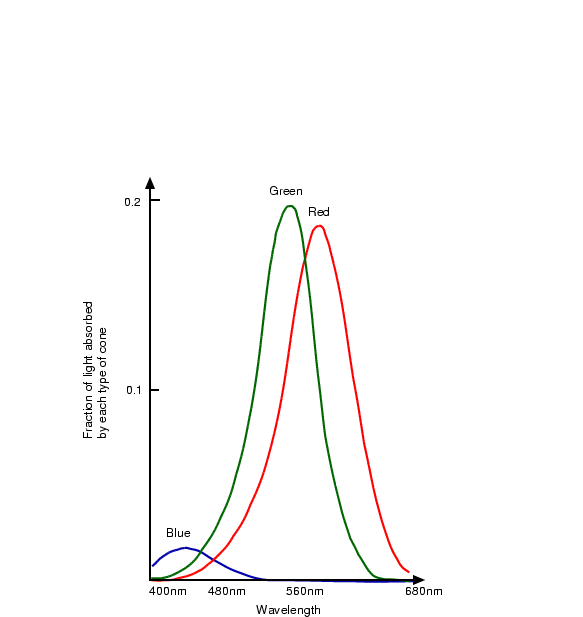
Re:Great Blazing ColorsArgh please don't mod this up so high, as people are going to read this and believe it without further research. I'm sure you meant well arth1, but it seems you weren't taught the whole story.
Our eyes don't work like that -- they don't scan the visible spectrum from low to high, and see blue as the opposite end of red. Instead, we have receptors for certain colours, and base our colour perception on how much each of those get triggered. This is why colour blindness hits red/green or yellow/blue, despite those colours not being adjacent on the spectrum.
Yes, we have different color sensors, but this is beside the GP's point. The green response curve overlaps significantly with red and blue. See the spectral response here. Red/Blue flashing lights will cause a significant color contrast as they alternately hit one type of cone and then the other. Even though the response to blue is low, it is still an effective color to use because the human eye's response is logarithmic wrt to brightness (i.e. take the graph I linked above and take the log the y dimension). Even that's a simplification when you add rods to the mix, but that's a subject for another post or later research.
Our eyes can differentiate shades and hues of green better than any other colours -- this is an inherited survival trait from when it was important to see predators and distinguish ripe from almost-ripe. Blue, on the other hand, wasn't as important to survival, so we can't tell too many shades of blue apart, nor very far towards ultraviolet.
This is wrong. We can identify more hues of blue than any other color, followed by red, while the intermediate hue discrimination can be quite low. Green sucks because that cone's frequency response is highly correlated with parts of the other two, and thus it forms somewhat of a degenerate basis for describing a hue with the 3 weights. Google "Hue-discrimination curve" for more info.
The evolutionary argument for this has *no* good evidence supporting it, but has become a very vibrant meme (I won't call it a legend, since it is an unproven theory). Green is bright for a variety of potential reasons: (1) It's one of the easier pigments for synthesize biologically, (2) There's a lot of green light coming from the sun, (3) It's a good baseline from which to differentiate other colors (there's a lot of green in our environment), and (4) yeah maybe it could have to do with rotten/ripe fruit. I'd bank on the first two though, especially noting that our hue sensitivity in the green range sucks. Predators are best to detect via motion (primarily rods), and by non-green cones (predators are camouflaged best against rods, i.e. non color vision, i.e. luminance, which overlaps most with green). You can of course believe whatever theory you want, but please don't start speaking about one as being authoritatively true; I know some evolutionary biologists like to extrapolate really far from the evidence, but it always hurts when they are wrong on some theory that gets discounted, since it gives creationists a hammer to bludgeon all of biology and science with. Please don't give them that ammo, and label speculation as speculation until there's real concrete evidence to show. For evolution of these traits, that means sticking mostly to the "what" and "how", and not claiming "why" except in the most general and statistically supportable terms.We perceive indigo (the traditional indigo, not the "purple" that's called indigo these days) as a dark colour, for example, because it's at the edge of what we can see.
It's not just that its near the edge, it's more complicated with several factors: (1) The blue cones are not that sensitive, (2) there is no additive luminance response due to the other cones frequency response falling off completely at violet, and (3) the rods don't even respond to it very well (last point only really matters for
-
Inferior to S-expressions
TFA is a fun read. Too bad XML sucks. As Jerome and Philip Wadler write, "[T]he essence of XML is this: the problem it solves is not hard, and it does not solve the problem well."
Lisp had the same problem solved 40 years earlier. While a lot of people find S-expressions verbose, XML is quite a bit more verbose. Slava Akhmechet has a nice essay on the relationship between the two notations.
-
Re:Damn!
-
Re:Oh!
OK, you deserved the upmods, but the moderators don't seem to grasp that you're making a joke. Same thing with the guy just after you who made the same joke about lynx. I'll say it one more time: the current moderator pool is full of clueless dweebs. Rob, bring back the old system!
-
its still development.
As someone who alternates between technical architecture and management I can sympathise with where you are going. My 2c worth
- developing people is far more interesting and challenging than developing solutions but is also 10* more frustrating.
- you can either manage or you can architect. You can't do both for the same project but you can do both roles so long as there is someone else doing the other.
- communication is all. Remember that it is up to you the communicator to ensure the person you are communicating to understands. Get them to paraphrase things back to you, maybe in the form of a first steps.
Of course in a classic catch 22, this doesn't apply to when your boss is communicating to you
- delegate but remember to set appropriate check in points and do so. Set appointments with yourself to check in on how tasks are progressing.
- say thanks for people who have done their job, not just for exceptional work.
- block out time in your calendar to do work.
- listen to what is being said about your team.
Good luck
PS I also like Gerald Blair's management thinkings. http://www.see.ed.ac.uk/~gerard/Management/index.h tml -
Ozone and Toner
I thought the EU and national governments had already issued health guidance for laser printers in Europe because they are known to emit dangerous levels of Ozone and other chemicals. As I recall printers had to be a certain number of meters away from the nearest desk and in a well ventilated office. Here is some existing information I found by googling:-
http://www.lhc.org.uk/members/pubs/factsht/76fact. pdf
http://www.safety.ed.ac.uk/resources/General/print ers.shtm
Certainly under United Kingdom health and safety legislation employers should not locate printers next to employee workstations. Although most IT workplaces I've worked in seem to flout these regulations to some extent - particuarly wrt to printer location, cabling and fire safety. -
Re:Call me off-topic but
Yes, a very sad loss. I was not sure anyone (surprisingly) on Slashdot picked this up.
I was privileged to attend his final talk the week before, given at Edinburgh. The video is now actually available here (for a while): http://www.inf.ed.ac.uk/events/jamboree/2007/
This was absolutely fascinating, and I listened spellbound for an hour and a half. Do not be misled by the title as it covered much of the early development of AI in Britain (not just at Edinburgh). Analogous with the actual topic of this story, it details another, very early "physical computer" MENACE - constructed of matchboxes and beads.
A fuller obituary (that goes way beyond his short involvement with Turing) is here: http://www.timesonline.co.uk/tol/comment/obituari
e s/article2061886.eceTruly a great pioneer and inspiration for us modern researchers in AI.
-
Re:IE still had some + points
That's doable for Firefox as well:
http://wiki.mozilla.org/Firefox:2.0_Institutional_ Deployment
and inparticular:
http://homepages.ed.ac.uk/mcs/FirefoxADM/Readme.ht m -
Re:As if computer science wasn't stunted enoughPython is a better language That is a dubious statement about a language which uses indentation to group statements. Even Basic isn't that silly.
Are outlines silly? Even look at this comment on Slashdot: it can be readily understood from its rendered form, which uses indentation to group statements from one person. Why do so many critics of Python have such a hard time accepting this alternative to block-end keywords such as Loop of Basic, End of Pascal, } of C, or </blockquote> of HTML? What's silly is do
-
Re:Which is worse
> http://www.iscr.ed.ac.uk/outreach/images/Human-bl
a stocyst.gif
Aaaw, ain't he a cute little guy!?!?!? I'm gonna call him Frank! -
Re:Which is worse
It's the killing of a young human being.
Actually, that is not the case. It's the destruction of a blastocyst, which is a compilation of 70-150 cells. These are often thrown out/discarded in fertility clinics. They are definitely not human. Here's a picture of one,
http://www.iscr.ed.ac.uk/outreach/images/Human-bla stocyst.gif -
Re:Canada vs. USBut they brough the infamous inluenza with them to spain, which spread and killed about 20 to 30 million people.
Closer to 50 million, worldwide. I hadn't heard that the source was the USA, though. Last time I read up on the subject, the source was still unknown. Can you point me at your reference indicating that the pandemic started in the USA, please?
Yikes, I think that was from a documentary on PBS a few years back... when they were first digging up victims from the permafrost up in norway or some such nordic climes.
The 20-30 number was the conservative estimate... From what I remember, the virus started in Asia (as usual), spread to the US, from the US to Spain with the troops, and then the world.
Ah! Googled "spanish flu origin", first result. They say between 40 and 100 million on there. Lots of details on the spread of the virus.
Have fun reading about countless deaths, and in the future, google stuff. -
Re:First Java open-sourced, now this... go Sun!"but the fact that the built-in make, vi, grep, etc. are still basically unmodified"
Who cares? Do they work? That depends on your measure of "work". They do the raw bare minimum one would expect from such things, but the GNU versions tend to come with a lot of comforts that you start taking for granted after not very long. Its nothing you can't technically live without, but it does start to feel awfully spartan. A good comparison might be Solaris grep and GNU grep, or perhaps Solaris diff and GNU diff. Nothing wrong with the Solaris versions, but the GNU versions have some useful extra options, and more flexible regexps. -
Re:First Java open-sourced, now this... go Sun!"but the fact that the built-in make, vi, grep, etc. are still basically unmodified"
Who cares? Do they work? That depends on your measure of "work". They do the raw bare minimum one would expect from such things, but the GNU versions tend to come with a lot of comforts that you start taking for granted after not very long. Its nothing you can't technically live without, but it does start to feel awfully spartan. A good comparison might be Solaris grep and GNU grep, or perhaps Solaris diff and GNU diff. Nothing wrong with the Solaris versions, but the GNU versions have some useful extra options, and more flexible regexps. -
That's already in place.
For more info: http://unixhelp.ed.ac.uk/CGI/man-cgi?cat
-
Re:What about Doppler?
Actually, it is not that simple: http://www.cwt.vt.edu/faq/gsm.htm The spill-over frequency will deteriorate the signal and there are also issues with TDMA. It looks like the GSM is only rated for 250 km/h (although it may work at higher speeds) http://www.ee.ed.ac.uk/~pmg/DIGICOMMS/4.mobile.ps Special specifications have been created for high speed trains: http://en.wikipedia.org/wiki/GSM-R
-
Same as it ever was
The "software" of the mind isn't the sort of thing you can sit down and code any more than our genes code for basketball skill. I'm sure they could teach people with hardware brains to be all sorts of things, but that's nothing new. The brain may be suitable for Von Neumann implementation, but the mind can't be written in C++. Or LISP, for that matter.
Minds have to write themselves, or they don't work. -
Re:I think that's the marketing dept.
-
Re:Wrong approach?
It's called configuration management. The old standard was cfengine (this is basically the Sendmail of configuration management systems), there are quite a few newer alternatives out there with different strengths and weaknesses.
Thin clients make life easier, but that's a business call.
http://homepages.inf.ed.ac.uk/group/lssconf/ is a good place to start off with. You do need at least one guru level person, but not too many of those, somewhat similar to having good Windows admin skills.
There are no pretty frontends yet, but it shouldn't be too hard to write one of those. -
Not actually a Maxwell Demon...Let's get the pedantic "This is not actually a Maxwell Demon" comments out of the way first. The original thought experiment of Maxwell's Demon was to suggest a hypothetical creature/device/demon that could watch molecules and make decisions based on what those molecules were doing. By watching the motion of molecules, the demon could open/close a flap and thus sort molecules by kinetic energy. This would allow the demon to generate a hot gas out of nowhere, without any energy input. This would thus contradict thermodynamics (which states that entropy always increases, etc.).
The reason that such a demon cannot be created is that the very act of making an observation (of a gas molecule's trajectory, for instance), requires the usage of energy. And on the scale we're talking about, that usage of energy is exactly the 'work' you are doing to raise the temperature of the gas in sorting the molecules. Thus no such thing as a maxwell demon can be made, and thermodynamics is intact.
This most recent report, as stated, requires an input of energy to move/sort molecules. Thus it doesn't violate thermodynamics and it's not really a Maxwell Demon. The article seems a bit confused on this issue, stating:
As Maxwell had predicted long ago, it does not need energy because it is powered by light.
I would content that the light is an input of energy, and thus saying "it does not need energy" is rather silly.
In any case, the actual research (see David Leigh's page) is about photo-activated molecular shuttles: molecules that switch between well-defined states with input of light. You can thus trap or move other molecules using light. Certainly one step towards the much-anticipated "nanotechnology" but not quite the fine control of molecular positions one would imagine when using the term "Maxwell Demon." -
Re:JS is not the problem, the whole environment is
such language exist and become more and more common.
Google already released their gwt (http://code.google.com/webtoolkit/) but there are also other languages like HOP (http://hop.inria.fr/) or Links (http://groups.inf.ed.ac.uk/links/) -
Re:Here's what you'll look like
It's true that articulatory speech recognition should be easier than automatic speech recognition (ASR) based on waveform analysis alone. It's massively unfortunate that ASR research has, at least for the past 20 years, concentrated mostly on the latter and not the former. Janet Baker, whose MIT PhD introduced Hidden Markov Model (HMM)-based ASR, and opened the door to companies such as Dragon (which she and her husband founded), is herself now saying that HMMs are rubbish for speech recognition. I desperately hope that through this CMU project, and others, that people will start to take note of this.
I think you're entirely correct that the machine translation (MT) stage is a bolt-on in this particular project. This project is I think a vehicle for articulatory ASR rather than MT. But I wouldn't be so keen to dismiss MT efforts altogether. It's true that in some ways the current deployable systems make gross assumptions about language, which may be even worse than the assumptions ASR systems make about speech (that's particularly true of purely statistical MT systems). But Google and others have apparently shown that with a large enough corpus, you can get results that extend beyond simple phrase-book look-up quality.
There's one main question facing the researchers at CMU, I think. That's whether people will be happy to stick a dozen electrodes on their face in order to achieve speech-to-speech translation, or whether they'll prefer to speak into a microphone and have a speech synthesiser (e.g. the open-source Festival, partly developed at CMU) speak the result. I'm not entirely convinced they will, but I'd be absolutely delighted to be proved wrong. -
Re:Yeah, and...
How exactly did you manage to post from over a year and a half in the past???
He's using a old type 40... And we all know how moody those can be. -
How to Start in Java
What amazes me is how many tools are out and available online regarding this sort of pattern recognition development. Since a lot of people know Java, I'm would encourage you to use the Java Media Framework (free from Sun). Once you have those libraries installed, it's quite easy to start editing sound, images & video. You might need to grab and install codecs if you're doing video analysis but I think almost all image codecs are supported.
I'm not going to lie, the video computation can be quite heavily but thankfully that framework is implemented such that the entire video doesn't have to be loaded into memory, just a one frame buffer analysis can be used if you want.
The last thing you would need is simply the know-how on programming these analysis algorithms. There are sites out there with a large wealth of up-to-date algorithms. An example would be the text book style site of pattern recognition or image processing. While this doesn't teach you how to do things, it does contain the raw resources and algorithms. General resources like the computer vision homepage exist that serve as links to all kinds of resources. Unfortunately, I know of no real solid books that contain everything out there because this field is so rapidly developing. My professors taught me from hand printed slides in a large compendium they had accumulated over the last couple years.
The last piece missing is the data to analyze. While you might not have the ultra high resolution Van Gogh images to do this yourself, it may be possible to visit museums with 6 MP cameras to obtain your own data. Failing that, there are repositories online that sometimes contain image information you can start with. While this may not satisfy your specific needs, it sure is great for the lazy developer like myself.
Lastly, I will mention citeseer and Google Scholar for cutting edge papers that you might want to try implementing. Distributing these algorithms and building a good GUI can be tricky but really anyone can build the backend. I heavily recommend experimenting with this if it interests you. -
Re:Pirates
This is slashdot, you're expected to understand how to use sed as a prerequisite for being here.
-
Re:"Moon is a Harsh Mistress" anybody??
Indeed. also Man who Sold the Moon. Also, if you rememeber 1962: Fireball XL5 http://www.aiai.ed.ac.uk/~bat/GA/fireball-xl5.htm
l -There is a model of the mag lift launcher on that page. The concept has been there for years. Sure it would not work for transporting passengers, but supplies? Chucking O2 cans, rocket fuel, even space food and station building parts into low orbit would become very cost effective. -
Re:Morgellons Disease
I'm not the OP, but lateral gene transfer between plants and animals seems extremely unlikely. Plant DNA and Animal DNA, although they share some similarities as they are both eukaryotic (e.g. large amounts of non-coding "junk", much of it regulatory), they're very different in other important respects. More importantly, there's no obvious mechanism by which lateral gene transfer could occur, since plant-infecting viruses don't affect humans and vice versa. Viruses have a hard enough time jumping from apes to humans, much less jumping from Kingdom to Kingdom.
Supposing that Morgellon's is a true infectious disease and not e.g. a type of delusional parasitosis or other psychosomatic disease, it sounds less like human-plant gene transfer and more like a parasitic infection, somewhat reminiscent of a lichen (a mutually beneficial symbiosis between fungi and algae). Based on the most common reported symptom (fibrous growths), it sounds like the hyphae of a parasitic fungus, but that's at odds with the presence of plant DNA. The plant DNA might just be incidental contamination from gardening, or I suppose an undiscovered infectious lichen isn't entirely out of the question (however unprecedented it may be), although one would expect fungal DNA to be present in either case. Either way, it sounds like something that a single application of hydrogen peroxide or rubbing alcohol could easily kill, so long as the wound is then covered and allowed to heal naturally. (Peroxide and alcohol kill your own skin cells, in addition to anything else. This prevents healing, so they shouldn't be used more than once.)
-
Re:Qs
``As for your first statement, sure, any language can be tailored to be useful in a particular domain. Can you name such a domain for Scheme? I can't.''
Ah, but I was only refuting your claim that no language can be useful without extensive libraries. I wasn't talking about Scheme, specifically.
If you do want examples of what Scheme has been successfully used for, well, some examples:
- As a vehicle for teaching the fundamentals of programming, programming languages, and computers (see, for example, SICP and the courses based on it)
- As an extension language (in festival, for example)
- I've used Scheme for a few projects: a text processing language (transforming text with embedded code to multiple output formats), a sudoku-solver, a network simulator, an HTML-generation library. I've also used it to prototype algorithms that I later implemented in Java.
- Other people have implemented mail filters, web frameworks, wiki's, theorem provers, and probably countless other things in Scheme
And, of course, when you look beyond the standardized core language and consider the implementations, you can find some more impressive examples, like DrScheme (at least, I think that's written in MzScheme). -
Re:Flash
You could try using speech synthesis with Festival or something, and randomize a string of letters and numbers.
-
Re:Expect to see this in Canada too
Great Britain does not include Ireland. U.K. stands for "The United Kingdom of Great Britain and Northern Ireland".
Check: http://www.geo.ed.ac.uk/home/scotland/britain.html -
Re:Normalize everything.
There are some ongoing efforts in the research community around such unifying languages for the web, such as Links: http://groups.inf.ed.ac.uk/links/
-
Edge detection
I think what you need is an edge detection algorithm of some kind. Try FILTERS.
-
Either tell them to get a Mac or ...
Install KDE in Kiosk mode so if they fiddle about with it and stuff things up, just logging out and in again will restore the settings. As part of the install supply KPDF and Kate, Festival, Mbrola, and kttsd. Together these projects provide a very effective text to speech system which reads text pretty well to folks who are either dyslexic, or have tired eyes. KMail is not yet speech enabled, so you will have to use Konqueror and Gmail instead.
-
Re:Wrong Side of Bed?
That's pretty nasty to do--the easiest way is to allocate 8K at a time, and use a page-aligned chunk from the middle of it. Talk about a waste of memory.
posix_memalign? -
Re:The politics of science
You can't just have a libertarian fit, throw up your hands, and leave it to Adam Smith's invisible hand to sort everything out. Pollution can and has killed in definitely non-subjective ways:
http://www.portfolio.mvm.ed.ac.uk/studentwebs/sess ion4/27/greatsmog52.htm -
Re:Same with WiFi and cell phones
> There were some rooms where my eyes would water
Did you have laser printers in the room ?
Did the room have a fresh air supply ? (like opening the windows for a few minutes every day)
In a previous job we had a laser printer in a very small closed room, staying there more than a few minutes was very very difficult and the smell in the room was strange when the printer was up for a few days.
I think laser printers produce ozone and many greats things like that, see http://www.safety.ed.ac.uk/resources/General/print ers.shtm for details.