Slashdot Mirror
Domain: electrek.co
Stories and comments across the archive that link to electrek.co.
Stories · 83
-
Dutch Government Confirms Plan To Ban New Petrol, Diesel Cars By 2030 (electrek.co)
An anonymous reader quotes a report from Electrek: Today, the new Dutch government presented its detailed plan for the coming years and it includes making all new cars emission-free by 2030 -- virtually banning petrol- and diesel-powered cars in favor of battery-powered vehicles. The four coalition parties have been negotiating their plans since the election in March and now after over 200 days, they have finally released the plan they agreed upon. NL Times posted all the main points of the plan and in "transportation," it includes: By 2030 all cars in the Netherlands must be emission free. While some local publications are reporting "all cars," we are told that it would be for "all new cars" as it is the case for the countries with similar bans under consideration. The potential for the ban has been under consideration in the country since last year. The year 2025, like in Norway, has been mentioned, but they apparently decided for the less ambitious goal of 2030. -
Elon Musk Says Tesla Could Rebuild Puerto Rico's Power Grid With Batteries, Solar (electrek.co)
After Puerto Rico was hit by hurricane Maria, Tesla quickly started shipping hundreds of its Powerwall batteries there to try and get power back on to some houses with solar arrays. Now, Tesla CEO Elon Musk took to Twitter to say that Tesla could rebuild Puerto Rico's power grid with batteries and solar on a bigger scale. Electrek reports: Puerto Rico's electricity rates were already quite high at around $0.20 per kWh and reliant on fossil fuels. After it was pointed out that Puerto Rico's destroyed grid is an opportunity to build a better one, Musk wrote on Twitter: "The Tesla team has done this for many smaller islands around the world, but there is no scalability limit so it can be done for Puerto Rico too. Such a decision would be in the hands of the Puerto Rico government, PUC (Public Utilities Commission), any commercial stakeholders and, most importantly, the people of Puerto Rico."
Musk is referring to solar and battery projects that Tesla recently deployed on other islands, like Tesla's visually stunning Powerpack and solar project in Kauai. Those projects power grids for much smaller populations, but Musk has always said that it's scalable to support much larger islands, like Puerto Rico, and ultimately entire continents, which are just like big islands to a certain degree. The thing is that those systems are still reliant on power lines for larger communities and devices, like solar panels and wind turbines, that are still subject to problems with natural disasters. The advantage of Tesla's solution is that it has the potential to be distributed, which increases the odds of at least some systems staying online or bringing some back online quicker. -
Tesla Discontinues Its Most Affordable Model S (engadget.com)
Tesla will be discontinuing its cheapest Model S option, the Model S 75, this Sunday. What that means is that the all-wheel-drive version -- the 75D -- will take its place as the low-end Model S sedan, currently listed at a starting price of $74,500. Engadget reports: The move to discontinue the Model S 75 was first announced by Tesla in July after it dropped the price by $5,000 a few months earlier. The removal of the model from Tesla's offerings follows its discontinuation of the Model S 60 and 60D vehicles in April, which at the time were the least expensive Model S options available. As well as streamlining its EV line and making all Model S options all-wheel-drive, knocking off the low-end Model S vehicles is also likely being done to carve out a bigger separation between the Model 3 and Model S lines. Custom orders for the Model S 75 will be taken until Sunday, September 24th and the pre-configured versions will be available for purchase until inventory runs out. -
Samsung Unveils New Electric Car Batteries For Up To 430 Miles of Range (electrek.co)
An anonymous reader quotes a report from Electrek: At the Frankfurt Motor Show (IAA Cars 2017) this week, Samsung's battery division, Samsung SDI, showcases a new "Multifunctional battery pack" solution to enable more range in electric vehicles as the Korean company tries to carve itself a bigger share of the growing automotive battery market. Most established automakers, like Nissan with the LEAF or even GM with the more recent Chevy Bolt EV, have been using large prismatic cells to build their electric vehicle battery packs. Tesla pioneered a different approach using thousands of individual smaller cylindrical li-ion battery cells in each pack. Earlier this year, Samsung unveiled its own '2170' battery cell to compete with Tesla/Panasonic. Now they are claiming that they can reach an impressive energy density by using those cells in new modules: "'Multifunctional battery pack' of Samsung SDI attracted the most attention. Its users can change the number of modules as they want as if they place books on a shelf. For example, if 20 modules are installed in a premium car, it can go 600 to 700 kilometers. If 10 to 12 modules are mounted on a regular sedan, it can run up to 300 kilometers. This pack is expected to catch the eyes of automakers, because they can design a car whose mileage may vary depending on how many modules of a single pack are installed." -
Man Blames Tesla Autopilot System For Rollover Crash, Then Recants (autoguide.com)
According to AutoGuide, the driver of a Tesla is blaming the Autopilot system for a recent crash in Minnesota. "58-year old David Clark was approaching an intersection when he turned the Autopilot system on, causing the car to accelerate suddenly and veer off the road," reports AutoGuide. "The vehicle ended up on its roof in a marsh with all five occupants sustaining minor injuries." From the report: Tesla's Autopilot function is considered an SAE Level 2 autonomous system, meaning the car will accelerate and steer on its own, but the driver is expected to remain alert and intervene if necessary. In an emailed statement to Electrek, Tesla said it has yet to establish whether or not the Autopilot function was actually turned on at the time of the accident. The company also noted it is still the driver's responsibility to ensure the safe operation of the vehicle when Autopilot is engaged. AutoGuide's report was based off the information Kandiyohi County Sheriff's Office received and reported. Now, it appears the Tesla driver is claiming the self-driving Autopilot system wasn't responsible for the crash, despite what he initially told investigators. According to ABC News, Clark said he was confused in the moments after the crash. After discussing the crash with his fellow passengers, he now believes that he disengaged Autopilot by stepping on the accelerator before the crash. "I then remember looking up and seeing the sharp left turn which I was accelerating into. I believe we started to make the turn but then felt the car give way and lose its footing like we hit loose gravel," Clark wrote in the email. -
Automakers Are Asking China To Slow Down Electric Car Quotas (electrek.co)
New submitter Kant shares a report from Electrek: The auto industry is once again attempting to slow down the rollout of electric vehicles. Virtually all automakers, except for Tesla of course, have sent a letter to the Chinese government in an attempt to have them drastically weaken their zero-emission vehicle mandate. As we previously reported, China, the world's biggest car market, has somewhat of an aggressive ZEV mandate that would force automakers to have zero-emission vehicles (ZEVs) represent 8% of new car sales as soon as 2018 and quickly ramp up to 12% by 2020. Now Germany's WirtschaftsWoche magazine (via Auto News) reports that the American Automotive Policy Council (AAPC), which represents Chrysler/Fiat, Ford, and GM, the European Automobile Manufacturers Association (ACEA), which represents all major European automakers, the Japan Automobile Manufacturers Association (JAMA) and the Korea Automobile Manufacturers Association (KAMA), have all sent a joint letter to China's Minister of Industry and Information Technology to ask for several significant changes to the mandate.
The "six recommended modifications" include slowing the rollout of the mandate by 1 to 3 years, reconsidering the penalty system if they don't meet the quota, having credits not only for all-electric cars but also plug-in hybrid cars, and basically making the whole mandate weaker so that they don't have to produce as many electric cars. -
Tesla Plans To Disconnect 'Almost All' Superchargers From the Grid In Favor of Solar and Battery Power (electrek.co)
Only half a dozen Supercharger stations or so out of the over 800 stations have solar arrays and batteries, but that may be about to change. Elon Musk said Tesla plans to deploy more battery and solar systems with the upcoming "Version 3" of the Supercharger, adding that "almost all Superchargers will disconnect from the electricity grid." Electrek reports: Previously, Musk said that Tesla's new Powerpack and solar arrays will power some Supercharger stations in sunny regions to go off-grid -- adding that "the grid won't be needed for moderate use Superchargers in non-snowy regions." While it makes sense to add solar arrays and battery packs, it's not clear why there would be a need to completely disconnect from the grid, which is often still useful -- especially if net metering is available. Even in regions where coal dominates electricity generation, electric cars are still more efficient than some of the most efficient gas-powered cars. Therefore, the argument could have ended here, but Musk apparently wants to take Tesla's Supercharger network off-grid as part of the company's mission to accelerate the advent of sustainable energy. Depending on the size and popularity of a Supercharger station, which generally varies from 6 partly used stalls to 20 stalls in almost constant use, Tesla would need some significantly large solar arrays at some stations -- almost football field in size. Unless there are some impressive advancements in efficiency, it's not clear how they would make it happen. -
Tesla Settles Lawsuit Against Former Autopilot Program Director Accused of Stealing Info, Engineers (electrek.co)
Earlier this year, Tesla filed a lawsuit against its former director of Autopilot Programs, Sterling Anderson, for stealing proprietary information about the Autopilot program and recruiting fellow Tesla engineers to work with him at Aurora Innovation, another autonomous driving company. According to Electrek, "the lawsuit was settled today with Tesla withdrawing their allegations without damages and Aurora agreeing to make itself available for an audit by a third-party to make sure they don't have proprietary information from Tesla's Autopilot program." From the report: Aurora also agreed to cover the cost of the audit for up to $100,000. The startup claims that it had already ordered its own audit, which found âoeno material Tesla confidential information." As for the allegations of poaching employees, Aurora has agreed not to reach out to Tesla employees for a year and to release the names of former Tesla employees who have joined the startup already. You can read Auroraâ(TM)s statement about the settlement in full here and Teslaâ(TM)s further down below: âoeSelf-driving vehicles will save lives, preserve resources, and make transportation more accessible and enjoyable for everyone. Aurora was founded on the premise that experience, innovative thinking, hard work, and a commitment to doing the right thing can accelerate this future..." -
Tesla Discontinuing Model S With 60 KWh Battery (electrek.co)
An anonymous reader quotes a report from Electrek: April 16th, 2017 will be the last day to order the Model S 60 and 60D. The vehicles were the least expensive models that customers could purchase from Tesla -- starting at $68,000. The Model S 60 and 60D were equipped with 75 kWh battery packs software-locked to 60 kWh. Owners were able to unlock the remaining 15 kWh through a software update for a fee at any time after the purchase if they decided that they wanted more capacity. Tesla says that they are making the change because most customers ultimately end up upgrading to 75 kWh and they want to streamline the ordering process. It comes as Tesla is preparing to launch the Model 3, which should start at $35,000, but higher performance versions are expected to be offered at higher prices closer to the price of the Model S. It would make sense for Tesla to try to create a bigger gap between the two vehicles. -
'Electric Buses Now Cheaper Than Their Diesel or CNG Counterpart, Could Dominate the Market Within 10 Years' (electrek.co)
An anonymous reader shares a report: Transit vehicles today are mostly powered by gasoline, diesel, and CNG, while batteries only represent about 1 percent of the market. It is currently a small part of the industry, but it's also the fastest growing fuel source in the sector and it's starting to become highly competitive. Electric bus maker Proterra is ramping up production and currently claims to be cheaper than diesel and CNG. It leads CEO Ryan Popple to make a bold prediction that battery-powered buses will dominate the transit bus market within 10 years. More specifically, he says that the majority of new bus sales will be electric by 2025 and all new bus sales to transit agencies will be electric by 2030. Proterra has so far only delivered a few hundred all-electric buses, but they have been announcing several major deals lately, like 73 buses from King County's Metro Transit, that seem to indicate there's a shift in the transit industry. -
Electric Car Battery Prices Fell By 80% In the Last 7 Years, Says Study (electrek.co)
An anonymous reader quotes a report from Electrek: A new study published this month by McKinsey and Company looks into how automakers can move past producing EVs as compliance cars and "drive electrified vehicle sales and profitability." Unsurprisingly, it describes battery economics as an important barrier to profitability and though the research firm sees a path to automakers making a profit selling electric vehicles as battery costs fall, it doesn't see that happening for "the next two to three product cycles" -- or between 2025 and 2030. That's despite battery costs falling from ~1,000 per kWh in 2010 to ~$227 per kWh in 2016, according to McKinsey. The company wrote in the report: "Despite that drop, battery costs continue to make EVs more costly than comparable ICE-powered variants. Current projections put EV battery pack prices below $190/kWh by the end of the decade, and suggest the potential for pack prices to fall below $100/kWh by 2030." Automakers capable of staying ahead of that cost trend will be able to achieve higher margins and possible profits on electric vehicle sales sooner. Tesla is among the automakers staying ahead of the trend. While McKinsey projects that battery pack prices will be below $190/kWh by the end of the decade, Tesla claims to be below $190/kWh since early 2016. That's how the automaker manages to achieve close to 30% gross margin on its flagship electric sedan, the Model S. Tesla aims to reduce the price of its batteries by another 30% ahead of the Model 3 with the new 2170 cells in production at the Gigafactory in Nevada. It should enable a $35,000 price tag for a vehicle with a range of over 200 miles, but McKinsey sees $100/kWh as the target for "true price parity with ICE vehicles (without incentives)": "Given current system costs and pricing ability within certain segments, companies that offer EVs face the near-term prospect of losing money with each sale. Under a range of scenarios for future battery cost reductions, cars in the C/D segment in the US might not reach true price parity with ICE vehicles (without incentives) until between 2025 and 2030, when battery pack costs fall below $100/kWh, creating financial headwinds for automakers for the next two to three product cycles." UPDATE 2/3/17: We have changed the source to Electrek and quoted McKinsey and Company -- the company that conducted the study. -
Tesla CEO Elon Musk Joins President Trump's New Manufacturing Council (electrek.co)
An anonymous reader quotes a report from Electrek: Tesla CEO Elon Musk was already on President Trump's Strategic and Policy Forum, but the White House announced today that he will also be joining the administration's new manufacturing council, a private sector group that advises the U.S. secretary of commerce. He headed a meeting on Monday at the White House. Musk was present along with several other industry leaders who are now also formally joining the manufacturing council. CNBC reports: "The group of business leaders includes Tesla Motors CEO Elon Musk and chief executives of large American companies like Ford, Dow Chemical, General Electric, Boeing and Lockheed Martin. Richard Trumka, president of the labor federation AFL-CIO, will also give advice." As we recently reported, while Musk's mission to accelerate the advent of renewable energy might seem at odd with Trump's plan to unlock fossil fuel reserve, but Musk is betting that job creation is more important to the new President than simply satisfying the oil industry. If Trump wants to be the champion of job creation and Tesla shows that renewables create a lot of jobs, then their interests are aligned. Tesla currently employs over 30,000 people, more than 25,000 of which are in the U.S. The company wants to add over 3,000 manufacturing jobs at its factory in Fremont, California, 1,000 at its solar panel factory in Buffalo, New York, and over to 6,500 at the Gigafactory in Nevada. -
Tesla To Power Gigafactory With World's Largest Solar Rooftop Installation (inhabitat.com)
Last week, Tesla announced that its Gigafactory has begun mass production of lithium-ion battery cells in Nevada. But the company failed to mention one thrilling detail in their January 4 announcement: the Gigafactory could be powered by the world's largest solar rooftop installation. According to an investor handout, a 70-megawatt (MW) solar array along with ground solar panels could let the factory operate entirely on clean energy. Inhabitat reports: The 70 MW solar array would be around seven times larger than any rooftop arrays currently installed, according to Tesla's exciting handout released by Electrek and confirmed as genuine by The Verge. The rooftop array currently boasting the title of world's largest is a 11.5 MW installation in India. The United States' biggest rooftop array is a 10 MW array atop a California Whirlpool distribution center. SolarCity will likely manufacture the solar panels, according to The Verge, as Tesla acquired the solar energy company in November. Powerpacks will store any excess energy generated by the vast solar installation. Tesla said in the handout the "all-electric" factory will be able to run with greater efficiency and will produce zero carbon emissions. Heating and water use at the Gigafactory will also be sustainable. In the handout, Tesla said a large part of heating for the building would come from waste heat obtained from production processes. Also, "Gigafactory's closed-loop water supply system uses six different treatment systems to efficiently re-circulate about 1.5 million liters (that's around 400,000 gallons) of water, representing an 80 percent reduction in fresh water usage compared with standard processes." Tesla even said they're building a recycling facility at the Gigafactory that will be able to "safely reprocess" battery cells, packs, and modules to obtain metal usable in new cells. -
GM Partners With Boston Startup WiTricity To Develop Wireless Charging Technology (electrek.co)
Earlier this week, General Motors announced a partnership with Boston-area startup WiTricity to develop wireless charging pads for electric vehicles. Their goal is to develop a wireless "charging pad" that can be installed beneath a layer of concrete or other garage flooring material so that cars would simply need to be parked over the pad to automatically start charging. Electrek reports: "The electric vehicle has been recognized as central to the future of mobility, and GM has been a leader, making EVs accessible to the broader market. The convenience of wireless charging will help accelerate adoption even further," said Alex Gruzen, CEO of WiTricity, about the alliance. "Wireless charging for EVs, based on industry standards, is inevitable as we move toward a future of self-driving and autonomous vehicles, and this project brings us one step closer to realizing our vision of a world powered wirelessly." GM agreed to allow WiTricity to conduct tests on a Chevrolet Volt hybrid vehicle, "to show how well it would work integrated into a real car," according to Gruzen. Witricity claims that their system can achieve over 90% efficiency, which would make it at least as efficient as a plug-in charger. "Wireless charging is a technology that our customers have told us they are interested in," GM's executive chief engineer of electrified vehicles, Pamela Fletcher, said. "By testing the WiTricity prototype system, we can ensure that wireless charging systems will comply with proposed industry standards, which benefits the entire industry and consumers." The company has high hopes for their product. Gruzen envisions a future in which EV owners can send autonomous cars to charging stations remotely, a future that would only be possible with wireless charging stations. -
Tesla Updates Autopilot To Make It Follow the Speed Limit On Roads (electrek.co)
An anonymous reader quotes a report from Electrek: Before a recent update that is being gradually pushed to Tesla owners, the automaker allowed its Autopilot to be set at a higher speed than the speed limit on all roads where the driver assist system could be enabled, but now Tesla is pushing a new update to make Autopilot follow the rules of the road more closely. Owners of Tesla vehicles equipped with Autopilot have, up until now, been able to set the speed of the Autopilot's 'Traffic-Aware Cruise Control' feature to up to 5 mph over the speed limit on roads and non-divided highways. Now they are restricted to following the speed limit exactly, without the 5 mph leeway. On highways, the speed limit doesn't have a direct effect on the Autopilot's speed. The speed is still limited by the Autopilot's overall 90 mph speed limit. Every time Tesla introduces new restrictions to its Autopilot system, it gets a mixed response from owners. While the new restrictions are often coming from the aspiration of making the system safer, some owners always see them as taking away capabilities that they already had and had paid for. With the introduction of the software update v8.0 in September, Tesla introduced a more aggressive "Autopilot nag," which prompts more 'Hold Steering Wheel' alerts. -
Tesla Updates Autopilot To Make It Follow the Speed Limit On Roads (electrek.co)
An anonymous reader quotes a report from Electrek: Before a recent update that is being gradually pushed to Tesla owners, the automaker allowed its Autopilot to be set at a higher speed than the speed limit on all roads where the driver assist system could be enabled, but now Tesla is pushing a new update to make Autopilot follow the rules of the road more closely. Owners of Tesla vehicles equipped with Autopilot have, up until now, been able to set the speed of the Autopilot's 'Traffic-Aware Cruise Control' feature to up to 5 mph over the speed limit on roads and non-divided highways. Now they are restricted to following the speed limit exactly, without the 5 mph leeway. On highways, the speed limit doesn't have a direct effect on the Autopilot's speed. The speed is still limited by the Autopilot's overall 90 mph speed limit. Every time Tesla introduces new restrictions to its Autopilot system, it gets a mixed response from owners. While the new restrictions are often coming from the aspiration of making the system safer, some owners always see them as taking away capabilities that they already had and had paid for. With the introduction of the software update v8.0 in September, Tesla introduced a more aggressive "Autopilot nag," which prompts more 'Hold Steering Wheel' alerts. -
China Opens Door For Tesla and Other Foreign Automakers To Produce Electric Vehicles (electrek.co)
Despite its strong protectionism laws in place that require any automaker wanting to establish production capacity in the country to partner and share its technology with a local manufacturer, China is proposing to relax laws. In an attempt to accelerate electric vehicle production in the country and fight its air pollution problem, China is now proposing to relax those laws for what they call "new energy vehicles," a.k.a. electric vehicles, in order to attract more foreign investments. From a report: The new rules are expected to open the door to Tesla and other automakers who recently expressed desires to establish manufacturing capacity in China to produce electric vehicles. The National Development and Reform Commission and the Ministry of Commerce released the new policy last week, and it is seeking public comment until next month. The new rules could go into effect soon after. -
6 Major Countries Have Recently Announced Plans To Phase-Out All Coal-Fired Power Plants (electrek.co)
At least 6 major countries, including Canada, France, Germany, the Netherlands, Austria and Finland, have all recently -- several within the past few weeks -- announced the imminent phase-out of all coal-fired power plants. Electrek reports: Earlier this week, Canada, which has already significantly reduced its use of coal to about 7% of its energy generation, announced a phase of the resource by 2030. The country's strong hydropower should keep dominating its energy generation, but the country has also been investing in wind and solar to make up the difference. A week before Canada's announcement, France announced a more aggressive timeline of 2023 for its own phase-out of coal, but it should be more easily achievable since they have already reduced the use of coal to 3% of their electricity generation -- thanks to a strong local nuclear industry. Finland is the latest country to join the group, but it also announced a more aggressive solution of simply banning entirely the use of coal to produce energy by 2030. The country gets about 12% of its electricity from coal, which it has to import. Peter Lund, a researcher at Aalto University and chair of the energy program at the European Academies' Science Advisory Council, told New Scientist: "These moves are important forerunners to enforce the recent positive signals in coal use. The more countries join the coal phase-out club, the better for the climate as this would force the others to follow." As for the U.S., it gets about 33% of its total electricity generation from coal and will likely grow the coal industry rather than phase it out under President-elect Donald Trump. -
Target Passes Walmart As Top US Corporate Installer of Solar Power (electrek.co)
An anonymous reader quotes a report from Electrek: Target is the top corporate installer of solar power in the USA with 147MW installed on 300 stores. Walmart is close behind with 140MW, while Ikea has installed solar on 90% of its retail locations. The Solar Energy Institute of America (SEIA) report shows over 1,000MW of solar installed in almost 2,000 unique installations by the largest corporate entities in the country. Additionally these groups have more than doubled their installation volume year on year, with 2015 seeing a total of 130MW, while 2016 is projected to be closer to 280MW. Big box retail locations offer some of the best potential spaces for solar power to be installed -- on top of square, flat structures and in previously built parking lots. The average size of an installation by a company in this group is about 500kW -- 75X the size of an average residential solar installation. The RE100 organization has signed up 81 global corporations (many on the SEIA list) who have pledged 100% renewable energy. "We're incredibly proud of the progress we've made in improving building efficiencies and reducing environmental impact. Our commitment to installing solar panels on 500 stores and distribution centers by 2020 is evidence of that progress" -- said John Leisen, vice president of property management at Target. The geographic breakdown of solar installations is based upon three main drivers -- good sunlight, expensive electricity and state level renewable mandates, with Southern California having all three. The northeast USA, with its expensive electricity and aggressive clean energy push, has been on par with California (50% of total solar) for commercial installations. A report put together by the World Wildlife Fund (WWF) and the World Resources Institute (WRI) breaks down the various state level laws that support corporations going green -- and, without surprise, it becomes clear that the legal support of renewable energy is a definite driver. -
Target Passes Walmart As Top US Corporate Installer of Solar Power (electrek.co)
An anonymous reader quotes a report from Electrek: Target is the top corporate installer of solar power in the USA with 147MW installed on 300 stores. Walmart is close behind with 140MW, while Ikea has installed solar on 90% of its retail locations. The Solar Energy Institute of America (SEIA) report shows over 1,000MW of solar installed in almost 2,000 unique installations by the largest corporate entities in the country. Additionally these groups have more than doubled their installation volume year on year, with 2015 seeing a total of 130MW, while 2016 is projected to be closer to 280MW. Big box retail locations offer some of the best potential spaces for solar power to be installed -- on top of square, flat structures and in previously built parking lots. The average size of an installation by a company in this group is about 500kW -- 75X the size of an average residential solar installation. The RE100 organization has signed up 81 global corporations (many on the SEIA list) who have pledged 100% renewable energy. "We're incredibly proud of the progress we've made in improving building efficiencies and reducing environmental impact. Our commitment to installing solar panels on 500 stores and distribution centers by 2020 is evidence of that progress" -- said John Leisen, vice president of property management at Target. The geographic breakdown of solar installations is based upon three main drivers -- good sunlight, expensive electricity and state level renewable mandates, with Southern California having all three. The northeast USA, with its expensive electricity and aggressive clean energy push, has been on par with California (50% of total solar) for commercial installations. A report put together by the World Wildlife Fund (WWF) and the World Resources Institute (WRI) breaks down the various state level laws that support corporations going green -- and, without surprise, it becomes clear that the legal support of renewable energy is a definite driver. -
SpaceX Is Building a Hyperloop Test Track Near Los Angeles (techcrunch.com)
An anonymous reader writes from a report via TechCrunch: SpaceX appears to be hard at work building its Hyperloop test track through Hawthorne, a city in southwestern Los Angeles County, California. TechCrunch reports: "SpaceX is hosting a Hyperloop Pod Design Competition for student and engineering teams, and 23 winners were selected earlier this year to build their pod prototypes and race them on the test track, a 1-mile tube capable of achieving 99.8 percent vacuum. Said track was photographed by reddit user 42finder this week (via Electrek). Pod testing would be a big step for Hyperloop technology. The two main companies competing to build the first operational Hyperloop systems, Hyperloop Transportation Technologies and Hyperloop One, have yet to create pod tests. HyperloopOne has begun construction on its own test track in the Nevada desert, of course, but the SpaceX project looks considerably further along. Back when SpaceX first announced the competition, the timing of the final round which includes the actual test of final prototype pods was set for Summer 2016, but in July SpaceX announced that would slip to January of next year." -
Tesla To Further Restrict Its Autopilot Software To Prevent Accidents (electrek.co)
Tesla is planning to further restrict its Autopilot mode via a v8.0 software update that will make it much harder for drivers to ignore safety alerts. Tesla's Autopilot currently issues alerts on the dashboard "reading Hold Steering Wheel and the driver has to apply pressure on the wheel to make it go away," reports Electrek. "If you quickly respond to those alerts, the Autopilot's Autosteer and Traffic Aware Cruise Control (TACC) do not disengage." The system will disengage if you ignore those warnings for too long. Electrek reports: "Now we learn that Tesla is about to introduce a new restriction with the upcoming v8.0 software update to give more weight to the alerts. According to sources familiar with the Autopilot program, Tesla will add a safety restriction that will result in not only the Autopilot disengaging after alerts are repeatedly ignored, but also blocking the driver from re-engaging the feature after it was automatically disengaged. The driver will not be able to reactivate the Autopilot until the car is stopped and put in 'Park.' So far, it looks like it would only affect the Autosteer feature of the Autopilot and TACC would still be available for the duration of the drive. The goal of the new restriction appears to be to encourage Tesla owners to respond to the visual alert and not to ignore them." -
World's Largest Solar Power Plant Planned For Chernobyl Nuclear Wasteland (electrek.co)
An anonymous reader writes from a report via Electrek: Chernobyl, the world's most famous and hazardous nuclear meltdown, is being considered for the world's largest solar power plant. Even though nearly 1,600 square miles of land around Chernobyl has radiation levels too high for human health, Ukraine's ecology minister has said in a recent interview that two U.S. investment firms and four Canadian energy companies have expressed interest in Chernobyl's solar potential. Electrek reports: "According to PVTech, the Ukrainian government is pushing for a 6 month construction cycle. Deploying this amount of solar power within such a time frame would involve significant resources being deployed. The proposed 1GW solar plant, if built today, would be the world's largest. There are several plans for 1GW solar plants in development (Egypt, India, UAE, China, etc) -- but none of them have been completed yet. One financial benefit of the site is that transmission lines for Chernobyl's 4GW nuclear reactor are still in place. The European Bank for Reconstruction and Development has stated they would be interested in participating in the project, 'so long as there are viable investment proposals and all other environmental matters and risks can be addressed to the bank's satisfaction.'" -
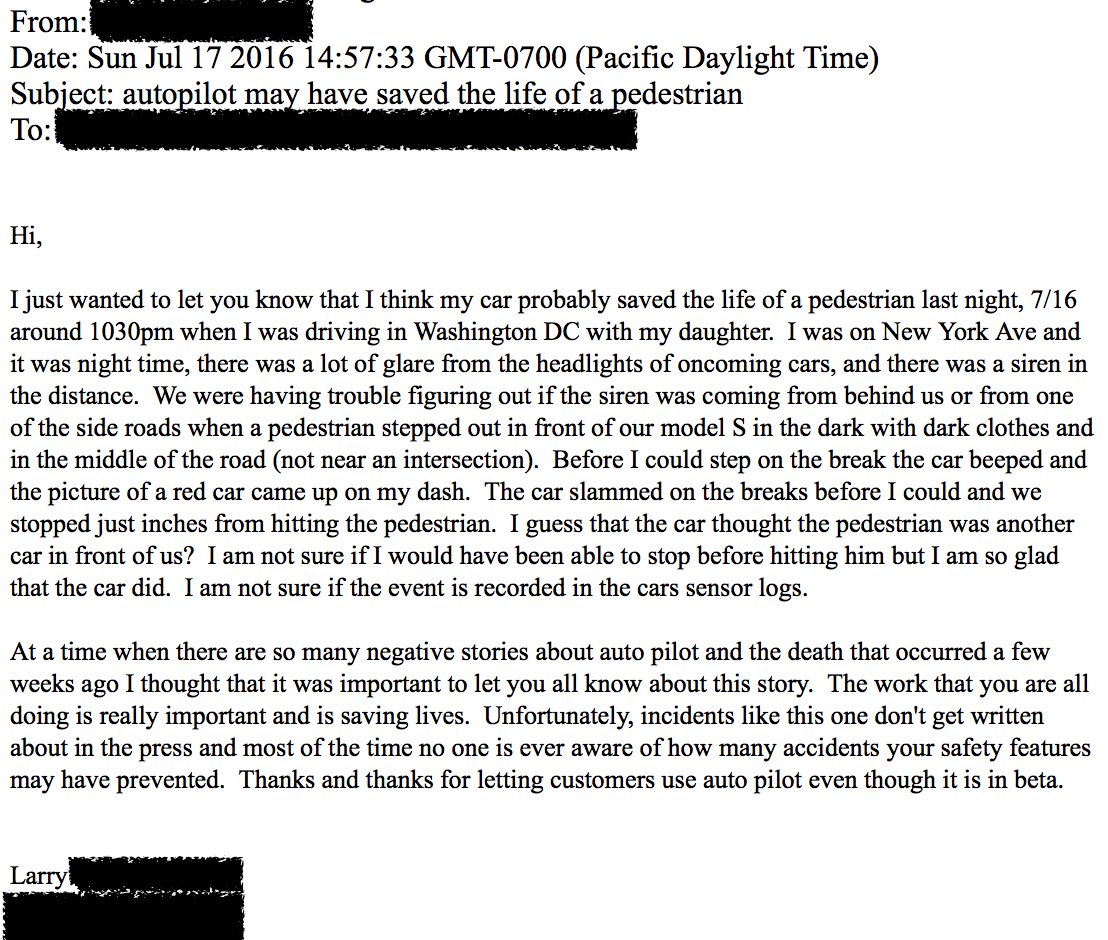
Tesla's Autopilot Mode Reportedly Saves Pedestrian's Life (electrek.co)
An anonymous reader writes: Following reports of Tesla's Autopilot mode being linked to a fatal crash, one Tesla Model S owner is reporting that the Autopilot mode has likely saved a pedestrian's life. The driver sent an email to Elon Musk explaining the situation, which was confirmed by Tesla through the vehicle logs: "I wanted to let you know that I think my car probably saved the life of a pedestrian last night, 7/16 around 10:30pm when I was driving in Washington DC with my daughter." The driver says him and his daughter were trying to locate where sirens were coming from "when a pedestrian stepped out in front of [their] Model S in the dark with dark clothes and in the middle of the road." The car slammed on its breaks before he could and "stopped just inches from hitting the pedestrian." The driver said, "I am not sure if I would have been able to stop before hitting him but I am so glad the car did." The Automatic Emergency Braking (AEB), which is standard on all Tesla vehicles and is part of Tesla's Autopilot mode, is what was at work here. It appears that many of the convenience features of Autopilot were not activated at the time of the incident. This is likely the first of many good press stories released by Elon Musk, who said he would consider releasing the stories of accidents prevented by the Autopilot mode with the authorization of the Tesla owners and by confirming the events through the vehicle logs. Elon Musk did also announce Tesla's 'Master Plan, Part Deux,' which includes new kinds of Tesla vehicles, expanded solar initiatives, updates on Tesla's 'autopilot' technology, and a ride-sharing program. -
Tesla Autopilot 2.0 Is Coming This Year, Source Confirms (technobuffalo.com)
An anonymous reader writes from a report via TechnoBuffalo: A source close to Tesla Motors confirmed to TechnoBuffalo that Tesla Autopilot 2.0 is coming soon. Other media outlets like Teslarati have reported on prototype Model S and Model X vehicles operating in the wild sporting two forward facing cameras, which may indicate part of the new hardware necessary to take advantage of Autopilot 2.0's additional features. "The dual camera system is capable of recognizing and reacting to stop signs and traffic lights with no driver input," said the source. The current Autopilot software cannot simply stop itself at a light or a stop sign on its own -- it needs a car in front of it in order to automatically slow down or stop. The added cameras should help Autopilot 2.0 read and react to traffic lights and stop signs, and thus bring Tesla's cars closer to autonomous driving. The source did mention that Tesla's current test vehicles with Autopilot 2.0 are running "very beta" software that was likely the precursor to v8.0. U.S. regulators are actively investigating 25,000 Tesla Model S cars after a fatal crash involving a vehicle using the "Autopilot" mode was reported. Despite the tragedy, Elon Musk recently said that Autopilot could save half a million lives every year if Tesla Autopilot was universally available. -
SolarCity Pushing Industry To 40% Increase In Useful Lifetime of Solar Power Installations (electrek.co)
An anonymous reader writes: SolarCity released a new report that says solar power systems have a usable lifetime of at least 35 years, which is 40% longer than what the market expects. Electrek reports: "The key finding of the report is that power degradation (annual efficiency loss) of solar panels supplied to SolarCity is as much as 35% lower than for a comparable industry-wide selection of non-SolarCity panels, which are typically expected to last for 25 years. In the study here, SolarCity looked at greater than 11,000 panels to determine their data points and come to their conclusion that their solar panels are performing well beyond expected industry standards. Today, standard efficiency solar panels put out by Tier 1 suppliers are generally warranted to lose no more than 0.7% efficiency per year for the first 25 years -- this is the Power Production Warranty. The key finding in this study is that the annual 0.7% efficiency loss is too high an estimation -- and that the number ought be closer to 0.5%. While it might seem a small number -- a difference of 0.2% -- when applied over a multiple decades timeframe, it means that instead of the standard twenty five year assumed productive life, we can expect at least another ten years of production above 80% of the original system output. Large installers like SolarCity, able to do this type of wide-scale research -- and to also demand higher quality, are showing their ability to pull the manufacturers of the world upward. With SolarCity building their own solar panel Gigafactory we ought expect the quality levels to be even greater in the near future. -
Tesla Owner Makes 'Solid Metal Snake' Self-Charging System That Elon Musk Promised (theverge.com)
An anonymous reader writes: Nearly two years ago, Elon Musk teased us with a robotic snake that would automatically plug-in and charge your Model S. Well, many months have passed and there has yet to be an official "solid metal snake" available for Tesla owners. So, one Tesla owner decided to make his own autonomous charging station, as spotted by Electrek, that will automatically guide the Model S's charging cable into the waiting receptacle with no human intervention required. The inventor Deepak Mital posted a video showing how it works, and while it's incredibly slow, it does work. Compared to the demo video of the system teased by Elon Musk last year, this version appears much less threatening. Mital calls it the "Evtron," which is controlled with a Raspberry Pi and swings from one side to another before sliding forward to make the connection with the car. -
Nikola Motor Receives Over 7,000 Preorders Worth Over $2.3 Billion For Its Electric Truck (electrek.co)
An anonymous reader writes: Last month, Nikola Motor unveiled the design of its first product -- an electric truck with a natural gas range extender called 'Nikola One.' The 'Nikola One' comes equipped with a massive 320 kWh battery pack that the company hopes can allow it to travel up to 1,200 miles with the natural gas range extender. Today, the company announced it has received over 7,000 pre-orders with deposits for the electric truck since its unveiling. CEO Trevor Milton says the pre-orders are worth over $2.3 billion. Milton said in a press release this morning: "Our technology is 10-15 years ahead of any other OEM in fuel efficiencies, MPG and emissions. We are the only OEM to have a near zero emission truck and still outperform diesel trucks running at 80,000 pounds. To have over 7,000 reservations totaling more than 2.3 billion dollars, with five months remaining until our unveiling ceremony, is unprecedented." Some other features of the truck include: 6x6 100% electric drive, zero idle, many times cleaner than diesel engines, half the fuel cost per mile compared to diesel, 3,700 FT. LBS Torque, 2,000 horsepower, one million miles fuel free, regenerative braking, and never plug-in feature as the turbine charges the batteries automatically while driving. This may sound familiar as the Tesla Model 3 received over 115,000 preorders worth $115 million in just 24 hours after its unveiling. -
Tesla: Model X Accident Caused By Driver Error, Not Autopilot (computerworld.com)
An anonymous reader writes: Tesla has responded to a recent report from a Model X owner claiming their vehicle suddenly accelerated at "maximum speed" by itself, jumped a curb and slammed into the side of a building while his wife was sitting behind the wheel. They said it analyzed vehicle logs, "which confirm that this Model X was operating correctly under manual control and was never in Autopilot or cruise control at the time of the incident or in the minutes before. Data shows that the vehicle was traveling at 6 mph when the accelerator pedal was abruptly increased to 100%. Consistent with the driver's action, the vehicle applied torque and accelerated as instructed. Safety is the top priority at Tesla and we engineer and build our cars with this foremost in mind. We are pleased that the driver is ok and ask our customers to exercise safe behavior when using our vehicles." When will people stop lying about Tesla's Autopilot mode crashing their cars? One Tesla owner recently filed a Lemon Law claim against the company over a high number of quality control issues. -
Norway Agrees On Banning New Sales Of Gas-Powered Cars By 2025: Report (electrek.co)
If you live in Norway, an all-electric future is likely closer than you think. The country's four leading political parties have agreed to a plan to stop selling gas-powered cars by 2025, according to a report. Electrek reports: The four main political parties, both from the right and the left, have agreed on a new energy policy that will include a ban on new gasoline-powered car sales as soon as 2025 -- making it one of the most aggressive timeline of its kind for such a policy. What's probably most remarkable here is that Norway is currently one of the world's largest Oil exporters.Tesla CEO Elon Musk was rather pleased with the announcement. He said, "Just heard that Norway will ban new sales of fuel cars in 2025. What an amazingly awesome country. You guys rock!!" -
Tesla Co-Founder Says Hydrogen Fuel Cells Are a 'Scam' (electrek.co)
Marc Tarpenning, co-founder of Tesla, believes hydrogen fuel cells are a "scam". Tarpenning, who is not with Tesla anymore appeared on Internet History Podcast last week to outline a number of issues with hydrogen fuel cells. He said (via Electrek blog): If your goal is to reduce energy consumption, petrol or whatever resource, you want to use it as efficiently as possible. You don't want to pick something that consumes a lot for whatever reason, and hydrogen is uniquely bad. There's a saying in the auto industry that hydrogen is the future of transportation and always will be. It's a scam as far as I can tell because the energy equation is terrible. People will say that hydrogen is the most abundant element in the universe, but it's abundant out there in the universe not here. We live on a planet where hydrogen is super reactive -- it's bound up into everything. It's bound up into water, wood and everything else. They only way that you get hydrogen requires you to pour energy into it to break it from the chemical bonds. Electrolysis is the most common method. You put electricity in water and it separates it, but you are pouring energy in order to make hydrogen, and then you have to compress it and that takes energy, and then you have to transport it to wherever you actually need it, which is really difficult because hydrogen is much harder to work with than gasoline or even natural gas -- and natural gas is not that easy. And then you ultimately have to place it into a car where you'll have a very high-pressure vessel which offers its own safety issues -- and that's only to convert it back again to electricity to make the car go because hydrogen fuel cell cars are really electric cars. They just have an extraordinary bad battery.Here's the podcast. -
Tesla Will Install More Energy Storage With SolarCity In 2016 Than The US Installed In 2015 (electrek.co)
An anonymous reader writes: Tesla is scheduled to install more energy storage capacity in 2016 with SolarCity alone than all of the US installed in 2015. It was revealed in a recent filing with the U.S. Securities and Exchange Commission (SEC) that Tesla foresees an almost 10x increase in sales to SolarCity for behind the meter storage. [From the SEC filing: "We recognized approximately $4.9 million in revenue from SolarCity during fiscal year 2015 for sales of energy storage governed by this master supply agreement, and anticipate recognizing approximately $44.0 million in such revenues during fiscal year 2016."] This revenue projection means Tesla expects to install approximately 116 MWh of behind the meter storage. The U.S. for example installed about 76 MWh of behind the meter storage. SolarCity and Tesla Energy doubled their battery installation volume last year. What's particularly noteworthy is that the 116 MWh expectation does not include SolarCity's biggest project -- Kauai Island's coming 52 MWh system. Hawaii is aiming for 100% renewable energy by 2045 and has contracted with SolarCity to balance the two 12MW Solar Power plants with the Kauai Island Utility Cooperative (KIUC). By 2020, there will be 70 GWh of Tesla battery storage on the road, and Straubel expects there to be 10 GWh of controllable load in those cars. -
Tesla Delays Launch of Model X Until Q3 2015
An anonymous reader writes "Tesla on Wednesday announced that it was pushing back the release of its highly anticipated Model X until the third quarter of 2015. Explaining the delay, Tesla relayed the following in its quarterly shareholder letter: "Work continues on the finalization of Model X with the testing of Alpha prototypes and initial builds of the first Beta prototypes. Model X powertrain development is almost complete with the early introduction of Dual Motor drive on Model S. We recently decided to build in significantly more validation testing time to achieve the best Model X possible. This will also allow for a more rapid production ramp compared to Model S in 2012." During Tesla's subsequent earnings conference call, Tesla CEO Elon Musk shed a bit more light on all things Model X, including the fact that if you order one today, it won't arrive until early 2016. Forbes goes into more on the business end of what's caused delays for the company, as well as how investors should see it (critically, they say).