Slashdot Mirror
Domain: flickr.com
Stories and comments across the archive that link to flickr.com.
Comments · 3,631
-
Re:mischeif
See also: "We can hear you..."
-
Re:Change channel / Try Kismet
Exactly what volume of popcorn are we talking if it takes 1.5 hours to pop in the microwave?
-
Re:Before you do it
Uhhh... I think he meant that the graph looks like a boob.
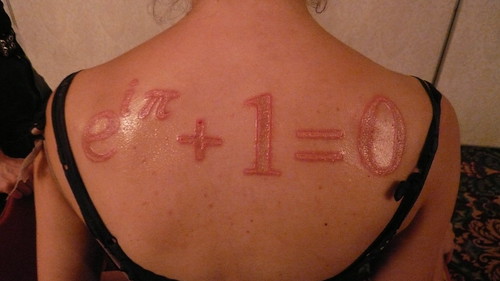
As an interesting item, here it is as scarification between the shoulderblades (SFW, not gruesome) -
Trekker Backpiece
Some might consider the Trekker option closer to fine:
http://www.flickr.com/photos/kencf0618/4719438855/
I've several palm-sized tattoos, all covered up. And mathemamatically, I'd go with phi.
-
Re:alternative choice
Along those lines:
http://www.flickr.com/photos/kencf0618/4719438819/
http://www.flickr.com/photos/kencf0618/4722147757/
And the inevitable counter-example:
-
Re:alternative choice
Along those lines:
http://www.flickr.com/photos/kencf0618/4719438819/
http://www.flickr.com/photos/kencf0618/4722147757/
And the inevitable counter-example:
-
Re:alternative choice
Along those lines:
http://www.flickr.com/photos/kencf0618/4719438819/
http://www.flickr.com/photos/kencf0618/4722147757/
And the inevitable counter-example:
-
Right Hand Rule
If you like Ohms law and Maxwell's equations, you must have some interest in electrical engineering. As such, don't forget the graphics. I highly recommend the right hand rule ripped off directly from , IEEE,
-
Qubit
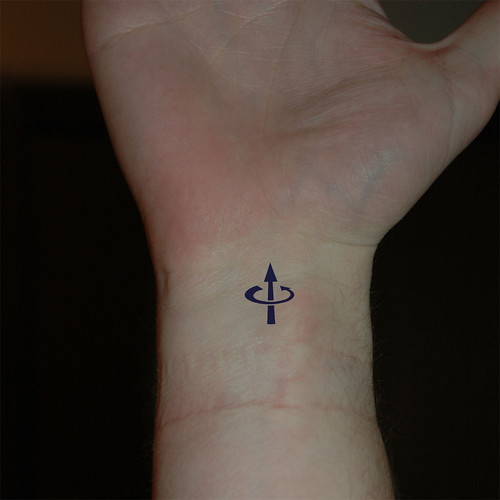
I have the equation for a qubit on the inside of my right wrist.
It's discrete enough for me not to look like a thug, and it can easily be covered with long sleeves.
Although quantum computing will change dramatically over time, this statement of the qubit will always be true, because it's a logical expression.
The only problem is when a girl sees it and asks what it means- I then have to give a vague answer, or risk boring her with geekdom.
I dream of a girl who will say 'No no, I really want to hear the long version! Maybe you could explain it to me at your place?'
-
Try this CERN T-Shirt
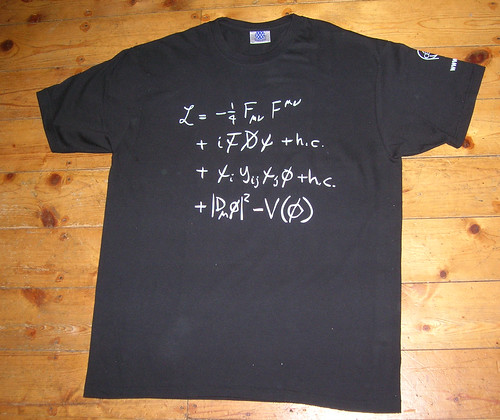
This one would give a nice large tattoo.
This is a T-shirt sold at CERN.
This equation neatly sums up our current understanding of fundamental particles and forces. It represents mathematically what we call the standard model of particle physics. The top line describes the forces: electricity, magnetism and the strong and weak nuclear forces. The second line describes how these forces act on the fundamental particles of matter, namely the quarks and leptons. The third line describes how these particles obtain their masses from the Higgs boson, and the fourth line enables the Higgs boson to do the job. Many experiments at CERN and other laboratories have verified the top two lines in detail. One of the primary objectives of the LHC is to see whether the Higgs boson exists and behaves as predicted by the last two lines.
I have one.
Alvie -
SpeakEasy sucks ass anyway - total liars
They claim "unlimited", then they kick you out if you actually dare to download more than 100G in a month. And they lie about it in pre-sales: http://www.flickr.com/photos/clintjcl/76331293/ -- And oh, they threatened me with a $300 early termination fee for THEM terminating ME, they told me they'd waive it only if I didn't talk about it online. Hah.
-
speakeasy are LIARS
They say "unlimited", then they kick you out if you actually dare to download more than 100G. And they lie about it in pre-sales: http://www.flickr.com/photos/clintjcl/76331293/
-
Re:Wow
This guy seems to be enjoying it. I guess it's to be expected if the shirt, haircut and his frail frame is any indication of his personal "lifestyle".
-
Re:Wow
Ha, if you're serious at all, thisshould be enough to help
-
Firsthand Experience with Getty
About a year ago I was invited and signed up with Getty through the initial program with Flickr. I had many discussions with friends who are professional photographers about whether or not I should sign up, and most echo what is being said here: the royalty rates are too low. This is a fair assessment; Getty pays between 20% to 30% commission for photos(depending on the license type), far below what most stock and micro-stock agencies will pay. For me however, the other advantages far outweighed the lower royalty rates. Having Getty handle everything is for me worth the fat cut they take. They are a large agency, and do attract a huge amount of customers, most being corporate-use type who are use to paying high amounts for photos. They will go after cases of infringement of photos licensed through them. Finally, I get bragging rights to be able to say I contract with Getty (this makes my pro photographer friends very mad. Now we have an understanding not to mention the "G" word). Basically, once I sat down, counted the cost and the other options, I decided it was worth signing up for. I've made enough money to keep me happy and be able to support my expensive photography habit.
Getty itself is in a interesting position here. For the longest time, stock photography was the domain of professional photographers. With the advent of digital photography, there's a new wave of pro-amateurs that have flourished in sites like Flickr. At the same time, traditional photographers worked themselves into a conformable niche shooting increasingly cliche photos. Creative professionals eventually started noticing they could find more creative photos on sites like Flickr and negotiate dirt-cheap rates directly with the photographer cutting out agencies like Getty out altogether. The deal between Getty and Flickr was smart play from Getty to keep themselves relevant in the changing market. There's still a need for a photo agency to do the middle-man work of contracts, licensing, releases, research, etc., at least for now.
So, in summary, this move is good for Getty, good for non-professional photographers, and not good for existing professional photographers.
btw, if anyone is interested, here's my small catalog on Getty and a shameless plug for my site on Flickr
-
diy solar
I skipped the yearly trip to Vegas and invested some time and money in small scale solar for the house. Best 1K I ever spent. Running the entire outdoors media system and lights on solar.
DIY Solar project.
http://www.flickr.com/photos/nsaspook/sets/72157622934371746/show/ -
Re:I demand
-
Re:Oh Canada
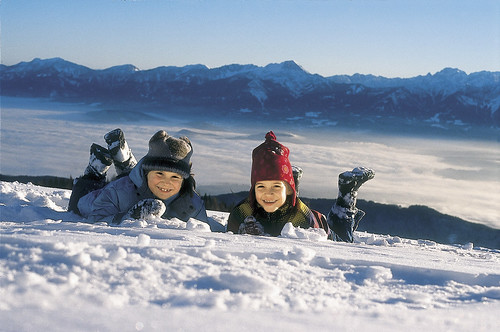
Oh, no. Snow. How terrible.
-
Re:How stupid.
Rule 34 please...
oh wait, never mind, Google provides:
I don't need to say these are probably NSFW for you now do I???
-
Speaking of creepy if ironic ads
-
I'm just hoping we capture the event ...
They are journalists, after all. I hope people are ready with their cameras to contribute to the wonderful collection of humanity that is first goatse before the surprise value is lost from reading about it in the press.
-
More like decelerated
Linux currently lacks a developed standard API that supports H.264 hardware video decoding, and Mac OS X does not expose access to the required APIs.
The Linux thing might be true. Even if there was one universally implemented GL desktop standard, that's not the same as having a universally implemented hardware decoding API. They're pretty much orthogonal. As far as OS X, though, nothing changes the fact that Flash uses 3x as much CPU as VLC to render the same video. Spare me the apologist line of "Flash does more work than VLC!" - maybe that's their whole problem. You'd think something as widely used would have some optimized codepaths for the most common use case of playing Youtube videos.
-
Re:In the rest of the world
My Toyota Camry Hybrid has exactly that
-
Greenpeace's Design New Logo For BP Contest
Enter here.
See some nice new logos for BP.
-
Sign Sign Everywhere a Sign
Maybe they should pay attention to their own rules: http://www.flickr.com/photos/therachelmaddowshow/4667450260/?
-
Re:scale argument is bogus
Show me a website that makes that data accessible in a consistent and easy-to-use manner that's comparable to Streetview as of today or
Here you go:
You type in you address and if the images are there, they'll pop up. There are two things that make it not quite like Streetview. (1) The coverage is not there yet because many people don't have GPS in their cameras yet, but that's not a technological restriction. (2) The images aren't integrated across views, but that is unrelated to the privacy concerns. You keep talking about. For the purposes of the privacy issues, this technology is equivalent to Streetview. Anything you could possibly be concerned about in Streetview you can be concerned about in Flickr map search.
Anything going beyond that is putting words in my mouth and ascribing positions to me that I haven't taken.
I'm not putting words in your mouth, I'm trying to get you to take a clear position. Instead you hide behind vague innuendo with words like "issue". It's the same kind of FUD that governments use to push their anti-data-protection agendas.
Bottom line; I said that I considered Google's large-scale, consistent data gathering to be different- in *effect*- to disparate, uncoordinated data gathering by random people.
No, you did not just say that it was "different in effect", you said that it was "an issue" (your words, in bold). The term "issue" means more than just being "different in effect", you're implying that there is a problem that needs a solution.
So, what is the "issue"? Who is (negatively) affected by the "issue" and how? How do you want this "issue" addressed? Is it feasible to address it?
-
Re:Lemote Yeelong
-
Re:copyrights
many works these days aren't the work of individuals, but corporations, and cost a LOT of money to make (i.e., movies).
That's true of movies but not other art work, and it is not necessary for movies to cost a lot to make, even in recent history. Made in 1999 The Blair Witch Project the "final budget was somewhere between $500,000 and $750,000." Yet it's world wide gross was almost $250 Million. The cost to write a book or write and compose music is even cheaper. It's not expensive to paint either. People with pocket cameras costing only a few hundred dollars make hundreds of dollars a week, well maybe not now but before the recession. With the recession now, pro photographers complain those amateurs taking away their clients. Microstock agencies like iStockphoto as well as photo sharing websites like Flickr are even taking sales away from venerable stock agencies.
They're not going to make as many blockbuster movies if their distribution rights disappear after only 5 years.
One, if they want money to keep coming in they'll make even more. But two, even if so so what? People can go back to how it used to be, and still is in some local scenes, producing art for local consumption. Almost every hit artist now started small. I recall years ago going to parties where people would bring their own instruments, get together, and play music. Others may stage a skit. Though it was too long ago for me, I used to dance on stage as well as work behind the scenes on plays. I have a flute from David Nighteagle I want to learn to play. I used to play the clarinet but that was more than 30 years ago.
Many companies would gladly pay a few million to secure distribution rights for another decade, and then this money would finance the system, so that the government doesn't need to tax anyone.
If government were small it wouldn't need much taxes.
You're no liberal if you believe in small government (if you're in the USA). That's a libertarian viewpoint.
Again you're wrong, you didn't even read the wiki article I linked to: "Classical liberalism is a political ideology that developed in the 19th century in England, Western Europe, and the Americas. It is committed to the ideal of limited government and liberty of individuals including freedom of religion, speech, press, assembly, and free markets." Notice "and the Americas". In the USA two of those liberals were Thomas Jefferson and his friend James Madison. Today's libertarian is yesteryear's liberal.
I don't care how small the government is, it still needs money to administer the copyright office (not to mention the patent and trademark office). Why not fund it from companies wanting longer copyright terms on their works?
As I hinted at in the post above I'd abolish the patent office. It already costs money to register trademarks and it's the responsibility of the holder to defend it not the government. The same with copyrights. All the copyright and trademark offices need do is put them in the registery, for what's copyrighted in the Library of Congress (LoC) and for trademarks I don't know where those go, perhaps they can be put in the LoC too.
Falcon
-
Re:Things like this...
I'd say the early Mobiras (first NMT phones) were exactly that:
http://www.nokiamuseum.com/view.php?model=Mobira%20Talkman
http://www.flickr.com/photos/21877990@N03/2162232049/ -
not gonna make it
They aren't even going to make it to Fairbanks without having to have the thing flatbedded. They are starting their trip with 400 miles of rough gravel road. In a track car. http://www.flickr.com/photos/smailtronic/1430466628/ 400 miles of that. In a track car.
-
Re:IBM is headed that way too
I did a preso on it back in 2007 at the Ubuntu Georgia Gutsy Gibbon InstallFest. Look for my ODP down at the bottom of: https://wiki.ubuntu.com/GeorgiaUSTeam/Events/GutsyGibbonInstallFest and a pic from the actual event: http://www.flickr.com/photos/ubuntugeorgia/1958309545/
-
Re:Best Towel Rack
http://farm1.static.flickr.com/224/513235829_c6ebab39af_o.jpg
backup link - http://www.flickr.com/photos/kitta/513235829/sizes/o/
triple backup link http://www.flickr.com/photos/kitta/
These are nice as well (NSFW):
http://www.redbloodedthing.com/blog/pics/front-magazine-cute-breasts-outside-beach-towel.jpg
http://img2.photographersdirect.com/img/25898/wm/pd1997135.jpg -
Re:Best Towel Rack
http://farm1.static.flickr.com/224/513235829_c6ebab39af_o.jpg
backup link - http://www.flickr.com/photos/kitta/513235829/sizes/o/
triple backup link http://www.flickr.com/photos/kitta/
These are nice as well (NSFW):
http://www.redbloodedthing.com/blog/pics/front-magazine-cute-breasts-outside-beach-towel.jpg
http://img2.photographersdirect.com/img/25898/wm/pd1997135.jpg -
Re:Best Towel Rack
http://farm1.static.flickr.com/224/513235829_c6ebab39af_o.jpg
backup link - http://www.flickr.com/photos/kitta/513235829/sizes/o/
triple backup link http://www.flickr.com/photos/kitta/
These are nice as well (NSFW):
http://www.redbloodedthing.com/blog/pics/front-magazine-cute-breasts-outside-beach-towel.jpg
http://img2.photographersdirect.com/img/25898/wm/pd1997135.jpg -
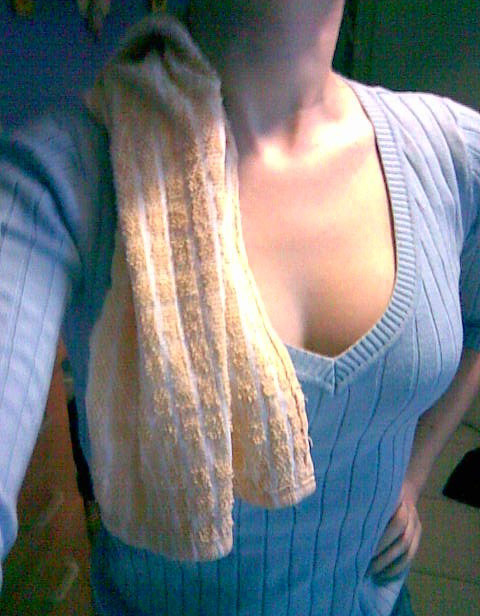
Best Towel Rack
-
Best Towel Rack
-
Best Towel Rack
-
Re:Of course there are opportunities.
The ham radio project was the AVT system, a system for sending and receiving analog (AFSK) slow scan television. The AVT format uses a combination of synchronous formats, multiple (32) start-time headers and time-wise interlace to reduce the effect of fading and long period interference on image reception. You could lose as much as 25% of the signal in a single chunk and still be able to reconstruct a very good reproduction of the entire image. That, added to the fact that you had 32 chances to get a proper synchronous start (and the ability to start manually if you simply heard the signal late), made the system surprisingly robust, even under conditions where voice was out of the question.
I developed the system myself, a spare time kind of thing, then AEA, a then-largish ham radio company, heard about it on the air, invited me out to their headquarters for discussions and so forth, and finally bought the rights and had me do a version two that was a bit more polished and had some additional hardware features (like a telephone interface.) Right now, with the sunspot numbers so low, there's almost no SSTV activity, so there's nothing to hear. In a few years it'll be back again, though, and it'll be interesting to see what happens with the mode -- presuming there are many hams left, that is. Ham radio isn't what it used to be, let me tell you.
It was almost entirely a "garage" effort. I wrote the PCB layout software I laid out the board with, and I designed the board on that; I wrote the schematic capture software, and I designed the electronics on that; I wrote the cross-macro-assembler for the microcontroller, and I wrote the code using that; I wrote the code for the host computer; and I invented the AVT modes themselves. I designed the CPU burner that I used to burn the microcontroller when I worked at a company that made UV erasers and burners, and I also wrote the utility that transferred the assembled code to the burner. I used two key outside tools, Rick Stiles UEDIT and Lattice's c compiler (to write the tools and the host machine's software.) Other than that, it was strictly garage work. If I didn't already have it, I undertook to make it. Don't ask why, there is no reasonable answer to that.
The moneymaker was a high speed image layering system that incorporated real-time geometric effects. So you could put waves or swirls or other distortions on an image and slide them around as an image layer without ever doing anything destructive to the image(s) underneath the geometric effect. This, implemented as an upgrade to a very powerful but at the time, non-layered, special effects and image animation/editing system (and combined with some very competitive pricing), kept interest in the software relatively high without any particular marketing effort -- and when you can sell software steadily at even moderate prices, but have little overhead and no debt... that's really good for the bottom line, let me tell you. Here is an example of using warp layers; that's how I did the tiny model's wake in the diorama.
The warp layers can do morphing and warping, zooms, reductions, almost any geometric effect you can imagine. And they stack over/between each other and other layer types and warp each other, as well -- they're truly layers. For instance, you stack two sets of waves, you get wave interference, just like you would if those waves were crossing the water. Or you can put multiple geometric effects into one warp layer if you prefer (it's more flexible the other way, though.) Add to that the "usual" layer abilities such as you'd find in Photoshop and etc., and you have something useful. There are 70+ layer modes in the system, including 20-odd standard types and a raft of specialized masking modes, but the geometric mode is the star.
The actual low level implementation was the thing that hit me. We sold morphing and warping software already, but it
-
Re:Of course there are opportunities.
The ham radio project was the AVT system, a system for sending and receiving analog (AFSK) slow scan television. The AVT format uses a combination of synchronous formats, multiple (32) start-time headers and time-wise interlace to reduce the effect of fading and long period interference on image reception. You could lose as much as 25% of the signal in a single chunk and still be able to reconstruct a very good reproduction of the entire image. That, added to the fact that you had 32 chances to get a proper synchronous start (and the ability to start manually if you simply heard the signal late), made the system surprisingly robust, even under conditions where voice was out of the question.
I developed the system myself, a spare time kind of thing, then AEA, a then-largish ham radio company, heard about it on the air, invited me out to their headquarters for discussions and so forth, and finally bought the rights and had me do a version two that was a bit more polished and had some additional hardware features (like a telephone interface.) Right now, with the sunspot numbers so low, there's almost no SSTV activity, so there's nothing to hear. In a few years it'll be back again, though, and it'll be interesting to see what happens with the mode -- presuming there are many hams left, that is. Ham radio isn't what it used to be, let me tell you.
It was almost entirely a "garage" effort. I wrote the PCB layout software I laid out the board with, and I designed the board on that; I wrote the schematic capture software, and I designed the electronics on that; I wrote the cross-macro-assembler for the microcontroller, and I wrote the code using that; I wrote the code for the host computer; and I invented the AVT modes themselves. I designed the CPU burner that I used to burn the microcontroller when I worked at a company that made UV erasers and burners, and I also wrote the utility that transferred the assembled code to the burner. I used two key outside tools, Rick Stiles UEDIT and Lattice's c compiler (to write the tools and the host machine's software.) Other than that, it was strictly garage work. If I didn't already have it, I undertook to make it. Don't ask why, there is no reasonable answer to that.
The moneymaker was a high speed image layering system that incorporated real-time geometric effects. So you could put waves or swirls or other distortions on an image and slide them around as an image layer without ever doing anything destructive to the image(s) underneath the geometric effect. This, implemented as an upgrade to a very powerful but at the time, non-layered, special effects and image animation/editing system (and combined with some very competitive pricing), kept interest in the software relatively high without any particular marketing effort -- and when you can sell software steadily at even moderate prices, but have little overhead and no debt... that's really good for the bottom line, let me tell you. Here is an example of using warp layers; that's how I did the tiny model's wake in the diorama.
The warp layers can do morphing and warping, zooms, reductions, almost any geometric effect you can imagine. And they stack over/between each other and other layer types and warp each other, as well -- they're truly layers. For instance, you stack two sets of waves, you get wave interference, just like you would if those waves were crossing the water. Or you can put multiple geometric effects into one warp layer if you prefer (it's more flexible the other way, though.) Add to that the "usual" layer abilities such as you'd find in Photoshop and etc., and you have something useful. There are 70+ layer modes in the system, including 20-odd standard types and a raft of specialized masking modes, but the geometric mode is the star.
The actual low level implementation was the thing that hit me. We sold morphing and warping software already, but it
-
Been done before
That's nothing new. I saw an entire robot orchestra at House on the Rock 18 years ago!
http://www.flickr.com/photos/decibelle/375548979/
What? You mean they weren't really playing those instruments? -
Re:Bunk test
So why are cell phone cameras (still and video) so popular?
They aren't. From my experience, hardly anybody actually uses phone cameras, unless they are really desperate and have no alternative camera at hand.
I could say my experience is the complete opposite, which it is, but since both are just anecdotal it made me curious to find out if there are any data on this.
According to Flickr usage statistics iPhone is the most used camera on Flickr. http://www.flickr.com/cameras/
Just one datapoint, I know. But seems at the very least to disprove the hardly used by anybody theory. I would guess, but have no data, that the complete different experiences people have on this comes down to demographic differences (mobile markets and usage very different from country to country, and age group to age group, etc).
Myself I find I'm using my mobile camera more, they have gotten quite good, and regular camera less. But I could still agree with your claim it is just because I don't have another camera with me, because that is mostly true, I usually don't go around with a camera, but I absolutely always have my mobile with me (currently a HTC HD2, so not in the iPhone group myself)
-
Russian man aims to reinvent Taser technology
-
Re:Yeah. That's it.
Old screenshot: genital warts image results (SFW).
NO!!! ImageLogr will SCRAPE IT!!!!!! NOOOoooo!!!!!!....
-
Re:Yeah. That's it.
Keep up that attitude, and we'll put it on a Pro-Herpes-Drug ad.
"Herpes. It's what's for dinner."
Yes, I know, way, way too far.
-TaylorActually, not too far from the truth. Do a google image search for genital warts. You know all those spam sites that return "The Best ____" where ____ is whatever your search term was?
Old screenshot: genital warts image results (SFW).
-
Re:Where can I get a robot?
Great, so where can I get a cheap compatible robot and what kind of stuff can I program it to do?
-
Re:Seems reasonable
From what I see, the gap between west and Islam is only going to grow with stuff like cartoons of Mohammed, these guys are akin to suscide bombers of afghanistan, working towards inciting violence (which BTW is a crime in Canada).
You're not the first Muslim to present an argument like that and I have a question I'd like you to answer:
There's no doubt that the cartoons have resulted in violence but that has been by Muslims and there's also no doubt that there has been violence against Muslims due to idiots equating all of you with terrorists but how much violence against Muslims have the cartoons as such incited non-Muslims to?
IMNSHO the answer is: None. The cartoons don't incite violence. What incites hate and violence, is Muslims that react with violence. And it doesn't exactly help the situation, if Muslims hold signs like "behead those who insult Islam" or exercise their right to free speech with the most ironic sign all. If your reaction was to shrug it of and be mature, it would make the cartoonists look bad instead.
-
Same here ...
... in Virginia Beach. You are not allowed to swear out on the boardwalk. http://www.flickr.com/photos/christopherdale/23860378/ Picture of the signs they have posted up and down the board walk. I believe you receive a fine for violating it.
-
My copy of the Anarchist Cookbook...
I took a copy of the older Anarchist Cookbook to PAX, shortly after the airing of Leverage in which Wil Wheaton played the hacker Chaos.... and asked him to sign it as such. He thought for a moment, then handed this back. Too meta?
-
On stage...Curiously fitting that I'm just back from one leg of a tour of a modern dance piece using Ableton, MaxMSP, Arduino, Python and Lasers.
Pix: http://www.flickr.com/photos/cassiel-com/sets/72157622557842760/
-
Re:I'll wait for Unit 02 ...