Slashdot Mirror
Domain: globalsecurity.org
Stories and comments across the archive that link to globalsecurity.org.
Comments · 973
-
Re:Invading privacy?
I would like to see 100% of the American border guarded by:
https://www.globalsecurity.org/military/systems/munitions/shm.htm
https://www.airforce-technology.com/projects/predator-uav/
https://foxtrotalpha.jalopnik.com/the-air-force-is-retiring-the-predator-drone-for-the-mo-1792832541
https://scholarlycommons.law.case.edu/cgi/viewcontent.cgi?article=1024&context=jilThe fewer human beings that are involved in the defense of no-man's-land style borders, the better.
But then again, I'm an anti-globalist who wants to stop smuggling and trade. Stopping immigration is just a byproduct of ending the first two.
-
Might wanna check those preconceptions...
Unless there is something VERY special about Norway, a wide-spread trend that cannot be attributed to education, gender, religion, or other environmental factor has pretty good predictive qualities, since the sample size is large, and unbiased (Only males tested most likely, but the service is compulsory, not voluntary.
Service in Norway is NOT compulsory.
https://en.wikipedia.org/wiki/...About 60,000 Norwegians are available for conscription every year, but only 8,000 to 10,000 are conscripted.[2] In earlier times, up until at least the early 2000s, all men aged 19â"44 were subject to mandatory service, with good reasons required to avoid becoming drafted.
Besides that decline in conscription, actual numbers of conscripts are around 14% of eligible Norwegian males, cause "the number of applicants each year exceeds the needs of the Armed Forces".
Further, researchers aren't showing a decline of IQ in Norway, nor anywhere else.
They are working with a presumption of a decline in IQ and trying to hammer their "observation" peg into that presumed roundish hole.Using administrative register data with information on family relationships and cognitive ability for three decades of Norwegian male birth cohorts, we show that the increase, turning point, and decline of the Flynn effect can be recovered from within-family variation in intelligence scores.
This establishes that the large changes in average cohort intelligence reflect environmental factors and not changing composition of parents, which in turn rules out several prominent hypotheses for retrograde Flynn effects.I.e. They claim that they can explain presumed IQ decline by extrapolating measured in-family IQ decline.
Problem is - they don't actually have the data to show that. And they are blind to their own biases regarding all the preconceptions they are juggling.From study's appendix it's pretty obvious that the IQ sample was both changing in structure AND reducing in sample size over the years.
Number of recruits born between 1964 and 1972 varied between 30440 and 32148.
1973-1980 we see a drop from 29159 down to 23900.
1981-1989 rises slowly from 23317 up to 26484.But far more important is the fact that they are NOT ACTUALLY FINDING THE IQ DECLINE AMONG THE NORWEGIAN CONSCRIPTS.
All that they ARE accurately finding is that the number of IQ tests among conscripts has declined by 10 percentage points, over a decade.From TFS:
Conscription test coverage declined substantially for cohorts born after 1980, with coverage rates falling from 93% in 1980 to 83% in 1991 (Fig. 3A).
So not only is the number of conscripts declining, number of conscripts taking IQ tests has declined even more.
Which they then take to consideration - and pull the following nonsense out of the thin air.Focusing on families with sons in the first two parities and plotting the share of unscored younger siblings by the observed IQ score of the older brother, lower scoring firstborns were more likely to have unscored younger brothers (Fig. 3B).
The problem is exacerbated toward the end of our data window: Among the 198-1991 birth cohorts, fully 30% of those whose older sibling scored in the bottom IQ bracket have missing IQ scores.
As sibling scores are correlated, this implies that low-ability males are less likely to be scored, and that the selection was stronger for the cohorts born in the late 1980s than for those from the 1960s and 1970s.I.e. Not only are they ASSUMING correlation between IQs of sibli
-
Re:Why are twin jets cheaper to run?
The efficiency of a turbofan (which is what those "jets" really are) is limited by how big you can make the fan part. This is a basic property, and applies to propellers too.
If you look on a modern airliner, they have "high bypass" turbofans, meaning the fan part is a lot bigger than the jet part. They've basically made the engines as big as they possibly can: most of them are mounted in front of the wings, not slung under them, so the intake and fan can actually extend up above the wing, and often the bottom of the cowling is flattened to give a bit extra ground clearance. Contrast that with older jets that had these long skinny little engine nacelles slung under the wing.
Your ideal design for an efficient jet would be one gigantic engine right in the middle, but unfortunately that's where you want to put the passengers. Your next best bet is to have two engines that are as big as you can get, to either side. A twinjet.
-
Re:US DoD Active Directories are larger
Uh, that site says 450,000 overseas. Try this site http://www.globalsecurity.org/... , 1.3M Active Duty, 750,000 civilians plus Guard and Reserve. Any way you slice it more than 400,000 desktops per service, most in the process of migrating to Win10.
-
Re:Why did we/are we building it?
So, are there any TECHNICAL reasons why the SLS booster is better than the booster for the Interplanetary Colonial Transport? While, it has been under development for (far) longer and cost much more, as the delays keep piling up it might not get finished before the ICT. Like, is it safer? (though I doubt it with the use of solid rockets in its heavy version).
No. There are no technical reasons. There is a military reason.
SLS, and Constellation and Shuttle before it, exist for the purpose of pretending that military spending isn't military spending. They are there to continue funneling money into ATK, maker of the solid fuel rockets. Why? Because the other name for a solid fuel rocket is 'ICBM', but the Air Force hasn't been allowed to buy new ICBMs since 1978, when the production run of the Minuteman III ended. The START treaties started requiring reductions in the number of missiles allowed by the US and Russia. They've been maintaining their current fleet of Minuteman III missiles, which were first deployed in 1970. Without Shuttle and Constellation and SLS, ATK may have lost the expertise to build solid fuel rockets of the required size, which would have been a strategic loss.
The Air Force is trying to convince Congress to spend many billions to replace all of the Minuteman III missiles. Solid fuels have a long shelf life, but still limited. The Air Force spends billions and does regular test launches to make sure they still work[1], but they're worried that they're reaching the end of their useful lives.
Donald Trump is already convinced that they need replacing, as evidenced by his public speeches and by his administration's budget proposal. Getting Congress to agree is the hard part. If they succeed, watch the solid fueled booster requirement for SLS silently vanish. If they fail, which is far more likely because of the terrible optics of "we're going to spend tens of billions of dollars to build new nuclear warhead delivery systems", SLS will continue to muddle along, absorbing silly amounts of money to build a rocket nobody needs[2] as slowly as possible.
----
[1] They do. America's dick is still bigger than North Korea's dick. Yay. </sarcasm>
[2] At that price. -
Re:Tubes or Tunnels?
The idea of a copter is great until you get to the 2 to 4 hours of maintenance for each flight hour.
Then there's the glide ratio being roughly the same as a set of car keys... and auto-rotation is not so much gliding as it is praying a clutch will save you.
I like how Global Security described helicopter pilots: "They know if something bad has not happened it is about to."
And the best quote was right near the top of the page, "Helicopters don't fly -- they beat the air into submission."
http://www.globalsecurity.org/military/systems/aircraft/rotary.htm -
Re:Good, then we can scrap that stupid f-35
For comparison purposes, the F-16 has a mishap rate, per 100,000 flight hours of 4.14 (apparently making it the safest single-engine multirole fighter around). The two-engine F-15 has a lower rate, at 2.47; but the F/A-18, also two-engined, has a higher rate, at 4.9. Source. These three aircraft are all from roughly the same era, so teething problems should affect them equally.
-
Re:Still higher than a Soyuz launch
Where did you get you number? That's way lower than what these guys think the Soyuz cost is: http://www.globalsecurity.org/...
Also, geostationary != LEO.
-
Re: A simple exercise
You don't count Russia as a peer country? They have the ability to completely destroy the United States 45 minutes after Putin makes a phone call. If nukes are too theoretical for you, consider this: They can occupy several NATO members, overnight, and present us with a fait accompli. Then we get to choose between a protracted war, with a nuclear armed state, or the abandonment of those allies and collapse of the post-1945 world order. NATO would probably win a protracted war with Russia -- assuming it didn't go nuclear, a very big assumption -- since economics, technology, and demographics are on our side, but it would be very costly in terms of blood and treasure.
China is definitely a near-peer country. They already have the ability -- without using nukes -- to make it extremely costly for us to honor our commitments to our Asian allies. They can rain conventional missiles down on American soil -- Guam and the NMI -- and if a conflict went nuclear they could exact a very heavy price from CONUS. The rest of the near-peers are all allies (Germany, UK, France, Japan, Israel) or at least friendly competitors (India), so we've got that going for us at least.
(Actually, I'm glad that we dominate -- I just think it's a bit overkill to do so by so wide a margin.)
Well, that's an interesting observation. You kind of surprised me with that one. Why is it "overkill?" You specifically cited the USN to prove your point but I think you're ignoring the reality that the USN has obligations in every ocean and sea on the blue marble. 10 supercarriers sounds like overkill, but in reality you can only deploy about 1/3 of them at any given time; the rest will be in the yard for maintenance and overhaul. Four of them are deployed right now, which may be four more than anyone else has, but it's still pretty thin coverage when you think about the demands placed on the USN.
Don't get me wrong, I do see a lot of waste with our defense spending. I'm not certain why we still maintain a force of ICBMs when SSBNs are infinitely more survivable. I don't understand why cheap and proven platforms like the A-10 fall out of favor. There's a lot of things I would do differently if I was SecDef. Alas, he hasn't asked me for my opinion.
-
Re:Reality demonstrated otherwise to movies
The effort to recover radioactive material from the satellite was dubbed Operation Morning Light. Covering a total area of 124,000 square kilometres (48,000sqmi), the joint Canadian-American team swept the area by foot and air in Phase I from January 24, 1978 to April 20, 1978 and Phase II from April 21, 1978 to October 15, 1978. They were ultimately able to recover 12 large pieces of the satellite. All but two of the fragments recovered were radioactive. These pieces displayed radioactivity of up to 1.1 sieverts per hour, yet they only comprised an estimated 1% of the fuel. One fragment had a radiation level of 500 R/h, which "is sufficient to kill a person
Even "Readers Digest" had a very good story on the incident.
could not find, but good stuff
-
Re: So happy. :)
North Korea, too: http://www.globalsecurity.org/...
-
Re:Archimedes had calculus
I don't believe the Great Flood was a myth. The "world" at that time was centered around the Euphrates river. Going by the description in some of the clay tablets, it would seem that someone upstream may have decided to destroy a natural dam out of revenge right when the mountain snow was melting in Spring (The Epic of Gilgamesh). That would have unleased a torrent of water 40x that of normal, and led to up to 11 feet of mud being deposited on the lower plains.
http://www.globalsecurity.org/...
https://newrepublic.com/articl...
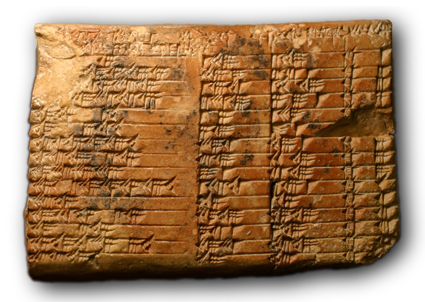
The layout of some of these clay tablets looks like someone invented the spreadsheet before the computer:
http://isaw.nyu.edu/exhibition...http://isaw.nyu.edu/exhibition...
They even invented a tablet with round corners before Apple:
-
Re:EU and US
This. Just to make the point even clearer, it takes a long, long time to go from ore to bomb grade uranium. The only way to speed up the process is to scale it up -- to have lots and lots of centrifuges working in parallel on lots and lots of uranium, like the US did in the Manhattan Project. Here is what our plant looked like. You can also peruse aerial images Pakistan's enrichment facility to see what a more modern plant would look like. These are not small, readily concealable facilities.
Is it possible that Iran is operating centrifuges completely underground where our intelligence services can't see them, as the GP poster claims? Sure, but only if their patient enough to wait decades to produce enough HEU for a bomb. The construction of an underground facility large enough to achieve "fast breakout" would be if anything harder to conceal than a surface plant. All the other parts of making a bomb and a delivery system are readily concealable, which is why anti-proliferation efforts focus on fuel. That means either Pu production, which would be very hard to conceal, or uranium enrichment, which is impossible.
So what paths does this leave Iran to "fast breakout"? Well, without a concealable enrichment program they'd have access to secret stashes of fuel that's already bomb grade or nearly so. But if that were the case the game's essentially over; there's nothing left that further sanctions could accomplish.
-
Nation's 'BIGGEST' wiretap operation, HA HA!
I love the headline (really do, no
FRANKLIN: I take it you mean the interception of private letters? We affix waxen seals to guard against casual inspection should carriers desire to do this, though there are some with great skill in revealing their contents. Steam from a kettle is often employed. But it is surely an unreasonable search for a government to do so. We also at times employ clever codes.
MACHIAVELLI: It is hard to imagine why such inspection would be desired for the massive daily packets that traverse cities, nations and oceans. Would not the burden of reading become tiresome?
STALIN: I instruct my post office to tear everything open whether there is time to read them or not. They rifle and crumple the contents. Some times they even stain the letters with wine to give correspondents the impression that there was a great feast and their precious documents were passed hand to hand and read aloud. In order to preserve equanimity the State must keep all persons on uneven footing.ME: In these times hardly anyone speaks in code and there are no seals. We speak into our devices plainly, and the paper packet has become a flowing river of letters passed over wires. Any communication can span the globe.
FRANKLIN: No seals and plain speech everywhere. What an enlightened time!
MACHIAVELLI: So those who talk greatly outnumber those who might listen? In the cacophony of such a mob secrets may be shouted yet unheard.
STALIN: This is madness. Every telephone conversation across the border had a listener. If one was not available the operator would ring you back, at times days later. Shut it all down before it is too late.
FRANKLIN: Surely our government takes steps to protect its citizens from having their conversations heard by hostile governments?ME: You guys are so behind the times. These are not just voices, everyone is identified and it so happens that the United States Government does most of the listening throughout the entire world, even and especially to its own citizens. People all over the world consider us scoundrels for doing this. They can even store voices and play them back years later. If a tyrant should arise, the Militia will discover that their own names and entire personal histories are laid bare, so the tyrant can clean house more efficiently than any in history.
FRANKLIN: How... can.... this.... be?? No,no no!-------- LOST CARRIER
MACHIAVELLI: How crude and uninteresting. So this is a simple story of gross stupidity and madness then. Ah, and I had hoped that as time progressed the plots of men would become more intricate. I think I will leave now to find a more suitable parallel existence.
MACHIAVELLI <has left the channel>
STALIN: Now it gets interesting. Tell me more about your government's so-called 'wiretaps'.ME: Well, which one? I mean there are so many. You have
Local policemen tracking people with their phones, able to follow their position. The voices are inside their boxes and with a flip of the switch they could hear them. They're only supposed to flip that switch if they have permission.
It is the law under the CALEA Act that our telephone companies be able to simultaneously intercept as much as 1 in 100 conversations in cities...
Under FISA people can be followed everywhere in the country and listened to with no involvement by local police and judge.
The DEA, Treasury and IRS can do pretty much anything they want, they rely on judges that rubber stamp requests.
The NSA is a spy organization like your KGB that was bound by charter -
Re:Misleading Summary
Think of it as truth serum that never fails.
Do you work at the Pentagon? Because that is some weapons-grade bullshit right there!
Torture will produce *some* answer, sure, but if you think it's true I've got an "enhanced interrogation" technique to sell you. The FBI knows it doesn't work. The army knew that too, and in fact still does (pages 97 and 351, or just search for "unreliable").
As for rapists and such, a bullet is good enough for them, once guilt is established beyond a shadow of a doubt. I feel the same way about anybody who permits or engages in the use of torture, whatever side they're on, by the way.
-
Re:I dern't believe it!
As to the Israelis having issues with AT rockets, they were surprised every time that happened from what I can tell. The two wars they had issues with were with the Egyptians in around 1973 and they had problems again in 2006 in Lebanon. In both cases the Israelis were surprised by the weapons and their doctrine did not account for them... and I think that more than anything caused the problem.
Well, yes - but the doctrine in question is exactly the one you're arguing is viable, advancing armor ahead of infantry that could back it up and engage enemy AT
As to the wider issues of urban warfare etc... this is just a question of enemies hiding behind women and children. If you're willing to kill women and children then this defense is gone. If you're not... then the enemy is invulnerable.
It's not so simple. Chechens weren't hiding behind their women and children in Grozny in 1994, for example, and Russians didn't really care either way in any case. But they didn't have the luxury of sitting there and demolishing the city building by building (and in any case they wanted to have the city, not to reduce it to rubble). Grozny still saw very extreme destruction in that war from bombs, artillery and tanks, but that rubble itself then provided plenty of cover to Chechen AT teams.
And again, the key deficiency in Russian planning was that they assumed that tanks could crush enemy infantry, and that they therefore had to lead the assault, while friendly infantry would follow them back at a distance to mop up & secure the area. It was during that initial assault that armor suffered heaviest losses. When they adjusted and put infantry in front as a screen, the losses have dropped significantly.
More reading:
http://fas.org/man/dod-101/sys...
http://www.globalsecurity.org/...
http://smallwarsjournal.com/do...Some notable quotes:
"According to many Russian officers, Chechen use of the antitank, or rocket-propelled grenade launcher (RPG), was the most effective city weapon. It could be used in the direct or indirect (that is, set up like a mortar) fire mode and was effective against people, vehicles, or helicopters as area or point weapons.
"Too many Russian tanks made advances without covering infantry"
"The problem with mobility can be seen in the vertical obstacle clearance capabilities of example tracked and wheeled vehicles. The M2 Bradley is able to clear a three foot obstacle, while the LAV, which has eight wheels, is only able to clear a one foot, eight inch vertical obstacle. In an urban environment, there are many short obstacles, some placed by the enemy and some a natural part of the city. If a vehicle is not able to climb over these obstacles, then it will become trapped in the street, and the Chechen tactics of taking out the lead and rear vehicles will work well against U.S. forces"
"The importance of an effective combined arms team became very evident in this MOUT situation. One of the major problems with sending tanks in by themselves was that they were not able to engage targets above or below the first floor. The main barrel on the T-72 tank, for instance, will not elevate higher than 14 or lower than –6, which is not enough to engage above or below the first floor of a building at close range. To add insult to injury, the Chechens developed a tactic of engaging Russian tanks with more than one RPG simultaneously. The tanks, however, were only able to return fire again
-
Re:US/NATO doctrine
Russian armor will not stop the Maverick missile, and the GAU-8 cannon spitting out 70 rounds a second of 30mm depleted uranium can achieve a disabling kill (e.g. throwing a track on a tank, disabling sensors and targeting hardware, etc), not counting what JDAMs can do.
In addition, your moronic reference to SAMs is addressed directly by US operational doctrine, most notably SEAD.
It's not like the modern A-10 is like the original variant, either.
-
Re:Challenges...
At 200km the air pressure is about 100 million times less than what it is over here. That is enough to have a reasonable decay rate of weeks/months/years. "skylab" came down after a few decades, right?
Depending on the satellite's drag and ballistic coefficient, below around 200km you're talking hours to days, at 300km - days to weeks at the outside. Unboosted, anything between (roughly) 300 to 350km is essentially gone within a year. That's why Skylab was and ISS is, higher still - in the 400km range.
Skylab's second stage (seperated after the station was in it's final orbit) re-entered after only two years, while the station itself was reboosted on several occasions by docked Apollo spacecraft. Skylab's post occupation lifetime was extended by giving it a larger than normal reboost before the final manned mission departed, and subsequently by carefully maintaining it in a low drag orientation.
The ISS requires regular reboosts to maintain altitude.
-
Re:I don't get the point of this thing...
Sorry but you didn't do much research before posting.
The carriers are all nuclear which means they boil sea water to turn steam turbines.
Boiling seawater would produce a lot of salt which would clog the boilers.
The EM system means you have high voltage lines running under the decks and I generally think the system is going to be more complicated and harder to repair/maintain than the steam version.
The high voltage lines take up a lot less space than all the pipes an insulation needed for steam. Pipes corrode and need to be replaced and are susceptible to vibration damage. Maintenance on a wire is much less than on a pipe.
Smoother acceleration? That also makes no sense.
Pistons provide maximum acceleration at the beginning of the stroke and less at the end. That is exactly the opposite of what is good for an aircraft. It is difficult to modify where in the stroke to apply thrust for different aircraft types.
We were hearing about them testing robots to go into a nuclear reactor in Japan.
So what? The catapult will not operate in a high radiation environment.
A steam piston is more reliable than some electro magnetic whatever.
There are a lot more to a steam powered catapult than a simple piston. If any of the valves jam the catapult is down.
Saying that you can't do this with finesse ignores that the most advanced robots these days actually make use of pneumatic actuators.
Which are limited in size and power by the difficulty in moving fluids. Sorry buy advanced robots do not accelerate aircraft weighing tons to flight velocity.
-
TSTO (Two-Stage to Orbit)
This vehicle is a low-cost testbed, which will be use to validate the technologies required to build a larger vehicle: the TSTO (Two-Stage To Orbit)
http://www.globalsecurity.org/...
http://antariksh-space.blogspo...
The eventual holy grail is to design, build and fly an SSTO (Single-Stage to Orbit) vehicle called AVATAR which would use scramjet technology. The scramjet-to-orbit concept is considerably more difficult, and may take much longer to accomplish.
Meanwhile the TSTO would just use regular rockets (semi-cryogenic booster & fully cryogenic for upper stage). Multiple copies of the cheap RLV-TD have been built, and will test different technologies across multiple flights, including the scramjet (on a later flight).
-
Darwin Award?
Definitely a Darwin award winner.
I grew up on US military bases, but haven't had an ID for 20+ yrs. The gate guards are nice folks, but don't be confused. They have a job and they will do it. There are gates with slightly touchier guards inside the base too. As a kid, we often found those places (think "Christmas tree" http://www.globalsecurity.org/... ) on our bikes about 100m from alert bombers loaded with nuclear weapons.
I think of all the times I've hopped the fence at different USAF bases trying to get to or from school rather than walk the extra mile to go through the gate. As a 7-10 yr old, I don't think there was much risk. Never heard of any kid being harmed for doing it. Around 12 yrs old, Dad had the talk about hopping the fence and being shot. Everyone my age stopped.
-
Re:Shortsighted Author
I mean if we're going to weigh the possibility of making hydrogen bomb construction easier, thus endangering the lives of millions/billions of people in the future, versus some author having spent time putting together a book and then having it be a big waste of time, we have to side with the author.
Oh for shit sakes.. who mods these idiots up? The secrets are OUT you idiot! Yes, be sure to scroll down to where the Chinese have one of our more advanced designs. Do you think others don't as well?
To answer the other questions here -- Assuming the information is already available elsewhere doesn't mean anything because: (1) It's possible that the author is exaggerating (for his own 'I want to publish' reasons) how available that information is, and (2) it saves villains the work of finding and putting that information together on their own - information they might've overlooked.
Do you honestly believe that foreign actors with the ability to get the raw materials won't have taken the time to assemble the information? Never mind.. I don't care what you believe as you're clearly an imbecile.
-
Re:how much it took
$159,279,888 in 1973 or ~$837M is 2015 dollars for the A-10. The GAU-8A develop cost was $49.7M in 1974 or $235M in 2015 dollars for a total system development cost of just over $1B.
-
Re:Faster than Light launches?!
Probably not great for cheap spy satellites.
Cost is still $10,000 per pound to LEO. Some existing commercial launch systems already match that price. The 100 pound payload limit is a real problem though as effective recon sats will be considerably heavier in order to have big enough lenses for high res images as well as the transmitter, solar panels, etc. The best recon sats are expected to be roughly equivalent to the Hubble telescope. Note that the Hubble cannot take good images of the earth because it cannot track the ground.
From the article on KH-11 recon sat
The maximum diameter of the spacecraft is 10 feet or 120 inches with an estimated length something over 43 feet. The long telescope barrel is on the order of 8.94-9.3 feet in diameter. Titan-23D could place 24,600 lbs in polar orbit while Titan-34D could place 27,600 lbs into polar orbit. The KH-11 SSB mass application is about 3,289 lbs dry while its fueled mass is about 10,568 lbs. The whole spacecraft dry mass is about 13,289 kilograms and the fueled mass is estimated between 24,500-25,800-27,500 lbs at orbital insertion depending on which booster is used. The KH-11 KENNON spacecraft was replaced in the early 1990’s by the KH- Advanced Crystal spacecraft.
The real advantages to this design is the small launch cost and the short prep. time needed for a launch (24 hours).
-
Re:WAR! What in the hell is it good for?
Some people say missiles are phallic symbols. But If that's true why is the NK one called "No dong"?
-
Freakin' logo
Nevermind the speculation; what's more interesting is the project logo. It's a freakin' EAGLE shooting LASER BEAMS out of its eyes!
-
Re:Bombing a city is ok ?
1- Reports from these cities say the Ukrainian army is bohttp://news.slashdot.org/story/14/07/27/208226/satellite-images-show-russians-shelling-ukraine#mbing indiscriminately in various neighborhoods. These actions has been consistent have been going on for at least 2 months. They are not targeting the rebels, since for the most part, they cannot pinpoint their positions. So they blindly bomb whatever houses/infrastructures to inflict maximum destruction/casualties. They must have learned that from the Anglo-Saxons. Some of today's results: http://www.youtube.com/watch?v...
And what's your explanation for why the Ukrainians would want to inflict civilian casualties?
>2- Your assertion about separatists being Russians who illegally entered Ukraine is a blatant lie. Most defenders are locals who took up arms to defend their families and land against a murderous and repressive government. Plenty of proof of that.
Bullshit. There was nothing murderous or repressive about the government, they had just thrown out a corrupt president and the current president is a Russian speaker who used to belong to the same party!
Precise estimates on the fighter composition are tricky but there is very significant Russian and non-Ukrainian component.
http://www.globalsecurity.org/...
http://www.theatlantic.com/int...Even the DPR leaders have been whining all along about locals not doing enough to fight.
3- Your comment about Russia is really sad and says a lot about the level of propaganda in the western media. Had Putin not been so moderate, your sorry ass might have been vaporized by now. But you're too brainwashed to realize what you're doing.
Sure Putin is a moderate, and the passengers of MH17 were slightly inconvenienced.
-
RubbishThe relevant passage from TFA is thus:
What performance characteristics make a rocket defense effective? To successfully intercept an artillery rocket of the type Hamas has been firing, an Iron Dome interceptor must destroy the warhead on the front end of the rocket. If the Iron Dome interceptor instead hits the back end of the target rocket, it will merely damage the expended rocket motor tube, basically an empty pipe, and have essentially no effect on the outcome of the engagement. The pieces of the rocket will still fall in the defended area; the warhead will almost certainly go on to the ground and explode."
tl;dr: Terminal intercept is hard. This is something we already know. For boost-phase or midcourse intercepts, however, destroying the rocket booster is more than enough to screw up the warhead's ballistic trajectory, bringing it down well short of the mark (entire cities) where they explode harmlessly in the wilderness. Unfortunately, after a half-hour of searching Google, I was unable to find any concrete data or information on the common intercept profiles of Iron Dome launches, the interceptor missiles capabilities, or likewise. One of the best civilian sources (i.e. people who sell technical information on military weapons to journalists, like Janes,) globalsecurity.org, has a sparse article long on general information and completely lacking hard data or numbers. This indicates to me that the data is simply highly classified and not being published, which makes perfect sense for a new defense system currently being employed against attackers who are actively adapting to it.
This means that, in addition to the ratio of boost-phase/midcourse/terminal intercepts Postol is making very free assumptions about the interceptor's warhead weight, their blast profile, the composition, density and thickness of their fragmentation jackets, density of the resulting fragmentation cloud, the exact range, detonation parameters and capabilities of the proximity fusing systems and the position of the Iron Dome batteries vis-a-vis the launch sites. If interceptors are indeed making frequent "tail chases," this would imply the rockets are flying over the batteries on their way to their targets, and the rockets are in fact performing mid-course intercepts - if they were located near the target area, intercepts would much more frequently be coming in from the front quarter. The latter is highly undesirable because (as Postel notes) its much harder to guarantee a "hard kill" of a warhead as opposed to simply shooting down the entire vehicle, but also because the combined closing speed of front-quarter intercepts drastically reduces the interception window, and thus accurate intercepts. The more time the interceptor has to track the target, compute solutions and make course-corrections, the better its chances of getting as close to the mark as possible.
Finally - and this should go without saying - Postel's entire argument is predicated on (apparently) a handful of contrail pictures with no context, frame-of-reference, or further data, this appears to constitute his "proof." If he has, in truth, analyzed gazillions of contrail images, then he should be presenting his portfolio of images, each one with as much contextual data as is available, along with his analysis. This is what actual, paid military analysts who know what they're doing would do, and indeed what most scientists know to do - document, document, document. If Postel wishes to idly theorize, then by all means, let him theorize: but to post such drivel as an actual argument is an insult to anybody with half a fucking brain. -
Re:Ah.
Do we know it's a MANPAD and not an S-300? The plane was probably at ~40,000ft.
http://www.globalsecurity.org/...
max range=6000m. That's only half the distance to cruising altitude. -
drones good at targeting terrorists in deserts
but not good in deterring Putin from taking Ukraine. Reading stuff at http://globalsecurity.org/ it suggests Estonia is vulnerable as well. Geez, this country's security strategy has got to be the worst of all times.
-
Re:Thoughts
Of course the US has satellites that can look at that part of the world. And they may well be doing so. It's just China is trying to score a couple of PR points by showing that they can act like a Big Important Country and task their surveillance satellites to suit their interests.
We of course know that they can - spy satellites don't do much good if you can't spy on people. The US is also spending assets in the search. So will everyone else who is involved.
Your left shoe is untied.
-
Re:Thoughts
Of course the US has satellites that can look at that part of the world. And they may well be doing so. It's just China is trying to score a couple of PR points by showing that they can act like a Big Important Country and task their surveillance satellites to suit their interests.
We of course know that they can - spy satellites don't do much good if you can't spy on people. The US is also spending assets in the search. So will everyone else who is involved.
-
Re:Reefer madness?
US militarism? Think again.
http://i.cfr.org/content/publications/July2013/010_national_defense_1948.png
http://www.globalsecurity.org/military/world/russia/mo-budget.htmIn the 1980s, the peak US military spending was 8% of GDP. OTOH, the Sovs pumped 15-17% of GDP into it's military.
But, you say, the US had/has a much larger economy than the USSR (and now Russia)... sure, because capitalism generates more wealth for more people than communism.
Oh, wait. That's what "economically fairER" means!
-
Re:as an american, im glad we didnt go to war.
Why do you assume that any of the Hague conventions, especially any protocols that the US is party to applies to white phosphorus?
The 1980 Protocol III of the Convention on Certain Conventional Weapons deals specifically with the Use of Incendiary Weapons, and their use against civilians. The United States is not a party to this Protocol.
Paragraph 1 of Article 2 states that the civilian population as such and individual civilians or civilian objects may not be made the object of attack with incendiary weapons -- a principle that applies to all weapons under customary international law. Paragraph 2 prohibits making of any military objective located within a concentration of civilians the object of attack by air-delivered incendiary weapons, such as napalm. This paragraph does not restrict the use of other types of incendiary weapons, such as White Phosphorus delivered by artillery. Paragraph 3 prohibits uses of incendiaries against military objectives located within concentrations of civilians, except when the target is clearly separated from the concentration of civilians and all feasible precautions are taken to limit the incendiary effects to the targe and minimize civilian casualties. Legal Status of Incendiary WeaponsAs far as Viet Nam goes the only chemical weapon we used there was good old tear gas, CS, the same stuff we use as a riot control agent all over the world. CS is kind of like eating hot peppers, once you've been exposed a couple times it hardy bothers you any more, I used to setup the gas chamber bare-faced for our mask confidence drills.
-
Re:Sounds way to optimistic...
I'd say 18-24 months for a vaccine, and 12%-14% population loss due to a real influenza pandemic.
And your credentials, sir? Internet pundit. Okay, how about a citation? Don't have one of those either. Okay. Well thanks, but I think I'll go with the formerly classified document released by actual experts over your knee-jerk "I think it's optimistic, and here's some numbers I think are more realistic!" post.
Purely for shits and giggles, I went and looked up what unclassified documents had to say about the likely timeline. Those numbers look similar to what's been revealed in this document. They, uhh, don't look like your numbers. According to WHO, it would take 5-6 months to produce a vaccine. Not nearly two years. If you were right, we would never have a flu vaccine available, yet every year like clockwork they show up at hospitals and clinics with those reminders to get vaccinated before the season starts. So I'm going to go with the DoD, CDC, and WHO's assessment on that timeframe, thanks.
However, it's just re-arranging deck chairs on the titanic either way. Our vaccine production, whether optimistic, or pessimistic, won't matter; From start to finish, the entire pandemic would last from 6-8 to perhaps 12 weeks. That's about as long as it takes the vaccine to take effect. In other words, even if we developed a vaccine the same day as patient zero showed up, and completely eliminated the production side of the equation and assumed limitless vaccines available to everyone, and that somehow, by magical fairy dust, everyone got the vaccine that same day... over a third of the population would still get infected and still suffer whatever the casualty rate is. Knock that timetable out by a month and it's everyone. Vaccine is useless.
In other words, the strategy outlined by the DoD -- containment and isolation, remains the only effective strategy. A vaccine being put in development would be there to prevent secondary infection and to have confidence that it is safe to end quarantine procedure. That's all a vaccine buys you; Some after-action security. Vaccination is not a priority. Even under super-optimal conditions, it's of limited value to us. We could throw billions at the problem trying to create a rapid response infrastructure and it would amount to exactly dick at a huge cost.
Now as far as your population loss numbers... There's just no way to predict that with confidence. The numbers they quoted are based on a historical evaluation of data over the last 50 years... which seems reasonable from a statistical standpoint... but the Pandemic of 1918 killed over 90% of the population. It was on par with the Black Death. That's pretty much the worst-case scenario -- the average case is much, much more mild. But we do know it can happen... and it's just a gamble as to when.
So I'm with the CDC and DoD on this; Containment. Isolation. Quarantine. That's our strategy, and given our current level of technology... it's the only viable one.
-
QUICK - THEY'RE ON OUR TAIL!
Release the Chaff
-
Re:Carrier?
Carriers are sitting ducks without a battle group when outside land based fighter range. I doubt the Chinese are worried over this at all.
Fixed it for you. But I admit that even Japanese F 15 Eagle would not be able to keep a continuous air cover on the Sea of Japan.
Be aware tough, that the Japanese navy already has the basic capability of a carrier group. Kongo Class destroyers are equipped with the SPY-1 phased array radar and the SM2 block 3 missile, the same suite defending American carriers.
If anything, given the cold war capabilities of the Japanese navy, their carrier group is a bit skewed towards anti submarine warfare, but who's complaining?
given your original post, I must say that China has no reason to complain. Even if Japan builds another three of these (one for each battle group that it has available now), there's no way that it can mount a credible threat to China itself. It can, tough, be a credible threat against China's expansionary policy in the Spratleys, etc., and above all China's wayward province, North Korea. -
Re:Good news for us, I suspect...
Japan is at a crossroads and drones are not the only form of military expansion that is being considered. They are giving a lot of thought to the task of guarding their trade routes along with the protection of disputed islands and areas of sea close to home rich in oil, minerals and fish http://www.guardian.co.uk/world/2013/jan/08/china-japan-drone-race http://defense-update.com/20120917_uas-on-maritime-surveillance-pacific.html and so are seeking to modernise and change the mix of the JMSDF http://www.globalsecurity.org/military/world/japan/ship.htm assets. This has resulted in the 22DDH a new light aircraft carrier http://www.globalsecurity.org/military/world/japan/cv-newcon.htm built upon ideas gained from the existing Hyuga-class helicopter carrier http://www.naval-technology.com/projects/hyuga-class/. Some are already beating the drum be it only in model form http://www.informationdissemination.net/2013/06/jmsdf-in-action.html but others in the area may well have other ideas of the future http://blogs.defensenews.com/intercepts/2012/12/what-china-wants-for-christmas/
-
Re:Good news for us, I suspect...
Japan is at a crossroads and drones are not the only form of military expansion that is being considered. They are giving a lot of thought to the task of guarding their trade routes along with the protection of disputed islands and areas of sea close to home rich in oil, minerals and fish http://www.guardian.co.uk/world/2013/jan/08/china-japan-drone-race http://defense-update.com/20120917_uas-on-maritime-surveillance-pacific.html and so are seeking to modernise and change the mix of the JMSDF http://www.globalsecurity.org/military/world/japan/ship.htm assets. This has resulted in the 22DDH a new light aircraft carrier http://www.globalsecurity.org/military/world/japan/cv-newcon.htm built upon ideas gained from the existing Hyuga-class helicopter carrier http://www.naval-technology.com/projects/hyuga-class/. Some are already beating the drum be it only in model form http://www.informationdissemination.net/2013/06/jmsdf-in-action.html but others in the area may well have other ideas of the future http://blogs.defensenews.com/intercepts/2012/12/what-china-wants-for-christmas/
-
Re:Harmless?
The whole of EU has a few hundred nukes
France and the UK have a total of 450 active (plus another >500 inactive) warheads between which is is a hell of lot of destructive power, even if only handful were to hit their target.
no known ICBMs
UK have 4 subs equipped with Trident missiles and France have their M51's that are capable of travelling 10.000km. So there are very few locations on Earth that could not be reached even without ICBMs.
Russia has many thousands of nukes and delivery capability. Many European nations - like my own - have heavily cut troop levels, training and starved them of all heavy equipment after the Cold War ended
Well the russian armed forces aren't exactly in tip top shape with units lacking basics such as showers in their quarters http://www.globalsecurity.org/wmd/library/news/russia/2013/russia-130204-rianovosti01.htm
Hell! It's just 6 months since it was announced that they finally are going to get socks to replace the traditional portyanki (footwrap) they have been wearing for the last 500 years.The main real strong point is that we're rather massive, it'd take a ridiculously big army to occupy 500 million people's countries, but per capita Europe is weak.
True, however I like to believe that some lessons about the necessity of co-operation between nations at an early stage of aggression have been learned from WWII. Also keep in mind that a heavily outnumbered but better equipped and/or more motivated force can stand up well against an invading force something, that the Finns proved between remarkably well between November 1939 and March 1940 with nearly 5 killed Soviets per 1 Finnish.
Like Sun Tzu said "In war, numbers alone confer no advantage. Do not advance relying on sheer military power." -
Re:Which one is it?
Snowden mentioned how the NSA conducted cyber espionage operations on Hong Kong and China infrastructures. He even mentioned specific targets. These are clearly "highly classified state secrets", unrelated to the domestic spying scandals.
China and Hong Kong didn't know they were the targets of "NSA conducted cyber espionage operations" or what the targets were? How dumb do you think they are? When China does the same to the US not only is it detected, but openly published.
Unless he divulged very concrete details, he divulged nothing of value to the targets of these operations. Want to know about the US arsenal? Try globalsecurity.org, wikipedia or nuclearweaponarchive.org. The only important things to keep classified are the exact details of the design, construction and capabilities. If the only thing you want to know about are the existence or general design and capabilities of anything from an RPG to a nuclear warhead, you can find it on the Internet. Hell, a lot of that info comes from Pentagon press releases!
-
Re:FIrst Post Maybe?
despite endless fearmongering propaganda in the West that the Ruskies were just itching to swarm over the border and eat your babies.
The Soviets invaded and annexed Estonia, Lithuania, and Latvia. The Soviets invaded and annexed part of Finland. The Soviets invaded and annexed part of Poland.
Eat babies? No. But the Soviets deliberately created a famine in Ukraine that killed 7 million people, men, women, and children, including babies.
After the invasion of Poland, the Soviets massacred the Polish army's officers and police officers in the Katyan Forest massacre - est. 22,000 dead
Swarming over the border with the Red Army might have been difficult at various times.
The whole Red Army development program was nearly wrecked in the 1937-39 period when Stalin's paranoiac purge of Tukhachevsky and some 35,000 other high-ranking officers in the Red Army brought the whole military machine to the verge of chaos. As was the case with the entire Soviet military establishment, Soviet operational maneuver concepts and forces suffered severe damage in the late 1930s, in part because Stalin purged their creators. The multiple waves of military purges, which began in 1937 and lasted into the opening months of World War II, liquidated most Red Army theoreticians and senior commanders. Inevitably, therefore, their ideas fell into disuse or outright disrepute. Incredibly, the slaughter of thousands of his military personnel was seated in Stalin's own paranoia, not any known coup attempt. The families, the friends, and the colleagues of the condemned either joined them in oblivion or sat with faces frozen in mute resignation, waiting for the summons that could arrive at any moment
Although the senior ranks experienced the most severe losses in terms of percentages (11 of 13 army commanders were shot, as were 57 of the 85 corps commanders and 110 of the 195 division commanders), the numerical bulk of the victims came from subordinates unfortunate enough to be on the wrong staff or performing the wrong mission. Estimates of the total losses created by this mass bloodletting range from 15,000 to 30,000 officers, depending upon the dates used and the figures available. And, most of the 1,836,000 surviving Red Army prisoners of war liberated from the Axis powersat the end of World War II were sent to the Gulag as "traitors to the motherland."
-
Re:As usual, Woz proves to be the guy who knows.
Can you provide an example of something that the Soviets did that the United States has not done?
At the end of this post are a couple resources. Please take some time to go through them, or the link to another post that is there. The gap between what is in your post versus the history is staggering. I hope you choose to become better informed. Also, choosing to depict the aberration in American society as typical while ignoring the typical in Soviet society does not illuminate, but adds to confusion.
Now, if we are talking about history of the Soviet Union and comparing it with the United States during the same period, there are a few things that come to mind.
The Soviet Union created the Ukraine terror famine resulting in 7,000,000 million dead.
The Soviet Union signed a non-aggression pact with Nazi Germany in 1939.
The Soviet Union conspired with Nazi Germany to invade and partition Poland's territory.
After the invasion of Poland, the Soviets massacred the Polish army's officers and police officers in the Katyan Forest massacre - est. 22,000 dead
The Soviet Union engaged in aggression by invading the country Latvia and annexed it to the Soviet Union.
The Soviet Union engaged in aggression by invading the country Lithuania and annexed it to the Soviet Union.
The Soviet Union engaged in aggression by invading the country Estonia and annexed it to the Soviet Union.
The Soviet Union engaged in aggression by invading the country of Finland and annexing Finnish territory to the Soviet Union
The Soviet Union purged its the Red Army, both before, and after the war.
The whole Red Army development program was nearly wrecked in the 1937-39 period when Stalin's paranoiac purge of Tukhachevsky and some 35,000 other high-ranking officers in the Red Army brought the whole military machine to the verge of chaos. As was the case with the entire Soviet military establishment, Soviet operational maneuver concepts and forces suffered severe damage in the late 1930s, in part because Stalin purged their creators. The multiple waves of military purges, which began in 1937 and lasted into the opening months of World War II, liquidated most Red Army theoreticians and senior commanders. Inevitably, therefore, their ideas fell into disuse or outright disrepute. Incredibly, the slaughter of thousands of his military personnel was seated in Stalin's own paranoia, not any known coup attempt. The families, the friends, and the colleagues of the condemned either joined them in oblivion or sat with faces frozen in mute resignation, waiting for the summons that could arrive at any moment
Although the senior ranks experienced the most severe losses in terms of percentages (11 of 13 army commanders were shot, as were 57 of the 85 corps commanders and 110 of the 195 division commanders), the numerical bulk of the victims came from subordinates unfortunate enough to be on the wrong staff or performing the wrong mission. Estimates of the total losses created by this mass bloodletting range from 15,000 to 30,000 officers, depending upon the dates used and the figures available. And, most of the 1,836,000 surviving Red Army prisoners of war liberated from the Axis powersat the end of World War II were sent to the Gulag as "traitors to the motherland."
If you pardon the language, life's a bitch when you're in the Red Army. Purged before the war, when captured sent to the genocidal prison camps of Nazi Germany, and after the war sent to the slightly less murderous NKVD prison camps. The US did nothing like that.
The Soviet Union kept German POWs for as long as 12 years after the war. The losses were staggering.
In early April 1945, the United States was responsible for 313,000 prisoners in Europe; by month's end this total had shot up to 2.1 million
-
Re:that's how a 15 years old teenager
Are you saying that because the UN agreed to it, that automatically means that Bush 1 wasn't pursuing the war for his own purposes?
I don't see how you can be following what I wrote and not already get the gist of what I'm saying. When you originally stated, "Bush 1 started the Somalia conflict. For no good reason [..]", it's completely bullshit to ignore the actual good reasons there were for intervening. Whether Bush personally cared or not is besides the point, and this is the last time I'm going to repeat myself.
(1) that Bush's efforts were a near-complete success
You're right, that wasn't clear in the link. That's mostly from memory of watching documentaries. There was one in particular that talked about how Aidid's son was in the Marines providing relief, and that the operation was largely a success.
However, I have found corresponding evidence from the Operation Restore Hope page, such as this quote from a cited page: "By March 1993, mass starvation had been overcome, and security was much improved."
I also found a chronology that completely invalidates your initial claim that Bush "was looking for a way to shore up his numbers for re-election":
"With only weeks left in his term as president, George Bush responds to the UN request, proposing that US combat troops lead an international UN force to secure the environment for relief operations. On December 5, the UN accepts his offer, and Bush orders 25,000 US troops into Somalia. On December 9th, the first US Marines land on the beach."
He had already lost the election by that point.
Clinton undermined by doing something Bush would not have done
I never said that. I don't even fault Clinton's decision, as I probably would have done the same thing. I just said he owns his decision, as it was his to make as Commander in Chief.
(3) means the entire situation becomes 100% Clinton's fault.
It's not 100%, but easily 80%.
You would have to at least specifically prove that Clinton mishandled the situation in a way that led to Blackhawk Down
No, it isn't about mishandled, it's about making decisions that lead US soldiers to die. You claimed no such military actions were initiated by Clinton. Per the chronology link: "While Clinton supported this expansion of the UN's mandate, he simultaneously ordered the number of US troops in Somalia to be reduced and replaced by UN troops."
I left the bit in the end about his reducing troops lest you think I was being selective, but it doesn't change the fact that the mission changed and Clinton was making decisions that led to American deaths.
-
Re:How can you tell North Korea was hacked?
Really? It's merely disagreement? Posturing with nuclear weapons = crazy. Being the darkest country on Earth = crazy. This computer setup = crazy. Their people are literally starving and this is how they spend what resources they have.
-
Re:Excellent timing, Apple!
and belt fed...
Very impressive! But I think Apple will skip it and in the new upgrade to their foot self-shooting, go directly to shotgun artillery.
-
Re:A sudden attack of reason
The nation has always had a top list of most wanted, and dead or alive for a terrorist isn't a problem.
Yes, it is actually. Authorizing the execution without trial of an American citizen, even one accused of terrorism, is illegal, a violation of the Constitution's guarantee of due process. And authorizing the assassination of a citizen of another county who is not a combatant or a military commander is a violation of international law.
In fact, the Army is expressly forbidden from offering a reward for an enemy "dead or alive". (Assuming this hasn't been superseded since this was written in the "anything does" post-9/11 moral decay of the U.S.)
A soldier with a gun is (if he's operating lawfully) firing at combatants on a battlefield. Drones have largely been used to slaughter people who are not currently engaging in hostile activities and are not on a battlefield.
Yes, the President could kill or order the killing of someone who was about to set of a bomb and kill many innocents. But he needs zero government power to do that -- if you or I saw someone about to push the button on a dirty bomb, we have the legal right (perhaps even the moral responsibility) to shoot them if we're able. That has fuck-all to do with how drones have been used; and given the crimes that have already been perpetrated, it's reasonable to question what further crimes
Any President who used a drone on innocent civilians without an overwhelming need to protect thousands more, would be impeached, and likely thrown in prison.
None of the three American citizens slaughtered so far in drone attacks were convicted of crimes, or belonged to the military of any nation, and therefore were legally innocent civilians. There was no imminent need to kill them. Yet Obama remains unimpeached and free.
-
Re:Nope.
Maybe there's more rape in North Korean prisons?
More of everything.
Revealed: the gas chamber horror of North Korea's gulag
Japanese families fear that North Korea is still abducting
Care to take a holiday?
The world's worst cruise holiday?
Two resources that they will apparently never run short of:
Nitwits that take up their cause.
Soldiers and weaponsFood, on the other hand....
The Cannibals of North KoreaNK is brutal. The problem is the US is brutal as well. Maybe if a country which actually didn't have the most prisoners in the world were to comment people wouldn't view it as a joke. It's clear the US government is not serious about human rights. Do we care about the rights of our prisoners?
I do think that American citizens care abut human rights but the lawmakers aren't voting that way. They won't even end the brutal war on drugs and outlaw for profit prisons. How can I take them seriously when they are building the worst prison state in the history of mankind. A prison state which will allow rich people to own shares in the prison camps. Laws which will arrest people on any charge they need to, in order to meet some quota so the prisons can profit.
I don't see how it's any worse or any better than what NK does. NK uses less humane methods, but the result and plan seems to be the same. Both nations have a prison industry. If the US has a prison industry it cannot speak on prisons. Outlaw for profit prisons and then you can speak on it.
-
Re:Nope.
Maybe there's more rape in North Korean prisons?
More of everything.
Revealed: the gas chamber horror of North Korea's gulag
Japanese families fear that North Korea is still abducting
Care to take a holiday?
The world's worst cruise holiday?
Two resources that they will apparently never run short of:
Nitwits that take up their cause.
Soldiers and weapons -
Re:Arab Spring
Wahhabism is problematic, to say the least, especially when coupled with the immense wealth and backing of the Saudis. However, it isn't the all-encompassing explanation of the difficulties regarding Islam in the world.
A Wahhabism Problem - Misleading historical negationism.
WAHHABISM: STATE-SPONSORED EXTREMISM WORLDWIDE