Slashdot Mirror
Domain: hmc.edu
Stories and comments across the archive that link to hmc.edu.
Comments · 168
-
Re: What other kind of trading could there be?
Crap, I submitted too quickly.
I would also point out that i to the power of i is a real number, and is e to the power of negative one half pi.
-
Re: They've been trying to...
Thing is we know how a hopfield stores and retrieves memories: neurons activate based on stimulus inputs, and they respond to these inputs based on prior training. If the prior training suggests an output, they emit an output. Arrays of this chain down and converge onto a target vector, which produces its own output. When a particular memory is better-associated, those activations cause the activation of more neurons, which increases the chances of reaching the correct target vector in the end.
Hopfields can output images with some level of noise. They're degraded. Human memory will reconstruct the image (so will a hopfield, if it has enough conceptual information). The human visual system generally looks at small pieces of images at a time and scans them together: you see large, conceptual shapes, and only can see fine detail by focusing on specific, small amounts of fine detail. You don't really process more than a tiny piece of an image at once in detail.
-
Re:Really?
You're correct of course about those rules. They're actually more general than that. And they particularly help when you're testing all the integers to get primes.
What you're referring to is essentially wheel factorisation, or at least turns into it. The trivial wheel is skipping every number which is a multiple of 2, i.e. by starting at 1 and using n+=2. For larger wheels, you don't add 2 each time, you add a member of a cyclic sequence.
There's a nice paper about the Sieve of Eratosthenese in Haskell which shows the practical implementation of such a wheel here:
https://www.cs.hmc.edu/~oneill...âZ
For numbers which don't follow such a regular sequence, however, applying a test such as "do the decimal digits add up to 9 (apply recursively)" is equivalent to simply testing if the number divides by 9. Doing your checks would save the inevitable conversion to base 2, for moderately large swathes of numbers.
However: that doesn't help all that much. Remember the number of digits goes up as about n log n, and sure you eliminate numbers, but the more you eliminate, the faster you get to really insanely long numbers. And while PRIMES is in P, I believe that to guarantee the correct answer, the order is something horrendous like the 6th power of the number of digits. You can of course limit the number of those tests with a faster randomized test (which will eliminate a large percentage) but you still ultimately need a deterministic test so you're still bounded by O((n log n)^6) running time.
So even if all your nice tricks work (and they do), eventually you'll slam into needing to test the primality of a number with a few hundred thousand digits and that's going to suck.
-
Better in hexadecimal
You can calculate any arbitrary digit of pi in hexadecimal without calculating the preceding digits.
-
Re:Feminist Programming Language
Nope, Arielle Schesinger is a real person. The other commenters also check out.
Now, I can't guarantee that in addition to their normal work, they didn't also decide together in private to create this page as a joke. But that is almost getting into conspiracy theory territory...
"real examples academic writing in the critical theory style go on at great length and detail"
"The very first thing you'd do in this kind of academic research is to assemble a bibliography,"This is a blog post, not a formal article! The point is to be easy to write and read (as much as is possible in their framework) so as to encourage discussion.
-
Re:SPOILERS
Saying that someone "tested positive" is far too strong for such a test.
This is true especially for cases where the 'true positives' are a very small percentage of the total population. For example, if the test has a 5% false positive rate, and 1% of the population is actually positive, then for every true positive there will
This is a well know problem in medical testing and drug testing (though it's often forgotten in the drug testing business). There is a name for this rule but I forget what it is. Here's a better explanation (Bayes' FTW).
Suppose that you are worried that you might have a rare disease. You decide to get tested, and suppose that the testing methods for this disease are accurate 99 percent of the time (regardless of whether the results come back positive or negative). Suppose this disease is actually quite rare, occurring randomly in the general population in only one of every 10,000 people.
If your test results come back positive, what are your chances that you actually have the disease?
Do you think it is approximately: (a)
Surprisingly, the answer is (d), less than 1 percent chance that you have the disease! -
Re:pi
Exactly what order does pi have, other than approaching the ratio of circumference to diameter?
Perhaps in hexadecimal (or any base which is a power of two)?
-
Obligatory Daley
Vote Early. Vote Often
http://www.cs.hmc.edu/~geoff/classes/hmc.cs070.200401/votequote.html -
Re:Oh yeah?
One could, without having to replicate all the work that this guy in TFA just did. It turns out to be possible to calculate the Nth digit of pi without calculating all the intervening digits:
Source 1, Source 2
Unfortunately, the expression is a summation that must be calculated from 0 to N, so it would take you a while if you went out to a quadrillion places. -
Re:You fail math forever
No. It is easier to convert 16bit into binary than decimal system.
-
Editor-basedHere's a simple script I wrote years ago; I've tagged over 30,000 photos with it and its descendants:
http://www.cs.hmc.edu/~geoff/digicam/camcomment
The key is that you use your favorite viewer to look at photos, and your favorite editor to edit the embedded EXIF comment information. All the data is stored inside the photos themselves. Simple tools like exiftool can then extract the data and put it into a database or wherever you want. Editor abbreviations can make tagging quick and easy; I even have simple "next photo" commands in my editor (emacs) so I don't have to move my cursor between windows.
-
Re:Sensitivity and specificity?
83% of cancer patients but fewer than 83% of healthy volunteers
Let me introduce you to my friend Reverend Bayes.
Worst. Gun. Introduction. Evar.
-
Sensitivity and specificity?
83% of cancer patients but fewer than 83% of healthy volunteers
Let me introduce you to my friend Reverend Bayes.
-
I welcome this merger wholeheartedly
I always end up confusing them, so I'll ascribe something to MediaSentry only to be corrected that no, the company involved was MediaDefender, or vice versa. Every time I wanted to complain to my alma mater about Randy Saaf being on their board of trustees (fortunately no longer the case), I had to go look up which of the two he was associated with.
So, I would like to thank the companies for kindly removing this frequent source of error.
-
I welcome this merger wholeheartedly
I always end up confusing them, so I'll ascribe something to MediaSentry only to be corrected that no, the company involved was MediaDefender, or vice versa. Every time I wanted to complain to my alma mater about Randy Saaf being on their board of trustees (fortunately no longer the case), I had to go look up which of the two he was associated with.
So, I would like to thank the companies for kindly removing this frequent source of error.
-
Send her to HMC
Suggest she apply at Harvey Mudd College "The Liberal Arts College of Science and Engineering" Four years of hanging out with people that all had those qualifications will give her a chance to figure out what she likes. (I'm not unbiased because I went to Harvey Mudd.)
-
Hebbian Learning
FYI, so-called "neural network software" has been exploiting this kind of repetitive neural strengthening for years. It's called Hebbian learning, in honor of Donald Hebb, who first described it in 1949. Not everyone believes that neural net software corresponds to anything really happening in the brain, it just works and produces useful results. I suppose this article could be used to motivate the biological "truth" of Hebbian learning.
-
Neurotech
Haha- so this is the sort of article that I miss when I sleep? Anyway, I have collected some links that somebody might find useful to go start some more research. Maybe setup a basement lab or something.
-- General
* Irazoqui's neurotransceiver [pdf] [2003] The problem with Irazoqui's device is that it is maybe 1% power efficient, so maybe some electronicists can come around and make some suggestions to improve the coil design and so on. He did his testing on rats, not humans.
* Direct brain interface bibliography from the University of Michigan
* Gleamed from an article below: wireless visual cortex implant publications
-- EEG
* Controlling computers with EEG signals
* EEG via soundcard from OpenEEG
* Wireless EEG
-- Slashdot goodness
* Scientists couple nerve tissue with semiconductors
* Post re: neurosilicon junction with PDF
* Thinkware
* Good post w/ links on neurocomputation
* Brain slice experiments
* Neuroscientists at MIT doing direct neural interfaces- but this post sets things into perpsective as well as this one
* Single neuron recordings w/ ref
* Sorry to dash your hopes, but
* Autonomously adjusting electrodes? and more
* Artificial hippocampus and stimulating neuron growth / neurogenesis
* Implant a chip inside your head- though it does not discuss the specific surgery skills you would need
* Working nerve chip of silicon and snail neurons
* Re: Kevin Warwick- interview- the so-called "Captain Cyborg" since '98 or something
* BrainPort
* Fusing neurons with computers
-- More
* Artificial vision
* The vision quest
* -
Re:Nobody Cares.
Emacs vs. vi?? They both suck!!
And what would you suggest instead? NEdit seems to be distinctly sub-emacs in features (though with different bindings) and Eclipse is massive (though good for a few things: notably Java and XSD/WSDL, all of which are impossibly officious without a fancy editor to help you out). Everyone knows that notepad is a terrible editor for real use, and ed is only for the real hard-core. (OK, I admit I like ed. But I wouldn't want to write code in it if at all possible, not these days.) If I've not mentioned what you think we should be using instead of vi or emacs, be prepared to say. -
Check out Prof. Jon Jacobsen at HMC
Prof. Jon Jacobsen at Harvey Mudd College also studies reaction diffusion equations. He's got some cool stuff!
http://www.math.hmc.edu/~jacobsen/index3.html -
Re:not dead ...
That's pretty close to the HMC core curriculum. Every Mudder does (just about) that. I would garner that most do more than that.
-
Re:From an HMC mailing listIt sure looks real.
Atleast, Chris Sundberg seems to be an actual Associate Dean of Students/Director of Student Activities at HMC.
-
Academic paper on Finding Naked People
I'm not too familiar with more recent work, but there's a well-cited paper by Fleck, Forsyth & Bregler (1996) on using image analysis to determine whether or not there were naked people in an image. My inner juvenile always found the title kind of amusing, "Finding Naked People". Fleck also has a web page with some descriptions.
I'm not so sure about its applications, but it's certainly an interesting vision problem. -
Academic paper on Finding Naked People
I'm not too familiar with more recent work, but there's a well-cited paper by Fleck, Forsyth & Bregler (1996) on using image analysis to determine whether or not there were naked people in an image. My inner juvenile always found the title kind of amusing, "Finding Naked People". Fleck also has a web page with some descriptions.
I'm not so sure about its applications, but it's certainly an interesting vision problem. -
Re:This is not new...
How about this paper from 1996?
http://www.cs.hmc.edu/~fleck/naked.html
This is so old that they actually had to use usenet porn to test it instead of web porn. They look for skin tone (and point out that it does work on non-caucasians) and then for some really basic shapes and if they can find them, they call it porn. Worked very very well.
Plus it's not often that you're allowed to publish porn in an academic journal... -
All horses are the same color (by induction)
-
Re:Article summary
As a graduate of a highly regarded engineering school, I find that I disagree with many of his points.
-
Re:How about
For what it's worth, 3 students did the same thing in 2003 using Linux, OpenGL, and a paintball gun for their Robotics project.
Could track a person, decide when to fire, and even had manual override for controlling the motors (pan, tilt, fire) by hand. -
Already InventedSome enterprising students at my college have already created such a device (albeit not as robust or elegant).
It's called the BarMonkey (http://www3.hmc.edu/~bgreer/barmonkey/)
-
When can I alter the damn CLOTHES?
Screw the cafepress model. Picking the design of the artwork on the clothing is a problem that has already been solved, and it's not the interesting problem anyway.
As someone who NEVER fits into off-the-rack clothes (I'm 5'4", >160lbs, with a 30in waist) what I want is a direct link between the online-order process and a computer-driven seamshop. I want to be able to buy 30waist/29inseam pants with a crotch that doesn't scrape the insides of my knees. I want to order shirts that fit across my shoulders without leaving enough extra material at my waist to outfit a small craft with a spare spinnaker. I want to find dress pants that fit over my thighs and butt without having to go up four waist sizes. I want to specify pocket size, shape, and design; I want to pick fabric and cut. I'm sure the same would hold true for many folks who don't easily fit into mass-produced clothing, regardless of how and why their physiques differ from the garment industry's mythical "average-size person".
Yes, these things are all possible now with a human tailor, but they are prohibitively expensive (think $5-10k for a bespoke suit using good fabric from a good but less-than-famous tailor, versus minor fractions of that for a mostly mass-produced off-the-rack suit of the same fabric from a known designer.) Cut the end-user cost even in half compared to the cost of tailoring, and you'd have a viable business proposition. Cut it to 10 percent (still more than retail cost for many off-the-rack suits) and I guarantee you'd have all the business you could handle.
(Or, as Captain Picard said to the robo-tailor's programmer... "Make it sew.")Ole
-
Re:digit extraction
Details here.
Quick answer: it's not.
Long answer: You still have to sum lots of terms (around N terms). The idea is to multiply the whole sum by 16^(K-1), where K is the digit you want. Now this digit is in the first decimal place.
To illustrate, these are the first few iterations of the formula:
n = 0: 3.222222
n = 1: 3.222222 + 0.021221 = 3.243443
n = 2: 3.243443 + 0.000ACE = 3.243F12
n = 3: 3.243F12 + 0.000055 = 3.243F67
n = 4: 3.243F67 + 0.000003 = 3.243F6AIf you want the 5th digit ("6"), you still need to do the sum, but you multiply by 16^4 and get:
32434.43, 3243F.12, 3243F.67, 3243F.6AThe trick, finally, is that you don't really need the integer part in the calculation, making it much easier to evaluate.
-
Cavendish: It takes Big Balls to measure Gravity!
-
If it's base 16 digit, you can find it fast
You can calculate the nth digit in base 16 in O(n) time with the following algorithm:
Algorithm
If you want decimal digits, it's a bit more complicated. -
Women in Games
The author wrote that there is something wrong with the way that heroines are designed. He said that he thought it made women feel objectified, and that this was turning them away from games.
I disagree, because my girlfriend (29) and daughter (4) love the outlandish clothes women wear in games.
Three games that we are playing right now are: Final Fantasy X, Final Fantasy: Chrystal Chronicles, and Xenosaga (ep 1.)
Pretty much all of these feature pretty outlandish clothing. We talk about it. We think it's cool.
I don't know about Ms. Floss, (pictured in the article,) but I suspect my girlfriend would think it was cool, and have no problem playing her. My daughter seems sort of blase, ("Do you like it?" "Yeah..,") but she's more focused on kicking robot ass in Xenosaga right now.
Our daughter regularly tells us, "I want to be Lulu," by which she means: "I want to dress like Lulu." She earnestly likes all these images. We let her cut and paster her old clothing, to make the outfits.
Nobody finds it particularly offensive that Lulu has big breasts.
So, I'm going to have to say: I think that one's right off the mark.
Maybe some women won't find the images appealing. Maybe a conservative christian women won't find it appealing. People who have strong ideas about what people should be, how they should dress- obviously, they're not going to like it.
But, there's a lot of women who like these kinds of things.
When I went to college, interest in anime was mostly a male thing. (Or, perhaps it was that I just went to a school that is mostly male.) But I've heard from the anime that in the younger croud, I'm guessing people aged 15-20 right now, that a lot of girls are into anime- that the ratio is even. I strongly suspect that almost all of those girls will feel comfortable with Ms. Floss.
Look at the movies that are coming out: Sin City, X-Men, - it's like we're going on a comic book fashion rampage. I don't think this is a bad thing.
It may offend more traditional sensibilities. Women from particular backgrounds may feel objectified. But: I think if we're talking about the growth of games, it makes sense to look at what this younger generation is doing and thinking. -
Re:uh...
Well, for lots of us who were born before the 80s (or the 70s for that matter), we've been using vi or emacs for so long that
And here I thought ed was the de-facto editor on all unices (It sais so in the man page)
I can't believe the number of people I meet who don't know how to edit a Bash command line
I must be getting stupider and stupider -
That research was actually done
The Berkeley-Iowa Naked People Finder project by Margaret Fleck and David Forsyth in ~1996 was fairly good at deciding whether pictures had naked people in them or not. (They also did a G-rated version that looked for horses.)
-
Some relevant research papers
There's a bunch of interesting papers out there on content-based image analysis and retrieval. Below is a sampling from my bibtex file. Does anyone else have others they'd like to share?
* Finding Naked People (Fleck et al, 1996)
* Video google: A text retrieval approach to object matching in videos (Sivic & Zisserman, 2003): web page demo here
* Names and Faces in the News (Berg et al, 2004)
* FACERET: An Interactive Face Retrieval System Based on Self-Organizing Maps (Ruiz-del-Solar et al, 2002)
* Costume: A New Feature for Automatic Video Content Indexing (Jaffre 2005) -
Pi in base 16
Pi can be simply calculated in base 16 according to the following formula:
Pi = SUM(for k=0 to infinity) { 16^(-k) [ 4/(8k+1) - 2/(8k+4) - 1/(8k+5) - 1/(8k+6) ] }
(source: http://www.math.hmc.edu/funfacts/ffiles/20010.5.sh tml )
It was discovered in 1995.
(So much for randomness) -
for full disclosure...
I didn't go to either of them, although I briefly considered both. I ended up going to a school that really does have a bit of an inferiority complex, Harvey Mudd College, although it too is so different as to be hard to compare (undergrad-only; humanities-heavy curriculum; part of a consortium with 4 other undergrad liberal arts colleges).
-
Re:Funny stuff about this contest...
"Sometimes, it's an institutional thing, as noted by postings to this article about certain countries offering entire courses centered around this competition."
Like these ones, for instance:
http://www.cse.unr.edu/~westphal/spring2005/cs491F
http://www.cs.sunysb.edu/~skiena/392/
http://www.cs.berkeley.edu/~hilfingr/csx98/
http://www.cs.hmc.edu/~dodds/ACM/homeACM.html -
The Memories! The HORRIBLE Memories!!!
I went to a school with a very significant unicycle population. It was by far the worst thing about going to that school. All the dorks thinking they were somehow cool by riding around on unicycles! These were the nerdiest of the nerds, the dorkiest dorks in a school full of geeks, nerds, and dorks. I don't claim to be "normal" but having these losers around was actually embarrassing to the rest of us.
<shudder> This story just brought back all the hideous memories... excuse me while I go and try to scrub my brain. -
Re:Boring
Don't forget hockey, always popular at my alma mater.
-
Re:Boring
Don't forget hockey, always popular at my alma mater.
-
Re:That's easy.
Did you happen to go to Harvey Mudd College?
Why yes, class of '94. And of course, the professor is Art Benjamin. Did you go there too? -
Re:That's easy.
if you're going to mention Professor Benjamin you mind as well use his name
-
Re:Well
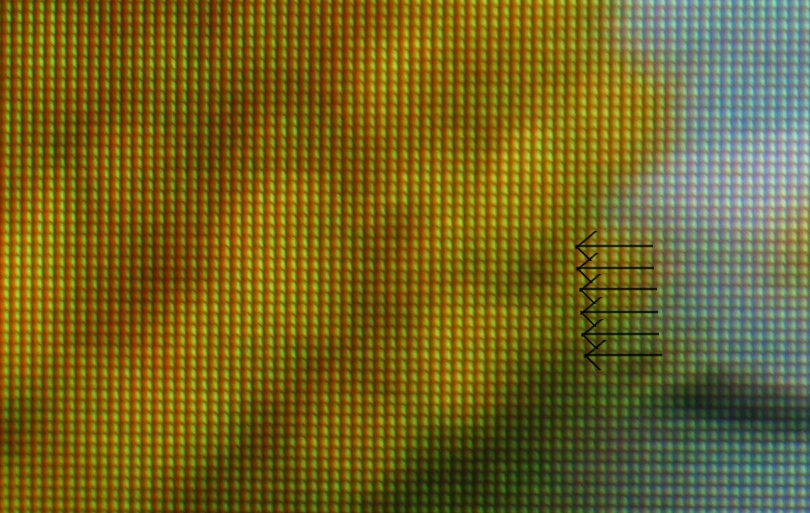
As a disgruntled former owner of that monitor, I must beg to differ. The one I got and the four that Dell sent me as possible replacements all had alternating brightness (gamma actually) between pixel rows. See a closeup of the screen. After countless hours struggling with Dell tech support I finally got it returned. I went to Amazon and bought a Samsung SyncMaster 213T and am a happy customer.
-
2001FP
I have to counteract your raving about Dell's 20" monitor. I had one, got an exchange, another exchange, another exchange, and finally returned it due to its poor image quality. The problem was that alternate pixel rows had different gamma values, so for midtones you get horizontal stripes. This is sometimes incorrectly attributed to the screen-door effect. This is happens on some other 20" LCDs but not on other monitors in the Dell UltraSharp line. For my money, the Samsung SyncMaster 213T is the way to go.
As for latency, the 2001FP does have the lowest you can get for an LCD. Perhaps you could post some timestamped stills from the video you made so as not to overload your server. -
Re:Speaking of LCDs...
For those concerned with image quality, I would not reccomend this. I got one, then, when I saw that every other row of pixels alternated gamma which produces alternating brightness for midtones like this (black arrows point to bright rows). I had Dell sent me a replacement, and another, then I asked for my money back and they sent me another replacement. Then I sent that right back, reiterated my desire for my money; they sent me a fourth replacement (fifth monitor). All five of them behaved this way. After two hours on the phone, I got permission to return my monitor for a refund. I still don't have my refund.
I've since gotten a Samsung SyncMaster 213T from Amazon, which had the best price considering no tax, and free shipping. Unfortunately it was $1056 rather than the $770 that the refurbished Dell did, but the Samsung is beautiful. -
original is back upyou can reach it here
i'm going to take down the copy on my computer in a few minutes so that my isp dosen't start hating me.
and to whoever modded my mirror as flamebait... you're a twit.
-
Seismic readings _have_ shown something...