Slashdot Mirror
Domain: homelinux.net
Stories and comments across the archive that link to homelinux.net.
Comments · 90
-
Defense costs much more than attack
I just wanted to reiterate this statement
The cost to the patent troll for filing a lawsuit is around $500, but Bannert was forced to spend over $10,000 on a legal defense
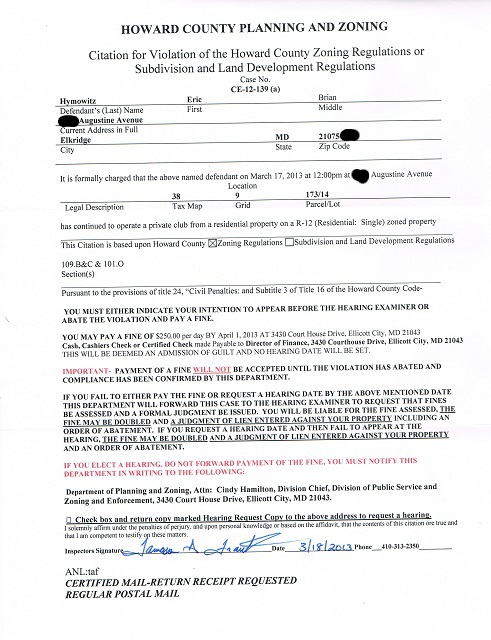
It cost my stalker nothing to convince the local government to issue me an unconstitutional citation for holding a St. Patrick's Day party without a permit, and it cost me over $6,000 to get the citation dismissed.
-
Defense costs much more than attack
I just wanted to reiterate this statement
The cost to the patent troll for filing a lawsuit is around $500, but Bannert was forced to spend over $10,000 on a legal defense
It cost my stalker nothing to convince the local government to issue me an unconstitutional citation for holding a St. Patrick's Day party without a permit, and it cost me over $6,000 to get the citation dismissed.
-
Re:Sadly, I know how she feels
As somebody who is being stalked myself, I believe that the correct way to fight privacy invasion is to keep doing what you're doing, and show the invaders that they cannot intimidate you.
No.... not really. To them that is just showing them you think what they're doing is lawful and OK.
The proper thing to do is make a lot of noise and FIGHT by whatever means are at your disposal. Be it the abuse of network resources, public speaking/protesting, or worse....
VIOLENCE AND MONEY ARE THE ONLY REAL DRIVING FACTORS AND VEHICLE FOR MASSIVE CHANGE IN POLITICS.
Even peaceful protests are usually designed to bait the enemy into committing violent acts. MLK knew this well. So does our government. If you notice, they often send undercover cops into the middle of protests to attempt to kick off a riot and bait the unarmed protestors into being violent so they have an excuse to crush the protest or shoot people. They know they will face worldwide condemnation for initiating the violence.
They've got a lot of money wrapped in these programs, they aren't going to let them go lawfully and peacefully. That would mean admitting they were criminals. That will not happen. I bet you they are rapidly trying to expand these programs as we speak because the list of evil "terrorists" just tripled in the last few months with the leaks. Some folks will pretend to be on our side but little action will come.
At this point the republic is lost until the American public has the balls to take it back. Legal methods useful to us in this regard have been effectively neutered.
-
Sadly, I know how she feels
As somebody who is being stalked myself, I believe that the correct way to fight privacy invasion is to keep doing what you're doing, and show the invaders that they cannot intimidate you.
But I realize that this is a decision each person must make for him/herself, and I am sorry but not necessarily surprised that this is the decision PJ made.
-
Re:Screw these guys, I'll mirror
I was going to tell you, the exploit uses binary data, which might not qualify as "text"
This guy did the psfreedom port: http://kakaroto.homelinux.net/
There's a post dated sept 16th: "I’ve also recently created a new branch in git for writing custom assembly for the payloads instead of using the hardcoded binary blob from PSJailbreak. I’ve cleaned up the payload used by PSJailbreak as well as documented it so others can read it and better understand how it works. The reverse engineering and information has been provided by the group of Mathieulh as well as some of my own reverse engineering work. You can find the ASM payload file here. AerialX from the PSGroove team is also working on cool payloads so you should check out his git repository too!"
Sorry I'm too lazy to fix the links but you get the idea... -
Re:Hehehe
Now, let's get working!
http://kakaroto.homelinux.net/2010/08/psjailbreak-usb-gadget-kernel-driver/
There you go. Still not released, but well underway (check the blog for updates).
-
Re:Imaginary? Really?
research would be much more valuable to me if it was accessible.
Yes, certainly. What I'm asking here is, where do you obtain the right to that value, as opposed to the people who did the work? Is it your position that just because something is valuable, it should be given to you? What if that changes the value available to the inventors? Should it still be given to you anyway?
Now I'm not the one you were writing to but I will state my opinion on your questions. 1st of all I'm very much against "intellectual property". That does not mean that I think anyone with so-called IP should give it to me against his will, I just don't think it is something you can own and thus can't be property - ownership in this case is purely imaginational man made set of rules with no basis in reality. However I must state, before I continue, that my resistance is not against software products nor copyright (as long as it will be limited in time), these are not what I mean when I talk about IP - nor does it seem to me that companies mean that either. Knowledge and ideas is not something you can own. Sure, you can sell them or keep them to yourself. You can even make a contract with instance you are giving/selling your "IP" for that they agree to not publist the information (or even use it to create a competing product).
And most of all, you can use it to make new products and make money with them.
However it gets more or less questionable when you state that if other people decide to build product based on some part on those ideas of yours they should have your permission (unless you made them agree with a contract to that). It get's *really* ridiculous when someone can sue me for using "their IP" if I came up with the idea by myself - it's outrageous that some people actually claim ownership on ideas and they not only claim ownership for theirs but mine too if they just had (or registered they have) it before me.
Yes, one thing I'm referring is to patent system - something originally made for good purpose, something that I don't necessarily even oppose where it serves that purpose. However some fields where I think it not only does not but actually serves quite opposite purposes (it was made for public benefit and to add development). Some places where it most definately does not belong to is software and medical business.society has much more ignorants than savants, so why should fencing knowledge be a net gain to society?
Simply speaking, it's a viable economic model. It's provided a great deal of progress in a very short time -- surely you recognize that in the last hundred years or so, we have made more technical / knowledge progress than ever before in human history; if we cannot credit a capitalist attitude towards knowledge as the cause, we can at least say that the capitalist attitude towards knowledge hasn't prevented it from happening.
It's not much of an argument that provides any support for it. At best it is a half truth, much of the progress has benefited loads of also being able to use others "IP" as it's now called - and software industry most definately suffers hugely from patent/IP madness. Sure that has not prevented development from happening on that field too
It's really kind of hard for me to fault the system. And while I see others trying, I don't yet see anything convincing in the various contrary arguments.
I can - and have actually blogged about it:
Software patent laws should be ditched
Anger about software patents -
Re:Imaginary? Really?
research would be much more valuable to me if it was accessible.
Yes, certainly. What I'm asking here is, where do you obtain the right to that value, as opposed to the people who did the work? Is it your position that just because something is valuable, it should be given to you? What if that changes the value available to the inventors? Should it still be given to you anyway?
Now I'm not the one you were writing to but I will state my opinion on your questions. 1st of all I'm very much against "intellectual property". That does not mean that I think anyone with so-called IP should give it to me against his will, I just don't think it is something you can own and thus can't be property - ownership in this case is purely imaginational man made set of rules with no basis in reality. However I must state, before I continue, that my resistance is not against software products nor copyright (as long as it will be limited in time), these are not what I mean when I talk about IP - nor does it seem to me that companies mean that either. Knowledge and ideas is not something you can own. Sure, you can sell them or keep them to yourself. You can even make a contract with instance you are giving/selling your "IP" for that they agree to not publist the information (or even use it to create a competing product).
And most of all, you can use it to make new products and make money with them.
However it gets more or less questionable when you state that if other people decide to build product based on some part on those ideas of yours they should have your permission (unless you made them agree with a contract to that). It get's *really* ridiculous when someone can sue me for using "their IP" if I came up with the idea by myself - it's outrageous that some people actually claim ownership on ideas and they not only claim ownership for theirs but mine too if they just had (or registered they have) it before me.
Yes, one thing I'm referring is to patent system - something originally made for good purpose, something that I don't necessarily even oppose where it serves that purpose. However some fields where I think it not only does not but actually serves quite opposite purposes (it was made for public benefit and to add development). Some places where it most definately does not belong to is software and medical business.society has much more ignorants than savants, so why should fencing knowledge be a net gain to society?
Simply speaking, it's a viable economic model. It's provided a great deal of progress in a very short time -- surely you recognize that in the last hundred years or so, we have made more technical / knowledge progress than ever before in human history; if we cannot credit a capitalist attitude towards knowledge as the cause, we can at least say that the capitalist attitude towards knowledge hasn't prevented it from happening.
It's not much of an argument that provides any support for it. At best it is a half truth, much of the progress has benefited loads of also being able to use others "IP" as it's now called - and software industry most definately suffers hugely from patent/IP madness. Sure that has not prevented development from happening on that field too
It's really kind of hard for me to fault the system. And while I see others trying, I don't yet see anything convincing in the various contrary arguments.
I can - and have actually blogged about it:
Software patent laws should be ditched
Anger about software patents -
Re:GOOGLE MAIL
Having your own home server is handy indeed... I use my own for remote access but also run a public web server on it to host my blog ( http://salamanteri.homelinux.net/wordpress/ ). What caught my attention is that you have to pay for "business service" to have a home server. Here in Finland you can host any server you want on any basic broadband from any ISP - and it is actually backed up by law that ISP cannot block you from running whatever server/service you want on your connection (as long as you have public IP, generally you get to plug in up to 5 machines that get their own private IP's each, to get more than 5 machines online you have to use NAT). I would like to know if it is common in other countries that you have to pay extra if you want to host a home server on your broadband?
-
Re:Here is the one I want:
Aptera. Coming out this month, reasonably priced.
Hybrid model coming out too (soon enough).
-
Re:old notebook
I did this, actually. I completely disassembled the laptop and installed the relevant parts in a $10 frame from Wal-Mart, plus a few extra pieces of wood. And it only took me two evenings of work.
I installed Linux but NOT X...I used a console installation and zgv which has a slideshow mode. I installed Apache and Gallery to manage the photos in an easy way. The only scripting I needed to do was to start zgv with the correct parameters on bootup. I could have used a wireless PC card, but my desktop application didn't require it.
Here's some photos of my result: Front & Side -
Re:old notebook
I did this, actually. I completely disassembled the laptop and installed the relevant parts in a $10 frame from Wal-Mart, plus a few extra pieces of wood. And it only took me two evenings of work.
I installed Linux but NOT X...I used a console installation and zgv which has a slideshow mode. I installed Apache and Gallery to manage the photos in an easy way. The only scripting I needed to do was to start zgv with the correct parameters on bootup. I could have used a wireless PC card, but my desktop application didn't require it.
Here's some photos of my result: Front & Side -
Re:wtf is composite?
If you like me have been confused about stuff like DRI, Mesa, GLX Extensions and so on in logs and conf files when trying to get OpenGL drivers working under Linux, I recommend How Xgl works.
-
Re:My letters from the ESA
Close, but no: http://en.wikipedia.org/wiki/Entertainment_Softwa
r e_Association Here's the first email I received: http://keeptalking.homelinux.net/esa.txt And this is the second: http://keeptalking.homelinux.net/esa2.txt -
Re:My letters from the ESA
Close, but no: http://en.wikipedia.org/wiki/Entertainment_Softwa
r e_Association Here's the first email I received: http://keeptalking.homelinux.net/esa.txt And this is the second: http://keeptalking.homelinux.net/esa2.txt -
Detailed image found on their site
Here is a real detailed picture of water on mars: http://nasa.homelinux.net/nasa_file/mars.jpg
-
My own experience
I've never had to use their service since I tested out of all but one English course for my degree, but I work with students every day as an employee for the English department, and I have to say that this service bites. It did nothing but give us headaches (none of the support staff knew how the site worked, and the students wasted so much time figuring it out that they could have written better essays with it). It's like living in the Soviet Union--even something as innocent as low-level academic papers written by undergraduates are being scanned and torn apart for "unauthorized" content.
Imagine my discomfort when I found out that they had begun indexing my personal website without permission. They had every right, to be sure (the site *is* public, after all), but I knew what they were doing with the information, and I don't publish material just to have it used against my fellow students. Not only do I disagree with the effectiveness of Turnitin.com's service, but also the ethics behind it.
As a response, I let them know that they weren't going to be using my content. I also blogged about it on my main page.
It's about time somebody protested.
-
My own experience
I've never had to use their service since I tested out of all but one English course for my degree, but I work with students every day as an employee for the English department, and I have to say that this service bites. It did nothing but give us headaches (none of the support staff knew how the site worked, and the students wasted so much time figuring it out that they could have written better essays with it). It's like living in the Soviet Union--even something as innocent as low-level academic papers written by undergraduates are being scanned and torn apart for "unauthorized" content.
Imagine my discomfort when I found out that they had begun indexing my personal website without permission. They had every right, to be sure (the site *is* public, after all), but I knew what they were doing with the information, and I don't publish material just to have it used against my fellow students. Not only do I disagree with the effectiveness of Turnitin.com's service, but also the ethics behind it.
As a response, I let them know that they weren't going to be using my content. I also blogged about it on my main page.
It's about time somebody protested.
-
Some pyramids did collapse
No one talks about the pyramid they built 5100 years ago that fell down after 21 years
That's just because it's no longer news: Collapsed pyramid
-
Re:speaking of KDE
I'm using Konq right now and it looks ok. The only problem I see is on the section bar where the text becomes garbled. If I highlight the text the problem goes away until the page is reloaded.
There aren't any real usability problems with the new layout. At least none since they moved the article links.
http://fs.nile.homelinux.net:8000/~john/goofed_up_ slashdot1.png shows the error. -
Re:To Interject for a moment
-
Re:My favorite editor
Aye aye! Here's mine.
-
I've built one
I built one. My favorite reference, and probably the largest information collection and most active discussion, is at DIYAudio in the "Moving Images" section.
Here's two photos of my results:
http://lserve.homelinux.net:7780/PICT0056.jpg
http://lserve.homelinux.net:7780/PICT0141.jpg
The white bar on the lefthand side indicates one problem you'll have: the internal components of an LCD are very delicate. I can solder 0603 SMD resistors without breaking a sweat, or lift a 208-pin FPGA from a circuit board without damaging either, but I still managed to tear one of the mylar edge connector ribbons loose. Fortunately it was right along the edge and there's still plenty of usable viewing area. I do have another monitor I'll use to replace the broken one, but for now it works.
You do need a fairly dim room, but the image is definitely bright enough. I use a 400W metal halide, but I don't have a reflector so that's one possible way I could upgrade the projector another 30% in brightness. And the cheap lenses have a short focal length, there is no zoom control and to fill an entire 8-foot-high wall, the lens is only 10 feet away. Makes couch placement difficult. I ended up putting my couches in an angled arrangement with the projector in between. Kind of like this: \./ except a shallower angle.
Anyway I like it and it was definitely worth the pain, misfortune, and expense. -
I've built one
I built one. My favorite reference, and probably the largest information collection and most active discussion, is at DIYAudio in the "Moving Images" section.
Here's two photos of my results:
http://lserve.homelinux.net:7780/PICT0056.jpg
http://lserve.homelinux.net:7780/PICT0141.jpg
The white bar on the lefthand side indicates one problem you'll have: the internal components of an LCD are very delicate. I can solder 0603 SMD resistors without breaking a sweat, or lift a 208-pin FPGA from a circuit board without damaging either, but I still managed to tear one of the mylar edge connector ribbons loose. Fortunately it was right along the edge and there's still plenty of usable viewing area. I do have another monitor I'll use to replace the broken one, but for now it works.
You do need a fairly dim room, but the image is definitely bright enough. I use a 400W metal halide, but I don't have a reflector so that's one possible way I could upgrade the projector another 30% in brightness. And the cheap lenses have a short focal length, there is no zoom control and to fill an entire 8-foot-high wall, the lens is only 10 feet away. Makes couch placement difficult. I ended up putting my couches in an angled arrangement with the projector in between. Kind of like this: \./ except a shallower angle.
Anyway I like it and it was definitely worth the pain, misfortune, and expense. -
I'm doing my part...
This holiday season I'm investing in a GP2X. This device has been reported on previously on Slashdot; basically, it's a handheld that's powered by open source software. If this doesn't help the "game industry," I don't know what will...
-
Not worth it?!?!?!
it isn't worth trying to reclaim old allocations...
Excuse me? Is it *really* that hard to talk to Apple, Ford, MIT or any of the other people with a whole Class A and ask "Say, guys, do you *really* need all 16 million addresses we gave you back when we didn't think this Internet thing was gonna take off?" Fucking A, according to that page, Halliburton has 34.x.y.z! Surely we can get *that* one back, right? -
Re:Nice, but...
If you don't like DIY anything, then this is pointless: but go to DIYAudio and browse through the "Moving Image" section. The DIY LCD projector is becoming very mature and you can select different price and quality options to get price range from almost nothing to $1000. The average projector costs about $300-$400 and requires a few days worth of building. The kicker is bulb price. Typical bulbs used in DIY projectors will last several years, and cost only $40 to replace. As for quality, here's what my first cardboard-and-duct-tape mockup was able to achieve: projected image. And this is FAR behind what the good DIY'ers are getting.
-
Contagious Marketing
As an experiement, we created an online German Language Resource to see what effect (if any) Slashdot has on our number of registered visitors.
-
Don't use an overhead
If you resign yourself to spending $150-$200 in addition to the LCD, you can get some amazing results. To be honest, any cheap overhead projector will have a halogen lamp that has too low of a color temperature, too dim of an output, and will need to be replaced every 25-50 hours. The cost adds up. Also, virtually no overhead projector is big enough to light the entire area of a 15" LCD. You will lose up to 60 pixels on both sides of the screen.
If you instead build your own enclosure, you can do some neat stuff. First, you can show the full 1024x768. Also, you can use a metal halide bulb, which typically have a clean white color and put out less heat for the amount of light produced. And metal halide bulbs last anywhere from 8000 to 20,000 hours. You will also be able to get a high-quality lens for good focus across the whole display, something a cheap overhead might not be able to do.
Go to http://www.diyaudio.com/ and visit the Moving Image forum. There are thousands of posts containing ideas, plans, calculations, optics sources, and photos. I'm in the process of building my own projector with a 400W 6500K metal halide bulb, here's a photo of the image projected by a test mockup: http://lserve.homelinux.net:7780/diyaudio/lightsof f.jpg -
Re:Samuel Beckett: Rejected
Those comments were likely written by the people I had an English writing "lab" with when I was still trying to decide what to major in. Most of my classmates were Junior or Senior class standing, but none of them could write to save their lives.
I dropped out of the class roughly 1/3rd of the way through it as I could no longer take the stupidity. Everyone in the class had to write a 5-10 page short story from (IIRC - this occured about 3 years ago) the first person perspective. I wrote this short story - or rather, this portion of the short story. I never got it done, as I'd started it at around 2am the night prior to it being due, and the class was at 8am.
Regardless of my story's completion, I handed 6 copies of my it out the next morning to the others in the class. In return, I got 6 copies of their respective stories: abusive nonsense the lot of them. There was one that barely resembled coherrent sentences. There was another that lacked any sort of point whatsoever - such as plot, meaningful characters, or use of words that didn't opitomize the typical Valleygirl vocabulary. I've managed to blot the rest from my mind through excessive drug abuse.
The next class resulted in half a dozen people comopletely misunderstanding everything about what was going on. Some didn't realize that the narrator was not "Ed" (the focus of the (partial) story, if you've not yet read it); some made asinine comments illustrating their inability to understand how one sentence follows the one proceeding it, eventually forming a single concept - something most of us know as a "paragraph". Now, granted, the story isn't air tight and isn't even complete, but if you've read it you'll realize that it's a decent enough story. These pedants couldn't see past the stars in their eyes of writting Xena: Princess Warrior scripts (which, if i recall correctly, one of the students mentioned as one of their main motivators into becoming an English major to write).
There was one guy that had good ideas, good characters, and good development, but his ability to form properly written text was a bit stunted. A shame. When he read his stories (as we all had to do) he seemed to accomidate for this negligence, though. But he also never attended class, so... -
Try alts.homelinux.net
You can find OSS alternatives to your "favorite" propietary application in ALTS: alternatives to dreamwaver
-
sorry to say but I 've done it long before...
Free software for window$. You can also try kikizas.net.
Ermm, I have also to say that these pages are in greek! -
various mirrors/links
http://mattscable.homelinux.net:8080/PAT-NEEDS-YO
U R-HELP.txt
http://uml.axpr.net/PAT-NEEDS-YOUR-HELP.txt
http://www.unixsphere.net/~devnull/PAT-NEEDS-YOUR- HELP.txt
http://www.dangerz.net/dz/PAT-NEEDS-YOUR-HELP.txt
http://science.slashdot.org/comments.pl?sid=129902 &threshold=0&commentsort=0&tid=134&tid=106&mode=th read&cid=10833797
Then there's the all too obvious posts that have the whole darn thing in it. No excuse not to read this article
(this mirror list was assembled by using find:mirror btw, and checked for down links) -
Free Electronics Samples
While I'm not jumping to build this project myself, I've got a couple dozen others that I'm half-working-on at all times. I've got a list of links to manufacturers that provide free samples of electronic components for this very purpose.
http://lukewarm.homelinux.net/freesamples/
Enjoy. If you know of more, I'd love to add to the list.
-
Torrent file for X.org 6.8.0 sources
-
Re:OT: personal wikis
media wiki is built on PHP, served from a webserver and keeps its data in a database. Currently I am running Apache and mysql. I believe their are windows ports of both available, as well php. Here are a few links.
http://us4.php.net/manual/en/install.windows.php
http://httpd.apache.org/download.cgi
http://dev.mysql.com/downloads/mysql/4.0.html
http://sourceforge.net/projects/wikipedia/
http://www.cygwin.com/
I have not heard of anyone installing it on windows, so if you do get it running you may want to consider documenting your results and post it somewhere for others who want to follow in your footsteps. If you decide that it is to much effort, Linux generally installs very well on older hardware that can be had for virtually pennies.
Oh, and I feel safe enough from a slashdotting now that the thread activity has decreased, here is my website http://butsuri.homelinux.net/. It is on a dynamic IP but freely hosted through dyndns. -
Re:It's crap
Actually what I am suggesting is that you have the wiki framework with your data in it. When you install the wiki you don't have to install their database, in fact you would have to make a special effort to import the wikidatabase of information.
Now that the thread activity has decreased somewhat, I feel safe in posting a link to my wiki as an example of what I am talking about;
http://butsuri.homelinux.net/ -
Re:good book for pics
I second that, Predko's book is great for getting into PIC development starting from scratch. His website has some good info about the book, including a great chapter available for free on microprocessor/hardware interfacing (applies to a broader audience than just PICMicro developers). He even covers a few Linux development tools in the book.
Since it's mostly on-topic here, I'll use this chance to mention that I've got a listing of manufacturers who will provide you with free samples. Microchip will happily send you a package stuffed with 15 PICMicro MCUs every couple of months. Free samples for EE/CpE projects
For an idea of what the home tinkerer can do these days, check out these incredible projects by Thorsten Klose. You can build some incredible MIDI synthesizers, sequencers, controllers...all based around simple PICMicro designs. Very, very cool.
-
Re:Question
Ok. I'm not sure I'd call it chaotic. That seems a bit of an exaggeration to me, and a misuse of the word chaotic. But you do have a point. It's just that it's been fixed in 2.0. Gimp 2.0 entered Debian Sid/unstable almost a month ago so hopefully it will enter Testing soon and you'll be able to see it. Don't you at least have the 1.3 development version available? In 1.3/2.0 the transform tool has been split up and each task (rotate, scale, shear, perspective) is now a seperate icon in the tool palette. I've made a screenshot of the main window in my setup (go easy on my home ADSL link). The new icons are the last four in the second row.
Another insteresting feature is that all the layers/channels/brushes/etc dialogs are now dockable. I can drag one off into a new window and drag it back to the main window. They can be added, removed, and re-ordered to suit your fancy. Each window (either the main Gimp window, or a stand-alone dialog window) can have many tabs, as well as many docks stacked vertically. You can see this in my screenshot. I have Layers, Channels, Gradients, Brushes, and Gradients all stacked in one dock, and the Device status (Wacom Intuos stuff) in a seperate dock down the bottom. It's all very flexible and easy to simply drag things about.
The Gimp 2.0 is much nicer. A lot of work has gone into the interface since 1.2.
-
My Kitchen Sink
I hacked my kitchen sink via an electric screwdriver, a cheap mouse, and a fax machine to produce the POWER SINK DUN DUN DUHHHHHH... http://gogglemarks.homelinux.net/cgi-bin/display.
c gi?file=projects/powersink -
Re:SpecializationHere are a few Knoppix varieties for people to check out.
EduKnoppix
Gnoppix
NordisKnoppix
KnoppMyth
Augustux
Condorux
BitDefender
FeatherLinux
Flonix
Overckockix
Knoppix STD
Sulix -
Source Torrent
Torrent here.
-
This doesn't stop the Terrorists!
Nobody loses here, but american citzens. The job of terrorist and others, those who actually pose a threat to national security, is to brainstorm up plans to get around and defeat our countermeasures. All this means for terrorists is that they've been tipped off, and now need to find a new way to launder money. Let's wake up, the CIA already had the power it needed, plus the benefits of suprise and secrecy, they just haven't been doing their job.
Me -
Pushed off course?
Could this leak be pushing the iss off course? Maybe it won't throw it completely out of the solar system, but it'll be close!
Me -
Re:Wow.
You can get IE to display transparent PNGs properly, but you have to do it in the most bone headed way imaginable.
-
A few other nice XFS features...no one has mentioned yet:
(from http://www.sgi.com/software/xfs/overview.html)Guaranteed Rate I/O
XFS is the only file system available that provides a guaranteed rate I/O system, which allows applications to reserve specific bandwidth to or from the file system. The file system can determine the available bandwidth and guarantee that a requested level of performance is met for a given time. This functionality is critical for media delivery systems such as video-on-demand or data acquisition.Expanded Dump Capabilities
Unlike traditional file systems, which must be dismounted to guarantee a consistent dump image, you can dump an XFS file system while it is being used. The XFS dump utility, XFSdump, can dump an entire filesystem, a directory tree, or specific files. XFSdump is restartable, which allows a large dump to be spread over an extended period of time or to be resumed after a system restart. -
Get it here, then.
-
Sharing the painI personally rather enjoy David Weber, but to each their own.
In addition to the oft-pimped Baen Free Library, you can also find their CD-ROMs included in several of their hardcovers which contain such gems as the entire Honor Harrington series. Or, if John Ringo's more your style, there's another CD with the entire Legacy of the Aldenata series available. Baen allows free distribution of these CDs, so long as no money is charged. I find it convenient to keep them on my webserver.
Lots of other good books not available on the BFL can also be found on the CDs, incidentally. It's a horribly effective marketing scheme. The BFL has cost me close to $300 over the last two years in books I would not have otherwise purchased.
-
Sharing the painI personally rather enjoy David Weber, but to each their own.
In addition to the oft-pimped Baen Free Library, you can also find their CD-ROMs included in several of their hardcovers which contain such gems as the entire Honor Harrington series. Or, if John Ringo's more your style, there's another CD with the entire Legacy of the Aldenata series available. Baen allows free distribution of these CDs, so long as no money is charged. I find it convenient to keep them on my webserver.
Lots of other good books not available on the BFL can also be found on the CDs, incidentally. It's a horribly effective marketing scheme. The BFL has cost me close to $300 over the last two years in books I would not have otherwise purchased.
-
MMmmmmm Free advertising!Let's see, this is the second time recently this company has had their product hawked on slashdot.
Isn't it just a $200 version of something you can buy for $2.99?
dave