Slashdot Mirror
Domain: ibiblio.org
Stories and comments across the archive that link to ibiblio.org.
Comments · 1,708
-
Learning Mathematicshttp://math.about.com/
http://www.math.com/
http://homeschooling.about.com/cs/math/index.htm?t erms=math
http://homeschooling.about.com/cs/science/
http://physics.about.com/
What is Science?Even on the off chance that the About network doesn't have all the information you need, they have a large number of links to sites with relevant information across the Web, so there's a very good chance that you will be able to use them to find what you are looking for.
Also...although these are not strictly an answer to your question, I would still heartily encourage you to follow the links to these (listed in a suggested order of reading...my probably misguided opinion only) text files, web pages, and books, as I think they could be of enormous benefit to both your children and yourself...indeed, anyone who wishes to read them. Although I understand that several of these could possibly only be understood at tertiary level, they also as far as I know are not normally included in *general* curriculums, and IMHO they should be.- The Allegory of the Cave by Plato
- Discourse on the Method of Rightly Conducting the Reason, and Seeking Truth in the Sciences, by Rene Descartes
- Guide to Ethics & Morality
- The Logic FAQ
- The Art of War, by Sun Tzu
- The Wealth of Nations, by Adam Smith
- The Sovereign Individual, by James Davidson
- The 48 Laws of Power, by Robert Greene
- The Prince, by Niccolo Machiavelli
It used to be in the past that the education systems of most nations didn't want us to know the why (philosophy, religion, history, political theory) of life, but were content enough to let us know the how. (Science without analysis, numeracy and literacy skills, etc) Now however we are seeing that primarily in America, but also in other places, government education departments no longer even want to allow people to know the how.
Mathematics is part of the how - a means to an end, a way of solving problems - but it is not a destination in itself. The material I've given you links to in my second section is concerned with finding out *why* - "Why am I here? Who am I? How do I know what reality is? What do I want to do with my life? What moral values do I believe in?"
The answers to these questions are far more important than becoming merely literate or mathematically capable for their own sake. Figure out what your purpose is first, and the rest, although still requiring work, will be relatively easy. That is what the links in the second list will help you do, and it's not something you'll be taught to do in any contemporary public school, either...Governments consider people with purpose to be highly dangerous. -
Learning Mathematicshttp://math.about.com/
http://www.math.com/
http://homeschooling.about.com/cs/math/index.htm?t erms=math
http://homeschooling.about.com/cs/science/
http://physics.about.com/
What is Science?Even on the off chance that the About network doesn't have all the information you need, they have a large number of links to sites with relevant information across the Web, so there's a very good chance that you will be able to use them to find what you are looking for.
Also...although these are not strictly an answer to your question, I would still heartily encourage you to follow the links to these (listed in a suggested order of reading...my probably misguided opinion only) text files, web pages, and books, as I think they could be of enormous benefit to both your children and yourself...indeed, anyone who wishes to read them. Although I understand that several of these could possibly only be understood at tertiary level, they also as far as I know are not normally included in *general* curriculums, and IMHO they should be.- The Allegory of the Cave by Plato
- Discourse on the Method of Rightly Conducting the Reason, and Seeking Truth in the Sciences, by Rene Descartes
- Guide to Ethics & Morality
- The Logic FAQ
- The Art of War, by Sun Tzu
- The Wealth of Nations, by Adam Smith
- The Sovereign Individual, by James Davidson
- The 48 Laws of Power, by Robert Greene
- The Prince, by Niccolo Machiavelli
It used to be in the past that the education systems of most nations didn't want us to know the why (philosophy, religion, history, political theory) of life, but were content enough to let us know the how. (Science without analysis, numeracy and literacy skills, etc) Now however we are seeing that primarily in America, but also in other places, government education departments no longer even want to allow people to know the how.
Mathematics is part of the how - a means to an end, a way of solving problems - but it is not a destination in itself. The material I've given you links to in my second section is concerned with finding out *why* - "Why am I here? Who am I? How do I know what reality is? What do I want to do with my life? What moral values do I believe in?"
The answers to these questions are far more important than becoming merely literate or mathematically capable for their own sake. Figure out what your purpose is first, and the rest, although still requiring work, will be relatively easy. That is what the links in the second list will help you do, and it's not something you'll be taught to do in any contemporary public school, either...Governments consider people with purpose to be highly dangerous. -
Re:Let's not forget...
I am partial to Tempora Heroica, but then I'm one of the developers. one of the nicest things about running and developing a MUD as opposed to making 'levels' or 'maps' for games like NeverWinterNights or some other game is that you can make your own engine. Don't like levels, they're gone. Don't like classes, they're gone. Think HPs, experience, etc are all silly, don't use 'em. With someone elses engine you're locked into their way of doing things. So with NWN, you're locked into Hasbro's D&D game.
-
Re:He teaches VB!
It seems he teaches Visual Basic in his programming course at Princeton. I'm a C nut so that came as a shock to me.
Well, he certainly is in good company. -
Re:It's the deterrent, stupid.
The link you posted (here) is a great study for anyone interested in the effects of speed limits. My transportation engineering professor sent that one around to the class when it came out.
This doesn't mean that speed limits aren't a great analogy for P2P file sharing. Perhaps an even better one, since the RIAA's campaign against downloading has if anything made it more likely, by causing the only people who are paying any attention to boycott CDs from major labels. In essence, this is the case with most law: if people feel that the law is reasonable, and it is not too difficult to comply with it, they will. If it becomes more difficult to comply, they will be less likely to. So, when the speed limit is 50, a lot of people drive 70... but when it's 60, many of those folks slow down a bit because it's not too different from what they want to drive. If the RIAA figured out their own way to let us download music and pay appropriate royalties, they wouldn't have a problem.
A little more on the speed limit issue, btw:
- "The most effective method of reducing speed is a visible patrol car." I suppose that depends on what you mean by "effective." The most effective of the relatively inexpensive methods is a speed trailer. You know, the digital sign that displays your speed right below the speed limit? Occasionally, kids will use the sign to see how fast they can go, but because of that they usually hard-code them not to display over 55 when used on surface streets. Somewhere recently I saw a permanent sign pole with a solar panel and a "your speed" sign. It does work.
- Speed limits are usually not just arbitrary "we want people to go no faster than this" numbers. There are some "statutory" limits, such as 25 in school zones, or 35 on residential streets. But for a lot of streets, the speed limit is based on the 85th percentile speed. Before they can change the speed limit, they have to do a speed study... which means they sit out there and record speeds for 24 hours (or have a speed trailer do it for them) and then find out what the 85th percentile is. The speed limit cannot be *lower* than that. -
A bit of math
Available number of IPv4 addresses: 4.2 billion
Number of people on earth: 6.35 Billion according to ibilio
At this moment, Every other person on earth could have their own IP address. And we'd still have a billion IP's to spare.
Throw NAT into the equation just for fun.
With proper addressing schemes, IPv4 still has a ton of life left in it. It's nice to know IP6 is out there. But just because it's better doesn't mean it will ever gain world wide acceptance.
Just ask Preston Tucker, The makers of the Betamax, The Newton development team, etc -
Re:Modem and internet connection in Linux
I don't really want to turn this into a tech support forum, but...
Probably your modem is a winmodem: a crippled piece of hardware which requires Windows software in order to work. See this document (somewhat old) for some help.
In other words, this is the hardware manufacturers' fault, and not the OSS community's. -
Re:Obsolete?
Actually, when you consider that most Chinese and a good number of Indianpeople speak English, 50% is fairly accurate.
The current world population (estimated). -
Re:Constitutionally Protected in some places...
And that, ladies and gentlemen, is why I should have just gone to Gutenberg. Of course they don't seem to have all the amendments, just basic bill of rights. Thanks for the correction, at any rate
-
Picture
Ibiblio has a picture of the platypus here.
-
WP for Linux resourcesaussersterne wrote:
Fast-forward to 2003... The products are orphaned. They have been removed from the Corel Web site without a trace.
It's certainly true that they've been orphaned, but WP8 for Linux Download Personal Edition remains available at a large number of sites, listed in my WordPerfect for Linux FAQ. You can also find PhotoPaint9 (Winelib) tarballs, here and there, if so interested.
The open-source linux.corel.com site that contained Corel's WINE tree is gone.
Substantially all of the former linux.corel.com Web site remains mirrored on http://corellinux.com/. The Corelwine fork remains maintained, for now, by Michael Torrie at http://students.cs.byu.edu/~torriem/.
And no service packs for the Linux versions of these programs ever got released!
Torrie's third-party updates to Corelwine, the Fontastic server, and other support code are said to make WP9 for Linux almost acceptable, although I find WP8 generally superior in fundamental ways. Valentijn Sessink has contributed a third-party fix to the Filtrix date-rollover problem, and there are numerous Corel-issued fixes to little bugs at http://corellinux.com/.
Your point generally is well taken: The corellinux.com site even enshrines Corel's lastingly broken promise to post an "Update coming soon for Corel WordPerfect 8 for Linux/UNIX import/export filter issue", which failure Sessink eventually worked around for the user community's benefit without Corel's help. However, I just wanted to point out that many problems can be fixed to a significant degree, despite Corel having cast the entire thing to the winds.
Library-support problems for WP8.x on modern Linux distributions can be fixed, given varying amounts of determination. In extreme cases, you can install all needed libs from a tarball available for that purpose. My FAQ has details.
I suspect you'd find WP8.x much less frustrating than the lamentable WP9, especially if you acquire a copy of the WP8.1 Personal Edition -- the best release by far of WP for Linux -- still sometimes available (on eBay and other places) bundled as part of Corel Linux OS Standard or Deluxe Editions.
But the long term answer is to realise that proprietary codebases are prone to being here today, gone tomorrow, and to realise that AbiWord 1.9.1 is starting to look awfully good and cannot suffer that same fate. (OpenOffice.org Writer 1.1 beta 2 is useful, too.)
Rick Moen rick@linuxmafia.com
-
In other news
Microsoft sued for copyright infringement over Windows XP shutdown music.
And On-Topic:
Software Giveaways should be assigned no value in a legal settlement!
-
Re:I thought this was a DOS attack
You want a DOS attack? Flood the machines with copies of FD-ODIN. Now That's a DOS attack!
FreeDOS ODIN - One Disk Installation
-uso. -
Re:Where is everyone?
Good Lord!
I'll try to be as normal as possible without being too caustic. At the moment the estimated world population is 6351506980 Is there any way that you think that a single continent could support 6.3bil people? Food, Water, Waste disposal, electricity, transportation networks... It boggles the mind that anyone could consider this. *bah* Must get back to work. However, whatever. -
Re:Search?really?
I could have sworn I saw him post to this this site last week.
-
Re:Hey!
Ever heard of PNG,GIF,Animated PNG/GIF? these are formats for both images and video, that are 100% lossless, and better than a 2:1 compression ratio on most video and images
I said photos, not images. The picture of your dog that you scanned in and saved to PNG won't compress nearly as much as the pie chart image on your website. Images with large areas of solid color will indeed compress down by a large amount. (A picture I scanned in of my truck compressed with PNG got about 1.63:1. Lena got about 1.65:1. Both sources were BMPs where the source data had never been subjected to lossy compression...they were compressed with bmptoppm foo.bmp | pnmtopng -comp 9 >foo.png.)
In the case of video, compression ratios are on the order of 100:1
Lossy compression can do that, but there's no lossless video compression that routinely gets anywhere near that. Reread my original assertion...it pertains to lossless compression of text, video, and audio and the likelihood of getting something substantially better than 2:1 compression.
Huffyuv is a codec that video editors use that is lossless and better than 2:1 in the average case
Not in my experience...720x480 captures from an All-In-Wonder Radeon usually get somewhere around 2:1, give or take a bit. (It's also worth noting that Huffyuv is lossless only for YUV sources; RGB video will experience a slight loss from colorspace conversion. For analog video capture, this isn't an issue...composite/S-video/component video are all variations of YCbCr, which is close enough to YUV for government work. CG video will most likely start out as RGB, so there will be some slight loss introduced by the RGB-to-YUV conversion...but it'll also likely see greater-than-typical compression for the same reason that a PowerPoint slide will compress more than a scanned photo.)
Text, for sure on the average case, is WAY WAY WAY over a 2:1 compression ratio (Ever heard of gzip,zip,bz2?). Especially considering they are zipping up code, and not written english, it is very very compressable because of so much redundancy.
Code is a special case. Compressing natural-language text is a more likely scenario. Taking Project Gutenberg's Hamlet, stripping out excess whitespace, and compressing it with gzip -9 yielded 2.32:1 compression. Doing the same with the text on
-
If you love freedom don't buy anything from redhat
-
What else should they do ?
It's not as if there are any free alternatives. Thanks Redhat.
-
Re:Of course MS is aware of prior art...
Yup, I'm right. MS's DoubleSpace infringed on sisk compression patents held by Stac, Inc.
To wit:
Here is Stac's original complaint
One guy's opinion
Wikipedia entry (scroll down a ways to 1993)
I should just let you Google these yourself.
So, clearly filesystems like MS is describing have not only been around since before 2000, but MS lost lawsuits over them 10 years ago! THAT'S JUST ONE EXAMPLE!
-
Re:Free registration..some implicationsMost people offer up the John Henry story as a testament to the indominitable will of Man in the face of dehumanizing machinery. For example, this site says
According to some accounts, on hearing of the machine, John Henry challenged the steam drill to a contest. He won, but died of exhaustion, his life cut short by his own superhuman effort.
which seems, to me, to be praising Henry instead of pointing out how useless this sacrifice was -
Re:Wrong suit Eric
Do you know what I really enjoy about the public domain and efforts such as Project Gutenberg? The texts that have been made available are the ones that are most important to read when debating topics such as this. The U.S. Constitution, and The Autobiography of Thomas Jefferson are two great places to start. Once you have digested the basic ideas, try reading The Psychology of Revolution
If you read all of this, you may find that you haven't the time to watch The Bachelor, American Idol, or Fear Factor. Personally, I think that's a good thing.
The public domain is a threat to media giants. Not only does it remind us of why our forefathers founded a new nation, it also competes directly with them for our eyes and minds.
-
Re:Output, not potential
Man, I wish I had my Tolstoy with me... there's a section at the end of Anna Karenina
Try here
Project Gutenberg is your friend! -
Re:And the #1 example...
Project Gutenberg has the classic Brothers Grimm tales here.
-
Woe to XHTMLThe GTP site naturally links to the Open Books Project site. Here things get sort of depressing. The HTML includes a reference to the XHTML DTD at w3.org. If you try to open this page with Internet Explorer, it tries to download and parse the DTD, with unfortunate results:
Parameter entity must be defined before it is used. Error processing resource 'http://www.w3.org/TR/xhtml11/DTD/xhtml11.dtd'. Line 85, Position 2
IE behaves correctly if you give it an out-of-band indication that this is HTML (such as copying the text to a file with an
This is frustrating. I'm beginning to be a fan of XHTML and CSS. The specification are much better thought out than they use to be. There's even support for using XHTML for hard copy! But what's the point of creating content in these formats if it's inaccessible to 90% of web users?
-
Thanks for support, plans for futureThanks to everyone who has helped contribute eBooks and other support to Project Gutenberg! If you haven't already, please visit Distributed Proofreaders and proof a page today!
Lots of plans for the future:
- Post-#10000 formatting changes. We'll be rearranging our directories to make it easier to find things. Likely we'll go with something OAI (OpenArchives.org) compliant
- Conversion on the fly to many formats. We'll putting eBooks into XML format (mostly using teixlite.dtd, we think) for conversion on the fly to many other formats.
- New ways to donate. "Sponsor a book"
- More contemporary content. We receive donations nearly every week from currently published authors who want to make their stuff available to a wider audience (i.e., our Doctorow's Down and Out)
- Your ideas! Visit gutenberg.net to sign up for newsletters, find out how to get started producing an eBook, and find eBooks
Thanks especially to our main and backup distribution sites, iBiblio and The Internet Archive. And thanks to the THOUSANDS of volunteers who have brought us nearly to our 10,000th eBook.
Dr. Gregory B. Newby
Chief Executive and Director
Project Gutenberg Literary Archive Foundation
http://gutenberg.net
A 501(c)(3) not-for-profit organization with EIN 64-6221541
gbnewby@pglaf.org - Post-#10000 formatting changes. We'll be rearranging our directories to make it easier to find things. Likely we'll go with something OAI (OpenArchives.org) compliant
-
Thanks for support, plans for futureThanks to everyone who has helped contribute eBooks and other support to Project Gutenberg! If you haven't already, please visit Distributed Proofreaders and proof a page today!
Lots of plans for the future:
- Post-#10000 formatting changes. We'll be rearranging our directories to make it easier to find things. Likely we'll go with something OAI (OpenArchives.org) compliant
- Conversion on the fly to many formats. We'll putting eBooks into XML format (mostly using teixlite.dtd, we think) for conversion on the fly to many other formats.
- New ways to donate. "Sponsor a book"
- More contemporary content. We receive donations nearly every week from currently published authors who want to make their stuff available to a wider audience (i.e., our Doctorow's Down and Out)
- Your ideas! Visit gutenberg.net to sign up for newsletters, find out how to get started producing an eBook, and find eBooks
Thanks especially to our main and backup distribution sites, iBiblio and The Internet Archive. And thanks to the THOUSANDS of volunteers who have brought us nearly to our 10,000th eBook.
Dr. Gregory B. Newby
Chief Executive and Director
Project Gutenberg Literary Archive Foundation
http://gutenberg.net
A 501(c)(3) not-for-profit organization with EIN 64-6221541
gbnewby@pglaf.org - Post-#10000 formatting changes. We'll be rearranging our directories to make it easier to find things. Likely we'll go with something OAI (OpenArchives.org) compliant
-
it's all lost and stoof
I like what happens when you run across a title which isn't on the site.
Example: "It's not there, eh? -- Canadian"
Heh.
SB -
Close enough
-
Safety question?Are those foam panels fireproof (or at least resistant)? If they're used in office ceilings, I'd guess so, but I'd want more than my guess before putting close to stuff that gets hot.
And here, laugh, it's relevant
-
Why not?I know that I will indeed sound like a rube, but isn't a pocket pc really just a toy anyway? I use my Axim to surf the web wirelessly and check my mail, but most of the time I use it just as a toy. Who really does word processing on these things? You can't take notes. Even surfing is pretty painful. On the toy side, however its a relatively useful device. Its multimedia capabilities are pretty good(its a good MP3 player and a good ebook reader(which allows me to read linux docs)) but I think people that have the geek positive gene wouldn't mind playing with something new simply for the toy potential. Ultimately, their are some upsides to these things:
- SSH(which I have yet to see for ppc.
- Coding in other languages than the M$ langs
- xterm
- testing embedded stuff
-
Scorched Earth
Scorched Earth was my favorite DOS game
Scorched Earth Site
Classic Gaming Site
A bunch of Arcade Linux Games including a Scorched Earth-esque game (about 8 from the top) -
Re:Heavy Sigh
Hmmm, Let's see
-
Re:Whey, what an ego!
He is a good example of Ghost of Usenet Postings Past!
-
You want Aqua themes?
-
the Superhero League of Hoboken...
Had the most wonderful names for its characters. How are you gonna beat the Crimson Tape? (his special power is Organizational Charts)
To further quote the ibiblio review, "However, the pictures are so colorful, so unique and lively that identifying with the characters is easy. Captain Excitement, Oxide Man, Princess Glovebox, they are much more memorable and interesting then any amount of warriors or mages. Every character seems to spring to life."
How can you not love characters who turn things to rust? -
Re: mysql replication and high availability howto
O'Reilly's Linux Hacks has one of the best explanations I've seen for setting up mysql replication. Load balancing and failover area are topics in their own right, but the Linux High Availability HOWTO is a good place to start. In general, the ibiblio site has been a helpful source.
-
Re:RPM?
Ibiblio's archive still occasionally has RPMS for releases that aren't available on mozilla.org's FTP servers (look under the contributed subdirectory in a release directory to see if they have one for the release you're interested in). They don't have even 1.4RC1 RPMS yet for any recent RH version, and for others they don't have 'em for v9. Maybe somebody will put one together when the final is release (whoever you are, by the way, thank you!). Check your own favourite mirror, you never know.
-
Re:Sleeping Giant
Legend (and the movie "Tora! Tora! Tora!") has it that after realizing that the bombing of Pearl Harbor was a surprise to Americans Admiral Yamamoto said, "I fear that we have awakened a sleeping giant and filled him with a terrible resolve."
Some sources I have found in the past said that he was misquoted or that the quote was a legend. It is still a very famous and oft-quoted er, quote.
-
Re:Reality and the Bible
Wow! You're right! I intended my reply ONLY for you!
In other words, I was trying to offer a counter-point, and indicate that certain groups may want to check exactly what the bible does say about certain things. It's easy to make assumptions on the overall tone based on whatever ministers/priests/whatever choose to read from week to week (like I used to), but once you research and read the thing itself you* might come away with a new perspective.
Frankly, having watched Fellowship again this week, "sabshire" sounds like a Hobbit surname.
*- Again, the universal you, for anyone who happens to read this and hasn't completely made up their mind one way or another.
Further reading for the really curious: Pagan & Christian Creeds, a 'free' book from the Gutenburg Project that discusses such interesting points as the history of creation mythology, and why Christmas is timed around the Winter Solstice. I'd assumed it was to compete with the pagans, but apparently it may have been part of the merging of pagan beliefs and jewish prophecy. -
Re:Call the editor!
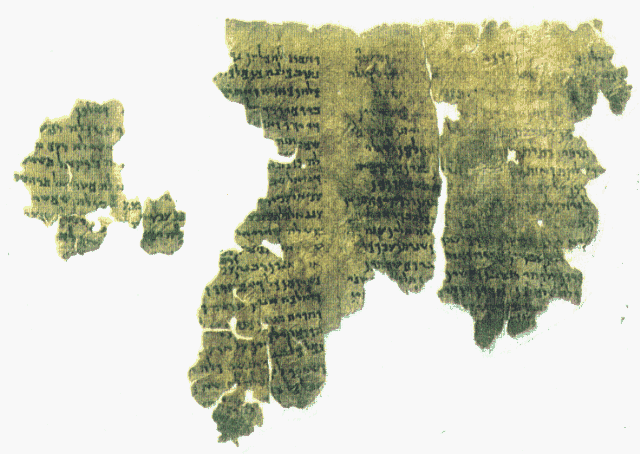
It is also my understanding that the reassembly and "translations" of the Dead Sea Scrolls have required a lot of guess work and artistic license.
Take a look at this image:
http://www.ibiblio.org/expo/deadsea.scrolls.exhibi t/full-images/enoch-b.gif
There are parts that are very faded... and those pieces on the left... how do they know where to put them - they are totally connected.
On a program that might have been Nova, or on Discovery, theyed showed people generating the digital versions. They would take the images and darken and lighten parts with a touch-up brush to make the letters stand out. But, the girl doing the work admitted that you could easily make it say anything you want - even to include putting her own name in there.
Part of their work was based on arranging the pieces to match other documents. So, of course, they match other documents!
I'm not saying what is written on those scrolls is not true, but I don't believe they are conclusive of much. -
Re:SSH TunnelsA more generic solution for getting around egress filtering is an SSH-based VPN.
For even more pertinacious network environments, one can use httptunnel or the more advanced desproxy
-
Re:Try Python
I would recommend "Learning Python" by Mark Lutz as a great starting reference.
Learning Python isn't too awful. Personally I like How to Think Like a Computer Scientist - Learning with Python far better. It's also available in bookstores if you like having a printed copy in front of you while you learn (I know I do).
Free high quality programming languages...
Great free reference and learning texts...
Kids today have it *so* easy!
-
Re:Where to start?
Good call, Knoppix will mean not having to install anything and still access the underlying filesystem to save programs.
For the book though, just point them to How to Think Like a Computer Scientist. It's an excellent tutorial on Python for beginners.
So to answer the question above, what's required to teach programming? A 50 cent CD with Knoppix, a computer and an internet connection. Problem solved. That's a wrap folks! See you next post. -
Re:Python
I'd add two points:a large amount of useful libraries, and good "non-programmer tutorials" - including a free book.
I learned to program with Python in a Windows environment. Three years later I'm a CS student and I use GNU/Linux and BSD exclusively. Advocate Python to your newbies! -
Re:So much for foodMaybe my imagination just sucks from too much TV, but verbal imagery never seems to affect my appetite. I was told that after reading Upton Sinclair's The Jungle I would never want to eat meat again, but as the book vividly described the unsanitary factory conditions, the diseased meat being passed by inspectors, the rancid smell of dead flesh, humans being made into lard after falling into the rendering machine, fingers and rats and whatnot being ground into sausages... all I could think is, "Damn! I really want a cheeseburger right about now."
You know, roast squirrel sounds really good right now.
-
On Beyond ASCIII understand the support in a lot of the comments here for the plain-vanilla ASCII Project Gutenberg approach to ebooks. Paradoxically, however, a simple ASCII conversion from print to digital form provides less assurance of future survivability and usability of your book than rendering it with the structured XML markup specified by the Open eBook standard (where well-formed XHTML is the least common denominator).
Why? Well, an ASCII text version of a printed book is really more like an analog facsimile than is a version in XML that has been tagged for structural features. Leaving aside issues of non-English characters, illustrations, and unusual typography, ASCII does a relatively poor job of capturing all of the structural conventions that exist in printed books. Books have copyright pages, tables of contents, chapter titles, subtitles, bylines, epigraphs, block quotations, footnotes, running headers and footers, citation lists, etc. ASCII can provide rough format equivalents of some of these, very poor equivalents of others. With an appropriate XML tagset, however, it's a relatively simple matter to tag most of the structural features of a book and then use stylesheets for presentational rendering. That's the whole assumption of the Open eBook specification.
Suppose you're in a world where all printed copies of Huckleberry Finn have been lost. You have two CD-ROMS that somehow you've managed to decode so that you can read the files and interpret their character sets. One of them contains the Project Gutenberg etext of the novel, an ASCII transcription. The other contains an XML encoding tagged according to a DTD from the Text Encoding Initiative, the current best standard for encoding literary (and many other) texts. It has all of the textual content of the PG version, as well as some that's missing (like the table of contents and the copyright page from the transcribed edition, which the PG version unaccountably omits). XML tags mark all the line and page breaks of the original. In addition, there are tags to mark quoted speech, unusual typography, words in foreign languages, and other significant features of the original. The CD-ROM contains the DTD used along with documentation on the tagset.
In this imaginary scenario, even if all of the XML documentation were missing it would be pretty straightforward for 31st-century programmers to strip out the tags and recreate the ASCII transcription. But with the documentation, it's possible to reconstruct something much closer to the original than the plain-vanilla PG version allows. And suppose your 31st-century archaeologist found a trove of TEI-tagged books on CD: with all of the structural tagging and metadata about authorship, publication dates, etc., a 31st-century librarian will be able to plug all of the books into a cataloging system that allows sophisticated searching. If instead you had a trove of plain-ASCII books, the best you could do with the collection would be simple full-text searches.
Leaving aside the sci-fi scenario, the reality is that our documents, over the next few decades, will move from format to format and be used for purposes that we can only guess at right now. Of course plain ASCII, or even proprietary formats, will be better than no documents at all. But the work involved in converting them will be a lot higher than if they are tagged in a well-documented, structured markup language.
Incidentally, there's already at least one project underway to take Project Gutenberg texts and add minimal XHTML or XML markup to capture structure and make them more readable via stylesheets. The Open eBook specification is just a more sophisticated way of doing the same thing.
-
That's not what I said...
Ahhh, but I didn't say completely get rid of defence did I? Nup. What saddens me is that so much money is spent on it... Now what are the main reasons for the need for defence? Leaders deciding they should invade other countries, impoverished nations being taken advantage of by the rich and violent, Holy crusades against those not of the same beliefs...
How about, let's say... 1/2 of their current budget is spent on some worthwhile things, like... feeding those who are starving, educating those who have no schools, giving people the information and the ability to stand up to these types of things...
Now if you're thinking "That money won't make a difference", think about this...
The current US defence budget is $US359 billion, with it possible reaching $US480 billion in the next decade (source). Now, the World Food Programme fed 77 million people in 82 countries at a cost of $1.74 billion in 2001 (source)
So, we could feed 2/3rds of the world's population using just HALF of the current US defence budget.
Now, surely, that's got to make a difference to the amount of anger and suffering in the world, and conversly reduce the amount of violence? Surely. -
There is enough info on the web
Taking a network security class, could help, but which classes are really worth the money and might there be enough information on the web to make such a choice, unnecessary?
I believe there is enough information on the web, that is why I started the project Information Security Bible for beginners coming into the field that want to read the necessary documentation to get the basic grasp on all the wide varitity subjects under information security, and for the pros to keep on the the latest info. All the documentation is online and free, not everyone has the money to pay for those expensive books and fancy classes but alot of people have the thirst to learn about it and want to have more indepth knowledge of certain subject matters in the infosec area.
I'm also a moderator over at security-forums and we get alot of newbies trying to learn everything overnight! They don't want to take the time and effort to read, read, and read some more, they don't realize that it has taken most of us 10+ years to know everything we know, and still have to learn new things everyday.
I do also believe you should have a test lab enviroment to test and hone your skills. Most security professionals have test labs to test new exploits or try new security prevention technqiues, because in infosec its always cutting edge area which you have to make an everyday effort to keep up with or you'll fall behind quickly.
Read before you do, so when you do, you know what you are doing. -
Gentoo?
-
It's not an overnight thing.
The thing I've seen most people forget is they tend to gloss over how long it took them to learn the first computer OS they worked with.
Once people know how to use a computer a certain way, they don't want to relearn. I had no choice since my first computer was an Apple
The linux documentation project is the best. Plus just do google searches for your problems. Linux is more difficult to install than windows (newer versions, 95 is a nightmare). However, it becomes quickly easier to use (kind of like OS X).