Slashdot Mirror
Domain: llnl.gov
Stories and comments across the archive that link to llnl.gov.
Comments · 548
-
A neat document on Energy Usage...
... is available here. It has lots of interesting information, allowing you to substantiate statements like "If Nuclear generation was increased 3-fold solely to generate H2 for Automotive use, it would only make just over 1/3 of the current energy used in transportation.". I can not see solar curtains fitting in there anywhere at all...
-
Re:Harmonics
I'd imagine the former. It might actually be worth making, though how the hell GP is proposing to get a quartz crystal large enough to carve a guitar out of I don't know.
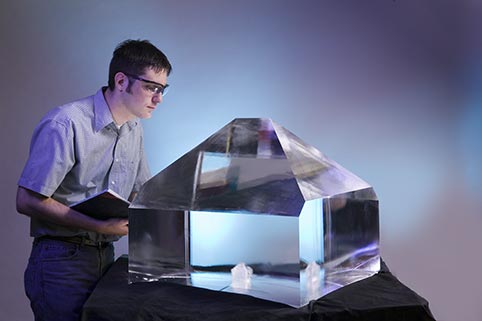
The government can help you out with that.
Granted, it's not quartz, but I think it might work.
-
Re:Yes, where is this technology outsourced from?.
Anybody notice the mention of Lockheed Martin in the original article?
Really? Is more outsourcing of sensitive government tasks the way to go? Have we learned nothing from experience...
The federal government outsources just about all of their sensitive science and engineering. Sandia National Lab is run by Lockheed Martin. LANL and LLNL are also run by contractors. Nothing new.
-
Re:Seriously, WTF?
This is a pretty interesting & relevant graphic.
-Ted -
Re:They had to wait until the US was losing in Ira
"Refusal to be prepared for that sort of thing is the fault of US military leadership."
Troll, eh?
Sending soft-skinned light truck HMMWVs into urban combat works badly. They cannot surmount roadblocks and do not effectively protect their crews. (US forces at Mogadish had to be rescued by Pakistani M113 and M48s, because the US armor was left in CONUS!) Uparmoring HMMWVs for Iraq was reactive to tactics that had been used against soft trucks for DECADES.
http://www.specialoperations.com/Operations/Restore_Hope/97-0364.pdf
As for soft-skinned supply convoys (OK in open desert, not OK when channelized in cities) we had protective solutions in the form of the famous Viet Nam war gun trucks. We have them again, but they had to be fabbed locally (again) because of the collective post-Viet Nam brain dump. Good thing the enlisted folks and contractors had their act together.
VN "Iron Butterfly" truck w.box style body:
http://134.198.33.115/sims12.htm
OIF homebrew version:
http://news.webshots.com/photo/1124605382054144800oTBMQt
Livermore high-dollar version:
https://publicaffairs.llnl.gov/news/news_releases/2005/NR-05-07-07.html
VN truck King Cobra (scroll down)
http://134.198.33.115/agee1.htm
Looks familiar!
http://www.cmvmag.co.uk/cgi-bin/news.cgi?article=040103
MRAP armored truck:
http://www.marinecorpstimes.com/xml/news/2007/05/marine_mrap_070523/070253mrap_story.JPG
BTW, Israel has figured out how to carry troops into combat under far more armor than the US uses. The Israelis use recycled Russian tank hulls as the basis for the Achzarit. Might be time for us to do the same thing.
http://www.youtube.com/watch?v=i1ly0fk1Pro -
Re:acceleration structures, etc...
Ok, I can see the benefit of being able to bail out early in cases where geometry is far away or the full resolution hasn't been loaded in from disk or network or wherever it comes from. I can also see the benefit of storing the texture and geometry in the same data structure. It sound kind of like roam but in three dimensions. I'm not sure if you'd have problems with discontinuities between neighboring voxels of different sizes.
I'm not very knowledgeable of volume rendering, but this seems to be pretty similar, though they only tested the algorithm on a very small dataset. I shall look forward to seeing this sort of thing in a modern game.
-
Re:lead acid still king of cheap
-
Most powerful laser in the World = NIFsome of the researchers speculate
Maybe some of the researchers should do some research into their speculations, it's not even the most powerful laser in the US.
The National Ignition Facility (NIF) https://lasers.llnl.gov/ at LLNL is orders of magnitude larger than this and its not even fully up and running yet https://publicaffairs.llnl.gov/news/news_releases/2007/NR-07-11-05.html
-
Most powerful laser in the World = NIFsome of the researchers speculate
Maybe some of the researchers should do some research into their speculations, it's not even the most powerful laser in the US.
The National Ignition Facility (NIF) https://lasers.llnl.gov/ at LLNL is orders of magnitude larger than this and its not even fully up and running yet https://publicaffairs.llnl.gov/news/news_releases/2007/NR-07-11-05.html
-
Re:Yeah, right...
"global-scale shared computer"
He was using their words, but really, what does that mean? A whole lot of nothing. It sounds impressive I guess. It would be a shared computer as much as the Google cluster is a global-scale shared computer.
https://asc.llnl.gov/computing_resources/bluegenel/configuration.html
Each node card is logically just like any cluster node made from commodity hardware. It runs linux and has a bunch of CPUs. The internal architecture of a Blue Gene node a lot is different than a commodity node, but from outside, they operate the same.
And another thing, it would really be no different than the existing Internet. The existing Internet has no sentience, so neither would this implementation. It's not like the Internet could all of a sudden become self aware and take over the world. -
fusion power a waste of money
Commercial fusion power is not be competitive for a LONG time if EVER. The SUN produces 276 mW/cm at its core and IT has a density of 160 g/cm^3 (2)!!! If the SUN has that much trouble with fusion, what makes us pathetic humans stand a chance?
Yes, I know that Deuterium - Deuterium reactions are a lot faster and easier, but this is competing against solar, coal and nuclear energy.
(2) http://fusedweb.llnl.gov/CPEP/Chart_Pages/5.Plasmas/SunLayers.html -
Re:Duh
Nuclear simulations are one of the main reasons DOE builds supercomputers. Since the U.S. can't test actual nuclear bombs anymore R&D is done on these supercomputers. Looks like they have some spare CPU time to lend out to academia though. https://publicaffairs.llnl.gov/news/news_releases/2007/NR-07-06-09.html http://www.wisconsinproject.org/pubs/articles/1990/thirdworldbomb.htm http://en.wikipedia.org/wiki/Los_Alamos_National_Laboratory
-
Re:I read this in the magazine
As "afaik_ianal" (918433) states, it's easy to calculate the actual cost/benefit of solar, compared to doing the same for coal. Further, one should factor in not only PV/turbine life time and energy efficiency, but also the energy required to build the power plant in the first place and then to bring the fuel to the plant. None of these latter categories earn any coal plants any points, though the life time and efficiency can indeed be improved upon.
In that light, it's really not a bad thing to have plants of a relatively short life span, as that ensures plants will be replaced ---by presumably improved technology--- in the foreseeable future. This has to be better than keeping old and inefficient plants running. Check out the split ratios of the black and grey paths in the image below:
https://eed.llnl.gov/flow/images/USEnFlow02-exaj.gif
There's not really any reason to *not* replace plants as fast as we can, and patch up efficiency as technology allows. Every moment delayed is a needless waste of energy. -
Re:Is that how much it costs?Bill Gates and Charles Simonyi only donated $30 million; in 2005, estimated costs were $300 million, $30 million for design and $270 million for construction.
Plus, according to NASA The cost to find at least 90 percent of the 20,000 potentially hazardous asteroids and comets by 2020 would be about $1 billion... Source. -
power losses during transmission
As chance would have it, I came across this very informative chart from Lawrence Livermore National Laboratory. I am astounded at the amount of loss (transmission being a major factor).
I see a problem with the chart. No where on it do I see whether the electricity is transmitted AC or DC or the distances. At high voltages over long distances AC looses more than DC does.
Falcon -
Re:Consumer offerings?
As chance would have it, I came across this very informative chart from Lawrence Livermore National Laboratory. I am astounded at the amount of loss (transmission being a major factor).
-
Re:Thank god
How about some SDL threading?
Not doing all that other stuff? Maybe pthread can save your soul? -
Not that big of a super computer
Really, I don't see what the big deal is. A 216 opteron machine is not very powerful compared to what is commonly available at many universities in the United States. To see the kind of processing power the US national labs have, and the ease of learning how to build/develop for them go to https://computing.llnl.gov/tutorials/linux_clusters/. This is the page of Lawrence Livermore National Lab's supercomputers. It has an overview of each machine, and technical information on building clusters. OpenMPI is open source, and gcc-4.3 includes OpenMP support. Perceus is an easy to implement cluster imaging system and Torque is a free scheduler. Building clusters nowadays is not any more expensive than the commodity hardware they are made from and a few techs to configure them. Most engineers have been taught at least a little programming, and leaning how to code in OpenMP+OpenMPI is not hard. The fact that they have built a modest supercomputer should not surprise anyone.
-
VisIT
Here is a full feature open source Visualization package. Though not quite the same as Sage, there are other options out there.
-
Drowning in a bucket
The potential microgram lethality of Pu is similar to the 1-gallon lethality of H20. Possible, but not inevitable.
(From http://www.llnl.gov/csts/publications/sutcliffe/)
The committed effective doses[9] and the increased probability of cancer death resulting from them have been studied extensively, as outlined in Appendix A. The estimated cancer fatality risk associated with exposure to weapons-grade plutonium is 12 cancer deaths per milligram inhaled, or 1 per 0.08 milligrams inhaled; and it is 0.0021 cancer deaths per milligram ingested,[10] or 1 per 480 milligrams ingested.[11] For perspective, an inhaled mass of about 0.0001 milligram would increase the cancer mortality from about 200 in 1000 (the risk of cancer mortality from all causes) to about 201.2 in 1000. This risk increase corresponds to a decrease in life expectancy of about 15 days; for comparison, smoking a pack of cigarettes a day reduces life expectancy by about 2250 days (more than six years).[12]
--
phunctor -
Re:Kreiss ...
... Overture Documentation
CC. -
Re:It's the grid that's the issue!
Here's an easier URL for the chart:
https://eed.llnl.gov/flow/02flow.php -
It's the grid that's the issue!
Sure, PV modules don't convert all they see to useful electricity. Where they really shine (sorry) is that they generate that power AT THE POINT OF USE.
Look at the chart on p 8 (of 41) of this pdf from Lawrence Livermore National Labs.
Note that of the 38.2 quads (quadrillion BTUs) of electrical energy produced in the USA in 2002, fully 26.3 quads never get used! That's where the real power (sorry again) of solar is found.
-
Re:Are these machines actually used?
In fact, a lattice QCD problem was one of the model problems for the Track 1 proposals. Proposers had to "provide a detailed analysis of the anticipated performance of the proposed system on the following set of model problems...A lattice-gauge QCD calculation in which 50 gauge configurations are generated on an 84^3*144 lattice with a lattice spacing of 0.06 fermi, the strange quark mass m_s set to its physical value, and the light quark mass m_l = 0.05*m_s. The target wall-clock time for this calculation is 30 hours." Full details here.
This is a Big F-ing Problem that does in fact require Big F-ing Computers to solve. To meet the target time would require at least a petaflop of sustained performance; hence the inclusion of this problem in the call for proposals. The other model problems came from CFD and molecular dynamics, and there was a wide range of smaller required problems as well.
Now, none of this explains how these machines will really be used, or to what end. Nevertheless, I can vouch for such large machines being used under heavy load to solve very large problems. Poke around any of the national supercomputing labs' websites, and you should be able to find at least plenty of news releases, if not papers.
Here are some quick samples:
- ASC at Lawrence Livermore National Lab (home of BG/L, Top500 #1)
- NCCS at Oak Ridge National Lab (home of Jaguar, Top500 #2)
- Sandia National Lab (home of Red Storm, Top500 #3)
- NERSC at Lawrence Berkeley National Lab
-
Re:Not to be a party-pooper...
In the real world however, even precision mirrors top out at 80% or so.
I think this is very incorrect, in this context. Silver-coated glass mirrors (that is, the normal household mirrors) have a reflectivity of about 98 % at 700 nm, and it increases even further with lower wavelengths. And this one was an infrared laser.
For example check this paper for info on silver's reflectivity. -
Re:Obligatory....
-
Re:So...
The bigger cause for worry is when someone's music is compromised through no substantial fault of their own (their laptop / ipod is stolen, malware, insecure password on a campus computer network, etc), and that person is suddenly answering the knocking fist of black-suited feds at 4am.
Maybe that sounds exaggerated but I experienced a similar encounter when I was in college because the IP address which was assigned to me was used to attempt a hack against LLNL systems. Fortunately for me I could prove that I was not on campus the weekend when this occurred, and the investigation showed that switch logs for the event traced the physical port being used as a publicly accessible port in a computer lab. -
Re:Ha! C != performance
Say that to entire highly parallel capable OS's written in C. Also, C has a nice, simple threading model, it's just not quite as nice as some of the others out there (python).
-
Re:3D-Accelerated Rendering?
I know MayaVi, it's a very cool package, but I wasn't been able to run it before. I should try again.
Also, speaking of cool VTK stuff, there is VisIt (http://www.llnl.gov/visit/). Seems very cool, and it's BSD-licensed (can they do that? they redistribute Qt with it...) -
Re:The grid IS more efficientNow I also don't have exact numbers for modern gasoline/diesel cars, but 40% of the heat from fuel turned into movement power? Maybe modern cars are that good, but I doubt it. If anyone has some more numbers on that: please fill us in.
For petrol, you are right - down around 30% - but for diesels (which most modern cars are in high fuel cost places like Europe) you are wrong.
Modern fuel diesel ICEs are 40-50% brake thermal efficiency.
Quote from wikipedia http://en.wikipedia.org/wiki/Fuel_economy_in_autom obiles:Diesel engines have maximum energy efficiency of 45% and Petrol engines of 30%
To go closer to real references (rather than just Wikipedia), figure 4 in this http://www.llnl.gov/tid/lof/documents/pdf/237490.p df paper shows thermal efficiency hitting 40% for a 1990s VW TDI engine (newer PD & common rail diesels are even better).
Looking to near future, people are pushing ICEs (diesel of course) that can hit 50%+ and meet 2010 emissions targets, eg. from http://www1.eere.energy.gov/vehiclesandfuels/pdfs/ deer_2006/session3/2006_deer_aneja.pdf we have:50.2% Peak Thermal Efficiency at a Single operating Condition
EPA 2010 Emissions Regulations over Steady-state and Transient Operation
Now, that's for larger vehicles first but the tech will likely work it's way down to car-sized engines (maybe sooner in the US where everyone drives truck-sized cars...).
So, maybe electric isn't the clear cut winner you thought. -
Re:Here we go again....
Without aqueous chemistry, carbon dioxide couldn't turn into carbonates and stayed in the atmosphere.
Ahhh, so that's why all that limestone looks like fossilized plankton... aqueous chemistry... Got it! Good thing that aqueous chemistry locked up all that C in 66,000,000 gigatons of limestone and dolomite and that life on earth only locked up a paltry amount in 4000 gigatons of fossil fuels. (Source) Man, if only there were some way to get life on earth to get with the program and reduce CO2 in the atmosphere, we could counteract any effect CO2 might have by removing it from the atmosphere completely... If only there were some government study or something to show us how!
Oh well, on to plan B. We should we should cease use of the internal combustion engine and shut down all power plants that utilize fossil fuels in the production of electricity. At least that stops adding CO2 to the atmosphere, even though it does nothing to remove the CO2 there and completely handicaps modern society in a multitude of ways. Brilliant plan! Let's begin immediately.
-
Global warmers again... *sigh*
No, actually, GP is right. The people offering the "Prize" are just cheap. Tell ya what, I'll offer a prize of $25 to anyone who can produce a Lamborghini for me and leave the vehicle with title and a big red bow in my driveway. What? No takers??
PS. The problem was solved quite a while ago. So take your $25 million and go lobby congress for some pollution credit trading scheme that doubles your price at the pump and pays for ocean fertilization. Next!
-
Re:Plant Respiration
Depends on where the tree is planted.
If you plant it too far north, you could actually be hurting global warming by planting trees.
http://www.llnl.gov/pao/news/news_releases/2006/NR -06-12-02.html -
Planting Sugar Cane in the Tropics is Stupid
It's stupid if you plan to stop global warming. According to a new study by the Federal Berkley Livermore Labs, RainForests, and Trees at lower latitudes are the only trees worth planting. http://www.llnl.gov/pao/news/news_releases/2006/N
R -06-12-02p.html Planting SugarCane in the Tropics, Either you force the cutting down of rainforests. Or eat up all the farmland not in the rainforests, Which then forces the local food crops out. Who are then, forced to cut down rainforests. Thats just pulling us out of the frying pan, And driving us into the fire. -
Take another look(Goddammit, why can't I see the italicized text inside blockquotes? Is Slashdot fucking me over AGAIN?)
We are not rapidly running out of natural gas. We're running out of domestic natural gas, but world natural gas supplies are still quite plentiful.
And, GW emissions aside, how exactly does this helps our energy security and balance of trade situations? There is considerable resistance to LNG terminals also.
Note that the US used to use a significant amount of oil for electricity generation.
A point I've made frequently. (Note that "petroleum" in that table includes refining byproducts such as petroleum coke, so the total of liquids is even less.)
The primary replacements for oil-fired electric plants were nuclear and coal. Recently we've added a lot of gas-fired capacity. We can't add more gas due to supply limits, coal is a pollution and GHG nightmare and nuclear has a 10-year or so planning horizon. The immediate problems require other solutions, and I think the primary ones are going to be wind, efficiency and cogeneration.When it became expensive, we switched, and now oil is almost unused in this country for power generation (except for backup power). Barring some instant, "ooops, we're out of natural gas -- when the heck did that happen?" moment (which is essentially impossible), there's not going to be an electricity shortage.
Impossible? It happened to New Zealand:
The Maui gas field has been responsible for 25% of New Zealand's electricity generation. When it runs out in a year or two, not only will a multibillion dollar infrastructure become essentially obsolete overnight but New Zealand will have lost 25% of it's electricity generation capacity. If you thought New Zealand's electricity crisis was a concern it is about to get a whole lot worse.
It ain't what you don't know that'll get ya. It those things you know that ain't so.
As for a charcoal fuel cell: it's not about whether or not you can get energy from charcoal in a variety of manners. Feeding it and removing the byproducts, even in a slurry, is the problematic element -- especially when you factor in the cost of making your charcoal consistent enough.
Consistent? It only has to be fine enough (and ball mills are very good at guaranteeing that). The actual feeding is an engineering problem; if engineers can build gravimetric feeders for powdered coal in furnaces which require steady flames, the management of a carbonate bath which needs feeding every half-hour or so can't be all that difficult. And here's what the originators say about ash:
The ash in coal may be chemically extracted and thereby reduced to levels below 0.5% at minimal cost and energy penalty. At this level, its impact on electrolyte life no longer limits cell economy.
In other words, you're going to need to deal with other things before the electrolyte composition changes enough to bother you. More about ash on pages 11-12 of this PDF.
As for charcoal itself, its production is a lossy process. Much of the original energy is contained in the released gasses -- namely CO, H2, and volatile oils/tars -- but they're mixed in with lots of CO2 and H2O, making for less efficient combustion (not to mention the energy loss involved with the process heat).
Quite right! Charcoal produced by flash carbonization yields about half the input energy as gas and heat (a pyrolysis process driven by external heat would convert more to carbon and le
-
Re:the edge of the plate spins 50 meters a second!
That's nothing; in terms of rotating things, flywheel batteries are much more interesting. They have achieved a velocity of 2km/s at the edge. (about Mach 6)
Take a look at http://www.llnl.gov/str/pdfs/04_96.2.pdf -
Re:Clueless (or humorless) mods strike again
There is almost no dissent in the scientific community as to whether global warming is man made, and even less that it exists.
So says the global warming advocate.
Face it, there is very little to be gained by believing in global warming.
Do you really believe that or do you think the rest of the world is stupid enough to believe it?
No money,
Billions in government grants?
no fame,
"Global warming to bring apocalypse! Story at 11."
Skepticism is the lazy person's default position.
My position, as a skeptic is "If it is such a huge problem, why aren't YOU doing something about it?" Government research shows you can take out twice as much CO2 as goes into the atmosphere with iron sulfate fertilization of the oceans. Where are all the global warming people now? There should be oodles of money in pollution credit to be had there, no? And it's important work! So save the planet already! Oh, wait, you'd rather make computer models and bellyache about the "End af thar worldz!!!"
-
One More I would inlcude: Plutonium
Funny note: as i was looking for the thermodynamic properties of plutonium, ebay promised to make me a great offer on it. Seriously, like ice it will expand and get less dense as it drops in temperature. Only, instead of just the one phase change, there are many. Unfortunately, this is the best I can find for a phase diagram. In thermo, my prof put up a much nicer one, just trust, the phase diagram is pretty crazy looking.
-
Long Lived Axions
Looking at this article, axions are described as:
The axion's extreme lightness (trillions would occupy a sugar-cube volume of space yet weigh less than does half of a proton) and nearly nonexistent coupling to radiation conspire to make the particle incredibly long-lived, perhaps as long as 10^50 seconds. The universe itself is estimated to be only 10^18 seconds, or 100 billion years, old. The axion's longevity would make it a stable particle for all intents and purposes.
But the particle found is extremely short-lived. So what's the deal here? Has the expectations changed since the article was written?
-
Re:Look out
-
Re:The issue isn't. . .
What is the issue is is this a natural process, a man-made process or a combination?
Why is that the issue? Are we looking to assign blame?The point is to figure out what (if anything) should be done based on what's happening. If global warming is caused primarily by mankind releasing carbon dioxide into the atmostphere, then it would behoove us to reduce our carbon dioxide emissions to control global warming. OTOH, if global warming is mostly a result (for example) the earth receiving more energy from the sun, then reducing carbon dioxide emissions will have only minimal effect.
It should also be pointed out that while most people generally take for granted that nearly everything we do releases carbon dioxide and therefore leads to global warming, that's a bit one-sided. Just for example, burning coal not only releases carbon dioxide but also generally releases at least some sulfur. Sulfur in the atmosphere causes global cooling (i.e. it does more to reflect energy from the sun back out of the atmosphere than to trap energy from the sun in the atmosphere). If you compare sulfur release into the atmosphere to the global temperature, you get a fairly close (inverse) correlation. That would support an argument that most of the arguments over global warming have things backwards: rather than currently causing global warming, the real situation could be that we (mankind) were mostly responsible for the mini-iceage by burning sulfur-bearing coal. In the last few decades we've reduced coal usage and (particularly) reduced emissions when we do use it (e.g. most power plants now have equipment to remove sulfur from their emissions). What we're seeing as global warming is really just the earth recovering back to about where it would have been if we hadn't been causing global cooling for centuries.
Likewise, many people (including some here) have suggested that planting trees as an obvious cure. Simple solutions to complex problems sound nice, but (as in this case) things are rarely as simple as they initially appear. Much of the loss of rain-forest that's often cited is largely illusory. While it's true that what's classed as rain-forest has been reduced (somewhat) the losses are often at least partially offset in terms of overall wooded land. Taking a look at the UN's FAO data we see that while the forest land in South America dropped by about
There are also problems with the idea itself. For one, large plantations of trees cause some environmental problems themselves. For another, depending on the latitude at which they're grown, trees can actually contribute to global warming.
Neither the problem, nor its cause, nor "the" solution is nearly as clear or certain as many would have you believe.
-
Re:And now the fun begins
Ha, ha
-
Re:Containment?"For a point of comparison, fusion is already hitting breakeven."
I agree with everything you posted besides this. To my knowledge the closest experiment to break even fusion is NIF (see http://www.llnl.gov/str/Powell.html or just http://www.llnl.gov/nif/). NIF still has a few years before it will be finished, inertial confinement is probably not going to be a viable energy source, and "break even" just means that you get as much out as you put into the plasma. So all that power on a magnetic confinement device going into magnet coils doesn't count. Power lost to inefficiencies doesn't count. Just what actually makes it into the plasma.
And even once break even is reached (whether it be NIF or ITER) the real goal is not just break even but a self-sustaining (burning) plasma. I think fusion is going to be great for the world, but it has a long way to come yet.
On topic with the article is that China's great accomplishment is in building a working experimental tokamak for less than 1/10th of the normal cost of a tokamak of its scale (around $ 37 million says wikipedia). If they are actually running shots and taking data then i think thats amazing. -
Re:Containment?"For a point of comparison, fusion is already hitting breakeven."
I agree with everything you posted besides this. To my knowledge the closest experiment to break even fusion is NIF (see http://www.llnl.gov/str/Powell.html or just http://www.llnl.gov/nif/). NIF still has a few years before it will be finished, inertial confinement is probably not going to be a viable energy source, and "break even" just means that you get as much out as you put into the plasma. So all that power on a magnetic confinement device going into magnet coils doesn't count. Power lost to inefficiencies doesn't count. Just what actually makes it into the plasma.
And even once break even is reached (whether it be NIF or ITER) the real goal is not just break even but a self-sustaining (burning) plasma. I think fusion is going to be great for the world, but it has a long way to come yet.
On topic with the article is that China's great accomplishment is in building a working experimental tokamak for less than 1/10th of the normal cost of a tokamak of its scale (around $ 37 million says wikipedia). If they are actually running shots and taking data then i think thats amazing. -
Re:I hate to break it to you amateur scientists ..
Oh, and there is no such thing as methane hydrate. I'm a chemist, turned atmospheric chemist.
You're a jabbering idiot. -
Global Warming SOLUTIONS
Well, to be honest, I think that it is in Minnesota (where I live), Canada, and Russia's best interest for the world to warm up. And maybe someday people will embrace a human-controlled climate, instead of running for the hills. Since we're controlling the climate unintentionally anyways, why not control it intentionally, for much less cost than Kyoto? I mean, reducing energy consumption is important, and we should do that as well, but everyone knows that at best Kyoto can only slow down global warming, right? So why not do something active?
http://www.llnl.gov/global-warm/
PS. I love the old Soviet determination of triumph over nature, even though it destroyed their country and their environment. Nuclear weapons as practical engineering tools, that's what I'm talking about! (Bad idea on our planet, though.)
PPS. Seriously, though. Even a super-Kyoto-type-thing will only slow global warming. It will NOT stop it, and it can not reverse it. Only geoengineering can do that. It's something people should at least consider.
http://www.llnl.gov/global-warm/ -
Global Warming SOLUTIONS
Well, to be honest, I think that it is in Minnesota (where I live), Canada, and Russia's best interest for the world to warm up. And maybe someday people will embrace a human-controlled climate, instead of running for the hills. Since we're controlling the climate unintentionally anyways, why not control it intentionally, for much less cost than Kyoto? I mean, reducing energy consumption is important, and we should do that as well, but everyone knows that at best Kyoto can only slow down global warming, right? So why not do something active?
http://www.llnl.gov/global-warm/
PS. I love the old Soviet determination of triumph over nature, even though it destroyed their country and their environment. Nuclear weapons as practical engineering tools, that's what I'm talking about! (Bad idea on our planet, though.)
PPS. Seriously, though. Even a super-Kyoto-type-thing will only slow global warming. It will NOT stop it, and it can not reverse it. Only geoengineering can do that. It's something people should at least consider.
http://www.llnl.gov/global-warm/ -
very difficult to make that effective
Plutonium is toxic, that's true.
But the descriptions you hear all the time about how one gram can kill a bazillion people assumes that each person gets exactly a lethal dose and no more.
In reality, this is difficult to do. Plutonium, for example, is not soluble in water and is very heavy. So distributing it through the water supply would be very difficult.
If you drop a bit in the water supply, it'll just sink to the bottom in the first eddy it reaches and sit there, killing only things that come near it instead of the intended targets. It might kill nothing except a few rats.
http://www.llnl.gov/csts/publications/sutcliffe/ -
Re:Chemical info on Borohydride
Gee golly! If only there was a fuel cell technology that could use something other than pure hydrogen. Or if it must be hydrogen, maybe if there was a way to use the otherwise dense hydrogen-storing capability of readily available and stable hydrocarbon fuels as a source... hmmmmmm...
But no, it's much too much fun to just fly off the handle isn't it?
Preemptive rebuttal: Don't bitch about temperatures and scalability of the above references. That's what research is for. Point is "hydrogen" is too much of a buzzword and there are plenty of promising technologies out there.
=Smidge= -
Re:What the hell is "bubble fusion"?
Actually, sonoluminescence was discovered in 1934. I believe the most recent batch of research may have been inspired by the observation that snapping shrimp seem to be able to acheive it, and trying to understand what process could release a photon via such a relatively low power system. It seems that if it's not some form of fusion, then an entirely new set of physics, or at least chemistry, needs to be invented.