Slashdot Mirror
Domain: man.ac.uk
Stories and comments across the archive that link to man.ac.uk.
Comments · 323
-
Re:5.33 Hz?
I got 40 MHz out of mine
-
Nothing New
For controlling a computer via bluetooth, there is Bemused Which works pretty well for playing mp3s, and can do other things which I haven't tested. There have been a lot of other attempts to read data in with camera phones. http://semacode.org/ allows you to open up web links from physical items.
I'm working on an open source bar code recognition program which functions, but is still in its alpha stages. -
We sell a product based on this
My company sells a Semantic Web product that is W3C compliant. Mainly based on the work of our chief scientist, Ian Horrocks.
-
Re:Learning OGL?
Here are some free online books for ya.
http://fly.cc.fer.hr/~unreal/theredbook/
http://www.cs.man.ac.uk/applhax/OpenGL/
the Red Book is a good guide to everything OpenGl
--
Stupid -
EyeToy and Gestural Interfaces
Cheap techology is great -- make digital cameras inexpensive, offer an SDK to grab their output, and folks will come up with wonderful ideas for how to abuse them. Devices like EyeToy are mostly just oddities now, but I'd like to see them used to popularize gestural interfaces.
Arkane Studios' RPG, Arx Fatalis is one of a handful of titles that offers gestural input, with its mouse-gesture-based spells. But this was more a novelty than a boon for usability -- it would have been easier to cast a spell by clicking icons. Perhaps a sequel will allow you to embellish your runes with serifs to achieve subtle variations on an incantation?
Avant Browser offers up a more useful gestural interface -- and I like it because it allows me to execute common tasks more easily. Rather than having to hit a smallish "new window" icon, I can rudely right-click anywhere on a window and sloppily drag my mouse upwards to open a new window.
EyeToy takes this a step further and does away with the mouse altogether; and though I had modest luck with the thing when I played against the noisy backdrop at Toys "R" Us, here's hoping that it's the first among many such interfaces. Perhaps five years down the road, a) gestures will be common, b) we'll laugh at what Minority Report got wrong, and c) we'll thank goofy gadgets like this one for paving the way.
After all, it was pretty silly to have a "Rat" for the Atari 800.
________________________________________________
The Inago Rage website is now up.
Critiques welcome and appreciated! -
Silent cooling systems
Artificial blood pumped through with silent hydrostatic pumps.
(With credit given to Seymour Cray for the idea of using blood as a coolant.)
Who wouldn't want a sweet looking system from "Vampire Computing"?
Just a few ideas I'm kicking around... gotta find a job now that I'm graduating with my BS CS degree. Maybe I shouldn't attempt 'artistic' computer design... -
Re:algebraic notation
I'm pretty sure you can assume this to mean infix notation =)
Either that or it comes with Chessmaster 10k, which uses Nf3 instead of NKB3...
- rabs -
Maybe its time for the clockless chips?
Current day CPUs like the Pentium march to an internal clock that at this moment runs at around 2 Ghz. This is both difficult to design and very inefficient.
There is research going on that changes the clock based design for much more energy efficient clockless design. Mind you this is nothing new, just not applied yet to every day computers.
One interesting chip design is/was the Amulet which is compatible with the very popular ARM design in a clockless version. -
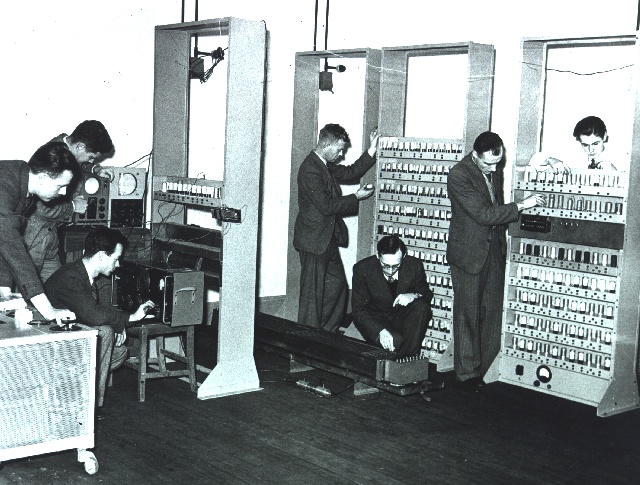
EDSAC missing, as well [Re: COLOSSUS missing too!]The EDSAC shall not be forgotten in this list:
"After the Second World War the director of the Computer Laboratory, M[aurice] V. Wilkes, headed what was perhaps the most influential of Britain's postwar computer projects the building of the EDSAC. Modelled on the American storedprogram concept that Wilkes had heard outlined at the Moore School lectures in August 1946, the EDSAC (Electronic Delay Storage Automatic Calculator) ran its first calculation in May 1949. The objective of the design team Wilkes, W. Renwick, S. Barton and G. Stevens on the hardware side; and D.J. Wheeler on the programming side was to provide a useful and reliable computing service. Such a service, the first in the world using a storedprogram computer, was available from early 1950. A significant feature of the Cambridge approach was the attention paid to userconvenience and programming; hence the group's book, The Preparation of Programmes for an Electronic Digital Calculator (1951), became the first textbook on programming a storedprogram computer, and was soon regarded as a classic."
(Quote, hyperlinks added by JLL) -
More BCI informationSome further links for more information on Brain-Computer Interfaces:
Upcoming talk and demonstration on the development of Brain-Computer Interfaces: http://www.notacon.org/speakers.html#lowne (shameless plug)
Invasive, motor-cortical BCI development at Utah: http://www.bioen.utah.edu/cni/Projects/Motor.htm
Mike Gibbs' work with BCIs at Oxford University's Robotics Group: http://www.robots.ox.ac.uk/~mgibbs/research.html
The Neural Prostheses program at the National Institutes of Health includes calls for proposals in BCI development: http://www.ninds.nih.gov/npp/
The University of British Columbia's BCI research group: http://www.ece.ubc.ca/~garyb/BCI.htm
Results of the 2003 Brain Computer interface competition (focuses on signal processing techniques): http://ida.first.fraunhofer.de/projects/bci/compet ition/results/index.html
BCI development at the Cognitive Science and Technology group at the Helsinki University of Technology: http://www.lce.hut.fi/research/bci/
Dr. Jessica Bayliss's BCI work and extensive bibliography (very important, seminal work on BCI development): http://www.cs.rit.edu/~jdb/research/ and http://www.cs.rit.edu/~jdb/research/baylissThesis. pdf
Dr. Charles Anderson's work at Colorado State University with EEG pattern classification in BCI systems: http://www.cs.colostate.edu/eeg/index.html
Manchester University's Toby Howard has written some good articles on BCIs, mostly for Popular Science: http://www.cs.man.ac.uk/aig/staff/toby/research/bc i/
Dr. Michael Black at Brown University teaches a course in BCI development: http://www.cs.brown.edu/courses/cs295-7/home.html
Cyberkinetics, Inc. makes medical-use BCIs: http://www.cyberkineticsinc.com/ -
Re:Jodrell Bank needs it
Jodrell Bank already has a mini-solar system laid out in the arboretum.
Car parking costs 3, not 5. Blame the government underfunding of the universities for this.
The visitor facilities are under redevelopment at the moment, so it's not that impressive. No planetarium there anymore, alas. -
A bit OTT
That is so over the top. Creating an entire PC just to show a picture? That's 200 for the screen and another 200 for the computer. On top of that they are recommending a hard disk?
My version uses a 5 quid FPGA and some junk thrown away equipment. The LCD was a 12" 9bit colour from some factory and a fiend of a friend offered them to us for a quid each. And the RAM is an old 1Mb 30simm (I have about 3kg of these). There you go. A picture displaying system with no need for a huge/noisy PC power supply (runs from one of those 12v ac/dc plug converters). The images can be sent to it via a serial cable (two wires internally so it can be passed over any old cable you have lying around). -
A bit OTT
That is so over the top. Creating an entire PC just to show a picture? That's 200 for the screen and another 200 for the computer. On top of that they are recommending a hard disk?
My version [man.ac.uk] uses a 5 quid FPGA and some junk thrown away equipment. The LCD was a 12" 9bit colour from some factory and a fiend of a friend offered them to us for a quid each. And the RAM is an old 1Mb 30simm (I have about 3kg of these). There you go. A picture displaying system with no need for a huge/noisy PC power supply (runs from one of those 12v ac/dc plug converters). The images can be sent to it via a serial cable (two wires internally so it can be passed over any old cable you have lying around).
ebizvyuspt -
A bit OTT
That is so over the top. Creating an entire PC just to show a picture? That's 200 for the screen and another 200 for the computer. On top of that they are recommending a hard disk?
My version uses a 5 quid FPGA and some junk thrown away equipment. The LCD was a 12" 9bit colour from some factory and a fiend of a friend offered them to us for a quid each. And the RAM is an old 1Mb 30simm (I have about 3kg of these). There you go. A picture displaying system with no need for a huge/noisy PC power supply (runs from one of those 12v ac/dc plug converters). The images can be sent to it via a serial cable (two wires internally so it can be passed over any old cable you have lying around). -
Mice power
Why hand power it when you can get mice to do it for you
-
Story of a GameIn 1984 I took my son to see The Last Starfighter. A story about a boy who has a strange relationship with a computer game. In the movie, the game was a standard upright video game, like every other arcade game; except for it's graphics which were drawn by a Cray XMP-1 which was not actually released until the next year; and software by Gary Demos Digital Productions (check out that first image!) The graphics were beautiful, to say the least. And I longed to play that game.
In 1990 I was finally able to fulfill that longing in the rec room of the Tiger's Claw, where there was, you guessed it, a standup video arcade simulation. Before I ever flew a mission I got scores in the millions fighting wave after wave of Dralthi. From then until the fireworks at the end, I was totally absorbed in the world that was Wing Commander. For the next several years, every time an expansion came out I was there. Malcom McDowell, Mark Hammell, John Rheys-Daves and even Ginger Lynn Allen!
In 1996 Chris Roberts, the man behind the Eing Commander Universe left for two projects. One is Digital Anvil the other was an extension of the movie sequences.
When Wing Commander hit the big screen in 1999 Chris finally made it to the big screen himself as the pilot of the salvage ship that rescues 1st Lt Blair.
Chris went on to Freelancer and other games, and we've moved on as well. But Chris and the whole team at Origin will always be remembered as the ones who first brought true 3D space combat to a computer near us!
-
Re:So?Companies like Nestle and Nike have been abusing human rights for years and nothing's happened.
Ah, Nestle. The company that gives African mothers free powdered milk for several months. Just enough to make sure they stop lactating and are essentially "addicted" to the product.
The good old "free samples to get the kids hooked" technique. Boycot Nestle!! They are literally killing children from malutrition right now.
-
Re:There's only one thing worse...
Yup... All these folks ready to give up on a "shoddy euro spacecraft" are probably forgetting all the months of searching for NASA's Polar Lander, and Jodrell Bank and Westerbork observatories pitching in to do their part in that search.
-
more news for the Beagle 2 weblog
more stuff from the Beagle 2 weblog
Listening out for Beagle 2
The 76m Lovell Telescope at the Jodrell Bank Observatory is ready to try and find Beagle 2 on Christmas evening. At 10:40 pm GMT Beagle 2 will begin to transmit an on/off sequence each minute - like very slow Morse Code - and about nearly 9 minutes later the signals should reach Earth. The transmitter power, at 5 watts, is little more than that of a mobile phone, but the team at Jodrell Bank have installed a very sensitive receiver to pick up the Beagle 2 frequency. See more details on the Jodrell Bank website>Betting on Life on Mars
Ladbrokes, the bookmaker, has cut its odds of finding life on Mars from 33-1 to 25-1 after a flurry of bets following the successful separation of Beagle 2 from Mars Express. Whilst these might not be true odds, the firm has taken the decision to minimise payouts in case Beagle 2 finds any evidence. Bets have been placed on the "Life on Mars" outcome since 1969. Link to Times story -
Re:in other news...
-
Re:If it was open source
If it was open source and GPLed then you wouldn't be able to use the code in your own commercial product.
Depends on the product. If it's an in-house application or it's generating content for a web server, then GPL would work just fine. Looking at the page http://people.man.ac.uk/~whaley/ag/appgen.html, AppGen (assuming this is the same program) is described as "a high level fourth generation language and application generator for producing World Wide Web (WWW) based applications." So it's a code generator (like the GPL'd flex and bison whose output can be used in proprietary code) and it's meant to be used to generate WWW backends (where the GPL doesn't require you to distribute code since you're not giving it away). Sounds to me like the GPL would have worked just fine for an application like this. -
Mirror
Mirror of firebird linux i686. If I can get the others I'll put them on the site too.
-
Re:They gave Yasser Arafat a Nobel Peace prize...FYI, the Peace Nobel is given by a separate (Norwegian) body from the Medicine Nobel.
According to this link, Damadian intended to use MRI for tissue characterization, not imaging. It was Laterbur that first used MRI to make a 2-dimensional image. If you look at Damadian's patent, there is no mention made of imaging. Rather, it covers two methods specifically designed to detect the presence of cancerous tissue (either in a sample or in the body). No imaging is implied. So, while he may have been important in magnetic resonance research, it doesn't look (to me, and I'm not a biomedical researcher) like he invented magnetic resonance imaging, which is what the Nobel was awarded for.
-
What I found the other day
I had a rant about it the other day. I found lights, toothbrushes, heat blankets and hot drinks cups.
Unfortunately the heatblankets link is now broken -
What I found the other day
I had a rant about it the other day. I found lights, toothbrushes, heat blankets and hot drinks cups.
Unfortunately the heatblankets link is now broken -
Grid computing?
I still think this is not what is commonly understood by the term "Grid Computing". Maybe it's the environment I work in but to me Grid Computing means something else
And is exemplified by projects like MyGrid. -
Re:Pong?
I allready had the thought of using LED's to see memory usage.
Then using that memory to play Pong but never with the LEDs themselves. -
Re:Pong?
I allready had the thought of using LED's to see memory usage.
Then using that memory to play Pong but never with the LEDs themselves. -
ARMBoards
We have made a few ARM Boards to teach undergraduate students. They work with ARM Angel or with our own debugger KMD. You can write code in asm or C or any even gcc front end (inc java).
The best feature for me is the huge FPGA's to play around with. Its quite easy to pick up any electronic equipment and plug it into it. Lots of fun and great experience gaining stuff.
The board total was around 100 GBP (inc board manufacture and mounting) and I think if you ask nicely the designs will be available.
Alternatively you could use something like a 6809 or an 8051 but then writing code for them is a pain. The best idea if you use someting old is to emulate a better processor. You can then run your favorite ARM/MIPS/x86 code on an emulation and forget the real system. -
ARMBoards
We have made a few ARM Boards to teach undergraduate students. They work with ARM Angel or with our own debugger KMD. You can write code in asm or C or any even gcc front end (inc java).
The best feature for me is the huge FPGA's to play around with. Its quite easy to pick up any electronic equipment and plug it into it. Lots of fun and great experience gaining stuff.
The board total was around 100 GBP (inc board manufacture and mounting) and I think if you ask nicely the designs will be available.
Alternatively you could use something like a 6809 or an 8051 but then writing code for them is a pain. The best idea if you use someting old is to emulate a better processor. You can then run your favorite ARM/MIPS/x86 code on an emulation and forget the real system. -
Very useful right away, let alone in the futureThere are already a lot of implantable devices for which power is a big concern. From simple things like pacemakers and sensors to more complex and experimental devices like artificial hearts, everything needs juice. One of the big problems, for instance, with some early devices is that in order to add more juice you had two bad options:
1. Have some sort of actual device sticking out of the body. This is bad, because it breaches the skin, our natural defensive screen, and such things tend to become very easily infected.
2. Surgery to replace cells. Again, any surgery at all is going to be both expensive and risk prone.
More recently, a third option has become available: having fully implanted power system that can be recharged wirelessly, via em radiation of some kind (you can google for it). This is a big gain, because it allows devices that are more power hungry while still maintaining the benefits of not breaching the skin and not needing frequent operations. But it still requires people to remember and have access to the appropriate charging device consistantly. If for any reason some one forgets or can't recharge, the device may shut down, sometimes with fatal results. So having a way to remove one more step for powering these things should really help improve the quality of life for a lot of people today.Of course, personally I find this to be a very exciting development for future things as well. When we get to the point of having more optional implants, for things like boosting hearing or vision, a way to power them will be necessary, and if the power requirements are low, then this system would be perfect. Ultimately, widespread adoption of anything, from an OS to a vehicle, is all about making it as easy and intuitive for end users as possible. There is a lot of interesting stuff going on for advanced things like brain-computer interfaces, and people who are interested should look around, as the state of the art has advanced a great deal in the past 5 years. Here are a few links for the curious, and much more can be found with google, of course:
Graz University of Technology
Standford/DVA Neural Interface Project
Beyond the Big Barrier(lighter, intro type stuff)
News Group:
sci.med.psychobiology -
Re:Wings In Space
The best explanation for the multitude of lettered spaceships in the Star Wars universe that I've found is here.
-
Re:About time, but nothing special
Well the CPU and DSP have allready been designed in the past. All this project needed to do is the software.
My university has a third year student doing ogg vobid decoder for our ARM boards. All that has to be done is to get the original source and replace the IO functions with hand written ones to interact with flash memory reather than files. Then you just load your ELF with a debugger and watch the thing squeak.
This is not rocket science. If the thing was done using proper application specific units and layed and they had to reverse engineer the ogg format then I would be impressed. -
not quite
It's because superior is mis-spelled in your "I'm so clever" signature.
Both of you might wan't to bone up on what a troll in this context actually is.
Mensa is for dorks. Who wants to be in a club with Gary Bushell, Jamie Theakston, Jimmy Saville, and
Carol Vorderman. -
FPGAs: good System C: you could do better
System/Handel C[++] are languages with two good points.
They allow software engineers to design hardware with minimal training and secondly they allow fantasticly fast simulations. The ultimate system of you feed in an MP3 decoder writen in C and you get a player with software at the other end is years (I think more than 10) away.
C is not a natural language to describe hardware. It creates large slow designs with very little transparency to the generated design. Transparency is important as a small looking piece of C code will generate a large slow design while a larger code will generate a smaller faster design. While trasparency is partly implicit in computer programs (You have a vague idea as to what the compiler will generate from your code) in hardware it is very easy to be well off.
FPGA's are getting more and more popular and powerfull. There are allready numerous CPU designs available and the current methods of creating them (mainly verilog and VHDL) seem to be generating much better results than system C ones.
As for soft computers I really like the idea. I would not be surprised to see some FPGA parts on the next 3d cards or CPUs. They allow hardware structures to replace complex code (e.g. I was trying to write code which effectively can be dome with a piece of CAM. hash tables are just a method of emulating CAM in programs).
To conclude, Yeah C based methods will become more popular but only because menagement like them. They produce appauling designs but as silicon area becomes nearly free and in areas where speed does not matter and you need to do a billion simulation runs to test it then yeah it will show it self more attractive to software engineers trying to do hardware. But at the end of the day this is all cheating. If you want to design hardware you really have to learn what structures there are at the bottom level and only then when you know what your compiler will produce for you can you effectively make use of such languages. If companys can affoard to get proper engineers to make hardware they may fetch some C monkey to do it instead but I think if you want to become one then you are selling your self short. -
Don't forget about the Square Kilometer Array
in Australia.
Site are here, here, and here.
Some technical details are here.
From the later,
The antenna has "...a proposed collecting area at low frequencies (150 MHz to 1.5 GHz) of roughly 1 km2 (or 106 m2) - the equivalent of more than one hundred dishes of 100 m diameter. In contrast, the largest and most sensitive existing array has a physical area approximately one hundred times smaller than this."
That's pretty big. -
Re:Spammers are pretty simple (for now)
It wouldnt take much to find and decode most of the simple spam-protected email addresses. Yeah, I had no problem figuring out that your e-mail adddress was actually cb@cs.man.ac.uk. It's easy.
-
a real experiment!You guys laugh, but...
from http://www.cs.man.ac.uk/~brejc8/rat.html
The Amulet
The Amulet2e is a asynchronous implementation of the ARM processor capable of 40 Dhrystone MIPS with a Core power efficiency of 290MIPS/watt. As it is asynchronous it will change speed dependant on the voltage supplied. Normal operation is at 3.3v but the processor will work correctly down to 1v.
The Mouse
As a real live mouse is not a very reliable piece of equipment we chose to buy a toy mouse (No longer available in the shops!). The mouse runs quite slowly and not in a straight line.
make sure you check video! -
Re:In related news...For those of you who don't remember the Good old days of Dr. Fun
-
Mirrors
Does anyone want to add a mirror of the comparison?
-
Mirror it here
Oh they are so dead. Please tell me someone got a copy.
Distributed Mirrors Project link
-
Mirror List
-
A bit overkill
1-10 mil gates is a very large number.
Take a look at my MIPS on an FPGA. That used less than 100k vertex gates including MMU and other things youprobably dont need.
Also why PCI? Why not talk to it via serial/usb/network? And why not make your own? We made these for just over £100 ($150) each (plus virtex). having the board outside the PC allows you to have more freedom and external connections to do things like this. Also it allows you to write a simpler download software routine to program the thing (serial vs PCI). -
A bit overkill
1-10 mil gates is a very large number.
Take a look at my MIPS on an FPGA. That used less than 100k vertex gates including MMU and other things youprobably dont need.
Also why PCI? Why not talk to it via serial/usb/network? And why not make your own? We made these for just over £100 ($150) each (plus virtex). having the board outside the PC allows you to have more freedom and external connections to do things like this. Also it allows you to write a simpler download software routine to program the thing (serial vs PCI). -
A bit overkill
1-10 mil gates is a very large number.
Take a look at my MIPS on an FPGA. That used less than 100k vertex gates including MMU and other things youprobably dont need.
Also why PCI? Why not talk to it via serial/usb/network? And why not make your own? We made these for just over £100 ($150) each (plus virtex). having the board outside the PC allows you to have more freedom and external connections to do things like this. Also it allows you to write a simpler download software routine to program the thing (serial vs PCI). -
Mirrors
Mirror here.
-
Mirrors
mirrorMirrors, because the graphs are quite important.
-
I still have mirrors from the last two times
Here they are.
-
Re:Looking at the tools...
Have a look at This Introduction to Very Long Baseline Interferometry at the Jodrell Bank Obervatory website - that will tell you (almost) everything you ever wanted to know about VLBI, and then some!!
-
Lots of software
I owned 7650 for quite some time now. It is great, if a bit bulky, phone. My only gripe is, that it does not support Bluetooth audio (no wireless headset support). 3650 supports this, supports movie capture and has somewhat enhanced J2ME support. Also 7650 has tons of software available:
As a bit of shameless self promotion, here is a game our company developed.
You also get obligatory IR control software and some other stuff here
You can get really nice & open source bluetooth remote controler here. There is other cool stuff like miniGPS, which gives you option to customize some options, depending on which base station you are currently connected.
Rant: Also, for anybody developing for nokia using J2ME - this is probably the most buggy implementation I have seen. For example, if you called Sound.setGain(byte) it crashed, no matter what the input was (this is a confirmed bug), and this is not isolated case. I really can't understand how somebody can get through QA when one of the public functions in interface that has 10 or so items doesn't work at all. *sigh*