Slashdot Mirror
Domain: mashable.com
Stories and comments across the archive that link to mashable.com.
Stories · 272
-
15,000 Hoverboards Seized As Unsafe In United Kingdom (nationaltradingstandards.uk)
puddingebola writes: National Trading Standards and trading standards services in Scotland have released figures that 15,000 of 17,000 hoverboards have been seized at ports of entry in the UK because of safety concerns. The boards were seized "due to a range of concerns, such as safety issues with the plug, cabling, charger, battery or the cut-off switch within the board, which often fails." Are we pushing hoverboard technology too far too quickly, or are there just a group of criminal sociopaths manufacturing unsafe devices at Christmastime and pumping them into the market? Mashable has a story summary with links to video of a man in Alabama with his hoverboard on fire. The government of New York City isn't so hot on hoverboards, either. -
BitTorrent To RIAA: You're 'Barking Up the Wrong Tree'
An anonymous reader writes: The Recording Industry Association of America (RIAA) sent a letter to BitTorrent last week asking the company to help stop copyright infringement of its members' content. Brad Buckles, RIAA's executive vice president of anti-piracy, asked BitTorrent CEO Eric Klinker to "live up to" comments made by former chief content officer Matt Mason. Two quotes by Mason stand out in particular: "We don't endorse piracy," and "If you're using BitTorrent for piracy, then you're doing it wrong." Both of these remain accurate, but the RIAA wants to see BitTorrent do more. VentureBeat contacted BitTorrent to get their stance on the letter, and the company said, "Our position is that they are barking up the wrong tree, as it seems they were with their approach to CBS last week. ... We do not host, promote, or facilitate copyright infringing content and the protocol, which is in the public domain, is a legal technology.". -
Inside the Failure of Google+
An anonymous reader writes: An article at Mashable walks through the rise and fall of Google+, from the company's worries of being displaced by Facebook to their eventual realization that Google services don't need social hooks. There are quotes from a number of employees and insiders, who mostly agree that the company didn't have the agility to build something so different from their previous services. "Most Google projects started small and grew organically in scale and importance. Buzz, the immediate predecessor to Plus, had barely a dozen people on staff. Plus, by comparison, had upwards of 1,000, sucked up from divisions across the company." Despite early data indicating users just weren't interested in Google+, management pushed for success as the only option. One employee said, "The belief was that we were always just one weird feature away from the thing taking off." Despite a strong feature set, there was no acknowledgment that to beat Facebook, you had to overcome the fact that everybody was already on Facebook. -
After 6-Year Beta Test, All Gmail Users Get 'Undo Send'
jones_supa writes: Since 2009, Google has been beta testing a feature in Gmail called "Undo Send." It allows you to delay emails up to 30 seconds from when you press the "Send" button so you can take them back if you immediately decide it was a bad idea to press the send button. Google announced in a blog post that Undo Send is becoming an official feature. For users who already had the Undo Send beta enabled, the feature will remain on, and those who didn't can turn it on via the General tab under Settings. Users can choose if they want to hold their mail for 5, 10, 20 or 30 seconds. -
US Airlines Say Smaller Carry-Ons Are Not In the Cards
New submitter callgen writes: Airlines for America, a trade group for U.S. carriers, has rejected proposed international standards for carry-on bags. Last week, the International Air Transport Association (IATA) announced an initiative to "optimize" airlines' accommodation of carry-on bags by suggesting a new standard luggage size. It suggested a standard of 55cm x 35cm x 19cm, 58% of the size that Southwest allows. Most standard carry-ons are larger than IATA's recommendations, meaning travelers would have to purchase new luggage if the smaller size was adopted. -
Tech Jobs and Apple: Every Bit As "Fun" As Pleasure Island?
theodp writes: On the eve of Apple's big Worldwide Developers Conference, Apple CEO Tim Cook said the lack of diversity in tech is 'our fault' — 'our' meaning the whole tech community. "I think in general we haven't done enough to reach out and show young women that it's cool to do it [tech] and how much fun it can be," Cook explained. Indeed, the WWDC scholarship winners shooting selfies with Cook at the San Francisco Four Seasons to celebrate their iPhone apps and other WWDC attendees looked to be having as much fun as, well, Pinocchio at Pleasure Island. But, as the NY Times recently pointed out, Cook can be guilty of overlooking inconvenient truths. Which here is that most young women (and men) wouldn't find it 'cool' or 'fun' to live with 8,000 co-workers in factory dormitories where they can be roused out of bed in the middle of the night by Apple for an emergency 12-hour shift to fit glass screens into beveled iPhone frames, although that too conjures up a scene from Pleasure Island. -
Drone Racing Poised To Go Mainstream
New submitter Strepto writes: Using video cameras and special goggles or screens, First Person View has been a thing in the RC world for a while. In the last couple of years though, mini quadcopters have taken things to a whole new level, and the inevitable racing has begun to happen with these incredibly quick and agile little machines.
A recent event in Melbourne, Australia, was covered by various media including the ABC, Gizmag and Mashable. Our little media race (first and last place videos here) went down well, but there are still a number of regulatory barriers to jump in Australia and overseas. It's hard to judge public perception though. I was just wondering what the Slashdot crew thinks about this; does it look dangerous, irresponsible or just plain cool? What do you think the future holds? -
Netflix Is Experimenting With Advertising
derekmead writes: Netflix is experimenting with pre-roll and post-roll advertisements for some of its users. For now, it's just pitching it's own original programming. However, many are concerned that they plan to serve third-party ads, but the company says they have no plans to do so. They told Mashable in a statement: "We are not planning to test or implement third-party advertising on the Netflix service. For some time, we've teased Netflix originals with short trailers after a member finishes watching a show. Some members in a limited test now are seeing teases before a show begins. We test hundreds of potential improvements to the service every year. Many never extend beyond that." -
Report: Apple Watch Preorders Almost 1 Million On First Day In the US
An anonymous reader writes The launch of the Apple Watch has got off to a good start, with an estimated 1 million pre-orders in the U.S. on Friday. "According to Slice's Sunday report, which is based on e-receipt data obtained directly from consumers, 957,000 people preordered the Watch on Friday, with 62% purchasing the cheapest variant, the Apple Watch Sport. On average, each buyer ordered 1.3 watches and spent $503.83 per watch." -
Google Unveils the Chromebit: an HDMI Chromebook Dongle
An anonymous reader writes: Today Google unveiled a new device: the Chromebit. It's a small compute stick that contains the Rockchip 3288 processor, 2GB RAM, and 16GB of storage — much like a low-end Chromebook. It connects to a TV or monitor through an HDMI port. (It also has a USB port for power and plugging in peripherals.) Google says the Chromebit is their solution for turning any display into a computer, and it will cost under $100. Google also announced a couple of new Chromebooks as well. Haier and Hisense models will cost $150, and an ASUS model with a rotating display will cost $250. -
Dad and Daughter Recreate Jurassic Park With $100,000 In Lego Pieces
mpicpp writes Animator Paul Hollingsworth and his daughter Hailee, along with some help from a few "master builders" — decided to Jurassic Park using only Lego pieces. More than $100,000 in Lego were used, according to the video's description. The result is a surprisingly stunning and hilarious version of the 1993 dino-thriller. The team behind the film also released an in-depth behind-the-scenes look at the production. -
The Revolution Wasn't Televised: the Early Days of YouTube
mrflash818 sends this report from Mashable: A decade ago, Netflix meant DVDs by mail, video referred to TV and the Internet meant simple text and pictures. All that changed in about 20 months. ... It was hard to get a handle on what YouTube was, exactly. The founders didn't know how to describe the project, so they called it a dating site. But since there weren't many videos on the site, Karim populated it with videos of 747s taking off and landing. Desperate to get people on the site, YouTube ran ads on Craigslist in Los Angeles and Las Vegas, offering women $20 for every video they uploaded. Not a single woman replied. Another vision for YouTube was a sort of video messaging service. “We thought it was going to be more of a closer circle relationship,” Chen said in a 2007 interview. “It was going to be me uploading a video and sharing it with eight people and I knew exactly who was going to be watching these videos — sharing with my family and my friends.” What actually happened was a “completely different use case” in which people uploaded videos and shared them with the world. -
Boston Dynamics Introduces Their Newest Four-Legged Robot, 'Spot'
MicroHex writes: Boston Dynamics, creators of "Big Dog" recently unveiled their newest creation, "Spot." Originally funded by DARPA to develop the technology behind Big Dog, Boston Dynamics is currently owned by Google and continues its robotics research. From the video: "Spot is a four-legged robot designed for indoor and outdoor operation. It is electrically powered and hydraulically actuated. Spot has a sensor head that helps it navigate and negotiate rough terrain. Spot weighs about 160 lbs." -
Rich Olson Embodies the Spirit of the Maker Movement (Video)
What kind of person builds a cloud chamber at home in his spare time -- and wants to make it easy for other people to make them, too? How about someone who uses a 3-D printer to make shifters for his bicycle? And then there's the spherical speaker enclosures and the alarm clock that shreds money if you don't wake up. The clock isn't original. Seattle resident Rich Olson (whose URL is nothinglabs.com) says someone else originally made it and he liked the idea. No 3-D printing or laser cutting required; just buy and hook up some inexpensive, easy-to-find components and off you go. Despite its lack of originality (which Rich freely admits), this little project got Rich mentioned everywhere from financial publications to the New York Daily News to Huffington Post's UK edition, which is somewhat amusing when you realize that Rich is not famous (outside of a small circle of maker-type people) and doesn't have anyone doing PR for him.
By day, Rich is a humble mobile app developer. But when he's done working he becomes Mr. 3-D and laser cut cool designer guy who does fun things in his workshop with CAD software, a 3-D printer, a laser cutter, and (of course) traditional cutting, drilling, and shaping tools. Since he's an open source devotee, Rich posts almost all of his designs online so you can make them yourself. Or modify them. Or use them to spur an entirely new idea that you can then make, and hopefully pass on to others. While it's interesting to see that Martha Stewart is now selling 3-D printer designs, Rich and his hobby are what the maker movement is really about. If you're so inclined, you can follow Rich on YouTube, where he posts a video now and then that shows what he's made recently or follow his low-volume blog to see what he's up to. -
Engineers Develop 'Ultrarope' For World's Highest Elevator
HughPickens.com writes: Halfway up the Shard, London's tallest skyscraper, you are asked to step out of the elevator at the transfer floor, or "sky lobby," a necessary inconvenience in order to reach the upper half of the building, and a symptom of the limits of elevators today. To ascend a mile-high (1.6km) tower using the same technology could necessitate changing elevators as many as 10 times. Elevators traveling distances of more than 500m [1,640 ft] have not been feasible because the weight of the steel cables themselves becomes so great. Now, after nine years of rigorous testing, Kone has released Ultrarope — a material composed of carbon-fiber covered in a friction-proof coating that weighs a seventh of the steel cables, making elevators of up to 1km (0.6 miles) in height feasible to build.
Kone's creation was chosen to be installed in what's destined to become the world's tallest building, the Kingdom Tower in Jeddah, Saudi Arabia. When completed in 2020, the tower will stand a full kilometer in height, and will boast the world's tallest elevator at 660m (2,165ft). A 1km-tall tower may seem staggering, but is this the build-able limit? Most probably not, according to Dr. Sang Dae Kim. "With Kingdom Tower we now have a design that reaches around 1 km in height. Later on, someone will push for 1 mile, and then 2 km," says Kim. He adds that, technically speaking, 2 km might be possible at the current time. Anything higher would require new materials and building techniques. -
Twitter Moves To Curb Instagram Links
Hammeh writes According to a report on Mashable, Twitter have sent out messages to some of their high profile users prompting them to share images using Twitter's own service rather than Instagram links. The news comes 2 years since Instagram pulled support for Twitter cards and has been part of the continuing battle between the two social networks. With Instagram now having overtaken Twitter in terms of users, this may be a move to try and use high profile users to show off Twitter's own image and content tools. -
Twitter Moves To Curb Instagram Links
Hammeh writes According to a report on Mashable, Twitter have sent out messages to some of their high profile users prompting them to share images using Twitter's own service rather than Instagram links. The news comes 2 years since Instagram pulled support for Twitter cards and has been part of the continuing battle between the two social networks. With Instagram now having overtaken Twitter in terms of users, this may be a move to try and use high profile users to show off Twitter's own image and content tools. -
Microsoft Reveals Windows 10 Will Be a Free Upgrade
mpicpp was one of many to point out this bit of news about Windows 10."Microsoft just took another big step toward the release of Windows 10 and revealed it will be free for many current Windows users. The company unveiled the Windows 10 consumer preview on Wednesday, showcasing some of the new features in the latest version of the operating system that powers the vast majority of the world's desktop PCs. The developer preview has been available since Microsoft first announced Windows 10 in the fall, but it was buggy, limited in scope and very light on new features. Importantly, Windows 10 will be free for existing Windows users running versions of Windows back to Windows 7. That includes Windows 7, 8, 8.1 and Windows Phone. Microsoft specified it would only be free for the first year, indicating Windows would be software that users subscribe to, rather than buy outright. Microsoft Corporate Vice President of the Operating Systems Group Joe Belfiore showed off some of the new features in Windows 10. While Microsoft had already announced it would bring back the much-missed Start Menu, Belfiore revealed it would also have a full-screen mode that includes more of the Windows 8 Start screen. He said Windows machines would go back and forth between to two menus in a way that wouldn't confuse people. Belfiore also showed a new notification center for Windows, which puts a user's notifications in an Action Center menu that can appear along the right side, similar to how notifications work in Apple OS X. Microsoft Executive Vice President of Operating Systems Terry Myerson revealed that 1.7 million people had downloaded the Windows 10 developer preview, giving Microsoft over 800,000 individual piece of feedback. Myerson explained that Windows 10 has several main intents: the give users a mobility of experience from device to device, instill a sense of trust in users, and provide the most natural ways to interact with devices." More details are available directly from Microsoft. -
Your High School Wants You To Install Snapchat
Bennett Haselton writes: They would never admit it, but your high school admins would probably breathe a sigh of relief if all of their sexting-mad students would go ahead and install Snapchat so that evidence of (sometimes) illegal sexting would disappear into the ether. They can't recommend that you do this, because it would sound like an implicit endorsement, just like they can't recommend designated drivers for teen drinking parties -- but it's a good bet they would be grateful. Read on for the rest.Five teenagers at Warren Township High School in Gurnee, Illinois were arrested in November in conjunction with a girl's topless photo being distributed throughout the school. Last Thursday, in Rochester Hills, Michigan, a prosecutor announced that contemplating filing child pornography charges against "dozens" of students for distributing explicit pictures to other students at Rochester Adams High School. In Portland, Oregon, police are investigating a group of Grant High School students for making videos of each other having sex at the school and off campus. (And, of course, these are just the incidents that police found out about.) Naturally, schools everywhere have been falling over themselves to institute strict anti-cyber-bullying and anti-sexting policies (not to mention that sending and forwarding sexually explicit pictures of children under 18 is a federal crime as well).
Schools have rules for reasons that are a mixture of cynical protection against lawsuits and sincere concern for the students. When education system teach students not to smoke cigarettes, they're presumably doing that out of genuine concern for students' welfare, since it would be hard to sue the school for not teaching about the dangers of smoking. When a school installs a railing by the side of a walkway to keep students safe from passing cars, they're probably motivated by a mixture of concern over being sued, and legitimate concern for students' safety. When the school installs software on their computers to block Facebook and Reddit (even outside of class time, when computers are sitting idle and students have nothing else to do), they're probably motivated entirely by liability concerns - because they know virtually all of those students can get on those websites at home, so they're not affecting the students' long-term welfare by keeping them off of those websites, but they just don't want to be liable for anything if the students access those sites at school.
In the case of anti-sexting policies, I'm not cynical enough to think that schools are motivated entirely by liability concerns. There are actual risks to sexting pictures of yourself, even if you're never charged with violating child pornography laws: the embarrassment of your picture being forwarded around the school, or ending up in the archive of a porn site. On the other hand, worse things happen to dozens of high school students every month, but only a handful of schools get dragged into the national spotlight as a result of a child porn investigation. So let's call it about 25% due to legitimate concern for students and 75% due to liability reasons and concern for adverse publicity.
But sexting students could vastly reduce schools' concerns about both issues, by sending pictures using an app like Snapchat, which automatically deletes photos after the recipient has viewed them -- in order to greatly reduce the chance of a picture being saved or forwarded after it's sent. Please note, I'm not saying the photos can't be saved anyway, or recovered by computer forensics. And take heed: I'm not saying you should do it either way! But if you greatly reduce the chances of an image being saved, you greatly reduce the chances of it leading to a scandal that engulfs the school, or leads to a federal child pornography charge.
Of course there are cases where teens were arrested for sending child pornography through Snapchat as well. But these high-profile stories don't address the relevant question, which is: Are you less likely to get arrested (or expelled, or humiliated) for sending these pictures if you do it through Snapchat, even if the likelihood doesn't drop to zero? Obviously, yes.
Now even someone with no phone-hacking knowledge can figure out that if they receive an image over Snapchat, they can "save" it by taking a photo of their screen with another phone or camera, and the sender won't know. (You can also take a normal screen shot with the phone, but that will notify the sender that you took a screen shot, unless you download a third-party app or try some other hack which may or may not even work by the time you read this.) However, this assumes that the trust relationship between the sender and the recipient is already broken at the time the message is being sent, if the recipient is saving the message without the knowledge or consent of the sender. Some of these sexts are presumably being sent in the context of a relationship in which some (sweet, naive, misguided) trust still exists, so that if the sender sends the message and the recipient doesn't use some sneaky workaround, the picture will get deleted on schedule. If trust only falls apart later, then the recipient won't have a copy of the image any more if it was sent by Snapchat, but they will if it was sent via text.
Actually, it may be possible for the recipient to recover a snapchat image after their smartphone Snapchat app has supposedly "deleted" it -- a company called Digital Forensics offers Snapchat image recovery as a service, but they charge $300-$500 per incident, and even they haven't figured out how to do it on an iPhone yet.
So, in terms of boolean logic, if you send an explicit photo via Snapchat, it might end up being saved permanently and forwarded if:
(
the recipient is already being dishonest with you (saving pics without your permission) at the time that you send the picture
AND
the recipient is smart enough to figure out how to save Snapchat pictures without notifying you -- not that hard, but eliminates some people
)
OR
(
you later go through a nasty breakup with the recipient and they're determined to humiliate you or get you in trouble with the law
AND
they don't mind the fact that they could also get in trouble with the law, for saving or forwarding the picture
AND
they're willing to spend $300 to recover the image
AND
they don't have an iPhone
)Whereas if you send a photo via regular text, all it takes to get in trouble is either (a) the recipient going through a nasty breakup with you, that puts them in a vindictive frame of mind, while they still have a copy on their phone, or (b) the recipient's family member snooping through their messages.
Your high school would never tell you so out loud, but between Snapchat and texting, you can guess which they would prefer you to use.
Of course, this advice wouldn't have done much good for the Portland students who made and distributed their own sex videos, since creating the illegal permanent recording was their entire goal. Snapchat can help protect people from mild levels of stupid, but it's a barrier you can overcome if you aim high and truly believe in yourself.
Got something to say about privacy, technology, or other topics of interest? Long-form submissions are welcome.
-
Your High School Wants You To Install Snapchat
Bennett Haselton writes: They would never admit it, but your high school admins would probably breathe a sigh of relief if all of their sexting-mad students would go ahead and install Snapchat so that evidence of (sometimes) illegal sexting would disappear into the ether. They can't recommend that you do this, because it would sound like an implicit endorsement, just like they can't recommend designated drivers for teen drinking parties -- but it's a good bet they would be grateful. Read on for the rest.Five teenagers at Warren Township High School in Gurnee, Illinois were arrested in November in conjunction with a girl's topless photo being distributed throughout the school. Last Thursday, in Rochester Hills, Michigan, a prosecutor announced that contemplating filing child pornography charges against "dozens" of students for distributing explicit pictures to other students at Rochester Adams High School. In Portland, Oregon, police are investigating a group of Grant High School students for making videos of each other having sex at the school and off campus. (And, of course, these are just the incidents that police found out about.) Naturally, schools everywhere have been falling over themselves to institute strict anti-cyber-bullying and anti-sexting policies (not to mention that sending and forwarding sexually explicit pictures of children under 18 is a federal crime as well).
Schools have rules for reasons that are a mixture of cynical protection against lawsuits and sincere concern for the students. When education system teach students not to smoke cigarettes, they're presumably doing that out of genuine concern for students' welfare, since it would be hard to sue the school for not teaching about the dangers of smoking. When a school installs a railing by the side of a walkway to keep students safe from passing cars, they're probably motivated by a mixture of concern over being sued, and legitimate concern for students' safety. When the school installs software on their computers to block Facebook and Reddit (even outside of class time, when computers are sitting idle and students have nothing else to do), they're probably motivated entirely by liability concerns - because they know virtually all of those students can get on those websites at home, so they're not affecting the students' long-term welfare by keeping them off of those websites, but they just don't want to be liable for anything if the students access those sites at school.
In the case of anti-sexting policies, I'm not cynical enough to think that schools are motivated entirely by liability concerns. There are actual risks to sexting pictures of yourself, even if you're never charged with violating child pornography laws: the embarrassment of your picture being forwarded around the school, or ending up in the archive of a porn site. On the other hand, worse things happen to dozens of high school students every month, but only a handful of schools get dragged into the national spotlight as a result of a child porn investigation. So let's call it about 25% due to legitimate concern for students and 75% due to liability reasons and concern for adverse publicity.
But sexting students could vastly reduce schools' concerns about both issues, by sending pictures using an app like Snapchat, which automatically deletes photos after the recipient has viewed them -- in order to greatly reduce the chance of a picture being saved or forwarded after it's sent. Please note, I'm not saying the photos can't be saved anyway, or recovered by computer forensics. And take heed: I'm not saying you should do it either way! But if you greatly reduce the chances of an image being saved, you greatly reduce the chances of it leading to a scandal that engulfs the school, or leads to a federal child pornography charge.
Of course there are cases where teens were arrested for sending child pornography through Snapchat as well. But these high-profile stories don't address the relevant question, which is: Are you less likely to get arrested (or expelled, or humiliated) for sending these pictures if you do it through Snapchat, even if the likelihood doesn't drop to zero? Obviously, yes.
Now even someone with no phone-hacking knowledge can figure out that if they receive an image over Snapchat, they can "save" it by taking a photo of their screen with another phone or camera, and the sender won't know. (You can also take a normal screen shot with the phone, but that will notify the sender that you took a screen shot, unless you download a third-party app or try some other hack which may or may not even work by the time you read this.) However, this assumes that the trust relationship between the sender and the recipient is already broken at the time the message is being sent, if the recipient is saving the message without the knowledge or consent of the sender. Some of these sexts are presumably being sent in the context of a relationship in which some (sweet, naive, misguided) trust still exists, so that if the sender sends the message and the recipient doesn't use some sneaky workaround, the picture will get deleted on schedule. If trust only falls apart later, then the recipient won't have a copy of the image any more if it was sent by Snapchat, but they will if it was sent via text.
Actually, it may be possible for the recipient to recover a snapchat image after their smartphone Snapchat app has supposedly "deleted" it -- a company called Digital Forensics offers Snapchat image recovery as a service, but they charge $300-$500 per incident, and even they haven't figured out how to do it on an iPhone yet.
So, in terms of boolean logic, if you send an explicit photo via Snapchat, it might end up being saved permanently and forwarded if:
(
the recipient is already being dishonest with you (saving pics without your permission) at the time that you send the picture
AND
the recipient is smart enough to figure out how to save Snapchat pictures without notifying you -- not that hard, but eliminates some people
)
OR
(
you later go through a nasty breakup with the recipient and they're determined to humiliate you or get you in trouble with the law
AND
they don't mind the fact that they could also get in trouble with the law, for saving or forwarding the picture
AND
they're willing to spend $300 to recover the image
AND
they don't have an iPhone
)Whereas if you send a photo via regular text, all it takes to get in trouble is either (a) the recipient going through a nasty breakup with you, that puts them in a vindictive frame of mind, while they still have a copy on their phone, or (b) the recipient's family member snooping through their messages.
Your high school would never tell you so out loud, but between Snapchat and texting, you can guess which they would prefer you to use.
Of course, this advice wouldn't have done much good for the Portland students who made and distributed their own sex videos, since creating the illegal permanent recording was their entire goal. Snapchat can help protect people from mild levels of stupid, but it's a barrier you can overcome if you aim high and truly believe in yourself.
Got something to say about privacy, technology, or other topics of interest? Long-form submissions are welcome.
-
Google Sees Biggest Search Traffic Drop Since 2009 As Yahoo Gains Ground
helix2301 writes: Google's grip on the Internet search market loosened in December, as the search engine saw its largest drop since 2009. That loss was Yahoo's gain, as the Marissa Mayer-helmed company added almost 2% from November to December to bring its market share back into double digits. Google's lead remains overwhelming, with just more than three-quarters of search, according to SatCounter Global Stats. Microsoft's Bing gained some momentum to take 12.5% of the market. Yahoo now has 10.4%. All other search engines combined to take 1.9%. -
Why Didn't Sidecar's Flex Pricing Work?
Bennett Haselton writes Sidecar is a little-known alternative to Lyft and Uber, deployed in only ten cities so far, which lets drivers set their own prices to undercut other ride-sharing services. Given that most amateur drivers would be willing to give someone a ride for far less than the rider would be willing to pay, why didn't the flex-pricing option take off? Keep reading to see what Bennet has to say.I live in Seattle, and nobody I know here has significantly changed the way they think about getting around in the city, as a result of Uber or Lyft. Of course it's more convenient to open an app on your phone and press a button to summon a driver, than to call a taxi company and wait on hold until an operator picks up. And it's reassuring to see a little dot moving across a map on your phone screen showing you how far away your Uber driver is, instead of staring out the window and wondering when your cab is going to arrive. But on price, UberX and Lyft are about the same price as a taxi or less (UberX being the cheaper version of Uber), and sometimes more during "surge pricing" periods. It sounds hip to drop a reference to "taking an Uber" instead of taking a cab, but when cost-conscious people need to get somewhere, they still drive themselves or take a bus, just like they always have.
So I was noodling about writing an article suggesting that a ride-sharing company should try to grab all the market share by implementing a "set-your-own-price" model, which would allow drivers to name their own price for how much they would charge to take a rider from A to B. I even had a specific company in mind: Sidecar, sensitively referred to as the "forgotten stepsister" of Uber and Lyft, should up-end the came and challenge the titans by undercutting them on price. My reasoning was simply that if I want to travel from my house to a location 30 minutes away, a cab might cost $30. But if anybody close by (with a reasonably modern car and safe driving record) can compete on price to take me on that trip, I could probably find someone willing to do it for $10. And with Sidebar not being able to compete with Uber and Lyft on funding or marketing, what have they got to lose by trying a game-changer?
So, beginning of an article sketched out in my head, only to find... that Sidecar has been doing this since February. And nobody noticed. Well, apart from some guy named "Richard Branson", but he hasn't been getting the word out. (All right, be honest: If I hadn't told you that this was an idea backed by Richard Branson, and went with the original article saying it was just my suggestion, would you already be composing comments in your head about what another half-baked Bennett Haselton idea this was?)
So why didn't it change everything? Why do none of my friends talk about "grabbing a Sidecar" to downtown or to the airport?
Well, trivially because there are fewer Sidecar drivers than Uber or Lyft drivers, but that just begs the question: Once a preferable (cheaper) option existed in the form of Sidecar, why didn't more users start trying it out, which in turn draws in more drivers to serve those greater numbers of users? This is the standard textbook economic prediction of what should happen. And while the real world doesn't always follow textbook economic predictions, it's a little surprising to see the reality this far off in this case. A competitor offered a service 50% cheaper than the leading brands, and nobody noticed.
Driver-set pricing has another advantage, which is to blunt criticism of "price-gouging" during periods of high demand. Economists have long puzzled over why Apple and Microsoft don't charge more for their new gadgets, since as long as people are lining up to buy out the stock, sellers could raise the price and still be assured of selling out completely. Various theories abound, including that the act of raising prices would create too much resentment that would cost the company more in the long run. This seems to be the case with Uber, which has long been the target of sarcastic jibes about its "surge pricing", and which was charging four times its standard rate to transport people out of Sydney during a hostage crisis, before the company reversed course after an outcry and offered free rides to passengers trying to leave the city.
Now, most economists would say that raising prices during periods of high demand is what suppliers should do, for various reasons. First, you're going to be providing the good/service to somebody, so by providing it to the people willing to pay the most, you are at least making an effort to provide the service to the person who needs the most. Second, the widely publicized high prices will draw more suppliers into the marketplace to meet the demand, which helps bring prices back down (the standard "surge pricing" notification in the Uber app tries to make this point: "Rates have increased to get more Ubers on the road"). That means even if you're an altruist who planned on burning all the money that you got from driving during "surge pricing", you're still doing more good for the world by charging the highest rate the market will bear. (If you're still feeling guilty about all that extra money, you can donate it to charity rather than "donating" it to your customers by offering them below-market fares.) But I've never heard of a company successfully fighting off charges of price-gouging, by making the economic argument that they were doing the right thing. Usually they just don't engage in a discussion at all, or they cave like Uber did.
But with driver-set pricing, companies could say that they have nothing to do with the sudden price hikes. That's your driver gouging you! And then the driver could justify it to the rider by explaining -- truthfully, in at least some cases -- that they were in the middle of doing something else, when they suddenly got the alert that they could make extra money by providing rides, and it was only because of the high price point that they could justify interrupting their work to come out and drive. By putting it in these personal terms, the drivers would essentially be imparting to their riders the aforementioned economic lesson, the one that no company has ever tried to explain to its customers when it's the company itself jacking up the price. (Although, I expect this would create a new running joke about ride-share drivers: during surge pricing, everybody claims that they stopped whatever else they were doing and came out to "help meet demand", even though some of those drivers must be liars who were already out on the road when the surge hit.)
But in most cases, driver-set pricing would be cheaper than the standard fare set by Uber or Lyft. So why didn't the cheaper option take off? Maybe Sidecar underestimated the disadvantage of only being rolled out in 10 cities -- because Uber and Lyft are deployed in far more markets, they also get name-dropped in vastly more news stories and pop culture references, so even Seattleites won't know what Sidecar is if they only hear about ride-sharing services on TV. Maybe people taking Uber and Lyft rides are consciously or subconsciously trying to be trendy, and there's no point in using the less popular alternative. (Hipsters, on the other hand, now there's a marketing opportunity -- "I'm using this really obscure ride-sharing app, you've probably never heard of it...")
But I think the simpler answer is that the free market is just not the meritocracy that people think it is, or that it's portrayed to be in textbook economic exercises (which would predict that Sidecar should have captured 100% of the market by now). People use what they've heard of, and if a critical mass of influencers happen to talk up a particular product or service at the same time, that gets the snowball rolling, so that still other users will be attracted to the product or service because of the large numbers already using it. Whether the product is objectively "the best" has little to do with the outcome. In a plausible parallel world, Sidecar could have captured more of the initial buzz purely by accident, and led the pack with its flex-pricing model, and now we'd all be talking about Richard Branson's brilliant move that "shook up the industry."
-
Woz Downplays the Significance of Apple's Startup Garage
mrspoonsi (2955715) writes "When thinking about the early days of Apple, most people who know even a little bit about the company probably picture Steve Jobs and cofounder Steve Wozniak busily brainstorming in a small garage in Silicon Valley. That's how the story goes — in fact, the garage where they famously started the company was even deemed a historical site last year. Wozniak, however, doesn't really see that location as a crucial part of Apple's history. "The garage is a bit of a myth," he told Bloomberg Businessweek's Brandon Lisy when asked whether the garage was important to Apple's story. "We did no designs there, no breadboarding, no prototyping, no planning of products. We did no manufacturing there." The garage served as a familiar location for him and Jobs in the early days, Wozniak said, but that's about it. "The garage didn't service much purpose, except it was something for us to feel was our home," he said. "We had no money. You have to work out of your home when you have no money."" -
New Facebook Update Lets You Choose News Feed Content
An anonymous reader writes The company has rolled out some changes that make it easier to control what comes in your News Feed. From the article: "The social network unveiled a new settings menu and customization options for News Feed that allows users to personalize the types of content they see. The News Feed settings menu, which appears in the Facebook apps and on the web, displays which friends appear most often in your News Feed and which friends you've chosen to unfollow. From there, you can choose to unfollow people you don't want to see anymore or re-follow (Facebook calls it "reconnecting" with) those you've previously hidden from your feed." -
Elon Musk Warns Against Unleashing Artificial Intelligence "Demon"
An anonymous reader writes Elon Musk, the chief executive of Tesla and founder of SpaceX, said that artificial intelligence is probably the biggest threat to humans. "I think we should be very careful about artificial intelligence. If I had to guess at what our biggest existential threat is, it's probably that. So we need to be very careful with artificial intelligence." he said. "I'm increasingly inclined to think that there should be some regulatory oversight, maybe at the national and international level, just to make sure that we don't do something very foolish. With artificial intelligence we're summoning the demon. You know those stories where there's the guy with the pentagram, and the holy water, and he's like — Yeah, he's sure he can control the demon? Doesn't work out." -
Rite Aid and CVS Block Apple Pay and Google Wallet
An anonymous reader writes CVS and Rite Aid have reportedly shut off the NFC-based contactless payment option at point of sale terminals in thousands of stores. The move will make it impossible to pay for products using Apple Pay or Google Wallet. Rite Aid posted at their stores: "Please note that we do not accept Apple Pay at this time. However we are currently working with a group of large retailers to develop a mobile wallet that allows for mobile payments attached to credit cards and bank accounts directly from a smart phone. We expect to have this feature available in the first half of 2015." -
IBM Pays GlobalFoundries $1.5 Billion To Shed Its Chip Division
helix2301 writes with word that Big Blue has become slightly smaller: IBM will pay $1.5 billion to GlobalFoundries in order to shed its costly chip division. IBM will make payments to the chipmaker over three years, but it took a $4.7 billion charge for the third quarter when it reported earnings Monday. The company fell short of Wall Street profit expectations and revenue slid 4 percent, sending shares down 8 percent before the opening bell. -
Stanford Promises Not To Use Google Money For Privacy Research
An anonymous reader writes Stanford University has pledged not to use money from Google to fund privacy research at its Center for Internet and Society — a move that critics claim poses a threat to academic freedom. The center has long been generously funded by Google but its privacy research has proved damaging to the search giant as of late. Just two years ago, a researcher at the center helped uncover Google privacy violations that led to the company paying a record $22.5 million fine. In 2011-2012, the center's privacy director helped lead a project to create a "Do Not Track" standard. The effort, not supported by Google, would have made it harder for advertisers to track what people do online, and likely would have cut into Google's ad revenue. Both Stanford and Google say the change in funding was unrelated to the previous research. -
$33 Firefox Phone Launched In India
davidshenba writes Intex and Mozilla have launched Cloud FX, a smartphone powered by Mozilla's Firefox OS. The phone has a 1 GHz processor, 2 Megapixel camera, dual SIM, 3.5 inch capacitive touchscreen. Though the phone has limited features, initial reviews say that the build quality is good for the price range. With a price tag of $33 (2000 INR), and local languages support the new Firefox phone is hitting the Indian market of nearly 1 billion mobile users. -
In Düsseldorf, A Robot Valet Will Park Your Car
stephendavion (2872091) writes In Germany, high tech has come to airport parking. Last week, Düsseldorf airport (DUS) introduced robot valets to take the hassle out of parking for travelers. Travelers can leave their cars at the arrival level of the ParkingPLUS structure. As they leave, they confirm on a touch-screen that no one is in the car. The robot valet, nicknamed "Ray," takes it from there. The robot measures the vehicle, picks it up with a forklift-like system, and takes it to the back area, where it will position it in one of the 249 parking spots reserved for automated valets. The machine is capable of carrying standard cars weighing up to 3.31 tons. -
Why Amazon Might Want a Big Piece of the Smartphone Market
Nerval's Lobster writes: If rumors prove correct, Amazon will unveil a smartphone at a high-profile June 18 event in Seattle. According to a new article in The New York Times, Amazon's willing to take such enormous risks because a smartphone will help it sell more products via its gargantuan online store. In theory, a mobile device would allow customers in the midst of their daily routines to order products with a few finger-taps, allowing Amazon to push back against Google and other tech companies exploring similar instant-gratification territory. But a smartphone also plays into Amazon's plans for the digital world. Over the past several years, the company has become a popular vendor of cloud services and used that base to expand into everything from tablets to a growing mobile-app ecosystem. A smartphone could prove a crucial portal for all those services. If an Amazon smartphone proves a hit, however, it could become a game-changer for mobile developers, opening up a whole new market for apps and services. Amazon CEO Jeff Bezos has succeeded in the digital space largely by opening up various platforms—whether Kindle self-publishing or the Amazon app store—to third-party wares. It'll be interesting to see whether he does something similar with the smartphone. Early reports suggest Amazon's phone will be exclusive to AT&T. -
Apple WWDC 2014: Tim Cook Unveils Yosemite
An anonymous reader writes "Apple's Worldwide Developers Conference (WWDC) has started, and OS X 10.10, officially named Yosemite, and iOS 8 have been officially unveiled. Craig Federighi, senior vice president of software engineering, also highlighted iCloud Drive. Although a little late to the party, Apple hopes to compete with the likes of Dropbox and Google Drive." -
Apple WWDC 2014: Tim Cook Unveils Yosemite
An anonymous reader writes "Apple's Worldwide Developers Conference (WWDC) has started, and OS X 10.10, officially named Yosemite, and iOS 8 have been officially unveiled. Craig Federighi, senior vice president of software engineering, also highlighted iCloud Drive. Although a little late to the party, Apple hopes to compete with the likes of Dropbox and Google Drive." -
Reading Rainbow Kickstarter Earns One Million Dollars In Less Than a Day
An anonymous reader writes "LeVar Burton and the rest of the Reading Rainbow crew opened a Kickstarter campaign to bring back Reading Rainbow yesterday, with the ambitious goal of collecting a million dollars for their cause. They are now at almost two million dollars, with over a month left to go. 'This Kickstarter campaign is about reaching every web-connected child. Universal access. Thousands of more books than what we have now. And hundreds of more video field trips,' Burton said." -
Report: Apple To Unveil "Smart Home" System
An anonymous reader writes "According to a report Apple will be unveiling a new smart home system at the upcoming Worldwide Developers Conference. The system will allow users to control security systems, appliances and lighting with their iPhones. A "select number" of device makers will be certified to offer products that work with Apple's upcoming system, according to the report, which didn't name any of the manufacturers." -
Steve Ballmer In Talks To Buy Los Angeles Clippers
SmartAboutThings (1951032) writes "According to rumors circulating, the wife of Los Angeles Clippers owner Donald Sterling has reportedly met billionaire former Microsoft chief executive Steve Ballmer on Sunday and they discussed the selling of the club. Previously, it was reported that Donald Sterling had surrendered control of the Los Angeles Clippers to his wife. The rumored deal has been estimated at about $2 billion, and if it does get through, there are chances that Ballmer might want to move the club to Seattle. If Ballmer does end up buying the Clippers, this would make him the second former Microsoft top executive to own an NBA team, after Paul Allen, the owner of the Portland Trailblazers." -
IBM Discovers New Class of Polymers
Charliemopps (1157495) writes "IBM Research has published a new paper to the journal Science which describes a newly discovered class of Industrial Polymers that promise to revolutionize the fields of transportation, aerospace, and microelectronics. These materials resist cracking, have strength higher than that of bone, the ability to self-heal, and are completely recyclable. 'Codenamed Titan and Hydro, both of which came from the same reaction. One is rigid; it could become part of the next generation of computers. The other is a gel, so it it could be included in water-soluble nail polish.'" -
Why Microsoft Shouldn't Patch the XP Internet Explorer Flaw
Hugh Pickens DOT Com writes: "Sebastian Anthony argues that Microsoft is setting an awful precedent by caving and issuing a fix for Windows XP. 'Yes, tardy governments and IT administrators can breathe a little easier for a little bit longer,' writes Anthony, 'and yes, your mom and dad are yet again safe to use their old Windows XP beige box. But to what end? It's just delaying the inevitable.' Lance Ulanoff argues that Microsoft can't turn a blind eye the security of XP users, even though the company ended support for the 12-year-old operating system on April 8, a fact that Microsoft has been warning about for, literally, years. But this won't be the only vulnerability found in XP, says Dwight Silverman. 'If Microsoft makes an exception now, what about the flaw found after this one? And the next? And the one after that, ad infinitum?' Even though Microsoft has released a patch for the IE flaw, and Windows XP is included, it's time to move on – really. 'I don't want to hear that tired "if it ain't broke, don't fix it" line. Hey, XP IS broke, and it will just get more so over time. Upgrade to a newer version of Windows, or switch to another modern operating system, such as OS X or Linux.'" -
HealthCare.gov Back-End Status: See You In September
theodp writes: "The consumer-facing parts of the Obamacare website may now work (most of the time) for people buying insurance, writes Politico, but beneath the surface, HealthCare.gov is still missing massive, critical pieces that are essential for key functions such as accurately paying insurers — and the deadline for finishing them keeps slipping. Without a fully built and operational system, federal officials can't determine how many of the 8 million Obamacare sign-ups announced last week will have actually paid their premiums. The Obama administration earlier this month indicated that insurers will continue to be paid through an 'interim' accounting process — pretty much a spreadsheet and some informed estimates — until at least September, when what is being called 'the mother of all reconciliations' will be conducted, which some fear could reveal the need for a massive correction and rate adjustments. Still, Oregon decided Friday to switch to Healthcare.gov from its own nothing-wrong-that-$78-million-couldn't-fix Cover Oregon online healthcare exchange." -
SpaceX Files Suit Against US Air Force
Today Elon Musk announced that SpaceX has decided to challenge the U.S. Air Force's restrictions on rocket launches related to national security. Such launches are done with a Russian rocket right now, and that contract is not up for competition with other rocket makers, like SpaceX. Musk says the company has exhausted other options to become part of the bidding process. "We're just protesting and saying these launches should be competed. And if we compete and lose, that's fine, but why were they not even competed?" He also said it's the "wrong time to send hundreds of millions of dollars to the Kremlin," referencing events in the Ukraine.
At the same press conference, Musk announced that SpaceX's recent attempt to soft-land a rocket booster stage was successful. It landed and was in "healthy condition" immediately afterward. Unfortunately, they weren't able to recover it because it landed in the middle of a rough storm, which eventually destroyed the stage. The storm was rough enough that the Coast Guard wouldn't even send a boat out to help recover it. Musk said, "We'll get much bigger boats next time." SpaceX also plans on landing the stage on shore at some point, which makes recovery easier. Musk made this prediction: "I expect we will be able to land a stage back at Cape Canaveral by the end of the year." -
The Best Parking Apps You've Never Heard Of and Why You Haven't
Bennett Haselton writes "If you read no further, use either the BestParking or ParkMe app to search all nearby parking garages for the cheapest spot, based on the time you're arriving and leaving. I'm interested in the question of why so few people know about these apps, how is it that they've been partially crowded out by other 'parking apps' that are much less useful, and why our marketplace for ideas and intellectual properly is still so inefficient." Read below to see what Bennett has to say.I casually asked a couple of my friends in Seattle -- where street parking is often unavailable, and parking garages vary widely in price -- if they'd ever heard of an app that would let them find the cheapest available parking garage, based on the time they wanted to enter and the time they planned on leaving. (Street parking is usually cheaper if you can find it, but the app would be useful for times that you can't find any.) Most of my friends said that they'd never heard of such an app, but they'd definitely use one if it existed. I also looked up parking apps on Google but the small subset that I randomly tried out, didn't do what I needed. So I thought about writing a "Somebody-with-more-time-than-me-should-go-and-do-this-thing" article, similar to the ride-swapping piece, when one of my friends casually mentioned the BestParking app.
Well, I tried it and it worked. (Lest I be accused of undue favoritism, ParkMe does the same thing just as well, although I didn't find it until later.) In both apps, you bring up a map centered on your current location, or scroll the map to where you plan on looking for parking later. You enter the time that you'll be entering and leaving, and the app shows a map with each parking garage represented by an icon showing the dollar amount that it will cost to park for that time. Without these apps, comparing rates is an annoyingly complex process to do by hand, in a crowded city like Seattle with many garages with different rates (and different times when their "evening rates" kick in -- usually 5 PM, but ranging from 4 to 7 PM), but the apps factor all of that in to give you the cheapest garage for the given time range. You can tap the individual garage icons for more information (if you plan on returning by 11 PM but you're not sure, you'd probably prefer a 24-hour garage instead of one that locks up at midnight). Also, if you're sitting at your computer and you already know the neighborhood where you'll be parking later, you can do the same search on each of their websites. (Although if you are on your phone, please don't do this from a moving car, duh. In Seattle there are plenty of 3-minute spots where you can pull over and do a search.)
So, I've been quite happy with both apps -- but I thought it was interesting that almost none of my friends had ever heard of them. I threw a quick survey up on Amazon's Mechanical Turk website, which I've used before for crowdsourced surveys and other experiments. I polled 50 people, offering them 25 cents apiece to answer these questions:
Would you use these apps? Section A: Parking garage app
Suppose a website and/or smartphone app existed where you could specify a neighborhood of a city, and enter a start and end time for when you wanted to park, and the app would automatically find the cheapest parking garage for that time range (assuming its too hard to find street parking).
1. Are you aware of any such apps/websites that already exist? If yes, whats the name of the app? (No need to do a web search -- only answer "Yes" if you already know of such an app or website.)
2. Would you use such an app/website if it existed? (Or, if youre aware of such an app that already exists, do you use it?)
Yes/No Section B: Spare room rental app
Suppose a website and/or smartphone app existed where you could list a room in your house as a temporary rental, and visitors to your city could rent it out for a single night, or more.
3. Are you aware of any such apps/websites that already exist? If yes, whats the name of the app? (No need to do a web search -- only answer "Yes" if you already know of such an app or website.)
4. Would you use such an app/website if it existed? (Or, if youre aware of such an app that already exists, do you use it?)
Yes/No
The second section, about a spare room rental app, was thrown in as a control in the experiment -- I knew the answer to that question (AirBnB), and I thought a large portion of the survey-takers would too, so I wanted to make sure they weren't just filling out the survey with blow-off answers to get the 25 cents as fast as possible.
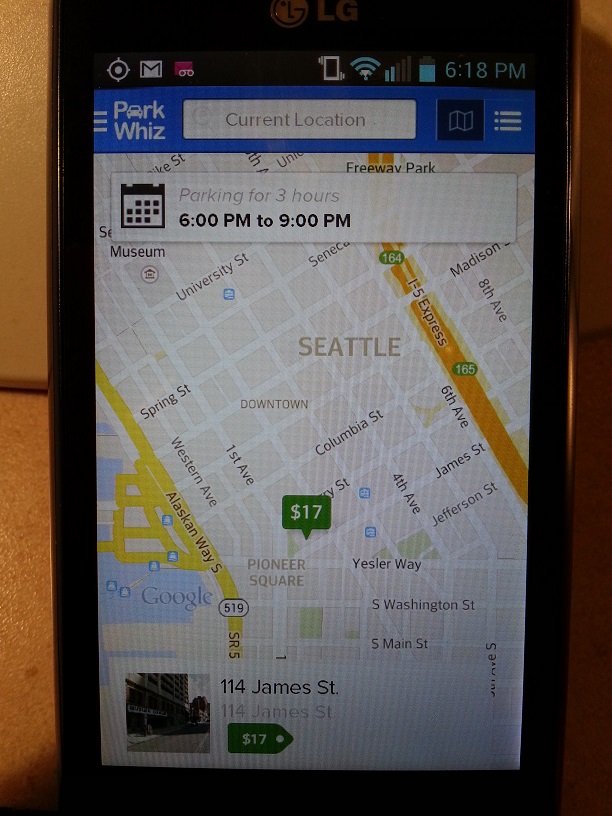
Of the 50 people who filled out the survey, 14 of them said they had heard of using AirBnB, Couchsurfing, or Craigslist for the purpose of renting out a room or finding one to rent (almost all of them mentioned AirBnB specifically). But of the same 50 respondents, only two of them mentioned any parking apps that they had heard of, and only one of them mentioned one of the two that I'd found which actually worked. (The other person mentioned an app called ParkWhiz, which, when I tested it out, only displayed one $17 parking garage in a neighborhood where I know of several $5 garages, which BestParking and ParkMe did list correctly.)
This seems to confirm the anecdotal evidence from my survey of my Seattle friends -- there is a great deficiency in awareness of these apps, relative to how useful people would find them if they knew about them.
So how is it that people are finding -- or not finding -- these apps? In a Google search for "parking app", the first result was an ad for ParkWhiz. BestParking and ParkMe did show up in the results, but so did another one called Parker, as well as a Mashable article by Kate Freeman listing "7 City Parking Apps to Save You Time, Money and Gas". Of the apps listed in the article, the only city-specific one that worked in Seattle (PrimoSpot) has been discontinued, and of the non-city-specific ones, only Parker is still around. (The article doesn't even mention BestParking or ParkMe, although I don't know if they existed when it was written.) Finally, a friend in my survey told me about an app called Parkopedia, which has over 100,000 downloads on Google Play (the same as BestParking, and more than ParkMe).
So even if it did occur to you to look for a parking-garage-finding app, the problem is that if you randomly picked one of the five most popular parking apps (BestParking, Parker, ParkMe, Parkopedia, and ParkWhiz), you might accidentally pick one of the three out of five that is a fail:
-
ParkWhiz, as noted above, only showed one $17 garage in a neighborhood full of other, cheaper garages.
-
Both ParkMe and Parkopedia display their results as a map with an icon marking each parking garage -- but with no price information. Simply having a map of parking garage locations isn't too useful, since you could get that by searching Google Maps for "parking" anyway. In both apps, you can click on parking garage icons to bring up a window showing their rates, but in Parker most of the listed garages just said "Contact facility for current rates". Parkopedia did usually display the rates for different garages -- but it's a pain to click on each of a dozen parking garage icons looking for the cheapest one. A typical area of downtown Seattle will have one garage where you can park for $5 for the evening, surrounded by garages where parking costs $10 or more, but Parkopedia doesn't make it easy to find it. And neither app lets you specify a start and end time for your parking so that you can find the cheapest garage for that time range.
So it seems odd that according to the Google Play store, Parkopedia has more downloads than ParkMe (100,000+ vs 50,000+), even though ParkMe seems a lot more useful. Meanwhile ParkWhiz, the one that found only one overpriced parking garage in a neighborhood full of cheaper ones, has fewer downloads but a slightly higher star rating in the app store than ParkMe. Of course in my parking-app survey of friends and Mechanical Turk users, the far-and-a-way winner was simply not knowing that any of these apps existed at all.
And here's why it matters to you even if you ride a granola-powered bike to work: I think this is a confirming instance of what I've been arguing for years, that the marketplace for ideas, inventions, and intellectual property is far less efficient than most people think it is. Every day a huge amount of human capital is squandered by people trying to jostle their competitors out of Google search results, or even just trying to raise the capital to advertise their products to people who would find them extremely useful, but will never find out about it if the venture capitalists don't come through with the money to advertise it. All of that is time and effort that could have instead gone towards making the products better.
I've suggested an algorithm based on "random-sample voting" as an antidote to some of these market inefficiencies, such as stopping people from buying votes on Digg, promoting the best ideas on Obama's "We The People" petition website, or even deciding whether J.K. Rowling is the world's greatest author or just lucky. Basically, in each scenario, the competing entities -- whether apps, or songs, or ideas for improving U.S. government policy -- would be rated by a sufficiently large random sample of qualified raters. ("Qualified raters" might mean economists in the case of the White House policy-petition website, or it might mean music consumers in the case of an algorithm to find the best new songs.) Each entity would receive an average rating from those raters, and then the entities with the highest average rating would be the ones promoted to the widest audience (at the top of Google search results, for example). It sounds deceptively simple, but it's far less amenable to "gaming the system", because you can't rope in your friends to vote for your app, or pay voters to rate you highly on Digg. The only way to win in this system is to make your song, idea, or app, the best that it can be -- which means your human capital is being channeled productively, instead of being wasted hiring an SEO company to try and knock your competition out of the top spot on Google.
If competition between parking apps worked this way, then all the current users of Parker, ParkWhiz and Parkopedia, would switch to BestParking and ParkMe, saving themselves a lot of hassle in the process, and those second-rate apps would have never even gotten on the ground unless they got their act together and implemented the same features. More broadly, if competition in the marketplace of ideas worked this way, then there wouldn't be so many users who really wish they could have an app like this, without realizing that the apps exist!
One striking thing about looking at a map of downtown parking garages, is how wildly the rates vary from each other, with $15 garages situated right next to the $5 ones. In theory, in a competitive marketplace, such rates should stabilize around a single price, for goods that are roughly comparable. But the $10 lots do still manage to get some customers who don't know any better, because it's just not practical to criss-cross a grid of several dozen city blocks looking for the cheapest garage. BestParking and ParkMe help people deal with this inefficient marketplace. So it's ironic that they're being held back by a marketplace for ideas that operates just as inefficiently in its own way.
-
-
Bennett Haselton: Google+ To Gmail Controversy Missing the Point
Bennett Haselton writes "Google created controversy by announcing that Google+ users will now be able to send email to Gmail users even without having those Gmail users' email addresses. I think this debate misses the point, because it's unlikely to create a deluge of unsolicited email to Gmail users, as long as Google can throttle outgoing messages from Google+ users and terminate abusive accounts. The real controversy should be over the fact that Google+ users can search a public database of the names of all Gmail users in the first place. And limiting the ability of Google+ users to write to those Gmail accounts, won't do anything to address that." Read below to see what Bennett has to say.To begin with, remember that on Facebook (which I no longer use, but which I keep up with) does allow you to search for other members' names and send them messages even if they have not yet accepted your friend request. Facebook users are generally not shy when it comes to complaining about problems with the site, but I've never heard Facebook users complaining about junk messages from strangers. (It's true that if you get a message from a user outside of your friends list, it gets routed to the "Other" folder of your Facebook inbox. But similarly, Google says that messages from strangers on Google+ will get routed to a Gmail user's "Social" tab of the inbox.)
So I expect the amount of actual unsolicited emails from Google+ users to Gmail users to be almost a complete non-issue, for the same reason that it's not an issue on Facebook. I assume the reason that Facebook users get so few junk messages, is that Facebook can limit the number of outgoing messages sent per day by any one account (although I don't know what that limit is), and can shut down accounts that are reported for abuse. Yes, a spammer could continually create new accounts to send more messages, but if you create too many Facebook accounts from the same IP address, and each account created from that IP address gets flagged for abuse, Facebook might start disallowing new accounts created from that IP. You could switch your IP address continually, but at a certain point, spammers must have decided that creating disposable Facebook accounts for spamming purposes wasn't worth the trouble, because the simple fact is that they don't do it. So Gmail users are not in danger of buried in spam from Google+ accounts. (By contrast, conventional email spam grew to unmanageable proportions because anybody with an email server could send out millions of messages per day, unless their provider cut them off.)
On the other hand, I think we should be more concerned about the fact that anyone who creates a Gmail address automatically has a Google+ account created for them. This doesn't just mean that any of Google's claims about the "number of Google+ users" are inflated, if they're including everyone who signs up for a Gmail account. (That's a valid complaint, but it's between Google and their shareholders, since the rest of us don't need to care how many users Google+ actually has.) More importantly, it means that all of those users become part of a public database that is searchable by name.
As a test, I went to Gmail.com and created a new user account, entering the first and last name "Zanzibar Higglesbrain" which I figured was probably unique. (Fan fiction authors: knock yourselves out.) Then I logged back in under my own Google+ account, went to the people search page, searched for "Zanzibar Higglesbrain", and found 1 match. (I didn't even need the exact name -- entering "Zanzibar Hi" into the people search box, listed Mr. Higglesbrain among the results.)
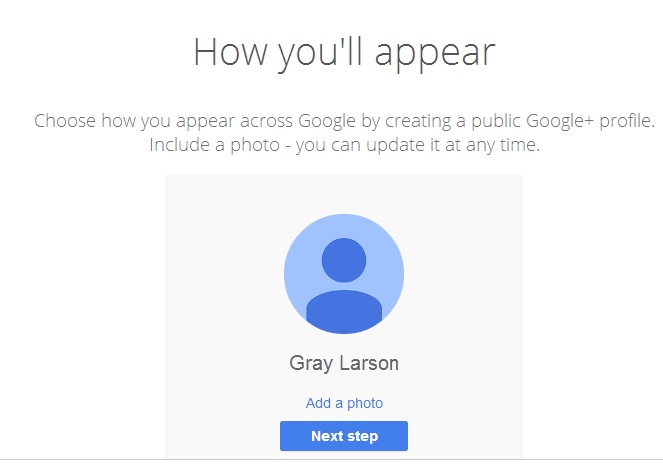
Now, when I created the Higglesbrain account, how much up-front notice was I given that I would be adding myself to a public database? I went through the normal signup process, viewed through the eyes of a novice -- after typing in Gmail.com, I was redirected to a page on accounts.google.com with the innocuous title "Create your Google Account", and entered my personal information. On the next page is the somewhat confusingly worded message (I've also posted a screen shot here):
How you'll appear
Choose how you appear across Google by creating a public Google+ profile.
Include a photo - you can update it at any time.
[Link:] Add a photo
[Button:] Next stepThis message is misleadingly worded because the phrase "by creating a public Google+ profile" implies that's something you can do, optionally, if you want to. It doesn't really disclose the fact that the profile is being created for you as a side effect of signing up for Gmail. The wording might be interpreted, rather, to mean that your profile will only be created if you upload a photo (which is not the case; your profile gets created regardless). And besides -- what if the user is a novice who went to Gmail.com because they saw all their friends using Gmail.com addresses, and have never even heard of "Google+"? If they haven't consented to their name being added to a publicly searchable database, it shouldn't be their responsibility to know what "Google+" is, so that they can object to their name being listed there.
After you click the "Next step" button, the final page in the account creation process says:
Welcome, [firstname]
Your new email address is [address]
Thanks for creating a Google Account. Use it to subscribe to channels on YouTube, video chat for free, save favorite places on Maps, and lots more.Note what's conspicuously missing from this message: It doesn't mention Google+ at all, much less the fact that you have unwittingly "joined" it, where other users can find you.
I can think of a couple of scenarios where a user might object to their name being listed in a searchable user database, apart from just "on general principles". If you have a stalker in your past, and they find your name on Google+, it confirms for them that you're probably still alive, that you're probably active on the Internet, and that you're still going by the name that they knew you under. Or, if you have a very unique first name, anyone who knows it could search on Google+ to find your last name, even if you didn't want them to. Similarly, if you have a very unique last name, someone could use the search feature to find the names of your children and other relatives with the same last name, at least those of them that are using Gmail.
And this lack of user consent is a more serious problem on Gmail/Google+ than on Facebook, because most Facebook users create a profile with the general expectation that other Facebook users can find them. Some Facebook users had chosen not to make their accounts searchable -- and Facebook justifiably received a firestorm of criticism for removing that feature and forcing those users' profiles to become publicly searchable after all -- but the overwhelming majority of Facebook users had joined with the understanding that their profiles could be found by others. That's not a valid assumption about Gmail users -- if someone creates a Gmail.com email address, there's no reason to think that they believed they were joining a publicly searchable name database.
Google has tried to mollify people's concerns about emails from strangers on Google+, by specifying that anyone not already in your Google+ circles will only be able to send one message to your Gmail inbox, and will not be able to send more messages until you reply. But this misunderstands the privacy implications in, for example, the stalker scenario. If a stalker ex "Bob" really did find your name on Google+, they might try to tease out a reply by creating a Google+ account under the name of a friend "Alice" you and your ex had in common, and sending you a generic "How have you been doing lately?" message. Since that message probably won't raise any alarm bells (the message isn't asking for anything like a current address or phone number), you might not realize that just by replying, you've already done the damage (the stalker now knows your email address, plus the fact that it's still an actively used account).
Similarly, although you can modify your Gmail settings to prevent strangers on Google+ from messaging you, the ability to change a setting to fix a problem only helps a user if the user realizes when the problem is happening. For example, if the problem resulting from this new feature switch were a deluge of spam from strangers on Google+, then more and more users would get frustrated and look for information about how to stop the flood of spam, and most of them would find out about this setting and switch it off. But for combatting the stalker problem, this setting is useless, because by definition if a stalker finds you on Google+ (and tricks you into replying to a message and revealing your email address), you wouldn't know about that problem until the damage has already been done, at which point it's too late to solve it by changing a setting.
The only way to avoid this risk to people's privacy, would be for Google to ask Gmail users at the time they create a Gmail account: "Do you also want to create a Google+ account, yes or no? This means you will have a publicly searchable profile, and people who know your name will be able to find you." Some people would like to be found, some people would rather not be, and this would allow them to sort themselves properly.
But instead, we have an untold number of zombie Google+ accounts created whenever someone signs up for Gmail, which serve no purpose except to make it possible to find people who never confirmed that they wanted to be found -- all most likely for the reason given by Chris Taylor at Mashable, so that "Larry Page gets to claim increased Google+ user numbers on the next quarterly earnings call."
-
Bennett Haselton: Google+ To Gmail Controversy Missing the Point
Bennett Haselton writes "Google created controversy by announcing that Google+ users will now be able to send email to Gmail users even without having those Gmail users' email addresses. I think this debate misses the point, because it's unlikely to create a deluge of unsolicited email to Gmail users, as long as Google can throttle outgoing messages from Google+ users and terminate abusive accounts. The real controversy should be over the fact that Google+ users can search a public database of the names of all Gmail users in the first place. And limiting the ability of Google+ users to write to those Gmail accounts, won't do anything to address that." Read below to see what Bennett has to say.To begin with, remember that on Facebook (which I no longer use, but which I keep up with) does allow you to search for other members' names and send them messages even if they have not yet accepted your friend request. Facebook users are generally not shy when it comes to complaining about problems with the site, but I've never heard Facebook users complaining about junk messages from strangers. (It's true that if you get a message from a user outside of your friends list, it gets routed to the "Other" folder of your Facebook inbox. But similarly, Google says that messages from strangers on Google+ will get routed to a Gmail user's "Social" tab of the inbox.)
So I expect the amount of actual unsolicited emails from Google+ users to Gmail users to be almost a complete non-issue, for the same reason that it's not an issue on Facebook. I assume the reason that Facebook users get so few junk messages, is that Facebook can limit the number of outgoing messages sent per day by any one account (although I don't know what that limit is), and can shut down accounts that are reported for abuse. Yes, a spammer could continually create new accounts to send more messages, but if you create too many Facebook accounts from the same IP address, and each account created from that IP address gets flagged for abuse, Facebook might start disallowing new accounts created from that IP. You could switch your IP address continually, but at a certain point, spammers must have decided that creating disposable Facebook accounts for spamming purposes wasn't worth the trouble, because the simple fact is that they don't do it. So Gmail users are not in danger of buried in spam from Google+ accounts. (By contrast, conventional email spam grew to unmanageable proportions because anybody with an email server could send out millions of messages per day, unless their provider cut them off.)
On the other hand, I think we should be more concerned about the fact that anyone who creates a Gmail address automatically has a Google+ account created for them. This doesn't just mean that any of Google's claims about the "number of Google+ users" are inflated, if they're including everyone who signs up for a Gmail account. (That's a valid complaint, but it's between Google and their shareholders, since the rest of us don't need to care how many users Google+ actually has.) More importantly, it means that all of those users become part of a public database that is searchable by name.
As a test, I went to Gmail.com and created a new user account, entering the first and last name "Zanzibar Higglesbrain" which I figured was probably unique. (Fan fiction authors: knock yourselves out.) Then I logged back in under my own Google+ account, went to the people search page, searched for "Zanzibar Higglesbrain", and found 1 match. (I didn't even need the exact name -- entering "Zanzibar Hi" into the people search box, listed Mr. Higglesbrain among the results.)
Now, when I created the Higglesbrain account, how much up-front notice was I given that I would be adding myself to a public database? I went through the normal signup process, viewed through the eyes of a novice -- after typing in Gmail.com, I was redirected to a page on accounts.google.com with the innocuous title "Create your Google Account", and entered my personal information. On the next page is the somewhat confusingly worded message (I've also posted a screen shot here):
How you'll appear
Choose how you appear across Google by creating a public Google+ profile.
Include a photo - you can update it at any time.
[Link:] Add a photo
[Button:] Next stepThis message is misleadingly worded because the phrase "by creating a public Google+ profile" implies that's something you can do, optionally, if you want to. It doesn't really disclose the fact that the profile is being created for you as a side effect of signing up for Gmail. The wording might be interpreted, rather, to mean that your profile will only be created if you upload a photo (which is not the case; your profile gets created regardless). And besides -- what if the user is a novice who went to Gmail.com because they saw all their friends using Gmail.com addresses, and have never even heard of "Google+"? If they haven't consented to their name being added to a publicly searchable database, it shouldn't be their responsibility to know what "Google+" is, so that they can object to their name being listed there.
After you click the "Next step" button, the final page in the account creation process says:
Welcome, [firstname]
Your new email address is [address]
Thanks for creating a Google Account. Use it to subscribe to channels on YouTube, video chat for free, save favorite places on Maps, and lots more.Note what's conspicuously missing from this message: It doesn't mention Google+ at all, much less the fact that you have unwittingly "joined" it, where other users can find you.
I can think of a couple of scenarios where a user might object to their name being listed in a searchable user database, apart from just "on general principles". If you have a stalker in your past, and they find your name on Google+, it confirms for them that you're probably still alive, that you're probably active on the Internet, and that you're still going by the name that they knew you under. Or, if you have a very unique first name, anyone who knows it could search on Google+ to find your last name, even if you didn't want them to. Similarly, if you have a very unique last name, someone could use the search feature to find the names of your children and other relatives with the same last name, at least those of them that are using Gmail.
And this lack of user consent is a more serious problem on Gmail/Google+ than on Facebook, because most Facebook users create a profile with the general expectation that other Facebook users can find them. Some Facebook users had chosen not to make their accounts searchable -- and Facebook justifiably received a firestorm of criticism for removing that feature and forcing those users' profiles to become publicly searchable after all -- but the overwhelming majority of Facebook users had joined with the understanding that their profiles could be found by others. That's not a valid assumption about Gmail users -- if someone creates a Gmail.com email address, there's no reason to think that they believed they were joining a publicly searchable name database.
Google has tried to mollify people's concerns about emails from strangers on Google+, by specifying that anyone not already in your Google+ circles will only be able to send one message to your Gmail inbox, and will not be able to send more messages until you reply. But this misunderstands the privacy implications in, for example, the stalker scenario. If a stalker ex "Bob" really did find your name on Google+, they might try to tease out a reply by creating a Google+ account under the name of a friend "Alice" you and your ex had in common, and sending you a generic "How have you been doing lately?" message. Since that message probably won't raise any alarm bells (the message isn't asking for anything like a current address or phone number), you might not realize that just by replying, you've already done the damage (the stalker now knows your email address, plus the fact that it's still an actively used account).
Similarly, although you can modify your Gmail settings to prevent strangers on Google+ from messaging you, the ability to change a setting to fix a problem only helps a user if the user realizes when the problem is happening. For example, if the problem resulting from this new feature switch were a deluge of spam from strangers on Google+, then more and more users would get frustrated and look for information about how to stop the flood of spam, and most of them would find out about this setting and switch it off. But for combatting the stalker problem, this setting is useless, because by definition if a stalker finds you on Google+ (and tricks you into replying to a message and revealing your email address), you wouldn't know about that problem until the damage has already been done, at which point it's too late to solve it by changing a setting.
The only way to avoid this risk to people's privacy, would be for Google to ask Gmail users at the time they create a Gmail account: "Do you also want to create a Google+ account, yes or no? This means you will have a publicly searchable profile, and people who know your name will be able to find you." Some people would like to be found, some people would rather not be, and this would allow them to sort themselves properly.
But instead, we have an untold number of zombie Google+ accounts created whenever someone signs up for Gmail, which serve no purpose except to make it possible to find people who never confirmed that they wanted to be found -- all most likely for the reason given by Chris Taylor at Mashable, so that "Larry Page gets to claim increased Google+ user numbers on the next quarterly earnings call."
-
How To Change U.S. Laws To Promote Robotics
An anonymous reader writes "A law professor says the U.S. could fall behind in the robotics race if we don't change product liability law. A new op-ed over at Mashable expands upon this: Yet for all its momentum, robotics is at a crossroads. The industry faces a choice — one that you see again and again with transformative technologies. Will this technology essentially be closed, or will it be open? ... What does it mean for robotics to be closed? Resembling any contemporary appliance, they are designed to perform a set task. They run proprietary software and are no more amenable to casual tinkering than a dishwasher. Open robots are just the opposite. By definition, they invite contribution. It has no predetermined function, runs third-party or even open-source software, and can be physically altered and extended without compromising performance. Consumer robotics started off closed, which helps to explain why it has moved so slowly." -
MIT Wristband Is a Personal Climatizer
rcastro0 writes "What looks like a CPU's heat sink worn around the wrist apparently may be able to make you feel cool even while it is hot — or warm while it is cold. As Wired reports, this termoelectric device explores human physiology and how we perceive temperature to fool our body and make us comfortable. The device is called Wristify, and Mashable has a video." -
Windows RT 8.1 Update Pulled From Windows Store
UnknowingFool writes "After reports of update problems including bricking of some devices, Microsoft has pulled the 8.1 update for RT from their store while they investigate. 'Microsoft is investigating a situation affecting a limited number of users updating their Windows RT devices to Windows RT 8.1. As a result, we have temporarily removed the Windows RT 8.1 update from the Windows Store. We are working to resolve the situation as quickly as possible and apologize for any inconvenience. We will provide updates as they become available.' While update problems are not new to software, could this be a consequence of Microsoft not releasing 8.1 RTM to developers? Developers may have experienced problems earlier and alerted Microsoft before it went live." -
LinkedIn Accused of Hacking Customers' E-Mails To Slurp Up Contacts
cold fjord writes with this Business Week report: "LinkedIn Corp. ... was sued by customers who claim the company appropriated their identities for marketing purposes by hacking into their external e-mail accounts and downloading contacts' addresses. The customers, who aim to lead a group suit against LinkedIn, asked a federal judge in San Jose, California, to bar the company from repeating the alleged violations and to force it to return any revenue stemming from its use of their identities to promote the site ... 'LinkedIn's own website contains hundreds of complaints regarding this practice,' they said in the complaint filed Sept. 17. ... LinkedIn required the members to provide an external e-mail address as their username on its site, then used the information to access their external e-mail accounts when they were left open ... 'LinkedIn pretends to be that user and downloads the e-mail addresses contained anywhere in that account to LinkedIn's servers,' they said. 'LinkedIn is able to download these addresses without requesting the password for the external e-mail accounts or obtaining users' consent.'" "This puts an interesting twist on LinkedIn's recent call for transparency," adds cold fjord. (More at Bloomberg.) -
Your Brain Waves Are a Password: How Your Next Car Will Check You're Not a Thief
cartechboy writes "And you thought stealing cars was hard today? You're facing locks, kill switches, LoJacks, OnStar, and more. But there's worse on the way: Engineers at Japan's Tottori University have developed a prototype theft-prevention system that uses brain waves to identify drivers. That's right: The system samples your brain waves, stores them--and actually shuts down the car if the driver's EEG signals don't match what's on file. It also busts drunk and sleepy drivers, because their brain waves differ from those when you're fully awake and totally sober. One non-Tron downside: If you want to drive, you have to wear a scary-looking set of sensors on your skull so the car can constantly reads your brainwaves." -
Angry Customer Buys Promoted Tweets To Bash British Airways
An anonymous reader writes "After the airline lost his father's luggage (and presumably was less than helpful in resolving the issue), one man decided to use Twitter's self-serve ad platform to issue a warning to fellow travelers in the New York and UK markets. The tweets have gotten the attention not only of media outlets, but also of fellow airlines. A JetBlue executive even retweeted it. While companies use the platform to target customers, it's interesting to see it being turned around." -
Samsung's Smart Watch Coming September 4th, Without Flexible OLED Screen
First time accepted submitter lager_monste sent in a tidbit from Mashable about the upcoming Samsung Galaxy Gear Smart Watch: "Samsung will launch its smart watch, the Galaxy Gear, on Sept. 4 ahead of the IFA consumer electronics trade show in Berlin, Germany. Lee Young-hee, VP of Samsung's mobile business, confirmed the date and some details about the device in an interview with The Korea Times." Ars Technica notes that the Gear is nothing like what was expected from a patent filing for a watch with a flexible OLED. Maybe next generation.