Slashdot Mirror
Domain: nasa.gov
Stories and comments across the archive that link to nasa.gov.
Comments · 16,365
-
Re:Price Controls?
I'm going to do something very foolish and imagine that you actually believe what you're saying, that you're not just being a troll, and that you actually think the data supports your conclusions. And now I'm going to explain why you're wrong, indulging in the fantasy that you'll listen with an open mind and, once you realize your mistake, freely acknowledge it. Prove me right. Or wrong. Your choice.
Also, ignore the arctic ice that's been increasing for three years,
Three years? Three years is random noise. The climate consists of steady, long term trends with lots of short term fluctuations superimposed on top of them. Take artic ice, for example. It shrinks every summer and grows every winter. There are lots of factors that affect the summer minimum: wind patterns, ocean currents, etc. A few years ago, lots of factors converged to give an exceptionally low minimum. It hasn't matched that since; but it's come close, and has remained far below anything seen until just a decade ago.
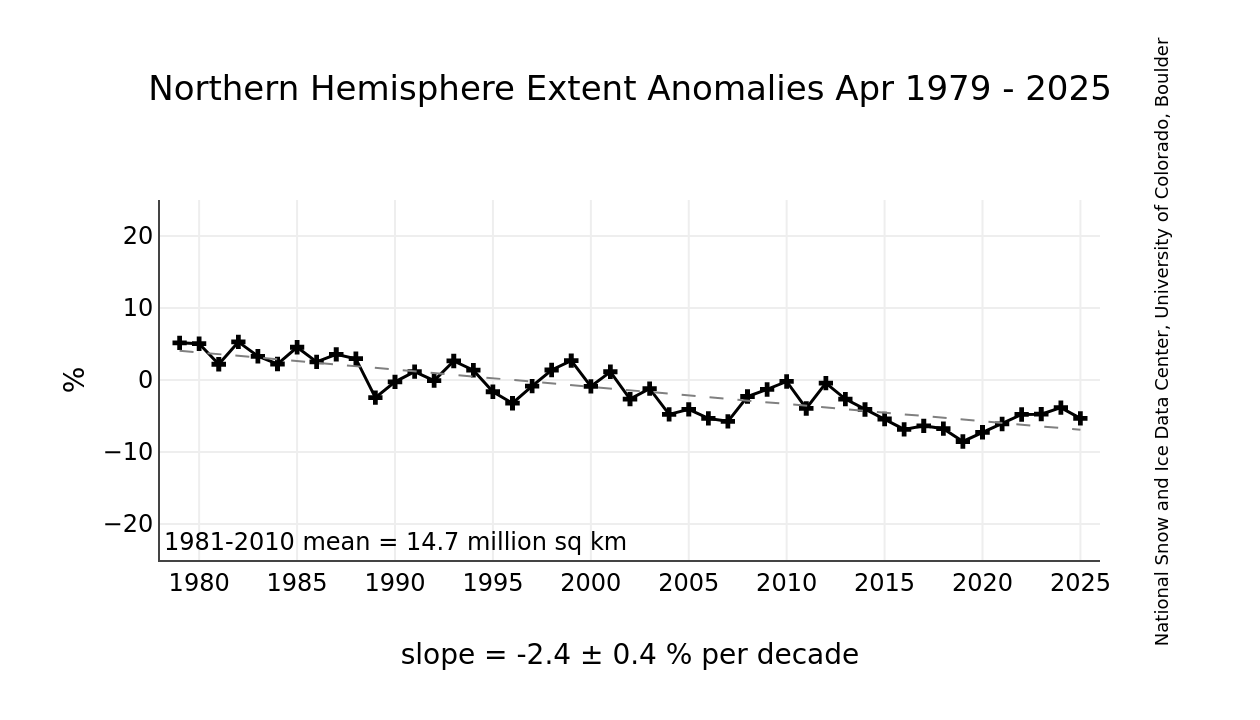
Here's a graph showing sea ice for almost 40 years: http://nsidc.org/data/seaice_i.... Yes, it fluctuates up and down from year to year. But look at that and tell me it shows anything other than fluctuations around a steady decreasing trend that remains upbroken.
Let's look at something even more convincing: world wide temperatures. http://data.giss.nasa.gov/gist.... Look at those graphs, and then tell me they show anything other than short term fluctuations on a long term warming trending that has been in place for the last century.
Ignore Niagara falls that has frozen over two years in a row and ignore all the record cold around the country.
Wrong! There has not been record cold "around the country". Believe me, the whole western half of the country has been getting record heat, as has most of the planet. Here's a map showing it: http://www.ncdc.noaa.gov/sotc/.... Those are the difference between Jan. 2015 temperatures and historical (1981-2010) average temperatures. The red areas are hotter than average. The blue areas are colder than average. Yes, there's a small blue patch over the eastern US. But overall there's a lot more red than blue.
This is why scientists tend to prefer the term "climate change" to "global warming". Yes, the globe is warming up, but that doesn't mean everything is exactly the same, just uniformly warmer. Some times and places are a lot warmer. Others are only a little warmer. Others are actually cooler. Wind patterns are changing. Ocean currents are changing. Precipitation patterns are changing. Sea level is rising. Permafrost it melting. The climate is changing.
And if you want to know precisely how global warming is causing unusually cold weather in the eastern US, take a look at http://en.wikipedia.org/wiki/P....
Ignore the fact NAS falsified the CO2 hypothesis in 2010
Sorry, but that is just BS. You linking to a story about how fungi help to hold onto carbon and keep it out of the atmosphere, and somehow translated that into "NAS falsified the CO2 hypothesis". No. I don't know what you think that article actually meant, but I can assure you that isn't what it meant. (OK, I see you also linked to that Register piece that totally misrepresented the conclusions of that study. The Register is a notorious denialist website. Believe me, the scientists who actually did the work would not agree with the conclusions they're trying to draw from it.)
No one has "falsified the CO2 hypothesis". In fact, it was recently proven beyond a shadow of a doubt, by actually directly measuring the incoming and outgoing radiation, showing that the CO2 abso
-
Re:still bullshit
No significant average temperature change in 15 years
Look at the trend, and don't stare too much at the 2-sigma outlier in 1998.
https://tamino.wordpress.com/2...
The trend is still as robust as it was. And before you complain that I'm linking to a wordpress blog, you can download the data here, and draw your own graph: http://data.giss.nasa.gov/gist...
-
Re:Price Controls?
Diverting 93% of the water to grow lettuce in the desert since 1920 had nothing to do with it.
Also, ignore the arctic ice that's been increasing for three years, the antarctic ice that's always grown and hit a new record in 2014, snow in Hawaii, and the great lakes that have frozen early,and that have frozen over compete the last two years. Ignore Niagara falls that has frozen over two years in a row and ignore all the record cold around the country. Ignore the fact we kill killed half the worlds trees in the last 100 years and where we do theres drought and ignore the fact the IPCC did not admit trees ate CO2 until 2010. Ignore the fact NAS falsified the CO2 hypothesis in 2010 and ignore the fact the climate models now have 95% error.Ignore the fact corals have genes that upregulate to ignore acidification and warming and ignore the fact pollution (I'm especially looking at you big oil) has gotten worse while we're distracted by this nonsense. Ignore the fact not a single IPCC prediction ever came true.
And especially ignore NAA/NOAA when they say "there has been no warming this century"
Creation science, social science, climate science... if you have to add "science" to a word to give it legitimacy, it's not science any more than the Democratic People's republic of North Korea is a democracy. Real sciences yield natural laws to quote Feynman.
Instead, look at 01% of a country that is 2% of the world.
Refs:
1) Ice
http://rs79.vrx.net/opinions/i...
http://rs79.vrx.net/opinions/i...
http://rs79.vrx.net/opinions/i...
http://news.ku.dk/all_news/201...
http://www.nasa.gov/topics/ear...
http://www.nasa.gov/content/go...2) records:
http://abcnews.go.com/WNT/vide...
http://www.cbc.ca/news/canada/...
http://www.staradvertiser.com/...
https://www.facebook.com/video...
http://www.dailymail.co.uk/new...
http://ottawa.ctvnews.ca/febru...
http://www.latimes.com/local/l...
http://www.huffingtonpost.com/...3) Trees:
http://www.pri.org/stories/201...
https://web.archive.org/web/20...
http://onlinelibrary.wiley.com...
http://www.agu.org/news/press/... -
Re:Price Controls?
Diverting 93% of the water to grow lettuce in the desert since 1920 had nothing to do with it.
Also, ignore the arctic ice that's been increasing for three years, the antarctic ice that's always grown and hit a new record in 2014, snow in Hawaii, and the great lakes that have frozen early,and that have frozen over compete the last two years. Ignore Niagara falls that has frozen over two years in a row and ignore all the record cold around the country. Ignore the fact we kill killed half the worlds trees in the last 100 years and where we do theres drought and ignore the fact the IPCC did not admit trees ate CO2 until 2010. Ignore the fact NAS falsified the CO2 hypothesis in 2010 and ignore the fact the climate models now have 95% error.Ignore the fact corals have genes that upregulate to ignore acidification and warming and ignore the fact pollution (I'm especially looking at you big oil) has gotten worse while we're distracted by this nonsense. Ignore the fact not a single IPCC prediction ever came true.
And especially ignore NAA/NOAA when they say "there has been no warming this century"
Creation science, social science, climate science... if you have to add "science" to a word to give it legitimacy, it's not science any more than the Democratic People's republic of North Korea is a democracy. Real sciences yield natural laws to quote Feynman.
Instead, look at 01% of a country that is 2% of the world.
Refs:
1) Ice
http://rs79.vrx.net/opinions/i...
http://rs79.vrx.net/opinions/i...
http://rs79.vrx.net/opinions/i...
http://news.ku.dk/all_news/201...
http://www.nasa.gov/topics/ear...
http://www.nasa.gov/content/go...2) records:
http://abcnews.go.com/WNT/vide...
http://www.cbc.ca/news/canada/...
http://www.staradvertiser.com/...
https://www.facebook.com/video...
http://www.dailymail.co.uk/new...
http://ottawa.ctvnews.ca/febru...
http://www.latimes.com/local/l...
http://www.huffingtonpost.com/...3) Trees:
http://www.pri.org/stories/201...
https://web.archive.org/web/20...
http://onlinelibrary.wiley.com...
http://www.agu.org/news/press/... -
Re:This is great!
>I have a couple things that I've lost in my life that must be on Mars.
Sorry to hear about your lost sibling...
I wonder if magnetometer data is available from any Mars orbiters that could correlate the arrival of fast solar wind streams with dust storms. Perhaps a local visual cam might be useful for spotting smaller dust-ups that aren't facing or otherwise visible from Earth?
It was recently that NASA images helped in finding the lost 2003 Beagle that had been thought to have crashed. I believe that a U.S. orbiter that was already there in 2003 had one experiment (nothing crucial to other functions thankfully) malfunction during the heavy solar activity associated with the 2003 Halloween storms. Some believe that a high-energy particle may have affected the electronics. It's a known problem, something that occasionally happens to satellites above Earth.
Telstar, the first satellite to relay television programming, died an early death due to radiation. It was launched the day after an atmospheric weapons test. There was a period of some operation using work-arounds before it became completely unusable. Although in retrospect the weapons test wasn't the healthiest thing to do, there was quite a bit of useful science done. Among other things, there were some connections made between the charged particles and weather. Many declassified papers are available to read.
Although the wording at the time attributed geomagnetism, in retrospect that was correlative not causative. Although still being researched and not getting much public discussion, it isn't hard to see that it is both particles and large amounts of electrical charge that are drivers of interaction.It is worthwhile to study how space weather affects Mars. Since Mars magnetic field is weak, it doesn't take coupling-friendly oriented fields in the incoming plasma to get deeper interaction into the atmosphere.
I diverged from my Beagle mission point. One of the lead researchers for the Beagle mission has already passed away. I'm not sure who is left to wonder if it was actually 2003 space weather that prevented full deployment after the landing. That apparently wasn't given much thought back then as most people assumed there'd been a crash landing.
Some of the space weather modeling apps can show what's happening at Mars (and allow a date range too). I don't know if they can show where Mars was relative to the fast streams in 2003.
Images are available elsewhere that show active sunspots, filaments, and coronal holes. The later seems to have the most affect of things like dust storms. -
Re:It's not censorship
I vehemently disagree. I highly recommend taking the 16 minutes and 39 seconds to actually watch the most compelling part of the documentary before trying to wave it away as "gloomy documentaries." For you to say such a thing shows that, contrary to your statement, you are denying the presence of pollution--or at least the social responsibility we all have to improve our health, life spans, and quality of life by regulating pollution.
I live in Washington DC and spend a great deal of time worrying about my health and the health of my children because our air quality here can get so bad that we have Red Ozone Days where we are told to keep our children inside, especially if they have any respiratory conditions, which they are more likely to have thanks to the poor air quality. I think it a blessing that NASA and the EPA monitor our air quality and that the local papers light a fire of panic under everyone's feet about the need to improve it because childhood leukemia and other cancers aren't something we should just shrug at.
Awareness of pollution is why we have Catalytic converters in our cars to dramatically reduce the toxic nature of the exhaust coming out of them. It's why we banned Lead Gasoline and ended the crime wave having that chemical in our brains unleashed on our culture. It's why air quality has improved over the last 10 years as new technologies, improved MPG, and other environmental regulations, but we still have much more to do.
It's also a moral issue for us, because our Made-In-China marketplace is why they have so much pollution. We want cheap goods and they turn a blind eye to the pollution to keep the products cheap. But that pollution is making it's way back to us over the Pacific Ocean. I want to keep buying cheap stuff from China, but I am also willing to pay a little more if it allows the Chinese people to improve their health.
The Chinese government should let people understand the science and choose for themselves.
-
Re:Pacific Decadal Oscillation (PDO)
news reports state the UK's summer was one of the coldest in decades, 5-6 degrees C colder than normal [weather.com]
Read more carefully. Where you say "summer", they're talking about a "spell" around the 19th of August.
Guess what. If you look at the August data, you can see that Ireland/UK are colder than average.
http://data.giss.nasa.gov/cgi-...But if you look at the entire summer (Jun-Aug), you get a different picture:
http://data.giss.nasa.gov/cgi-...I stand by my assertion that something is seriously wrong with how we measure average global temperatures.
No, the only thing that is seriously wrong is how you read local weather reports, and extrapolate those both in time and area.
-
Re:Pacific Decadal Oscillation (PDO)
news reports state the UK's summer was one of the coldest in decades, 5-6 degrees C colder than normal [weather.com]
Read more carefully. Where you say "summer", they're talking about a "spell" around the 19th of August.
Guess what. If you look at the August data, you can see that Ireland/UK are colder than average.
http://data.giss.nasa.gov/cgi-...But if you look at the entire summer (Jun-Aug), you get a different picture:
http://data.giss.nasa.gov/cgi-...I stand by my assertion that something is seriously wrong with how we measure average global temperatures.
No, the only thing that is seriously wrong is how you read local weather reports, and extrapolate those both in time and area.
-
Re: I feel it in Houston
But then, we've got that 1/4 of the country in the north east around the Great Lakes that's at least 13 degrees colder than average. That will hugely skew the country's average for the month down, making Feb 2015 significantly colder than average.
You seem to be very preoccupied with the weather in the US, which represents less than 2% of the entire world.
Here's an anomaly graph of the entire world, for the month of January 2015 (February isn't available yet):
http://data.giss.nasa.gov/cgi-...
The number on the top right (0.74) represents the average temperature anomaly for the world in deg C.
-
Re:Pacific Decadal Oscillation (PDO)
a high El Nino/La Nina year cannot affect the average temperature of the earth to any significant extent.
True, but it can affect the surface temperature, which is only a small portion of the earth. The bulk of the heat resides in the ocean water.
Was the south pole on fire? Because unless it was, the southern hemisphere certainly wasn't warm enough to counteract the 6-10 degrees C cooler than average that the northern hemisphere saw.
The northern hemisphere was significantly warmer than average. Here's a map of the global temperature anomaly for 2014:
-
Under the red soil, Mars is blueRecent NASA photo that shows under the red soil, Mars is blue, courtesy of Curiosity's drill bit...
-
Approach trajectory
The approach trajectory was particularly cunning considering that there was an outage of Dawn's ion thruster.
-
Re:If there was water, there probably still is wat
Well in just one region, they found an underground patch the size of Texas and thirteen stories thick.
-
Re: Star Wars!
These ran NiCd cells. Here's some TL;DR from NASA about a variant of NiCd they use(d), not sure if it applies here.
http://www.nasa.gov/offices/oc...
Short notes:
Fancy NiCd, Higher density and sealed. They rely on precise chemistry to be hermetically sealed units (lean on one element, for limiting and only O2 production).
High pressure at full charge (~60PSI at room temp), higher if things go south, Pressure drops with charge state.
Excess discharge causes hydrogen production.So, tin can, pressure changing with charge cycles (metal fatigue over many cycles?), H2 production, O2 production... maybe there is some chance for catastrophic failure there.
-
Re:Better definition of planet
Up until last Thursday night, I completely agreed with you. I thought that if an object had enough mass to pull itself into a sphere, it should be a planet. I thought the IAU's definition of planet was an offense to reason--well, I still think it is. Requiring an object to have "cleared its orbit" is a silly concept that would mean gas giants larger than Jupiter would be "Dwarf Planets" if they were found in a proto-planetary disc. The name, "Dwarf Planet," is completely stupid and offensive. How is a "Dwarf Planet" not a planet if it has "Planet" in the #$%^ing name???
Then, just this last Thursday night, I attended a lecture by the very engaging, highly-studied Neil deGrasse Tyson. The guy who declassified Pluto as a planet in the Hayden Planetarium exhibits long before the IAU did so officially. He explained to us that Pluto was mostly a dirty ball of ice... like a comet. In fact, if it were in orbit around the Earth, it would have a tail.
That took me aback. If Pluto is just a particularly large Kuiper Belt object--if Pluto is just a large comet that isn't close enough to the Sun to melt, then I must admit that it doesn't make sense to call it a planet.
This is a bit of an iconoclasm for me, so I'm still figuring out my position on the matter, but I'm leaning toward accepting that Pluto is not a planet, but that the IAU is a bunch of numbskulls who need to fix their illogical, nonsensical definition of "Planet" and take the word "Planet" out of their labels for things that aren't planets. This is the kind of political bullcrap that turns kids off to science.
Of course, all this could change when New Horizons reaches Pluto this July.
-
Re:Actually, we've already stopped...
lol @ wordpress link.
Lol @ attacking the messenger. Here's the source:
http://data.giss.nasa.gov/gist...
That wasn't so hard. The graphs even say "NASA".
-
Re:Leonard Nimoy is why we have nice things
NASA even is paying tribute on almost all of their Facebook pages, as well as their main site:
-
Re:Good grief...
Ask any random American why airplanes fly.
99.5% of them will give you some nonsense about Bernouli and air pressure.It's wrong.
It's always been wrong.
It will always be wrong.*Yet it's what is taught in science classes and textbooks all over the US, even at the college level.
Basically the only place where the actual mechanics are taught is in aeronautical engineering courses.That is in a nutshell the state of science education in this country.
(*Nutshell version: Bernoulli's principle is not why airplanes fly, but his formulas are useful for determining the factors that go into the Navier Stokes equations which are the actual description of why airplanes fly. The (short and still over simplified reason) wings generate lift is Newton's 3rd. The boundary layer, the layer of molecules in contact with the wing, will tend to flow along the wing surface. Since the surface is curved, as the boundary layer leaves the wing at the trailing edge it has a downward component to its movement. This downward impetus the wing applies to the air molecules must have a reaction force, and that reaction force is Lift. All of this however requires that the flow is fairly straight, fast enough, undisturbed, and in the direction of travel. Too high an angle of attack, or insufficient speed, or erratic flow, or other factors, can cause a boundary layer separation, which is more commonly called, a "stall". What keeps the boundary layer in contact with the wing? Pressure, that is, the compression of the air as the wing forces its way through it. Which is why insufficient speed can stall a wing. And this why Bernoulli's formula are useful for determining the factors that go into the NS equations. The NS equations are essentially mass/momentum equations describing what the wing is doing to the boundary layer flow. Individual airfoil designs, like any actual engineering application, can increase or decrease the various factors of the formula and mechanics, whether its supercritical, symmetrical, or even nearly flat airfoils, but the basics remain the same. And Bernoulli's isn't it, though we continue to teach it in basic science courses, and it incorporates more than a couple false assumptions. NACA (forerun to NASA) long ago determined that in fact the airflow over the top DOESNT have to speed up to catch up to the lower sides flow. Some airfoils it arrives after, so at the same time, and some before. http://www.grc.nasa.gov/WWW/k-... )
-
Re:disclosure
He's in good company here, this scientist in 2008, using the same hypothesis correctly predicts the awful and cold winters of 2013 and 2014
The winters of 2013 and 2014 were in the top-10 warmest. Not sure why you would refer to them as "awful and cold".
You think it's warming? Show me your data that proves NASA wrong then.
How about NASA's own data where they show it's warming ?
-
Re:Whenever you want something other people have..
God you need a lot of hand holding don't you?
The legend in the sea ice graph refers to the studies they come from. For instance "GISS AOM" refers to the GISS Fast Atmosphere Ocean model. The predictions cover from 1900 to 2100 and the bold red line is what the actual observations show. They start in 1950 presumable because observations before then are too spotty to be very useful in this context. The bold black line is the ensemble mean of the different predictions. The chart is only about Arctic sea ice, nothing to do with Antarctic sea ice. There has been plenty of stuff written about the rise in Antarctic sea ice. I suggest you seek it out.
I'm tired of banging my head against your wall and you could obviously keep stringing me along forever. As the future unfolds you will find out if the scientists are generally right about this as I believe they are. The problem is that the changes from AGW are subtle from year to year and seldom do something that slaps you in the face. That makes it easy for someone like you to continue to pick nits but it doesn't change the underlying reality. Good luck.
-
Re:Well, if they wanted to make it more realistic.
In the supermassive black hole in this PDF, the diameter of the event horizon is about 600 million kilometers, or roughly four AU, which is roughly the gap between the orbits of Jupiter and Saturn. It also has a mass 100 million times that of the Sun, which would basically suck the Solar System in real fast. A black hole the mass of the Sun (which would disrupt the Solar System considerably) would have tidal forces of about 50K Gs at the event horizon.
I'm way not convinced. (I'm also not impressed with the huge rocket that throws them to Saturn in a few years, carrying smaller rockets that can maneuver in the gravity well of a supermassive black hole and casually get out of an Earth-style gravity well.)
-
don't assume that aliens are biological
Scientists and Philosophers at SETI believe that an alien race sufficiently advanced to visit our solar system would have evolved beyond biological life, becoming cyborg or truly artificial life. It's a logical progression from computing to AI to re-engineering their own life forms, and we are likely headed that way if we survive. I blogged about it, as evidence for my own assertion that Web 3.0 will involve a direct neural connection to the internet, a first step in melding human and artificial intelligence. Philosopher Susan Schneider has proposed that any alien race we are likely to counter are probably BISAs: Biologically-Inspired Superintelligent Agents. One reason SETI has not produced results is because we have been looking for biological life and consciousness. And what would any sane and advanced alien civilization want with our messy biological self-destructive race, and our ruined planet, anyway? I think they stay the hell away from us, like we have Ebola. I have also considered that UFOs may be time travelers, perhaps from our own future?
-
Only if they were taking their time.
It took NASA about 20 years to find 90% of NEO asteroids bigger than 1KM in diameter. and most of those more than 100M... so if The Aliens have been stalking earth for the last decade trying to match orbit, and have a ship more than 1KM in diameter, then there's a 50% chance that we've mistaken them for an asteroid.
-
Ask NEO
-
Try Minecraft for cheap beachfront property
You can download a Palm Beach Hotel and beachfront here: http://www.planetminecraft.com...
Or, if you want something less virtual, consider working towards seasteading.
http://en.wikipedia.org/wiki/S...Or large space habitats:
http://settlement.arc.nasa.gov...And of course, there is also "the Matrix" of "the Holodeck" for immersive reality beyond what Minecraft offers (not there yet, but maybe we are?)
Each of those ideas is a product of the imagination... Even if some have yet to be realized, or may never be.
So, yes, you can have what you want, today, with Minecraft, thanks to a lot of imaginative people (including Inifiniminer by Zachary Barth, a big inspiration behind Minecraft). Should we have declared all those imaginative people surplus at birth out of some fear there was not enough to go around? People may consume resources and they may crowd places, it's true, but people also can create resources and can create places worth being in.
Now, after my having said this, you may put more qualifiers on your request to be contrary perhaps and say a beach front hotel in Minecraft virtual reality is not what you mean. However, then you are not engaging in a playful spirit and you are to some extent creating your own artificial scarcity and artificial unhappiness for yourself compared to a lot of interesting experiences you can have right now. As far as the basics (and including a computer that can run Minecraft and so on) there is plenty to go around on planet Earth for billions of humans. And with a little bit of effort, we could create enough land (and beachfront property) for quadrillions of people. Just like the Dutch created habitable land from the sea, future humans can create habitable land from space resources.
For some inspiration on what might be possible, see Iain Bank's "Culture" novels.
http://en.wikipedia.org/wiki/C...Anyway, will there still be conflicts and scarcities, even with abundance? Sure. Humans compete with each other for all sorts of reasons, including for the attention of specific people nearby (and including as part of a mating dance for relative status, see for example James P. Hogan's "Voyage from Yesteryear"). But by the time we are talking about those sorts of scarcities, we are way beyond the sort of material scarcity most mainstream economics assumes.
BTW, various jobs are listed here at Palm Beach area hotels if you want to be around that physical ambiance right now:
http://www.hotelforcepalmbeach...After all, how many rooms of a mansion can one person physically occupy at one time? And an empty mansion at night with you as the only occupant can seem kind of creepy and lonely and even boring...
-
The map is a fraud
As other commenters have noticed, the map looks like a light map, a little TOO much like a light map.
At first I thought they actually HAD used a light map, just for the sake of illustration, but it clearly shows a legend in decibels.Here is a light map from NASA: http://www.nasa.gov/sites/defa...
You will notice a few small but very bright dots in North Dakota. These are not cities, they are oil fields. They aren't nearly as loud as a city of comparable light output, yet they still show up as bright spots on the audio map.
I'm sure there are inconsistencies in other locations where the light and sound values should be different, but appear the same on both maps.
-
Re:More than 1 AU
Still pretty far away
Yeah. Let's hope when it gets closer, the pictures will look like what we got from Voyager-[12]. That was 35 years ago. Man, we were good at the time.
-
Nice collaborative work
NASA in TFA relates in details that the work they did mainly comes from the European Space Agency results from the Rosetta mission.
-
Re:No science fiction future here
The time is largely spent in political wrangling and procurement. Once people figure out how to make money with space flight (and that will happen), things will go much more quickly.
Private companies are probably going to be reluctant to invest significantly in space flight until property rights have been worked out. No point in spending billions on mining an asteroid only to have people tell you that you don't own it, on top of an already very risky operation.
The Asteroid Redirect Mission might be the most important upcoming mission. It will demonstrate that this sort of thing is feasible, which will lead companies to lobby and pressure politicians to create more of a legal framework for private space industry and mining.
-
Re:Consider Man's Footprint
Way ahead of you.
http://planetaryprotection.nas... -
Re:Drop it on Europa
What you're describing is an incredibly challenging tasks. One needs several missions to get to better know Europa in general, and specific potential entry areas in particular, first. These missions are going to be expensive and have long lead times. And an actual boring / submersible mission is going to be extremely expensive.
Titan has one main strike against its exploration, that it's so dang far away. But almost everything else about it is tailor-made for exploration. It's ideal for aerocapture. It's trivial to stay aloft, at an altitude of your choice, be it by hot air or lifting gas balloon, blimp (likewise), helicopter, fixed-wing aircraft, tilt-wing aircraft, etc. Low temperatures pose some difficulties but can be nice for electronics, and the rate of heat loss (even in a hot air balloon concept) is so low at such low temperatures that you don't need very big heat sources. The hydrocarbon seas are permanently exposed for whatever means of exploration (aerial, boat, submarine) you choose. Ascent requirements (sample return, for example) are surprisingly low versus a body of that size due to the ability to fly so high in the significant pressure / low gravity environment before needing to fire rockets. And so forth. And there's so darn much we don't know about Titan, perhaps even more than Europa. There's constant complex organic chemistry going on in the upper atmosphere of which we know almost nothing, and probably even some on the surface. There's probable liquid water under the surface and cryovolcanoes that erupt it to the surface. There's earthlike weathering processes done with/to completely different materials, and the entire gas cycle is a giant mystery right now. So yes, I'm pretty excited about whatever mission goes to Titan next.
Too bad the next launch window to Saturn (2018, 4,13km/s delta-V, 8,2 years) is simply not going to happen. : There's not going to be such a low delta-V/time window for a long time - 2020 is 5,18 km/s / 11,0y; 2021 is 4,80km/s / 8,8y; 2024 is 4,81km/s / 10,4y; etc. So if we're lucky maybe we could get the 2021 window (though the increased delta-V reqs would significantly hurt the payload)... otherwise, there won't be a spacecraft getting to Saturn before the mid 2030s. :
-
Re:Research?
It's one thing to put up an artifact for display. Another to actually put it context and background. And it's possible that maybe the camera wasn't Armstrong's or used on the moon, but a duplicate made for familiarization purposes (to help the astronauts get comfortable with the cameras, NASA actually produced a bunch for them to take home to use in all situations.) This could very well be one of them. Plus, if there's any film, they need permission to develop and identify it.
They already did a lot of work to identify every single item and determine what each and every bit has been used for (using mission photographs and radio transcripts, plus clues like bits of paint). Link from summary: http://www.hq.nasa.gov/alsj/a1... - click each item on the clickable map to see what it is and what role it played during the Apollo 11 mission.
-
Re:Faster than Light launches?!
It's all fine to launch such a tiny satellite, but how are they going to get all the information beamed down, and distributed to the whole world for a low cost ?
And free public daily images of the Earth already exists: https://earthdata.nasa.gov/dat...
-
Re:lagrange point
At this point, the pull from the earth will cancel out the pull from the sun, and the satellite will effectively stay positioned exactly between the earth and sun as the earth rotates around.
Not quite. From NASA:
The Lagrange Points are positions where the gravitational pull of two large masses precisely equals the centripetal force required for a small object to move with them.
Lagrangian Point 1 (L1) is located on the line between the Earth and the Sun. At L1, the opposing gravitational force from the Earth partially cancels the force from the Sun, reducing the overall centripetal force. In orbital mechanics, the periods of Sun orbiting objects increase with increasing radius, due to the decreasing gravitational force (lower force, lower acceleration, lower speed, increasing circumference). Because the satellite at L1 feels a weaker centripital force than it would normally experience at that solar orbital radius, it can orbit the Sun at a period of 365.25 days, in spite of being closer to the Sun than the Earth. Thus it maintains its relative position between the Sun and the Earth.
-
Re:Grammar
Even the NASA does not agree with you "A solar system refers to a star and all the objects that travel in orbit around it.
https://solarsystem.nasa.gov/p...If one day humans reach other solar or if you prefer star systems, then they likely will keep using the terms solar and sun to refer to their local star. A solar panel will never be renamed to something like an Alpha Canis Minoris panel.
-
Re:Europa vs Asteroid Rendezvous and Redirect
There has been a payback already. NASA/JPL's missions to Mars have been hugely successful. As has Cassini, and Voyager, etc. at a fraction of the cost of the ISS.
http://spinoff.nasa.gov/pdf/Ma...
That's what NASA lists as the spinoffs from the mars mission. It's rather lame even for a NASA spinoff brochure. Especially seeing as everything on it originated outside of NASA.
-
Let's see if that works...
Let's read the treaty, shall we?
Article I
[...] Outer space, including the moon and other celestial bodies, shall be free for exploration and use by all States without discrimination of any kind, on a basis of equality and in accordance with international law, and there shall be free access to all areas of celestial bodies. [...]Article II
Outer space, including the moon and other celestial bodies, is not subject to national appropriation by claim of sovereignty, by means of use or occupation, or by any other means.Article VI States Parties to the Treaty shall bear international responsibility for national activities in outer space, including the moon and other celestial bodies, whether such activities are carried on by governmental agencies or by non-governmental entities, and for assuring that national activities are carried out in conformity with the provisions set forth in the present Treaty. The activities of non- governmental entities in outer space, including the moon and other celestial bodies, shall require authorization and continuing supervision by the appropriate State Party to the Treaty. [...]
There's a lot more to it, but let's look at these three parts:
Article I: The Moon is free for every country and state to use.
Article II: No country or state can claim the moon in any way
Article VI: Every country is responsible for what its people do. You can't sneak around articles I and II by claiming that it technically wasn't the government that claimed the moon and tried to interdict access to large parts of it. It it's your people doing it, then you're responsible for them.This would be a lot clearer if the USA had signed The Moon Treaty, but it seems quite clear that if Bigelow Airspace wants to land on the Moon and claim part of it for themselves then the USA would be responsible for their actions there and Bigelow would be unable to do anything that the government of the USA could not also do under the Outer Space Treaty.
The only loophole that I can see is the usual one, which is "I know I'm breaking the rules that we all agreed to, but you can't stop me."
-
Re:Brightness
They calculated that there are 5 planets orbiting the star by the way the intensity of the star dips very, very slightly in a pattern. Are we sure there are no other mechanisms that can cause the star's intensity to vary in a pattern? We only know about our own star's sunspots, and the longer term cycle (11 years) in which the sunspots change the intensity at which it emits. How do we know that a smaller, much older star doesn't have a sunspot type cycle that is shorter or more complex, and that is what is causing this star's intensity to change?
Please refer to the Kepler FAQ
Planetary transits have durations of a few hours to less than a day. The measured solar variability on this time scale is 1 part 100,000 (10 ppm) as compared to an Earth-size transit of 1 part in 12,000 (80 ppm). Even then, most of the variability is in the UV, which is excluded from the measurements by the Kepler Mission.
Also concerning stellar variablity...
Even for the Sun - a star of low rotation rate and relatively evenly distributed active regions (in longitude) - variability is concentrated at time scales comparable to the rotational period. Fortunately, the time scales of interest to planet detection are considerably shorter.
One would hope that we can have enough faith in our friends at Nasa that they would do their homework (rather than just surf a few sites on the internet before launching a 1/2 billion dollar mission)...
-
Re:Brightness
They calculated that there are 5 planets orbiting the star by the way the intensity of the star dips very, very slightly in a pattern. Are we sure there are no other mechanisms that can cause the star's intensity to vary in a pattern? We only know about our own star's sunspots, and the longer term cycle (11 years) in which the sunspots change the intensity at which it emits. How do we know that a smaller, much older star doesn't have a sunspot type cycle that is shorter or more complex, and that is what is causing this star's intensity to change?
Please refer to the Kepler FAQ
Planetary transits have durations of a few hours to less than a day. The measured solar variability on this time scale is 1 part 100,000 (10 ppm) as compared to an Earth-size transit of 1 part in 12,000 (80 ppm). Even then, most of the variability is in the UV, which is excluded from the measurements by the Kepler Mission.
Also concerning stellar variablity...
Even for the Sun - a star of low rotation rate and relatively evenly distributed active regions (in longitude) - variability is concentrated at time scales comparable to the rotational period. Fortunately, the time scales of interest to planet detection are considerably shorter.
One would hope that we can have enough faith in our friends at Nasa that they would do their homework (rather than just surf a few sites on the internet before launching a 1/2 billion dollar mission)...
-
The golden record!
By far the best method to ensure long term survival of your data is to send it out in interstellar space embossed on a golden record like the guys from NASA did with the Voyager probes. Now, you didn't ask about retrieving it did you?
-
Technology is a moving target.
.... lead or follow it in EXACTLY the same orbit. That would be a feat of orbital mechanics never before achieved.
The GRACE mission has been doing it for a few years now, tiny fluctuations in gravity can be inferred by the change in distance between the two probes. However it's not a geostationary orbit, just one probe following the other in low orbit. Personally I think it's a genius idea to turn the problem of keeping two probes in sync into a highly accurate gravity probe.
-
give this one a pass
Silly me, making the mistake of reading TFA on
You want to know how we 'know' all of those things with such great precision? It's all about the scale of temperature fluctuations in the cosmic microwave background. The CMB is a snapshot of the universe some 30k years after the big bang, during the time of first neutralization, when the pathlength of photons quickly (on cosmic scales) went form very short in the hot plasma (think neon light tube) to mostly neutral hydrogen. The spectrum of density fluctuations there tells an incredible amount about how the small perturbations left over from inflation evolved during that early time, and is the main stick by which all of our cosmological models are tested. The incredible agreement with the standard cosmological model and the CMB using only 7 free parameters is probably the most successful accomplishment in scientific history.Nowhere on the article's page of drivel is the CMB mentioned, nor the WMAP or Planck satellites which were responsible for bringing us that data. I didn't read much of the article, but there is simply no way to speak intelligently about early universe models without the CMB. If you actually want to learn about this stuff, take a look at some of the public stuff NASA has put together for WMAP at http://map.gsfc.nasa.gov/missi... ; some of the animations are really quite revealing, and I use them in seminars on the subject all the time. Then if you're still hungry for more and can handle the math, take a look at Dodelson's Modern Cosmology.
Bah, still too angry about this kind of crap. Not a good way to start the week.
-
Re:News
While Jupiter really wants to grow up and become the brown dwarf it was always meant to be, it didn't. The radiation it puts out is hardly enough to make up the difference between the solar energy received by Earth and by Europa.
The energy to keep most of Europa above the freezing point of water comes from gravitational forces, not radiation. It's enough to even drive volcanoes.NASA's Europa FAQ
-
Re:Going down the up escalator
And considering the sparse thermometer coverage, how can they claim to be accurate to within hundredths of a degree?
Oh you are thick. What do you think the uncertainty represents?
I do find it hard to believe that yearly global temperatures can be measured to an accuracy of ±0.05C, as they state on their FAQ. Are they misleading people with that number? Is the uncertainty actually much larger? Do tell.
-
Re:Lift?
You mean like this?
Granted, it's actually targeted for Titan, but yeah...
-
Re:Publicly funded....
Images fresh out of the camera
http://rosetta.jpl.nasa.gov/ -
Re:Interstellar missions...
Ah, of course - where a car frame might crumple on impact to dissipate energy, an atom's electron cloud can only bump one or more electrons to a higher energy state. Makes sense, thanks.
I have my doubts about the "maximum temperature" thing though - The black body peak at 310K (body temperature) is ~9350nm. If I blast you with a billion gigawatt 9350nm laser, it seems very unlikely that you would somehow become a perfect mirror to avoid heating up further. Perhaps there's n additional qualifier? Maybe the source has to be a blackbody radiator as well?
Also, I think you're off by an order of magnitude on the solar energy transfer - Wikipedia lists a photon travel time through the solar radiative zone (core to 0.75 solar radii, where convection starts kicking in) 170,000 years. And this page on NASA's website says estimates vary between between 10,000 and 170,000 years, and that the persistence much larger estimates are due to publishers repeating early poor-quality estimates of something generally not considered important. Still pretty mind-boggling though - I would have guessed months, maybe years.
http://sunearthday.nasa.gov/20... -
God's Expressive Influence
My all-time favorite Hubble pic: http://apod.nasa.gov/apod/ap03...
-
Re:Stanford, UC Berkeley prof of climatology, UN
"Dr Schnieider was warning of the dangers of global cooling" He wrote a paper speculating that the effects of aerosols would be greater than that of global warming. His was a minority view and he was wrong.
"By the year 2000 the United Kingdom will be simply a small group of impoverished islands, inhabited by some 70 million hungry people"
Firstly, Ehrlich is a biologist, not a climatologist. Secondly, he was talking about overpopulation, not climate change."Entire nations could be wiped off the face of the earth by rising sea levels if global warming is not reversed by the year 2000"
But that's a prediction about the future, not now. Global warming wasn't reverse by the year 2000 and Bangladesh in particular is going to face a lot of difficultly this century."Amid predictions that by 2010 the world will need to cope with as many as 50 million people escaping the effects of creeping environmental deterioration,
"let's throw in our favorite leader of the global warming movement, Al Gore" Al Gore is a politician. A politician is only as reliable as the information he gets and has no particular expertise. "The polar ice caps have actually INCREASED since then, significantly" Nope http://earthobservatory.nasa.g... There is a lot of variability, but the trends are pretty apparent and the lowest extent was in 2012.
Here the Washington post have a visual of the same thing: http://www.washingtonpost.com/... . Again there is variability but the trends are pretty obvious. Nothing to justify saying it would be clear (as far as I can see) by 2013, but the trend is still there.
Edit: Same post but with the formatting fixed.
-
Re:Stanford, UC Berkeley prof of climatology, UN
"Dr Schnieider was warning of the dangers of global cooling" He wrote a paper speculating that the effects of aerosols would be greater than that of global warming. His was a minority view and he was wrong. "By the year 2000 the United Kingdom will be simply a small group of impoverished islands, inhabited by some 70 million hungry people" Firstly, Ehrlich is a biologist, not a climatologist. Secondly, he was talking about overpopulation, not climate change. "Entire nations could be wiped off the face of the earth by rising sea levels if global warming is not reversed by the year 2000" But that's a prediction about the future, not now. Global warming wasn't reverse by the year 2000 and Bangladesh in particular is going to face a lot of difficultly this century. "Amid predictions that by 2010 the world will need to cope with as many as 50 million people escaping the effects of creeping environmental deterioration,