Slashdot Mirror
Domain: nationalgeographic.com
Stories and comments across the archive that link to nationalgeographic.com.
Comments · 1,630
-
Re:Stupid slideshow, but...
They already did this competition, the final homes have been announced.
-
Need better terminology
FTFA: "A creationist member of the review panel released a list of Holt's supposed errors involving evolution and common descent."
Thing is, common descent is provably scientifically false at this point.
Fluorescent cats: http://news.nationalgeographic.com/news/2007/12/photogalleries/wip-week59/ http://www.foxnews.com/story/0,2933,316592,00.html
Are we stating that only events in the far past can be included to apply to common descent based on, well, what the words simply mean? Because there's no question there's been Design of living creatures, the only question is whether Design has occurred only recently.
No, really. Absolute proof common descent is false, and Design (in the abstract) is true. Just click on any of the jpg's. It's right there.
Now, the question is, what more nuanced terminology is necessary to describe the principle of "common descent" in this age of genetic engineering? Because it being false on the face of it, if unqualified as terminology, isn't ever going away.
-
Re:7 billion? No wait, 8? 9?
National Geographic has been running a good series on this: http://ngm.nationalgeographic.com/2011/01/seven-billion/kunzig-text
-
Re:Deregulate ...
I can totally see a company form up that takes nuclear waste (and other waste) and hurls it into the sun.
Not if you know anything about orbital mechanics.
Anything launched from Earth is in Earth's orbit of the sun. Which means unless your rocket is astoundingly powerful, it is going to keep crossing Earth's orbit over and over to get a gravity assist to slingshot it to the sun. Look at the orbit for MESSENGER, and that diddnt even go all the way to the sun.
Besides with as much uranium as coal power puts into the atmosphere it probably doesn't matter.
-
Re:Jellyfish love global warmingI was with you up to the last point.
When carbon dioxide dissolves in this ocean, carbonic acid is formed. This leads to higher acidity, mainly near the surface, which has been proven to inhibit shell growth in marine animals and is suspected as a cause of reproductive disorders in some fish.
The oceans currently absorb about a third of human-created CO2 emissions, roughly 22 million tons a day. Projections based on these numbers show that by the end of this century, continued emissions could reduce ocean pH by another 0.5 units. Shell-forming animals including corals, oysters, shrimp, lobster, many planktonic organisms, and even some fish species could be gravely affected.http://ocean.nationalgeographic.com/ocean/critical-issues-ocean-acidification/
-
Re:Just odd.
There are other groups out there as well that do similar things like Pheasants Forever for open prairie and grass land, or Ducks Unlimited does for wetlands. The interesting thing is that they have a vested interest in the land in that their members want to maximize the quality of hunting. These groups often purchase lands and take on multi-year restoration projects to return the land to a productive natural state. Also this may have been the article you were talking about.
-
Re:PETA: hated by 100% of house dogs
Did you see the recent National Geographic story about the fox domestication experiment that's been running in Russia for the last 50 years? Here's that article and another about the program:
http://ngm.nationalgeographic.com/2011/03/taming-wild-animals/ratliff-text/1
http://www.freerepublic.com/focus/news/807641/postsIn short, with a program that only looks for "tameness" (i.e. does a given animal accept or reject food and petting from a human, measured twice in their life with minimal other human contact), in just 50 years they've bred fully domesticated foxes. The link above points out that some of their domesticated animals have escaped and returned, but that even in this short time they doubt any of them could survive on their own.
The N.G. magazine article included many more photos of some of the foxes. Many of the domesticated group have started being born mottled, with floppy ears, etc., which surprised the researchers because they never included animal appearance in their selection process. From this they conclude that the genetics for some of the traits of domesticated dogs are expressed from the same genes that drive tameness, instead of being complementary features that humans also bred for.
The N.G. article also mentioned that, at the same time, they've been breeding a group of foxes for their lack of tameness (i.e. worst reaction to humans). These are now the most vicious, snarling foxes they've ever seen.
This is the best quote, with my comments in brackets:
As for Mavrik, Luda Mekertycheva [the reporter's translator] was so enthralled by the chestnut-colored fox and another playmate that she decided to adopt them. They arrived at her dacha outside of Moscow a few months later, and not long after, she emailed me an update. "Mavrik and Peter jump on my back when I kneel to give them food, sit when I pet them, and take vitamins from my hand," she wrote. "I love them a lot."
-
Re:I support nuclear power
I think of nuclear power as a battery. We're going to have to pay everything back in energy to transmute the waste.
Energetically, I cannot see transmutation (of transuranics) ever happening outside of a 'burner' reactor. Most of the Nuclear fanbois tout this type of reactor, the Integral Fast Reactor, as the answer to all our nuclear woes and the design is sound. Achieving a transmutation rate of almost 20% of the plutonium fuel it's an ideal platform for global nuclear disarmament and produces spent fuel products (fissile ash) that last 600 years instead of 25,000 years (pu-239). Obviously the fissile ash is highly radioactive.
The problem is that material technology simply is not advanced enough to implement this technology leaving it with the same issue every nuclear reactor has. The capital investment is written off over forty years and is pretty much junk at the end of it. What this does is expose the facility to the energetic costs of decommissioning the reactor and facility. Peer reviewed science costs this, energetically, at roughly a third (iirc) of the reactor facilities total output over it's lifetime.
Clearly this is not an issue that is going to go away and the only logical conclusion of a reasoned mind is to implement a viable energy solution such as wind, solar, geothermal etc for at least the next 5 decades. What seems to be beyond most nuclear fanbois is any seriously engineered Nuclear program would be the type of project that would restructure the entire nature of a nations economy and take between 30 and 100 years to complete. It's possible but I'm too tired to go into the how right now.
So, it really only has specialized applications. Add to that the safety issues and it is pretty clear that it only has application in life-or-death situations such as in the submarine service.
I don't disagree with you in the here and now but I think that the devil really is in the detail. We are leaving behind a legacy of plutonium that by conservative estimates will last 10 times longer than our entire civilisation has existed. This is the enormity of our responsibility, now, to future generations that remains a largely unrealised aspect of the nuclear industry. To get an understanding of the scope of this issue have a look at this National Geographic article. We are manipulating elements that are toxic into geological time frames, yet our engineering is framed in terms of capital investment. If there is an insistence on Nuclear power our engineering must be framed in terms of geological time frames.
The irony of this debate is that while it is so polarised the structural issue that needs to be addressed whether you are for or against nuclear power is the same, construction of geologically stable spent fuel containment facilities *in granite*. Granite being the only element that science has shown to be able to contain ground water contamination from radioisotopes. Fukushima has shown us that the spent fuel containment issue has to be solved 10 years ago to mitigate the scale of these accidents. Anyone for nuclear power will inevitably realise that there is no future of Nuclear power without such a facility and those against Nuclear power need to be pragmatic about what has to happen to mitigate the scale of a disaster and reduce the amount of transuranic sites. Any discussion about future nuclear reactors is only appropriate after such an infrastructure project.
Unfortunately, I think there is some inevitability in another nuclear accident, San Onofre scares me in the immediate future. America is so close and I fear none of these necessary lessons will be learned until this happens, heralding the post-fission age when it will be so much more difficult to accomplish energetically. This will be the price for our wisdom and the penalty for our arrogance.
-
Re:Short Answer
1) Atomic bombing != civilian nuclear disaster. Very, very different things.
2) Russia spent tens of billions of dollars cleaning up after Chernobyl, several billion more on compensation (a per-victim pittiance which would never fly in the west), and still has billions more to spend on things like resealing the sarcophagus and further damage claims.Want to get a sense of the enormity of the USSR's losses in the relief operation? A picture is worth 1000 words. That's just a fraction of their hardware that was so contaminated that they had to leave it to rot.
-
Re:Low Probability?
You have the pro-nuclear group that wants all existing plants kept running and new ones build.
No, the pro-nuclear group does not all want existing plants kept running.
Old designs should be replaced by latest-generation designs. Plants which were originally scheduled to be decommissioned by now should be decommissioned, and be replaced with newer designs - and shore-situated (or other wave or flood prone regions) installations should have proper failsafe designs to survive even total submersion - and for god's sake, if you store backup to the backup generators off-site make damn sure the voltage and phase match that of the backup generators, and make sure you keep adequate fuel for the cooling generators.
Even better, why not make reactors misfeasance and malfeasance-proof? Pebble bed reactors should be further developed and mini reactors further developed as well for safe operation by municipalities or even small towns (villages?) in rural areas (see http://ngm.nationalgeographic.com/big-idea/08/mini-nukes but it's absent of any technical details). With any of those reactor designs you can have a failure, and while the generator may be damaged, the reactor integrity itself will not even in the worst case. In theory anyhow. In tests even forced overstressing resulted in the fuel not being damaged. The mini- and micro-reactor designs are actually intended to be installed, buried, and forgotten about until they need refueling (or just replacement since mass production would make them cheap enough) 30-40 years later.
Mini- and micro-nuke articles:
http://www.nextenergynews.com/news1/next-energy-news-toshiba-micro-nuclear-12.17b.html
http://www.nextenergynews.com/news1/next-energy-news5.28.08c.htmlI could forsee small neighborhoods or even a single wealthy McMansion owner utilizing Hyperion's units in green home designs, if only people would get over the irrational "ZOMG NO NUCULEAR!" mantra.
It's the irrational fear which is keeping ancient, unsafe (well, less safe) reactor designs in operation because more safe reactors aren't allowed to be built, so the anti-nuke nuts are ironically defeating their own purpose by promoting an unsafe situation.
-
Re:Lawlessness
You are trying to change the subject once again - why are you talking about the days of communism and the Pravda?
I'm talking about the year of 2010 when a record heat wave hit Russia and other parts of Eastern Europe. You started with this bold-faced lie:
[...] shortages of supply in commodities? On which planet?
I gave you the link: here it is again ("Russian wheat export ban threatens higher inflation and food riots") . That article predicted food inflation before last year's big run-up in food commodity prices.
Here's more pictures from that record heat-wave ("Wildfire Pictures: Russia Burns, Moscow Chokes") , unprecedented in Russia's 200 years history of meteorological record keeping.
The year 2010 was also the hottest year on record, with record low Arctic ice early this year ("Arctic warmth: Sea ice at record low levels in January [2011]") .
Can you read, liar? Can you think? Do you really think that with major wheat production areas on fire or hit by record draught and with population growing ever faster wheat production is just business as usual and prices will stay super low?
-
Re:Not surprising
More from the article: "The research is likely to trigger scientific challenges and cause some controversy because it places far more complex life in an environment where researchers have generally held it should not, or even cannot, exist."
I thought they stopped saying that after finding life in the Challenger Deep section of The Mariana Trench.
To be fair, the researchers probably have said stuff like 'According to what we currently know about life, it doesn't seem very likely that there would be complex life in a place like that'. And, as we all know, the media will report that sentence as 'RESEARCHER MOCKS DOUBTERS, PROMISES TO CUT OFF LEG, ARM IF DEEP LIFE DISCOVERED'.
-
Re:How big are these hell-worms?
The National Geographic article says half a millimeter, but the Washington Post article says they're up to 1/3 of an inch (8.5 mm, for the uneducated). I wonder which one is correct...
-
Not surprising
More from the article: "The research is likely to trigger scientific challenges and cause some controversy because it places far more complex life in an environment where researchers have generally held it should not, or even cannot, exist."
I thought they stopped saying that after finding life in the Challenger Deep section of The Mariana Trench.
-
Re:First in a long line I hope!
Compared to conventional burnt (chemical) fuel, like fossil fuel, wood fired stoves, etc.?
http://news.nationalgeographic.com/news/2007/07/070709-china-pollution.html
You're kidding yourself if you think chemical fuels are risk-free. Nuclear isn't without risks, and in an ideal world we'd have something better (like unlimited, ultra-efficient, cheap solar power). But for the time being, it's one of the best options we have (and far better than the only other serious competitors- coal and gas), and certainly not deserving of the ridiculous stigmatising heaped on it over the last few decades.
-
Re:Beware link...
The article is a puff 'news' piece regurgitating a new NatGeo documentary Area 51 Declassified that premiered on May 22. Check your local listings or favourite video sharing site.
-
Re:Beware link...
Well I found the site by browsing from the main NG site. (Didn't try the summary link) Here joo go: http://news.nationalgeographic.com/news/2011/05/110520-area-51-secret-hid-craft-base-declassified-a-12-plane/
-
Wait...
Should I stop holding my breath for microbial fuel cells? http://news.nationalgeographic.com/news/2005/09/0909_050909_cowbattery.html
-
A nice bit of political grand-standingNot to sound like a sourpuss, but this is nothing but grandstanding. Political grand-standing at that, and with clear ulterior motives.
Now how to I phrase that in a way which is close to your heart? Yes. Consider the funding. Why aren't there any private investors lining up to finance this scheme, eh? He pitched this idea at a petroleum conference, so plenty of parties with deep pockets. None stepped up so far.
So, the good (former) senator tacitly implied *public* funding for his scheme that private investors won't touch. What part of that do you like, as a tax payer?. I personally consider this an attempt to further a hobbyist agenda to revive moon travel, at the public expense, after it was canned. So count me out. There are better ways to spend public money (the best being not to spend it at all).
Secondly: why would we *need* such a boondoggle? We haven't even *got* nuclear fusion operational, despite about half a century of work. Interestingly, the first step in his grand plan is to build a $5 billion demonstration fusion reactor. Nice going! Amidst huge on-going research programmes and demonstration reactors being built (see e.g. http://en.wikipedia.org/wiki/ITER for magnetic confinement and http://en.wikipedia.org/wiki/Inertial_confinement_fusion#Inertial_confinement_fusion_as_an_energy_source for inertial confinement) our dear former senator proposes we go it alone and simply build a demo. How cute!
Personally I'm optimistic about nuclear fusion, but it's not going to help us meet our energy needs in the near or medium future. If we're getting away from fossil fuels, then how about first exhausting nuclear fission (yes, despite the Fukushima disaster) geothermal (think the magma reservoir under Yellowstone park; see http://news.nationalgeographic.com/news/2011/01/110119-yellowstone-park-supervolcano-eruption-magma-science/ ), and "alternative" energy sources like wind, tidal, and solar?
And lets not forget about energy efficiency, shall we? Energy you don't waste is energy you don't have to generate in the first place. Even now US energy efficiency in all walks of life is about one half to one third of what;s usual in e.g. Western Europe (which has a comparable standard of living). Think home insulation and building for energy efficiency. The usual homes and offices are basically sheds with an airco and a heater installed. Easy, simple, and very wasteful.
Design them with a view to energy efficiency and you can make do with about 20% of the energy consumption of "dumb" buildings. Think efficient cars (this is already happening, albeit not through any foresight: the high price of gasoline is making fuel-efficient cars attractive). All of that is something we can do right now, it's proven technology, and it's cost-effective (at current oil prices).
In third place, just suppose we had nuclear fusion. Why-ever would we *need* Lunar hydrogen? The oceans are chock-full of hydrogen, and a lot of that is deuterium, which ''burns" just fine in nuclear fusion (see http://en.wikipedia.org/wiki/Nuclear_fusion ). So why go all the way to the moon to get Helium-3 eh? Just to rekindle some moon-projects? Not with my money!
And don't forget the issue of ownership rights to the moon. If the US were to take its traditional point of view (being: "finders keepers", or "you get what you can grab"), it will now face *serious* competition from e.g. China. And what about the other BRIC (Brasil, Russia, India) countries? They're going to agree with the US and China ripping up the moon and unilaterally laying claim to all its minerals, are they?
So
-
Re:vs. the alternative fuel methods
The interesting problem seems to be that where geothermal is a "viable" option, there interestingly sits a volcano or subterranean volcanic features and structures.
There was a plan a while back to create geothermal energy in Yellowstone. Even though we (by then) understood the fact that there was a massive, far from dormant volcano there, using it as a source of geothermal energy probably would have been disasterous - considering the new information we have recently gained that indicates the Yellowstone volcano is far far more massive than previously believed (and that even the caldera, already thought to be the second largest in the world, is also larger than originally believed). Keep in mind, much of the Yellowstone volcano is underground, so the part of the volcano I am discussing is it's magma chamber. It is now believed to be over 15,000 cu km big. While "back in the day" when we almost put a geothermal plant on top of it, we also thought it was just a little pool of magma. Then a few years ago, we thought it went far enough down that it was actually connected to the upper mantle. Today, we think it and it's surface plumbing may go a LOT farther down - to the LOWER mantle.
Sounds like dangerous folly to me. This brings up the problem with large geothermal plants (which need to be in such locations to operate at the size they are). We are finding out we know very little about these underground monsters - something that may (or may not) have very serious and very dangerous repercussions. For instance, what would have happened if we had fractured the cap on Yellowstone's magma chamber? It's apparently already more than full enough for an explosion on the level of some of it's earlier ones - all that is preventing that is apparently a greater thickness of rock above it (3-10 miles... though even that number has decreased as we've gained a better understanding). If we triggered a "super-eruption", the theories all pretty much indicate we'd end up eradicating much of the life on the plant (some immediately, a vast majority of the rest over time as crops and food animals died, creating a scarcity that could no longer support the billions of humans on the planet).
-
Re:Jerry Pournelle's *uninformed* view of Fukushim
we could be looking at around 800-1000 tons of plutonium assuming a 10 year refueling cycle
No, we can't be looking at 800-1000 tons of Pu.
The plant wasn't designed to make Pu, and you're assuming that it incidentally created enough Pu to replace the entire US nuclear arsenal?!?
Sorry, don't buy it. I might believe 800-1000 Kg, maybe.
My apologies, I meant "spent fuel", I was tired. However the U.S reserves of pu-239 is approximately 70,000 tons, I'm too tired to dig out an exact reference for you at this time, but you may be interested in this National Geographic article on the state of nuclear waste materials (as opposed to pu-239).
-
3000 year old prior art
http://news.nationalgeographic.com/news/2006/09/060914-oldest-writing.html
Not to mention those Babylonians and Mesopotamians loved those stone tablets!
There of course there was those Egyptian folks they loved the tablets as well, as did those Roman guys.
Then of course God made tablets, with rounded edges even. You gonna sue God next Apple?
-
Re:Didn't know about the UN prediction...
Vietnam is supposedly one of the most susceptible countries to sea level rising but I can imagine things could be even worse in an even poorer (and closer to sea level) country like Bangladesh.
It is. National Geographic has a fascinating article on how Bangladesh deals with things like rising oceans and other types of floods. Note that they also have one of the highest population densities in the world, which makes it even harder to deal with.
-
Re:"No consequences for violence"
Awesome -- we are moving toward understanding/agreement!
Do you also see why I am down on the 'violence' content while 'sexuality' is banned: not for a 'tit-for-tat', or 'fair-play', but because the current setup is a manipulation by the the government and the media supporting a 3rd-world-similar theocracy!
Of **ALL** modern countries, the US has policies most similar to 'NONE', but instead, has policies similar to Islamic theocracies!
A study was done in % people who believe in evolution.
Of 34 countries, the only country who had a lower percentage of people believing in evolution was Turkey! (graphic) That's the company we keep.The US political and religious right have more in common with the Islamic fundamentalists (and terrorists), than any modern western nation. The screwed up views on sexuality and violence are two major symptoms of this. A side effect -- in countries where sexuality isn't repressed -- women have significantly more pay-parity with men. Also, in countries where sexuality is open and uncensored, violent crime is significantly lower than in countries where it is repressed.
While, I admit, I'm not a huge fan of violent content (***realistic violent content, that is***, I can handle shoot-em-up sci-fi and fantasy till the cows come home!), I'd be much more willing tolerate it if I didn't feel it was a symptom of religious-warmongering control.
-
Re:"No consequences for violence"
Awesome -- we are moving toward understanding/agreement!
Do you also see why I am down on the 'violence' content while 'sexuality' is banned: not for a 'tit-for-tat', or 'fair-play', but because the current setup is a manipulation by the the government and the media supporting a 3rd-world-similar theocracy!
Of **ALL** modern countries, the US has policies most similar to 'NONE', but instead, has policies similar to Islamic theocracies!
A study was done in % people who believe in evolution.
Of 34 countries, the only country who had a lower percentage of people believing in evolution was Turkey! (graphic) That's the company we keep.The US political and religious right have more in common with the Islamic fundamentalists (and terrorists), than any modern western nation. The screwed up views on sexuality and violence are two major symptoms of this. A side effect -- in countries where sexuality isn't repressed -- women have significantly more pay-parity with men. Also, in countries where sexuality is open and uncensored, violent crime is significantly lower than in countries where it is repressed.
While, I admit, I'm not a huge fan of violent content (***realistic violent content, that is***, I can handle shoot-em-up sci-fi and fantasy till the cows come home!), I'd be much more willing tolerate it if I didn't feel it was a symptom of religious-warmongering control.
-
Re:Before everyone freaks
What I find ironic is that by blasting stuff into the sun, we might just be able to 'push it over that hill' in a manner that won't be an issue for literally billions of years.
It's so radioactive in space there is practically nothing we would be able to do that would change it in any significant way, even just an orbit that lasted some billions of years.
More valuable though would be to use the stuff we use in reactors, spent fuel, as fuel for space craft flying around the solar system.
Could we possibly produce enough stuff from this planet that we actually effect the sun in any meaning full way? In terms of scale it seems like we might just be able to get away with blasting our refuse into the sun and not see any significant consequences.
Short answer first question) is no, unfortunately the actual mass we would need to lift out of our gravity well is staggering. It could not be done with rockets and more than likely you would have to use a space elevator or the like.
-
Re:So it's a solar cell....
Those 2/3rds covered by water produce half of the oxygen you breathe.
-
Re:The elephant in the room
The UN projects that the world will reach replacement fertility by 2030. “The population as a whole is on a path toward nonexplosion—which is good news,”
http://ngm.nationalgeographic.com/2011/01/seven-billion/kunzig-text
-
Re:9,000,000,000
Not likely. The population of large portions of the planet is stabilizing. The population boom primarily exists because of the 40-50 year gap between the rise of health planning and the rise of family planning in each country. This gap is getting shorter and shorter, even in developing countries. Thus, the population is expected to peak out.
In industrialized countries it took generations for fertility to fall to the replacement level or below. As that same transition takes place in the rest of the world, what has astonished demographers is how much faster it is happening there. Though its population continues to grow, China, home to a fifth of the world’s people, is already below replacement fertility and has been for nearly 20 years, thanks in part to the coercive one-child policy implemented in 1979; Chinese women, who were bearing an average of six children each as recently as 1965, are now having around 1.5. In Iran, with the support of the Islamic regime, fertility has fallen more than 70 percent since the early ’80s. In Catholic and democratic Brazil, women have reduced their fertility rate by half over the same quarter century.
The UN projects that the world will reach replacement fertility by 2030. “The population as a whole is on a path toward nonexplosion—which is good news,”
Both quotes from
http://ngm.nationalgeographic.com/2011/01/seven-billion/kunzig-text -
http://www.khanacademy.org/
http://www.khanacademy.org/ http://makezine.com/ http://www.instructables.com/ http://www.arduino.cc/ http://www.nationalgeographic.com/ And many many more, but those are my favorites.
-
Re:Not really ridiculous
Did you even read the National Geographic article you linked to? It makes a pretty strong case that (a) creationists aren't capable of basic scientific through process, and (b) the people who claimed to have found the ark are full of it.
Way to support your position.
-
Re:Not really ridiculous
http://en.wikipedia.org/wiki/Black_Sea_deluge_theory
This was on the History Channel.
Big ass boats are found in places they don't belong all the time. The one I was referring to was in 2002 or so, also on the History Channel.
The point is we're not discussing a "global" flood in the first place; think about it for a minute, why would that happen?
-
Re:astroturf in action
Meanwhile. devastating as the floods were, the waters receeded(Floods do not make regions uninhabitable).
Floods don't. Hydroelectric dams do. In fact, quite a few more people are relocated for dams than from Chernobyl.
Would you build one of these plants within 30km of a major city like Tokyo, London or New York?
No. But neither would I build a large hydroelectric dam upriver from them. Nor a coal plant upwind from them. All of these plants are very safe, but there's no sense taking that risk if there's lots of open space in a relatively uninhabited area where you can put the plant.
Are you prepared to write off one major metropolitan area every thirty years or so?
We already do far more than that. Coal plant emissions are estimated to kill about 1 million people each year worldwide. Yeah all those deaths are distributed around the world. But 30 million deaths every 30 years would easily exceeds a major metropolitan area.
Your entire spiel on Banqiao is an elaborate straw man. China has been subject to catastrophic floods for millennia. It has a lot to do with geography, but basically China is flat as a pancake and its major rivers have enormous watersheds. The dam is only part of the problem.
I wanted to address this last because you're introducing another variable (a good one) into the comparison. Mainly, the presence of the hydroelectric dams cannot be compared against a vacuum where nobody dies. If the dams were not there, those regions of China would experience more annual flooding. Sure, the Banqiao dam failure resulted in a huge number of deaths that fateful day, but we have to also take into account the number of lives saved by the presence of those dams in other years.
The net effect could be that having the dam actually resulted in a net savings of life. If flooding normally caused 8000 deaths in the region per year, and the dams stopped that for 24 years, then it saved a total of 192,000 lives. 171,000 lives were lost when the Banqiao dam burst. So over those 24 years, there would've actually been a net benefit of 21,000 lives saved.
But if you do that for hydro, you also have to do it for nuclear. You can't compare nuclear power to a vacuum where nobody dies. If nuclear power plants didn't exist, the need for the power they generate would still be there. Something else would have to provide that power. The most likely candidate is coal plants. Both are the constantly on type of power generation referred to as base load (oil, gas, and hydro plants are usually used to adjust for variability in demand, solar and wind provide a negligible contribution to power generation). So if our currently existing nuclear plants had never been built, we'd most likely be using coal plants in their place.
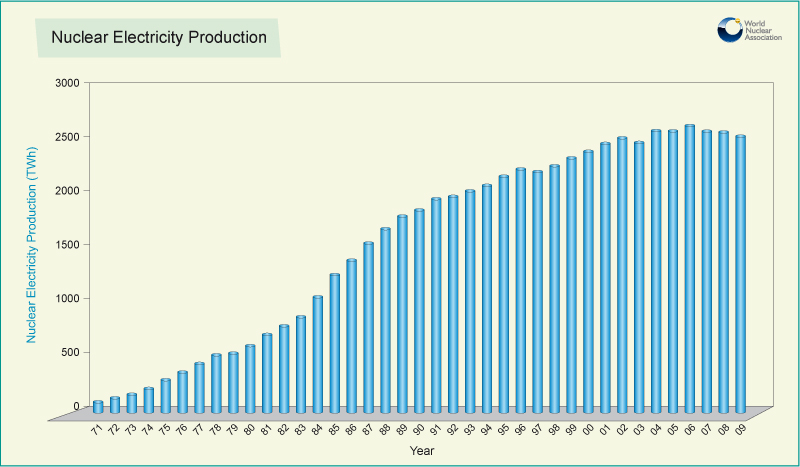
Statistically, coal plants cause about 161 deaths per TWh of power generated. Worldwide, nuclear power generates about 2500 TWh per year. Its average fatality rate has bee 0.04 deaths per TWh. So if all our nuclear plants had never been built, and were coal plants instead, we'd be looking at (161-0.04)*2500 = 402,400 more deaths per year from the additional coal mining and pollution.
In other words, if we analyze safety the way you're proposing, nuclear power saves 400,000 lives each year. -
Timeline has already been Tinkered with
Someone is tinkering with the timeline. And it's someone from a period +- 50 yrs Current time. They're trying to produce outcomes that bear on our current geopolitical status. There are changes embedded in ancient periods:
The mother culture of Central America:
http://www.bbc.co.uk/science/horizon/2001/caraltrans.shtmlMassive civilization in Amazonian Basin:
http://news.nationalgeographic.com/news/2008/11/081119-lost-cities-amazon.htmlThere are better-known examples closer to Europe, and more modern: the Antikythera mechanism or the batteries of Sumer, the Jacquard loom or the automata of Rhodes or China:
http://en.wikipedia.org/wiki/AutomatonAll of these happened. They are indisputable fact. Yet, they have not disrupted the general sweep of accepted history. For example, if the mother culture of the Central and South American cultures the Spanish encountered, namely the Maya, Aztec, and Inca, far pre-dated even the Egyptians, then why did the peoples of the New World not stand on par with those of the Old? If the Amazonian basin sported a sophisticated culture of millions of people far before the same was achieved by Rome, then why do we scarcely know about them today?
Closer to home, meaning the here and the now, we have attempts to introduce advanced technology far prior to their realization now. Yet, they have not changed the here and the now. Rather, they remain outliers.
Certain parties have tried to alter the timeline. But they've done so in scattershot fashion, trying to get history to pivot on a dime by introducing innovations before their time or deeper, longer term ploys to get the engine of history moving in a different direction earlier (ie. Ecuador or Brazil). If they had succeeded, then we would not now know the difference. It would simply be as it has always been. There would be no alternate outcomes.
That there is a disparity suggests that the timeline is a massively multi-variate system whose movements defy simple interpretations or solutions. Kill Hitler and WWII and the Holocaust would never have happened? Well, the disparity suggests it may have changed the timing, but that one event, Hitler's death, may not have avoided the thing altogether. There was much more in play than that one man.
There is a lot more than a
Why?
-
Re:I'd be open to it, but good luck with everyone
nat geo: small town nukes
http://ngm.nationalgeographic.com/big-idea/08/mini-nukes
i have the magazine somewhere, but cant seem to find the article at a glance and dont remember if the print article was any longer.
-
Re:Yes absolutely
Like this?
http://news.nationalgeographic.com/news/2005/12/1215_051215_north_pole.html- not a reversal. But it's being blamed for some of the recent migratory bird mass deaths.
-
Re:Call me when it's on shelves.
There might have been one about fusion power, but there was one specifically about isobutanol.
Gevo has been developing their own fermentation technology for over 8 years, until a patent issued to a JV between BP and Dupont on Dec 2010 is suddenly seeing Gevo in court
If IP battles are going to go on in such a raging manner it will be decades before we (as consumers) see anything useful come out of these technologies.
And we all know where things are heading while we linger... -
Re:Satellite Launch Failures Happen All The Time
Perhaps the Martians don't want us to follow up our findings of
Global Warming on Mars. (not caused by humans) -
Re:You have to keep buying
Unconstrained exponential growth at ~3% per year:
http://ngm.nationalgeographic.com/2009/03/canadian-oil-sands/kunzig-text
http://jirirezac.photoshelter.com/image/I0000.As2KdwWZVE
Now add an extra 4 billion people.
-
Re:Why paper books are NOT better
They cost a forest and a polluted river.
And electronic trash is any better?
-
Re:whatwhatwhat
I never understood why photographs can be copyrighted. If somebody takes a picture of me, then why do they own the picture?
I bet the famous Afghan girl never saw any of those millions that the photographer did.
They did the creative work, however, without a model release from you they are limited in how they can use it commercially. As for the Afghan girl, NG reports:
-
Re:Please say it ain't true !
I would be curious to see a comparison of the percentage of population within 20 miles of a city between the US and Canada.
I couldn't find that particular stat but according to Wikipedia 80% of the population lives within 150km (93 mi) of the U.S. border. NationalGeographic.com estimates it as 75% within 161km (100mi).
-
Re:Good lord...
And rape. Don't forget the rape.
-
Re:The meaning of random
[citation needed]. That doesn't seem plausible, since that would have Tokyo sinking more than twice as fast as New Orleans, and I cannot find a source that mentions Tokyo sinking into the sea. Can you cite a source for this claim?
-
Re:Energy requirements?
Hint, once again: geo comes from Gea or Gaia: the primal Greek goddess personifying the Earth
Most of the Moon comes from Earth in the first place, if we're going to be that pedantic.
Then, let me stay pedantic a bit more: "Most of the Moon comes from Earth" is only a theory, for the time being. The very existence of the water on the Moon raises some supplementary questions on it:
Most astronomers believe a rogue planet collided with Earth about 4.5 billion years ago. The impact sent molten debris into orbit around Earth, some of which coalesced to form the moon.
Under this scenario, the heat of the impact should have vaporized light elements, including the hydrogen necessary for water to form. -
Re:This why Rome fell
Far too many assumptions:
1) That's accurate (i.e. an Ancient Greek who could judge accurately how many separate people were involved on a 20 year Egyptian project 1500 years before his time without exaggeration)
2) The builder's ALL worked an 8 hour day, every single day, even religious festivals (and there wasn't, say, one man who knew how to do the bottom bits and then slunk off, or only lifted one stone before breaking his back, etc.) during the night, etc. on hard heavy-labour, as did every architect, priest, tile-polisher, boatsman etc. and there was never a flood, or rainstorms, or other problems that stopped work for even a single guy.
3) The Egyptian pyramids weren't slave-built (actually they were quite decently treated for the time) - so "the builders" probably worked no harder than anyone else, especially if it meant burning oil to be able to see.Allow me to link to a really crappy, kiddies article: http://www.nationalgeographic.com/pyramids/pyramids.html
"Contrary to some popular depictions, the pyramid builders were not slaves or foreigners."
"Some of the builders were permanent employees of the pharaoh. Others were conscripted for a limited time from local villages."
"An estimated 20,000 to 30,000 workers built the Pyramids at Giza over 80 years. Much of the work probably happened while the River Nile was flooded." (suggesting 1.6m man-years assuming 24/7 working, or 53,000 man-years on a working-day, less than your estimate)And that's the pyramids (plural), not your unfounded estimate of a pyramid (singular).
I'd be extremely surprised if there was more than 30,000 man years of productive work overall, and probably a lot less.
-
Re:Or Ostrich
-
Much more important astronomical news
There have been discussions of a probe to Uranus. Don't the Slashdot editors realize how many more silly jokes and pageviews this could generate? As a stockholder in GKNT, I demand that you post a story about the Uranus probe.
-
Re:Department of the obvious
anatomical
Really?
For a Long Time, scientists thought that Savanna and Forest elephants were sub-species of the same Loxodonta africana, and only 10 years ago did people start thinking that they *might* be separate species. Only now has DNA evidence proven it.
http://news.nationalgeographic.com/news/2010/12/101222-african-elephants-two-species-new-science/chemical
Note that I wrote pre-DNA methods.
-
Re:Surely everybody has heard of the placebo effec
So they expect it to still work. And because they expect it to work it does.
You know, if you could induce the placebo effect like that, it would be fairly astounding because the placebo effect is often as effective (or more) than the medicine. I suspect it would also turn modern medicine on its ear. "You're better because you want to be better" becomes something for some pretty serious investigation.
Part of me wonders if the patients understood this -- they were described as "like sugar pills", and it said placebo on the pill -- but it's possible that they just didn't realize that they were literally being given nothing whatsoever in terms of medicine.
This part intrigues me
Heck, leeching was considered medically useless for a long time too. And then there's that whole maggots thing.
I think the underlying mechanism for this (or at least explanation for it) is fairly interesting.