Slashdot Mirror
Domain: nature.com
Stories and comments across the archive that link to nature.com.
Comments · 2,953
-
Re:News?
The results are published in Nature today.
And so it is indeed news.
https://www.nature.com/article... -
Re:Something Stinks...
The key will be to establish "open source" peer-reviewed journals that are backed by the biggest names in science and the major universities. That at this point it hasn't happened makes me think that the biggest names in science and the major universities like the way things are now...
You mean such as Nature Scientific Reports? It's a relatively good journal (impact factor 4.3), open access, and does not discriminate against negative results. Even older mainstream journals like Physical Review Letters (impact factor 8.5) are starting to offer open access publication. Nature Communications (high impact factor 12.1) also just switched to an open access model last year, and even removed the paywall from all their older content. So I'd say that things are at least moving in the right direction, especially after funding bodies in many countries started pushing it.
-
Re:Something Stinks...
The key will be to establish "open source" peer-reviewed journals that are backed by the biggest names in science and the major universities. That at this point it hasn't happened makes me think that the biggest names in science and the major universities like the way things are now...
You mean such as Nature Scientific Reports? It's a relatively good journal (impact factor 4.3), open access, and does not discriminate against negative results. Even older mainstream journals like Physical Review Letters (impact factor 8.5) are starting to offer open access publication. Nature Communications (high impact factor 12.1) also just switched to an open access model last year, and even removed the paywall from all their older content. So I'd say that things are at least moving in the right direction, especially after funding bodies in many countries started pushing it.
-
Re:A US centric view
According to Phil Jones of the CRU, " he simply couldn’t hand over entire data sets because of long-standing confidentiality agreements with other nations that restrict their use". Seems that they do not hand over data because of International confidentiality agreements.
-
Re:You left off
I'm old.
Hey, so am I! And you know what, being old means you tend to be miserable a lot of the time. It's a package deal: on one hand life afflicts you with suffering. On the other hand, you get to live.
Being able to take it doesn't make you special; everyone who survives long enough learns to live with whatever it is aging has in store for them, whether it is arthritis, digestive problems, or for a majority of us, disturbed sleep patterns. That doesn't make disrupted sleep normal for younger people, or mean it should be compulsory for everyone.
Now the smart thing to do as you get older is to optimize the time you have left. And that means paying attention to the best evidence we have. You say that your cells don't know what time of day it is? Wrong. Even single-celled eukaryotic organisms have circadian rhythms. So as you get older if you want to minimize your misery you have to get serious about sleep discipline. No late night screen sessions without blue-filtered glasses, regular bedtimes, don't eat or drink to much late at night. Basically all the stupid shit you did when you were a kid because you could get by on six hours of not very good sleep.
As long as we're talking anecdotes, when I got serious about sleep hygiene I saw improvements in my arthritis and Type 2 diabetes sugar control. That makes sense because diabetes and arthritis are both inflammatory diseases, and the evidence is strong linking sleep disruption and a wide variety of inflammatory conditions linked with aging, including cardiovascular diseases and dementia.
-
Re:What do you mean "strength"?
I’m obviously no expert, but even I know you can't just say "strength".
Also, "under certain conditions"... Could you get any more weasely?
The weasel words came from the journalist, who felt a need to dumb things down for a general audience.
The actual paper is much more specific and unambiguous.
-
Re:Take that Karl Marx
Put on your scientist hat on and look at history like actual scientists and historians have done. The profession consensus is that the link between capitalism and success outside of the expansion of capitalism, i.e. technological or social progress, is a correlation, not a causation.
Where the fuck are you getting this from? Some communist blog/forum? Newsflash: Capitalism has allowed technology to scale at an exponential rate due to private citizens investing massive amounts of money toward that end; this is not a coincidence. Hell, the Soviet Union, for all of the resources it had at its disposal to improve its military technology, was still using vacuum tubes in its fighter jets when the US had moved to integrated circuits long before. The same integrated circuits that were made practical for mass production in 1958 by three US companies, and that now power most of the technology we enjoy today.
Here's a bit of data that should drive the point home, especially when correlated with countries that have come from some other system to capitalism.
https://www.gapminder.org/tool...
Take a look at China for example; the government began adopting capitalist practices around 1980, and not long after that (roughly 1988,) you see their bubble quickly heading in the direction of higher average purchasing power (shown in that chart as income.) Granted, China had an enormous pile of untapped labor, that doesn't erase the fact that prior to these changes, such labor couldn't have ever been tapped because nobody could invest into the needed infrastructure (not even the government could.)
Hans Rosling (scientist, by the way) explains this data rather well:
https://www.ted.com/talks/hans...
And chances are, you score worse than the monkeys in this test:
https://www.ted.com/talks/hans...
By the way, until he died, he dedicated his career to educating academics, and to a lesser extent, people like you:
rather than generating data, Rosling has spent the past two decades communicating data gathered by others. He relays facts that he thinks many academics have been too slow to appreciate and argues that researchers are ignorant about the state of health and wealth around the world. That’s dangerous. “Campuses are full of siloed people who do advocacy about things they don’t understand,” he says.
http://www.nature.com/news/thr...
Communists/socialists here on slashdot always like to slam capitalism as if there's a much better way to go, but we've honestly been there and tried those, and they're all crap. They don't understand, at all, that the world is doing nothing but improving, as the data there very clearly shows. And contrary to popular belief, "megacorps" (as they're often described here, as if this is a cyberpunk novel) are a lot less powerful than they were in ages past. The first publicly traded corporation to exist the Dutch East India Company, at its peak had a net worth of $7 trillion in today's dollars back in 1675. Let that sink in for a minute. They also had the power to raise armies, declare war, jail and execute people who didn't pay their bills, and they had the largest monopoly the world has ever seen. As time has gone on, we've seen this power continually decrease, whereas right now the biggest companies have no martial powers at all, and the number of monopolies that exist is getting smaller and smaller, and the ones that remain have very tiny impact compared to the ones that existed in the past.
-
Getting scary
An abstract of the nature.com article is here.
I hope this algorithm will help prevent suicides.
However, the increasing ability of machines to read minds is getting a little scary. Some day we'll be able to read someone's emotions without hooking the person up to a machine - just point a reader at their head.
Government employee: What do you think of our dear leader?
The person's brain shows the emotion of revulsion.
Government employee: Off to a re-education camp, for you and your family!
-
Re:I 3 Global Warming
More accurately, CO2 is plant junk food. Higher CO2 levels produce less nutritious crops
Not sure why you provided a paywalled link when there are alternatives like this one.
You might read the actual study if you haven't -- the details suggest a lot less of a clear-cut situation even for the single variable the authors are trying to isolate. The generally single-digit decreases in zinc and iron varied widely per cultivar of a given crop, and some cultivars had little decrease or even had an increase in nutrient content when grown under elevated CO2.
So stack up a negligible decrease in certain nutrients, most of which likely could be avoided via cultivar selection and breeding, against likely double-digit increases in both gross yield and yield per unit of water.
Would that we had more "junk food" like that.
-
Re:I 3 Global Warming
"CO2 is plant food," a stupid argument to use in favor of global warming considering CO2's other negative effects - especially the reduction in arable land, isn't even right in itself.
More accurately, CO2 is plant junk food. Higher CO2 levels produce less nutritious crops:
-
Re:Nanny State
If someone sneezes near me, no big deal.
...for very large values of "near".
Feeding her video evidence into her mathematical models, Bourouiba concluded that, thanks to the cloud dynamics, many of the larger droplets can travel up to 8 metres for a sneeze and 6 metres for a cough, depending on the environmental conditions, and stay suspended for up to 10 minutes — far enough and long enough to reach someone at the other end of a large room, not to mention the ceiling ventilation system.
-
It's an example of poor communication.
It seems to me that poor communication discourages people from being interested in Physics. "The Universe should not exist" is clickbait dishonesty by the media.
Read the scientific article, A parts-per-billion measurement of the antiproton magnetic moment. There is nothing dishonest.
It would have been far better to explain the conflict being observed and acknowledge that not much is known in that area of interest. It is FAR too early to draw conclusions.
What the CERN scientists may have discovered is that the "basic assumptions of the standard model of particle physics" are incorrect.
More clickbait dishonesty:
CERN Antimatter Experiment Suggest the Universe Shouldn't Exist
CERN Research Finds "The Universe Should Not Actually Exist"
The Universe Should Not Actually Exist, CERN Scientists Discover
CERN Scientists Find Further Evidence That the Universe 'Should Not Exist'
The universe shouldn't exist, scientists say after finding bizarre behaviour of anti-matter. Quote: "We don't know why the universe isn't destroying itself." That is at least in the direction of being honest; we don't know why.
I'm guessing that media writers didn't want to try to understand the actual issues, so they all adopted one writer's wild exaggeration.
I see NO evidence that anyone at CERN is dishonest. The dishonesty seems to be only in media reports. -
Re:Eye Sight, Destroyed.
Agree with AC to a degree, but I also feel that AC could have done a google instead of being an unhelpful twit: https://www.nature.com/news/th...
-
Re:Gattaca once the patent expires
They arguably don't use it for editing, just for cutting and degradation to protect against phage. There was recently even published a viral CRISPR-like system, which functions in immunity against viruses that infect other viruses. See "MIMIVIRE is a defence system in mimivirus that confers resistance to virophage."
-
Re:Not Mosquitos
Bats, purple martins and other insectivores get a vanishingly small amount of their calories from mosquitoes - less than 1% of the stomach contents of bats. Mosquitoes are quite small and therefore not very calorically rich. Unlike midges and gnats, they don’t really swarm in a way that would allow insectivores to get a whole bunch in one swoop, so generally mosquitoes are providing fewer calories than the expense required to fly at them. Bats, martins and the like mostly end up eating moths and midges. Some species of dragonfly are mosquitovores but, again, not as a large percentage of their caloric intake.
There are a handful of species that target mosquito larvae, which bunch up enough to be worth it. The aptly named mosquitofish is one such creature.
But the saving grace even among mosquitofish is that they don’t care what species of mosquito larva they eat - getting rid of the handful that target humans will leave space for the hundreds of other species that exist in the US (let alone the thousands worldwide). There are approximately 3,500 species of mosquito and only about 40 that target humans. Most of the human targeting mosquitoes are invasive species in nearly all of their range, brought by humans. (Aedes aegypti and the Asian Tiger mosquito, for instance, shouldn't be found in the Americas...)
Contrast that with the enormous chemical inputs we put into our lakes, streams and rivers in order to just control mosquitoes - we are surely inadvertently killing off other species of insects just trying to control mosquitoes. And when we drain a wetland because of mosquitoes, we impact far, far more species than even the worst case scenario of mosquito extinction.
There have been a number of discussions among ecologists and the consensus is that wiping out human-targeting mosquito species is fine. Even E.O. Wilson, the famed biologist and campaigner for biodiversity, wants to kill them all. (He’s actually slightly more cautious, but basically wouldn’t spill any tears over eradicating human-feeding insects.)
-
Re:Those were the days.
everything is happening faster than expected by all but the most pessimistic models. (Even most of them are being outpaced by reality.)
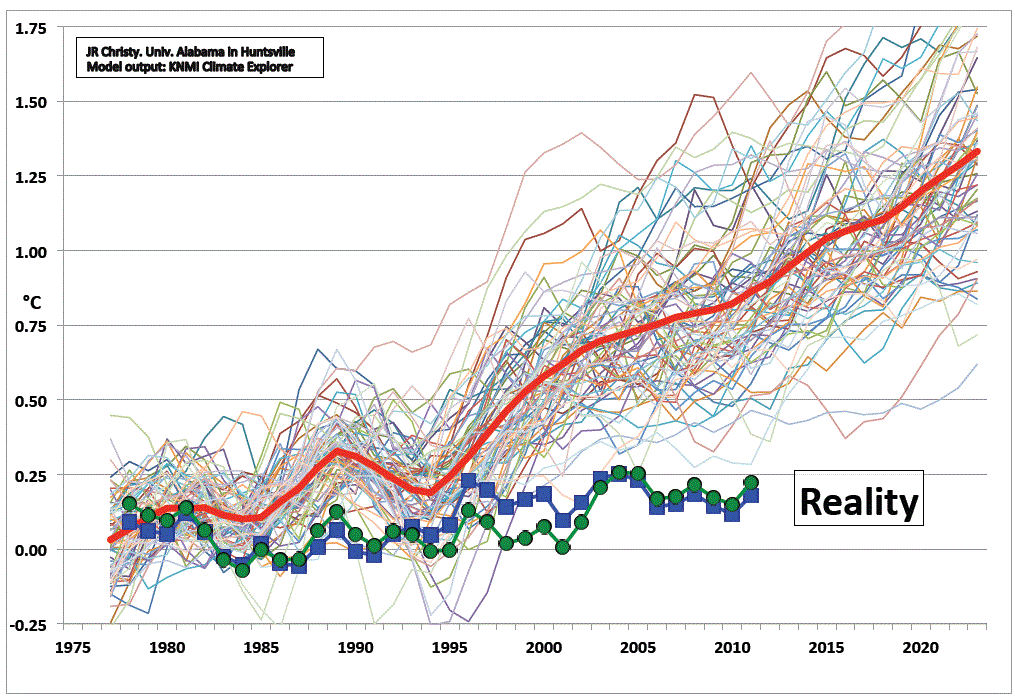
Wow no, the opposite, the models over-estimate, as multiple studies have shown. Graph.
-
Re:I agree - moon first
Wait a minute... are you the same AC who wrote:
"and cloud city, deals with 800 degrees and sulphuric acid atmosphere how????
I'm thinking you don't realize that both pressure and temperature decline with altitude. So, here you go. Does that help clear things up?
-
Wrong study linked in summary...
Link to TFA study...
-
Yes - no risk to the ecosystem because
any mosquito species is the easiest species to replace - there are so many of them, and we could even eradicate all the blood-sucking mosquitoes and just leave those that don't.
In fact, a mosquito species can even be replaced by entirely different families (i.e. not from Culicidae):
Yet in many cases, scientists acknowledge that the ecological scar left by a missing mosquito would heal quickly as the niche was filled by other organisms. Life would continue as before — or even better. When it comes to the major disease vectors, "it's difficult to see what the downside would be to removal, except for collateral damage", says insect ecologist Steven Juliano, of Illinois State University in Normal. A world without mosquitoes would be "more secure for us", says medical entomologist Carlos Brisola Marcondes from the Federal University of Santa Catarina in Brazil. "The elimination of Anopheles would be very significant for mankind."
-
Re:no kill them all
Brilliant!
Here is some background:
https://www.nature.com/news/20...
http://www.mosquitoreviews.com...
https://www.quora.com/What-is-... -
In this thread people will worry about China
Of course, 2 months ago the same feat was published in Nature from a doctor in Oregon. https://www.nature.com/news/cr...
-
Re:HepC isn't a retrovirus, though
HCV is not capable of true dormancy, it's either infective or not. "Dormant" period simply means that the immune system and the HCV virus are at a stalemate ( http://www.nature.com/nm/journ... ). It happens because the HCV virus has unusually low activity inside infected cells, a typical virus replicates itself furiously and causes cells to lyse (explode) quickly but HCV only produces around 50 copies of virus per day. So you can have situation where a fairly small amount of viral particles in blood are efficiently controlled by antibodies but they can't do anything with the actual virus-producing cells, until the virus eventually evolves a subtype that evades the immune system...
-
Re: At least...
Yes, yes it has. Read your link. Your own link says that they revised the results but that AGW is still occurring - no shit, that's not really disputed except by people who don't pay attention to the science. Nobody (sane) is denying that the Earth is warming. However, it's not spiking like it was in their original predictions. In fact, warming has been less than the models predicted. It's not a hockey stick, but a gradual warming.
Citation:
http://www.nature.com/ngeo/jou...
Distilled version for the regular people:
https://www.washingtonpost.com...
The data doesn't match the models, warming is less than predicted. Nobody (sane) is denying that the planet is warming or that CO2 is a primary cause.
-
Re:Holy shit, stop the insanity
As long as you don't admit that the models are wrong, you're opposed to science.
Oh the irony.
Sigh. Fine, we'll do this again. Yes, of course the models are not perfect - they do not (and cannot) predict every last short-term wiggle. To a "black and white" viewpoint then that means they're *always* wrong - even when they reliably nail the long-term trend for over thirty years. This of course does not mean they are not still very useful to climatologists that know how to use them (and as long as you don't admit that, you're opposed to science, yes?)
So with that out of the way, when the models don't match closely to what we observe, we want to know why, so that we can improve them. From your own first link (again):
..both internal variability and external forcing contribute to the ‘slowdown’. The externally forced contribution is due to the combined cooling effects of a succession of moderate early twenty-first century eruptions, a long and anomalously low solar minimum during the last solar cycle, increased atmospheric burdens of anthropogenic sulfate aerosols, and a decrease in stratospheric water vapour
As you point out, internal variability (ENSO etc) alone is very unlikely to account for the discrepancies, but your own citation says that internal variability and the short-term external forcings listed above are responsible for the so-called "pause" (in tropospheric warming specifically), and the models do not adequately account for these (again, no surprise to actual climatologists). Meanwhile, other (and more important) climate models are tracking nicely; for example, "ocean warming estimates over a range of times and depths agree well with results from the latest generation of climate models" (which is accelerating rapidly).
if you think the cause was volcanoes and solar activity, this paper talks to you. You'll have to find some other explanation.
So when your first link from 2017 explicitly calls out volcanoes and solar activity (among other things) as significant factors, you cite a paper from 2013 (four years out of date) to claim that it can't be those - despite that same paper explicitly not ruling out external forcings like those as being a factor. You really need to read your own citations more closely.
Seriously, do you look at this and say, "Oh yeah, that's right"? If so, what is wrong with you?
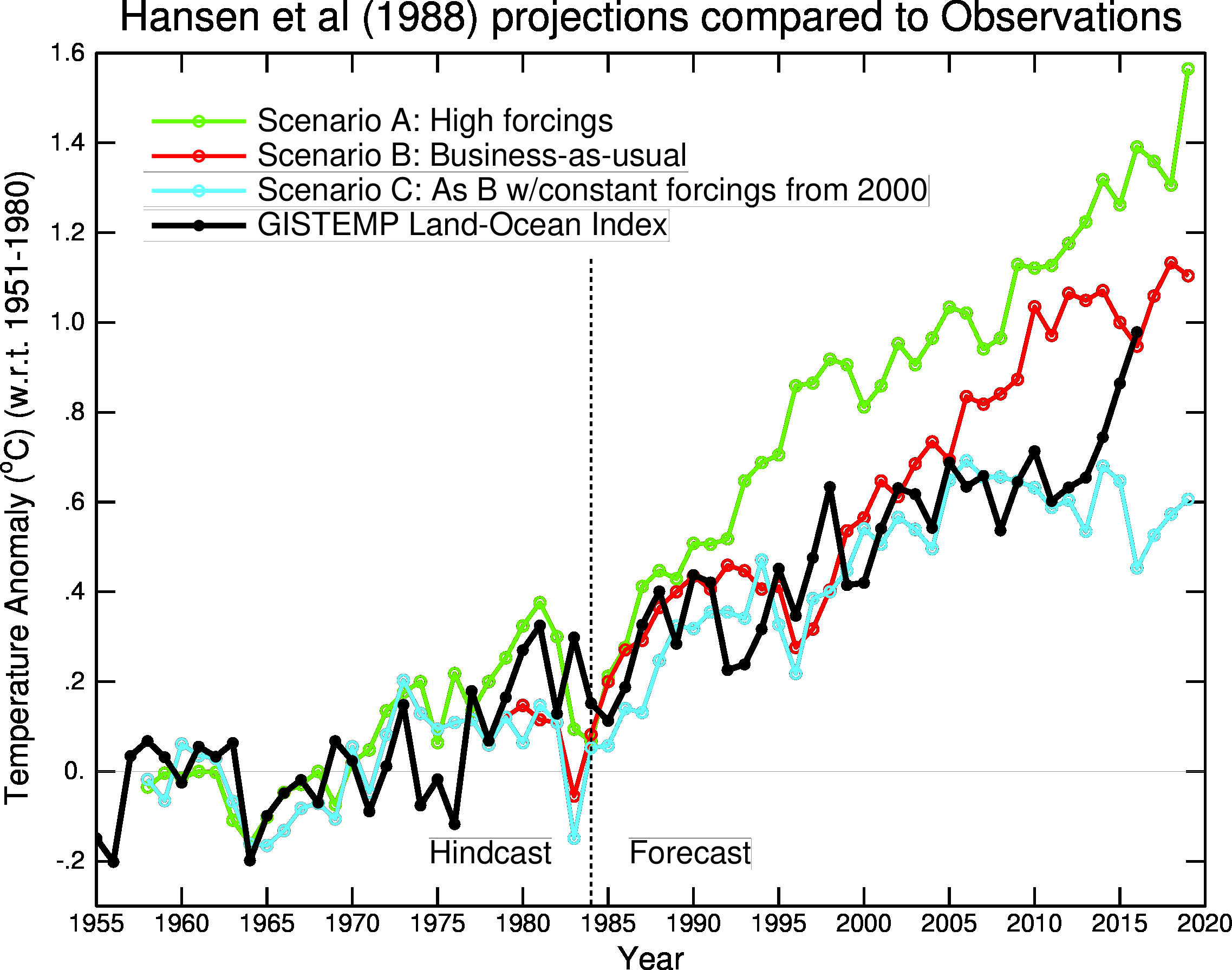
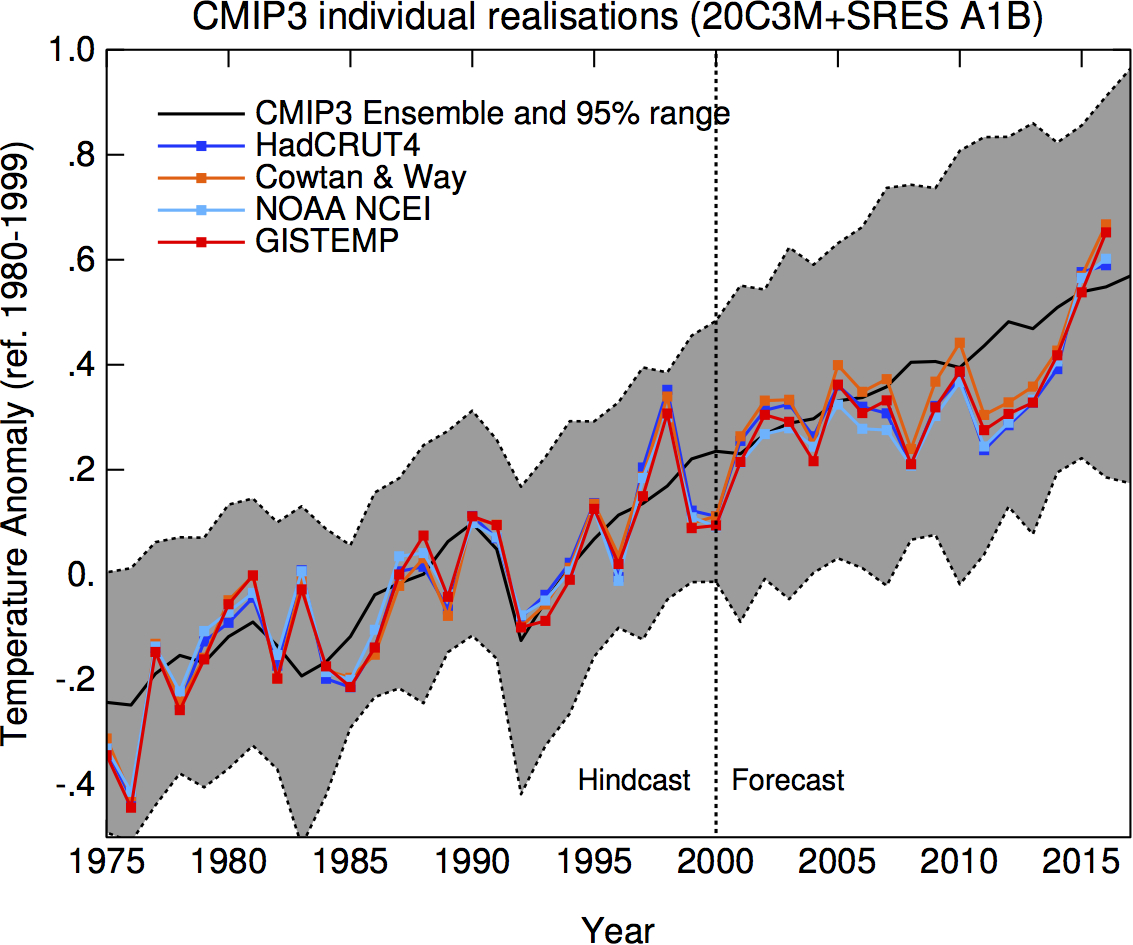
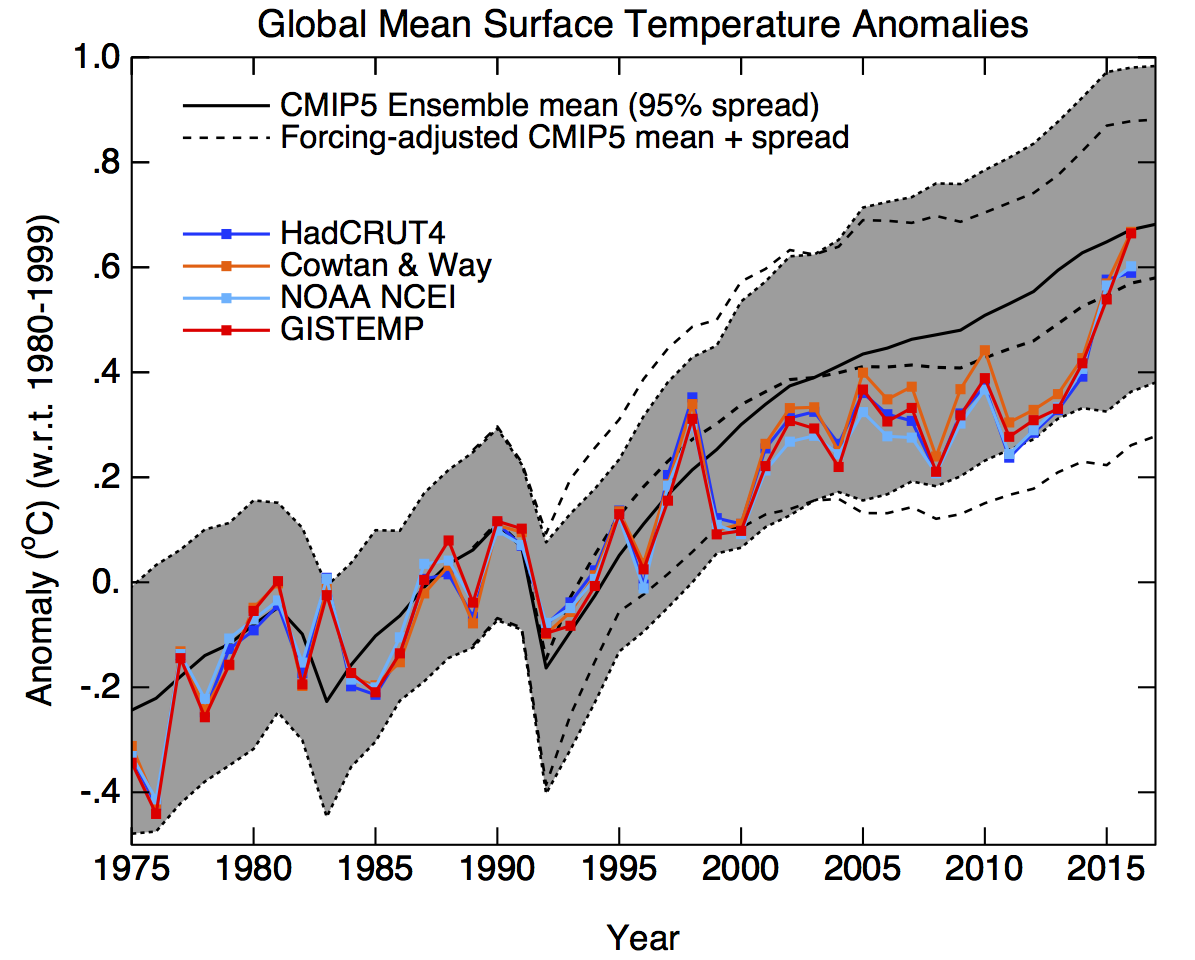
I look at that and say, "I see it's 5 years out of date, big surprise". Then I say "what is that graph even representing? There's no labels". Then I look at more up-to-date data. (NB I'm assuming from your example that you're fine with linking to images on blogs, but at least try to use something current and well-sourced?)
-
Re:Holy shit, stop the insanityAs long as you don't admit that the models are wrong, you're opposed to science. The paper says it is due, at least partly, to "systemic deficiencies" in the models.
These papers have been coming out http://www.stat.washington.edu...">for a while, and they will keep coming out. Eventually scientists will come up with explanations for why the models are wrong, and will fix them. Seriously, do you look at this and say, "Oh yeah, that's right"? If so, what is wrong with you?
btw, if you think the cause was volcanoes and solar activity, http://www.academia.edu/421041...">this paper talks to you. You'll have to find some other explanation. ENSO doesn't work as an explanation either, since it's oscillated both ways over that time period. Specifically (quoting from the paper):a significant increase in recent volcanic activity has not been recorded, while variations in solar insolation or activity still require rather speculative amplification mechanisms that could contribute to the observed recentdecrease in global warming
-
The full answer is, we don't know
It's not a "wild card," it is considered so unlikely by scientists that after consideration, the IPCC didn't even put it in their report as a reasonable possibility. Nature has a good summary of the research:
That's a good article, thanks. There are other articles, however-- some of them even cited in that one-- that emphasize slightly more the "We don't know" aspect of the clathrate stability.
Methane clathrates are only one of several sources of greenhouse gasses that are currently sequestered in cold traps, primarily in the Arctic. We do know that, in the past, there have been times when warming has released these. We don't know enough about how much is currently sequestered in cold traps, and how much warming is needed to release them, to know what the effect is. Maybe they're stable, and we don't have to worry about them.
-
Re:Catastrophic feedback
The possibility of a catastrophic feedback is indeed the wild card in global warming calculations: there is a lot of carbon dioxide and methane trapped in frozen soil and in undersea clathrates, and it is indeed possible that there is a threshold above which these will be released, dramatically increasing the temperature.
It's not a "wild card," it is considered so unlikely by scientists that after consideration, the IPCC didn't even put it in their report as a reasonable possibility. Nature has a good summary of the research:
Catastrophic, widespread dissociation of methane gas hydrates will not be triggered by continued climate warming at contemporary rates (0.2C per decade; IPCC 2007) over timescales of a few hundred years. Most of Earth's gas hydrates occur at low saturations and in sediments at such great depths below the seafloor or onshore permafrost that they will barely be affected by warming over even 10^3 yr.
-
FYI paper already published...
FYI paper already published. Here's the final paper link , and the pre-print...
Abstract
Practical quantum computers require a large network of highly coherent qubits, interconnected in a design robust against errors. Donor spins in silicon provide state-of-the-art coherence and quantum gate fidelities, in a platform adapted from industrial semiconductor processing. Here we present a scalable design for a silicon quantum processor that does not require precise donor placement and leaves ample space for the routing of interconnects and readout devices. We introduce the flip-flop qubit, a combination of the electron-nuclear spin states of a phosphorus donor that can be controlled by microwave electric fields. Two-qubit gates exploit a second-order electric dipole-dipole interaction, allowing selective coupling beyond the nearest-neighbor, at separations of hundreds of nanometers, while microwave resonators can extend the entanglement to macroscopic distances. We predict gate fidelities within fault-tolerance thresholds using realistic noise models. This design provides a realizable blueprint for scalable spin-based quantum computers in silicon.
Of course they haven't built it yet, so you never know...
-
oysters?
Oysters aren't fish, they're not even vertebrates (nor chordates). And the original technical article (here: https://www.nature.com/article...) did NOT say that the oysters ate plastic, on the contrary, "The Pacific oysters came from aquaculture in urban bays and had anthropogenic debris composed entirely of fibers." (The scientists were not able to ID the fibers; could have been cotton, could have been polyester, or...) In fact, the vast majority of the "anthropogenic" materials the study found in fish caught on the west coast of the US were fibers, not (necessarily) plastic. Plastic was only common in fish bought at a market in Indonesia. (I don't know how much of the seafood we eat comes from Indonesia, nor what fish caught in other places besides Indonesia and the west coast of the US might ingest.)
That said, I do think it would be good to reduced the amount of plastic in the ocean.
-
Re:The Scam Continues
Nope. I remember reading that the human eye needs at least 6 photons per second in order to trigger depolarization of nerves.
The latest study from 2016 seems to show that a single photon can, indeed,be enough.
Of course, many photons hit the layers before the receptors (in part due to the eye being suboptimal in that the receptors are at the wrong side or the retina - so much for 'intelligent design"), or miss. But when lucky, we appear to be able to detect single photons.
Luck multiplied with a high number of repetitions approaches certainty, which is also how most of our scientific equipment works. -
Re:fools day already?
Yes, you have. The conversion you mean is probably an audio signal modulated on a (much) higher fixed (unless modulation is FM) frequency EM signal. In that case, you receive the EM signal, separate the effects of the modulation by subtracting (filter, mix, whatever) the fixed EM signal and go on to recreate the audio according to the modulation used.
In this case, you convert an EM signal directly in its same frequency 'sound' equivalent. Because 'sound' (or pressure) waves travel slower (~340 m/s in average sea-level pressure air) than EM (a bit less than 3000000 m/s in vacuum, light is a special kind of EM) waves, you need less 'distance' in the materials that need to resonate with the frequency. The signal energy is now stored as stresses between molecules inside the material instead of electrons bumping/traveling through the material. Do note the speeds of 'sound' and 'light' are quite a bit different in various materials, but most of the time 'light' is a LOT faster than 'sound' and thus travels a MUCH longer 'distance'.
The novelty here is two-fold. 1) They found a way to directly convert EM waves into their 'sound' equivalent. 2) They developed/found an appropriate material that can 'detect' (turn into an electric signal) the stresses of 'sound' waves at very high frequencies.
Here is a part of the article:
During the receiving process, the magnetic layer of ME antennas senses H-components of EM waves, which induces a oscillating strain and a piezoelectric voltage output at the electromechanical resonance frequency.
In other words, the material uses magnetic detection (also done by coils, like in AM ~1MHz / 300 meter radios... which are a lot smaller than a 300 meter wire antenna equivalent) and because of its shape it starts to oscillate with the signal. Not electromagnetically, like in almost every other EM wave antenna, but mechanically. It creates stresses in the material (oscillating strain). They convert that strain back to an electric signal, using piezoelectric properties of the material (like the quartz in a 'push button' style lighter which emits a(n electric) spark that ignites gas). Oscillation only happens when the 'distance' in the material very closely matches the frequency of the receiving/transmitting wave; in this case in its 'sound' form. This is why you need to tune a guitar to get the right tone and 'normal' EM antennas need to be an appropriate fraction of their receiving/transmitting EM wave length.
What I'm interested in with this technology, is how you could 'tune' the material to receive/transmit in a broader frequency range than its 'natural' oscillation. That may be needed to make the antenna interesting for very broadband signals and tune-able equipment (like amateur radio transceivers or channel selectable broadcasting)
With 'normal' EM transmitting/receiving antennas we have various options to electrically tune the antenna but here you may have to dynamically 'shape' the material to permit a broader frequency range... -
Re:Sure but what if it's all a big hoax
So, Obama got elected in both 2008 and 2012 we made amazing progress on wind, solar, and other renewable energy as result of the Obama administration energy policies.
Define amazing.
so all he could do was flush a bunch of money down the toilet with grants to supposed renewable energy companies that ended up burning through the taxpayer dollars and then going bankrupt.
Your statement is provably false. You don't get to chide one person for hyperbole and imprecision, then make them yourself.
-
Re:Worry worry worry
I'm not sure exactly what is the chicken and what is the egg, but it's quite well established that the weight of water or ice deforms the land. There's lots of geological evidence of uplift after glaciers melt, and you can see the same on a smaller scale in places like California today where groundwater depletion is causing uplift. The effect has also been linked to seismicity, so it's not that big a leap to volcanism.
-
Re:The science is not settled
I'm going to disturb the echo chamber a little. There is a link between vaccinations and autism. It has been proven.
What has been found is that women who give birth to children with ASD have had at least one fever during their pregnancy. It doesn't take much of one, only about 1 degree of fever, but that fever has major effects on brain development in the unborn child.
You ask what that has to do with vaccinations? Fever is a side effect of almost all vaccinations. So, the side effect, the unintended consequence, of vaccination is causing autism. Here's a link to the study.
http://www.nature.com/mp/journ...
It will be interesting to see how many people here will refuse to believe the study. The claims of many to believe science will vanish when science contradicts that which they have an emotional attachment to.
-
which reminds me
The guest, Li-Huei Tsai, director of some august learning and memory institute at MIT, eventually confesses that transfer from mice models to humans in this line or research has about a 1% success rate.
It's a great episode.
Memories retrieved in mutant 'Alzheimer's' mice — 16 March 2016
-
Here
https://www.nature.com/mp/jour...
Forget short hand summaries and the articles you are gonna read about this subject that are often misguided and sensationalistic.
Read the piece. It has some merit, but it might not be drawing the conclusions that people are writing about it. -
Isn't the lesson here...
First up, link to the actual study in Nature's Molecular Psychology:
Impact of video games on plasticity of the hippocampus
The study was mostly on the effects of different navigation mechanisms (the "control group" did 3d platforming) - so isn't the lesson here, if you spend lots of time gaming, don't only play one kind of game?
Also, where was the non-videogaming control? Isn't there a general loss of grey matter over time regardless? I'd think tablet/GPS users using virtually NO navigational skills would also see a reduction in hippocampus grey matter over time - and most archived studies wouldn't have taken into account newer commonly used technologies reducing general navigation.
Nice data point - as the paper states and strongly implies, more study is needed, and the conclusions that can be drawn here are quite limited.
Ryan Fenton -
Study actually looks at navigation strategies used
Actual study (open access): http://www.nature.com/mp/journ...
The actual study looks at the navigation strategies used in games and separates both the type of games and the type of players; i.e., players of the same game using different navigation strategies develop their brains differently.
The finding is that if you play first person shooters and just wander around and shoot things, the hippocampus doesn't develop (and decreases in mass). By contrast, if you learn to navigate based on references in the game (or, by dying repeatedly by navigating incorrectly, as is common in the Mario game control group they used) your brain develops.
It would be interesting to see a comparison between Call of Duty pub players and competitive Counter-Strike players. The former just "shoot everything that moves". The latter are highly coordinated like SWAT teams. The present findings seem to suggest that the latter--in the same game--would develop their brain matter, whereas the former would not.
-
Re:He does not mean it actually
-
Re:Gattaca predicted the outcome in 1997
Edit gene blah to fix pimples... whoops that gives you an automatic heart attack at age 30.
TLDR: it will be illegal to perform the type of edits you're worried about.
Doctors doing this to people would be legally required to follow ethics guidelines. Researchers in lab don't have to since they're not doing research on people*.
Those ethical guidelines were already being debated heavily when it was even more hypothetical than it is now. Steven Pinker is probably the most gung ho guy for "do germline editing" and even he seems to suggest no edits for purely cosmetic reasons. The guidelines will be codified into policy for clinics wanting to do this in people. The safe money is that they specifically ban any edits that aren't correcting life-threatening conditions like cystic fibrosis. I would bet that there will be a short list of conditions and mutations that would be approved for correction. These would be well documented mutations that are purely negative, and the fixes approved will be restoring it to "normal" sequences.
I would bet my house that human augmentation, making embryos that are better faster stronger (Work is never over) than normal would not be allowed in the US in the foreseeable future.
"What could go wrong" is that the editing could fail in some cases, and you'd abort the pregnancy, much like people do now when they discover via amniocentesis that their embryos have life-ending mutations.
Also superhuman zombie babies could destroy the earth like in "I am Legend" only with smaller vampire creatures. In movies which will inevitably be made.
(* Any pro-lifers out there wanting to debate this off-topic point are free to instead yell it into the wind and get it out of their system faster) -
P-values are undergraduate level statistics
I'm a biologist, I don't understand P values, but I am aware that they shouldn't be the gold standard
It worries me when I read about people doing science who don't understand basic statistics. This is undergraduate level stuff and it's not terribly difficult to wrap your brain around. Anyone smart enough to be a professional biologist should be able to handle P-values without difficulty.
Scientists who aren't statisticians care passionately about only their topic and it isn't statistics.
Whether you are passionate about statistics or not is irrelevant. You are advocating mathematical illiteracy because some people aren't "passionate" about math? I'm not passionate about grammar but I recognize its importance. Please tell me how you as a purported biologist plan to conduct population studies or sampling without involving and understanding statistical methods? Do you not want to understand the papers you are putting your name on? How do you know that your conclusion makes sense if you don't understand the math used? Even top journals like Nature recognize the problem of biologists not taking statististics seriously.
There are topics in pretty much every scientific discipline that cannot be properly understood without a solid grasp of statistics. Sure if you run into a technical problem beyond your prowess at mathematics by all means go seek out the math department at your local university for help but for someone to describe themselves as a scientist without understanding something as basic as a P-value is to basically admit they are not competent at their job.
-
Re:Won't somebody think of the birds?
-
Re:I'm torn
I’ve read a lot about mosquitoes and their place in the ecosystem over the past 10 years. Bats, purple martins and other insectivores get a vanishingly small amount of their calories from mosquitoes - less than 2% of the stomach contents of bats. Mosquitoes are quite small and therefore not very calorically rich. Unlike midges and gnats, they don’t really swarm in a way that would allow insectivores to get a whole bunch in one swoop, so generally mosquitoes are providing fewer calories than the expense required to fly at them. Bats, martins and the like mostly end up eating moths and midges. Some species of dragonfly are mosquitovores but, again, not as a large percentage of their caloric intake.
There are species that target mosquito larvae, which bunch up enough to be worth it. The aptly named mosquitofish is one such creature.
But the saving grace even among mosquitofish is that they don’t care what species of mosquito larva they eat - getting rid of the handful that target humans will leave space for the hundreds of other species that exist in the US (let alone the thousands worldwide). There are 3,500 species of mosquito and only 40 of them target humans - getting rid of those would not affect total mosquito mass available for fish. Especially considering that most of the deadliest mosquito vectors in the Americas are invasive species (Aedes aegypti, Asian Tiger Mosquitoes) - wiping them out from this hemisphere should be a good thing. (No one cries over attempts to control/wipe out lionfish in the Caribbean - but attempt to kill an invasive disease vector and everyone gets the vapors.)
Contrast wiping out a handful of mosquito species via bacteria or genetic engineering with the enormous chemical inputs we put into our lakes, streams and rivers in order to just control mosquitoes - we are surely inadvertently killing off other species of insects just trying to control mosquitoes. And when we drain a wetland because of mosquitoes, we impact far, far more species than even the worst case scenario of mosquito extinction. Even ecologists who are nervous about tampering with ecosystem largely agree.
-
Up the food chain?
Hummm... So the bacteria in the male mosquito makes the female eggs 'unable to reproduce' and is 'harmless to humans.'
At least we've never seen bacteria mutate -
Re:Completely false, they are vital to the ecosyst
My understanding is that they don't occupy a vital niche in the food-chain or otherwise in the ecosystem.
Google is your friend. I knew the answer to this already, but was surprised by how readily available source material was to support my response.
A few notable items:
http://www.nature.com/news/201... http://io9.gizmodo.com/what-if... http://science.howstuffworks.c... https://www.theguardian.com/gl...
Etc.
You were surprised? Yeah, I was too, particularly as to the data you provided, since I believe the point you were trying to make is mosquitoes are necessary and vital to our ecosystem.
Some of your articles hint that eradication would not create an ecological impact. Some also stated that eradication efforts are "not worth it unless there was a very serious public health emergency."
Perhaps the true question is how many humans will have to become infected or die until the latter statement rings true?
Perhaps we look at history to answer that. The mosquito has long been known as the deadliest animal on the planet. They have killed countless humans through the ages. It carries over a dozen diseases, including malaria, which still kills over a million people every year. Now Zika has been added to that infamous list.
Sad when you consider the innocent victims of Zika are babies suffering from microcephaly. The fear of that affliction alone is a form of terrorism when it comes to people wanting to start a family. Imagine the other impacts of areas known to be Zika-prone. Think your home value would not plummet if they found a 300% increase of Zika cases in your zip code? Impact local business that rely on humans being outside but now aren't due to increased fear of infection? I'm willing to bet it would. Much like the global concerns surrounding the Ebola outbreaks a few years ago, humans can get rather panicky when it comes to increased chances of being exposed to a life-threatening disease. Perhaps rightly so.
It would appear that we are doing something now to counter the threat, likely because enough revenue is at risk. Efforts have to be financially justified when it comes to preventing harm or death these days. If we do nothing in response to increased risk, then the mosquito will simply stand as yet another form of population control.
-
Re:Completely false, they are vital to the ecosyst
You can't be bothered to even read your fscking links? From http://www.nature.com/news/201...
Eradicating any organism would have serious consequences for ecosystems — wouldn't it? Not when it comes to mosquitoes, finds Janet Fang.
-
Completely false, they are vital to the ecosystem.
My understanding is that they don't occupy a vital niche in the food-chain or otherwise in the ecosystem.
Google is your friend. I knew the answer to this already, but was surprised by how readily available source material was to support my response.
A few notable items:
http://www.nature.com/news/201...
http://io9.gizmodo.com/what-if...
http://science.howstuffworks.c...
https://www.theguardian.com/gl...Etc.
-
Re:Default Judgement
You're an asshole. Someone "facing up to eight years" in prison is not the same as someone sentenced to eight years in prison. I hate people like you who write dishonestly. The person you write about served no prison time and was cleared of the copyright charge. https://www.nature.com/news/colombian-biologist-cleared-of-criminal-charges-for-posting-another-scientist-s-thesis-online-1.22057
-
Re:Breaking down != Degradable
I'm sorry to scatter your illusions: http://www.nature.com/news/bot...
A simple search for "plastic in the ocean photos" gives you an overview.
Or this one: http://ocean.nationalgeographi...
-
Re:"As a believer"?
You're not doing any favours for the notion of probiotics having more scientific credibility than Revlon's latest innovation.
Linked in TFA, and then there's a trivial web search:
Probiotics are safe and appear to exert some beneficial effects in GI-related illnesses. The use of probiotics in non-GI illnesses is not sufficiently supported by current data.
Or a little more googling and you'll find plenty of peer-reviewed articles saying they have a small beneficial effect (*for certain diseases/ailments*), with some studies recommending caution for various groups.
No, they don't appear to be as medically useful as their "anti" counterparts, and they don't appear to cure cancer (though they can be good -- and bad! -- for cancer patients), but they are hardly in the same category as a beauty product.
AndCall us when you have gone through peer review by scientists who weren't hoping for a positive result before they even started.
Seriously? a) That's why we have a peer review process in the first place, and b) do you honestly think we don't care one way or the other which way a study turns out? Obviously, it's our job to report the facts, but do you really think a scientist starts an experiment without, at some level, hoping for a remarkable result? There's no problem with personal bias, so long as it's just that -- *personal*, not professional.