Slashdot Mirror
Domain: ndtv.com
Stories and comments across the archive that link to ndtv.com.
Stories · 60
-
Google's Transition To 64-Bit Apps Begins in August, 32-Bit Support To End in 2021 (ndtv.com)
In a bid to deliver better software experience on devices powered by 64-bit processors in the coming years, Google aims to shift Android towards a 64-bit app ecosystem. From a report: The company has now shed more light on the transition and has announced that developers will have to submit a 64-bit version of their Android apps starting August this year. This move will eventually culminate in a universal implementation of the 64-bit app policy that will be enforced in 2021, after which, Google will no longer host 32-bit apps on the Play Store accessed on a device based on 64-bit hardware. Google announced the move towards 64-bit apps in 2017, claiming that apps with 64-bit code offer significantly better performance. However, the search giant did not provide any details regarding the exceptions to the new rule or when the Play Store will cease to serve 32-bit apps. Google has now revealed that starting August 1 this year, developers must submit 64-bit versions of all new apps and app updates, alongside the old 32-bit versions prior to their publishing from the Play Store. -
Across The Arctic, Lakes Are Leaking Dangerous Greenhouse Gases (ndtv.com)
An anonymous reader shares a report: Set against the austere peaks of the Western Brooks Range, the lake, about 20 football fields in size, looked like it was boiling. Its waters hissed, bubbled and popped as a powerful greenhouse gas escaped from the lake bed. Some bubbles grew as big as grapefruits, visibly lifting the water's surface several inches and carrying up bits of mud from below. This was methane. As the permafrost thaws across the fast-warming Arctic, it releases carbon dioxide, the top planet-warming greenhouse gas, from the soil into the air. Sometimes, that thaw spurs the growth of lakes in the soft, sunken ground, and these deep-thawing bodies of water tend to unleash the harder-hitting methane gas. But not this much of it. This lake, which Katey Walter Anthony, an ecologist who has studied 300 lakes across the tundras of the Arctic, dubbed Esieh Lake, looked different. And the volume of gas wafting from it could deliver the climate system another blow if lakes like this turn out to be widespread.
The first time Walter Anthony saw Esieh Lake, she was afraid it might explode -- and she is no stranger to the danger, or the theatrics, of methane. In 2010, the University of Alaska at Fairbanks posted a video of the media-savvy ecologist standing on the frozen surface of an Arctic lake, then lighting a methane stream on fire to create a tower of flame as tall as she is. It got nearly half a million views on YouTube. So now, in the Arctic's August warmth, she had come back to this isolated spot with a small research team, along with her husband and two young sons, to see what secrets Esieh Lake might yield. Was it simply a bizarre anomaly? Or was it a sign that the thawing Arctic had begun to release an ancient source of methane that could worsen climate change? One thing she was sure of: If the warming Arctic releases more planet-warming methane, that could lead to... more warming. Scientists call this a feedback loop. -
WhatsApp Flaw Could Allow Hackers To Modify, Send Fake Messages (nytimes.com)
A recently discovered flaw in WhatsApp could allow hackers to modify and send fake messages (Warning: source may be paywalled; alternative source). Researchers at the Israeli cybersecurity firm Check Point said the vulnerability gives a hacker the possibility "to intercept and manipulate messages sent by those in a group or private conversation" as well as "create and spread misinformation." The New York Times reports: WhatsApp acknowledged that it was possible for someone to manipulate the quote feature, but the company disagreed that it was a flaw. WhatsApp said the system was working as it had intended, because the trade-offs to prevent such a deception by verifying every message on the platform would create an enormous privacy risk or bog down the service. The company said it worked to find and remove anyone using a fake WhatsApp application to spoof the service. "We carefully reviewed this issue and it's the equivalent of altering an email," Carl Woog, a spokesman for WhatsApp, said in a statement. What Check Point discovered had nothing to do with the security of WhatsApp's so-called end-to-end encryption, which ensures only the sender and recipient can read messages, he said.
For now, the issue appears limited to a discussion among security experts. Both WhatsApp and Check Point Software said they had not seen regular users creating fake quote messages in chats. Check Point said it also discovered a way within group chats to send a message to a specific individual within the discussion. That individual is tricked into believing that the whole group saw the message and responds accordingly. WhatsApp played down the concerns raised by Check Point, saying most people know the person who they are messaging on the service. The company said 90 percent of all messages on the service are sent in one-on-one conversations, and the majority of groups are six people or less -- making it less likely that an unknown person can infiltrate a conversation to trick other users. -
BYD Claims New Battery Factory Will Be 'Largest In the World' (electrek.co)
China's largest electric vehicle manufacturer, BYD, is opening a new battery factory that it claims will be the "largest in the world." Electrek reports: The factory is located in the western province of Qinghai and while it was "opened" this week, it is still under construction and BYD aims to complete it by the end of next year. BYD President and Chairman Wang Chuanfu said at the opening ceremony (via NDTV): "Electrification is a done deal as several countries have announced a deadline for the sale of internal combustion engine cars to end. Electric vehicles are on the cusp of another boom."
With a capacity of 24 GWh, this new battery factory should enable them to significantly increase production with a total battery production capacity of 60 GWh. BYD focuses on the production of prismatic LiFePO4 battery cells, different from most of the auto industry's NCA and NMC battery cells. -
56,000 Layoffs and Counting: India's IT Bloodbath This Year May Just Be the Start (qz.com)
An anonymous reader quotes a report from Quartz: For Indian techies, 2017 was the stuff of nightmares. One of the top employment generators until a few years ago, India's $160 billion IT industry laid off more than 56,000 employees this year. Some analysts believe this spree was worse than the one during the 2008 financial crisis. Meanwhile, hiring plummeted, with entry-level openings having more than halved in 2017, according to experts. Tata Consultancy Services (TCS) and Infosys, two of India's largest IT companies and once leaders in job creation, reduced their headcounts for the first time ever. Even mid-sized players like Tech Mahindra retrenched several employees.
Compared to the normal rate of forced attrition (i.e. asking non-performers to leave) of around 1% in earlier years, 2017 saw Indian IT companies letting go of between 2% and 6% of their employees, said Alka Dhingra, general manager of IT staffing at TeamLease Services. Infosys cut 9,000 jobs in January. "Instead of 10 people, what if we have three people to work on (a project). If we don't have the software, then some others will take the advantage (away from us)," Vishal Sikka, the former CEO of the Bengaluru-based company, said in February. Meanwhile, around 6,000 Indian employees at Cognizant reportedly lost their jobs to automation. -
Android One Is Anything But Dead, Google Reaffirms With Xiaomi Mi A1 (ndtv.com)
An anonymous reader shares a report: Google executives shared the stage with Xiaomi chiefs at a media event in New Delhi on Tuesday as the Chinese phone maker unveiled its "new flagship" Mi A1 smartphone. Google's presence at the event was essential. Xiaomi's Mi A1 is the latest phone to be launched under Google's Android One program, a three-year-old initiative from Google, which in the past year has been presumed dead by many. It's anything but that, Google executives said. The Xiaomi Mi A1 smartphone features a 5.5-inch full-HD (1080x1920 pixels) display. It also offers a duo of 12-megapixel rear cameras, one with telephoto capability and 2X optical zoom feature. On the front, for the selfie enthusiasts is a 5-megapixel shooter. The dual-SIM capable Mi A1 smartphone houses a Snapdragon 625 octa-core SoC, 4GB of RAM, 64GB internal storage, IR blaster, a 3080mAh battery, a fingerprint scanner, modems for 4G LTE bands in its gold- and black-coloured thin, full-metal unibody form factor. It is priced at $235, and will be available in dozens of markets including Mexico, India, Indonesia, Russia, and Singapore. -
Amid Crackdown On Torrent Websites, Some Users Move To Google Drive To Distribute Movies and Shows (ndtv.com)
An anonymous reader shares a report: As crackdown on torrent sites continues around the world, people who are pirating TV shows and movies are having to get a little more creative. Cloud storage services such as Google Drive, Dropbox, and Kim Dotcom's Mega are some of the popular ones that are being used to distribute copyrighted content, according to DMCA takedown requests reviewed by Gadgets 360. Google Drive seems most popular among such users, with nearly five thousand DMCA takedown requests filed by Hollywood studios and other copyright holders just last month. Each DMCA requests had listed a few hundred Google Drive links that the content owners wanted pulled. What's interesting though is that while at times pirates upload full movies to Google Drive or other cloud services, in other cases, these Google Drive links are empty and just have a YouTube video embedded. -
Developers Explain Why iOS Apps Are Getting Bulkier (ndtv.com)
Reader joshtops shares a report: Apps are getting bigger in size, in part because developers add new features, something many users obviously appreciate, developers say. "Apps are getting bigger because iOS devices are more powerful, and developers are building more and more complex things for them without considering the impact the size will have around the world," developer Stephen Troughton-Smith tells Gadgets 360. But in part, it is also happening because developers are being careless, and adding more than one instance of files, Troughton-Smith added. "So Facebook, Twitter, and other large companies have perhaps tens or hundreds of people building their iOS apps. A lot of the components for these apps are developed independently as components, or frameworks. For each additional component you glue together into an app, there is some overhead," he explained. "Some of the teams will duplicate functionality some other team wrote. Images and other resources end up being duplicated." The high-resolution image assets that developers are required to add also contributes to the size of an app, two India-based developers, and Peter Steinberger, founder and CEO of PSPDFKit, a dev kit that is used by several popular PDF apps, told Gadgets 360. Apple can itself take some blame, too. Developers using Apple's Swift language, which the company introduced in 2014, are required to add several components to their apps that make them heavier. "Apple's new Swift language, for example, requires a bunch of components to be embedded each time it's used, because it's not yet 'ABI stable,'" Troughton-Smith explained. This means developers need to embed the versions of libraries they've developed against, and not count on the one available on the system. Another developer who didn't want to be identified said a typical app built with Swift language requires as many as 30 Swift runtime libraries to be stuffed within the app. On top of this, he added, "you will be surprised at just how many apps use common code found at places like GitHub. Developers often don't care about removing the bits that wasn't relevant to their app," he added.
In a blog post published in June, marketing and research firm Sensor Tower wrote, "The total space required by the top 10 most installed US iPhone apps has grown from 164 MB in May 2013 to about 1.9 GB last month, a 12x or approximately 1,100 percent increase in just four years." The phones' storage capacity has not changed at anything close to the same rate, with the base iPhone version only recently going up from 16GB to 32GB of storage." [...] San Francisco-based developer Ben Sandofsky, who was part of the team that made Twitter's iOS app and has served as a consultant on HBO's Silicon Valley show, resonated our concerns and said often "employees at these [Western] companies live in an 'early adopter bubble.' They have LTE connections, fast Wi-Fi at home, and phones with 64 gigs of storage. This creates a huge blind spot around your average user." Sandofsky, who recently developed popular third-party Halidi camera app for iPhone, added, "another issue is advances that have made the lives of engineers and managers easier, without understanding the burden on users. It's gotten easier than ever to reuse code between iPhone apps. With a few keystrokes, an engineer can add thousands of lines of code to an app. In theory that's good, because engineers shouldn't reinvent the wheel. Unfortunately things have gotten crazy in the last few years, with engineers pulling gigantic libraries that add megabytes to their app's size, when they could build something much smaller to solve the task at hand in under an hour." -
Developers Explain Why iOS Apps Are Getting Bulkier (ndtv.com)
Reader joshtops shares a report: Apps are getting bigger in size, in part because developers add new features, something many users obviously appreciate, developers say. "Apps are getting bigger because iOS devices are more powerful, and developers are building more and more complex things for them without considering the impact the size will have around the world," developer Stephen Troughton-Smith tells Gadgets 360. But in part, it is also happening because developers are being careless, and adding more than one instance of files, Troughton-Smith added. "So Facebook, Twitter, and other large companies have perhaps tens or hundreds of people building their iOS apps. A lot of the components for these apps are developed independently as components, or frameworks. For each additional component you glue together into an app, there is some overhead," he explained. "Some of the teams will duplicate functionality some other team wrote. Images and other resources end up being duplicated." The high-resolution image assets that developers are required to add also contributes to the size of an app, two India-based developers, and Peter Steinberger, founder and CEO of PSPDFKit, a dev kit that is used by several popular PDF apps, told Gadgets 360. Apple can itself take some blame, too. Developers using Apple's Swift language, which the company introduced in 2014, are required to add several components to their apps that make them heavier. "Apple's new Swift language, for example, requires a bunch of components to be embedded each time it's used, because it's not yet 'ABI stable,'" Troughton-Smith explained. This means developers need to embed the versions of libraries they've developed against, and not count on the one available on the system. Another developer who didn't want to be identified said a typical app built with Swift language requires as many as 30 Swift runtime libraries to be stuffed within the app. On top of this, he added, "you will be surprised at just how many apps use common code found at places like GitHub. Developers often don't care about removing the bits that wasn't relevant to their app," he added.
In a blog post published in June, marketing and research firm Sensor Tower wrote, "The total space required by the top 10 most installed US iPhone apps has grown from 164 MB in May 2013 to about 1.9 GB last month, a 12x or approximately 1,100 percent increase in just four years." The phones' storage capacity has not changed at anything close to the same rate, with the base iPhone version only recently going up from 16GB to 32GB of storage." [...] San Francisco-based developer Ben Sandofsky, who was part of the team that made Twitter's iOS app and has served as a consultant on HBO's Silicon Valley show, resonated our concerns and said often "employees at these [Western] companies live in an 'early adopter bubble.' They have LTE connections, fast Wi-Fi at home, and phones with 64 gigs of storage. This creates a huge blind spot around your average user." Sandofsky, who recently developed popular third-party Halidi camera app for iPhone, added, "another issue is advances that have made the lives of engineers and managers easier, without understanding the burden on users. It's gotten easier than ever to reuse code between iPhone apps. With a few keystrokes, an engineer can add thousands of lines of code to an app. In theory that's good, because engineers shouldn't reinvent the wheel. Unfortunately things have gotten crazy in the last few years, with engineers pulling gigantic libraries that add megabytes to their app's size, when they could build something much smaller to solve the task at hand in under an hour." -
Lenovo Switches To Stock Android For All Future Smartphones (ndtv.com)
Lenovo is canning its Vibe Pure UI Android skin in favor of the stock version of Google's mobile OS for its future smartphones, starting with the upcoming K8 Note, according to an interview from Gadgets 360 with Anuj Sharma, Lenovo India's head of marketing. From a report: Lenovo has confirmed that going forward, it will be abandoning its Vibe Pure UI Android customisation which ran on top of its recent Android smartphones in almost all markets. "What we have done in last 11 months is we looked at what we had in terms of software perspective. We have been close to the consumers and we saw what they were asking for. There was a certain trend and we have now decided to cut the Vibe Pure UI off from our phones. So you will now get the stock Android which consumers have been asking for," Sharma told Gadgets 360. -
Samsung Said To Open Its Pay Service, Could Make It Available On Rival Companies' Smartphones (phonedog.com)
Samsung Pay, the second most OEM-Pay mobile payments service (only second to Apple Pay), may be available on smartphones from other manufacturers, according to a report. From an article: Samsung is in talks with other device makers about bringing Samsung Pay to non-Samsung high-end devices, according to a report from Gadgets 360. Samsung is reportedly aiming to offer Samsung Pay support for these non-Samsung devices by mid-2018. As for how it'll happen, Samsung is said to be considering two options. Samsung Pay relies on MST chips in order to offer contactless payments with non-NFC terminals, and so Samsung is said to be talking with other smartphone makers about adding MST tech to their devices. Another option that Samsung is thinking about is an external accessory like the LoopPay Card Case. This would enable Samsung Pay on supported devices without requiring the phones' manufacturers to add MST tech into their phones. Magnetic Secure Transmission technology is patented to LoopPay, which Samsung acquired two years ago. The feature, which mimics a card swipe, enables Samsung Pay to work on any card swiping machine, an advantage it has over Android Pay and Apple Pay. -
Elon Musk Says Mark Zuckerberg's Understanding of AI Is Limited (ndtv.com)
An anonymous reader shares a report: Elon Musk is a man of many characteristics, one of which apparently is not shying away from calling out big names when they are not informed about a subject. A day after Facebook founder and CEO Mark Zuckerberg said Musk's doomsday prediction of AI is "irresponsible," the Tesla, SpaceX, and SolarCity founder returned the favour by calling Zuckerberg's understanding of AI "limited." Responding to a tweet Tuesday, which talked about Zuckerberg's remarks on the matter, Musk said he has spoken to the Facebook CEO about it, and reached the conclusion that his "understanding of the subject is limited." Even as AI remains in its nascent stage -- recent acquisitions suggest that most companies only started looking at AI-focused startups five years ago -- major companies are aggressively placing big bets on it. Companies are increasingly exploring opportunities to use machine learning and other AI components to improve their products and services and push things forward. But as AI is seeing tremendous attention, some, including people like Musk worry that we need to regulate these efforts as they could pose a "fundamental risk to the existence of human civilisation." At the National Governors Association summer meeting earlier this month in the US, Musk added, "I have exposure to the very cutting edge AI, and I think people should be really concerned about it. I keep sounding the alarm bell, but until people see robots going down the street killing people, they don't know how to react, because it seems so ethereal." Over the weekend, during Zuckerberg's Facebook Live session, a user asked what he thought of Musk's remarks. "I have pretty strong opinions on this. I am optimistic," Zuckerberg said. "And I think people who are naysayers and try to drum up these doomsday scenarios -- I just, I don't understand it. It's really negative and in some ways I actually think it is pretty irresponsible." -
Uber Takes Inspiration From Its Indian Rival, Plans To Introduce an Infotainment System in Its Cars In the Country (ndtv.com)
Reader manishs writes: Uber is taking a page out of Ola's playbook as it pushes to expand business in India, its largest overseas market. Months after its Indian rival introduced its 'connected platform' called Ola Play, Uber is set to launch its own infotainment system across several of its cab tiers in the country, people familiar with the matter have told Gadgets 360. The company began testing its infotainment system -- an Android tablet that comes loaded with a range of services -- in select cities in the country earlier this year. The ride-hailing service now plans to install the tablet on several of its premium cabs including its Uber X fleet, and make it available for passengers in select circles later this year, people said. Uber has been inviting select drivers in New Delhi and other cities to install an HD screen-enabled tablet, according to a source and two drivers who spoke on the condition of anonymity. This is the first time Uber is planning to bring an actual tablet to its cabs in any of the markets where it operates. The company currently offers Uber Trip Experiences in select markets where it lets passengers consume a range of services using their own phone. -
Apple's Pitch To Indian Developers: Think Local, Stay Up To Date, and Aim For Design Awards (ndtv.com)
An anonymous reader shares an article: With just under half-a-million registered Apple developers in the country, India is among the most active markets when it comes to making apps for Apple's platforms, but the iPhone-maker took its time before getting involved with the local ecosystem in a meaningful way. Things started to change earlier this year, when Apple setup App Accelerator - a first-of-its-kind initiative, in namma Bengaluru, India earlier this year. More than three months later, the company's efforts are starting to shape up. Gadgets 360 spoke to many developers who have signed up for the App Accelerator, and they are pleased with how things are going so far. Registration to the App Accelerator - which is capable of hosting 500 developers per week - as well as attending the sessions, is free and open to everyone. At the App Accelerator sessions, which range between two to four hours, "evangelists" from the company are getting developers up to speed with the newest technologies, and guiding them to improve their apps and make the best out of the available resources. Developers told Gadgets 360 they get to understand what new technologies Apple specifically recommends they target, with SiriKit being one such example. That's a big and helpful change, developers say, because Indian companies often take long time in leveraging new features Apple introduces. The most crucial advice that developers have walked out of the campus with, they tell Gadgets 360, has been to reconsider their target audience. The evangelists have told them to make apps that serve to the needs of the local market, instead of focusing their energies in chasing the Western audience. -
Reddit Is Testing Country-Specific Home Pages That Highlight 'Geo Popular' Content (ndtv.com)
Reader joshtops writes: Reddit is exploring a new way to make its front page more relevant to its readers. The social aggregation and discussion website is testing tailored home pages based on a reader's location in select places, Gadgets 360 spotted. The company has confirmed to us that it is indeed testing "geo popular" home pages. As part of the test, readers in Australia, Canada, India, Ireland, Mexico, New Zealand, and United Kingdom could see a banner when they visit Reddit.com informing them of the new home page. It's unclear if registered and signed in users are also a part of the experiment. Testing from India, in one case we found several stories from r/India and r/cricket (no surprise given the sport's popularity in the country) subreddits populate the home page. Reddit is also letting people switch the home page to any of the aforementioned country's home pages. Users also have the option to switch to the global -- universal -- home page. In a statement, a Reddit spokesperson told Gadgets 360, "We've been testing new geo-based popular feeds as a way to surface more relevant content to users based on their location," reserving any timeframe for when -- and if -- Reddit plans to roll-out this feature to all its users. "We'll be adjusting as we receive feedback from users," the spokesperson added, reaffirming that users will be "able to toggle locations to see popular posts in other geographical areas or globally." -
Ola, India's Largest Ride-Hailing Service, Plans International Expansion (ndtv.com)
Reader joshtops writes: Indian ride-hailing company Ola, which operates in over 100 cities in the local country, is eyeing international expansion, according to a report, which cites multiple sources. The company, which leads rival Uber in India's ride-hailing market, has been looking at international markets for some time, and it has identified India's neighbours Sri Lanka, Nepal, and Bangladesh as the first international countries where it will offer its services, the report added. Rival Uber already operates in Sri Lanka and Bangladesh. Ola is also eyeing other countries in Asia and North Africa to continue this expansion in the future, another person requesting anonymity told Gadgets 360. [...] Ola is exploring international markets at a time when Uber is increasingly expanding its reach in India. The global ride-hailing service, which operates in over 500 cities, is presently available in 29 cities in the country. India has become the fastest growing market for Uber, especially in the wake of its exit from China. The report adds that an alliance by US' Lyft, South Asia's Grab, China's Didi, and India's Ola, which they formed to utilize each other's resources to better fight Uber, ended this year. Now the companies could become direct competitors. -
Amazon Will Offer Prime Video At Half-Price In All New Markets For Six More Months (ndtv.com)
An anonymous reader writes: Amazon is leaving no stones unturned with its Prime Video, which it expanded to over 200 international markets last December. For the last six months, the company has been offering Prime Video, the sticker price of which is $5.99 or 5.99 Euro a month, at $2.99 or 2.99 Euro as part of its "introductory offer". That introductory offer will now be valid till the end of the year, the company said. In comparison, Netflix charges over $9 every month. According to estimates from last year, Amazon Prime Video has four times as many films available for streaming. -
User Expresses Privacy Concerns After Software Update Replaces Default Phone App (martinruenz.de)
An anonymous reader writes: Since I am not living in my home country, I frequently use two different SIM cards and prefer having a phone with dual-sim support. This limits your choice significantly when buying a new device and last time I bought one, I opted for the Wileyfox Swift. It was cheap, had most features I desired and shipped with CyanogenMod (Android) -- which, I thought, might indicate that Wileyfox delivers a slim, privacy-aware system. Yesterday, I was delighted to see that Wileyfox provides an update to a new version of Android (7.1.1) and I didn't hesitate long to install the upgrade. Concerns that the hardware might not hold-up to the new system showed to be unfounded and everything seemed to work just fine. But when I realised that the dialler now labelled itself as 'truecaller' -- something I had never heard of, shoot, I didn't even know the dialler is an app -- it gave rise to a bad suspicion: Is some of my phone's core functionality now provided by a 3rd-party app? Indeed. Does it respect my privacy? No. Can I uninstall it again? No. Was I ever asked to comply with their terms and conditions? Of course not. On top of this, Truecaller doesn't seem to have a clean background. Here's how an Indian daily (Truecaller seems to be popular in emerging regions) described the app: Truecaller is a popular app that shows you contact details of unknown numbers calling you. It crowdsources contact details from all its users' address books. So even if you've never used the service, your name and number could be on Truecaller's database, thanks to someone else who's saved your contact details and allowed the app to access them. -
How UPS Trucks Saved Millions of Dollars By Eliminating Left Turns (ndtv.com)
Some people probably already know this, but for those who don't: UPS truck drivers don't take left turns, and despite this usually resulting in longer route, they are saving millions of dollars in fuel costs. From a report: The company decided on eliminating left turns (or right turns in left-hand driving countries such as India) wherever possible after it found that drivers have to sit idly in the trucks while waiting to take the left turn to pass through traffic. So, it created an algorithm that eliminated left turns from drivers' routes even if meant a longer journey. This meant that drivers do not have to wait in traffic to take a left turn and can take the right turn at junctions. Of course, the algorithm does not entirely eliminate left turns, but the number of left turns taken by UPS trucks is less than 10 percent of all turns made. Turns out that UPS was right -- the idea really paid off. In 2005, a year after it announced that it will minimize left turns, the company said that the total distance covered by its 96,000 trucks was reduced by 747,000km, and 190,000 litres of fuel had been saved. In 2011, Bob Stoffel, a UPS Senior Vice President, told Fortune that the company had reduced distance traveled by trucks by 20.4 million miles, and reduced CO2 emissions by 20,000 metric tons, by not taking left turns. A recent report by The Independent says that the total reduction in distance traveled by UPS trucks now stands at 45.8 million miles, and there are 1,100 fewer trucks in its fleet because of the algorithm. Even by conservative estimates, that's tens of millions of dollar of savings in fuel costs. Senior VP Bob Stoffel explained how it works on CNN a few years ago. -
Postal, the Legendarily Violent Video Game by Running With Scissors, Is Now Open Source (ndtv.com)
An anonymous reader writes: Video game developer Running With Scissors has announced that it is open sourcing the original version of its most popular title-Postal, which was released back in 1997. Even though violence in video games has been a topic of debate for over decades now, Postal has been one of the most criticised games out of the lot. Running With Scissors has published the code for the game on Bitbucket under the GPL2 license and further said that it is entrusting the fans with the fate of its game. "Anyone with the time and skills can now tweak/change/update/modify anything in the game at all!" the company was quoted as saying in the report. Postal is popularly known for being termed "digital poison" by US Senator Joe Lieberman but developed an audience for itself over the years. Earlier this year, a high-definition remaster of the game called Postal Redux was released on Steam as well as PS4. -
Uber Says App Doesn't Keep Track of Location; iOS Maps Extension to Blame (ndtv.com)
Uber recently landed itself in hot water after a report claimed that its app was tracking the location of passengers even when they had not used the service for weeks. The company has responded to the accusations. From a report: The company has come up with an explanation and says that the location-tracking is enabled for some users due to a new iOS setting. Uber stresses that it's not its app that's doing this -- but an iOS feature. John Gruber of DaringFireball in a recent post had claimed how Uber was tracking user location and it could be easily checked via Settings > Privacy > Location Services on an iOS device. The setting showed how an app was tracking the location in three options: "Always", "While using the app", and "Never." However, several users shared screenshots of the Settings page that showed Uber location tracking as set to "Always" despite not having used the app in nearly a week. An Uber spokesperson in a statement said this behaviour was attributable to use of the new iOS Maps extension, "For people who choose to integrate ride-sharing apps with iOS Maps, location data must be shared in order for you to request a ride inside the Maps app. Map extensions are disabled by default and you can choose to turn them on in your iOS settings." -
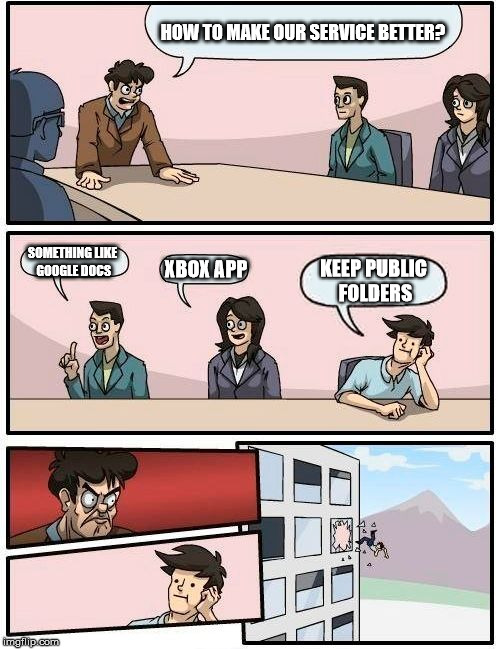
Dropbox Kills Public Folders, Users Rebel (ndtv.com)
New submitter rkagerer writes: Dropbox unleashed a tidal wave of user backlash yesterday when it announced plans to eradicate its Public folder feature in 2017. Criticism from users whose links will break surfaced on Reddit, HackerNews and its own forums. Overnight, customers up-voted a feature request to reverse the decision, skyrocketing it to a "Top 10" position on the company's tracker. joemck explains: "There are countless users who have been using the public folder to post images and files in blogs and forums. These aren't just worthless jokes and memes that nobody will miss if you flip the switch and break all of them. These are often valuable resources that users have created and entrusted to you to retain and keep online." One user even created a comic strip for the occasion, with another concerned the URL he registered with the Coast Guard containing potentially lifesaving information will go dark. Although the feature was deprecated in 2012, it remained in place for existing users. The company provides an alternative sharing method, but some users claim it's not as convenient and doesn't provide direct links. According to the announcement, free accounts have until March 15 to update their links, while the lights will go out for paid accounts on September 1. UPDATE 12/17/16: Slashdot reader rkagerer notes, "Dropbox quietly killed the feature request after this story hit the front page, but the original content can still be found interleaved in the forum discussion." -
LinkedIn-Russia: US Says Concerned Over Decision to Block Professional Networking Site (ndtv.com)
The US government said on Friday it was deeply concerned over Russia's decision to block public access to networking site LinkedIn, saying it created a precedent that could be used to justify blocking other sites operating in Russia. From a report: LinkedIn, which has its headquarters in the United States, is the first major social network to be blocked under a new law that requires firms holding Russian citizens' data to store it on servers on Russian soil. Internet services analysts say other tech firms, including Facebook and Twitter, could also find access blocked unless they move data onto Russian-based servers. Maria Olson, spokeswoman at the US Embassy in Moscow, said Washington urged the Russian authorities to restore access immediately to LinkedIn, and said the restrictions harmed competition and the Russian people. "The United States is deeply concerned by Russia's decision to block access to the website LinkedIn," Olson said in a statement sent to Reuters. "This decision is the first of its kind and sets a troubling precedent that could be used to justify shutting down any website that contains Russian user data." -
Right To Be Forgotten? Web Privacy Debate in Italy After Women's Suicide (ndtv.com)
The suicide of a woman who battled for months to have a video of her having sex removed from the internet is fuelling debate in Italy on the "right to be forgotten" online. The 31-year-old, identified as Tiziana, was found hanged at her aunt's home in Mugnano, close to Naples in the country's south on Tuesday, reports Agence France-Presse. From the report: Her death came a year after she sent a video of herself having sex to some friends, including her ex-boyfriend, to make him jealous. The video and her name soon found their way to the web and went viral, fuelling mockery of the woman online. The footage has been viewed by almost a million internet users. In a bid to escape the humiliation, Tiziana quit her job, moved to Tuscany and tried to change her name, but her nightmare went on. The words "You're filming? Bravo," spoken by the woman to her lover in the video, have become a derisive joke online, and the phrase has been printed on T-shirts, smartphone cases and other items. After a long court battle, Tiziana recently won a "right to be forgotten" ruling ordering the video to be removed from various sites and search engines, including Facebook. -
Firefox Will Try To Show You Saved Archive Of a Page Instead Of 404 Error (ndtv.com)
Firefox has announced a new add-on dubbed No More 404s in its Test Pilot platform which aims to change the way we see 404 links on the web. The add-on, Firefox says, replaces the Error 404 from missing webpages, and replaces them with saved archives from the Wayback Machine. From a report on Gadgets 360: Normally, when presented with a missing link, the browser shows the 404 error. However, Mozilla's No More 404s add-on will give Firefox users the choice to see old Internet snapshots saved in the Internet Archive's Wayback Machine. This is especially handy for users trying to do research or just digging up some old graves out of curiosity. For now, this add-on is only available in Firefox's experimental Test Pilot platform, with no details on availability for regular Firefox users. Interested users can install the test version here. Apart from this, the Test Pilot platform also introduced improved search results through the Awesome Bar, redesigned the Tabs bar to the side, and even tweaked the history feed. -
America Uses Stealthy Submarines To Hack Other Countries' Systems (washingtonpost.com)
When the Republican presidential nominee Donald Trump asked Russia -- wittingly or otherwise -- to launch hack attacks to find Hillary Clinton's missing emails, it caused a stir of commotion. Russia is allegedly behind DNC's leaked emails. But The Washington Post is reminding us that U.S.'s efforts in the cyber-security world aren't much different. (could be paywalled; same article syndicated elsewhere From the report: The U.S. approach to this digital battleground is pretty advanced. For example: Did you know that the military uses its submarines as underwater hacking platforms? In fact, subs represent an important component of America's cyber strategy. They act defensively to protect themselves and the country from digital attack, but -- more interestingly -- they also have a role to play in carrying out cyberattacks, according to two U.S. Navy officials at a recent Washington conference. "There is a -- an offensive capability that we are, that we prize very highly," said Rear Adm. Michael Jabaley, the U.S. Navy's program executive officer for submarines. "And this is where I really can't talk about much, but suffice to say we have submarines out there on the front lines that are very involved, at the highest technical level, doing exactly the kind of things that you would want them to do."
The so-called "silent service" has a long history of using information technology to gain an edge on America's rivals. In the 1970s, the U.S. government instructed its submarines to tap undersea communications cables off the Russian coast, recording the messages being relayed back and forth between Soviet forces. (The National Security Agency has continued that tradition, monitoring underwater fiber cables as part of its globe-spanning intelligence-gathering apparatus. In some cases, the government has struck closed-door deals with the cable operators ensuring that U.S. spies can gain secure access to the information traveling over those pipes.) These days, some U.S. subs come equipped with sophisticated antennas that can be used to intercept and manipulate other people's communications traffic, particularly on weak or unencrypted networks. "We've gone where our targets have gone" -- that is to say, online, said Stewart Baker, the National Security Agency's former general counsel, in an interview. "Only the most security-conscious now are completely cut off from the Internet." Cyberattacks are also much easier to carry out than to defend against, he said. -
Steam On Windows 10 Will Get 'Progressively Worse': Gears of War Developer (ndtv.com)
Microsoft's Universal Windows Platform, or UWP, approach isn't sitting well with many game developers. Four months after criticising UWP ecosystem for being a walled-garden, curtailing "users' freedom to install full-featured PC software, and subverting the rights of developers and publishers to maintain a direct relationship with their customers," Tim Sweeney, co-founder of Epic Games, the studio behind the Gears of War and Unreal franchises has once again lashed out at the Redmond-based company. He alleges that Microsoft plans to make Steam -- the world's largest PC gaming platform, "progressively worse and more broken." in a move to bolster people's reliance on the Windows Store. From a Gadgets 360 report: "Slowly, over the next five years, they will force-patch Windows 10 to make Steam progressively worse and more broken. They'll never completely break it, but will continue to break it until, in five years, people are so fed up that Steam is buggy that the Windows Store seem like an ideal alternative. That's exactly what they did to their previous competitors in other areas. Now they're doing it to Steam. It's only just starting to become visible. Microsoft might not be competent enough to succeed with their plan but they are certainly trying," Sweeney said. He adds the outcome of this would be forcing every app and game to be sold through the Windows Store alone. "If they can succeed in doing that then it's a small leap to forcing all apps and games to be distributed through the Windows store. Once we reach that point, the PC has become a closed platform. It won't be that one day they flip a switch that will break your Steam library -- what they're trying to do is a series of sneaky manoeuvres. They make it more and more inconvenient to use the old apps, and, simultaneously, they try to become the only source for the new ones," he claims. -
Steam On Windows 10 Will Get 'Progressively Worse': Gears of War Developer (ndtv.com)
Microsoft's Universal Windows Platform, or UWP, approach isn't sitting well with many game developers. Four months after criticising UWP ecosystem for being a walled-garden, curtailing "users' freedom to install full-featured PC software, and subverting the rights of developers and publishers to maintain a direct relationship with their customers," Tim Sweeney, co-founder of Epic Games, the studio behind the Gears of War and Unreal franchises has once again lashed out at the Redmond-based company. He alleges that Microsoft plans to make Steam -- the world's largest PC gaming platform, "progressively worse and more broken." in a move to bolster people's reliance on the Windows Store. From a Gadgets 360 report: "Slowly, over the next five years, they will force-patch Windows 10 to make Steam progressively worse and more broken. They'll never completely break it, but will continue to break it until, in five years, people are so fed up that Steam is buggy that the Windows Store seem like an ideal alternative. That's exactly what they did to their previous competitors in other areas. Now they're doing it to Steam. It's only just starting to become visible. Microsoft might not be competent enough to succeed with their plan but they are certainly trying," Sweeney said. He adds the outcome of this would be forcing every app and game to be sold through the Windows Store alone. "If they can succeed in doing that then it's a small leap to forcing all apps and games to be distributed through the Windows store. Once we reach that point, the PC has become a closed platform. It won't be that one day they flip a switch that will break your Steam library -- what they're trying to do is a series of sneaky manoeuvres. They make it more and more inconvenient to use the old apps, and, simultaneously, they try to become the only source for the new ones," he claims. -
Facebook's Android App Can Now Save Offline Videos (ndtv.com)
An anonymous reader quotes a report from NDTV: The latest versions of Facebook's Android app now allow users to save videos for offline viewing. The video is saved inside the app in the 'Saved' section, and is not accessible independently to users. Facebook for Android is showing a 'Save video' option in the dropdown menu of a Facebook video post. The videos can be saved and viewed offline for as many times as the user desires and can also be deleted as per his/her wish. The company might not be willing to provide the video file independently to its users in order to encourage sharing over its own social media networking site, however, it is anybody's guess what the actual reason behind this decision is. It seems in line with what companies like Google have been doing with YouTube in developing nations like India, where a save for offline viewing option is present to combat mobile data woes. As per an Android Police report, the option to save videos is currently showing up in versions 85 and 86 (beta) of the Facebook for Android app. -
NBC Universal Patents a Way To Detect BitTorrent Pirates In Real-Time (ndtv.com)
An anonymous reader writes: NBC Universal has been granted a patent, titled "Early detection of high volume peer-to-peer networks in real-time," to try and restrict piracy of its copyrighted content. "Early detection of high volume swarms in a peer-to-peer network, including a data feed of peer-to-peer swarm activity, and an analytics engine processing the data feed and identifying the high volume swarms that have parameters that exceed a threshold. The system can include a pre-processing section for conditioning the swarm data for the analytics section. There can also be a verification section that confirms that the peer download file matches the target file," notes the patent document issued by USPTO (United States Patent and Trademark Office). "The early detection provides for enhanced anti-piracy efforts, improved allocation of network resources, and better business decision-making," it adds. NBC Universal says that the "P2P infrastructure has many advantages" but it has also led to abuses. Piracy is estimated to cost content owners billions of dollars annually. "These costs are typically passed along to the consuming public in terms of increased costs for legitimate purchased works and higher charges for increased deterrents to the piracy," NBC Universal added. The patent NBC Universal received was applied for back in 2009, but only granted last week. -
$4 Android Smartphone From India To Begin Shipping Next Week (ndtv.com)
Earlier this year, an Indian smartphone company called Ringing Bells unveiled the Freedom 251, an entry-level Android smartphone that was priced at Rs. 251 (roughly $3.7 USD). It didn't take long for the company to stir controversy -- soon after media got the device, they learned that Ringing Bells had disguised Adcom Ikon 4s (retail price: $60) as the Freedom 251 smartphone for marketing and media reviewing purposes. The company at the time noted that it was just a sample device. Furthermore, it was clear that components in the sample device alone would cost more than Rs. 2,000 ($30). Ringing Bells, standing by its earlier commitment, has now announced that it will begin shipping the Freedom 251 handset starting next week.
The Freedom 251 unit which will ship to consumers reportedly features dual-SIM capability, 1GB of RAM, a 1.3GHz SoC from an unnamed chipset maker, 8GB of internal storage, an 8-megapixel rear camera, 3.2-megapixel front-facing shooter and a 1,800mAh battery. How did the company manage to get the price of the handset this cheap? In a separate interview with Times of India, the company noted that it has partnered with a number of software firms to pre-install their apps on the phone. -
Online Loans Made In China Using Nude Pictures As Collateral
HughPickens.com writes: There is more than one way to get a student loan in China as People's Daily Online reports that many Chinese university students use their nude pictures as IOUs on online lending platforms, putting themselves at the risks of having everybody -- including their parents -- see them naked. Borrowers are also required to upload pictures of their ID cards and report their family information, including their address and cellphone numbers. "The nude photos will be made public if the borrowers fail to repay their debts with interest," an insider was quoted as saying. The credit varies based on the borrower's education background. Usually an undergraduate student can receive 15,000 yuan ($2,277) in credit, while those studying at famous universities as well as doctorate students can receive even larger loans. Snapshots of threatening collection messages have also gone viral, with a photo of a female borrower and a message reading how the lender would send the photo and her naked video footage to her family members if she could not pay back her 10,000 yuan borrowed on an annual interest rate of 24 percent within a week. "Naked IOUs started long ago. Not only university students but many others also borrowed money with nude pictures," says insider surnamed Zhang. Zuo Shenggao from Jingshi Law Firm says that nude photos are actually invalid as collateral in terms of laws. "Nude photos are not property. It is in the category of reputation rights," says Shenggao. "If anyone threatens to publish the photos online, they will violate the clients' reputation. At the same time, they are also spreading pornographic material. Both are illegal and they will commit double offense," -
Intel Launches Its First 10-Core Desktop CPU With Broadwell-E
Two years since the release of Intel's Haswell-E platform, which popularized 8-core processor to users. On Tuesday, the chipmaker unveiled Broadwell-E family, which consists of an "Extreme Edition" of Core i7 chipset that has 10 cores and 20 threads. (Do note that Intel is intentionally not calling it deca-core.) Intel says the Extreme Edition is designed for games, content creators, and overclockers. From an NDTV report: The 7th generation Intel Core processors are built on the 14nm fabrication process, and are part of the 'semi-Tock' release -- neither in the Intel Tick or Tock cycle. and come with Turbo Boost Max Technology 3.0 for more efficient core allocation for single-threaded processes, giving up to 15 percent better performance compared to the previous Haswell-E generation. All four new Intel Core i7 Enthusiast processors, codenamed Broadwell-E, support 40 PCIe lanes, quad-channel memory, and bear a TDP of 140W. Give Intel $1,723 and the Extreme Edition pack is yours. -
Chinese Conglomerate LeEco Wants To Give Away Its 'Tesla Killer' Electric Supercar For Free (ndtv.com)
Rishi Alwani, reporting for Gadgets 360 (edited and condensed for clarity): At an event in Beijing this week, Chinese technology conglomerate LeEco showed off its LeSEE self-driving electric supercar. A slide noted that LeEco's car can reach 130mph which is a fair bit behind of the Tesla Model S' top speed range of 140 to 155 mph. Nonetheless, the company said the final product should beat Tesla in "all aspects of performance." The car sports a rounded design with a giant LED screen plastered on the front of the vehicle. If the car is being used for cab services, for instance, the screen can show if it's available for hire or not. There's an arched transparent roof and what seems to be generous cabin space. The interior sported a futuristic-looking steering wheel with a lit-up centre that quite possibly would replace the traditional dashboard and was complemented by a monitor next to it. It also had ridged backseats that may look uncomfortable but is actually memory foam - a polyurethane material used in mattresses that can mould to the shape of a passenger's body for maximum comfort.
Perhaps the most interesting component of its LeSEE concept has nothing to do with the technology, but rather the business models involved. For one, the company believes it has a huge role to play in LeShare - a time-sharing electric vehicle platform that's present in Beijing and Shanghai with plans to expand to five more cities in China. Electric vehicles and charging resources will be shared between LeShare and LeEco-backed Uber competitor Yidao. In addition to this, LeEco believes that the car will eventually be free, in line with the same business model it has for some of its other hardware, charging users for content, subscriptions or memberships.For a refresh, LeEco (LeTV) was founded in 2004, and has since become a major name in many technology-centric markets. It offers live-streaming, e-commerce, cloud, smartphones, TV set-top boxes, and smart TVs among many other products and services. The company has a market capitalisation of at least $12 billion. -
Chinese Conglomerate LeEco Wants To Give Away Its 'Tesla Killer' Electric Supercar For Free (ndtv.com)
Rishi Alwani, reporting for Gadgets 360 (edited and condensed for clarity): At an event in Beijing this week, Chinese technology conglomerate LeEco showed off its LeSEE self-driving electric supercar. A slide noted that LeEco's car can reach 130mph which is a fair bit behind of the Tesla Model S' top speed range of 140 to 155 mph. Nonetheless, the company said the final product should beat Tesla in "all aspects of performance." The car sports a rounded design with a giant LED screen plastered on the front of the vehicle. If the car is being used for cab services, for instance, the screen can show if it's available for hire or not. There's an arched transparent roof and what seems to be generous cabin space. The interior sported a futuristic-looking steering wheel with a lit-up centre that quite possibly would replace the traditional dashboard and was complemented by a monitor next to it. It also had ridged backseats that may look uncomfortable but is actually memory foam - a polyurethane material used in mattresses that can mould to the shape of a passenger's body for maximum comfort.
Perhaps the most interesting component of its LeSEE concept has nothing to do with the technology, but rather the business models involved. For one, the company believes it has a huge role to play in LeShare - a time-sharing electric vehicle platform that's present in Beijing and Shanghai with plans to expand to five more cities in China. Electric vehicles and charging resources will be shared between LeShare and LeEco-backed Uber competitor Yidao. In addition to this, LeEco believes that the car will eventually be free, in line with the same business model it has for some of its other hardware, charging users for content, subscriptions or memberships.For a refresh, LeEco (LeTV) was founded in 2004, and has since become a major name in many technology-centric markets. It offers live-streaming, e-commerce, cloud, smartphones, TV set-top boxes, and smart TVs among many other products and services. The company has a market capitalisation of at least $12 billion. -
India Aims To Become 100% Electric Vehicle Nation By 2030 (ndtv.com)
An anonymous reader quotes a report on NDTV: The Indian government is working on a scheme to provide electric cars on zero down payment for which people can pay out of their savings on expensive fossil fuels, for becoming 100% electric vehicle nation by 2030. "India can become the first country of its size which will run 100 per cent of electric vehicles. We are trying to make this program self-financing," said Piyush Goyal, Power Minister. That's forward thinking. However, it's not clear whether the Indian government is also committing to 100% renewable energy -- because if the electricity comes from coal, it might not help with curtailing the pollution level. -
Samsung Woos Developers As It Eyes Tizen Expansion Beyond Smartphones
New submitter Manish Singh writes: Why is Samsung, the South Korean technology conglomerate which has the tentpole position in Android, becoming increasinglu focused on its homegrown operating system Tizen? At its annual developer summit this week, the company announced new SDKs for smartwatches, smart TVs, and smartphones, and also shared its future roadmap. -
Color Movie Made of Pluto-Charon System
VernonNemitz writes: Today NASA released a color movie of Pluto and its largest moon Charon, as the New Horizons probe approaches its July 2015 rendezvous date. "It's exciting to see Pluto and Charon in motion and in color," said New Horizons principal examiner Alan Stern of the Southwest Research Institute (SwRI) at Boulder, Colorado. "Even at this low resolution, we can see that Pluto and Charon have different colours - Pluto is beige-orange, while Charon is grey. Exactly why they are so different is the subject of debate," Stern said. -
US To Monitor Air Quality In India and Other Countries
mdsolar writes with news about a U.S. plan to monitor air quality in countries like India and Mongolia to help raise awareness about the dangers of pollution. "The United States says it will expand air-quality monitoring at some overseas diplomatic missions, following several years of reporting pollution data in China. The goal is to increase awareness of the health risks of outdoor air pollution, which easily spreads across borders, Secretary of State John Kerry said in announcing the program on Wednesday. The program is intended to help United States citizens abroad reduce their exposure to pollution and to help other countries develop their own air-quality monitoring through training and exchanges with American experts, he said. "We're hoping that this tool can also expand international cooperation when it comes to curbing air pollution," Mr. Kerry said. The program, run in conjunction with the Environmental Protection Agency, will begin to operate in India in a few months. New Delhi has some of the world's worst air pollution, and residents there are becoming increasingly concerned about the dangers. American diplomatic missions will also monitor air quality in Vietnam, Mongolia and elsewhere, Mr. Kerry said." -
Samsung To Discontinue Galaxy Alpha For Cheaper Galaxy A5
An anonymous reader writes that Samsung is giving up on their Galaxy Alpha smartphones. "Samsung will reportedly stop producing the metal-clad Galaxy Alpha early next year, and instead position the Galaxy A5 smartphone as its replacement. According to a report, with the launch of Galaxy A5 in South Korea - which can be as early as mid-January and as late as early February - Samsung will phase out production of the Galaxy Alpha once the current inventory of materials is exhausted for the smartphone, reported Korean publication ET News on Friday." -
India Successfully Test Fires Its Heaviest Rocket
vasanth (908280) writes India on Thursday moved forward in rocket technology with the successful flight testing of its heaviest next generation rocket and the crew module . The 630-tonne three-stage rocket, Geo-Synchronous Satellite Launch Vehicle Mark III, carried active solid boosters, liquid core stage and a passive cryo stage and a crew module to test its re-entry characteristics. This rocket is capable of doubling the capacity of payloads India can carry into space and it can deposit up to four tonne class of communication satellites into space. India also plans to use this rocket for ferrying Indian astronauts into space. For India, ISRO (the Indian space agency) perfecting the cryogenic engine technology is crucial as India can save precious foreign exchange by launching heavy duty communication satellites by itself. -
Mangalyaan Successfully Put Into Mars Orbit
knwny writes: India's Mars satellite Mangalyaan was successfully placed into orbit around Mars early on Wednesday following a 10-month journey from Earth. India thus joins the U.S., the European Space Agency and the former Soviet Union in having successfully completed a Mars mission. It is, however, the only one to have done so on the first attempt. Headed by the Indian space agency ISRO, Mangalyaan was made in 15 months at a cost of just around 74 million USD — the cheapest inter-planetary mission ever to be undertaken. -
$33 Firefox Phone Launched In India
davidshenba writes Intex and Mozilla have launched Cloud FX, a smartphone powered by Mozilla's Firefox OS. The phone has a 1 GHz processor, 2 Megapixel camera, dual SIM, 3.5 inch capacitive touchscreen. Though the phone has limited features, initial reviews say that the build quality is good for the price range. With a price tag of $33 (2000 INR), and local languages support the new Firefox phone is hitting the Indian market of nearly 1 billion mobile users. -
Iran Builds Mock-up of Nimitz-Class Aircraft Carrier
Hugh Pickens DOT Com (2995471) writes "The NYT reports that US intelligence analysts studying satellite photos of Iranian military installations say that Iran is building a mock-up of an American nuclear-powered aircraft carrier with the same distinctive shape and style of the Navy's Nimitz-class carriers, as well as the Nimitz's number 68 neatly painted in white near the bow. Mock aircraft can be seen on the flight deck. The mock-up, which American officials described as more like a barge than a warship, has no nuclear propulsion system and is only about two-thirds the length of a typical 1,100-foot-long Navy carrier. Intelligence officials do not believe that Iran is capable of building an actual aircraft carrier. "Based on our observations, this is not a functioning aircraft carrier; it's a large barge built to look like an aircraft carrier," says Cmdr. Jason Salata. "We're not sure what Iran hopes to gain by building this. If it is a big propaganda piece, to what end?" Navy intelligence analysts surmise that the vessel, which Fifth Fleet wags have nicknamed the Target Barge, is something that Iran could tow to sea, anchor and blow up — while filming the whole thing to make a propaganda point, if, say, the talks with the Western powers over Iran's nuclear program go south. "It is not surprising that Iranian military forces might use a variety of tactics — including military deception tactics — to strategically communicate and possibly demonstrate their resolve in the region," said an American official who has closely followed the construction of the mock-up. The story has set off chatter about how weird and dumb Iran is for building this giant toy boat but according to Marcy Wheeler if you compare Iran's barge with America's troubled F-35 program you end up with an even bigger propaganda prop. "I'm not all that sure what distinguishes the F-35 except the cost: Surely Iran hasn't spent the equivalent of a trillion dollars — which is what we'll spend on the F-35 when it's all said and done — to build its fake boat," writes Wheeler. "So which country is crazier: Iran, for building a fake boat, or the US for funding a never-ending jet program?"" -
Israeli Group To Attempt Moon Landing
cold fjord writes: "NDTV reports, 'Israel plans to do what only the world's biggest countries have so far managed to do: land an unmanned spacecraft on the moon ... only Russia, the U.S. and China have soft landed on the moon, and India hard landed its tri-colour using the moon impact probe in 2008 ... The washing machine-sized spacecraft that weighs 121 kilograms is being readied by a not-for-profit venture called SpaceIL. ... The Israeli lunar probe had its genesis after the $30 million Google Lunar X Prize was announced as a competition which challenged non-state-owned space agencies to land on the moon, send back photos, and move 500 meters on the surface of the moon. About two dozen global teams are racing to win the prize- SpaceIL reckons it's in pole position. ... ex-NASA engineer Yonatan Winetraub and two of his friends conceived of the spacecraft in 2010 ... then used a Facebook page to promote the dream. Today, the dream has matured into a $36 million mission with 20 full time employees and 250 volunteers. ... Around 40,000 school students have been associated with this project.' Further details are available here." -
Mexican Village Creates Its Own Mobile Phone Service
Dave_Minsky writes "The small indigenous village of Villa Talea de Castro (pop. 2,500) in the state of Oaxaca is showing the world that it doesn't have to rely on major cellular telecommunications providers for service. With the help from indigenous groups, civil organizations and universities, village residents put up an antenna on a rooftop, installed radio and computer equipment, and created its own micro provider called Red Celular de Talea. Service costs only 15 pesos ($1.2) per month and a few pennies per minute to make calls to the United States. However, there is one catch: calls are limited to a maximum of five minutes to prevent saturation of lines." -
India's $20 Android Tablet First Project Completed
symbolset writes "Though there were some troubles and worries along the way, Datawind has delivered to India's government the full allocation of 100,000 (1 lakh) 'Aakash 2' Android tablets from their first order. Priced at about $40, these tablets aren't the sort Americans would rave about: 330 MHz, 256MB RAM and so on. But for the last 2,000 units for the same price Datawind supplied Aakash 3 1GHz, 1GB RAM, 4GB Android tablets with SDHC and 3G mobile — for the same price. Such is the progress in mobile today. There was some doubt whether Datawind could deliver, so kudos to them." -
Islamists In Bangladesh Demand Murder of More Bloggers
An anonymous reader writes "Days after the killing of leftist blogger Thaba Baba, mosques throughout Bangladesh called for a popular uprising to demand the killing of other bloggers who had held a rally calling for the death of Jama'at-e-Islami leaders convicted of war crimes. This happens in an atmosphere of ongoing tension between Left and Right, with the leftist government threatening to outlaw rightist parties while the right uses violence to quiet selected enemies." -
Kevin Mitnick Helping Secure Presidential Elections In Ecuador
hypnosec writes "Kevin Mitnick, who was one of the most wanted computer hacker in the US at one time, is now heading a security consultancy firm – Mitnick Security Consulting, and is entrusted with the task of securing Sunday's presidential elections in Ecuador. Mitnick tweeted, '18 years ago I was busted for hacking. I do the same thing today but with full authorization. How cool is that?' His company will focus on protecting the Net Lock computer system tasked with tabulating Ecuador's elections." -
French Telecom Claims To Have Forced Google To Pay For Traffic
Dupple writes "The head of French telecoms operator Orange said on Wednesday it had been able to impose a deal on Google to compensate it for the vast amounts of traffic sent across its networks. Orange CEO Stephane Richard said on France's BFM Business TV that with 230 million clients and areas where Google could not get around its network, it had been able to reach a 'balance of forces' with the Internet search giant. Richard declined to cite the figure Google had paid Orange, but said the situation showed the importance of reaching a critical size in business. Network operators have been fuming for years that Google, with its search engine and YouTube video service, generates huge amounts of traffic but does not compensate them for using their networks. An editorial piece at GigaOm says Google is abandoning its principles and giving Orange 'the incentive to demand the same from other content providers.'"