Slashdot Mirror
Domain: newscientist.com
Stories and comments across the archive that link to newscientist.com.
Stories · 1,328
-
Berners-Lee Wants Truth Ratings For Websites
holy_calamity writes "While introducing the new World Wide Web Foundation Tim Berners-Lee made also asked for a system of ratings to help people distinguish truth and untruth online. 'On the web the thinking of cults can spread very rapidly,' he said, saying that 'there needed to be new systems that would give websites a label for trustworthiness once they had been proved reliable sources.'" -
Berners-Lee Wants Truth Ratings For Websites
holy_calamity writes "While introducing the new World Wide Web Foundation Tim Berners-Lee made also asked for a system of ratings to help people distinguish truth and untruth online. 'On the web the thinking of cults can spread very rapidly,' he said, saying that 'there needed to be new systems that would give websites a label for trustworthiness once they had been proved reliable sources.'" -
Scribbling On Digital Photos
JagsLive notes a patent application filed in the US by Nokia for a way to 'scribble on the back' of digital photos. Nokia's approach is similar to the iPod's Cover Flow, except that Nokia users will be able to flip through their snaps, select one, and then turn it over and annotate the back just using SMS-like text entry. The scribble becomes an integral part of the saved photo. -
Royal Society and Creationism In Science Classes
An anonymous reader writes "The Reverend Professor Michael Reiss, a biologist and Anglican priest, is the education director for the Royal Society, the venerable British science institution. He recently called for creationism to be discussed in science classes, not just in religion or philosophy classes. Science journals reacted with a world of 'WTF' and the Royal Society backpedaled furiously. Now Nobel laureates are gathering to get him fired: 'The thing the Royal Society does not appreciate is the true nature of the forces arrayed against it and the Enlightenment for which the Royal Society should be the last champion.' The blogs, of course, are loving it." -
Has Superstition Evolved To Help Mankind Survive?
Pickens writes "The tendency to falsely link cause to effect — a superstition — is occasionally beneficial, says Kevin Foster, an evolutionary biologist at Harvard University. For example, a prehistoric human might associate rustling grass with the approach of a predator and hide. Most of the time, the wind will have caused the sound, but 'if a group of lions is coming there's a huge benefit to not being around.' Foster worked with mathematical language and a simple definition for superstition to determine exactly when such potentially false connections pay off and found as long as the cost of believing a superstition is less than the cost of missing a real association, superstitious beliefs will be favored. In modern times, superstitions turn up as a belief in alternative and homeopathic remedies. 'The chances are that most of them don't do anything, but some of them do,' Foster says. Wolfgang Forstmeier argues that by linking cause and effect — often falsely — science is simply a dogmatic form of superstition. 'You have to find the trade off between being superstitious and being ignorant,' Forstmeier says. By ignoring building evidence that contradicts their long-held ideas, 'quite a lot of scientists tend to be ignorant quite often.'" -
"Water Bears" First Animals to Survive Trip Into Space Naked
Adam Korbitz writes "New Scientist and Science Daily are reporting the results of an intriguing experiment in which scientists launched tardigrades or 'water bears' — tiny invertebrates about one millimeter long — into space onboard the European Space Agency's FOTON-M3 spacecraft. After 10 days in the vacuum of space, the satellite returned to Earth and the tardigrades were recovered. The tardigrades survived the vacuum just fine, but exposure to the Sun's ultraviolet radiation proved deadly for most of the water bears. However, some did survive. The tardigrades are the first animals to have survived such an experiment, a feat previously achieved only by lichens and bacteria." -
Shadow Analysis Could Spot Terrorists
Hugh Pickens writes "An engineer at Jet Propulsion Labs says it should be possible to identify people from the way they walk — a technique called gait analysis, whose power lies in the fact that a person's walking style is very hard to disguise. Adrian Stoica has written software that recognizes human movement in aerial and satellite video footage by isolating moving shadows and using data on the time of day and the camera angle to correct shadows that are elongated or foreshortened. In tests on footage shot from the sixth floor of a building, Stoica says his software was indeed able to extract useful gait data. Extending the idea to satellites could prove trickier, though. Space imaging expert Bhupendra Jasani at King's College London says geostationary satellites simply don't have the resolution to provide useful detail. 'I find it hard to believe they could apply this technique from space,' says Jasani." Comments on the article speculate on the maximum resolution possible from KH-11 and KH-12 spy satellites. -
Possible Monogamy Gene Found In People
Calopteryx sends in a New Scientist summary of research from Sweden pointing toward the existence of a gene that influences monogamy in men. (The article doesn't mention women, and the study subjects were all men at least 5 years into a heterosexual relationship.) "There has been speculation about the role of the hormone vasopressin in humans ever since we discovered that variations in where receptors for the hormone are expressed makes prairie voles strictly monogamous but meadow voles promiscuous; vasopressin is related to the 'cuddle chemical' oxytocin. Now it seems variations in a section of the gene coding for a vasopressin receptor in people help to determine whether men are serial commitment-phobes or devoted husbands." -
First Prototype of Open Source TechCrunch Tablet
holy_calamity writes "Big mouth tech blogger Mike Arrington decided earlier this year to 'teach gadget-makers a lesson' and make his own portable, touch screen web tablet. The first, very rough, prototype is complete. Despite the claims it would be fully open source — even the hardware — there's no sign of a project site or any other openness yet." -
"Shimmer Vision" Scopes See Better Using Heat
holy_calamity writes "New Scientist reports on a neat DARPA idea that uses the shimmer of heat haze to allow binoculars to see further. It works by exploiting the fact that some distortions from heat haze actually magnify objects behind them. The binoculars collect a series of frames when that is occurring to boost magnification by 3 times. The design goal is to be able to present one image a second, and to enable facial recognition at 90% accuracy at a distance of 1 km. The scopes could be on the battlefield inside of 3 years." -
Fuel-Cell Car Racing Series Aims To Spur Green Motoring
Anonymous Cow writes "The world's first international fuel-cell powered motor racing series kicked off in Rotterdam over the weekend. The organisers hope that 'Formula Zero,' like Formula 1, can become a forum for competing technology as much as anything else, helping green consumer cars to become better." -
Fuel-Cell Car Racing Series Aims To Spur Green Motoring
Anonymous Cow writes "The world's first international fuel-cell powered motor racing series kicked off in Rotterdam over the weekend. The organisers hope that 'Formula Zero,' like Formula 1, can become a forum for competing technology as much as anything else, helping green consumer cars to become better." -
Software To Provide Astronaut Counseling
Currently, whenever an astronaut needs to talk to someone, a counselor is only a radio call away. Unfortunately, for voyages further out, this contact time starts to increase quite a bit, so researchers have started to look for alternative methods of counseling. I just hope the new counseling software has the Dr. Sbaitso voice. "Instead of asking astronauts to reflect on their feelings, Mark Hegel of Dartmouth Medical School has them create lists of concrete things that are bothering them and brainstorm about practical ways to solve them. At the end of the exercise, users fill out a form used to diagnose depression. Clinical tests of this approach, which has never been tried in a multimedia self-help format, will start in a few months, using subjects recruited from the biomedical and engineering community in Boston." -
Siemens Develops Multi-Purpose Surveillance System
ekesis tips a story up at NewScientist about the development of a new surveillance system by German engineering conglomerate Siemens. The system is notable for its integration of many different types of automated data-gathering. It can scan "telephone calls, email and internet activity, bank transactions and insurance records." It uses advanced pattern-recognition software to pick out unusual activities and important pieces of data. So far, the system has been sold to 60 countries. "According to a document obtained by New Scientist, the system integrates tasks typically done by separate surveillance teams or machines... This software is trained on a large number of sample documents to pick out items such as names, phone numbers and places from generic text. This means it can spot names or numbers that crop up alongside anyone already of interest to the authorities, and then catalogue any documents that contain such associates." -
Full Facial Transplant Is One Step Closer
Hugh Pickens writes "A Chinese medical team led by Shuzhong Guo of the Fourth Military Medical University in Xi'an has successfully completed the first transplant to include facial bone in a transplant on a man whose face was slashed by a bear. The Chinese graft included muscles, nerves, blood vessels, cartilage and skin and included an intact salivary gland, another first. Two years after the procedure, the man can eat, drink and speak, thanks to the gradual fusing of transplanted nerves and muscles with what remained of the patient's own. This transplant together with the another ground breaking transplant last year by French doctors that removed a huge tumor that had completely infiltrated and disfigured their patient's face, now sets the stage for a full facial transplant." -
Research Suggests Polygamous Men Live Longer
Calopteryx writes "Want to live a little longer? Get a second wife. A study reported in New Scientist suggests that men from polygamous cultures outlive those from monogamous ones. After accounting for socioeconomic differences, men aged over 60 from 140 countries that practice polygamy to varying degrees lived on average 12% longer than men from 49 mostly monogamous nations." -
Magpies Are Self-Aware
FireStormZ writes "Magpies can recognize themselves in a mirror, confounding the notion that self-awareness is the exclusive preserve of humans and a few higher mammals. It had been thought only four species of apes, bottlenose dolphins, and Asian elephants shared the human ability to recognize their own bodies in a mirror. But German scientists reported on Tuesday that magpies, a species with a brain structure very different from mammals, could also identify themselves. It had been thought that the neocortex brain area found in mammals was crucial to self-recognition. Yet birds, which last shared a common ancestor with mammals 300 million years ago, don't have a neocortex, suggesting that higher cognitive skills can develop in other ways." -
Stone Age Mass Graves Reveal Green Sahara
iminplaya sends along a New Scientist article that begins: "One of the driest deserts in the world, the Saharan Tenere Desert, hosted at least two flourishing lakeside populations during the Stone Age, a discovery of the largest graveyard from the era reveals. The archaeological site in Niger [is] called Gobero... It had been used as a burial site by two very different populations during the millennia when the Sahara was lush... 'The first people who used the Gobero cemetery were Kiffian, hunter-gatherers who grew up to two meters tall,' says Elena Garcea of the University of Cassino in Italy and one of the scientists on the team. The large stature of the Kiffian suggests that food was plentiful during their time in Gobero, 10,000 to 8,000 years ago... All traces of the Kiffian vanish abruptly around 8,000 years ago, when the Sahara became very dry for a thousand years. When the rains returned, a different population, the Tenerians, who were of a shorter and more gracile build, based themselves at this site... 'The most amazing find so far is a grave with a female and two children hugging each other. They were carefully arranged in this position. This strongly indicated they had spiritual beliefs and cared for their dead,' says Garcea." The research article is at PLoS One. -
Rat-Brained Robots Take Their First Steps
missb writes "Brain tissue cultured from rats has controlled a wheeled robot around a lab, according to New Scientist this week. Researchers in the UK have harnessed signals from thousands of disembodied rat neurons, and manipulated them to get a robot to respond to instructions. The team at the University of Reading in the UK hope their research will help provide treatments for diseases like Alzheimer's and epilepsy." -
Rat-Brained Robots Take Their First Steps
missb writes "Brain tissue cultured from rats has controlled a wheeled robot around a lab, according to New Scientist this week. Researchers in the UK have harnessed signals from thousands of disembodied rat neurons, and manipulated them to get a robot to respond to instructions. The team at the University of Reading in the UK hope their research will help provide treatments for diseases like Alzheimer's and epilepsy." -
Let Your Theme Song be Your Password
An anonymous reader writes "The latest proposed solution to the fact humans suck at using passwords properly is to let people use digital objects, like mp3s, photos or videos instead. A file is hashed into a unique, secure string that acts as the real password. A paper on the idea was put forward in a recent Usenix conference on hot topics in security, and a Firefox extension that implements the idea is available too." -
Atom-Thick Balloon Inflated
Anonymous Cow writes "Researchers have inflated gas-filled balloons of graphene, the atom-thick carbon material being used to make super-small transistors. Apart from giving them a valid claim to be in the Guinness Book of Records, it could apparently be handy for weighing microscopic objects. 'The sheets were used to seal microscopic wells made in a layer of silica glass, forming a kind of drum head. The membranes were held in place only by the van der Waals forces that make things sticky at microscopic scales. The wells varied from 1 to 100 square micrometers in area and 250 nanometers to 3 micrometers deep.'" -
Atom-Thick Balloon Inflated
Anonymous Cow writes "Researchers have inflated gas-filled balloons of graphene, the atom-thick carbon material being used to make super-small transistors. Apart from giving them a valid claim to be in the Guinness Book of Records, it could apparently be handy for weighing microscopic objects. 'The sheets were used to seal microscopic wells made in a layer of silica glass, forming a kind of drum head. The membranes were held in place only by the van der Waals forces that make things sticky at microscopic scales. The wells varied from 1 to 100 square micrometers in area and 250 nanometers to 3 micrometers deep.'" -
Electronic Eyeball Uses Curved Image Sensor
AnonymousCoward writes "US researchers have made a digital imaging system designed like the human eyeball — its image sensor is on the inside of a hemisphere like your retina. Resolution is so far low, but finding a way to use silicon sensors this way offers a way around the unavoidable distortion that results from projecting a wide angle view onto a flat sensor." -
Electronic Eyeball Uses Curved Image Sensor
AnonymousCoward writes "US researchers have made a digital imaging system designed like the human eyeball — its image sensor is on the inside of a hemisphere like your retina. Resolution is so far low, but finding a way to use silicon sensors this way offers a way around the unavoidable distortion that results from projecting a wide angle view onto a flat sensor." -
Hot Water, Hot Earth
Calopteryx notes a New Scientist article on the discovery of "supercritical" water emerging from a vent in the Atlantic Ocean at 407 deg. C (765 deg. F). One of its discoverers actually said, "It's water, but not as we know it"; it's the hottest water ever found on earth. The cause seems to be a huge bubble of magma beneath the ocean floor, 3 km below the sea surface. Meanwhile Nymz shares a journal entry on a hot spot on land: a 2-acre patch in Ventura county, in California, that has heated up to 433 deg. C (812 deg. F). Here geologists blame buried hydrocarbons burning as they get access to air through cracks in the ground. That high temperature was measured a foot below the ground surface. -
Gravity Tractor Could Deflect Asteroids
Hugh Pickens writes "A new study at the Jet Propulsion Labs shows that weak gravitational pull of a "gravity tractor" could deflect an Earth-threatening asteroid if it was deployed when the asteroid was at least one orbit away from potential impact with Earth. First a spacecraft would be crashed directly into the asteroid, similar to the Deep Impact mission that impacted a comet in 2005. This would provide a big change of direction, but in a less controllable fashion that could push the path of the asteroid into a dangerous keyhole. But then a second spacecraft, the gravity tractor, would come into play, hovering about 150 meters away from the asteroid, to exert a gentle gravitational force, changing the asteroid's velocity by only 0.22 microns per second each day. Over a long enough time, that could steer it away from the keyhole. In the simulation, a simple control system kept the spacecraft in position, and a transponder on the asteroid helped monitor its position and thus determine its trajectory more precisely than would be possible otherwise. 'The gravity tractor is a wimp, but it's a precise wimp,' said astronaut Jack Schweickart. 'It can make very small, precise changes in orbit, and that's what you need to avoid a keyhole.'" -
Face-Swapping Software To Protect Privacy
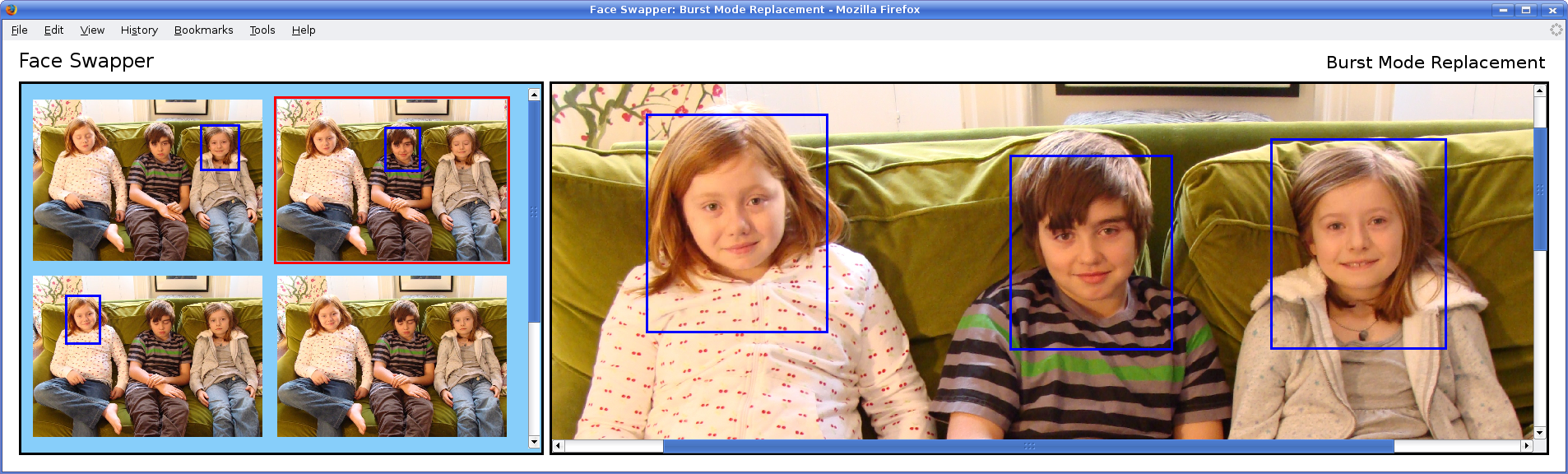
(0d0 writes "Some researchers at Columbia University's Computer Vision Labratory have developed software to automatically replace faces in batches of photos. Practical applications include protecting the identities of people in Google's Street View, coupling it with a digital camera's burst mode to create a perfect group photo, or protecting the identities of witnesses or law enforcement and military personnel. Other links to coverage include Boing Boing, American Public Media, and New Scientist." -
New Rifle Tech Offers Variable Muzzle Speed
Ponca City, We love you writes "A gun that fires variable-speed bullets that can be set to kill, wound, or just inflict a bruise is being built by a Lund and Company Invention, a toy design studio that makes toy rockets powered by burning hydrogen obtained by electrolyzing water. The company is being funded by the US Army to adapt the technology to fire bullets instead. The new weapon, called the Variable Velocity Weapon System or VWS, lets the soldier use the same rifle for crowd control and combat, by altering the muzzle velocity. It could be loaded with 'rubber bullets' designed only to deliver blunt impacts on a person, full-speed lethal rounds, or projectiles somewhere between the two. Bruce Lund, the company's CEO, says the gun works by mixing a liquid or gaseous fuel with air in a combustion chamber behind the bullet. This determines the explosive capability of the propellant and consequently the velocity of the bullet. 'Projectile velocity varies from non-lethal at 10 meters, to lethal at 100 meters or more, as desired,' says Lund. The existing VWS design is a .50 caliber (12.7 mm) rifle weapon, but Lund says the technology can be scaled to any size, 'handgun to Howitzer.'" -
Scientists Pave Way For 25nm CPUs
arcticstoat writes in with word that scientists at the Space Nanotechnology Laboratory at MIT have found a new way of extending Moore's law into the future — they have succeeded in etching a grid of 25nm lines into a silicon wafer. The article notes that this technique could be used for writing the grid on which chips are laid down, but that the electronic elements would have to be written using more complex techniques. "[Researchers] created an interference pattern using light from a laser with a wavelength of 351 nm. The pattern consists of alternating light and dark zones repeating every 200 nm. This allowed them to etch 25-nm lines into a silicon wafer, each 175 nm apart. They then repeated the process three times, each time shifting the interference pattern by 50 nm and etching another 25-nm groove. The resulting grid has alternating 25-nm stripes and grooves..." -
Louisiana Passes Intelligent Design Law
H0D_G writes "The US state of Louisiana has passed the 'Science Education Act,' a piece of legislation that could allow Intelligent design to be taught in schools. From the article: 'The act is designed to slip ID in "through the back door"'" -
Roundest Object In the World Created
holy_calamity writes "An international research group has created the most perfect spheres ever made, in a bid to pin down a definition of the kilogram. It should be possible to count exactly the number of atoms in one of the roughly 9cm silicon spheres to define the unit. Currently the kilogram is defined only by a 120-year-old lump of platinum in Paris, but its mass is changing relative to copies held elsewhere. Other SI units have more systematic definitions." -
Roundest Object In the World Created
holy_calamity writes "An international research group has created the most perfect spheres ever made, in a bid to pin down a definition of the kilogram. It should be possible to count exactly the number of atoms in one of the roughly 9cm silicon spheres to define the unit. Currently the kilogram is defined only by a 120-year-old lump of platinum in Paris, but its mass is changing relative to copies held elsewhere. Other SI units have more systematic definitions." -
Scientists Create Synthesized DNA Bases
Iddo Genuth writes to tell us that researchers at the Scripps Research Institute in San Diego have created two artificial DNA bases in an effort to "expand biology's potential." "In the future, [chemist Floyd] Romesberg envisions manipulating the genetic code of bacteria in order to assemble better drugs or even man-made proteins. Until now, the bases only work in bacteria, so human augmentation is currently not possible. Another option is to use alpha and beta to help construct nanomachines to be used for drug delivery. 'This is like jumping from the Stone Age to the Bronze Age,' Romesberg says. 'It takes time to figure out how best to use metal.'" Update 18:10 GMT by SM: Roger writes to share the NewScientist link with a bit more information. There is also the original release text for consideration. -
Researchers Demo Flippable-Page E-book Reader
holy_calamity writes "E-readers are getting better but still limit users to keyboard-style interaction. Researchers at Berkeley and Maryland Universities have changed that with a reader that has two 'pages.' The two displays can be moved like a real book's pages to leaf through a document, or detached to compare and share virtual pages. If they are folded back to create a tablet with displays on each side, you can turn it over to flip pages. A video shows it in action." You may be reminded of the promised second-generation OLPC device, which looks somewhat similar. -
Studies Confirm That Bad Boys Get More Girls
seattlle foodie sends along a New Scientist article outlining two recent studies that confirm what many have long suspected: bad boys get the most girls. "The finding may help explain why a nasty suite of antisocial personality traits known as the 'dark triad' persists in the human population, despite their potentially grave cultural costs. The traits are: the self-obsession of narcissism; the impulsive, thrill-seeking, and callous behavior of psychopaths; and the deceitful and exploitative nature of Machiavellianism. At their extreme, these traits would be highly detrimental for life in traditional human societies. People with these personalities risk being shunned by others and shut out of relationships, leaving them without a mate, hungry and vulnerable to predators." -
Fastest-Ever Flashgun Captures Image of Light Wave
loconet writes to tell us that a team of researchers have created the shortest-ever flash of light. Weighing in at just 80 attoseconds, this flash has already been used to capture an image of a laser pulse and could possibly be used in the future to capture the electron movement around large atoms. -
Nokia's Cellphone Anthropologist
holy_calamity writes "New Scientist have an interview with a Nokia researcher who uses anthropological methods to study how people use their phones. His work currently focuses on watching how people in emerging markets like Africa use their devices to inform designs. For example, after finding that in Uganda many people use one handset, they shipped a version with multiple separate address books. There's also a slideshow of Chipchase's research images." -
Nokia's Cellphone Anthropologist
holy_calamity writes "New Scientist have an interview with a Nokia researcher who uses anthropological methods to study how people use their phones. His work currently focuses on watching how people in emerging markets like Africa use their devices to inform designs. For example, after finding that in Uganda many people use one handset, they shipped a version with multiple separate address books. There's also a slideshow of Chipchase's research images." -
Nokia's Cellphone Anthropologist
holy_calamity writes "New Scientist have an interview with a Nokia researcher who uses anthropological methods to study how people use their phones. His work currently focuses on watching how people in emerging markets like Africa use their devices to inform designs. For example, after finding that in Uganda many people use one handset, they shipped a version with multiple separate address books. There's also a slideshow of Chipchase's research images." -
Compressed VoIP Calls Vulnerable To Bugging
holy_calamity writes "Security researchers at Johns Hopkins report that a variable bit-rate compression scheme being rolled out on VoIP systems leaves encrypted calls vulnerable to bugging. Simpler syllables are squeezed into smaller data packets, with more complex ones taking up more space; the researchers built software that uses this to spot phrases of interest in encrypted calls simply by measuring packet size." -
Compressed VoIP Calls Vulnerable To Bugging
holy_calamity writes "Security researchers at Johns Hopkins report that a variable bit-rate compression scheme being rolled out on VoIP systems leaves encrypted calls vulnerable to bugging. Simpler syllables are squeezed into smaller data packets, with more complex ones taking up more space; the researchers built software that uses this to spot phrases of interest in encrypted calls simply by measuring packet size." -
Bacteria Make Major Evolutionary Shift In the Lab
Auxbuss sends us to New Scientist for news sure to perplex and confound creationists: scientists have watched a new, complex evolutionary trait develop in the lab. "A major evolutionary innovation has unfurled right in front of researchers' eyes. It's the first time evolution has been caught in the act of making such a rare and complex new trait. And because the species in question is a bacterium, scientists have been able to replay history to show how this evolutionary novelty grew from the accumulation of unpredictable, chance events." -
How Laptops in Education Can Help Dictators, Hurt Learning
holy_calamity writes "New Scientist reports on worries that the OLPC's BitFrost security protocols could hand a ready-made surveillance system to controlling 3rd world governments. The laptops identify themselves regularly to a server that can disable individual machines reported stolen — a system that hands a government a kill switch for every unit. BitFrost also has the potential to have machines attach a unique ID to every internet transaction, helping out anyone wanting to track net internet use. A freely available paper from a recent USENIX conference spells out the concerns." Relatedly, an anonymous reader points out a story at Slate about a study which examined the impact that free PCs had on poor students in Romania, writing that "giving the kids machines without a corresponding level of parental supervision just resulted in distractions which ultimately damaged academic performance. By contrast, allowing children access to machines in a supervised setting, say an after school program via school labs, might mitigate some of the negative effects." -
How Laptops in Education Can Help Dictators, Hurt Learning
holy_calamity writes "New Scientist reports on worries that the OLPC's BitFrost security protocols could hand a ready-made surveillance system to controlling 3rd world governments. The laptops identify themselves regularly to a server that can disable individual machines reported stolen — a system that hands a government a kill switch for every unit. BitFrost also has the potential to have machines attach a unique ID to every internet transaction, helping out anyone wanting to track net internet use. A freely available paper from a recent USENIX conference spells out the concerns." Relatedly, an anonymous reader points out a story at Slate about a study which examined the impact that free PCs had on poor students in Romania, writing that "giving the kids machines without a corresponding level of parental supervision just resulted in distractions which ultimately damaged academic performance. By contrast, allowing children access to machines in a supervised setting, say an after school program via school labs, might mitigate some of the negative effects." -
Spitzer's 5-Gigapixel Milky Way
James Harold writes "Today NASA unveiled a new infrared mosaic of our galaxy. The result of over 800,000 individual images collected by the Spitzer Space Telescope, it is the largest, highest-resolution, and most sensitive infrared picture ever taken of the Milky Way (and will likely remain so for the foreseeable future). Because Spitzer sees in infrared, it penetrates much farther into the galaxy, revealing previously hidden star clusters, star-forming regions, shocked gases, glowing 'bubbles' and more. The complete mosaic is about 400,000 by 13,000 pixels, and a 180' printed version is being shown at the American Astronomical Society meeting in St. Louis. A zoomable, annotated version of two different variants on the image (as well as some additional information on the science) is available at Alien Earths, a NASA- and NSF-supported education site." The Spitzer survey is already causing a stir potentially bigger than that raised when Pluto was deemed not a planet: two minor spiral arms of the Milky Way may be demoted. -
Hiding Packets in VoIP Chat
holy_calamity writes "Two Polish researchers say they have developed a system to hide secret steganographic messages in the packets of a VOIP connection. It exploits the fact that VoIP uses UDP, not TCP; it is designed to tolerate some packets going missing -- so hijacking a few to transmit a hidden message is not a problem." You may also be interested in reading the original paper. -
Hiding Packets in VoIP Chat
holy_calamity writes "Two Polish researchers say they have developed a system to hide secret steganographic messages in the packets of a VOIP connection. It exploits the fact that VoIP uses UDP, not TCP; it is designed to tolerate some packets going missing -- so hijacking a few to transmit a hidden message is not a problem." You may also be interested in reading the original paper. -
Prototype EU Airplane Spy Cams Watch For Facecrime
I Don't Believe in Imaginary Property writes "You can't make stuff like this up. The EU is actually testing a prototype system of cameras in airplanes to monitor passengers' facial expressions in order to detect both terrorism and 'air rage.' The Security of Aircraft in the Future European Environment (SAFEE) project used an Airbus A380 fuselage with six wide-angle cameras to watch for people running or loitering near the cockpit door, as well as a camera in the back of every seat to watch for facecrime like sweating too much, or acting nervous. But that's okay, because the system won't alert anyone until it sees a 'combination of signs,' instead of just one stray expression, or they might accidentally catch a lot of people who are afraid of flying or of being watched." -
Cell Metabolism Artificially Enhanced
NewScientist is reporting that Swiss researchers have shown that a cell's metabolism can be increased without altering the genetic makeup. Small plastic packages of enzymes have been successfully inserted into cells, increasing metabolism. "Meier and colleagues coated their polymer vesicles in a chemical that encouraged human white blood cells called macrophages to engulf them. The small capsules contained enzymes, just like natural organelles. The enzymes chosen produced fluorescent chemicals, signaling they were working without problems inside their new host."