Slashdot Mirror
Domain: newscientist.com
Stories and comments across the archive that link to newscientist.com.
Stories · 1,328
-
Top 10 Objects That Have Flown In Space
boef writes "New Scientist has a gallery showing the top 10 unusual objects that have flown in space — from a small communion kit (that resulted in a lawsuit) to small toys to indicate when crew are in weightless conditions." -
Water Detected At Record Distance From Earth
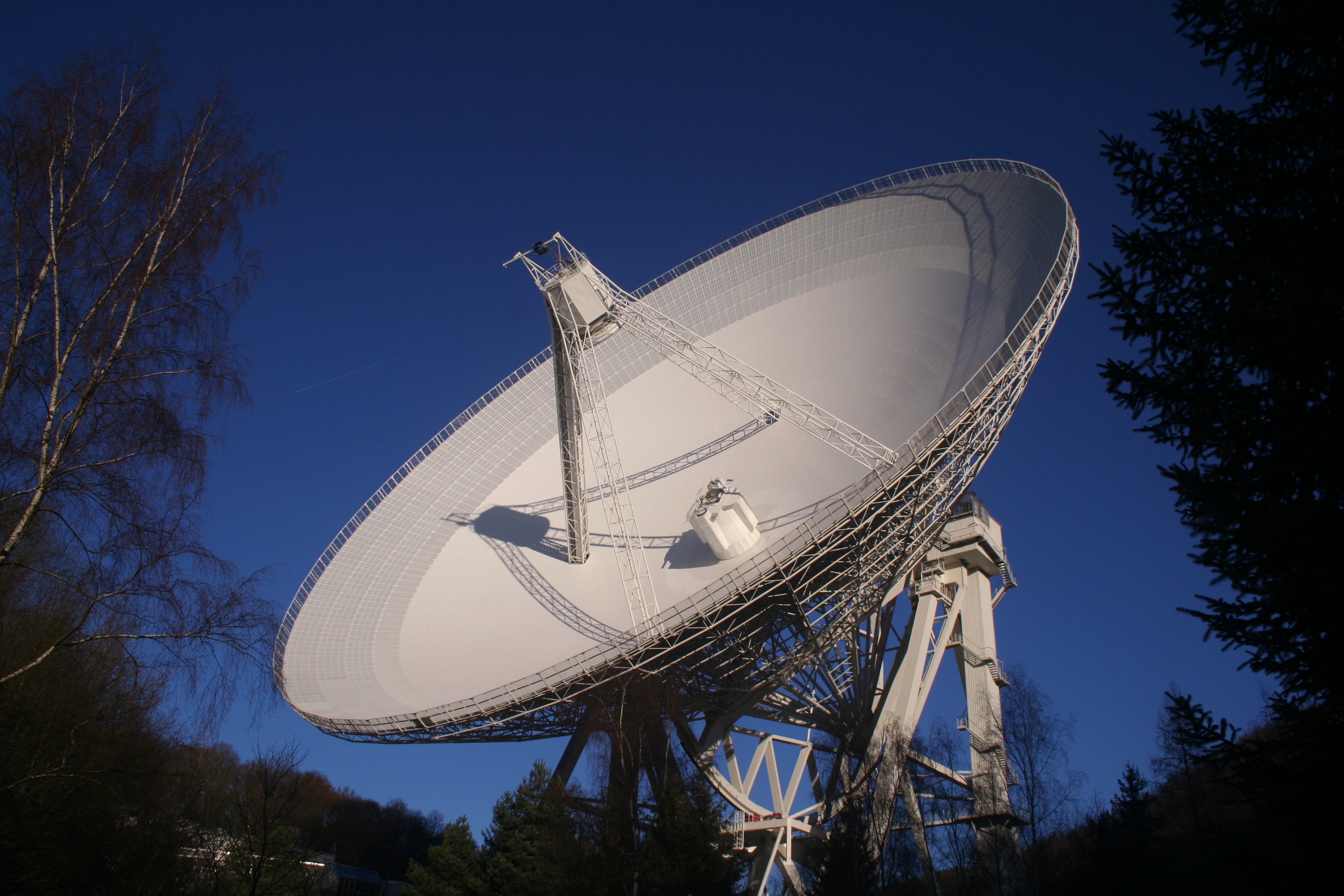
Matt_dk writes with news that scientists have detected water in a galaxy 11.5 billion light-years from Earth. Evidence came in the form of emissions from water masers around a quasar at the center of the galaxy. Detection at such a large distance was made possible by a closer, intervening galaxy which acted as a gravitational lens. "'We were only able to discover this distant water with the help of the gravitational lens,' said Violette Impellizzeri, an astronomer with the Max-Planck Institute for Radioastronomy (MPIfR) in Bonn, Germany. 'This cosmic telescope reduced the amount of time needed to detect the water by a factor of about 1,000,' she added. The astronomers first detected the water signal with the Effelsberg telescope. They then turned to the VLA's sharper imaging capability to confirm that it was indeed coming from the distant galaxy. The gravitational lens produces not one, but four images of MG J0414+0534 as seen from Earth. Using the VLA, the scientists found the specific frequency attributable to the water masers in the two brightest of the four lensed images. The other two lensed images, they said, are too faint for detecting the water signal. The radio frequency emitted by the water molecules was Doppler shifted by the expansion of the Universe from 22.2 GHz to 6.1 GHz." -
"See-Through" Touchscreen Solves Fat Finger Problem
Urchin sends along a New Scientist writeup on Microsoft Research's nanoTouch prototype, a way of operating a touch screen from the rear (video here). The prototype will be presented at the Computer and Human Interaction conference in Boston, Mass., in April 2009. Coming soon to a wristwatch or neck pendant near you. "Electronic devices have been shrinking for years, but you might be forgiven for thinking that one that's only a centimeter across would be just too difficult to operate. Microsoft Research's new nanoTouch device suggests otherwise. Touch-screens are difficult to control with any precision — the fingers get in the way of the tiny targets you're trying to hit. But putting the touch interface on the rear of the screen instead gives users more precision because they can still see the whole screen as they interact with it. Microsoft Research has produced a prototype device called nanoTouch with a rear-mounted touch interface. User tests show it lets users accurately and reliably hit targets just 2 millimeters across on a screen under a centimeter across." -
"See-Through" Touchscreen Solves Fat Finger Problem
Urchin sends along a New Scientist writeup on Microsoft Research's nanoTouch prototype, a way of operating a touch screen from the rear (video here). The prototype will be presented at the Computer and Human Interaction conference in Boston, Mass., in April 2009. Coming soon to a wristwatch or neck pendant near you. "Electronic devices have been shrinking for years, but you might be forgiven for thinking that one that's only a centimeter across would be just too difficult to operate. Microsoft Research's new nanoTouch device suggests otherwise. Touch-screens are difficult to control with any precision — the fingers get in the way of the tiny targets you're trying to hit. But putting the touch interface on the rear of the screen instead gives users more precision because they can still see the whole screen as they interact with it. Microsoft Research has produced a prototype device called nanoTouch with a rear-mounted touch interface. User tests show it lets users accurately and reliably hit targets just 2 millimeters across on a screen under a centimeter across." -
Photos of the Damage To the Large Hadron Collider
holy_calamity writes "CERN have released images of the damage done to the world's most powerful machine, the Large Hadron Collider, when an electrical fault caused a helium leak. New Scientist has posted them, along with explanations of what you can see. The sudden burst of gas shifted some of the huge superconducting magnets by half a meter, causing at least $21 million in damage." -
Photos of the Damage To the Large Hadron Collider
holy_calamity writes "CERN have released images of the damage done to the world's most powerful machine, the Large Hadron Collider, when an electrical fault caused a helium leak. New Scientist has posted them, along with explanations of what you can see. The sudden burst of gas shifted some of the huge superconducting magnets by half a meter, causing at least $21 million in damage." -
Brain Electrodes That Screw On the Skin
An anonymous reader writes "New Scientist says that attaching electrodes to the skin for monitoring brain activity (for example when 'installing brain implants that can allow disabled people to control machines using their mind') is tricky, especially on a hairy scalp, so the new solution from the University of Pittsbugh is an electrode that screws into the skin: its 'teeth dig into the upper layer of skin and become fixed in place, maintaining good electrical contact.' They say that the thing 'should be pain-free.' (Note: it does not go through the skull!)" -
Future of Space Elevator Looks Shaky
lurking_giant writes "In a report on NewScientist.com, researchers working on development of a space elevator (an idea we have discussed numerous times) have determined that the concept is not stable. Coriolis force on the moving climbers would cause side loading that would make stability extremely difficult, while solar wind would cause shifting loads on the geostationary midpoint. All of this would likely make it necessary to add thrusters, which would consume fuel and negate the benefits of the concept. Alternatively, careful choreography of multiple loads might ease the instability, again with unknown but negative economic impacts." -
First Superconducting Transistor Created
holy_calamity writes "New Scientist reports that the first working superconducting transistor has been created, by researchers at the University of Geneva. Field effect transistors with zero electrical resistance would allow much faster operations. Only drawback is they need to be supercooled, something that may be addressed by improving the materials used." -
First Superconducting Transistor Created
holy_calamity writes "New Scientist reports that the first working superconducting transistor has been created, by researchers at the University of Geneva. Field effect transistors with zero electrical resistance would allow much faster operations. Only drawback is they need to be supercooled, something that may be addressed by improving the materials used." -
Light Echoes Solve Mystery of Tycho's Supernova
Ponca City, We love you writes "Powerful telescopes in Hawaii and Spain are using 'light echoes' from the original supernova explosion that have bounced off dust in the surrounding interstellar clouds to identify the precise type of supernova that Tycho Brahe saw 436 years ago. Although the echoed light from Tycho's supernova is around 20 billion times fainter than the original light observed in 1572, the team took identical images of the sky a few months apart and then digitally subtracted one from the other to find evidence for several sets of light echoes rippling across patches of dust in the northern Milky Way. 'Using light echoes in supernova remnants is time-travelling in a way, in that it allows us to go back hundreds of years to observe the first light from a supernova event. We got to relive a significant historical moment and see it as the famed astronomer Tycho Brahe did hundreds of years ago,' said Tomonori Usuda, of the Subaru Telescope in Hawaii. Tycho's original observations were particularly important as he immediately concluded that the new star, visible even by day, could not be closer than the Moon challenging the Aristotelian view of the cosmos, widely accepted since ancient times, which held that the sky beyond the Moon never changed." -
Alien Comet May Have Infiltrated the Solar System
New Scientist has a piece about Comet Machholz 1, whose uncommon molecular composition suggests, but does not prove, that it may be an interloper from another star system. "Comet Machholz 1 isn't like other comets. David Schleicher of the Lowell Observatory in Flagstaff, Arizona, measured the chemical makeup of 150 comets, and found that they all had similar levels of the chemical cyanogen (CN) except for Machholz 1, which has less than 1.5% of the normal level. Along with some other comets, it is also low on the molecules carbon-2 and carbon-3." -
Ubiquitous Hydrogen Power Not Getting Any Closer
NewScientist has a story about the "hydrogen economy" that has been resting on the horizon for a decade or more. Despite a great deal of enthusiasm for and research into hydrogen-based power systems, the technology seems just as far away from everyday use as it's always been. A British startup, ITM Power, has recently claimed a breakthrough in lowering production costs by using a nickel catalyst (rather than platinum) with a membrane small enough for home use. But, even if their method is proven and adopted, it still wouldn't address huge energy efficiency problems in the process. "The point was made forcefully by Gary Kendall of the conservation group WWF in a recent report called Plugged In (PDF, pgs. 135-149). Kendall, a chemist who previously spent almost a decade working for ExxonMobil, highlights how the energy losses in the fuel chain - from electrolysis to compression of the hydrogen for use to inefficiencies in the fuel cell itself — mean that only 24 per cent of the energy used to make the fuel does any useful work on the road." -
Down's Symptoms May Be Treatable In the Womb
missb writes "US researchers have found that prenatal treatment for Down syndrome works in mice. This raises the possibility that a pregnant woman who knows her unborn child has Down syndrome might be able to forestall some of the symptoms before giving birth. When fetal mouse pups that had a syndrome similar to Down's were treated with nerve-protecting chemicals, some of the developmental delays that are part of the condition — such as motor and sensory abilities — were removed." -
Down's Symptoms May Be Treatable In the Womb
missb writes "US researchers have found that prenatal treatment for Down syndrome works in mice. This raises the possibility that a pregnant woman who knows her unborn child has Down syndrome might be able to forestall some of the symptoms before giving birth. When fetal mouse pups that had a syndrome similar to Down's were treated with nerve-protecting chemicals, some of the developmental delays that are part of the condition — such as motor and sensory abilities — were removed." -
New Nanotech Fabric Never Gets Wet
holy_calamity writes "New Scientist reports on a simple coating for polyester that renders it unwettable — even after two months underwater it emerges dry to the touch. Water cannot attach to the new fabric thanks to nanostructured filaments and a structure that traps a constant air layer. One potential use is for low-drag swim wear." -
New Nanotech Fabric Never Gets Wet
holy_calamity writes "New Scientist reports on a simple coating for polyester that renders it unwettable — even after two months underwater it emerges dry to the touch. Water cannot attach to the new fabric thanks to nanostructured filaments and a structure that traps a constant air layer. One potential use is for low-drag swim wear." -
Electron Strobe Makes Movies of Atoms
holy_calamity writes "Some grainy black and white movies are receiving rave reviews from scientists. They are taken by a new microscope which, thanks to a 'strobing' electron gun, can image movement at sub-nanometer scales. Until now, only still images that smeared out movement were possible at such scales. The press release notes, 'The researchers first blasted the sample with a pulse of heat. The heated carbon atoms began to vibrate in a random, nonsynchronized fashion. Over time, however, the oscillations of the individual atoms became synchronized as different modes of the material locked in phase, emerging to become a heartbeat-like "drumming."' Further details and a few animations are available at Caltech's site." -
Electron Strobe Makes Movies of Atoms
holy_calamity writes "Some grainy black and white movies are receiving rave reviews from scientists. They are taken by a new microscope which, thanks to a 'strobing' electron gun, can image movement at sub-nanometer scales. Until now, only still images that smeared out movement were possible at such scales. The press release notes, 'The researchers first blasted the sample with a pulse of heat. The heated carbon atoms began to vibrate in a random, nonsynchronized fashion. Over time, however, the oscillations of the individual atoms became synchronized as different modes of the material locked in phase, emerging to become a heartbeat-like "drumming."' Further details and a few animations are available at Caltech's site." -
Dark Matter Discovered Near Solar System?
gpronger writes "The ATIC (Advanced Thin Ionization Calorimeter) has potentially discovered the presence of dark matter close (only 3000 light-years) to our solar system. The system detected a large-amount of high energy cosmic rays which match the theoretical signature of dark matter annihilating itself. The universe is believed to be composed of about 25% dark matter, but there has been little evidence of it. This discovery, if correct, would be the first." The paper was published in Nature , but it requires a subscription to see beyond the abstract. -
E=mc^2 Verified In Quantum Chromodynamic Calculation
chirishnique and other readers sent in a story in AFP about a heroic supercomputer computation that has verified Einstein's most famous equation at the level of subatomic particles for the first time. "A brainpower consortium led by Laurent Lellouch of France's Centre for Theoretical Physics, using some of the world's mightiest supercomputers, have set down the calculations for estimating the mass of protons and neutrons, the particles at the nucleus of atoms. ... [T]he mass of gluons is zero and the mass of quarks is only five per cent. Where, therefore, is the missing 95 per cent? The answer, according to the study published in the US journal Science on Thursday, comes from the energy from the movements and interactions of quarks and gluons. ... [E]nergy and mass are equivalent, as Einstein proposed in his Special Theory of Relativity in 1905." Update: 11/21 15:50 GMT by KD : New Scientist has a slightly more technical look at the accomplishment. -
Crowdsourcing Site Offers Rewards To Bust Patents
holy_calamity writes "Article One Partners is a new startup that offers $50,000 rewards to people that find prior art for certain valuable patents. The company's founder told New Scientist she thought the initiative would improve 'patent quality' by increasing scrutiny on poor patents. She aims to profit by selling the information contributors collect, or trade stocks based on it. Current patents they are looking for help to bust include those being used by Konami to sue Harmonix over Rock Band and Guitar Hero." -
Crowdsourcing Site Offers Rewards To Bust Patents
holy_calamity writes "Article One Partners is a new startup that offers $50,000 rewards to people that find prior art for certain valuable patents. The company's founder told New Scientist she thought the initiative would improve 'patent quality' by increasing scrutiny on poor patents. She aims to profit by selling the information contributors collect, or trade stocks based on it. Current patents they are looking for help to bust include those being used by Konami to sue Harmonix over Rock Band and Guitar Hero." -
Digital Photos Give Away a Camera's Make and Model
holy_calamity writes "Engineers at Polytechnic University Brooklyn have discovered that digital snaps shorn of any metadata still reveal the make and model of camera used to take them. It is possible to work backwards from the relationships of neighboring pixel values in a shot to identify the model-specific demosaicing algorithm that combines red, green, and blue pixels on the sensor into color image pixels. Forensics teams are already licking their chops." -
Digital Photos Give Away a Camera's Make and Model
holy_calamity writes "Engineers at Polytechnic University Brooklyn have discovered that digital snaps shorn of any metadata still reveal the make and model of camera used to take them. It is possible to work backwards from the relationships of neighboring pixel values in a shot to identify the model-specific demosaicing algorithm that combines red, green, and blue pixels on the sensor into color image pixels. Forensics teams are already licking their chops." -
DNA Strands Modified Into Tiny Fiber-Optic Cables
holy_calamity writes "New Scientist reports on the latest idea from researchers trying to make microcomputers use photons in place of electrons — to make optical interconnects from strands of DNA. Mixing DNA strands with the right dye molecule upgrades them into wires for light, like microscopic optical fibers, able to absorb photons at one end and transmit them to the other. One of the neat things about using DNA is it is the right scale to play nicely with existing and future chip lithography. Quoting: 'The result is similar to natural photonic wires found inside organisms like algae, where they are used to transport photons to parts of a cell where their energy can be tapped. In these wires, chromophores are lined up in chains to channel photons.'" -
DNA Strands Modified Into Tiny Fiber-Optic Cables
holy_calamity writes "New Scientist reports on the latest idea from researchers trying to make microcomputers use photons in place of electrons — to make optical interconnects from strands of DNA. Mixing DNA strands with the right dye molecule upgrades them into wires for light, like microscopic optical fibers, able to absorb photons at one end and transmit them to the other. One of the neat things about using DNA is it is the right scale to play nicely with existing and future chip lithography. Quoting: 'The result is similar to natural photonic wires found inside organisms like algae, where they are used to transport photons to parts of a cell where their energy can be tapped. In these wires, chromophores are lined up in chains to channel photons.'" -
How To Cut In Line and Not Get Caught
ewenc writes "A psychology study of hundreds of people waiting for front-row access to U2 concerts points to the best ways to cut in line and not get caught. 'Super-fans' are most irked by queue-jumpers. People were equally peeved whether someone cut in front or behind, and cutters who jumped beside a friend were less likely to attract scorn." -
Stretchable, Flexible, Transparent Nanotube Speakers
An anonymous reader writes "Chinese researchers have realised that a sheet of nanotubes behaves like a speaker when you send an audio current through it. The technology opens the way for a range of new versatile speaker systems. A video shows the speakers in action — some are stretched, one has even been sewn into a flag." -
New Type of Particle May Have Been Found
An anonymous reader writes "The LHC is out of commission, but the Tevatron collider at Fermilab is still chugging along, and may have just discovered a new type of particle that would signal new physics. New Scientist reports that the Tevatron's CDF detector has found muons that seem to have been created outside of the beam pipe that confines the protons and anti-protons being smashed together. The standard model can't explain the muons, and some speculate that 'an unknown particle with a lifetime of about 20 picoseconds was produced in the collision, traveled about 1 centimeter, through the side of the beam pipe, and then decayed into muons.' The hypothetical particle even seems to have the right mass to account for one theory of dark matter." -
Cassini Could Find Signs of Life on Enceladus
New Scientist reviews the possibility that the Cassini probe might be repurposed to look for signs of life on Saturn's enigmatic moon Enceladus. "[Enceladus' water vapor] plume's origin is still being debated, but some models suggest the moon holds an ocean of liquid water beneath its surface. This ocean could be a potential habitat for extraterrestrial life. ... Though the probe was never designed to look for life, it could do so by studying organic chemicals such as methane in the plume, the team says." -
How Vampire Bats Evolved To Live On Blood Alone
New research has discovered some of the genetic changes that allowed vampire bats to live on a diet of pure blood. One of the bats' most important evolutionary traits is the ability to manipulate an anticoagulant protein in their blood and saliva. In humans similar proteins protect against heart attack by breaking up blood clots and clearing vessels. -
The Greatest Scientific Hoaxes?
Ponca City, We love you writes "The New Scientist has an amusing story about the seven greatest scientific hoaxes of all time. Of course, there have been serious cases of scientific fraud, such as the stem cell researchers recently found guilty of falsifying data, and the South Korean cloning fraud, but the hoaxes selected point more to human gullibility than malevolence and include the Piltdown Man (constructed from a medieval human cranium); a ten-foot "petrified man" dug up on a small farm in Cardiff; fossils 'found' in Wurzburg, Germany depicting comets, moons and suns, Alan Sokal's paper loaded with nonsensical jargon that was accepted by the journal Social Text; the claim of the Upas tree on the island of Java so poisonous that it killed everything within a 15-mile radius; and Johann Heinrich Cohausen's claim of an elixir produced by collecting the breath of young women in bottles that produced immortality. Our favorite: BBC's broadcast in 1957 about the spaghetti tree in Switzerland that showed a family harvesting pasta that hung from the branches of the tree. After watching the program, hundreds of people phoned in asking how they could grow their own tree but, alas, the program turned out to be an April Fools' Day joke." What massive scientific hoaxes/jokes have other people witnessed? -
Packs of Robots Will Hunt Down Uncooperative Humans
Ostracus writes "The latest request from the Pentagon jars the senses. At least, it did mine. They are looking for contractors to 'develop a software/hardware suite that would enable a multi-robot team, together with a human operator, to search for and detect a non-cooperative human subject. The main research task will involve determining the movements of the robot team through the environment to maximize the opportunity to find the subject ... Typical robots for this type of activity are expected to weigh less than 100 Kg and the team would have three to five robots.'" To be fair, they plan to use the Multi-Robot Pursuit System for less nefarious-sounding purposes as well. They note that the robots would "have potential commercialization within search and rescue, fire fighting, reconnaissance, and automated biological, chemical and radiation sensing with mobile platforms." -
Patient "Roused From Coma" By a Magnetic Therapy
missb writes "Could the gentle currents from a fluctuating magnetic field be used to reverse the effects of traumatic brain injury? New Scientist reports on a patient in the US who was in a coma-like state, but can now speak very simple words after being given transcranial magnetic stimulation. This is the first time TMS has been used as a therapy to try and rouse a patient out of a coma." -
Patient "Roused From Coma" By a Magnetic Therapy
missb writes "Could the gentle currents from a fluctuating magnetic field be used to reverse the effects of traumatic brain injury? New Scientist reports on a patient in the US who was in a coma-like state, but can now speak very simple words after being given transcranial magnetic stimulation. This is the first time TMS has been used as a therapy to try and rouse a patient out of a coma." -
Do Nerds Have Better Sperm?
mcgrew writes "The question of how we loveless nerds managed to not be bred out of the species genome may have been answered. According to New Scientist, we have better sperm. According to the article, men who scored high on a battery of intelligence tests boasted high counts of healthy sperm, while low scorers tended to have fewer and more sickly little guys. ... Though the connections between brains and sperm were 'not awesome, they're there and highly significant.' All things held equal, good sperm and good brains go together." Don't start gloating yet. Another recent study found that the gene that makes you good at Halo also makes you a premature ejaculator. A study of 200 Dutch men found that those with a premature ejaculation problem all had a version of a gene that controls the release of serotonin. These men seem to "have very quick reflexes. They may be excellent at playing tennis or computer games." Remember, if you smoke after sex you're doing it too fast. -
The Quietest Sun
Orbity sends in a Boston Globe report on the unusual calm on the surface of the sun. The photos, many taken in more active solar times, are excellent — see the sequence from last year of a coronal mass ejection carrying away the tail of a comet. "The Sun is now in the quietest phase of its 11-year activity cycle, the solar minimum — in fact, it has been unusually quiet this year — with over 200 days so far with no observed sunspots. The solar wind has also dropped to its lowest levels in 50 years. Scientists are unsure of the significance of this unusual calm..." As if to be contrary, New Scientist mentions that the number of sunspots seem to be increasing. -
Google's Chrome Declining In Popularity
holy_calamity writes "After launching in a blaze of publicity that even warmed Slashdot, Google's browser grabbed a 3% share of the market, but has been slipping ever since, and now accounts for 1.5%. Google has also stopped promoting the browser on its search page. Assuming they wanted it to grab a significant share of the browser market, have they dropped the ball, or is this part of the plan?" On Slashdot, Chrome is still the #4 browser (after FF, IE, and Safari) but it was ahead of Safari for a few days, hitting almost 10% of our traffic. -
Google's Chrome Declining In Popularity
holy_calamity writes "After launching in a blaze of publicity that even warmed Slashdot, Google's browser grabbed a 3% share of the market, but has been slipping ever since, and now accounts for 1.5%. Google has also stopped promoting the browser on its search page. Assuming they wanted it to grab a significant share of the browser market, have they dropped the ball, or is this part of the plan?" On Slashdot, Chrome is still the #4 browser (after FF, IE, and Safari) but it was ahead of Safari for a few days, hitting almost 10% of our traffic. -
Soyuz With Richard Garriott Successfully Launched
Toren Altair writes "Soyuz TMA-13 with ISS Expedition Crew 18 and Richard Garriott successfully launched from Baikonur Cosmodrome at 7:01 UT (3:01 EDT). The Soyuz capsule will dock to the ISS in two days. Garriott will return to Earth with Expedition 17 crew members, Commander Sergei Volkov and Flight Engineer Oleg Kononenko on October 23." With the extra attention on this launch, the Russians have gone out of their way to say that the return of the Soyuz vehicle will be safe, after a couple of different malfunctions in the past year. Garriott is in space partly for recreation, and partly as a promotion for his latest MMO, Tabula Rasa. He took with him a hard drive filled with information about humanity, as well as DNA sequences from Tabula Rasa players and various celebrities (including Stephen Colbert and Stephen Hawking) to 'preserve' that data in case of a disaster on Earth. Garriott will also spend time running and participating in experiments. Coverage of the Soyuz mission is ongoing at NASATV. -
Watching Brain Cells In Action
Roland Piquepaille writes "A Stanford University team has developed a microscope weighing only 1.1 grams. It is so small that it can be mounted to the head of a freely moving mouse to watch its brain cell activity. According to what the lead researcher told New Scientist, 'A lot of work has been done using brain slices, or anaesthetised animals — even using animals that are awake but restrained. But so far it has been impossible to image cellular-level activity in a freely moving mouse.' Not any more. And as mice are the 'preferred' animals in medical labs, this new kind of microscope could lead to new ways to study human diseases." -
Nobel Prize For Medicine Awarded, Physics Soon To Follow
Nobel Prize season is here again, and the first award for Physiology or Medicine was split between two virologists who discovered HIV and one who demonstrated that a virus causes cervical cancer. Coming soon is the announcement for Physics. Look to the right for a chance to pit your selection wit against the Royal Swedish Academy of Sciences with a poll for which scientific achievement deserves the prize. Front runners, according to Reuters, are; Andre Geim and Kostya Novoselov, discovers of graphene, Vera Rubin, provider of the best evidence yet of dark matter, and Roger Penrose and Dan Shechtman, discoverers of Penrose tilings and quasicrystals. -
Tsunami Invisibility Cloak
BuzzSkyline writes "New Scientist is reporting on a lab-scale experiment that may lead to a tsunami invisibility cloak, which could protect islands, open-ocean platforms and even coastlines from dangerous waves by effectively making them invisible to tsunamis. The technology is based on the same sorts of negative index of refraction ideas that some physicists are exploring as they try to make an optical invisibility cloak, except that it works with water instead of light." -
Universal Surface Scanner Detected
mcgrew writes to tell us that scientists at the University of California, San Diego, have created a new system that can test any surface for just about anything. "Their idea uses a thin layer of metal drilled with nanoscale holes, laid onto the surface being tested. When the perforated plate is zapped with laser light, the surface plasmons that form emit light with a frequency related to the materials touching the plate. A sensitive light detector is needed to measure the frequency of light given off. The team says devices using this approach can be small and portable, will work on very low power, and could detect everything from explosives to bacteria. All that needs to be done now is build a system able to decode the light signatures." -
Homeland Security Department Testing "Pre-Crime" Detector
holy_calamity writes "New Scientist reports that the Department of Homeland Security recently tested something called Future Attribute Screening Technologies (FAST) — a battery of sensors that determine whether someone is a security threat from a distance. Sensors look at facial expressions, body heat and can measure pulse and breathing rate from a distance. In trials using 140 volunteers those told to act suspicious were detected with 'about 78% accuracy on mal-intent detection, and 80% on deception,' says a DHS spokesman." -
Homeland Security Department Testing "Pre-Crime" Detector
holy_calamity writes "New Scientist reports that the Department of Homeland Security recently tested something called Future Attribute Screening Technologies (FAST) — a battery of sensors that determine whether someone is a security threat from a distance. Sensors look at facial expressions, body heat and can measure pulse and breathing rate from a distance. In trials using 140 volunteers those told to act suspicious were detected with 'about 78% accuracy on mal-intent detection, and 80% on deception,' says a DHS spokesman." -
Gamers Are Fitter (and Sadder) Than You Think
missb writes "According to NewScientist.com, online gamers are no 'couch potatoes'. US researchers quizzed players of the role-playing game EverQuest II, and found adult gamers to be in better physical condition than the average American. The downside, however, was the gamers reported more cases of depression and substance abuse than their compatriots." -
Gamers Are Fitter (and Sadder) Than You Think
missb writes "According to NewScientist.com, online gamers are no 'couch potatoes'. US researchers quizzed players of the role-playing game EverQuest II, and found adult gamers to be in better physical condition than the average American. The downside, however, was the gamers reported more cases of depression and substance abuse than their compatriots." -
Software Spots Spin In Political Speeches
T.S. Ackerman writes "According to an article in NewScientist Tech, there is now software that can identify the amount of spin in a politician or candidate's speech. From the article, 'Blink and you would have missed it. The expression of disgust on former US president Bill Clinton's face during his speech to the Democratic National Convention as he says "Obama" lasts for just a fraction of a second. But to Paul Ekman it was glaringly obvious. "Given that he probably feels jilted that his wife Hillary didn't get the nomination, I would have to say that the entire speech was actually given very gracefully," says Ekman, who has studied people's facial expressions and how they relate to what they are thinking for over 40 years.' The article goes on to analyze the amount of spin in each of the candidates running for president, and the results are that Obama spins the most."