Slashdot Mirror
Domain: nongnu.org
Stories and comments across the archive that link to nongnu.org.
Comments · 557
-
Re:Bayesian SPAM filterPOPFile uses a different algorithm than TBird. POPFile is based on the IFile project while Mozilla/Thunderbird is based on Paul Graham's original 2002 essay "A Plan for Spam".
Paul Graham's ideas have undergone a lot of improvements. Some of the best improvements and tweaks have been implemented by the SpamBayes project. Their Outlook plugin makes Outlook the best spam solution that I have seen (better than SpamAssasin).
I don't know if it will help, but you can vote for the bug to improve Mozilla's spam algorithm.
-
Still using Kazaa to access FastTrack?Check out MLDonkey. Here's the description from one of their sites:
MLdonkey is a multi-platform multi-networks peer-to-peer client. Originally, it was the first open-source client to access the eDonkey network . The protocol was reverse-engeneered using an efficient protocol sniffer, Pandora .
Currently, with eDonkey , it supports several large networks, such as Overnet , Bittorrent , Gnutella (Bearshare, Limewire,etc), Gnutella2 (Shareaza), Fasttrack (Kazaa, Imesh, Grobster), Soulseek (beta), Direct-Connect (alpha), and Opennap (alpha). Networks can be enabled/disabled, searches are performed in parallel on all enabled networks, but each file is only downloaded from one network (wait for next release !), but from multiple clients concurrently.
-
Re:Are these low cost DVD Burners Linux Compatible
I have a Sony DVD Writer in a Formac firewire case (not orig combination) and I have had no problems with the drive itself. You can download cdrecord-PRODVD which works pretty much the same as cdrecord. K3b pops up when I put a blank DVD in (kind of it isn't it?) so I can burn the DVD very easily from an
-
Re:So, as an artist...
No, that's the nice part, you won't. Compare it to the copying machines here at my school. I have to pay kopinor for every copy i make, which means that when I print out Programming from the ground up the jerks who get rich by writing bad school books get richer, when Jonathan Bartlett won't see a dime. Mandatory licensing is a very effective way to get rid of these pesky independent competitors.
-
Re:Don't forget the users!
-
Re:Really?
Combine this with the fact that they are driven to participate based on their interest or itch and we end up with a fine kernel, a few great apps and an abundance of mp3 players.
shit. you mean my mp3 player wasn't the first? </shamelessSelfPromotion>
-
Re:Additional reasonsIt will probally take a decade to get rid of people claiming that FreeCraft got shutdown by Blizzard, it is simply not right. FreeCraft did not get shutdown by Blizzard.
Yes, Blizzard sent a letter to the FreeCraft developers asking them for a name change and a few other things, which seem to be mostly a result of Blizzard lawyers not understanding what FreeCraft really is and never ever looking at it. Thats it, the next day the FreeCraft developers deleted the project from sourceforge.net without any further communications with Blizzard or any try to rename the project and move it. Blizzard did not request such drastic measures. It was the lone decission from the two active FreeCraft maintainers at that point, nothing more. Since both of the developers started a new project a few weeks after this, my guess would be that it was mostly the lack of interest in FreeCraft to keep the project alive, since they havn't even tried it. Anyway, in the meantime some former contributors picked up the remains of FreeCraft, organised a CVS-repo tarball and renamed the project. It is now well alive again under the name Stratagus and there are even some projects making use of the engine, without simply trying to clone Warcraft2.
-
Re:UserUtopia?
I agree with you that user-downloaded software installs are a nightmare, but have you tried Synaptic (a GUI for apt on Debian as well as Red Hat)?
1. Click on your favorite desktop or menu icon for synaptic and enter the root password.
2. Just hit the "Update List" button and listings of all (several thousand) pieces of software are updated.
3. Click some combination of "Update All" and/or double click on a package name to select the software that you want to install.
4. Click "Proceed".
All of your old and new software is now downloaded and installed with no dependency problems or any other modification.
I absolutely love this sort of system as it makes it so trivial to install AND update just about everything. At the same time however, it would be nice to have some sort of a standard GUI installer that simplified the "./configure make make install" options. I might be a bit slow at these things
Idea for a helpful GUI source installer:
- give it a tarball of the source, the installer will unpack it and give you a list of dependencies and options.
- The installer will search for allready installed apps to fullfill dependencies and let you choose if there are multiple results (or "Advanced"
- For each of the options have some decent defaults and put descriptions next to them for easy understanding.
- when done with options, hit "go" and the thing will be installed.
The above system should be pretty compatible with current cli installation methods and might only need a standard format for listing dependencies and default options to pass to the installer. If you don't have X (or Y!) or some other GUI, don't use it. Simple.
-
QEMU and BOCHS
-
Re:mutella
Yeah, I was one. Not anymore, since I've learned the existence of giFT I'm not using it anymore.
giFT works with a small server, which clients can connect. So I can control it graphically on my home (using giFToxic) or remotely (using ssh and giFTcurs).
Also, giFT turns all that reseach into garbage, since it can connect on several servers of several different types. Tt currently comes with OpenFT (giFT original protocol) and Gnutella by default but you can also find FastTrack network plugin for it. There is also a OpenNap network plugin in the works (and I just can't wait to put my hands on it). -
Re:2 kinds of users
hi dmaxwell, some good points there
yes, I know I was lucky with the garden design stuff
as to the other ' two things that really screw Linux as a consumer OS.'
1) they had an old-ish (PIII 450 Dell) box and some randomly-bought hardware (recent HP printer etc)
not a prob - for me to set up, and then leave, safe in the knowledge that they *can't* screw it up from now on.
cupsd in web admin mode looks great - to me at least, but i can see why it might not to all
The second point - software install, i totally disagree with. One of the reasons I went for fedora for them was apt-get
showing them it was *amazing*.
Dad - 'so who do i pay now.... This can't be free'
one click in synaptic and they're done
me, calling out random stuff - you wanna spreadsheet? You want a personal finance tool?
them, happy, happy.
For tinkerers, (who just *wont* RTFM, as every system has to be able to support their uninformed clicky-clicky stuff) - no, you're right. Leave them to OSX and the ability to move the panel around . ooooh!
So the install-on-demand is there, the free (beer) is there, mum's *just* about accepting altrusim/ love of fame as the reason why this stuff is free, next is some patches from them to sort out lirc problems in 2.6
-
Re:Vortex drivers
Yippee, thanks. I thought their download area was especially useful. Any chance they'll be Windows drivers? I doubt it.
-
Re:The free market is creative
Collaborative, voluntary creation works for software, it works on wikis
Who will pay to host the wikis? Who will pay to host the free software once VA Software dies and Savannah becomes too overloaded after the mass migration from SF to be usable?
-
Yes there is a replacement.
XUOVERT is that replacement. Let Xfree86 burn in hell and lets make a fork. I'm sick of reading stories about how the Xfree core people are preventing drivers from being commited and closing themselves off to the world, if they dont want developer support we should fork Xfree86 and compete with them, if they are so good at coding that they make a better Xfree86 than the community does well props to them, but if they don't, well they lose. Survival of the fittest. XOUVERT
-
Great, Xfree86 needs this.
Lets just make a fork and be done with it, its over! Let them work with Rest in Peace Xfree86, Enter Xouvert.
-
Re:"beginning of the end"?
From their Savannah website:
Xouvert is a development branch of the Xfree86 source tree. It's purpose is to provide wide testing and integration for third party patches, and to test and stabilize innovative new ideas for submission to the main Xfree86 branch.
Doesn't really sound like Xouvert marks the end of XFree86. Indeed, it sounds like Xouvert is dedicated to improving XFree86.
Dinivin -
Looks like Linux is ahead of them already
So far Linux seems to be ahead of them in development, I mean Storage Slicker and then theres xouvert , cairographics and project Y.
-
Re:Prior art shoudl be irrelevant
Follow this Link to find out more about the prior art issue.
-
Re:No, Linux is NOT an alternative
I can. apt-get is great for us geeks, but for normal users you need a nice gui replacement for dselect.
Synaptic?
I agree, printing is one thing that on Unix/Linux still needs a good bit of work. KDE makes it easy to configure printers, but it's going to take a lot more than one desktop environment to make it stick. I just hope Gnome adds something like this soon, as does Xfce (my other favorite WM/DE). -
MLDonkey babyKazaa? Kazaa who?
I've been using MLDonkey for a while now, mainly because Kazaa doesn't have a GNU/Linux version, and it is nothing short of amazing. You can download files from any of about eight different networks, including FastTrack (Kazaa), eDonkey, Gnutella 2, and others. The important thing is that FastTrack--the underlying network behind Kazaa and Morpheus--is not controlled by Sharman Networks.
So now, they can back any old plan they want. If they get too greedy, their users don't even have to switch networks. All they have do to is just use a different client. I mean KazaaLite is already a really popular, and vastly superior alternative that they have _no_ control over.
So I say screw 'em. Let them ask for money until they turn blue. It doesn't matter.
-
Re:Comparison with other free VMs?Thanks for the info, however you seem to be confusing Plex86 with Bochs. They share a lot of code, however while Bochs emulates the entire hardware (and thus can be used on any platform) Plex86 virtualizes many things and so can only be run on x86 hardware, but is supposed to have much better performance because of this. Also, AFAIK Plex86 is only available for Linux (as the host OS). The original Plex86 should run any x86 OS. The new Plex86 fork simplifies the virtualization even more and only runs Linux, supposedly with an even greater performance increase, providing basically the same thing as UML but in a different manner.
What I was interested in was performance comparisons between the different Plex86 versions, UML, and Xen, as well as some info on how each goes about virtualizing the hardware (which is better and why). I was playing with Bochs just a few weeks ago (on a 600 MHz ibook, Linux as the host, Windows 98SE as the guest) and found it unusably slow. I haven't played with Plex86, UML or Xen yet, but I plan to as soon as I get the free time.
-
Comparison with other free VMs?
So it looks like this is the third (or fourth) free VM for Linux, the others being Plex86 (and a different fork here) and User Mode Linux. Does anyone have a good comparison of these three? I know Zen compared UML on their site but not plex86. I'm not really sure of the differences between them, particularly the different versions of plex86 and UML (Zen explained their virtualization process pretty well on their site). Which is the best choice for different scenarios? It looks like Zen is the winner for running Linux as the guest OS, and the original Plex86 (first link) is the only one which offers a free choice in guest OS's.
-
Re:Use open source in government> He said that ALL software used by the government should be open source.
Actually, I meant that all software created by or for government should be open source.I don't care if any government employer works on proprietary operating system or uses closed source office suite.
But it is important to know how systems collecting my personal data work.For example in Poland Social Insurance Institution forces payers to use MS Windows system whether they like it or not. Open source community fights to release only communication specification, to be able to write alternative program: http://savannah.nongnu.org/projects/janosik/
Regards
-
Consider waiting...And not just because the site will be Slashdotted.
I was seriously considering downloading this when the announcement appeared on GnomeDesktop.org, but decided to hold off until the next release.
First, this was announced the same day that Gnome 2.4 was announced. That sort of put a damper on things. I already had a (mostly) Gnome live CD via Morphix Heavy, and it wasn't clear that Gnoppix offered anything new.
Then there was also the issue of the English option being broken.
From what I've seen, the Gnoppix haven't been keeping as current as Morphix. I'm hoping that this changes in the near future, because Gnome 2.4 is starting to convince me that it's a viable desktop. In the mean time, I'll continue playing with Morphix.
-
Changing my mind on Copyright Assignment
When I first started working on an OpenMP extension to gcc, I bristled at the FSF copyright assignment process.
I was wrong. I now see the value in FSF copyright assignments, which create a paper trail for documenting contributions to free software.
While the SCO attack dogs are extortionists, their greedy actions have shown weaknesses in the free-wheeling process of Linux development.
The "free" and "open" software communities can argue, until they are blue in the face, about the validity of copyrights, patents, trademarks, and other forms of owning ideas. Under existing law and practice, however, those concepts do exist, with the weight of law and tradition behind them -- and ignoring that reality is foolhardy.
Think of copyright assignment as akin to virus protection. I shouldn't have to protect myself against malicious software, but I am wise to do so. By the same principle, tracking contributions to the kernel is excellent protection from the desperate shakedown tactics of a company like SCO.
-
Re:I thought the IPod was "Lame"
You might want to try duplicity.
-
For bare-bones fun
There is construo, which is free software (as in beer and speech) and runs on Linux. Is has nothing for graphics and is strictly 2D, but it is still a hell of a lot of fun. Plus, you aren't just restricted to bridges--you can build almost anything you like. It's like the Tetris of the construction game genre--it ain't pretty, but it is very addictive.
-
Re:What about my hotmail?
How about gotmail?
-
Namazu + nmh
I recently switched to Namazu as a full-text search engine for my nmh e-mail. The combination seems to do pretty much what I want. Searches are reasonably fast and flexible, indexing is incremental, and I can script things massively.
I'd still like to get a machine-learning classifier going someday, perhaps by adapting the fine-looking dbacl, but my current combination seems like a good first cut.
-
Re:Archaeological Filing system
I use nmh with exmh as a GUI. It does all the above: sort by most recent, symbolic links to multiple directories, etc. The O'Reilly book is now freely (beer) available on the Web.
-
Straw
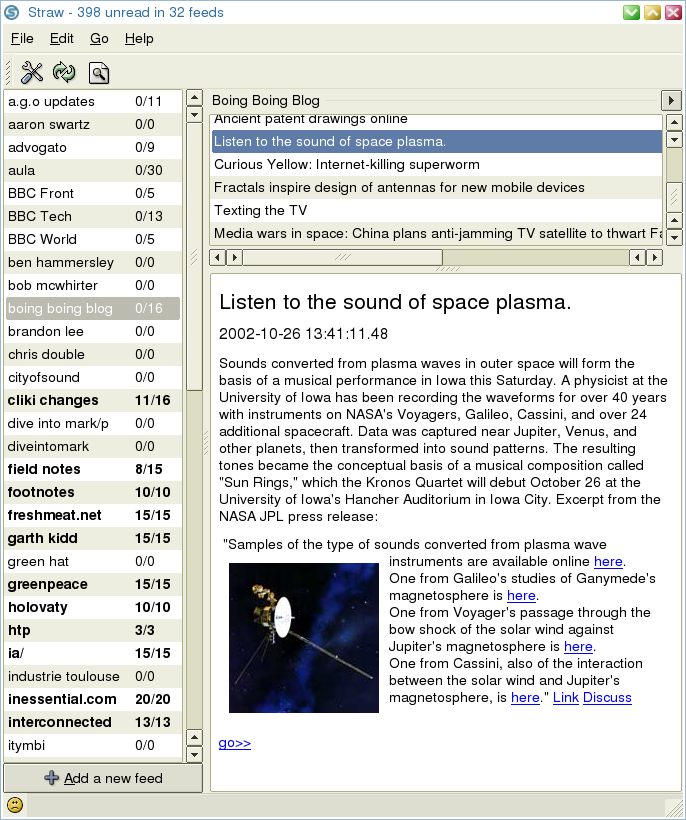
Try Straw, a three-pane aggregator for GNOME 2 (screenshot). It's almost as good as SharpReader (and some things are better.)
SharpReader and Straw are my primary interface to the web these days.
-
Straw
Try Straw, a three-pane aggregator for GNOME 2 (screenshot). It's almost as good as SharpReader (and some things are better.)
SharpReader and Straw are my primary interface to the web these days.
-
Interested in seeing what ocaml can do?
Check out mldonkey
It supports a large number of P2P networks and is entirely open source (GPLv2). It's designed to be cross-platform, it has a GTK GUI, a web interface, and a telnet interface. -
Re:ScummVM, Sarien, FreeSCI
According to the FreeSCI website, there IS a Mac OS X binary. It can be found here.
-
Re:Nautilus?
But for a filemanager? If you're going to insist on a GUI for that, please don't complain about bloat.
When I'm working with a colleague behind my PC, I often fire up GNOME Commander (not Nautilus, because I found it to be lacking). This looks more like their Windows boxes and they can more easily follow what I'm doing.Also, sometimes you want to eyeball a directory tree. You could use tree for this, but it's not as handy.
-
Re:No more hotmail support...
Gotmail might be useful, too.
-
Re:Is the Unix philosophy real?
-
Didn't cover XForms and got its license wrong
FLTK is the C++ successor to the XForms library (which is written in plain C), so I won't cover the latter here. XForms is not Free Software and is free of charge only for non-commercial use.
XForms has been free software, under the LGPL, for a while now.
See the Debian package in the main archive. -
Re:Missed the best
I agree. I came across GNUstep two months ago and was amazed by its incredibly simple API. I quickly made my first app, Charmap, a character map which uses Unicode.org's standards files to provide a wealth of information about any character. This was easy and fast because GNUstep provided solid Unicode/UTF-8 support from the start. While for example GTK was a pain to use until 2.0 with regards to non-Latin scripts, GNUstep at the same time had one of the most advanced string classes.
Not only is GNUstep concise and simple, but because Apple's Cocoa is also an implementation of the OPENSTEP standard, one can use Cocoa docs in GNUstep programming. This allows the programmer to tap into abundant resources online and in print.
If you're interested in what's going on in the GNUstep world, my favourite resource is www.gnustep.us, which lists the latest news and updates. I hope I don't sound like a karma whore, I'm just super-enthused about a fantastic API that doesn't get the attention it deserves. -
Re:Music Studio
Anyone used Ardour? I have got as far as installing, but it requires jack configured, which I think requires ALSA (which I don't use). I wouldn't know where to start as I use the kernel drivers for my SB Live.
What about ProTux or Glame? A guide starting point to look is http://linux-sound.org/hdr.html. -
Re:Laptop mode, yes!The laptop mode patch is also available with other patches in savannah
-
mozilla-bonobo
You could already have seen some of SVG through the mozilla-bonobo plugin. As this plugin actually activates Eye Of Gnome for the image viewing, and EOG is actually more of a pixel-graphics viewer that happens to read SVG through the (still lagging) librsvg, the capacities are limited though.
For instance, you can only view SVG images as object tags, and complex stuff (like copied/ rotated graphics) aren't rendered well. (And it just so happens that Sodipodi produces SVG with a lot of copied/ rotated objects.) -
Re:It exists: Prior Art DataBase
To submit your idea you will have to write your idea in a file and add it to PADB using CVS. If you do not have access to CVS you can simply mail the ideas to a human that has access to CVS
What CVS? To which human? A contact address and CVS access instructions are needed on that site. This project does not lie in my definition of "organized"
-
It exists: Prior Art DataBase
Some people are already working on this, please work with them:
http://www.nongnu.org/padb/
Development of the database is being worked on at:
http://savannah.nongnu.org/projects/padb/
and the software used is Free Software, available at:
http://savannah.nongnu.org/projects/topas/
Lobbying EU MEPs is still the best thing we can do right now, people from any country can do this. I gave an example for what an American can do in a later post:
http://slashdot.org/comments.pl?sid=69331&threshol d=0&commentsort=0&tid=155&tid=99&mode=thread&pid=6 327875#6328000
Ciaran O'Riordan -
It exists: Prior Art DataBase
Some people are already working on this, please work with them:
http://www.nongnu.org/padb/
Development of the database is being worked on at:
http://savannah.nongnu.org/projects/padb/
and the software used is Free Software, available at:
http://savannah.nongnu.org/projects/topas/
Lobbying EU MEPs is still the best thing we can do right now, people from any country can do this. I gave an example for what an American can do in a later post:
http://slashdot.org/comments.pl?sid=69331&threshol d=0&commentsort=0&tid=155&tid=99&mode=thread&pid=6 327875#6328000
Ciaran O'Riordan -
It exists: Prior Art DataBase
Some people are already working on this, please work with them:
http://www.nongnu.org/padb/
Development of the database is being worked on at:
http://savannah.nongnu.org/projects/padb/
and the software used is Free Software, available at:
http://savannah.nongnu.org/projects/topas/
Lobbying EU MEPs is still the best thing we can do right now, people from any country can do this. I gave an example for what an American can do in a later post:
http://slashdot.org/comments.pl?sid=69331&threshol d=0&commentsort=0&tid=155&tid=99&mode=thread&pid=6 327875#6328000
Ciaran O'Riordan -
Re:Future vs. Present oriented viewpoints Re:Same
-
A lack of Parallelism
All of these tools address different aspects of numerical computing. A mixture of languages and tools will generally produce the best results.
I've been experimenting with a number of scientific programming packages, ranging from traditional languages like Fortran 95 to new developments like SciPy. Of the "new" approaches, I like SciPy the best, given its support for MPI and ease of linking to traditional languages.
Support for NUMA and SMP architectures is severely lacking in most "free" packages. This may, in some respects, be due to the lack of parallel support on gcc (although there is an effort underway (gomp) to add OpenMP support to gcc).
Parallelism is important to any large-scale numerical application -- and PDL, as yet, does not appear to support SMP, NUMA, or cluster architectures. I know there are attempts at adding parallel support to Perl, but haven't seen much activity with them.
GSL does not implement any parallel algorithms; according to this post by Brian Gough (), GSL is not designed to support parallelism.
-
I have used the FSF blurbAvailable at the bottom of the LGPL license here.
Verbatim:
" Yoyodyne, Inc., hereby disclaims all copyright interest in the
library `Frob' (a library for tweaking knobs) written by James Random Hacker.
, 1 April 1990
Ty Coon, President of Vice"
IANAL, but as I see it, this also releases the company from the wrath of any disgruntled users if it turns out that the patch is less that satisfactory. They don't own the bits and bobs any more.
-
Goodbye Tramp?
Damn. I have been using tramp for the last few years to do this with emacs. I'll have to try this and lufs out to see which method I like better.