Slashdot Mirror
Domain: ntnu.no
Stories and comments across the archive that link to ntnu.no.
Comments · 213
-
Eurobot is way cooler
The entire contest seems kind of boring, as it is supposed to use robots built by someone else.
Eurobot is a contest for completely autonomous robots that are constructed for the contest.
The rules can be found at www.anstj.org.
The basic idea is to find and flip 12 twocoloured pucs, so that the color you fight for is up. Two robots compete for 1.5 minutes, and the pucs are placed on the board after the robots.
This year 32 teams from Europe and Asia are competing. My teams homepage is here, but in Norwegian, to not give away too much to our competitors.
-
Didn't work for me
I tried this a few years back at my high-school. I managed to pull together some great kit (not just computers, but yet-to-be-released consumer kit and other neat toys). I got the school to provide perks like free sandwiches and drinks for those who came. We even had Sir. Clive Sinclair come and speak, but never more than a couple of people turned up. It was an after-school activity rather than a club, so there was no obligation any anyone could turn up if they wanted.
It was a little embarrassing to have such a great computer society, but no members. Unfortunately, my experience has been that people of the age of 16/17 are just too preoccupied with other things like going out to the pub after school or driving about town in their friends' new cars. It might be that the fact the school I went to was a rather posh London private school didn't help, but it just didn't work out. Nobody was interested.
I hope it works out for you, but I wouldn't be surprised if people just don't turn up. Eventually I gave up and started doing the things the other guys did, and realised that you'll never win back those years of your life. Believe me, you'll have enough time to geek out at university. Go out with your friends and have a pint while the good times last. -
Re:On a similar note
-
Re:world's greatest remote
-
Much better: Reprogrammable Co-processors
A lot of computing records over the years have been set vector computers or other specialized hardware. Putting that power on a PCI-card like this gzip-solution and in addition making the algorithm reprogrammable and reconfigurable you get: Mitron Co-processor on a PCI-card.
Here is a crude translation of an article in Swedish ( Source Elektroniktidningen)
FPGA enhances PC
You don't have to be a logic constructor to make use of FPGA-chips. Using a normal PCI-card and a compiler from the innovation startup Flow Computing in Lund, programming in Flow's dialect of C is enough.
- We can make a normal PC do calculations that otherwize would have needed supercomputers of large Linux-clusters, said Josef Macznik on Carlstedt Research & Technology, a company that invested and works together with Flow Computing.
The main idea is parallelism. That implies that the PC hardware has to be added in some way, since normal PC-processors works sequentially and normal programs are written to be executed in that way.
Flow has chosen to use normal PCI-cards. The cards are equipped with an FPGA-chip from Xilinx with two million gates, but the size of the chip can be selected depending on requirements according to Josef Masznik.
The corporate secret lies in the compiler. Software has to be written in Flows own variety of C, and the compiler can decide which processes that wins the most on parallell execution, configuring the FPGA for maximum efficiency.
- The user don't see the FPGA-chip and don't really have to know what kind of hardware there is on the card. We are directed towards programmers - that's where the market is, said Josef Macznik.
Flows solution is currently used by a bioinformationcompany in Lund. But the technology can according to the company be used for all purposes where the computing power in a PC needs to be multiplied using parallelism ane where the effort to adapt their programs to the special variety of C is worthwhile. -
The ultimate home 6502 machine
IMHO, the ultimate 6502 based home computer had to be the BBC Micro; those of us educated in the UK during the 80's will almost certainly remember these ubiquitous machines sitting in virtally every computer lab in every school up and down the country.
One of the great things about this system was that it's BASIC interpreter contained a full 6502 assembler, and they produced some excellent documentation. Check out the Advanced User Guide from The BBC Lives! site. For my money, you couldn;t get a better start to 6502 development.
-
Re:Let me get this Straight
If you want something which looks cool you should look into getting something a little more space age!. Sadly now only available in second hand form...
-
Wired article is complete CRAP!You are bloody right. Mods, the post above is 5 Insightful. Hydrogen is an energy CARRIER, NOT A SOURCE. It is not found freely in nature, and it is generated by steam reforming of naphtha or natural gas.
Wired's article is of a stunning ignorance! Not only they ignore that hydrogen is a carrier and NOT a source, which won't move the energy dependance of the US by a millimeter, they write:Hydrogen stores energy more effectively than current batteries[...]
These guys at Wired are simply LAMERS!!!
The main fields of research in fuel cells are now:- Get hydrogen to fit in a car, in metal hydrides or in another form;
- Implement PEM fuel cells on cars (See Mercedes' Necar 4)
- Use SO fuel cells to burn natural gas more efficiently and reduce emissions while managing to actually make money, see Siemens.
- First mobile implementations will likely be buses, as they have a reduced chicken-and-egg problem (they all refuel at the same place and regularly), see Ballard.
who happens to be a PhD student in Hydrogen technology at NTNU Trondheim
(I actually haven't read the 2nd page. Too much crap makes me sick.) -
Discs and microdrives
The disc (as seen on the Spectrum +3) was a real 3" disc. The 'fast tape' was the Microdrive and was available for the original Spectrum (and later the QL...)
-
Discs and microdrives
The disc (as seen on the Spectrum +3) was a real 3" disc. The 'fast tape' was the Microdrive and was available for the original Spectrum (and later the QL...)
-
Re:The Brits could have predicted this...I have a very small amount of sympathy for Sinclair over this. The C5 was never the intended end product.
I remember seeing a documentary about it - basically, the end product was to be a full-sized electric car which could carry four people. However, the company ran out of cash and needed something to sell quickly. Hence the rather quickly thrown-together C5.
Can still remember its debut on TV. Looked great in the studio, then they showed some live shots of trying to use it in London traffic. I'll never forget the sheer terror on the face of the guy who drove ir down the inside of a large truck...
Cheers,
Ian -
Sinclair C5 anyone?
The Segway is the 2000's equivalent of the Sinclair C5 (a 1980's electic personal transport vehicle). No doubt a good technical achievement it can't compete with the tried and tested designs of bicycles, motorcycles and cars. The road systems are designed for particular modes of transport unless you have something that can move through a different medium, floating the air perhaps, failure is assured.
-
Re:The many faces of asciiI'm blushing, and I hope you can forgive me.
While we're at it, we should also mention ACiDDraw, which some people prefer over TheDraw under DOS. Wanna draw under *nix? Try TetraDraw.
For Win32 there's a promising little app called PabloDraw. The SourceForge page hasn't been updated for a while, but there's a newer, more stable version circulating. Ask around.The above mentioned are all fine and dandy for blockstyle, newschool and ansi, but if you want to draw oldschool (and don't have an Amiga with CygnusEd lying around), you might want to use something like UltraEdit for Windows (or some other editor with vertical block selection) with SAC-OS.FON, a modified (added pixels, doubled height to fix perspective) Topaz font.
Are anyone drawing oldschool under Linux, and wanna share what tools they are using? Kwrite has block selection, but finding a descent (Well, familiar) font is pretty hard. Yes, courier can be used, but I'd rather wanna use SAC-OS. If anyone knows how to convert it (Windows bitmap font) to something that is usable under Linux, feel free to do so
For more info on the ascii scene (Which still is alive, mind you), check out Acheron.org, or pop by #ascii or #sac on EFNet. People are also organizing oldschool ascii compos on #oscompo/EFNet on Sunday evenings, but I'm not sure if there has been any activity there lately.
-
Re:The many faces of asciiI'm blushing, and I hope you can forgive me.
While we're at it, we should also mention ACiDDraw, which some people prefer over TheDraw under DOS. Wanna draw under *nix? Try TetraDraw.
For Win32 there's a promising little app called PabloDraw. The SourceForge page hasn't been updated for a while, but there's a newer, more stable version circulating. Ask around.The above mentioned are all fine and dandy for blockstyle, newschool and ansi, but if you want to draw oldschool (and don't have an Amiga with CygnusEd lying around), you might want to use something like UltraEdit for Windows (or some other editor with vertical block selection) with SAC-OS.FON, a modified (added pixels, doubled height to fix perspective) Topaz font.
Are anyone drawing oldschool under Linux, and wanna share what tools they are using? Kwrite has block selection, but finding a descent (Well, familiar) font is pretty hard. Yes, courier can be used, but I'd rather wanna use SAC-OS. If anyone knows how to convert it (Windows bitmap font) to something that is usable under Linux, feel free to do so
For more info on the ascii scene (Which still is alive, mind you), check out Acheron.org, or pop by #ascii or #sac on EFNet. People are also organizing oldschool ascii compos on #oscompo/EFNet on Sunday evenings, but I'm not sure if there has been any activity there lately.
-
Re:MicroDrive2 - horribly delicate.. pick up the microdrive and lightly pinch it... Oops.. it's dead now.
Glad to hear they're living up to the illustrious reputation of their predecessor then...
Cheers,
Ian -
Re:Concept
Sorry, better link here for C5 info.
-
Re:That's why having resources in files is helpful
This kind of problematic already occured in the past... for Open Source development on Amiga Platform.
The Workbench 2.04 and later (especially 3.0 and 3.1) included the concept of "Catalogs file". Each catalog had a CT file (plain ascii to be edited through a System tool) and CD file for "compiled language description".
When releasing a software, you had to first think of putting all text strings in a separate file, even for the "standard" English release. The file was to be stored in a Locale/Language/English/ folder.
Later, anybody could get the CT file to modify it, compile it again and get a new language done... or un-compile the CD file and modify it manually too.
This was quite easy to implement and the need for international translators rose. Most of the time, someone would offer freely to translate a software and post the Catalog file on Aminet. But how coordinate 10 translations at the same time?
Thus was created the Amiga Translators Organization whose responsability was to offer free translation for Freeware tools and Open Sources projects. A few commercial games and Professional tools were also done (I did some of the last Amiga Games and GFX Tools for French).
I'm sure this could be done again today for a plateform independent translation process...
Rgds, Julien
-
Re:It seems to me..It sorta sounds like Intel is about ready to quit trying to innovate, perhaps this is time for AMD to take the lead..
No, they just state what everybody already knows -- CMOS technology will end soon and radically new technology must be found.
Read about it in the international technology roadmap for semiconductors: itrs.pdf
-
Re:Which computer?
-
Re:So why
a recent visit to the Science Museum in London revealed many Acorn BBCs/Masters still running various demos - as per my last visit about 15 years ago
interestingly a large number of NT based demos were not running due to DHCP errors - many of them displaying the errors prominently on huge projectors...
The BBC Lives! -
Mud Client
I must confess. I had no clue a movie could be made about my favorite MUD client.
-
Re:The English C5 was a plastic electric car.
that first link shows a girl riding that little C5 thing with a shoulder seatbelt on. If that thing gets hit and starts rolling she is *dead* she is tethered to that thing with no helmet - and *no* structure around her upper body to protect her in the event of a tip/roll/whatever.
Read: Deathtrap! -
Sinclaire
-
Re:Mirror
I managed to download a jpg of one of the casemods, see it here.
-
Re:The Golden Globes, meanwhile, struggle onFrom A Tribute to Jennifer Connelly
I was very interested in physics when I was younger and I had thought that when I got to college I would major in physics. Yale is quite a rigorous university and I soon realized that I was not going to change the world with my aptitude in physics and that we would be no more enlightened because of my presence. It was on a whole different level from high school physics and although it was fascinating, I struggled with it more than the other kids.
-W.
-
Re:Background on FortranWell, you do have to at least give Fortran respect from a historical perspective and its influence. After all, McCarthy was inspired to invent Lisp in part by Fortran I's deficiencies and in part because the Algol committee wouldn't accept his recommendations =].
All kidding aside, I would seriously love to see a good research paper on the reasons behind Fortran's (relatively) enormous success, especially compared to other languages of the era. I've briefly looked at some Fortran code, and I just can't understand why it's been consistently used for so long. Anyone have any links?
-
Compare these to Clive Sinclair's C5 from 1985
Clive Sinclair's C5 from 1985.
The idea was a huge loser then, and its a huge loser now. People will buy cars that do more, not less. -
Re:SuperDrive does DVD?
Yeah, and I thought the Microdrive was an ill concieved miniaturised 8-track cartridge
-
Re:This approach is nothing new
> A friend of mine and I once considered writing a language editor which guaranteed that at any time, the program displayed in the editor window was syntactically correct.
Actually, the BASIC interpretor/editor of my 48K Sinclair ZX Spectrum (1983 vintage) already has this capability, so that's not too new, either
Seriously though, that feature could also be a pain in the ass. When writing a complicated function, I'll often start with some bare-bones code that isn't correct (refers to functions that don't exist yet etc) and then flesh it out. I'm sure I'm not alone.
-
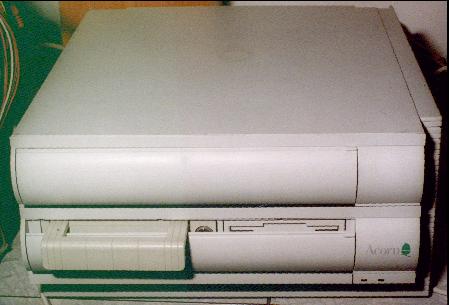
I want the Acorn RiscPC concept reborn!
Remember the Acorn RiscPC? The most expandable case design ever.
Start with a pizzabox with 1 CD drive 1 floppy drive. Then if you need more room, just add slices until you have behemoth server case!
Would this be possible? Of course, you would new motherboard standard, with riser plates for PCI.
Just a thouhgt. (Oh and the RiscPC was quiet, no fans whatsoever needed!) -
Re:Curious about Dvorak?
I'd like to point you at this applet. It calculates statistics on bodies of text for Qwerty, Dvorak, and Arensito layouts. I sent your comment through it and here are the stats:
Qwerty:
34.07% hit with the same hand (i.e. not alternating) with a finger distribution of:
7% 10% 16% 22% 21% 6% 11% 2%
Dvorak:
25.95% hit with the same hand (i.e. more alternating) with a finger distribution of:
6% 8% 11% 16% 16% 15% 12% 11%
That is, Dvorak alternates hands more and more evenly distributes finger use.
You'll see that statistics close to these hold for longer bodies of English text. Try pasting in a news article and you'll see. What do you have to back up your statements? -
Re:AllTheWeb _has_ one advantage
>Anyone remember archie ?
Not much, but I do remember ftpsearch.ntnu.no.
Old web addresses are fun, I wonder if this one still works: altavista.digital.com. -
Re:The way we got around it...A more sensible policy is
- No sound
- As soon as somebody needs your PC for anything but gaming, you free it immediately.
-
Screenshots of KDE 3.0
-
Screenshots of KDE 3.0
-
Another..
An an slightly different node, I found this link a while ago that discusses, in great depth, Sinclair Clones from teh late 1970's to the early 1990's.
Another thing I remember reading a long while ago was an article in "A+/Incider" magazine (and Apple II magazine) where the cover story was the giant headline "Red Apples"; in it they talked about a close of the Apple IIe that looked like a negative of the Apple IIe we know (black case, white keys), but otherwise was more or less the same -- compatible logic, just made somewhere else. I may even throw that coppy in my flatbed if there is enoguh interest.
If I had to guess, all but either very high-end or very early machine will be of the same designs as western counterparts, probably for engineering reasons because an engineer doesn't want to reinvent the wheel (or bitwise logic in this case) just to make machine to do word processing. -
Been going on for years in back bedrooms!
In the days of the Sinclair Spectrum or in the US, the Timex TS2048 the programs came on tape. Initially (especially for games by Ultimate-Play The Game [now RareWare]) the tape would contain a small BASIC loader, which then loaded the binary game code and executed it.
One of the skills was to load the BASIC program, break it (stop it running) and find out where the binary game code loaded. Then you'd possibly manually load the binary and start looking around at the code. Using your trusty Z80 opcode-list you'd look for places where counters were decreased (lives reduced?). You'd also look for places where initial values were set (number of lives/amount of energy). These were pretty easy to do at the start.
Once you knew the location, you could create a modified BASIC loader containing POKE statements. These would modify the contents of memory after the binary had loaded, but before it was executed. That way you could change the number of lives, or amount of energey or whatever..
Then things got a bit tricker. The developers would embed some machine code into the first line of the BASIC program. This special code would load the binary code, but using a different (non-standard) speed. This was the advent of the 'turbo-loader', the bane of most spectrum owners. With higher speed loading came the delicate balancing of the volume and tone controls on the tape desk. Get the controls wrong and the game would refuse to load.. or worse, the game would load all the way to the end, but crash either dumping you to the '(c) 1982 Sinclair Research' initial screen, or show flashing coloured blobs (sorta the equivalent of BSOD).
The other problem with turbo loaders was that you couldn't just load the binary on its own, you needed a special loader. Each game developer had their own set of routines for storing the binary data on tape. Some had cool things like counters, music or animated loading screens whilst you wait for the game to load.
People would 'decrypt' the developers loader and create their own programs to load the turbo-loader games and then hack them....
Anyway, I'm rambling..
..suffice to say, this isn't new. More complex, harder, maybe? More fun... hmmm. There's a big difference between doing this for a job, and doing it to get a namecheck in a crappy Sinclair Magazine! -
Been going on for years in back bedrooms!
In the days of the Sinclair Spectrum or in the US, the Timex TS2048 the programs came on tape. Initially (especially for games by Ultimate-Play The Game [now RareWare]) the tape would contain a small BASIC loader, which then loaded the binary game code and executed it.
One of the skills was to load the BASIC program, break it (stop it running) and find out where the binary game code loaded. Then you'd possibly manually load the binary and start looking around at the code. Using your trusty Z80 opcode-list you'd look for places where counters were decreased (lives reduced?). You'd also look for places where initial values were set (number of lives/amount of energy). These were pretty easy to do at the start.
Once you knew the location, you could create a modified BASIC loader containing POKE statements. These would modify the contents of memory after the binary had loaded, but before it was executed. That way you could change the number of lives, or amount of energey or whatever..
Then things got a bit tricker. The developers would embed some machine code into the first line of the BASIC program. This special code would load the binary code, but using a different (non-standard) speed. This was the advent of the 'turbo-loader', the bane of most spectrum owners. With higher speed loading came the delicate balancing of the volume and tone controls on the tape desk. Get the controls wrong and the game would refuse to load.. or worse, the game would load all the way to the end, but crash either dumping you to the '(c) 1982 Sinclair Research' initial screen, or show flashing coloured blobs (sorta the equivalent of BSOD).
The other problem with turbo loaders was that you couldn't just load the binary on its own, you needed a special loader. Each game developer had their own set of routines for storing the binary data on tape. Some had cool things like counters, music or animated loading screens whilst you wait for the game to load.
People would 'decrypt' the developers loader and create their own programs to load the turbo-loader games and then hack them....
Anyway, I'm rambling..
..suffice to say, this isn't new. More complex, harder, maybe? More fun... hmmm. There's a big difference between doing this for a job, and doing it to get a namecheck in a crappy Sinclair Magazine! -
Been going on for years in back bedrooms!
In the days of the Sinclair Spectrum or in the US, the Timex TS2048 the programs came on tape. Initially (especially for games by Ultimate-Play The Game [now RareWare]) the tape would contain a small BASIC loader, which then loaded the binary game code and executed it.
One of the skills was to load the BASIC program, break it (stop it running) and find out where the binary game code loaded. Then you'd possibly manually load the binary and start looking around at the code. Using your trusty Z80 opcode-list you'd look for places where counters were decreased (lives reduced?). You'd also look for places where initial values were set (number of lives/amount of energy). These were pretty easy to do at the start.
Once you knew the location, you could create a modified BASIC loader containing POKE statements. These would modify the contents of memory after the binary had loaded, but before it was executed. That way you could change the number of lives, or amount of energey or whatever..
Then things got a bit tricker. The developers would embed some machine code into the first line of the BASIC program. This special code would load the binary code, but using a different (non-standard) speed. This was the advent of the 'turbo-loader', the bane of most spectrum owners. With higher speed loading came the delicate balancing of the volume and tone controls on the tape desk. Get the controls wrong and the game would refuse to load.. or worse, the game would load all the way to the end, but crash either dumping you to the '(c) 1982 Sinclair Research' initial screen, or show flashing coloured blobs (sorta the equivalent of BSOD).
The other problem with turbo loaders was that you couldn't just load the binary on its own, you needed a special loader. Each game developer had their own set of routines for storing the binary data on tape. Some had cool things like counters, music or animated loading screens whilst you wait for the game to load.
People would 'decrypt' the developers loader and create their own programs to load the turbo-loader games and then hack them....
Anyway, I'm rambling..
..suffice to say, this isn't new. More complex, harder, maybe? More fun... hmmm. There's a big difference between doing this for a job, and doing it to get a namecheck in a crappy Sinclair Magazine! -
An even better solution
Fast Search & Transfer has developed a "whistle sreach". Just whistle a few notes from the song you want, and their searchengine finds the songs mathcing.
I have tried it and can confirm it works really well.
Story from newscientist.com here. (cache)
Also a article from GEMENI here. -
While we're at it
Why not discuss another interesting article, this time about The benefits of Object Oriented Programming Languages
Sheesh.
Kakemann -
Re:Why can't anyone see the implications of this?
I really like the idea, and Kamen appears to be targetting a good marketplace - with companies like the US Postal service and FedEx, or anyone with big warehouses.
This is the thing that could make or break the Segway - another wise it could turn into just another Sinclair C5.
Remember those? I hope that these things take off - but then again, if everyone was so concerned about turning a 30 minute walk into a 10 minute ride, why are the streets of the World not packed with bicycles (or electic bikes) like we see on the streets of Beijing?
-
Weird and Wonderful Wheelman
-
ArtMLUntil solve the grand "context problem", you can't have creativity.
It's obvious that we need a way to describe the output. XML is the answer.
If you use the hair tag inside the kitsch tag, then the program goes to get hair renderings from the 50s, 60s, and 70s. Let's not forget the all-important self-referential (a slfref) tag. Or the critical distance tag (a refref), which is different from the META tag. ArtML allows the artist to transmit his intent as well as the formal aspects of his art (which are contained in separate stylesheets).In the future, all artist's intent will be searchable on the net. For instance, a search using the sheep,anatomy,warhol, and plastic tags could turn up Damian Hirst. Thanks to Boolean logic and the descriptive tags of XML, we'll be able to find art that appeals to us while avoiding art that does not. This will also allow programs such as Aaron to understand context and create new art. Will this make Aaron a follower? No, Aaron will have some success in predicting new trends and styles by using a similar algorithm to PubGene.
Context problem solved. You could even subscribe to a selection of artist programs through
Art At Home -
Doh - just when I found the hidden setting
Gone now? Damn, I just changed the hidden setting "Annoy me with that sodding paper clip" from "Contstanly" to "When I least expect it". You're saying I can't use it? That's the last drop, I'm dropping MS Office!
-
Re:Suicide Note - Screenshots
I liked the screenshot version, part of the Things You Wish Your Computer Had series that circled a while back.
Fittingly, I got it as a MS Word doc, and saved it onto http://www.stud.ntnu.no/~reneky/hmmm/hmm.htm. If you haven't seen it go ahead - it's good -
Re:Suicide Note - Screenshots
I liked the screenshot version, part of the Things You Wish Your Computer Had series that circled a while back.
Fittingly, I got it as a MS Word doc, and saved it onto http://www.stud.ntnu.no/~reneky/hmmm/hmm.htm. If you haven't seen it go ahead - it's good -
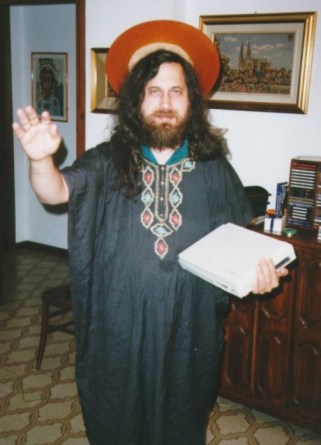
Re:How about "GNU"There's already a Church of Emacs which of course operates all over the world. It has a song sung by its leader, Saint IGNUcius. "I bless you, my computer, my child!"
And remember... Lensmen eat Jedi for breakfast.
-
structured markup languageswysiwyg is handy... but anything bigger than a few lines of code and you'll start to feel limited if you stay in bash instead of going for c/c++... same with documents...
I expect any significant writing I do to be in a structured markup language like XML. Most of our departmental documentats are in DocBook. They've been revised several times; they've been run through several revisions of stylesheets; they have not been revised for the sake of style.
TeX's typesetting is great, but the markup language is mostly presentational. LaTeX is okay, but I expect (SG|X)ML + (CSS|XSL|DSSL) to be a better solution. I want a TeX-like back end to CSS and/or XSL (FO).
It's sad that all this time after the introduction of TeX, Adobe InDesign can advertise paragraph-level justification as a new feature. (Although I am intrigued by the supposed use of the hz program.)
-
Elite!I saw this article a few days ago.
It's great that it metioned one of the all-time great games from the 8-bit days: Elite. It's a game that really started a genre, and nothing has quite surpassed it. Many versions were produced. Frontier Developments is now making an Elite 4. (Elite 2 and 3 were Frontier: Elite 2 and Frontier: First Encounters respectively).
The game fired the imagination, so much so there's quite a lot of Frontier Elite Universe fiction out there on various websites (including my own), the newsgroup alt.fan.elite, plus even a JAVA Spectrum Emulator running Elite out there on the Web. The 8-bit days really were the new frontier too, where code bloat could not exist, and super-tight coding was a measure of a software house's superiority, rather than MICROS~1's share price.
I fondly remember the BBC Micro too. A great machine: see the website, the BBC Lives! for emulators and the background of this superb machine.