Slashdot Mirror
Domain: nwsource.com
Stories and comments across the archive that link to nwsource.com.
Stories · 399
-
Mario Segale, Namesake For Nintendo's Mascot, Dies At 84 (arstechnica.com)
Iwastheone shares a report from Ars Technica: Mario Segale, the Seattle real estate and construction business owner who inspired the name for Nintendo's famous mascot, passed away on October 27 according to reports from The Seattle Times and The Auburn Reporter. He was 84 years old. Segale owned the business park housing Nintendo's American arcade operation in the early '80s, when the company was busy converting thousands of disused Radarscope cabinets to play Donkey Kong. At the time, Nintendo of America President Minoru Arakawa and other executives were trying to come up with an Americanized name for the game's player avatar, who was still referred to as "Jumpman" at that point (a name that appears on early Donkey Kong cabinet art). As the story goes, when Segale came to Arakawa to demand payment for a late rent bill, inspiration struck.
While the broad strokes of Segale's role in Mario's naming remain consistent, the particulars can change with the retelling. David Sheff's seminal Nintendo history Game Over suggests the executives exclaimed "Super Mario!" after Segale's visit in 1981 (though the book misspells his name "Segali"). As Benj Edwards notes in an in-depth 2010 exploration of the tale, though, the "Super" descriptor for the character wouldn't become common until the release of Super Mario Bros. in 1985. Other retellings over the years go so far as to suggest that the "Super" came from Segale's role as "superintendent" of the building, but these stories offer little in the way of direct evidence. Ars mentions a 1993 Seattle Times article that quotes Segale as joking, "You might say I'm still waiting for my royalty checks." -
Why America's Obsession With STEM Education Is Dangerous
HughPickens.com writes According to an op-ed by Fareed Zakaria in the Washington Post, if Americans are united in any conviction these days, it is that we urgently need to shift the country's education toward the teaching of specific, technical skills, expand STEM courses (science, technology, engineering and math) and deemphasize the humanities. "It is the only way, we are told, to ensure that Americans survive in an age defined by technology and shaped by global competition. The stakes could not be higher." But according to Zakaria the dismissal of broad-based learning, however, comes from a fundamental misreading of the facts — and puts America on a dangerously narrow path for the future.
As Steve Jobs once explained "it's in Apple's DNA that technology alone is not enough — that it's technology married with liberal arts, married with the humanities, that yields us the result that makes our hearts sing." Zakaria says that no matter how strong your math and science skills are, you still need to know how to learn, think and even write and cites Jeff Bezos' insistence that writing a memo that makes sense is an even more important skill to master. "Full sentences are harder to write," says Bezos. "They have verbs. The paragraphs have topic sentences. There is no way to write a six-page, narratively structured memo and not have clear thinking." "This doesn't in any way detract from the need for training in technology," concludes Zakaria, "but it does suggest that as we work with computers (which is really the future of all work), the most valuable skills will be the ones that are uniquely human, that computers cannot quite figure out — yet. And for those jobs, and that life, you could not do better than to follow your passion, engage with a breadth of material in both science and the humanities, and perhaps above all, study the human condition." -
Washington State To Allow Voter Registration Over Facebook
An anonymous reader writes "The Associated Press reports that the state of Washington will soon have an application available on its Facebook page that will let residents register to vote. Washington and other states already allow online registration, but this is the first time it will be allowed over Facebook. The state's co-director of elections, Shane Hamlin, said, 'In this age of social media and more people going online for services, this is a natural way to introduce people to online registration and leverage the power of friends on Facebook to get more people registered.' Facebook won't have access to the State's database, and Hamlin says Facebook won't collect any of the personal information with which it interacts." -
Not Just Apple, How Microsoft Sidestepped Billions In State Taxes
reifman writes "Apple's not the only company to save billions in taxes through Nevada as The New York Times reported yesterday. Here's how Microsoft's saved $4.37 billion in tax payments to Washington State and how it's led indirectly to $4 billion in K-12 and Higher Education cuts since 2008. 18% of University of Washington freshman are now foreigners (because they pay more) up from 2% six years ago. Washington State ranks 47th nationally in 18-24 yo college enrollment and 48th in K-12 class size. This hasn't stopped the architect of the company's Nevada tax dodge from writing in The Seattle Times: 'it's [Washington] state's paramount duty to provide for the public education of all children. Unfortunately, steady declines in public resources now threaten our ability to live up to that commitment.' Yes, indeed." -
The Engineer Who Stopped Airplanes From Flying Into Mountains
New submitter gmrobbins writes "The Seattle Times profiles avionics engineer Don Bateman, whose Honeywell lab in Redmond, Washington has for decades pioneered ground proximity warning systems. Bateman's innovations have nearly eliminated controlled flight into terrain by commercial aircraft, the most common cause of fatal airplane accidents." -
The Painkiller That Saves Money But Costs Lives
Hugh Pickens writes "Over 2,000 patients have died since 2003 in Washington State alone by accidentally overdosing on a commonly prescribed narcotic painkiller that costs less than a dollar a dose and the deaths are clustered predominately in places with lower incomes because Washington state has steered people with state-subsidized health care — Medicaid patients, injured workers and state employees — to methadone because the drug is cheap. Methadone belongs to a class of narcotic painkillers, called opioids, that includes OxyContin, fentanyl and morphine. Within that group, methadone accounts for less than 10 percent of the drugs prescribed — but more than half of the deaths and although Methadone works wonders for some patients, relieving chronic pain from throbbing backs to inflamed joints, the drug's unique properties make it unforgiving and sometimes lethal. 'Most painkillers, such as OxyContin, dissipate from the body within hours. Methadone can linger for days, pooling to a toxic reservoir that depresses the respiratory system,' write Michael J. Berens and Ken Armstrong. 'With little warning, patients fall asleep and don't wake up. Doctors call it the silent death.'" -
Civilian Use of Drone Aircraft May Soon Fly In the US
An anonymous reader sends this excerpt from the Seattle Times: "Drone aircraft, best known for their role in hunting and destroying terrorist hideouts in Afghanistan and Pakistan, may be coming soon to the skies near you. Police agencies want drones for air support to find runaway criminals. Utility companies expect they can help monitor oil, gas and water pipelines. Farmers believe drones could aid in spraying crops with pesticides. 'It's going to happen,' said Dan Elwell, vice president of civil aviation at the Aerospace Industries Association. 'Now it's about figuring out how to safely assimilate the technology into national airspace.' That's the job of the Federal Aviation Administration, which plans to propose new rules for using small drones in January, a first step toward integrating robotic aircraft into the nation's skyways." -
Valve Boss Expects Apple To Challenge Game Consoles
Speaking at a panel during the WTIA TechNW conference, Valve CEO Gabe Newell had some interesting things to say about his expectations for the console business. Quoting: "The living room is the domain of the consoles, and its ability to exist independently from the other platforms is gone, Newell said. Newell expects Apple to disrupt the living room platform with a new product that will challenge consoles, although he doesn't have any particular knowledge of that new product. 'I suspect Apple will launch a living room product that redefines people's expectations really strongly and the notion of a separate console platform will disappear,' he said. Newell reiterated his concerns about a closed model being the 'wrong philosophical approach' but one that people will emulate because of the success of Apple and Xbox Live." -
How Do You Educate a Prodigy?
Nethead writes "When he was 8 years old, Gabriel See got a score on the math part of the SAT that would be the envy of most high-school seniors. When he was 10, he worked on T-cell receptor research at the Fred Hutchinson Cancer Research Center. He's built a Genomic Lab Liquid Handling System out of Legos. He's studied chaos theory, string theory, quantum mechanics and nuclear science. He's 13 now. How do you fit him into the American school system?" -
Court to Decide If Man Can Keep His Moon Rock
Joe Gutheinz, a former senior investigator for NASA's Office of Inspector General, has made it his goal to collect all 230 moon rocks presented by the US to governments around the world, and put them in a museum. Deadliest Catch Captain Coleman Anderson wants to keep his little piece of the moon. Anderson says he found the rock in the trash mixed with debris following a fire at an Anchorage museum in 1973. He's kept it as a good luck charm ever since. "Our astronauts and their descendants are not permitted to have an Apollo 11-era moon rock to sell for their own enrichment and neither should a private citizen who acquired one in a less-noble manner," Gutheinz said. An Alaskan judge will now decide who legally owns the rock. -
United Airlines Passengers Stranded By Computer Outage
From reader Peter McDermott comes word of a computer outage with effects to dwarf those of the one that stranded thousands of US Airways passengers last week. This time, it's United Airlines' systems that are out of commission and unable to handle passenger reservations, leaving passengers stranded all over the U.S. According to Peter, experiencing the resultant delays first-hand at Dulles Airport near Washington, D.C., United planes are being sent on — along with their passengers' luggage — to the cities from which they're to leave tomorrow morning, in anticipation of the computer system being fixed in the interim. -
Teen Fakes Pregnancy for School Project
For six months, 17-year-old Gaby Rodriguez endured stares, gossip and ridicule, all for a school project. As part of a presentation called "Stereotypes, Rumors and Statistics," Gaby pretended to be pregnant for most of her senior year. From the article: "Only a handful of people — her mother, boyfriend and principal among them — knew Gaby was pretending to be pregnant for her senior project, a culminating assignment required for graduation. Her teachers and fellow students, except for her best friend, didn't realize they were part of a social experiment." -
MS Wants Laws To Block Products Made By Software Pirates
kaptink writes with this quote from Groklaw: "Microsoft seems to be trying to get its own personal unfair competition laws passed state by state, so it can sue US companies who get parts from overseas companies who used pirated Microsoft software anywhere in their business. The laws allow Microsoft to block the US company from selling the finished product in the state and compel them to pay damages for what the overseas supplier did. So if a company overseas uses a pirated version of Excel, let's say, keeping track of how many parts it has shipped or whatever, and then sends some parts to General Motors or any large company to incorporate into the finished product, Microsoft can sue not the overseas supplier but General Motors, for unfair competition. So can the state's Attorney General. I kid you not. For piracy that was done by someone else, overseas. The product could be T shirts. It doesn't matter what it is, so long as it's manufactured with contributions from an overseas supplier, like in China, who didn't pay Microsoft for software that it uses somewhere in the business. It's the US company that has to pay damages, not the overseas supplier." -
WA Election To Try Online Voting
AuMatar writes "According to the Seattle Times, the King Conservation District is going to allow online voting to combat chronic low turnouts. You can already view the voting portal. As a citizen of WA seriously concerned with politics, anything that completely removes a paper trail like this scares me. Luckily, this is probably the least important election in the state. I wonder if anyone will hack the election so 300% of voters vote for Firefly or Stephen Colbert or something." -
Boeing CEO Says Outsourcing Didn't Pay
frank_adrian314159 writes "The Seattle Times reports that Boeing's CEO is saying that the cost overruns on the 787 'Dreamliner' were greatly exacerbated by the company's heavy use of outsourcing. Although it is now fairly well accepted that outsourcing provides little cost savings and what cost savings there are often get spent in increased management costs and rework, the outsourcing drive goes on. It's nice to see a major industry figure saying that all is not so rosy as the MBAs would have us think." -
Next Generation of Windows To Run On ARM Chip
Hugh Pickens writes "Sharon Chan reports in the Seattle Times that at the Consumer Electronics Show in Las Vegas, Microsoft showed the next generation of Windows running natively on an ARM chip design, commonly used in the mobile computing world, indicating a schism with Intel, the chip maker Microsoft has worked with closely with throughout the history of Windows and the PC. The Microsoft demonstration showed Word, PowerPoint and high definition video running on a prototype ARM chipset made by Texas Instruments, Nvidia. 'It's part of our plans for the next generation of Windows,' says Steve Sinofsky, president of Windows division. 'That's all under the hood.' According to a report in the WSJ, the long-running alliance between Microsoft and Intel is coming to a day of reckoning as sales of tablets, smartphones and televisions using rival technologies take off, pushing the two technology giants to go their separate ways. The rise of smartphones and more recently, tablets, has strained the relationship as Intel's chips haven't been able to match the low power consumption of chips based on designs licensed from ARM. Intel has also thumbed its nose at Microsoft by collaborating with Microsoft archrival Google on the Chrome OS, Google's operating system that will compete with Windows in the netbook computer market. 'I think it's a deep fracture,' says venture capitalist Jean-Louis Gassee regarding relations between Microsoft and Intel." -
Scientists Propose One-Way Trips To Mars
vortex2.71 writes "Invoking the spirit of Star Trek in a scholarly article entitled 'To Boldly Go,' two scientists contend human travel to Mars could happen much more quickly and cheaply if the missions are made one-way. They argue that it would be little different from early settlers to North America, who left Europe with little expectation of return. 'The main point is to get Mars exploration moving,' said Dirk Schulze-Makuch of Washington State University, who wrote the article in the latest Journal of Cosmology with Paul Davies of Arizona State University. The colleagues state — in one of 55 articles in the issue devoted to exploring Mars — that humans must begin colonizing another planet as a hedge against a catastrophe on Earth." -
Amazon Prevails In State Sales Tax Dispute, Thus Far
snsh writes "A US judge has ruled for Amazon.com (PDF) against North Carolina's request to turn over the names of its customers to state tax officials. The ruling was focused on privacy grounds, so the state can still re-request less detailed sales data which does not identify items purchased." Reader arbitraryaardvark adds a link to The Volokh Conspiracy's take on the decision. -
Heroic Engineer Crashes Own Vehicle To Save a Life
scottbomb sends in this feel-good story of an engineer-hero, calling it "one of the coolest stories I've read in a long time." "A manager of Boeing's F22 fighter-jet program, Innes dodged the truck, then looked back to see that the driver was slumped over the wheel. He knew a busy intersection was just ahead, and he had to act fast. Without consulting the passengers in his minivan — 'there was no time to take a vote' — Innes kicked into engineer mode. 'Basic physics: If I could get in front of him and let him hit me, the delta difference in speed would just be a few miles an hour, and we could slow down together,' Innes explained." -
Narco-Blogger Beats Mexico Drug War News Blackout
An anonymous reader writes "An anonymous, twentysomething blogger is giving Mexicans what they can't get elsewhere — an inside view of their country's raging drug war. Operating from behind a thick curtain of computer security, Blog del Narco in less than six months has become Mexico's go-to Internet site at a time when mainstream media are feeling pressure and threats to stay away from the story. Many postings, including warnings and a beheading, appear to come directly from drug traffickers. Others depict crime scenes accessible only to military or police." -
Amazon Kindle Fails First College Test
theodp writes "If Amazon hoped for honest feedback when it started testing the Kindle DX on college campuses last fall, writes Amy Martinez, it certainly got its wish. Students pulled no punches telling Amazon what they thought of its $489 e-reader. But if Amazon also hoped the Kindle DX would become the next iPhone or iPod on campuses, it failed its first test. At the University of Virginia, as many as 80% of MBA students who participated in Amazon's pilot program said they would not recommend the Kindle DX as a classroom study aid (though more than 90% liked it for pleasure reading). At Princeton and Reed, students complained they couldn't scribble notes in the margins, easily highlight passages, or fully appreciate color charts and graphics. 'The pilot programs are doing their job — getting us valuable feedback,' said Amazon spokesman Drew Herdener. Martinez notes that Reed, Seton Hall, and other colleges plan to test the iPad in the fall to see if it can do better." -
Microsoft's Free, Online Version of Office To Premiere This Week
walterbyrd writes "Microsoft will offer an online version of Office 2010 for free. I have to wonder, will this remain free indefinitely? Or is Microsoft just trying to firmly establish its OOXML standard, then go back to business as usual?" Probably a harder sell after Google's acquisition of DocVerse. -
IBM Claims Breakthrough Energy-Efficient Algorithm
jitendraharlalka sends news of a claimed algorithmic breakthrough by IBM, though from the scant technical detail provided it's hard to tell exactly how important the development might be. IBM apparently presented its results yesterday at the Society for Industrial and Applied Mathematics conference in Seattle. The breathless press release begins: "IBM Research today unveiled a breakthrough method based on a mathematical algorithm that reduces the computational complexity, costs, and energy usage for analyzing the quality of massive amounts of data by two orders of magnitude. This new method will greatly help enterprises extract and use the data more quickly and efficiently to develop more accurate and predictive models. In a record-breaking experiment, IBM researchers used the fourth most powerful supercomputer in the world... to validate nine terabytes of data... in less than 20 minutes, without compromising accuracy. Ordinarily, using the same system, this would take more than a day. Additionally, the process used just one percent of the energy that would typically be required." -
"Green" Ice Resurfacing Machines Fail In Vancouver
lurking_giant writes "The Seattle Times is reporting that the Men's 500 meter speed-skating competition was delayed more than an hour Monday evening by the breakdown of the two ice grooming machines at the skating oval. The real story is that the machines that failed were the latest state-of-the-art 'Resurfice Fume-Free Electric Groomers' leased to the Olympics committee. An old, propane-powered Zamboni had to be brought out to fix the ice. This makes two nights in a row with ice resurfacing machine failures. If you're going to spend twice as much on electric devices to replace non-green designs, at least test the things first." -
Get a Job Being a "Mystery Worshipper"
Jim Henderson, a 62-year-old evangelical Christian, wants to know what people who aren't Christians think of church services, so he created ChurchRater.com. Now he just needs non-Christian "Mystery Worshipers" to go to any church and rate their experience. His Craigslist ad reads in part: "Need people who aren't Christians to review church service...Who: Age 20-35. Do not currently believe Jesus Christ is God. Not mad at Christians. What: Attend a church service (anonymously) and complete a survey." The going rate for a church rater is $50. Henderson says, "We say it's our mission to reach out, including to nonbelievers. So why would we not want them to tell us what they think of our efforts to influence, change or even convert them?" -
Comcast Launches Broadband Meter
nlawalker writes "Beginning on Tuesday, January 12, Comcast high-speed internet users in Washington state will have access to an online tool that displays their bandwidth usage for the most recent three calendar (not billing) months of usage, including the current month. Washington is the second market to receive access to the tool, following its introduction in Portland. 'For the fraction of less than 1 percent of our customers who are concerned about exceeding our excessive use threshold, we believe this meter will help them monitor and calibrate their usage,' said spokesman Steve Kipp. Perhaps those who aren't using 250GB a month should take it as a challenge." -
Bloodmobile Offers Beer To Blood Donors
In college I found the best time to drink was right after giving blood, and it appears that the Cascade Regional Blood Services in Tacoma, Washington agrees. The blood center has launched a "Give blood, get beer" promotion. Donors who are at least 21 years old are given a coupon for a free pint of beer at a participating pub or restaurant. -
Legal War For WA State Sunshine Law
joeszilagyi writes "In a major battle in Washington State, anti-gay rights groups created and got R-71 on the 2009 election ballot. This is a public initiative to put same-sex civil unions up for public vote. The real legal war then erupted: activists created WhoSigned.org to take advantage of WA state's Public Records Act, and put the names of all people who publicly endorsed R-71 on a public, SEO-optimized website. Lawsuits quickly followed, and today it reached the United States Supreme Court, in a matter of months. The records appear to have always been public, but have only been available in digital form since 2006. An assault on civil rights, an assault on marriage, or an assault on sunshine laws and freedom of information?" -
No App Store For Microsoft's Zune HD
Xerfas writes 'Microsoft's Zune HD, set to go on sale Tuesday, will not feature an open application store like its competitor the iPod Touch. It will come with some unique features, though, like an HD radio tuner, and with software that has been well-received by users. Those capabilities will determine whether the ZuneHD sells well — and whether Microsoft decides to keep selling its own music player, said Matt Rosoff, an analyst at Directions on Microsoft.' The Zune marketing manager was quoted in the Seattle Times on whether the Zune would open up for 3rd-party apps, and he gave a response of such mind-numbing PR-speak that John Gruber of Daring Fireball was moved to provide this English translation: "No, because our mobile strategy is a convoluted mess." -
Bolivia Is the Saudi Arabia of Lithium
tcd004 writes "You can literally scrape valuable lithium off the ground of many Bolivian salt flats. The country is poised to be the center of world lithium battery production, reaping the benefit of the metal's skyrocketing value. 'The US Geological Survey says 5.4 million tons of lithium could potentially be extracted in Bolivia, compared with 3 million in Chile, 1.1 million in China and just 410,000 in the United States. ... Ailing automakers in the United States are pinning their hopes on lithium. General Motors next year plans to roll out its Volt, a car using a lithium-ion battery along with a gas engine. Nissan, Ford and BMW, among other carmakers, have similar projects.' However, the government fears foreign countries might exploit their natural resources, so for the time being, the salt flats remain untouched." -
$81 Billion Gas Tab
denobug writes "Ever wonder how expensive a tank of gas could get? How about $81 billion! Juan Zamora had his PayPal debit card maxed out after a routine gas fill up, the transaction cost him $81,400,836,908. Makes me wonder whether the glitch is the debit card transaction system or in PayPal's system." -
Has Microsoft's Patent War Against Linux Begun?
Glyn Moody writes "Microsoft has filed a suit against TomTom, 'alleging that the in-car navigation company's devices violate eight of its patents — including three that relate to TomTom's implementation of the Linux kernel.' What's interesting is that the intellectual property lawyer behind the move, Horacio Gutierrez, has just been promoted to the rank of corporate vice president at Microsoft. Is this his way of announcing that he intends going on the attack against Linux?" -
A Real Bill Gates Rant
lou ibmix XI submitted an email written by Bill Gates a few years ago and turned over to the feds as part of the government's antitrust case. Great quotes like 'Someone decided to trash the one part of Windows that was usable?' and 'The lack of attention to usability represented by these experiences blows my mind.' We like to think of him as an abstract, but I think this is interesting stuff. Also, this might seem familiar. Oops. -
1-Click Smacked Down Again, While Reexam Languishes
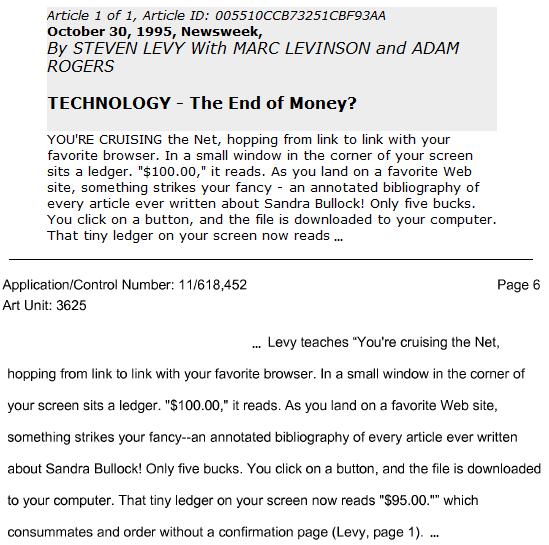
theodp writes "Pressed on Amazon's 1-Click patent, then-USPTO Chief Q. Todd Dickinson got testy: "I make this challenge all the time. If you're aware of prior art out there that invalidates a patent that is existing, file a re-examination. We'll be happy to take a look at it." Really? It's been 3+ years since unemployed actor Peter Calveley submitted prior art that triggered a USPTO reexamination of the 1-Click patent. Still no 'final answer' from the USPTO. To put things in perspective, 1-Click inventor Jeff Bezos once proposed a three-year lifespan for patents (later retracted), let alone patent reexams. In the meantime, other patent examiners have repeatedly smacked down 1-Click — the latest (non-final) rejection was issued on Feb. 10th with Sandra Bullock's help." -
Washington State Wants DNA From All Arrestees
An anonymous reader writes in to say that "Suspects arrested in cases as minor as shoplifting would have to give a DNA sample before they are even charged with a crime if a controversial proposal is approved by the Legislature. "It is good technology. It solves crimes," claims Don Pierce, executive director of the Washington Association of Sheriffs and Police Chiefs. Under the bill, authorities would supposedly destroy samples and DNA profiles from people who weren't charged, were found not guilty or whose convictions were overturned. Others believe that this is just another step in the process to build a national DNA database with everyone in it." -
Microsoft Lays Off Entire Flight Sim Team
Dutch Gun writes "Microsoft has just laid off the entire Flight Simulator development team. This continues a long-running trend of terminating or severing relationships with game development studios, such as the Bungie split, FASA, or the closure of Ensemble Studios. While one would presume that core Xbox development is not currently in jeopardy after Microsoft spent up to a billion dollars to pay for Xbox 360 repairs and salvage its reputation with gamers, does this signal a reversal from Microsoft's recent focus on internal game development? And what are its plans for Flight Simulator, a twenty-seven-year product with an extremely loyal user-base and a multitude of externally developed add-ons?" -
USAF Seeks Air Force One Replacement
Tyketto writes "The United States Air Force has taken the first public step in the search for a replacement of the Boeing VC-25, also known as Air Force One, saying it is no longer cost effective to operate and modernize the two 19-year-old VC-25s, which are converted Boeing 747-200s. Airbus has already submitted data for the A380, and while Boeing has had the Air Force One contract for nearly 50 years, delays with the Boeing 787 Dreamliner and Boeing 747-8, as well as the KC-X Tanker competition, may see the USAF looking to Europe for its next presidential aircraft." -
Microsoft Knew About Xbox 360 Damaging Discs
Kelly writes "An unsealed document in a Washington lawsuit filed last week at Seattle, Microsoft was well aware that the Xbox 360 was prone to damaging game discs even before the console was introduced in November 2005. Microsoft had three solutions for solving the issue, but all three solutions were rejected due to technical concerns or on the basis of cost. Microsoft settled on a cost-free fourth solution: a warning was added to Xbox 360 manual, which essentially placed the blame on users instead of the hardware." The scratching-disks problem was mentioned a few years back, too. I wonder whether more people would prefer a slight discount on the price of a console to the ability to reorient it while a disk was playing inside. -
Microsoft Knew About Xbox 360 Damaging Discs
Kelly writes "An unsealed document in a Washington lawsuit filed last week at Seattle, Microsoft was well aware that the Xbox 360 was prone to damaging game discs even before the console was introduced in November 2005. Microsoft had three solutions for solving the issue, but all three solutions were rejected due to technical concerns or on the basis of cost. Microsoft settled on a cost-free fourth solution: a warning was added to Xbox 360 manual, which essentially placed the blame on users instead of the hardware." The scratching-disks problem was mentioned a few years back, too. I wonder whether more people would prefer a slight discount on the price of a console to the ability to reorient it while a disk was playing inside. -
HP's Fury At Vista Capable Downgrade
More documents are coming out in court proceedings over the Vista Capable debacle. Internetnews.com has good coverage of HP's fury over Microsoft lowering the requirements for a Vista Capable sticker, at Intel's request. "Intel officials may have been pleased that Microsoft lowered standards for obtaining the company's Windows Vista Capable logo program sticker, but the same can't be said about HP's execs. 'I can't be more clear than to say you not only let us down by reneging on your commitment to stand behind the [device driver model] requirement, you have demonstrated a complete lack of commitment to HP as a strategic partner and cost us a lot of money in the process,' said one e-mail from Richard Walker, the senior vice president of HP's consumer business unit, to [Microsoft executives]." PCPro.co.uk follows the trail of accusatory emails inside Microsoft from there: "HP's email prompted then Microsoft co-President, Jim Allchin, to send a furious email of his own to company CEO Steve Ballmer. Allchin's email suggests the decision to lower the requirements was made in his absence by Ballmer, following 'a call between you and Paul [Otellini, Intel CEO].' 'I am beyond being upset here,' Allchin wrote to Ballmer. 'What a mess. Now we have an upset partner, Microsoft destroyed credibility [sic], as well as my own credibility shot.' Ballmer, in turn, blamed another Microsoft executive, Will Poole, in a rather erratically typed reply to Allchin." -
Spammer Perjury is Worth Prosecuting
Slashdot regular Bennett Haselton summarizes his essay by saying "Spammers really do lie more often under oath than other parties in court (surprise). Judges and prosecutors could promote respect for the law by cracking down on it, and maybe make a dent in spam in the process." Read on to learn of his experiences with (shocking!) spammers who lie in court.I'm sure everyone feels like their opponents in court are the most reprehensible liars that ever walked the face of the Earth. But these instances seem unusually clear-cut even for a courtroom:
-
When I sued one Ohio company for sending me spam, they sent a letter to me (and, when that didn't work, to the court) claiming that someone had dropped a business card in their box at a trade show with an e-mail address one letter different from mine, and they must have mis-read the address when typing it in. They didn't know that after I first got their spam, I called them pretending to be an interested customer, and tape-recorded a conversation with their advertising manager, pretending to be impressed and asking him how he did it (I was in Arizona, so it was legal to tape the call). He admitted that he used a program to scrape e-mail addresses from Web pages into a list and spam them from his desktop.
-
A spammer who lived in Washington appeared in court and claimed that he had never sent the spam in question and wouldn't know how. I then produced a tape recording of another conversation in which I had talked to him on the phone, again pretending to be an interested customer, and he talked about sending the mails from a server in China to make it harder for people in the U.S. to block them.
-
One company called "Lions Pride Enterprises" actually sent a representative from out of state to tell the judge, "I can tell you, under penalty of perjury, that we looked up the address bhas (at) speakeasy.net in our records, and verified that he had signed up for our list via confirmed-opt-in" (this was right after he explained to the judge, more or less accurately, what confirmed-opt-in meant). Except the mail hadn't been sent to bhas (at) speakeasy.net, the headers showed it was sent to bennett (at) peacefire.org and then forwarded to bhas (at) speakeasy.net. Presumably the spammer just looked at the first address they could find in the headers and assumed that's the one they had mailed, and claimed that address had "opted in." (Much later, this same company apparently branched out into infecting people with spyware.)
-
A spammer from Michigan called in to the court hearing by phone, to defend against charges that he'd sent me a spam advertising credit card processing services, and claimed, "I don't even sell merchant accounts." (He lost, due to inconsistencies in his story -- the judge in that case was unusually tech-savvy.) A few weeks later, the same guy sent me another merchant account spam, so I sued him again, and this time he called in to the court hearing (with a different judge) and admitted that he'd sent the spam, but claimed it was legal. I tried to challenge his credibility on the grounds that he'd testified under oath earlier that he "didn't even sell merchant accounts," but the judge said I wasn't allowed to bring that up.
Meanwhile, I've sat through dozens of other people's Small Claims cases, and I've never seen anyone in a non-spammer case get caught really, brazenly lying under oath. Of course, it always seems more egregious when it's your opponent -- but I probably would have noticed if someone had gotten tripped up by a physical document or a recording of their own voice.
The traditional cost-benefit analysis of prosecuting people who lie under oath in a civil trial is that it's just not worth it. The King County Prosecutor's office responded to my inquiry to say they could not recall any instances of someone prosecuted for perjury committed in a civil case. It is not true, by the way, that civil perjury is never prosecuted — when this assumption was making the rounds in 1998 during the Clinton perjury controversy, Professor Stephen Gillers of NYU published a list of counterexamples -- but he conceded in an e-mail that it's nevertheless highly unlikely. Perhaps this makes sense for most trials, where parties come from a general population that includes some honest people and some dishonest people, and even dishonest people often just bend the truth to a degree that outright lying would be hard to prove. (Although I still think it's possible that the costs of prosecuting people who lie under oath in civil cases, might still be outweighed by the benefits of having everyone be scared into being a little more truthful in court proceedings.)
But spammers are different. In the U.S., all spammers are liars — either they are lying to their hosting provider about what they're doing, or, if they have a secret agreement with their provider to avoid getting kicked off, they are complicit in their provider lying to the rest of the world by claiming that they don't allow spam to emanate from their network. (I'm assuming that 100% of U.S. providers at least claim not to allow the sending of spam. This may not be true of the entire world.) Those lies in themselves can't always be punished in court — I can't sue a spammer for lying to their service provider — but I think that courts just haven't realized that all spammers are liars to some degree, and they're more likely than average to lie under oath. This may make the cost-benefit analysis different in the case of prosecuting spammers who get caught lying. You wouldn't need a "spammer perjury law"; there are already laws against perjury, if judges wanted to enforce them.
Courts could start with deterrents that don't cost anything. All judges start out their Small Claims hearings by laying out the rules. Some of them include some very stern admonitions about parties not interrupting each other or the judge (one judge, who possibly had a bad morning, started the afternoon session by threatening to have anyone thrown in jail who argued with him). But I've never seen a judge say anything about being strictly required to tell the truth under oath, with penalties for lying that theoretically include jail time. And if someone does get caught lying, the judge could reprimand them as strongly as possible and stop just short of recommending a criminal prosecution. "Oh, wow," you're laughing, "a stern reprimand! That'll teach them!" But that's what judges do to people who interrupt the judge or each other, and it does get people's attention.
In the examples above, what was surprising was not that the spammers lied to the court but that the judges seemed so blasé about it. In the first case, I had gotten spammed by an Ohio company called SAY Security. After I filed the Small Claims suit and served the papers on them in the mail along with a copy of the spam, I got an e-mail from the owner, Jason Szuch, claiming that they had received a business card at a trade show with 'bnas (at) speakeasy.net' handwritten on it, and accidentally replaced the 'n' with an 'h', and that's how I had gotten their mail. They later made the same claim in a letter to the judge. At the trial, SAY Security didn't show up, so I first pointed out that the e-mail had been sent to bennett (at) peacefire.org and automatically forwarded to bhas (at) speakeasy.net, so it was another case of the spammer mis-reading what address it was sent to, and coming up with a story after the fact. I also had a recording of a conversation with SAY Security's advertising manager, in which he explained how he used a program called Email Extractor to scrape e-mails from Web pages and send the ads.
At that point, the judge thought he had me: You're not allowed to record phone calls in Washington without the consent of all parties. I told him that I knew this, which is why I had made the call and recorded it while I was visiting my Mom in Arizona, which has no such law (and neither does Ohio, which was where the other party was — in order to secretly tape a phone call, it has to be legal in both the caller's state and the call recipient's state). The judge still said I couldn't use it as evidence in Washington. This raises an interesting question. My understanding is that the rules of evidence in Washington don't say "You can't use a secretly taped phone call as evidence." They say, on the one hand, "You can't secretly tape a phone call in Washington," and on the other hand, "You cannot use evidence that was obtained illegally" — but if the call was taped in Arizona and then brought to Washington, it wasn't obtained illegally. I compared it to winning money by gambling in Vegas and then bringing it to Washington to pay the Small claims filing fee — what difference does it make that gambling is illegal in Washington? Oh well, different judges probably would have come to different conclusions on that.
But the real point is that even if the judge did think the recording was inadmissible, couldn't he have still said something like, "Well, if the court did admit this evidence, and if these defendants were here, then they could very well be arrested for perjury — if they were here, I'd tell them that they just had a really close call." At least for the benefit of everyone else who was in the courtroom, waiting for their case to be heard — send a message that the court does care if you get caught lying. As it was, he just shrugged it off, and I got a default judgment since SAY Security didn't show up.
The second case was against a spammer named Joe Spies, who did live in Washington, and who came to court claiming that he didn't know how to send spam and had never made anyone an offer to send spam for money. Again, I had a recording of a phone call in which I pretended to be an interested customer, and he said he could send "5 million e-mails for $500" from a server in China. (This time, since both parties were in Washington, I used a phone number I had specially set up so that people who called it would hear a disclaimer saying "Your call may be monitored or recorded," before it forwarded to my home phone.) Judge Karlie Jorgensen said that even with that phone call, there was not enough evidence that the defendant had sent the e-mail. (This was also the case that I wrote about when I filed a motion with the middle two pages stuck together in the center, and after the motion was denied, I went to the courthouse and saw that the pages were still attached, so I knew that she hadn't read it.)
Lions Pride Enterprises was the other company who sent a representative claiming that they had sent the mail to bhas (at) speakeasy.net and saying, "I swear under penalty of perjury [he was already sworn in, but repeated it presumably for dramatic effect] that I checked personally, and the address bhas (at) speakeasy.net subscribed to our list via verified opt-in," even though the mail had actually been sent to bennett (at) peacefire.org. This was my first spam case, so at the hearing I stuck to my script and I didn't think to point this out to the judge. But if the courts took a harsher view of defendants lying under oath, maybe it would have been worth the time to write a letter to the judge later after I realized the defendant had lied. (In theory, you can be prosecuted for lying under oath even if it's not discovered until after the original trial is over -- since "in theory" is the only place where spammers are punished for lying under oath anyway.)
Finally, in May 2008, a spammer in Michigan named John Tucker called in to a court hearing in which I'd sued him for sending me more spam advertising merchant accounts, as well as the company, Pivotal Payments, on whose behalf he was sending the spam. Tucker admitted that he had sent the spam but claimed that Pivotal Payments had nothing to do with it, at which point I attempted to discredit him by bringing up what he'd said at the last trial:
Me: I wanted to address something that Mr. Tucker said. He sent the faxes saying that he sent this e-mail but he doesn't think it's a violation. But he has stated under oath, to the court, at one point: "I don't even sell merchant accounts." Now I want to introduce that statement because there's a specific rule in the Rules of Evidence, ER 801, which says--
Judge Eiler: Well, don't quote the Rules of Evidence at me. The Rules of Evidence do not necessarily apply in Small Claims Court. If I were to apply the Rules of Evidence, we would have hearings that lasted about 25 seconds. So, don't quote to the rules of Evidence. If you think there's something that you want to tell me, tell it to me straight out.
Me: All right. I want to challenge the credibility of John Tucker as a witness, because he has in the past said under oath in court, "I don't even sell merchant accounts."
Judge Eiler: Did he do it in this court?
Me: Yes.
Judge Eiler: Did he do it today?
Me: No. It was under oath.
Judge Eiler: Well, while you may tell me it's under oath, it wasn't in front of me, I'm not going to hear it. Move on.
Me: Well--
Judge Eiler: Move on.
Me: Do you want the audio?
Judge Eiler: Do you want to move on?Now there's an odd statement -- "If I were to apply the Rules of Evidence, we would have hearings that lasted about 25 seconds." In Small Claims, the Rules of Evidence are sometimes relaxed in the other direction -- evidence that would be excluded from a regular trial is sometimes allowed to be presented -- but what's the point of making Small Claims more restrictive, excluding evidence that is explicitly allowed under the rules?
Largely on the basis of John Tucker's testimony absolving Pivotal Payments, and their claims that they refused to pay him once they found out he was spamming, I didn't get a judgment against them (I did get another judgment against John Tucker, although I doubt that he has any assets). Later John told me on the phone that Pivotal Payments did pay him the money they owed him after the trial, in accordance with their agreement with him that he would get paid once they were dismissed from the lawsuit. If that's the case, then they lied under oath, too.
This was the same Judge Eiler who, in an earlier case, said that an e-mail "didn't quite have the earmarks" of "spam" sent in bulk, when the e-mail said "I run the web site Work At Home Business Opportunities [...] Please post a link to my site as follows...". The Commission on Judicial Conduct formally reprimanded her in 2005 for being rude to plaintiffs representing themselves; she is currently facing charges for the second time for the same issues, including "preventing pro se litigants [i.e. people representing themselves] from fully presenting their testimony or their positions in court." The CJC receives hundreds of complaints every year about rude and inappropriate behavior by judges, and rejects 97% of the complaints. For a judge to get on their radar even once is an achievement; to do it twice probably warrants a steroids test.
But with regard to laxity towards spammers lying under oath, she is indeed no worse than any other judge. Although Professor Gillers's article showed it's not true that no one is ever prosecuted for civil perjury, it's no wonder that people think that's the case, based on the rarity of prosecutions, combined with the outcomes of the two famous cases that people have heard about. Bill Clinton was disbarred from practicing law before the Supreme Court and had his Arkansas law license suspended for five years, but was never prosecuted; Kwame Kilpatrick was heavily criticized for lying under oath, but only went to jail for violating the terms of his bond. The defenders of both men had a point that even if they lied under oath in a civil case, hardly anyone else ever got punished for that.
In fact, I don't think all perjurers should be prosecuted — Clinton and Kilpatrick were lying to cover up extra-marital affairs, after all. When Clinton was asked during Paula Jones's sexual-harassment lawsuit whether he had ever had a sexual relationship with any other subordinate, if he had answered "Yes" out of the blue and voluntarily spilled out all the lurid details about Monica Lewinsky, wouldn't you have thought, "Dude, you could have just said, 'No'"? They probably shouldn't have gone to jail for perjury. But the mud-slinging they endured, as partisan as it was, at least reminded everyone that a rule had been broken.
The judicial branch can instruct judges at all levels to take perjury in civil cases seriously — at the very least, judges should act angry when someone gets caught lying under oath, at least as angrily as they act when someone interrupts them. That promotes respect for the rule of law, and it doesn't cost anything. And if some parasite like a spammer gets caught lying, prosecutors may be doing the world a favor by pressing criminal charges against them.
In other words, I agree with Thomas Sowell, who responded to defenders of Bill Clinton who said that "everybody" lies about sex: "Everybody urinates every day, but if you do it in a court of law, you will be arrested. And then you will be tried by a jury of your PEERS." OK, I made the last part up.
-
-
Man Robs Armored Car And Escapes On Inner Tube
A man robbed an armored-car guard in Monroe, Washington on Tuesday morning, then fled with the money — down a nearby creek on an inner tube. The inner tube was only part of the master plan. The robber may have also used a Craigslist ad to recruit decoys. About a dozen men showed up near the bank after responding to an ad about road maintenance work. The ad asked that they wear "a Yellow vest, safety goggles, a respirator mask ... and, if possible, a blue shirt," the same outfit the robber was wearing. If only he had asked, "Why so serious?" before he got away. -
Court Rules Against AT&T's Service Agreement
The Seattle Post-Intelligencer is running a story about a recent ruling from the Washington State Supreme Court, which decided that AT&T's service agreement was not capable of waiving a customer's right to file a lawsuit against the company. The full opinion (PDF) is also available. From the conclusion: "AT&T's Consumer Services Agreement is substantively unconscionable and therefore unenforceable to the extent that it purports to waive the right to class actions, require confidentiality, shorten the Washington Consumer Protection Act statute of limitations, and limit availability of attorney fees. ... Courts will not be easily deceived by attempts to unilaterally strip away consumer protections and remedies by efforts to cloak the waiver of important rights under an arbitration clause." -
"E For All" Game Expo Withers, PAX Thrives
After the continued struggles of E3 this year, it looks like another IDG-based games conference will have its own troubles. BigDownload reports that most major game manufacturers are skipping E For All, in part due to their focus on the upcoming Penny Arcade Expo (PAX) and BlizzCon (which will be televised). E for All will have major presentations by Microsoft and EA, but you'll have to go to PAX to see events and exhibits from other big publishers; for example, the playable Jumpgate Evolution demo, the Guild Wars tournament, or the Omegathon. The Seattle Times ran a story about Penny Arcade's creators and how PAX came into existence. Further competition for E For All is coming from the Tokyo Game Show, which runs in the beginning of October. -
Seattle Flushes $5M High-Tech Toilets
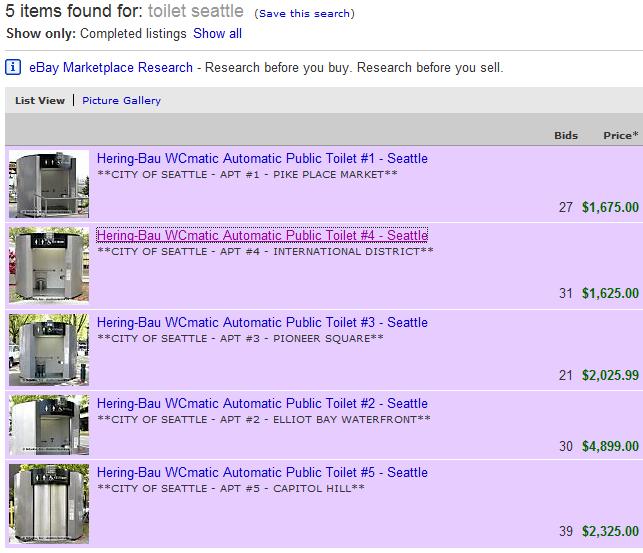
theodp writes "Hopes were high back in 2004 as Seattle's posh public potties opened for business. But four years later, city officials have said good riddance to the five high-tech toilets, self-cleaning and cylindrical, that had cost Seattle $5 million. The city unloaded them on eBay for just $12,549. The commodes had become filthy hide-outs for drug use and prostitution." -
Seattle Flushes $5M High-Tech Toilets
theodp writes "Hopes were high back in 2004 as Seattle's posh public potties opened for business. But four years later, city officials have said good riddance to the five high-tech toilets, self-cleaning and cylindrical, that had cost Seattle $5 million. The city unloaded them on eBay for just $12,549. The commodes had become filthy hide-outs for drug use and prostitution." -
Microsoft's Annual Report Reveals OSS Mistakes
mjasay writes "Microsoft's most recent annual report suggests that the company is increasingly coming to grips with open source, yet also seems determined to perpetuate myths about open source that poorly serve it and its shareholders. Microsoft CEO Steve Ballmer has suggested before that 'free software means no free soda' for Microsoft employees; but this is perhaps the first time that Microsoft has managed to enshrine its ignorance in a public document. In the annual report, Microsoft makes two primary false claims about open source: 1) Open source companies don't invest in research and development and instead largely free-ride on Microsoft's patents and copyrights; and 2) Open source projects don't innovate and instead mimic Microsoft's products. Perhaps Microsoft has forgotten its own 'innovative' past copying of markets and technologies created by Apple and others. But at least Microsoft gets one thing right: 'To the extent open source software gains increasing market acceptance, our sales, revenue and operating margins may decline.'" -
Author Faces Canadian Tribunal For Hate Speech
An anonymous reader writes "A Seattle Times editorial notes that the British Columbia Human Rights Tribunal will put author Mark Steyn on trial for his book 'America Alone,' which has angered Muslims in Canada. Steyn is a columnist for the Canadian magazine Maclean's. According to the editorial, British Columbia bans all words and images 'likely to expose a person... to hatred or contempt because of race, religion, age, disability, sex, marital status or sexual orientation.' Steyn is unapologetic, and is advertising his book as a 'Canadian Hate Crime' and daring the tribunal to 'pronounce him bad.'" The Canadian tabloid the National Post has coverage of what it calls "a media storm." -
Cell Phones, Missing Persons, and Privacy
An anonymous reader sends in a Seattle PI story about the use of cell phone records in missing-person cases. Typically, phone companies turn over location information to police without a warrant if one of their customers is reported missing; the police need only to state that the person may be in danger. In any criminal case, a warrant from a judge would be required before the telcos divulged any information. While in some poster-child cases lives have been saved as a result of this practice, it seems like a class-action lawsuit waiting to happen. It is not a crime to go missing. -
Microsoft Helps Police Crack Your Computer
IGnatius T Foobar writes "Microsoft has developed a small plug-in device that investigators can use to quickly extract forensic data from computers that "may have been used in crimes." It basically bypasses all of the Windows security (decrypting passwords, etc.) in order to eliminate all that pesky privacy when the police have physical access to your computer. Just one more reason not to run Windows on your computer."