Slashdot Mirror
Domain: odu.edu
Stories and comments across the archive that link to odu.edu.
Comments · 55
-
Re:Every time....
Judicial Watch just linked to his original paper and even your article says this
Here's what the math should look like (that is, if Richman's initial study was accurate -- which many researchers doubt). If 6.4 percent of the estimated 20.3 million noncitizens in the US voted, and if just 81.8 percent of them voted for Clinton (the percentage who voted for Obama in his 2008 study), that's an added margin of a little more than 835,000 votes. In other words: Even with all of those supposedly fraudulent ballots, Clinton still would have won the popular vote by more than 2 million votes.
Exactly what I said. And Richman stands by his study and defended it here
https://www.washingtonpost.com...
It's true he wrote this article attacking the way his research has been used
https://fs.wp.odu.edu/jrichman...
This post is not intended to make a specific claim on my part concerning how many non-citizens voted in 2016. It has a much narrower aim. My goal was to show that an extrapolation from my coauthored work on the 2008 election to the 2016 election did not support the arguments some seemed to be making that the entire popular vote margin for Clinton was due to illegal votes by non-citizens. In this post I do my own calculation of that extrapolation for the purpose of demonstrating that this extrapolation would not support that claim.
So what he's saying is that if you use his estimate of 834,318 non citizen votes to claim that that was less than Clinton's 2,235,663 popular vote lead that's fine with him. If however you use his estimate of 834,318 non citizen votes to say that non citizen votes are significant problem with US elections that's not. Because the media and the Democrats - like there's any difference - have both dogpiled him to get him to stop publishing research with that inconvenient truth in it.
Also, remember this entire research is based on an opt-in online survey. In other words, as evidence of voter fraud, it's pretty much horseshit.
Bullshit. It's based on CCES. And he cross checked the CCES data against voter files. His 6.4% estimate is based on non citizens who claim they voted and who he'd actually checked did vote by looking at voter files.
https://www.washingtonpost.com...
In a forthcoming article in the journal Electoral Studies, we bring real data from big social science survey datasets to bear on the question of whether, to what extent, and for whom non-citizens vote in U.S. elections. Most non-citizens do not register, let alone vote. But enough do that their participation can change the outcome of close races.
Our data comes from the Cooperative Congressional Election Study (CCES). Its large number of observations (32,800 in 2008 and 55,400 in 2010) provide sufficient samples of the non-immigrant sub-population, with 339 non-citizen respondents in 2008 and 489 in 2010. For the 2008 CCES, we also attempted to match respondents to voter files so that we could verify whether they actually voted.
How many non-citizens participate in U.S. elections? More than 14 percent of non-citizens in both the 2008 and 2010 samples indicated that they were registered to vote. Furthermore, some of these non-citizens voted. Our best guess, based upon extrapolations from the portion of the sample with a verified vote, is that 6.4 percent of non-citizens voted in 2008 and 2.2 percent of non-citizens voted in 2010.
You need to stop consuming Democrat fake news mate!
-
Re:Every time....
Except that people who've done research find that non citizens vote overwhelming for the Democrats over Republicans.
https://fs.wp.odu.edu/jrichman...
Here I run some extrapolations based upon the estimates for other elections from my coauthored 2014 paper on non-citizen voting. You can access that paper on the journal website here and Judicial Watch has also posted a PDF. The basic assumptions on which the extrapolation is based are that 6.4 percent of non-citizens voted, and that of the non-citizens who voted, 81.8 percent voted for Clinton and 17.5 percent voted for Trump. These were numbers from our study for the 2008 campaign. Obviously to the extent that critics of my study are correct the first number (percentage of non-citizens who voted) may be too high, and the second number (percentage who voted for Clinton) may be too low.
The count of the popular vote is still in flux as many states have yet to certify official final tallies. Here I used this unofficial tally linked by Real Clear Politics. As of this writing Trump is 2,235,663 votes behind Clinton in the popular vote.
If the assumptions stated above concerning non-citizen turnout are correct, could non-citizen turnout account for Clinton's popular vote margin? There is no way it could have. 6.4 percent turnout among the roughly 20.3 million non-citizen adults in the US would add only 834,318 votes to Clinton's popular vote margin. This is little more than a third of the total margin.
Is it plausible that non-citizen votes added to Clinton's margin. Yes. Is it plausible that non-citizen votes account for the entire nation-wide popular vote margin held by Clinton? Not at all.
800K votes nationally could swing a few states. And in fact this paper on previous elections gives examples of elections where non citizens changed the result of an election
http://www.judicialwatch.org/w...
In spite of substantial public controversy, very little reliable data exists concerning the frequency with which non-citizen immigrants participate in United States elections. Although such participation is a violation of election laws in most parts of the United States, enforcement depends principally on disclosure of citizenship status at the time of voter registration. This study examines participation rates by non-citizens using a nationally representative sample that includes non-citizen immigrants. We find that some non-citizens participate in U.S. elections, and that this participation has been large enough to change meaningful election outcomes including Electoral College votes, and Congressional elections. Non-citizen votes likely gave Senate Democrats the pivotal 60th vote needed to overcome filibusters in order to pass health care reform and other Obama administration priorities in the 111th Congress.
-
Re:Every time....
Foreigners interfering in elections isn't an 'act of war' though, otherwise Mexico would have declared war on the US each time a Mexican citizen illegally voted in a US election.
The individual foreigner voting is breaking US law, but the country they come from isn't declaring war on the US.
And before you say 'Non citizens voting doesn't happen, you racist!' yeah, it does
https://empowertexans.com/arou...
While the National Voter Registration Act (NVRA) requires local election officials to maintain accurate voter rolls, it also made it easier for non-citizens to get on the rolls by mandating that states offer voter registration by mail and at driver's license offices. Registering to vote is now an honor system, with no documentation required and no one verifying citizenship -- applicants merely check a box affirming they're U.S. citizens.
Birdwell asked Ingram what mechanisms the Secretary of State or county voter registration officials have to ensure that non-citizens aren't registering to vote. "Only the jury summons," Ingram responded. State law requires jury clerks to report to elections officials all individuals who claim an exemption to jury duty because they are not citizens.
"The Secretary of State's office's only way to ensure non-citizens aren't voting is the random sampling of a jury duty summons?" Birdwell asked.
"That is correct," Ingram replied.
If a non-citizen never gets summoned to jury duty or doesn't respond to a summons, Birdwell asked, "you have no mechanism to correct that wrong?"
"That's right," Ingram confirmed.
"We have no active method [to ensure non-citizens aren't registering to vote]. We depend on the self-reporting of the individual," Birdwell concluded. "That is a significant problem."
Texas Scorecard reported on those findings last month. A brief survey of four Texas counties found that in just the past two years, 165 unlawfully registered non-citizens were removed from those counties' voter rolls -- but only after they self-identified as non-citizens in the process of recusing themselves from jury duty. Those non-citizens cast 100 illegal votes.
Worse, the AG's investigators found that "the process for removing ineligible voters who self-report as non-citizens at jury duty is not being followed correctly, or even at all, in various counties."
Curious is it not how when a few Russians spend a few hundred thousand dollars in an election where the total spending was $6.5 billion that means Russia committed an 'act of war' against the US and anyone who disagrees is a traitor. When only 834,000 non citizens vote in a US election, that's not enough to explain Hillary's popular vote lead so we should ignore it. And that demanding people provide proof of citizenship before they buy Facebook ads is something the US must do to protect the integrity of its elections but trying to prevent hundreds of thousands of non citizens voting is racist.
-
Re:Top of first article nullifies your entire post
Also if you look here
https://fs.wp.odu.edu/jrichman...
The 2008 estimate is inherently uncertain. It depends upon a number of assumptions including assumptions about the validity of the survey data. Our critics have made a variety of arguments and I encourage readers to evaluate those arguments along with our responses to them. The underlying study on which the extrapolation is based has been the subject of some cogent criticisms, and this leads me to believe that the actual rate of non-citizen involvement is on the low end of our initial estimates rather than anywhere close to the high end.
The critics paper is the ' peer-reviewed article [sciencedirect.com] argued that the findings reported in this post (and affiliated article [sciencedirect.com]) were biased and that the authors' data do not provide evidence of non-citizen voting in U.S. elections'
Well it turns out they've issued a response to that
https://fs.wp.odu.edu/jrichman...
Conclusion
Ansolabehere et. al. (2015) make a useful point - that group-membership measurement error rates must be considered very carefully when analyzing small subsamples. However, there are ways to estimate this error rate, and to validate the estimated error rate using other measures. We have shown that each of four independent approaches to evaluating electoral participation by non-citizens indicates that in fact a small number of non-citizens do most likely participate in US elections. Analysis of group-specific error rates, repeatedly measured individuals, higher frequency behaviors, and hypotheses that follow from the assumption that responses are driven by group-identification errors all yield the same independent conclusion, refuting the Ansolabehere et.al. (2015) contention that the Richman et. al. (2014) non-citizen participation results "are completely accounted for by very low frequency measurement error" among citizens. A more thorough analysis of the data makes clear that response error in the citizen-status question cannot account for the entirety of observed non-citizen verified and reported voting in the CCES. Hence, the CCES survey does provide substantial evidence that in the United States non-citizens hold verified registration status, cast verified votes, report they are registered, and report they are voters.
The analysis offered above should not be a stopping point, however. There are design choices that can improve the capability to engage in test-retest validation of group status and assessment of differential group-level rates of measurement error. Inclusion of specific followup questions aimed at verifying group membership status in the CCES should be pursued by those interested in making specific inferences about small subpopulations in large sample surveys. In the context of the non-citizen subsample such questions could include closed-ended and open-ended follow-up inquiries aimed at confirming or disconfirming self-identified noncitizen status and thereby ensuring that measurement error does not contaminate estimates of non-citizen sub-population behaviors.
Incidentally in the first source they say
If the percentage of non-citizens voting for Clinton is held constant, roughly 18.5 percent of non-citizens would have had to vote for their votes to have made up the entire Clinton popular vote margin. I don't think that this rate is at all plausible. Even if we assume that 90 percent voted for Clinton and only 10 percent for Trump, a more than fourteen percent turnout would be necessary to account for Clinton's popular vote margin. This is much higher than the estimates we offered. Again, it seems too high to be plausible.
-
Re:Top of first article nullifies your entire post
Also if you look here
https://fs.wp.odu.edu/jrichman...
The 2008 estimate is inherently uncertain. It depends upon a number of assumptions including assumptions about the validity of the survey data. Our critics have made a variety of arguments and I encourage readers to evaluate those arguments along with our responses to them. The underlying study on which the extrapolation is based has been the subject of some cogent criticisms, and this leads me to believe that the actual rate of non-citizen involvement is on the low end of our initial estimates rather than anywhere close to the high end.
The critics paper is the ' peer-reviewed article [sciencedirect.com] argued that the findings reported in this post (and affiliated article [sciencedirect.com]) were biased and that the authors' data do not provide evidence of non-citizen voting in U.S. elections'
Well it turns out they've issued a response to that
https://fs.wp.odu.edu/jrichman...
Conclusion
Ansolabehere et. al. (2015) make a useful point - that group-membership measurement error rates must be considered very carefully when analyzing small subsamples. However, there are ways to estimate this error rate, and to validate the estimated error rate using other measures. We have shown that each of four independent approaches to evaluating electoral participation by non-citizens indicates that in fact a small number of non-citizens do most likely participate in US elections. Analysis of group-specific error rates, repeatedly measured individuals, higher frequency behaviors, and hypotheses that follow from the assumption that responses are driven by group-identification errors all yield the same independent conclusion, refuting the Ansolabehere et.al. (2015) contention that the Richman et. al. (2014) non-citizen participation results "are completely accounted for by very low frequency measurement error" among citizens. A more thorough analysis of the data makes clear that response error in the citizen-status question cannot account for the entirety of observed non-citizen verified and reported voting in the CCES. Hence, the CCES survey does provide substantial evidence that in the United States non-citizens hold verified registration status, cast verified votes, report they are registered, and report they are voters.
The analysis offered above should not be a stopping point, however. There are design choices that can improve the capability to engage in test-retest validation of group status and assessment of differential group-level rates of measurement error. Inclusion of specific followup questions aimed at verifying group membership status in the CCES should be pursued by those interested in making specific inferences about small subpopulations in large sample surveys. In the context of the non-citizen subsample such questions could include closed-ended and open-ended follow-up inquiries aimed at confirming or disconfirming self-identified noncitizen status and thereby ensuring that measurement error does not contaminate estimates of non-citizen sub-population behaviors.
Incidentally in the first source they say
If the percentage of non-citizens voting for Clinton is held constant, roughly 18.5 percent of non-citizens would have had to vote for their votes to have made up the entire Clinton popular vote margin. I don't think that this rate is at all plausible. Even if we assume that 90 percent voted for Clinton and only 10 percent for Trump, a more than fourteen percent turnout would be necessary to account for Clinton's popular vote margin. This is much higher than the estimates we offered. Again, it seems too high to be plausible.
-
Re:Top of first article nullifies your entire post
Read the rebuttals and the author's response to them. It's just the WashPo trying to discredit Inconvenient Truths.
Rebuttals
https://www.washingtonpost.com...
https://www.washingtonpost.com...
https://www.washingtonpost.com...Author's response which seems to cover them all
https://www.washingtonpost.com...
I think the authors are onto something. Their paper was peer reviewed too. And the peer reviewed paper the WashPo claims debunks it is in the same journal but is paywalled. Unlike theirs, which I linked to. It seems to be claiming their sample size is too small and that constitutes cherry picking.
tl;dr - they did a study which was very cautious about interpreting the data. Even that found evidence of 620,000 non citizens voting. People criticized them. They responded. Peer reviewed is not the same as 'true', and in fact can't be given both their paper and the paper critiquing it were published in the same journal.
And the comments are full of anecdotal evidence that illegals voting is well known.
It's true they said Trump's claim that non citizens voting accounted for all of Hillary's popular vote lead. However they reckon significant numbers of non citizens voted.
https://fs.wp.odu.edu/jrichman...
If the assumptions stated above concerning non-citizen turnout are correct, could non-citizen turnout account for Clintonâ(TM)s popular vote margin? There is no way it could have. 6.4 percent turnout among the roughly 20.3 million non-citizen adults in the US would add only 834,318 votes to Clintonâ(TM)s popular vote margin. This is little more than a third of the total margin.
Is it plausible that non-citizen votes added to Clintonâ(TM)s margin. Yes. Is it plausible that non-citizen votes account for the entire nation-wide popular vote margin held by Clinton? Not at all.
Then when that number got picked up by people they disagree with they disowned it
https://fs.wp.odu.edu/jrichman...
As a primary author cited in this piece, I need to say that I think the Washington Times article (http://m.washingtontimes.com/news/2017/jan/26/hillary-clinton-received-800000-votes-from-nonciti/) is deceptive. It makes it sound like I have done a study concerning the 2016 election. I have not. What extrapolation I did to the 2016 election (https://fs.wp.odu.edu/jrichman/2016/11/28/is-it-plausible-that-non-citizen-votes-account-for-the-entire-margin-of-trumps-popular-vote-loss-to-clinton/) was purely and explicitly and exclusively for the purpose of pointing out that my 2014 study of the 2008 election did not provide evidence of voter fraud at the level some Trump administration people were claiming it did. I do not think that one should rely upon that extrapolation for any other purpose. And I do not stand behind that extrapolation if used for ANY other purpose.
In the original article they point out things like
This post is not intended to make a specific claim on my part concerning how many non-citizens
-
Re:Top of first article nullifies your entire post
Read the rebuttals and the author's response to them. It's just the WashPo trying to discredit Inconvenient Truths.
Rebuttals
https://www.washingtonpost.com...
https://www.washingtonpost.com...
https://www.washingtonpost.com...Author's response which seems to cover them all
https://www.washingtonpost.com...
I think the authors are onto something. Their paper was peer reviewed too. And the peer reviewed paper the WashPo claims debunks it is in the same journal but is paywalled. Unlike theirs, which I linked to. It seems to be claiming their sample size is too small and that constitutes cherry picking.
tl;dr - they did a study which was very cautious about interpreting the data. Even that found evidence of 620,000 non citizens voting. People criticized them. They responded. Peer reviewed is not the same as 'true', and in fact can't be given both their paper and the paper critiquing it were published in the same journal.
And the comments are full of anecdotal evidence that illegals voting is well known.
It's true they said Trump's claim that non citizens voting accounted for all of Hillary's popular vote lead. However they reckon significant numbers of non citizens voted.
https://fs.wp.odu.edu/jrichman...
If the assumptions stated above concerning non-citizen turnout are correct, could non-citizen turnout account for Clintonâ(TM)s popular vote margin? There is no way it could have. 6.4 percent turnout among the roughly 20.3 million non-citizen adults in the US would add only 834,318 votes to Clintonâ(TM)s popular vote margin. This is little more than a third of the total margin.
Is it plausible that non-citizen votes added to Clintonâ(TM)s margin. Yes. Is it plausible that non-citizen votes account for the entire nation-wide popular vote margin held by Clinton? Not at all.
Then when that number got picked up by people they disagree with they disowned it
https://fs.wp.odu.edu/jrichman...
As a primary author cited in this piece, I need to say that I think the Washington Times article (http://m.washingtontimes.com/news/2017/jan/26/hillary-clinton-received-800000-votes-from-nonciti/) is deceptive. It makes it sound like I have done a study concerning the 2016 election. I have not. What extrapolation I did to the 2016 election (https://fs.wp.odu.edu/jrichman/2016/11/28/is-it-plausible-that-non-citizen-votes-account-for-the-entire-margin-of-trumps-popular-vote-loss-to-clinton/) was purely and explicitly and exclusively for the purpose of pointing out that my 2014 study of the 2008 election did not provide evidence of voter fraud at the level some Trump administration people were claiming it did. I do not think that one should rely upon that extrapolation for any other purpose. And I do not stand behind that extrapolation if used for ANY other purpose.
In the original article they point out things like
This post is not intended to make a specific claim on my part concerning how many non-citizens
-
Re: The summary is...
The page you linked is concerning the 2008 election not the 2016 election. What proof or scientifically defensibly study do you have about 2016?
The underlying study by Jesse T. Richman, Gulshan A. Chattha and David C. Earnest found only five non-citizens self reported as voting in 2008 that they could verify out of a study sample size of 32,800 people.
If you are interested in reading the actual 2014 study concerning the 2008 election based on polling 32,800 people in 2008 and 55,400 in 2010 here is a link:
https://ww2.odu.edu/~jrichman/...Here is a link to the lead author, Jesse Richman, of that study saying that the washingtontimes.com article is deceptive if anyone believes it's concerning 2016.
https://fs.wp.odu.edu/jrichman/2017/01/27/i-do-not-support-the-washington-times-piece/ -
Re: The summary is...
The page you linked is concerning the 2008 election not the 2016 election. What proof or scientifically defensibly study do you have about 2016?
The underlying study by Jesse T. Richman, Gulshan A. Chattha and David C. Earnest found only five non-citizens self reported as voting in 2008 that they could verify out of a study sample size of 32,800 people.
If you are interested in reading the actual 2014 study concerning the 2008 election based on polling 32,800 people in 2008 and 55,400 in 2010 here is a link:
https://ww2.odu.edu/~jrichman/...Here is a link to the lead author, Jesse Richman, of that study saying that the washingtontimes.com article is deceptive if anyone believes it's concerning 2016.
https://fs.wp.odu.edu/jrichman/2017/01/27/i-do-not-support-the-washington-times-piece/ -
Re:Then maybe Democrats should change policies
-
Re:Missed the Problem
However, the BIG difference I saw between the two schools was hiring:
Perhaps that more an artifact of short-sighted managers and HR people. I got inconsistent grades in school (always working part-time) and have a BSCS from Old Dominion University (from 1987, yes I'm old) and have never had a problem getting a well-paying job. During the interview for my first job, the company president (it was a small software development firm) remarked than he especially like that my college experience involved more than just taking classes and such. In addition to being a grader for (under)graduate CS classes and assisted with professors' research papers as part of my financial aid, I was a research assistant on an AI project in LISP and PROLOG, funded by NASA - focusing on automatic analysis and evaluation using abstract data types. (The Xerox 1108 Dandelion system running InterLISP-D at my desk was amazing, especially for 1985 - I still have the InterLISP-D manual.)
It's not where you go to school, but what you do while you're there...
-
Re:How about offer a BS first?
Old Dominion Univ.
http://dl.odu.edu/programs/computer-science -
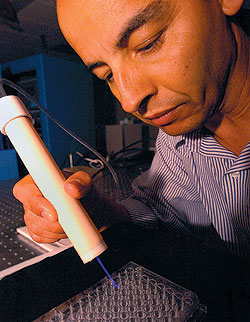
This tool was invented once already.
Old Dominion University did this nearly a decade ago and filed a patent for it. I see no reference to them in the article.
http://www.odu.edu/ao/research/ip/PlasmaPencil.pdf -
Legal != Moral
I don't know enough about what's going on with Google to really tell one way or the other; as the saying goes, the devil is in the details.
That aside, it appears that you are conflating legal with moral. The two have some overlap, but it bears noting that there are yawning chasms between them in some areas.
... it's the morality of knowingly allowing something which is illegal...
You seem to be saying that an illegal act is by definition immoral. By that argument, it would be immoral to have a bathtub in your house in Virginia, or to wear high heels in Carmel, CA, and it would very nearly have been immoral to have properly round circles in Indiana. There are tons of laws on the books that are still technically in force, but have passed into irrelevance and remain as a sort of legal appendectomy-in-waiting.
The converse would be that a legal act is by definition moral. By that argument, pre-US-Civil-War slavery was perfectly moral in the South, because it was perfectly legal. I think most everyone here can see the logical failings of this proposition.
Whether it SHOULD be illegal has no bearing on the issue.
If you're going to argue about the morality of what someone has done, sure, the issue of whether the action *should be* legal/illegal has no bearing on the issue of whether or not the action is moral. But by the same token, whether their action *is* actually legal or illegal also has no bearing—"legal" and "moral" are orthogonal qualities.
Cheers,
-
Re:Everybody is an engineer?
-
Re:Typical applications?
-
Exit Writing ExaminationsThe school I received my B.S. degree (Old Dominion University, Norfolk, Virginia) required all undergraduate students to take an exit writing examination prior to graduation. They still do this. And the scary fact is that at least half of all graduates fail the test the first time they take it, so the school suggests students take the test well before they intend to graduate. As for me, I took the test a week before I was set to graduate, and everyone mocked me saying that I was going to fail it and I would have to take it during the summer. Instead, I found it ridiculously easy, and passed the first time around.
Didn't have to take a writing examination prior to getting my Ph.D. (different school), although I did have to write a 200-page dissertation. I think schools generally expect students to be able to write by the time they get there. Still, I've seen lots of students in graduate school with pretty poor grammar skills; although this problem is more due to the fact that there are so many students in graduate school where English is not their first language.
-
Exit Writing ExaminationsThe school I received my B.S. degree (Old Dominion University, Norfolk, Virginia) required all undergraduate students to take an exit writing examination prior to graduation. They still do this. And the scary fact is that at least half of all graduates fail the test the first time they take it, so the school suggests students take the test well before they intend to graduate. As for me, I took the test a week before I was set to graduate, and everyone mocked me saying that I was going to fail it and I would have to take it during the summer. Instead, I found it ridiculously easy, and passed the first time around.
Didn't have to take a writing examination prior to getting my Ph.D. (different school), although I did have to write a 200-page dissertation. I think schools generally expect students to be able to write by the time they get there. Still, I've seen lots of students in graduate school with pretty poor grammar skills; although this problem is more due to the fact that there are so many students in graduate school where English is not their first language.
-
Re:I'm not sure I understand
Also the bit where your data is locked into whatever file formats the cloud provider has and you will have difficulty maintaining your own back ups and migrating to a different provider if the current one is inadequate or fails.
Yup. It's just another variation of a walled garden.
While not about software-as-a-service, JCDL 09 had an insightful paper "What Happens When Facebook is Gone?", about the lack of control, specifically archivability, of the content on facebook. The key quote:
Archiving oneâ(TM)s personal Facebook data is also not currently possible. Facebook does not provide a mechanism to locally archive oneâ(TM)s profile, activities, or messages or to export oneâ(TM)s profile to other social networking sites. This is despite efforts like the Bill of Rights for Users of the Social Web [23], a manifesto espousing the opinion that all data from social networks should be transportable, and public statements made by Mark Zuckerberg (founder of Facebook) in 2007 supporting that opinion [21].
Let us all remember Lawrence Lessig's observation "code is law."
-
Re:Notes?
Not necessarily true - most items created by students in the academic setting are vested to the University (they don't usually enforce this, but it is a legal question):
Many explicitly state their ownership over the copyrighted materials created by staff and students:
(example for IT) http://www.odu.edu/ao/facultyhandbook/index.php?page=ch04s03.html
(example for artworks, etc) http://www.cotr.bc.ca/handbook/cotr_web.asp?IDNumber=164
This is true of most colleges - they hold strict Work for Hire rights over the faculty, and any creation by s student is a "Joint" work and therefore tied up under the professors work for hire restrictions (e.g. they own the work).
When I went to school for photography, I remember this being specifically spelled out to us by one of my design professors who was in a fight with the school over work being sold by a student (it was sculpture - he was pissed that the school was trying to stop his student from selling the art).
Lately we've seen more colleges adopt policies where they allow the student and faculty the rights to their own work, but they explicitly have to state so through a transfer of copyright; see:
http://www.dartmouth.edu/~osp/resources/policies/dartmouth/copyright.html
You'll also note that they still retain copyright over materials that are patentable.
Yes, they are just your notes; but they also qualify as a literary creation by you (created jointly with faculty).
ANYWAYS, my point isn't to start a debate about copyright in the academic setting, but to point out that it is unlikely that the professor has the right to mandate what is done with the students notes for one of two reasons:
1) The University holds the rights over those notes, and it would have to be University policy that mandated the destruction of the copyrighted material (since it is likely the only copy)
-OR-
2) The University has transferred those rights (as in the Dartmouth example) and the Prof. has no rights over the students work.
Short answer - Report this to the Dean. -
Re:The US already has a maglev
Our university has had this technology on our campus for almost 10 years now. If you're wondering how it works check out Dr Lawrence Weinstein's page on maglevs. Our current problem is vibration which makes riding at any speed intolerable.
AEN
Yeah... tell me about it. I've been on this campus for 10 years, and the train is STILL not in operation. Although we've HAD it for 10 years, at this point, it seems like it will never be done.
-
Re:The US already has a maglev
Our university has had this technology on our campus for almost 10 years now. If you're wondering how it works check out Dr Lawrence Weinstein's page on maglevs. Our current problem is vibration which makes riding at any speed intolerable.
AEN
Yeah... tell me about it. I've been on this campus for 10 years, and the train is STILL not in operation. Although we've HAD it for 10 years, at this point, it seems like it will never be done.
-
The US already has a maglev
Our university has had this technology on our campus for almost 10 years now. If you're wondering how it works check out Dr Lawrence Weinstein's page on maglevs. Our current problem is vibration which makes riding at any speed intolerable. AEN
-
The US already has a maglev
Our university has had this technology on our campus for almost 10 years now. If you're wondering how it works check out Dr Lawrence Weinstein's page on maglevs. Our current problem is vibration which makes riding at any speed intolerable. AEN
-
Re:Has anyone looked at the sample test?
By around age 5 I learned most (if not all) of these facts from watching TLC or Discovery.
That we teach and test facts is part of the problem with science education in the US. I'm a science teacher at a public charter school and I struggle with this problem constantly. The comprehensive curriculum and Grade Level Expectations (standards) emphasize science as an inquiry skill. If I follow the GLEs, the most important skills I can teach are inquiry. That is to say, I should be teaching kids to ask questions, design experiments, do research, be curious and skeptical. This is a perfect science education. It doesn't matter if kids know exactly what the carbon cycle is, or if the sun is the center of our solar system. Instead, I'm giving them the skills to learn about these content knowledge areas.
Unfortunately, when it comes time to take a standardized test, 20% of the test asks kids to call upon their ability to do science by making predictions, designing experiments or comparing data. The other 80% of the test actually tests content knowledge (facts).
If you're familiar with blooms taxonomy, you know that regurgitating facts is the least mentally strenuous and intellectually challenging task. It's great if a kid knows that the earth orbits the sun and that sun orbits the center of the milky way and the milky way is part of a super cluster of galaxies, but isn't it more important that a kid knows how to do a good scientific experiment? That she knows what a control is, what a variable is and can shout, "BOGUS!" when an infomercial tells her that something--that clearly has not been--is scientifically proven.
What we need to do, is push for teaching and assessment (standardized tests) that challenge kids to think. We want science fairs that don't just show what the solar system is, but rather show off quality experiments that kids did regarding the solar system. Every citizen would benefit from the ability to not just know what a neurotransmitter is (that's what teh intertubes and books are for), but rather how to use scientific reasoning in solving problems and learning.
If you have kids, try encouraging your kid's teachers to try experiments in class. If you know what good science looks like, volunteer to help conduct a quality, rigorous experiment in your kid's school. Most of my colleagues at the elementary level are liberal arts majors that have NEVER been taught good science. They don't know what it looks like because their teachers failed them. If you sincerely care about your kid's education, help out the teacher. It has to start somewhere!
Encourage your kids to ask questions and then help them find the answer. Don't just look the damn thing up, teach them how to create a test that will either answer the question or lead them to more questions. Science is beautiful and doesn't have to subtract from the natural beauty of the world, rather it adds to it and reveals the subtle beauty and elegance of everything.
[Rant concluded.]
-
Re:Get off his nuts
Basically, I can agree to lay off the streets if you acknowledge the usefulness of conscious (rather than habit or historically driven) urban planning.
Oh, absolutely, the idea that you can plan a city around foot traffic has been popular for years. There are thinkers who believed you could prioritize foot traffic in a city design, but still leave room for the automobile. Lewis Mumford was actually working on the concept of the "garden city," which represented a more comfortable meshing of foot traffic with auto traffic.
See Radburn, New Jersey for an example of Mumford's concepts of meshing the automobile with people.
The only problem is, it's not so easy to implement correctly, because the concept has many flaws that must be dealt with. See Columbia, Maryland for an example of this social experiment gone-haywire: in the last 20 years, the city has expanded without much thought, and the car is now the only way to get around. The only people who use the network of sidewalks and bridges are joggers and people walking their dogs.
-
Maglev Boondoggle at ODU
A maglev project at Old Dominion University has been a boondoggle and an embarrassment to the community:
http://www.odu.edu/webroot/orgs/IA/university_news.nsf/articles/11152006091139AM
http://content.hamptonroads.com/story.cfm?story=122680&ran=183404
It's such a shame.
Now local officials want to construct a light rail line linking two non-residential areas. More colossal waste.
http://content.hamptonroads.com/story.cfm?story=136584&ran=226930&tref=rss
The miracle is that these decision makers keep their jobs. There must be a bright future in wasting money. -
Re:Was Wondering...I followed your link, and was thereafter directed to a book here: http://www.ccpo.odu.edu/SEES/ozone/class/Chap_11/
i ndex.htm Which said:These studies have shown that stratospheric ozone loss is caused by chlorine and bromine catalytic reaction. The source of stratospheric chlorine ultimately comes from photochemical breakdown of manmade chlorofluorocarbons released in the troposphere from human activities.
-
Old Dominion University invented it first:
http://www.odu.edu/webroot/orgs/IA/university_new
s .nsf/articles/01252006095739AM
http://www.odu.edu/webroot/orgs/IA/university_news .nsf/articles/09272005090143PM
and an image: http://media.hamptonroads.com/images/news/plasmape ncilbig.jpg
Old Dominion had this a while ago, and I believe that it was slashdotted too. -
Old Dominion University invented it first:
http://www.odu.edu/webroot/orgs/IA/university_new
s .nsf/articles/01252006095739AM
http://www.odu.edu/webroot/orgs/IA/university_news .nsf/articles/09272005090143PM
and an image: http://media.hamptonroads.com/images/news/plasmape ncilbig.jpg
Old Dominion had this a while ago, and I believe that it was slashdotted too. -
Re:CSI-ish
Personally, I would go to a FBI field office and ask them, tell them what you want to do, and unless you find an ass they'll probabbly help you (as it can help them).
Good suggestion. I would just like to add that most colleges, including the poster's, also have career counselors who can give guidance on what programs are good or not. They have various stacks of guides and ratings that can be more informative than a simple Google search.
OT: UMass has great chemistry! (Former Lederle dweller, not sure if that's still the departmental motto, but it sounds good.) -
Re:A practical approach to learningRe #2: No argument there, the information that comes with a well-documented UNIX is the best way to achieve wizard or guru knowledge levels. Not quite so well suited for getting as far novice, though: A lot of the man pages - at least back in the day - were written by experts who assumed the reader was close to expert, or at least was a C coding system hacker. Like it or not, not all of us were. C coder? Yes. Sysadmin? Eventually? Kernel hacker? Nope. Library hacker? Only at gunpoint. Shell hacker? Oh, yes, please anytime.
I disagree, actually. They weren't written for experts, but they were written for folks willing to spend a fair amount of time learning. I was 13 when I started using Unix in the lab at ODU, and I didn't have much of a problem: I just read the man pages, and read 'em again (that was back when more couldn't back up a page, and so if I wanted to read the previous page I had to quit and start all over again), and read 'em yet again until I began to figure 'em out.
I'm a Unix admin by trade now, so something must've stuck...
-
More images here!!
-
This guy would love to have you as a student.
"and there's two parts to that claim -- majority and everything. Perhaps the majority of people here have pirated something (be it software, music, movies, TV (broadcast, cable, satellite) or a ship at sea) but I seriously doubt that the majority pirates *everything*."
My Discrete Structures professor would have needed some private time after your logical breakdown of that sentence.
-
You want factual answers...
try the Intelligent Question Answering System!!
-
Re:Lack of rational thinking
Well, studies have shown differences between men and women. This is no surprise. Studies have not on the other hand been particularly revealing as to whether it's down to nature or nurture. Of course, in the example of his good at maths/bad at maths one, it all comes down to the question that you ask.
If you ask, "Are men better at maths than women?" you can show it to be true easily by showing the number of graduates of each sex - just as you can supposedly prove that white men can't jump by looking at basketball results. Are either of these results rigorous proof of the assertions? No. They just show that as of today, white men apparently less often jump and women less often take maths degrees.
As a matter of pure interest, note the UK A-level results; girls outperform boys in science and maths on a regular basis at age 18, according to those.
So one might say that really what this guy has done is asked, and answered, the wrong question, using a mixture of anecdotal evidence (that stupid story about his daughter's trucks; why is he so upset that she shows such a good grasp of metaphor?!) and what appears to be pure presumption.
Can women do maths? immediately splits ability by gender, which is daft, seeing that gender is a pretty blurry line. Even the differences in language processing in the brain so popular for authors of self-help books are only true in a small set of circumstances, for a small proportion of the population; probably you could split by toenail length and get an intriguing correlation, too.
You might find it interesting to read Beyond Binary Thinking, an interesting introduction to exactly this field. -
The largest...
...is widely regarded as this (next to last paragraph of section I)
-
Trivial or vacuous?
So is that trivially true or vacuously true? I can never keep those straight.
Lemme Google for a sec...
Ok. Maybe this helps. -
Re:Yipee!!!!!
For the uninitiated, here's the link to the ODU Maglev project.
If this wasn't the inspiration for the Simpsons episode, it may well have been. Outside entrepreneur comes in, sells everyone on the idea (maglev! monorail!), gets a big check, it doesn't work, more money pours in, still doesn't work, etc. -
It's a really stupid pork programThis is another one of those pork programs pushed through by Southern legislators. The Old Dominion University maglev is one car on a single 3/4 mile stretch of totally straight track. And the bozos building it can't even make that work.
Similar maglevs have been built. Birmingham Airport had one from the mid 1980s to 1995. It was too hard to maintain, and was replaced with a cable-driven system.
Even as a pork program, the Old Dominion University system sucks. Better taxpayer-supported overpriced transit systems have been built at Southern universities. The Morgantown, West Virginia Group Rapid Transit System is a futuristic system started during the Nixon administration and opened in 1975. It's automated, with 3.6 miles of line, five stations, and little eight-person cars. It's an advanced system; all stations are "offline", and cars pull off the main line to stop at stations, rather than blocking the main tracks. It actually works, but it's way overbuilt for the usage it gets.
-
Joke Science
Throwing good money after bad. BTW, the ODU campus isn't really that big.
-
NASA TV Programming - The Information Age, not yet
I think I know what they did with the apes that came back from the early spaceflights.
They put them in charge of NASA TV programming.
I mean, J.H.C, when the "big spacewalk" was happening a week or two ago I tuned into NASA TV, and what did I get to watch?
**NOTHING**
Well, not quite nothing, a grainy image of the command center with an even grainer occasional camera view of a bigscreen projection of their track, which was 100 times worse than simply going to J-Track. Do you seriously mean to tell me that NASA controllers did not have a video feed of or from their own astronauts outside the station, and that all they had was nearly unintelligable acryonym laced audio? Or is it that they simply can't afford a $5 video splitter?
( During the hubble repairs a few years ago at one point they showed nothing but a video feed of an inanimate obscure connector between the shuttle and the telescope. Apparently the shuttle didn't have enough downlink bandwidth, and they needed them all for the job at hand. )
In any case if NASA and the administrationis so concerned about public image and if they really want people to get enthused about spaceflight, how about simply spending an extra $5000 for a single extra camera on the station to provide a view of the interesting things going on?
Throw in another camera to give us a LIVE view of the earth on another channel - 24/7. How many of you wouldn't LOVE to see a 400 mile wide live video feed from space of the earth, and follow it along with J-Track, a recent GOES image, and your atlas / globe, dynamic topographic and/or terraserver reference feed?
Isn't this supposed to be the information age?
Can you imagine how utterly amazing it would be for science teachers to be able to plan a science/geography class around an hour of that each couple weeks with a few groups of kids around 5 PCs all watching the different feeds and trying to match them to the live feed? Add in a few kids using google groups and google news to provide live socio/political/weather commentary, etc etc. -
Re:Maglev in U.S.
The only maglev train in the U.S. that I am aware of is a prototype at Old Dominion University. This project was started several years ago and has yet to be completed due to insufficient funding (or running way over budget). ODU press release
-
A hair dryer can lift 2500 lbs.?According to the original press release:
One 50,000-pound car can be lifted a quarter of an inch above the rail line using the power equivalent of running 20 hair dryers.
I'd be interested to see that calculation explained. Seems to me those hair dryers must blow as much hot air as the contractor who wrangled $14,000,000 out of those Old Dominion boys. -
Re:does this really require a readme.txt??
Well, if you believe that he's the man behind the (crappy) webiste he pimps, then his email address would be kzamore@cs.odu.edu
-
Re:why is anyone exempt?
Now, now, now -- the vital role of the telephone in conducting random surveys has been well known ever since the Landon administration.
-
These magnets are set to '11'!
During the first trial run they had the power turned up too high on the magnets. You can see in the photo that the train is levitating a good 15' above the track. This caused stability problems and the power has been reduced in subsequent trial runs.
-
Re:short run track
It is only going to run on ODU's campus to test out the system. If it fairs well, it will be extended to downtown norfolk to the MacArther shopping mall. There are rumors that it will also go to Virginia Beach and other locations, but I am not exactly sure. If it does extend to MacArther, I hope it can go above 60mph and skip the Hampton Blvd traffic
dk
Since I go to and work for ODU, my sig is a shameless advertisement -
Not very impressive...
I'm not impressed, really. I can see the strings.
-
It looks like it's about 10 feet off the track.......that's SOME LEVITIATION
I thought it would be a few centimeters, at best.