Slashdot Mirror
Domain: old-computers.com
Stories and comments across the archive that link to old-computers.com.
Comments · 337
-
Re:My List
The author of the original article list seemed to have categorised the computers according to the level of application usage.
Some of these computers were really more suited to learning programming and computers than to do serious applications. How many computers could display 80 column text without requiring special drivers to be installed?
It would be interesting to have separate categories for 'learning technology', 'writing/playing games', 'business applications' than a single list.
The ZX81 and BBC Model B were definitely designed for the learning experience. The BBC actually ran a series teaching people about computers.
The Commodore 64, Atari 800, Amiga supported advanced graphics and audio, and were suited to playing/writing games.
The BBC Model B, TRS-80 lesser so. The Apple II and Heathkit were more limited in terms of multimedia, but could support 80 column text natively.
The Palmpilot and Sony Vaio (both of which I own) did come a little later -
Re:My List
The author of the original article list seemed to have categorised the computers according to the level of application usage.
Some of these computers were really more suited to learning programming and computers than to do serious applications. How many computers could display 80 column text without requiring special drivers to be installed?
It would be interesting to have separate categories for 'learning technology', 'writing/playing games', 'business applications' than a single list.
The ZX81 and BBC Model B were definitely designed for the learning experience. The BBC actually ran a series teaching people about computers.
The Commodore 64, Atari 800, Amiga supported advanced graphics and audio, and were suited to playing/writing games.
The BBC Model B, TRS-80 lesser so. The Apple II and Heathkit were more limited in terms of multimedia, but could support 80 column text natively.
The Palmpilot and Sony Vaio (both of which I own) did come a little later -
Re:My List
The author of the original article list seemed to have categorised the computers according to the level of application usage.
Some of these computers were really more suited to learning programming and computers than to do serious applications. How many computers could display 80 column text without requiring special drivers to be installed?
It would be interesting to have separate categories for 'learning technology', 'writing/playing games', 'business applications' than a single list.
The ZX81 and BBC Model B were definitely designed for the learning experience. The BBC actually ran a series teaching people about computers.
The Commodore 64, Atari 800, Amiga supported advanced graphics and audio, and were suited to playing/writing games.
The BBC Model B, TRS-80 lesser so. The Apple II and Heathkit were more limited in terms of multimedia, but could support 80 column text natively.
The Palmpilot and Sony Vaio (both of which I own) did come a little later -
Re:My List
The author of the original article list seemed to have categorised the computers according to the level of application usage.
Some of these computers were really more suited to learning programming and computers than to do serious applications. How many computers could display 80 column text without requiring special drivers to be installed?
It would be interesting to have separate categories for 'learning technology', 'writing/playing games', 'business applications' than a single list.
The ZX81 and BBC Model B were definitely designed for the learning experience. The BBC actually ran a series teaching people about computers.
The Commodore 64, Atari 800, Amiga supported advanced graphics and audio, and were suited to playing/writing games.
The BBC Model B, TRS-80 lesser so. The Apple II and Heathkit were more limited in terms of multimedia, but could support 80 column text natively.
The Palmpilot and Sony Vaio (both of which I own) did come a little later -
Re:My List
The author of the original article list seemed to have categorised the computers according to the level of application usage.
Some of these computers were really more suited to learning programming and computers than to do serious applications. How many computers could display 80 column text without requiring special drivers to be installed?
It would be interesting to have separate categories for 'learning technology', 'writing/playing games', 'business applications' than a single list.
The ZX81 and BBC Model B were definitely designed for the learning experience. The BBC actually ran a series teaching people about computers.
The Commodore 64, Atari 800, Amiga supported advanced graphics and audio, and were suited to playing/writing games.
The BBC Model B, TRS-80 lesser so. The Apple II and Heathkit were more limited in terms of multimedia, but could support 80 column text natively.
The Palmpilot and Sony Vaio (both of which I own) did come a little later -
Re:My List
The author of the original article list seemed to have categorised the computers according to the level of application usage.
Some of these computers were really more suited to learning programming and computers than to do serious applications. How many computers could display 80 column text without requiring special drivers to be installed?
It would be interesting to have separate categories for 'learning technology', 'writing/playing games', 'business applications' than a single list.
The ZX81 and BBC Model B were definitely designed for the learning experience. The BBC actually ran a series teaching people about computers.
The Commodore 64, Atari 800, Amiga supported advanced graphics and audio, and were suited to playing/writing games.
The BBC Model B, TRS-80 lesser so. The Apple II and Heathkit were more limited in terms of multimedia, but could support 80 column text natively.
The Palmpilot and Sony Vaio (both of which I own) did come a little later -
Re:My List
The author of the original article list seemed to have categorised the computers according to the level of application usage.
Some of these computers were really more suited to learning programming and computers than to do serious applications. How many computers could display 80 column text without requiring special drivers to be installed?
It would be interesting to have separate categories for 'learning technology', 'writing/playing games', 'business applications' than a single list.
The ZX81 and BBC Model B were definitely designed for the learning experience. The BBC actually ran a series teaching people about computers.
The Commodore 64, Atari 800, Amiga supported advanced graphics and audio, and were suited to playing/writing games.
The BBC Model B, TRS-80 lesser so. The Apple II and Heathkit were more limited in terms of multimedia, but could support 80 column text natively.
The Palmpilot and Sony Vaio (both of which I own) did come a little later -
Re:My List
The author of the original article list seemed to have categorised the computers according to the level of application usage.
Some of these computers were really more suited to learning programming and computers than to do serious applications. How many computers could display 80 column text without requiring special drivers to be installed?
It would be interesting to have separate categories for 'learning technology', 'writing/playing games', 'business applications' than a single list.
The ZX81 and BBC Model B were definitely designed for the learning experience. The BBC actually ran a series teaching people about computers.
The Commodore 64, Atari 800, Amiga supported advanced graphics and audio, and were suited to playing/writing games.
The BBC Model B, TRS-80 lesser so. The Apple II and Heathkit were more limited in terms of multimedia, but could support 80 column text natively.
The Palmpilot and Sony Vaio (both of which I own) did come a little later -
Re:Apple is dying...
NeXT had a proprietary media format similar to the CD-ROM but it was actually a Magneto-Optical drive with a capacity of 256mb. AFAIK, Apple did ship commerically the first CD-ROM with a computer. I would have to check that though. More information on the NeXT Cube where the internet we know today was actually created: NeXT Cube
-
Re:UK Perspective
...and lets not forget that the successor to the BBC, the Acorn Archimedes, was the first-ever RISC-based home computer, despite claims that Apple make to the contrary regarding their PPC machines. The Archimeded' innovative RiscOS operating system introduced the task bar, a design we now see ripped off in Microsoft Windows. Furthermore, it was BillG himself, when shown a demonstration of Acorn's low-cost networking setup (Econet), who commented that the idea of linking computers together "wouldn't catch on".
-
Re:Dissapointed
That's really odd looking. I didn't realise that Timex released the Sinclair machines in the US. They're almost identical except for the logo. The TS1000 is the US model of the Sinclair ZX-81, my first computer!
I had a further browse around that site and found the Timex Sinclair 1500, which was basically a Sinclair ZX Spectrum (my 3rd computer) in a shiny case. I challenge any 1980's UK Speccy addict to not be ever so slightly freaked out by a picture of the Timex Sinclair 1500.
Bah! You guys got a shiny tape recorder too, I had to line mine into my stereo. -
Re:Dissapointed
That's really odd looking. I didn't realise that Timex released the Sinclair machines in the US. They're almost identical except for the logo. The TS1000 is the US model of the Sinclair ZX-81, my first computer!
I had a further browse around that site and found the Timex Sinclair 1500, which was basically a Sinclair ZX Spectrum (my 3rd computer) in a shiny case. I challenge any 1980's UK Speccy addict to not be ever so slightly freaked out by a picture of the Timex Sinclair 1500.
Bah! You guys got a shiny tape recorder too, I had to line mine into my stereo. -
Printer Cable from 1987I'm still using an old centronics printer cable which I've bought for my first computer, a Schneider CPC6128 (originally sold by Amstrad) and a dot-matrix printer back in 1987.
Now it's connecting my 1GHz celeron (running linux) with a Brother laser printer, and it's still working fine!
-
How about a Tandy 200?My dad-in-law has a 100 as well, but the 200 is actually still comfortable to use (the 100 isn't).
Near-zero boot time, and uptime for days (literally) when a "power pillow" made of C-cell nicads is plugged in (it puts the keyboard at the proper angle for comfortable typing).
Coupled up with an ancient Tandy 9-pin dot-matrix printer in "single-sheet" mode, taking minutes for church meetings...just what it's made to do.
Supposedly, quite a few reporters still use the old things, too. Quick, easy, reliable, and (with the proper software), able to transfer documents and files to a PC.
Built back when Bill Gates used to actually program...
-
Probably my Dell P4-50 laptopThe humorous answer is my stove from the 1930s.
The real answer is that I use a Dell 486 50MHz with a whopping 20 MB of memory and 400 odd MB of disk space. It still has original flavor Windows 95 on it and it's proved itself invaluable. I have used it too many times to bring our network back to life to chuck it. It can do TCP/IP, has a serial port for modems and consoles. The only thing I'd like to do is to nuke it to the bare metal and and install Linux.
I still own my DEC Robin with CP/M and ZCPR from around 1983. I haven't used it yet this century. I last used it in 1998 - it worked just fine.
-
ZX Spectrum 48
I still use an old Sinclair ZX Spectrum for a couple of old games. Yeah, I know I could emulate them, but it's not the same, is it?
-
hungkungfooeyKaypro II!$!@! 4 MHz Z80A 400 KB floppy 300 baud modem 2serial ports... Okay maybe not
Anyway the oldest machine I have working right now that I actually use is called an Adam and it was made by Coleco Vision. What is it used for you ask? An ashtray. An overgrown ashtray/beerstand nothing more. But I used it in elementary school so I won't part with it no matter how many burns it has... Besides one day it'll be a collectors item which I will sell for billions! NO! MILLIONS!
Brings tears to my eyes coming here... http://www.old-computers.com/
-
For all those not just out of nappies/diapers...
Oh, you mean this then?
(sry NYI) -
About your username
Chuck Peddle, developer of the "64 columns ought to be enough for anybody" (it was one of the first PCs with an 80-column screen) CBM and the Victor-9000/Sirius-1 - among other things - once owned (maybe still owns, who knows?) a company called NNA, for No Name Available, an expression of his frustration at being unable to find a viable name.
-
About your username
Chuck Peddle, developer of the "64 columns ought to be enough for anybody" (it was one of the first PCs with an 80-column screen) CBM and the Victor-9000/Sirius-1 - among other things - once owned (maybe still owns, who knows?) a company called NNA, for No Name Available, an expression of his frustration at being unable to find a viable name.
-
Re:What else is based on the 8008?
It was actually used in a number of different designs.
It was designed as a terminal controller for CTC (later became Datapoint) but it seems they never actually used it. According to this post it was developed not by Intel but by CTC themselves, for use in the Datapoint 2200, which however wound up shipping without it and never used it. A firm called Traf-O-Data is said to have used it in a microcomputer designed to record highway traffic flow. The same year that this Canadian micro came out (1973), a French company called R2E used this in their Micral-N which has been credited as the first commercial, non-kit microcomputer. In the US, Scelbi Computer Consulting Company used it in Scelbi 8h, credited with being the first microcomputer available in the US. It was used in the Mark-8 micro, a design that was never mass produced but built instead by hobbyists from a published design - it appears less than 400 of them were ever made. MITS, described by one source as a dying calculator company, but apparently the same MITS that brought out the Altair a few years later, is said to have bought a large batch of them from Intel, planning to revive their business by building a large batch of cheap microcomputers with it, but I can't find any reference to them ever actually selling a computer based on this chip. Might be an interesting story for someone with the time to track it down. The NBI Hantu word processor used this chip.
Well that's enough for me, if you're interested this post should give you a ton of keywords to search for more data on.
-
Re:What else is based on the 8008?
It was actually used in a number of different designs.
It was designed as a terminal controller for CTC (later became Datapoint) but it seems they never actually used it. According to this post it was developed not by Intel but by CTC themselves, for use in the Datapoint 2200, which however wound up shipping without it and never used it. A firm called Traf-O-Data is said to have used it in a microcomputer designed to record highway traffic flow. The same year that this Canadian micro came out (1973), a French company called R2E used this in their Micral-N which has been credited as the first commercial, non-kit microcomputer. In the US, Scelbi Computer Consulting Company used it in Scelbi 8h, credited with being the first microcomputer available in the US. It was used in the Mark-8 micro, a design that was never mass produced but built instead by hobbyists from a published design - it appears less than 400 of them were ever made. MITS, described by one source as a dying calculator company, but apparently the same MITS that brought out the Altair a few years later, is said to have bought a large batch of them from Intel, planning to revive their business by building a large batch of cheap microcomputers with it, but I can't find any reference to them ever actually selling a computer based on this chip. Might be an interesting story for someone with the time to track it down. The NBI Hantu word processor used this chip.
Well that's enough for me, if you're interested this post should give you a ton of keywords to search for more data on.
-
Re:What else is based on the 8008?
It was actually used in a number of different designs.
It was designed as a terminal controller for CTC (later became Datapoint) but it seems they never actually used it. According to this post it was developed not by Intel but by CTC themselves, for use in the Datapoint 2200, which however wound up shipping without it and never used it. A firm called Traf-O-Data is said to have used it in a microcomputer designed to record highway traffic flow. The same year that this Canadian micro came out (1973), a French company called R2E used this in their Micral-N which has been credited as the first commercial, non-kit microcomputer. In the US, Scelbi Computer Consulting Company used it in Scelbi 8h, credited with being the first microcomputer available in the US. It was used in the Mark-8 micro, a design that was never mass produced but built instead by hobbyists from a published design - it appears less than 400 of them were ever made. MITS, described by one source as a dying calculator company, but apparently the same MITS that brought out the Altair a few years later, is said to have bought a large batch of them from Intel, planning to revive their business by building a large batch of cheap microcomputers with it, but I can't find any reference to them ever actually selling a computer based on this chip. Might be an interesting story for someone with the time to track it down. The NBI Hantu word processor used this chip.
Well that's enough for me, if you're interested this post should give you a ton of keywords to search for more data on.
-
Re:What else is based on the 8008?
It was actually used in a number of different designs.
It was designed as a terminal controller for CTC (later became Datapoint) but it seems they never actually used it. According to this post it was developed not by Intel but by CTC themselves, for use in the Datapoint 2200, which however wound up shipping without it and never used it. A firm called Traf-O-Data is said to have used it in a microcomputer designed to record highway traffic flow. The same year that this Canadian micro came out (1973), a French company called R2E used this in their Micral-N which has been credited as the first commercial, non-kit microcomputer. In the US, Scelbi Computer Consulting Company used it in Scelbi 8h, credited with being the first microcomputer available in the US. It was used in the Mark-8 micro, a design that was never mass produced but built instead by hobbyists from a published design - it appears less than 400 of them were ever made. MITS, described by one source as a dying calculator company, but apparently the same MITS that brought out the Altair a few years later, is said to have bought a large batch of them from Intel, planning to revive their business by building a large batch of cheap microcomputers with it, but I can't find any reference to them ever actually selling a computer based on this chip. Might be an interesting story for someone with the time to track it down. The NBI Hantu word processor used this chip.
Well that's enough for me, if you're interested this post should give you a ton of keywords to search for more data on.
-
Re:"This little gem"?
The world as it used to be:
Musician: "Atari rocks!"
Gamer: "Amiga rocks!"
Designer: "Apple rocks!"
Accountant: "PCs are the future!"
All others together: ROFL
*Sigh*
Back in 1992 I had a megaST with a 40MByte Harddrive and two screens, color and b/w. That machine looked really cool, even better than the apples from back then.
While were at it: What really rocked my world was the Atari Portfolio. I could never afford one so I got one on ebay a few months ago. Its serves as a really neat terminal for configuring firewalls and stuff via a serial conn. -
Re:"This little gem"?
The world as it used to be:
Musician: "Atari rocks!"
Gamer: "Amiga rocks!"
Designer: "Apple rocks!"
Accountant: "PCs are the future!"
All others together: ROFL
*Sigh*
Back in 1992 I had a megaST with a 40MByte Harddrive and two screens, color and b/w. That machine looked really cool, even better than the apples from back then.
While were at it: What really rocked my world was the Atari Portfolio. I could never afford one so I got one on ebay a few months ago. Its serves as a really neat terminal for configuring firewalls and stuff via a serial conn. -
Re:Um... okay?
3. first company to bring risc out of the server room and into the living room
Not quite right.
The Acorn Archimede was the first RISC home computer.
Acorn Archimede
-
Re:Thank God it's not the PC Convertable!
If you think those are bad, I have one of these monsters. My left arm is twice the size of my right from carrying it through airports.
-
Re:My 486 DX/2 66mhz machine hardly push 200kbps
That machine is a beast compared to a C64.
The first box I had after the C64 was a 80286 cruising along at a blazing 16mhz, and that was a quantum leap upgrade. The C64 plodded along at a piddly 1mhz, with a whopping 64kilobytes of ram. I'd be real surprised if the C64 could utilize a fast connection, especially since all the data is running over serial cables for god's sake.
Not to be a bastard, but I've got an obsolete TI-83 calculator sitting on my desk which can do anything a C64 can do, and I don't have to lug around a 30 pound floppy drive to use it.
Just my opinion. Flame away. -
My first mouse...
My first mouse was in ~1985 and was OPTICAL!It was for my PCjr and came with ColorPaint, and connected to the computer via both the proprietary LightPen port and a serial port. This complemented the PCjr's WIRELESS keyboard, all to make a package well ahead of its time.
Here's a pic.
The PCjr was the first IBM to come with a 16-color display, which Sierra used in the King's Quest games and others, with 3 channel sound, and a noise generator that Sierra used for crashing waves and running streams and could be used to generate (very remedial) speech.
As with most of you, when you turned this computer on without any disk (or PCjr cartridge) it popped into basic. ~15 years later, and I'm a professional programmer
Yet more PC jr links.
Lastly, if you've ever played any of Sierra's Xxxxxx-Quest games (King's Quest, Space Quest, etc)., thank the PCjr. The first, King's Quest, was designed on request from the PCjr boys to show off the machine.
-
Re:Plenty of reasonsyeah, I understand otoh I think I may have considered a typewriter as an alternative.
About the link: use this<a HREF="http://www.old-computers.com/museum/compute
for:r
www.old-computers.com -
In my experience and my (not so humble) opinion...
...90% of hardware improvements are essentially wasted by programmer inefficiency.
Look at those amazing 4K demos that people did (and stll do) for DOS. People are doing wild stuff here-- things like real-time pseudo-3D rendering, fractals, you name it-- all inside of 4 kilobytes of code. And most of these demos will run just as well on a '286 or (at most) '386 than today's space-heater chips.
Contiki is a lovely example of what can be done with efficient coding. In my experience, this sort of efficiency is NEVER achieved today in "commercial" projects or even in OSS/FS code-- people never even come close. The only areas of computing which have seen significant improvements (I don't just mean "more widgets" or "better interfaces" (the latter has nothing to do with hardware improvements, so don't even mention it)) in recent years have been:
* Gaming (perhaps the only area where efficiency is even SOMEWHAT appreciated, as it leads to higher FPS)
* Rendering (ditto)
* Real-time scientific simulations
In 1980, I could flip on an Apple II and have a usable prompt inside of a second or two. Nowadays, even with a screamin' P4 or Duron will get you a 30-second startup time-- if you're lucky. That's just to boot up the OS. Wanna start a word processor? That'll take even longer.
If you want to get a sense of what MY expectations were that were shattered, go grab a good Apple II emulator and some appropriate software and fire the emulator up. Make sure that it's running at the full possible speed-- not "compatible" speed (which is 1.02MHz, if I remember correctly). Look at how fast stuff runs... and that's in emulation. Sure, there's no fancy GUI, there's no clippy, whatever you think "modern" OSes have to have... but the point is that even in emulation, old stuff runs REALLY, REALLY FAST. If the same mentality of "efficiency is everything" that was necessary during the days of limited hardware power was voluntarily adopted today... well... imagine Windows XP starting up in one second (and not crashing). Imagine being able to swap cool new games on floppy disks. Imagine most games being distributed on Mini CDs, even those with lots of videos and speech, since a full (650-700MB) CD would be overkill for them.
Then wake up and realize it's time to go buy some more RAM again... ho hum...BillG just raised the bar on hardware requirements. Back to the treadmill we go... -
Re:Wouldn't a SBC be better in almost every respec
Wouldn't a single board computer be better in almost every respect? Take a lower end mini-itx board, develop a wall plug silent power supply for it, and all you'd then have to make are compact flash adaptors and joystick adaptors.
[...]The only downside I see is that it will encourage people to use the same bloated tools they are using now, rather than encouraging them to at least take a cursory glance at assembly, and gain experience in writing their own device drivers.
I think this is exactly the point: have a computer with lots of ready-to-use-software, OS, libraries, and you don't learn nearly as much as if you need to write all those nifty things yourself. And let a beginner use somethink like OpenGL/DirectX8 and they won't understand simple basics like "How do I draw a 3D cube on a 2D display?"
While I think the choice of CPU was not the best (I'd gone for a 16 or 32 bit microcontroller like NEC VR or Motorola Coldfire or IBM small PPCs), having a simple system do simple games makes you understand games (or any task) much better than buying or just installing a new program.
I for example had a Color Genie while every one else had a C64. Everyone except me knew lots of games. Me learned how to program.
In this light, the chosen CPU might be a good idea after all. 32 bit microcrontrollers with their PCI bus, memory configuration etc. are clearly more tricky to handle than a (fast) 8 bit type with no such things. And given all the power of a fast 32 bit CPU, you'd want to create very complex games, which will be more difficult for most beginners than they can handle.
-
An earlier DragonMany
The 1982 Dragon 32 was substantially cheaper than that. Though it did have MS Basic.
-
I've visited and it's great!
I visited this place a few years ago when it was a bit harder to get into and it was fantastic! Back then you had to call ahead and get an escort through the guarded gate onto the base. The museum was a few ancient warehouses in the shadow of this monstrous dirigile hanger which is also an amazing sight.
I forget his name, but the person who ran the museum was very cool and took an hour just guiding me and a friend through the museum chatting about all the computers they had. Back then everything was in a huge dark warehouse on big dusty shelves. It felt like walking into the government warehouse at the end of the Raiders of the Lost Arc. Every time you turned a corner you were facing a lost treasure.
Crazy old LISP OS machines in wooden cabinets. One of the original Internet routers the size of a refrigerator with a hand drawn network map of the Internet from 1979 still taped to the side. An amazing old Cray that looked like an art deco couch from the movie 2001. Computers that look like telephone switches from 1901. The kitchen computer! Oh my GOD they actually built this thing! See it and believe it.
-
Back to the future
I don't know what the big deal is about all this size stuff. My high-end state of the art desktop was smaller than the keyboard. It even has the keyboard built-in!Well, OK. Fine. It was high-end for the 80's (128KB and CP/M Bee-otch!).
-
Re:What's the deal...
Hell, when I was your age, we didn't HAVE cnn.com. We had 300 baud modems, spewing out text so slow, you could TYPE it faster. And we thought that was FAST compared to 110 baud.
And we didn't have laptops, either! We carried our lunchbox portables to school! Up the hill! Both ways! In the snow in the middle of July! Those things weighed 6 kilos let me tell you....
-
Re:what about 4004?
this one beats that even.
-
Re:what about 4004?
this one I believe was first of that group.
-
Re:what about 4004?
This is definitely a *Personal* computer. And as best as I can tell, so is this. And I am certain that this Trs-80 qualifies, even though it used the z80, from Zilog which was the equivilant to AMD then and the z80 was an extention to the 8080.
-
Re:what about 4004?
This is definitely a *Personal* computer. And as best as I can tell, so is this. And I am certain that this Trs-80 qualifies, even though it used the z80, from Zilog which was the equivilant to AMD then and the z80 was an extention to the 8080.
-
Re:what about 4004?
This is definitely a *Personal* computer. And as best as I can tell, so is this. And I am certain that this Trs-80 qualifies, even though it used the z80, from Zilog which was the equivilant to AMD then and the z80 was an extention to the 8080.
-
Re:Might sir suggest
Many times I found that weeks of class went by where I dozed in class and left unintelligible scribbles on the page.
Ditto! That's where the transcription piece comes in. Even though I had a PC, an HP-150 with a whopping 10M hard drive (take a look at this thing), I didn't actually enter my notes into it and I didn't mean to insinuate that that's the way to do it. I transcribed from paper-to-paper. There's just something annoying about having to write things in block characters that makes me remember. -
Re:OSX Inroads?
While they're at it, why doesn't someone put a Z80 and a 6502 in the same box.
Already been done, though technically it was an 8502, not a 6502. -
Adventure
Before Zork, there was Adventure and Haunted House. With no idea about what an adventure game was let alone what do do with it, My best friend, my dad, and I started typing words at random into this program we'd loaded from data cassette on the Commodore Pet we'd borrowed from the University.
A quarter century and a chemistry(?!) degree later, I'm doing sysadmin work and relearning the fun of programming that was ignited by that Pet, and by seeing just how complex computer games could be. -
Just a case of definition?
Ok, you may be right. But isnt it just renaming and repackaging? My Mom hated her old "PC" when it was a beige box with cablechaos collecting dust under her desk.
Now shes got a cute lil Mini-ITX Box and a TFT and she wouldnt trade it in anytime soon (If only I could get her to use Linux but when I first installed it I was only familiar with Windows and now she wont climb the learning curve...*sigh*).
Probably a Mac or an Amiga were the right way to go after all. An enduser focused Computer in a neat little box. But since it all boils down to a definition of where the PC ends and the PDA starts (check this out for a cute, old borderliner) I dont really think this is a real topic of discussion but rather a marketing issue... -
The first "quantum" computer was released in 1984
The Sinclair QL - the worlds first 32bit home computer
QL = Quantum Leap
According to his book Just for fun Linus Torvalds cut his teeth on this old classic
I don't remember superbasic having any qubits or quantum registers or quantum operators though, perhaps someone can backport the quantum programming language to it's rightful home -
Re:LAN party?
How about if the old Laptop TFT screen gets built into the side of the PC case? Like those glass windows everyone bores out of the case.
Of course, then, ultimately, you'll end up with something like this...
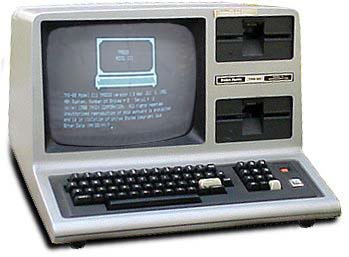
Model III
- or -
Sony's new all-in-one
- or -
Datapoint 2200
- and an Osborne computer mentioned elsewhere in the thread -
Osborne executive 3I will have to say, though, one of the prettiest cases I've ever seen was this one... it'd make a pretty cool Linux box today (with some hardware modification)!
I guess all-in-ones are somewhat en-vogue again. It just figures an all-in-one-(esque) case mod for a regular tower case is in order.
-
Re:LAN party?
How about if the old Laptop TFT screen gets built into the side of the PC case? Like those glass windows everyone bores out of the case.
Of course, then, ultimately, you'll end up with something like this...
Model III
- or -
Sony's new all-in-one
- or -
Datapoint 2200
- and an Osborne computer mentioned elsewhere in the thread -
Osborne executive 3I will have to say, though, one of the prettiest cases I've ever seen was this one... it'd make a pretty cool Linux box today (with some hardware modification)!
I guess all-in-ones are somewhat en-vogue again. It just figures an all-in-one-(esque) case mod for a regular tower case is in order.
-
Re:LAN party?
How about if the old Laptop TFT screen gets built into the side of the PC case? Like those glass windows everyone bores out of the case.
Of course, then, ultimately, you'll end up with something like this...
Model III
- or -
Sony's new all-in-one
- or -
Datapoint 2200
- and an Osborne computer mentioned elsewhere in the thread -
Osborne executive 3I will have to say, though, one of the prettiest cases I've ever seen was this one... it'd make a pretty cool Linux box today (with some hardware modification)!
I guess all-in-ones are somewhat en-vogue again. It just figures an all-in-one-(esque) case mod for a regular tower case is in order.