Slashdot Mirror
Domain: oldcomputers.net
Stories and comments across the archive that link to oldcomputers.net.
Comments · 266
-
Re:But they invented the name
-
Re:Old school
-
The IBM 5100 was introduced in 1975
It has the all the main personal computing features we associate with pre-Macintosh/Lisa systems, like a keyboard, CRT, local storage and user programmability. It probably predates the systems you sold by a year or two.
-
IBM 5100
I'm surprised that no one (not even IBM) has mentioned the IBM 5100
By no means is it the first Personal Computer, but it is IBM's first PC. and its arguably the first portable computer as well.
-
Keyword 'funding'
it's free money for somebody's buddy. Seriously, 'internet in a suitcase'? It's probably one of these
-
Re:So the question is...
You can't really mention those in relation to this article without mentioning the Commodore SX-64.
-
Re:So the question is...
-
Re:So the question is...
-
Re:Why Osborne failed?
In 1981, the same year as the Osborne I, there was the truly portable GRiD Compass 1101 with a 8088 CPU for $8150 - it originally came with GRiD-OS, but MS-DOS became available later on. In 1983, there were the Sharp PC5000 and the Gavilan SC, both with MS-DOS.
-
Re:Get off my lawn!
Close - Late 70's: http://oldcomputers.net/appleii.html
-
Re:This is why...
...and the term PC wasn't associated with Windows.
You mean the Pocket Computer from Radio Shack? A friend of mine had a PC1 that was so cool! I think he had a printer for it too!
-
Re:Wow
Wow you're a young welp.
http://oldcomputers.net/trs80i.html was my first Home PC.
http://oldcomputers.net/kim1.html was my first computer.
Nothing like keying in HEX to learn how to program.
-
Re:Wow
Wow you're a young welp.
http://oldcomputers.net/trs80i.html was my first Home PC.
http://oldcomputers.net/kim1.html was my first computer.
Nothing like keying in HEX to learn how to program.
-
Re:Still work?
Bill Cosby advertising
oh yeah? Well my old computer had Alan Alda shilling for it!
just to settle the issue of celeberty microcomputer advertising:
Bill Cosby < Alan Alda < William Shatner < Iassic Asimov
hmmm, Leonard Nimoy should be in there somewhere, right? (what? no endorsements from DeForest Kelley, James Doohan, Nichelle Nichols, George Takei or Walter Koenig I smell parody potential! Come on, George!)
and photographic proof Apple is out to turn you whole family GAY!
Jack Black?!!! -
Re:Still work?
Bill Cosby advertising
oh yeah? Well my old computer had Alan Alda shilling for it!
just to settle the issue of celeberty microcomputer advertising:
Bill Cosby < Alan Alda < William Shatner < Iassic Asimov
hmmm, Leonard Nimoy should be in there somewhere, right? (what? no endorsements from DeForest Kelley, James Doohan, Nichelle Nichols, George Takei or Walter Koenig I smell parody potential! Come on, George!)
and photographic proof Apple is out to turn you whole family GAY!
Jack Black?!!! -
Re:Why not?
-
Re:Why not?
-
Re:I saw Avatar the other day
Except that all Commodore users had 5,25 inch floppies.
Jealous much?
And TRS80 had an 8 inch floppy.
But that's not a reason to be jealous, after-all there were all floppies - not hards, thus the size doesn't matter that much, does it? -
Re:Terminator
Uh, like the original?
-
Re:Wow
some Star Trek nerds might speculate on how an economy like that depicted on Star Trek might work
In a way, that's the whole point of SF -- To explore how people relate to new technology, new cultures and new ways of living.
In 1966 it may have seemed far fetched to have the crew of the Starship Enterprise carrying around flippy communicators and tricorders while jotting down notes on tiny pad-like computers, but after years of watching and wondering "Why not?", here we are.
-
Re:It's going to suck.
Wimp!
Real men don't need more than 3.25 MHz, 2K of RAM, and an old TV.
http://oldcomputers.net/ts1000.html
Get off my lawn! -
Re:That's the way it was.
As you scale everything up, costs increase.
In general, as you scale up, costs go down due to economies of scale.
The costs of actually moving bits around have gone way down since the 80s -- I now have a ~4,700,000 bps (according to speedtest.net) WiMax link for less (counting for inflation) than I paid in the late 1980s for a phone line I could only use to move data at 2,400 bps. (9,600 and 56k modems didn't come into common usage for ordinary folks until the 1990s.) Improvement: a factor of over 1,900.
The costs of storage are tremendously lower. Back in 1988 or so my first hard disk cost on the order of $200. It held 30 MB -- 30,000,000 bytes. One can get terrabyte disks -- 1,000,000,000,000 bytes -- now, for less money. Improvement: over 33,000 times.
And the costs of twiddling bits are far, far lower than they were in the late 80s. My first PC operated at 8 MHz -- "Turbo" mode. My current box, old and pokey as it is, runs at 2210 Mhz. Let's say the overall cost was roughly the same, though I remember my dad paying something on the order of $5,000 for our first PC. (A Victor 9000 that could run both CP/M and MS-DOS, wow!) Improvement, over 270 times -- and that's not counting the improvement in what gets done per tick. My current box rates 4420.08 BogoMIPS; using the conversions at that article, my * MHz "Turbo" PC would have rated about
-
So the prior art artists can sue them now instead?
- 1995: April - At an auction in New York, ESCOM buys all rights, properties, and technologies of Commodore. http://oldcomputers.net/
- [ESCOM] declared bankruptcy on 15 July 1996 and was liquidated
-
Re:Some hardware needs them
Anybody still using 5 and a quarter inch disks? I see they are still being sold even though I haven't seen one in a modern PC since 1990..... http://www.floppydisk.com/buy.htm
Floppy History - http://oldcomputers.net/floppydisks.html
-
Re:value
I upgraded a Compaq luggable, http://oldcomputers.net/compaqi.html to Linux once. I found a pentium motherboard that could handle the ISA video card and fit in the weird form factor. It still works even.
-
value
It would be interesting to find out if the reason why some of us are so attached to old hardware just might be that it was not long ago that that hardware was mind boggingly expensive. My brother sometimes took a IBM model 5155 home and let me play nethack on it. At that time you could buy a nice car for that money instead of such a beast.
More than 10 years later I got my hands on one of these, but sadly parted with it under the influence of my wife at the time. (Yup, we divorced.). Seeing a picture of it still fills me with awe thinking how expensive this machine once was. Maybe that awe combined with a but-it-still-works attitude makes us think twice about throwing such stuff away?
-
Re:Not worth it for them
I agree, except you have one thing backward. It's not that big business isn't a market they want. On the contrary, they've made many attempts to penetrate this market. Why even bother to have a rack mount server if you don't care about business customers? Or sophisticated internet technologies?
It's the other way around. Apple tries to sell to big business, but they pretty thoroughly suck at it. So a sort of economic Darwinism guarantees that the only Apple products that succeed are ones that sell well to individuals and small organizations. In other words, the person who uses the product is either the same person who makes the purchase decision, or has a lot of direct influence over that person.
That tends to slant their product line towards kewlness. But not always. Apple's first really successful product was the Apple ][. Note that this is not a proto-Mac, it's a proto-PC. Note the open bus, which encouraged the creation of third-party hardware extensions. This is the basic design paradigm that almost all desktop computers (and a lot of servers) follow to this very day. It's a good utilitarian system, like something from Dell, not a sleek, sexy proto-iMac.
Geeks know the ][ because it was a great hacking platform. But geeks didn't drive its success, business did. When business people discovered that they could pop in a Z80 card, run Visicalc, and do really sophisticated financial projections without hiring a programmer, they had to have them. It pretty much created the business PC market.
But if the ][ created the market, why didn't it create the market lock-in that the IBM PC did a little later? Because the biggest consumer of computing is big business, and Apple simply didn't know how to sell to them. I don't mean bad salesmanship, I mean they literally didn't have the ability to integrate and distribute them in the quantities large business would have needed. So Fortune 500 companies would go to Apple and say, "please sell us 1,000 Apple ][s with Z80 cards, disk drives, and monitors" and Apple would simply have no way of filling the order. All they knew how to do was to ship out job lots to their wholesalers, none of whom were set up to integrate systems this way.
Apple did develop better business-oriented sales channels eventually, but their ability to create stuff that businesses want is still pretty limited.
-
Re:Not really
http://oldcomputers.net/trs100.html
should fit your needs
-
Re:Actually, the Mandelbrot set is already 4D
You can find a picture of a "4-D" Mandlebrot set in a mid/late 80's issue of Scientific American. I was generating pictures of this on a 286 pc. (with EGA graphics) 15 years ago, and the pictures in TFA of z^2 look *nothing* like that did.
Hah, I can beat that! I used a Compaq portable with an 8088 processor, 256 K of RAM and 2 floppies! I wrote a C program based on that original Scientific American article, and then had a Basic program read the results and display it. I think the C program took a week to run.
The joke, of course, is that the Compaq didn't have a color screen—it had a small grayscale monitor built in. But I still thought it was really cool.
-
Re:It's fairly obvious why they are so successful.
I remember my old Timex Sinclair 1000 computer, looks almost identical to the new netbooks (minus the screen). What I do find interesting about the netbook craze is that people will soon realize that they really aren't that powerful. As a result, expect companies to increase RAM, performance, storage, weight, etc. and keep the price reasonable.
Personally, I'm going to wait just a little longer so I can use it for wireless video streaming. -
Re:Very cool.
Man..... time to retire that Osborne 1...
-
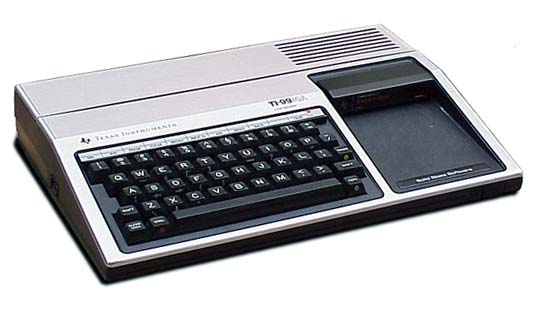
Re:TI-99/4A
Yes! I have fond memories of programming simple programs in BASIC and storing my hangman dictionary on cassette. The keyboard was a little difficult -- I believe the colon, brackets, other normal punctuation were a special key + normal alphabet key. a picture
-
Re:crack bank accounts?
-
First?
http://oldcomputers.net/grid1101.html This was even earlier. I guess what passed for a
netbook today, is well, not quite a netbook, except for the browsing stuff. -
Tandy Model 100
The "netbook craze" started with the EEE PC. There was no "craze" before then because small laptops were expensive.
If there was anything like the netbook craze before, it may have been the Tandy Model 100, a small, lightweight, inexpensive computer with built-in modem that's popular even today with writers. In fact, I think a netbook in that form factor (flat, screen and keyboard open, AA battery powered) would still be nice.
-
TRS-80 Model 1 RF interference next?
I recall some software that would play (crappy) music on an AM radio within a few feet of the TRS-80 Model 1 - the software just went through loops of various calculations that would cause RF interference that produced the desired tone on the radio.
I believe the Model 1 did not require FCC certification of being free of FR interference since it was classified as a low volume hobby device or something like that. Nope, Wikipedia and oldcomputers.net say it got caught by a change in FCC regulations.
http://en.wikipedia.org/wiki/TRS-80
http://oldcomputers.net/trs80i.htmlNow can we emulate that in the latest systems?
-
With a bumper sticker...
-
Re:GPL to plugins?
A plugin uses the host application's API. It is, therefore a derived work. In the case of the GPL, derived works must be distributed under compatible licenses.
It's only a "derivative work" of the application if it contains actual copyrightable stuff from the application. Things required purely for interoperability (like, say, function declarations or the data structures required by those functions) don't count.
Back when the IBM clone PCs came out, the clones had reverse-engineered and reimplemented BIOS code, very much derived from the original (copyrighted) BIOS. But it wasn't a "derivative work", because copyright covers the actual code itself, rather than what the code does.
-
Re:Be Warned
OLPC has the worst keyboard in history
Stop dissing the Atari 400!
Respect your elders, dammit! -
Re:Wrong Decision
Sitting here in my recliner typing this,
The heat from under the machine is cooking your testicles, making you sterile.
my old 8 lb luggable
That's not luggable. This is luggable!
-
Re:A bit on the heavy side
Wow that was an obscure reference. I remember hearing the word "Osbourne" but didn't recall what it was (24 pounds): http://oldcomputers.net/osborne.html - Now if you had said "Commodore 64 portable" then I could relate (23 pounds): http://oldcomputers.net/sx64.html ----- The heaviest portable ever made was the IBM PC at over 30 pounds!!! Ouch.
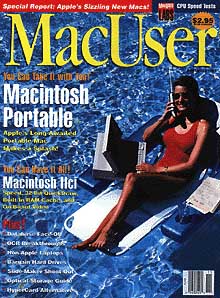
And finally the first laptop PC (12 pounds). It ran over 10 hours! Why don't today's laptops run ten hours? http://oldcomputers.net/ibm5140.html ----- And the Macintosh laptop. I like the image of a beautiful woman doing computer work *in her pool*. Yeah that would happen. Beautiful women don't use computers (ducks a spitball). http://oldcomputers.net/pics/macuser1189.jpg
P.S.
Free games: http://oldcomputers.net/games.html
-
Re:A bit on the heavy side
Wow that was an obscure reference. I remember hearing the word "Osbourne" but didn't recall what it was (24 pounds): http://oldcomputers.net/osborne.html - Now if you had said "Commodore 64 portable" then I could relate (23 pounds): http://oldcomputers.net/sx64.html ----- The heaviest portable ever made was the IBM PC at over 30 pounds!!! Ouch.
And finally the first laptop PC (12 pounds). It ran over 10 hours! Why don't today's laptops run ten hours? http://oldcomputers.net/ibm5140.html ----- And the Macintosh laptop. I like the image of a beautiful woman doing computer work *in her pool*. Yeah that would happen. Beautiful women don't use computers (ducks a spitball). http://oldcomputers.net/pics/macuser1189.jpg
P.S.
Free games: http://oldcomputers.net/games.html
-
Re:A bit on the heavy side
Wow that was an obscure reference. I remember hearing the word "Osbourne" but didn't recall what it was (24 pounds): http://oldcomputers.net/osborne.html - Now if you had said "Commodore 64 portable" then I could relate (23 pounds): http://oldcomputers.net/sx64.html ----- The heaviest portable ever made was the IBM PC at over 30 pounds!!! Ouch.
And finally the first laptop PC (12 pounds). It ran over 10 hours! Why don't today's laptops run ten hours? http://oldcomputers.net/ibm5140.html ----- And the Macintosh laptop. I like the image of a beautiful woman doing computer work *in her pool*. Yeah that would happen. Beautiful women don't use computers (ducks a spitball). http://oldcomputers.net/pics/macuser1189.jpg
P.S.
Free games: http://oldcomputers.net/games.html
-
Re:A bit on the heavy side
Wow that was an obscure reference. I remember hearing the word "Osbourne" but didn't recall what it was (24 pounds): http://oldcomputers.net/osborne.html - Now if you had said "Commodore 64 portable" then I could relate (23 pounds): http://oldcomputers.net/sx64.html ----- The heaviest portable ever made was the IBM PC at over 30 pounds!!! Ouch.
And finally the first laptop PC (12 pounds). It ran over 10 hours! Why don't today's laptops run ten hours? http://oldcomputers.net/ibm5140.html ----- And the Macintosh laptop. I like the image of a beautiful woman doing computer work *in her pool*. Yeah that would happen. Beautiful women don't use computers (ducks a spitball). http://oldcomputers.net/pics/macuser1189.jpg
P.S.
Free games: http://oldcomputers.net/games.html
-
Re:A bit on the heavy side
Wow that was an obscure reference. I remember hearing the word "Osbourne" but didn't recall what it was (24 pounds): http://oldcomputers.net/osborne.html - Now if you had said "Commodore 64 portable" then I could relate (23 pounds): http://oldcomputers.net/sx64.html ----- The heaviest portable ever made was the IBM PC at over 30 pounds!!! Ouch.
And finally the first laptop PC (12 pounds). It ran over 10 hours! Why don't today's laptops run ten hours? http://oldcomputers.net/ibm5140.html ----- And the Macintosh laptop. I like the image of a beautiful woman doing computer work *in her pool*. Yeah that would happen. Beautiful women don't use computers (ducks a spitball). http://oldcomputers.net/pics/macuser1189.jpg
P.S.
Free games: http://oldcomputers.net/games.html
-
Re:Not the media that's the problem
The disks will be readable but you'll have no mechanical or logical way to read what's on them.
Come on, it's not really that hard. I can walk into any thrift store around here and buy an 8 track player if I really wanted to play old 8 track tapes. My father still has some reel-to-reel tapes, even. If he really wanted, it wouldn't be that hard for him to get a reel-to-reel player capable of reading the media. I've seen those in thrift stores too, and plenty of electronics nerds or audiophiles have this stuff around for no reason other than they like having it.
The point is that even today you can easily get your hands on equipment for media that nobody has used in decades. If you couldn't find one in a thrift store, a quick ad on Craigslist would turn up a few people willing to let you use their equipment, especially if you're willing to pay.
In fact, you can even get ancient computers fairly easily. Not long ago I stumbled across one of these babies for sale, a TI-99 computer. First computer I had, back when I was about five or six. Want to read those old solid-state catridges they used? The computer cost all of seven dollars or so. Computers with 5.25" drives are everywhere as well. It may have been foolish, twenty years ago, to rely on those disks for long-term backup, but certainly not for lack of equipment to read it.
The longevity of the media is certainly more important than whether or not "computers of the future" will be able to read it. It's just not that hard to find old equipment, and if it's that important to you, you'll shell out the ten bucks to get an old computer. Who cares if the media is "standard" later?
See, while I'm sure I could find a reel-to-reel player for my father's old tapes, I doubt the tapes themselves are reliable. That's why media is more important here.
Of course, if I really cared, I'd just back up to a hard drive or two, and repeat the process in another three years. An hour or two every couple of years to keep a fresh copy around isn't that much of a sacrifice. -
Re:Memory exists to be used
...Don't think any of the SSD based netbooks use swap at all and they get along just fine...
What is the best way to configure Linux on a sub 512MB RAM box, sub notebook, etc..., so that no matter how much you load (application wise) it will not die, although it might run slower should swapping occur? (The system seems to stop swapping as well when Free Memory falls below 10MB and really poorly when it falls below 5 MB. Ideally I would like to maintain 10 - 15 MB of Free RAM Memory available at all times.)
I know Linux can be configured to run in 128MB of RAM and love that...actually have a PC that I would like to configure and use with that low of RAM. (Intuitively I understand that if I can run with less RAM, when I purchase newer boxes with more RAM I should be able to run, much, much faster...the idea that a system for a normal Power user would ever get sluggish with over 1 GB of RAM is ridiculous in my opinion. If I purchase more RAM, I want my apps to benefit from that, not be required to have it just to function, but than my first work computer was an IBM mainframe with 32KB of RAM, an IBM 360.
My first desktop was the Radio Shack Model III, (4K RAM, Floppy drives, 12 inch B/W Monitor, keyboard, BASIC in ROM, TRS-DOS on disk, between $700 - $2,500 depending on config)my first IBM PC had either 16kB of RAM, 4.77 MHz Intel 8088, Floppy Disk Drive (credited with its business success per the wiki, aah the power of the floppy), 5 Bus slots (w/Expander in 1 of 5 - 8 more Bus Slots, slots used by Monitor, Hard Disk (if you had one, my first did not), I/O adapters, 3278/3279 Adapter - for moving up to 2 MB files to/from mainframe.), No hard disk for around $3,000. My first lug gable the IBM P70, OS/2 1.2 Extended Edition, MSDOS, Windows 3.1, Microsoft Word, Intel 9600 EX Modem, Hyper Access software, Token Ring Built in, slot for Ethernet, external monitor port (dual monitor mode), 8512 Color Monitor, floppy drive and hard disk (120 MB I believe) cost over $5,000. Made well over $15,000 working out of a hotel room on a consulting contract in a few weeks with that sexy heavy beast which was state of the art at the time. so was well worth the purchase.
A Intel Celeron M running at 900 MHz sub notebook, 512MB of RAM, 4GB SSD drive, 10/100 & WiFi built in; Web Cam, Audio and Mic ports, 3 USB ports, MMC.SD slot, external monitor port for $300 - $400 is something else... warning...slow loading flash; wiki page.
I could probably fit 9+ sub Notebooks the size of the Asus Eee PC in the IBM P70 leather carrying case, lol.
Thanks to the many great posts here I am learning this is a bit art as it is science and I do not mind experimenting with different configurations...
Read on if you need specifics about my configurations and PCs to help me...honestly looking for the right answers. I too would love to be able to set a MIN and MAX memory point (as another poster mentioned above) to begin swapping IN/OUT only allowing the swap if it is honestly required. Sounds like that is NOT possible at this time, though I sneakingly expect there might be a way...one day as I learn more...might be time to pick up programming in C again.
On my Asus EeePC I have noticed that my free memory continues to shrink, down to around 4 - 6KB free, at which point my performance suffers greatly. If an app fails or my Network Adapter hic ups when it is this low it can cause a lockup situation for me. I thought about swap space, but based on reading about hard disk performance issues, that does not sound like a good solution. ( Or is it?)
Now I do this to myself, I will often have
-
Re:The Text
In point of fact, there were no probably no individual digital computer owners (analog computers are another matter) before the cost of a computer fell below, say, an average person's annual income. Probably the first computer to have a lot of user-owners was the Sol 20, which went for $1K in kit form — about $3800 in today's money.
Also, sneering at the lack of hacking expertise of somebody like Dijkstra ignores the difference between computer science and computer engineering. Sort of like sneering at a chemist who doesn't know how to brew beer.
As for Turing: I think too many people contributed to the birth of computing for any one of them to claim parenthood. You could make a case for AT being the father of software, since he was the first computer scientist to really consider programming to be more than a minor adjunct to the hardware. Indeed, if you consider Turing Machine code to be software, Turing was doing software long before there were any computers to do it on!
-
Re:The First Laptop computer
http://oldcomputers.net/grid1101.html for more info and pics
-
Re:The first laptop I remember...
According to an old computers sight the HX-20 was the second laptop, being beaten by one year by the TRS80 pocket computer. The first computer they list that looks like a laptop is the GRiD Compass 1101, complete with bubble memory.