Slashdot Mirror
Domain: powerstream.com
Stories and comments across the archive that link to powerstream.com.
Comments · 53
-
Re:19V - sigh
This would do the trick if it's 19v DC (adjustable up to 38v DC):
http://www.powerstream.com/Pro...Usually I'm converting up to 12 volt DC and not with electronics, so I use a $5 buck converter. The product above provides more safety features.
-
Re:Belongs here
As I use solar and already have DC available at home, I'm curious if I might be able to find DC power supplies.
Yes, assuming you want to take an ATX PSU, there are DC options available to you.
Well, obviously there are plenty of other options, but given the subject of discussion, I figure ATX is the most likely interest.
If you're serious, you can do it. If you don't care, well, others will do it anyway.
-
Not a linear relation
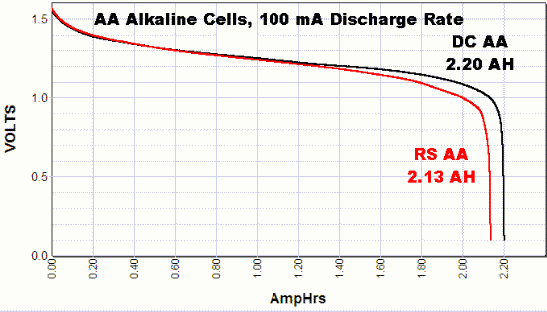
Alkaline battery voltage doesn't fall linearly with lifetime, but undergoes a rapid drop near the end of life: http://www.powerstream.com/z/A... In this curve, the battery has only 10-20% of its life left at 1.1v, and I've never owned any device that did not work down to at least that voltage and usually less. Whatever device in the example that stops working at 1.35v is very poorly designed and not something you run across often.
-
Re:Too good to be true
But the claim was "batteries that would otherwise be thrown into the trash when the voltage dips to 1.3V or 1.4V."
One doesn't have to look hard to find that an alkaline cell drops to 1.4 V when only about 10% of its energy capacity is used. So I can believe the claim, even though it's exceedingly misleading. I can't think of a device designed for alkaline batteries which would fail to work at even 1.0 V/cell.
From the article: "Batteroo is a Silicon Valley company preparing to release its Batteriser product in September."
And don't forget, it's Batterrific! -
Re:Premature
I see what you mean. Let's put some numbers to that for everyone's benefit.
According to the table I linked previously, the OOOO gauge wire is 0.16072 ohms per 1000m. So, for a 20m run, that's about 0.00321 ohms. The voltage drop incurred by 330A across that resistance would be just over 1.06 volts.
For a 5V run, that's pretty significant, really. And you'd be dissipating over 350W in that wire alone. Yow! At 330A, you'd be burning 20% of your power just in that cable if you used OOOO gauge cabling.
Now the same numbers for 10 gauge wire, 15A, 110V, 20m. That's 3.276392 ohms per 1000m, or 0.0655 ohms for 20m. Voltage drop at 15A is 0.983V. Peak power dissipated in the wire is 15A * 0.983V = 14.7W. (RMS power is only ~10W.)
-
Re:Premature
I'd hate to think of just how much extra copper I'd need in my walls to distribute ample power throughout my house and not suffer resistive losses. A 15A 110V circuit would become a 330A 5V circuit. The wire that carries the 15A @ 110V circuit is about the thickness of a pencil lead (about 1/10"). The wire required to carry 330A would have conductors the size of a garden hose (about 1/2"). (Note: The table linked above only goes up to 302A with a thickness of 0.46"; 330A would be larger still.)
-
Re:suitable for home use?
The power density is really nowhere close to a battery.
A typical 100 Ah car battery weighs 33 Kg. At 12 volts that comes out to 1.2 KWh/33Kg or 36Wh/g. That is in the same neighborhood as the values cited by the grandparent post.
-
Re:Damage on the wall sideThat's in open air, where each strand of conductor has proper cooling. Wiring for power transmission, you only want to shove around 5.9A through 14AWG. For 15A, you'd want at least 10AWG and more likely 9AWG to give you a safety factor. Yes, this is by rule of thumb, and doesn't take into account the length (increasing length increases resistance) , type of insulation, etc., but do you really want to take the cheapest possible approach when it can potentially burn your house down?
The Maximum Amps for Power Transmission uses the 700 circular mils per amp rule, which is very very conservative. The Maximum Amps for Chassis Wiring is also a conservative rating, but is meant for wiring in air, and not in a bundle.
-
Re:Standardised DC, eh?
What's 5A between friends? That means you likely want a 14 AWG. I've got an extension cord here rated for 30A at 300V...or 9kW (okay, I had to attach the plug/outlet myself, but still!) It's only moderate overkill, weighs about 20lbs. O:-)
-
Re:That is very energy dense
They're named the way they are because of their chemistry. An alkaline cell has an open circuit voltage of 1.43V - close enough to the old Zinc-Carbon cell's OC voltage of 1.5V. A lead-acid cell has an open circuit voltage of about 2.1V. 6 of those in series makes 12-ish V. The cell potential between the anode and cathode materials determines their open circuit voltage (see this chart).
-
Re:Pay your Sony bill
How witty.
Still wrong though.
-
Re:also needed for houses
but the 100 other widgets in my house could plug in DC.
That's 100A of 12V. From here, you'd need at least number 2 or number 1 wire to carry that current. Ballpark figure.
Same reference, you lose 3 volts for every ten feet of 12 gage at that current (one wire for supply, one for return.) Can your 12V device run happily on 9V?
Sure, the TV and PC would still convert AC power,
The costs of running two power systems in a house would swamp any savings you think you'd make by using DC.
-
Re:In related news ...
Gah! I meant it is supposed to be able to handle up to 24 ampers. The next smallest wire only reaches 19.
Stupid brain. It's late in the day.
linky to where I got the number.
-
Re:Wrong place
Let's say you wanted to run 5VDC throughout your house from a single centralized power supply. (And who among us hasn't thought about exactly this idea?) 14 AWG wire, like the stuff you probably have carrying your 120VAC 15A service today, has a resistance of 0.25 ohms on a 100 foot run. That's 50 feet out and back, which we'll call typical for a small house average run. At 5VDC that's a voltage drop of 2.5% to a barely usable 4.9VDC.
That depends on your current. Assuming you have a 200 watt device on 120V, you are drawing 1.7A, with a voltage loss of I*R=1.7*0.25=0.4V. Not a major problem. The same 200 watts from a 5V line would draw 40 A (not remotely safe with normal 14 AWG wire, it is only rated for 5.9A). The voltage loss over those 0.25 Ohms would be 10 V (this is not impossible. We are calculating with the voltage supplied to the device, you'd need 15 V at the "source end" of the cable. You can't draw 40A over a 0.25 Ohms resistance at 5 V, so even a short circuit wouldn't let that sort of current flow).
Disclaimer: I am an electrical engineer, although I am by no means immune to very stupid mistakes.
By the way: do you really use only 14 AWG (= about 1,6 mm diameter) for houses? What kind of circuit breakers do you use? We, in NL, usually use 2,5 mm wires (between AWG 11 and 10) with a 16A circuit breaker, so a short will always trip the breaker before it starts a fire. We do not have fuses or switches in our outlets. -
Re:Not viable yet
Perhaps in a few decades we'll have incredibly small, flexible batteries, but that's a much, MUCH harder problem to solve.
Well, actually...
-
Re:DC-DC conversion?
For reasons which are a long story, I have had several servers up and running on 12V for many years now. The powerstream guys are pretty much the gold standard of ATX 12 volt power supplies, as far as I know:
http://www.powerstream.com/DC-PC-12V.htm
[...]Wire everything in Amphenol power poles, exactly like the ham radio guys so you can use their DC products, and keep a stock of extension cords and Y cables and other gadgets. Use fuses, and as a subset of that rule, only use automotive fuses because they are infinitely available. Use 12 volts as your standard because you probably own a mobile 12 volt generator (aka your car). Perhaps if you're in the
A DC powered system is frankly pretty straightforward and simple.
A lot of telco equipment runs on -48VDC, as that's what is sent down the phone line to power your landline handset. They also often require NEBS-rated equipment.
Sun had/has a large line of these types of systems (NEBS, DC) as they are/were fairly big in the telco space. DC is nothing new to a lot of server manufacturers.
-
Re:Dumb idea
Technically you could swap out power supplies for a DC input version:
http://www.powerstream.com/DC-PC-12V.htm
and
http://www.mini-box.com/DC-DC (these are more for low power systems though)I had debated putting a 12vdc power supply in my home computer and running it to a 12v battery with a power/charging circuit on that. I never understood having UPS systems that convert AC to DC to charge the batteries then switching back to AC to power the computer which just converts it back to DC.
-
Re:DC-DC conversion?
Today if you blow a power supply (one of the most common computer failures) you lose one computer. If you blow the power supply for the office floor you might lose 100 or 200 computers.
For reasons which are a long story, I have had several servers up and running on 12V for many years now. The powerstream guys are pretty much the gold standard of ATX 12 volt power supplies, as far as I know:
http://www.powerstream.com/DC-PC-12V.htm
Note that these are "honest wattages" not the "marketing wattages" seen in the AC power industry. The price of a 300 watt DC supply seems high compared to a 100 watt AC supply from China that has a sticker claiming 300 watts. However its not too bad compared to a AC supply that actually only provides 300 watts despite having a sticker labeled 800 watts or a million watts or whatever marketing felt necessary. Also the powerstream supplies, to the best of my knowledge, are some of the few computer power supplies you can buy that do not have forged FCC and UL registries, which is worth something to me. In summary, expensive, but strongly recommend based on years of experience.
Anyway, what happens when the primary rectifier goes down, is my battery bank will run the asterisk PBX and friends for something like half a day, during which time I can source a generator and charger, or perhaps casually purchase a new supply, etc. Also I have multiple supplies any of which could theoretically power the whole works (at a cost of high heat and much shorter capacitor lifetimes, etc). So you Y-cable them to run multiple plants off one supply. Guess what, the same Y cable can be used to run multiple plants off one battery, if one fails. Etc.
Theoretically, I could run the entire phone system off an idling car, assuming you have enough gas in the tank. Unfortunately my entire plant draws just a little too much for the cigarette lighter plug, probably 15 amps total. If I could invest in new phones / new servers / etc and get total plant draw down to 5 amps, not only would my batteries be 1/3 cheaper or last 3 times longer in an outage, but I could also run the works conveniently off a car cig lighter port.
Obviously if you have zero battery capacity then you are instantly in deep doo doo, but given three or so figures of amp-hours you're good to go for a very long time.
Wire everything in Amphenol power poles, exactly like the ham radio guys so you can use their DC products, and keep a stock of extension cords and Y cables and other gadgets. Use fuses, and as a subset of that rule, only use automotive fuses because they are infinitely available. Use 12 volts as your standard because you probably own a mobile 12 volt generator (aka your car). Perhaps if you're in the
A DC powered system is frankly pretty straightforward and simple.
-
Re:How long does it last?
A reasonable estimate for the efficiency of an electric car (according to Wikipedia) is about 15kWh/100km; after converting to more usable units, the 600km capacity means the battery holds 324MJ. A 6 minute charge time gives a 900kW transfer rate
900,000 watts eh? That makes me wonder just how practical this would be outside of the lab. You'd need a really high voltage or a really thick cable to transfer that much wattage into an automobile. The American Wire Gauge only goes up to OOOO according to this table. A OOOO conductor is 0.46" thick. Even that insanely heavy cable only goes up to 300 amps. You'd need 3,000 volts to deliver your 900kW on such a cable.
-
Re:Mod parent up
The voltage/capacity curve for rechargeable batteries is *much* flatter than for alkaline batteries -- alkaline batteries have a pretty steep slope with a fairly linear relationship between "current voltage" and "remaining power", and devices that expect alkaline batteries and have a low-power indicator calibrated for that curve. Rechargeable batteries have a much flatter curve and the low-power indicator never lights because the trigger voltage is not reached until there's far too little power.
So presumably, devices with built-in rechargeable batteries are properly calibrated for those, and produce a low-power warning at the appropriate time.
-
Re:Physics?
The AeroVironment Posicharge ELT single vehicle charger comes close to delivering that kind of power. Given AVAV's business model, I daresay they'd be all over that market, if it were to emerge.
And the required stranded copper conductor is about 500k circular mils, which converts to a conductor about 1.8cm in diameter. Not too unweildy.
The problem isn't getting that much power from the charging station to the car, the problem is getting that much power from the grid to the charging station. Charging stations would necessarily be located at community electric substations.
It seems like the real answer is trickle charge overnight at home, rapid charge topoff for long trips or emergency return-to-home situations. Batteries generally store more energy from a C/10 or C/20 trickle charge than from a 10C fast charge, anyway.
-
Re:Price of certainty.
I imagine it would be bad to run A/C stuff inverted from a variable DC line as well. If you are trying to run normal household stuff straight off the power output of the panels, as it gets later in the day, you'd start getting your own 'brownouts' in the house wouldn't you?
I suppose you could intentionally buy stuff that fails that way. I don't.
Most switching mode supplies don't care as long as it's above a certain minimum.
For example, I have a perfectly nice "twelve volt" input ATX supply in my server from powerstream. It doesn't much care as long as the input voltage is above 9 volts and below 18. At 9 volts the lead-acid backup batteries are about 99.99% empty so theres not much lost capacity. If the battery is above 18 volts, its probably on fire or something. So pretty much, as long as there's the tiniest fraction of a KWh left in the batteries, my server runs.
http://www.powerstream.com/DC-PC-12V.htm
This is all off the shelf stuff, no big deal, nothing special.
-
Re:Now...
running off a power inverter hacked into the vehicles 12-volt power
No need to hack. They already have DC Power Supplies just for this purpose:
http://www.powerstream.com/mini-itx.htm
http://www.short-circuit.com/ -
Re:Of interest...
We are talking, at 2 AWG, just over 1/4" (6.5mm)* conductor diameter. Per wire. Not the lightest, most flexible, or most convenient size around...
* American Wire Gauge Tables -
Re:Thank god!
How about the math then? I found energy efficiency figures for the Tesla Roadster here. Unfortunately, we're going to have to serve standard-sized vehicles, and the Telsa isn't exactly that. But they do say that the batteries are 86% efficient. That compares favourably to a typical internal combustion engine, which averages about 20%.
Okay, the fuel tank on my car holds 54 litres. It takes around 3 minutes to fill. Sometimes less, but let's use 3 minutes for a from-empty fill. The energy density of gasoline is 34.8 MJ/L. So when I fill my tank I'm pumping 34.8 Mj/L * 54 L = 1.88 GJ.
Now, after ICE losses, that 1.88 GJ turns into 1.88 GJ * 0.2 = 376 MJ, which is the amount of energy it actually takes to move my car the 600 km or so it goes on a tank of gas.
Okay, so what about the electric? It's more efficient. 86% if you're a Tesla Roadster... under ideal conditions. When I pump gas into my car it takes me pretty much the same distance in the winter as it does in the summer. Not so the electric. Actually, the electric would probably die horribly here during the winter, but let's compromise and use some more reasonable cold weather. According to this performance drops by about 40% in cold weather because you have to heat the battery. There's no citation, but it seems reasonable, knowing what happens to car batteries here in the winter. Not to mention I'm probably going to want the cabin heated as well. Plus car companies lie about efficiency, so Tesla's 86% number is probably high anyway.
So our non-ideal conditions EV efficiency is 0.8*0.6 = 0.48. Batteries are heavy and EVs tend to be heavier than their same-size gasoline equivalents. But let's call that a wash.
So to run my EV as far as my gas car I'm going to need 376 MJ / 0.48 = 783 MJ. To match the refueling performance of the gas station I need to transfer that energy in 3 minutes, or 3*60 = 180 s. That's 783 MJ / 180 s = 4.35 MJ / s.
A watt is 1 J/s. So we're going to need an electrical system that can handle 4.35 MW. We can get around some of the problems by cranking up the voltage, but that's got problems of it's own. Get the voltage too high and it will start arcing a fair distance through the air. So let's keep it to 1000 V. 4.35 MW / 1000 V = 4.35 kA. The biggest wiring guidelines figures I could find are here. According to the table, a wire 11.684 mm in diameter is safe for 302 amps. We need a bit more than that.
R = p*L/A, where R is resistance, p is resistivity, L is wire length and A is cross sectional area. When we're considering how big a wire we need, we're concerned about power dissipation. That is, P=R*I^2. We want our power dissipation to stay safe, as given by the guidelines in the table. So P1 = P2, or R1*I1^2 = R2*I2^2. Substituting in the formula for wire diameter, we get (simplified), I1^2 / A1 = I2^2 / A2.
From the table, I1 = 302 A. Area of a circle is pi*r^2, so A1 = pi*(11.684 mm / 2)^2 = 107 mm^2.
I2 = 4.35 * 10^3 A. So A2 = A1*I2^2 / I1^2 = 107 mm^2 * (4.35 kA)^2 / (302 A)^2 = 22199 mm^2.
Translating back into diameter, d = 2*sqrt(A/pi) = 2*sqrt(22199/pi) = 168 mm. That's about 6.6 inches for the metrically challenged.
When your conductor is more than half a foot in diameter it really ceases to be a wire. Oh, and the internals of your car, including the battery, has to be able to handle that 4.35 MW.
Oh, and my local gas station has eight gas pumps. 4.35 * 8 = 34.8 MW. I'll let you calculate how big a wire you need to transfer that. Another fun exercise would be to calculate the diameter of conductor needed to match the energy transfer of a tanker truck that delivers the gasoline each morning.
It's late
-
Re:MiyEee PC runs just fine
Perhaps the widget is actually correct?
Check out the discharge behaviour of NiMH under serious load for instance:
http://www.powerstream.com/AA-tests.htm#nimh -
Re:go 12 volt
Generator and battery bank were about 50ft away in a separate shed.
Unless the inverter was in the shed next to the battery, I call BS.
We had other misc small appliances, (toaster, blender, hot-wire foam/glass cutter, soldering iron, inverter-powered microwave, fans etc).
These items blender, toaster, microwave, simply can't be powered by a battery 50 feet away on any normal size wire.
Just for grins use this copper wire table;
http://www.powerstream.com/Wire_Size.htm
Figure a small toaster of 600 watts... at 12 volts that's 50 amps. Assume a 14 volt fully charged battery (generator running maybe) an permitting a 2 volt drop from the shed 50 feet away. That's 100 feet round trip for the conductor. Using ohm's law, 2 volts at 50 amps permits a resistance of 0.04 ohms. Now taking the resistance for 1,000 feet and cutting by 10 to get resistance for 100 feet, a #6 wire at 0.03951 will do the job not counting connectors. That is a 2 Volt X 50 Amp or 100 Watt loss in the wire. That is more loss than the loss of a typical inverter near the battery.
How many watts is the microwave and what is the inverter low voltage shutdown point? My inverter alarms at 12 volts shuts down at 11.5 volts. Please tell me your inverter for the microwave is somewhere near the batteries. -
Re:go 12 volt
I'll make it easy, here's a hand-dandy wire gauge calculator/ and AWG size reference chart.
Plug any normal residential electrical load into it for both 120v and 12v, keep the voltage drop to ~2v (acceptable to most 12v devices, including inverters) and you'll find that in all but the most extreme cases you'll need a max difference of 3X wire diameter between 12v and 120v and that just for the primary feeds coming in from the power source and normal wiring suffices for all but the longest secondaries.
10X diameter is just ridiculous, (in fact with AWG only going to 000000 you wouldn't even be on an AWG chart any more). -
Re:Voltage.
Like you said, it's already put inside of every lithium battery made, that's not the problem
I admit I'm being a bit of a pedant here, but it sounds like what you want aren't lithium batteries, but lithium cells. I would guesstimate that the mass-produced cost of the safety circuitry is somewhere between $3 and $10, which would double or quadruple the cost of a cell. (a MAX1737 which only implements charge control, not discharge control, is $2.85 for lots of 1000, and requires supporting components. The LM3621 is less expensive at $1.40 but has the same limitations), and some room in each cell (reducing capacity and adding weight). You may find the R/C aircraft hobbyists' attempts to use lithium in their homemade battery packs interesting reading.
If my guesstimation is wrong, there's probably a profitable business waiting for you.
-
Re:Power over Ethernet Could Help
I think I remember reading somewhere that loses are about 40% (15 to 9 amps) per run of cable. Not running at operational power also will decrease the life of the equipment.
I hope you're missing a couple of decimal points in there - anyone putting 15A on a 24AWG wire is asking for an electrical fire to start. 15A is the maximum allowable ampacity for most insulation grades of 14AWG wire, and 24AWG has 10x the resistance of 14AWG (87.5 ohms/km vs 8.54 ohms/km).
Voltage drop depends on the current & length of the cable, but even a 25-foot run with just 0.5A of current works out to a 0.66V drop - unsuitable for anything below 24V (maybe 12V could get away with it).
Handy link for checking the numbers: http://www.powerstream.com/Wire_Size.htm
-
Re:Big ego department
I have wondered about that too, but, like the fact that after 20 years the monitor doesn't shut off with the pc, there has to be some other reason or agenda involved. It's just too obvious to have been an oversight. As for the dc power supplies, why not go with a form-factor equivalent retrofit: http://www.powerstream.com/DC_PC.htm?
-
Here are the published EEstor capacitor figures
Good comment - ~4kV on the caps makes it a lot easier.
I'm not really sure why the Slashdot article links to the Wikipedia "Supercapacitor" article - that hasn't had anything useful on EEStor since July 26, when this section with all the important claimed numbers for EEStor's capacitor was removed:
"As of spring 2006, EEStor Inc. claims to have a supercapacitor with a barium titanate dielectric nearing production. The company claims a unit with 31 farads capacitance and an operating voltage of 3.5 kV, capable of storing up to 340 Wh/kg (1232 kJ/kg)and charging or discharging at up to 3.5 kW/kg (52 kWh = 187 MJ and 520 kW - 6 minute charging time - for the 152 kg unit), lifetime of over 1,000,000 discharge cycles and leakage of less than 0.1% per month [[4] US Patent 7,033,406] with a cost of $40-$60 per kWh ($3,200 - $2,100 per unit). [BusinessWeek, 3 September 2005]. The technology is scheduled for third-party verification during the summer of 2006."
(This had links to Barium Titanate Ultra-Capacitor (Richard WEIR / Carl NELSON). That page seems to include copies of essentially all the professional articles on EEStor.)
So the charge rate on a car-size capacitor is 520 kW at 3.5 kV which means the current is a bit under 150 amps. According to American Wire Gauge (AWG) Current limits the necessary diameter for each wire of the pair is between 0.25 - 0.33 inches (5.83 mm - 8.25 mm) depending on the wire length.
The solution to the high peak power demands of an electrical "filling" station is to have a large (MWh -class) Ultracapacitor bank at the station to level the load over the course of a day.
The car range estimate also seems reasonable - the relevant figure is not the full-cycle efficiency (which includes charging losses), but the efficiency based on the energy actually stored in the capacitor. The EV1 had an efficiency on that basis of about 0.18 kWh per mile, so even without adjusting for the lower weight and losses of the capacitor compared to the EV1's batteries, a 52kWh capacitor should have a range of about 290 miles.
***
I think he most interesting things about the EEStor capacitor are not just the energy and power densities but the amazing durability and low cost. If it works as advertised this is going to allow lots of businesses that aren't
practical today such as solar, wind, and tide generation far from the grid - with energy shipped out in boxes. Utilities could use these for load-levelling. With the right setup in the cars, the vast number of cars hooked up to the grid and any given time could itself be the utilities' supply buffer. -
Re:Safety
>That's because AC will always give you a zap. I know this because I have been hit with 120, 208, and 277 volts, because it wasn't really off even though I tested it(damn meter). It's part of my job.
AC will *not* always give you a zap anymore than DC will always give you a zap!
If you've worked on this so much, though, haven't you ever come across an isolation transformer? Ask one of your buddies that's done work for a hospital, they will definitely give you some insight into what I'm saying that AC and DC are equally dangerous, but that the isolation transformer magically makes AC safe (for a single conductor).
120 volts of DC or AC will hurt you, no question.
12 volts of DC or AC will (normally) not hurt you, though. It doesn't matter the waveform, it matters if the voltage is high enough to allow enough current through your body to hurt you. Your body is nothing more than a resistor, so the amount of current will depend on the voltage and resistivity of your body. It's basically Ohm's law, and Ohm's law doesn't care about DC or AC.
>Now for the other part of your idiotic idea, that 0000awg cable would be used overhead or underground to deliver electricity to you, not in your house. We use AC because it is cheaper to run distances of miles and miles.
What????????????
Okay, I don't know the EXACT voltage Edison's DC power ran at, but I know for SURE it was less than 50 volts, since anything above that approaches being dangerous. Considering he suggested it was so safe you couldn't even feel the electricity, I'd probably say it's closer to the 12 volts a car runs at.
For the other slashdotters that don't work with electricity, Ohm's law: I = E/R and P = IE
A normal house will have 100 Amp service at 220 volts. That's 22,000 watts. 100 Amp service requires a minimum 6 AWG cable (4 is preferred).
Now, let's reverse 22,000 watts into what amount of current that is at 50 volts and 12 volts.
At 50 volts it is 440 Amps, requiring OVER a 0000 AWG cable (honestly, look up the charts if you can find one for that cable size, they all seem to top off at 0000 AWG though) . At 12 volts it is 1834 Amps (rounded). I can't even imagine the AWG for that much current, but I can only imagine it is about 000000000 AWG.
AC is no more efficient than DC, though, in a general sense. In specific cases, an argument can be made for each. AC motors are easier to build. DC works very well for digital circuits. But in a general sense, 1,000 watts DC is the same as 1,000 watts AC.
The only REAL difference between AC and DC is the waveform. That's it. In all honesty, DC is basically just AC at 0 Hz.
>So Every day you touch DC conductors and don't feel a thing.
And most people touch AC conductors and don't feel a thing every day too! I don't know how many times I've seen the neutral line used (often improperly, double insulated my ASS) as a ground on items. That ground is then usually exposed through the chassis (for example, on an old fridge). Since the neutral is bonded to ground at either the electrical panel in a house (good, done in North America) or at the transformer (bad, done in Europe) the voltage on it is pretty close to ground in the home (in North America I usually read less than 0.7 VAC potential betweeen true ground and neutral). You can touch that neutral and the ground at the same time and not get hurt. Of course, if the outlet is wired backwards or isn't polarized, well, then you touch what is supposed to be a chassis ground (which is actually hooked up to HOT/LIVE now!) and real ground and OOPS! Pow!
But that isn't because it's DC or AC. It's because you are touching the LIVE to GROUND through your BODY! It'd be no different than hooking 10 car batteries in series and touching the body of the car and the positive of the last battery at the same time! POW! -
Re:Li-Po use in RC
If you are having problems with high temperature when charging NIMh batteries then you are using an inappropriate charger. For Fast charging of NiMh the charger should monitor the temp and throttle back accordingly. A normal NiCad charger is not good for NiMh, and older ones were not good for NiCad anyway. See here for more details http://www.powerstream.com/NiMH.htm
If high temp when discharging NiMh is a problem then the battery is not suitable for that application. In fact for R/C cars I believe NiCad is best because of their high current delivery. But be sure to have a good modern charger that does not kill the batteries prematurely. Also NiMh does not like to be discharged down below 1 volt per cell so unless your R/C car stops itself at this point it can damage the cells. I guess you don't want your cars to just stop toward the end of a race so again NiCad is better for this application.
As an aside I just pulled the NiCads out of an old TI59 calculator and tried it with NiMh cells. It runs for 10 hours on a charge now instead of the original advertized 5 or more normally 1 hour. Now I just have monitor that 1v per cell thing and power down at that point automatically some how. -
Link
-
conserve power in a real datacenter
Heat source management
Do not put large transformers in HVAC space.
Encourage the use of dc power supplies. (12 24 48 72)
http://www.mini-box.com/s.nl/sc.8/category.13/it.A /id.300/.f efficiency %95
http://www.mini-box.com/s.nl/sc.8/category.13/it.A /id.417/.f efficiency %97
this is only %70 at full load http://www.powerstream.com/DC-PC-48V.htm other units can be %30-%75 see http://www.tomshardware.com/2004/01/22/getting_the _right_power/page3.html and http://www.tomshardware.com/2005/07/11/how_thg_tes ts_power_supplies/page3.html for more info.
Cooling
Take a look at heat pumps for local heat dumps.
Do not run your ac on UPS
Peak shaving
Run your generators during peak loads
Use the heat from your gen set to cool the datacenter (continuous-cycle absorption cooling) http://www.nh3tech.org/absorption.html
Use solar / wind to recharge the battery bank.
smart non data center power use
turn off elevators/automatic doors during peak usage
use efficient low level/low power (led) lighting.
Have your users pay a heat tax per 100wt
Look not only at the cost upfront but the total cost over the life of the data center. There are a whole bunch more, but it depends on your needs/design/issues. -
Re:What about houses?There would be a savings in power, but you'd need huge wires in between each socket. See this chart. As voltage goes down, amps go up. Amps go up, and wire size goes up.
Granted, you may not need to carry a lot of amps at 2V. However, no matter what voltage/current you pick, it's much easier (in terms of wiring cost) to use higher voltage for electricity distribution.
I think what the main article was discussing is changing 120 AC into 120 DC centrally, but still having the 120 DC => 2v DC conversion done right where it's needed.
-
Re:External Power Supply Macho
Always suprised me on these new pizza box servers that I can't buy a pizza box PSU or two and save space enough in the main box for an extra CPU or two.
I think it's a basic issue of amperage and voltage drop?
You take the same wattage of power, coming in over 120v, and output it at various voltages under 12v, and your cables coming out end up being pretty large if you need to go 4+ feet. Cable size and weight varies with amps, not with volts or watts, so for the same wattage, lowering the voltage makes the cable size grow, so it's more efficient to transport electricity around at >=120 volts rather than <=12 volts.
There might be more details like the PSU not being able to respond to spikes in current draw fast enough because of characteristics of the line too, but I bet the cable size/weight is the biggest part of it.
-
Re:New car electrical system
Electrical is freaking great if your engine is electric or a turbine with stirling voltage ring (it has other names; magnetos is not one of them.) Otherwise of course the generator is on a belt. (Someone made a car with it on a -clutch-; a gearbox is inlined when it's in starter mode. Pricey spare, there.) There are several implementations now, in Volvos and Mercedes (european ones only!?), but the commitment is soft and the exposure of that kind of voltage is limited for obvious reasons (...for use with: http://www.powerstream.com/48v-switchmode.htm ) (plus golf carts and some solar systems) but the 1000s-strong ranks of 48v controllers and electronic accessory devices are still thin in ways. Must've been EDNmag..... http://www.edn.com/article/CA624964.html?spacedes
c =newProducts Yes, I think that's our source of choice. That said, shorting your current-gen RoHS-compliant peltier across 48v instead of 12v is not going to run it in a more efficient mode.a rticleID=CA624962 --Utah, Hong Kong: Fiiiiiight! 'Better' electronics though, you say: Remember when ATX power supplies didn't weigh 4 stone? A way to 'jump' a car safely at 48v while keeping voltage tolerance within 4% is its own enigma. Reusing all those old Athlon XP HSFs to condense and cool air though, is really going to help save then environment. -
Re:price of energy
As a side matter, a google search on Li CSC batteries doesn't turn up much. What are they exactly?
Li/CSC seems to be an acronym for "Lithium Sulfuryl Chloride." Why they decided to make it look like Lithium/Computer Science, I dunno.
This is the best link I could find with a description of the different battery technologies that also mentions Li/CSC. It seems the main characteristics of the Li/CSC battery is that it's rechargable, carries a higher-than-average voltage, has a VERY high energy density, and is suitable for high-current applications. It seems the ideal match for the Spray-type application. -
Re:Electric Cars?
I think your assumption that the batteries in a Prius carry the same energy as a 20 gal tank of gas is incorrect. The big limiting factor of electric cars is the power density of the battery. That is, pound for pound, gasoline stores far more energy than a pound of battery.
That's why the car has both a gas motor and an electric motor. The electric system provides the torque for acceleration, while the small gas motor provides keeps it going down the road.
Your calculations should be based on the batteries , not gasoline.
BTW, a pair of half-inch wires would be adequate for up to 300A, according to this site -
E-bike / BattleBots
After getting into BattleBots years ago, I decided to reduce my commute to college (before I graduated) by building an electric scooter out of "spare" parts. It's not an e-bike from the standpoint that I didn't want to have to input any energy into the system myself (i.e. the motors had to do all the work). For cost and simplicity reasons, I chose to go with SLA (sealed lead acid) batteries and a couple of overvolted motors. With the proper timing, I achieved a flat speed of 16.5 MPH on two 1HP motors. With 64Ah (@12V) of Pb-acid chemistry onboard (this weighed a whopping 50 pounds), I had a maximum range (tested on all terrain including large hills) of just over 12 miles.
That's what I did and perhaps you can learn from what I would have done differently. First off, I would have used NiMh batteries. This would have cut the weight in more than half and also would have allowed me to customize the pack more both in shape and capacity (I only needed to go 9 miles in a day). The only downside to this was the charge time. SLA batteries are pretty indestructible and I could charge the full 64Ah in around an hour. With NiMh, you're talking about several hours or less if you don't mind compromising lifespan (with the right charger you could charge the same capacity in NiMh in the same time if you didn't mind getting only ~100 charges out of your packs). If I had the cash, I would probably use the high capacity, high discharge Li-Ion batteries from PowerStream (http://www.powerstream.com/LL.htm) as they would be incredibly light (~10 pounds for the same capacity).
As far as the motors went, I was fairly satisfied with the power output, but would have liked more. If you compare it to a car (~100HP for ~2000 pounds), you should have ~10-15HP available for the same performance. Now with electric motors, due to their differing torque curves (in comparison to internal combustion engines), you can achieve similar results from significantly less overall horsepower, but I still would have preferred having 3-6HP on my project.
Of course, if you go with high output motors, you need a speed controller capable of handling the current. And if you go with the Li-Ion batts, you need a fairly expensive charger.
You can take a look at some basic pics of my scooter at:
http://sloviper.com/hobbies/scooter/index.html
A good place for parts is:
http://www.robotmarketplace.com/
Cheap Ni-Mh batteries can be found at:
http://www.batteryspace.com/
I have used them in BattleBots before and they hold up decently, almost as well as the "expensive" ones from http://www.battlepack.com/
If you have any specific questions, feel free to contact me. I love discussing this sort of thing and have had tons of experience. -
Re:Or...
The Xenarc screens are supposed to be better than the Lilliput screens FWIW. I've purchased a 7inch version with vid capability as well as VGA for under $400 off of EBAY.
I've been looking into this in order to monitor what's going on with my car's standalone EFI system. Since that EFI system's software allows me to build "dashboards" I can do LOTS of interesting displays. I have been collecting URLs and you can see pics of other's progress and discussion here -> http://forum.aempower.com/bbs/viewtopic.php?t=9604
Some URLs I've collected in no distinct order or organization:
http://www.logisysus.com/catalog/product_info.php? cPath=74&products_id=189
http://logisysus.com/catalog/product_info.php?prod ucts_id=334
http://www.kingyoung.com.tw/s620.htm
http://littlepc.com/
http://www.diamondsystems.com/
http://www.viaarena.com/
http://www.media-car.fr.st/
http://www.everythingusb.com/hardware/index/Griffi n_RadioSHARK_AM-FM_Radio.htm
http://www.xmradio.com/xmpcr/ (I bought one, have added optical output, and have purchased TimeTrax!)
http://www.hauppauge.com/html/wintvpvr usb_datashee t.htm> (have one on the way, thanks EBAY!)
http://store.karpc.com/cat-LCD-Touch-Screen--lcdmo nitor.htm
http://www.mp3car.com/
http://www.soundblaster.com/products/audigy2NX/
http://www.carbotpc.com/products/
http://www.powerstream.com/DC_PC.htm
http://www.powerstream.com/mini-itx.htm
http://www.media-car.fr.st/
http://drivesoft.net/
http://www.gnetcanada.com/
http://www.lighttek.com/talisman.htm
http://skylab.org/~chugga/mpegbox/MPBS1/
http://www.compucar.be.tf/
http://www.autonode.com/ig710specs.html?
http://www.trc12volt.com/
http://www.intraplexcorp.com/tx3.asp
http://www.sfftech.com/
http://www.mini-itx.com/store/
http://www.dashmatics.com/forum/faq.php
Hopefully some of those will be of help to others considering this sort of thing, I'd be interested in working with others to research this! My plans are to mock up something with the touchscreen and front-end software working with the WINTV, XM PCR, my MP3 collection, GPS mapping, the RLTC software, and my AEM datalogging software. IF it works well (or even halfway well) THEN I'll buy hardware to put IN the car. No sense spending the money if the interface turns out to suck or be too distracting while driving. I'll likely be able to play DVDs too but honestly that's pretty se -
Re:Or...
The Xenarc screens are supposed to be better than the Lilliput screens FWIW. I've purchased a 7inch version with vid capability as well as VGA for under $400 off of EBAY.
I've been looking into this in order to monitor what's going on with my car's standalone EFI system. Since that EFI system's software allows me to build "dashboards" I can do LOTS of interesting displays. I have been collecting URLs and you can see pics of other's progress and discussion here -> http://forum.aempower.com/bbs/viewtopic.php?t=9604
Some URLs I've collected in no distinct order or organization:
http://www.logisysus.com/catalog/product_info.php? cPath=74&products_id=189
http://logisysus.com/catalog/product_info.php?prod ucts_id=334
http://www.kingyoung.com.tw/s620.htm
http://littlepc.com/
http://www.diamondsystems.com/
http://www.viaarena.com/
http://www.media-car.fr.st/
http://www.everythingusb.com/hardware/index/Griffi n_RadioSHARK_AM-FM_Radio.htm
http://www.xmradio.com/xmpcr/ (I bought one, have added optical output, and have purchased TimeTrax!)
http://www.hauppauge.com/html/wintvpvr usb_datashee t.htm> (have one on the way, thanks EBAY!)
http://store.karpc.com/cat-LCD-Touch-Screen--lcdmo nitor.htm
http://www.mp3car.com/
http://www.soundblaster.com/products/audigy2NX/
http://www.carbotpc.com/products/
http://www.powerstream.com/DC_PC.htm
http://www.powerstream.com/mini-itx.htm
http://www.media-car.fr.st/
http://drivesoft.net/
http://www.gnetcanada.com/
http://www.lighttek.com/talisman.htm
http://skylab.org/~chugga/mpegbox/MPBS1/
http://www.compucar.be.tf/
http://www.autonode.com/ig710specs.html?
http://www.trc12volt.com/
http://www.intraplexcorp.com/tx3.asp
http://www.sfftech.com/
http://www.mini-itx.com/store/
http://www.dashmatics.com/forum/faq.php
Hopefully some of those will be of help to others considering this sort of thing, I'd be interested in working with others to research this! My plans are to mock up something with the touchscreen and front-end software working with the WINTV, XM PCR, my MP3 collection, GPS mapping, the RLTC software, and my AEM datalogging software. IF it works well (or even halfway well) THEN I'll buy hardware to put IN the car. No sense spending the money if the interface turns out to suck or be too distracting while driving. I'll likely be able to play DVDs too but honestly that's pretty se -
Powerstream
Here is one example of a DC-input ATX power supply. It uses 24V in, so it's up to you how you want to mix'n'match utility AC and alternate DC sources. For more general info along those lines, check out Home Power.
-
Re:Moore's Law and the Automobile
You fail to understand even basic high school chemistry.
The greater the energy density of any battery, the greater the reactivity of the chemicals inside it.
Likewise. What makes NiCad batteries so environmentally toxic? That's right, cadmium. How about lead-acid batteries? Lead, and, well, acid. Now, what are NiMH batteries made of? Nickel (obviously) and various alloys of Vanadium, Titanium, Zirconium, more Nickel, Chromium (toxicity depends on type; source does not specify), Cobalt, and Iron (from here). In short, there is nothing in NiMH batteries that is as nasty as lead or cadmium. Which is why, if you google a bit, you'll discover a multitude of sites that state that NiMH batteries are much less harmful to the environment that NiCad or lead-acid. -
Re:_how_ to power a PC
Oh, come on!
Both notebooks and desktops ultimately run on DC. and there are DC-DC atx powersupplies. Mini-ITX also does DC-DC conversion of some sort.
A slight problem with the laptop powersupplies and charging is that they assume "unlimited" power is available when plugged in. They are also configured to do so. Your Dell (and mine) and most other laptops can be made far more economical with their power consumption by setting the "On AC Power" settings to the low performance/low power values.
Stepping down to a previous generation of laptops might prove worthwhile since a lot of modern laptops have hotter cpus (both literally and in power consumption) and not much improvement in the battery department.
A Dell C810 with batteries from the C840 series is very nice wrt. power usage. -
Re:Whiskey. Tango. Foxtrot.At the risk of feeding a troll:
90% chemical-to-heat efficiency
30-40% internal-combustion engine efficiency
60-70% large scale turbine efficiency
70% lead-acid battery efficiency
Another reference for gasoline energy densityWhich numbers were out to lunch in the real world, and what are the correct numbers?
-
Re:Different adapters for 110 and 220V?
It's a European, African, Australian, Asian and South-American thing. See here.
-
Comparing hydrogen and batteriesI followed your links. The Honda link led me to a subscribers-only page, and the Edmunds link has few specifics and none on tank size. But the LLNL page has something you can sink teeth into.
Their Table 1 lists a volume of 28 gallons for the LH2 tank, or 62 gallons for the compressed H2 tank. Comparing against current Li-ion cells, I note that you'd be able to squeeze 50 of the 100 AH cells into the volume of the LH2 tank for an energy capacity of roughly 18 KWH; that's 90 miles for most electric vehicles. But the battery doesn't evaporate its stored energy, so it's more equivalent to the CH2 tank. 235 liters of cells would be roughly 112 cells, for energy storage of 40.3 KWH and a range of about 200 miles. The latter pack would weigh about 740 pounds, and unless you were going on long trips you would never have to stop to charge except at home.
At first blush hydrogen has a range advantage, but batteries can go into odd nooks and crannies where you can't stick hydrogen tanks. (Natural-gas vehicles have the same problem.) The best system might be a hybrid FCV, where run on batteries for most driving and only fill the liquid-hydrogen tank when you are going on a long trip. If you ran the tank dry on every leg (or burned off the hydrogen to recharge the batteries rather than letting it go to waste), you could take advantage of the strong points of both systems.
Unfortunately for hydrogen, that gallon-equivalent (119,000 BTU) of energy per kilogram comes at a density of 0.07 even for LH2; that's about 14 liters of volume for 3.8 gasoline-liters-equivalent of energy. A diesel sustainer engine running on biodiesel at 121,000 BTU/gallon and 40% thermal efficiency would get the same gallon-gasoline-equivalent of useful energy out of a mere 1.13 gallons of volume (compensating for 40% efficiency vs. 46%), so the 28 gallon LH2 tank could be replaced by an 8.5 gallon biodiesel tank. You'd have no evaporation problems to contend with or requirements to engineer a new fuel system, either; everything is off the shelf. Hydrogen just isn't very attractive as a motor fuel, which is why I think it is a distraction from the issues we should be addressing here and now.