Slashdot Mirror
Domain: rutgers.edu
Stories and comments across the archive that link to rutgers.edu.
Comments · 426
-
Re:If I were to change the US educational system..
Incidentally, here's the professor:
http://www.physics.rutgers.edu/~croft/FARADAY.HTMLAwesome dude. For the last 14 years, he's given the annual Faraday Christmas Children's Lecture where he messes around with physics experiments like jetting around on rollerblades and a 50 pound fire extinguisher and having a cinder block broken on his chest while laying on a bed of nails.
-
Re:I don't get this
That's funny. An intelligently designed autonomous underwater vehicle seems to have no trouble getting GPS fixes when surfaced.
-
Re:pegged connection == latency, who'd of thunk it
You understand! And, as you pointed out, output buffers are never sized in this manner precisely due to the latency. Hardware engineers typically know a little bit about queuing theory. Which make the article a non-issue.
-
Re:Being a mathematics undergraduate...
My own motivations for being in math are for the challenge and because of the lack of concrete answers in calculus. Trigonometric functions especially are always treated as little boxes that magically calculate what you need.
Trigonometry predates calculus by a long time (see Ptolemy's table of chords which were calculated purely geometrically, since algebra wasn't invented then either). Trigonometric functions are incredibly rich and important, there are so many different ways of looking at them, and so many mathematical fields which are related to their various properties.
-
Re:Pull it out of the patent safe....
A musician friend of mine noticed how a spring reverb sounds different depending on location. Altitude perhaps but also locations, Canada, Florida, west coast, etc.
So he started messing around with the magnets but not your typical magnets. I forget what type of magnet he called them but I think it was rare earth magnets as they don't wear out and that was something he said regarding the magnet quality. He eventually chopped one in half and oriented the parts in a suspended manner. They started spinning on their own and not a lightweight type of spin for their size.
He told his dad about it and his dad said, they will kill you. His Father had worked many years for a well known electronics company but for the military developing such things as lasers that can punch holes in thick plates of steel, leaving a burnt air path, etc..
Only I don't think my friend was the first to do this with magnets. Seems I came across other mentions of such free energy magnet devices that mysteriously vanished along with their discoverer/inventor.
My clearance level prevents me from revealing what I know about this subject, but I suggest you immediate forget all you heard from your friend. Especially don't go reading these subversive documents (PDF), or you will get the same visit from men-in-black that all undergraduate electrical engineers get after they realize the breadth of this worldwide conspiracy!
..I can only say this much: "harmonic time dependence", "poynting vector"..."inverse Fourier transform".. AAAA!!!
connection terminated by peer
NO CARRIER -
Petkovsek, Wilf, Zeilberger A=B
For an expanded explanation of what the equals sign means, check out Petkovsek, Wilf and Zeilberger's A=B. I remember it as a very enjoyable read from university, in parallel with Concrete Mathematics... (btw, why won't š show in comments?)
-
Re:More Info & Dashboard
No one is doubting Global Warming.
That's simply not true. There's a large contingency of folks who are outright denying even the temp rises. They're typically the mindless followers of Beck & Limbaugh.
By "solar weather theory" are you referring to the false arguments that AGW is caused by cosmic rays and/or temps are increasing on other planets? If so, no problem. Here's 34 different scientific papers that refute each aspect of them.
So, you ready to change your business model now? -
Re:Governments are the problem, not the solution
Terrorists, even when very successful, effect a tiny percentage of a population.
You might want to read up on affect vs effect
-
Re:My Point
Yes, Edison did steal from Tesla. I would not say he was a "poor" inventor. He had unorthodox methods that worked really well in some fields. He's known for light bulbs and the phonograph, but what he really invented was the Nickel-Iron battery. These batteries are utterly amazing. They have about 2x the energy density of lead-acid (which is not impressive compared to li-ion), but many are still working today (100+ year life times). As you can probably tell, it's likely that NiFe will play a big role in our future. Edison was also give us detailed instructions on reproducing them in his patents, which can be found here.
Even if he screwed people over and was dishonesty, wouldn't it be valuable to recover what he said so we could avoid people like him in the future? -
Re:Wait, does this mean...
-
Re:Whatever it takes!
They are not alone...
The BBC has this problem.
As does CNN.
Even Engadget has their finger on this pulse...
And the odd TV station.
And just plain odd sites.
The U.S. Army got in on this one.
And Rutgers University chimed in. Well, someone at Rutgers.
If your point was that Fox News got snookered, well, they are in good company. If your point was that this is jsut another example of Fox News incompetence, well, you can use the same brush to tar CNN and the BBC. Though what the threee have in common escapes me. Oh, wait, I know.
They all purport to deliver the truth.
Right.
Nice try though. Keep swinging. In baseball, succeeding once in 4 at bats will get you a decent job. In politics and Slashdot, you need much less. Way much less.
-
Re:Who exactly is fighting back?
This paper predicts massive cooling-- on the order of 1--10 K. What's more, it would be anthropogenic!
-
Re:Bad argument
Ah, but people inevitably give their password to a co-worker who then gets fired. The 2 month rule takes care of that situation.
Annoying 100% of your workforce with stupid rules that hurt security more than they help it, is an excellent way to shore up failing internal procedures. I'm equally sure most people who get fired will wait a month on average before doing something rash in a fit of anger.
Actually, the reasoning behind most password aging rules is pretty sad. To quote http://rusecure.rutgers.edu/content/password-aging (Rutgers uni) on password aging reasons:
"So why do people suggest aging passwords? Because they have nothing else they can suggest! Password aging is a feel good response to threats you have no control over. Unfortunately it annoys the users and often make them select passwords which are far easier to compromise. You are better off forcing your users to choose a very complex password (or better yet a pass phrase) of at least 12 characters which includes 3 character classes. That pretty much eliminates the guessing problem and makes voluntary sharing a little less convenient."
I wholeheartedly agree with that.
-
Atlantic Glider
What about Rutgers glider, Atlantic Glider, that has already crossed the Atlantic ocean? If I'm not mistaken it is completely powered by the thermal difference between the surface of the ocean and deeper water as well. http://rucool.marine.rutgers.edu/atlantic/
-
Read Gelfand
Obtain all four books from the Gelfand Correspondence Program in Mathematics. Read them carefully and do all the exercises.
The titles are:
Algebra
Trigonometry
Functions and Graphs
The Method of Coordinates -
It's not general purpose. It's for dumb mobiles.
Here's the real paper. This gives a better idea of what they have in mind.
They're proposing this for mobile phones, not general-purpose computers. Specifically, they're thinking of phones where the software is entirely determined by the mobile carrier. So the carrier's server knows exactly what's supposed to be in the phone's memory. The problem is then to determine if, in fact, the contents of memory in the phone match the image back at the server, even if the phone has been corrupted.
That's a solveable problem, and their rather complex solution might actually work for that. The "reliable external checking agent" is at the carrier's server farm, not within the phone. The key idea is that while malware might try to fake the appropriate responses to the checking agent, it can't do so within time limits imposed by the checking agent. This is because some cryptographic tricks make the faking job computationally expensive.
In the phone environment, if the carrier detects that the phone has been compromised, they can limit what the phone can talk to, since they control the channel. Worst case, they could just de-authorize the phone, which limits it to 911 calls and customer service calls. This is the default state of an unregistered phone.
It's not clear how useful this would be for phones which can download applications. The paper punts on this issue. On page 5, item 5, they write "[The verification policy] is beyond the scope of this paper."
I could see this as being very useful in military communication systems and in embedded systems, where you know what's supposed to be in the device and want to make sure the device at the other end of a link hasn't been compromised. It's a way to check whether a locked-down environment is still locked down.
In other words, it's not going to help in the Windows world.
-
University cartography or geography department
You might want to find the local university cartography or geography department. They will probably already have a method of doing this, or at least could point you to someone who does. Here's an example: http://mapmaker.rutgers.edu/ and their historical maps: http://mapmaker.rutgers.edu/MAPS.html
-molo
-
University cartography or geography department
You might want to find the local university cartography or geography department. They will probably already have a method of doing this, or at least could point you to someone who does. Here's an example: http://mapmaker.rutgers.edu/ and their historical maps: http://mapmaker.rutgers.edu/MAPS.html
-molo
-
Re:It's shitty science, Rei.
After all, even most of the die-hard warming advocates admit that they can't explain the current cooling trend in their models.
Is it cooling now? Just last weekend it got warm enough here, MN which shares a border with Canada, that all of the snow and ice on the sidewalks outside melted. Instead of it being below zero (F) it was above freezing.
And nobody can explain a cooling trend, if there is one? What is this pdf I found on Rudger University's website, Surface Cooling Due to Forest Fire Smoke, then? Though it's a lot I don't know how many tymes I've heard scientists say that all the smoke from forest fires can cool the atmosphere. And currently the Amazon Rainforest in Brazil is being burned at a faster rate than at any recorded period. Meanwhile Malaysia became the third largest emitter of Greenhouse Gases because the rainforests there are being cleared to plant palm oil plantations. Now what are these plantations for? To supply Europe with biofuel to run their vehicles. So the EU can pass off it's GHGs to a nation that needs the money.
Falcon
-
Here is a better article (from 2006)
Here is a better article http://www.physics.rutgers.edu/grad/681/mpoles_physicstoday.pdf
-
Re:I'm sure it didn't help.
Your right, there will not be any oil shortages any time soon.
However, if there was, it wouldn't be as bad as you think. Most diesel engines can be modified relatively easily to run on propane-natural gas. Also, there is bio-diesel as well as coal gasification that can be used. Not to mention that in the US, we already have coal gasification in production for electrical generation which is more efficient and cleaner then burning coal in it's natural form.Recent breakthroughs can make synthetic diesel which burns cleaner then traditional oil
(even gasoline) cheaply and cost competitive to about $45-$70 a barrel oil.The Fischer Trospch (FT) synthesis process can actually be used on municipal wastes and other bio sources of carbon too. Imagine the shit factory of LA or NYC producing a majority of the nations diesel and gasoline (albeit syngas). Work is being done currently that suggest using the FT process on corn can create fuels much cheaper then conventional fermenting and distillation.
Pennsylvania recently announced plans to purchase Diesel for their state vehicles and equipment, synthetic diesel made from waste coal from mining operations. I'm not sure if the FT plan is operational but it's likely close to being there if it isn't.
While a lot of this is niche or in development, it will be a lot more mature and availible by the time we run out of oil if we even need it still.
-
Re:That Analogy Falls Apart
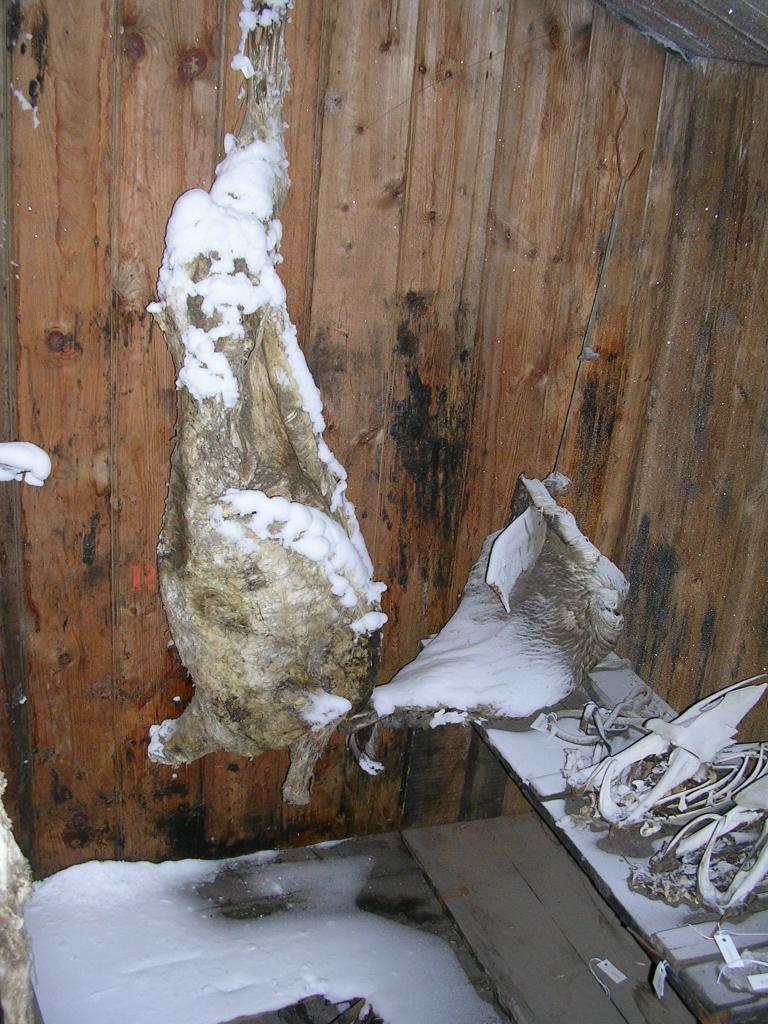
Reminds me of the meat that's still in tact (though a little freezer burnt) from Shackleton's (failed) expedition to cross Antarctica almost 100 years ago.
http://climate.envsci.rutgers.edu/Antarctica/DiscoveryHutMeat9.10.04.JPG
-
A little more on Edison.
The Stock ticker is merely a different telegraph. The Quadruplex telegraph was based on J. B. Stearns duplex telegraph. The incandescent lamp was invented by Swan. The phonograph was probably the only thing major invention in that list that he made a major contribution to.
The improved stock ticker.
Edison's improved stock ticker included his key contributions to printing telegraphy. His most significant improvement was a mechanism that enabled all of the tickers on a line to be synchronized so that they printed the same information. Because the printers frequently fell behind the transmitter by one or more letters, exchange companies had to send employees to the offices where printers were running out of "unison" to reset them.
One of the most effective and longest used devices was Edison's screw-thread unison. With Edison's device the transmitting operator could bring all the printers on a line into unison by sending electrical impulses to turn the shaft of each machine until a peg sitting in a screw-thread on the typewheel hit a stop. Edison also designed an improved typewheel-shifting mechanism and a paper feed so that his ticker required much less battery power. Edison also devised a transmitter for his stock ticker that used a keyboard like that of a typewriter. Edison's ticker was used on the stock exchange for several years before being replaced, but it continued to be used until about 1960 for many other purposes, including the transmission of sports scores. Stock TickerThe improved stock ticker netted Edison $40,000.
Quadaplex telegraphy.
While working on duplex telegraphs, Edison realized that he could send four messages simultaneously by combining the duplex with a diplex for sending two messages in the same direction. The common approach to diplex was the use of weak and strong batteries to produce signals of different strengths, with relays at the receiving end designed to respond to one or the other signal. However, it proved difficult in practice to prevent the sensitive weak-signal relay from responding to the stronger signal current. In essence, Edison used a cascade of electromagnets to bridge over the time during which the reversed current regenerated the magnetic field in the main relay magnet. This solution represented an important approach that Edison often took when confronted by particularly intractable problems - rather than completely eliminate a defect he found a way to use its own effects to obviate the problem. The quadruplex continued to be used into the twentieth century. Quadruplex Telegraph
The incandescent lamp
In addressing the question "Who invented the incandescent lamp?" historians Robert Friedel and Paul Israel list 22 inventors of incandescent lamps prior to Joseph Wilson Swan and Thomas Edison. They conclude that Edison's version was able to outstrip the others because of a combination of three factors: an effective incandescent material, a higher vacuum than others were able to achieve and a high resistance lamp that made power distribution from a centralized source economically viable.
Thomas Hughes, has attributed Edison's success to the fact that he invented an entire, integrated system of electric lighting. "The lamp was a small component in his system of electric lighting, and no more critical to its effective functioning than the Edison Jumbo generator, the Edison main and feeder, and the parallel-distribution system. Other inventors with generators and incandescent lamps, and with comparable ingenuity and excellence, have long been forgotten because their creators did not preside over their introduction in a system of lighting." History of the light bulbThe common thread in these stories is Edison's ability to see the problem as a whole - and deliver a commercially viable solution to the problem as a whole.
-
A little more on Edison.
The Stock ticker is merely a different telegraph. The Quadruplex telegraph was based on J. B. Stearns duplex telegraph. The incandescent lamp was invented by Swan. The phonograph was probably the only thing major invention in that list that he made a major contribution to.
The improved stock ticker.
Edison's improved stock ticker included his key contributions to printing telegraphy. His most significant improvement was a mechanism that enabled all of the tickers on a line to be synchronized so that they printed the same information. Because the printers frequently fell behind the transmitter by one or more letters, exchange companies had to send employees to the offices where printers were running out of "unison" to reset them.
One of the most effective and longest used devices was Edison's screw-thread unison. With Edison's device the transmitting operator could bring all the printers on a line into unison by sending electrical impulses to turn the shaft of each machine until a peg sitting in a screw-thread on the typewheel hit a stop. Edison also designed an improved typewheel-shifting mechanism and a paper feed so that his ticker required much less battery power. Edison also devised a transmitter for his stock ticker that used a keyboard like that of a typewriter. Edison's ticker was used on the stock exchange for several years before being replaced, but it continued to be used until about 1960 for many other purposes, including the transmission of sports scores. Stock TickerThe improved stock ticker netted Edison $40,000.
Quadaplex telegraphy.
While working on duplex telegraphs, Edison realized that he could send four messages simultaneously by combining the duplex with a diplex for sending two messages in the same direction. The common approach to diplex was the use of weak and strong batteries to produce signals of different strengths, with relays at the receiving end designed to respond to one or the other signal. However, it proved difficult in practice to prevent the sensitive weak-signal relay from responding to the stronger signal current. In essence, Edison used a cascade of electromagnets to bridge over the time during which the reversed current regenerated the magnetic field in the main relay magnet. This solution represented an important approach that Edison often took when confronted by particularly intractable problems - rather than completely eliminate a defect he found a way to use its own effects to obviate the problem. The quadruplex continued to be used into the twentieth century. Quadruplex Telegraph
The incandescent lamp
In addressing the question "Who invented the incandescent lamp?" historians Robert Friedel and Paul Israel list 22 inventors of incandescent lamps prior to Joseph Wilson Swan and Thomas Edison. They conclude that Edison's version was able to outstrip the others because of a combination of three factors: an effective incandescent material, a higher vacuum than others were able to achieve and a high resistance lamp that made power distribution from a centralized source economically viable.
Thomas Hughes, has attributed Edison's success to the fact that he invented an entire, integrated system of electric lighting. "The lamp was a small component in his system of electric lighting, and no more critical to its effective functioning than the Edison Jumbo generator, the Edison main and feeder, and the parallel-distribution system. Other inventors with generators and incandescent lamps, and with comparable ingenuity and excellence, have long been forgotten because their creators did not preside over their introduction in a system of lighting." History of the light bulbThe common thread in these stories is Edison's ability to see the problem as a whole - and deliver a commercially viable solution to the problem as a whole.
-
Re:Urban Transit
Not to mention, there are no sidewalks, and the roads have little shoulder. Perhaps early suburbs were more bike friendly. That was when they looked like this, but modern suburbs are designed for cars. The houses are stretched farther apart, and the only thing connecting developments are 4 lane highways.
-
Re:6-9 months?
We will soon be exiting the Gulf Stream which means things will start to move a lot slower and many more challenges will be thrust upon us.
from http://rucool.marine.rutgers.edu/atlantic/
also see here for an explanation of how it moves:
http://rucool.marine.rutgers.edu/atlantic/about_gliders.html -
Re:6-9 months?
We will soon be exiting the Gulf Stream which means things will start to move a lot slower and many more challenges will be thrust upon us.
from http://rucool.marine.rutgers.edu/atlantic/
also see here for an explanation of how it moves:
http://rucool.marine.rutgers.edu/atlantic/about_gliders.html -
Re:Xcom
-
Re:Programming Language Research
my suggestion - go work with Barbara Ryder at Rutgers http://www.cs.rutgers.edu/~ryder/
-
Re:RT
Last update to software in 2005 according to http://ruqueue.rutgers.edu/download/.
That would be a dealbreaker to me.
-
Re:RT
RT doesn't scale well. We used it at Rutgers but around the 100K ticket mark it started to tank. So we rewrote it:
Very capable.
Any chance that some of the changes can be ported back to RT?
-
Re:RT
RT doesn't scale well. We used it at Rutgers but around the 100K ticket mark it started to tank. So we rewrote it:
Very capable.
-
Re:Does she carry a gun?
I can only guess that you're the same anonymous coward from before--you know, the one who talks tough but is too afraid to even register a nickname on a website. So, I'll respond under that pretense.
Since you refuse to provide a citation for your first claim I'm not going to waste my time on it. Your second claim, however, is a lot more entertaining. I can only assume that you are not aware of the facts surrounding the study on which you've premised your entire argument. The thing is, it was debunked years ago by various independent sources; your own citation even points to at least one of them. What's even better is that John Lott, the study's author, has a reputation for slanting the facts to favor his arguments against gun legislation. For instance, he cited a survey he supposedly conducted in 1997, but was never able to provide the the survey data (claiming he lost it in a hard disk crash). Worse yet, he couldn't even name any of the grad students that were supposed to have performed the survey, and none ever came forward in his defense.
In summary, not only have your claims been summarily debunked, but your only source of empirical data has demonstrated a pattern of being overtly dishonest on this very topic. But hey, you can always continue living in your fantasy world where you get to play with lions.
-
gelfand books
For high school students, I think the Gelfand books listed here are some of the best books available to really understand the subjects they set to teach (note that I have absolutely no experience with the program at Rutgers, that's one of the few pages I can find referencing this great collection though). I certainly find them better teaching guides than the typical mammoth text books for geometry and trig. I would seriously consider basing classes off of these books if I were allowed to.
-
Re:Is lying to Congress illegal?No. He lied in a sworn deposition in federal court.
http://www.eagleton.rutgers.edu/e-gov/e-politicalarchive-Clintonimpeach.htm
-
My own lists
Hey, if we're listing... my family's home machines have been named after fictional computers or artificial intelligences:
hactar, neuromancer, wintermute, brainiac, Windows boxes included Deep Thought, The Earth, The Oracle, and The Architect, routers were ennesby and jane, NAS is max (Headroom, that is).
I had a series of external hard drives named Kingdom, Power, Glory, and Forever.
My university's CS department named the computers in the labs after cereals, pasta, and soups (which identified what room they were in). When I was working there I started setting up some Final Fantasy themed ones (gurgu, corneria) but didn't get very far. -
Tinker toys
Like the computer made from tinker-toys that plays tic-tac-toe? http://www.rci.rutgers.edu/~cfs/472_html/Intro/TinkertoyComputer/TinkerToy.html
-
Re:A Little Known Maryland Scientist Has Made Publ
Actually, the main competitor to the geoengineering approach described in TFA is stratospheric injection of aerosol precursors, i.e., artificial volcanoes. It has drawbacks.
-
Re:Get your facts straight
In a serious nuclear war you can get a lot more material into the air than that. Here is some very recent analysis on the subject, using one of the latest climate models. (Try this paper and this one.) This research group also does work on volcanic events, which the model's response has been tested on. They find that even a regional Indian-Pakistan exchange, each country using 50 Hiroshima-sized bombs, can have pretty significant global climate impacts (almost 1.5 C cooling).
Hmm... I think we may have discovered the solution to global warming.
-
Re:Get your facts straight
In a serious nuclear war you can get a lot more material into the air than that. Here is some very recent analysis on the subject, using one of the latest climate models. (Try this paper and this one.) This research group also does work on volcanic events, which the model's response has been tested on. They find that even a regional Indian-Pakistan exchange, each country using 50 Hiroshima-sized bombs, can have pretty significant global climate impacts (almost 1.5 C cooling).
Hmm... I think we may have discovered the solution to global warming.
-
Re:Get your facts straight
In a serious nuclear war you can get a lot more material into the air than that. Here is some very recent analysis on the subject, using one of the latest climate models. (Try this paper and this one.) This research group also does work on volcanic events, which the model's response has been tested on. They find that even a regional Indian-Pakistan exchange, each country using 50 Hiroshima-sized bombs, can have pretty significant global climate impacts (almost 1.5 C cooling).
Hmm... I think we may have discovered the solution to global warming.
-
Re:Ummm, probalby not so much
Thus far, there has been no good proof that there's any sort of reality in it.
Pretty much all the studies in your link conclude that there is reality to "nuclear winter", if by that you mean "significant cooling as a result of a large nuclear exchange". What's contested is mostly how much smoke there would actually be. Compared to that, the climatic effects of particulate matter in the atmosphere are relatively well understood. A few people criticized the early models which assumed that the atmospheric doesn't respond dynamically (note your link was published 20 years ago). Modern models which have dynamical circulation bear out the same results (e.g., here). The weak link remains assumptions about what gets injected into the air, not the models themselves. You can get very large variations in particulate emissions if you tweak your assumptions about how the war plays out.
Don't confuse scientists speculating on things with real empiricism. There's lots of interesting ideas and theories, something with mathematical or computer models to back them up. That doesn't mean any of it has a thing to do with reality.
Large climatic effects from particulate emissions are pretty much undeniable. You don't need a fancy theory or model to know that. Particles of that size reflect sunlight. And lo, we see it happen from volcanoes. We even know how much particulate matter the volcanoes emit. The models reproduce the observed volcanic climate effects.
The main uncertainty, as I said, is in how much burning will take place.
String theory would be a good example.
Sigh.
String theory is not a good analogy. While there may be uncertainty about nuclear winter, there is still vastly more experimental evidence underlying our understanding of particulate emissions and atmospheric circulation models than there is about string theory. Comparing the former to the most theoretical of all theoretical physics is grossly exaggerating for effect. The two levels of uncertainty are not comparable.
It is, in fact, not a theory. It makes no testable prediction.
Both those statements are false.
People always try to compare string theory to a model of particle physics like the Standard Model. That's not the right comparison. String theory is a theoretical framework. The correct comparison is to quantum field theory in general.
"Quantum field theory" makes very few testable predictions, because it makes no assumptions about what particles exist or how they interact. To make predictions, you have to construct a specific model within QFT, such as the Standard Model. That is, you have to say that quarks and leptons exist, there are three forces whose interactions take a particular form, etc.
String theory is a theory in the same sense quantum field theory is: they are both frameworks in which you can write down predictive models. String theory by itself doesn't say much other than particles are made of strings. To make predictions, you have to write down a specific model. And you can write down something like the Standard Model (or one of its GUT generalizations) in string theory. It will make the same predictions as the SM in low energy regimes.
The problem with string theory is not that it doesn't make testable predictions. It's just as predictive as QFT is; in fact, QFT is just a limiting case of string theory, so any prediction you make in low energy QFT, you can make in string theory. And its predictions are certainly testable, because you can write down string models that are demonstrably false (the same is true of QFT models, such as all models before the Standard Model). It's hard to think of an experiment that could falsify all possible string models, but the same is true of one that could falsify all possible quantum field theories.
The
-
Re:Get your facts straight
Also from the most recent material I have read the threat of a "nuclear winter" was a gross beat up. We have had multiple volcanic events that discharged more particles into the atmosphere than would happen with optimal usage of warheads to cause a "nuclear winter"
In a serious nuclear war you can get a lot more material into the air than that. Here is some very recent analysis on the subject, using one of the latest climate models. (Try this paper and this one.) This research group also does work on volcanic events, which the model's response has been tested on. They find that even a regional Indian-Pakistan exchange, each country using 50 Hiroshima-sized bombs, can have pretty significant global climate impacts (almost 1.5 C cooling). They do assume an "optimal" scenario, where the bombs are aimed at the highest population centers, causing maximum burning and thus particulate emission. The "winter" only hangs around for a decade or two, but it's worse for a "full scale" MAD scenario.
For the full "global thermonuclear war" scenario, they see cooling of up to 30 C (~ 60 F) over some regions! The global temperature drops by 8 C, which is colder than an ice age. It doesn't last long enough to form continental ice sheets, of course. But sticking around for a decade or two is Very Bad for plant life and the animals which depend on it. (And this is just the temperature effect, not counting the reduced sunlight for photosynthesis, any burned vegetation outside cities, effects of fallout, etc.)
A full nuclear exchange during the Cold War would have involved up to 10 gigatons of explosives. Even very large volcanic eruptions like Thera were only 0.5-1 gigatons (and I suspect that burning cities would emit more particulate matter). World War III wouldn't have been a Dinosaur Killer, and it wouldn't have sterilized the planet, but it would have had damn large effects on the biosphere.
-
Re:Get your facts straight
Also from the most recent material I have read the threat of a "nuclear winter" was a gross beat up. We have had multiple volcanic events that discharged more particles into the atmosphere than would happen with optimal usage of warheads to cause a "nuclear winter"
In a serious nuclear war you can get a lot more material into the air than that. Here is some very recent analysis on the subject, using one of the latest climate models. (Try this paper and this one.) This research group also does work on volcanic events, which the model's response has been tested on. They find that even a regional Indian-Pakistan exchange, each country using 50 Hiroshima-sized bombs, can have pretty significant global climate impacts (almost 1.5 C cooling). They do assume an "optimal" scenario, where the bombs are aimed at the highest population centers, causing maximum burning and thus particulate emission. The "winter" only hangs around for a decade or two, but it's worse for a "full scale" MAD scenario.
For the full "global thermonuclear war" scenario, they see cooling of up to 30 C (~ 60 F) over some regions! The global temperature drops by 8 C, which is colder than an ice age. It doesn't last long enough to form continental ice sheets, of course. But sticking around for a decade or two is Very Bad for plant life and the animals which depend on it. (And this is just the temperature effect, not counting the reduced sunlight for photosynthesis, any burned vegetation outside cities, effects of fallout, etc.)
A full nuclear exchange during the Cold War would have involved up to 10 gigatons of explosives. Even very large volcanic eruptions like Thera were only 0.5-1 gigatons (and I suspect that burning cities would emit more particulate matter). World War III wouldn't have been a Dinosaur Killer, and it wouldn't have sterilized the planet, but it would have had damn large effects on the biosphere.
-
Re:Get your facts straight
Also from the most recent material I have read the threat of a "nuclear winter" was a gross beat up. We have had multiple volcanic events that discharged more particles into the atmosphere than would happen with optimal usage of warheads to cause a "nuclear winter"
In a serious nuclear war you can get a lot more material into the air than that. Here is some very recent analysis on the subject, using one of the latest climate models. (Try this paper and this one.) This research group also does work on volcanic events, which the model's response has been tested on. They find that even a regional Indian-Pakistan exchange, each country using 50 Hiroshima-sized bombs, can have pretty significant global climate impacts (almost 1.5 C cooling). They do assume an "optimal" scenario, where the bombs are aimed at the highest population centers, causing maximum burning and thus particulate emission. The "winter" only hangs around for a decade or two, but it's worse for a "full scale" MAD scenario.
For the full "global thermonuclear war" scenario, they see cooling of up to 30 C (~ 60 F) over some regions! The global temperature drops by 8 C, which is colder than an ice age. It doesn't last long enough to form continental ice sheets, of course. But sticking around for a decade or two is Very Bad for plant life and the animals which depend on it. (And this is just the temperature effect, not counting the reduced sunlight for photosynthesis, any burned vegetation outside cities, effects of fallout, etc.)
A full nuclear exchange during the Cold War would have involved up to 10 gigatons of explosives. Even very large volcanic eruptions like Thera were only 0.5-1 gigatons (and I suspect that burning cities would emit more particulate matter). World War III wouldn't have been a Dinosaur Killer, and it wouldn't have sterilized the planet, but it would have had damn large effects on the biosphere.
-
Re:Album title: Oval Office Party - Chiefs and Squ
Sorry I got appeal confused with Aquitted.
They voted for acquittal not appeal.
'The Senate voted on the Articles of Impeachment on February 12, with a two-thirds majority, or 67 Senators, required to convict. On Article I, that charged that the President "...willfully provided perjurious, false and misleading testimony to the grand jury" and made "...corrupt efforts to influence the testimony of witnesses and to impede the discovery of evidence" in the Paula Jones lawsuit, the President was found not guilty with 45 Senators voting for the President's removal from office and 55 against. Ten Republicans split with their colleagues to vote for acquittal; all 45 Democrats voted to acquit. On Article II, charging that the President "...has prevented, obstructed, and impeded the administration of justice"..., the vote was 50-50, with all Democrats and five Republicans voting to acquit.'
The perjury charge was from the Paula Jones case, not the Monica Lewinski case. It was Sexual Harassment not Sexual Relations.
I am sorry for the confusion, I had a bit of a rough time in the late 1990's as my best friend killed himself and the stresses of my job were getting to me during that period in time.
-
Re:Saw on ubuntu forums and other sites
-
Grammar Nazi needs to go back to Nazi Training
The final trick: preloading desktop environment files while waiting for the user to type their password."
Thanks for playing, but you're wrong:
Each student is singular -- the is instead of are proves it -- so the colloquial their (a plural) doesn't agree with the verb, and is frowned on by traditionalists. It's common enough in speech -- "A friend of mine called me." "What did they say?" -- but, although many writers have used it (see examples from Jane Austen), it often sets off alarm bells among the fussier readers of formal writing today.
The correct answer is "there is no answer". There's plenty of "right" ways that have either fallen out of favor (such as using "type one's password"), or that get repetitive and annoying ("type his' or her's password")
I suggest brushing up on your Grammar Youth Movement handbook at http://andromeda.rutgers.edu/~jlynch/Writing/s.html#sexist
-
Re:Stanford's patent policy.
I've got two patents through work I did at Rutgers University and the university keeps a huge portion of the profit. One of the licensing things that happens is that the University gets stock from the upstarts or licensees. Rutgers gets 25-32% of the total patent royalties. See: http://ocltt.rutgers.edu/documents/patentpolicy.pdf
-
Re:Summary: