Slashdot Mirror
Domain: scientificamerican.com
Stories and comments across the archive that link to scientificamerican.com.
Comments · 1,496
-
Art is where you find it
It's curious you'd mention Pollock, because some of his works look like cans of paint randomly thrown onto a canvas. Not all of them, but some certainly do.
I agree with you completely. There's a Pollock at the museum in Omaha that looks for anything like a cat puked on the canvas.
OTOH, a famous Pollock painting will draw you in, and have a sort of fundamental emotional appeal that keeps you wondering why the painting is so engaging.
Scientific American once did an analysis of some of Polluck's paintings, along with other painters who painted in the same style but which aren't as successful as Pollock.
The analysis found that Pollock's paintings have a fractal quality that other painters (in the same style) don't have, leading to the conjecture that it's this quality that makes his paintings so engaging.
There's a Picasso at the Currier Gallery of Art which I think is awful and completely pointless, yet I can stare at Guernica all day.
And finally, if you ever go to the Detroit Institute of Art you'll find Fuseli's The Nightmare, which is completely and totally ho-hum in any reproduction, including images on the internet, but which is captivating when seen in person.
(And I was astonished when I saw my first real Rembrandt portrait (the one at Omaha). These are also ho-hum from a distance and through the internet, but to see one in person... wow!
Many people don't get why art is so pleasing. I suspect it's because they only have 2nd hand exposure, through reproductions, the internet, TV, and so on.
So in summary, I agree with you completely, but note that "art is where you find it". Not every work of every master is a masterpiece, and if you dig in the dirt you'll eventually uncover a few treasures.
-
Re: Nothing wrong with waterboarding
gravely harm an innocent person
The whole point was, waterboarding does not cause "grave harm". Even the scientists opposing the procedure, god bless their mighty hearts, can fault it only for the potential of dirty water seeping into nostrils and the high levels of stress-hormones. Nothing, in other words, that can't happen to a prisoner of an ordinary detention facility, military or civilian alike...
Inconvenience, maybe
You seem to use the term "innocent" as in "not convicted of wrong-doing by any court". Fine — Khalid Shaikh Mohammed was certainly innocent in that sense, when he was waterboarded. Ok, now, are you going to condemn President Obama for his extensive killing of similarly innocent people? Why not? Mind you, Obama has already done it — on numerous occasions — whereas Trump merely says, he will.
If Obama got reelected comfortably despite such outrageous killings — with enthusiastic support of most Slashdotters — why should mere waterboarding be a problem for Trump?
But, if those killed by "Hellfire" on President Obama's orders were not quite innocent — and thus acceptable in your opinion — what makes you suspect, President Trump will order waterboarding of suspects with less evidence against them?
-
Re:A complete waste of resources
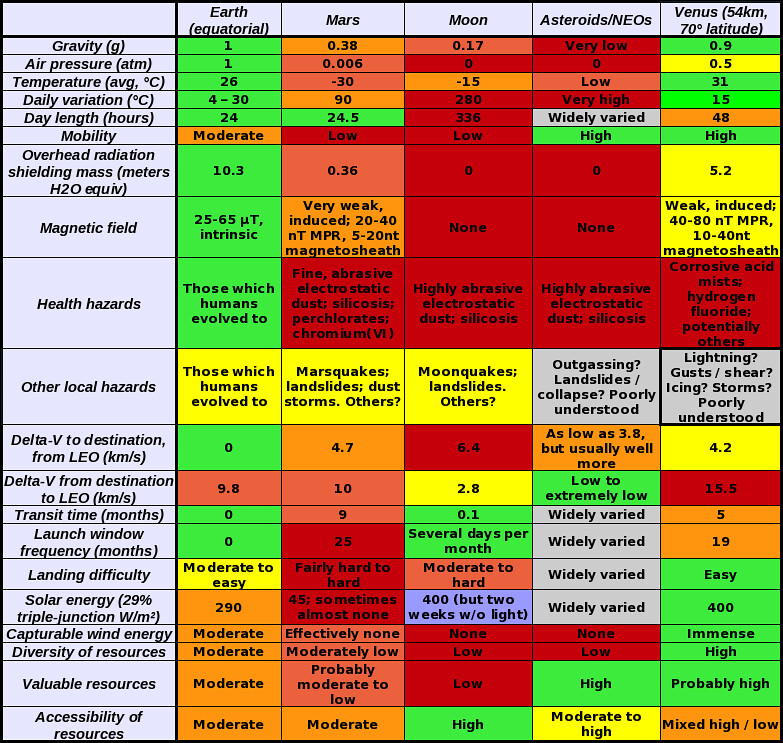
Meh, everyone has their own goals. I personally wish we'd be focusing toward a colony in Venus's cloudtops (the most Earthlike place in the solar system).
I once heard that the US spends all of it's resources on Mars because the Soviets had put a lander on Venus. The US wanted to prove its superiority, so it chose to explore the more distant and inhospitable Mars.
-
Re:A complete waste of resources
Meh, everyone has their own goals. I personally wish we'd be focusing toward a colony in Venus's cloudtops (the most Earthlike place in the solar system).
-
Re:Completely wrong
... http://www.scientificamerican....
that one actually describes the issues...
And with nuclear-plants it because of people like you that we are stuck with decade old nuclear-plants instead of newer plants that would increase safety and reduce the amount of waste.
-
Re:Fiduciary sense?
1. No, it hasn't. Radically and slowly, but not radically and quickly. http://www.scientificamerican..... Nothing comes close.
2. They are not the best we have because of their polluting nature. Even aside from climate change they have large negatives. They do indeed have a huge infrastructure advantage.The total amount of oil in North America is of minimal relevance; somewhat more relevant is the expected cost of extracting oil as time goes on since that makes oil seem ever-worse by comparison. Also your entire counterargument is moving the original goalpost, which stated that oil was inarguably the only option. This said I'm going to need a cite on proven oil reserves lasting 100 years. I've never heard of anything close to that, and couldn't find it from a quick search. In fact, it sounds like the *worldwide* estimate, from actual oil companies, is about half that: http://www.ibtimes.co.uk/world.... "North America alone" has a small slice of that.
3. I advocate we keep using oil for those purposes. It's not a major source of pollution -- at least, not the same kind of pollution -- and it's a small fraction of our overall oil use, so that use really can last hundreds of years. This said, given that this oil use is at a much lower scale, the "nothing else is viable at the scale needed" argument doesn't work as well. -
Re:Questioning isn't "denying"; it's science!
The problem here is that the big players, the oil companies and major investors, have no interest in actually falsifying AGW. They scarcely need to. They just need to spread enough FUD to create a political environment in which any government looking to curb CO2 emissions is going to have an uphill fight.
And Exxon performing research in the 1970's that validated AGW, then lying about it is indeed the proof of your statement http://www.scientificamerican....
I feel the same way about AGW pseudo-skeptics as I do about Creationists,
Many are the same people. Which allows them to disregard the evidence of ages like the Silurian, warmer than the present via CO2 levels, despite the dimmer sun of the time https://en.wikipedia.org/wiki/...
-
Re:OMG! NUKULAR!
So, since coal does not release radiation, I guess you must have done more studies than scientists at Oak Ridge have?
http://www.scientificamerican....
In a 1978 paper for Science, J. P. McBride at Oak Ridge National Laboratory (ORNL) and his colleagues looked at the uranium and thorium content of fly ash from coal-fired power plants in Tennessee and Alabama. To answer the question of just how harmful leaching could be, the scientists estimated radiation exposure around the coal plants and compared it with exposure levels around boiling-water reactor and pressurized-water nuclear power plants.
The result: estimated radiation doses ingested by people living near the coal plants were equal to or higher than doses for people living around the nuclear facilities. At one extreme, the scientists estimated fly ash radiation in individuals' bones at around 18 millirems (thousandths of a rem, a unit for measuring doses of ionizing radiation) a year. Doses for the two nuclear plants, by contrast, ranged from between three and six millirems for the same period. And when all food was grown in the area, radiation doses were 50 to 200 percent higher around the coal plants.
-
Re:Why conceal it?
You're the one trying to use the deceptive language in downplaying the differences.
Which is just as bad as hyperbole, from a different direction.
But it was Jellyfish, not Glow-worms.
-
Re:Why conceal it?
DNA is DNA, it has no memory of how it was created -- through genetic engineering or through natural mutations which were then bred because humans or animals intentionally or inadvertently favored them in some way.
What a wonderfully ignorant statement that captures the very essence of this argument. While DNA has no "memory" of how it was created, DNA is not the only concern with GMO foods. GMO foods are engineered to contain genes that express proteins that are advantageous to the recipient plant. Proteins, when expressed the wrong way can wreak havoc on the humans (or animals) that consume them. About the agent that causes CJD: It is difficult to kill, it does not appear to contain any genetic information in the form of nucleic acids (DNA or RNA), and it usually has a long incubation period before symptoms appear. In some cases, the incubation period may be as long as 50 years. See Prions. Prions cannot be destroyed through cooking, and therefore would be present in any product manufactured from the ingredient that contained them. Not to say that GMO products will contain Prions, but if a GMO protein contained in a foodstuff was harmful, it could take decades before it was discovered.
Additionally, our understanding of how DNA works is laughably limited. While we know that DNA contains the instructions to produce a protein, the exact mechanisms that determine the expression of those genes are complicated and aren't always understood. Our understanding of how proteins work and how they interact with each other and RNA is even more limited, especially when you consider how many interactions that must be considered to determine if a GMO protein will be safe to consume.
What hubris you, and everyone who claims that a few years of very limited research, is enough to prove that something this complicated is absolutely safe and warrants no caution by the consumer.
As for myself:
“I am sufficiently proud of my knowing something to be modest about my not knowing all.”
Vladimir Nabokov, Lolita
-
Re:Let's all start running now!
All this assumes the IPCC predictions are correct. Generally they have vastly over predicted warming and sea level rise.
That's not actually correct, the IPCC has over predicted global surface temperatures by a little bit, and for a brief period in 2010, the temperatures actually fell out of the IPCC prediction + 95% confidence interval. However, since then the temperatures have remained in the 95% confidence interval, but are admittedly still below the actual prediction. Sea level rise, however, is a completely different story. The IPCC got it pretty wrong, they underestimated sea level rise by around 60%.
-
Re:Mars again?
In case you haven't noticed, Mars drains the lion's share of the exploration dollars these days.
It's kind of weird, really - we're far more obsessed with Mars now that we know it's a perchlorate-laden organics-destroying corrosive silicosis-risk hexavalent-chromium-laden dustscape than we were back when for all we knew there was life just sitting there on the surface. It's totally disproportionate to what we know of our solar system. If the goal was to find life, we'd be prioritizing Enceladus, whose oceans (containing a known potential energy source, H2) gush out into space for easy pickup by spacecraft. If the goal was to settle, we'd be priorizing Venus, which offers earthlike gravity, earthlike pressures, earthlike temperatures, requires no radiation protection, provides vast amounts of living space (pressure vessels = small, cramped per unit mass), vast amounts (well surpassing Earth) of energy (solar, wind), and for which all of the components of a plastics industry (and probably small steel industry as well, based on the evidence for FeCl3/FeCl2) get blown through your engines in a highly hygroscopic form from which water and oxygen can be recovered by mere heating and filtering. Meanwhile, you're sitting over a potential treasure trove where high heat, pressure and acids have been extracting minerals for rocks and concentrating them for billions of years, a region with pressures only 8% that of the deepest oceans on Earth and temperatures that can be - and have been, on 1960s Soviet tech - withstood by simple thermal inertia - and from which dredged materials can be hauled up by phase change balloon (rigid metal, contracting metal, Zylon, possibly others).
-
Re:The trade was a fair one.
This is absolute total fucking bullshit!
I can only assume that you're referring to a Scientific American article that says that a coal powered plant emits a hundred times than the amount of radiation of a RUNNING nuclear plant; that's a RUNNING plant, not one that has lost its containment when it melted down. When a nuclear reactor melts down, the amount of radiation emitted jumps about a MILLION fold; and then takes decades, or longer, to decay away.
But don't take my word for it, here's the article:
http://www.scientificamerican....
The articles just says that the absorbed dose of someone living within a mile or so downwind of a coal plant is about 1.8 mrem/year, compared to 300 mrem/year of natural background radiation. After a meltdown the levels at that distance can be more than 300mrem/year just from the reactor. It will decay away over time, but it can still be well above acceptable limits hundreds of years later.
There's just absolutely no way at all that the total output of the coal plant could ever reach that of melted down nuclear reactor, let alone being a hundred times more. You're just totally full of it.
There's plenty of reasons to shut down coal plants, mercury, small particle air pollution, acid rain, CO2 etc. etc. Radiation just isn't one of them. The radiation is very dilute and far, far below background radiation. Dilute radiation is largely (but non completely) non problematic; we're surrounded by dilute background radiation anyway. it's the fallout from meltdowns that causes mass evacuations and all farming to cease. That's the real problem, and it's specific to nuclear accidents.
-
Re:The trade was a fair one.
Indeed. Coal Ash is more radioactive than actual nuclear waste.. In fact, significant amounts of both uranium and thorium are found in coal fly ash, to the point, in some cases, Thorium Reactor advocates have suggested there's more generate-able power if the Thorium was used in a reactor, than was generated by burning the coal. I've seen no numbers to back that up, but it seems plausible, based on back-of-the envelope numbers. . .
-
Re:No good guys.
Firstly, I've found that people tend to talk louder when they are on the phone. Maybe it's because there is no feedback to adjust their speaking volume. Almost everyone on the phone on the bus is loud while many people having a conversation together speak in a lowered voice.
Secondly, it's harder to ignore half a conversation. http://www.scientificamerican....
-
I don't all BS on many things, this article I do.
I don't spend this much time on many things like this but for some reason this came across as bad science.
A session with Google and no knowledge anthropology I found this:
Chimpanzee's habit was an entire Continent away from H. erectus
http://www.janegoodall.ca/abou...
(not that big of a deal we do have Hurricanes, Cyclones and Typhoons to mix the groups)Chimpanzee's are a different time line than humans
https://en.wikipedia.org/wiki/...So what do the modern apes—and in particular our closest relatives the chimpanzees and bonobos—eat? Plants. Yes, plants.
http://blogs.scientificamerica...Despite their hunting behavior, however, only a very tiny percentage–perhaps as small as two percent–of a wild chimp’s diet consists of meat or insects.
http://www.allaboutwildlife.co...Google this phrase: what do you feed a chimpanzee - give one this blurb:
It also eats leaves and leaf buds. Seeds, blossoms, stems, pith, bark and resin, insects, and meat make up the rest of its diet. While the common chimpanzee is mostly herbivorous, it does eat honey, soil, insects, birds and their eggs, and small to medium-sized mammals, including other primates.http://www.janegoodall.org/ is a worthless site unless you wish to give money.
Topic: H. erectus meat consumption is associated with __________.
Not one answer includes teeth
http://science-forums.com/inde...The only thing that associates chimpanzee (meat eating) and evolve of humans jaws to is the submitted article itself.
-
Re:Quantum computers were "5 years away"... in 197
Alchemy is the new alchemy, too.
-
Re:Seems reasonable
You probably won't look but I posted this earlier.
http://www.scientificamerican....As I've already posted it once, I'll avoid cluttering up other screens and post this as AC for those who filter based on score. Are you guys seriously too afraid to type this stuff into your favorite search engine?
-
Re:Increase the punishment
Wow... I should have scrolled down a bit more. This "a lot" that you speak of... Have you seen the FBI's stats on it? I'm gonna guess you haven't or that you've got an unusual definition of a lot. Check the FBI's recidivism rates for sex offenses. They're just a wee bit more frequent than murderers and miles away from every single other offense type out there.
Hell, I went and got you a link. It looks like they've adjusted the numbers a little, but not a whole lot, and what I remembered is largely correct:
http://www.scientificamerican....Here's a good quote from it:
Hanson and his colleagues conducted a meta-analysis on treatment and found that 17 percent of untreated subjects reoffended, whereas 10 percent of treated subjects did so.
-
Sea levels are actually dropping (source cited)
Source: http://www.scientificamerican....
Nothing to worry about, unless you live in Australia, but drop bears are probably more worrying than sea level drop anyways.
-
private insurers jump ship, governments jump in.
The government is stepping in where insurers have bailed. This is socialism: "As the crisis mounts, hard hit states such as Florida and Louisiana are increasingly stepping up as insurance companies check out, providing coverage for residents dropped by their insurers." http://www.scientificamerican....
-
Re:A surgeon got cancer from one of his patients
I read a while back that a surgeon accidentally got cancer from one of his surgical patients:
http://www.nejm.org/doi/full/1...
So, it appears that cancer can move between hosts in a mechanical fashion.
I found a nastier one a while back: guy has tapeworm, tapeworm has cancer, tapeworm spreads its cancer throughout the guy's body as it wriggles around.
Here's the story. One of the interesting things was that the tapeworm tumors had differently-sized cells, so they were easy to differentiate from the host's cells. Now, that's not exactly cancer being transmitted, insofar as it wasn't his cells that were turning cancerous, but they were growing/multiplying and helped cause his death. It's like being infected with some other animal's cancer. -
Re:Kind of like down-modding a post you disagree w
ExxonMobil also has a huge vested interest in refuting any false role that burning oil has in accelerating climate change.
The disagreement can only be on whether the premise, that fossil fuels are in fact accelerating climate change, is correct. If no, shame on the majority fo scientists that have been convinced in error.
Exxon first heard about the issue from their own scientists nearly 40 years ago in 1977:
Since then the science has only strengthened and no one has come up with anything that explains the accelerated warming better than carbon dioxide and other greenhouse gases.
-
The new frontier
Exactly! Our microbiomes are the new frontier of health for all sorts of things, obesity being number one for the general western population.
It's only a matter of time, and IP law, that engineered bacteria will be sold as designer probiotics to counter all sorts of maladies. Could we easily create a grassroots organization to distribute colon flora? Sure! But the fat, sterile westerners will say "Ew, gross!", but happily pay for Monsanto Microbiome Enhancement Plus for a premium. (it's a fictional drug to counter the bacterial imbalance created by eating processed, industrialized food.)
Just as the finding of lead in our environment is bad for humans, perhaps so will antibiotics from medicines to soaps, along with polymers such as BPA (commonly found in most thermal paper receipts that people handle on a daily basis), be found to cause harm to our microbiome.
If you count cells in the human body, there are more bacterial cells than human cells; of course the human cells are much larger, but human individuals are complex organisms living with lots of other living "things".
-
Re:green?
Burning coal puts nuclear material into the atmosphere, including tons of fissile uranium per year.
One: no it does not, the uranium/thorium is in the ashes.
Yes, most of which goes right out the fucking stack. We can find out-of-compliance power plants in this country literally as fast as we can pay people to climb the stacks and probe them.
Two: no it does not in general. Only coal that is mined from mines that have that particular "contamination" obviously can set free uranium/thorium. Or were the trees from which the coal formed made from uranium? I don't think so.
The environmental cost of solar, especially non-PV systems or modern PV systems which use ever-vanishing quantities of rare earths or even organic materials, is minuscule compared to any fossil fuel.
One: wrong, because PV systems don't use rare earths.
Who told you that? They lied to you, and now you're being a stupid fuck.
Two: wrong still, as rare earths are not "vanishing". They are very abundant on the planet, they are misnamed because of some issues when they got "discovered".
What I meant was that the panels use less and less rare earths. Sorry I confused you. Apparently that's quite easy, so I'm not very sorry.
Three: wrong, organic materials are a non issue if you use them for PV or other electronics.
My post was pro-solar, stupid. Try reading it again.
-
Re:The science is not settled
Here are some things science is settled on:
The earth being round.
The earth is not round http://www.scientificamerican....
The earth orbiting the sun.
Technically, the earth does not orbit the sun. It orbits the central mass of the solar system.
http://www.realclearscience.co...Science IS settled on a lot of issues. AGW is a new one, but something we can do something about (well, 10 years ago).
Just because there is a preponderance of evidence that our explanation of an observed phenomenon is correct, it does not mean the science is settled. It means that we have a good explanation. If a better explanation comes along and it fills in areas where the first did not, we adjust our understanding of the universe and the accepted scientific belief is changed.
Ill add that if you are getting your science from grade school or the news outlets, then you need to realize that you are not reading the science and are instead reading an opinion.
-
Re:Things that I wish wouldn't keep getting repeat
Which is also has not been subjected to any enrichment by nuclear industry processes. I specifically referred to artificially made elements.
Fission power plant fuel has minor enrichments to the level of 3-4% U-235. Artificially made elements that occur through the transmutation of U-238 and other transuranics in the fuel material are also contained within the cladding. What "artificially made" elements are you referencing? Humans do not come into contact with "artificially made" transuranic elements that are of concern for internal exposure in their daily lives.
Yes I can, I just don't know how much of them Fukushima, Chernobyl or other accidents have released.
Sorry but
Yes: http://science.time.com/2013/0...
You: http://www.world-nuclear.org/i...
Can: http://www.who.int/ionizing_ra...
You literally get more radiation living next to a coal power than you would living next to Three Mile Island at the time of the disaster, or presently.
Coal source 1: http://www.scientificamerican....
Coal source 2: http://www.reboundhealth.com/c...
Do you life next to the damaged Fukushima reactor? You have a problem. Do you live 15km away from the Fukushima reactor? You are getting less radiation exposure than living in Colorado. Were you exposed to radionuclides after the Chernobyl disaster in Belarus, Ukraine, or Russia? Take the iodine pills the Soviet Union gave you immediately; after that your biggest health risk is the stress of living in what you "perceive" to be a toxic environment (though it was later proved not!).
Just because you don't understand it, doesn't mean it's irrational. What you're doing is how social proof spreads ignorance.
Not that I should make an appeal to authority or that you should trust me solely based on my credentials, but since you "called me out" for not understanding it I will inform you that I am a trained nuclear engineer working in the nuclear industry, wasting my time posting on the internet fighting someone like you because the level of misinformation out there is too much to bear. Please listen to experts and stop your conspiracy theories and stop spreading true ignorance of the basic reality.
-
Re:Typo, should have read..
-
Sleep deprivation also causes insanity
http://www.scientificamerican....
"There seems to be a causal relationship between impaired sleep and some of the psychiatric symptomatology and disorders that we're seeing," says Robert Stickgold, an associate professor of psychiatry at Harvard Medical School who was not involved in this study. He cites research linking sleep apnea, in which breathing is disrupted, to attention deficit hyperactivity disorder and the evidence of a connection between depression and insomnia as examples. "It might be that those medial frontal regions tell the rest of the brain, 'You can chill,'" he says. "Those circuits become exhausted or altered after a lack of sleep."
I have to say, I find these two things indicative of the posts you see on Facebook
-
Re:Memories ...
Sure the launch decision was political - but we should also blame Powerpoint for contributing to it, with the "don't launch below this temperature" warning is really small font.
Why anyone is using a deck of badly designed slides to make a launch decision is beyond me
-
As my physics teacher once said
Time is what keeps everything from happening at once.
The best part is we're discussing the brain's timekeeping mechanisms -- keep in mind that your sensory perception has a built-in time delay.
-
Re:Mdsolar strikes again with unrealistic FUD
I would hope the new grid would be designed to prevent this: http://www.scientificamerican....
-
Re:Keep dreaming.
Or trains. (Forgot about them.)
Trains lose money, so they require a lot of government subsidies. This grid will (supposedly) save money, so it should require no subsidies. There is no reason for the government to "fund" it. If private investors are not willing to pay for it, then that is a sure sign that it is not going to generate an acceptable ROI, and shouldn't be built.
Just because something is not profitable does not mean it shouldn't be built. Trains are one you've already mentioned, roads another, schools, etc.
The existing grid is failing so why not replace it with something more efficient?
https://en.wikipedia.org/wiki/...
http://www.scientificamerican.... -
Re:Not at all
What people fail to understand
`People' don't "fail to understand." They're taught the wrong understanding.
"Violence never solves anything." "Violence begets violence". "Thou shalt not kill." Pablum we feed each other from birth.
Why people think this was an invention which came much later is beyond me
It's really remarkable such a simple concept has escaped you. Have you been under a rock somewhere? Our world is governed by people that are convinced violence is the exclusive fault of greedy capitalist, white Christians and their military industrial complex. But for them the world would be a big happy romper room, and before the advent of these cretins there was only peace.
That is the mentality we impart to children. How can it possibility be a surprise to you that they believe it?
We're told our ancestors were all vegan. I've been hearing that tripe my entire life. Yet every ancient habitation we've found is festooned with arrow heads and axes. Skeletal remains — animal and human — are covered in tool marks and damaged by pointed weapons. My digestive system processes large quantities of meat just fine. And so does yours, regardless of what you've allowed yourself to be convinced of.
You're been fed bullshit by bullshit artists that don't like your nature and would rather you suppress it. Having fully inculcated that bullshit, you're convinced everyone else has as well.
We haven't. Not all of us. Stop assuming you're some special snowflake with a unique insight. You're not.
-
Re: Tomorrow in The Guardian
Federal grants for climate change research dwarfs anything the fossil fuel industry offers.
Maybe the fossil fuel doesn't spend money on research to refute climate change because they know it would be wasted money. After all as early as 1977 Exxon's in house scientists told them about the possibility for global warming from carbon dioxide emissions.
-
Re:This was _outlawed_ in the USA?
Okay thanks for the clarification but I have to disagree.
While the Indian government puts a premium on protecting girls (perhaps because of the gender imbalance), perspective parents evidently do not.
http://www.aljazeera.com/indep...
http://www.independent.co.uk/n...
http://www.worldlifeexpectancy...
http://www.cnn.com/2014/09/03/...
http://www.cnn.com/2013/09/11/...
http://www.scientificamerican....
http://www.bbc.co.uk/news/worl...Humans place a premium on their own life but we aren't talking about suicide here.
-
Re:This was _outlawed_ in the USA?
because society places a premium on girls. Boys and men are generally considered to be comparatively disposable. This has deep roots in survival instincts.
A tribe that suffers the loss of to many young women would be unable to propagate itself, efficiently. The harm from that could last generations. The loss of almost all the young males however could be more easily survived. Older males remain fertile longer than females, and one male can easily impregnate large numbers of women. Its pretty simple really.
Our instincts are what they are. We generally instinctively protect all of our children pretty enthusiastically. Giving into our more base desires to afford our female offspring a little extra safety is probably harmless. We have plenty of other instincts that don't fit the environment most of us live in to focus on fighting.
Depends on which society you're talking about. There is a severe dearth of girl babies in both China and India, relative to the population. My no doubt imperfect understanding is that in China this is largely because of the old one child law where boys would be earners and so were more desirable than girl babies, and in India where Hindu requires a boy for the death rites of the parents in addition to the boys being earners.
http://www.scientificamerican....
http://www.theguardian.com/wor...
http://www.bbc.co.uk/news/worl... -
Another Fed Agency Destroying Innovation
The science behind Lumosity's claims looks positive so far. Did the FTC provide any counter examples or studies showing that certain types of Lumosity games are not significantly effective? It seems to me that the government would have a vested interested in improving the intelligence of its population. http://www.scientificamerican....
-
Re:Better source
According to the BBC, the polar bears will drown due to global warming. This is because the seals are spending more time in the deep ocean catching fish, forcing the polar bears to swim more often to catch them.
Let's follow the food chain
"Diet. Polar bears feed almost exclusively on ringed seals and bearded seals. They are also known to eat walrus, beluga whale and bowhead whale carcasses, birds' eggs, and (rarely) vegetation. Polar bears travel great distances in search of prey."
Ringed seals eat: Arctic cod and crustaceans, krill, squid, octopus, cod. mussels & crustaceans
Bearded seals: The bearded seal diet consists primarily of crustaceans (shrimps and crabs), mollusks (clams, snails and whelks), and some fish such as sculpin, flatfish, and cod.
Ringed and Bearded seals live on the ice flows and make ice holes for themselves.
"They prefer to rest on ice floe and will move farther north for denser ice. Two subspecies can be found in freshwater."Crustaceans: Eat absolutely everything as scavengers
Arctic cod: Eat Copepods and marine wormsFlatfish: polychaetes and gammarids (many others)
http://journal.nafo.int/J30/li...Sculpin: aquatic insect larvae, but will also eat crustaceans, small fish, fish eggs, and some plant material.
-
Re:Offtopic...but....
Google is your friend: http://www.gizmag.com/telomera...
http://www.gizmag.com/telomere...
http://blogs.scientificamerica... -
Re: Climatology
http://www.scientificamerican....
https://www.washingtonpost.com...
http://www.theguardian.com/sci...
and on and on and on... -
stretching conclusions from false positives
Let's not forget that same fMRI technology successfully identified brain function in a DEAD SALMON.
-
Grid Cells
I thought we already knew that. Grid Cells. I first learned about them in a 2007 Scientific American Mind issue.
I think the new thing in the article is this particular way of searching for their signature, or something.
-
Restrictions ...Restrictions come in several forms. One of them being security and safety.
We have big mainstream (tobacco) companies denying any linkage between smoking and cancer. We had a major energy trading firm (Enron) that was a total scam. We had a major automobile manufacturer (Ford) leaving a substandard gasoline tank in place
And you really really think it's a good idea to entrust an enitity of a similar ilk with the building and management of a load of fast breeders across the country? Because I don't.
In addition, fast breeder reactors tend to be sodium-cooled, plutonium-generating contraptions [see e.g. http://www.scientificamerican.... ]. So in return for burning U238 you get a lot of Pu239. Neat, from an engineering perspective, plus you can use the high neutron flux to "burn" all kinds of waste too. So far so good.
Only (as has been rehashed ad-nauseam) you need extensive reprocessing to separate the Pu239 from fuel rods that contain U238 and its end-product, Pu239. So you take the rods out of the reactor, cart them to a reprocessing plant, dissolve the rods in acid, and chemically separate the Pu239 from the rest, reconvert the Pu salts and the U salts into metals, produce new rods (or pellets or whatever), cart the reprocessed rods back
In addition, there is plant safety. The sodium coolant for the primary loop will react spectacularly with the water coolant for the secondary loop if you ever get leaks in your piping or your heat exchanger (as seems to be quite often).
Am I the only one who thinks this is an extra set of vulnerabilities vulnerability the US doesn't need when there are squads of potential suicide terrorists looking for an opening?
So yes, there are all kind of restrictions to ensure safety and security at all stages of the plutonium-cycle. Expensive. So err
Well, I don't. I'm unhappy about fast breeders and their inherent fuel cycle, and that's with pretty darned heavy (and costly) security restrictions in place. Unfortunately, we need a nuclear industry, if only to keep current and to maintain a certain nuclear arsenal. It's dangerous and costly
However I'm dead against anything like it _without_ the heavy security restrictions.
-
There's an old curse
There's an old curse that seems relevant: "May you live in interesting times." Times are certainly interesting. At this point, it seems like some sort of full-scale war between NATO and Russia is more likely now than it has been any time since the 1980s (granted then it would have been NATO against the USSR but the basic point is the same). Worse, at least historically the military and diplomats spent much of their time making sure that things didn't spiral out of control. Without the Cold War feeling, people may feel less of a need to guard against such issues. Worse, Russian military doctrine currently describes a limited nuclear strike on conventional military targets as a de-escalation http://thebulletin.org/why-russia-calls-limited-nuclear-strike-de-escalation . While in official documents they reserve that terminology for using nuclear weapons to handle direct conventional military attacks on Russia itself, one finds very worrying the level of doublethink where one describes being the first to use nukes as de-escalating a situation.
During the Cold War, one popular explanation for the Fermi paradox https://en.wikipedia.org/wiki/Fermi_paradox, the apparent lack of highly advanced civilizations in the universe, was that species end up blowing themselves up. For most of my life, this belief looked almost quaint but it is not looking disturbingly likely. At this point, the evidence for some sort of serious barrier to civilizations emerging substantially is much stronger than it was a few decades ago. The apparent lack of K3 or K2.5 civilizations is at this point substantially robust https://en.wikipedia.org/wiki/Kardashev_scale with around 100,000 galaxies searched and almost no sign of any civilization using a substantial fraction of its galactic energy output http://www.scientificamerican.com/article/alien-supercivilizations-absent-from-100-000-nearby-galaxies/. With this return to Cold War norms, it looks like we need to not only take seriously that there's a Great Filter, but that the Filter might be nuclear war. That's especially the case because a nuclear war does not need to kill every member of the civilization to completely destroy any hope of a technologically advanced civilization. If not enough natural resources have been consumed by the civilization (e.g. the easily accessible coal and oil) then even if the species survives it may not have the ability to reboot itself to a high tech level since getting to a high tech level may actually require access to these resources (in which case one gets essentially one chance to get to be a high tech civilization).
-
Re:Cyber attack???
Lead in: "In a preview of what the U.S. may one day face with cyberattacks on the U.S. power grid,"
And
"Power Grid Cyber Attacks Keep the Pentagon Up" at Night http://www.scientificamerican....
Funny what reading does...you learn things... -
Re:lack of imagination != endgame
Dude, As perhaps you have, I have followed this "debate" for years, in the same way I have followed the "debate" over things like creationism and the efficacy of supply-side economics. However, unlike the debate for these other things, faux pas can be reversed. Please tell me you have had the courtesy to consider what is at stake if you are wrong: extermination of the human race. The effects of melting methane hydrates on the Arctic sea floor are a game changer.
Unless we solve this, this is certain death for me, you and our kids. You think I may be frothing at the mouth? Good! I am. We should be in crisis mode. Please stop sewing disinformation until you know the science for sure. You willing to risk your kids dying from global climate extermination? I'm not!
Mysterious Seafloor Methane Begins to Melt Off Washington State Coast
Warming Arctic Ocean Seafloor Threatens To Cause Huge Methane Eruptions
Pacific Seafloor Methane is Escaping at Alarming Rates
Enormous mounds of methane found under the Arctic sea: Underwater pingos may reveal 'worrying' clues about climate change -
Information is lost
What I think is the really important thing in the original paper is that information actually seems to be lost in the black hole. There is an enormous amount of theoretical musing about how to prevent information loss at event horizons (remember the black hole firewall?); this, if taken seriously, could have implications in quite a number of areas in theoretical physics.
-
Re:Who measured in pre-industrial times?
Droughts are natural and they havent been increasing in frequency or intensity, unless you can otherwise prove it.
EVERYTHING is natural, up to and including asteroids slamming into planets. And as for droughts - they are increasing as a direct result of climate change: http://phys.org/news/2011-10-h...
Tropical disease spreading has not been linked to an increase of 0.8c, that would be rediculous.
ORLY? http://www.scientificamerican....
Food prices have skyrocketed because of so called GREEN initiatives like wasting maze/corn for fuel production.
Oh, prices are low right now. Just wait until a significant part of farmland becomes desert or salt marsh.
-
Re:Slashvertising
I thought about trying their service but for $199 I'll pass.
I thought about trying their service but for the ultimate invasion of privacy and an open door to future violations of human rights, I'll pass. I really want to know what they have to tell me but I certainly am not willing to find out under these terms. Now, when I can do it anonymously...