Slashdot Mirror
Domain: slashdot.org
Stories and comments across the archive that link to slashdot.org.
Stories · 37,380
-
FCC Won't Release DDoS Logs, And Will Probably Honor Fake Comments (zdnet.com)
An anonymous reader quotes ZDNet on the alleged denial of service attack which blocked comments supporting net neutrality. In a ZDNet interview, FCC chief information officer David Bray said that the agency would not release the logs, in part because the logs contain private information, such as IP addresses. In unprinted remarks, he said that the logs amounted to about 1 gigabyte per hour during the alleged attack... The log files showed that non-human [and cloud-based] bots submitted a flood of comments using the FCC's API. The bot that submitted these comments sparked the massive uptick in internet traffic on the FCC by using the public API as a vehicle...
Bray's comments further corroborate a ZDNet report (and others) that showed unknown anti-net neutrality spammers were behind the posting of hundreds of thousands of the same messages to the FCC's website using people's names and addresses without their consent -- a so-called "astroturfing" technique -- in an apparent attempt to influence the results of a public solicitation for feedback on net neutrality. Speaking to reporters last week, FCC chairman Ajit Pai hinted that the agency would likely honor those astroturfed comments, nonetheless. -
Aftermath From The Net Neutrality Vote: A Mass Movement To Protect The Open Internet? (mashable.com)
After Thursday's net neutrality vote, two security guards pinned a reporter against a wall until FCC Commissioner Michael O'Rielly had left the room, the Los Angeles Times reports. The Writers Guild of America calls the FCC's 2-to-1 vote to initiate a repeal of net neutrality rules a "war on the open internet," according to The Guardian. But the newspaper now predicts that online activists will continue their massive campaign "as the month's long process of reviewing the rules begins." The Hill points out that Mozilla is already hiring a high-profile tech lobbyist to press for both cybersecurity and an open internet, and in a blog post earlier this week the Mozilla Foundation's executive director sees a larger movement emerging from the engagement of millions of internet users. Today's support for net neutrality isn't the start of the Internet health movement. People have been standing up for an open web since its inception -- by advocating for browser choice, for open source practices, for mass surveillance reform. But net neutrality is an opportunity to propel this movement into the mainstream... If we make Internet health a mainstream issue, we can cement the web as a public resource. If we don't, mass surveillance, exclusion and insecurity can creep into every aspect of society. Hospitals held hostage by rogue hackers can become the status quo.
Meanwhile, The Guardian reports that it's not till the end of the FCC's review process that "a final FCC vote will decide the future of internet regulation," adding that however they vote, "court challenges are inevitable." -
Uber Threatens To Fire Engineer Accused of Stealing Trade Secrets From Waymo (gizmodo.com)
Uber's general counsel Salle Yoo has warned Anthony Levandowski that if he doesn't return the files he's accused of stealing from Google's self-driving car unit and using them to develop similar technology at Uber, or open deny taking them, he could be fired. Gizmodo reports: Uber's general counsel Salle Yoo warned Levandowski in a letter sent Monday and made public last night that, if he didn't return the stolen files or openly deny taking them, he could be fired. The letter is a result of a court order issued Monday, and Levandowski has until the end of the month to comply. "We understand that this letter requires you to turn over information wherever located, including but not limited to, your personal devices, and to waive any Fifth Amendment protection you may have," Yoo wrote. "While we have respected your personal liberties, it is our view that the Court's Order requires us to make these demands of you." Despite the allegations against him, Levandowski's job at Uber has been protected so far by his reputation as a rising star in the self-driving industry and his close friendship with CEO Travis Kalanick, who called Levandowski his brother from another mother. However, Yoo's letter hints that the tide at Uber may be turning against Levandowsk -- in addition to demanding he return Waymo's documents, Yoo also asks Levandowski to return any Uber files he may have and to only use Uber-issued devices for work, where his actions will be monitored. "If you have not fully complied with our prior request to return all Uber-owned documents in your possession, custody, or control, you must immediately return all such documents to us," Yoo wrote. -
A Bug in Twitter's Old Vine App May Have Exposed Your Email (cnet.com)
An anonymous reader shares a report: If you had a Vine account, there's an alert you may want to know about. The video app, which Twitter bought in 2012 and shut down last year after its six-second videos failed to take off, sent out emails to some users Friday alerting them to a vulnerability in its service. Yeah, that's right, Vine is dead, but your account may have been compromised anyway. Apparently, the "bug" potentially exposed email addresses to hackers or other "third parties under certain circumstances." The vulnerability apparently existed for less than 24 hours, or 14,400 Vine videos. "We take these incidents very seriously, and we're sorry this occurred," Vine wrote in its email. It also said the information exposed could not be used to access accounts, and there were no indications any of the data had been misused. -
'Without Action on Antibiotics, Medicine Will Return To the Dark Ages' (theguardian.com)
Four years ago professor Sally Davies, England's chief medical officer, gave the world a sombre warning of the growing threat posed by bacteria evolving resistance to life-saving antibiotics. If this were left unaddressed, she argued, it would lead to the erosion of modern medicine as we know it. Doctors and scientists had long warned of the problem, but few outside medicine were taking real heed. Consumption of antibiotics rose 36% between 2000 and 2010, writes Ed Whiting, director of policy and chief of staff at Wellcome, a biomedical research charity based in London. He notes that much of the progress in the field is yet to be made: We urgently need new antibiotics. No new classes of antibiotics have been approved since the early 1980s. Between 1940 and 1962 about 20 classes were produced, but industry backing has decreased significantly since that golden age. The pipeline of new treatments is all but dry, the void fast exploited by resistant bacteria. A concerning number are now resistant to drugs reserved as the last line of defence, and the most vulnerable are in greatest danger -- the young, old and critically ill. Blood infections caused by drug-resistant microbes kill more than 200,000 newborn babies each year. The reason for the lack of interest from the pharmaceutical industry is simple: the economics don't add up. Developing new antibiotics is scientifically challenging, time-consuming and costly. The medicines we so badly need cannot be allowed to be sold in volume; they must be conserved for real need, with fair access guaranteed. This limits their retail value. Many early-stage projects will fail, making them a risky bet. Even those that are successful will take at least a decade to produce medicines that are safe for human use. -
IBM is Telling Remote Workers To Get Back in the Office Or Leave (wsj.com)
For the last few years, IBM has built up a remote work program for its 380,000 employees. Now the Wall Street Journal reports that IBM is "quietly dismantling" this option, and has told its employees this week that they either need to work in the office or leave the company (Editor's note: the link could be paywalled; alternative source). From the report: IBM is giving thousands of its remote workers in the U.S. a choice this week: Abandon your home workspaces and relocate to a regional office -- or leave the company. The 105-year-old technology giant is quietly dismantling its popular decades-old remote work program to bring employees back into offices, a move it says will improve collaboration and accelerate the pace of work. The changes comes as IBM copes with 20 consecutive quarters of falling revenue and rising shareholder ire over Chief Executive Ginni Rometty's pay package. The company won't say how many of its 380,000 employees are affected by the policy change, which so far has been rolled out to its Watson division, software development, digital marketing, and design -- divisions that employ tens of thousands of workers. The shift is particularly surprising since the Armonk, N.Y., company has been among the business world's staunchest boosters of remote work, both for itself and its customers. IBM markets software and services for what it calls "the anytime, anywhere workforce," and its researchers have published numerous studies on the merits of remote work. -
IBM is Telling Remote Workers To Get Back in the Office Or Leave (wsj.com)
For the last few years, IBM has built up a remote work program for its 380,000 employees. Now the Wall Street Journal reports that IBM is "quietly dismantling" this option, and has told its employees this week that they either need to work in the office or leave the company (Editor's note: the link could be paywalled; alternative source). From the report: IBM is giving thousands of its remote workers in the U.S. a choice this week: Abandon your home workspaces and relocate to a regional office -- or leave the company. The 105-year-old technology giant is quietly dismantling its popular decades-old remote work program to bring employees back into offices, a move it says will improve collaboration and accelerate the pace of work. The changes comes as IBM copes with 20 consecutive quarters of falling revenue and rising shareholder ire over Chief Executive Ginni Rometty's pay package. The company won't say how many of its 380,000 employees are affected by the policy change, which so far has been rolled out to its Watson division, software development, digital marketing, and design -- divisions that employ tens of thousands of workers. The shift is particularly surprising since the Armonk, N.Y., company has been among the business world's staunchest boosters of remote work, both for itself and its customers. IBM markets software and services for what it calls "the anytime, anywhere workforce," and its researchers have published numerous studies on the merits of remote work. -
French Researchers Find Last-ditch Cure To Unlock WannaCry Files (reuters.com)
French researchers said on Friday they had found a last-chance way for technicians to save Windows files encrypted by WannaCry, racing against a deadline as the ransomware threatens to start locking up victims' computers first infected a week ago. From a report: WannaCry, which started to sweep round the globe last Friday and has infected more than 300,000 computers in 150 nations, threatens to lock out victims who have not paid a sum of $300 to $600 within one week of infection. A loose-knit team of security researchers scattered across the globe said they had collaborated to develop a workaround to unlock the encryption key for files hit in the global attack, which several independent security researchers have confirmed. The researchers warned that their solution would only work in certain conditions, namely if computers had not been rebooted since becoming infected and if victims applied the fix before WannaCry carried out its threat to lock their files permanently. Also see: Windows XP PCs Infected By WannaCry Can Be Decrypted Without Paying Ransom. -
Windows XP PCs Infected By WannaCry Can Be Decrypted Without Paying Ransom (arstechnica.com)
An anonymous reader quotes a report from Ars Technica: Owners of some Windows XP computers infected by the WCry ransomware may be able to decrypt their data without making the $300 to $600 payment demand, a researcher said Thursday. Adrien Guinet, a researcher with France-based Quarkslab, has released software that he said allowed him to recover the secret decryption key required to restore an infected XP computer in his lab. The software has not yet been tested to see if it works reliably on a large variety of XP computers, and even when it does work, there are limitations. The recovery technique is also of limited value because Windows XP computers weren't affected by last week's major outbreak of WCry. Still, it may be helpful to XP users hit in other campaigns. "This software has only been tested and known to work under Windows XP," he wrote in a readme note accompanying his app, which he calls Wannakey. "In order to work, your computer must not have been rebooted after being infected. Please also note that you need some luck for this to work (see below), and so it might not work in every case!" -
'WannaCry Makes an Easy Case For Linux' (techrepublic.com)
An anonymous reader writes: The thing is, WannaCry isn't the first of its kind. In fact, ransomware has been exploiting Windows vulnerabilities for a while. The first known ransomware attack was called "AIDS Trojan" that infected Windows machines back in 1989. This particular ransomware attack switched the autoexec.bat file. This new file counted the amount of times a machine had been booted; when the machine reached a count of 90, all of the filenames on the C drive were encrypted. Windows, of course, isn't the only platform to have been hit by ransomware. In fact, back in 2015, the LinuxEncoder ransomware was discovered. That bit of malicious code, however, only affected servers running the Magento ecommerce solution. The important question here is this: Have their been any ransomware attacks on the Linux desktop? The answer is no. With that in mind, it's pretty easy to draw the conclusion that now would be a great time to start deploying Linux on the desktop. I can already hear the tired arguments. The primary issue: software. I will counter that argument by saying this: Most software has migrated to either Software as a Service (SaaS) or the cloud. The majority of work people do is via a web browser. Chrome, Firefox, Edge, Safari; with few exceptions, SaaS doesn't care. With that in mind, why would you want your employees and staff using a vulnerable system? [...] Imagine, if you will, you have deployed Linux as a desktop OS for your company and those machines work like champs from the day you set them up to the day the hardware finally fails. Doesn't that sound like a win your company could use? If your employees work primarily with SaaS (through web browsers), then there is zero reason keeping you from making the switch to a more reliable, secure platform. -
Cisco To Cut 1,100 More Jobs Amid a Worse-Than-Expected Business Outlook (cnbc.com)
Cisco said this week that it will cut an additional 1,100 employees as part of an expanded restructuring plan. From a report: The cuts come on top of the 5,500 job cuts, or 7 percent of its workforce, announced in August 2016, the enterprise technology company said. Cisco said it plans to recognize hundreds of millions of pretax charges related to the restructuring, which will end around the first quarter of the 2018 fiscal year. -
Net Neutrality Goes Down in Flames as FCC Votes To Kill Title II Rules (arstechnica.com)
As we feared yesterday, the rollback of net neutrality rules officially began today. The FCC voted along party lines today to formally consider Chairman Ajit Pai's plan to scrap the legal foundation for the rules and to ask the public for comments on the future of prohibitions on blocking, throttling and paid prioritization. ArsTechnica adds: The Federal Communications Commission voted 2-1 today to start the process of eliminating net neutrality rules and the classification of home and mobile Internet service providers as common carriers under Title II of the Communications Act. The Notice of Proposed Rulemaking (NPRM) proposes eliminating the Title II classification and seeks comment on what, if anything, should replace the current net neutrality rules. But Chairman Ajit Pai is making no promises about reinstating the two-year-old net neutrality rules that forbid ISPs from blocking or throttling lawful Internet content, or prioritizing content in exchange for payment. Pai's proposal argues that throttling websites and applications might somehow help Internet users. -
App Maker's Code Stolen in Malware Attack (bbc.com)
Mac and iOS software developer Panic has had the source code for several of its apps stolen. An anonymous reader writes: Panic founder Steven Frank said in a blog post that it happened after he downloaded an infected copy of the video encoding tool Handbrake. He said there was no sign that any customer data was accessed and that Panic's web server was not affected. Users have been warned to download Panic's apps only from its website or the Apple App Store. Panic is the creator of web editing and file transfer apps Coda and Transmit, and the video game Firewatch. On May 2, Handbrake was hacked, with the Mac version of the app on one of the site's download servers replaced by a malicious copy. In what Mr Frank called "a case of extraordinarily bad luck", he downloaded the malicious version of Handbrake and launched it "without stopping to wonder why Handbrake would need admin privileges... when it hadn't before. And that was that, my Mac was completely, entirely compromised in three seconds or less." -
EU Fines Facebook $122 Million Over Misleading Information On WhatsApp Deal (siliconrepublic.com)
On Thursday, the European Union's powerful antitrust chief fined Facebook 110 million euros, or about $122 million, for giving misleading statements during the company's $19 billion acquisition of the internet messaging service WhatsApp in 2014. From a report: During the review process, the EC discussed the possibility of Facebook matching its users' accounts with WhatsApp users' accounts, to which Facebook replied that it "would be unable to establish reliable automated matching" between the two. Since then, though, the company has found a way, and it seems pretty straightforward. Unhappy with this, the EC today revealed a "proportionate and deterrent fine." How it acts as a deterrent, however, is unclear. Facebook was at risk of a fine totalling 1 percent of its turnover, which would have been closer to 200 million euros, but the figure was lower due to its compliance during the investigation. "The commission has found that, contrary to Facebook's statements in the 2014 merger review process, the technical possibility of automatically matching Facebook and WhatsApp users' identities already existed in 2014, and that Facebook staff were aware of such a possibility," the EC said. -
Comcast's New Wireless Service Goes Live For Current Xfinity Subscribers (digitaltrends.com)
An anonymous reader quotes a report from Digital Trends: Comcast already pipes internet into millions of homes, and now it wants to take its service to the airwaves. In April, the media giant announced the details of a new service, Xfinity Mobile, that will compete toe-to-toe with Google Fi, US Cellular, and incumbents like AT&T and T-Mobile. Now it appears the company is in the initial stages of launching the service nationwide. If you're already an Xfinity subscriber, you can head to the company's new mobile website now to get started. The service is available in all markets in which Comcast already operates. Xfinity Mobile features an unlimited data, talk, and text plan starting at $65 a month for up to five lines ($45 per line for customers with Comcast's top X1 TV packages), or $12 per GB a month a la carte. The unlimited option has been reduced to $45 a month through July 31 for the network's first customers. A combination of Comcast's 16 million Wi-Fi hot spots and Verizon's network will supply coverage, and, as with Google's Fi technology, phones will automatically switch between Wi-Fi and cellular depending on network conditions. Xfinity Mobile customers have their choice of the iPhone, 7, 6S, and SE series, the Samsung Galaxy S8 and S7 series, and the LG X Power.Here's a good review of Xfinity Mobile. -
Chinese State Media Says US Should Take Some Blame For Cyberattack (cnbc.com)
An anonymous reader shares a CNBC report: Chinese state media on Wednesday criticized the United States for hindering efforts to stop global cyber threats in the wake of the WannaCry ransomware attack that has infected more than 300,000 computers worldwide in recent days. The U.S. National Security Agency (NSA) should shoulder some blame for the attack, which targets vulnerabilities in Microsoft systems and has infected some 30,000 Chinese organisations as of Saturday, the China Daily said. "Concerted efforts to tackle cyber crimes have been hindered by the actions of the United States," it said, adding that Washington had "no credible evidence" to support bans on Chinese tech firms in the United States following the attack. The malware attack, which began on Friday and has been linked by some researchers to previous hits by a North Korean-run hacking operation, leveraged a tool built by the NSA that leaked online in April, Microsoft says. -
Chinese State Media Says US Should Take Some Blame For Cyberattack (cnbc.com)
An anonymous reader shares a CNBC report: Chinese state media on Wednesday criticized the United States for hindering efforts to stop global cyber threats in the wake of the WannaCry ransomware attack that has infected more than 300,000 computers worldwide in recent days. The U.S. National Security Agency (NSA) should shoulder some blame for the attack, which targets vulnerabilities in Microsoft systems and has infected some 30,000 Chinese organisations as of Saturday, the China Daily said. "Concerted efforts to tackle cyber crimes have been hindered by the actions of the United States," it said, adding that Washington had "no credible evidence" to support bans on Chinese tech firms in the United States following the attack. The malware attack, which began on Friday and has been linked by some researchers to previous hits by a North Korean-run hacking operation, leveraged a tool built by the NSA that leaked online in April, Microsoft says. -
Chelsea Manning Set To Be Released From Prison, 28 Years Early (nbcnews.com)
An anonymous reader quotes a report from NBC News: Army whistleblower Chelsea Manning is set to walk out of prison Wednesday -- but she won't be entirely free. Manning's 35-year sentence for leaking an enormous trove of military intelligence records was commuted by President Barack Obama in January. But Manning is still appealing her conviction in a case that could take years, and the government has yet to respond to the appeal. And all the while, Private First Class Manning, 29, will remain an active duty soldier in the U.S. Army. She won't be paid a salary, and it's highly unlikely that she will be called to serve. But being placed on voluntary excess leave rather than discharged, says one of her attorneys, makes her vulnerable to new military punishment or charges if she steps out of line. Such an offense could be anything from getting into a fistfight to revealing previously unreleased classified information. Manning could even get into trouble with the military for speaking and writing. The Army private then known as Bradley Manning was just 22-year-old when she leaked nearly 750,000 military files and cables to WikiLeaks. Manning was court-martialed and sentenced in 2013 to 35 years in prison, with opportunity for parole after seven years served. n a statement given to the TODAY show the day after sentencing, Manning came out as a transgender woman. Last Tuesday, in Manning's first official statement about her plans after prison, she said, "I can see a future for myself as Chelsea." -
Chelsea Manning Set To Be Released From Prison, 28 Years Early (nbcnews.com)
An anonymous reader quotes a report from NBC News: Army whistleblower Chelsea Manning is set to walk out of prison Wednesday -- but she won't be entirely free. Manning's 35-year sentence for leaking an enormous trove of military intelligence records was commuted by President Barack Obama in January. But Manning is still appealing her conviction in a case that could take years, and the government has yet to respond to the appeal. And all the while, Private First Class Manning, 29, will remain an active duty soldier in the U.S. Army. She won't be paid a salary, and it's highly unlikely that she will be called to serve. But being placed on voluntary excess leave rather than discharged, says one of her attorneys, makes her vulnerable to new military punishment or charges if she steps out of line. Such an offense could be anything from getting into a fistfight to revealing previously unreleased classified information. Manning could even get into trouble with the military for speaking and writing. The Army private then known as Bradley Manning was just 22-year-old when she leaked nearly 750,000 military files and cables to WikiLeaks. Manning was court-martialed and sentenced in 2013 to 35 years in prison, with opportunity for parole after seven years served. n a statement given to the TODAY show the day after sentencing, Manning came out as a transgender woman. Last Tuesday, in Manning's first official statement about her plans after prison, she said, "I can see a future for myself as Chelsea." -
Apple To Refresh Entire MacBook Lineup Next Month, Air and Pro To Feature Kaby Lake (bloomberg.com)
Apple will unveil new laptops during its annual developer conference, known as WWDC, next month, reports Bloomberg. The company is going to refresh the MacBook Pro (as well as Air and just the 'MacBook' models) with new seventh-gen processors from Intel, the newest available, the report adds. Last year, Apple launched three new MacBook Pro laptops with older sixth-generation chips, which means people who already own the newer model may be a bit dismayed by Apple's refresh. From the article: Apple is planning three new laptops, according to people familiar with the matter. The MacBook Pro will get a faster Kaby Lake processor from Intel, said the people, who requested anonymity to discuss internal planning. Apple is also working on a new version of the 12-inch MacBook with a faster Intel chip. The company has also considered updating the aging 13-inch MacBook Air with a new processor as sales of the laptop, Apple's cheapest, remain surprisingly strong, one of the people said. -
Group Linked To NSA Spy Leaks Threatens Sale of New Tech Secrets (reuters.com)
Hacker group Shadow Brokers, which has taken credit for leaking NSA cyber spying tools -- including ones used in the WannaCry global ransomware attack -- has said it plans to sell code that can be used to hack into the world's most used computers, software and phones. From a report on Reuters: Using trademark garbled English, the Shadow Brokers group said in an online statement that, from June, it will begin releasing software to anyone willing to pay for access to some of the tech world's biggest commercial secrets. In the blog post, the group said it was setting up a "monthly data dump" and that it could offer tools to break into web browsers, network routers, phone handsets, plus newer exploits for Windows 10 and data stolen from central banks. It said it was set to sell access to previously undisclosed vulnerabilities, known as zero-days, that could be used to attack Microsoft's latest software system, Windows 10. The post did not identify other products by name. It also threatened to dump data from banks using the SWIFT international money transfer network and from Russian, Chinese, Iranian or North Korean nuclear and missile programs, without providing further details. -
MP3 Is Not Dead, It's Finally Free (marco.org)
The commentary around IIS Fraunhofer and Technicolor terminating their MP3 licensing program for certain MP3 related patents and software has been amusing. While some are interpreting this development as the demise of the MP3 format, others are cheering about MP3s finally being free. Developer and commentator Marco Arment tries to prevail sense: MP3 is no less alive now than it was last month or will be next year -- the last known MP3 patents have simply expired. So while there's a debate to be had -- in a moment -- about whether MP3 should still be used today, Fraunhofer's announcement has nothing to do with that, and is simply the ending of its patent-licensing program (because the patents have all expired) and a suggestion that we move to a newer, still-patented format. MP3 is supported by everything, everywhere, and is now patent-free. There has never been another audio format as widely supported as MP3, it's good enough for almost anything, and now, over twenty years since it took the world by storm, it's finally free. -
WikiLeaks Dump Reveals CIA Malware That Can Sabotage User Software (bleepingcomputer.com)
An anonymous reader writes: "While the world was busy dealing with the WannaCry ransomware outbreak, last Friday, about the time when we were first seeing a surge in WannaCry attacks, WikiLeaks dumped new files part of the Vault 7 series," reports BleepingComputer. This time, the organization dumped user manuals for two hacking tools named AfterMidnight and Assassin. Both are malware frameworks, but of the two, the most interesting is AfterMidnight -- a backdoor trojan for stealing data from infected PCs. According to its leaked manual, AfterMidnight contains a module to "subvert" user software by killing processes and delaying the execution of user software. Examples in this manual show CIA operatives how to kill browsers every 30 seconds to keep targets focused on their work, how to delay the execution of PowerPoint software with 30 seconds just to mess with their targets, or how to lock up 50% of PC resources whenever the user starts certain software. Basically, the CIA created nagware. -
ZeniMax Is Suing Samsung After Winning Its Case Against Oculus (cnn.com)
Games company ZeniMax successfully sued Facebook-owned Oculus for $500 million earlier this year, and now it has a new target in sight: Samsung. The company has filed a new lawsuit over Samsung's Gear VR headset, claiming that "Samsung knowingly profited from Oculus technology that was first developed at ZeniMax, then misappropriated by Oculus executive John Carmack," reports The Verge. From the report: Carmack, whose company id Software was acquired by ZeniMax in 2009, was one of the driving forces behind the Gear VR. While the headset was released by Samsung, it's described as "powered by Oculus," with heavy software optimizations developed by Carmack. But the lawsuit alleges that Carmack owed much of his success at Oculus to software he developed as part of a team at ZeniMax. Among other things, the Texas court filing claims that Carmack secretly brought Oculus (and former ZeniMax) employee Matt Hooper into id Software's offices to develop an "attack plan" for mobile VR, which Oculus would later take to Samsung. The Samsung Gear VR was also built on some of the same code as the Oculus Rift, which was the subject of ZeniMax's earlier lawsuit. ZeniMax's basic argument is that Samsung would have been aware of the lawsuit against Oculus, which was filed during the initial development of the Gear VR. But "Samsung continued to develop the Gear VR with full knowledge of ZeniMax's allegations and without obtaining any right or permission from ZeniMax to use any of its copyrights or other confidential information." The new lawsuit officially accuses Samsung of copyright infringement for using ZeniMax VR code in the Gear VR, as well as trade secret misappropriation, unfair competition, and unjust enrichment. -
WannaCry Ransomware Shares Code With North Korean Malware, Says Researchers (cyberscoop.com)
New submitter unarmed8 quotes a report from CyberScoop: The ransomware known as WannaCry that spread rapidly to 300,000 machines in 150 countries over the past few days shares code with malware written by a group of North Korean hackers known as the Lazarus Group. While the shared code is important, experts warned that it's far from proof about who created and launched the ransomware attacks. Neel Mehta, a security researcher at Google, first pointed out the shared code on Monday on Twitter. The link was quickly echoed by numerous other experts. "From a technical point of view those two functions and their references are identical," said Matt Suiche, founder of United Arab Emirates-based cybersecurity firm Comaeio. "From an attribution point of view a ransomware would subscribe to the narrative of Lazarus Group, which is stealing money like we saw with multiple financial institutions with fraudulent SWIFT transactions -- having a nation-state powered ransomware leveraging crypto currency would be a first." -
UK Tabloids Doxxed the 'Hero' Hacker Who Stopped a Global Cyberattack (theoutline.com)
The UK-based security researcher, who "accidentally" halted the spread of the ransomware Wanna Decryptor over the weekend, has been doxxed by UK tabloids. From a report: [...] Journalists have published his name against his will, bringing him unwanted attention and sending a signal to privacy-sensitive researchers that no good deed goes unpunished. The researcher, writing under the username MalwareTechBlog, published a blog post on his personal site with findings about the virus, explaining how it was stopped and what would have to be done to prevent it from coming back. News outlets, including the Daily Mail, The Guardian, and CNN called the anonymous researcher a hero. The researcher was initially responsive to press inquiries. He told reporters that he was 22, lived in the south of England with his parents, and worked for an L.A. security firm. However, he told The Guardian that he wanted to remain anonymous "because it just doesn't make sense to give out my personal information, obviously we're working against bad guys and they're not going to be happy about this." It took about a day for UK papers, including The Mail, The Sun, The Telegraph, and The Mirror, to suss out the researcher's name and publish photos of him, show up at his house, and track down his friends and associates for interviews. "It's caused a fair bit of stress," he told Forbes. "I don't want fame." -
UK Tabloids Doxxed the 'Hero' Hacker Who Stopped a Global Cyberattack (theoutline.com)
The UK-based security researcher, who "accidentally" halted the spread of the ransomware Wanna Decryptor over the weekend, has been doxxed by UK tabloids. From a report: [...] Journalists have published his name against his will, bringing him unwanted attention and sending a signal to privacy-sensitive researchers that no good deed goes unpunished. The researcher, writing under the username MalwareTechBlog, published a blog post on his personal site with findings about the virus, explaining how it was stopped and what would have to be done to prevent it from coming back. News outlets, including the Daily Mail, The Guardian, and CNN called the anonymous researcher a hero. The researcher was initially responsive to press inquiries. He told reporters that he was 22, lived in the south of England with his parents, and worked for an L.A. security firm. However, he told The Guardian that he wanted to remain anonymous "because it just doesn't make sense to give out my personal information, obviously we're working against bad guys and they're not going to be happy about this." It took about a day for UK papers, including The Mail, The Sun, The Telegraph, and The Mirror, to suss out the researcher's name and publish photos of him, show up at his house, and track down his friends and associates for interviews. "It's caused a fair bit of stress," he told Forbes. "I don't want fame." -
Slashdot Asks: In the Wake Of Ransomware Attacks, Should Tech Companies Change Policies To Support Older OSs Indefinitely?
In the aftermath of ransomware spread over the weekend, Zeynep Tufekci, an associate professor at the School of Information and Library Science at the University of North Carolina, writes an opinion piece for The New York Times: At a minimum, Microsoft clearly should have provided the critical update in March to all its users, not just those paying extra. Indeed, "pay extra money to us or we will withhold critical security updates" can be seen as its own form of ransomware. In its defense, Microsoft probably could point out that its operating systems have come a long way in security since Windows XP, and it has spent a lot of money updating old software, even above industry norms. However, industry norms are lousy to horrible, and it is reasonable to expect a company with a dominant market position, that made so much money selling software that runs critical infrastructure, to do more. Microsoft supported Windows XP for over a decade before finally putting it to sleep. In the wake of ransomware attacks, it stepped forward to release a patch -- a move that has been lauded by columnists. That said, do you folks think it should continue to push security updates to older operating systems as well? -
Slashdot Asks: In the Wake Of Ransomware Attacks, Should Tech Companies Change Policies To Support Older OSs Indefinitely?
In the aftermath of ransomware spread over the weekend, Zeynep Tufekci, an associate professor at the School of Information and Library Science at the University of North Carolina, writes an opinion piece for The New York Times: At a minimum, Microsoft clearly should have provided the critical update in March to all its users, not just those paying extra. Indeed, "pay extra money to us or we will withhold critical security updates" can be seen as its own form of ransomware. In its defense, Microsoft probably could point out that its operating systems have come a long way in security since Windows XP, and it has spent a lot of money updating old software, even above industry norms. However, industry norms are lousy to horrible, and it is reasonable to expect a company with a dominant market position, that made so much money selling software that runs critical infrastructure, to do more. Microsoft supported Windows XP for over a decade before finally putting it to sleep. In the wake of ransomware attacks, it stepped forward to release a patch -- a move that has been lauded by columnists. That said, do you folks think it should continue to push security updates to older operating systems as well? -
Cyberattacks From WannaCry Ransomware Slow But Fears Remain (bbc.com)
WannaCry ransomware, which has spread across 150 countries, appears to be slowing down with few reports of fresh attacks in Asia and Europe on Monday. A report on BBC adds: However staff beginning the working week have been told to be careful. The WannaCry ransomware started taking over users' files on Friday, demanding $300 to restore access. Hundreds of thousands of computers have been affected so far. Computer giant Microsoft said the attack should serve as a wake-up call. BBC analysis of three accounts linked to the ransom demands suggests only about $38,000 had been paid by Monday morning. -
Open Source Educators 'OpenHatch' Close, Leaving Void For Campus Events (openhatch.org)
Long-time Slashdot reader paulproteus writes: OpenHatch was a non-profit that organized free tutorials with college computer science groups to learn how to teach how to get involved in open source, covered previously on Slashdot. It has run more than 50 events so far. On Friday, it announced it is closing its doors due to board members moving on to other projects, leaving open the door for other people to organize future Open Source Comes to Campus events.
If you have any stories to share about Open Hatch -- or other campus outreach groups -- feel free to leave them in the comments. Are any Slashdot readers involved with Open Source outreach efforts? -
EFF Warns Most Of Intel's Chipsets Contain 'A Security Hazard' (eff.org)
The EFF is issuing a warning about the "tiny homunculus computer" in most of Intel's chipsets -- the largely-undocumented "Management Engine" which houses more than just the AMT module. An anonymous reader quotes their report: While AMT can be disabled, there is presently no way to disable or limit the Management Engine in general. Intel urgently needs to provide one....vulnerabilities in any of the other modules could be as bad, if not worse, for security. Some of the other modules include hardware-based authentication code and a system for location tracking and remote wiping of laptops for anti-theft purposes... It should be up to hardware owners to decide if this code will be installed in their computers or not. Perhaps most alarmingly, there is also reportedly a DRM module that is actively working against the user's interests, and should never be installed in a Management Engine by default...
While Intel may put a lot of effort into hunting for security bugs, vulnerabilities will inevitably exist, and having them lurking in a highly privileged, low-level component with no OS visibility or reliable logging is a nightmare for defensive cybersecurity. The design choice of putting a secretive, unmodifiable management chip in every computer was terrible, and leaving their customers exposed to these risks without an opt-out is an act of extreme irresponsibility... EFF believes that Intel needs to provide a minimum level of transparency and user control of the Management Engines inside our computers, in order to prevent this cybersecurity disaster from recurring. Unless that happens, we are concerned that it may not be appropriate to use Intel CPUs in many kinds of critical infrastructure systems.
TLDR: "We have reason to fear that the undocumented master controller inside our Intel chips could continue to be a source of serious vulnerabilities in personal computers, servers, and critical cybersecurity and physical infrastructure." -
Researchers Find New Version Of WanaDecrypt0r Ransomware Without A Kill Switch (vice.com)
Remember that "kill switch" which shut down the WannCry ransomware? An anonymous reader quotes Motherboard: Over Friday and Saturday, samples of the malware emerged without that debilitating feature, meaning that attackers may be able to resume spreading ransomware even though a security researcher cut off the original wave. "I can confirm we've had versions without the kill switch domain connect since yesterday," Costin Raiu, director of global research and analysis team at Kaspersky Lab told Motherboard on Saturday... Another researcher confirmed they have seen samples of the malware without the killswitch. -
As World Reacts To WanaDecrypt0r, Microsoft Issues Patch For Old Windows Systems (bleepingcomputer.com)
An anonymous reader quotes the AP: Teams of technicians worked "round the clock" Saturday to restore hospital computer systems in Britain and check bank or transport services in other nations after a global cyberattack hit dozens of countries and crippled the U.K.'s health system. The worldwide attack was so unprecedented that Microsoft quickly changed its policy and announced that it will make security fixes available for free for older Windows systems, which are still used by millions of individuals and smaller businesses. [Windows XP, Windows 8, and Windows Server 2003]
An anonymous reader writes: The patches are available for download from here. Microsoft also advises companies and users to disable the Windows Server Message Block version 1 protocol, as it's an old and outdated protocol, already superseded by newer versions, such as SMBv2 and SMBv3... Microsoft had released a fix for that exploit a month before, in March, in security bulletin MS17-010 [which] included fixes for Windows Vista, Windows 7, Windows 8.1, Windows 10, Windows Server 2008, Windows Server 2012, and Windows Server 2016.
Below the fold are more stories about the WanaDecrypt0r ransomware.
- The Los Angeles Times says the attack "shows why Apple refused to hack terrorist's iPhone," and why Google, Apple, and Microsoft resist calls for backdoors. "Though the NSA hasn't confirmed it was hacked, the purported leak of its tools shows that even supposedly secret vulnerabilities can get into the wrong hands.... when flaws the agencies discover pose a threat to the nation's businesses and consumers, they should be forced to help secure systems."
- Science fiction writer Charlie Stross blogged a humorous take on the event, sharing a "Rejection Letter" from Reality Publishing Corporation that argues the plot of his newest thriller -- MS17-010 -- "does not hold up to scrutiny." (A government agency hoards known vulnerabilities about vital infrastructure, then suddenly loses control of them...)
- troublemaker_23 shares ITWire's call for a "public statement of contrition" from Microsoft, which reminds readers that "the ransomware and exploits are just the effects. The vulnerabilities in Windows are the cause."
- There's now a first-person account about the discovery of the kill switch, which insists that registering that domain "was not a whim. My job is to look for ways we can track and potentially stop botnets..."
- Slashdot reader Lauren Weinstein says some antivirus services (and firewalls incorporating their rules) are mistakenly blocking the kill switch's site as a 'bad domain', which allows the malware to continue spreading. "Your systems MUST be able to access the domain above if this malware blocking trigger is to be effective, according to the current reports that I'm receiving!"
-
Gorilla Glass Maker Corning Gets $200 Million From Apple's US Manufacturing Investment Fund (techcrunch.com)
An anonymous reader quotes a report from TechCrunch: Apple made news and scored some positive PR earlier this month when the company announced a $1 billion fund aimed at investing in U.S.-based manufacturing. Now it's ready to announce the first big investment from its Advanced Manufacturing Fund. New York-based Corning Incorporated will be receiving $200 million from the tech giant's coffers, money that will go toward its Harrodsburg, Kentucky R&D facility. Corning is a logical first choice for Apple. The two companies have worked closely for roughly a decade, when Apple first pushed Corning to create a chemically strengthened glass for the iPhone. The resulting product, Gorilla Glass, has since become the standard for nearly every smartphone maker out there. As Apple helpfully adds in a news release touting the funding, the relationship thus far "has created and sustained nearly 1,000 U.S. jobs across Corning's R&D, manufacturing and commercial functions, including over 400 in Harrodsburg." And indeed, aside from a brief dalliance with synthetic sapphire crystal a couple of years back, it's been a pretty fruitful partnership. -
Wana Decryptor Ransomware Using NSA Exploit Leaked By Shadow Brokers To Spread Ransomware Worldwide (threatpost.com)
msm1267 quotes a report from Threatpost: A ransomware attack running rampant through Europe today is spreading via an exploit leaked in the most recent Shadow Brokers dump. Researchers said the attackers behind today's outbreak of WannaCry ransomware are using EternalBlue, an exploit made public by the mysterious group in possession of offensive hacking tools allegedly developed by the NSA. Most of the attacks are concentrated in Russia, but machines in 74 countries have been infected; researchers at Kaspersky Lab said they've recorded more than 45,000 infections so far on their sensors, and expect that number to climb. Sixteen National Health Service (NHS) organizations in the U.K., several large telecommunications companies and utilities in Spain, and other business throughout Europe have been infected. Critical services are being interrupted at hospitals across England, and in other locations, businesses are shutting down IT systems. An anonymous Slashdot reader adds: Ransomware scum are using an SMB exploit leaked by the Shadow Brokers last month to fuel a massive ransomware outbreak that exploded online today, making victims all over the world in huge numbers. The ransomware's name is Wana Decrypt0r, but is also referenced online under various names, such as WannaCry, WannaCrypt0r, WannaCrypt, or WCry. The ransomware is using the ETERNALBLUE exploit, which uses a vulnerability in the SMBv1 protocol to infect vulnerable computers left exposed online. Microsoft issued a patch for this vulnerability last March, but there are already 36,000 Wana Decrypt0r victims all over the globe, due to the fact they failed to install it. Until now, the ransomware has laid waste to many Spanish companies, healthcare organizations in the UK, Chinese universities, and Russian government agencies. According to security researchers, the scale of this ransomware outbreak is massive and never-before-seen.
UPDATE: The Guardian reports that "An 'accidental hero' has halted the global spread of the WannaCry ransomware" by discovering a kill switch involving "a very long nonsensical domain name that the malware makes a request to." By registering that domain, the spread of the ransomware was effectively halted. -
Wana Decryptor Ransomware Using NSA Exploit Leaked By Shadow Brokers To Spread Ransomware Worldwide (threatpost.com)
msm1267 quotes a report from Threatpost: A ransomware attack running rampant through Europe today is spreading via an exploit leaked in the most recent Shadow Brokers dump. Researchers said the attackers behind today's outbreak of WannaCry ransomware are using EternalBlue, an exploit made public by the mysterious group in possession of offensive hacking tools allegedly developed by the NSA. Most of the attacks are concentrated in Russia, but machines in 74 countries have been infected; researchers at Kaspersky Lab said they've recorded more than 45,000 infections so far on their sensors, and expect that number to climb. Sixteen National Health Service (NHS) organizations in the U.K., several large telecommunications companies and utilities in Spain, and other business throughout Europe have been infected. Critical services are being interrupted at hospitals across England, and in other locations, businesses are shutting down IT systems. An anonymous Slashdot reader adds: Ransomware scum are using an SMB exploit leaked by the Shadow Brokers last month to fuel a massive ransomware outbreak that exploded online today, making victims all over the world in huge numbers. The ransomware's name is Wana Decrypt0r, but is also referenced online under various names, such as WannaCry, WannaCrypt0r, WannaCrypt, or WCry. The ransomware is using the ETERNALBLUE exploit, which uses a vulnerability in the SMBv1 protocol to infect vulnerable computers left exposed online. Microsoft issued a patch for this vulnerability last March, but there are already 36,000 Wana Decrypt0r victims all over the globe, due to the fact they failed to install it. Until now, the ransomware has laid waste to many Spanish companies, healthcare organizations in the UK, Chinese universities, and Russian government agencies. According to security researchers, the scale of this ransomware outbreak is massive and never-before-seen.
UPDATE: The Guardian reports that "An 'accidental hero' has halted the global spread of the WannaCry ransomware" by discovering a kill switch involving "a very long nonsensical domain name that the malware makes a request to." By registering that domain, the spread of the ransomware was effectively halted. -
Wana Decryptor Ransomware Using NSA Exploit Leaked By Shadow Brokers To Spread Ransomware Worldwide (threatpost.com)
msm1267 quotes a report from Threatpost: A ransomware attack running rampant through Europe today is spreading via an exploit leaked in the most recent Shadow Brokers dump. Researchers said the attackers behind today's outbreak of WannaCry ransomware are using EternalBlue, an exploit made public by the mysterious group in possession of offensive hacking tools allegedly developed by the NSA. Most of the attacks are concentrated in Russia, but machines in 74 countries have been infected; researchers at Kaspersky Lab said they've recorded more than 45,000 infections so far on their sensors, and expect that number to climb. Sixteen National Health Service (NHS) organizations in the U.K., several large telecommunications companies and utilities in Spain, and other business throughout Europe have been infected. Critical services are being interrupted at hospitals across England, and in other locations, businesses are shutting down IT systems. An anonymous Slashdot reader adds: Ransomware scum are using an SMB exploit leaked by the Shadow Brokers last month to fuel a massive ransomware outbreak that exploded online today, making victims all over the world in huge numbers. The ransomware's name is Wana Decrypt0r, but is also referenced online under various names, such as WannaCry, WannaCrypt0r, WannaCrypt, or WCry. The ransomware is using the ETERNALBLUE exploit, which uses a vulnerability in the SMBv1 protocol to infect vulnerable computers left exposed online. Microsoft issued a patch for this vulnerability last March, but there are already 36,000 Wana Decrypt0r victims all over the globe, due to the fact they failed to install it. Until now, the ransomware has laid waste to many Spanish companies, healthcare organizations in the UK, Chinese universities, and Russian government agencies. According to security researchers, the scale of this ransomware outbreak is massive and never-before-seen.
UPDATE: The Guardian reports that "An 'accidental hero' has halted the global spread of the WannaCry ransomware" by discovering a kill switch involving "a very long nonsensical domain name that the malware makes a request to." By registering that domain, the spread of the ransomware was effectively halted. -
HP Issues Fix For Keylogger Found On Several Laptop Models (zdnet.com)
HP says it has a fix for a flaw that caused a number of its PC models to keep a log of each keystroke a customer was entering. The issue, caused by problematic code in an audio driver, affected PC models from 2015 and 2016. From a report: HP has since rolled out patches to remove the keylogger, which will also delete the log file containing the keystrokes. A spokesperson for HP said in a brief statement: "HP is committed to the security and privacy of its customers and we are aware of the keylogger issue on select HP PCs. HP has no access to customer data as a result of this issue." HP vice-president Mike Nash said on a call after-hours on Thursday that a fix is available on Windows Update and HP.com for newer 2016 and later affected models, with 2015 models receiving patches Friday. He added that the keylogger-type feature was mistakenly added to the driver's production code and was never meant to be rolled out to end-user devices. Nash didn't how many models or customers were affected, but did confirm that some consumer laptops were affected. He also confirmed that a handful of consumer models that come with Conexant drivers are affected. -
Windows 10 On ARM Will Support x86 Apps From Outside the Store (liliputing.com)
An anonymous reader quotes a report from Liliputing: First announced last year, Microsoft provided an update on Windows 10 ARM at the MS Build developer conference today. And the company confirmed that not only would Windows 10 ARM be able to run legacy apps developed for computers with x86 processors but you'd be able to just download any old Win32 app from the internet, install it, and run it on a computer running Windows 10 ARM. In other words, Windows 10 S runs on devices with ARM or x86 processors, but only supports Windows Store apps. Windows 10 ARM only runs on devices with ARM chips... but supports apps from pretty much any source. Developers don't need to convert their software in any way, because Windows 10 ARM includes a built-in emulation layer that allows Win32 apps to run on an ARM-powered system. But Microsoft demonstrated how you could download a common program like 7zip from the internet and simply install it on a device with a Qualcomm Snapdragon 835 processor. Of course, developers can also package software optimized for ARM as Universal Windows Platform apps for distribution in the Windows Store. But they don't necessarily have to. -
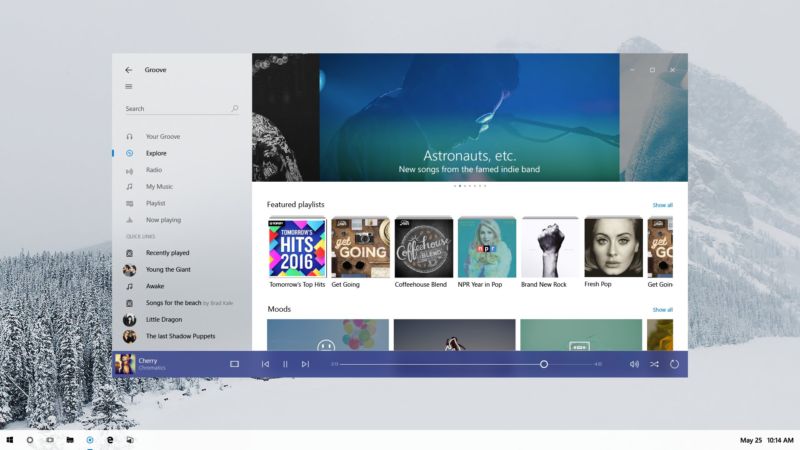
New Windows Look and Feel, Neon, Is Officially the 'Microsoft Fluent Design System' (arstechnica.com)
An anonymous reader quotes a report from Ars Technica: Earlier this year, pictures of a new Windows look and feel leaked. Codenamed Project Neon, the new look builds on Microsoft Design Language 2 (MDL2), the styling currently used in Windows 10, to add elements of translucency and animation. Neon has now been officially announced, and it has an official new name: the Microsoft Fluent Design System. The switch from "design language" to "design system" is deliberate; Fluent is intended to define more than just the appearance, but also the interactivity. Though visually there are common elements, the system is designed to work across virtual/augmented reality, phones, tablets, desktop PCs, games consoles, using mice, keyboards, motion controllers, voice, gestures, touch, and pen, with the interactivity and input optimized to each particular form factor. Fluent is described as having five "fundamentals": light, depth, motion, material, and scale. "Light" means that the interface should avoid distracting and strive to ensure that attention is drawn to where it needs to be. With "depth," Fluent apps will make greater use of layering and the relationships between objects and interface elements. Fluent will use "motion" to indicate relationships and connections between elements, establishing context. Microsoft is using "Material" to mean making best use of the screen space and giving room to content. "Scale" means building interfaces that can go beyond two dimensions, and go beyond the size of a screen, to embrace new form factors and input methods as they arrive. -
Amazon Is the 2nd Most Popular App Among Teens, Says Study (cnbc.com)
An anonymous reader writes: When it comes to apps they're using these days, teens and millennials say Snapchat is king -- no surprise there. But second place? It's not Instagram: It's Amazon. This is according to a survey -- The 2017 Love List Brand Affinity Index, run by Conde Nast and Goldman Sachs -- that asked 2,345 U.S. millennial and Gen Z shoppers about their fashion, retail and consumer preferences. The survey skewed towards younger consumers. One question asked which apps they were using currently that they weren't using a few months ago: Snapchat and Amazon came in first and second. (Other popular apps -- Instagram, Twitter and Pinterest -- came in third, fourth and fifth respectively.) "Users are looking for efficiency, speed and convenience, and Amazon hits all those buckets," said Conde Nast chief marketing officer Pam Drucker Mann told CNBC. On a side note, it appears people generally don't have many gripes with Amazon. Early results of our poll from Wednesday suggests Amazon is the last company (of the five tech giants) whose services people are keen on ditching. Also, regardless of how some of us feel about Snapchat, the company seems to be a hit among teenagers. -
Amazon Is the 2nd Most Popular App Among Teens, Says Study (cnbc.com)
An anonymous reader writes: When it comes to apps they're using these days, teens and millennials say Snapchat is king -- no surprise there. But second place? It's not Instagram: It's Amazon. This is according to a survey -- The 2017 Love List Brand Affinity Index, run by Conde Nast and Goldman Sachs -- that asked 2,345 U.S. millennial and Gen Z shoppers about their fashion, retail and consumer preferences. The survey skewed towards younger consumers. One question asked which apps they were using currently that they weren't using a few months ago: Snapchat and Amazon came in first and second. (Other popular apps -- Instagram, Twitter and Pinterest -- came in third, fourth and fifth respectively.) "Users are looking for efficiency, speed and convenience, and Amazon hits all those buckets," said Conde Nast chief marketing officer Pam Drucker Mann told CNBC. On a side note, it appears people generally don't have many gripes with Amazon. Early results of our poll from Wednesday suggests Amazon is the last company (of the five tech giants) whose services people are keen on ditching. Also, regardless of how some of us feel about Snapchat, the company seems to be a hit among teenagers. -
Snap CEO Evan Spiegel Is Not Afraid of Facebook (recode.net)
An anonymous reader writes: Snap CEO Evan Spiegel addressed on Wednesday what many have been hoping he would address for months: What he thinks about Facebook and the fact the social giant is copying all of Snapchat's best features. On Snap's Q1 earnings call Wednesday, Spiegel was asked bluntly: "Does Facebook scare you? Why or why not?" Spiegel laughed. Then talked about how important it is to be creative. Then said this: "At the end of the day, just because Yahoo, for example, has a search box, it doesn't mean they're Google." Fun fact: Yahoo is an investor in Snap. -
Snap CEO Evan Spiegel Is Not Afraid of Facebook (recode.net)
An anonymous reader writes: Snap CEO Evan Spiegel addressed on Wednesday what many have been hoping he would address for months: What he thinks about Facebook and the fact the social giant is copying all of Snapchat's best features. On Snap's Q1 earnings call Wednesday, Spiegel was asked bluntly: "Does Facebook scare you? Why or why not?" Spiegel laughed. Then talked about how important it is to be creative. Then said this: "At the end of the day, just because Yahoo, for example, has a search box, it doesn't mean they're Google." Fun fact: Yahoo is an investor in Snap. -
Snap CEO Evan Spiegel Is Not Afraid of Facebook (recode.net)
An anonymous reader writes: Snap CEO Evan Spiegel addressed on Wednesday what many have been hoping he would address for months: What he thinks about Facebook and the fact the social giant is copying all of Snapchat's best features. On Snap's Q1 earnings call Wednesday, Spiegel was asked bluntly: "Does Facebook scare you? Why or why not?" Spiegel laughed. Then talked about how important it is to be creative. Then said this: "At the end of the day, just because Yahoo, for example, has a search box, it doesn't mean they're Google." Fun fact: Yahoo is an investor in Snap. -
NVIDIA Unveils Tesla V100 AI Accelerator Powered By 5120 CUDA Core Volta GPU (hothardware.com)
MojoKid writes: NVIDIA CEO Jen-Hsun Huang just offered the first public unveiling of a product based on the company's next generation GPU architecture, codenamed Volta. NVIDIA just announced its new Tesla V100 accelerator that's designed for AI and machine learning applications, and at the heart of the Tesla V100 is NVIDIA's Volta GV100 GPU. The chip features a 21.1 billion transistors on a die that measures 815mm2 (compared to 12 billion transistors and 610mm2 respectively for the previous gen Pascal GP100). The GV100 is built on a 12nm FinFET manufacturing process by TSMC. It is comprised of 5,120 CUDA cores with a boost clock of 1455MHz, compared to 3585 CUDA cores for the GeForce GTX 1080 Ti and previous gen Tesla P100 AI accelerator, for example. The new Volta GPU delivers 15 TFLOPS FP32 compute performance and 7.5 TFLOPS of FP64 compute performance. Also on board is 16MB of cache and 16GB of second generation High Bandwidth (HBM2) memory with 900GB/sec of bandwidth via a 4096-bit interface. The GV100 also has dedicated Tensor cores (640 in total) accelerating AI workloads. NVIDIA notes the dedicated Tensor cores also allow for a 12x uplift in deep learning performance compared to Pascal, which relies solely on its CUDA cores. NVIDIA is targeting a Q3 2017 release for the Tesla V100 with Volta, but the timetable for a GeForce derivative family of consumer graphics cards has has not been disclosed. -
US To Ban Laptops in All Cabins of Flights From Europe (thedailybeast.com)
An anonymous reader shares an article: The Department of Homeland Security will ban laptops in the cabins of all flights from Europe to the United States, European security officials told The Daily Beast. An official announcement is expected Thursday. Initially a ban on laptops and tablets was applied only to U.S.-bound flights from 10 airports in North Africa and the Middle East. The ban was based on U.S. fears that terrorists have found a way to convert laptops into bombs capable of bringing down an airplane. It is unclear if the European ban will also apply to tablets. DHS said in a statement to The Daily Beast: "No final decisions have been made on expanding the restriction on large electronic devices in aircraft cabins; however, it is under consideration. DHS continues to evaluate the threat environment and will make changes when necessary to keep air travelers safe." -
Hackers Came, But the French Were Prepared (nytimes.com)
Adam Nossiter, David E. Sanger, and Nicole Perlroth, reporting for the New York Times: Everyone saw the hackers coming. The National Security Agency in Washington picked up the signs. So did Emmanuel Macron's bare-bones technology team. And mindful of what happened in the American presidential campaign, the team created dozens of false email accounts, complete with phony documents, to confuse the attackers (Editor's note: the link could be paywalled; alternative source). The Russians, for their part, were rushed and a bit sloppy, leaving a trail of evidence that was not enough to prove for certain they were working for the government of President Vladimir V. Putin but which strongly suggested they were part of his broader "information warfare" campaign. The story told by American officials, cyberexperts and Mr. Macron's own campaign aides of how a hacking attack intended to disrupt the most consequential election in France in decades ended up a dud was a useful reminder that as effective as cyberattacks can be in disabling Iranian nuclear plants, or Ukrainian power grids, they are no silver bullet. The kind of information warfare favored by Russia can be defeated by early warning and rapid exposure. -
Windows 10 Now On 500 Million Devices, Up By 200 Million in a Year (arstechnica.co.uk)
At Build developer conference in Seattle today, Microsoft announced that Windows 10 is now running on 500 million monthly active devices. From a report: Little over a year ago, the company said that the operating system had reached 300 million systems. As the operating system nears the end of its second full year on the market, it's clear that it's going to fall a long way short of the company's original estimates. At launch, the ambition was to reach 1 billion devices over the first two to three years of availability, but this estimate assumed that Windows 10 Mobile would be a going concern, selling something of the order of 50 million or more devices a year.