Slashdot Mirror
Domain: solarviews.com
Stories and comments across the archive that link to solarviews.com.
Comments · 111
-
Re:"Water-sculpted" landscape?
Although there are also aeolian features on Mars, wind doesn't carve the particular kinds of features in the Viking images that are the ones mostly attributed to water, e.g., http://solarviews.com/cap/mars...
Geologists argued for a long time, though, about whether the fluid that carved the features was actually water, or some other fluid. But now that we have ground truth measurements from the rovers, the case for water is pretty well established.
-
Jane is Lonny Eachus is a pathological liar
I haven't "baselessly" accused anyone of anything. I make sure I have very good bases when I make actual accusations. If anything, your comment was a "baseless accusation". And those emails were almost certainly not "hacked". Evidence strongly suggests the leak was an "inside job", as the saying goes See what I mean, folks?. [Jane Q. Public, 2015-03-23]
Good grief, Jane. Of course Sky Dragon Slayers like you mistakenly believe the emails were almost certainly not "hacked". And since you're almost completely incapable of admitting when you're wrong, you'll never be reasoned out of that position.
But surely even Jane can see that unless the scientists Jane was quoting and attacking "leaked" the emails, then Jane was using private emails to attack scientists. And apparently that's cool, but responding to public comments is illegal, unethical, despicable lowlife sociopathic behavior.
Janeland is a funny place. For instance:
... I mean look: you want evidence that this guy is short of a full load? Some of those comments are from someone he thinks is me, and not even from Slashdot.
It's so adorable how Jane keeps hiding behind a pole.
... call it revenge for not getting to name Charon "Goofy". [Lonny Eachus, 2014-11-07]
... If left up to me, I would have really, honestly, named new 9th planet "Goofy". [Lonny Eachus, 2013-07-28]
... You're talking to somebody who thought that other rock should have been named "Goofy". [Lonny Eachus, 2013-07-28]
I want the definition to go back the way it was. That way, maybe we will finally get to name its companion "Goofy", rather than that dumbass Charon moniker. [Jane Q. Public, 2015-02-28]
Dumbass Charon moniker? James Christy named Charon because his wife's nickname is "Char".
In fact, "Charon is informally pronounced "SHAR-on," similar to the name of the discoverer's wife, Charlene."
The man who discovered Pluto wanted to name its moon after his wife, and astronomers pronounce it "SHAR-on" to honor his choice. Why does Jane/Lonny Eachus call this a dumbass moniker?
-
Re:"...moving east."
I checked that for one of the previous posts: http://blogs.esa.int/rosetta/2... lists the declination and ascension of its axis of rotation so the wobble must be modest.
And here's asteroid Toutasis. It wobbles. http://www.solarviews.com/raw/...
-
Re:Cough. Earth's Mass?!?
Mass of the sun is 330,000 times the mass of earth.
So if it were losing an Earth-Mass yearly it would have had to be 7 times as massive as today at the beginning of the Pleistocene, and would only have a life expectancy of about 330,001 years left.
The Sun appears to have been active for 4.6 billion years and has enough fuel to go on for another Five billion years or so..
So I think you may have lost a few digits (in the exponents) when making your calculations.
-
Re:Orbits in a single day!
No.
Although Mercury is not tidally locked to the Sun, its rotational period is tidally coupled to its orbital period. Mercury rotates one and a half times during each orbit. Because of this 3:2 resonance, a day on Mercury (sun rise to sun rise) is 176 Earth days long.
-
Mission to Titan
Now, we need to send a robot to Saturn's moon Titan and see if life exists there.
Titan's surface temperature appears to be about -178C (-289F). Methane appears to be below its saturation pressure near Titan's surface; rivers and lakes of methane probably don't exist, in spite of the tantalizing analogy to water on Earth. On the other hand, scientists believe lakes of ethane exist that contain dissolved methane. Titan's methane, through continuing photochemistry, is converted to ethane, acetylene, ethylene, and (when combined with nitrogen) hydrogen cyanide. The last is an especially important molecule; it is a building block of amino acids. -
Re:What injustice!You're a troll but nevermind...
-
Nothing new
I've heard about this over a year ago, at a minimum.
Same goes with Jupiter's moon Europa ( http://www.solarviews.com/eng/europa.htm ). Signs are that it could have liquid water inside, as quoted from the site: "Since liquid water existed in the past, could life have formed and even exist today? The primary ingredients for life are water, heat, and organic compounds obtained from comets and meteorites. Europa has had all three. From the images and data collected by the Galileo spacecraft, scientists believe that a subsurface ocean existed in relative recent history and may still be present beneath the icy surface. Europa's water should have frozen long ago, but warming could be occurring due to the tidal tug of war with Jupiter and neighboring moons."
Same site mentions that the water has been spotted spewing forth from Enceladus in July 14, 2005, being also noted as a "dramatic warm spot centered on the pole that is probably a sign of internal heat leaking out of the icy moon" ( http://www.solarviews.com/eng/enceladus.htm )
-
Nothing new
I've heard about this over a year ago, at a minimum.
Same goes with Jupiter's moon Europa ( http://www.solarviews.com/eng/europa.htm ). Signs are that it could have liquid water inside, as quoted from the site: "Since liquid water existed in the past, could life have formed and even exist today? The primary ingredients for life are water, heat, and organic compounds obtained from comets and meteorites. Europa has had all three. From the images and data collected by the Galileo spacecraft, scientists believe that a subsurface ocean existed in relative recent history and may still be present beneath the icy surface. Europa's water should have frozen long ago, but warming could be occurring due to the tidal tug of war with Jupiter and neighboring moons."
Same site mentions that the water has been spotted spewing forth from Enceladus in July 14, 2005, being also noted as a "dramatic warm spot centered on the pole that is probably a sign of internal heat leaking out of the icy moon" ( http://www.solarviews.com/eng/enceladus.htm )
-
Re:High res?
True, but it was the closest thing I could find on short notice. The point is that Pluto isn't very many pixels across. Also, I think when they said "best" they were actually talking about the new images, even though they didn't show a picture.
There are a few more pictures here, both from Hubble and ground telescopes: http://www.solarviews.com/eng/pluto.htm
It's not quite as simple as "the image is over-exposed." Pluto is dim and small enough to be right at the edge of telescopes' resolving power. Intensity variations across its face are even harder to detect, so it usually looks like either a fuzzy white ball or a fuzzy grey ball.
The images are quite impressive.
-
Re:Nice mission overall
[citation needed]
So then Viking 1 and 2 were just built by Chuck Norris, so they'd be able to rocket through space and land on Mars with zero deacceleration and function perfectly and do good science. Back in the 1970s. Before the "airbag" invention used on the pathfinder mission.
p.s. you're a fucking idiot, i hope your account gets banned and you die a horrible death. at least reference random wikipedia articles so it looks like you know what you're BSing about. even a cursory glance at previous mars missions would have told you your assumptions are completely wrong. eat shit and die, and don't come back until you're willing to backup your shitty posts without at least negligible proof that you're not talking out of your ass.
here's your proof that you're wrong btw (note both parachute and thrusters were used, successfully, almost forty years ago) http://www.solarviews.com/eng/viking.htm -
Re:What are the chances
-
Re:Fine by me.
Also bullshit. The reason we don't bother sending rovers to the moon is because nothing interesting actually happens on the surface. Anything we might want to look at is easily discovered with high-resolution cameras operating in lunar orbit.
First rule of holes: When you're in a hole and you can't get out, then stop digging. You are wasting not just my time, but yours with statements like that. There are interesting things on the surface. You just don't know about them.
To start with, if we had never gotten any information about the surface of the Moon, we'd be almost completely in the dark about what was happening in the early Solar System (no Earth material is older than roughly 3.8 billion years and that material exists as a component in much younger rocks around 3 billion years old). We can see that the Moon has been banged up by asteroid impacts, but we can't figure out the dates of any of these impacts, unless we got lucky with a few of the very rare lunar meteorites on Earth and could link them to particular impact sites on the Moon. But radioactive dating of lunar material returned by astronauts has settled those date questions and pieced together key parts of the early Solar System.
Second, the lunar missions discovered various signs of volcanic activity and through luck and the intuition of some astronauts picked up interesting bits of geology (like the famous "orange soil"). This happens to have high titanium content and could well be an exploitable resource in the future. It's worth noting that most initial prospecting on Earth has been done by humans on foot.
We'd have no knowledge of the nature of lunar dust or of the regolith. In effect, the lunar missions were glorified sample and return missions with on site human intelligence guiding the selection of materials.
That brings me to the next point. Next time you push your unmanned space exploration fetish, emphasize sample and return missions. The fact that this hasn't yet come to your mind indicates to me that you have no clue about how to conduct unmanned space exploration. Even if you can't send humans to a particular location, a decent alternative is to bring a piece of that location to the humans.You *really* don't understand the economics of space travel, do you? It costs somewhere around $10k *per pound* to launch something into orbit, let alone on a trajectory to Mars. Hell, a large number of the design decisions that went into building the shuttle involved keeping weight down. In short: when you're planning a launch, *every single pound counts*.
I see some more furious digging of the hole. There's a simple economy of scale that no current launch vehicle properly exploits: launch frequency. Then there's the lesser economy of scale that everyone knows about, payload size. Even expendable chemical propulsion vehicles can exploit those two economies of scale. The launch costs you cite are for the Shuttle (that's roughly the marginal cost of launch per pound). $10k per kg (not pound) is for the current EELVs, the Delta IV Heavy and Atlas V. Russia is the cheapest with costs somewhere around $3k to $5k per kg. The theoretical limit for chemical propulsion (which probably could only be realized with almost completely reusable vehicles launching thousands of times a year) is an Earth to orbit cost somewhere around $300 per kg of payload (that is crudely triple the current cost of common propellants, LOX/Kerosene or LOX/LH2 at $100 per kg of payload to get something to orbit). The choice of triple the cost of propellant is in analogy to commercial air flight which has transportation costs roughly triple the cost of fuel.
That would be a bit under $150 per pound. At that point, a 500 ton Mars mission would cost about $150 million to launch. That gives you an idea of the true limits of chemical propulsion.If you believe that, you don't underst
-
Re:That's only 20 Amps at 115V
The lunar axis tilts about 1.5 (vs. our 23.5). That will mean that some of the poles will have seasonal adjustment, but most will not. The real concern is the day/night. Fortunately, a short pole going up can be used to redirect light. In fact that same pole can be used to collect heat as well.
-
Re:suspected? are you kidding?
Bullshit. The Viking lander saw water frost, as evident from the temperatures:
http://www.solarviews.com/cap/mars/frost.htm
http://www.agu.org/pubs/crossref/1990/89JB03428.shtml
http://en.wikipedia.org/wiki/Viking_2 -
ice on Mars is nothing new
Finding water was one of the key goals of the Phoenix mission.
That is a bizarre statement. Large quantities of ice have been observed in numerous ways already. Even the Viking lander observed water frost directly in the 1970's:
http://en.wikipedia.org/wiki/Viking_2
http://www.solarviews.com/cap/mars/frost.htm
That frost sublimated just like this ice did.
Here are other observations:
http://science.nasa.gov/headlines/y2002/28may_marsice.htm
Here you can see a frozen crater lake:
http://esamultimedia.esa.int/images/marsexpress/210-010705-1343-6-co-01-CraterIce_H.jpg
http://www.esa.int/SPECIALS/Mars_Express/SEMGKA808BE_0.html
Not only is that ice, it may actually be an outflow.
What makes the results from Phoenix exciting is that the actual experiments that Phoenix is supposed to perform depend on having landed on ice. But finding ice somewhere on Mars is not a surprise.
-
Re:The power to destroy a planet...
-
Re:Wow
Done, here it is, optimized and at high resolution...
-
Re:Earth doesn't movehttp://www.learner.org/channel/courses/essential/earthspace/session7/closer1.html
Orbital period (days) 27.32166
Rotational period (days) 27.32166
http://www.solarviews.com/eng/moon.htmThe moon has about 13 days a year.
I think you'd increase your slash-cred if you explained it using a Futurama quote:- Leela: Our car broke down and we're low on oxygen. Can we borrow some?
Moon farmer: Borry? Listen here, city girl. You can't just borry oxygen. Oxygen doesn't grow on trees. You'll have to work it off doing chores on my hydroponic farm. You can return to your precious park at sun-up.
Fry: I guess we can do chores for a few hours.
Leela: Night lasts two weeks on the moon.
Moon farmer: Yep, goes down to minus-173 degrees.
Fry: Celsius or Fahrenheit?
Moon farmer: First one, then the other.
- Leela: Our car broke down and we're low on oxygen. Can we borrow some?
-
Re:Earth doesn't move
Doesn't that infer the moon's rotation is 365.25 days?
No. If you thing of the earth and moon as orbiting each other, the earth could be considered in geostationary orbit. The earth and moon as they circle each other has the same side of the moon facing the earth at all times.
http://www.learner.org/channel/courses/essential/earthspace/session7/closer1.html
Orbital period (days) 27.32166
Rotational period (days) 27.32166
http://www.solarviews.com/eng/moon.htm
The moon has about 13 days a year. -
Saturn's rings. Ice. Water. Life remains?
Saturn's rings are composed largely of water ice with some impurities. Frozen ugly bags of mostly water.
In 1952, Isaac Asimov wrote a story called "The Martian Way", where colonists on Mars got sick of paying Earth to export water (and Earth politicians said the colonists were Wasters anyhow). The Martian Scavengers flew to Saturn, chose a large fragment of ice, reshaped it into a cylinder, embeded their ships in it, and flew it like a giant ship back to Mars. Using the fragment's ice as reaction mass, they were able to make the return trip in five weeks.
We now know they'd have to melt many fragments together instead of having a cubic mile chip to reshape -
Re:The bigger issue
"Hmm, the evidence is pretty strong that more CO2 leads to higher temperatures. If C02 was a symptom, please explain what you think would release more C02 as the temperature rises." - Mars vs. Venus. If more CO2 leads to higher temperatures; Venus could serve as pretty solid evidence: Approximately 96.5% CO2 by volume (+ 3.5% Nitrogen) averaging approximately 900F (480C). But Mars can throw a wrench into the whole theory with its 95.32% by volume (+ Nitrogen (N2): 2.7%, Argon (Ar): 1.6%, Oxygen (O2): 0.13%, Water (H2O): 0.03%, Neon (Ne): 0.00025%) with a maximum temperature of 68F (20C) and a minimum of -220F (-140C) - it starts to look like the CO2 rule of higher temperatures is pretty much doo-doo science. (Look it up here http://www.solarviews.com/eng/mars.htm and here http://hyperphysics.phy-astr.gsu.edu/hbase/solar/
v enusenv.html#c2 - Earth's atmosphere contains the following gasses (by volume): nitrogen: 78%, oxygen: 20.95%, argon: 0.93% and finally - carbon dioxide: 0.038% - wow, that's a pretty high concentration - I think we're all going to die. I'll reply to the other comment in my next post - because it's a little more difficult to compile that data and many sources contradict each other. -
Re:Two targets?
The article says ORBITED, not visited.
Giotto came within 500 miles of Halley but never actually orbited.
http://www.solarviews.com/eng/giotto.htm -
Bad science from CBC News
...the Cassini-Huygens spaceprobe made a descent over two years ago onto Titan, the only moon in the solar system known to have an atmosphere.
4 0.htm, or our own Moon's http://www.iac.es/galeria/mrk/atmo_lun.html or that of Enceladus http://www.space.com/scienceastronomy/enceladus_at mosphere_050316.html or Io's http://www.solarviews.com/eng/iomountain.htm, Europa's http://www.windows.ucar.edu/tour/link=/jupiter/moo ns/europa_atmosphere.html&edu=high, Ganymede's http://www2.jpl.nasa.gov/galileo/hst7.html, or Callisto's http://www.jpl.nasa.gov/releases/99/calliatm.html. -
Re:Pic from article
I was expecting comments on Uranus....
-
"rotating earth" as seen from Galileo probei saw the movie, and kind of liked it, even though i think i didn't really learn anything new (most information can be taken from +5 slashdot posts over the last year or so). I highly recommend taking people that are maybe not very interested in the whole topic to see this movie though. It can really be quite a shocker for people that don't read the science part of the newspaper everyday.
Apart from that, i really loed the video taken from the galileo spacecraft where you can see earth rotating in space, and looked it up on the net, for your convenience:
-
Re:Georges Moonbat. Great choice there.
Has anyone measured CO2 levels on mars and venus? So far the only proof we have that co2 is linked to global warming is that any time in the past when temperatures have gone up, so has CO2. How can we prove which one is the cause, and which one a symptom? And if we can't even prove that, how in the world can we possibly expect to determine exactly how much effect CO2 has on temperature?
With regards to Mars, the following pages (among many others) contain info about the exact makeup of the Mars atmosphere:
http://adsabs.harvard.edu/abs/2003AGUFM.P42A0425K
http://www.earthsci.unimelb.edu.au/mars/Carbon_Dio xide.html
http://www.solarviews.com/eng/mars.htm
This would suggest that such measurements have been made.
I'm pretty sure this is true for Venus as well. -
Olympus Mons
Nope. Its "the most powerful". While they might cover the same surface area, Olympus Mons stands much higher.
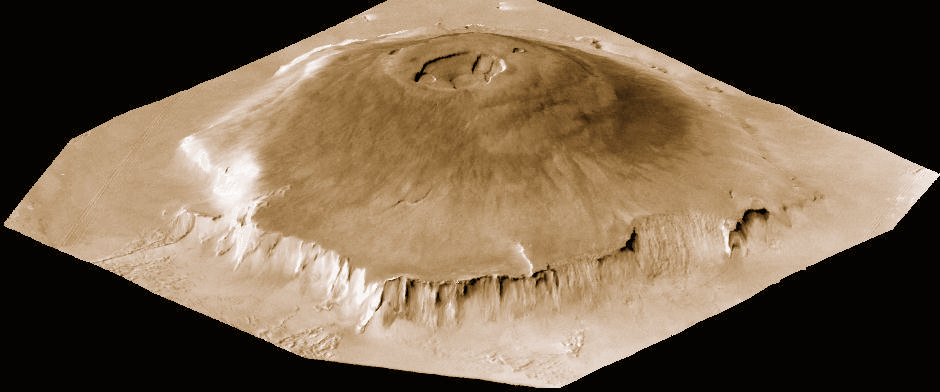
True, Olympus Mons is absolutely huge. The summit is at 27 kilometres above the mean surface level on Mars and it covers a surface area the size of Arizona. It would be fantastic to be able to stand on that summit and enjoy the view. -
Re:I think UB313 was way cooler as a planetoid nam
Eris? It'll immediately be confused with Eros.
At first I wasn't sure if you meant the asteroid named Eros or just the similarity of the name Eros itself (also culled from Greco-Roman mythos). Then I realized it didn't matter because your statement applied regardless. You'd think someone would have thought about potential naming confusion for bodies in our own solar system. My Discordian friends are chortling with glee, though. -
Re:We got it wrong
Two different measures. You're measuring radius vs diameter. But then again, I made a NASA mars probe mistake, and was comparing KM for the moon to miles for Mercury. Oops.
The Moon:
3476 km in diameter, 7.349E22 kg
Mercury:
4,880 km, 3.30E23 kg
Mercury's 40% larger in diameter and about 5 times more massive. -
Re:How about Fresnel lenses?
I agree. In an old PopSci article, they mentioned that solar cells with fresnel-type lenses were used on Deep Space One to boost the output. The article is at http://www.solarviews.com/eng/deepspace1.htm[sola
r views.com]. FTA: "The solar panels, designated SCARLET II (Solar Concentrator Arrays with Refractive Linear Element Technology) constitute one of the technology tests on the spacecraft. A cylindrical lens concentrates sunlight on a strip of GaInP2/GaAs/Ge photovoltaic cells and acts to protect the cells. Each solar array consists of four 160 cm x 113 cm panels." -
Re:A planet by any other name....
"I'm pretty sure we'd see it, unless it were all black"
you are probably right there - drop it back to 2 * pluto avg distance and seeing it would be a dodgy proposition
"If we really incist on saying that it should be a circular orbit,"
http://www.solarviews.com/eng/solarsys.htm
Down the bottom of the page - eccentricity = 0 for a circular orbit so even that doesn't work - Pluto and Mercury would well and truly fail at >3 * average ecc of those planets in that table including themselves. -
This is not news.
http://www.solarviews.com/eng/uranus.htm
Rings have been known about since 1977. Voyager "didn't see it" because voyager couldn't see in color. -
OMG!!!
OMG HOT!!! LOL!!!
-
We're still talking very cold temperatures
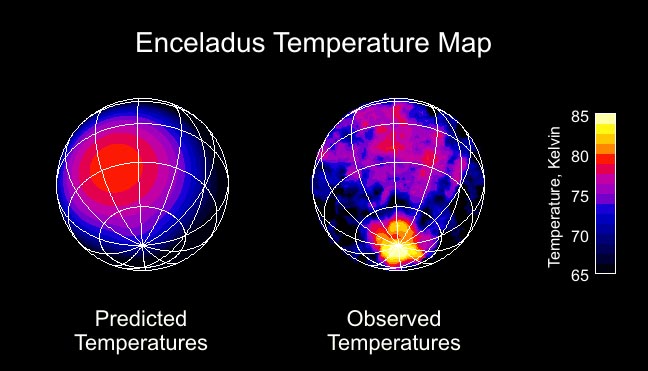
If you look at a temperature map of Enceladus, it's still quite cold, perhaps 100 degrees Kelvin. With virtually no pressure, it's enough to cause evaporation and the formation of water. There's a good write-up here.
So, don't expect to see exotic creatures swimming about. It might end up being a great place to mine for water, however, supporting future colonies of Saturn. The moon has virtually no gravity, so you could practically throw it off the surface (well, not really - the escape velocity is 212 m/s). -
We're still talking very cold temperatures
If you look at a temperature map of Enceladus, it's still quite cold, perhaps 100 degrees Kelvin. With virtually no pressure, it's enough to cause evaporation and the formation of water. There's a good write-up here.
So, don't expect to see exotic creatures swimming about. It might end up being a great place to mine for water, however, supporting future colonies of Saturn. The moon has virtually no gravity, so you could practically throw it off the surface (well, not really - the escape velocity is 212 m/s). -
Re:Er, don't throw away your lifevest just yet
For heavens sake, why is everyone so arrogant to think that our species is capable of uprooting the climate cycle of a planet?
I know, the idea that there is substantial warming in the northern hemisphere seems strange too....
Espcially when you look at this photo
I mean, where could all that heat production be coming from? -
Lovely Summer Months in Southern SaturnThese storms (and their cycles) are old news. Hubble spotted them back in 1990, the only new information we have today is how strong the lightening is. From the Solar Views article:
Although these events were separated by about 57 years (approximately 2 Saturnian years) there is yet no explanation why they apparently follow a cycle -- occurring when it is summer in Saturn's northern hemisphere.
Now that'd be interesting to know how these storms work on a two planet year cycle as our monsoons and other weather phenomenon seem to primarily operate on single planet year cycles. This area has been nicknamed "Storm Alley."
For more information on how the bands that show up on Saturn reflect weather patterns, check out the weather section on this planet at NJU.
The planet's got 30 named satellites and the most prominent feature a belt of dust and debris. I'm sure there's a lot of factors at play here--probably more than our own atmosphere. There's a lot of talk about cosmic rays actually being the cause of lightning on both Jupiter and Saturn but this topic is heavily debated. -
Re:Can't Hear You
Why should it be frightening?
The temperature on the surface of the sun is 6000 C. +- 100 wouldn't be that noticable. (Sure, sustained over a long time it might be, but I'm not an astronomer.) In addition, compare that to the temperature inside the sun, which is measured in millions of degrees.
http://www.solarviews.com/eng/sun.htm -
Re:VenusParachute mostly. They don't last long.
-
Re:Old news?
More than ten by now. Hundreds of Kuiper belt objects are known. The ones that make the news are ones that are interesting for some reason: larger than usual (Quaoar, Sedna, Xena/Gabrielle 2003 UB313, etc.) or in unusual orbits (this one).
-
somewhat current sun pic
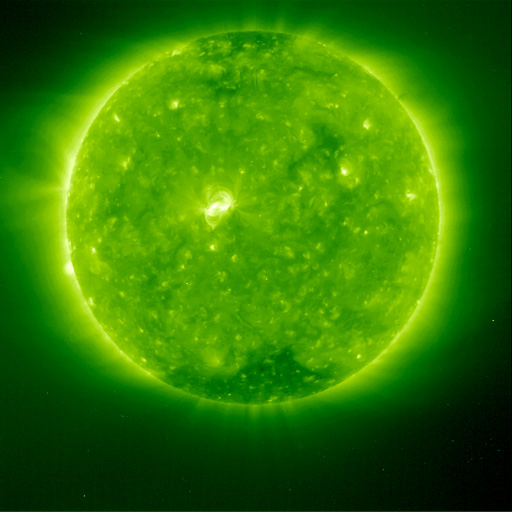
This image of 1,500,000C gas in the Sun's thin, outer atmosphere (corona) was taken March 13, 1996 by the Extreme Ultraviolet Imaging Telescope onboard the Solar and Heliospheric Observatory (SOHO) spacecraft. Every feature in the image traces magnetic field structures. Because of the high quality instrument, more of the suttle and detail magnetic features can be seen than ever before. (Courtesy ESA/NASA)
http://www.solarviews.com/raw/sun/eitfexii.jpg
Freaky looking, but damn cool! -
Re:Someone inform me?
The atmospheric pressure on mars is only ~10 millibars, whereas earth's atmospheric pressure is ~1000 millibars. That drops water's boiling point to around ~70 celcius [sic].
Not sure where you're getting your numbers from, but that's almost certainly wrong. According to this article:The boiling point of water is 100 C (212 F) at standard pressure. On top of Mount Everest the pressure is about 260 mbar (26 kPa) so the boiling point of water is 69 C.
So if the boiling point of water is 69 degrees Celsius at 260 millibars, it's most assuredly far lower at 10 millibars. Assuming that the surface pressure on Mars is 10 millibars (which is 1 kPa), you can calculate the boiling point there. There's a handy boiling point calculator to assist with this; for 1 kPa of atmospheric pressure, you get just above -11 degrees Celsius as the boiling point of water. (This temperature is well within the typical temperature swing for the planet Mars. You can find the temperature and atmospheric pressure ranges at this site; the temperature ranges from -140 C to 20 C, with the average at -63 C. Pressure varies from 6.8 mbar to 10.8 mbar.) -
Re:Sustainable?
Actually, if I remember correctly, Mars has it's problems not because of it's size or mass, but because it has a weak magnetic field. Because of that, every solar storm that smacks into the planet shears off some of it's atmosphere. Linky.
Saturn's moon Titan has a radius of about 2570km and a mass of about 1.35e23kg and has a thick atmosphere. Linky
Mars's radius is about 3397km and has a mass of about 6.42e23kg and has a thin atmosphere.Linky -
Re:Hauling The Trash...No you're not being Trolled, you're supposed to be having an adult debate about the merits/demerits of tossing waste into the Sun. Nice attempt at ad hominem though. And if that's the way you want to play it, well I can give as good as I get.
Having lost the grape argument
Only in your reality distortion field, Sparky. In your warped world, tossing a stone into the sea would likely cause a tsunami off the coast of Australia.
you have degenerated into simple minded mass arguments
Simple minded
Was the comet composed perhaps of the advanced technological cast offs of a spacegoing race? And this spacegoing race, once it blithely decided it was okay to hurl one lump of crap into the sun, did they then just dump every inconvenient piece of crap into the sun?
Ok, lets ignore mass for the minute, plus the fact you're moving the goal posts away from the space shuttle to the entire earth (I accept that I won the shuttle argument, thank you) and lets explore your new angle.
Everything we make no matter how technologically complex, is made up of various combinations of base elements from the periodic table. Everything we make changes its form with changes in temperature and pressure. Everything burns, or melts and vaporizes. Anything we chuck at the Sun will approach it so slowly and absorb so much heat that by the time it gets there it will be a combination of ash and metallic vapor. It won't actually "hit" the Sun, it'll be a wisp of dirty compounds and elements! It won't penetrate into the depths of the Sun, its just going to scatter and bounce around inside the photosphere where its totally removed from the nuclear goings on in the Sun's core.
Or fuck itIt is the largest object and contains approximately 98% of the total solar system mass. One hundred and nine Earths would be required to fit across the Sun's disk, and its interior could hold over 1.3 million Earths.
Troll
Twit! You've obviously spent too long out in the Sun. Go back to your science fiction bubble world where you're most comfortable. You probably believe in Martians too. -
Not CSI
If it were CSI we could enhance the image to see the location antipodal to the impact as well!
-
Try Googling instead
http://www.solarviews.com/eng/iapetus.htm
A Google on "iapetus" will net someone more interesting (and more objectively plausible) information than a poorly-designed site that not only starts off by alluding to a science-fiction movie but is written by a well-known UFO buff (Richard Hoagland) who may suffer a certain lack of objectivity. And yes, some of the info out there is curious. Yes, there seems to be some sort of structure lying along the equator, but nothing says it's perfect; there is not enough info to determine that. Yes, there is a strange large dark area on the leading face of the moon. And that's about all we can say about it without actually being there. The rest is idle (or, in your case, rampant) speculation. -
Re:Add Mass
I'd imagine two reasons:
1) Titan's surface temperature appears to be about -178C (-289F). These temperatures mean that different gasses would be present in the atmosphere, although Nitrogen still appears to be the primary gas.
2) Since Titan is further away from the sun, it experiences less solar pressure. Solar pressure would tend to blow an atmosphere away.
Other possible contributing factors could be the age of Titan (can't verify right now... for some reason firefox isn't opening up new windows properly) and capturing some gases which were lost by Jupiter. I suppose the age would mainly affect the atmosphere due to, as you previously mentioned, techtonic activity. Oh, and titan may have a strong magnetic field helping hold the atmosphere in (or rather preventing ionic winds from blowing it away.) As Titan is techtonically active, one can assume that it has a molten core. This could set up a dynamo system similar to that hypothesized to creat the Earth's magnetic poles.
Okay, I guess that ended up being a lot more than two reasons. -
Re:So...
Er, according to some Hubble-gazing folks, Europa's crust is _made_ of frozen water. Stand corrected.
-
Re:"Small" correction
You're thinking of Saturn. Jupiter is more dense than water.
http://www.solarviews.com/eng/saturn.htm
http://www.solarviews.com/eng/jupiter.htm