Slashdot Mirror
Domain: solarviews.com
Stories and comments across the archive that link to solarviews.com.
Comments · 111
-
Re:"Small" correction
You're thinking of Saturn. Jupiter is more dense than water.
http://www.solarviews.com/eng/saturn.htm
http://www.solarviews.com/eng/jupiter.htm -
Re:Complaint about the writeup
Wait... you're claiming that a ship that handles all sorts of volatiles can't *combust* *hydrogen*? There was strong evidence in original galactica that the ship had fusion power, for YHVH's sake. They're dealing with dangerous 'tylium' and 'solium'... it's silly to think that they can't handle having a hydrogen torch inside a tank with cool walls.
that's just a theory
That is not a theory. The spectral signature of ice is all over the bloody place.
there's so little solid matter
Yeah... most ice is gasseous at near the background temperature. Suuuure
The Kupier Belt is believed to be composed of rocky bodies
Saturn's moon Phoebe is the most studied kupier belt object thusfar, and it's mostly ice. The Kupier belt is bodies made of rock *and* ice, mostly ice. Heck, Uranus and Neptune are known as *ice giants*, because they have accumulated so much ice-laden material from the kupier belt that they have large icy cores. The icy worlds Pluto and Quaoar probably have the next best Kupier belt data.
Oh, and Saturn's rings are mostly ice. A good chunk of their moon's masses are ice - Enceladus being some of the most pure ice in the solar system. Ice is the dominant surface material in Saturn's moons, and once of the most dominant in Jupiter's moons
Please... get serious here. -
Dirty Mexico touchers
-
Re:Oort cloud
taken from http://www.solarviews.com/eng/oort.htm/
"Within the cloud, comets are typically tens of millions of kilometers apart. They are weakly bound to the sun, and passing stars and other forces can readily change their orbits, sending them into the inner solar system or out to interstellar space. This is especially true of comets on the outer edges of the Oort cloud. The structure of the cloud is believed to consist of a relatively dense core that lies near the ecliptic plane and gradually replenishes the outer boundaries, creating a steady state. One sixth of an estimated six trillion icy objects or comets are in the outer region with the remainder in the relatively dense core."
so, in effect the probability that either voyager would encounter anything is for all intents and purposes zero.
(but i still think they should keep funding the program) -
Re:Superman
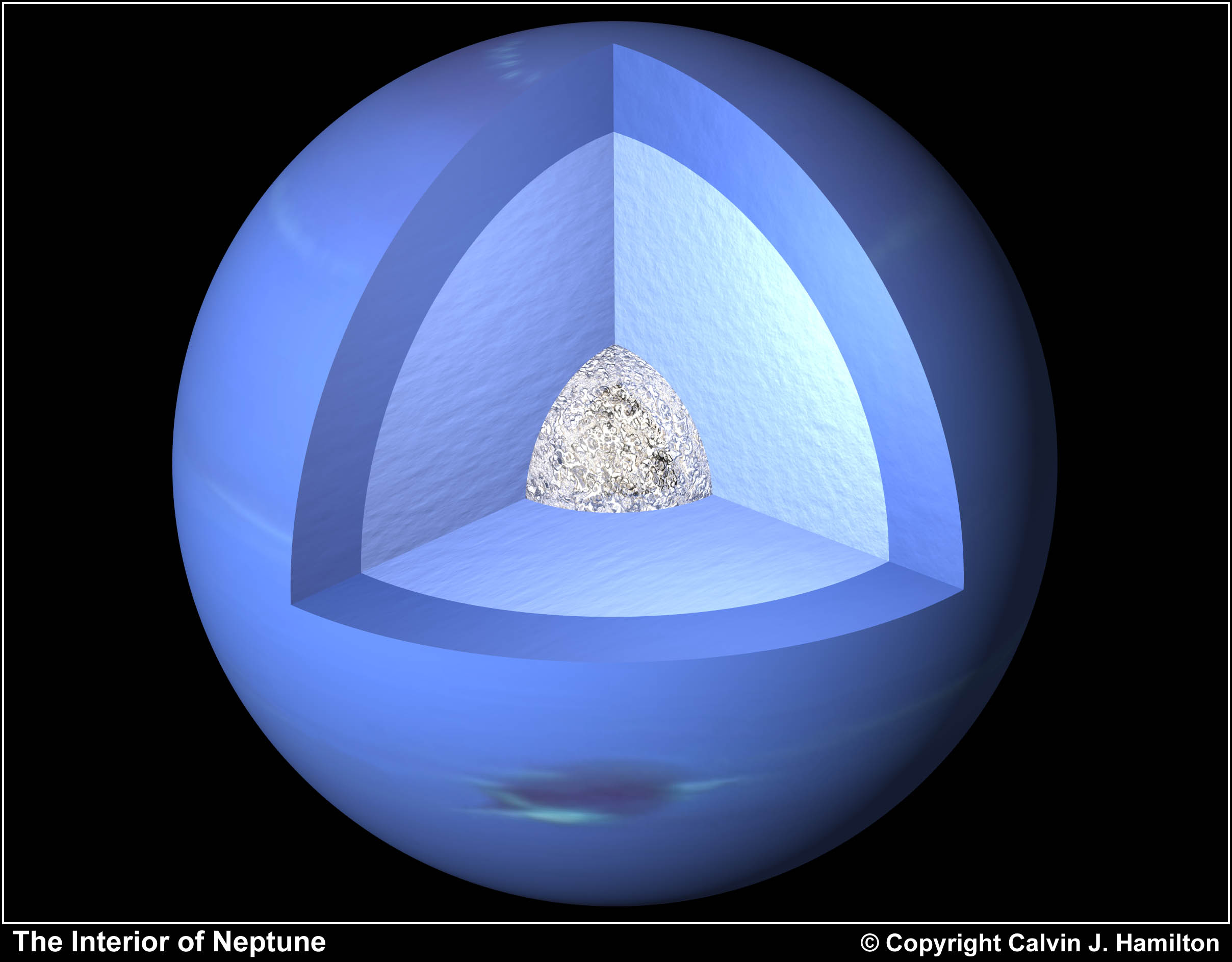
I could be wrong, but I thought that Neptune was a gas giant. This page seems to support that, but also seems to indicate that most of the planet is molten rock, water and similar stuff...
-
Re:Arthur C. Clarke and Iapetus.
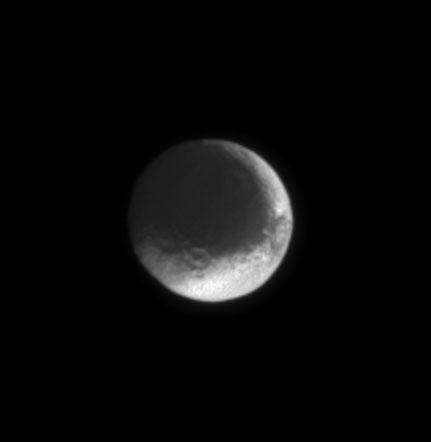
[in "2001"] Clarke described Iapetus as having a black circle painted on it, with a white circle within....When one of the Voyager probes photographed Iapetus, a "circular" black area was found with a smaller white area within.....2001 was published in 1968. The Voyager probes didn't visit Jupiter [Saturn?] until 1980
Image of circular area (on the right side). -
Re:say what?
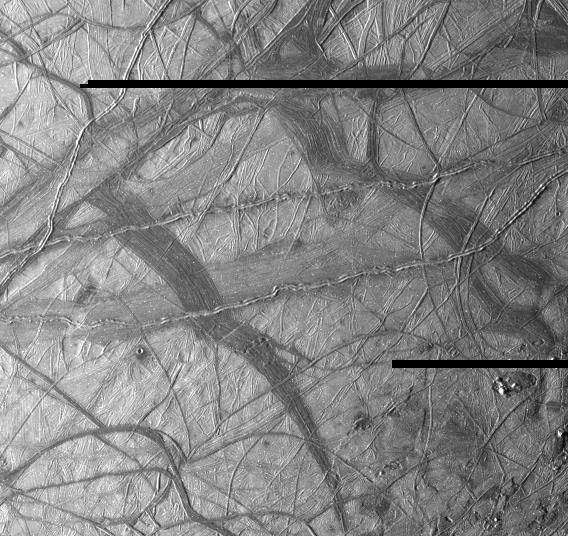
Plus: Europa-the-planet. Water beneath the ice. Lots of critters.
-
Re:Okay...
Triton, the one near Neptune, is a very strange object. One of the coldest places in the solar system yet it manages to have geological activity and even a thin atmosphere with clouds. It's also possible that the entire atmosphere collapses into a frost covering the half of the moon that's in winter at the time. Not to mention the moon orbits Neptune backwards, suggesting that it's a captured object from the Kuiper Belt. If true this means it's the largest such object, not Pluto. There are missions being planned to orbit Neptune and send landers to Triton. Should be good!
Only 20+ years to go -
right stuff to ask questions'... some retired guy
Yes John Young is some old retired *guy*. But he's a reminder of a generation of real acheivers. Forget the awards and look at what he has actually done:
Born in depression era America he graduated from Georgia Tech in Aero class of '52, (for all you pre college persons - it's one of the harder enginering courses), while his armed service combat record only mentions service in Korea on DD-558, Young flew Crusader and Phantom test pilot missions evaluating weapons systems, breaking speed records at 3000 and 25,000 ft. He retired as a Caption after 25 yrs Navy service in '76.
Youngs Nasa career started in '62, flying Gemini 3 missions in '65 with Gus Grissom (remember Grissom, Commander of Apollo 1 which tragically burnt on the PAD), Gemini 10 in '66, CMMP on Apollo 10 in '69 (test run for Apollo 11 in - so thats around the Moon), Apollo 16 in '72 (with Ken Mattingly who missed his ride with Apollo 13 - so he has worked on the lunar surface for his day job), Commander of STS-1 (that the first shuttle flight) in '81, Commander of STS-9 Spacelab in '83. Was backup in Gemini 6, Apollo1, Apollo 7, 13, 17.
In summary 15,000 hrs training, 15100 hrs in flight hours and 835 hrs in 6 space flights.
He's some *retired guy* all right. He is one of only 12 people who have walked, worked and lived on the moon. That give him a unique insight into this area. He has seen how puny Earth is from space and realises how human existance is not something to be taken for granted. You can read more about his bio here.
-
Re:Power Boost
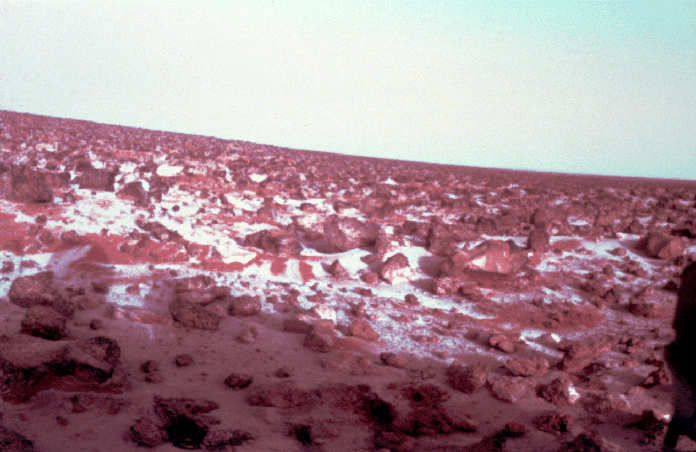
Here is an image of frost at the Viking 2 landing site. It is believed to be water frost according to that site.
-
beer?
nice. some info about Titan, and Saturn itself at Solarviews.
might be interesting. maybe i can finally do my extraterrestrial beerbrewing there. -
beer?
nice. some info about Titan, and Saturn itself at Solarviews.
might be interesting. maybe i can finally do my extraterrestrial beerbrewing there. -
beer?
nice. some info about Titan, and Saturn itself at Solarviews.
might be interesting. maybe i can finally do my extraterrestrial beerbrewing there. -
Re:If the cold-fusion people got even 1% of the mo
It's not cold but...
-
Re:Careful design and orbit?
The planet does indeed spin - Mercury rotates on its axis 1.5 times per solar orbit (see http://www.solarviews.com/eng/mercury.htm). Because of this 3:2 resonance, a Mercury solar day (sunrise to sunrise) is equivalent to 176 Earth days.
So what this means is that for every Earth year Messenger is orbit, 4 Mercury Years will pass, which consists of 2 Mercury Solar Days (see http://messenger.jhuapl.edu/the_mission/mission_de sign.html.
This gives the spacecraft many passes over the light and dark side of the planet, so much that they can spend one (Mercury) day doing global mapping and the second (Mercury) day doing targeted science investigations.
In terms of heat - the highly elliptical, near polar orbit is designed so that the heat shield always faces the sun, giving the instruments a nice room temperature setting on the other side of the shield. There is the possibility of heat from the surface, but the instruments are designed to take that into account. -
It sounds kewler with an "n";-)
Well your doubts have no basis in fact, as this link shows.
The Oort cloud is the source of long-period comets and possibly higher-inclination intermediate comets that were pulled into shorter period orbits by the planets, such as Halley and Swift-Tuttle. Comets can also shift their orbits due to jets of gas and dust that rocket from their icy surface as they approach the sun. Although they get off course, comets do have initial orbits with widely different ranges, from 200 years to once every million years or more. Comets entering the planetary region for the first time, come from an average distance of 44,000 astronomical units. Long period comets can appear at any time and come from any direction. Bright comets can usually be seen every 5-10 years. Two recent Oort cloud comets were Hyakutake and Hale-Bopp. Hyakutake was average in size, but came to 0.10 AU (15,000,000 km) from Earth, which made it appear especially spectacular. Hale-Bopp, on the other hand, was an unusually large and dynamic comet, ten times that of Halley at comparable distances from the sun, making it appear quite bright, even though it did not approach closer than 1.32 AU (197,000,000 km) to the Earth
-
Re:relevancy?
Mars was an example. Titan's atmosphere is about 1.6 bars at -178C. I'm surprised it's denser than the Earth's. Nothing I've read talks about liquid water at that temperature or pressure. It's just a solid at that temp and pressure.
-
Re:2001
Does anyone else find it interesting that in the original draft of 2001: A Space Odyssey, the craft is bound for one of the moons of Saturn as opposed to Europa as was portrayed in the movie. Now after some preliminary exploring Europa we find that Europa's a dud and the easy-bake life mix is in fact on Titan.
In the book of 2001: A Space Odyssey, they do go to Saturn. The plot is more or less the same as the movie, with Arthur C. Clarke's bonus technical details, except that the monolith is located on the surface of mysterious Iapetus, which the book clearly indicated was an artificial satellite built for the purpose of housing the monolith. When Dave Bowman emerged from the other side, there was an identical moon with an identical monolith.
You might want to read it.
I, for the record, predict that past or present life exists on every massive body in the solar system that has or ever had a reasonably dense atmosphere and geological activity. I wouldn't be surprised if self-replicating molecules inhabit most comets, although I guess they freeze to death pretty quickly after leaving the inner solar system. -
Re:2001
Hmm, so you know nothing interesting is below this ice layer?
Yeah, it should be awfully cold there, but at the same time, if it consists of lots of fluid, wouldn't Jupiter's gravitation cause some massive tidal forces and giving it heat energy from the movement? -
Re:Why aren't these on the Mars rovers?
Yeah, because the pictures from Spirit sucked.
-
Re:Looking at newest images of Phoebe...
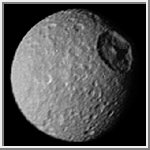
Actually, Mimas is just that.
-
Re:I prefer....
I know you're just going for a lame joke, but for the record, Uranus does have rings.
-
Re:Correct me if I'm wrong.
Everything in science is a theory. The "asteroid impact" idea has a lot to back it up however since there are some realy big craters on this ball of mud we call home. Check out the 170 km one at the Yucatan Peninsula.
-
Re:Crap?I swear the moderators are on crack today, and I know I'll end up paying for this in karma, but someone needs to be the voice of sanity here. Does no-one know any physics? Lets break it down:
At this point, we'll say that the balloon is 'floating' on the very top of the Earth's atmosphere. It won't go down (buyoant[sp] force) and it won't go up (gravity). At this point, as long as the ion engines can beat the force of gravity, you have acceleration.
Wrong! As long as the ion engines can beat drag, you have acceleration. But they won't, and you can show that in a few lines - though I wish it were easier to write equations here...
At 50 km altitude the atmospheric denisty is something like 1 gram per cubic meter. So to lift 1 kg of mass with a balloon you need something like 1000 cubic meters of volume (actually more since you're using hydrogen and not vacuum, but whatever). That will mean a balloon with a radius of 6 meters. It will have a frontal area of 120 square meters. Now, the drag equation is: F_drag = Cd * Area * density * velocity^2, where Cd = 0.2, Area = 120 m2, denisty = 0.001 kg/m3, velocity = 8 km/s. So, F_d = 1.5 million Newton. The ion engine on DS-1 produced 0.09 N of thrust, and massed about 10 kg.
So this idea is cracked by a factor of 10 million or so. I'm sure I'll get lots of indignant, anonymous replies saying how it's actually at 60 km, not 50 etc etc. But the point remains, this is an idea anyone who passed high school physics should be able to see through. Sorry, but that's life. Don't moderate down the messenger....
-
Re:Yucatan...I remember some Discovery piece about another giant meteor hitting around area of the Yucatan several hundred million years ago. I could swear that they were using that crator as evidence of the great die off too.
You know, there hasn't just been one great extinction in history. The dino-killer happened 65MYA. This article is talking about a much earlier event that happened 250MYA.
The comment in the article about the Chix . . . Chick . . . Mexican event refers to the idea that impact catastrophies may not have been the isolated event many assumed. Considering the large number of impact structures of up to several hundred kilometers in diameter around the world, it seems pretty obvious to me that it would have had a large effect on the development of life.
Most of these structures are so weathered that they aren't recognizable from the ground. For instance, the Chesapeake Bay on the east coast of the United States is a 90 km impact structure. Here are a couple of links about terrestrial impact structures. The second one is the best.
-
and it's almost menhir shaped, too.
Toutatis.
instead of sending up bruce willis to mine into it and blow it up, we need to send up obelix to make it into the world's largest menhir. don't know how he'd get it down to use as decoration for a cottage, though... -
Food for Celestia :-)
This could be useful as texture map addons to Celestia, along with textures from Planet Portal, etc...
Also, don't miss this site for your amateur astronomy needs. -
PICTURES of a MOON with a MOON
Here you go. Asteroid Ida and it's little moon "Dactyl".
Dactyl is about 0.75 x 0.8 x 1.0 miles in size. Imagine that!! Imagine sitting on Dactyl and orbiting Ida. Now, I'm not sure if a rock of 1 mile in diameter can even hold you down.
Does anyone know how to calculate your weight on Dactyl? Size listed above and it's probably 2.2 - 2.9 grams per cubic centimeter. -
Re:The trouble with isolated environments
Io?
It's highly unlikely that there's any life on Io. It appears to be too extreme for extremophiles. Perhaps you are thinking of Europa. Europa's the icy moon. Io's the volcanic one covered in sulfur. -
Re:What happened to the naming convetion?
Vesta has already been used.
-
Re:Waste of Time and Money
I know you're joking, but I don't think that's entirely accurate. Titan's atmospheric pressure is only 1.5 times that of Earth. It's definitely no Venus. Here is a page with some info on Titan, including artists renderings that depict a spectacular sky.
-
Re:hurrah, we found dirt!
why the heck havent they toddled over to the face?
-
On Mars' Atmosphere, Scientific DataSource: Calvin J. Hamilton, http://www.solarviews.com/eng/mars.htm:
Atmosphere
--The atmosphere of Mars is quite different from that of Earth. It is composed primarily of carbon dioxide with small amounts of other gases. The six most common components of the atmosphere are:
- Carbon Dioxide (CO2): 95.32%
- Nitrogen (N2): 2.7%
- Argon (Ar): 1.6%
- Oxygen (O2): 0.13%
- Water (H2O): 0.03%
- Neon (Ne): 0.00025 %
Martian air contains only about 1/1,000 as much water as our air, but even this small amount can condense out, forming clouds that ride high in the atmosphere or swirl around the slopes of towering volcanoes. Local patches of early morning fog can form in valleys. At the Viking Lander 2 site, a thin layer of water frost covered the ground each winter.
There is evidence that in the past a denser martian atmosphere may have allowed water to flow on the planet. Physical features closely resembling shorelines, gorges, riverbeds and islands suggest that great rivers once marked the planet.
Temperature and PressureThe average recorded temperature on Mars is -63 C (-81 F) with a maximum temperature of 20 C (68 F) and a minimum of -140 C (-220 F).
Barometric pressure varies at each landing site on a semiannual basis. Carbon dioxide, the major constituent of the atmosphere, freezes out to form an immense polar cap, alternately at each pole. The carbon dioxide forms a great cover of snow and then evaporates again with the coming of spring in each hemisphere. When the southern cap was largest, the mean daily pressure observed by Viking Lander 1 was as low as 6.8 millibars; at other times of the year it was as high as 9.0 millibars. The pressures at the Viking Lander 2 site were 7.3 and 10.8 millibars. In comparison, the average pressure of the Earth is 1000 millibars.
For news, status, updates, scientific info, images, video, and more, check out:
(AXCH) 2004 Mars Exploration Rovers - News, Status, Technical Info, History. -
Re:She was good while she lasted
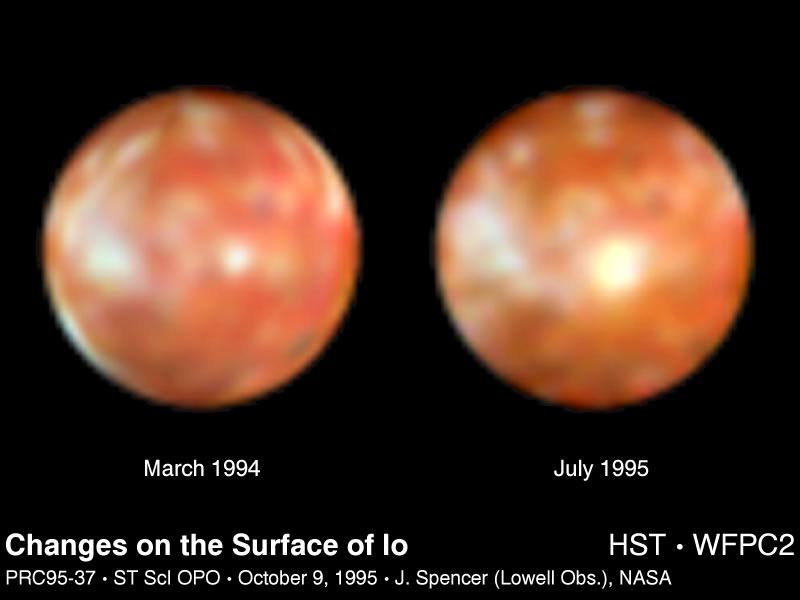
Well, you're wrong about that. Here's a hubble shot of IO. If you can see a poker game there you're the king of ink-blots. Here's another. Compare those to the keck observations I posted earlier and you'll see that hubble's strong point isn't observing planetary bodies; ESO's OWL should be much better for looking at that sort of dim object. And as it turns out, really disant galaxies are better observed in the X-ray spectrum, and NASA has a couple of other satellites for that purpose.
-
Re:Geological Event
Okay, Here you go... volcanic activity on mars: http://www.solarviews.com/eng/marsvolc.htm
-
Re:Whop!!!
You mean like Neptune, we have known of oceans before. Just not ones that could sustain life that is the kicker, and don't ask me why life can't exist on neptune's huge ass oceans I have never taken biology and cannot offer any theories. Can anyone explain to me what is lacking in the neptune/uranus planetary setup that is not satisifed by energy, water, or access to organic compounds at any point in the planets' layers that would make people dismissive of its potentiality for life?
-
Re:Voyager is *not* outside of the solar system!
I had forgotten about the Oort Cloud , interesting stuff .
Oort Cloud
Peace,
Ex-MislTech -
Re:Relative to ...?So, that's 48 km/s relative to what? If it's correct to assume the writer meant "relative to Jupiter," then that is ridiculously fast. IIRC, typical orbits around Earth manage only ~8-10km/s.
Metis [MEE-tis] is the innermost known satellite of Jupiter. According to this page Metis orbits at a mean distance of 127,969 km with a Mean orbital velocity of 31.57 km/sec. So 48 km/sec is not so ridiculous.
-
Re:Boring is ok with me
Sorry, but gravity is inversely preportional to the distance to the center of the earth. This is an interesting explaination. At 300 meters, you would feel
Anyways, once something is at the end of that cable, it will have already achieved orbital velocity
Someone else pointed out that not all satalites are geosynchronous. -
River beds and Volcanos
There are theroys about how mars once had river beds and Volcanos i would love to see a closer look of these
-
Re:Long distance repairs
I couldn't find any information on that... I did find that the USSR Phobos 1 had been told to turn off it's attitude thrusters, loosing the sattelite en-route...
-
Re:Solar wind and Voyager
No (human) spacecraft to date has used the solar wind for propulsion
Mariner 10 did in 1974, although not as a primary means of propulsion. (I assume that by "solar wind" you mean radiation pressure, not actual solar wind?)
-
The size of Texas?
detect an asteroid the size of Texas headed straight at us?
Just for the record, Texas is 266,807 sq miles . Does it make sense to compare a two dimensional item like a state to a three dimensional object like an asteroid? How? Compare the surface area of the asteroid to Texas? 4 pi r^2 is the formula for the area of a sphere.
Maybe one should use the largest cross section? This site says Vesta , the third largest asteroid, is the size of the state of Arizona. This site and this site list some of the larger asteroids.
Let me suggest that the chance of Ceres sneaking up on us is not one in a billion, or one in a trillion. Let me suggest it is zero.
Are there any asteroids the size of US states that haven't been discovered yet? None with Earth crossing orbits.
Are Kuiper Belt Objects asteroids? If so Ceres is no longer the largest asteroid. . But it is even more unlikely that something would divert a Ceres size KBO from past the orbit of Pluto to Earth orbit.
How long would it take to divert an asteroid from an Earth impact? Decades? Centuries? Millenia? Anyhow, Deep Impact had the incoming object be a comet. Even with a project to find deadly NEOs, we could still be snuck up on by a long period or extra-solar comet.
-
The size of Texas?
detect an asteroid the size of Texas headed straight at us?
Just for the record, Texas is 266,807 sq miles . Does it make sense to compare a two dimensional item like a state to a three dimensional object like an asteroid? How? Compare the surface area of the asteroid to Texas? 4 pi r^2 is the formula for the area of a sphere.
Maybe one should use the largest cross section? This site says Vesta , the third largest asteroid, is the size of the state of Arizona. This site and this site list some of the larger asteroids.
Let me suggest that the chance of Ceres sneaking up on us is not one in a billion, or one in a trillion. Let me suggest it is zero.
Are there any asteroids the size of US states that haven't been discovered yet? None with Earth crossing orbits.
Are Kuiper Belt Objects asteroids? If so Ceres is no longer the largest asteroid. . But it is even more unlikely that something would divert a Ceres size KBO from past the orbit of Pluto to Earth orbit.
How long would it take to divert an asteroid from an Earth impact? Decades? Centuries? Millenia? Anyhow, Deep Impact had the incoming object be a comet. Even with a project to find deadly NEOs, we could still be snuck up on by a long period or extra-solar comet.
-
Re:50,000 years?
We should get plenty of warning of when the explosion would happen BEFORE it happens.....but once it did, yeah, like 8 minutes before we toast. A drastic change in neutrino emissions (which do get to us at lightspeed from the core) should tip us off, we hope
Events in the core of the Sun would take a long time, a million years, to work their way through the many layers of the Sun to the surface.
-
Forget that
Both of them stole from Mimas, one of Saturn's moons!
Image. -
Re:Why don't they...
-
uh, not quite
Not mentioned, it cost less than the making of even a medium-sized Hollywood movie.
That's strange- I read that the total mission cost $265 million - more than Titanic cost to make. Still, at $1 a citizen, I think it was worth it. -
Re:Cool.
I seem to remember reading somewhere that it would be possible to see your surroundings if you were somehow able to survive a visit to Venus' surface - the light being a dark dull red glow.
Well for what it's worth, Venera 9 and Venera 10 managed to return images with lighting that was reportedly similar to an overcast summer day on Earth. (At least the Venera 10 photo was.) I'm not sure if that means visual light or not.
Too bad the view wouldn't stop human tourists from being crushed to death, combusted into nothing and suffocated, all simultaneously.
-
Better than liquid nitrogen
First install your mobo and proc inside this custom case. Then use the patented location cooling system to lower the temperature to 4Deg about absolute zero. Now you only need to find 7.5 billion miles of CAT 5 ( and some batteries that last longer than 2 hours). Sure you can play Qake at 900fpss, but the latency is a bitch.
SD