Slashdot Mirror
Domain: soton.ac.uk
Stories and comments across the archive that link to soton.ac.uk.
Comments · 276
-
Re:Evolution
guruevi stated position of the scientific community on the currently-unfolding global climate change as:
Our current model predicts a massive change, we don't know what that means or what will happen, but we probably have to do something
Mmm
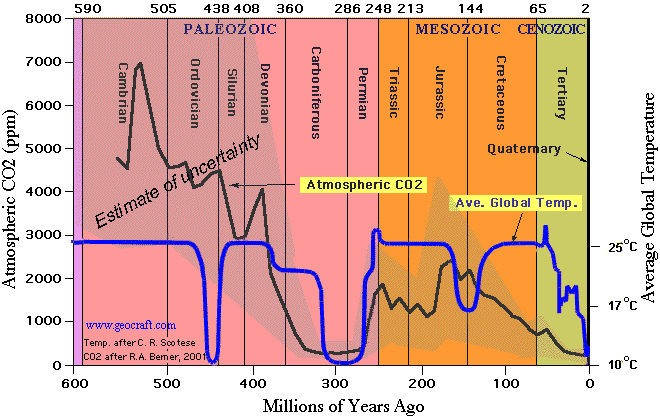
The thing is, we do, in fact, know what that means, and what will happen, because it has happened before, at the end of the Permian Period, when a massive increase in greenhouse gas emissions created a cascade of events that eventually caused 70% of terrestrial species and as much as 96% of marine species to go extinct over a period of no more than 100,000 years.
What we don't know - because the increase in CO2 levels at the onset of the P-T extinction occured much, much more slowly than is the case in the current event - is how quickly what happened a quarter-billion years ago will happen in the current era. Back then, it may have taken as long as 20,000-50,000 years for CO2 to accumulate to sufficient levels to cause the ocean to warm up enough to melt the massive deposits of methane clathrates in its abyssal depths. That - along with the melting of arctic and antarctic permafrost - released an enormous quantity of methane into the atmosphere over a very short time. In turn, that sudden, massive, global methane release had two effects that were catastrophic for land species and downright apocalyptic for oceanic ones. First, the oceans abruptly became both acidic enough to dissolve the shells of bivalves, nautiluses, crustaceans, corals, and other exoskeletal creatures, and, at the same time, their upper layers also became highly anoxic to a sufficient depth to smother pretty much all the icthyoid and gelatinous ones. Secondly, temperatures on land soared to levels that killed off those species that were unable either to migrate to more suitable climes, or that were dependent for key parts of their food web on the species that had succumbed directly in response to the increased temperatures.
We also know that, even though the Great Dying began with a snap ice age, by its end, global temperatures had increased beyond the pre-ice-age average by approximately 10 degrees Centigrade. That was enough to completely melt the planet's ice caps, which led to a significant increase in global sea levels (by as much as 100 meters) and downright biblical floods, as a consequence.
Because CO2 persists in the atmosphere for 20,000 years or more under current conditions (and which will likely stick around still longer as the world's rain forests and wetland environments - which are critical CO2 sinks - continue to disappear), even once we, as a species, achieve zero net CO2 emissions (assuming, of course, that we ever actually do so), the climate-warming effects of the accumulated atmospheric load will continue to push global average temperatures upward for quite literally thousands of years to come.
And, given that the Arctic is already experiencing unprecedented methane emissions, both from deposits released by melting permafrost and from what does, in fact, appear to be melting clathrates at relatively shallow depths, the same kind of abrupt, massive atmospheric methane infusion that caused peak extinction in the P-T event may occur considerably sooner in the current one than climate models of even a few years ago predicted.
So, in broad terms, what is going to happen is well-known. The currently-unanswered questions are: how soon will it happen, and what will happen to our technological/industrial civilization as a result?
So, here's the good news, such as it is: although the climate - and the global ecology that depends on it - is going to radically change, and the e
-
Re:Length, width, depth
-
Re:I have tons of questions on this...
According to the paper, they wrote three layers deep at a 150nm pitch. At 3 bits per nanodot, the claimed 360TB could be stored in about one square inch. Compare that to the latest 10TB HDDs, which have an areal density of around 0.14 TB per square inch.
No figures are given for transfer speeds, though they describe 200kHz laser pulses, which would be about 75 kB/second - not so dramatic, but it is after all a lab prototype. There are numerous options for speeding this up in commercial products.
If the intention is to provide data for future civilisations, then presumably some "key" discs would be included, with information at various scales describing the technology, equipment, and encoding needed to read the next deeper scale. The larger scales could be inscribed in common human-readable languages, but any civilisation capable of imaging the deepest nanoscopic scales would have no problem decoding well-described binary formats as well.
-
Re:I have tons of questions on this...
According to the paper, they wrote three layers deep at a 150nm pitch. At 3 bits per nanodot, the claimed 360TB could be stored in about one square inch. Compare that to the latest 10TB HDDs, which have an areal density of around 0.14 TB per square inch.
No figures are given for transfer speeds, though they describe 200kHz laser pulses, which would be about 75 kB/second - not so dramatic, but it is after all a lab prototype. There are numerous options for speeding this up in commercial products.
If the intention is to provide data for future civilisations, then presumably some "key" discs would be included, with information at various scales describing the technology, equipment, and encoding needed to read the next deeper scale. The larger scales could be inscribed in common human-readable languages, but any civilisation capable of imaging the deepest nanoscopic scales would have no problem decoding well-described binary formats as well.
-
Re:smart people, including Bill Gates
At this point, you're just in denial.
And I don't even have a word for what you're doing. You were wrong, deal with it.
Citation needed.
"And make no mistake about it, if you took a poll -- in the first round of BBS Commentary, in the Continuing Commentary, on comp.ai, or in the secondary literature about the Chinese Room Argument that has been accumulating across both decades to the present day (and culminating in the present book) -- the overwhelming majority still think the Chinese Room Argument is dead wrong, even among those who agree that computers can't understand! In fact (I am open to correction on this), it is my impression that, apart from myself, the only ones who profess to accept the validity of the CRA seem to be those who are equally persuaded by what I called "Granny Objections" earlier -- the kinds of soft-headed friends that do even more mischief to one's case than one's foes."
Let me guess, as with your misreading of the other source I gave you, you're somehow going to see that as saying that nobody disputes the CRA, right?
-
Re:Near Zero Information in the article
It's more clever than that. Here's a sonar explanation anyway:
It involves clutter (e.g. bubbles) having non-linear reflections (presumably because they're compressible), hence they have both even and odd harmonic reflections. Something from a harder object will have only odd harmonics. Adding the reflections from two pulses, one of which is inverted, will cancel the even harmonics of the clutter.
-
Re:Some fundamental, unchecked assumption here ?
I am fully aware that a napkin graph is no way science. I'm challenging the authers premise, that there is a causal link between patent strength and innovation. In fact, slight search engine fu will turn up a veritable zoo of papers on that particular subject, many of which directly contradict what this guy is saying. TechDirt has a bunch of articles on this subject too, and they're sufficiently dumbed down so that anyone should be able to follow it.
COMPETITION & INNOVATION: New Evidence from US Patent and Productivity Data (PDF 29 pages).
From the abstract:Is there any evidence that innovation and technological progress are constrained by com-
petition and fostered by monopoly power? Our results, based on a newly constructed dataset
of US manufacturing industries observed over more than two decades, suggest that this is
not the case. On the contrary, using both patent statistics and productivity growth as al-
ternative measures of innovation and technological change, we observe faster technological
advances in more competitive markets.From the conclusion:
Our empirical findings suggest that there is a positive monotonic relationship between
competition and innovation. Patent counts (simple or weighted by citations) are found to in-
crease with more competition. Similarly, TFP* and LP* keep growing as we move from industries
with signicant market power to more competitive industries. These findings seem to contradict
the Schumpeterian hypothesis that ex-ante market power is necessary to foster innovation. They
also cast serious doubts on the existence of an inverted-U relationship between competition and
innovation in markets with well-defined intellectual property rights.*TFP: total factor productivity
*LP: labor productivity
Both alternative measures of "technological progress" ie innovation. -
There is also a Genetic Basis For Nicotine
There is also a genetic basis for nicotine tolerance. The mechanism is essentially the same. There is an gene that codes for an enzyme which removes nicotine from the bloodstream. This gene has several different alleles that code for more or less effective versions of the same enzyme. Individuals who have the allele that codes for the most effective enzyme are heavy smokers if they smoke. They smoke a cigarette, receive the desired stimulation, and then the enzyme clears the nicotine. Thus they desire another dose soon afterward. Individuals who produce the least effective version of the enzyme get sick when they smoke. The enzyme fails to clear the toxin in a reasonable time and they feel ill, sometimes vomiting. Individuals producing middling effective versions can be occasional smokers. Read more here.
If researchers can create a treatment for alcohol in this way, they can probably create a smoking treatment as well. It is unlikely, though, that the treatment would alleviate withdrawal symptoms on its own. This approach likely will lead to treatments for other addiction problems also.
If there come sto exist effective treatments for illegal drugs, there will be serious socio-political implications. The rational for the the war on drugs will be completely destroyed. If people can choose effective treatment, then there will be no unwilling chemical dependence. This will decrease crime, health problems, and other negative effects of dangerous drugs. So there will be no basis for illegality. Will that change the politics surrounding drugs? I don't think so.
-
Re:Wrong direction
I've worked two years on a PHD thesis involving all-optical signal processing (though I worked on all-optical signal regeneration, not logical gates), and one of my conclusions is that multi-level is an order of magnitude more challenging than two values. The reason is that if you do multiple processing steps, you usually get some random fluctations, so you need to have components that fix that, i.e. fix to a certain level. Now you have basically two options, you can encode your information in the phase or in the amplitude/power. In the case of power levels you can use something like nonlinear loop mirrors, but they have the problem that they change the power ratio level between the states. In the case of phase encoded signals, a you can use a saturated phase-sensitive amplifier (for example two symmetric pumps), but they require quite high powers, and you have to injection-lock the pumps to compensate phase drifts, and they still only work for two levels. There is exactly one scheme that works for multiple levels (see http://eprints.soton.ac.uk/336325/1.hasCoversheetVersion/Thesis.pdf for a PHD thesis about it), but it turns phase noise into amplitude noise, so you need an amplitude regenator after it. So, binary logic is plenty of challenge to get working; once that's establish, we can still think about multiple levels.
-
Dead men tell no tales
For those looking for more details about this voyage http://eprints.soton.ac.uk/294/
-
My whole course is online
I'm currently studying a masters on a distance learning basis, where the whole course is delivered online - lectures come in the form of podcasts, and all supplied reading material is for download. Assignments are submitted via email, and we have regular real-time (text) chats and forum-based discussions.
For me, it's been a great experience, since I can fit my studying in around my work, listen to my lectures when driving or doing the ironing and the like. However, on the other side of things, I miss the casual chatting and discussion which takes place in person at an institution which, in my experience, fosters the best ideas and thinking (at least, this was the case in my undergraduate experience). If I could come up with a solution to that, and to overcome the chicken-and-egg situation of needing a critical mass to try to use it to generate enough interest (nothing worth than a blank discussion board), that would tick the final box for me.
(For anyone interested: distance-learning masters in IT and telecommunications law.)
-
Re:IQ is bullshit ... so?
The problem with IQ is not one of acceptance or usefulness. Some scientists have already pointed out that taking the results of IQ tests at face value has some very Unfortunate Implications, see this article by Paul Barrett for example. (the article points out consistently measured significant differences between IQ scores between races, for example). Basically, IQ is an undefined construct which has a purely statistical basis at best. Nonetheless it is a very widely known construct which has nested itself deeply in the collective psyche.
-
Keystrokes as a biometric
Here's the paper which may have started this research: http://eprints.soton.ac.uk/66795/01/thesis.pdf
-
Re:Hyperthreading
Hyperthreading used to suck, but it works pretty well now. In the benchmarks I've done with my code I see about a 60% speedup.
http://www.vips.ecs.soton.ac.uk/index.php?title=Benchmarks#Results_summary
-
Re:I notice that Dr. O'Hara is not a lawyer.
If you would like to read more about him it's easy to find the details of his life online
-
Re:Ob. Matrix quote
On top of all that, the fact that "The Flood" actually has even earlier recorded sources (Sumerian, for example) just make the whole thing even more, well not maybe comical, but at least mildly amusing.
Yes, amazingly almost every culture on earth has a global flood story with a single boat, a bunch of animals and a negotiation of sorts with a god or gods. There are over 200 of them, involving nearly every culture that was on earth in early history.
For instance, this one from China, where the person is even named Ndrao-Ya.
http://www.archives.ecs.soton.ac.uk/miao/songs/TranslatedSongs/m131/m131tr.pdf
Here's a handy chart to summarize the similarities:
http://www.answersingenesis.org/articles/am/v2/n2/flood-legends
-
Re:Sure, but...
Criminals know how to defeat simple measures
Then clearly what we need are more complex measures:
* Higher resolution cameras for more accurate info
* Links between cameras so as someone moves out of sight of one the next one automatically picks them up and tracks them
* More cameras so that the dirty crims can't hide in an unobserved corner
* Gait recognition like this is aiming for so you can id someone without prints or a face
* Total removal of the right to privacy that the liberal terrorist sympathiser communists bleat on about all the time
While we're at it, what about
* compulsory ID cards so we can identify people when they are caught
* Tracking chips in your skull so we can do away with cameras all together
* Screens on every surface reminding us that it's for our protection.
</rant> -
Re: Fretting Corrosion
I recently had a perfectly good set of RAM degrade to useless in
only 3 months hereThis could caused by contact failure, especially if tin/lead
contacts are mixed with gold connectors. Any electrical contact is subject to
fretting corrosion that eventually makes the contact unreliable.Here are some articles showing why fretting corrosion occurs and
what to do about it:http://www.chemassociates.com/products/findett/PPEs_Swedish_Cell.pdf
http://www.nyelubricants.com/lubenotes/LN_Sta_Sep_Elec-04-2.pdf
http://archives.sensorsmag.com/articles/0500/78/main.shtml
http://eprints.soton.ac.uk/51024/01/Final_Tribology_paperJMcB__(A).pdf
An old radio engineer's trick from the 1930's is to coat the contact
with ordinary vaseline. It is a hydrocarbon and cleans the grime and
oxides from the surface allowing a true metal-to-metal contact. This
reduces the contact resistance by a factor of ten and stabilizes it.The vaseline leaves a film that lubricates the contact and
eliminates the fretting corrosion. It works on memory cards, power
connections, SATA connectors, pcb contact fingers, and any other
connector in the PC.For more information, please see my post on mysteryonion's page on
solving Kenmore front load washer fault codes athttp://www.flickr.com/photos/mysteryonionpatch/471156850
To find it, search for "monettsys". It is dated Wed Feb 25, 2009,
11:58:03 pm, near the bottom of the page.Regards,
Mike Monett
-
Re:You just don't get it.
IN a volcanic eruption of the one we are talking about you will have no sunlight for several months
Ah, modern technology. Crops can be grown in greenhouses with grow lights powered by geothermal, hydro, or wind power.
and most sources of water would be contaminated.
These greenhouses can also help provide filtered water. And while new technology may provide some answers so can old tech. Pottery can and is used to purify water. Local potters could have a good business making pottery. Here's an abstract of a study on the effectiveness of ceramic filters from the University of Southampton. I didn't find the article I had a few years ago but here's Google's results for pottery water filters africa, a number of people in Africa started businesses making pottery to filter water. References like these can be found throughout the world.
Only people in the other side of the world would have any realistic chance to make it on their own
Who says people have to make it on their own? People form communities because it helps them and because they are social animals.
Falcon
-
Re:660K years vs. 10K?
Like anything in life or science, there are always exceptions. For a given population of large enough size, the distribution for mature adults fits linearly. A sperm whale has a brain mass of 7.8kg, about 6 times ours. They are, however, between 25 and 55 Mg, which is far greater than six times our own mass. Hence, we are smarter. With a larger body, you need a bigger brain to pull off the same feats. It's not that simple, but it holds for the most part.
With midgets, things fall apart. You can't use those data points because they just completely fall apart. People affected by dwarfism do not fit the regression that the rest of the population does. It is, as they say, the exception that prove the rule.
-
Re:these exist!
I worked on the software for a colour-calibrated 20k x 20k pixel scan back (400 mpixels) in 1995.
A 400 mpixel scan took about 40 minutes, I think. It was so long we had to have extra corrections in the image assembly stage for the sag in the easel over that time.
Pics plus details are here:
-
Re:List your projectThat's a nice idea -- everyone loves showing off
Mine is VIPS, an image processing system with a spreadsheet-like GUI targetting large images (images bigger than RAM) and multicore (it has a fancy automatic threading system).
-
TFA - enjoy... :)Supercomputer Confirms Standard Model Theory Of The Universe, Deepens Puzzle
ScienceDaily (Feb. 29, 2008) -- Scientists have used a supercomputer to shed new light on one of the most important theories of physics, the Standard Model, which encapsulates understanding of all the material that makes up the universe. This 30-year-old theory explains all the known elementary particles and three of the four forces acting upon them - however, it excludes the force of gravity, which is its shortcoming.
Physicists have been trying to find the missing pieces in the jigsaw that would extend the Standard Model into a complete theory of all the forces of nature. However, the landmark findings by researchers at the Universities of Edinburgh and Southampton, and their partners in Japan and the US, confirm the Standard Model to even greater precision than before, deepening the puzzle.
The project's enormously complex calculations relate to the behaviour of tiny particles found in the nuclei of atoms, known as quarks. In order to carry out these calculations, the researchers first designed and built a supercomputer that was among the fastest in the world, capable of tens of trillions of calculations per second. The computations themselves have taken a further three years to complete.
Their result shows that the Standard Model's claim to be the best theory invented holds firm. It raises the stakes for the riddle to be solved by experiments at the Large Hadron Collider at CERN, which will switch on later this year. Physicists' efforts to confront Standard Model predictions using the most powerful computers available with the most precise experiments offer no clues about what to expect.
Professor Chris Sachrajda of the University of Southampton's School of Physics and Astronomy said: 'Modern supercomputers and improved theoretical techniques are allowing us to explore the limits of the Standard Model to an unprecedented precision. The next stage will be to combine such computations with new experimental results expected from the Large Hadron Collider to unravel the next level of fundamental physics.'
Professor Richard Kenway of the University of Edinburgh's School of Physics added: 'Although the Standard Model has been a fantastic success, there were one or two dark corners where experimental tests had been inconclusive, because vital calculations were not accurate enough. We shone a light on one of these, but to our enormous frustration, nothing was lurking there.'
The research, published in Physical Review Letters, was supported by the Science and Technology Facilities Council.
Adapted from materials provided by University of Southampton
-
Re:Boycott ScienceDaily
it's much worse than that, the article was pretty much mirrored from the source university of south hampton article here: http://www.soton.ac.uk/mediacentre/news/2008/feb/08_31.shtml which has absolutely nothing to add on the subject. three years of work and they don't even say what it is that they were modeling... what exactly was the point? perhaps a better article is required like the one here: http://www.physorg.com/news121963192.html
-
Re:Changing the theme in Linux...
You can still set the GTK theme:
http://gtk-qt.ecs.soton.ac.uk/
The Firefox team decided to make Firefox appear as a native GNOME application on Linux. They could have chosen it to appear as a KDE application or an Enlightenment application, but they chose GNOME. Get over it. It is better to please somebody, than to please nobody. -
Re:Effortless?
Quoted: I say that if you took your average adult, put them into a fully immersive foreign language environment, where they could not get anything for themselves, they would learn the foreign language even faster than a child. Heck, to make it a fair comparison, you also would have to give the adult multiple tutors who will happily spend every day helping with identifying words and correcting pronunciation.
I have worked on learning Dutch (skip rant on no proper books or CD's after the beginning level) and gone to live there. So I have observed myself, as a proper human observer, learning vs my pictures and experiences of how children learn. I came to a similar conclusion.
Then I stumbled across something that contrasts (my languaging here) _the organic way a child learns_ with the linear, discursive (2nd def here "Proceeding to (results) through reason rather than intuition"), _language courses that study words and grammar rules_. Here's something from http://www.sk.com.br/sk-krash.html
(Quoted)"The best methods are therefore those that supply 'comprehensible input' in low anxiety situations, containing messages that students really want to hear. These methods do not force early production in the second language, but allow students to produce when they are 'ready', recognizing that improvement comes from supplying communicative and comprehensible input, and not from forcing and correcting production." Stephen Krashen
I wanted the children's environment, if not the level of attention given them, simple tasks, repeated phrases, the same experiences each day with the same words applied to them. And keeping no mind available, just soaking up the way to deal with 'this situation' or 'that'. I was hoping to be able to live with a family and as a 3rd person experience the kid's world or repetitions.
The second (or third) level of language speaking, (quoted) Our car. Papa away. Dry pants. All gone. See baby. Mail come. Children's two-word combinations are highly similar across cultures. Everywhere, children announce when objects appear, disappear, and move about, point out their properties and owners, comment on people doing things and seeing things, reject and request objects and activities, and ask about who, what, and where. (from http://users.ecs.soton.ac.uk/harnad/Papers/Py104/pinker.langacq.html)
If I had interaction on this level, what I have described and quoted, then I have no doubt that I would learn to speak faster than a baby, really they take years you know. And I would have picked up a lot more of the nonverbal culture, speed, style, gesture and attitude than I would in any university class. -
Re:more info in the summary
it's web 3.0, actually:
http://www.sciam.com/print_version.cfm?articleID=00048144-10D2-1C70-84A9809EC588EF21 [sciam.com]
http://eprints.ecs.soton.ac.uk/12614/01/Semantic_Web_Revisted.pdf [soton.ac.uk]
Actually, the word "mashup" does not exist on any of those pages. But at least we now know that "mashup" has something to do with the semantic web. -
Re:more info in the summary
-
Read this
It's interesting to note that the actual scientists do not believe that any such attempts are doomed. You might want to read this (free) crime story to learn about modern elementary particle physics from a professor of the field. It also sums up quite nicely what a scientist's real life is like -- if you subtract the wild sex life of the protagonist.
-
The Full Paper
can be found here:
http://xxx.soton.ac.uk/abs/hep-th/0501117 -
The Paper
Here is the full paper: http://xxx.soton.ac.uk/PS_cache/arxiv/pdf/0707/07
0 7.1167v1.pdf -
Re:I know this...
They'd just better watch out that SGI doesn't sue them. After all, SGI created the 3D File System Navigator.
I hear it was widely used during the development of Jurassic Park. -
Re:Efficiency
You are correct, The carnot efficiency comes about due to the phonons:
http://scitation.aip.org/getabs/servlet/GetabsServ let?prog=normal&id=JAPIAU000084000002001109000001& idtype=cvips&gifs=yes
http://www.evidenttech.com/applications/solar-cell -white-paper/solar-limitations.php
http://www.springerlink.com/content/u8854u22418252 73/
http://www.evidenttech.com/applications/quantum-do t-solar-cells.php
http://eprints.soton.ac.uk/29499/
(some of these require account to access
In practice only those photons that exactly match the bandgap are able to be converted with this efficiency, limiting Silicon cells to about 30%. Using multiple layers of decreasing bandgap can produce higher efficiencies (and hence the interest in higher bandgap materials such as those based on Gallium). This lower efficiency is called the Shockley-Queisser limit which increases with increasing illumination to about 40%:
http://www.pv.unsw.edu.au/Research/3gp.asp
Similarly, virtual photons corresponding to the 'flame temperature' or 'temperament' (derived from the Gibbs free energy) limit the maximum efficiency of the fuel cell to the carnot ratio:
http://www.benwiens.com/energy4.html#energy1.17 -
Re:Really?I fail to see how downlading and building a few libs on windows is any more difficult that the same task on *nix,
Here's an example: I wrote a HOWTO for my pet project explaining how to set up a build environment for it on windows: http://www.vips.ecs.soton.ac.uk/index.php?title=B
u ild_on_windows. That's about a day's work for an experienced developer. Much longer if you didn't have the HOWTO to follow.The same setup is a couple of clicks and less than a minute on a system with a nice package manager.
-
Re:Upright
Ordinary subsidence of the crust can do that (e.g., the modern Mississippi Delta continues to subside and slowly bury old swampland forests in sediment), but sudden drops due to earthquakes are well-known too. An excellent example is Reelfoot Lake in Tennessee, which was formed (or at least enhanced) due to ground shifts related to the 1812 New Madrid earthquake -- this was not far from Illinois.
Burial of trees happens all the time. Sites with fossil forests are known from all over the world. But having them exposed in a roof of a coal seam is quite cool, even though that isn't unknown either (e.g., in the area near Price, Utah -- some of the seams even have dinosaur footprints in their roof in addition to tree stumps).
The original article being referred to is in the latest issue of the journal Geology, but you have to be a subscriber to view it. -
Re:Big difference between theory and building
He actually did make LEDs and measured some of the properties of them. He then used Einstein's theories to explain his observations. Not purely theoretical in the least. What he did is explained a little more fully here (pdf warning).
-
Re:The article is even more interesting.
Here, btw, is the original survey article refered to:
http://www.orc.soton.ac.uk/fileadmin/downloads/100 _years_of_optoelectronics__2_.pdf [pdf] -
Re:ARGH!Also there's the fact that its quite possible that the CO2 levels are actually an effect of global warming and not vice versa.
No it isn't. This and other myths are debunked here.
-
Forget the tether...
... what about the power transfer cable? I can't imagine a cable that can carry 10MW of juice over 10KM of distance could possibly considered a lightweight matter. This little helicopter contraption will need to generate power AND have enough energy to remain aloft under the weight of that cable. I think it's an interesting concept, but the solution to all our future power woes? Enh. While we're dreaming big, I'd be more interested in this Energy Island concept being built out.
-
Gravy Train derails
Did you know that when an academic writes a paper, to get it published, they have to surrender the copyright to the academic journal? After that, they can't even give copies away. If someone wants to see it, they're supposed to point them to the journal publisher where they can "buy" reprints.
Who are these academic publishers? Springer, Wiley, etc. Try doing a scholarly search in Google. You'll find many PDF entries show a few words from the article, but no [cache]. When you click, you seen none of the article, but are taken to a "Pay Up!" page run by Springer, Wiley, etc. I wish Google wouldn't even waste my time listing these. (Note they even make an exception, allowing them to show one version of the web page to Google and another to the public. BMW was blacklisted by Google for doing this. Why are these publishers allowed to get away with it?)
In the pre-Internet days they could get away with it. But with the Internet, these companies should have dropped out of the business. Certainly Universities are sick of paying big bucks and would love to spend their money on more important things. Many third world countries can't afford them period:
http://www.ojr.org/ojr/stories/121004ohanluain/
http://www.libraryjournal.com/article/CA6289896.ht ml
Springer, Wiley etc should have gone out of business, but they've managed to hang on. How? In part due to Academics who still contribute to them. Prestige and promotion depends on having their papers published in 'prominent' journals. There are alternatives: peer-reviewed journals, organisational or web sites. What really stinks is most of this research is paid for by the tax payer. But the taxpayer has to pay Springer, Wiley, etc to read the research they paid for.
http://eprints.ecs.soton.ac.uk/2900/01/harnad96.pe er.review.html
http://www.press.umich.edu/jep/04-01/varian.html
http://en.wikipedia.org/wiki/Scientific_journal
Hopefully Universities will finally read academics the riot act: "We're not going to buy anymore of your publishing buddies overpriced ripoff journals, and we're not going to give you credit for being published in one either" and for government/taxpayers to say "We paid you to do the research. We're not going to let you give away the results" -
memory use
I hacked it into my image processing library a year or so ago:
http://www.vips.ecs.soton.ac.uk/index.php?title=G
R EYCstorationThe big issue was memory use: at least for the version I adapted, it needs 20x as much memory to run as the size of the image you want to process. So a 3k x 3k 8-bit RGB image needs 1GB of RAM. I blame CImg (I think). It needs reimplementing in a more practical image processing library. The results are nice though, if you play with the parameters a bit.
-
Re:AMD64 is very fast
I have some benchmarks too:
http://www.vips.ecs.soton.ac.uk/index.php?title=Be nchmarks
Again, plain C code, no SSE/whatever. It is threaded, which makes it slightly different. The source is there too.
Results:
Opteron 850, 2.4 GHz, 4 CPUs, 4.5s
Opteron 254, 2.7 GHz, 2 CPUs, 6.9s
P4 Xeon (64 bit), 3.6 GHz, 2 CPUs (4 threads), 7s
Core Duo, 2.0 GHz, 2 CPUs, 18.1s
P4 Xeon (32 bit), 3.0 GHz, 2 CPUs (4 threads), 19.7s
P4 (Dell desktop), 2.4 GHz, 1 CPU, 36.6s
PM (HP laptop), 1.8 GHz, 1 CPU, 58.5s
So I agree: an Opteron beats a Core Duo by about a factor of two. I blame a combination of gcc, the extra regsiters in 64-bit mode and AMD's better FPU. -
Re:I-Can't-Believe-It's-Not-The-Legal-System!
Not to mention that fingerprinting is very hard to use even when you're not in a battlefield situation: Lawyer wrongly arrested in bombings: 'We lived in 1984'
PORTLAND, Oregon (CNN) -- The U.S. Justice Department said Wednesday it is paying $2 million and apologizing to an Oregon lawyer wrongly accused of being involved with the 2004 train bombings in Madrid, Spain. Brandon Mayfield was arrested in Portland on a material witness warrant in May 2004, less than two months after the bombings. According to an FBI affidavit at the time, his fingerprint was identified as being on a blue plastic bag containing detonators found in a van used by the bombers. The FBI's fingerprint identification was wrong, however, and Mayfield was released several days later.
http://www.cnn.com/2006/LAW/11/29/mayfield.suit/in dex.html
Erroneous Fingerprint Individualizations -- Why do they occur?
Most recently, Dr. Dror was interviewed by the BBC on his research in erroneous "fingerprint identifications" and how they are caused.. Dr. Dror has given us permission to provide a link to the source where the entire interview can be heard and observed. Click on: http://www.ecs.soton.ac.uk/~id/bbc.html
http://forensic-evidence.com/site/ID/Err_fingerpri nt.html
I find it hard to believe that these grunts are in any way trained to the level of the FBI's experts and even if they were it'd still be damned hard to identify people from their fingerprints as shown by the frequent misidentifications made by the best FBI and other LEA people.
This is just over-blown propaganda from people with a product trying to get a chance to suckle at the government teat and at the same time trying to dress it up as "not part of the government" and "doing something for the troops".
Ineffective and mendacious hypocrites is probably what they are, but to be charitable they may just be fools. -
More interesting DNA visualisations
There's a lot more out there, take a look at the repeat analysis at: http://www.4g.soton.ac.uk/~new/genomeReport/ Also a tool called Reputer is commonly used for genomic repeat visualisation..
-
Looks similar to ARToolKit
The marker looks very similar to those used in the Open Source ARToolKit - http://www.equator.ecs.soton.ac.uk/projects/artoo
l kit/ - it uses known-size 2D barcodes to get the 3D transform of the camera relative to the position of the marker. Would probably be straightforward to extend the ARToolKit to be able to do this. -
What's old is new, Yawn.
Head mounted displays have *not* been fiction. Steve Mann has been building these things for decades. A number of commercial solutions, based on several generations of products exist. I count a total of 17 basic wearable display product lines at Tekgear, a distributor who focuses on wearable computing hardware. This sort of thing is so common that an Open Source toolkit has been developed to deal with the real problems with these displays -- not the graphics display, but the user input. The ArToolkit is an object-recognition system which allows easy, keyboard-less interaction with a computer mediated augmented reality display. It's rather far along.
-
Re:Three Points
2) Isn't global warming better than another ice age?
Is it? What if that same warming melts glaciers, releasing fresh water that dilutes the ocean's salinity? That makes it increasingly difficult for cooling water to sink and return south towards the poles to pick up more heat. This kind of disruption could cause Europe's climate to cool down. We're already seeing signs that a component of the current system powering the Gulf Stream might be slowing down. -
Public planning based on hype is ill-founded>> global warming is very real, however we simply don't have good enough models yet
You are right on both counts. I am a scientist and an engineer, and I work enough with climate modelling to understand the problems and limitations in this area. And from this background, I judge that the esteemed economist is paying more attention to hype than fact.
Global warming is very real. Without natural global warming, this planet would be about 33 C colder than it currently is, so it's an extremely important effect that keeps this planet liveable. The most important greenhouse gas that creates 95% of the greenhouse effect is water vapour (not CO2), and we have no control over the water vapour whatsoever, but we're damn glad it's there.
What's more, there has been a gradual (though erratic) increase of temperature throughout the current interglacial period (18,000 years), which cannot be attributed to "advanced" civilization emissions, and this should be viewed against the backdrop of the longer current glaciation cycle (100,000 years) --- ie. we're at a perfectly normal peak in temperature, and it's not even a high one within the current interglacial.
That's the background. Now let's see where current observations put us.
Man's huge outpouring of CO2 has very significantly increased the CO2 ppm in the atmosphere, to levels unprecedented in recent glacial periods. While CO2 is not a primary controller of global temperature (the long-term paleoclimate record shows almost no correlation whatsoever, the record through the last several glaciations shows a strong correlation between the two.
Of course, graphing CO2 and temperature from the fossil record doesn't tell us which is cause and which is effect, and we are not currently able to model the very complex biosphere nor the chaotic cloud formation processes well enough to make any sound judgements about this. However, that doesn't mean that we can ignore it.
Two things we do know with total certainty:- Man-made CO2 *does* cause a tiny initial rise in the greenhouse effect (that's just simple physics), even if it turns out that its final effect is not the obvious one expected.
- The climate is in the process of abrupt change, as noted from the extremely rapid melting of Greenland ice flows and polar ice cover, and the very dramatic observed slowdown in the Atlantic overturning that drives the Gulf Stream. And these processes are unstoppable, period, no matter what we do.
Firstly, this is what we DON'T do: we don't conclude that the temperature is going to go through the roof. Not only is there no significant temperature excess in the record (the +0.6 C of recent times would be regarded as entirely within natural climate variation if it weren't for the hype), but more importantly, the trend cannot be stopped in the ways suggested because CO2 has a very long lifetime, and all the industrial age CO2 will continue having its effect for a good 800+ years.
Secondly, this is what we DO do: we accept that the North Atlantic and polar melting cannot be stopped and that therefore the sea level will rise enormously in coming decades and centuries. This will have a collosal effect on Man, and we should plan for it, basically through gradual retreat from the shorelines.
That would be economic planning based on scientific facts, rather than hype.
Of course, reducing CO2 while we're at it is a great idea --- we should not polute the planet, FULL STOP, as it's the only one we've got, currently. But to believe that this is going to solve climate change is a complete fiction. - Man-made CO2 *does* cause a tiny initial rise in the greenhouse effect (that's just simple physics), even if it turns out that its final effect is not the obvious one expected.
-
Building a "Cognitive Reserve"
Experts in cognitive chronometrics and also neuroplasticity have long held these views, but research conducted in the past 3 years and published supports the contention that you can enhance your brain...building a cognitive reserve through 'education' and cognitive training. Some of the gains in BrainAge are due to the practice effect, as are some of the gains in chonometrics, but it also seems that greater attention, speed, and focus capability is a direct result, e.g., your coding is likely to be both faster-to-production and more accurate. a good link for G and ECT's (Arthur Jensen) is here. A free game is here. The historical legacy goes back to Terman.
-
The *real* article is here. fT = 110GHz
Who reads BBC news for scientific discovery?
Summary:
http://eprints.ecs.soton.ac.uk/12112/
pdf:
http://eprints.ecs.soton.ac.uk/12112/01/2006_Kham_ Record_fT.pdf