Slashdot Mirror
Domain: spiderwebsoftware.com
Stories and comments across the archive that link to spiderwebsoftware.com.
Comments · 65
-
Re:It's called donationware.
It's called donationware, a variant of shareware, and its an old way of getting paid for your work. I think I saw the first example of it back in the mid 80's on the BBS scene.
It's not new, and it's not news.
I really miss those days. Being able to download something and use it for a week or so before deciding to get the full deal or pay the shareware fee. A few game companies do this, like Spiderweb Software - you can play a huge chunk of the game before it stops and requires payment. By the time the demo is over you're pretty sure it will run on your computer and there's no question about liking it or not.
-
Re:If you're not going to read your forum ...
You mean they didn't just reskin Blades of Exile and re-release it? Weird.
-
Re:Exactly right!
Same here. Loved the Exile series, and I bought Exile III and Nethergate. When I was a college freshman, a guy down the hall came into my room and peeked over my shoulder while I played. He said, "Wow, those graphics suck!" I replied "Yeah, but it's a good game." This was 13 years ago.
He still uses the same engine, and the games are still fun. And even better, you can download the source code for Blades of Exile (awesome game), which is a must for any aspiring game developer. I mean, how many successful game devs let you peek under the hood? Thanks Jeff! -
Re:It's not just gamesWhich is why it's funny that he has this statement at the bottom of his Our Games" Page.
What's Coming? Now that the Avernum series is concluded, we are developing a whole new game in a whole new world with a completely new game system. We hope to have lots of information and screenshots available for you this summer
-
Re:How to make a million in FLOSS:
You see, if you are one guy writing closed source, unless it becomes HUGELY popular, you won't make any money.
I argue that that is simply not true.
I point you to Spidwerweb Software as proof. Jeff Vogel's games are not hugely popular. They have a fairly small following. They are pretty cheap, too, and they are shareware, technically. Nothing open or free, though, about them - aside from the demo's, and if you decide to pirate it/use a keygen. Which, by the way, definitely hurts his income... it's an interesting perspective on the whole "software piracy doesn't hurt anyone" thing. Anyway, he can make a living for himself without being hugely popular.
-
Re:Interesting/Disappointing
Yes I've seen it here before. Some indie developers aren't fussed but others seem to believe they have a god given right for their product to be immune from piracy.
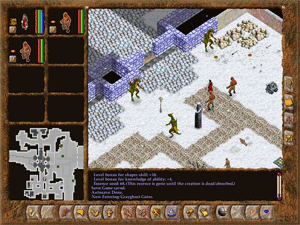
I had a look at the article and saw he's selling the game for $28. When you bear in mind it's a game that looks around 15 years old in quality and style (something that's effectively admitted in the article albeit not quite so explicitly) one has to wonder why he thinks people would pay that amount for this:
http://www.spiderwebsoftware.com/images/geneforge4/Geneforge4SSThumb1large.gif
When you could pay the same, or in fact, probably even less nowadays, and get a few year old yet far superior game such as say Neverwinter Nights or Oblivion?
Sometimes I believe indie developers become a little deluded as to how good their product is and for every good indie title out there there's 100 crap ones. Still, the guy made just short of $112,000 from it (spread across 3 people) and didn't even push it out to 3rd party sales channels (Xbox live, RealArcade, MSN Games, Instant Action). Frankly, for what he's peddling and the amount he's peddling it for I think he should be happy and bitching about pirates is laughable when you consider how much he's asking for something so awful looking and compared to what you could get instead. It doesn't strike me as suprising that people would pirate something like that rather than pay $28 for it. He claims including salaries the cost to make the game was $120k (but doesn't reveal individual salaries- the two staff other than him are only part time) so is implying he's only broken even, but if he's taking a $100k salary out of that for example then of course he's doing much better than makes out. As he doesn't give any break down of figures we can't be sure whether his costs really are as high as he infers (I really can't see how they could be) or if he's actually making a fairly decent wage which seems more likely.
What should really be taken from this article is that even if you make a shite unoriginal game and sell it for much more than it's worth, don't bother marketing and selling through important channels, despite piracy, you can still make a decent buck off of it.
There's a lot of good indie titles out there, Popcap was always the prime example of how good titles sell (they made millions) but indies that are failing and blaming piracy need to look at why- if even this guy with such a poor product can make a decent amount then chances are, if your product is failing, you really do have a severely crap product. Even this guy seems to believe he deserved to make more even though it's amazing the amount he did make for what he's selling.
Perhaps another piece of advice to take from this article is that indie developers need to have realistic expectations and that whilst they'll still make a decent buck, they wont necessarily become the next Popcap. If they don't make much at all then they need to have a long hard look at whether they really have the skills to be making indie games that people want for the price it's offered at.
-
Re:This was the last game that I really enjoyed
Along with Fallout II, and simcity, this was the last game that I really enjoyed. The funny thing is that one of the things mentioned in the article is one of the reasons that I stopped playing video games.
They simply got too hard. I seemed to me that the developers kept trying to impress reviewers and hard core players with new, near impossible, challenges. Somewhere along the way they lost a lot of players. About the only company that I will pay for games from is spiderweb software http://www.spiderwebsoftware.com/ , the graphics are terrible; but, the games are playable and relaxing.
The games have gotten too hard. Before you make comments about being a whiner; remember, what I am is a lost costumer.
Actually the trend has reversed the last years, I have the feeling a lot of games have become easier, down to the point that a game like the recent prince of persia just is an occasional hit on a button from time to time.
I think while games have become too hard a few years ago, currently some have become too easy. Fortunately most of the games get the balance more or less right nowadays and have difficulty settings to please everyone! -
This was the last game that I really enjoyed
Along with Fallout II, and simcity, this was the last game that I really enjoyed. The funny thing is that one of the things mentioned in the article is one of the reasons that I stopped playing video games.
They simply got too hard. I seemed to me that the developers kept trying to impress reviewers and hard core players with new, near impossible, challenges. Somewhere along the way they lost a lot of players. About the only company that I will pay for games from is spiderweb software http://www.spiderwebsoftware.com/ , the graphics are terrible; but, the games are playable and relaxing.
The games have gotten too hard. Before you make comments about being a whiner; remember, what I am is a lost costumer.
-
Spiderweb Software
You'd have to check, but I think their older Exile series has been released to some extent as free. Not Avernum, but Exile. Direct link to their older games: http://www.spiderwebsoftware.com/productsOld.html
They are fun adventure RPGs, story-driven, and will run an old [as in Pentium I, I think...] hardware. I believe their Exile series can be downloaded for free, and Blades of Exile's code has actually been GPL'd recently. I highly recommend the games. Great fun.
-
Re:Think Antarctica
>Whatever combination of distro and package code that enables PC gaming on Linux will BE the standard.
One of the... many... many reasons there are no virtually no games on Linux is because *there are no standards* so software written a few years ago doesn't work a few years later if it's distributed in binary form.
Windows has games because not just because it has a large audience, but also because you can ship a game for windows and the exact same binary will still run years later.
Even on the transition to vista, most software actually worked if you turned compatibility mode on, and UAC off. You can still run *starcraft* on vista. Starcraft from *1995*.
Here's a link to a commercial Linux game from the 90s.
http://www.spiderwebsoftware.com/exile3/linuxexile3.htmlGo ahead, download the demo. Have fun getting that to run...
-
Re:Summary: Beginners need tips too.>> The author may not be a beginning programmer, but it appears that he might be a beginning writer on programming.
On Spiderweb Software's News page it says this:5-30-2007: IBM, in its infinite wisdom, asked Jeff Vogel to write an article about programming practices. The result is here. You might think his ideas are stupid, but that is all right. It doesn't matter that he was stupid. What does matter is that he was paid.
Remember, Jeff Vogel is the author of the article referenced by TFA. Please note especially the last sentence in his News entry.
-
Re:Summary: Beginners need tips too.>> The author may not be a beginning programmer, but it appears that he might be a beginning writer on programming.
On Spiderweb Software's News page it says this:5-30-2007: IBM, in its infinite wisdom, asked Jeff Vogel to write an article about programming practices. The result is here. You might think his ideas are stupid, but that is all right. It doesn't matter that he was stupid. What does matter is that he was paid.
Remember, Jeff Vogel is the author of the article referenced by TFA. Please note especially the last sentence in his News entry.
-
Re:Obligatory Planet of the Apes
I enjoyed game called Geneforge quite a bit. It uses "shaping" to magically describe away genetic modification, and the story seems to graze against the consequences of the very issues you mention.
Example: there are a subspecies of "human" created by Shapers (those who have trained in the ways of genetic engin-- oops, I mean, "shaping") who are made for the exact types of reasons as above... farming, mining, other hard labor. They have just enough of an intellect to do things but not enough to really think or survive without a master to guide them. -
About the author ..
A lot of people seem to think the guy who wrote the article is an idiot.
He makes his living off of writing RPG games.
I won't argue on the look of his games. They have very obviously dated graphics.
But his games are not about graphics.
I've personally purchased 9 of his games over the years.
They have good story lines, long play times, multiple endings and have a bit of replay value.
He does make good games for those looking for a game with depth and story to them.
Hes also very sarcastic.
Take a look at what he wrote about his daughter.
As is site is aptly named - Irony Central - The irony is hes an RPG writer who happens to make a decent living off RPGs, and can write off every game he plays as research.
Seeing what he wrote though, I'm more curious what his next game is going to look like.
As he wrote about starting you off as a loser, thats exactly how his games start you as well. -
Re:Very true
Geez, Spiderweb Software deserves a link at least, doesn't it?
-
Re:Comments From Another Self-Published Pro
For the last over a decade, my company has done quite well for itself self-publishing our role-playing games. (Spiderweb Software, http://www.spiderwebsoftware.com/ If you can pull it off, it's a great way to make a living. With electronic distribution and a huge profit margin, you don't have to sell too too many copies of your game to buy a house.
The only problem is that you have to make sure that your interface is "bullet-proof". If a person plays Exile for a while, moves onto a competing product (e.g. Angband), and whacks into interface issues on a return to your game, then that's a potentially lost sale.
Large game companies have enough weight that they will get orders no matter what - smaller game companies are do-or-die, and don't have agility. The only hope is to make the gameplay good enough that any small or medium bugs become marginalized. (Not only that, but you will encounter hardware problems that manifest themselves bugs in the game. I had one myself - it plaged several different games.)
Of course, Exile is done right - it has a group of fans. -
Comments From Another Self-Published Pro
For the last over a decade, my company has done quite well for itself self-publishing our role-playing games. (Spiderweb Software, http://www.spiderwebsoftware.com/ If you can pull it off, it's a great way to make a living. With electronic distribution and a huge profit margin, you don't have to sell too too many copies of your game to buy a house.
The problem is getting off the ground. Once you write your great game (oh, and it does have to be great), you have to get that first group of people to notice you. Then, hopefully, this core group will turn, through word-of-mouth, into an actual audience.
Once that very difficult thing is accomplished, you, like me, can live your basement-dwelling dream life.
Best of luck to Gamelab! -
A note from the author.
The responses to my article weren't surprising. People have a lot emotionally invested in the whole "Indie idea."
I appreciate the examples of innovative games from Indies. Even if many of them came from the days when dinosaurs ruled the Earth. SimCity and Doom are not relevant to a discussion about the world Today.
But I'm still right. A huge chunk of the really innovative stuff is coming from the big studios. I'm thinking of The Sims/Sims 2/Sims Online. (EA) The Movies. (Activision) Spore, if it works. (EA) Guild Wars. (NCSoft) And I didn't even mention any console games. (I should get 2 bonus points for not bringing up Katamari Damacy.)
Because of space limitations, I regret I couldn't mention Darwinia. (Incremental innovation in quality visuals.) Or Tale In the Desert. (Which is one valid argument against my point of view. I hope one day to see another.)
I'm not saying Indies suck. Obviously. I am one. But I am saying that people shouldn't fetishize them. They're people with small budgets and bills to pay. And that's why they write 50 retro-arcade games and puzzle clones for every one game with any claim to creativity. Because they have to.
- Jeff Vogel
http://www.spiderwebsoftware.com/ -
Since hardly any of you RTFA
I'm going to list the points that Jeff Vogel made, all of which many of you missed in your kneejerk rush to judgment. BTW, Vogel is responsible for the Avernum/Exile series of games, which are among the best indie games ever made, so I think he has some clue of what he's talking about.
1. He's talking about games made recently, as in the 21st century. Mentioning games like SimCity, Ultima, and Tetris damages his argument not a bit. The reason he focuses on recent games is because his argument is that many of the major innovations that are possible in video games have already been done. Quote: "I might humbly point out that this is simply a sign of the growing maturity of the art of game design. I mean, seriously. When was there last a truly new book that wasn't reminiscent of something that came before? Or play? Or movie?"
2. He doesn't say that all innovation comes from big developers. He says that if true innovation comes, it will come from big developers. Why? Because only big developers have the money to really explore new ideas without having to worry about their employees' children starving to death. Quote: "Some would say that only people out on their own, free of corporate infection, are free enough to make something truly new. This is backwards. Only the people under control of a big corporation (with the corporate resources and paychecks that come with it) have the freedom to make something new. Not being afraid of starvation does wonders for the mind."
3. Some indie developers do innovate, but their innovations are only incremental, just like the usual innovations you see from big developers. (And yes, big developers do innovate on a fairly regular basis; pointing out Madden as if it's the only big-name game in existence does no one any favors.) They don't create new genres like they used to due to the first two points I mentioned. Quote: "These games are worthy and fun and contain innovation, yes. But incremental innovation. Not the new thing, but the clever twist on the old. In other words, the same sort of innovation that the big, corporate world regularly provides. And the sort of innovation you'd better get used to, because it's just about all you're ever going to get from now on."
Is it a bit cynical? Sure. But I think his argument deserves at least the amount of respect that would be shown by actually reading the article before you start bashing it.
Rob -
Re:Old gamers? I must be ancient.
33? youngster. I remember video gaming (on a magnavox odyssey) around the time you were born, though I admit, I was awfully young and it's pretty hazy back there.
I still get "boys night" for beer (quality, rarely quantity - no rice or corn for us), but the only possibly active pr0n star I can name is Marey Carey because I saw that bimbo interviewed for the California elections on Fox news (or whatever the lunchroom TV is set to).
Turn based gaming has mostly gone underground. You may want the try the indies - off the top of my head, I can only think of Spiderweb software's Avernum, a game I didn't like much personally, but I'm sure there are others (and they have a bunch of sequels I never played). You may also want to try Wizardy 8 (realtime movement with phased combat - see their FAQ or try the demo). I have motion sickness problems with the realtime in that one (rare for me with RPGs, usually only a problem with about 50% of shooters), but most of my friends loved it. -
Well, for the Ultima-like fans,Have a look at the spiderweb games.
I never tried them on a portable platform, but they are great in term of lightness and usability, not counting the easy to drop and pick back factor. Maybe a bit of lobbying would help porting them on light(er) platforms ? They for sure runs without problem in wine. merry xmas to all !
-
Re:Indie games were the wave of the past"These days, most types of games need good production values as well as a good concept."
Spiderweb Software (a mom and pop operation) seems to be doing alright for itself for many years now... using an extremely archaic game engine with shockingly limited production values. Of course they are never going to get a mainstream market (at least until Geneforge: The Movie comes out!), but that's not the point.
"To add to that, games are getting more complex in the way of graphics engines, physics engines, and AI as well."
Not a very complex game, nor a highly original concept, but the wonderful and addictive Breakquest took an open source physics engine (not to mention SDL based graphics) and applied it a "breakout" style game, with a style of its own, and beautiful results.
These two examples somewhat contradict some of the assumptions above. It seems to me creativity and visions are the two main things needed... and a competent developer still may be able to find a niche big enough to support himself, at least... it's a matter of scale.
-
Indie games live.
I'm currently playing the mac shareware version of GeneForge from Spiderweb Software http://www.spiderwebsoftware.com/ Will soon become my first computer game purchase in over five years, the last one being the original Quake.
-
Re:I'm tired
I've had a lot of fun with Avernum and Geneforge, see http://www.spiderwebsoftware.com/. Quite retro, but very addictive, heavy on the story, and witty. Example, when you go into the Arena to watch Gladiator battle, the Ogre stamps your hand for reentry.
Cheers,
AC -
More great mac games
More great Mac games http://www.spiderwebsoftware.com/ Geneforge 3 is actiually pretty good. I found this companies games back when I was runing Linux. There is also freeciv, and absoute backgammon. What else would I want?
-
Re:I have a killer idea for a gameI don't doubt that you have some good ideas. I have two or three fleshed-out designs myself, which would be projects on SourceForge if I had any hope of finding someone to do even rudimentary 2D graphics for them.
Everyone has fun ideas. The trouble is first, will anything come of the idea? The market for games is interesting, because there's always room for a great game to be successful. Second, will the implementation be any fun? Good luck to you. God knows we need more games that don't suck.
-
Great Game
For all the people out their claiming that gameplay beats graphics anyday, I highly recommend checking out the Geneforge series. I recently played the demo for the first one, and I loved it. I'm going to Fry's soon so I can pick it up, provided they have it. Anyhow, I spent about 8 hours playing it on Saturday, with no intention of doing that whatsoever. I woke, turned it on thinking I would play for an hour or two, and realized that over eight hours had passed and I hadn't eaten anything since I woke up. I haven't had that sort of gaming experience in many years.
So to recap, if you like RPGs, and you prefer a great story and gameplay then check out this series. The graphics are reminescent of early 90's stuff. You can download demos of the series which cover about a quarter of the game.
-
A bit sad...
to see Spiderweb Software's Blades of Avernum tactical RPG missing from the list. I am getting a tad tired of the re-use of the old Avernum engine, but the plots of Jeff Vogel's scenarios and the overall gameplay are just fantastic. Avernum 2 remains my favorite, if only for some of the ridiculous battles that you could face off in the end (one of which had the enemy turns lasting a good twenty times longer than mine simply because there were so many of them). You could keep yourself occupied for hours just playing the various demos available from their site - since each demo is about a fourth of its respective game, there's literally about the equivalent of a game and a half there to play.
-
The problem is with the publishers.From what I understand, currently the problem with forming game start-ups isn't with finding capital or producing the product (god knows there's enough amateurs out there), but with the publishing end. Even established firms with hit titles (for example Troika, and I'm sure there are others that I don't follow) have trouble negotiating agreeable publishing agreements. Just look at the squeeze Vivendi tried to put on Valve over Steam. Big publishers have retailers locked down when it comes to distribution (read David Sheff's Game Over for an account of how Nintendo used to strong-arm stores in the late 80s/early 90s, something that eventually earned them an antitrust lawsuit). Distributing games over the Internet isn't yet feasible (maybe Steam will change that, but it does have it's downsides). And of course this is talking about the PC market only - if you're developing for the consoles, you have to shell out big bucks for development kits, pay a hefty sum on each game sold to the console maker, and be subject to major distribution restrictions (more than one Gamecube game has been sacked after Nintendo deemed it too violent). There was hope a few years ago that Internet and cell-phone minigames would bring about a sort of developer's Renaissance, but so far it seems the margins and the markets are too small and there is too much competition for any real success stories.
It's not as bleak as it sounds though. There is at least one mom and pop game developer that's been successful making and selling games independently over the Internet for a number of years. Maybe some more operations can follow their formula successfuly.
-
Spiderweb software, and others...
Spiderweb software is a 10-year old gaming company that only has one coder (President Jeff Vogel).
See http://www.spiderwebsoftware.com/.
Thomas Warfield, author of Pretty Good Solitaire, Pretty Good Majongg, etc., is also a Lone Coder.
See http://www.asharewarelife.com/.
See generally discussion on "micro-isvs" at http://www.microisv.com/. -
Re:Shareware?I know what a Spyware developer is, and I know of open source and closed source; but is there really such a thing as a shareware developer anymore?
Your confusion is understandable; in the Windows/x86 world, shareware truly is dead. But the distribution format continues to exist (though barely) in the Mac market. Besides, Panic, there's Ambrosia Software, Freeverse, Littlewing, Spiderweb and others.
Mac users, partly due to reduced malware exposure and partly due to cultural conviction, tend to be more appreciative of shareware developers, and as such are more likely to download strange unknown software and pay their fees. I used to have a link to a developer's anecdote where he got about 3% or so pay-in from Mac downloads, but only got much less than 1% when he ported his product to Windows. The result is that Mac shareware tends to get more income than on Windows, despite (or because of?) the low market share of the platform.
That said, even the old shareware houses are starting to migrate to brick-and-mortar. Freeverse sells some of their games in Apple Stores, and even Ambrosia has made CD pressings of Escape Velocity: Nova (as well as a board game!). It's a shame, shareware was as close as the "little person" could get to a true free market of software sales, sacrificed during the current war between Corporate software and Open Source.
-
Re:Mac Games
I personally like the games from Spiderweb Software and Ill Winter Games. Pretty much everything each of these companies makes is available for Mac OS X. Most of the games Ill Winter makes are also available for Linux and Solaris if you so desire...
While I generally agree, I'm not too happy that Spiderweb Software has yet to port their best game (IMHO) from Mac OS 9 to Mac OS X -- Nethergate.
-
Re:GishMy complaint about ChronicLogic is that their demos are far too short, taking 15-30 minutes to beat. It was true for Bridge Construction Set - it looked interesting, but not interesting enough. For Gish, I couldn't tell whether it was an interesting game that I would enjoy, or whether I'd just get annoyed or bored after another half-hour. So, I erred on the side of caution, and ignored it.
I think the demo should cover 10%-33% of the game, the more the better, and tell you how much you are getting. It worked for iD software, back when they were primarily a shareware company, and it works today, for companies like SpiderWeb Software. After playing a few hours of Avernum 3, I couldn't stop myself from buying the full version.
-
Voodoo statistics.Since when is the PC games market shrinking? For whom? Is the half-million or so copies (already at more than 300,000) Doom 3 will sell make up for the 23% year to date drop? Who's counting the numbers, anyway? I know that a lot of PC gamers are playing independently published games, mostly because of lack of original games from big publishers (time is limited, and the indie games are by and large not very good either). I know Jeff Vogel says he sells about 20 to 30 thousands copies of each of Spiderweb's games, despite piracy (the games are downloaded in their entirety and then use an activation key to be unlocked - cracks are abundant).
Of course, the telling evidence of Starforce's carpetbaggery is the following quote (highlights mine):
" We havent done any official studies, other than know for a fact we have protected many titles this year alone that are still not cracked. It is up to the developer to put forth as much effort as it takes to install a great protection and the payoff is obvious. I dont have any specific numbers to share, but economic advantages can be significant. Let me give an example..."
This looks to me to be the same arguments used by TV ad salesmen in the bad old days of Nielsen ratings, with one difference: at least the Nielsen people tried to make up numbers. The Starforce strategy seems to be to provide some alternative-universe scenario that may or may not occur in real life, and leave the rest as being "obvious." They don't even try to stereotype gamer demographics. There is absolutely no evidence for the success of their products (go to Megagames and check out how many Starforce-protected products have been cracked), and the above quote from the horse's mouth makes that pretty clear. This is the same scare tactic used by Macrovision and other copy protection businesses, and a reason why I have absolutely no respect for them. Pointing to BSA piracy numbers and yelling loudly isn't going to show their products work - they need to do their own damn effectiveness studies, but they're afraid of the results. -
Re:The national culture of games
(Speaking of which, while Spiderweb Software isn't UK-based, does anyone else think that they do a nice job of dark English-style humor? If it weren't for American spellings, I would have thought that the Exile series had British roots.)
If you like Spiderweb's stuff, you should take a look at Jeff Vogel's other site, Irony Central.
-
Re:The national culture of games
(Speaking of which, while Spiderweb Software isn't UK-based, does anyone else think that they do a nice job of dark English-style humor? If it weren't for American spellings, I would have thought that the Exile series had British roots.)
If you like Spiderweb's stuff, you should take a look at Jeff Vogel's other site, Irony Central.
-
Re:Underground
stories are becoming less important for commercial games
Not necessarily true. There are at least a few commercial games out there with good stories - for example, Beyond Good and Evil is quite good. And almost all of Jeff Vogel's games over at Spiderweb Software have excellent stories (yes, they're shareware, but he makes a living off of them - that makes them commercial). I see less problem with the stories than with the length of a lot of games coming out today - a lot of them are only 10-15 hours long, when 40 used to be the minimum...
-
Re:How are these systems for game developers?
Now, you can't even think of producing a commercially viable game by yourself or in small groups;
Doesn't seem to stop some people. -
Re:How about a job?**WARNING THIS POST IS COMPLETELY OFF TOPC** Lord Dweomer, where did your quote come from? I've seen it the Tip o' the Day section of Exile III, a deep but graphically challenged roleplaying game by Spider Web Software and one other place.
~~~~~~~~~~~~~~~~~~~~Zaxser
-
Re:Don't agree...
Do you know if Avernum (newer version of Exile series, by same company) is the same way with monsters? I've beaten A1, am almost done A2, and will soon start A3. I didn't notice this, but maybe it was because by the time I was high enough to wander around doing random final quest thingies (outside), I was looking at the tiny automap instead of the big map. I have noticed a few times, though, when the monsters try to run away from me, and I have to chase them halfway across the "world", before I pulverize them. (For those who haven't played, in Avernum 1 and 2, your world is actually a system of caves.)
-
Re:Don't agree...
In the Exile series off RPGs, when you became too strong the random groups avoided you - when you cornered them on the map, they even disappeared. No cheap XP for you!
-
Yes, they can
Check out Spiderweb Software for a prime example. They (or more approporiately, he) caters to a small, hardcore niche of old-school RPGers, listens to them, and gives them what they want and abstains from what they don't want. An excellent business model for a small scale developer; give people what they are paying you for and improve yourself on their feedback. And any RPG fan would be a damned fool not to download the Geneforge 2 demo.
-
Re:Will we ever learn...
What is wrong with exploring for yourself?
I'll have to agree. I think that getting out there and playing a variety of games is better than being told what games to play.
As a professional, independent game developer, I find the lists useless. I consider myself a pretty serious gamer and a student of game history, but I barely know half the games there.
One of the biggest issues is that a lot of the older games are mostly lost to time. I played arcade games obsessively as a kid, but I only really got to play some of the classics due to the involvement some of my friends have with emulation. I didn't appreciate a game like Robotron when I was 10, and paying $1k+ (plus shipping!) to get a live machine seems a bit insane. People looking for a legal way to play these classic games are mostly out of luck.
You can say the same thing about older consoles and computers, too. Strict copyright enforcement and the ravages of time have made some classic games very hard to find and play. Finding legal copies of these games is damn near impossible.
Further, the lists focus on big-name games. Ultima is mentioned, but what about the critically acclaimed games produced by Spiderweb Software? Is the Exile series less worthy of attention just because it is "shareware" instead of being published by a large company? Why does Anarchy Online get a mention on the lists when it is widely considered to have the worst launch in history? Why doesn't Meridian 59 get a mention when it is widely considered to be a pioneer in the retail graphical online game market. Especially considering that former developers of M59 went on to work on a lot of other online games, such as UO, UO2, The Sims Online, Shadowbane, etc.
Finally, there's a lot of repeats. Do you really need to play Parappa the Rapper and Dance Dance Revolution in order to appreciate both games? Both games have to deal with music and rhythm with some differences. Yes, those differences result in different games, but even those differences can be found in other games.
I think what would be more interesting would be to pick different vital gaming elements and then provide games that provide a good example of that.
For example, using a computer game-centric list:
Game types
Music and Rhythm games (DDR, Parappa, Samba De Amigo)
First-person shooter (DOOM, Quake)
RPG (Ultima, Might & Magic, Final Fantasy, Exile)
Online RPG (Ultima Online, EverQuest, Meridian 59)
Game art styles
Tile engines (Ultima 1-5, Exile)
Cell-shaded (Parappa, Jet Set/Grind Radio)
2.5D (DOOM, Meridian 59)
3D (Quake, Half-Life)
Notable games
Ultima 4 - introduced morality and consequences for actions in a fantasy RPG.
DOOM - introduced multiplayer games to a wider audience.
I think this would be a much more useful list for distilling what people probably should be noticing about these games. Of course, there are flaws with this as well. The business side of things has obviously influenced things, for example, but which game really introduced which business model?
My opinion, -
The best (IMHO) indie developer out there...
Check out the folks over at spiderweb software - Jeff Vogel and co. make the Avernum and Geneforge series of indie RPGs. The graphics and sound leave more than a bit to be desired, but the games have excellently balanced gameplay and very well-written, witty plots. Vogel himself is one of the more famous characters in the whole shareware scene - he's among the few that's actually made a solid living off of it.
-
Spiderweb Software
Another company that always gets mentioned -- and for good reason -- is Spiderweb. They make solid, fun to play, RPGs with intriguing and well-thought-out stories. I'm particularly fond of the new "Geneforge" series.
-
Re:A shameless plug, for someone I don't knowI was hoping someone would make a snide remark about my intellect and make a link to spiderweb software to correct my original posts trajic omission. Looks like I'll have to do it myself.
Statutory ad hominem: The grandparent who forgot to use the little <a> tag obviously doesn't have the brains of a chimp, so it's amazing that he was able to recognize good RPGs like the Avernum series. Oh, and it's spelled tragic. Moron.
-
Exile III by spiderweb software
A small company called Spiderweb Software released a game for Linux called Exile III - it is similar to the classic Ultima IV or Ultima V style. It is shareware, so you can try before you buy (even for Linux). I am kind of disapointed they only released one game for Linux as they released so many for both the Mac and the PC - including scenerio design tools - and this was way before Neverwinter Nights. Sure the graphics are not overwhelming but worth a look. Here is a link to the game.
I personally bought and played Exile I-III on the PC around 1998 and was very satisfied. Currently, there is NWN and Everquest and many others to choose from, but I felt it was the best comptuer RPG at that time.
But the reason I bring this up is that apparently it did not sell well under Linux - perhaps it was piracy, perhaps just not enough of a user base (note: I did not play under Linux maybe it is ultra buggy or something) but for whatever reason an ideal candidate for producing Linux games was turned off. -
Re:Old Hardware?Yeah, dammit, no one bothers to support my 386 anymore! Even the Commodore 64 got an OS upgrade!
But seriously, if you don't want to use OpenGL for your X server, then don't use it. Likewise, if 4 doesn't support your videocard (I heard that some drivers got broken) then use 3.3.6 - anything it breaks your videocard is too slow to display anyway. And if you want games that run on older PCs, buy shareware! People need to use that new hardware for something, and given the choice between getting shiny new hardware and optimizing crap for someone's 486, I choose shiny new hardware. You can always optimize later, and the 486 users should just go use free software so they can compile whatever they need for their own machines.
Oh, and if you have a 386, don't junk it, run FreeDOS!
-
Techies just don't know how to Sell things.Look at LadyStar. Go look at SpiderWeb.
If you are a programmer, look at how the game runs, think about it technically. No offence to the writers (I admire y'all greatly), but those games are relatively technically simple. One's an RPG, one's sort of a myst-like adventure. But the games sell, and they are paying for themselves well. Woo hoo!
Anyone of you, if you learn to sell, can sell your games. A good salesman can sell anything, they say. So if you learn that _one_ thing, provided that you have all the programming skills, and can get a friend to do some artwork for you, or can spare a couple K for art and music, you can sell your indie game.
Now excuse me, I've got to go play Strange Adventures in Infinite Space.
-
Re:Good Weapons and Leveling SystemI'd love to see a CRPG that is based on dialog and plot that would immerse a player in the game...
Check out the Exile series or their reworking with better graphics and a different skills system, the Avernum series.
They have the best mix of dialog, (In the Exile series you actually determine what you say yourself, instead of having canned responses! What a concept!) exploring, immense detail and backstory, and a concrete plot that is open-ended.