Slashdot Mirror
Domain: theadvocates.org
Stories and comments across the archive that link to theadvocates.org.
Comments · 105
-
Restitution, not prison...
Non-violent offenders such as this guy should not go to jail. They should be held accountable for their actions through financial restitution.
"Nearly six out of every ten federal prison inmates are there for non-violent drug-related offenses, it's clear that drug prohibition is the primary source of this over-crowding. It has been estimated that every drug offender imprisoned results in the early release of one violent criminal, who then commits an average of 40 robberies, 7 assaults, 110 burglaries and 25 auto thefts
We should dramatically reduce the number of these early releases by eliminating their root cause - prison over-crowding.
Restitution, even if enforced through court action, deters criminals and decreases the necessity of actually going to court. Japan, which has such a system in place, is the only industrialized nation that has seen a consistent decrease in violent crime since World War II. Litigants normally come to a settlement before coming in front of the judge, so very little time is spent in court.
Why should victims have to pay taxes to feed, clothe, and shelter those who harmed them? Why should criminals get a free ride at the further expense of their victims?
People have a right to their life, liberty and property. Anyone who takes these away has an obligation to restore them as much as possible. Such restitution will not always be perfect, but the punishment fits the crime much better than today's system does.
In addition, restitution is a more effective deterrent than prison. During informal surveys, inmates claimed that they much preferred jail time, which they saw as 'time off,' than restitution, which they saw as 'work.
Restitution through productive work is the most successful rehabilitation known. Even if the victim can't be fully compensated, something is better than the nothing that they receive today. Also, repayment to the victim allows criminals to truly right their wrongs. "
http://www.theadvocates.org/ruwart/categories_list .php -
Re:Quite possibly, yes.
"If businesses can pay what they want, why do 90-95% of today's workers in the U.S. make more than the minimum wage? The answer: supply and demand applies to employees as well as products. If a business doesn't pay a person what he or she is worth, they go to a new employer or start their own business. In a truly free-market/libertarian economy, such moves will be much easier than they are today.
Minimum wage laws actually destroy entry-level positions for the unskilled. Black economist Walter Williams believes that the minimum wage laws are the single most important factor in keeping young blacks out of the job market. The next time Congress considers raising the minimum wage, look in your newspaper for an estimate of the number of jobs that will be lost - potential training jobs for the disadvantaged
Raising the minimum wage will not necessarily result in lost jobs. The number of salaried employees is not the only factor that needs to be taken into consideration. There are three areas where the added cost may show up: (1) Revenues; (2) Expenditures: and (3) Profits.
If a company decides to take the extra money from expenditures, that may result in lost jobs, since employees are paid a set number of dollars. It also may result in inferior products, using cheaper parts/ingredients/whatever.
If a company decides to take the extra money out of profits, that may result in lower salaries for higher-level employees.
However, the third option, taking the extra money from revenues is something that I never see discussed. Specifically, that would result in raising prices. If the inflation is large enough, *the value of the new minimum wage is decreased*. What this means is that at some point in the future, the wage will have to be raised yet again, resulting in more inflation...
Nobel Laureate James Buchanan once remarked, "No self-respecting economist would claim that increases in the minimum wage increase employment. Such a claim, if seriously advanced, becomes equivalent to a denial that there is even minimum scientific content in economics... Fortunately, only a handful of economists are willing to throw over the teaching of two centuries."
http://www.theadvocates.org/ruwart/questions_list. php?Category=51&PHPSESSID=4b7544a3a3eba804e1f98b23 4672982b
However, here in the US, the real point of things is that no where in Article 1 Section 8 of the Constitution does it authorize the Dept of Labor, or the fed to set wages. -
Re:It's not that hard to be a parent today
Your terms and axes are a bit off, at least relative to normal usuage.
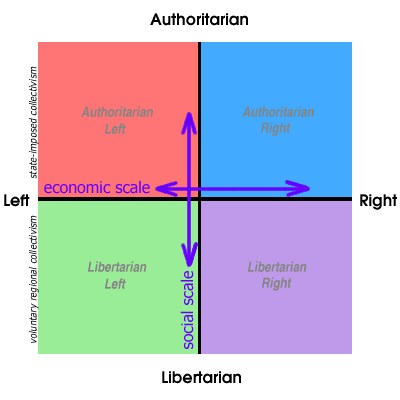
Right generally *is* equated to Conservative (with Left equated to Liberal). The second axis... the one you call "Libertarian-Conservative"... is usually called Libertarian-Statist or Libertarian-Authoritarian. Someone can be a Conservative Libertarian, just as one can be a Liberal Libertarian.
Take a look at this Animated GIF 2 axis diamond and/or this 2 axis square.
Anyone curious about where they are on the 2 axis map can try this quicky 10 question quiz or this more detailed 40-odd question quiz.
- -
Libertarians....
Recent polls have shown that 28-35% of US voters lean libertarian. It is essentially the party that has a firm and hard stance on issues based upon principle.
You should really study it a bit more:
http://cato.org/about/about.html
http://www.lp.org/issues/issues.shtml
http://www.theadvocates.org/ruwart/categories_list .php -
Re:Let the market decide
Which is why you should vote libertarian. They beleive that less government is the best government.
For more info:
http://lp.org/issues/issues.shtml
http://cato.org/about/about.html
http://theadvocates.org/ruwart/categories_list.php -
FDA in a libertarian society
"medical advances [should]would not be hamstrung by excessive regulation as they are today. Even former FDA Commissioner Donald Kennedy acknowledged, "...the pattern of intervention into science from a combination of local, state, and federal sources has moved from reasonable control to something close to chaotic strangulation." Better medical advances mean better overall health."
As taxpayers, we first pay government to create the problem (e.g., FDA) and then pay once again for the government-mandated solution (e.g., NIH).
Delays caused by FDA regulations cost many more lives than they save. The cure is worse than the disease. For the terminally ill, denying access to drugs that could potentially save their lives, prolong their lives, or make them more comfortable, is especially cruel.
"FDA delays mean that companies have fewer years left on their patent to recover the cost of development when a drug is finally marketed. As delays get longer, fewer drugs have enough market life to pay for themselves before going generic. Drugs that could save lives or alleviate suffering are simply not offered to the public because the cost of their development can't be recovered. In all likelihood, drugs that are never developed because of FDA regulations cost even more lives than the delays!"
"The Thalidomide tragedy was the worst drug disaster in modern history, yet it pales in comparison to the damage done by the delays of life-saving drugs. The FDA's three year delay in introducing propranolol after it was sold in Europe, cost (conservatively) 30,000 U.S. lives. In comparison, 10,000 children were affected by thalidomide. Every time the FDA delays a life-saving drug, we have the equivalent of three thalidomide tragedies.
Source:
Dr. Ruwart
http://www.theadvocates.org/ruwart/ -
Re:heheLibertarianism falls into the left wing [...] in some ways and right wing in others.
Or better put, it's completely tangential to both. Left (Liberal) vs. right (Conservative) isn't useful, much less accurate, when talking about the border case Libertarian & Statist philosophies. More appropriate is a 4-point diamond with Libertarian & Statist opposite of each other and perpendicular to Liberal & Conservative; with Centrists in the middle.
Take the World's Smallest Political Quiz.
Quiz & explanation (PDF file)
Libertarians support a great deal of liberty and freedom of choice in both personal and economic matters. They believe government's only purpose is to protect people from coercion and violence. They value individual responsibility, and tolerate economic and social diversity.
Left-Liberals generally embrace freedom of choice in personal matters, but support central decision-making in economics. They want the government to help the disadvantaged in the name of fairness. Leftists tolerate social diversity, but work for what they might describe as "economic equality."
Right-Conservatives favor freedom of choice on economic issues, but want official standards in personal matters. They tend to support the free market, but frequently want the government to defend the community from what they see as threats to morality or to the traditional family structure.
Centrists favor selective government intervention and emphasize what they commonly describe as "practical solutions" to current problems. They tend to keep an open mind on political issues. Many centrists feel that government serves as a check on excessive liberty.
Statists want government to have a great deal of control over individuals and society. They support centralized planning, and often doubt whether liberty and freedom of choice are practical options. At the very bottom of the chart, left-authoritarians are usually called socialists, while right-authoritarians are generally called fascists. -
Re:heheLibertarianism falls into the left wing [...] in some ways and right wing in others.
Or better put, it's completely tangential to both. Left (Liberal) vs. right (Conservative) isn't useful, much less accurate, when talking about the border case Libertarian & Statist philosophies. More appropriate is a 4-point diamond with Libertarian & Statist opposite of each other and perpendicular to Liberal & Conservative; with Centrists in the middle.
Take the World's Smallest Political Quiz.
Quiz & explanation (PDF file)
Libertarians support a great deal of liberty and freedom of choice in both personal and economic matters. They believe government's only purpose is to protect people from coercion and violence. They value individual responsibility, and tolerate economic and social diversity.
Left-Liberals generally embrace freedom of choice in personal matters, but support central decision-making in economics. They want the government to help the disadvantaged in the name of fairness. Leftists tolerate social diversity, but work for what they might describe as "economic equality."
Right-Conservatives favor freedom of choice on economic issues, but want official standards in personal matters. They tend to support the free market, but frequently want the government to defend the community from what they see as threats to morality or to the traditional family structure.
Centrists favor selective government intervention and emphasize what they commonly describe as "practical solutions" to current problems. They tend to keep an open mind on political issues. Many centrists feel that government serves as a check on excessive liberty.
Statists want government to have a great deal of control over individuals and society. They support centralized planning, and often doubt whether liberty and freedom of choice are practical options. At the very bottom of the chart, left-authoritarians are usually called socialists, while right-authoritarians are generally called fascists. -
Libertarian
You just described the libertarian principles in a nutshell:
-limited government
-free markets
-personal freedom
-individual responsibility
According to your post you are a libertarian (lower case "L").
Don't believe me?
Take this test and find out:
http://www.theadvocates.org/quiz.html -
Overly Simplistic Views
Why do people continue to think of the political "spectrum" as simply left/right or one dimensional?
At the minimum it is really two-dimensional?
View this image for a better explination:
http://www.theadvocates.org/quiz-score/draw.php -
Re:Oh no!!
There are quite a few others out there fighting the good fight. Congressman Ron Paul and the entire Libertarian Party are just a few thousand examples of such people.
-
Re:I'd like to see this taken farther
Don't you dare try and put that on teachers.
I have no respect for any teacher that is a member of any teacher union. I have at least 4 friends who are teachers who quit the unions and still teach, and I have the utmost respect for them. If you are a teacher and a member of the socialist union, you're trash, plain and simple. Read what the teacher unions do every year and you'll agree.
Have you talked to the crazy parents teachers have to put up with? Most will actually tell you they expect the school to teach their kids dicipline.
I agree. This is also the teacher unions fault. They have fought, tooth and nail, the ability to bring independent graders into the system. Let teachers teach, let grades grade. A teacher grading their own students is similar to an employee setting their own salary!
And every kid is a geneous, and most parents do about 20% of their kids work, especially essays. And teachers do a LOT of work for the crap pay they get, more than you know.
Crap pay? This is a myth. Teachers are some of the best paid for the actual time they spend and the quality of their output.
They also usually have very specific lesson requirements handed down from the state level, so any real teaching or discussion gets put to the side.
Thanks, I also agree that the State is to blame. The Federal mandates on education are a big problem as well.
The problem is lazy parents who don't have time to deal with their kids because their (1) divorced or (2) both working.
When we were in the 1960s, a family of 4 paid about 20% of their income to government at every level. 1 parent could afford to stay home. In 2005, a family of 4 pays over 50% of their income to government at every level. This is 250% higher, causing both parents to have to work just to get by. Don't blame the parents for what you voted for. -
Liberal or libertarian?
I think you might be confused.
Perhaps you are really libertarian and don't know it.
You should try The World's Smallest Political Quiz (it only takes about 45 seconds):
http://www.theadvocates.org/quiz.html
Most liberals (and unfortunately some conservatives too these days) want MORE government intervantion in their lives, not LESS. The founding principles of the libertarian movement are:
1) limited govenrment
2) individual liberties
3) free markets
According to your post, it looks like you meet 2 out of the 3 of those.
Here are some links for further reading on the topic:
http://en.wikipedia.org/wiki/Libertarianism
http://www.cato.org/
http://www.lp.org/ -
Re:RiiiiiightAnd I find this guy to be more credible than, say ESR, why, exactly?
Because he's not a stark raving lunatic?
-
Re:It's a leftist's dream come true
Neither Dinkins nor Giuilani are liberal
Oops, I mean neither are conservative
Sounds like you're ready for the quiz also. -
Re:What is a leftist?
Now that you've discovered the difference between Left and Right, you can discover what it really is you're (both) mad about:
http://www.theadvocates.org/quiz.html -
Re:He is NOT a conservative.
First of all, a "communo-anarchist" sounds like an oxymoron. Communism is about government control over the people. An anarchist is someone who is in favor of absolutely no government what-so-ever. In fact, to an anarchist, there is no law. To really find out what your viewpoint is, try taking this test. http://www.theadvocates.org/quiz.html
Maybe if he asked to debate someone who was actually a "far-out liberal" (like a socialist, communist or an anarchist), he'd actually get a yes.
He has, and Rush has spanked many live on radio with facts. If you managed to stump Rush, you would be the first. And I really doubt your much smarter then some of the professors and Dr that he has debated before. -
Re:what's with the gasp?
Yeah, that whole socialized medicine thing really works out great.
-
Re:These guys have my full support.
You're not a libertarian, or a democrat, or a republican, no, you're something else, something that I would call, for lack of a better term, a fascisto-idiotarian.
Perhaps the term you are looking for is authoritarian? Also sometimes referred to as populist, interventionist, or statist.
If you draw the political spectrum as a diamond shape you have the democrat/liberal/left on the left corner, you have the republican/conservative/right on the right corner, you have the libertarians at the top corner, and you have authoritarian at the bottom corner. You can see this sort of political map and a quiz for it here. In particular look at the top of the right column on the page.
- -
Re:The modern political spectrum.
Libertarians are left of right and right of left, not far from either.
Libertarians are far north of Statists.
http://www.theadvocates.org/quiz.html -
Re:Republicans sponsored the bill & you blame
I take issue with the suggestion that the LP is more like the GOP than the Dems.
Modern Republicans seem pretty dissimilar to Libertarians, however parts of the LP creedo is pretty close to that of Republicans of a century ago. I don't know much about the old Republican stance on civil liberties, but traditionally, it leaned towards states' rights, smaller government, and geared towards business friendly policiess.
The other issues that you mention sort of represents how the Republicans have evolved to appeal to the socially conservative voters. With this, issues like abortion choice and religion/morality are pushed to the forefront of some of their policy. Regarding the issue on drugs, both parties major parties have pushed the drug agenda pretty hard, and to me it seems that this is primarily out of fear that the party/politican appears soft on drugs. As an example, the Clinton administration on drug spending was higher than any other administration before his. Consequently, marijuana posession arrests also hit their all time high. This does not say that Clinton was necessarily a huge drug fighter; IMO, he just didn't want to appear weak on the issue. Both parties will continue to escalate their efforts becuase (again, IMO) politicians would rather be outspoken about more popular issues and avoid political suicide.
For an interesting chart on the political "spectrum", and where the LP feels that they fall on it, check out the world's smallest political Quiz. According to the chart, the spectrum is not quite linear. I suppose, however, that the chart (and the questionaire) are oversimplified, but it is interesting nevertheless.
-
Re:Do-gooder
Yup. Welcome to the Libertarian party! Have a look at the following:
* http://www.cato.org/
* http://www.reformthelp.org/
* http://www.lp.org/
* http://www.theadvocates.org/
There's also some good info on Libertarians on WiKiPedia. Though sometimes divided we support drug reform, welfare reform, social security reform, minimal government and above all else personal liberty. We're growing stronger each and every year. -
Re:Republicans sponsored the bill & you blame
The "center" between Republicans and Democrats, especially when viewed compared to other countries, is right of the actual "center", whereas the LP would be on the true "center", therefore closer to the left. If that makes sense.
Left, right... pfft. That's just one dimension! At least go for two. Or, *spooky music*, three dimensions! -
Political Compass
I prefer this one, World's Smallest Political Quiz . Well actually I don't, it's just shorter.
Oh, going by either or both I am Libertarian.
Falcon -
Re:Are they Liberal or are they Social Democrats?
I took the quiz and it says:
- Economic Left/Right: -0.38
- Social Libertarian/Authoritarian: -6.72
ie it says I'm very much libertarian, something I already knew. The smallest political quiz, which I prefer, says:
- Your PERSONAL issues Score is 100%.
- Your ECONOMIC issues Score is 100%.
-
Re:Not as bad as it sounds...
It pisses me off when people stick with their simplified notions of the political "spectrum" instead of joining the 20th century and evaluating political parties based upon a metric with more than one dimension
-
Re:I see problems coming if Google uses trust rank
If these factors (as mentioned in TFA) are the only factors, I think Google will placing a greater emphasis on (large|corporate) sites:
average story length
This one is probably most up for grabs -- although we'll have to see if the formula prefers longer or shorter stories.
number with bylines
This too is up for grabs. Certainly a willingness to put your name on a story helps for credibility.
number of the bureaux cited
This certainly favors (large|corporate) organizations. A news source that sites many sources will tend to either have staffed those themselves or can afford to pay for those sources.
how long they have been in business
Hopefully this won't be too great a factor. This will heavily favor giant print media and severly punish Web firms.
number of staff a news source employs
This will, by definition, punish the little guy. More good news for the print guys though.
volume of internet traffic to its website
Umm, can you say "the rich getting richer"? Should monkey-see, monkey-do really be a criteria? Plus, more traffic most likely means bookmarks. I have the BBC bookmarked and browse their headlines/articles sometimes four times a day. If I go searching for news, I'm not really interested in BBC results.
number of countries accessing the site
This is probably the most interesting criteria in terms of the effect it will have. It should have a really interesting impact on CNN. If this criteria is heavily weighted, CNN may have to rethink their whole policy of segregating visitors into different domains based on where they're reading the site from. Still, it can only serve to promote bigger sites at the expense of smaller ones.
What I find interesting is the criteria they leave out:
While news stories are too new to achieve much in terms of page rank, one indicator of Trust might be the factor in the number of links into the news source's domain from non-news sources.
Editorial Bias is another interesting factor in news searches. It would be nice to see google track a source's leanings in this sort of fashion and include that information in the details about the results. Too many people take what they read from a single source as gospel. It would be nice to know which way sources lean before clicking through to them. -
Neither "side" believes in freedom.
Neither "conservatives" nor "liberals" necessarily believe in freedom. Each camp attempts to limit different kinds of freedom to accomplish its objectives.
The political landscape can be dumbed down to a simple Cartesian coordinate system: personal freedom on one axis, economic freedom on another.
Whereas a liberal will tend to deprive you of economic freedom in order redistribute wealth and fund social programs, a conservative will tend to deprive you of personal freedom in order to control your behavior.
Take this test, it's interesting: http://www.theadvocates.org/quiz.html -
Re:Please Note
The post you're replying to is making a distinction between "liberal" as used by most of the world and "left." Technically in the US, since liberal and left seem to be used almost interchangably, libertarians should be classified as "classical liberals." The original meaning of liberal is one who wants to limit the role of government in all facets of life.
Libertarians are not further right than conservatives, because "right" includes a mix of economic nonintervention and social intervention. The war on drugs is an obvious "right" issue that libertarians are opposed to. Libertarians are against government intervention in either social or economic issues.
The Libertarian Party website still links to the World's Smallest Political Quiz, which will show you the two-dimensional grid for understanding how these four cardinal directions of ideology relate, once you submit your answers.
And yes, I am a registered libertarian. -
abuse
Abuse of rights, law, and tax dollars. This is why you should vote Libertarian.
Take the Advocates.org "World's Smallest Political Quiz" to find out what party you belong in based on real issues. According to them, "Take the Quiz now and find out where you fit on the political map!"
It is my belief that everyone is a Libertarian, but they they just don't know it.
Vote Michael Badnarik in 2004. Send a message to Washington and don't choose between a Giant Douche and a Turd Sandwich. -
INVEST Your Vote, Don't "waste" it!In a fit of electoral frustration from the fact that there is not a major candidate that I actually WANT to win, my brain snapped and I went on a political rant about the concept of INVESTING YOUR VOTE instead of "wasting" it by voting for someone you don't actually want to win. The premise is simple: You get an accumulated return on investment if you vote for a party you actually WANT to win. It won't pay off today, but after a few elections and a slight change in voting 'spin' it could. Here's the short version, click on the link for additional commentary and your can post all the reasons you think I'm wrong:
...To summarize the rest of this post, here aremy basic personal political beliefs:
(1) The Constitution is a great idea. We should try living by it sometime.
(2) The job of the government is to protect the people from outside forces, not to control them.
(3) Taking care of the people is the job of the people, not of the government.
(4) Any organization will attempt to increase it's power until it reaches "absolute power" and will resist all attempts to restrain it.
(5) Individuals should be free to choose their own actions, be responsible and accountable for their own actions, and accept the repercussions of those actions.
Put those together and you can probably project my opinion on pretty much any topic.
[Clarification: When I speak of "government" in the general sense, I am speaking of it at the Federal level]
That being said, I just took The World's Smallest Political Quiz, which tells you where you basically fall in the political question with just 10 questions. I ended pretty firmly in the Libertarian camp, though I am not affiliated with the party.
Fortunately, they seem to have the basic ideas that I support. Unfortunately, the very principles that make them attractive to me are the very qualities that prevent them from becoming a major political force. Sort of like Wicca in the religious arena, the very "decentralized power" structure it is based up is antithical to it obtaining sufficient power to make the changes you want to make.
That being said, I'd like to offer some strategies that might help alternative parties, whatever they may be, to obtain at least enough power to weaken the major parties that they compete against. Quite frankly I'm not worried about diluting the election for either party, as neither major party supports the 5 beliefs I described above (or lacks the conviction to support them) and I think that they are both screwed up, unsustainable in the medium-to-long-term and are doomed to failure (at least from the perspective of a citizen that wants to live in a free country) in their current forms. That being said, here's my suggestion to counter some of the usualfull-of-crap rhetoric.
Full of crap rhetoric #1:
"Don't Waste Your Vote" - This is stupidest thing you could possibly say to a voter, so of course the major political parties say it often enough that people start to believe it. The only way you could possibly waste your vote is to: (1) Don't Vote or (2) Vote for someone you don't want to actually win. Here's my counter-proposal that I hereby release to the public domain in the hopes that some other political party or organization will pick it up and run with it:
INVEST YOUR VOTE! Let's accept the fact that if you vote for a third party candidate (whatever the party may be) they are pretty certain not to win the election. But don't think of it as a wasted vote, think of it as an INVESTED VOTE.
What is an investment? It is something small that you put away now and don't use in the hopes that it will grow into something more useful and powerful in the future. And that is exactly what INVEST YOUR VOTE means to do. You take your vote
-
Re:Funny
People always talking about Left, Right, More Left, More Right.
Anyone tried Forward/Backward
Yes -
Re:It's about time...
A basic spectrum goes (left to right): Socialist, Democrat, Republican, Libertarian.
This is flatly incorrect. Political ideologies do not exist across a linear spectrum, but can be placed on a grid.
More information on the Nolan Chart.
10-question, 2-minute quiz to chart your political leanings on the grid.
-
Re:It's about time...
we got a movie based on politics that really doesn't have a bias or an op-ed piece, and just around Election Day. It's just a movie making fun of everyday politics and the current events that we face. Sometimes we just have to look at what's going on and laugh instead of picking sides and blaming people for it.
Trey Parker makes fun of left and right because he thinks they are both stupid. That's right, folks -- Trey Parker is a Libertarian. And you thought Libertarians couldn't be funny!
-
Re:Why does Slashdot...
Which would be a great part of an approval system of voting because it would help keep the government in a more centerest posission. Some say it is a winner of comprimise as a bad thing. I see this as the best possibility of all. Get rid of the extreame left/right swing back and forth, get the government a little more centered, where it should be.
I am a libertarian I belive many, but not all, of the libertatian views and ideals. I also understand that there is no one system that is going to work best, or for everybody. swirling around the center of the political chart we are the better off I think every one ends up.
-
Moderating 3rd parties?
One of the reasons 3rd parties often fail to obtain a significant portion of the vote is that they tend to take on extremist views. Your own party, for example, recommends extreme policies such as turning environmental protection over to corporations, and legalizing drugs.
The problem is that most Americans fall somewhere in the middle on the policital spectrum (or near the origin of your own two-axis spectrum), and both of the major parties cater to those Centrists by doing their best to appear Moderate/Centrist regardless of their actual agenda.
How do you plan to lead your party toward a more Moderate viewpoint, and thus toward political power? -
You are a lib.
And don't call me a lib, I'm a small govt. conservative deeply concerned with our rights
Face it, you are a lib. A lib-ertarian, that is. As "liberals" have drifted from liberty-oriented values toward the "liberal" government spending of socialism, libertarians have reorganized classical liberalism under a new name. Where do you stand?
-
Re:So then, vote libertarian
Ok, I'll bite... what's missing? I don't claim to know a lot about the libertarian party, I just know that as far as I have looked so far, it sounds good... I'm all for smaller government, less intrusion into personal matters, etc.
The little political quiz at This site ranks me as a Libertarian too. I have always thought of myself as conservative, although wihout any alliance to a particular party.
-
Re:Democracy..
How about you take the World's Smallest Political Quiz. It's by no means exhaustive -it's only of value to an US voter as most of the other Western countries have an entirely different political atmosphere- but a lot of my 'republican' and 'democrat' acquaintances have found themselves in a strange place with the test.
For the record, I'm a Left-liberal leaning towards Statist. -
Re:Democracy..
take one of these quizes:
Smallest Quiz or Polital Compass
then check out where this years candidates sit
I'm guessing that if you hate them both, you probably lean towards the libertarian end of the spectrum (vs the authoritarian end). The problem is, left or right, most candidates tend to be more authoritarian than many in the population. -
Re:Thank the lordAccording to your answers, your political philosophy is: libertarian
Here is the map of where your views fall.
Your Personal issues Score is 90%.
Your Economic issues Score is 100%. -
No, your reply is BS
The libertarian party believes that we should [...] eliminate all environmental regulations
Did you even read the article you referenced? It was about how in certain cases the government has been unable to enforce the laws mostly due to "sovereign immunity" of government agencies (like the military), and previous incorrect policies (killing wolves in parks to increase deer population) which have since been re-evaluated. But nowhere do they claim that all environmental regulations should be eliminated... not even close... In the last paragraph it states:
The third and final step in the libertarian program to save the environment is the use of restitution both as a deterrent and a restorative. (emphasis mine)
Hello... restitution n 1: a sum of money paid in compensation for loss or injury.
How do you think they're going to collect this restitution without laws and regulations? You think libertarians would want a government where the following could happen:
Government Lawyer: Your Honor, Company X polluted the land around their factory. They need to pay restitution for the harm it caused.
Company X Lawyer: There are no laws or regulations saying that it's illegal to do this.
Judge: Is this true? Did Company X not break any laws?
Government Lawyer: Well no, not really, we don't have *any* laws regarding the environment. But we want to be able to arbitrarily say when law abiding companies should pay us money.
Judge: I find in favor of the government.Yeah... That what libertarians are going after.
I also found this from the same author's column, "Ask Dr. Ruwart":
If government focused on making ALL polluters right their wrongs, businesses, individuals, and public officials would make cost-effective behavioral changes. We'd get more environmental protection for less!
government
Yeah... that sounds nothing like regulation
Speaking of this specific author, reading her other columns I found that she seems to try to duck the issue quite a bit but in places she can't avoid it, she ends up coming back to the fact that the government would still have to play a role. She uses quite a bit of straw man arguments, and in general makes very strained conclusions (because some companies and government agencies have gotten away with polluting in the past, we should stop trying to police all companies).
She uses restitution because libertarians only want to the government to protect citizens' private property, so restitution fits in nicely. But what happens when a company pollutes the air... or a river that no one "owns". Or what if a company has since gone out of business, or just doesn't have enough money to pay for what they've done? And what if a company can make more money by polluting than they would have to pay land owners for any damages? What if they just pollute land they own and then abandon it (while still technically owning it)? Or what if you can't really put a dollar price on what the pollution has done. The point is that for future generations and greater good, we really need to stop pollution for the environment's sake, not for any land owners that may happen to be near by.
I consider myself pretty libertarian when it comes to personal rights and smaller government, but when it comes to the environment I want regulations, the tighter the better. And I could really care less about huge corporations that pollute, regulate them to hell, they certainly shouldn't be given the same right's as individuals.
About the only point I agreed with is that the government should also be responsible for pollution it causes, but that means strengthening curren
-
Re:Arrogant
You should reconsider your political stance. I am also a libertarian, and I find the beliefs of 'liberals' (democrats) to be farther from libertarian beliefs than those of republicans.
While I do agree that democrats tend better than republicans when it comes to freedoms (neither party is great), that's not always the case. (Libertarians, for example, oppose gun control.)
Also, you neglect the other half of governmental policy: money. Libertarians also want the low taxes and great financial . Republicans are far better than democrats on this issue. Bush gave a tax cut. Kerry plans to instate national health care.
I'm not here to bash, but I, as a libertarian, find republicans closer to my beliefs than democrats. Maybe you ought to try this.
Oh, and BTW, I have had the exact opposite experience with people. -
Re:"Liberal"
The problem with liberalism (and conservatism) is that its definition changes over time. Conservatives want to keep things the way they were when they grew up, liberals want to change it. Neither one is always a good thing. Don't get me wrong--I'd like to see change too, but not toward socialism.
The liberals of 1776 (our founding fathers) would probably be the libertarians of today.
My point is, it's all relative. Many liberals today (those in office as well as those not) seem to be on the crazy side, IMO. The worst ones are America-hating (I'm talking about American liberals) socialists. To be fair, I think many conservatives are full of crap, too. Some are intolerant religious-nut rednecks and border on fascism. I'm a libertarian, so I can see the faults of both right and left, being myself somehwere in the middle and up, according to this quiz. My political beliefs, of course, are perfect in every way. -
Re:BEFORE the flamewar commences...
You've hit a nail on the head I think, describing Kerry & Bush in relation to their Euro counterparts. It has always made me scratch my head a bit that politicians everywhere are often times described as either liberal or conservative. Blair is liberal, Chirac is conservative. Kerry is liberal (though probably more conservative than Chirac), etc.
I think the libertarian quiz page (a bit slanted to convince you you're libertarian) has an interesting point on this, that political affiliation is not 1 dimensional.
-
Re:Extreme views
I think the problem stems largely from restricting ourselves to 'left' and 'right'. Look at diamond. Libertarians aren't left or right: they're top.
-
Political Quiz sites
Here is a list of political quizzes, to help you determine where you really stand. Most of these are sponsored by libertarian groups.
- World's Smallest Political Quiz
- Should you vote Libertarian?
- The Enhanced-Precision Political Quiz
- Libertarian Purity Test
- The Political Compass
This quote (from The Political Compass FAQ) is instructive.
"Some of the questions are slanted
Most of them are slanted ! Some right-wingers accuse us of a leftward slant. Some left-wingers accuse us of a rightward slant. But it's important to realise that this isn't a survey, and these aren't questions. They're propositions - an altogether different proposition. To question the logic of individual ones that irritate you is to miss the point. Some propositions are extreme, and some are more moderate. That's how we can show you whether you lean towards extremism or moderation on the Compass.
Some of the propositions are intentionally vague. Their purpose is to trigger buzzwords in the mind of the user, measuring feelings and prejudices rather than detailed opinions on policy.
-
"political compass"
The World's Smallest Political Quiz
The site is biased towards libertarianism, and the "quiz" is overly simplified, but the concept is quite sound IMO. -
Re:For the Love of God
I'd have to say you completely missed the mark regarding Heinlein's political message. Heinlein was a libertarian, and as such, an advocate for personal liberty in equal share with personal responsibility. He was an advocate of less government control in all things. As pertains to Starship Troopers, after you read the book (you have read the book, right?) recall how each cap trooper is responsible for one thing, themselves. Personal honor and a dedication to fellow soldiers is what drives them and keeps them fighting together. Further, in Troopers at least, Heinlein created a system where there was no universal sufferage. Rather, those that wished a franchise to vote had to be ready to make the ultimate sacrifice in defense of others that had made the same choice. The value and exercise of a franchise is increased due to it's cost. The society isn't based on force. It's based on the notion that, it's yer own neck, see? and if you want to be a damn fool with it, that's just fine as long as you don't hurt anyone else. In addition, there's the concept that someone who was willing to die in service to society (without the right to vote!) exercises and values their franchise more than some goof that got it as a gift for his birthday. Go back and read the History and Moral Philosophy discussion between Colonel DuBois and Rico about being awarded a first prize ribbon without earning it
It's important to note not that there's a lot of fighting in the story, but rather, *why* they are fighting, and what they are fighting *for*.
-
Yet another version of the "Nolan Chart".
Looks like another variation of the Nolan Chart.
The basic idea of the Nolan Chart and its variations are to clump the many separate components of political opinion into TWO groups, rather than one.
Measuring their values and laying out "political position" in two dimensions more clearly shows clustering of ideologies and differences between them than collapsing the many components of opinion into a single "left-right" scale. Using only one dimension causes ideologies with a pair of extreme positions to be mashed together with middle-of-the-road milksops, obscuring major difference.
More dimensions would be better. But opinions on various subjects tend to be highly correlated. So it's easy to pick two (or three) sets where cancelation won't confuse any two popular ideologies. Also: Examining (and naming) the nature of the subjects where opinions cluster can lead to additional insight into political thought.
My personal favorite version is World's Smallest Political Quiz, which groups opinion on ten subjects into two groups of five - half on regulation of personal behavior, half on economic behavior - then displays the data with the chart rotated into a "diamond" position, so that the traditional "left-right" axis (which ends up at 45 degrees in a 2-D cartesian plot) is left-right, while a new "authoritarian-libertarian" axis appears as up-down. (Of course the "libertarian" corner is at the top. But a communist, fascist, or member of a US political party might prefer to invert it. B-) )