Slashdot Mirror
Domain: thinkgeek.com
Stories and comments across the archive that link to thinkgeek.com.
Stories · 288
-
2014 Geek Gift Guide
With the holidays coming up, Bennett Haselton has updated his geek-oriented gift guide for 2014. He says: Some of my favorite gifts to give are still the ones that were listed in several different previously written posts, while a few new cool gift ideas emerged in 2014. Here are all my current best recommendations, listed in one place. Read on for the list, or to share any suggestions of your own.Most annual gift guides would only list new items. It would be considered a mortal sin of click-baiting to tell the reader, "Well, the coolest stuff we could tell you about, was stuff that we mentioned this time last year, so first and foremost we're just going to direct you to that."
Well, my job in writing a gift guide is not to dazzle people with "all new hottest gift item" recommendations, my job is to recommend the things that I think you would most enjoy giving and the recipient would most enjoy receiving, and the fact of the matter is that most of the gifts I would most highly recommend, were listed in different previously written articles. I'll provide that list in a second (with links back to the older articles describing them in more detail), but first some criteria for how I make the recommendations.
First, I'm assuming you want to go inexpensive. If you have unlimited cash, you don't need my help finding cool presents -- although for the record, the online store of New York's Museum of Modern Art has the best collection of things that incorporate "visual puns" that I really like, but which are usually overpriced for what the item does. (Check out this image of a set of nesting tables, for example -- which isn't even that much of a "neat idea", by their standards -- and try to guess how much they cost, before looking at the answer on the product page.) If you don't mind spending the money, they also sell a dandelion encased in acrylic ($375), a lamp in the shape of an open book ($190), a necklace of small rectangular mirrors creating an interesting 3D effect ($190), a porcelain vase that kind of looks like a crinkled paper bag ($120), a pair of candleholders that interlock without touching ($170), a serving tray that looks like the splash from a drop of water ($130), a clock that evokes an M.C. Escher "infinite staircase" optical illusion ($80), and a vase that exists in the shape of an outline ($65, which at this point sounds cheap). At the end of this gift guide I list some MoMA items that are somewhat more reasonably priced.
Second, I'm assuming you don't need help finding branded merchandise. I'm sure literally every combination of [Star Wars / LOTR / Game of Thrones / Star Trek / Hunger Games] and [coffee mug / beach towel / earrings / Christmas tree ornaments / shot glass / cufflinks] is available somewhere. It's not that these are bad gifts for the hardcore fan, it's that all you need to find them is to Google "Game of Thrones Christmas tree ornaments" and you'll find something. And occasionally you'll will find something in this "branded" category that jumps out as a pretty cool idea, like the TARDIS Tea Infuser or the Game of Thrones Dragonclaw Goblet or the light-up lightsaber chopsticks.
Third, I look mostly for novelty or decorative items that confound your senses or demonstrate some interesting scientific principle (or both), but that can still fit in to a semi-elegant environment without garishly calling attention to themselves. These color changing beads are kind of neat, but it would look weird having them lying around on top of a living room dresser along with a UV flashlight to demonstrate what they do. On the other hand, a Galileo thermometer can blend in pretty well the decorations on a mantlepiece.
The following are my current most-recommended gift ideas:
Custom Photomosaic
In this December 2013 post I described how to create a photomosaic (a patchwork of smaller pictures that, when viewed from a distance, take on the appearance of a larger picture) using two free (donation-supported) programs, one to download and save pictures en masse from a friend's Facebook profile, and the other to create the photomosaic using those photos. I still think they make amazing gifts, and the only cost is the cost of printing and framing it. You can even give the digital-only version as a gift that costs nothing at all, making a photomosaic from a friend's photos and sending it to them on the other side of the world, where they can print it themselves or use it as a desktop background. Everyone that I've given one of these to, has loved it.
Strandbeest kit
With this $35 kit, which I recommended as a Christmas gift last year, you can assemble a tabletop version of the legendary full-size Strandbeests, the eerily lifelike creatures created by Dutch artist Theo Jansen which walk across the beaches of Holland powered only by the wind. Assembly of the creature takes about 90 minutes, less if you make a family activity out of it and share the labor.
In the last year, a second model has been released, dubbed the "Rhinoceros Mini-Beest (technically, it was available a year ago, but the assembly instructions were only printed in Japanese; now it's available with English directions). I haven't assembled one of these myself yet, but it looks fine in the video.
There is also now a pre-assembled, motorized, remote-control version of the Strandbeest, although honestly, where's the fun in that? Part of the effect of the Strandbeest assembly kit is the feeling that you've breathed life into an inanimate object by putting it together from static parts. A remote-control toy that moves forwards and backwards on the ground is a little underwhelming when you can get an RC helicopter for the same price.
Levitron Revolution and Levitron Cherrywood
The Levitron Revolution ($70) consists of a circular magnetic disc that levitates about half an inch above an electrically powered square base, and can support up to a pound of weight on top of it while maintaining levitation. The Levitron Cherrywood ($35) consists of a top that has to be spun by hand, which levitates almost a full two inches above the cherrywood base containing an embedded magnet. As described in the first gift guide, the Levitron Cherrywood is more visually impressive because of the extra height of levitation, but the top almost always falls if you touch the top or move the base while the top is spinning. The Levitron Revolution only levitates the disc by half an inch, but you can embellish the appearance by placing other objects on top of it, like the pyrite crystal levitating in this video. (Also, the Levitron Revolution will continue levitating as long as power is supplied to it, making it a good decorative item; the Levitron Cherrywood has to be spun by hand and levitates for only about two minutes before air friction slows it down, so it works better as a toy or party activity.) Both of them take some practice to operate (the Levitron Cherrywood takes considerably more), but they're worth it.
Spare batteries for your friend's phone
I mentioned this in January 2013 as a life hack for smartphones and got pilloried for promoting what people called an "obvious" idea. But two years later, almost nobody that I know is carrying around fully charged extra batteries for their phones. It's easy, it works, and the spare batteries in my jacket pockets have gotten me out of a jam multiple times. If you know what type of phone your gift recipient uses, get them some extra batteries. (T-Mobile sent me extra batteries for my LG Optimus for free.)
The iPhone is the only phone I'm aware of that does not support this, because the battery is not meant to be removed or replaced by the user.
And yes, I know about the portable external battery products that can be used to charge a phone. These aren't as big or expensive as they used to be, but you still have to leave them plugged in to your phone while they're charging it, which is awkward if you're using your phone or carrying it in your pocket (compared to the 10 seconds it takes to swap out the battery).
Heat Wave car heater
This $40 device from Canadian company "Heat & Clean" sits on your dashboard and turns itself on at a pre-determined time, blowing hot air into the interior of the car for 20 minutes, all without starting the car. If all goes well, this means your car will be warm (or at least not as cold as it would have been) when you first get into it in the morning, and you don't have to wait several minutes for the air ventilation system to heat up. The Heat Wave is powered by the car's 12V charger, although Heat & Clean states that "has built-in circuitry to ensure that the health of the vehicle's battery is never compromised."
I can't vouch for the device's respect for your battery (the device unfortunately isn't sold on Amazon, which is usually where I go to find out if something does what it's supposed to), but I ordered one and verified that it works, then gave it to my aunt for her birthday. (If it kills her car, I will promptly make it up to her by taking it out of the gift guide.) Even though I tested the functionality, I didn't get the chance to see if the device actually helps much, because it's not cold enough yet here in Seattle to really feel the bite of the cold when you get into your car in the morning. (The other reason I personally won't get much benefit from this, is that I work from home and leave the house at a different time every day, so I never know in advance what time I'll be getting into my car the next morning.)
Most cars can be modified so they can be started remotely, so that they're warmed up by the time you go outside and get into them, but that modification usually costs a few hundred dollars. You might as well try the Heat Wave first to see if it does the job almost as well.
(To me, the obvious question is: Why not make a version of the Heat Wave that can be turned remotely, as well? For people like me who usually don't know the night before what time they'll be getting into their car the next day, but who often do know at least 20 minutes in advance, so they can turn it on remotely and start heating the car. The company does make a very different-looking product called the Heat Stick which can be activated remotely -- but at $300, that's more than it costs to add remote start to the actual car.)
It's Nuts 3D puzzle
Distributed by Grand Illusions in the UK, the It's Nuts 3D puzzle consists of a bolt and a pair of nuts threaded onto the bolt. As you can see in the video, when you rotate one nut, it moves in the direction that you'd expect, following the threading on the bolt -- but when you rotate the other nut the same way, it moves in the opposite direction. There are no hidden moving parts to make the illusion work, and you can unscrew both nuts right off of the bolt and examine them.
Having acquired one, I can say that the secret is a little bit easier to figure out when you're holding it in your hand and looking at it closely, than when you're watching the video. But it still makes a nice novelty conversation piece.
As a brain-tickler, this feels a bit overpriced at $40 - costing more than the aforementioned Levitron Cherrywood, which actually levitates. I bought It's Nuts mainly to fill out my collection off oddities since I already owned most of the other items in this list. Of course, unlike the Levitron, this takes no skill to operate (only a little bit of smarts to figure out the secret). I wouldn't foist the Levitron on my grandfather, but he would probably enjoy this one.
(Note that if you buy from the Grand Illusions website to ship to the United States, you'll pay the non-VAT rate -- but then you'll have to add about $14 in air mail shipping to the U.S. So you might want to combine this order with some other items from Grand Illusions -- search this article for "Grand Illusions" for the other recommended items, or browse their site and pick your own.)
Inverter Magnet
The Inverter Magnet, from Grand Illusions (also available from Amazon at a slightly higher price), consists of one disc magnet encased in rubber, which holds a second disc magnet in a permanent "force field" a few millimeters away when the two are slid across a table.
At $40, this might be more of a "collection filler-outer", since especially as a magnetic toy it compares unfavorably with the Levitron Cherrywood, which, to repeat, can actually fly. But again, the Inverter Magnet also takes no skill to operate.
Magna Nails
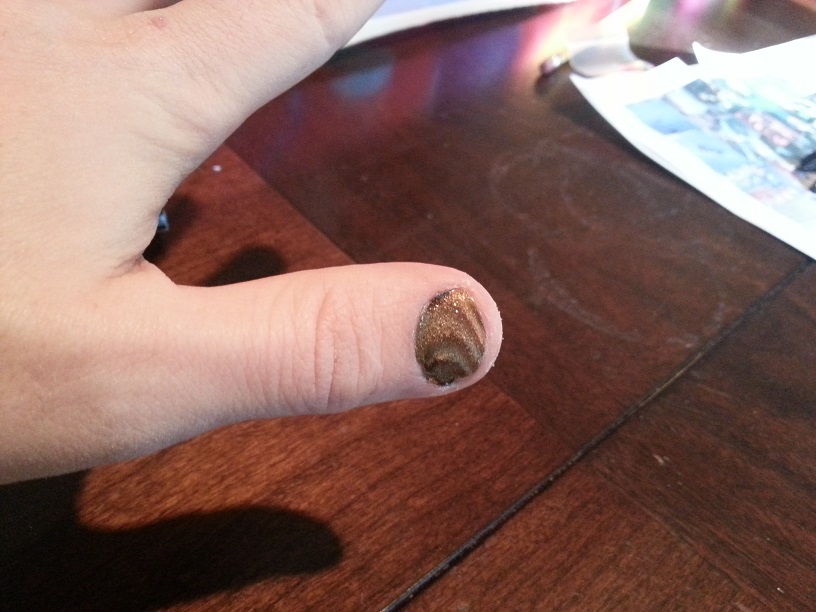
This nail polish (about $7 used on Amazon) forms a stripe pattern when you hold a magnet near your fingernail while the polish is trying. (There are many similar products on the market, searchable under "magnetic nail polish.") The appeal to young science geeks is that the iron filings in the nail polish align themselves along magnetic field lines in the vicinity of the magnet, forming the stripes.
I don't wear glittery nail polish (at least not as "Bennett Haselton"...), but I took one for the team to see if this works. It does. That's my thumb. (Apparently it looks better if you apply a "top coat" after the nail polish dries, but I didn't have any.) If you plan on testing it out before giving it as a gift, remember to pick up some nail polish remover to get it off.
A few things from MoMA that we can actually afford
- An appetizer serving dish complete with toothpick holder that looks like a porcupine ($28). This item probably has the highest price-to-cool-factor ratio of anything on this list, just barely within the limit of what I'd recommend, but it's elegant in addition to being funny, and the recipient would probably use it.
- A faux-wood cube clock ($38). This is interesting mostly for looking like a visual impossibility -- how can the digital numbers appear on the side of a block of wood, even fake wood? Unfortunately I think the photo is doctored, because this youtube video shows an undoctored shot of the cube clock, and you can easily see the un-illuminated LEDs on the side, which don't quite blend in with the wood. But it still makes for an elegant optical illusion.
Miscellaneous "Visual Puns"
- The ambiguous vase ($33) from Grand Illusions -- a real-life version of the Rubin vase optical illusion, where a vase suddenly takes on the appearance of two faces in profile.
- The glass water faucet ($50)
- The sliced grandfather clock ($36)
- Ulexite "television stones" ($10) - a rock that, when placed on a flat surface, will cause the markings on that surface to re-appear on the top face of the rock, due to the naturally occurring fiber optics in ulexite.
Of course, if you're now craving one of these items for yourself, order one and try it out before re-gifting, or set up an Amazon wish list in the last two weeks before Christmas. And remember to be good!
-
2014 Geek Gift Guide
With the holidays coming up, Bennett Haselton has updated his geek-oriented gift guide for 2014. He says: Some of my favorite gifts to give are still the ones that were listed in several different previously written posts, while a few new cool gift ideas emerged in 2014. Here are all my current best recommendations, listed in one place. Read on for the list, or to share any suggestions of your own.Most annual gift guides would only list new items. It would be considered a mortal sin of click-baiting to tell the reader, "Well, the coolest stuff we could tell you about, was stuff that we mentioned this time last year, so first and foremost we're just going to direct you to that."
Well, my job in writing a gift guide is not to dazzle people with "all new hottest gift item" recommendations, my job is to recommend the things that I think you would most enjoy giving and the recipient would most enjoy receiving, and the fact of the matter is that most of the gifts I would most highly recommend, were listed in different previously written articles. I'll provide that list in a second (with links back to the older articles describing them in more detail), but first some criteria for how I make the recommendations.
First, I'm assuming you want to go inexpensive. If you have unlimited cash, you don't need my help finding cool presents -- although for the record, the online store of New York's Museum of Modern Art has the best collection of things that incorporate "visual puns" that I really like, but which are usually overpriced for what the item does. (Check out this image of a set of nesting tables, for example -- which isn't even that much of a "neat idea", by their standards -- and try to guess how much they cost, before looking at the answer on the product page.) If you don't mind spending the money, they also sell a dandelion encased in acrylic ($375), a lamp in the shape of an open book ($190), a necklace of small rectangular mirrors creating an interesting 3D effect ($190), a porcelain vase that kind of looks like a crinkled paper bag ($120), a pair of candleholders that interlock without touching ($170), a serving tray that looks like the splash from a drop of water ($130), a clock that evokes an M.C. Escher "infinite staircase" optical illusion ($80), and a vase that exists in the shape of an outline ($65, which at this point sounds cheap). At the end of this gift guide I list some MoMA items that are somewhat more reasonably priced.
Second, I'm assuming you don't need help finding branded merchandise. I'm sure literally every combination of [Star Wars / LOTR / Game of Thrones / Star Trek / Hunger Games] and [coffee mug / beach towel / earrings / Christmas tree ornaments / shot glass / cufflinks] is available somewhere. It's not that these are bad gifts for the hardcore fan, it's that all you need to find them is to Google "Game of Thrones Christmas tree ornaments" and you'll find something. And occasionally you'll will find something in this "branded" category that jumps out as a pretty cool idea, like the TARDIS Tea Infuser or the Game of Thrones Dragonclaw Goblet or the light-up lightsaber chopsticks.
Third, I look mostly for novelty or decorative items that confound your senses or demonstrate some interesting scientific principle (or both), but that can still fit in to a semi-elegant environment without garishly calling attention to themselves. These color changing beads are kind of neat, but it would look weird having them lying around on top of a living room dresser along with a UV flashlight to demonstrate what they do. On the other hand, a Galileo thermometer can blend in pretty well the decorations on a mantlepiece.
The following are my current most-recommended gift ideas:
Custom Photomosaic
In this December 2013 post I described how to create a photomosaic (a patchwork of smaller pictures that, when viewed from a distance, take on the appearance of a larger picture) using two free (donation-supported) programs, one to download and save pictures en masse from a friend's Facebook profile, and the other to create the photomosaic using those photos. I still think they make amazing gifts, and the only cost is the cost of printing and framing it. You can even give the digital-only version as a gift that costs nothing at all, making a photomosaic from a friend's photos and sending it to them on the other side of the world, where they can print it themselves or use it as a desktop background. Everyone that I've given one of these to, has loved it.
Strandbeest kit
With this $35 kit, which I recommended as a Christmas gift last year, you can assemble a tabletop version of the legendary full-size Strandbeests, the eerily lifelike creatures created by Dutch artist Theo Jansen which walk across the beaches of Holland powered only by the wind. Assembly of the creature takes about 90 minutes, less if you make a family activity out of it and share the labor.
In the last year, a second model has been released, dubbed the "Rhinoceros Mini-Beest (technically, it was available a year ago, but the assembly instructions were only printed in Japanese; now it's available with English directions). I haven't assembled one of these myself yet, but it looks fine in the video.
There is also now a pre-assembled, motorized, remote-control version of the Strandbeest, although honestly, where's the fun in that? Part of the effect of the Strandbeest assembly kit is the feeling that you've breathed life into an inanimate object by putting it together from static parts. A remote-control toy that moves forwards and backwards on the ground is a little underwhelming when you can get an RC helicopter for the same price.
Levitron Revolution and Levitron Cherrywood
The Levitron Revolution ($70) consists of a circular magnetic disc that levitates about half an inch above an electrically powered square base, and can support up to a pound of weight on top of it while maintaining levitation. The Levitron Cherrywood ($35) consists of a top that has to be spun by hand, which levitates almost a full two inches above the cherrywood base containing an embedded magnet. As described in the first gift guide, the Levitron Cherrywood is more visually impressive because of the extra height of levitation, but the top almost always falls if you touch the top or move the base while the top is spinning. The Levitron Revolution only levitates the disc by half an inch, but you can embellish the appearance by placing other objects on top of it, like the pyrite crystal levitating in this video. (Also, the Levitron Revolution will continue levitating as long as power is supplied to it, making it a good decorative item; the Levitron Cherrywood has to be spun by hand and levitates for only about two minutes before air friction slows it down, so it works better as a toy or party activity.) Both of them take some practice to operate (the Levitron Cherrywood takes considerably more), but they're worth it.
Spare batteries for your friend's phone
I mentioned this in January 2013 as a life hack for smartphones and got pilloried for promoting what people called an "obvious" idea. But two years later, almost nobody that I know is carrying around fully charged extra batteries for their phones. It's easy, it works, and the spare batteries in my jacket pockets have gotten me out of a jam multiple times. If you know what type of phone your gift recipient uses, get them some extra batteries. (T-Mobile sent me extra batteries for my LG Optimus for free.)
The iPhone is the only phone I'm aware of that does not support this, because the battery is not meant to be removed or replaced by the user.
And yes, I know about the portable external battery products that can be used to charge a phone. These aren't as big or expensive as they used to be, but you still have to leave them plugged in to your phone while they're charging it, which is awkward if you're using your phone or carrying it in your pocket (compared to the 10 seconds it takes to swap out the battery).
Heat Wave car heater
This $40 device from Canadian company "Heat & Clean" sits on your dashboard and turns itself on at a pre-determined time, blowing hot air into the interior of the car for 20 minutes, all without starting the car. If all goes well, this means your car will be warm (or at least not as cold as it would have been) when you first get into it in the morning, and you don't have to wait several minutes for the air ventilation system to heat up. The Heat Wave is powered by the car's 12V charger, although Heat & Clean states that "has built-in circuitry to ensure that the health of the vehicle's battery is never compromised."
I can't vouch for the device's respect for your battery (the device unfortunately isn't sold on Amazon, which is usually where I go to find out if something does what it's supposed to), but I ordered one and verified that it works, then gave it to my aunt for her birthday. (If it kills her car, I will promptly make it up to her by taking it out of the gift guide.) Even though I tested the functionality, I didn't get the chance to see if the device actually helps much, because it's not cold enough yet here in Seattle to really feel the bite of the cold when you get into your car in the morning. (The other reason I personally won't get much benefit from this, is that I work from home and leave the house at a different time every day, so I never know in advance what time I'll be getting into my car the next morning.)
Most cars can be modified so they can be started remotely, so that they're warmed up by the time you go outside and get into them, but that modification usually costs a few hundred dollars. You might as well try the Heat Wave first to see if it does the job almost as well.
(To me, the obvious question is: Why not make a version of the Heat Wave that can be turned remotely, as well? For people like me who usually don't know the night before what time they'll be getting into their car the next day, but who often do know at least 20 minutes in advance, so they can turn it on remotely and start heating the car. The company does make a very different-looking product called the Heat Stick which can be activated remotely -- but at $300, that's more than it costs to add remote start to the actual car.)
It's Nuts 3D puzzle
Distributed by Grand Illusions in the UK, the It's Nuts 3D puzzle consists of a bolt and a pair of nuts threaded onto the bolt. As you can see in the video, when you rotate one nut, it moves in the direction that you'd expect, following the threading on the bolt -- but when you rotate the other nut the same way, it moves in the opposite direction. There are no hidden moving parts to make the illusion work, and you can unscrew both nuts right off of the bolt and examine them.
Having acquired one, I can say that the secret is a little bit easier to figure out when you're holding it in your hand and looking at it closely, than when you're watching the video. But it still makes a nice novelty conversation piece.
As a brain-tickler, this feels a bit overpriced at $40 - costing more than the aforementioned Levitron Cherrywood, which actually levitates. I bought It's Nuts mainly to fill out my collection off oddities since I already owned most of the other items in this list. Of course, unlike the Levitron, this takes no skill to operate (only a little bit of smarts to figure out the secret). I wouldn't foist the Levitron on my grandfather, but he would probably enjoy this one.
(Note that if you buy from the Grand Illusions website to ship to the United States, you'll pay the non-VAT rate -- but then you'll have to add about $14 in air mail shipping to the U.S. So you might want to combine this order with some other items from Grand Illusions -- search this article for "Grand Illusions" for the other recommended items, or browse their site and pick your own.)
Inverter Magnet
The Inverter Magnet, from Grand Illusions (also available from Amazon at a slightly higher price), consists of one disc magnet encased in rubber, which holds a second disc magnet in a permanent "force field" a few millimeters away when the two are slid across a table.
At $40, this might be more of a "collection filler-outer", since especially as a magnetic toy it compares unfavorably with the Levitron Cherrywood, which, to repeat, can actually fly. But again, the Inverter Magnet also takes no skill to operate.
Magna Nails
This nail polish (about $7 used on Amazon) forms a stripe pattern when you hold a magnet near your fingernail while the polish is trying. (There are many similar products on the market, searchable under "magnetic nail polish.") The appeal to young science geeks is that the iron filings in the nail polish align themselves along magnetic field lines in the vicinity of the magnet, forming the stripes.
I don't wear glittery nail polish (at least not as "Bennett Haselton"...), but I took one for the team to see if this works. It does. That's my thumb. (Apparently it looks better if you apply a "top coat" after the nail polish dries, but I didn't have any.) If you plan on testing it out before giving it as a gift, remember to pick up some nail polish remover to get it off.
A few things from MoMA that we can actually afford
- An appetizer serving dish complete with toothpick holder that looks like a porcupine ($28). This item probably has the highest price-to-cool-factor ratio of anything on this list, just barely within the limit of what I'd recommend, but it's elegant in addition to being funny, and the recipient would probably use it.
- A faux-wood cube clock ($38). This is interesting mostly for looking like a visual impossibility -- how can the digital numbers appear on the side of a block of wood, even fake wood? Unfortunately I think the photo is doctored, because this youtube video shows an undoctored shot of the cube clock, and you can easily see the un-illuminated LEDs on the side, which don't quite blend in with the wood. But it still makes for an elegant optical illusion.
Miscellaneous "Visual Puns"
- The ambiguous vase ($33) from Grand Illusions -- a real-life version of the Rubin vase optical illusion, where a vase suddenly takes on the appearance of two faces in profile.
- The glass water faucet ($50)
- The sliced grandfather clock ($36)
- Ulexite "television stones" ($10) - a rock that, when placed on a flat surface, will cause the markings on that surface to re-appear on the top face of the rock, due to the naturally occurring fiber optics in ulexite.
Of course, if you're now craving one of these items for yourself, order one and try it out before re-gifting, or set up an Amazon wish list in the last two weeks before Christmas. And remember to be good!
-
2014 Geek Gift Guide
With the holidays coming up, Bennett Haselton has updated his geek-oriented gift guide for 2014. He says: Some of my favorite gifts to give are still the ones that were listed in several different previously written posts, while a few new cool gift ideas emerged in 2014. Here are all my current best recommendations, listed in one place. Read on for the list, or to share any suggestions of your own.Most annual gift guides would only list new items. It would be considered a mortal sin of click-baiting to tell the reader, "Well, the coolest stuff we could tell you about, was stuff that we mentioned this time last year, so first and foremost we're just going to direct you to that."
Well, my job in writing a gift guide is not to dazzle people with "all new hottest gift item" recommendations, my job is to recommend the things that I think you would most enjoy giving and the recipient would most enjoy receiving, and the fact of the matter is that most of the gifts I would most highly recommend, were listed in different previously written articles. I'll provide that list in a second (with links back to the older articles describing them in more detail), but first some criteria for how I make the recommendations.
First, I'm assuming you want to go inexpensive. If you have unlimited cash, you don't need my help finding cool presents -- although for the record, the online store of New York's Museum of Modern Art has the best collection of things that incorporate "visual puns" that I really like, but which are usually overpriced for what the item does. (Check out this image of a set of nesting tables, for example -- which isn't even that much of a "neat idea", by their standards -- and try to guess how much they cost, before looking at the answer on the product page.) If you don't mind spending the money, they also sell a dandelion encased in acrylic ($375), a lamp in the shape of an open book ($190), a necklace of small rectangular mirrors creating an interesting 3D effect ($190), a porcelain vase that kind of looks like a crinkled paper bag ($120), a pair of candleholders that interlock without touching ($170), a serving tray that looks like the splash from a drop of water ($130), a clock that evokes an M.C. Escher "infinite staircase" optical illusion ($80), and a vase that exists in the shape of an outline ($65, which at this point sounds cheap). At the end of this gift guide I list some MoMA items that are somewhat more reasonably priced.
Second, I'm assuming you don't need help finding branded merchandise. I'm sure literally every combination of [Star Wars / LOTR / Game of Thrones / Star Trek / Hunger Games] and [coffee mug / beach towel / earrings / Christmas tree ornaments / shot glass / cufflinks] is available somewhere. It's not that these are bad gifts for the hardcore fan, it's that all you need to find them is to Google "Game of Thrones Christmas tree ornaments" and you'll find something. And occasionally you'll will find something in this "branded" category that jumps out as a pretty cool idea, like the TARDIS Tea Infuser or the Game of Thrones Dragonclaw Goblet or the light-up lightsaber chopsticks.
Third, I look mostly for novelty or decorative items that confound your senses or demonstrate some interesting scientific principle (or both), but that can still fit in to a semi-elegant environment without garishly calling attention to themselves. These color changing beads are kind of neat, but it would look weird having them lying around on top of a living room dresser along with a UV flashlight to demonstrate what they do. On the other hand, a Galileo thermometer can blend in pretty well the decorations on a mantlepiece.
The following are my current most-recommended gift ideas:
Custom Photomosaic
In this December 2013 post I described how to create a photomosaic (a patchwork of smaller pictures that, when viewed from a distance, take on the appearance of a larger picture) using two free (donation-supported) programs, one to download and save pictures en masse from a friend's Facebook profile, and the other to create the photomosaic using those photos. I still think they make amazing gifts, and the only cost is the cost of printing and framing it. You can even give the digital-only version as a gift that costs nothing at all, making a photomosaic from a friend's photos and sending it to them on the other side of the world, where they can print it themselves or use it as a desktop background. Everyone that I've given one of these to, has loved it.
Strandbeest kit
With this $35 kit, which I recommended as a Christmas gift last year, you can assemble a tabletop version of the legendary full-size Strandbeests, the eerily lifelike creatures created by Dutch artist Theo Jansen which walk across the beaches of Holland powered only by the wind. Assembly of the creature takes about 90 minutes, less if you make a family activity out of it and share the labor.
In the last year, a second model has been released, dubbed the "Rhinoceros Mini-Beest (technically, it was available a year ago, but the assembly instructions were only printed in Japanese; now it's available with English directions). I haven't assembled one of these myself yet, but it looks fine in the video.
There is also now a pre-assembled, motorized, remote-control version of the Strandbeest, although honestly, where's the fun in that? Part of the effect of the Strandbeest assembly kit is the feeling that you've breathed life into an inanimate object by putting it together from static parts. A remote-control toy that moves forwards and backwards on the ground is a little underwhelming when you can get an RC helicopter for the same price.
Levitron Revolution and Levitron Cherrywood
The Levitron Revolution ($70) consists of a circular magnetic disc that levitates about half an inch above an electrically powered square base, and can support up to a pound of weight on top of it while maintaining levitation. The Levitron Cherrywood ($35) consists of a top that has to be spun by hand, which levitates almost a full two inches above the cherrywood base containing an embedded magnet. As described in the first gift guide, the Levitron Cherrywood is more visually impressive because of the extra height of levitation, but the top almost always falls if you touch the top or move the base while the top is spinning. The Levitron Revolution only levitates the disc by half an inch, but you can embellish the appearance by placing other objects on top of it, like the pyrite crystal levitating in this video. (Also, the Levitron Revolution will continue levitating as long as power is supplied to it, making it a good decorative item; the Levitron Cherrywood has to be spun by hand and levitates for only about two minutes before air friction slows it down, so it works better as a toy or party activity.) Both of them take some practice to operate (the Levitron Cherrywood takes considerably more), but they're worth it.
Spare batteries for your friend's phone
I mentioned this in January 2013 as a life hack for smartphones and got pilloried for promoting what people called an "obvious" idea. But two years later, almost nobody that I know is carrying around fully charged extra batteries for their phones. It's easy, it works, and the spare batteries in my jacket pockets have gotten me out of a jam multiple times. If you know what type of phone your gift recipient uses, get them some extra batteries. (T-Mobile sent me extra batteries for my LG Optimus for free.)
The iPhone is the only phone I'm aware of that does not support this, because the battery is not meant to be removed or replaced by the user.
And yes, I know about the portable external battery products that can be used to charge a phone. These aren't as big or expensive as they used to be, but you still have to leave them plugged in to your phone while they're charging it, which is awkward if you're using your phone or carrying it in your pocket (compared to the 10 seconds it takes to swap out the battery).
Heat Wave car heater
This $40 device from Canadian company "Heat & Clean" sits on your dashboard and turns itself on at a pre-determined time, blowing hot air into the interior of the car for 20 minutes, all without starting the car. If all goes well, this means your car will be warm (or at least not as cold as it would have been) when you first get into it in the morning, and you don't have to wait several minutes for the air ventilation system to heat up. The Heat Wave is powered by the car's 12V charger, although Heat & Clean states that "has built-in circuitry to ensure that the health of the vehicle's battery is never compromised."
I can't vouch for the device's respect for your battery (the device unfortunately isn't sold on Amazon, which is usually where I go to find out if something does what it's supposed to), but I ordered one and verified that it works, then gave it to my aunt for her birthday. (If it kills her car, I will promptly make it up to her by taking it out of the gift guide.) Even though I tested the functionality, I didn't get the chance to see if the device actually helps much, because it's not cold enough yet here in Seattle to really feel the bite of the cold when you get into your car in the morning. (The other reason I personally won't get much benefit from this, is that I work from home and leave the house at a different time every day, so I never know in advance what time I'll be getting into my car the next morning.)
Most cars can be modified so they can be started remotely, so that they're warmed up by the time you go outside and get into them, but that modification usually costs a few hundred dollars. You might as well try the Heat Wave first to see if it does the job almost as well.
(To me, the obvious question is: Why not make a version of the Heat Wave that can be turned remotely, as well? For people like me who usually don't know the night before what time they'll be getting into their car the next day, but who often do know at least 20 minutes in advance, so they can turn it on remotely and start heating the car. The company does make a very different-looking product called the Heat Stick which can be activated remotely -- but at $300, that's more than it costs to add remote start to the actual car.)
It's Nuts 3D puzzle
Distributed by Grand Illusions in the UK, the It's Nuts 3D puzzle consists of a bolt and a pair of nuts threaded onto the bolt. As you can see in the video, when you rotate one nut, it moves in the direction that you'd expect, following the threading on the bolt -- but when you rotate the other nut the same way, it moves in the opposite direction. There are no hidden moving parts to make the illusion work, and you can unscrew both nuts right off of the bolt and examine them.
Having acquired one, I can say that the secret is a little bit easier to figure out when you're holding it in your hand and looking at it closely, than when you're watching the video. But it still makes a nice novelty conversation piece.
As a brain-tickler, this feels a bit overpriced at $40 - costing more than the aforementioned Levitron Cherrywood, which actually levitates. I bought It's Nuts mainly to fill out my collection off oddities since I already owned most of the other items in this list. Of course, unlike the Levitron, this takes no skill to operate (only a little bit of smarts to figure out the secret). I wouldn't foist the Levitron on my grandfather, but he would probably enjoy this one.
(Note that if you buy from the Grand Illusions website to ship to the United States, you'll pay the non-VAT rate -- but then you'll have to add about $14 in air mail shipping to the U.S. So you might want to combine this order with some other items from Grand Illusions -- search this article for "Grand Illusions" for the other recommended items, or browse their site and pick your own.)
Inverter Magnet
The Inverter Magnet, from Grand Illusions (also available from Amazon at a slightly higher price), consists of one disc magnet encased in rubber, which holds a second disc magnet in a permanent "force field" a few millimeters away when the two are slid across a table.
At $40, this might be more of a "collection filler-outer", since especially as a magnetic toy it compares unfavorably with the Levitron Cherrywood, which, to repeat, can actually fly. But again, the Inverter Magnet also takes no skill to operate.
Magna Nails
This nail polish (about $7 used on Amazon) forms a stripe pattern when you hold a magnet near your fingernail while the polish is trying. (There are many similar products on the market, searchable under "magnetic nail polish.") The appeal to young science geeks is that the iron filings in the nail polish align themselves along magnetic field lines in the vicinity of the magnet, forming the stripes.
I don't wear glittery nail polish (at least not as "Bennett Haselton"...), but I took one for the team to see if this works. It does. That's my thumb. (Apparently it looks better if you apply a "top coat" after the nail polish dries, but I didn't have any.) If you plan on testing it out before giving it as a gift, remember to pick up some nail polish remover to get it off.
A few things from MoMA that we can actually afford
- An appetizer serving dish complete with toothpick holder that looks like a porcupine ($28). This item probably has the highest price-to-cool-factor ratio of anything on this list, just barely within the limit of what I'd recommend, but it's elegant in addition to being funny, and the recipient would probably use it.
- A faux-wood cube clock ($38). This is interesting mostly for looking like a visual impossibility -- how can the digital numbers appear on the side of a block of wood, even fake wood? Unfortunately I think the photo is doctored, because this youtube video shows an undoctored shot of the cube clock, and you can easily see the un-illuminated LEDs on the side, which don't quite blend in with the wood. But it still makes for an elegant optical illusion.
Miscellaneous "Visual Puns"
- The ambiguous vase ($33) from Grand Illusions -- a real-life version of the Rubin vase optical illusion, where a vase suddenly takes on the appearance of two faces in profile.
- The glass water faucet ($50)
- The sliced grandfather clock ($36)
- Ulexite "television stones" ($10) - a rock that, when placed on a flat surface, will cause the markings on that surface to re-appear on the top face of the rock, due to the naturally occurring fiber optics in ulexite.
Of course, if you're now craving one of these items for yourself, order one and try it out before re-gifting, or set up an Amazon wish list in the last two weeks before Christmas. And remember to be good!
-
2014 Geek Gift Guide
With the holidays coming up, Bennett Haselton has updated his geek-oriented gift guide for 2014. He says: Some of my favorite gifts to give are still the ones that were listed in several different previously written posts, while a few new cool gift ideas emerged in 2014. Here are all my current best recommendations, listed in one place. Read on for the list, or to share any suggestions of your own.Most annual gift guides would only list new items. It would be considered a mortal sin of click-baiting to tell the reader, "Well, the coolest stuff we could tell you about, was stuff that we mentioned this time last year, so first and foremost we're just going to direct you to that."
Well, my job in writing a gift guide is not to dazzle people with "all new hottest gift item" recommendations, my job is to recommend the things that I think you would most enjoy giving and the recipient would most enjoy receiving, and the fact of the matter is that most of the gifts I would most highly recommend, were listed in different previously written articles. I'll provide that list in a second (with links back to the older articles describing them in more detail), but first some criteria for how I make the recommendations.
First, I'm assuming you want to go inexpensive. If you have unlimited cash, you don't need my help finding cool presents -- although for the record, the online store of New York's Museum of Modern Art has the best collection of things that incorporate "visual puns" that I really like, but which are usually overpriced for what the item does. (Check out this image of a set of nesting tables, for example -- which isn't even that much of a "neat idea", by their standards -- and try to guess how much they cost, before looking at the answer on the product page.) If you don't mind spending the money, they also sell a dandelion encased in acrylic ($375), a lamp in the shape of an open book ($190), a necklace of small rectangular mirrors creating an interesting 3D effect ($190), a porcelain vase that kind of looks like a crinkled paper bag ($120), a pair of candleholders that interlock without touching ($170), a serving tray that looks like the splash from a drop of water ($130), a clock that evokes an M.C. Escher "infinite staircase" optical illusion ($80), and a vase that exists in the shape of an outline ($65, which at this point sounds cheap). At the end of this gift guide I list some MoMA items that are somewhat more reasonably priced.
Second, I'm assuming you don't need help finding branded merchandise. I'm sure literally every combination of [Star Wars / LOTR / Game of Thrones / Star Trek / Hunger Games] and [coffee mug / beach towel / earrings / Christmas tree ornaments / shot glass / cufflinks] is available somewhere. It's not that these are bad gifts for the hardcore fan, it's that all you need to find them is to Google "Game of Thrones Christmas tree ornaments" and you'll find something. And occasionally you'll will find something in this "branded" category that jumps out as a pretty cool idea, like the TARDIS Tea Infuser or the Game of Thrones Dragonclaw Goblet or the light-up lightsaber chopsticks.
Third, I look mostly for novelty or decorative items that confound your senses or demonstrate some interesting scientific principle (or both), but that can still fit in to a semi-elegant environment without garishly calling attention to themselves. These color changing beads are kind of neat, but it would look weird having them lying around on top of a living room dresser along with a UV flashlight to demonstrate what they do. On the other hand, a Galileo thermometer can blend in pretty well the decorations on a mantlepiece.
The following are my current most-recommended gift ideas:
Custom Photomosaic
In this December 2013 post I described how to create a photomosaic (a patchwork of smaller pictures that, when viewed from a distance, take on the appearance of a larger picture) using two free (donation-supported) programs, one to download and save pictures en masse from a friend's Facebook profile, and the other to create the photomosaic using those photos. I still think they make amazing gifts, and the only cost is the cost of printing and framing it. You can even give the digital-only version as a gift that costs nothing at all, making a photomosaic from a friend's photos and sending it to them on the other side of the world, where they can print it themselves or use it as a desktop background. Everyone that I've given one of these to, has loved it.
Strandbeest kit
With this $35 kit, which I recommended as a Christmas gift last year, you can assemble a tabletop version of the legendary full-size Strandbeests, the eerily lifelike creatures created by Dutch artist Theo Jansen which walk across the beaches of Holland powered only by the wind. Assembly of the creature takes about 90 minutes, less if you make a family activity out of it and share the labor.
In the last year, a second model has been released, dubbed the "Rhinoceros Mini-Beest (technically, it was available a year ago, but the assembly instructions were only printed in Japanese; now it's available with English directions). I haven't assembled one of these myself yet, but it looks fine in the video.
There is also now a pre-assembled, motorized, remote-control version of the Strandbeest, although honestly, where's the fun in that? Part of the effect of the Strandbeest assembly kit is the feeling that you've breathed life into an inanimate object by putting it together from static parts. A remote-control toy that moves forwards and backwards on the ground is a little underwhelming when you can get an RC helicopter for the same price.
Levitron Revolution and Levitron Cherrywood
The Levitron Revolution ($70) consists of a circular magnetic disc that levitates about half an inch above an electrically powered square base, and can support up to a pound of weight on top of it while maintaining levitation. The Levitron Cherrywood ($35) consists of a top that has to be spun by hand, which levitates almost a full two inches above the cherrywood base containing an embedded magnet. As described in the first gift guide, the Levitron Cherrywood is more visually impressive because of the extra height of levitation, but the top almost always falls if you touch the top or move the base while the top is spinning. The Levitron Revolution only levitates the disc by half an inch, but you can embellish the appearance by placing other objects on top of it, like the pyrite crystal levitating in this video. (Also, the Levitron Revolution will continue levitating as long as power is supplied to it, making it a good decorative item; the Levitron Cherrywood has to be spun by hand and levitates for only about two minutes before air friction slows it down, so it works better as a toy or party activity.) Both of them take some practice to operate (the Levitron Cherrywood takes considerably more), but they're worth it.
Spare batteries for your friend's phone
I mentioned this in January 2013 as a life hack for smartphones and got pilloried for promoting what people called an "obvious" idea. But two years later, almost nobody that I know is carrying around fully charged extra batteries for their phones. It's easy, it works, and the spare batteries in my jacket pockets have gotten me out of a jam multiple times. If you know what type of phone your gift recipient uses, get them some extra batteries. (T-Mobile sent me extra batteries for my LG Optimus for free.)
The iPhone is the only phone I'm aware of that does not support this, because the battery is not meant to be removed or replaced by the user.
And yes, I know about the portable external battery products that can be used to charge a phone. These aren't as big or expensive as they used to be, but you still have to leave them plugged in to your phone while they're charging it, which is awkward if you're using your phone or carrying it in your pocket (compared to the 10 seconds it takes to swap out the battery).
Heat Wave car heater
This $40 device from Canadian company "Heat & Clean" sits on your dashboard and turns itself on at a pre-determined time, blowing hot air into the interior of the car for 20 minutes, all without starting the car. If all goes well, this means your car will be warm (or at least not as cold as it would have been) when you first get into it in the morning, and you don't have to wait several minutes for the air ventilation system to heat up. The Heat Wave is powered by the car's 12V charger, although Heat & Clean states that "has built-in circuitry to ensure that the health of the vehicle's battery is never compromised."
I can't vouch for the device's respect for your battery (the device unfortunately isn't sold on Amazon, which is usually where I go to find out if something does what it's supposed to), but I ordered one and verified that it works, then gave it to my aunt for her birthday. (If it kills her car, I will promptly make it up to her by taking it out of the gift guide.) Even though I tested the functionality, I didn't get the chance to see if the device actually helps much, because it's not cold enough yet here in Seattle to really feel the bite of the cold when you get into your car in the morning. (The other reason I personally won't get much benefit from this, is that I work from home and leave the house at a different time every day, so I never know in advance what time I'll be getting into my car the next morning.)
Most cars can be modified so they can be started remotely, so that they're warmed up by the time you go outside and get into them, but that modification usually costs a few hundred dollars. You might as well try the Heat Wave first to see if it does the job almost as well.
(To me, the obvious question is: Why not make a version of the Heat Wave that can be turned remotely, as well? For people like me who usually don't know the night before what time they'll be getting into their car the next day, but who often do know at least 20 minutes in advance, so they can turn it on remotely and start heating the car. The company does make a very different-looking product called the Heat Stick which can be activated remotely -- but at $300, that's more than it costs to add remote start to the actual car.)
It's Nuts 3D puzzle
Distributed by Grand Illusions in the UK, the It's Nuts 3D puzzle consists of a bolt and a pair of nuts threaded onto the bolt. As you can see in the video, when you rotate one nut, it moves in the direction that you'd expect, following the threading on the bolt -- but when you rotate the other nut the same way, it moves in the opposite direction. There are no hidden moving parts to make the illusion work, and you can unscrew both nuts right off of the bolt and examine them.
Having acquired one, I can say that the secret is a little bit easier to figure out when you're holding it in your hand and looking at it closely, than when you're watching the video. But it still makes a nice novelty conversation piece.
As a brain-tickler, this feels a bit overpriced at $40 - costing more than the aforementioned Levitron Cherrywood, which actually levitates. I bought It's Nuts mainly to fill out my collection off oddities since I already owned most of the other items in this list. Of course, unlike the Levitron, this takes no skill to operate (only a little bit of smarts to figure out the secret). I wouldn't foist the Levitron on my grandfather, but he would probably enjoy this one.
(Note that if you buy from the Grand Illusions website to ship to the United States, you'll pay the non-VAT rate -- but then you'll have to add about $14 in air mail shipping to the U.S. So you might want to combine this order with some other items from Grand Illusions -- search this article for "Grand Illusions" for the other recommended items, or browse their site and pick your own.)
Inverter Magnet
The Inverter Magnet, from Grand Illusions (also available from Amazon at a slightly higher price), consists of one disc magnet encased in rubber, which holds a second disc magnet in a permanent "force field" a few millimeters away when the two are slid across a table.
At $40, this might be more of a "collection filler-outer", since especially as a magnetic toy it compares unfavorably with the Levitron Cherrywood, which, to repeat, can actually fly. But again, the Inverter Magnet also takes no skill to operate.
Magna Nails
This nail polish (about $7 used on Amazon) forms a stripe pattern when you hold a magnet near your fingernail while the polish is trying. (There are many similar products on the market, searchable under "magnetic nail polish.") The appeal to young science geeks is that the iron filings in the nail polish align themselves along magnetic field lines in the vicinity of the magnet, forming the stripes.
I don't wear glittery nail polish (at least not as "Bennett Haselton"...), but I took one for the team to see if this works. It does. That's my thumb. (Apparently it looks better if you apply a "top coat" after the nail polish dries, but I didn't have any.) If you plan on testing it out before giving it as a gift, remember to pick up some nail polish remover to get it off.
A few things from MoMA that we can actually afford
- An appetizer serving dish complete with toothpick holder that looks like a porcupine ($28). This item probably has the highest price-to-cool-factor ratio of anything on this list, just barely within the limit of what I'd recommend, but it's elegant in addition to being funny, and the recipient would probably use it.
- A faux-wood cube clock ($38). This is interesting mostly for looking like a visual impossibility -- how can the digital numbers appear on the side of a block of wood, even fake wood? Unfortunately I think the photo is doctored, because this youtube video shows an undoctored shot of the cube clock, and you can easily see the un-illuminated LEDs on the side, which don't quite blend in with the wood. But it still makes for an elegant optical illusion.
Miscellaneous "Visual Puns"
- The ambiguous vase ($33) from Grand Illusions -- a real-life version of the Rubin vase optical illusion, where a vase suddenly takes on the appearance of two faces in profile.
- The glass water faucet ($50)
- The sliced grandfather clock ($36)
- Ulexite "television stones" ($10) - a rock that, when placed on a flat surface, will cause the markings on that surface to re-appear on the top face of the rock, due to the naturally occurring fiber optics in ulexite.
Of course, if you're now craving one of these items for yourself, order one and try it out before re-gifting, or set up an Amazon wish list in the last two weeks before Christmas. And remember to be good!
-
2014 Geek Gift Guide
With the holidays coming up, Bennett Haselton has updated his geek-oriented gift guide for 2014. He says: Some of my favorite gifts to give are still the ones that were listed in several different previously written posts, while a few new cool gift ideas emerged in 2014. Here are all my current best recommendations, listed in one place. Read on for the list, or to share any suggestions of your own.Most annual gift guides would only list new items. It would be considered a mortal sin of click-baiting to tell the reader, "Well, the coolest stuff we could tell you about, was stuff that we mentioned this time last year, so first and foremost we're just going to direct you to that."
Well, my job in writing a gift guide is not to dazzle people with "all new hottest gift item" recommendations, my job is to recommend the things that I think you would most enjoy giving and the recipient would most enjoy receiving, and the fact of the matter is that most of the gifts I would most highly recommend, were listed in different previously written articles. I'll provide that list in a second (with links back to the older articles describing them in more detail), but first some criteria for how I make the recommendations.
First, I'm assuming you want to go inexpensive. If you have unlimited cash, you don't need my help finding cool presents -- although for the record, the online store of New York's Museum of Modern Art has the best collection of things that incorporate "visual puns" that I really like, but which are usually overpriced for what the item does. (Check out this image of a set of nesting tables, for example -- which isn't even that much of a "neat idea", by their standards -- and try to guess how much they cost, before looking at the answer on the product page.) If you don't mind spending the money, they also sell a dandelion encased in acrylic ($375), a lamp in the shape of an open book ($190), a necklace of small rectangular mirrors creating an interesting 3D effect ($190), a porcelain vase that kind of looks like a crinkled paper bag ($120), a pair of candleholders that interlock without touching ($170), a serving tray that looks like the splash from a drop of water ($130), a clock that evokes an M.C. Escher "infinite staircase" optical illusion ($80), and a vase that exists in the shape of an outline ($65, which at this point sounds cheap). At the end of this gift guide I list some MoMA items that are somewhat more reasonably priced.
Second, I'm assuming you don't need help finding branded merchandise. I'm sure literally every combination of [Star Wars / LOTR / Game of Thrones / Star Trek / Hunger Games] and [coffee mug / beach towel / earrings / Christmas tree ornaments / shot glass / cufflinks] is available somewhere. It's not that these are bad gifts for the hardcore fan, it's that all you need to find them is to Google "Game of Thrones Christmas tree ornaments" and you'll find something. And occasionally you'll will find something in this "branded" category that jumps out as a pretty cool idea, like the TARDIS Tea Infuser or the Game of Thrones Dragonclaw Goblet or the light-up lightsaber chopsticks.
Third, I look mostly for novelty or decorative items that confound your senses or demonstrate some interesting scientific principle (or both), but that can still fit in to a semi-elegant environment without garishly calling attention to themselves. These color changing beads are kind of neat, but it would look weird having them lying around on top of a living room dresser along with a UV flashlight to demonstrate what they do. On the other hand, a Galileo thermometer can blend in pretty well the decorations on a mantlepiece.
The following are my current most-recommended gift ideas:
Custom Photomosaic
In this December 2013 post I described how to create a photomosaic (a patchwork of smaller pictures that, when viewed from a distance, take on the appearance of a larger picture) using two free (donation-supported) programs, one to download and save pictures en masse from a friend's Facebook profile, and the other to create the photomosaic using those photos. I still think they make amazing gifts, and the only cost is the cost of printing and framing it. You can even give the digital-only version as a gift that costs nothing at all, making a photomosaic from a friend's photos and sending it to them on the other side of the world, where they can print it themselves or use it as a desktop background. Everyone that I've given one of these to, has loved it.
Strandbeest kit
With this $35 kit, which I recommended as a Christmas gift last year, you can assemble a tabletop version of the legendary full-size Strandbeests, the eerily lifelike creatures created by Dutch artist Theo Jansen which walk across the beaches of Holland powered only by the wind. Assembly of the creature takes about 90 minutes, less if you make a family activity out of it and share the labor.
In the last year, a second model has been released, dubbed the "Rhinoceros Mini-Beest (technically, it was available a year ago, but the assembly instructions were only printed in Japanese; now it's available with English directions). I haven't assembled one of these myself yet, but it looks fine in the video.
There is also now a pre-assembled, motorized, remote-control version of the Strandbeest, although honestly, where's the fun in that? Part of the effect of the Strandbeest assembly kit is the feeling that you've breathed life into an inanimate object by putting it together from static parts. A remote-control toy that moves forwards and backwards on the ground is a little underwhelming when you can get an RC helicopter for the same price.
Levitron Revolution and Levitron Cherrywood
The Levitron Revolution ($70) consists of a circular magnetic disc that levitates about half an inch above an electrically powered square base, and can support up to a pound of weight on top of it while maintaining levitation. The Levitron Cherrywood ($35) consists of a top that has to be spun by hand, which levitates almost a full two inches above the cherrywood base containing an embedded magnet. As described in the first gift guide, the Levitron Cherrywood is more visually impressive because of the extra height of levitation, but the top almost always falls if you touch the top or move the base while the top is spinning. The Levitron Revolution only levitates the disc by half an inch, but you can embellish the appearance by placing other objects on top of it, like the pyrite crystal levitating in this video. (Also, the Levitron Revolution will continue levitating as long as power is supplied to it, making it a good decorative item; the Levitron Cherrywood has to be spun by hand and levitates for only about two minutes before air friction slows it down, so it works better as a toy or party activity.) Both of them take some practice to operate (the Levitron Cherrywood takes considerably more), but they're worth it.
Spare batteries for your friend's phone
I mentioned this in January 2013 as a life hack for smartphones and got pilloried for promoting what people called an "obvious" idea. But two years later, almost nobody that I know is carrying around fully charged extra batteries for their phones. It's easy, it works, and the spare batteries in my jacket pockets have gotten me out of a jam multiple times. If you know what type of phone your gift recipient uses, get them some extra batteries. (T-Mobile sent me extra batteries for my LG Optimus for free.)
The iPhone is the only phone I'm aware of that does not support this, because the battery is not meant to be removed or replaced by the user.
And yes, I know about the portable external battery products that can be used to charge a phone. These aren't as big or expensive as they used to be, but you still have to leave them plugged in to your phone while they're charging it, which is awkward if you're using your phone or carrying it in your pocket (compared to the 10 seconds it takes to swap out the battery).
Heat Wave car heater
This $40 device from Canadian company "Heat & Clean" sits on your dashboard and turns itself on at a pre-determined time, blowing hot air into the interior of the car for 20 minutes, all without starting the car. If all goes well, this means your car will be warm (or at least not as cold as it would have been) when you first get into it in the morning, and you don't have to wait several minutes for the air ventilation system to heat up. The Heat Wave is powered by the car's 12V charger, although Heat & Clean states that "has built-in circuitry to ensure that the health of the vehicle's battery is never compromised."
I can't vouch for the device's respect for your battery (the device unfortunately isn't sold on Amazon, which is usually where I go to find out if something does what it's supposed to), but I ordered one and verified that it works, then gave it to my aunt for her birthday. (If it kills her car, I will promptly make it up to her by taking it out of the gift guide.) Even though I tested the functionality, I didn't get the chance to see if the device actually helps much, because it's not cold enough yet here in Seattle to really feel the bite of the cold when you get into your car in the morning. (The other reason I personally won't get much benefit from this, is that I work from home and leave the house at a different time every day, so I never know in advance what time I'll be getting into my car the next morning.)
Most cars can be modified so they can be started remotely, so that they're warmed up by the time you go outside and get into them, but that modification usually costs a few hundred dollars. You might as well try the Heat Wave first to see if it does the job almost as well.
(To me, the obvious question is: Why not make a version of the Heat Wave that can be turned remotely, as well? For people like me who usually don't know the night before what time they'll be getting into their car the next day, but who often do know at least 20 minutes in advance, so they can turn it on remotely and start heating the car. The company does make a very different-looking product called the Heat Stick which can be activated remotely -- but at $300, that's more than it costs to add remote start to the actual car.)
It's Nuts 3D puzzle
Distributed by Grand Illusions in the UK, the It's Nuts 3D puzzle consists of a bolt and a pair of nuts threaded onto the bolt. As you can see in the video, when you rotate one nut, it moves in the direction that you'd expect, following the threading on the bolt -- but when you rotate the other nut the same way, it moves in the opposite direction. There are no hidden moving parts to make the illusion work, and you can unscrew both nuts right off of the bolt and examine them.
Having acquired one, I can say that the secret is a little bit easier to figure out when you're holding it in your hand and looking at it closely, than when you're watching the video. But it still makes a nice novelty conversation piece.
As a brain-tickler, this feels a bit overpriced at $40 - costing more than the aforementioned Levitron Cherrywood, which actually levitates. I bought It's Nuts mainly to fill out my collection off oddities since I already owned most of the other items in this list. Of course, unlike the Levitron, this takes no skill to operate (only a little bit of smarts to figure out the secret). I wouldn't foist the Levitron on my grandfather, but he would probably enjoy this one.
(Note that if you buy from the Grand Illusions website to ship to the United States, you'll pay the non-VAT rate -- but then you'll have to add about $14 in air mail shipping to the U.S. So you might want to combine this order with some other items from Grand Illusions -- search this article for "Grand Illusions" for the other recommended items, or browse their site and pick your own.)
Inverter Magnet
The Inverter Magnet, from Grand Illusions (also available from Amazon at a slightly higher price), consists of one disc magnet encased in rubber, which holds a second disc magnet in a permanent "force field" a few millimeters away when the two are slid across a table.
At $40, this might be more of a "collection filler-outer", since especially as a magnetic toy it compares unfavorably with the Levitron Cherrywood, which, to repeat, can actually fly. But again, the Inverter Magnet also takes no skill to operate.
Magna Nails
This nail polish (about $7 used on Amazon) forms a stripe pattern when you hold a magnet near your fingernail while the polish is trying. (There are many similar products on the market, searchable under "magnetic nail polish.") The appeal to young science geeks is that the iron filings in the nail polish align themselves along magnetic field lines in the vicinity of the magnet, forming the stripes.
I don't wear glittery nail polish (at least not as "Bennett Haselton"...), but I took one for the team to see if this works. It does. That's my thumb. (Apparently it looks better if you apply a "top coat" after the nail polish dries, but I didn't have any.) If you plan on testing it out before giving it as a gift, remember to pick up some nail polish remover to get it off.
A few things from MoMA that we can actually afford
- An appetizer serving dish complete with toothpick holder that looks like a porcupine ($28). This item probably has the highest price-to-cool-factor ratio of anything on this list, just barely within the limit of what I'd recommend, but it's elegant in addition to being funny, and the recipient would probably use it.
- A faux-wood cube clock ($38). This is interesting mostly for looking like a visual impossibility -- how can the digital numbers appear on the side of a block of wood, even fake wood? Unfortunately I think the photo is doctored, because this youtube video shows an undoctored shot of the cube clock, and you can easily see the un-illuminated LEDs on the side, which don't quite blend in with the wood. But it still makes for an elegant optical illusion.
Miscellaneous "Visual Puns"
- The ambiguous vase ($33) from Grand Illusions -- a real-life version of the Rubin vase optical illusion, where a vase suddenly takes on the appearance of two faces in profile.
- The glass water faucet ($50)
- The sliced grandfather clock ($36)
- Ulexite "television stones" ($10) - a rock that, when placed on a flat surface, will cause the markings on that surface to re-appear on the top face of the rock, due to the naturally occurring fiber optics in ulexite.
Of course, if you're now craving one of these items for yourself, order one and try it out before re-gifting, or set up an Amazon wish list in the last two weeks before Christmas. And remember to be good!
-
Gift Review: Strandbeest Model Kit
Bennett Haselton has in years previous made some canny suggestions for tech-oriented holiday gifts; you can look forward to another one. Today, though, Bennett writes about one cool toy in particular: a kit to make your own creepy robot: "For over 20 years, Dutch inventor Theo Jansen has been building truck-sized sculptures that crab-walk eerily across the beach, using only the power of the wind to turn fan blades that power the gears and crankshafts and enable the walking motion. This kit allows you to assemble your own working model that 'walks' sideways across your desktop." Read on for the rest.The Strandbeest Model Kit is a home run in multiple categories. The box says "Ages 8 and up", and that seems about right (adult supervision recommended to make sure you're following all the assembly instructions exactly). It takes about 90 minutes to assemble (I timed it), which is enough to feel like a rewarding journey in itself, and not just an extra thing you have to do after you open the box. The work can be easily split between multiple people to make a family night out of it. The assembly instructions are reasonably clear and actually work. And the finished product actually does what the videos show it doing. (Most demo videos show the Strandbeest moving under the power of an air hose, but it works perfectly fine if you just blow on the fan.) When you can see all of the individual plastic parts moving in concert, it gives such an uncanny impression of an inanimate object come to life, that a few people that I showed the walking Strandbeest to, said that it "creeped them out". Like I said, home run.
And the kit provides a portal into the world of the full-sized Strandbeests, built from PVC pipe and corrugated cardboard by Dutch "kinetic sculptor" Theo Jansen. Of all of the links and videos that we keep sending each other about "amazing things around the world that you've never seen before", how could we have missed this?
Before or after you put the kit together, you and your kids can gorge on the over 20,000 Youtube videos showing the walking creatures. According to the BBC One piece, "Theo Jansen is evolving such clever designs that one day, he hopes they'll be able to leave home, and live permanently in the Dutch sand dunes." In the printed interview that comes with the assembly kit, Jansen says, "My ultimate goal is that the strandbeests stroll, eat, reproduce, and survive as as group on the beach without me," and I can't quite tell if he's kidding. The "reproduce" and "eat" parts are probably impossible, but as for "stroll" and "survive" -- if a future design becomes "smart" enough to change direction when it hit an incline, or to walk across uneven terrain, then couldn't they keep wandering in the sand dunes under the power of the wind, until one of the parts broke? Well, why not? I can imagine the full-size Strandbeests "in the wild" becoming such a tourist draw that they would need human volunteers at the beach just to stop visitors from getting too close and damaging them.
Until then, if you want to go in person to see one of the full-size Strandbeests walking alongside the ocean under the power of the wind, you'll probably have to check Theo Jansen's public event schedule when it ramps up again in the summer of 2014. According to his website, the studio is also open to the public year-round, where you can operate one of the non-wind-powered full-sized Strandbeests which has to be pushed or pulled manually. I'd be willing to go quite far out of my way to see one of these things up close, next time I'm anywhere in or near Holland.
The kit to build your own mini-beest is $35 from ThinkGeek. (When I wrote my gift guide last year, some people accused me of shilling for ThinkGeek, Slashdot's corporate cousin, but this year, they're owned by different parent companies, so suck it haterz.) Earlier versions of the kit cost about $70 and came only with Japanese instructions. Adam Savage from Mythbusters put one together in 45 minutes just from reading the diagrams, since he doesn't speak Japanese, but the rest of us will probably do better with the English version that is now finally available.
The kit comes with a "science and history guide" which, along with the interview with Jansen, describes the successive "generations" of Strandbeests he has built, and the new features that were added over the years, The models are described eerily like living creatures:
"Animals that can utilize wind energy to live do not need to eat food. This type of creature can dominate sandy beaches where there is an abundance of wind but not very much nutrients. This is a tremendous advantage to the strandbeests since they do not need to compete with the other animals in the nature."
In the "Vaporum period", Jansen added the ability for Strandbeests to harness energy from the wind and store it in the form of compressed air in plastic bottles attached to the bodies, which he calls "muscles". In the most recent "Cerebrum period", Jansen added the ability for different parts of the body to communicate using compressed air in polyurethane tubes, which he calls "nerves":
"When a sensory appendage, a polyurethane tube dragged behind on the ground, touches water, the beest turns itself around and walks away from the water, saving itself from drowning in the ocean. Furthermore, the beest is built with a step counter and a system to record its experience. From the second time around, the beest stops three steps in front of the memorized water line and turns itself around before its antenna hits the water."
To a steampunk fan, this must sound like one of their dreams come to life.
(Apparently a $60 coffee table book by Theo Jansen, describing the evolution of his designs and including a DVD with more video footage, also exists, but is currently out of stock.)
If you get hooked after putting your first Strandbeest together, there is at least one other model available, the mini Rhinoceros, currently only with Japanese assembly instructions. If the first English-language assembly kit is a hit, hopefully the instructions for the mini Rhinoceros kit will be translated into English some time in the next year.
In fact, judging from the quality of the "Engrish" on the box and in the "science and history" guide (presumably translated from Dutch by way of Japan), it looks as if the English-language translation was probably rushed in order to make the Christmas 2013 selling deadline -- the right decision, no doubt. (The assembly instructions, on the other hand, were clearly written by a native English speaker, and are easy to understand all the way through.) At first I the broken English detracted from the quality of the product, but now I kind of like the effect, since the writing gives the eerie feeling that the brilliantly designed object in your hands is a touchstone to a foreign culture much smarter than ours. All your beest are belong to us!
-
Gift Review: Strandbeest Model Kit
Bennett Haselton has in years previous made some canny suggestions for tech-oriented holiday gifts; you can look forward to another one. Today, though, Bennett writes about one cool toy in particular: a kit to make your own creepy robot: "For over 20 years, Dutch inventor Theo Jansen has been building truck-sized sculptures that crab-walk eerily across the beach, using only the power of the wind to turn fan blades that power the gears and crankshafts and enable the walking motion. This kit allows you to assemble your own working model that 'walks' sideways across your desktop." Read on for the rest.The Strandbeest Model Kit is a home run in multiple categories. The box says "Ages 8 and up", and that seems about right (adult supervision recommended to make sure you're following all the assembly instructions exactly). It takes about 90 minutes to assemble (I timed it), which is enough to feel like a rewarding journey in itself, and not just an extra thing you have to do after you open the box. The work can be easily split between multiple people to make a family night out of it. The assembly instructions are reasonably clear and actually work. And the finished product actually does what the videos show it doing. (Most demo videos show the Strandbeest moving under the power of an air hose, but it works perfectly fine if you just blow on the fan.) When you can see all of the individual plastic parts moving in concert, it gives such an uncanny impression of an inanimate object come to life, that a few people that I showed the walking Strandbeest to, said that it "creeped them out". Like I said, home run.
And the kit provides a portal into the world of the full-sized Strandbeests, built from PVC pipe and corrugated cardboard by Dutch "kinetic sculptor" Theo Jansen. Of all of the links and videos that we keep sending each other about "amazing things around the world that you've never seen before", how could we have missed this?
Before or after you put the kit together, you and your kids can gorge on the over 20,000 Youtube videos showing the walking creatures. According to the BBC One piece, "Theo Jansen is evolving such clever designs that one day, he hopes they'll be able to leave home, and live permanently in the Dutch sand dunes." In the printed interview that comes with the assembly kit, Jansen says, "My ultimate goal is that the strandbeests stroll, eat, reproduce, and survive as as group on the beach without me," and I can't quite tell if he's kidding. The "reproduce" and "eat" parts are probably impossible, but as for "stroll" and "survive" -- if a future design becomes "smart" enough to change direction when it hit an incline, or to walk across uneven terrain, then couldn't they keep wandering in the sand dunes under the power of the wind, until one of the parts broke? Well, why not? I can imagine the full-size Strandbeests "in the wild" becoming such a tourist draw that they would need human volunteers at the beach just to stop visitors from getting too close and damaging them.
Until then, if you want to go in person to see one of the full-size Strandbeests walking alongside the ocean under the power of the wind, you'll probably have to check Theo Jansen's public event schedule when it ramps up again in the summer of 2014. According to his website, the studio is also open to the public year-round, where you can operate one of the non-wind-powered full-sized Strandbeests which has to be pushed or pulled manually. I'd be willing to go quite far out of my way to see one of these things up close, next time I'm anywhere in or near Holland.
The kit to build your own mini-beest is $35 from ThinkGeek. (When I wrote my gift guide last year, some people accused me of shilling for ThinkGeek, Slashdot's corporate cousin, but this year, they're owned by different parent companies, so suck it haterz.) Earlier versions of the kit cost about $70 and came only with Japanese instructions. Adam Savage from Mythbusters put one together in 45 minutes just from reading the diagrams, since he doesn't speak Japanese, but the rest of us will probably do better with the English version that is now finally available.
The kit comes with a "science and history guide" which, along with the interview with Jansen, describes the successive "generations" of Strandbeests he has built, and the new features that were added over the years, The models are described eerily like living creatures:
"Animals that can utilize wind energy to live do not need to eat food. This type of creature can dominate sandy beaches where there is an abundance of wind but not very much nutrients. This is a tremendous advantage to the strandbeests since they do not need to compete with the other animals in the nature."
In the "Vaporum period", Jansen added the ability for Strandbeests to harness energy from the wind and store it in the form of compressed air in plastic bottles attached to the bodies, which he calls "muscles". In the most recent "Cerebrum period", Jansen added the ability for different parts of the body to communicate using compressed air in polyurethane tubes, which he calls "nerves":
"When a sensory appendage, a polyurethane tube dragged behind on the ground, touches water, the beest turns itself around and walks away from the water, saving itself from drowning in the ocean. Furthermore, the beest is built with a step counter and a system to record its experience. From the second time around, the beest stops three steps in front of the memorized water line and turns itself around before its antenna hits the water."
To a steampunk fan, this must sound like one of their dreams come to life.
(Apparently a $60 coffee table book by Theo Jansen, describing the evolution of his designs and including a DVD with more video footage, also exists, but is currently out of stock.)
If you get hooked after putting your first Strandbeest together, there is at least one other model available, the mini Rhinoceros, currently only with Japanese assembly instructions. If the first English-language assembly kit is a hit, hopefully the instructions for the mini Rhinoceros kit will be translated into English some time in the next year.
In fact, judging from the quality of the "Engrish" on the box and in the "science and history" guide (presumably translated from Dutch by way of Japan), it looks as if the English-language translation was probably rushed in order to make the Christmas 2013 selling deadline -- the right decision, no doubt. (The assembly instructions, on the other hand, were clearly written by a native English speaker, and are easy to understand all the way through.) At first I the broken English detracted from the quality of the product, but now I kind of like the effect, since the writing gives the eerie feeling that the brilliantly designed object in your hands is a touchstone to a foreign culture much smarter than ours. All your beest are belong to us!
-
Gift Review: Strandbeest Model Kit
Bennett Haselton has in years previous made some canny suggestions for tech-oriented holiday gifts; you can look forward to another one. Today, though, Bennett writes about one cool toy in particular: a kit to make your own creepy robot: "For over 20 years, Dutch inventor Theo Jansen has been building truck-sized sculptures that crab-walk eerily across the beach, using only the power of the wind to turn fan blades that power the gears and crankshafts and enable the walking motion. This kit allows you to assemble your own working model that 'walks' sideways across your desktop." Read on for the rest.The Strandbeest Model Kit is a home run in multiple categories. The box says "Ages 8 and up", and that seems about right (adult supervision recommended to make sure you're following all the assembly instructions exactly). It takes about 90 minutes to assemble (I timed it), which is enough to feel like a rewarding journey in itself, and not just an extra thing you have to do after you open the box. The work can be easily split between multiple people to make a family night out of it. The assembly instructions are reasonably clear and actually work. And the finished product actually does what the videos show it doing. (Most demo videos show the Strandbeest moving under the power of an air hose, but it works perfectly fine if you just blow on the fan.) When you can see all of the individual plastic parts moving in concert, it gives such an uncanny impression of an inanimate object come to life, that a few people that I showed the walking Strandbeest to, said that it "creeped them out". Like I said, home run.
And the kit provides a portal into the world of the full-sized Strandbeests, built from PVC pipe and corrugated cardboard by Dutch "kinetic sculptor" Theo Jansen. Of all of the links and videos that we keep sending each other about "amazing things around the world that you've never seen before", how could we have missed this?
Before or after you put the kit together, you and your kids can gorge on the over 20,000 Youtube videos showing the walking creatures. According to the BBC One piece, "Theo Jansen is evolving such clever designs that one day, he hopes they'll be able to leave home, and live permanently in the Dutch sand dunes." In the printed interview that comes with the assembly kit, Jansen says, "My ultimate goal is that the strandbeests stroll, eat, reproduce, and survive as as group on the beach without me," and I can't quite tell if he's kidding. The "reproduce" and "eat" parts are probably impossible, but as for "stroll" and "survive" -- if a future design becomes "smart" enough to change direction when it hit an incline, or to walk across uneven terrain, then couldn't they keep wandering in the sand dunes under the power of the wind, until one of the parts broke? Well, why not? I can imagine the full-size Strandbeests "in the wild" becoming such a tourist draw that they would need human volunteers at the beach just to stop visitors from getting too close and damaging them.
Until then, if you want to go in person to see one of the full-size Strandbeests walking alongside the ocean under the power of the wind, you'll probably have to check Theo Jansen's public event schedule when it ramps up again in the summer of 2014. According to his website, the studio is also open to the public year-round, where you can operate one of the non-wind-powered full-sized Strandbeests which has to be pushed or pulled manually. I'd be willing to go quite far out of my way to see one of these things up close, next time I'm anywhere in or near Holland.
The kit to build your own mini-beest is $35 from ThinkGeek. (When I wrote my gift guide last year, some people accused me of shilling for ThinkGeek, Slashdot's corporate cousin, but this year, they're owned by different parent companies, so suck it haterz.) Earlier versions of the kit cost about $70 and came only with Japanese instructions. Adam Savage from Mythbusters put one together in 45 minutes just from reading the diagrams, since he doesn't speak Japanese, but the rest of us will probably do better with the English version that is now finally available.
The kit comes with a "science and history guide" which, along with the interview with Jansen, describes the successive "generations" of Strandbeests he has built, and the new features that were added over the years, The models are described eerily like living creatures:
"Animals that can utilize wind energy to live do not need to eat food. This type of creature can dominate sandy beaches where there is an abundance of wind but not very much nutrients. This is a tremendous advantage to the strandbeests since they do not need to compete with the other animals in the nature."
In the "Vaporum period", Jansen added the ability for Strandbeests to harness energy from the wind and store it in the form of compressed air in plastic bottles attached to the bodies, which he calls "muscles". In the most recent "Cerebrum period", Jansen added the ability for different parts of the body to communicate using compressed air in polyurethane tubes, which he calls "nerves":
"When a sensory appendage, a polyurethane tube dragged behind on the ground, touches water, the beest turns itself around and walks away from the water, saving itself from drowning in the ocean. Furthermore, the beest is built with a step counter and a system to record its experience. From the second time around, the beest stops three steps in front of the memorized water line and turns itself around before its antenna hits the water."
To a steampunk fan, this must sound like one of their dreams come to life.
(Apparently a $60 coffee table book by Theo Jansen, describing the evolution of his designs and including a DVD with more video footage, also exists, but is currently out of stock.)
If you get hooked after putting your first Strandbeest together, there is at least one other model available, the mini Rhinoceros, currently only with Japanese assembly instructions. If the first English-language assembly kit is a hit, hopefully the instructions for the mini Rhinoceros kit will be translated into English some time in the next year.
In fact, judging from the quality of the "Engrish" on the box and in the "science and history" guide (presumably translated from Dutch by way of Japan), it looks as if the English-language translation was probably rushed in order to make the Christmas 2013 selling deadline -- the right decision, no doubt. (The assembly instructions, on the other hand, were clearly written by a native English speaker, and are easy to understand all the way through.) At first I the broken English detracted from the quality of the product, but now I kind of like the effect, since the writing gives the eerie feeling that the brilliantly designed object in your hands is a touchstone to a foreign culture much smarter than ours. All your beest are belong to us!
-
Bennett's Whimsi-Geek Gift Guide For 2012
Frequent contributor Bennett Haselton writes this week with his favorite novelty science gift items for 2012. Levitation engines, puzzles, optical illusions brought to life, and all of the tips and tricks he's found for getting the products to work correctly. Decorative, whimsical, and not too expensive — except for the items that have earned it by being pretty amazing. Read on for the details, and be sure to mention other good possibilities (Just 14 shopping days left until Christmas) in the comments below.You already know how to find all the latest iPad or iPhone accessories, or how to find all the licensed merchandise if your BFF is a fan of some specific franchise. The items in this list are things that most people wouldn't even think to look for, but that I thought seemed interesting once I found out that they existed.
I'm more of a science geek than a gadget geek, so this list is built around optical illusions, whimsy, conversation pieces that demonstrate some scientific principle, and a reasonable budget. (The "Swinging Sticks Kinetic Energy Sculpture" from ThinkGeek is a work of art, but at $225, the price is apparently set to extract as much as possible from all the people who have to have one after seeing it in Iron Man 2.)
Also, unless otherwise noted, I've actually tried everything listed here and verified that it actually works; there were some items that I really wanted to make work, but couldn't. The Double Sand Sculpture, for example, looks great (especially in colors other than that ugly orange), but in all three models that American Science & Surplus sent me — the original plus the two free replacements — air bubbles formed in the hourglasses after a few days, which blocked the sand grains from flowing through the apertures. I could also never get Educational Innovations' Color Changing Nail Polish to change color, even under a UV light. And I loved the look of the Tornado Fountain from Fascinations.com, but no matter how I calibrated it, the drain at the bottom made a squirting and scraping sound like the last dregs of water draining from a bathtub, which pretty much killed its potential as a "tranquil" conversation piece. (As far as I can tell, any tabletop water fountain that costs less than $100 is either too noisy or doesn't work, but I haven't given up looking.) Of course, if you can get any of those things to work, more power to you.
For most of these items I've included the tips and tricks that I've accumulated for getting the full effect out of the product, tips that in some cases would have saved me a lot of hassle if I'd known them when the product first arrived. So you get the full benefit of my impulsive early-September Christmas shopping.
Neither I nor Slashdot make any profit from these links (except some items are from ThinkGeek, which is a corporate cousin of Slashdot for a few more weeks — but I didn't know that when I was making this list, and besides, it's not like you can put together a geek gift guide without including some stuff from ThinkGeek anyway).
Here are some of the things I've found that look as cool in person as they do in their catalog photos, and actually work:
- - - - - - - - - - - - - - - - - - - -
Levitron Revolution
Made by Fascinations.com, $100 from Innovatoys.com.I bought my first "Levitron"-branded product out of a Sky Mall catalog 15 years ago, assuming the picture of the levitating spinning top had to be a doctored photo, and half-set on proving that the product was a sham. I had spent enough time trying to levitate repelling magnets as a kid to conclude that it "couldn't be done," but I held out the faintest glimmer of hope that this might be the holy grail that I'd given up chasing about 10 years earlier. When the box arrived, I spent all evening and a sleepness night trying to get it working (the original product had to be calibrated and balanced very carefully, and you could waste a lot of time trying to make it work if the weights or alignments were slightly off), until just as the sun was coming up, I got the spinning top to levitate above the magnetic base for about four seconds before falling, and felt as if it had all been worth it. And the Levitron product line has come a long way since then, so you probably won't have to journey to the edge of your sanity to get this latest one working.
The Levitron Revolution is a levitation device which uses a base containing four computer-controlled magnets, and a magnetic disc that levitates about 1/2-inch above the base and can support a weight of up to 1 pound placed on top of it while continuing to levitate. It still takes a bit of practice to learn how to position the disc above the base to start the levitation, but the payoff is worth the effort. You can even rotate the base sideways and upside down, and the levitating disc will stay in the same position relative to the base while you turn it.
I used mine to levitate a crystal specimen that I got from a specialty gem store, which set me back about another $30, but I liked the way it glittered in the lights from the magnetic base. The rock was labeled "quartz / pyrite / sphalerite" at the store, and if you're looking for a similar rock to go with the Levitron Revolution, it looks like you can find one on Google Shopping for less than I paid for mine.
You can also use the Levitron Revolution for homemade illusions like levitating a cupcake in mid-air. (A Hostess dessert cup has a circular cavity on top to hold strawberries and whipped cream; turn it upside down and it fits perfectly over the Levitron disc. The book underneath the cupcake in the video was hollowed out to contain the magnetic base.)
Innovatoys sells several other Levitron products made by Fascinations, which all fall into two categories: those based on the classic Levitron design (which include any product showing the yellow-necked Levitron spinning top), and those based on the newer Levitron Revolution technology (everything else). I also have a Levitron CherryWood which is part of the "classic" lineup. The pros and cons of the two series are:
- The classic Levitron levitates the spinning top a full two inches above the base, which is much more visually impressive than the 1/2-inch that the magnetic disc floats above the base of the Levitron Revolution.
- The classic Levitron has to be hand-spun, however, and takes even more practice to operate than the Levitron Revolution.
- The classic Levitron has to be perfectly level for the top to float (the base comes with three adjustable legs to help you level it perfectly); the Levitron Revolution can be tilted and rotated, and the magnetic disc will continue to float in position relative to the base.
- The classic Levitron levitates in a very delicate equilibrium, with just the slightest touch being enough to push the floating top out out of balance and make it fall, so it can't be used to support other objects (and the top is spinning so fast that you wouldn't be able to see anything attached to it anyway). The Levitron Revolution floating disc can be touched and objects can be placed on top of it without pushing it out of equilibrium.
- The classic Levitron requires no power to operate, but because the top has to keep spinning at a high rate for the gyroscopic force to keep it from flipping over, after about two minutes the air friction will slow down the top enough that it falls. The Levitron Revolution will levitate forever as long as the DC power supply is connected.
The Levitron invention itself has something of a contentious history (recounted here and here). Evidently, the physicist Ray Harrigan had patented a similar device a few years earlier and showed it to Bill Hones, who later got his own patent for a similar device and called it the "Levitron," but Hones was advised by his own lawyer that his own invention was sufficiently different from Harrigan's that he could market it without infringing Harrigan's patent or giving him credit or royalties. Apparently Harrigan was so disgusted and distrustful of his own lawyer that he never took the issue to court, so we'll never know what a judge would have thought. (The only issue which was ever litigated in court was over a former re-seller's use of the trademark "Levitron" — but that seems more straightforward, since the company that made up the word and trademarked it, owns it, completely separate from the merits of the invention that bears the name.) Some physicists have mixed feelings about the Levitron because of this, but it was apparently Harrigan's choice not to pursue the issue. (Besides, the new Levitron Revolution design uses nothing of Harrigan's idea, so some might feel that it's less "tainted".)
For cheaper levitation that takes no skill to operate, you can get the Diamagnetic Levitation Kit from Educational Innovations or search for pyrolitic graphite levitation on eBay — much less visually impressive though, with the graphite sheet levitating only 1 millimeter above the magnets.
Or for a more expensive conversation piece, the Levitron Lamp ($450 from InnovaToys or $400 from WorldToHome) levitates an entire lampshade above the base. I haven't tried that one out though.
- - - - - - - - - - - - - - - - - - - -
Levitating Picture Frames
Heart-shaped frame $25 from ZOpid; rectangular frame $70 from Hammacher Schlemmer.Computer-controlled levitation operating on a similar principle to the Levitron Revolution products. The $25 ZOpid picture frame is currently hanging out in Amazon limbo with a solitary 1-star review from a customer whose model broke after 4 months. But I think they look fine, and I'm giving two of them as gifts and crossing my fingers that I'm not that unlucky. With both the ZOpid and the Hammacher Schlemmer frames, unfortunately, there's apparently no way to switch off the LED lights (short of turning off the whole model).
Protip: You can prepare these as gifts by using photos downloaded from a friend's Facebook profile, but Facebook reduces the quality of uploaded photos, so that if you print them out, the pixellation will be noticeable up close. If you want the photos to look the best, you need to print them from high-res originals.
- - - - - - - - - - - - - - - - - - - -
Hanayama Japanese Pocket Puzzles
$13 from ThinkGeek and other vendors; some puzzles available for slightly less on eBay.Some disassembly puzzles are complete fails, either because there are so many separately moving pieces that you can't manipulate the puzzles in your hands at all (e.g. Yin and Yang"), or the moving parts are hidden from view so you can only "solve" them by pure guesswork (e.g. the "Bolted Closed" puzzle). The Hanayama pocket puzzles actually get it right — you can see all the pieces and move them comfortably in your hands, so solving them is just a matter of figuring out the right sequence of moves.
These are basically grown-up versions of the twisted nail puzzles you might have grown up with (and which you could also get, of course, as much cheaper stocking stuffers). But the Hanayama ones look good as shelf knick-knacks as well.
Hanayama pocket puzzles come with no solution included, but you can download a solution by going to this page and submitting your email address to request a download link.
- - - - - - - - - - - - - - - - - - - -
LED Jellyfish Mood Lamp
$35 from ThinkGeek and other vendors; no cheaper alternatives on eBayWorks more or less as shown in the video, with one caveat: In both the first model that I tried, and the free replacement ThinkGeek sent me when I reported the problem, the transitions between the different colors were much more abrupt and jarring than the smooth "color fade" shown in the video. (For some reason, some color LEDs would switch from completely on to completely off at the same time that other LEDs would switch on.) Unfortunately this small problem completely breaks the "reverie" effect of staring at the jellyfish floating around in the water, so I just set mine to a single color without using the transition effect.
Protip: You have to use real distilled water like the instructions tell you. I tried to make it work with regular tap water, and bubbles kept forming around the jellyfish and causing them to float to the surface. Fill it with distilled water and the jellyfish should sink beneath the surface without too much trouble.
Note, Fascinations has come out with a similar product, again sold on Innovatoys.com; I haven't tried that one, so it might be better (might actually get the color transition right), or it might not. Discovery Kids also makes a similar product which I haven't seen and which has been pulling pretty bad reviews on Amazon.
- - - - - - - - - - - - - - - - - - - -
Vino Vault and Cryptex Puzzle Pod
$30 and $22 from 4Thought Products LLCThe Puzzle Pod is a gift container that can only be opened by arranging the 5 rings to spell out a 5-letter password. It arrives pre-configured with the keyword "GRAPE"; once opened, you can re-configure the Pod with a new 5-letter secret word, seal a gift inside, and gift it to a recipient who has to find the secret word to open the puzzle and retrieve the gift. (It's re-usable, and you can set a different 5-letter "password" every time.) The Vino Vault is a larger version of the Puzzle Pod that can hold a bottle of wine.
I've only sampled the Puzzle Pod, so I can just vouch for the fact that it works exactly as described and doesn't get stuck or break easily. When you line up the letters of the secret word correctly, it actually slides smoothly open like it's supposed to.
- - - - - - - - - - - - - - - - - - - -
Ambiguous Vase
$33 from Grand Illusions Ltd (ships from the UK)This is a real-life version of the Rubin vase optical illusion. For years, Grand Illusions sold only a ceramic version for about $400 (plus another $200 to ship to the U.S.), but in November 2012 they released the $33 plastic version. It can also be used as a real vase (as long as you don't mind the barrier running down the center that divides the two halves).
- - - - - - - - - - - - - - - - - - - -
Steam Powered Top
$14 from Grand Illusions (ships from the UK)The world's simplest steam engine, made from a tube of copper pushed through a piece of cork, as shown in the demo video. Wikipedia explains the principle here — when the water in the copper tube is heated by the candle flame and boils, it expands and pushes out the ends of the tubes (driving the spinning motion). When the water contracts again, in sucks in water through the ends of the tubes — but the sucking motion pulls in water from all directions (while the expulsion of water pushes in only one direction), so the suction doesn't counteract the propulsion, and the top continues spinning.
Now, the original version is from Germany (and comes with detailed German instructions); the version that I got came with a sheet of English instructions that weren't as detailed. The instructions say to push the copper tube through the cork platform and "bend the tube at a 90-degree angle"; however if you just try bending the tube, it will probably crimp and create a hole, making it useless. To bend the tube so that it curves gradually, place your thumb on the cork next to where the tube protrudes, and use the fingers of your other hand to gently push the tube so that curves around your thumb. (This is spelled out in the original German instructions.)
Also, the instructions say to fill the copper tube by holding it under running tap water. This didn't work at all for me, since the tube is only about 2mm wide and the surface tension of water makes it hard to "push" it into a tube that small. Fortunately, a straw from a grocery-store juicebox fits perfectly over the other end of the copper tube, so if you submerge the other end in water, you can suck on the straw to fill the tube that way. (It's just copper after all, not lead.)
Finally, if you leave the cork floating in water too long, it eventually gets waterlogged and sinks, and as far as I can tell it's very hard to dry it out and bring it back to its original buoyancy. The workarounds for this are: (1) to increase the buoyancy, first put another tea light directly into your bowl of water so that it floats, and then lower the top into the water on top of that tea light, which will then help keep the top afloat; and (2) don't leave the top floating in water when not in use.
- - - - - - - - - - - - - - - - - - - -
"Flying F*CK" Remote-Control Helicopter
$20 from ThinkGeekAgain with the ThinkGeek swag; I swear I didn't know.
This is pretty self-explanatory, except I've tried two of them and the product doesn't seem to work too well as an actual remote-control helicopter; one of them couldn't hover in place (its two modes were "shooting up at the ceiling" or "falling"), and with the other, the R/C didn't seem to work through furniture. But that's probably OK since the whole point of this gift is in the giving and not the having.
In my case, I hid it behind a friend's chair at his birthday party, then at the appropriate time gave a speech ending with, "And so I thought, what do I give my friend to mark this occasion? What do I give? After much thought, I decided, this is what I give:..." There followed a dramatic pause where I pressed the "up" control on the remote, and nothing happened, whereupon I muttered, appropriately enough, "Fuck", then wandered over behind my friend's chair, repeated the setup line, pressed the remote button, at which point the copter shot up, banged into a chair and fell to the ground, whereupon for my third attempt I just picked it up and held it on the palm of my hand, pressed the remote, and the copter took flight and finally delivered the punch line, and all was good. If I'm there when he re-gifts it (since we both agreed that was the point of a gift like this), I hope it works better for him.
- - - - - - - - - - - - - - - - - - - -
Falling Sand Sculptures
$13 for the smaller 'Sandscape'; $80 for the larger 'Deep Sea Round'; both available from Educational InnovationsThese both make good decorations and shelf widgets. The sand in the Sandscape always falls in more or less the same pattern, since it's pre-determined by the gaps in the shelves holding the sand; the Deep Sea Round is more interesting since the pattern is determined by the placement of air bubbles and varies every time.
Pro tip: water evaporates from both of these, so eventually the water level will drop and the volume of air will increase, getting in the way of the sand flow. The 'Deep Sea Round' comes with a syringe that you can use to draw out air and inject more water into the aperture on the side. The cheaper 'Sandscape' doesn't come with a syringe, but it has a hole in the side where you can use a syringe to inject more water, if you buy the syringe separately.
- - - - - - - - - - - - - - - - - - - -
Galileo Thermometer
$17 for a wood-mounted model from Office Playground; cheaper ones available without wood mountingJust your basic elegant conversation piece demonstrating the principle that the density of a liquid changes with temperature. Pro tip: If you get the wood mounted one, before emailing the seller to complain that it's not working because all the spheres are bunched together at the wrong end, make sure it's not upside-down. (I realized, before I hit Send, that the felt-covered end goes on the bottom.)
- - - - - - - - - - - - - - - - - - - -
All of the remaining items on this list do exactly what they say they do, with no need for any special instructions not included by the manufacturer, so I'm just going to list them:
Glass Water Faucet — $50 from Uncommon Goods — a nice double optical illusion (faucet suspended in space, and glass-as-water).
Slicked Grandfather Clock — $30-$60 depending on who's selling it.
Tin Can Robot Kit — about $15 from various vendors — my stepdad and I assembled one using one of his beloved Hansen's soda cans.
Mini metal DIY sculptures — the Metal Works sculptures from Innovatoys ($7-$12) take some time to assemble but they come out looking pretty much like the pictures and make good shelf decorations. These Mikro sculptures ($10 and up, also available from Grand Illusions if you're filling your shopping cart there) are a bit easier to assemble since you just have to bend some shapes out from the metal sheet that they're carved from.
Ulexite "Television Stones" — $10 from Educational Innovations — a naturally occuring rock containing thousands of parallel fiber optic strands. Give it as a gift together with a square of patterned fabric so you can see the eerie effect when you place the rock against the fabric and the pattern "magically" appears on the opposite side of the rock.
And finally, if you need a last-minute gag gift for someone, browse through the gum and hand sanitizers from BlueQ.com — they're not geek-themed, but at $5.49 for the hand sanitizers and $1.39 for the gum, you can afford to stock up so you'll have a reserve of gag gifts suited for a variety of different people's tastes (except, of course, good taste).
And those are my favorites for gift-giving season 2012. You can send me suggestions for any items in this category that I've missed; I'll be back for Valentine's Day.
- - - - - - - - - - - - - - - -
Remember, if you have a feature idea, we'd love to hear it. -
Bennett's Whimsi-Geek Gift Guide For 2012
Frequent contributor Bennett Haselton writes this week with his favorite novelty science gift items for 2012. Levitation engines, puzzles, optical illusions brought to life, and all of the tips and tricks he's found for getting the products to work correctly. Decorative, whimsical, and not too expensive — except for the items that have earned it by being pretty amazing. Read on for the details, and be sure to mention other good possibilities (Just 14 shopping days left until Christmas) in the comments below.You already know how to find all the latest iPad or iPhone accessories, or how to find all the licensed merchandise if your BFF is a fan of some specific franchise. The items in this list are things that most people wouldn't even think to look for, but that I thought seemed interesting once I found out that they existed.
I'm more of a science geek than a gadget geek, so this list is built around optical illusions, whimsy, conversation pieces that demonstrate some scientific principle, and a reasonable budget. (The "Swinging Sticks Kinetic Energy Sculpture" from ThinkGeek is a work of art, but at $225, the price is apparently set to extract as much as possible from all the people who have to have one after seeing it in Iron Man 2.)
Also, unless otherwise noted, I've actually tried everything listed here and verified that it actually works; there were some items that I really wanted to make work, but couldn't. The Double Sand Sculpture, for example, looks great (especially in colors other than that ugly orange), but in all three models that American Science & Surplus sent me — the original plus the two free replacements — air bubbles formed in the hourglasses after a few days, which blocked the sand grains from flowing through the apertures. I could also never get Educational Innovations' Color Changing Nail Polish to change color, even under a UV light. And I loved the look of the Tornado Fountain from Fascinations.com, but no matter how I calibrated it, the drain at the bottom made a squirting and scraping sound like the last dregs of water draining from a bathtub, which pretty much killed its potential as a "tranquil" conversation piece. (As far as I can tell, any tabletop water fountain that costs less than $100 is either too noisy or doesn't work, but I haven't given up looking.) Of course, if you can get any of those things to work, more power to you.
For most of these items I've included the tips and tricks that I've accumulated for getting the full effect out of the product, tips that in some cases would have saved me a lot of hassle if I'd known them when the product first arrived. So you get the full benefit of my impulsive early-September Christmas shopping.
Neither I nor Slashdot make any profit from these links (except some items are from ThinkGeek, which is a corporate cousin of Slashdot for a few more weeks — but I didn't know that when I was making this list, and besides, it's not like you can put together a geek gift guide without including some stuff from ThinkGeek anyway).
Here are some of the things I've found that look as cool in person as they do in their catalog photos, and actually work:
- - - - - - - - - - - - - - - - - - - -
Levitron Revolution
Made by Fascinations.com, $100 from Innovatoys.com.I bought my first "Levitron"-branded product out of a Sky Mall catalog 15 years ago, assuming the picture of the levitating spinning top had to be a doctored photo, and half-set on proving that the product was a sham. I had spent enough time trying to levitate repelling magnets as a kid to conclude that it "couldn't be done," but I held out the faintest glimmer of hope that this might be the holy grail that I'd given up chasing about 10 years earlier. When the box arrived, I spent all evening and a sleepness night trying to get it working (the original product had to be calibrated and balanced very carefully, and you could waste a lot of time trying to make it work if the weights or alignments were slightly off), until just as the sun was coming up, I got the spinning top to levitate above the magnetic base for about four seconds before falling, and felt as if it had all been worth it. And the Levitron product line has come a long way since then, so you probably won't have to journey to the edge of your sanity to get this latest one working.
The Levitron Revolution is a levitation device which uses a base containing four computer-controlled magnets, and a magnetic disc that levitates about 1/2-inch above the base and can support a weight of up to 1 pound placed on top of it while continuing to levitate. It still takes a bit of practice to learn how to position the disc above the base to start the levitation, but the payoff is worth the effort. You can even rotate the base sideways and upside down, and the levitating disc will stay in the same position relative to the base while you turn it.
I used mine to levitate a crystal specimen that I got from a specialty gem store, which set me back about another $30, but I liked the way it glittered in the lights from the magnetic base. The rock was labeled "quartz / pyrite / sphalerite" at the store, and if you're looking for a similar rock to go with the Levitron Revolution, it looks like you can find one on Google Shopping for less than I paid for mine.
You can also use the Levitron Revolution for homemade illusions like levitating a cupcake in mid-air. (A Hostess dessert cup has a circular cavity on top to hold strawberries and whipped cream; turn it upside down and it fits perfectly over the Levitron disc. The book underneath the cupcake in the video was hollowed out to contain the magnetic base.)
Innovatoys sells several other Levitron products made by Fascinations, which all fall into two categories: those based on the classic Levitron design (which include any product showing the yellow-necked Levitron spinning top), and those based on the newer Levitron Revolution technology (everything else). I also have a Levitron CherryWood which is part of the "classic" lineup. The pros and cons of the two series are:
- The classic Levitron levitates the spinning top a full two inches above the base, which is much more visually impressive than the 1/2-inch that the magnetic disc floats above the base of the Levitron Revolution.
- The classic Levitron has to be hand-spun, however, and takes even more practice to operate than the Levitron Revolution.
- The classic Levitron has to be perfectly level for the top to float (the base comes with three adjustable legs to help you level it perfectly); the Levitron Revolution can be tilted and rotated, and the magnetic disc will continue to float in position relative to the base.
- The classic Levitron levitates in a very delicate equilibrium, with just the slightest touch being enough to push the floating top out out of balance and make it fall, so it can't be used to support other objects (and the top is spinning so fast that you wouldn't be able to see anything attached to it anyway). The Levitron Revolution floating disc can be touched and objects can be placed on top of it without pushing it out of equilibrium.
- The classic Levitron requires no power to operate, but because the top has to keep spinning at a high rate for the gyroscopic force to keep it from flipping over, after about two minutes the air friction will slow down the top enough that it falls. The Levitron Revolution will levitate forever as long as the DC power supply is connected.
The Levitron invention itself has something of a contentious history (recounted here and here). Evidently, the physicist Ray Harrigan had patented a similar device a few years earlier and showed it to Bill Hones, who later got his own patent for a similar device and called it the "Levitron," but Hones was advised by his own lawyer that his own invention was sufficiently different from Harrigan's that he could market it without infringing Harrigan's patent or giving him credit or royalties. Apparently Harrigan was so disgusted and distrustful of his own lawyer that he never took the issue to court, so we'll never know what a judge would have thought. (The only issue which was ever litigated in court was over a former re-seller's use of the trademark "Levitron" — but that seems more straightforward, since the company that made up the word and trademarked it, owns it, completely separate from the merits of the invention that bears the name.) Some physicists have mixed feelings about the Levitron because of this, but it was apparently Harrigan's choice not to pursue the issue. (Besides, the new Levitron Revolution design uses nothing of Harrigan's idea, so some might feel that it's less "tainted".)
For cheaper levitation that takes no skill to operate, you can get the Diamagnetic Levitation Kit from Educational Innovations or search for pyrolitic graphite levitation on eBay — much less visually impressive though, with the graphite sheet levitating only 1 millimeter above the magnets.
Or for a more expensive conversation piece, the Levitron Lamp ($450 from InnovaToys or $400 from WorldToHome) levitates an entire lampshade above the base. I haven't tried that one out though.
- - - - - - - - - - - - - - - - - - - -
Levitating Picture Frames
Heart-shaped frame $25 from ZOpid; rectangular frame $70 from Hammacher Schlemmer.Computer-controlled levitation operating on a similar principle to the Levitron Revolution products. The $25 ZOpid picture frame is currently hanging out in Amazon limbo with a solitary 1-star review from a customer whose model broke after 4 months. But I think they look fine, and I'm giving two of them as gifts and crossing my fingers that I'm not that unlucky. With both the ZOpid and the Hammacher Schlemmer frames, unfortunately, there's apparently no way to switch off the LED lights (short of turning off the whole model).
Protip: You can prepare these as gifts by using photos downloaded from a friend's Facebook profile, but Facebook reduces the quality of uploaded photos, so that if you print them out, the pixellation will be noticeable up close. If you want the photos to look the best, you need to print them from high-res originals.
- - - - - - - - - - - - - - - - - - - -
Hanayama Japanese Pocket Puzzles
$13 from ThinkGeek and other vendors; some puzzles available for slightly less on eBay.Some disassembly puzzles are complete fails, either because there are so many separately moving pieces that you can't manipulate the puzzles in your hands at all (e.g. Yin and Yang"), or the moving parts are hidden from view so you can only "solve" them by pure guesswork (e.g. the "Bolted Closed" puzzle). The Hanayama pocket puzzles actually get it right — you can see all the pieces and move them comfortably in your hands, so solving them is just a matter of figuring out the right sequence of moves.
These are basically grown-up versions of the twisted nail puzzles you might have grown up with (and which you could also get, of course, as much cheaper stocking stuffers). But the Hanayama ones look good as shelf knick-knacks as well.
Hanayama pocket puzzles come with no solution included, but you can download a solution by going to this page and submitting your email address to request a download link.
- - - - - - - - - - - - - - - - - - - -
LED Jellyfish Mood Lamp
$35 from ThinkGeek and other vendors; no cheaper alternatives on eBayWorks more or less as shown in the video, with one caveat: In both the first model that I tried, and the free replacement ThinkGeek sent me when I reported the problem, the transitions between the different colors were much more abrupt and jarring than the smooth "color fade" shown in the video. (For some reason, some color LEDs would switch from completely on to completely off at the same time that other LEDs would switch on.) Unfortunately this small problem completely breaks the "reverie" effect of staring at the jellyfish floating around in the water, so I just set mine to a single color without using the transition effect.
Protip: You have to use real distilled water like the instructions tell you. I tried to make it work with regular tap water, and bubbles kept forming around the jellyfish and causing them to float to the surface. Fill it with distilled water and the jellyfish should sink beneath the surface without too much trouble.
Note, Fascinations has come out with a similar product, again sold on Innovatoys.com; I haven't tried that one, so it might be better (might actually get the color transition right), or it might not. Discovery Kids also makes a similar product which I haven't seen and which has been pulling pretty bad reviews on Amazon.
- - - - - - - - - - - - - - - - - - - -
Vino Vault and Cryptex Puzzle Pod
$30 and $22 from 4Thought Products LLCThe Puzzle Pod is a gift container that can only be opened by arranging the 5 rings to spell out a 5-letter password. It arrives pre-configured with the keyword "GRAPE"; once opened, you can re-configure the Pod with a new 5-letter secret word, seal a gift inside, and gift it to a recipient who has to find the secret word to open the puzzle and retrieve the gift. (It's re-usable, and you can set a different 5-letter "password" every time.) The Vino Vault is a larger version of the Puzzle Pod that can hold a bottle of wine.
I've only sampled the Puzzle Pod, so I can just vouch for the fact that it works exactly as described and doesn't get stuck or break easily. When you line up the letters of the secret word correctly, it actually slides smoothly open like it's supposed to.
- - - - - - - - - - - - - - - - - - - -
Ambiguous Vase
$33 from Grand Illusions Ltd (ships from the UK)This is a real-life version of the Rubin vase optical illusion. For years, Grand Illusions sold only a ceramic version for about $400 (plus another $200 to ship to the U.S.), but in November 2012 they released the $33 plastic version. It can also be used as a real vase (as long as you don't mind the barrier running down the center that divides the two halves).
- - - - - - - - - - - - - - - - - - - -
Steam Powered Top
$14 from Grand Illusions (ships from the UK)The world's simplest steam engine, made from a tube of copper pushed through a piece of cork, as shown in the demo video. Wikipedia explains the principle here — when the water in the copper tube is heated by the candle flame and boils, it expands and pushes out the ends of the tubes (driving the spinning motion). When the water contracts again, in sucks in water through the ends of the tubes — but the sucking motion pulls in water from all directions (while the expulsion of water pushes in only one direction), so the suction doesn't counteract the propulsion, and the top continues spinning.
Now, the original version is from Germany (and comes with detailed German instructions); the version that I got came with a sheet of English instructions that weren't as detailed. The instructions say to push the copper tube through the cork platform and "bend the tube at a 90-degree angle"; however if you just try bending the tube, it will probably crimp and create a hole, making it useless. To bend the tube so that it curves gradually, place your thumb on the cork next to where the tube protrudes, and use the fingers of your other hand to gently push the tube so that curves around your thumb. (This is spelled out in the original German instructions.)
Also, the instructions say to fill the copper tube by holding it under running tap water. This didn't work at all for me, since the tube is only about 2mm wide and the surface tension of water makes it hard to "push" it into a tube that small. Fortunately, a straw from a grocery-store juicebox fits perfectly over the other end of the copper tube, so if you submerge the other end in water, you can suck on the straw to fill the tube that way. (It's just copper after all, not lead.)
Finally, if you leave the cork floating in water too long, it eventually gets waterlogged and sinks, and as far as I can tell it's very hard to dry it out and bring it back to its original buoyancy. The workarounds for this are: (1) to increase the buoyancy, first put another tea light directly into your bowl of water so that it floats, and then lower the top into the water on top of that tea light, which will then help keep the top afloat; and (2) don't leave the top floating in water when not in use.
- - - - - - - - - - - - - - - - - - - -
"Flying F*CK" Remote-Control Helicopter
$20 from ThinkGeekAgain with the ThinkGeek swag; I swear I didn't know.
This is pretty self-explanatory, except I've tried two of them and the product doesn't seem to work too well as an actual remote-control helicopter; one of them couldn't hover in place (its two modes were "shooting up at the ceiling" or "falling"), and with the other, the R/C didn't seem to work through furniture. But that's probably OK since the whole point of this gift is in the giving and not the having.
In my case, I hid it behind a friend's chair at his birthday party, then at the appropriate time gave a speech ending with, "And so I thought, what do I give my friend to mark this occasion? What do I give? After much thought, I decided, this is what I give:..." There followed a dramatic pause where I pressed the "up" control on the remote, and nothing happened, whereupon I muttered, appropriately enough, "Fuck", then wandered over behind my friend's chair, repeated the setup line, pressed the remote button, at which point the copter shot up, banged into a chair and fell to the ground, whereupon for my third attempt I just picked it up and held it on the palm of my hand, pressed the remote, and the copter took flight and finally delivered the punch line, and all was good. If I'm there when he re-gifts it (since we both agreed that was the point of a gift like this), I hope it works better for him.
- - - - - - - - - - - - - - - - - - - -
Falling Sand Sculptures
$13 for the smaller 'Sandscape'; $80 for the larger 'Deep Sea Round'; both available from Educational InnovationsThese both make good decorations and shelf widgets. The sand in the Sandscape always falls in more or less the same pattern, since it's pre-determined by the gaps in the shelves holding the sand; the Deep Sea Round is more interesting since the pattern is determined by the placement of air bubbles and varies every time.
Pro tip: water evaporates from both of these, so eventually the water level will drop and the volume of air will increase, getting in the way of the sand flow. The 'Deep Sea Round' comes with a syringe that you can use to draw out air and inject more water into the aperture on the side. The cheaper 'Sandscape' doesn't come with a syringe, but it has a hole in the side where you can use a syringe to inject more water, if you buy the syringe separately.
- - - - - - - - - - - - - - - - - - - -
Galileo Thermometer
$17 for a wood-mounted model from Office Playground; cheaper ones available without wood mountingJust your basic elegant conversation piece demonstrating the principle that the density of a liquid changes with temperature. Pro tip: If you get the wood mounted one, before emailing the seller to complain that it's not working because all the spheres are bunched together at the wrong end, make sure it's not upside-down. (I realized, before I hit Send, that the felt-covered end goes on the bottom.)
- - - - - - - - - - - - - - - - - - - -
All of the remaining items on this list do exactly what they say they do, with no need for any special instructions not included by the manufacturer, so I'm just going to list them:
Glass Water Faucet — $50 from Uncommon Goods — a nice double optical illusion (faucet suspended in space, and glass-as-water).
Slicked Grandfather Clock — $30-$60 depending on who's selling it.
Tin Can Robot Kit — about $15 from various vendors — my stepdad and I assembled one using one of his beloved Hansen's soda cans.
Mini metal DIY sculptures — the Metal Works sculptures from Innovatoys ($7-$12) take some time to assemble but they come out looking pretty much like the pictures and make good shelf decorations. These Mikro sculptures ($10 and up, also available from Grand Illusions if you're filling your shopping cart there) are a bit easier to assemble since you just have to bend some shapes out from the metal sheet that they're carved from.
Ulexite "Television Stones" — $10 from Educational Innovations — a naturally occuring rock containing thousands of parallel fiber optic strands. Give it as a gift together with a square of patterned fabric so you can see the eerie effect when you place the rock against the fabric and the pattern "magically" appears on the opposite side of the rock.
And finally, if you need a last-minute gag gift for someone, browse through the gum and hand sanitizers from BlueQ.com — they're not geek-themed, but at $5.49 for the hand sanitizers and $1.39 for the gum, you can afford to stock up so you'll have a reserve of gag gifts suited for a variety of different people's tastes (except, of course, good taste).
And those are my favorites for gift-giving season 2012. You can send me suggestions for any items in this category that I've missed; I'll be back for Valentine's Day.
- - - - - - - - - - - - - - - -
Remember, if you have a feature idea, we'd love to hear it. -
Bennett's Whimsi-Geek Gift Guide For 2012
Frequent contributor Bennett Haselton writes this week with his favorite novelty science gift items for 2012. Levitation engines, puzzles, optical illusions brought to life, and all of the tips and tricks he's found for getting the products to work correctly. Decorative, whimsical, and not too expensive — except for the items that have earned it by being pretty amazing. Read on for the details, and be sure to mention other good possibilities (Just 14 shopping days left until Christmas) in the comments below.You already know how to find all the latest iPad or iPhone accessories, or how to find all the licensed merchandise if your BFF is a fan of some specific franchise. The items in this list are things that most people wouldn't even think to look for, but that I thought seemed interesting once I found out that they existed.
I'm more of a science geek than a gadget geek, so this list is built around optical illusions, whimsy, conversation pieces that demonstrate some scientific principle, and a reasonable budget. (The "Swinging Sticks Kinetic Energy Sculpture" from ThinkGeek is a work of art, but at $225, the price is apparently set to extract as much as possible from all the people who have to have one after seeing it in Iron Man 2.)
Also, unless otherwise noted, I've actually tried everything listed here and verified that it actually works; there were some items that I really wanted to make work, but couldn't. The Double Sand Sculpture, for example, looks great (especially in colors other than that ugly orange), but in all three models that American Science & Surplus sent me — the original plus the two free replacements — air bubbles formed in the hourglasses after a few days, which blocked the sand grains from flowing through the apertures. I could also never get Educational Innovations' Color Changing Nail Polish to change color, even under a UV light. And I loved the look of the Tornado Fountain from Fascinations.com, but no matter how I calibrated it, the drain at the bottom made a squirting and scraping sound like the last dregs of water draining from a bathtub, which pretty much killed its potential as a "tranquil" conversation piece. (As far as I can tell, any tabletop water fountain that costs less than $100 is either too noisy or doesn't work, but I haven't given up looking.) Of course, if you can get any of those things to work, more power to you.
For most of these items I've included the tips and tricks that I've accumulated for getting the full effect out of the product, tips that in some cases would have saved me a lot of hassle if I'd known them when the product first arrived. So you get the full benefit of my impulsive early-September Christmas shopping.
Neither I nor Slashdot make any profit from these links (except some items are from ThinkGeek, which is a corporate cousin of Slashdot for a few more weeks — but I didn't know that when I was making this list, and besides, it's not like you can put together a geek gift guide without including some stuff from ThinkGeek anyway).
Here are some of the things I've found that look as cool in person as they do in their catalog photos, and actually work:
- - - - - - - - - - - - - - - - - - - -
Levitron Revolution
Made by Fascinations.com, $100 from Innovatoys.com.I bought my first "Levitron"-branded product out of a Sky Mall catalog 15 years ago, assuming the picture of the levitating spinning top had to be a doctored photo, and half-set on proving that the product was a sham. I had spent enough time trying to levitate repelling magnets as a kid to conclude that it "couldn't be done," but I held out the faintest glimmer of hope that this might be the holy grail that I'd given up chasing about 10 years earlier. When the box arrived, I spent all evening and a sleepness night trying to get it working (the original product had to be calibrated and balanced very carefully, and you could waste a lot of time trying to make it work if the weights or alignments were slightly off), until just as the sun was coming up, I got the spinning top to levitate above the magnetic base for about four seconds before falling, and felt as if it had all been worth it. And the Levitron product line has come a long way since then, so you probably won't have to journey to the edge of your sanity to get this latest one working.
The Levitron Revolution is a levitation device which uses a base containing four computer-controlled magnets, and a magnetic disc that levitates about 1/2-inch above the base and can support a weight of up to 1 pound placed on top of it while continuing to levitate. It still takes a bit of practice to learn how to position the disc above the base to start the levitation, but the payoff is worth the effort. You can even rotate the base sideways and upside down, and the levitating disc will stay in the same position relative to the base while you turn it.
I used mine to levitate a crystal specimen that I got from a specialty gem store, which set me back about another $30, but I liked the way it glittered in the lights from the magnetic base. The rock was labeled "quartz / pyrite / sphalerite" at the store, and if you're looking for a similar rock to go with the Levitron Revolution, it looks like you can find one on Google Shopping for less than I paid for mine.
You can also use the Levitron Revolution for homemade illusions like levitating a cupcake in mid-air. (A Hostess dessert cup has a circular cavity on top to hold strawberries and whipped cream; turn it upside down and it fits perfectly over the Levitron disc. The book underneath the cupcake in the video was hollowed out to contain the magnetic base.)
Innovatoys sells several other Levitron products made by Fascinations, which all fall into two categories: those based on the classic Levitron design (which include any product showing the yellow-necked Levitron spinning top), and those based on the newer Levitron Revolution technology (everything else). I also have a Levitron CherryWood which is part of the "classic" lineup. The pros and cons of the two series are:
- The classic Levitron levitates the spinning top a full two inches above the base, which is much more visually impressive than the 1/2-inch that the magnetic disc floats above the base of the Levitron Revolution.
- The classic Levitron has to be hand-spun, however, and takes even more practice to operate than the Levitron Revolution.
- The classic Levitron has to be perfectly level for the top to float (the base comes with three adjustable legs to help you level it perfectly); the Levitron Revolution can be tilted and rotated, and the magnetic disc will continue to float in position relative to the base.
- The classic Levitron levitates in a very delicate equilibrium, with just the slightest touch being enough to push the floating top out out of balance and make it fall, so it can't be used to support other objects (and the top is spinning so fast that you wouldn't be able to see anything attached to it anyway). The Levitron Revolution floating disc can be touched and objects can be placed on top of it without pushing it out of equilibrium.
- The classic Levitron requires no power to operate, but because the top has to keep spinning at a high rate for the gyroscopic force to keep it from flipping over, after about two minutes the air friction will slow down the top enough that it falls. The Levitron Revolution will levitate forever as long as the DC power supply is connected.
The Levitron invention itself has something of a contentious history (recounted here and here). Evidently, the physicist Ray Harrigan had patented a similar device a few years earlier and showed it to Bill Hones, who later got his own patent for a similar device and called it the "Levitron," but Hones was advised by his own lawyer that his own invention was sufficiently different from Harrigan's that he could market it without infringing Harrigan's patent or giving him credit or royalties. Apparently Harrigan was so disgusted and distrustful of his own lawyer that he never took the issue to court, so we'll never know what a judge would have thought. (The only issue which was ever litigated in court was over a former re-seller's use of the trademark "Levitron" — but that seems more straightforward, since the company that made up the word and trademarked it, owns it, completely separate from the merits of the invention that bears the name.) Some physicists have mixed feelings about the Levitron because of this, but it was apparently Harrigan's choice not to pursue the issue. (Besides, the new Levitron Revolution design uses nothing of Harrigan's idea, so some might feel that it's less "tainted".)
For cheaper levitation that takes no skill to operate, you can get the Diamagnetic Levitation Kit from Educational Innovations or search for pyrolitic graphite levitation on eBay — much less visually impressive though, with the graphite sheet levitating only 1 millimeter above the magnets.
Or for a more expensive conversation piece, the Levitron Lamp ($450 from InnovaToys or $400 from WorldToHome) levitates an entire lampshade above the base. I haven't tried that one out though.
- - - - - - - - - - - - - - - - - - - -
Levitating Picture Frames
Heart-shaped frame $25 from ZOpid; rectangular frame $70 from Hammacher Schlemmer.Computer-controlled levitation operating on a similar principle to the Levitron Revolution products. The $25 ZOpid picture frame is currently hanging out in Amazon limbo with a solitary 1-star review from a customer whose model broke after 4 months. But I think they look fine, and I'm giving two of them as gifts and crossing my fingers that I'm not that unlucky. With both the ZOpid and the Hammacher Schlemmer frames, unfortunately, there's apparently no way to switch off the LED lights (short of turning off the whole model).
Protip: You can prepare these as gifts by using photos downloaded from a friend's Facebook profile, but Facebook reduces the quality of uploaded photos, so that if you print them out, the pixellation will be noticeable up close. If you want the photos to look the best, you need to print them from high-res originals.
- - - - - - - - - - - - - - - - - - - -
Hanayama Japanese Pocket Puzzles
$13 from ThinkGeek and other vendors; some puzzles available for slightly less on eBay.Some disassembly puzzles are complete fails, either because there are so many separately moving pieces that you can't manipulate the puzzles in your hands at all (e.g. Yin and Yang"), or the moving parts are hidden from view so you can only "solve" them by pure guesswork (e.g. the "Bolted Closed" puzzle). The Hanayama pocket puzzles actually get it right — you can see all the pieces and move them comfortably in your hands, so solving them is just a matter of figuring out the right sequence of moves.
These are basically grown-up versions of the twisted nail puzzles you might have grown up with (and which you could also get, of course, as much cheaper stocking stuffers). But the Hanayama ones look good as shelf knick-knacks as well.
Hanayama pocket puzzles come with no solution included, but you can download a solution by going to this page and submitting your email address to request a download link.
- - - - - - - - - - - - - - - - - - - -
LED Jellyfish Mood Lamp
$35 from ThinkGeek and other vendors; no cheaper alternatives on eBayWorks more or less as shown in the video, with one caveat: In both the first model that I tried, and the free replacement ThinkGeek sent me when I reported the problem, the transitions between the different colors were much more abrupt and jarring than the smooth "color fade" shown in the video. (For some reason, some color LEDs would switch from completely on to completely off at the same time that other LEDs would switch on.) Unfortunately this small problem completely breaks the "reverie" effect of staring at the jellyfish floating around in the water, so I just set mine to a single color without using the transition effect.
Protip: You have to use real distilled water like the instructions tell you. I tried to make it work with regular tap water, and bubbles kept forming around the jellyfish and causing them to float to the surface. Fill it with distilled water and the jellyfish should sink beneath the surface without too much trouble.
Note, Fascinations has come out with a similar product, again sold on Innovatoys.com; I haven't tried that one, so it might be better (might actually get the color transition right), or it might not. Discovery Kids also makes a similar product which I haven't seen and which has been pulling pretty bad reviews on Amazon.
- - - - - - - - - - - - - - - - - - - -
Vino Vault and Cryptex Puzzle Pod
$30 and $22 from 4Thought Products LLCThe Puzzle Pod is a gift container that can only be opened by arranging the 5 rings to spell out a 5-letter password. It arrives pre-configured with the keyword "GRAPE"; once opened, you can re-configure the Pod with a new 5-letter secret word, seal a gift inside, and gift it to a recipient who has to find the secret word to open the puzzle and retrieve the gift. (It's re-usable, and you can set a different 5-letter "password" every time.) The Vino Vault is a larger version of the Puzzle Pod that can hold a bottle of wine.
I've only sampled the Puzzle Pod, so I can just vouch for the fact that it works exactly as described and doesn't get stuck or break easily. When you line up the letters of the secret word correctly, it actually slides smoothly open like it's supposed to.
- - - - - - - - - - - - - - - - - - - -
Ambiguous Vase
$33 from Grand Illusions Ltd (ships from the UK)This is a real-life version of the Rubin vase optical illusion. For years, Grand Illusions sold only a ceramic version for about $400 (plus another $200 to ship to the U.S.), but in November 2012 they released the $33 plastic version. It can also be used as a real vase (as long as you don't mind the barrier running down the center that divides the two halves).
- - - - - - - - - - - - - - - - - - - -
Steam Powered Top
$14 from Grand Illusions (ships from the UK)The world's simplest steam engine, made from a tube of copper pushed through a piece of cork, as shown in the demo video. Wikipedia explains the principle here — when the water in the copper tube is heated by the candle flame and boils, it expands and pushes out the ends of the tubes (driving the spinning motion). When the water contracts again, in sucks in water through the ends of the tubes — but the sucking motion pulls in water from all directions (while the expulsion of water pushes in only one direction), so the suction doesn't counteract the propulsion, and the top continues spinning.
Now, the original version is from Germany (and comes with detailed German instructions); the version that I got came with a sheet of English instructions that weren't as detailed. The instructions say to push the copper tube through the cork platform and "bend the tube at a 90-degree angle"; however if you just try bending the tube, it will probably crimp and create a hole, making it useless. To bend the tube so that it curves gradually, place your thumb on the cork next to where the tube protrudes, and use the fingers of your other hand to gently push the tube so that curves around your thumb. (This is spelled out in the original German instructions.)
Also, the instructions say to fill the copper tube by holding it under running tap water. This didn't work at all for me, since the tube is only about 2mm wide and the surface tension of water makes it hard to "push" it into a tube that small. Fortunately, a straw from a grocery-store juicebox fits perfectly over the other end of the copper tube, so if you submerge the other end in water, you can suck on the straw to fill the tube that way. (It's just copper after all, not lead.)
Finally, if you leave the cork floating in water too long, it eventually gets waterlogged and sinks, and as far as I can tell it's very hard to dry it out and bring it back to its original buoyancy. The workarounds for this are: (1) to increase the buoyancy, first put another tea light directly into your bowl of water so that it floats, and then lower the top into the water on top of that tea light, which will then help keep the top afloat; and (2) don't leave the top floating in water when not in use.
- - - - - - - - - - - - - - - - - - - -
"Flying F*CK" Remote-Control Helicopter
$20 from ThinkGeekAgain with the ThinkGeek swag; I swear I didn't know.
This is pretty self-explanatory, except I've tried two of them and the product doesn't seem to work too well as an actual remote-control helicopter; one of them couldn't hover in place (its two modes were "shooting up at the ceiling" or "falling"), and with the other, the R/C didn't seem to work through furniture. But that's probably OK since the whole point of this gift is in the giving and not the having.
In my case, I hid it behind a friend's chair at his birthday party, then at the appropriate time gave a speech ending with, "And so I thought, what do I give my friend to mark this occasion? What do I give? After much thought, I decided, this is what I give:..." There followed a dramatic pause where I pressed the "up" control on the remote, and nothing happened, whereupon I muttered, appropriately enough, "Fuck", then wandered over behind my friend's chair, repeated the setup line, pressed the remote button, at which point the copter shot up, banged into a chair and fell to the ground, whereupon for my third attempt I just picked it up and held it on the palm of my hand, pressed the remote, and the copter took flight and finally delivered the punch line, and all was good. If I'm there when he re-gifts it (since we both agreed that was the point of a gift like this), I hope it works better for him.
- - - - - - - - - - - - - - - - - - - -
Falling Sand Sculptures
$13 for the smaller 'Sandscape'; $80 for the larger 'Deep Sea Round'; both available from Educational InnovationsThese both make good decorations and shelf widgets. The sand in the Sandscape always falls in more or less the same pattern, since it's pre-determined by the gaps in the shelves holding the sand; the Deep Sea Round is more interesting since the pattern is determined by the placement of air bubbles and varies every time.
Pro tip: water evaporates from both of these, so eventually the water level will drop and the volume of air will increase, getting in the way of the sand flow. The 'Deep Sea Round' comes with a syringe that you can use to draw out air and inject more water into the aperture on the side. The cheaper 'Sandscape' doesn't come with a syringe, but it has a hole in the side where you can use a syringe to inject more water, if you buy the syringe separately.
- - - - - - - - - - - - - - - - - - - -
Galileo Thermometer
$17 for a wood-mounted model from Office Playground; cheaper ones available without wood mountingJust your basic elegant conversation piece demonstrating the principle that the density of a liquid changes with temperature. Pro tip: If you get the wood mounted one, before emailing the seller to complain that it's not working because all the spheres are bunched together at the wrong end, make sure it's not upside-down. (I realized, before I hit Send, that the felt-covered end goes on the bottom.)
- - - - - - - - - - - - - - - - - - - -
All of the remaining items on this list do exactly what they say they do, with no need for any special instructions not included by the manufacturer, so I'm just going to list them:
Glass Water Faucet — $50 from Uncommon Goods — a nice double optical illusion (faucet suspended in space, and glass-as-water).
Slicked Grandfather Clock — $30-$60 depending on who's selling it.
Tin Can Robot Kit — about $15 from various vendors — my stepdad and I assembled one using one of his beloved Hansen's soda cans.
Mini metal DIY sculptures — the Metal Works sculptures from Innovatoys ($7-$12) take some time to assemble but they come out looking pretty much like the pictures and make good shelf decorations. These Mikro sculptures ($10 and up, also available from Grand Illusions if you're filling your shopping cart there) are a bit easier to assemble since you just have to bend some shapes out from the metal sheet that they're carved from.
Ulexite "Television Stones" — $10 from Educational Innovations — a naturally occuring rock containing thousands of parallel fiber optic strands. Give it as a gift together with a square of patterned fabric so you can see the eerie effect when you place the rock against the fabric and the pattern "magically" appears on the opposite side of the rock.
And finally, if you need a last-minute gag gift for someone, browse through the gum and hand sanitizers from BlueQ.com — they're not geek-themed, but at $5.49 for the hand sanitizers and $1.39 for the gum, you can afford to stock up so you'll have a reserve of gag gifts suited for a variety of different people's tastes (except, of course, good taste).
And those are my favorites for gift-giving season 2012. You can send me suggestions for any items in this category that I've missed; I'll be back for Valentine's Day.
- - - - - - - - - - - - - - - -
Remember, if you have a feature idea, we'd love to hear it. -
Bennett's Whimsi-Geek Gift Guide For 2012
Frequent contributor Bennett Haselton writes this week with his favorite novelty science gift items for 2012. Levitation engines, puzzles, optical illusions brought to life, and all of the tips and tricks he's found for getting the products to work correctly. Decorative, whimsical, and not too expensive — except for the items that have earned it by being pretty amazing. Read on for the details, and be sure to mention other good possibilities (Just 14 shopping days left until Christmas) in the comments below.You already know how to find all the latest iPad or iPhone accessories, or how to find all the licensed merchandise if your BFF is a fan of some specific franchise. The items in this list are things that most people wouldn't even think to look for, but that I thought seemed interesting once I found out that they existed.
I'm more of a science geek than a gadget geek, so this list is built around optical illusions, whimsy, conversation pieces that demonstrate some scientific principle, and a reasonable budget. (The "Swinging Sticks Kinetic Energy Sculpture" from ThinkGeek is a work of art, but at $225, the price is apparently set to extract as much as possible from all the people who have to have one after seeing it in Iron Man 2.)
Also, unless otherwise noted, I've actually tried everything listed here and verified that it actually works; there were some items that I really wanted to make work, but couldn't. The Double Sand Sculpture, for example, looks great (especially in colors other than that ugly orange), but in all three models that American Science & Surplus sent me — the original plus the two free replacements — air bubbles formed in the hourglasses after a few days, which blocked the sand grains from flowing through the apertures. I could also never get Educational Innovations' Color Changing Nail Polish to change color, even under a UV light. And I loved the look of the Tornado Fountain from Fascinations.com, but no matter how I calibrated it, the drain at the bottom made a squirting and scraping sound like the last dregs of water draining from a bathtub, which pretty much killed its potential as a "tranquil" conversation piece. (As far as I can tell, any tabletop water fountain that costs less than $100 is either too noisy or doesn't work, but I haven't given up looking.) Of course, if you can get any of those things to work, more power to you.
For most of these items I've included the tips and tricks that I've accumulated for getting the full effect out of the product, tips that in some cases would have saved me a lot of hassle if I'd known them when the product first arrived. So you get the full benefit of my impulsive early-September Christmas shopping.
Neither I nor Slashdot make any profit from these links (except some items are from ThinkGeek, which is a corporate cousin of Slashdot for a few more weeks — but I didn't know that when I was making this list, and besides, it's not like you can put together a geek gift guide without including some stuff from ThinkGeek anyway).
Here are some of the things I've found that look as cool in person as they do in their catalog photos, and actually work:
- - - - - - - - - - - - - - - - - - - -
Levitron Revolution
Made by Fascinations.com, $100 from Innovatoys.com.I bought my first "Levitron"-branded product out of a Sky Mall catalog 15 years ago, assuming the picture of the levitating spinning top had to be a doctored photo, and half-set on proving that the product was a sham. I had spent enough time trying to levitate repelling magnets as a kid to conclude that it "couldn't be done," but I held out the faintest glimmer of hope that this might be the holy grail that I'd given up chasing about 10 years earlier. When the box arrived, I spent all evening and a sleepness night trying to get it working (the original product had to be calibrated and balanced very carefully, and you could waste a lot of time trying to make it work if the weights or alignments were slightly off), until just as the sun was coming up, I got the spinning top to levitate above the magnetic base for about four seconds before falling, and felt as if it had all been worth it. And the Levitron product line has come a long way since then, so you probably won't have to journey to the edge of your sanity to get this latest one working.
The Levitron Revolution is a levitation device which uses a base containing four computer-controlled magnets, and a magnetic disc that levitates about 1/2-inch above the base and can support a weight of up to 1 pound placed on top of it while continuing to levitate. It still takes a bit of practice to learn how to position the disc above the base to start the levitation, but the payoff is worth the effort. You can even rotate the base sideways and upside down, and the levitating disc will stay in the same position relative to the base while you turn it.
I used mine to levitate a crystal specimen that I got from a specialty gem store, which set me back about another $30, but I liked the way it glittered in the lights from the magnetic base. The rock was labeled "quartz / pyrite / sphalerite" at the store, and if you're looking for a similar rock to go with the Levitron Revolution, it looks like you can find one on Google Shopping for less than I paid for mine.
You can also use the Levitron Revolution for homemade illusions like levitating a cupcake in mid-air. (A Hostess dessert cup has a circular cavity on top to hold strawberries and whipped cream; turn it upside down and it fits perfectly over the Levitron disc. The book underneath the cupcake in the video was hollowed out to contain the magnetic base.)
Innovatoys sells several other Levitron products made by Fascinations, which all fall into two categories: those based on the classic Levitron design (which include any product showing the yellow-necked Levitron spinning top), and those based on the newer Levitron Revolution technology (everything else). I also have a Levitron CherryWood which is part of the "classic" lineup. The pros and cons of the two series are:
- The classic Levitron levitates the spinning top a full two inches above the base, which is much more visually impressive than the 1/2-inch that the magnetic disc floats above the base of the Levitron Revolution.
- The classic Levitron has to be hand-spun, however, and takes even more practice to operate than the Levitron Revolution.
- The classic Levitron has to be perfectly level for the top to float (the base comes with three adjustable legs to help you level it perfectly); the Levitron Revolution can be tilted and rotated, and the magnetic disc will continue to float in position relative to the base.
- The classic Levitron levitates in a very delicate equilibrium, with just the slightest touch being enough to push the floating top out out of balance and make it fall, so it can't be used to support other objects (and the top is spinning so fast that you wouldn't be able to see anything attached to it anyway). The Levitron Revolution floating disc can be touched and objects can be placed on top of it without pushing it out of equilibrium.
- The classic Levitron requires no power to operate, but because the top has to keep spinning at a high rate for the gyroscopic force to keep it from flipping over, after about two minutes the air friction will slow down the top enough that it falls. The Levitron Revolution will levitate forever as long as the DC power supply is connected.
The Levitron invention itself has something of a contentious history (recounted here and here). Evidently, the physicist Ray Harrigan had patented a similar device a few years earlier and showed it to Bill Hones, who later got his own patent for a similar device and called it the "Levitron," but Hones was advised by his own lawyer that his own invention was sufficiently different from Harrigan's that he could market it without infringing Harrigan's patent or giving him credit or royalties. Apparently Harrigan was so disgusted and distrustful of his own lawyer that he never took the issue to court, so we'll never know what a judge would have thought. (The only issue which was ever litigated in court was over a former re-seller's use of the trademark "Levitron" — but that seems more straightforward, since the company that made up the word and trademarked it, owns it, completely separate from the merits of the invention that bears the name.) Some physicists have mixed feelings about the Levitron because of this, but it was apparently Harrigan's choice not to pursue the issue. (Besides, the new Levitron Revolution design uses nothing of Harrigan's idea, so some might feel that it's less "tainted".)
For cheaper levitation that takes no skill to operate, you can get the Diamagnetic Levitation Kit from Educational Innovations or search for pyrolitic graphite levitation on eBay — much less visually impressive though, with the graphite sheet levitating only 1 millimeter above the magnets.
Or for a more expensive conversation piece, the Levitron Lamp ($450 from InnovaToys or $400 from WorldToHome) levitates an entire lampshade above the base. I haven't tried that one out though.
- - - - - - - - - - - - - - - - - - - -
Levitating Picture Frames
Heart-shaped frame $25 from ZOpid; rectangular frame $70 from Hammacher Schlemmer.Computer-controlled levitation operating on a similar principle to the Levitron Revolution products. The $25 ZOpid picture frame is currently hanging out in Amazon limbo with a solitary 1-star review from a customer whose model broke after 4 months. But I think they look fine, and I'm giving two of them as gifts and crossing my fingers that I'm not that unlucky. With both the ZOpid and the Hammacher Schlemmer frames, unfortunately, there's apparently no way to switch off the LED lights (short of turning off the whole model).
Protip: You can prepare these as gifts by using photos downloaded from a friend's Facebook profile, but Facebook reduces the quality of uploaded photos, so that if you print them out, the pixellation will be noticeable up close. If you want the photos to look the best, you need to print them from high-res originals.
- - - - - - - - - - - - - - - - - - - -
Hanayama Japanese Pocket Puzzles
$13 from ThinkGeek and other vendors; some puzzles available for slightly less on eBay.Some disassembly puzzles are complete fails, either because there are so many separately moving pieces that you can't manipulate the puzzles in your hands at all (e.g. Yin and Yang"), or the moving parts are hidden from view so you can only "solve" them by pure guesswork (e.g. the "Bolted Closed" puzzle). The Hanayama pocket puzzles actually get it right — you can see all the pieces and move them comfortably in your hands, so solving them is just a matter of figuring out the right sequence of moves.
These are basically grown-up versions of the twisted nail puzzles you might have grown up with (and which you could also get, of course, as much cheaper stocking stuffers). But the Hanayama ones look good as shelf knick-knacks as well.
Hanayama pocket puzzles come with no solution included, but you can download a solution by going to this page and submitting your email address to request a download link.
- - - - - - - - - - - - - - - - - - - -
LED Jellyfish Mood Lamp
$35 from ThinkGeek and other vendors; no cheaper alternatives on eBayWorks more or less as shown in the video, with one caveat: In both the first model that I tried, and the free replacement ThinkGeek sent me when I reported the problem, the transitions between the different colors were much more abrupt and jarring than the smooth "color fade" shown in the video. (For some reason, some color LEDs would switch from completely on to completely off at the same time that other LEDs would switch on.) Unfortunately this small problem completely breaks the "reverie" effect of staring at the jellyfish floating around in the water, so I just set mine to a single color without using the transition effect.
Protip: You have to use real distilled water like the instructions tell you. I tried to make it work with regular tap water, and bubbles kept forming around the jellyfish and causing them to float to the surface. Fill it with distilled water and the jellyfish should sink beneath the surface without too much trouble.
Note, Fascinations has come out with a similar product, again sold on Innovatoys.com; I haven't tried that one, so it might be better (might actually get the color transition right), or it might not. Discovery Kids also makes a similar product which I haven't seen and which has been pulling pretty bad reviews on Amazon.
- - - - - - - - - - - - - - - - - - - -
Vino Vault and Cryptex Puzzle Pod
$30 and $22 from 4Thought Products LLCThe Puzzle Pod is a gift container that can only be opened by arranging the 5 rings to spell out a 5-letter password. It arrives pre-configured with the keyword "GRAPE"; once opened, you can re-configure the Pod with a new 5-letter secret word, seal a gift inside, and gift it to a recipient who has to find the secret word to open the puzzle and retrieve the gift. (It's re-usable, and you can set a different 5-letter "password" every time.) The Vino Vault is a larger version of the Puzzle Pod that can hold a bottle of wine.
I've only sampled the Puzzle Pod, so I can just vouch for the fact that it works exactly as described and doesn't get stuck or break easily. When you line up the letters of the secret word correctly, it actually slides smoothly open like it's supposed to.
- - - - - - - - - - - - - - - - - - - -
Ambiguous Vase
$33 from Grand Illusions Ltd (ships from the UK)This is a real-life version of the Rubin vase optical illusion. For years, Grand Illusions sold only a ceramic version for about $400 (plus another $200 to ship to the U.S.), but in November 2012 they released the $33 plastic version. It can also be used as a real vase (as long as you don't mind the barrier running down the center that divides the two halves).
- - - - - - - - - - - - - - - - - - - -
Steam Powered Top
$14 from Grand Illusions (ships from the UK)The world's simplest steam engine, made from a tube of copper pushed through a piece of cork, as shown in the demo video. Wikipedia explains the principle here — when the water in the copper tube is heated by the candle flame and boils, it expands and pushes out the ends of the tubes (driving the spinning motion). When the water contracts again, in sucks in water through the ends of the tubes — but the sucking motion pulls in water from all directions (while the expulsion of water pushes in only one direction), so the suction doesn't counteract the propulsion, and the top continues spinning.
Now, the original version is from Germany (and comes with detailed German instructions); the version that I got came with a sheet of English instructions that weren't as detailed. The instructions say to push the copper tube through the cork platform and "bend the tube at a 90-degree angle"; however if you just try bending the tube, it will probably crimp and create a hole, making it useless. To bend the tube so that it curves gradually, place your thumb on the cork next to where the tube protrudes, and use the fingers of your other hand to gently push the tube so that curves around your thumb. (This is spelled out in the original German instructions.)
Also, the instructions say to fill the copper tube by holding it under running tap water. This didn't work at all for me, since the tube is only about 2mm wide and the surface tension of water makes it hard to "push" it into a tube that small. Fortunately, a straw from a grocery-store juicebox fits perfectly over the other end of the copper tube, so if you submerge the other end in water, you can suck on the straw to fill the tube that way. (It's just copper after all, not lead.)
Finally, if you leave the cork floating in water too long, it eventually gets waterlogged and sinks, and as far as I can tell it's very hard to dry it out and bring it back to its original buoyancy. The workarounds for this are: (1) to increase the buoyancy, first put another tea light directly into your bowl of water so that it floats, and then lower the top into the water on top of that tea light, which will then help keep the top afloat; and (2) don't leave the top floating in water when not in use.
- - - - - - - - - - - - - - - - - - - -
"Flying F*CK" Remote-Control Helicopter
$20 from ThinkGeekAgain with the ThinkGeek swag; I swear I didn't know.
This is pretty self-explanatory, except I've tried two of them and the product doesn't seem to work too well as an actual remote-control helicopter; one of them couldn't hover in place (its two modes were "shooting up at the ceiling" or "falling"), and with the other, the R/C didn't seem to work through furniture. But that's probably OK since the whole point of this gift is in the giving and not the having.
In my case, I hid it behind a friend's chair at his birthday party, then at the appropriate time gave a speech ending with, "And so I thought, what do I give my friend to mark this occasion? What do I give? After much thought, I decided, this is what I give:..." There followed a dramatic pause where I pressed the "up" control on the remote, and nothing happened, whereupon I muttered, appropriately enough, "Fuck", then wandered over behind my friend's chair, repeated the setup line, pressed the remote button, at which point the copter shot up, banged into a chair and fell to the ground, whereupon for my third attempt I just picked it up and held it on the palm of my hand, pressed the remote, and the copter took flight and finally delivered the punch line, and all was good. If I'm there when he re-gifts it (since we both agreed that was the point of a gift like this), I hope it works better for him.
- - - - - - - - - - - - - - - - - - - -
Falling Sand Sculptures
$13 for the smaller 'Sandscape'; $80 for the larger 'Deep Sea Round'; both available from Educational InnovationsThese both make good decorations and shelf widgets. The sand in the Sandscape always falls in more or less the same pattern, since it's pre-determined by the gaps in the shelves holding the sand; the Deep Sea Round is more interesting since the pattern is determined by the placement of air bubbles and varies every time.
Pro tip: water evaporates from both of these, so eventually the water level will drop and the volume of air will increase, getting in the way of the sand flow. The 'Deep Sea Round' comes with a syringe that you can use to draw out air and inject more water into the aperture on the side. The cheaper 'Sandscape' doesn't come with a syringe, but it has a hole in the side where you can use a syringe to inject more water, if you buy the syringe separately.
- - - - - - - - - - - - - - - - - - - -
Galileo Thermometer
$17 for a wood-mounted model from Office Playground; cheaper ones available without wood mountingJust your basic elegant conversation piece demonstrating the principle that the density of a liquid changes with temperature. Pro tip: If you get the wood mounted one, before emailing the seller to complain that it's not working because all the spheres are bunched together at the wrong end, make sure it's not upside-down. (I realized, before I hit Send, that the felt-covered end goes on the bottom.)
- - - - - - - - - - - - - - - - - - - -
All of the remaining items on this list do exactly what they say they do, with no need for any special instructions not included by the manufacturer, so I'm just going to list them:
Glass Water Faucet — $50 from Uncommon Goods — a nice double optical illusion (faucet suspended in space, and glass-as-water).
Slicked Grandfather Clock — $30-$60 depending on who's selling it.
Tin Can Robot Kit — about $15 from various vendors — my stepdad and I assembled one using one of his beloved Hansen's soda cans.
Mini metal DIY sculptures — the Metal Works sculptures from Innovatoys ($7-$12) take some time to assemble but they come out looking pretty much like the pictures and make good shelf decorations. These Mikro sculptures ($10 and up, also available from Grand Illusions if you're filling your shopping cart there) are a bit easier to assemble since you just have to bend some shapes out from the metal sheet that they're carved from.
Ulexite "Television Stones" — $10 from Educational Innovations — a naturally occuring rock containing thousands of parallel fiber optic strands. Give it as a gift together with a square of patterned fabric so you can see the eerie effect when you place the rock against the fabric and the pattern "magically" appears on the opposite side of the rock.
And finally, if you need a last-minute gag gift for someone, browse through the gum and hand sanitizers from BlueQ.com — they're not geek-themed, but at $5.49 for the hand sanitizers and $1.39 for the gum, you can afford to stock up so you'll have a reserve of gag gifts suited for a variety of different people's tastes (except, of course, good taste).
And those are my favorites for gift-giving season 2012. You can send me suggestions for any items in this category that I've missed; I'll be back for Valentine's Day.
- - - - - - - - - - - - - - - -
Remember, if you have a feature idea, we'd love to hear it. -
Bennett's Whimsi-Geek Gift Guide For 2012
Frequent contributor Bennett Haselton writes this week with his favorite novelty science gift items for 2012. Levitation engines, puzzles, optical illusions brought to life, and all of the tips and tricks he's found for getting the products to work correctly. Decorative, whimsical, and not too expensive — except for the items that have earned it by being pretty amazing. Read on for the details, and be sure to mention other good possibilities (Just 14 shopping days left until Christmas) in the comments below.You already know how to find all the latest iPad or iPhone accessories, or how to find all the licensed merchandise if your BFF is a fan of some specific franchise. The items in this list are things that most people wouldn't even think to look for, but that I thought seemed interesting once I found out that they existed.
I'm more of a science geek than a gadget geek, so this list is built around optical illusions, whimsy, conversation pieces that demonstrate some scientific principle, and a reasonable budget. (The "Swinging Sticks Kinetic Energy Sculpture" from ThinkGeek is a work of art, but at $225, the price is apparently set to extract as much as possible from all the people who have to have one after seeing it in Iron Man 2.)
Also, unless otherwise noted, I've actually tried everything listed here and verified that it actually works; there were some items that I really wanted to make work, but couldn't. The Double Sand Sculpture, for example, looks great (especially in colors other than that ugly orange), but in all three models that American Science & Surplus sent me — the original plus the two free replacements — air bubbles formed in the hourglasses after a few days, which blocked the sand grains from flowing through the apertures. I could also never get Educational Innovations' Color Changing Nail Polish to change color, even under a UV light. And I loved the look of the Tornado Fountain from Fascinations.com, but no matter how I calibrated it, the drain at the bottom made a squirting and scraping sound like the last dregs of water draining from a bathtub, which pretty much killed its potential as a "tranquil" conversation piece. (As far as I can tell, any tabletop water fountain that costs less than $100 is either too noisy or doesn't work, but I haven't given up looking.) Of course, if you can get any of those things to work, more power to you.
For most of these items I've included the tips and tricks that I've accumulated for getting the full effect out of the product, tips that in some cases would have saved me a lot of hassle if I'd known them when the product first arrived. So you get the full benefit of my impulsive early-September Christmas shopping.
Neither I nor Slashdot make any profit from these links (except some items are from ThinkGeek, which is a corporate cousin of Slashdot for a few more weeks — but I didn't know that when I was making this list, and besides, it's not like you can put together a geek gift guide without including some stuff from ThinkGeek anyway).
Here are some of the things I've found that look as cool in person as they do in their catalog photos, and actually work:
- - - - - - - - - - - - - - - - - - - -
Levitron Revolution
Made by Fascinations.com, $100 from Innovatoys.com.I bought my first "Levitron"-branded product out of a Sky Mall catalog 15 years ago, assuming the picture of the levitating spinning top had to be a doctored photo, and half-set on proving that the product was a sham. I had spent enough time trying to levitate repelling magnets as a kid to conclude that it "couldn't be done," but I held out the faintest glimmer of hope that this might be the holy grail that I'd given up chasing about 10 years earlier. When the box arrived, I spent all evening and a sleepness night trying to get it working (the original product had to be calibrated and balanced very carefully, and you could waste a lot of time trying to make it work if the weights or alignments were slightly off), until just as the sun was coming up, I got the spinning top to levitate above the magnetic base for about four seconds before falling, and felt as if it had all been worth it. And the Levitron product line has come a long way since then, so you probably won't have to journey to the edge of your sanity to get this latest one working.
The Levitron Revolution is a levitation device which uses a base containing four computer-controlled magnets, and a magnetic disc that levitates about 1/2-inch above the base and can support a weight of up to 1 pound placed on top of it while continuing to levitate. It still takes a bit of practice to learn how to position the disc above the base to start the levitation, but the payoff is worth the effort. You can even rotate the base sideways and upside down, and the levitating disc will stay in the same position relative to the base while you turn it.
I used mine to levitate a crystal specimen that I got from a specialty gem store, which set me back about another $30, but I liked the way it glittered in the lights from the magnetic base. The rock was labeled "quartz / pyrite / sphalerite" at the store, and if you're looking for a similar rock to go with the Levitron Revolution, it looks like you can find one on Google Shopping for less than I paid for mine.
You can also use the Levitron Revolution for homemade illusions like levitating a cupcake in mid-air. (A Hostess dessert cup has a circular cavity on top to hold strawberries and whipped cream; turn it upside down and it fits perfectly over the Levitron disc. The book underneath the cupcake in the video was hollowed out to contain the magnetic base.)
Innovatoys sells several other Levitron products made by Fascinations, which all fall into two categories: those based on the classic Levitron design (which include any product showing the yellow-necked Levitron spinning top), and those based on the newer Levitron Revolution technology (everything else). I also have a Levitron CherryWood which is part of the "classic" lineup. The pros and cons of the two series are:
- The classic Levitron levitates the spinning top a full two inches above the base, which is much more visually impressive than the 1/2-inch that the magnetic disc floats above the base of the Levitron Revolution.
- The classic Levitron has to be hand-spun, however, and takes even more practice to operate than the Levitron Revolution.
- The classic Levitron has to be perfectly level for the top to float (the base comes with three adjustable legs to help you level it perfectly); the Levitron Revolution can be tilted and rotated, and the magnetic disc will continue to float in position relative to the base.
- The classic Levitron levitates in a very delicate equilibrium, with just the slightest touch being enough to push the floating top out out of balance and make it fall, so it can't be used to support other objects (and the top is spinning so fast that you wouldn't be able to see anything attached to it anyway). The Levitron Revolution floating disc can be touched and objects can be placed on top of it without pushing it out of equilibrium.
- The classic Levitron requires no power to operate, but because the top has to keep spinning at a high rate for the gyroscopic force to keep it from flipping over, after about two minutes the air friction will slow down the top enough that it falls. The Levitron Revolution will levitate forever as long as the DC power supply is connected.
The Levitron invention itself has something of a contentious history (recounted here and here). Evidently, the physicist Ray Harrigan had patented a similar device a few years earlier and showed it to Bill Hones, who later got his own patent for a similar device and called it the "Levitron," but Hones was advised by his own lawyer that his own invention was sufficiently different from Harrigan's that he could market it without infringing Harrigan's patent or giving him credit or royalties. Apparently Harrigan was so disgusted and distrustful of his own lawyer that he never took the issue to court, so we'll never know what a judge would have thought. (The only issue which was ever litigated in court was over a former re-seller's use of the trademark "Levitron" — but that seems more straightforward, since the company that made up the word and trademarked it, owns it, completely separate from the merits of the invention that bears the name.) Some physicists have mixed feelings about the Levitron because of this, but it was apparently Harrigan's choice not to pursue the issue. (Besides, the new Levitron Revolution design uses nothing of Harrigan's idea, so some might feel that it's less "tainted".)
For cheaper levitation that takes no skill to operate, you can get the Diamagnetic Levitation Kit from Educational Innovations or search for pyrolitic graphite levitation on eBay — much less visually impressive though, with the graphite sheet levitating only 1 millimeter above the magnets.
Or for a more expensive conversation piece, the Levitron Lamp ($450 from InnovaToys or $400 from WorldToHome) levitates an entire lampshade above the base. I haven't tried that one out though.
- - - - - - - - - - - - - - - - - - - -
Levitating Picture Frames
Heart-shaped frame $25 from ZOpid; rectangular frame $70 from Hammacher Schlemmer.Computer-controlled levitation operating on a similar principle to the Levitron Revolution products. The $25 ZOpid picture frame is currently hanging out in Amazon limbo with a solitary 1-star review from a customer whose model broke after 4 months. But I think they look fine, and I'm giving two of them as gifts and crossing my fingers that I'm not that unlucky. With both the ZOpid and the Hammacher Schlemmer frames, unfortunately, there's apparently no way to switch off the LED lights (short of turning off the whole model).
Protip: You can prepare these as gifts by using photos downloaded from a friend's Facebook profile, but Facebook reduces the quality of uploaded photos, so that if you print them out, the pixellation will be noticeable up close. If you want the photos to look the best, you need to print them from high-res originals.
- - - - - - - - - - - - - - - - - - - -
Hanayama Japanese Pocket Puzzles
$13 from ThinkGeek and other vendors; some puzzles available for slightly less on eBay.Some disassembly puzzles are complete fails, either because there are so many separately moving pieces that you can't manipulate the puzzles in your hands at all (e.g. Yin and Yang"), or the moving parts are hidden from view so you can only "solve" them by pure guesswork (e.g. the "Bolted Closed" puzzle). The Hanayama pocket puzzles actually get it right — you can see all the pieces and move them comfortably in your hands, so solving them is just a matter of figuring out the right sequence of moves.
These are basically grown-up versions of the twisted nail puzzles you might have grown up with (and which you could also get, of course, as much cheaper stocking stuffers). But the Hanayama ones look good as shelf knick-knacks as well.
Hanayama pocket puzzles come with no solution included, but you can download a solution by going to this page and submitting your email address to request a download link.
- - - - - - - - - - - - - - - - - - - -
LED Jellyfish Mood Lamp
$35 from ThinkGeek and other vendors; no cheaper alternatives on eBayWorks more or less as shown in the video, with one caveat: In both the first model that I tried, and the free replacement ThinkGeek sent me when I reported the problem, the transitions between the different colors were much more abrupt and jarring than the smooth "color fade" shown in the video. (For some reason, some color LEDs would switch from completely on to completely off at the same time that other LEDs would switch on.) Unfortunately this small problem completely breaks the "reverie" effect of staring at the jellyfish floating around in the water, so I just set mine to a single color without using the transition effect.
Protip: You have to use real distilled water like the instructions tell you. I tried to make it work with regular tap water, and bubbles kept forming around the jellyfish and causing them to float to the surface. Fill it with distilled water and the jellyfish should sink beneath the surface without too much trouble.
Note, Fascinations has come out with a similar product, again sold on Innovatoys.com; I haven't tried that one, so it might be better (might actually get the color transition right), or it might not. Discovery Kids also makes a similar product which I haven't seen and which has been pulling pretty bad reviews on Amazon.
- - - - - - - - - - - - - - - - - - - -
Vino Vault and Cryptex Puzzle Pod
$30 and $22 from 4Thought Products LLCThe Puzzle Pod is a gift container that can only be opened by arranging the 5 rings to spell out a 5-letter password. It arrives pre-configured with the keyword "GRAPE"; once opened, you can re-configure the Pod with a new 5-letter secret word, seal a gift inside, and gift it to a recipient who has to find the secret word to open the puzzle and retrieve the gift. (It's re-usable, and you can set a different 5-letter "password" every time.) The Vino Vault is a larger version of the Puzzle Pod that can hold a bottle of wine.
I've only sampled the Puzzle Pod, so I can just vouch for the fact that it works exactly as described and doesn't get stuck or break easily. When you line up the letters of the secret word correctly, it actually slides smoothly open like it's supposed to.
- - - - - - - - - - - - - - - - - - - -
Ambiguous Vase
$33 from Grand Illusions Ltd (ships from the UK)This is a real-life version of the Rubin vase optical illusion. For years, Grand Illusions sold only a ceramic version for about $400 (plus another $200 to ship to the U.S.), but in November 2012 they released the $33 plastic version. It can also be used as a real vase (as long as you don't mind the barrier running down the center that divides the two halves).
- - - - - - - - - - - - - - - - - - - -
Steam Powered Top
$14 from Grand Illusions (ships from the UK)The world's simplest steam engine, made from a tube of copper pushed through a piece of cork, as shown in the demo video. Wikipedia explains the principle here — when the water in the copper tube is heated by the candle flame and boils, it expands and pushes out the ends of the tubes (driving the spinning motion). When the water contracts again, in sucks in water through the ends of the tubes — but the sucking motion pulls in water from all directions (while the expulsion of water pushes in only one direction), so the suction doesn't counteract the propulsion, and the top continues spinning.
Now, the original version is from Germany (and comes with detailed German instructions); the version that I got came with a sheet of English instructions that weren't as detailed. The instructions say to push the copper tube through the cork platform and "bend the tube at a 90-degree angle"; however if you just try bending the tube, it will probably crimp and create a hole, making it useless. To bend the tube so that it curves gradually, place your thumb on the cork next to where the tube protrudes, and use the fingers of your other hand to gently push the tube so that curves around your thumb. (This is spelled out in the original German instructions.)
Also, the instructions say to fill the copper tube by holding it under running tap water. This didn't work at all for me, since the tube is only about 2mm wide and the surface tension of water makes it hard to "push" it into a tube that small. Fortunately, a straw from a grocery-store juicebox fits perfectly over the other end of the copper tube, so if you submerge the other end in water, you can suck on the straw to fill the tube that way. (It's just copper after all, not lead.)
Finally, if you leave the cork floating in water too long, it eventually gets waterlogged and sinks, and as far as I can tell it's very hard to dry it out and bring it back to its original buoyancy. The workarounds for this are: (1) to increase the buoyancy, first put another tea light directly into your bowl of water so that it floats, and then lower the top into the water on top of that tea light, which will then help keep the top afloat; and (2) don't leave the top floating in water when not in use.
- - - - - - - - - - - - - - - - - - - -
"Flying F*CK" Remote-Control Helicopter
$20 from ThinkGeekAgain with the ThinkGeek swag; I swear I didn't know.
This is pretty self-explanatory, except I've tried two of them and the product doesn't seem to work too well as an actual remote-control helicopter; one of them couldn't hover in place (its two modes were "shooting up at the ceiling" or "falling"), and with the other, the R/C didn't seem to work through furniture. But that's probably OK since the whole point of this gift is in the giving and not the having.
In my case, I hid it behind a friend's chair at his birthday party, then at the appropriate time gave a speech ending with, "And so I thought, what do I give my friend to mark this occasion? What do I give? After much thought, I decided, this is what I give:..." There followed a dramatic pause where I pressed the "up" control on the remote, and nothing happened, whereupon I muttered, appropriately enough, "Fuck", then wandered over behind my friend's chair, repeated the setup line, pressed the remote button, at which point the copter shot up, banged into a chair and fell to the ground, whereupon for my third attempt I just picked it up and held it on the palm of my hand, pressed the remote, and the copter took flight and finally delivered the punch line, and all was good. If I'm there when he re-gifts it (since we both agreed that was the point of a gift like this), I hope it works better for him.
- - - - - - - - - - - - - - - - - - - -
Falling Sand Sculptures
$13 for the smaller 'Sandscape'; $80 for the larger 'Deep Sea Round'; both available from Educational InnovationsThese both make good decorations and shelf widgets. The sand in the Sandscape always falls in more or less the same pattern, since it's pre-determined by the gaps in the shelves holding the sand; the Deep Sea Round is more interesting since the pattern is determined by the placement of air bubbles and varies every time.
Pro tip: water evaporates from both of these, so eventually the water level will drop and the volume of air will increase, getting in the way of the sand flow. The 'Deep Sea Round' comes with a syringe that you can use to draw out air and inject more water into the aperture on the side. The cheaper 'Sandscape' doesn't come with a syringe, but it has a hole in the side where you can use a syringe to inject more water, if you buy the syringe separately.
- - - - - - - - - - - - - - - - - - - -
Galileo Thermometer
$17 for a wood-mounted model from Office Playground; cheaper ones available without wood mountingJust your basic elegant conversation piece demonstrating the principle that the density of a liquid changes with temperature. Pro tip: If you get the wood mounted one, before emailing the seller to complain that it's not working because all the spheres are bunched together at the wrong end, make sure it's not upside-down. (I realized, before I hit Send, that the felt-covered end goes on the bottom.)
- - - - - - - - - - - - - - - - - - - -
All of the remaining items on this list do exactly what they say they do, with no need for any special instructions not included by the manufacturer, so I'm just going to list them:
Glass Water Faucet — $50 from Uncommon Goods — a nice double optical illusion (faucet suspended in space, and glass-as-water).
Slicked Grandfather Clock — $30-$60 depending on who's selling it.
Tin Can Robot Kit — about $15 from various vendors — my stepdad and I assembled one using one of his beloved Hansen's soda cans.
Mini metal DIY sculptures — the Metal Works sculptures from Innovatoys ($7-$12) take some time to assemble but they come out looking pretty much like the pictures and make good shelf decorations. These Mikro sculptures ($10 and up, also available from Grand Illusions if you're filling your shopping cart there) are a bit easier to assemble since you just have to bend some shapes out from the metal sheet that they're carved from.
Ulexite "Television Stones" — $10 from Educational Innovations — a naturally occuring rock containing thousands of parallel fiber optic strands. Give it as a gift together with a square of patterned fabric so you can see the eerie effect when you place the rock against the fabric and the pattern "magically" appears on the opposite side of the rock.
And finally, if you need a last-minute gag gift for someone, browse through the gum and hand sanitizers from BlueQ.com — they're not geek-themed, but at $5.49 for the hand sanitizers and $1.39 for the gum, you can afford to stock up so you'll have a reserve of gag gifts suited for a variety of different people's tastes (except, of course, good taste).
And those are my favorites for gift-giving season 2012. You can send me suggestions for any items in this category that I've missed; I'll be back for Valentine's Day.
- - - - - - - - - - - - - - - -
Remember, if you have a feature idea, we'd love to hear it. -
Thanks For the Logos; Help Us Choose a Winner
Over the course of October, we marked each day of our 15th anniversary month with a different reader-submitted graphic, instead of the usual Slashdot logo. (Thanks to all the artists who participated, whether or not your submission made it to the page: to keep it to one each day, we had to reluctantly cull a lot of great ones.) Now that all the selected graphics have had their day in the sun, we'd like your help in figuring out which one of the selected artists will receive a Nexus 7 tablet (in addition to one of our anniversary T-shirts). Take a look at the current poll and cast your vote. We've listed a handful of favorites as poll options, but feel free to pick the "some other" option and make a case for your favorite in the comments. As the note below all Slashdot polls warns, "This whole thing is wildly inaccurate. Rounding errors, ballot stuffers, dynamic IPs, firewalls. If you're using these numbers to do anything important, you're insane." So we'll take the results with a grain of salt ("advisory") — but as of this writing, four of the options are between 13 and 16 percent, which gives us an idea that it's working pretty well. -
Get Your 15 Years of Slashdot Shirt (For free, Depending)
We'll be sending a passel of shirts to the crowd-sourced parties that we hope you'll get to, and to any artists whose Slashdot logo suggestions we end up selecting. (There are nearly 30 parties planned so far, in places as far-flung as Latvia and Nigeria!) But starting today the limited edition Slashdot anniversary shirt is also available from our brethren and sistren at ThinkGeek (still, for now, serving the same corporate overlord as Slashdot). So if you can't land one of the swag ones (sorry!), you can still swathe yourself in the Slashdot livery, which isn't so different from the colors of the Vogon constructor fleet. We'll only turn 15 once, but a clever T-shirt is forever. Update: 09/21 17:12 GMT by T : If you want to come hang out with the folks who post the stories to Slashdot day-to-day, note that Unknown Lamer is hosting a party in Raleigh, NC, Soulskill and Samzenpus will both be in Ann Arbor, and timothy will be at parties (coffee shops are awesome!) in Houston and Austin. -
Ladies and Gentlemen, Welcome to SlashdotTV! (Video)
You may have noticed that we've posted quite a few original videos on Slashdot in the past few months. Rather than being the work of a few rogue editors with newly-acquired Christmas cameras, this was part of the groundwork for a new site we're launching today. SlashdotTV, found at http://tv.slashdot.org, will let you easily find and watch all of our videos in one convenient location. In addition to Slashdot content, you also can watch videos from our sister sites, SourceForge and ThinkGeek. The site is brand new, and we're interested in hearing your feedback -- what you think about it, and what kind of videos you'd like to see. Currently, you can embed our videos on your own site or show them to your friends with our share feature. Commenting is coming soon. Check back often for new videos, and keep watching! -
Glasses Purge 3rd D From Films
After watching Jack-Ass 3D seriously ipaidcash moneyforit in the theater and nearly losing my lunch, not from the low-brow hijinx, but instead from the motion sickness, I've already put my pre-order shill buybuy slashvertisement in for the De-3D Cinema Glasses that ThinkGeek started selling today. I'm pretty sure that 3D movies are conspiracy between the Ginger Red-Head Conan Ginko , Dramamine, and Film industries to drive up ticket prices and dinner, so I hope these work half as well as advertised. And please note that ThinkGeek and Slashdot share corporate parentage overlords baby-sitters money-levers so if you got a problem with that, complain a whole bunch in the comments while loading our banner ads. -
Glasses Purge 3rd D From Films
After watching Jack-Ass 3D seriously ipaidcash moneyforit in the theater and nearly losing my lunch, not from the low-brow hijinx, but instead from the motion sickness, I've already put my pre-order shill buybuy slashvertisement in for the De-3D Cinema Glasses that ThinkGeek started selling today. I'm pretty sure that 3D movies are conspiracy between the Ginger Red-Head Conan Ginko , Dramamine, and Film industries to drive up ticket prices and dinner, so I hope these work half as well as advertised. And please note that ThinkGeek and Slashdot share corporate parentage overlords baby-sitters money-levers so if you got a problem with that, complain a whole bunch in the comments while loading our banner ads. -
ThinkGeek's Best Ever Cease-and-Desist Letter
ThinkGeek, sister company to Slashdot, received a meticulously researched (except on one point) 12-page cease-and-desist letter from the National Pork Board. What had the meat lobbyists up in arms was an April Fools product from the TG catalog: Radiant Farms Canned Unicorn Meat, whose copy included the line "the new white meat." The NPB figured this was confusingly similar to their trademarked "the other white meat" (an advertising slogan the pork industry is considering retiring anyway). Geeknet, parent company of Thinkgeek and Slashdot, issued a press release apologizing for any confusion; you can read it on ThinkGeek's site (PDF), because the newswires refused to distribute it for some reason. Oh, and ThinkGeek has no intention of taking down the protected parody. -
ThinkGeek's Best Ever Cease-and-Desist Letter
ThinkGeek, sister company to Slashdot, received a meticulously researched (except on one point) 12-page cease-and-desist letter from the National Pork Board. What had the meat lobbyists up in arms was an April Fools product from the TG catalog: Radiant Farms Canned Unicorn Meat, whose copy included the line "the new white meat." The NPB figured this was confusingly similar to their trademarked "the other white meat" (an advertising slogan the pork industry is considering retiring anyway). Geeknet, parent company of Thinkgeek and Slashdot, issued a press release apologizing for any confusion; you can read it on ThinkGeek's site (PDF), because the newswires refused to distribute it for some reason. Oh, and ThinkGeek has no intention of taking down the protected parody. -
iCade, an Arcade Cabinet Docking Bay For Your iPad
schmidt349 writes "ThinkGeek has announced a cool new accessory for that iPad you're too ashamed to be seen buying in the Apple Store. iCade is an arcade cabinet/dock that lets you play all your favorite vintage arcade games at your desk, on the airplane, or in the bathroom with an authentic look and feel. Games are still being licensed, but iCade's launch titles include Dig Dug, Donkey Kong, Q-Bert, and everyone's favorite, Super Steve Brothers. Quarters, thick veil of cigarette smoke, and annoying eight-year-olds are not included." -
Hollow Spy Coins
Bruce Schneier's blog links to a few sources for hollow spy coins, one being BoingBoing's Bazaar — where a nickel that can hold a microSD card costs $27. Another is Slashdot's sister company ThinkGeek, where you can get hollow quarters and half-dollars in the low 20s. As if corporate and government security geeks didn't have enough to worry about. -
Timmy O'Riley By L. Hadron and the Colliders
Making music has never been quite this awesome! Using only ThinkGeek products (Bliptronic 5000, Guitar Shirt, Drumkit Shirt, Stylophone, and Otamatone Electronic Instrument) the ultra-geeks over at ThinkGeek have created this ultra-cool cover of The Who's Baba O'Reilly. This also qualifies as a full blown shameless plug since ThinkGeek shares a corporate overlord with Slashdot. -
Timmy O'Riley By L. Hadron and the Colliders
Making music has never been quite this awesome! Using only ThinkGeek products (Bliptronic 5000, Guitar Shirt, Drumkit Shirt, Stylophone, and Otamatone Electronic Instrument) the ultra-geeks over at ThinkGeek have created this ultra-cool cover of The Who's Baba O'Reilly. This also qualifies as a full blown shameless plug since ThinkGeek shares a corporate overlord with Slashdot. -
Timmy O'Riley By L. Hadron and the Colliders
Making music has never been quite this awesome! Using only ThinkGeek products (Bliptronic 5000, Guitar Shirt, Drumkit Shirt, Stylophone, and Otamatone Electronic Instrument) the ultra-geeks over at ThinkGeek have created this ultra-cool cover of The Who's Baba O'Reilly. This also qualifies as a full blown shameless plug since ThinkGeek shares a corporate overlord with Slashdot. -
Timmy O'Riley By L. Hadron and the Colliders
Making music has never been quite this awesome! Using only ThinkGeek products (Bliptronic 5000, Guitar Shirt, Drumkit Shirt, Stylophone, and Otamatone Electronic Instrument) the ultra-geeks over at ThinkGeek have created this ultra-cool cover of The Who's Baba O'Reilly. This also qualifies as a full blown shameless plug since ThinkGeek shares a corporate overlord with Slashdot. -
Timmy O'Riley By L. Hadron and the Colliders
Making music has never been quite this awesome! Using only ThinkGeek products (Bliptronic 5000, Guitar Shirt, Drumkit Shirt, Stylophone, and Otamatone Electronic Instrument) the ultra-geeks over at ThinkGeek have created this ultra-cool cover of The Who's Baba O'Reilly. This also qualifies as a full blown shameless plug since ThinkGeek shares a corporate overlord with Slashdot. -
Gadgets For a Budding Geek?
fprintf writes "As much as I hate to admit it, it looks like my 13-year-old son is following in my footsteps and preferring interesting, science-based toys. In the past he has been really interested in Lava Lamps, Newton's Cradle, and anything magnetic. It seems the knick-knacks that have generated the most interest were small and relatively inexpensive. For example, a small laser pointer keychain I bought him a couple of years ago still provides tons of entertainment. Yesterday I showed him ThinkGeek and he really liked the Levitron. I wanted to ask the Slashdot crowd what were some other really neat, interesting gadgets? Is there anything cool in the under-$50 range that you would like in your stocking this year?" -
Gadgets For a Budding Geek?
fprintf writes "As much as I hate to admit it, it looks like my 13-year-old son is following in my footsteps and preferring interesting, science-based toys. In the past he has been really interested in Lava Lamps, Newton's Cradle, and anything magnetic. It seems the knick-knacks that have generated the most interest were small and relatively inexpensive. For example, a small laser pointer keychain I bought him a couple of years ago still provides tons of entertainment. Yesterday I showed him ThinkGeek and he really liked the Levitron. I wanted to ask the Slashdot crowd what were some other really neat, interesting gadgets? Is there anything cool in the under-$50 range that you would like in your stocking this year?" -
Amazon Launches "Frustration-Free Packaging"
mallumax notes Amazon's new Frustration-Free Packaging initiative. Over several years the retailer hopes to convince many of its suppliers to offer consumer-friendlier packaging. It's starting with just 19 products from Mattel, Fisher-Price, Microsoft, and Transcend. Until this program spreads to more products, better get one of these (ThinkGeek and Slashdot share a corporate overlord). From Amazon's announcement: "The Frustration-Free Package is recyclable and comes without excess packaging materials such as hard plastic clamshell casings, plastic bindings, and wire ties. It's designed to be opened without the use of a box cutter or knife and will protect your product just as well as traditional packaging. Products with Frustration-Free Packaging can frequently be shipped in their own boxes, without an additional shipping box. Amazon works directly with manufacturers to box products in Frustration-Free Packages right off the assembly lines, which reduces the overall amount of packing materials used." -
Slashdot 10-Year Anniversary Party Grand Prize Winner
From Brisbane to Beunos Aires... From the UK to France to Romania... from New York to San Francisco and everywhere in between, we had well over 100s of parties and over 2,300 registered attendees scattered around the world. Many of them got boxes of t-shirts and ThinkGeek gift certificates (and some of them even got them on time). We've seen cakes with legos and logos, we seen nerf gun fights, and even a lawn sporking. I've put a tiny sampling of my favorite pictures online. The grand prize winner is of the $1k store credit at ThinkGeek is Lindsi from Minneapolis. Their party featured a lolcats cake, a taco bar and a dude in a helmet smashing computers with a sledge hammer in a raining parking lot. They earned it. We had a great time in both Palo Alto and Ann Arbor- I hope you guys had fun wherever you gathered. See you again in 2017! -
Last Chance to Enter For Slashdot Anniversary Party Grand Prize
Today is your last chance to enter the Slashdot 10-Year Anniversary party contest. All you need to do is send pictures, videos, or whatever party evidence you can email to anniversary at slashdot dot org. The winner will be whoever sends the things that make their party look the coolest, the most nerdish etc. We've seen signs, games, etc so far... and of course, the winner gets $1k at ThinkGeek. Both the Ann Arbor and Silicon Valley parties were great. Much alcohol consumed. Old friends chatted with. New friends met. I hope many of you around the net got your t-shirts and had good times. -
Last Chance to Sign Up for 10-Year Anniversary Party
We have 700 T-Shirts coming in today and now we need to know where to ship them. So while you can continue to sign up for parties, today is the last day we'll be looking at the sign-ups to determine where to send shirts. You can sign up or host your own party and we'll try to mail lots of you schwag and ThinkGeek gift certificates. A note to people signed on for my party in Ann Arbor- we will be at Leopold Bros Oct 20. Pudge has a large party coming together near Seattle, Zonk has 30+ in Madison, and of course there's a big party in Palo Alto Oct 25 that Hemos & I will both be at as well. A reminder to all party planners- make SURE your email address is accurate so we can spam you guys and get snail mail addresses. Remember to take pictures/videos/etc at your local gatherings and submit them to us (we'll have an email address later). Whoever impresses us the most with their creativity in submission will win $1k ThinkGeek prize. -
Ask Rob Malda
We last interviewed CmdrTaco, along with Hemos, in January 2000. Slashdot's 10th anniversary seems like a good time to put Rob back on the hot seat. He's older now and married, his former hobby site now has well over one million registered user IDs, and Linux has gone from "upstart" operating system to a normal part of the IT landscape. So ask away, one question per post. Expect to see answers to at least 10 of the highest-moderated questions next week. And if you miss your chance to participate in this interview, don't worry. We'll probably do another one with CmdrTaco sometime between 2014 and 2017. CT: Also the clock is ticking if you want to sign up for a Slashdot 10-Year Anniversary party if you want a T-Shirt or a shot at the $1k ThinkGeek gift certificate. -
Slashdot 10-Year Anniversary Party Updates
Reminder to check for parties in your area. You can still create new parties through the weekend, but you'll need to RSVP ASAP in order to make your location eligible to get a care package of ThinkGeek gift certificates, and Slashdot T-Shirts. Remember to read the discussions on your party to be notified of location changes or updates. Party planners- make sure your email address is up to date- we'll need to get a shipping address for shirts. We've upped the number of shirts to 700 to accommodate a quite impressive number of parties and attendees. The corporate drones demand that I share with you official rules to be eligible for the $1000 gift certificate. The winner will be selected by me, based on who sends in the picture/video/story from their party that proves theirs was best/coolest/whatever. Some folks have already contacted me with some creative ideas so the competition is gonna be tough. Choreography? Synchronized Swimming? Group Chanting? Streaking? Lastly, A special note to Ann Arbor party attendees (Oct 20!)- we've moved the location to Leopold Bros. It's only a block away, but they can handle a larger group. I'll be in attendance trading T-Shirts for booze ;) The Palo Alto party is looking large as well. Looking forward to attending both. -
Slashdot Turns 10 But You Get The Presents
October marks 10 friggin years of Slashdot, and nobody is more surprised about any of this than me. Throughout the month we'll be running a series of navel gazing meta news articles about our history, infrastructure and plans for the future. We're also going to give away 500 t-shirts and ThinkGeek gift certificates to people willing to organize and attend their own local Slashdot parties. One lucky winner will get a cool grand to blow at ThinkGeek! I'm going to attend "official" gatherings in Ann Arbor, MI on Oct 20 and in Palo Alto, CA on Oct 25. But you can read on for details about party organization and how you can win the grand prize. The idea is simple. Visit the Slashdot Anniversary Party Web Page. You can sign up to attend a party, or if there's nobody hosting near you, you can create your own. The details of your local parties are up to you- each has a corresponding discussion so you can work it out amongst yourselves. The Ann Arbor gathering will be at a bar because dammit I'm old and don't have time to go out for beers much these days. But you do whatever works for the folks in your area. Dorm Room. Bar. Gym. Wherever several Slashdot readers gather, we shall attempt to mail shirts until we run out.To be eligible for schwag, you need to schedule your party by Oct 8 and sign up to attend a party by Oct 9- this will give us time to figure out where to send the shirts, and time to send them before you all start partying naked during the official party window of Oct 19-28.
As for the one thousand dollar ThinkGeek Gift Certificate grand prize, the winner will be the party attendee who submits the coolest thing for our "scrapbook". Videos. Pictures. Songs. Anything you can email. Something that proves that your party was the one we all wish we were at. The deadline for submissions will be Oct 28. We'll have an official submission email address posted later. This is all about creativity and coolness so good luck with that. The grand prize winner will be posted on Oct 31, the end of the month when we can all forget that any of this ever happened.
Oh, and happy birthday to us. Here's to wasting another decade, same as the first.
-
WiiHelms Go on Sale
SlashRating© $slashrating slashdottit! tm eldavojohn writes "ThinkGeek (Owned by same parent corporation as Slashdot) has recently started selling WiiHelms which allows the user to effortlessly play the Wii without tirelessly moving their arms around. An added foot pedal controls the A, B button pushing to minimize activity. According to the article, "After extensive scientific study it was found that manipulating muscles in your neck for 10 minutes uses 64% less energy than waving your arms about like a lunatic." Indeed, after watching the demonstration video, I myself will order four or five — I'm sick of flailing my arms around like a chump. Don't forget to check out ThinkGeek's other offerings today including inhalable caffeine sticks, the 8-bit tie and the most amazing T-shirt ever." -
WiiHelms Go on Sale
SlashRating© $slashrating slashdottit! tm eldavojohn writes "ThinkGeek (Owned by same parent corporation as Slashdot) has recently started selling WiiHelms which allows the user to effortlessly play the Wii without tirelessly moving their arms around. An added foot pedal controls the A, B button pushing to minimize activity. According to the article, "After extensive scientific study it was found that manipulating muscles in your neck for 10 minutes uses 64% less energy than waving your arms about like a lunatic." Indeed, after watching the demonstration video, I myself will order four or five — I'm sick of flailing my arms around like a chump. Don't forget to check out ThinkGeek's other offerings today including inhalable caffeine sticks, the 8-bit tie and the most amazing T-shirt ever." -
Is A Bad Attitude Damaging The IT Profession?
dtienes writes "Why does IT get a free pass to insult users? Slamming customers isn't acceptable in any other profession; doctors don't call their patients "meatbags" — at least, not publicly. But IT professionals think nothing of wearing their scorn on their sleeves (or at least their chests — just check out ThinkGeek). There's more at stake here than just a few hard feelings. IT may be seriously damaging the credibility of the profession. See the essay I'm An Idiot (And Other Lessons From The IT Department) for a former IT professional turned user's take on insults, attitudes and ethics. (Full disclosure: The submitter is also the author.)" -
Sysadmin of the Year
PMcGovern writes "Do you know a great sysadmin? Nominate them for OSTG's sponsored Sysadmin of the Year. The first 2500 sysadmins nominated receive a free ThinkGeek T-shirt. Your sysadmin can also win great prizes including an Apple MacBook, a trip to the LISA conference in Washington DC, Splunk Professional server, and cases of Bawls soda. Only two weeks left to nominate your sysadmin (Oct. 31, 2006). (Note: Slashdot is part of OSTG.)" -
Sysadmin of the Year
PMcGovern writes "Do you know a great sysadmin? Nominate them for OSTG's sponsored Sysadmin of the Year. The first 2500 sysadmins nominated receive a free ThinkGeek T-shirt. Your sysadmin can also win great prizes including an Apple MacBook, a trip to the LISA conference in Washington DC, Splunk Professional server, and cases of Bawls soda. Only two weeks left to nominate your sysadmin (Oct. 31, 2006). (Note: Slashdot is part of OSTG.)" -
Will Pretty PCs Make Vista More Attractive?
Yesterday's post about a concerted effort on Microsoft's part to beautify computers by means of a comprehensive set of design guidelines drew more than 500 comments. Read on for today's Slashback summary which highlights a few of the most interesting reader insights on the project. blamanj summed up many others' comments with this snarky contribution:Well, they finally realized that nobody's going to buy it because of the operating system.
(Whether that's true or not is up for debate; certainly a lot of people may prefer Vista to Windows XP.)
Stavr0 writesMicrosoft wants 'PCs to be objects of pure desire.'
I desire my PC to be pure of spyware, security flaws and instability.
Reader melted was one of the first to dismiss the PC-prettification project as a lost cause:
Those OEMs couldn't "beautify" anything if their life depended on it. If they could, they'd already do so. The best they can do is steal Apple's 3-year-old designs.
Others, too, described Microsoft's aesthetic guidelines as a clear response to the widely hailed industrial design from Apple; reader Dan East offers a compact formulation of that idea:
MS is just trying to grab a few sales away from Apple at the expense of the OEMs. Why not? MS doesn't have anything to lose on this one — the OEMs are the ones taking the risk.
"The Mac isn't a good comparison," though, says reader dada21, who writes
I'm not sure I agree with the "Be like a Mac!" comparison. For most PC manufacturers, having their own "look and feel" has been part of what has given them a strong brand name. Sure, Microsoft wants to grab some of that brand recognition beyond just the bootup splash screen (and the desktop look and feel), but I also think this will create more than just brand recognition for Microsoft — I believe it will also produce an interesting "playing field" for companies beyond the Big Four (Dell, Gateway, HP/Compaq, Toshiba). Consider the smaller OEMs and white box companies — by providing a standardized look and feel, this will open the door of opportunity for many more companies. Sure, the big guys probably don't WANT this (they want to keep their look and feel in order to keep their branding strong), but it could create a new competitive atmosphere by giving smaller companies a foot in the door to compete on the look and feel front.
I've always loved third-party cases and keyboards and monitors moreso than the Big Four for the same reason that I've always liked clones — they've pushed the envelope before the big guys did. The downside is that the clones never seemed to sell well in the corporate environment nor in the newb home environment; the clones were just powerhouse sellers for us geeks. By having Microsoft "dictate" what they want to see, we may actually see more third parties offering competition to the Big Four, which in turn could see prices drop a bit more, which could push more legal Microsoft products into the fray.
All around, there are some Mac-branding similarities, but I don't really think that is Microsoft's desired goal to miMac (mimic the Mac, in my vernacular). I think it is just a good idea that will help the little(r) guys, and still give the big guys a chance to offer different products that the market can choose from.
According to reader linguae, a bit more mimicking might be a good idea:
Macs are worth the price . When I showed my parents and siblings my Mac and fooled around with it for a few days, they fell in love with it. They were sold on buying a Mac, and they are now saving up for a iMac. The problem is that cheaper PCs are good enough for 90% of the market. Windows XP "just works" now (as long as you keep an eye on security), and Vista will be far better than XP (insert "it's a copy of OS X here"; say what you want, but Vista is still better than XP). Perhaps they haven't had exposure to OS X; my parents were sold on the Mac within a few days. Perhaps they still must have a Windows PC for their jobs (and they don't know that Intel Macs can run Windows natively). Or, perhaps that money is an issue for most people.
Reader MojoRilla phrased his response in the form of a "Dear John" letter, writing
A bit more positively, reader meburke points out that "real design considerations" go beyond the shape of the box, and provides links to a few sites which should be of interest to anyone who designs anything at all for others' use:Dear Microsoft,
It seems that you are doing a lot of things lately to tell me what I want out of your products. Vista's new UI, and now these fancy industrial design specs.
Guess what? I couldn't care less what the shape of my PC is. It is under the desk with my UPS, sub woofer and trash can. And I have no need for a fancy new desktop UI, especially one that takes resources away from what I actually want to do with my computer, like photo and video editing.
What I want is excellent software, compatible with open standards, for a reasonable price. You used to deliver this. When you delivered virtual memory and preemptive multitasking, you were ahead of Apple. Now you seem way behind. And also, I want you to support open standards so that I can use other products with others that haven't paid you a licensing fee, such as open source. I'm not a sheep to lock in. Hello Linux and OSX.
And your prices are far from reasonable. The fact that I can't transfer a OEM Windows license from one PC to another is rubbish. The fact that you want $399 for the standard edition of office, which I have paid you for several times over the years is robbery. I was happy with the functionality of office five years ago. Why should I need to buy it again? Hello, Open Office.
I'm not a sheep, Microsoft. You used to be innovative. Now you are all about marketing. Its been fun, but we're breaking up!
Many thanks to the readers (especially those quoted above) whose comments informed this discussion.As a starting point, I'd like to suggest designers read, "A Whole New Mind" by Daniel Pink, and check out some articles at danpink.com. Furthermore, I suggest visiting IDEO. Pay special attention to their "method card" deck. Lastly (for purposes of this discussion) I suggest visiting mcdonough.com. The common thread in all this is design. William McDonough says that the need for regulation indicates a failure in design.
The design of the product goes way beyond just cosmetics. There is only so much you can do with an enclosure for a PC board, but there is LOTS you can do with the system as a whole. Case modding is just a place to start. Functional design improvements are being made in everything from the input devices to really innovative interfaces.
The IDEO method cards are different from the "Creative Whack Pack" or "Thinkertoys" cards, in that they redefine the product design domain. The jobs of the future are going to be design jobs requiring both high creativity and high technical ability. If someone in India or China can do your job as well and cheaper than you, or if a computer can do your job better and faster, your job is obsolete.
-
Happy System Administrator Appreciation Day!
saintp writes "In case you forgot, today is System Administrator Appreciation Day. Be sure to appreciate your sysadmin with some sweet schwag, a LOPSA membership, or even some theme cupcakes. Here's to all the sysadmins out there! Now I've got to go fix the mail server...." Update: 07/28 17:44 GMT by H :And remember that you can vote/nominate them for SysAdmin of the Year. -
Slashdot CSS Redesign Winner Announced
The winner of the contest is Alex Bendiken. He will receive a new laptop as well as bragging rights as the creator of the new look of Slashdot. You can see his winning design in a near complete form now. Feel free to comment on any compatibility issues. We plan to take this live in the next few days. There will undoubtedly be a few minor glitches, but please submit bug reports and we'll sort it out as fast as possible. Also congratulations to Peter Lada, our runner up. He gets $250 credit at ThinkGeek. Thanks to everyone who participated- it was a lot of fun. -
OMG WIRELESS EXTENSION CORDS!!! LOL!!!
True ChAoS writes "Using the latest in microwave energy transmission technology, the Wireless Extension Cords (WECs) 'beam' power right where you need it. Broadcasting in the 7.2GHz range, the WECs will not interfere with wireless networks, phones, or Bluetooth components. Be sure to heed all the warnings in the instruction manual; the microwaves used are relatively safe, but you don't want to cook your computer (or coworkers) by mistake." ThinkGeek is also owned by OSTG. -
Jack Thompson Calls Cops on Penny-Arcade
Anon1001 sent us the latest developments in the ongoing saga between Miami Attorney Jack Thompson and Penny-Arcade. So far the story goes that Jack has filed a wrongful death suit against Rock Star, claiming that GTA is a cop killing training simulator responsible for the murder of a pair of cops. He also offered $10k to charity if anyone who would develop some ridiculous murder spree game. When someone did it, and he changed his mind and Penny-Arcade donated the cash instead. All of this is being documented on the Penny Arcade website, in phone calls, rants and comics, as well as an 'I Hate Jack Thompson' T-Shirt. (Note, Slashdot's parent company owns ThinkGeek). He has now called the cops claiming harassment. Update: 10/18 17:40 GMT by Z : It seems like this confrontation has been brewing all summer. The most recent altercation is just another link in the chain made by Thompson's reaction to Hot Coffee and his crusade against the Sims 2. Further, PA has put up the scan of the letter to the cops, and a photo of the check. -
Shopping Online
A reader writes:"I've been buying stuff on the Internet for a while, and wanted to get people's thoughts about the best places to go. I primarily am looking for media or computer parts. Of course, I've used Froogle, PriceWatch or PriceGrabber, but also use places like tigerdirect or NewEgg. Where else do people go, and any recommendations for getting decent deals? " Oh, and of course, shamless plug for ThinkGeek, who is also owned by OSTG. -
The Ultimate Leatherman?
numbski asks: "I have long been a fan of the Leatherman tool and its act-a-likes. I have never bought one, however. I keep looking for just the right one with the tools that I would actually use on a daily basis. Sure, the pliers, knives, phillips and standard screwdrivers are nice, but there's always been a few things lacking. A t-10 and t-15 torx (security torx preferred) for the Compaq systems that torment me, or how about a USB2 Flash Drive? Hex wrenches, or a socket tool that fits machine screws (in case the phillips has been stripped out)? What would you put on a Leatherman? Even better, seen anything that matches what I'm looking for?" -
ThinkGeek ThinkGeek ThinkGEEK!
ThinkGeek writes "ThinkGeek ThinkGeek ThinkgEEk ThinkGeek! ThinkGeek ThinkGeek THINK geek think GeEk thinkgEek. ThinkGeek. (TG is owned by OSTG, the parent company of Slashdot, so activate all conspiracy theories now). You can also look into the new iPod accessory iCopulate which allows intimacy between mp3 players never before fantasized. And for the suit that has everything, Executve Pong. " -
ThinkGeek ThinkGeek ThinkGEEK!
ThinkGeek writes "ThinkGeek ThinkGeek ThinkgEEk ThinkGeek! ThinkGeek ThinkGeek THINK geek think GeEk thinkgEek. ThinkGeek. (TG is owned by OSTG, the parent company of Slashdot, so activate all conspiracy theories now). You can also look into the new iPod accessory iCopulate which allows intimacy between mp3 players never before fantasized. And for the suit that has everything, Executve Pong. "