Slashdot Mirror
Domain: toastytech.com
Stories and comments across the archive that link to toastytech.com.
Comments · 363
-
Re:Amiga 1000...
The people over at toastytech have a GUI timeline with screenshots of various OS desktops from different years; including one of the Amiga 1000, a computer which was available in 1985 for the rather princely sum of $1,595 dollars, running a "user interface that has multiple workspaces".
-
What?!?
I, for one, think all that money spent on Microsoft Bob and Microsoft Songsmith was money well spent!
-
Re:Standard in embedded systems world
Remember the QNX 1.44MB demo disk? That was a slimmed down OS!
http://toastytech.com/guis/qnxdemo.html -
Re:out of curiousity
you can see screenshots here
-
Old GUIs are fun!
I didn't see this mentioned in comments before this, apologies in advance if it was.
Give http://toastytech.com/guis/index.html a try. It's got a lot of various screenshots of GUIs, some pretty obscure.
-
Re:No its just that :
Windows is dominant despite that because MS was in the right place at the right time to become so ubiquitous
Microsoft Windows became popular when there *were* many options to choose from. See the guis page on http://toastytech.com/ (This is a pro-Microsoft site, btw). See how the choices narrowed down over the years as Microsoft began to enforce their monopoly.
There was also a noticeable lack of competition on both of the other fronts. The first Macintosh was out late, late enough that the IBM PC gained critical mind and market share. It also was a joke compared to what we had come to expect from the Apple ][.
In the same time frame, AT&T was broken up and allowed to market Unix and
In a free market, one could walk into a store selling computers and buy a machine running Linux. Strange how I can do that in Manila, but I cannot do that in San Jose.
An enforced monopoly does not imply anything other than the fact that the seller has a monopoly.
I agree with your conclusion, but not your logic. "One size does not fit all" is the first *crucial* step Microsoft took towards becoming ubiquitous. Once their monopoly was established, they could do anything they wanted and they did.
-
Re:It's a plant
It's a fake.
I think it's not fake. It is frustration.
Most of the company websites advertise "The site is best viewed in Internet Explorer." http://toastytech.com/evil/onlyie.html
Now please don't tell me install Wine + IE. It is a pain in the ass. -
The dock/taskbar was invented by Microsoft.
All the posters citing NeXT's dock/taskbar and CDE are not going back far enough.
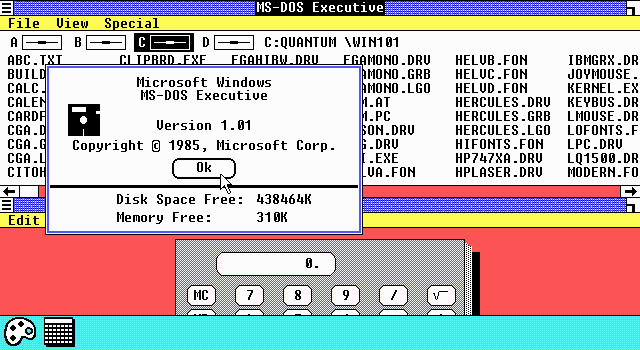
The first dock/taskbar appeared in Windows 1.01 in 1985: http://toastytech.com/guis/bigw101.gif
It next appeared in Acorn's Arthur OS in 1987: http://toastytech.com/guis/bigw101.gif
-
The dock/taskbar was invented by Microsoft.
All the posters citing NeXT's dock/taskbar and CDE are not going back far enough.
The first dock/taskbar appeared in Windows 1.01 in 1985: http://toastytech.com/guis/bigw101.gif
It next appeared in Acorn's Arthur OS in 1987: http://toastytech.com/guis/bigw101.gif
-
Re:So, it's basically Windows Vista again then?
Chicago changed enough times that it makes up for the same effect. Also, 2000/Me, and 98 were really just different colour schemes; that might be so minor as to fall below the radar.
For kicks, here is a collection of them: ToastyTech's GUI Gallery (Windows page.) -
Re:colors
-
Re:What linux really needs
(Yes, I know, don't feed the trolls and such, but for the sake of the dear reader:)
Maybe in your fantasy world, that is the case. Here in the real world, Microsoft wouldn't exist, if their product didn't work.
Yeah but who the hell has the balls to take them to court? And everybody knew their half-assed products always failed. What else were you going to use, Linux 0.2?
People can bash MS all they want, but still, the bottom line is, if their product didn't work (and in the early days, better than anything else), it wouldn't be as popular.
Because, you know, landing a lucky contract with IBM means you have skill.You're such an adorable little thing, aren't you? I hope you realise if MS didn't land the IBM contract, there would be no MS today. That little one-trick-pony BASIC shop would have died or been swallowed up.
IOW, Linux is free, so that blows the entire Linux "Piracy made windows what it is"... No, windows operability amongst all machines in the class (PC's), as well as a standard desktop (no "you can get whatever flavor desktop you want, don't like gnome, get kde".
No, you sir, are re-writing history.I told you plainly. The only reason Windows got its base popularity is because MS-DOS was chosen for the IBM PC. From that point on MS was rolling in dough and could afford to do anything.
Macintosh had a GUI second (GEOS on the COMMODeORE was first), and it cost so much to make the hardware and software, nobody bought that crap (LISA). Then Mac himself came out, and it looked like shit. Windows solved both, in that you could have a clone, or a real IBM, and BOTH machines acted the same way.
"Nobody bought that crap" because it came out a long time before windows.Wow, this is such superior technology!
And I hope you realise, you insentive clod, Amiga had the best OS for the longest time, up until BeOS came along. BeOS could run on PPC hardware and on x86. It was lightning-fast, multi-threaded, and was a commercial product. Not only that it had excellent hardware and software support, and "just worked" with its UNIX-like core. In ~1996. So, by that reasoning, shouldn't we all have been using BeOS?
Let's talk about a clone and an IBM, each one running a different flavor of linux, and different desktop GUI's, and then lets talk about support.
If Apple would have made GUI's affordable, MS never would have had an opportunity. Unfortunately, it took HOW many years for the Apple stuff to come down to realistic pricing?
Who cares about Apple, really. The real contender was BeOS and before that the Amiga.
"Different flavours" = different support? I think not. The only difference between linux distributions is package management, and it takes all of two minutes to make a package in another format. Or you know, god forbid, you could compile your programs, and image your hard drives.
Yeah, a EULA gets a company out of most trouble, but at the same time, MS wouldn't BE where they are if their product didn't deliver. Period.
Oh, it delivered alright. Clever troll aren't we? You know, there's plenty of people who don't deliver but still make a killing.
We call them criminals. MS is one of them.
-
Re:Not enough information
I agree this is too little information, so I will take advantage of the vagueness to walk a decade down memory lane.
Back in 1998 when I was first getting into Linux and other OSs--back when we thought OSs besides Windows had a chance because Windows was so crappy and all these others were so great--there were a couple experiments that were fun.- BeOS, as others have already mentioned, booted very quickly. I remember seeing it advertised at around 20 seconds after POST; on my 300 MHz AMD K6-2 it took about 30. On any newer system with a halfway decent disk you'd see boot times in the teens or less. One of the open-source BeOS clones might be worth looking at.
- Around that same time, QNX released a free demo that fit onto a floppy--one with (limited) NIC support and the other for computers with modems. Full TCP/IP stack, browser, shipped with a browser-based ring-stacking game (Towers of Hanoi) written in JavaScript. You can probably find copies of the image online. Ah, here we go, fifth match. I don't remember what floppy boot times were like but if you install it onto a CF card or something I bet it'd be great. (Can't get it to run in VirtualBox at the moment.)
- A bit later I bought a 1 GHz PIII HP Pavillion. After I replaced the 60 GB WD HDD with a 13 GB unit (big drives are for servers; clients get small drives) and replaced the trialware-laden WinME with Win98 boot times dropped from 35 seconds to 25. That's gotta be 6, 7 years ago by now... how old is your box?
- Not known for boot times but speaking of relatively fullfeatured alternative OSs, ReactOS might be worth looking into.
- Oh yeah, and way back in the late 1980s, my parents bought an AT or XT clone which booted from power off to a C: prompt in seven seconds. Great for running WordPerfect 5.1 and Banner Blue Movie Guide.
-
Re:You just don't understand
Windows 3.2 (Chinese Windows)
http://toastytech.com/guis/win32.html -
Re:Xbox Fiasco, Zune, Vista, Stock PriceMicrosoft has set back innovation in computer software by decades, How do you figure/calculate that? Take a look through the evolution of different GUIs based on Microsoft Windows.
http://toastytech.com/guis/
I am referring *only* to the Microsoft Windows sections.
The pattern to notice is that where there was once diversity, competition and innovation has all been strangled away. It's hardly an unfair URL either, the author is clearly someone I would label as a Microsoft fan boy. -
Re:Multi Touch
And the interface sounds strikingly similar to At Ease
-
Good User inteface Design Tips...
If you want to whiz off your users...
From http://toastytech.com/guis/uirant.html
General application user interface guidelines:
* Always use cute icons, buttons, and graphics. Everyone loves big red hearts, pink bunnies, and yellow smiley faces.
* Don't be afraid to experiment with colors!
* Your application should play fun sounds while operating to keep the users entertained.
* Never, ever, under any circumstance use the OS-native graphical controls or widgets. Users get bored of the same old buttons, text boxes, and stuff.
* When possible, disable window management and use unusual, oddly placed graphics for the windowing functions such as the window close option.
* When writing your own controls or widgets, make absolutely sure they look and feel nothing like the OS-native widgets or anything else the user might expect. Otherwise you might accidentally make the user think that your application is actually designed for their OS.
* Use your own creative ideas on how a "save as" dialog should look and work. Built in ones are always too limiting.
* It is important that the user should never be able to tell the difference between a checked and unchecked check box or option box.
* Always use obscure or poorly drawn graphics for your tool bar buttons, and never put text on them.
* Avoid including a preferences or options dialog. Instead, let the user use the standard OS provided text editor or an editor of their choosing to edit text configuration files.
* Users need time to think about what they are doing and get coffee. Your application should always take at least 5 minutes to load even on the fastest available computer.
* Make sure an accidental double-click on a single-click item does something really nasty or unexpected.
* Tool tips are the perfect way to display critical information.
* To get the most screen space, force your application to always run maximized.
* Always make the default positions of floating properties windows cover something important.
* Use the most exotic fonts you can find.
* Your application's user interface should be flexible and customizable to the point where if the user accidentally sneezes on the mouse or keyboard they will have to spend the next half an hour setting things back.
* Let a 5-year old draw your graphics, including your corporate logo.
* File browsing dialogs are not needed, users can easily remember and type in long file paths.
* Design your application so it requires the user to set their tiny monitor to 10512*7430.
* Always crash at a critical step and then display a fake apology to the user.
* It is a mistake to make use of application hooks in the native desktop environment such as new file templates, file associations, or program menu icons.
* The exception to the above is placing icons in the system tray. Place as many icons as you can in the system tray and make sure that the user can not remove them.
* If your program implements keyboard shortcuts be original and make them completely different from any other applications.
* Rent extra UI space in your application out for advertising. Advertising benefits the users and y -
Re:I don't get itAnd that's why this unbundling crap is so retarded and has been since the American antitrust case. OEMs will go right ahead and install the full suite of MS freebies anyway, even if they install others as well. It seems like it was planned that way. Take a look at all the screenshots here http://toastytech.com/guis/index.html The thing that jumped out at me most as I was looking at the historical Microsoft screenshots is how diversity has slowly been squeezed out of the market as Microsoft pushes more and more (of their own version of) things into the "core O/S".
I think diversity in O/S's, hardware architectures, standardized components of the system like browsers, shells, players, etc., and graphical environments is A Good Thing. All of the competition in the Microsoft Windows world has been extinguished over time and no amount of laws, complaints like Opera's are going to bring it back. In my opinion.
Since this is slashdot, I'll use a car analogy. Look at all the different colors, models, types of cars people buy when they're given a chance. Microsoft is like the Model T of cars. You can have any color of Model T you want, just so long as it is black. The monopoly part is that you can have any kind of car you want, just so long as it is a Model T, or you buy a Model T first. -
Chips and Dips
Actually, before it was Slashdot, it was "Chips And Dips", a section on Rob Malda's Personal site.
For a while archive.org had an archive of a Chips and Dips page, but it mysteriously disappeared. The files I retrieved are here: http://toastytech.com/files/chipsndips.html
I wasn't there myself at the beginning, I discovered Slashdot one of the first times C-Net News.com linked to it - and then I just stupidly hung around without signing up for ages until there was some article I wanted to comment on (probably something anti-IE)
BTW, anyone got the original Chips & Dips logo graphic? Archive.org never did have that. -
Packard Bell Navigator
I remember that. I also remember uninstalling it by mistake and not knowing how to get it installed again (was my first PC). Those were the days.
(hey look, someone has screen shots) -
Is Ballmer single?
You know, the last time Microsoft rolled out an operating system that was a complete market flop, the developer had to marry Bill Gates.
There are worse fates for a failed project's lead, I guess.
So the question now is: is Steve Ballmer single, or will he just take on a mistress? -
Re:Honorable mention: BeOS
It isn't just a GUI, browser and web server on that 1.44MB floppy. It's: boot loader, QNX real-time micro-kernel, process manager with full Unix/POSIX semantics, device manager, network manager, Unix filesystem, TCP/IP stack, ramdisk, auto hardware detection, XVGA graphics drivers, full windowing GUI, 3D vector graphics, web browser, web server, and demo applications. And with a little hacking you can open up a shell too. All in 1.44MB. Yes. Really.
Here's a link to the original demo:
http://toastytech.com/guis/qnxdemo.html
Here's the slashdot article on it:
http://slashdot.org/article.pl?sid=99/10/06/073421 3
And to all those Amiga folks who will jump in and say, "The Amiga could do that too!", no the Amiga had most of the graphical stuff in ROM...
Cheers,
AJ -
Statistic: IQ average is 100
This means there's going to be a lot of people out there making stupid choices, whether this is one of them or not (disclaimer: I don't particularly dislike Vista, and have never had a reason to buy a Macintosh). At least they're not demanding a more user-friendly OS.
-
Re:Fine...
-
You're still wrong. Firefox renders its own UI.
Firefox renders its own UI, rather than passing it on to Windows. Need proof? Run it on Windows 95 (with an updated comctl32.dll) or on Windows NT 3.51 SP5 (also with proper patches) or on NT 4.0. Notice how the menu bar behaves completely different than inside its own environment. No native app on 95 / NT looks like this.
Also check it out on XP. Right click on the scroll bar. There is no "Scroll Here" or other options.
Take a look here to see some examples of what I am talking about. A picture is worth a thousand words. -
Possible answer
BillG: that's the dumbest fucking idea I've heard since I've been at Microsoft.
TomEv: Even more than Microsoft Bob? -
Re:Clean experiences
Dear Microsoft,
Instead of a blue screen with random text, please show me a big yellow smiley face before rebooting my computer.
Thanks.
Like this?
http://toastytech.com/guis/bobboot1.gif -
What about BOB? He just won't DIE!
How can any Top 10 Worst list not include Microsoft BOB? Sacrilege!
I have noticed that BOB has made a reappearance in Microsoft Office Communicator as a "smiley", just as Rover from the Microsoft BOB suite reappeared in Windows XP's Search.
Just let BOB die, please! -
IE only sites make me a sad fox....
Obviously the typical answer to why some sites still only work in IE is "stupidity" and "laziness" but it boggles my mind that there are still sites out there like this. It is 2007 for crying out loud!
Just a few weeks ago I went through and updated my "Sites that Make Firefox sad" page: http://toastytech.com/good/badsitelist.html I was able to remove a large number of sites from this list as they appeared to be working in Firefox now, but I wound up ADDING almost just as many new sites to my list.
And my list still focuses mainly on sites that completely forbid Firefox, there are incredibly many sites that have various small glitches (like menus or spacing) in Firefox and no fix in site. And the WORST offenders are corporate Intranet applications. Companies are still "sold" on Microsoft. Heck, brand new "web" apps from Microsoft such as Exchange Web Access, Sharepoint, Project Server Web Access still either require IE or give other browsers a "downlevel" experience.
And the thing that really gets me is that Firefox can be a very good thing for companies - it is available for so incredibly many different platforms and works mostly the same on each - Firefox can help turn operating systems in to a true commodity! Each app that only works in IE (and arguably if it is IE only it really can't be called a true web application) just ties you down to Microsoft just that much more. -
Re:Harm Apple?
You mean the character that Microsoft ripped off from Berke Breathed in "Bloom County"?
http://toastytech.com/guis/banana.html
I'm very surprised that Berke Breathed never nailed Microsoft to the wall for copyright infringement, Max was such a rip-off of the Banana Jr. -
USB flash is everywhere!I really like USB flash drives these days, and this is coming from someone, who back in the day, wrote a floppy disk formatting program to get more than 1.4 megs out of 3.5" disks.
To me the best thing about flash drives is that they work almost EVERYWHERE now. There are drivers out there for Windows 95 ("B" version and up), Windows NT, and even DOS! Ok, here's a link. They will work on my Mac, Linux and even the eComstation (that's OS/2) demo CD I tried!
I used to think Iomega would rule the world with their Zip drives, but the prices of the disks always remained insanely high and the disks and drives were not as reliable as they should have been. Also, I don't think I ever saw anybody other than Iomega produce zip-compatible drives. Probably patents and BS.
-
Re:Oh please...
Nope, the case was Apple Computer, Inc. v. Microsoft Corp., 35 F.3d 1435 (9th Cir. 1994), summary here
Apple lost all claims except the trash can icon and file folder icons from HP's NewWave Windows application were infringing on their IP. The judges basically ruled that since Apple did not copyright the GUI and that because Apple and Microsoft had entered into an license agreement that included Microsoft Windows 1.0 it was a contractual matter, and dismissed those parts of the suit.
Hence Apple did not win. Although they did win the suit Xerox files against them for doing the same thing, granted that was because the statute of limitations ran out on Xerox. And who knows how that would have worked out as Apple did hire a couple of the PARC's designers to work on the MAC and IIRC paid Xerox some money (granted that may have been after the fact).
In 1997 Microsoft paid Apple $150 million that settled, among other things, once and for all the claims of infringement between the two companies. But that was more of a side note of the deal. -
Re:Can I do the following under OS X then?
I had very strong doubts, because Outlook+Exchange integration is an overdesigned house of cards with numerous dependencies, a nightmare for IT admins everywhere, but I decided to search on Google anyways:
http://toastytech.com/guis/wineo2knotes.html
Looks like they got Outlook 2000 working. They had to copy some rpc related dlls from a real Windows system, among other things. -
Re:You missed the pointThere were two of them actually, first Apple released a GUI shell for prodos in 1996 called Apple II Desktop, it had vital office applications such as er..calc, and notepad, and it looked vaguelly mac-like.
The GEOS operating system was released for the Apple II, but not until 1988. It had windows, it had a fairly nice office suite, it looked like a low budget rip-off of the Mac OS. I don't think this helped Apple's chances much, it was too little and far too late.
The bottom line is that Apple's greatest strength was their huge software library, which was also their greatest weakness as it tied them to the (none too gracefully) aging 6502.
I think it would have been possible to build a Mac-like UI on top of the Apple II. If they had done that, they could have built on their earlier success, maintained their huge library of software (which was a major driver of Apple II sales all through the 80s)
-
Re:so, what this seems to say
64 bit Vista doesn't run Win16 stuff.
Awwwww! I so wished we could have seen more Sick Windows Tricks. Oh well...
-
Dude, you're 100% right!
>> Windows itself is an extrapolation of other people's prior works at best.
This got me thinking... You know, Microsoft can't even claim to have invented windows. Pretty amazing... I had forgotten how late they've come to this game.
According to this link http://toastytech.com/guis/guitimeline.html , it took M$ about 12 (twelve) f* years to finish (?) a product that would "revolutionize" IT. -
Re:But who needs to download IE?
I got my second computer (first was a C64) when Win95 first came out. At first I really liked it, but after a few weeks I couldn't wait to get rid of it and went back to using my C64 primarily. Luckily I found out about Linux through a C64 IRC channel and have been a happy Linux ever since.
Win95 was awful. I really can't understand how anyone thought it was halfway decent. Maybe this was just because my first computer experiences were with Commodore (also used GEOS on it) and Macs in middle school. -
Re:I must be blind...
I sort of speak from a mid-90s perspective here, when I was using SGI computers because I just couldn't take how ugly X-Windows on Linux looked.
You weren't using X, you were most likely using CDE, which I also consider to be ugly.
No, he wasn't. He was using IRIX's proprietary desktop, which had nothing to do with CDE. The IRIX desktop was lightyears ahead of anything else coming out of the *nix camp at the time. Nice object-oriented file manager, excellent support for audio, video and 3D graphics and even its own widget toolkit.
And to say that you weren't using X, you were using CDE, is as silly as saying that you aren't using X, you're using GNOME. -
Overlapping Windows
Windows 1.01 didn't have to worry about Z order, since it didn't even allow you to overlap the windows! Window overlapping wasn't allowed until Windows 2.03, released in 1987. Here is an excellent reference.
-
Re:Some of them, yes
I never had IE4 installed, since after installation I removed the CD-ROM from the drive (the guy from the store where I had my PC assembled probably also did that). Except for once, when I suddenly saw a channel bar and such, which is how I know this.
It still meant IE3 was installed, though. Yes, I did some 'hacking' to not have it installed. I edited -
Re:Alto again ...
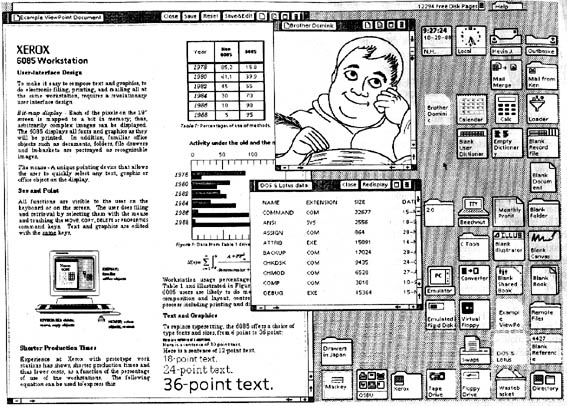
The Alto was released in 1973. The Xerox system Apple and Microsoft copied most of their GUI concepts from was the Xerox Star, which was the successor to the Alto. The Star was released in 1981, eight years after the Alto, and naturally included a much more modern GUI (with double-clickable file and folder icons on a desktop, dialogue boxes, etc.).
There's no 'club' of people trying to belittle Apple's contributions to GUIs, just a lot of Apple zealots who don't know the history of GUIs, and don't realise that most of Apple's GUI concepts were copied from earlier systems. Even today, when Mac OS incorporates a feature copied from elsewhere (even from relatively popular systems like MS Windows and Linux), Mac zealots almost invariably credit Apple with having invented the feature.
Hardly any new ideas in GUI or OS design have come from either Apple's or Microsoft's commercial OS groups, both of which are developing production as opposed to research systems, and this typically employ ideas previously used in research systems, together with less prominent commercial systems. The irritating thing about Apple zealots is that almost none of them seem to understand this, where as the typical Windows zealot at least realises that Microsoft copied most of the ideas in its systems from other sources (and, contrary to the beliefs of the Apple zealots, most of them were not copied from Apple). -
Re:Overlapping windows
I don't like working that way personally, and I suspect the reason we've moved away from that model is because most people don't. Remember the early Windows versions?
I think the throuble with tiling is that it simply doesn't work that well as a generic concept, there are simply to much applications around that are just to small to make sense in a tiled workspace, ie. a small calculator should overlap, not tile, since else he can't be seen in full and wastes a lot of screenspace. However in Blender or Emacs tiling works great, much better then MDI solution which present windows in a window, this is probally because Blender and Emacs deal with one kind of data only and don't have to work with hundreds of different applications which made have wastly variing requirements.
However, while tiling has a fair share of problems, our way to manage windows is also far from optimal, there is a lot of time wasted with moving windows around and aranging the screen in such a way that it is actually usable Apples Expose helps a bit, but real solution is probally to move to a fully zoomable desktop, so that one isn't restrited by screen borders, but can simply zoom out when more space is needed. This also helps a lot with orientation, since you can simply place everything side by side and still reach it and don't have to lower/raise yourself through a stack of windows.
It's not reasonable to expect such mnemonics, input through an alphanumeric keyboard, to work any other way -- unless you can think of a better one where alphanumeric input is both easy to remember and language-independent. Good luck.
How about an LCD Keyboard that actually displays those shortcuts so that you don't have to type them blindly in the first place? Might of course still take a while those are actually available and affortable, but the problem with shortcuts is certainly solvable in a better way.
I remember when some word processors and the like included a "smooth scrolling" option. No one used it. It turned out that most people wanted the screen to scroll quickly instead.
That isn't because smooth scrolling is a bad idea, but because it simply was badly implemented. Now I don't necesarily blame the developers for that, because some things simply can't be implemented well with todays hardware, ie. when I press down I don't want the screen to scroll automatically for half a second, thats just not really a good way of doing it. However I also don't want the screen to just jump around, since that is extremly disorientating. So what could the solution be? How about a pressure sensitive scroll button, the harder I press the faster it scrolls and scrolling both starts instantly when I press and stops when I depress. Or how about a scroll wheel that actually scrolls smoothly instead of just sending up/down events on every click?
-
Re:Obligatory disgruntled sarcastic comment
GUI Gallery is much better.
-
Re:Better timeline Full of FUD
> Alright, I think I can still call FUD on the GEOS unless the Apple II version supported dates up to and including 1995.
Which pic are you looking at? You are talking about this timeline, aren't you? I don't see any GEOS in the 1995 section, only BeOS (and Windows 95).
-
OS/2The link at Toasty Tech is much better than the original link. The original link seems to be focused on the GUIs of operating systems (OSes) targeted at consumers, but the Toasty-Tech link presents the GUIs for all major OSes.
The original link notably omits OS/2.
Whereas Windows 3.1 was a cooperatively multitasked OS, OS/2 was a pre-emptively multitasked OS just like UNIX. OS/2 was rock solid. In opinion, it had only 2 problems. It was released just slightly ahead of its time: OS/2 needed, at least, an 80486 to be adequately fast even though most consumers were running computers that had an 80386, an 80286, or even an 8088.
The second problem was that IBM did not give it away for free. Windows 3.1 was, in general, inferior to OS/2 although Windows 3.1 was perfectly matched to the underpowered processors at the time. Windows 3.1 often crashed. Even when Windows did not crash, it often froze when an application neglected to cooperatively relinquish the processor. Windows 3.1 main advantage was that it had the Microsoft name on it. If IBM had open-sourced OS/2 or given it away for free, then IBM could have wrestled the entire OS market from Microsoft. Most consumers would have chosen a free, rock-solid OS over a more expensive, crappy OS. Being free is important since most consumers are cheapskates.
Also, Windows 3.1 was actually based on the core code on which IBM and Microsoft had collaborated. After they terminated the joint project, IBM continued development on the core code and turned it into OS/2. Meanwhile Microsoft gutted the parts (e.g., preemptive multitasking) that, in its opinion, the consumer would not value and morphed the result into Windows 3.1.
When you look at the APIs for both OS/2 and Windows 3.1, you can see the common heritage of both products. More than half of the APIs have identical or nearly identical names and arguments.
If the common ancestor of both products were called "Homo Erectus", then OS/2 is Cro-Magnon man, and Windows 3.1 is the chimp that preceded Homo Erectus.
-
Cool
The Work In Progress window is a kind of task manager that shows which programs are running, which programs have finished running and shows any console output that the program may have generated.
Am I the only one who things that storing console output would still be a useful feature? It would make batch processing jobs a great deal easier. -
Re:Interesting, but...
I just posted the above comment and, now having seen this, stand corrected. Surely the likes of this will never be matched again:
http://toastytech.com/guis/bob.html -
Another excellent source for this bit of history
Another good site to look at for GUI history is Nathan Whitehorn's "GUI Gallery" here: The GUI Gallery. I like it because Nathan is actively developing it. He actually loads and runs these various environments before writing about them.
Either that, or that boy has way too much time on his hands
-Scott -
Better timeline
Man, must be a slowwwww news day...
Here is a link to a better timeline:
http://toastytech.com/guis/guitimeline.html Toasty Tech has some spiffy screenshots of various GUIs.
Ah, the memories... -
Re:Someday they will know !!!!!
As far as I can see they still are stealing from the Amiga
What did they steal from the Amiga?
1973: Xerox Alto. Bitmapped display, 3-button mouse, 16-bit CPU.
1981: Xerox Star screenshot.
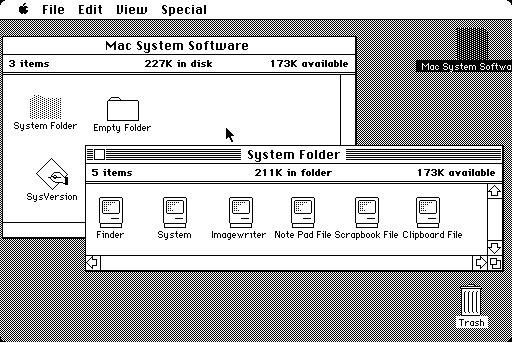
1984: Apple Macintosh.
1985: Amiga 1000.
1988: NeXT and OPENSTEP.
1990: Amiga pushing the boundaries of the GUI in 1990! Watch out Apple, NeXT and Microsoft!
Most of this from Nathan Lineback's Graphical User Interface Timeline.