Slashdot Mirror
Domain: toastytech.com
Stories and comments across the archive that link to toastytech.com.
Comments · 363
-
Re:Someday they will know !!!!!
As far as I can see they still are stealing from the Amiga
What did they steal from the Amiga?
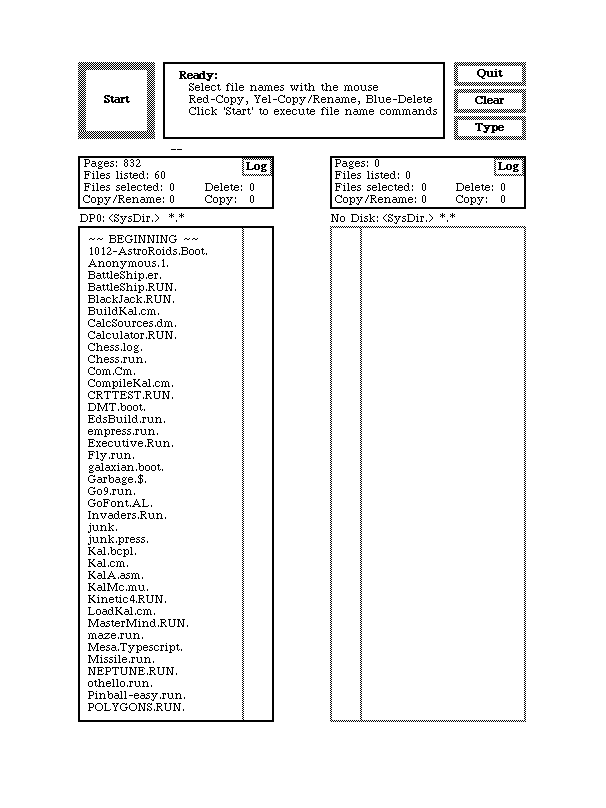
1973: Xerox Alto. Bitmapped display, 3-button mouse, 16-bit CPU.
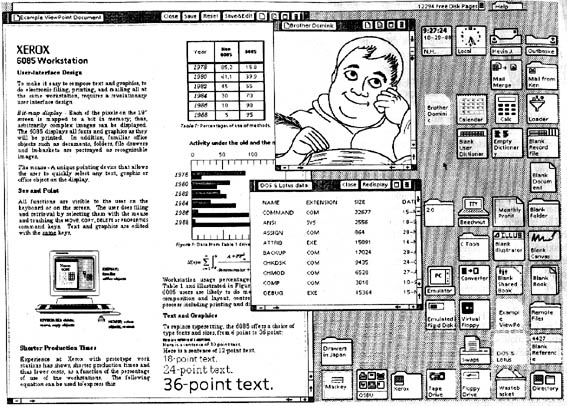
1981: Xerox Star screenshot.
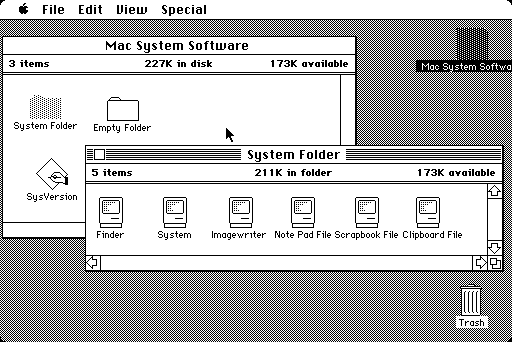
1984: Apple Macintosh.
1985: Amiga 1000.
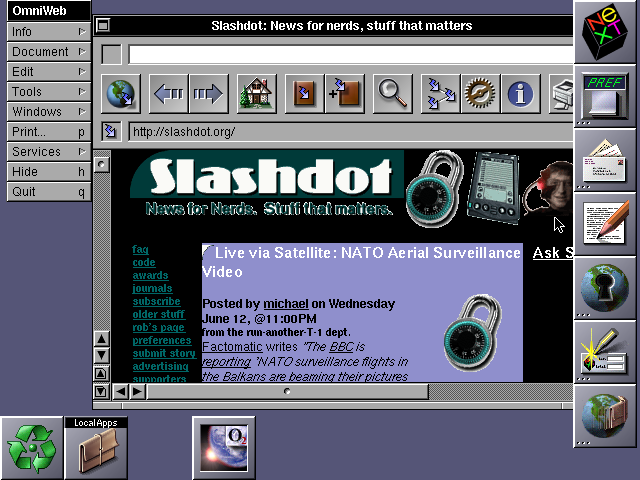
1988: NeXT and OPENSTEP.
1990: Amiga pushing the boundaries of the GUI in 1990! Watch out Apple, NeXT and Microsoft!
Most of this from Nathan Lineback's Graphical User Interface Timeline. -
Re:Someday they will know !!!!!
As far as I can see they still are stealing from the Amiga
What did they steal from the Amiga?
1973: Xerox Alto. Bitmapped display, 3-button mouse, 16-bit CPU.
1981: Xerox Star screenshot.
1984: Apple Macintosh.
1985: Amiga 1000.
1988: NeXT and OPENSTEP.
1990: Amiga pushing the boundaries of the GUI in 1990! Watch out Apple, NeXT and Microsoft!
Most of this from Nathan Lineback's Graphical User Interface Timeline. -
Re:Someday they will know !!!!!
As far as I can see they still are stealing from the Amiga
What did they steal from the Amiga?
1973: Xerox Alto. Bitmapped display, 3-button mouse, 16-bit CPU.
1981: Xerox Star screenshot.
1984: Apple Macintosh.
1985: Amiga 1000.
1988: NeXT and OPENSTEP.
1990: Amiga pushing the boundaries of the GUI in 1990! Watch out Apple, NeXT and Microsoft!
Most of this from Nathan Lineback's Graphical User Interface Timeline. -
Re:Someday they will know !!!!!
As far as I can see they still are stealing from the Amiga
What did they steal from the Amiga?
1973: Xerox Alto. Bitmapped display, 3-button mouse, 16-bit CPU.
1981: Xerox Star screenshot.
1984: Apple Macintosh.
1985: Amiga 1000.
1988: NeXT and OPENSTEP.
1990: Amiga pushing the boundaries of the GUI in 1990! Watch out Apple, NeXT and Microsoft!
Most of this from Nathan Lineback's Graphical User Interface Timeline. -
Re:Someday they will know !!!!!
As far as I can see they still are stealing from the Amiga
What did they steal from the Amiga?
1973: Xerox Alto. Bitmapped display, 3-button mouse, 16-bit CPU.
1981: Xerox Star screenshot.
1984: Apple Macintosh.
1985: Amiga 1000.
1988: NeXT and OPENSTEP.
1990: Amiga pushing the boundaries of the GUI in 1990! Watch out Apple, NeXT and Microsoft!
Most of this from Nathan Lineback's Graphical User Interface Timeline. -
Little Investigation
Ok, there seems to be some errors and misfirings here, so I will attempt to clarify and align some dates and times.
Because of the lack of evidence, I have to bring things from numerous sources.
The article "AICN under fire" attributed earlier in this discussion as having the first archived comment was spidered by the internet archive on January 13th 1998 at 19:44:55.
This is not the earliest slashdot article and comment I found.
During the same spidering run by the archive, the spider grabs more than a single page. slashdot has a link to previous article which can be followed in the archive.
Following this link leads to comments starting on the 9th of January 1998 at 16:20:
Intel Releases 266 Pentium (sidenote: wow, I had one of those for ages)
Pentium Bug
Jasper Nuyens
Fri Jan 09 at 4:20PM EST
Just a question that came into my mind:
is the (quiet old) pentiumbug still 'working' on this faster processor? I don't know much of processor-development but I understood it takes alot of time to finish such a thing.
Jasper
A sibling poster has remarked that slashdot cannot find any of its comments for the 1998 year, this appears to be correct.
The first comment in the live slashdot database appears to come on 1st January 1999.
Moving back onto the articles, slashdot articles appear to begin in the live slashdot database on 1st January 1998:
http://slashdot.org/article.pl?sid=98/01/01/012000
This probably marked a change in the database and web interface format because previously (and concurrently as it happens) the articleID was a numeric.
I found the same article had been archived as well as being live using its old artnum variable and the new date format.
This ties the articles with their origins, and extrapolating back at about 2-3 articles per day brings the artnum back to the start which roughly matches up with with the Chips&Dips days (if I were creating a system it makes sense to start with article 1)
http://web.archive.org/web/19980113193426/slashdot
And its live version:
http://slashdot.org/article.pl?sid=98/01/09/122900
Now, a couple of questions for Taco (if he finds out about my little big of digging),
Do the artnum references actually go all the way back to the C&D database?
what happened to the earlier comments and articles? (it looks like a choice to simply upgrade the db to me)
do you still have them from your C&D/early slash days? (theres an archive grabbed and stored from Chips & Dips in July '97 here)
Was the time between C&D and slashdot a quick changover with essentially no stopping, or did you have a break for a while?
Mini timeline
yyyy mm dd artnum notes
1997 07 29 0xxx Front Page: Chips & Dips archive
1998 01 01 0xxx Article: Become 007 On The Internet First live article, no comments
1998 01 08 0403 Index: Smurf Attacks First article reference in archive (lo -
Little Investigation
Ok, there seems to be some errors and misfirings here, so I will attempt to clarify and align some dates and times.
Because of the lack of evidence, I have to bring things from numerous sources.
The article "AICN under fire" attributed earlier in this discussion as having the first archived comment was spidered by the internet archive on January 13th 1998 at 19:44:55.
This is not the earliest slashdot article and comment I found.
During the same spidering run by the archive, the spider grabs more than a single page. slashdot has a link to previous article which can be followed in the archive.
Following this link leads to comments starting on the 9th of January 1998 at 16:20:
Intel Releases 266 Pentium (sidenote: wow, I had one of those for ages)
Pentium Bug
Jasper Nuyens
Fri Jan 09 at 4:20PM EST
Just a question that came into my mind:
is the (quiet old) pentiumbug still 'working' on this faster processor? I don't know much of processor-development but I understood it takes alot of time to finish such a thing.
Jasper
A sibling poster has remarked that slashdot cannot find any of its comments for the 1998 year, this appears to be correct.
The first comment in the live slashdot database appears to come on 1st January 1999.
Moving back onto the articles, slashdot articles appear to begin in the live slashdot database on 1st January 1998:
http://slashdot.org/article.pl?sid=98/01/01/012000
This probably marked a change in the database and web interface format because previously (and concurrently as it happens) the articleID was a numeric.
I found the same article had been archived as well as being live using its old artnum variable and the new date format.
This ties the articles with their origins, and extrapolating back at about 2-3 articles per day brings the artnum back to the start which roughly matches up with with the Chips&Dips days (if I were creating a system it makes sense to start with article 1)
http://web.archive.org/web/19980113193426/slashdot
And its live version:
http://slashdot.org/article.pl?sid=98/01/09/122900
Now, a couple of questions for Taco (if he finds out about my little big of digging),
Do the artnum references actually go all the way back to the C&D database?
what happened to the earlier comments and articles? (it looks like a choice to simply upgrade the db to me)
do you still have them from your C&D/early slash days? (theres an archive grabbed and stored from Chips & Dips in July '97 here)
Was the time between C&D and slashdot a quick changover with essentially no stopping, or did you have a break for a while?
Mini timeline
yyyy mm dd artnum notes
1997 07 29 0xxx Front Page: Chips & Dips archive
1998 01 01 0xxx Article: Become 007 On The Internet First live article, no comments
1998 01 08 0403 Index: Smurf Attacks First article reference in archive (lo -
Re:What is worse that a first post?
How about going back to the proto-slashdot!
Chips & Dips was Rob's college "blog" which eventually became slashdot.
Some guy has made a page and archive of it, its clear to see the ancestry. -
Re:What is worse that a first post?
How about going back to the proto-slashdot!
Chips & Dips was Rob's college "blog" which eventually became slashdot.
Some guy has made a page and archive of it, its clear to see the ancestry. -
Back in the QNX day ...
Why I remember the QNX demo floppy disk (all 1.44MB) packing the OS (posix compliant), GUI, PPP or networking, Web browser, file browser, and several demo applications including web server, vector graphics program and a text editor. Pffft kids today
-
50 megs?
Pfft, I remember playing with a bootable floppy containing QNX with a complete GUI, web browser, texteditor and full network support.
Ok, it had absolutely _nothing_ else but it was still damn cool. -
Disappointed
I thought this might have finally been a reality.
-
Already tried
Microsoft already tried placing small items/thumbnails in a "3D" environment. It was called Microsoft Bob and it failed completely.
-
Re:This reminds me of....
Heh, remember MS Bob? To bad that software isn't still being sold. I would LOVE to see a fight between MS and Walmart. Battle of the titans!!!
http://toastytech.com/guis/bobboot1.gif -
Re:Annoyance as a marketing technique?Um, never? Can you point me to a few of these? I use Firefox all the time and have NEVER encountered one. Yes, not once.
You must not get out much on the web, especially in a corporate environment.
There are a list of some here: Sites that Make Mozilla Sad
And even more can be found here: Mozilla Reporter Database
But the worst sites are on corporate Intranets or behind logins.
At work I am expected to use Microsoft Project Server Web Access. This archaic piece of trash requires IE because it uses ActiveX. The webby app we use to manage our Outlook/Exchange profile info only works in IE. Our Exchange web access e-mail only provides a crippled interface to anything other than IE.
Then I get this thing in the e-mail about Oracles new web site with a link to a presentation here - but don't open this in Firefox or it will crash! that only works in IE.
I had to repeatedly e-mail certain folks when links with illegal backslashes showed up in links on the department web site. They finally fixed those but there are several apps on the site that require or claim to require IE. (What the hell: here , here, , here and the system that we now have to use to get our pay checks says here (login required) that "Internet Explorer (version 5.5 or higher) is the only supported web browser for Employee Self Service. Using any other browser may affect your ability to gain access." It mostly works but the the help system requires IE.
Then the other day I am trying look up info on my home warranty and I find this part of their site: Aon Home Warranty
So anyway yes they exist. Yes, real people run in to them all the time. And the Firefox community needs to do something to fight back.
-
Excellent!
I am SO looking forward to upgrading from Windows 3.2!
-
Damn Small Linux (50MB)
Well, if he don't like what's out there - he's the prof with lots of grad student slaves, ah - I mean assistants.
IF Damn Small Linux, at 50 MB is still too big for him,
he can reverse engineer some GEOS type O.S. user interface.
Anyone up for making a GEOS Linux distribution?
Strip all the extras from Linux, and give it a GEOS type interface instead of KDE or Gnome,
add in color, firefox, and a trimmed down version of the Open Office Suite, it should be good to go.
Considering the GEOS GUI was running on C>64 machines back in 1985,
he should have no problem hand coding his own version of DCLL [Damn Cheap Laptop Linux]!
I thought some of these MIT guys were tech geeks, after all ? -
Re:Transitions....
It isn't that hard to get win 2.0 programs running in XP. You can down load the programs that came with windows 1.0 and 2.0 here: http://toastytech.com/guis/misc.html and they run under windows XP.
-
Re:What's bright....You're right, Google doesn't have the lockin with their search engine that Microsoft has with all the software that people can't move away from. I'm dubious that anyone will be able to reproduce Google's success with search engine technology, but it's always possible.
But that's all beside the point. I wasn't claiming that Google would always dominate searching the way Microsoft seems destined to always dominate PC software. I was simply pointing out that Google, like Microsoft, doesn't have to pay for their mistakes — they have enough cash coming in so they're not in trouble when they screw up. And they have screwed up.
Not in the same way Microsoft has, of course. Microsoft screws up with bad QA, mind-boggling feature bloat, and the odd product nobody could possibly want. The computer geniuses at Google have more professional pride than that. Their products are well tested, unbloated, and extremely useful — they just never seem to finish them.
-
Re:But, Dr Evil...
Interex is similar in all but a technical sense to Cygwin. He's talking about something more like OSX for Windows. From an OSX perspective he's be replacing the Darwin layer with Windows and making the
-
Re:The problem is...
Firefox 1.5 is available for OS/2 Warp 4 (with updates applied) and eComStation. There are a couple of screen shots of it here: http://toastytech.com/guis/ff15t2.html
-
Re:probably never.
With the migration to Intel the "Mac Tax" is more evident. This puts pressure on the geek market. Many of us would like to have a machine to run OS/X. That word "machine" is key. I'm not buying an Apple unless I can use another OS on it. My first preference is that it boot Windows as that is what I need at work and for home use. Next is Linux. So why would these new machines appeal to me? Outside of the mini the new ones will be too expensive for something just to play with.
Exactly. Most regular users don't know or care about operating systems and computers, so to them a Mac is something unique. A Mac to geek users, however, is now just a PC with OS X and a pretty case. I am under the "geek user " category. I love OS X (heck, I'd install Rhapsody on my PC if I had a Rhapsody disk), but I'm not going to shell out $$$ for new hardware that is exactly the same as what I currently have.
And to those Mac users who say that the point of a Mac is OS X, what if you're using OS X on your Dell or eMachines box (especially if the drivers work well)? Is that the Macintosh experience?
Finally, I still have some animosity toward Apple's switch to the x86 in general. Yes...IBM G5 sucks heat...Intel's laptop's chips are cooler...G4 sucks...users don't care...OS X is still shiny and snappy....blah blah blah, but I'm still disappointed with the switch. The x86 architecture sucks from a architectural standpoint compared to most of the other architectures out there, but I recommend that you read printed pages 10 and 16 of Rob Pike's Systems Software Research is Irrelevant (PDF warning). It best discusses the lack of diversity and innovation in hardware, in words better than I describe.
-
I take offense to that assumption. IE is EVIL!Churchgoing folks are generally conservative, and thus more likely to use more typically corporate/conservative software (thus IE).
I am so offended. Behold:
-
Re:like a desktop
then create an interface where the computer places virtual objects in your environment in a natural fashion
Microsoft is way ahead of you. -
Re:Unix was tried and failed ...
microsoft created OS/2 v1 for IBM when the big blue released the first PC-AT based around intel's 80286 (they still had the 80 prefix at that time). the objective was to take advantage of 286's protected mode, which allowed the OS to use a flat 16 MB memory space and multitasking capabilities.
it was a fiasco for several reasons. one of them was the 286 could switch from "real mode" (in this mode it was little more than a glorified 8086) to "protected mode" (with all the new features), but there was no way to switch back to real mode. the result was that to run MS-DOS (which required "real mode") they needed some ugly hacks, and the compatibility was far from perfect, specially for things like lotus 1-2-3.
when they added a GUI, things became even worse. if you tried to run a real-mode DOS app in full (text) screen, it was almost impossible to switch back and forth between graphical an text mode. the reason was the EGA graphics cards. those older cards (CGA, Hercules, EGA, etc.) had write-only registers. this meant that the OS had to keep a table in main memory with a copy of the registers, otherwise it was impossible to know the state of the graphics card. since DOS apps had direct access to card's registers, it was impossible for OS/2 to know in wich state DOS programs left the graphics card, making switching modes impossible.
the GUI was called "desktop manager" and looks pretty much like windows 3.0's. here's some screenshots -
Time to switch dudeReally? I'm a customer of Rhapsody.
Switch to OS X already. Rhapsody is way out of date.
-
Sun's Dancing Screenshots URL, +Comment
Sun URLs show several different slideshows of what this interface looks like in use. It's pretty cool, if gratuitous and annoying, and I wouldn't waste screenspace on it unless I had a much larger screen than my laptop has. Basically you've got a 3D space, and instead of windows being parallel to your screen, they can be turned arbitrarily, stacked in front of each other, etc. So you can have windows sitting half-sideways in perspective scattered around an image of Stanford campus or your apartment, like an improved version of the Microsoft Bob Family Room, just waiting for your cursor to be a friendly animated dog.
-
Another 20th anniversary: GeOS
It's also the 20th anniversary of GeOS on the Commodore 64.
-
fertile ground? more like BS
Is that why they "invented" Microsoft Bob?
-
Time for me to upgrade from Netscape 3!
*Sigh* now slashdot won't look so good in my collection of old browsers. I actually used to rely on Netscape 3 on some slower computers until around the release of Mozilla 1.0. Well, at least the latest Seamonkey and Firefox Deer Park will run on Windows NT 3.51 Just try that with IE!
-
Re:Hrmph.
I have always felt that Linux is a nice operating system (for hobbyists and geeks), but there are some areas where it is seriously lacking, especially when compared to its main competitor, Microsoft Windows.
* File sharing. Windows has long been superior when it comes to making large amounts of files available to third parties. Even early versions of Windows automatically detected and made available all directories thanks to the built in NetBIOS-powered file sharing support. But Microsoft has realized that this technology is inherently limited and has added even better file sharing support to its Windows XP operating system. Universal Plug and Play will make it possible to literally access any file, from any device! I think universal file sharing support needs to be built into the Linux kernel soon.
* Intelligent agents. With innovations like Clippy, the talking paperclip and Microsoft Bob, Microsoft has always tried to make life easier for its customers. With Outlook and Outlook Express, Microsoft has built a framework for developers to create even smarter agents. Especially popular agents include "Sircam", which automatically asks the users' friends for advice on files he is working on and the "Hybris" agent, which is a self-replicating copy of a humorous take on "Snow-White and the Seven Dwarves" (the real story!). Microsoft is working on expanding this P2P technology to its web servers. This project is still in the beta stage, thus the name "Code Red". The next versions will be called "Code Yellow" and "Code Green".
* Version numbers. Linux has real naming problems. What's the difference between a 2.4.19 and a 2.2.17 kernel anyway? And what's with those odd and even numbers? Microsoft has always had clear and sophisticated naming/versioning policies. For example, Windows 95 was named Windows 95 because it was released in 1995. Windows 98 was released three years later, and so on. Windows XP brought a whole new "experience" to the user, therefore the name. I suggest that the next Linux kernel releases be called Linux 03, Linux 04, Linux 04.5 (OSR1),
Linux 04.7B (OSR2 SP4 OEM), Linux 2005 and Linux VD (Valentine's Day edition). Furthermore, remember how Microsoft named every upcoming version of Windows after some Egyptian city? Cairo, Chicago and so on. I think that the development kernels should be named after Spanish cities to celebrate Linux' Spanish origins. Linux Milano or Linux Rome anyone?
* Multi-User Support. This has always been one of Microsoft's strong sides, especially in the Windows 95/98 variants, where passwords were completely unnecessary. Microsoft has made the right decision by not bothering the user
with a distinction between "normal" and "root" users too much -- practice has shown that average users can be trusted to act responsibly and in full awareness of the potential consequences of their actions. After all, if your operating system doesn't trust you, why should you trust it? (To be fair, Linux is making some progress here with the Lindows distribution, where users are always running as root.)
With Windows XP, Microsoft has again improved multi-user support. Not only does Windows XP come with a large library of user pictures that are displayed on the login screen, such as a guitar and a flower, i -
No
The code name for the project would be Minneapolis and the final product would be called Opportunity.
-
Measles?
Aren't people supposed to have had measels as kids and be done with it?
Or was that virus spreading among the developers of their next OS: Bob II, which is to follow Vista? -
How hard can it be to crack Windows 3.2? (Chinese)
-
RIP
Microsoft BOB
*Sniff* -
Re:There is a price for what you want
Apple's At Ease is nothing like Microsoft Bob. The only real simularity is that they are both shells that sit over their host OS. If anything, Microsoft Bob is ripped off from programs like Packard Bell's Navigator.
-
Re:There is a price for what you want
Apple's At Ease is nothing like Microsoft Bob. The only real simularity is that they are both shells that sit over their host OS. If anything, Microsoft Bob is ripped off from programs like Packard Bell's Navigator.
-
Re:There is a price for what you want
Apple's At Ease is nothing like Microsoft Bob. The only real simularity is that they are both shells that sit over their host OS. If anything, Microsoft Bob is ripped off from programs like Packard Bell's Navigator.
-
Re:Heh
I think it's the most over rated piece of software ever built
When we polarize issues such that one side is "ultimately good" and the other is "ultimately bad," we put ourselves at risk for embarrassment and then further entrenchment and violence.
I do this not to break the spirit of someone who has become smitten with his new toy or his new friends; I do this for enlightenment, so that we may all see how even the best among us are human and make mistakes. Behold what your new love has done. Betwixt the speed and the compatibility, betwixt the games and primary colors, behold your lover. Behold the puppy dog and the smiley on the screen at the same time. Behold: Microsoft Bob. -
Another great page on all GUIshttp://toastytech.com/guis/index.html has a great gallery of all GUIs and little bits and pieces of screenshots.
Nice site to look at and poke around.
-
Re:Linux is still growing
Ah, how the mac people forget rhapsody
http://toastytech.com/guis/rhap.html
Which I know runs on x86 because I have a copy. -
Re:Better question:
* OpenBSD is focused 100% on security. They very tightly audit their code and control what goes in the distribution. In theory it shares code with FreeBSD, but in practice it lags behind (ie: last I knew it doesn't even have multiprocessor support because of security complications).
* NetBSD is designed with portability in mind. It runs on 17 different CPU families and over 60 different machine architectures. I've a feeling that the embedded systems folks love this OS. Because of the multiplatform focus it does lag somewhat in single-platform features.
* FreeBSD is the "mainstream" BSD distribution. It supports a range of modern x86-32 and x86-64 hardware with multiprocessor support (and has ports to some other supported CPUs where things like multiprocessor may not work), and enjoys features like a Linux compatibility layer (so you can run Linux x86 binaries, including 3D accelerated games like Unreal Tournament 2004). For it's users, the FreeBSD Ports Tree is the greatest software repository and distribution method in the know universe (eg: "cd
* OSX is Apple's custom version of FreeBSD that only runs on Macs. The focus here is a friendly, hugable user interface slapped over the Unixy FreeBSD core. The concept is a bit like Microsoft Bob but without making you want to kill yourself quite so badly, the implementation is not terrible. I would say more, but I'm tired of people saying how "great" OSX is then pointing to the shiny UI. A shiny UI does not a great OS make, although it certainly is no worse or better than Windows XP when it comes to running applications (provided applications are available for it).
If you're not sure which one to try, install FreeBSD with the Gnome desktop. It has the potential to be an interesting afternoon's learning experience and there is a lot of documentation to guide you if something goes wrong. Get FreeBSD from the official site or via BitTorrent (and always check the MD5's from the official site after downloading).
I really like FreeBSD - however, I'm now officially tired of messing with my computer for the sake of messing with my computer. Linux and FreeBSD have both worn out their welcome in favor of Windows XP with it's autoupdate feature. Hey, Windows XP runs Firefox AND all my games. -
Freedom from corporate bloggers!
Funny comment, but are you getting paid to be here? I see your sig leads to an insurance add. Therefore, you suck
That being said, order office today! -
Re:Uhhh.... DUH~!
microsoft tried once
-
Re:Yeah, but...
True, but couldn't some of the things we've learned from building houses have been applied to writing software ?
you haven't used Bob lately have you? -
Re:Symphony looks like the Apple Lisa?It's just you. The Lisa interface was, essentially, indistinguishable from the early Macintosh interface. If anything, Symphony OS looks more like a cross between Windows XP and that new widget environment in OS X 10.4 (Dashboard?).
The Lisa interface would be immediately familiar to anyone accustomed to modern GUIs. It had all the expected behaviors:
- icons representing disks, applications and files
- double clicking to open files or launch applications
- a trash can into which items could be dragged to be deleted
- overlapping, movable, resizable windows
- pull-down menus in the same arrangment we see today (File, Edit,
- a clipboard supporting multiple data types
- and applications that were, essentially, indistinguisable from their modern equivalents
- icons representing disks, applications and files
-
Re:Symphony looks like the Apple Lisa?It's just you. The Lisa interface was, essentially, indistinguishable from the early Macintosh interface. If anything, Symphony OS looks more like a cross between Windows XP and that new widget environment in OS X 10.4 (Dashboard?).
The Lisa interface would be immediately familiar to anyone accustomed to modern GUIs. It had all the expected behaviors:
- icons representing disks, applications and files
- double clicking to open files or launch applications
- a trash can into which items could be dragged to be deleted
- overlapping, movable, resizable windows
- pull-down menus in the same arrangment we see today (File, Edit,
- a clipboard supporting multiple data types
- and applications that were, essentially, indistinguisable from their modern equivalents
- icons representing disks, applications and files
-
Microsoft's Most Successful Failure
Microsoft Bob! Oh, wait. Successful failure... hmm... Ah! Windows Millennium Edition (ME), without a doubt! This insecure, rushed, overhyped, bug-ridden excuse for an operating system should've gone the way of Bob and New Coke even before it was officially released.
-
Re:OO is all very well...
Me? I'm waiting for Bob...
-
Re:Time to call out the old folks
Yeah, back when it was called Chips & Dips. It was actually a pretty decent site, even back then. The only reason my Slashdot ID isn't smaller than it is, is that I didn't see the need to get one when they were first issued.