Slashdot Mirror
Domain: toddverbeek.com
Stories and comments across the archive that link to toddverbeek.com.
Comments · 36
-
Re:The terrorists won, beyond their wildest dreams
The Onion has an article joking that Americans enjoy remembering 9/11 more than we enjoy remembering the 10 years since. It's true, and you can hardly blame us. On 9/11, despite the pain and fear, we saw scenes from around the world of people weeping along with us, or standing firmly in solidarity with us, because they saw this attack on the US as an attack on civilized people everywhere. Sure, there were some assholes cheering here and there, but there was also the Queen of England having "The Star Spangled Banner" played at Buckingham Palace, and countless makeshift US flags and signs saying things like "we are all Americans today" being waved at vigils in the streets around the world.
Then George W. Bush – with the support of the American people – pissed all over that goodwill, to the point that the Nobel committee eagerly handed the Peace Prize to the new guy when "regime change" finally happened.
I wrote this on 9/12/2001. I sent it in to the local newspaper, and they ran it on the front page of the Opinion section the following Sunday, next to a big picture of Osama Bin Laden and an article about what America would do in response. As my words were being read, they were already being ignored. Fear and Hatred won.
-
another Hope College alumnus
I was a CS major at the same college as Rob Malda several years before him. I worked in the CIT dept there when he was a student, but I never met him (maybe I reset his password), so that's as close as I get to having an actual connection to early Slashdot. As you can see from my 6-digit UID I wasn't even an "early adopter". (Doing theater with Gillian Anderson in high school is my real I-knew-someone-famous claim.)
One of my CS profs (Herb, in case Rob reads this) commented my senior year that I was not as good a CS student as I could have been. I had to agree with that. I think it was mostly because I had too many other interests (college newspaper, radio, student government, fraternity). I'm smart, and I was good, but I didn't have the hacker drive that Rob obviously had. Which is why he created Slashdot, and I... didn't. I did some half-assed early stuff on the web in the mid-1990s, but didn't follow through with it.
Evidently we're both at "what do I want to do with myself now?" points in our lives. But damn, I wish had something like this to look back at. So some advice to the younger folks (which is most of you, it seems): do what Rob did. Not the same thing, of course. But do something. Make something. And do it now. So that when you're having your mid-life crisis, it won't be tinged with regret.
-
Re:Digital has been around for awhile.
Here's a detail of the above-linked image.
-
Re:Digital has been around for awhile.
A bit closer in time to the Kodak project was an exhibit/activity at the Museum of Science and Industry in Chicago in (I think) 1978. The subject sat in front of a video camera which fed its signal to a computer, which did an analog-to-digital conversion and produced a "portrait by computer": overprinting characters on a dot-matrix printer to produce the right tonal value for each (rather large) pixel. When I sat for it, this was the result. I was really into photography (darkroom in the basement, etc), and this helped spark my interest in computers; I started saving my nickels and bought an Atari 400 a couple years later.
-
Re:Can we drink it?
More importantly: Can you go sailing on it? Swim in it? Fish salmon, trout, and invasive asian carp from it? Ride a scooter along hundreds and hundreds of miles of it?
If not, I'll stay here in Michigan, the Great Lakes State.
We're Bi-peninsular and Proud.
Yes! Michigan!
(This message has been a public service announcement, brought to you in cooperation with the Michigan tourism office and my summer travel plans.)
-
Re:No mobility in blue-collar jobs
I hear that claim from time to time, but in practice I've never met anyone who got the chance to travel freely and didn't take it, unless they were already shackled down by a spouse or children.
In that case, I'd like to introduce myself. I used to travel a lot (19 countries, sometimes a month or more at a time), but not so much anymore. No spouse or children. I still go places (planning a week-long scooter trip along Lake Michigan for this summer) but I just prefer staying at home most of the time. If you really haven't met anyone like this before, maybe you need to try harder to actually meet people in the places you travel to, or at least try harder to listen and understand them, instead of (from the sound of it) going there and burying your face in your laptop and projecting your own values onto everyone else. Because I know lots of people who simply find travel a nuisance, and who find things like spouses, children, and communities to be anything but "shackles". Not that they're "right" and you're "wrong"... but clearly there are more things in heaven and earth than are dreamt of in your philosophy.
-
Re:Trust No One
The truth is in here
-
Re:I almost feel bad about this........
In the interest of full disclosure: the Mac SE web server site is currently running on a Linux box, as a placeholder while I figure out a better place in my data center (read: "apartment") to set up my Mac SE and Windows 3.1, and 386 floppy web servers.
More closely related to this article (but not quite the same kind of thing), my current project is to run OS X on a Mac SE. Before anyone imagines an unholy hack involving PowerPC CPU replacements and XPostFacto, or calls bullshit on me, it actually involves stuffing a replacement monochrome VGA CRT and the innards of a G4 Mac Mini inside the SE case, with an iMate to connect the ADB keyboard and mouse. I call this machine the "Macintosh SE X". Most of the basic specs of the finished machine are roughly 1024x the specs of the original machine from 20 years ago: 1GB RAM instead of 1MB, 700MB recordable media (CD-R) instead of 800KB (floppy), 80GB hard drive instead of 20MB. I'm more of a shade-tree software hacker than a hardware hacker, so the "fit and finish" on it is a bit rough, but it's working pretty well so far. I'll put up a page about it when it's completed. -
Re:I almost feel bad about this........
In the interest of full disclosure: the Mac SE web server site is currently running on a Linux box, as a placeholder while I figure out a better place in my data center (read: "apartment") to set up my Mac SE and Windows 3.1, and 386 floppy web servers.
More closely related to this article (but not quite the same kind of thing), my current project is to run OS X on a Mac SE. Before anyone imagines an unholy hack involving PowerPC CPU replacements and XPostFacto, or calls bullshit on me, it actually involves stuffing a replacement monochrome VGA CRT and the innards of a G4 Mac Mini inside the SE case, with an iMate to connect the ADB keyboard and mouse. I call this machine the "Macintosh SE X". Most of the basic specs of the finished machine are roughly 1024x the specs of the original machine from 20 years ago: 1GB RAM instead of 1MB, 700MB recordable media (CD-R) instead of 800KB (floppy), 80GB hard drive instead of 20MB. I'm more of a shade-tree software hacker than a hardware hacker, so the "fit and finish" on it is a bit rough, but it's working pretty well so far. I'll put up a page about it when it's completed. -
I almost feel bad about this........
Brings back the memory of this site, which is hosted on a Mac SE: http://oldmac.toddverbeek.com:8012/
let the slashdot effect commence! -
Re:This is an excellent idea...
This challenge is similar to the 24 Hour Comic. This was a challenge issued many years ago by cartoonist Scott McCloud to one of his friends, who had a tendency to take days (at least) to finish a single page of art. The goal was to write and illustrate a 24-page comic book in just 24 hours, starting with 24 blank sheets of paper and ending with a finished story. (By comparsion, a typical issue of a DC or Marvel superhero comic takes 4 or 5 creators a whole month to produce.)
It's a great exercise. (I've tried twice and succeeded once.) It forces you to set aside whatever's preventing you from getting things done, and create. Forget "I don't have time"; it's only one day. Forget the need to get everything "just right"; the deadline for each page is only an hour away. Just do it. The results are usually far from perfect; no one produces their "best" work like this, and that's not the point. It's an eye-opening exercise, showing the cartoonist what he can accomplish - and how efficiently - if he tries.
In many ways it's like the punk rock ethos vs. the studio rock of the 70s, favoring raw energy, enthusiasm, and creative inspiration instead of the over-processing, second-guessing, and sterility of baking something for 12 months in a studio. And I know that I get more of a kick from the Ramones' End of the Century than from ELO's DiscoVery. -
Re:DIYNo doubt you use Exchange, right? No need to become insulting here. If you actually visited his http://microsoft.toddverbeek.com/ page, you'd see that he advocates against Microsoft, not in favor of it...
-
Re:High Alert
The terrorist attacks worked. We're terrorized. We don't want to die. We don't want others to die. Now we're being overly vigilant. It sucks. What can we do?
Get over it. Instead of quivering like a 7-year-old because some national father figure says that we all need to be afraid of everything now, evaluate the situation for yourself and assess just how "terrorized" you really need to be. On a long soul-searching walk on September 12, I decided that I wasn't going to be afraid. Not of flying. Not of Arabs. Not of Muslims. Not of tall buildings. Not of anything that I wasn't afraid of on September 10. I wrote an essay that went into a little more depth about it (published by the local metro newspaper the following week), but the basic point was: I don't want to live in fear, and I won't. Granted, I do still struggle with certain fears... of being hit by a car on my bike, of my mom having a cancer relapse, of global warming, of losing my job... of things that have some statistically signficant chance of happening. But I won't let fear lead me to restrict my own freedom, and I don't think we as a society should allow it to restrict our collective freedom to the point that crap like this happens. -
Re:Smart is one thing...
-
Re:Which college?
add www. to it and it works
http://www.toddverbeek.com/ -
A bit about my boyfriendIn 1996 my boyfriend Andy suffered a subarachnoid hemorrhage from an aneurysm, and after surgery to repair it, had an ischemic stroke which hit his hypothalamus. End result: almost no short-term memory, like the subject of this article.
In the weeks afterward, Andy had some fairly classic stroke symptoms, including paralysis on his right side. He couldn't talk, even to say his own name. But he could sing songs with people, because that skill is located on the right side of the brain, rather than on the left side with our language centers. And when his nasogastric feeding tube was pulled out, he spat out a very intelligible "fuck". Evidently swearing becomes a reflex.
While he was still recovering the ability to stand and to walk, he had to be watched all the time, because he'd keep trying to get up out of his wheelchair... unsuccessfully. But the fact that he kept trying to use his right arm and leg - not remembering that they didn't work - probably helped their recovery.
Every time I talked to Andy, I'd tell him about my new apartment; he'd usually - but not always - react with surprise. During one phone conversation (which wasn't going very well because he was distracted by the TV in front of him), I asked if I could talk to his father (with whom he was staying). Andy put down the cordless phone, saw that Dad was busy, looked up at the TV... and forgot I was there. I had to yell from the sofa cushion to get his attention, so he'd pick up the phone again. Conversations were always difficult because "what did you do today?" would elicit either shrugs or he'd just make something up, his mind grasping at any random memory that might serve as an answer. I frequently fell back on retelling him the same stories about my life lately, just to fill time and stay connected to him, and hoping that maybe they'd sink in.
He did gradually form some new memories. His therapists accomplished some of this by chronic repetition. Living in an environment with lots of calendars and repeated quizzes about the month and year, he got fairly good at remembering that. By asking him over and over during our drive home from a restaurant what the name of it was (no, he didn't find it annoying; each time I asked he barely remembered that previous time), he was able to remember it an hour later. Once, in response to me commenting about my shitty finances, he commented about "the new apartment". After several months of telling him about the fact that I'd gone back to college for another degree, he seemed surprised when I mentioned it again, but on a hunch I asked him what the name of it was, and he remembered. But for the most part, he learned to compensate for short-term memory with habits and with a lot of clever guessing.
I wish I could tell you about Andy's condition in the long-term, but his family won't let me see or talk to him anymore. (They say he'd get overstimulated and unmanageable after I visited or called on the phone... and I never got along that well with them to begin with.) I fought this at first, but since they're better able to care for him (they have money and a support network; I'm just me and underemployed), and since he's painlessly unaware that I'm not in his life anymore (for all he knows, he might have just seen me yesterday), I finally had to let go. More of the personal sob-story details can be found here.
-
web site of the same nameI've been maintaining* a web site entitled "Just Say No to Microsoft" since the late 1990s. It is a bit biased to my own preferences in places, but tries to be non-dogmatic about what "other road" to take (including proprietary alternatives as well as open-source)... just pointing out as many of them as practical. Perhaps not as in-depth and hand-holding as a book like this could be, but a bit less expensive to consult. And IMNSHO a lot more comprehensive than the links on the author's web site.
*OK, not maintained enough lately; some of the info's getting dated.
-
Re:This is worth a whole book?
"Seems like how to "just say no" to Microsoft could be covered in an article or two."
or a Web site?
http://microsoft.toddverbeek.com/index.html -
Re:Perhaps they need a team of paid editors
Silly me, I once tried to include literature citations in the entry for Julius Caesar, they were promptly deleted and someone re-entered demonstrably false information.
Yeah, no kidding.
Point 1. The system doesn't favor true information, it favors whoever can be the most obstinate, anal-retentive, vindictive prick. Take this dipshit, for example. Imagine having a flaming, bitchy drag queen editing your stuff. Not to make it better or more correct-- changing/deleting/removing content just because he didn't like edits to other, unrelated articles you'd done.
Point 2. Then you get the tools that label your factually correct additions as "vandalism". They'll delete whole paragraphs just because they consider the article to be "their" article. This is especially prevalent by the older users towards the newer users.
Point 3. Then there's the "vote for deletion" nazis. See Tverbeek, above. Again, as "revenge" for some perceived past slight, these mental giants will put your stuff up for deletion with the rationale that it belongs on uncyclopedia, this is the typical rationale for deleting topics relating to fiction or pop-culture. Why then, do certain "uncyclopedia-quality" articles (i.e. the Klingon dictionary) stick while others don't? See Point 1.
-
Re:Perhaps they need a team of paid editors
Silly me, I once tried to include literature citations in the entry for Julius Caesar, they were promptly deleted and someone re-entered demonstrably false information.
Yeah, no kidding.
Point 1. The system doesn't favor true information, it favors whoever can be the most obstinate, anal-retentive, vindictive prick. Take this dipshit, for example. Imagine having a flaming, bitchy drag queen editing your stuff. Not to make it better or more correct-- changing/deleting/removing content just because he didn't like edits to other, unrelated articles you'd done.
Point 2. Then you get the tools that label your factually correct additions as "vandalism". They'll delete whole paragraphs just because they consider the article to be "their" article. This is especially prevalent by the older users towards the newer users.
Point 3. Then there's the "vote for deletion" nazis. See Tverbeek, above. Again, as "revenge" for some perceived past slight, these mental giants will put your stuff up for deletion with the rationale that it belongs on uncyclopedia, this is the typical rationale for deleting topics relating to fiction or pop-culture. Why then, do certain "uncyclopedia-quality" articles (i.e. the Klingon dictionary) stick while others don't? See Point 1.
-
Which senior year?My senior year in college - the first time - I wrote a program which would automatically derive proofs for arguments of propositional logic, or declare them unverifiable. I wrote it in Prolog (a language I'd learned studying abroad at the University of Aberdeen), and drew upon the Logic class I'd taken over in the Philosophy department. I coded up a batch of theorems and axioms (e.g. transitivity, DeMorgan's), plus a shell to parse the input and return the results, then told the Prolog machine to go solve! A bit trivial, I suppose, but doing it with 1980's microcomputers made it a challenge.
The second time I went to college, my last-semester project was a bit different. This time I was studying digital media and illustration, and the project was to build a portfolio site using Flash that would help get me a job. On the left side was a structured outline of my technical skills, and on the the right side was a more free-flowing demonstration of my creative work. Naturally, I used Leonardo's Vitruvian Man as the visual theme.
Which I'm sure is nothing like what you're asking about, but it does reflect the difference between being a CS major in the late 80s with a few job offers already in the bag, and being a Digital Media major in the early 00s just hoping to get a job that'll pay what those late-80s jobs did.
-
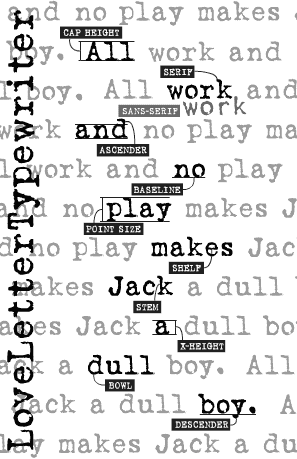
Re:Nestalgiaall work and no play makes jack a dull boy
Reminds me of an assignment I did for typography class.
-
Re:Color or B/W?
A year or three ago I set up a Color QuickCam 2 running on a stock Mandrake 9.2 install (kernel 2.4) with cqcam 0.91 (still the current version). It took a little work to get it functioning, but that was more about me not knowing what I was doing, rather than actual complications.
-
Re:But will they be less secritive?If it's not Apple hardware then it's Microsoft software lock in. The entire argument in this paragraph is ridicules - "so in the future when Apple sucks again", so you're implying that PC hardware has NEVER sucked? Ever? Apple hardware dating back to the Mac SE are still in use today. It has a GUI and can connect to the web WITH NO MODIFICATIONS! Can *you* run Windows 95 on a 286 today? No, even if you could you'd be cheating because Win95 was not available when the 286 came out. If I am correct, the ONLY way to run a webserver on 286 hardware is to use the Minix web server, created by Andrew Tanenbaum - Linus Torvalds TEACHER!
See:
Mac SE Server
Webserver Mac SE
Another Mac SE Server( The SE is a 68000 Motorola running at 8mhz on 4MB of ram. So if you can *avoid* clicking the last link directly *today* I'm sure the owner would appricate it. )
As for short life cycles - oh please. I've was using a G4 single CPU then a G4 dual CPU for 3 yrs before the G5 came out. The G4 was a VERY long life cycle for a CPU.
As for getting parts, in my 20+ yrs with Apple hardware I have NEVER replaced anything other than hard drives which have ALWAYS been stock (and NOT made by Apple). OMG this is a pointless argument. Where do you misinformed twats come from anyway? It's a never ending story with you WinTel people is it?
-
Ultimate TV???
Didnt' they already try this?
Yup thought so -
odds and sodsI've got a Toshiba laptop whose LCD died, so it's now tethered to a cheap external LCD. And I... I... installed Windows ME on it.
But the greatest abuse I've given to my hardware has been to keep using it well after a respectible retirement age. Like a PC's Limited Turbo XT (bought from a kid named Mike Dell) that's had everything but its keyboard and power supply replaced over the past 17 years, which I still use as an emergency backup web/mail/dns server. Or a 15-year-old Mac SE, a monochrome Windows 3.1 laptop, and a 386 running Linux... all of which I'm running as web servers. (Sorry, no direct links; even a modest
-
Re:A program written in many of them
One version they're missing is the one I wrote in Lotus 1-2-3 (release 2.x) macro language.
-
Re:jup15 years old and still routing my packets.
I not only have a 486 routing my packets (and blocking the incoming packets I don't want), but also another one running print jobs for me, and another serving up web pages. That last one's running Windows 3.1 as a kind of "look how we used to do this stuff, kids" project, so it's not exactly
-
Re:jup15 years old and still routing my packets.
I not only have a 486 routing my packets (and blocking the incoming packets I don't want), but also another one running print jobs for me, and another serving up web pages. That last one's running Windows 3.1 as a kind of "look how we used to do this stuff, kids" project, so it's not exactly
-
Matches photos, not faces?
I submitted a few different photos of myself, and was variously matched with David Lee Roth, Ethan Hawke, Michael Jordan, and David Hyde Pierce. In watching the animation flipping back and forth between and Mr. Jordan, I could see why the machine matched us: the angle of the photo and the line of our smiles were the same. Same with my match to Mr. Pierce. If this is the state of the technology, I don't think there's much use for it yet in identifying crmininals.
-
Matches photos, not faces?
I submitted a few different photos of myself, and was variously matched with David Lee Roth, Ethan Hawke, Michael Jordan, and David Hyde Pierce. In watching the animation flipping back and forth between and Mr. Jordan, I could see why the machine matched us: the angle of the photo and the line of our smiles were the same. Same with my match to Mr. Pierce. If this is the state of the technology, I don't think there's much use for it yet in identifying crmininals.
-
I'm glad to hear...
...that LEGO is getting back to basics. I know I'm dating myself here (I can't get anyone else to), but back when I was a kid (and not just up to age 7) LEGOs were "only" bricks of various sizes and colors... and one of my favorite toys. They didn't have any "sets" that tell you what you're supposed to make out of them, with pre-built "people" figures and whatnot. Just building blocks, which you could make into absolutely anything your imagination came up with. Who needs a LEGO-licensed character, when you can make your own?
-
Re:Lack of alternatives
At the risk of slashdotting myself (please be gentle... it's Celeron/333 on residential DSL!), might I suggest my Alternatives to Microsoft site (listing various alternatives to each of MS's major products) as a resource?
-
Re:Brilliant-"Crutch" logic
"3 media players that dont really work is never going to help Linux conquer the desktop. MS only has one, that does work!"
Oh! You mean like these?
Free clue:Microsoft's media player didn't help it conqueror anything. -
The role of planningYou mention that you want a thorough plan before you write any code. As another poster pointed out, it's easier to change a plan than it is to change code; a plan involving a dead-end approach can be scrapped with a smaller loss than a large body of code involving the same dead-end approach.
So the first reason for "plan first, then code" is that coding is expensive. That expense represents a risk if you're pursuing an approach that doesn't work out. Throwing away a plan is quicker and less expensive.
The second reason for "plan first, then code" is that a written plan is a clear expression of the ideas in the plan. Code is often not very readable or very obvious, and a large body of code may require weeks or months of study to get all the nuances at work.
There is a hidden disadvantage to "plan first, then code". Remember that we're trying to manage the risk of choosing a dead-end approach, so we want to minimize the investment before the discovery that the approach is bogus. A non-executable plan won't catch all the design bugs. It will only catch the design bugs that you can recognize on inspection of a written plan; the screening process is limited by your own human cognitive faculties.
What if we could write an executable plan, in a language that is clear and expressive, and in which writing the plan is inexpensive? This would be the best of all possible worlds! Luckily you're not the first person to face a daunting software design challenge, and people have been designing languages for exactly these constraints for many years (Python, Perl, Scheme, Ruby, Smalltalk, and others. These languages vary in the expressiveness of their syntax. If you're concerned about the mental expense of coding, you probably will want to avoid Perl (which looks a lot like C) and Scheme (which requires a mental paradigm shift). My off-the-cuff recommendation among these would be Python.
Why not write your final product in one of these easy, inexpensive, readable, expressive languages? Alas, many of them don't have the performance of C or C++. If you're doing something computation-intensive, that matters. But wait! There is another saving grace, called SWIG, a program that lets you glue small bits of C or C++ code into your larger program written in one of the easy languages.
In most computer programs, the performance is gated by a small number of small pieces of the code. Usually, the majority of the code does not have a big impact on performance. If you can identify those small performance-expensive bits, and translate them to C or C++ and glue them back into your program, you get the speed you want, and 95% of your code is still readable and expressive, and easy to change later. The trick to finding these performance-limiting bits is called profiling (see 1, 2, 3).
So here's the advice (assuming Python):
1. Spend a day learning Python, two days if you're busy. Python has lots of great libraries, skim the list of libraries as somebody may have contributed something you'll need.
2. Write your entire program readably in Python. Don't worry about speed yet. Rewrite as required until you're sure you've got a good design.
3. Use profiling to locate the few small pieces that slow down your program.
4. Use SWIG and C/C++ to rewrite those pieces and connect them back into your program. -
Workalikes...
A quick search on google turned up this link: http://microsoft.toddverbeek.com/tv.html
Enjoy!
--
"I'm surfin the dead zone