Slashdot Mirror
Domain: torrentfreak.com
Stories and comments across the archive that link to torrentfreak.com.
Stories · 725
-
Sony Blunders By Uploading Full Movie To YouTube Instead of Trailer (torrentfreak.com)
Instead of uploading a trailer of "Khali the Killer," an upcoming move from Sony Pictures Entertainment, the conglomerate accidentally uploaded the entire movie on Google's video platform, according to users. TorrentFreak: When we started writing this article the movie had around 8,000 views. Just a few paragraphs later that had swelled to almost 11,000. However, while news may be traveling quickly, those numbers probably won't reach epic levels anytime soon.
As usual, the comments on YouTube are absolutely brutal. The section includes gems such as "Trailer gave the whole plot away. Pass," "It's just the trailer the whole movie will be 4 hours," and the rather blunt "Someone's getting the sackï." -
Google Downranks 65,000 Pirate Sites In Search Results (torrentfreak.com)
An anonymous reader quotes a report from Torrent Freak: In a comment to Australian media, Google states that it has demoted 65,000 [pirate] sites in search results, a list that's still growing every week. In total, the company received DMCA takedown requests for over 1.8 million domain names, so a little under 4% of these are downranked. The result of the measures is that people are less likely to see a pirate site when they type "watch movie X" or "download song Y." This means that these sites see a drop in visitors from Google and a quite significant one too. "Demotion results in sites losing around 90 percent of their visitors from Google Search," a Google spokesperson told The Age. -
YouTube Videos From Some High-Profile Channels Have Disappeared (venturebeat.com)
Late last week, YouTube videos from several high-profile channels began to mysteriously disappear, puzzling both the owners of those channels and viewers. Some of these channels include MIT Open Courseware, Blender Foundation, Jamendo Music, India's Press Information Bureau, soccer club Sparta Praha, and England Rugby. In a statement, MIT Open Courseware said, "You may have noticed that we are having some trouble with our videos! Please stand by. The elves are working around the clock to fix the issue. There is still a ton of content you can use on MIT OCW's website that doesn't have video. Hang in there folks!" Ton Roosendaal, the chairman of Blender Foundation, has been tweeting his frustration at YouTube. The issue, which per Roosendaal YouTube is aware of, is yet to be resolved at the time of publication.
TorrentFreak, a news website which covers piracy and copyright issues, speculates that YouTube's piracy filters could be the bottleneck here.
YouTube has addressed the issue, says it is working to bring the videos back online. -
'Pirates' Tend To Be the Biggest Buyers of Legal Content, Study Shows (vice.com)
An anonymous reader quotes a report from Motherboard: According to a paywalled survey of 1,000 UK residents by anti-piracy outfit MUSO first spotted by Torrent Freak, 60 percent of those surveyed admitted that they had illegally streamed or downloaded music, film, or TV shows sometime in the past. But the study also showed that 83 percent of those questioned try to find the content they are looking for through above board services before trying anything else. And while the study found that 86 percent of survey takers subscribe to a streaming subscription service like Netflix, that total jumped to 91 percent among those that admit to piracy. The survey found that the top reason that users pirate is the content they were looking for wasn't legally available (34 percent) was too cumbersome or difficult to access (34 percent), or wasn't affordable (35 percent). "The entertainment industry tends to envisage piracy audiences as a criminal element, and writes them off as money lost -- but they are wrong to do so," MUSO executive Paul Briley said of the study's findings. "The reality is that the majority of people who have gone through the effort of finding and accessing such unlicensed content are, first and foremost, fans -- fans who are more often than not trying to get content legally if they can," Briley added. -
YouTube Can Be Liable For Copyright Infringing Videos, Court Rules (torrentfreak.com)
An anonymous reader shares a report: YouTube is known to be a breeding ground for creators. At the same time, however, it's also regularly used to share copyrighted material without permission. While copyright holders can issue takedown notices to remove infringing content, a preliminary ruling by the Commercial Court in Vienna has decided this is not sufficient. The ruling follows a complaint from local television channel Puls 4. After a thorough review of YouTube's functionalities, the Court concluded that YouTube has an obligation to prevent third parties from uploading infringing content. In its defense, YouTube argued that it's a neutral hosting provider under the provisions of the E-Commerce Act. As such, it should be shielded from direct liability for the actions of users. However, the Commercial Court disagreed, noting that YouTube takes several motivated actions to organize and optimize how videos are displayed. By doing so, it becomes more than a neutral hosting provider. -
PC Software Piracy Decreases Worldwide, But Remains Rampant (torrentfreak.com)
An anonymous reader writes: A new report published by The Software Alliance shows that usage of pirated PC software is decreasing worldwide. While this is a positive trend for the industry, piracy remains rampant in many countries. This includes Libya, where a massive 90 percent of all software is used without permission. -
Google's Chrome Web Store Spammed With Dodgy 'Pirate' Movie Links (torrentfreak.com)
Unknown third parties appear to be exploiting the Chrome Store's 'theme' section to offer visitors access to a wide range of pirate movies including "Black Panther", "Avengers: Infinity War" and "Rampage." From a report: When clicking through to the page offering Ready Player One, for example, users are presented with a theme that apparently allows them to watch the movie online in "Full HD Online 4k." Of course, the whole scheme is a dubious scam which eventually leads users to Vioos dot co, a platform that tries very hard to give the impression of being a pirate streaming portal but actually provides nothing of use. In fact, as soon as one clicks the play button on movies appearing on Vioos dot co, visitors are re-directed to another site called Zumastar which asks people to "create a free account" to "access unlimited downloads and streaming." Google services have a history of being exploited. -
Singapore ISPs Block 53 Pirate Sites Following MPAA Legal Action (torrentfreak.com)
53 piracy websites, including The Pirate Bay and KickassTorrents, have been blocked in Singapore following the most sweeping action taken by copyright holders in the country in more than a decade. From a report: A new wave of blocks announced this week are the country's most significant so far, with dozens of 'pirate' sites targeted following a successful application by the MPAA earlier this year. [...] "In Singapore, these sites are responsible for a major portion of copyright infringement of films and television shows," an MPAA spokesman told The Straits Times. "This action by rights ïowners is necessary to protectï the creative industry, enabling creators to create and keep their jobs, protect their works, and ensure the continued provision of high-quality content to audienceïsï." -
MPAA Silently Shut Down Its Legal Movies Search Engine (techdirt.com)
Back in 2015, the Motion Picture Association of America (MPAA) released its own search engine to combat the argument that people pirate films because there are too few legal alternatives. According to TorrentFreak, the search engine, WhereToWatch.com, has since been quietly shut down by the movie industry group, stating that there are plenty of other search options available today. From the report: The MPAA pulled the plug on the service a few months ago. And where the mainstream media covered its launch in detail, the shutdown received zero mentions. So why did the site fold? According to MPAA Vice President of Corporate Communications, Chris Ortman, it was no longer needed as there are many similar search engines out there. "Given the many search options commercially available today, which can be found on the MPAA website, WheretoWatch.com was discontinued at the conclusion of 2017," Ortman informs TF. "There are more than 140 lawful online platforms in the United States for accessing film and television content, and more than 460 around the world," he adds. "That is all absolutely true today, though it was also true three years ago when the site was launched," adds Techdirt. "The simple fact of the matter is that the site did little to serve any real public customer base. Yes, legal alternatives to piracy exist. Everyone knows that, just as they know that there are far too many hoops and restrictions around which to jump that have nothing to do with price. The MPAA and its client organizations have long asserted strict control over their product to the contrary of public demand. That is, and has always been, the problem. On top of all that, the MPAA showed its no better at promoting its site than it was at promoting the legal alternatives to pirating movies." -
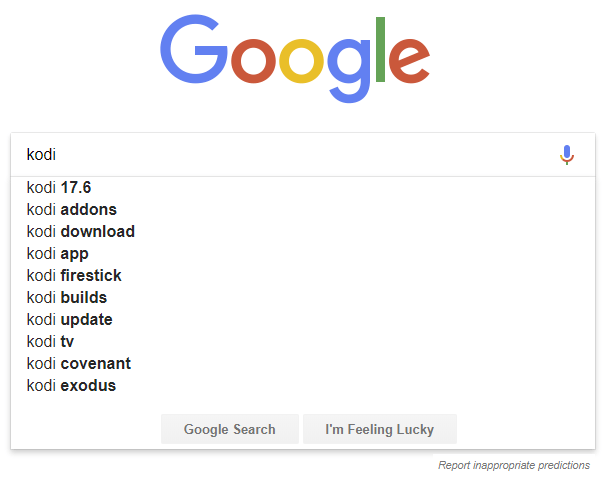
Google Removes 'Kodi' From Search Autocomplete In Anti-Piracy Effort (torrentfreak.com)
Google has banned the term "Kodi" from the autocomplete feature of its search engine because it's "closely associated with copyright infringement." This means that the popular software and related suggestions won't appear unless users type out the full term. TorrentFreak reports: It turns out that Google has recently removed the term "Kodi" from its autocomplete results. While Kodi can be abused through pirate add-ons, the media player software itself is perfectly legal, which makes it an odd decision. Users who type in "Kod" get a list of suggestions including "Kodak" and "Kodiak," but not the much more popular search term Kodi. Similarly, when typing "addons for k" Google suggests addons for Kokotime and Krypton 17.6. While the latter is a Kodi version, the name of the media player itself doesn't come up as a suggestion. Once users type the full Kodi term and add a space, plenty of suggestions suddenly appear, which is similar to other banned terms. Ironically enough, the Kokotime app is frequently used by pirates as well. Also, the names of all of the pirate Kodi addons we checked still show up fine in the autosuggest feature. Unfortunately, Google doesn't document its autocomplete removal decisions, nor does it publish the full list of banned words. However, the search engine confirms that Kodi's piracy stigma is to blame here. In a statement to TorrentFreak, a Google spokesperson said: "Since 2011, we have been filtering certain terms closely associated with copyright infringement from Google Autocomplete. This action is consistent with that long-standing strategy." -
Google Removes 'Kodi' From Search Autocomplete In Anti-Piracy Effort (torrentfreak.com)
Google has banned the term "Kodi" from the autocomplete feature of its search engine because it's "closely associated with copyright infringement." This means that the popular software and related suggestions won't appear unless users type out the full term. TorrentFreak reports: It turns out that Google has recently removed the term "Kodi" from its autocomplete results. While Kodi can be abused through pirate add-ons, the media player software itself is perfectly legal, which makes it an odd decision. Users who type in "Kod" get a list of suggestions including "Kodak" and "Kodiak," but not the much more popular search term Kodi. Similarly, when typing "addons for k" Google suggests addons for Kokotime and Krypton 17.6. While the latter is a Kodi version, the name of the media player itself doesn't come up as a suggestion. Once users type the full Kodi term and add a space, plenty of suggestions suddenly appear, which is similar to other banned terms. Ironically enough, the Kokotime app is frequently used by pirates as well. Also, the names of all of the pirate Kodi addons we checked still show up fine in the autosuggest feature. Unfortunately, Google doesn't document its autocomplete removal decisions, nor does it publish the full list of banned words. However, the search engine confirms that Kodi's piracy stigma is to blame here. In a statement to TorrentFreak, a Google spokesperson said: "Since 2011, we have been filtering certain terms closely associated with copyright infringement from Google Autocomplete. This action is consistent with that long-standing strategy." -
Pirate Music Site's Owner Sentenced to Five Years in Prison (torrentfreak.com)
An anonymous reader shares an update on Artur Sargsyan, who owned the music-pirating site Sharebeast as well as Newjams and Albumjams. TorrentFreak reports: Thursday a U.S. District Judge sentenced the 30-year-old to five years in prison, three years of supervised release, and more than $642,000 in restitution and forfeiture... The RIAA claimed that ShareBeast was the largest illegal file-sharing site operating in the United States... "Millions of users accessed songs from ShareBeast each month without one penny of compensation going to countless artists, songwriters, labels and others who created the music," RIAA Chairman & CEO Cary Sherman commented at the time...
If Sargsyan had responded to takedown notices more positively, it's possible that things may have progressed in a different direction. The RIAA sent the site more than 100 copyright-infringement emails over a three-year period but to no effect. This led the music industry group to get out its calculator and inform the Deparmtment of Justice that the total monetary loss to its member companies was "a conservative" $6.3 billion "gut-punch" to music creators who were paid nothing by the service... "His reproduction of copyrighted musical works were made available only to generate undeserved profits for himself," said U.S. Attorney Byung J. "BJay" Pak. "The incredible work done by our law enforcement partners and prosecutors in light of the complexity of Sargsyan's operation demonstrates that we will employ all of our resources to stop this kind of theft."
David J. LaValley, Special Agent in Charge of FBI Atlanta, said "His sentence sends a message that no matter how complex the operation, the FBI, its federal partners and law enforcement partners around the globe will go to every length to protect the property of hard working artists and the companies that produce their art."
Today if you visit ShareBeast.com or AlbumJams.com, they display an "FBI anti-piracy warning" image notifying visitors the domain has been seized, adding "Willful copyright infringement is a federal crime that carries penalties for first time offenders of up to five years in federal prison, a $250,000 fine, forfeiture and restitution." The image is surrounded by a red border with the word "seized" written over and over again. -
KeepVid Site No Longer Allows Users To 'Keep' Videos (torrentfreak.com)
An anonymous reader quotes a report from TorrentFreak: For many years, KeepVid has been a prime destination for people who wanted to download videos from YouTube, Dailymotion, Facebook, Vimeo, and dozens of other sites. The web application was free and worked without any hassle. This was still the case earlier this month when the site advertised itself as follows: "KeepVid Video Downloader is a free web application that allows you to download videos from sites like YouTube, Facebook, Twitch.Tv, Vimeo, Dailymotion and many more." However, a few days ago the site radically changed its course. While the motivation is unknown at the time, KeepVid took its popular video download service offline without prior notice. Today, people can no longer use the KeepVid site to download videos. On the contrary, the site warns that using video download and conversion tools might get people in trouble. "Video downloading from the Internet will become more and more difficult, and KeepVid encourages people to download videos via the correct and legal ways," the new KeepVid reads. The site now lists several alternative options to enjoy videos and music, including Netflix, Hulu, Spotify, and Pandora. -
Online Piracy Is More Popular Than Ever, Research Suggests (torrentfreak.com)
An anonymous user writes: A broad and detailed report from piracy tracking outfit MUSO shows that visits to pirate sites went up last year. The company recorded more than 300 billion visits in 2017, which suggests that "piracy is more popular than ever." TV remained the most popular category and most pirates prefer streaming over torrents or direct downloading. -
US Navy Under Fire In Mass Software Piracy Lawsuit (torrentfreak.com)
An anonymous reader quotes a report from TorrentFreak: In 2011 and 2012, the U.S. Navy began using BS Contact Geo, a 3D virtual reality application developed by German company Bitmanagement. The Navy reportedly agreed to purchase licenses for use on 38 computers, but things began to escalate. While Bitmanagement was hopeful that it could sell additional licenses to the Navy, the software vendor soon discovered the U.S. Government had already installed it on 100,000 computers without extra compensation. In a Federal Claims Court complaint filed by Bitmanagement two years ago, that figure later increased to hundreds of thousands of computers. Because of the alleged infringement, Bitmanagement demanded damages totaling hundreds of millions of dollars. In the months that followed both parties conducted discovery and a few days ago the software company filed a motion for partial summary judgment, asking the court to rule that the U.S. Government is liable for copyright infringement. According to the software company, it's clear that the U.S. Government crossed a line. In its defense, the U.S. Government had argued that it bought concurrent-use licenses, which permitted the software to be installed across the Navy network. However, Bitmanagement argues that it is impossible as the reseller that sold the software was only authorized to sell PC licenses. In addition, the software company points out that the word "concurrent" doesn't appear in the contracts, nor was there any mention of mass installations. The full motion brings up a wide range of other arguments as well which, according to Bitmanagement, make it clear that the U.S. Government is liable for copyright infringement. -
Trump Promises Copyright Crackdown As DoJ Takes Aim At Streaming Pirates (torrentfreak.com)
An anonymous reader quotes a report from TorrentFreak: Yesterday, a panel discussion on the challenges associated with piracy from streaming media boxes took place on Capitol Hill. Hosted by the Information Technology and Innovation Foundation (ITIF), "Unboxing the Piracy Threat of Streaming Media Boxes" (video) went ahead with some big name speakers in attendance, not least Neil Fried, Senior Vice President, Federal Advocacy and Regulatory Affairs at the MPAA. ITIF and various industry groups tweeted many interesting comments throughout the event. Kevin Madigan from Center for the Protection of Intellectual Property told the panel that torrent-based content "is becoming obsolete" in an on-demand digital environment that's switching to streaming-based piracy. "There's a criminal enterprise going on here that's stealing content and making a profit," Fried told those in attendance. "The piracy activity out there is bad, it's hurting a lot of economic activity & creators aren't being compensated for their work," he added.
And then, of course, we come to President Trump. Not usually that vocal on matters of intellectual property and piracy, yesterday -- perhaps coincidentally, perhaps not -- he suddenly delivered one of his "something is coming" tweets. "The U.S. is acting swiftly on Intellectual Property theft," Trump tweeted. "We cannot allow this to happen as it has for many years!" Given Trump's tendency to focus on problems overseas causing issues for companies back home, a comment by Kevin Madigan during the panel yesterday immediately comes to mind. "To combat piracy abroad, USTR needs to work with the creative industries to improve enforcement and target the source of pirated material," Madigan said. -
Comcast's Protected Browsing Is Blocking PayPal, Steam and TorrentFreak, Customers Say (vice.com)
Comcast's Xfinity internet customers have been reporting multiple websites, including PayPal, Steam, and TorrentFreak have been getting blocked by the ISP's "protected browsing" setting. From a report: The "protected browsing" setting is designed to "reduce the risk of accessing known sources of malware, spyware, and phishing for all devices connected to your home network." This, in general, isn't a bad thing. It's similar to Google Chrome's security settings that warn you when you have an insecure connection. But it's odd that Xfinity's security setting would be blocking perfectly harmless sites like PayPal. Multiple consumers have been reporting on Comcast's forums and elsewhere that they've been blocked while trying to access sites that many people use every day. After posting about it on the forums, one user who said they couldn't access PayPal said the problem with that particular site had been fixed. Further reading: Comcast's Protected Browsing Blocks TorrentFreak as "Suspicious" Site (TorrentFreak). -
Spotify Is Cracking Down On Users Pirating Premium-Like Service (torrentfreak.com)
People who access Spotify using hacked apps that remove some of the restrictions placed on free accounts are receiving warning emails from the company. Noting that "abnormal activity" has been observed from the user's software, Spotify warns that future breaches could result in suspension or even termination of a user's account. TorrentFreak reports: "We detected abnormal activity on the app you are using so we have disabled it. Don't worry -- your Spotify account is safe," the email from Spotify reads. "To access your Spotify account, simply uninstall any unauthorized or modified version of Spotify and download and install the Spotify app from the official Google Play Store. If you need more help, please see our support article on Reinstalling Spotify." While the email signs off with a note thanking the recipient for being a Spotify user, there is also a warning. "If we detect repeated use of unauthorized apps in violation of our terms, we reserve all rights, including suspending or terminating your account," Spotify writes. -
Spotify Is Cracking Down On Users Pirating Premium-Like Service (torrentfreak.com)
People who access Spotify using hacked apps that remove some of the restrictions placed on free accounts are receiving warning emails from the company. Noting that "abnormal activity" has been observed from the user's software, Spotify warns that future breaches could result in suspension or even termination of a user's account. TorrentFreak reports: "We detected abnormal activity on the app you are using so we have disabled it. Don't worry -- your Spotify account is safe," the email from Spotify reads. "To access your Spotify account, simply uninstall any unauthorized or modified version of Spotify and download and install the Spotify app from the official Google Play Store. If you need more help, please see our support article on Reinstalling Spotify." While the email signs off with a note thanking the recipient for being a Spotify user, there is also a warning. "If we detect repeated use of unauthorized apps in violation of our terms, we reserve all rights, including suspending or terminating your account," Spotify writes. -
Spotify Is Cracking Down On Users Pirating Premium-Like Service (torrentfreak.com)
People who access Spotify using hacked apps that remove some of the restrictions placed on free accounts are receiving warning emails from the company. Noting that "abnormal activity" has been observed from the user's software, Spotify warns that future breaches could result in suspension or even termination of a user's account. TorrentFreak reports: "We detected abnormal activity on the app you are using so we have disabled it. Don't worry -- your Spotify account is safe," the email from Spotify reads. "To access your Spotify account, simply uninstall any unauthorized or modified version of Spotify and download and install the Spotify app from the official Google Play Store. If you need more help, please see our support article on Reinstalling Spotify." While the email signs off with a note thanking the recipient for being a Spotify user, there is also a warning. "If we detect repeated use of unauthorized apps in violation of our terms, we reserve all rights, including suspending or terminating your account," Spotify writes. -
MPAA Wants Filmmakers To Pay Licenses, Not Rip Blu-rays (torrentfreak.com)
An anonymous reader writes: Late last year several filmmaker groups asked the US Copyright Office to lift some of the current DMCA circumvention restrictions, so they can rip and use clips from Blu-rays and other videos without repercussions. In the US, people risk bypassing DMCA's anti-circumvention when they rip a DVD or Blu-ray disc. (There are some exemptions, such as educational and other types of fair use, but the line between legal and illegal is not always clear, some argue.) Not everyone agrees with this assessment though. A group of "joint creators and copyright owners" which includes Hollywood's MPAA, the RIAA, and ESA don't think this is a good idea and point out that filmmakers have plenty of other options. The MPAA and the other groups point out that the exemption could be used by filmmakers to avoid paying licensing fees, which can be quite expensive. -
Flight Sim Company Embeds Malware To Steal Pirates' Passwords (torrentfreak.com)
TorrentFreak: Flight sim company FlightSimLabs has found itself in trouble after installing malware onto users' machines as an anti-piracy measure. Code embedded in its A320-X module contained a mechanism for detecting 'pirate' serial numbers distributed on The Pirate Bay, which then triggered a process through which the company stole usernames and passwords from users' web browsers. -
Sweden Considers Six Years in Jail For Online Pirates (torrentfreak.com)
Sweden's Minister for Justice has received recommendations as to how the country should punish online pirates. From a report: Helene Fritzon received a proposal which would create crimes of gross infringement under both copyright and trademark law, leading to sentences of up to six years in prison. The changes would also ensure that non-physical property, such as domain names, can be seized. -
Pirates Crack Microsoft's UWP Protection, Five Layers of DRM Defeated (torrentfreak.com)
A piracy scene group has managed to get past the five layers of DRM in Microsoft's Unified Windows Platform UWP -- which enables software developers to create applications that can run across many devices. From a report: This week it became clear that the UWP system, previously believed to be uncrackable, had fallen to pirates. After being released on October 31, 2017, the somewhat underwhelming Zoo Tycoon Ultimate Animal Collection became the first victim at the hands of popular scene group, CODEX. "This is the first scene release of a UWP (Universal Windows Platform) game. Therefore we would like to point out that it will of course only work on Windows 10. This particular game requires Windows 10 version 1607 or newer," the group said in its release notes. CODEX says it's important that the game isn't allowed to communicate with the Internet so the group advises users to block the game's executable in their firewall. -
EFF Urges US Copyright Office To Reject Proactive 'Piracy' Filters (torrentfreak.com)
TorrentFreak: As entertainment companies and Internet services spar over the boundaries of copyright law, the EFF is urging the US Copyright Office to keep "copyright's safe harbors safe." In a petition just filed with the office, the EFF warns that innovation will be stymied if Congress goes ahead with a plan to introduce proactive 'piracy' filters at the expense of the DMCA's current safe harbor provisions. [...] "Major media and entertainment companies and their surrogates want Congress to replace today's DMCA with a new law that would require websites and Internet services to use automated filtering to enforce copyrights. "Systems like these, no matter how sophisticated, cannot accurately determine the copyright status of a work, nor whether a use is licensed, a fair use, or otherwise non-infringing. Simply put, automated filters censor lawful and important speech," the EFF warns. -
Tickbox Must Remove Pirate Streaming Add-ons From Sold Devices (torrentfreak.com)
TickBox TV, the company behind a Kodi-powered streaming device, must release a new software updater that will remove copyright-infringing addons from previously shipped devices. A California federal court issued an updated injunction in the lawsuit that was filed by several major Hollywood studios, Amazon, and Netflix, which will stay in place while both parties fight out their legal battle. TorrentFreak reports: Last year, the Alliance for Creativity and Entertainment (ACE), an anti-piracy partnership between Hollywood studios, Netflix, Amazon, and more than two dozen other companies, filed a lawsuit against the Georgia-based company Tickbox TV, which sells Kodi-powered set-top boxes that stream a variety of popular media. ACE sees these devices as nothing more than pirate tools so the coalition asked the court for an injunction to prevent Tickbox from facilitating copyright infringement, demanding that it removes all pirate add-ons from previously sold devices. Last month, a California federal court issued an initial injunction, ordering Tickbox to keep pirate addons out of its box and halt all piracy-inducing advertisements going forward. In addition, the court directed both parties to come up with a proper solution for devices that were already sold.
The new injunction prevents Tickbox from linking to any "build," "theme," "app," or "addon" that can be indirectly used to transmit copyright-infringing material. Web browsers such as Internet Explorer, Google Chrome, Safari, and Firefox are specifically excluded. In addition, Tickbox must also release a new software updater that will remove any infringing software from previously sold devices. All tiles that link to copyright-infringing software from the box's home screen also have to be stripped. Going forward, only tiles to the Google Play Store or to Kodi within the Google Play Store are allowed. In addition, the agreement also allows ACE to report newly discovered infringing apps or addons to Tickbox, which the company will then have to remove within 24-hours, weekends excluded. -
Man Handed Conditional Prison Sentence for Spreading Information About Popcorn Time Service (torrentfreak.com)
A man from Denmark has been handed a six-month conditional prison sentence for spreading information about Popcorn Time, an authorized on-demand movies and TV shows streaming service, news outlet TorrentFreak reports. From the report: In what is being described as a first for Europe, the man was convicted after telling people how to download, install and use the movie streaming service. He was also ordered to forfeit $83,300 in ad revenue and complete 120 hours community service. -
Cloudflare Terminates Service To Sci-Hub Domain Names (torrentfreak.com)
While Sci-Hub is praised by thousands of researchers and academics around the world, copyright holders are doing everything in their power to wipe the site from the web. From a report: Last weekend another problem appeared for Sci-Hub. This time American Chemical Society (ACS) went after CDN provider Cloudflare, which informed the site that a court order requires the company to disconnect several domain names. "Cloudflare has received the attached court order, Case 1:17-cv-OO726-LMB-JFA," the company writes. "Cloudflare will terminate your service for the following domains sci-hub.la, sci-hub.tv, and sci-hub.tw by disabling our authoritative DNS in 24 hours." According to Sci-Hub's operator, losing access to Cloudflare is not "critical," but it may "cause a short pause in website operation." -
Blizzard Issues DMCA Notice to a Fan-Run 'WoW' Legacy Server (torrentfreak.com)
An anonymous reader calls it "the never-ending stupidity of copyright wars." TorrentFreak reports: Blizzard Entertainment is taking a stand against a popular World of Warcraft legacy server. The fan-operated project allows gamers to experience how the game was played over a decade ago and to revive old battles... In recent years the project has captured the hearts of tens of thousands of die-hard WoW fans. At the time of writing, the most popular realm has more than 6,000 people playing from all over the world... Blizzard, however, sees this as copyright infringement and has asked GitHub to pull the site's code offline.
The article notes the DMCA notice came "just weeks after several organizations and gaming fans asked the US Copyright Office to make a DMCA circumvention exemption for 'abandoned' games." -
Cloudflare Is Liable For Pirate Sites and Has No Safe Harbor, Publisher Says (torrentfreak.com)
After dragging Cloudflare to court and accusing the web services company of various types of copyright and trademark infringement, noting that several customers used Cloudflare's servers to distribute pirated content, adult publisher ALS Scan told the California District Court this week that the company should be held liable for copyright infringements committed by its customers. According to TorrentFreak, "The company requests a partial summary judgement, claiming that the CDN provider assists pirates and doesn't qualify for safe harbor protection." From the report: "The evidence is undisputed," ALS writes. "Cloudflare materially assists website operators in reproduction, distribution and display of copyrighted works, including infringing copies of ALS works. Cloudflare also masks information about pirate sites and their hosts." ALS anticipates that Cloudflare may argue that the company or its clients are protected by the DMCA's safe harbor provision, but contests this claim. The publisher notes that none of the customers registered the required paperwork at the U.S. Copyright Office. "Cloudflare may say that the Cloudflare Customer Sites are themselves service providers entitled to DMCA protections, however, none have qualified for safe harbors by submitting the required notices to the U.S. Copyright Office. Cloudflare may say that the Cloudflare Customer Sites are themselves service providers entitled to DMCA protections, however, none have qualified for safe harbors by submitting the required notices to the U.S. Copyright Office."
Cloudflare itself has no safe harbor protection either, they argue, because it operates differently than a service provider as defined in the DMCA. It's a "smart system" which also modifies content, instead of a "dumb pipe," they claim. In addition, the CDN provider is accused of failing to implement a reasonable policy that will terminate repeat offenders. "Cloudflare has no available safe harbors. Even if any safe harbors apply, Cloudflare has lost such safe harbors for failure to adopt and reasonably implement a policy including termination of repeat infringers," ALS writes. ALS now asks the court to issue a partial summary judgment ruling that Cloudflare is liable for contributory copyright infringement. If this motion is granted, a trial would only be needed to establish the damages amount. -
Kim Dotcom Sues New Zealand For $6.8 Billion In Damages Over Erroneous Arrest (torrentfreak.com)
An anonymous reader quotes a report from the BBC: Kim Dotcom, the founder of file-sharing site Megaupload, is suing the New Zealand government for billions of dollars in damages over his arrest in 2012. The internet entrepreneur is fighting extradition to the U.S. to stand trial for copyright infringement and fraud. Mr Dotcom says an invalid arrest warrant negated all charges against him. He is seeking damages for destruction to his business and loss of reputation. Accountants calculate that the Megaupload group of companies would be worth $10 billion today, had it not been shut down during the raid. As he was a 68% shareholder in the business, Mr Dotcom has asked for damages going up to $6.8 billion. He is also considering taking similar action against the Hong Kong government. As stated in documents filed with the High Court, Mr Dotcom is also seeking damages for: all lost business opportunities since 2012, his legal costs, loss of investments he made to the mansion he was renting, his lost opportunity to purchase the mansion, and loss of reputation. -
iTunes Snafu Made 'Thor: Ragnarok' Available Almost a Month Early (engadget.com)
An anonymous reader shares a report: When you check out the 'Thor: Ragnarok' page on iTunes, it says pre-orders of digital copies are expected to arrive on February 20th. But as TorrentFreak reports, some people got their hands on the Marvel film about a month early due to some sort of snafu with iTunes and Movies Anywhere. According to TorrentFreak, a Reddit user said in a now-deleted post that their legal purchase of the film on Vudu landed them an iTunes copy of it the next day. "I pre-ordered Thor Ragnarok on Vudu yesterday and it links it to my iTunes also. But curiously it showed up in my iTunes library this morning (pre-orders shouldn't). And now I can watch the full movie in HD," they wrote. "I obviously downloaded it right away. I know its supposed to come out February 20th." Others then responded that going that same purchase route made the movie available to them in iTunes as well. -
Linking Is Not Copyright Infringement, Boing Boing and EFF Tell Court (torrentfreak.com)
An anonymous reader shares a report: The popular blog Boing Boing has asked a federal court in California to drop the copyright infringement lawsuit filed against it by Playboy. With help from the EFF, Boing Boing argues that its article linking to an archive of hundreds of centerfold playmates is clearly fair use. Or else it will be "the end of the web as we know it," the blog warns. Late last year Playboy sued the popular blog Boing Boing for publishing an article that linked to an archive of every playmate centerfold till then. "Kind of amazing to see how our standards of hotness, and the art of commercial erotic photography, have changed over time," Boing Boing's Xena Jardin commented. Playboy, instead, was amazed that infringing copies of their work were being shared in public. While Boing Boing didn't upload or store the images in question, the publisher took the case to court. -
Google Blocks Pirate Search Results Prophylactically (torrentfreak.com)
Google is accepting "prophylactic" takedown requests to keep pirated content out of its search results, an anonymous reader writes, citing a TorrentFreak report. From the article: Over the past year, we've noticed on a few occasions that Google is processing takedown notices for non-indexed links. While we assumed that this was an 'error' on the sender's part, it appears to be a new policy. "Google has critically expanded notice and takedown in another important way: We accept notices for URLs that are not even in our index in the first place. That way, we can collect information even about pages and domains we have not yet crawled," Caleb Donaldson, copyright counsel at Google writes. In other words, Google blocks URLs before they appear in the search results, as some sort of piracy vaccine. "We process these URLs as we do the others. Once one of these not-in-index URLs is approved for takedown, we prophylactically block it from appearing in our Search results, and we take all the additional deterrent measures listed above." Some submitters are heavily relying on the new feature, Google found. In some cases, the majority of the submitted URLs in a notice are not indexed yet. -
Filmmakers Want The Right To Break DRM and Rip Blu-Rays (torrentfreak.com)
An anonymous reader shares a report: Breaking DRM or ripping Blu-Rays discs is a crime In the United States. While there are fair use exemptions, these don't apply to the public at large. Interestingly, filmmakers themselves are now urging the Copyright Office to lift some of the current restrictions, so that they can make the films they want. [...] Technically speaking it's not hard to rip a DVD or Blu-Ray disc nowadays, and the same is true for ripping content from Netflix or YouTube. However, people who do this are breaking the law. The DMCA's anti-circumvention provisions specifically forbid it. There are some exemptions, for educational use for example, and to allow for other types of fair use, but the line between legal and illegal is not always clear. Interestingly, filmmakers are not happy with the current law either. They often want to use small pieces of other videos in their films, but under the current exemptions, this is only permitted for documentaries. The International Documentary Association, Kartemquin Films, Independent Filmmaker Project, University of Film and Video Association and several other organizations hope this will change. In a comment to the Copyright Office, which is currently considering updates to the exemptions, they argue that all filmmakers should be allowed by break DRM and rip Blu-Rays. According to the filmmakers, the documentary genre is vaguely defined. This leads to a lot of confusion whether or not the exemptions apply. They, therefore, suggest to apply it to all filmmakers, instead of criminalizing those who don't identify themselves as documentarians. -
Piracy Notices Can Mess With Your Thermostat, ISP Warns (torrentfreak.com)
U.S. Internet provider Armstrong has warned persistent pirates on its network of limiting their access to the thermostats if they didn't play by its rules. From a report: Our attention was caught by a recent letter the company sent to one of its users. The ISP points out that it received multiple copyright infringement notices, urging the customer to stop, or else. [...] While reduced Internet speeds are bad enough, there's another scary prospect. The reduced service level may also prevent subscribers from controlling their thermostat remotely. Not ideal during the winter. "Please be advised that this may affect other services which you may have connected to your internet service, such as the ability to control your thermostat remotely or video monitoring services." Accused pirates who want their full service restored, and regain control over their thermostats, have to answer some copyright questions and read an educational piece about copyright infringement. -
AnyDVD Supports UHD Blu-Ray Ripping, While Devices Patch Security Holes (torrentfreak.com)
The controversial ripping tool AnyDVD has released a new beta version that allows users to decrypt and copy UHD Blu-Ray discs. The software makes use of the leaked keys that came out recently and appears to work well. Meanwhile, disc drive manufacturers are patching security holes. TorrentFreak reports: This year there have been some major developments on this front. First, full copies of UHD discs started to leak online, later followed by dozens of AACS 2.0 keys. Technically speaking AACS 2.0 is not confirmed to be defeated yet, but many discs can now be ripped. This week a popular name jumped onto the UHD Blu-Ray bandwagon. In its latest beta release, AnyDVD now supports the format, relying on the leaked keys. "New (UHD Blu-ray): Fetch AACS keys from external file for use with 'UHD-friendly' drives," the release notes read. The involvement of AnyDVD is significant because it previously came under legal pressure from decryption licensing outfit AACS LA. This caused former parent company Slysoft to shut down last year, but the software later reappeared under new management. Based on reports from several AnyDVD users, the UHD ripping works well for most people. Some even claim that it's faster than the free alternative, MakeMKV. -
ISPs and Movie Industry Prepare Canadian Pirate Site Blocking Deal (torrentfreak.com)
An anonymous reader quotes a report from TorrentFreak: A coalition of movie industry companies and ISPs, including Bell, Rogers, and Cineplex are discussing a proposal to implement a plan to allow for website blockades without judicial oversight. The Canadian blocklist would be maintained by a new non-profit organization called "Internet Piracy Review Agency" (IPRA) and enforced through the CTRC, Canadaland reports. The plan doesn't come as a total surprise as Bell alluded to a nationwide blocking mechanism during a recent Government hearing. What becomes clear from the new plans, however, is that the telco is not alone. The new proposal is being discussed by various stakeholders including ISPs and local movie companies. As in other countries, major American movie companies are also in the loop, but they will not be listed as official applicants when the plan is submitted to the CRTC. Canadian law professor Micheal Geist is very critical of the plans. Although the proposal would only cover sites that "blatantly, overwhelmingly or structurally" engage in or facilitate copyright infringement, this can be a blurry line.
"Recent history suggests that the list will quickly grow to cover tougher judgment calls. For example, Bell has targeted TVAddons, a site that contains considerable non-infringing content," Geist notes. "It can be expected that many other sites disliked by rights holders or broadcasters would find their way onto the block list," he adds. While the full list of applicants is not ready yet, it is expected that the coalition will file its proposal to the CRTC before the end of the month. -
Free Game Company Sues 14-Year-Old Over 'Cheats' Video -- Claiming DMCA Violation (bbc.co.uk)
Bizzeh shared this report from the BBC: A mother has written a letter in defense of her 14-year-old son who is facing a lawsuit over video game cheats in the US. Caleb Rogers is one of two people facing legal action from gaming studio Epic Games for using cheat software to play the free game Fortnite. The studio says it has taken the step because the boy declined to remove a YouTube video he published which promoted how to use the software... "This company is in the process of attempting to sue a 14-year-old child," she wrote in the letter which has been shared online by the news site Torrentfreak.
Ms. Rogers added that she had not given her son parental consent to play the game as stated in its terms and conditions, and that as the game was free to play the studio could not claim loss of profit as a result of the cheats... In a statement given to the website Kotaku, Epic Games said the lawsuit was a result of Mr. Rogers "filing a DMCA counterclaim to a takedown notice on a YouTube video that exposed and promoted Fortnite Battle Royale cheats and exploits... Epic is not OK with ongoing cheating or copyright infringement from anyone at any age," it said.
Cory Doctorow counters that the 14-year-old "correctly asserted that there was no copyright infringement here. Videos that capture small snippets of a videogame do not violate that game creator's copyrights, because they are fair use..." -
Netflix Is Not Going to Kill Piracy, Research Suggests (torrentfreak.com)
Even as more people than ever are tuning to Netflix, Hulu, Amazon Prime and other streaming services to look, piracy too continues to thrive, a research suggests. An anonymous reader shares a report: Intrigued by this interplay of legal and unauthorized viewing, researchers from Carnegie Mellon University and Universidade Catolica Portuguesa carried out an extensive study. They partnered with a major telco, which is not named, to analyze if BitTorrent downloading habits can be changed by offering legal alternatives. The researchers used a piracy-tracking firm to get a sample of thousands of BitTorrent pirates at the associated ISP. Half of them were offered a free 45-day subscription to a premium TV and movies package, allowing them to watch popular content on demand. To measure the effects of video-on-demand access on piracy, the researchers then monitored the legal viewing activity and BitTorrent transfers of the people who received the free offer, comparing it to a control group. The results show that piracy is harder to beat than some would expect. Subscribers who received the free subscription watched more TV, but overall their torrenting habits didn't change significantly. "We find that, on average, households that received the gift increased overall TV consumption by 4.6% and reduced Internet downloads and uploads by 4.2% and 4.5%, respectively. However, and also on average, treated households did not change their likelihood of using BitTorrent during the experiment," the researchers write. -
Google and Apple Order Telegram To Nuke Channel Over Taylor Swift Piracy (torrentfreak.com)
An anonymous reader writes: Instant messaging client Telegram has for the first time blocked access to an entire channel following pressure from Google and Apple. A channel, called Any Suitable Pop, was found distributing copyright infringed copies of songs from Taylor Swift's new album 'Reputation'. It's understood that following complaints from Universal Music, Google and Apple ordered Telegram to take action. -
Google Wipes 786 Pirate Sites From Search Results (torrentfreak.com)
Google and several leading Russian search engines have completely wiped 786 "pirate" sites from their search results. That's according to telecoms watch Rozcomnadzor, which reports that the search providers delisted the sites after ISPs were ordered by a Moscow court to permanently block them. TorrentFreak reports: Late July, President Vladimir Putin signed a new law which requires local telecoms watchdog Rozcomnadzor to maintain a list of banned domains while identifying sites, services, and software that provide access to them. [...] Nevertheless, on October 1 the new law ("On Information, Information Technologies and Information Protection") came into effect and it appears that Russia's major search engines have been very busy in its wake. According to a report from Rozcomnadzor, search providers Google, Yandex, Mail.ru, Rambler, and Sputnik have stopped presenting information in results for sites that have been permanently blocked by ISPs following a decision by the Moscow City Court. "To date, search engines have stopped access to 786 pirate sites listed in the register of Internet resources which contain content distributed in violation of intellectual property rights," the watchdog reports. The domains aren't being named by Rozcomnadzor or the search engines but are almost definitely those sites that have had complaints filed against them at the City Court on multiple occasions but have failed to take remedial action. Also included will be mirror and proxy sites which either replicate or facilitate access to these blocked and apparently defiant domains. -
US Court Grants ISPs and Search Engine Blockade of Sci-Hub (torrentfreak.com)
Sci-Hub, a scientific research piracy site home to thousands of research papers, has suffered another blow in a U.S. federal court. According to TorrentFreak, "The American Chemical Society has won a default judgment of $4.8 million for alleged copyright infringement against the site. In addition, the publisher was granted an unprecedented injunction which requires search engines and ISPs to block the platform." This comes after a $15 million fine was imposed on Sci-Hub by a New York federal judge earlier this year. From the report: Just before the weekend, U.S. District Judge Leonie Brinkema issued a final decision which is a clear win for ACS. The publisher was awarded the maximum statutory damages of $4.8 million for 32 infringing works, as well as a permanent injunction. The injunction is not limited to domain name registrars and hosting companies, but expands to search engines, ISPs and hosting companies too, who can be ordered to stop linking to or offering services to Sci-Hub. The injunction means that Internet providers, such as Comcast, can be requested to block users from accessing Sci-Hub. That's a big deal since pirate site blockades are not common in the United States. The same is true for search engine blocking of copyright-infringing sites.
"Ordered that any person or entity in active concert or participation with Defendant Sci-Hub and with notice of the injunction, including any Internet search engines, web hosting and Internet service providers, domain name registrars, and domain name registries, cease facilitating access to any or all domain names and websites through which Sci-Hub engages in unlawful access to, use, reproduction, and distribution of ACS's trademarks or copyrighted works," the injunction reads. -
Google Denies Demoting the Pirate Bay In Some Countries (venturebeat.com)
An anonymous reader writes: Google and The Pirate Bay have had an interesting relationship over the years, to say the least. This week, users pointed out that The Pirate Bay can appear significantly lower down in search results (and definitely not on the first page), depending on which country you are searching in. We reached out to Google, and it denied the allegations that it was demoting the site. TorrentFreak first spotted the odd behavior. The publication used Chrome in incognito mode to search for "The Pirate Bay" in Google with different IP addresses to see where the site's thepiratebay.org domain showed up. An IP address in the U.K., for example, would result in The Pirate Bay showing up on the fifth or sixth page, while an IP address in the U.S. would bring back The Pirate Bay as the top result. -
Pirate Bay is Mining Cryptocurrency Again, No Opt Out (torrentfreak.com)
The Pirate Bay is mining cryptocurrency again, causing a spike in CPU usage among many visitors. From a report: For now, the notorious torrent site provides no option to disable it. The new mining expedition is not without risk. CDN provider Cloudflare previously suspended the account of a site that used a similar miner, which means that The Pirate Bay could be next. Last month The Pirate Bay caused some uproar by adding a Javascript-based cryptocurrency miner to its website. The miner utilizes CPU power from visitors to generate Monero coins for the site, providing an extra source of revenue. [...] The Pirate Bay currently has no opt-out option, nor has it informed users about the latest mining efforts. This could lead to another problem since Coinhive said it would crack down on customers who failed to keep users in the loop. -
Judge Recommends ISP and Search Engine Blocking of Sci-Hub in the US (torrentfreak.com)
Sci-Hub, which is regularly referred to as the "Pirate Bay of Science," faces one of the strongest anti-piracy injunctions we have seen in the US to date, reports TorrentFreak. From the article: Earlier this year the American Chemical Society (ACS), a leading source of academic publications in the field of chemistry, filed a lawsuit against Sci-Hub and its operator Alexandra Elbakyan. Sci-Hub was made aware of the legal proceedings but did not appear in court. As a result, a default was entered against the site. In addition to millions of dollars in damages, ACS also requested third-party Internet intermediaries to take action against the site. While the request is rather unprecedented for the US, as it includes search engine and ISP blocking, Magistrate Judge John Anderson has included these measures in his recommendations. Judge Anderson agrees that Sci-Hub is guilty of copyright and trademark infringement. In addition to $4,800,000 in statutory damages, he recommends a broad injunction that would require search engines, ISPs, domain registrars and other services to block Sci-Hub's domain names. If the U.S. District Court Judge adopts this recommendation, it would mean that Internet providers such as Comcast could be ordered to block users from accessing Sci-Hub. -
Bell Canada Wants Pirate Websites Blocked For Canadians (www.cbc.ca)
New submitter wierzpio writes: According to Rob Malcolmson, Bell Canada's VP of regulatory affairs, Canada is a safe haven to internet pirates and the only solution is to create a federally mandated blacklist of pirate websites. Unlike the existing blacklist in the U.K., Bell's plan appears to involve no judicial oversight. "Engaging in extrajudicial attempts to block access to sites, I think, raises all kinds of Charter of Rights and Freedoms issues," argues Michael Geist, a University of Ottawa professor and internet law expert. Quebec also wants to block sites. The province recently introduced a provincial law that would force internet providers to block users' access to online gambling sites not approved by the government. It argues the legislation is necessary to ensure internet gambling companies maintain responsible gaming rules. -
Showtime Websites Are Mining Monero With Your CPU, Unclear If Hack Or Experiment (bleepingcomputer.com)
An anonymous reader writes: Two Showtime domains are currently loading and running Coinhive, a JavaScript library that mines Monero using the CPU resources of users visiting Showtime's websites. The two domains are showtime.com and showtimeanytime.com, the latter being the official URL for the company's online video streaming service. It is unclear if someone hacked Showtime and included the mining script without the company's knowledge. Showtime did not respond to a request for comment, but it could be an experiment as the setThrottle value is 0.97, meaning the mining script will remain dormant for 97% of the time. Despite this, Coinhive has been recently adopted by a large number of malware operations, such as malvertisers, adware developers, rogue Chrome extensions, and website hackers, who secretly load the code in a page's background and make money off unsuspecting users. At least two ad blockers have added support for blocking Coinhive's JS library -- AdBlock Plus and AdGuard -- and developers have also put together Chrome extensions that terminate anything that looks like Coinhive's mining script -- AntiMiner, No Coin, and minerBlock.
The Pirate Bay recently ran tests using Coinhive. A recent report has calculated that a site like The Pirate Bay could make around $12,000 per month by mining Monero in the background. -
Can The Pirate Bay Replace Ads With A Bitcoin Miner? (betanews.com)
Mark Wilson writes: When it comes to the Pirate Bay, it's usually movie studios, music producers and software creators that get annoyed with the site — you know, copyright and all that. But in an interesting twist it is now users who find themselves irked by and disappointed in the most famous torrent site in the world.
So what's happened? Out of the blue, the Pirate Bay has added a Javascript-powered Bitcoin miner to the site. Nestling in the code of the site is an embedded cryptocurrency miner from Coinhive. Users who have noticed an increase in resource usage on their computers as a result of this are not happy.
TorrentFreak reports the miner is being tested for about 24 hours -- as a possible way to earn enough revenue to remove advertising from the site. -
Sci-Hub Faces $4.8 Million Piracy Damages and ISP Blocking (torrentfreak.com)
The American Chemical Society (ACS), a leading source of academic publications in the field of chemistry, accused Sci-Hub of mass copyright infringement and is demanding $4.8 million in piracy damages. "Sci-Hub was made aware of the legal proceedings but did not appear in court," reports Torrent Freak. "As a result, a default was entered against the site, and a few days ago ACS specified its demands, which include $4.8 million in piracy damages." The complaint comes soon after the pirate site was ordered to pay $15 million in piracy damages to academic publisher Elsevier. From the report: "Here, ACS seeks a judgment against Sci-Hub in the amount of $4,800,000 -- which is based on infringement of a representative sample of publications containing the ACS Copyrighted Works multiplied by the maximum statutory damages of $150,000 for each publication," they write. "Sci-Hub's unabashed flouting of U.S. Copyright laws merits a strong deterrent. This Court has awarded a copyright holder maximum statutory damages where the defendant's actions were "clearly willful' and maximum damages were necessary to 'deter similar actors in the future.'" The publisher notes that the maximum statutory damages are only requested for 32 of its 9,000 registered works. This still adds up to a significant sum of money, of course, but that is needed as a deterrent, ACS claims.
Although the deterrent effect may sound plausible in most cases, another $4.8 million in debt is unlikely to worry Sci-Hub's owner, as she can't pay it off anyway. However, there's also a broad injunction on the table that may be more of a concern. The requested injunction prohibits Sci-Hub's owner to continue her work on the site. In addition, it also bars a wide range of other service providers from assisting others to access it. Specifically, it restrains "any Internet search engines, web hosting and Internet service providers, domain name registrars, and domain name registries, to cease facilitating access to any or all domain names and websites through which Defendant Sci-Hub engages in unlawful access to [ACS's works]."