Slashdot Mirror
Domain: tpub.com
Stories and comments across the archive that link to tpub.com.
Comments · 52
-
Re:Clearing its orbit
What the hell is a piston bearing?
That's a piston bearing, note not bushing.
Wheel bearing and hub assembly are exactly as they state.
Nope. Those are two different pieces, your links show that. Know why? Because not all wheel bearing are already pressed into the hub, in some cases they come as separate parts because the hub assembly is another one-off manufactured component. GM/Opel/Suzuki/Toyota for example used both in various on-off model years. In the last decade it's only become standard to use a pressed bearing into a wheel hub assembly because of the integrated components and the possibility of destroying things that are attached to it. A good example is the ABS system which is also attached to the hub, and is standard on pretty much all cars since 2006(minus the very cheapest of models). The problem, is that trying to remove the bearing itself is more likely to destroy the toothed ring. Which means you've just trashed the assembly anyway, on top of that since many wheel hubs also include speed sensors, the chances of destroying the speed sensor is also high on pretty much any vehicle that's seen a year on the road.
Trucks(semi) are the exception, they all come in individual parts because sometimes blowing $4800 on a wheel hub is too much vs the $300 for a wheel bearing. And many trucks may or may not have ABS as a standard feature, even on high end models. Especially since ABS on trailers isn't heavily in use, and there's millions of old trailers in use and will be until they fall apart.
-
Re:It really is about security, not repair
As I clearly labeled which part of my fingers I use and you have displayed insufficient comprehension/intelligence to follow here is an URL you should read:
http://www.tpub.com/maa/179.ht...Do you see both examples of typical fingerprints? (hint: they are labeled A & B). Do you see what part of your finger is not present on either example? That is what is called the fingertip and as I explained earlier (I'm repeating as you seem to have an extremely short attention span) fingerprints rarely give good latent prints but are more than sufficient for TouchID.
I, like most normal people grasp objects use those parts of my fingers that are typically registered when registering fingerprints. Fingertips, palm prints toe prints, nose prints and whatever it is that you use (I'm guessing tentacles) rarely give usable prints which is why most fingerprint registers do not include them.
-
Re:I could see it
I learned the six step troubleshooting process back in Navy Electrician "A" School. Once you make it a habit to employ these steps you can apply these principles to help solve any technical problem. http://electriciantraining.tpub.com/14191/css/14191_144.htm http://electriciantraining.tpub.com/14191/css/14191_145.htm
-
Re:I could see it
I learned the six step troubleshooting process back in Navy Electrician "A" School. Once you make it a habit to employ these steps you can apply these principles to help solve any technical problem. http://electriciantraining.tpub.com/14191/css/14191_144.htm http://electriciantraining.tpub.com/14191/css/14191_145.htm
-
Re:weekly
This is a 1996 document from the GAO, but is roughly in line with this from 2006. A little less than a third of postal employees are city carriers, and it's not going to be possible to eliminate them completely. Let us assume you could fire half of them, and that doing so would cut your labor cost in half (both big assumptions). Assuming that these are average-pay employees, you can save at most 10% of overall costs. It's not nothing, but it's also not salvation.
-
Re:Brilliant
Here you go!
-
Re:Distributor caps and a strobe light
Why is this even up for discussion? Just show him these pictures:carb vs fuel injector
-
Re:Am I alone in translating "green"
I'm afraid I have to agree with the GP here. If I've been exposed to an NBC agent, I want something that I know works. I really don't care if it kills the grass I'm standing on.
The problem is that stuff that kills the grass you're standing on tends to get into the water table. Anyway, some of the decontamination products used today are probably not all that harmful, as you say; for example, if your humvee gets an agent sprayed on it, the official response is to wash it with a pressure washer and soap. Or, you know, so says the book.
It's bleach. It's just like your standard bottle of Clorox, only about 7x stronger. Bleach breaks down pretty quickly to relatively harmless chemicals except for AOX, which is harmful to invertebrates and fish. STB is not used in large enough quantities to do any real damage. If the decom site is next to a pond, expect all the fish to die. If it is next to a small lake, it won't be much of a problem.
So, the question to you is this: What is more important, the possible death of a pond full of fish or the certain death of large group of human soldiers and a victory to the types of assholes that would use chem/bio weapons?
Of course, if this "green" product works as well or better than the products we are using today, like STB, the great! I'm all for it. However, when it's my ass on the line, don't ask me to be the one to test it. When I've been "contaminated", I don't even want the NBC Decom specialist even taking the time to tell me how green the product is. Just get this human pesticide off of me!
-
Re:Am I alone in translating "green"
I'm afraid I have to agree with the GP here. If I've been exposed to an NBC agent, I want something that I know works. I really don't care if it kills the grass I'm standing on.
The problem is that stuff that kills the grass you're standing on tends to get into the water table. Anyway, some of the decontamination products used today are probably not all that harmful, as you say; for example, if your humvee gets an agent sprayed on it, the official response is to wash it with a pressure washer and soap. Or, you know, so says the book.
-
Re:I'm not clear on what their case is...
Yup. Secret clearences are run through the ENTNAC, which anybody can pass. TS and above are where they send a guy to speak in person to friends and family and run more extensive checks. I was only SECRET scum, so I easily got away with violating UCMJ Article 83. No sir, I never smoked marihuana in my life.
It's Article 125 enlistees should worry about. Fortunately, it's usually only invoked in high-profile cases and/or in conjunction of violation of articles like 120 or 134. -
Re:Boiling-Water Reactors?
There are different phases of boiling.
Nucleate boiling water removes more heat from the core than non boiling water. Once you have a departure from nucleate boiling, the heat transfer rate drops significantly, AKA critical heat flux.
http://www.tpub.com/content/doe/h1012v2/css/h1012v2_64.htmA reactor design that includes nucleate boiling is also considered a "boiling water reactor".
-
Re:An invention from University of Texas at Austin
I maintained a smaller, IBM drum unit, mounted on a military plane. I often wonder what it would be like to work on a modern implementation. Imagine, zero seek times, less than 1ms access times, and parallel reads possibly from every track at once (if the bus would allow it).
The system I worked on was a whopping 12Mhz minicomputer... and it's 60's era drum unit was actually faster than any magnetic storage available today (for random reads and writes), I did the math once and it could sustain well over 200MB's (if every track were read at once); not that the system could feed it data that fast or that it had that much capacity.
Fun read: http://www.tpub.com/neets/book22/92d.htm
Don't even get me started on the core memory that was later replaced with bubble memory. Though I do miss the days of a computer maintaining it's state when power is removed.
It's kind of amusing how we have gone backwards from those days. MRAM always seems to be a few years away and in the meantime if the power goes out, we lose everything. Even in the 60's this wasn't the case.
-
If all you want to do is learn
If all you want to do is learn for free, you can always watch lectures online.
http://www.youtube.com/user/MIT
http://www.youtube.com/user/stanforduniversity
http://www.youtube.com/user/ucberkeleyYou can even get lectures from Australia or India:
http://www.youtube.com/user/unsw
http://www.youtube.com/user/nptelhrdAnd if you want to learn stuff like how to solder and splice try http://www.tpub.com/neets/
Or watch someone make vacuum tubes:
http://www.youtube.com/watch?v=gl-QMuUQhVM
http://www.youtube.com/watch?v=9S5OwqOXen8Sure you might not be able to afford all that equipment to actually do everything. But at least you have a better idea of what you might like and what's worth it before forking out lots of money (or going in debt) in fees.
-
Re:Vaccum Tubes?
>Sure, once the tubes are at operating temperature...
The joke didn't need explaining. Trust me.
I actually thought value_added was having a crack at the audiophiles that describe sound produced through valve amplifiers as 'warm' as opposed to semiconductor amplifiers. I can understand the use of Valve amps in musical instruments because they are seeking the third harmonic distortion of the waveform produced by the musical instrument. In actuality the amplifier *is* part of the instrument.
I work really hard with the bands I produce (I produce music) to create *exactly* the sound intended which is why I really appreciated value_added's comment. I find it tiresome when audiophiles use a valve amplifier in a domestic environment to produce a warmer sound, because they are introducing a third harmonic distortion that was not intended to be there when the album was recorded and produced.
Sure audiophiles may argue that they can hear the 0.001% THD of a modern semiconductor amplifier but I've trained my ears *really* well and I've never heard it. Sure there maybe some argument for the temporal distortions that a semiconductor causes to the waveform but I've never had an audiophile even able to name that as the consequence of the transistors switching. I'm glad they love music but I often muse to myself if they were that committed to sound quality they would purchase a Class A *power* amplifier which would introduce no distortion at all.
Ok, sorry that that was all very off topic but I thought it was the appropriate time to vent my spleen and share my bemusement.
-
Re:Not the boat design, except indirectly
Icebreaking cargo vessels have operated this route for a while: the Ukrainian made SA-15 cargo vessels are perhaps the best icebreaking cargo ships out there these days (see http://www.tpub.com/content/ArmyCRREL/CR96_03/CR96_030014.htm). I would liken these more to be the truck route, as they are adapted for ice use. The Beluga vessel's transom stern and bulbous bow ensure it's inadequacy for any serious ice-work: hence, it's noteworthy, and your Darien Gap equivalent would be Toyota Corolla's and Hyundai Accent's.
-
Re:Interesting...
Just from a quick search on "diesel" and "maintenance", here's the first hit I find, comparing diesel maintenance costs on diesel buses with buses powered by other fuels, based on real-world data from several cities:
http://www.tpub.com/content/altfuels10/emission/emission0004.htm
At least compared to CNG and ethanol, the diesel maintenance costs appear to be notably *higher*. In fact, on the diesel buses, maintenance seems to cost almost as much as the fuel does.
But hey, go ahead and queue up any excuses you want about why anecdotes are better than case studies or how buses don't count or whatnot.
-
Re:EEStor AND Graphene
Look up introductory electrical engineering stuff, searching for RC time constant and RC curves. This appears to be a good page.
The overall idea is that charge cannot move instantly through a resistance. Think of a capacitor like a bucket of water, and the resistor a hose hooked to the bottom of the bucket. The bucket can drain only as fast as the hose is wide. And the less water there is in the bucket, the slower it will drain (since there is less weight/pressure pushing on the water at the bottom of the bucket where the hose is.)
-
Rhombic Antennas
Does anyone know of any attempts to use Rhombic Antennas with WiFi? They're very simple and provide huge gain. Their typical downside is that the length of one leg needs to be 8-12 wavelengths, which means they're the size of a football field when you're dealing with most radio frequencies, but 2 GHz has a 0.15m wavelength. A point-to-point rhombic should easily fit on the roof of a house.
-
Re:The Armada Christened Invincible
:) I just enjoy the debate.
To say the defeat of the armada was circumstantial is overlooking the tactics at work. From http://www.historybuff.com/library/refarmada4.html
"While the Spanish Armada battle itself was not decisive, it nonetheless did serve as an inspiration for future English sailors and naval commanders. The English had successfully managed to defend their coastal waters, using clever tactics and a well-prepared defensive navy to scatter a Spanish attacking squadron. Drake himself became a prototype for future English naval captains, and his example inspired the leadership of other renowned commanders like Horatio, Lord Nelson during the Napoleonic Wars"
and from http://www.tpub.com/content/administration/12966/css/12966_11.htm
"Ignoring a chance to attack the English off Plymouth, the Spanish sailed on up the Channel while the English pecked away at them. Although these attacks did little damage, they induced the Spaniards to fire all their heavy shot with no telling effects on the English. When the Spaniards anchored in Calais, the English forced them out by floating several burning hulks down on them during the night. The next day the combined English and Dutch fleets attacked the Armada and might have crushed it had they possessed ample powder and shot. After this upsetting blow, the demoralized Spaniards fled north and rounded the British Isles to the Atlantic. There, storms nearly succeeded in finishing what the English had started."
But I take your point - British power at the time really was quite small, and the Spanish, with their pieces of eight, continued to be a massive naval power for a few good years.
Thanks. -
A similar phenomenon
http://www.tpub.com/content/neets/14177/css/14177_51.htm
The less current you put into a series wound DC motor, the faster it goes. The faster it goes, the less current it takes. The result is that a series wound DC motor accelerates as its current decreases. This continues until the motor flies apart. Sounds like perpetual motion to me. -
Re:These cables were cut on purposeYeah, my bad for not including the link. I'm in no way arguing that any security agency has anything to do with this, simply that it's possible to sniff fiber without breaking the link. Which is in itself an argument against the "NSA did it!" paranoia - why would they bother disrupting it. This site (Warning! Informative non-conspiracy site!) describes the simple details of fiber-optic coupling by bending one fiber.
Radioshack does fall regrettably short in network sniffing equipment, but a quick google search will find you hundreds of companies selling splitters and couplers, albeit not ones designed to be attached covertly. This company will happily quote you.If you're going to debate, at least do a five second search to establish the facts.
-
Re:The real scoop on RFI suppressionThank you for an excellent post. I'm disappointed how few electrical engineers appear to be on slashdot anymore . .
Actualy I'm a technician. I never went for the engineering degree due to the math. I understood most of the concepts, but dont ask me to design a choke joint or circulators. I can tune the stuff, but not design it. RFI was a huge part of my job. Harmonic generation included finding the source of RFI from things like a rusty downspout rectifying an RF field and radiating harmonics which then would wipe out a television channel. The transmitter was clean, but the RFI came from the downspout. Technicians know to look for this stuff. Engineers at first are thinking we are off our rocker, but we are able to teach them in the field.
http://www.e-meca.com/rf-circulator-isolator.php
http://www.tpub.com/content/neets/14183/css/14183_51.htm
I didn't design it. I just make it work.
Info on the rain gutter stuff for the unbelieving engineers is here..
http://www.nzart.org.nz/nzart/Exam/AMATEUR%20RADIO%20STUDY%20GUIDE%2007A/Course%20Files/Harmonics%20And%20Parasitics/STUDY%20NOTES%20-%20HARMONICS%20&%20PARASITICS.htmHarmonics can also be generated by external causes - for example a bad connection between two metal surfaces, e.g. gutters, metal roofing, and antennas. The joint can oxidise and form a poor quality diode which when excited by an RF field produces harmonics.
Often the conusmer complaint is our transmitter is causing problems. In reality the transmitter is very clean. The RFI is often generated by a bad connection near the TV reciever, such as rusty connections on the downlead of the TV antenna itself or the aluminum mast and mounting bracket or guy wires. It's always the fault of the transmitter. Often the fix is on the complainer's roof. I got out of the field because of the endless bickering over who pays the bill. It can take a long time to trace down a noise source that only appears after it rains and stops. -
Re:Confusing Switches
The mnemonic is an "open" ( O ) versus "closed" ( | ) electrical circuit. A circle could be seen as open, as the circuit appears to "break" as it passes through the center of the O. Meanwhile a closed circuit passes directly through the center of the line, unbroken.
-
Re:NEETS texts available free online...
The downloadable
http://www.tpub.com/neets/book1/chapter1/index.htm -
NEETS texts available free online...
A good introduction to the subject, an available for free at:
http://www.tpub.com/content/neets/ -
Magnetic amplifiers work fine. They're just big.The UNIVAC Solid-State 80 used magnetic amplifiers for computation. 3000 of them.
Magnetic amplifiers have a long and honorable history. They're basically transformers with at least three windings, designed so that the control winding can saturate the magnetic core. This yields gain. Magnetic amplifiers were big and slow, but solidly reliable. Absent major physical damage, they don't fail.
Magnetic amplifiers were used widely in the telephone system for decades. In Western Electric gear, anything with a vacuum tube had to have monitoring and alarm circuitry, but a magnetic amplifier didn't. Millions of little grey boxes with mag amps inside populated the phone system.
Magnetic amplifiers can be built to handle considerable power, so they were used in motor controls. They're still used in welders.
-
Re:Screw that - I'm going back to stone tabletsOn the other hand, bad batches of mag tape can experience sticky shed syndrome (a.k.a. tape shed). The binders these days are less prone to the phenomenon, but not immune.
There's also the problem of adhesion between layers to contend with after a period of time. This can be particularly bad if it sticks to the next layer with greater adhesion than the binder that holds the oxide in place. It can also lead to tape stretching, jams/tearing, and loose bits of oxide clogging your heads.
Don't forget about bleed through, which over time, can destroy information. (Wikipedia is wrong about this. Bleed through gets worse with time, and no digital tapes are old enough to exhibit this at levels sufficient to cause problems yet. The closer they get to the level of the original signal, the harder it will become.)
Sorry, IBM, I know how much you like magnetic media, but the only truly permanent way to store data is to have copies in multiple places and periodically copy it to new media with error correction during the transfers. Of course, even that is only permanent as long as the company or group of individuals handling the data transfers doesn't lose them all simultaneously, go out of business, die, etc....
-
Re:Ice ice babyThere is a P-T diagram of water here: http://www.tpub.com/content/doe/h1012v1/css/h1012
v 1_68.htm The diagram describes how the phase of the water depends on the pressure and temperature. You can see that at pressure below the "triple point" of water that it can exist as only a solid or a gas. This diagram is actually a little off because the boundary between the liquid and solid phase should have a negative slope rather than being straight up and down.Carbon dioxide is an example of a substance that exhibits solid to gas sublimation at atmospheric pressure because its triple point is somewhere above. A block of dry ice will simply evaporate without ever forming a liquid. However if you were to consider much higher pressures (say 700 psi) you can have liquid CO2, as well as solid and gas, depending on the temperature.
Liquids and gases are really not that different. They both consist of freely moving molecules. Liquids just happen to be denser and less compressible. By manuevering around the critical point shown in the diagram linked above by increasing the pressure and temperature one can even go from a liquid to a gas without ever boiling!
-
Re:Uranium is a finite resource
Well, according to this it actually transmutes to U-233, which is also usable. The whole point is its much higher abundance, but anyway, we'll see *shrug*
-
Re:Resistor lattice?
But what about the even simpler path of just one resistor? Link
There are many paths around that resistor and each of them has to be taken into account, what you end up with is the sum of an infinite series.
1/x = 1/R + 1/3R + 1/5R -
Re:The TV could kill!!
I was about to contradict you...until I googled and saw This
-
Re:Lead
graphite was found to be a much better substititute.
Just a note for posterity: "Plastic lead" was used on Mylar for drafting purposes for a few years before CAD became dominant for engineering drawings. It did not smudge. -
Re:Why not just immerse in REGULAR water?
Infact once the stuff starts boiling the system will probably lose efficiency. That's why most cooling systems work on the principle of circulating coolant rather than phase changes.
Actually, the most efficient heat transfer occurs when the steam bubbles are carried away from the cooled surface by the flow of liquid over that surface. The phase change of the bubble captures a lot of energy, which is then swept away by the flow.
When the bubbles start to form, in what is known as nucleate boiling, the bubbles tend to grow until they break away from the surface (carried away by buoyancy or drag). The bubbles will often collapse as they transfer heat to the rest of the cooling liquid. As heat transfer increases, the bubbles can group together before breaking away from the surface, forming a layer of vapor that acts as an insulating barrier to heat transfer (film boiling). The temperature will then increase locally, causing any liquid that comes in contact with the surface to flash to vapor. Heat transfer can still be quite high, but the temperature difference required may have already cooked your hardware.
Integrated Publishing has a good explanation of heat transfer here.
-
Re:Bah (flashback)You mean they still taught typewriting in the late 80s? Jeez.
Counting letters wasn't so bad. But counting lines so you left a proper bottom margin was something I always forgot to do. Finally started using backing sheets with margin marks drawn in orange magic marker.
There is no impact-printing device that I feel the tiniest bit of nostalgia for. When I started tech writing in the 80s, we produced most manuals on daisy-wheel printers that quickly broke down under such a heavy load. And somehow it seemed impossible to find repair people who weren't total idiots.
One company I worked for decided to get some really early laser printers. They were clumsy beasts -- somebody seemed to have taken a Canon personal copier, replaced the scan glass with a laser, and mated the whole thing to this huge system box, which turned DVI codes into laser movement. Despite its basic ugliness, I almost bowed down and worshiped the thing, because I knew it would replace all those nasty, slow, unreliable impact printers.
-
Dissociation of water?? : -1 Wrong
Sorry, vacuum will not cause water to decompose into hydrogen and oxygen. It will remain water molecules, albeit very disperse ones. Breaking the molecular bonds between H and O in water requires an input of energy - electrical as in electrolysis or thermal - creating a dissociated plasma (very high temperatures). Vacuum is not sufficient to break molecular bonds.
This is what P-T diagrams are all about. Here's one for water. Note that there is a region where you can go straight from solid water (ice) to water vapor (steam) - sublimation. This is what would happen, in short order, to ice on mars. Unless, of course, it was bonded to soil or another molecucle (hydrous form) rather than being molecular water.
But I'm not a chemist... -
Re:Vaporware?Conceptually a better analogy may be balancing a circuit panel in your home. One doing this you want to put appliances and other circuits on opposite phases. This can be generalized to multi-phased systems as well. In principle the load from one phase "balances" the load on another phase so the current to neutral (which goes to ground at the main panel) is minimal.
Do a google on phase balancing or look at this URL that has a diagram: http://www.tpub.com/ceb/74.htm
If ignorance is bliss why are so many people in such a bad mood?
-
Re:Why the fuck weren't these parents sterilized?
No, it can't "dislodge atomic structures" - it's not ionising radiation. It might cause some heating if you shoved the antenna through your eyeball and directly into your brain though...
Not ionizing? Pray tell, why then do transmission lines have maximum power handling limits? Waveguide, for instance, can't handle any more power than that which provides an electric field equal to the dielectric strength of the filling material. Any more power and the dielectric ionizes and arcing occurs.
Walk outside near a power line here in Florida, and you can here the lines crackling, as small arcs in the damp salty air jump from the transmission cables to their support stuctures.
Now EM radiation won't do anything to nuclear structures, if that's what you mean. Transmutation requires more energy than possible through EM bombardment. -
Re:The 100-watt Transmitter.
Microwaves won't make you sterile!
Actually, the effects of overheating of the testicles have been known for some time. Why do you think they hang down out of your body, relatively unprotected? So your body can control their temperature. That's why your scrotum (if you have one) shrinks in the cold and goes loose when you're warm.
I can't find any better references than http://www.tpub.com/fcv2/24.htm right now.
-
PLease Google before comments ...
-
Re:How does it know?
What I mean was that gamma radiation looks the same to a GM detector like the AN PDR-27. Standard GM detectors to not seperate readings based on wavelength, just the amount of rads.
-
Re:Halon systems aren't illegal, but....Halon, otoh, is perfectly comofortable to breathe in and out, but will provide no oxygen.
Why does it need to provide oxygen? The air provides oxygen. How come you're not worried that air is about 80% nitrogen, which also provides no oxygen? See, humans don't need to breathe 100% oxygen... we do fine with much less. The advantage of Halon over CO2 is that it does not extinguish a fire by displacing oxygen. It will put out a fire at concentrations of about 5%, leaving plenty of oxygen to breathe.
the burned Halon/air/diesel mixture produces some really nasty toxic gasses.
And a fire doesn't? If you have an undersized system installed, you're gonna have problems in a fire anyways. With a proper system, the small quantity of toxic gasses produced by the Halon decomposition before the fire is extinguished (which is a fraction of a second--Halon systems have been used for explosion suppression) is much preferable to the large quantity of toxic gasses and heat produced by a fire.
-
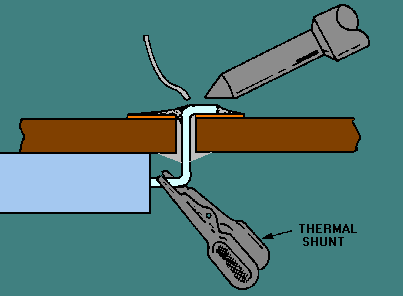
you gotta solder it
Here is some good advice on how to solder.
-
Re:Sprint PCS is terrible
check this out, it might help. enjoy!
-
Re:we need...
It helps that us old farts have all seen a disk pack explode. Reliability might be down from it's peak a few years ago, but it's still a heck of a lot better than it was in say 1975.
-
Re:Wonder what the useful lifetime of these things
You'll have to excuse me, I was shooting from the hip and didn't realize that I had made a mistake in my original discussion.
I originally said, "When you bend metal you tend to form more grains in it, due to the movement breaking up existing grains and splitting them into smaller pieces. The increase in grains causes the metal to weaken, even if it is a small amount every time."
This is not exactly true, it had been a while since I studied metallurgy and I didn't have any reference texts to consult. To clarify, the reason the metal weakens is not that the number of grains is increasing and making the material more ductile (easily bendable), but that the dislocations (areas of stress in the metal matrix) and impurities are getting moved to the edge of the grains and are collecting together. This means that less of the metal has flaws distorting its structure and is therefore harder. Since it is harder it is now less flexible and more brittle. This causes micro cracks to form during the bending. Eventually these cracks lengthen and the metal fails.
Work hardening occurs when the metal is plasticly deformed. These deformations cause impurities and other strains to gather together and less distort the structure of the metal. Since more of the metal is ordered, it is harder than it was originally.
One thing you should know is that metallurgy is very complex. There are many factors which enter into the equation, such as grain size, alloys, impurities, many different phases (crystal structures) of the metal, etc. Often simply how the metal is composed, heated, cooled, worked can vastly change its properties.
Here are some sites to study more about metallurgy:
PLANT MATERIAL PROBLEMS - a site on metal failure
Metallurgical Terms Made Simple - a site on the basics of steel metallurgy
The Metallurgy Of Carbon Steel - a more in-depth analysis of steel metallurgy -
This sounds interesting...But it isn't really anything "new" or "revolutionary". Fuel cells running on hydrogen or hydrocarbons? Which power electric motors? Or hybrids using conventional engines, doing the same?
Bah!
What would I like to see succeed?
How about the McMaster Motor? Two moving parts, light weight, innovative fuel source (but could be run off of steam in a pinch!), simple design - similar to a
Nutating Disk Displacement Meter.Or, how about the Ball Piston Engine? An interesting design that looks more like a ball bearing than an engine. The nice thing about the engine is the "standard" parts - ie, all the cylinders look the same and operate the same, parts can be swapped almost at will. I would bet one of these could be prototyped using parts from Home Depot.
Yet another twist on engines, The Henry Engine is a rotary steam engine, not a turbine.
These are the kind of mechanics I want to see in a future car. Something different, maybe based on older tech (I am sure all of these examples I have given are based on older principles/ideas).
Another kind of engine, one that I think would actually make for a better and lighter hybrid vehicle: the free-piston engine. Basically this engine consists of a piston that is fired on both side (alternatingly), with the shaft that extends through the piston driving linear hydraulic pumps, with the hydraulic fluid being conveyed in the normal manner to power hydraulic motors which drive the wheels. I would suggest that instead of the piston driving pumps (more indirection=more friction=more heat=wasted energy), make the piston a magnet of sorts, wrap a coil around the cylinder (or make the cylinder be the coil), and extract the electricity directly as the piston is bounced back and forth between the ends. I would think such a system could be made to use the fuel in a super-efficient fashion (not perfect, but better than a standard piston engine). I can think of a number of design issues (ie, how to make a piston be a magnet with the heat of combustion working at odds, among others) - but these can be worked out.
Think about how (relatively) simple a free-piston engine is - a tube, a piston inside the tube, and inlet/outlet ports (and controlling valves) plus spark plugs at the ends. I would think a good spud-gun builder could build a prototype (that would run for a while, then melt from the heat) from ABS/PVC pipe, sprinkler valves, etc from Home Depot - make the piston from a chunk of wood with steel end plates, magnets set in holes around the edge, wrap wire around the middle. Control the solenoid valves and plugs with reed magnet switches, maybe some relays (or Hall Effect sensors) - hmm, if I had the time I would do it myself!
Someone should try to build this - I guarantee you will get
-
Re:Be Careful
I could hold a 1 volt 300000 amp power supply's leads all day and not be hurt. The reason is Ohms law.
Although what you say is mostly correct from a practical point of view, try not to forget that "ohms law" is an idealization and only applies to a small class of conductors. What G. S. Ohm noticed more than a hundred years ago what the in metalic conductors at a constant temperature the ratio of electric field to current density was approximately a constant, known as the resistivity. (note that this is a microscopic statement.) Working from this assumtion that rho=E/J, and assuming an isotropic, ohmic conductor, one easily arrives at the more familliar version of ohms law: R=V/I. Now this is a very usefull result, but please remember that it was drived only after making multiple assumptions regarding the nature of the conducting material and has noting to say with regard to what is going on at a smaller scale.
Anyways, just be carefull you don't read too much into "ohms law".
A tunnel diode is not a bad example of something you can hold in your hand which is most deffinately not ohmic and exhibits some interesting behavior because of this.
Electrochemical systems (such as collections of cells in a human body) are another good example of decidedly non-ohmic systems. Pick up a physical chemistry book if you want to learn more.
The take home point is: Yes, you could probably hold on to a 1v supply with no problem, but the effects of electricity on the body are not as simple as you make them seem.
And, No, I am not one of those people who think cell phones or power lines are harmfull
-
Re:Frightening stuff!
I don't know about you, but 40 miles from London doesn't quite count as the middle of nowhere to me. According to a recent article in New Scientist (hard copy edition - no link, sorry) the MoD is even preventing wind turbine farms from being placed in the North Sea because of the possiblity that they may interfere with radar. I think that those guys are going to be quite concerned about EM pulses going off in the English Channel.
Ahhhh, yes, true. Perhaps a directional EM pulse (I don't know if that's possible) or a directional 10GW UWB pulse (yeah I think that's possible).More realistically, some unidentified ship from some place will drag it's anchor on the sea floor and sever the undersea fiber-optic cable, like happened before. Or for a satellite link, flood their dish with directional static, targetted at where their side-lobes would be. But this would probably be of limited effect.
-
Hogwash!
Evidently, the something-for-everyone model epitomized by Heathkit and the Amateur Scientist column can't compete anymore. Specialized sources and Internet newsgroups cater to each skill level. But much of the mentoring and serendipity that the diverse community of amateurs offered has been lost. It is hard not to regret its passing.
What an idiot. We have just largely stopped using magazines in light of the Internet.
I've learned almost everything I know about electronics from the Internet.
Look at these books! Look at them! All Free, as in Liberty AND No-Cost. These are some of the very best books I have found on electronics, on-line or off. Forest Mims the Third, eat your heart out.
Do we want to talk about mentoring and serendipity?
It was out of frustration that I compiled Lessons in Electric Circuits from notes and ideas I had been collecting for years. My primary goal was to put readable, high-quality information into the hands of my students, but a secondary goal was to make the book as affordable as possible. Over the years, I had experienced the benefit of receiving free instruction and encouragement in my pursuit of learning electronics from many people, including several teachers of mine in elementary and high school. Their selfless assistance played a key role in my own studies, paving the way for a rewarding career and fascinating hobby. If only I could extend the gift of their help by giving to other people what they gave to me . . .
There you go.
If anything, I'd say that amateur science and learning and construction is more popular now, because it is more accessible.
It just doesn't take the form of magazine articles.
-
Hardness and Toughness DefinedThe material is very hard, and could be used as bulletproof windows
Hardness increases with toughness not necessarily vis versa.
Think of it roughly in these terms:
A hardness contest between two materials consists of trying to scratch one with the other. The one scratched is harder.
A toughness contest between two materials consists of trying to break one material with the other. The one broken wins.