Slashdot Mirror
Domain: uh.edu
Stories and comments across the archive that link to uh.edu.
Comments · 221
-
Re:Paranoid BS
A break in the chain IS possible. If someone gains access to the device, they could issue commands to retrieve the raw biometric data from the device and offload it. Most biometric sensors have API calls both to receive the template (hash) or the fingerprint image (raw data). If you get remote code execution on the device, employee fingerprints could be stolen by simply calling the API to retrieve the raw data.
Reversing the template to obtain the original fingerprint is simply not possible. That would be equivalent to saying "I have the md5 of a file, so if I find a weakness in md5, I can get the original file back!" To understand why this statement is untrue, let's talk about hashes and how they're broken.
A hash reduces a large data input to a small output, which can be used to verify that the input has not been altered (accidentally or maliciously). Except in extremely rare cases (small, known input sizes), hashing always causes such loss of data that the original file cannot be reconstructed.
A cryptographically secure hash adds one extra property. A cryptographically secure hash is engineered so it is difficult or "impossible" to create a different input that hashes to the same output. When hashes (like md5) are "broken", that means that we've devised a way to generate a series of inputs that resolves to the same hash--not that we can reconstruct the original input. In fact, once broken, we can generate a number of inputs that resolve to the same hash, and the original could be any one of them (or potentially another one we have not yet generated)!
Biometric templates are essentially non-cryptographic hashes. They are simply a measurement of the relative position and orientation between minutae (see here: http://www.uh.edu/engines/fing... for a description of what minutae are). Because they are not cryptographic, if you have a fingerprint template, it is absolutely possible to reconstruct a fingerprint that will match and score well against the template--that is, you could generate a spoof that would be accepted in the fingerprint reader. However, it would NOT be possible to reconstruct the original fingerprint, as too much data has been lost to reconstruct the original fingerprint.
I agree with the privacy concerns of biometric devices. It takes only one hack on such a device for your unchangeable biometric data to be stolen, forever. But if you need a person's fingerprint, the attack vectors aren't on the template data, they're on the device to obtain the raw image. Alternatively, if you had a fingerprint and a large data of stolen templates, you could likely identify a single or small set of individuals that had the fingerprint.
Note: I work on the industry on biometric devices, although not the ones that Wendy's uses. -
Re:alt take: maybe democracy isn't good for societ
I agree - we need better education; but I also agree that not everyone should be able to vote. Why should we let people who don't even understand our constitution decide who gets to lead us? I posted this above: What Americans Don't Know About the Constitution, in a poll (granted an old one) "... Nearly half believed that the Constitution contains Karl Marx's phrase 'From each according to his ability, to each according to his need.'"
It's not wealth - it's education. It's an incentive to get educated. We're not talking about people living like they do in the favelas of Brazil (although, believe me, they have electric and water and most of them have internet and smartphones), we're talking about first world countries where even the poorest person can go into a library and read a book or look something up on the internet.
And since education is one of the primary factors in earning wealth, it's a plus all around.
Social Media, as it is now, is practically a disincentive for people to be educated, because far too many rely too much on it for information, and take whatever they read there as truth.
-
Re:That's stupid.
I agree - huge swaths of both republicans and democrats (or conservatives and liberals, or whatever labels you want to use) would be eliminated from the voting pool.
From What Americans don't know about the constitution:
A public opinion poll conducted during the 200th anniversary of the U.S. Constitution in 1987 found that most Americans were woefully ill-informed about the content and meaning of the document. Only a bare majority knew that the purpose of the Constitution was to create a federal government and define its powers. Nearly half believed that the Constitution contains Karl Marx's phrase "From each according to his ability, to each according to his need."
-
Re:Because you'd be in jail
Sure... http://www.digitalhistory.uh.e...
See Section 1 paragraph e.
Then you will need the following definition:
gross negligence
n. carelessness which is in reckless disregard for the safety or lives of others, and is so great it appears to be a conscious violation of other people's rights to safety. It is more than simple inadvertence, but it is just shy of being intentionally evil. If one has borrowed or contracted to take care of another's property, then gross negligence is the failure to actively take the care one would of his/her own property. If gross negligence is found by the trier of fact (judge or jury), it can result in the award of punitive damages on top of general and special damages.
Clinton was very careful to "filter" her E-Mails when she finally was ordered to provide them. She had her legal team go through them and only provided the ones *she* found relevant. She didn't exercise this same care with classified information.
I'm sure you can make the connection to what I'm saying here.
-
Citation Needed
the Espionage Act -- a World War I era law meant for spies -- which explicitly forbids the jury from hearing why the defendant acted, and bars them from deciding whether the outcome was to the public's benefit.
I read The Text of that Law and find no reference at all to restrictions on what the jury is allowed to hear. Moreover, it uses the phrase
with intent or reason to believe that the information to be obtained is to be used to the injury of the United States, or to the advantage of any foreign nation,
more than once. It seems challenging to me to obtain a proper conviction where one needs to show "with intent or reason to believe" and not allow the jury to hear from the defendant what that person intended or had reason to believe, especially since not permitting the jury to hear from the defendant in matters regarding intent violates the Confrontation Clause of the 6th Amendment to the Constitution. That said, the way this law is phrased does poor service to people who believe the information obtained will be used to the benefit of the United States, since "benefit to the United States" itself provides advantage to those foreign nations who are allies of the United States, and the law makes no distinction between allies and opponents among foreign nations. I suppose it could be argued that with a sufficiently strong "America First" policy in place, benefit to the USA does not also benefit our allies. Certainly, any law that doesn't permit the defendant to tell the jury why she did what she did ought to be repealed or rewritten so that this is no longer the case.
-
Re:Chine did something original?
This. And The Wall.
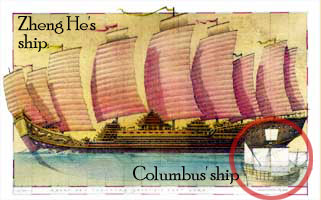
The Great Wall was started before 200 B.C., but much of what we see today was rebuilt in the 1500s Ming dynasty, when Zheng He's epic around-the-world voyage occurred. His fleet was 300 ship strong, with the capital ship's size comparable to modern day aircraft carriers. Here is an image comparing Zheng He's ship and Columbus':
http://www.digitalhistory.uh.e...
Sadly, after the voyage, they decided they didn't want anything to do with the rest of the barbarian world. The emperor declared it a capital offense for anyone to own a ship with more than one mask, and ordered to build/rebuild the wall.
Incidentally, Zheng He was a Muslim.
-
Re: TFA missed two.
"you are a member of the race of which the community and culture accepts you as a member"
And that is the real definition of race. Lots of people think race is genetic, but the one group that has near unanimous agreement that race is not genetic are actual geneticists. For example, Dr Craig Venter (founder of the Human Genome Project) says, "Race is a social concept, not a scientific one. We all evolved in the last 100,000 years from the same small number of tribes that migrated out of Africa and colonized the world."
Turns out there is more genetic diversity within commonly defined racial groups than there is between them. An illustration of this fact:
In one example that demonstrated genetic differences were not fixed along racial lines, the full genomes of James Watson and Craig Venter, two famous American scientists of European ancestry, were compared to that of a Korean scientist, Seong-Jin Kim. It turned out that Watson (who, ironically, became ostracized in the scientific community after making racist remarks) and Venter shared fewer variations in their genetic sequences than they each shared with Kim.
Race Is a Social Construct, Scientists ArgueAnother example is that it was only within the last 130 years or so that italians, germans, french, irish and even swedes were considered "white." Here's Ben Franklin expressing the commonly held beliefs of his time:
the Number of purely white People in the World is proportionably very small. All Africa is black or tawny. Asia chiefly tawny. America (exclusive of the new Comers) wholly so. And in Europe, the Spaniards, Italians, French, Russians and Swedes, are generally of what we call a swarthy Complexion; as are the Germans also, the Saxons only excepted, who with the English, make the principal Body of White People on the Face of the Earth.
Benjamin Franklin, "Observations Concerning the Increasing of Mankind, Peopling of Countries, &c." (Boston: Printed by S. Kneeland, 1755) -
Re:Right
And yet I see people half my age bust their asses around the work place all the time.
Either way, anecdotal evidence is garbage.
Y'all crack me up wih anecdotal evidenc is worthless bullshit. Everything is anecdotal evidence.
You are confusing data points with non truth. Allow me to make this clear to you. All of the exploding phones put out by samsung have not had a double blind rigourous testr process to teliminate all ofhter possibilities that eliminated every other possibility for the reports of them catching fire. This is truth.
NOw you are saying that every person that reported "My phone caught on fire is garbage, and means nothing. Each of those reports was an anecdote, therefore you in your wisdom can claim that there is no scientific evidence that SamSung S7 phones have any problem whatsoever, therefore thw batteries do not catch on fire.
All of the phones that burned up were not done under rigourous laboratory condition so any conclusions ore pointless, the phones are 100 percent safe.
So bullshit.
The Universities that have multiple instances of student's parents interfering with the university's functions, such as trying to have professors fired because the child didn't like them are get ready for this Anecdotal evidence, not proven by strict scientific studies. So in your jugement bullshit and garbage.
Here re some non scientific anecotal evident for ya Complete with a lot of references
http://www.law.uh.edu/ihelg/mo...
Total bullshit, you might say, as not each single anecdote which is garbage has not been totally proven. right? I mean you have to be rigorous right?
I have two finals things to say. My data points, of approximately 20 unsuccessful and semi successful 3 and 2 successful millenial candidates are just that. Data points that agree with a lot of other data points. And when a lot of data points agree with other data points, you are probably on to something.
And finally, give me the rigourous scientific proof that concludes that all anecdotes are garbage. otherwise you are just giving your opinion, and last time I checked, opinions are not necessarily the truth, and certainly not scientific proofs.
-
Re:Let me be the first to say
When completely deprived of oxygen, loss of consciousness occurs within about 12 seconds, and death after about a minute. This is why the safety briefing aboard airliners says in the event of cabin depressurization you should put your oxygen mask on first, then your child's. If you try to put your child's mask on first, you'll likely go unconscious before you can get around to putting yours on.
It really is the perfect way to painlessly kill someone. Which I suspect is why it's not covered more by the media (a huge majority of whom are against the death penalty). A large part of the opposition to the death penalty is based on potential suffering of the prisoner. Presented with a guaranteed way to avoid that suffering, that opposition evaporates.
Disclaimer: I don't have a moral problem with a death penalty in certain cases, but I do not believe our current legal system is accurate enough to justify the use of death as a punishment. IMHO its irreversible nature disqualifies it from use in a justice system which has been proven to be error-prone. -
Re:Snowflakes
AFIS is just an automated system. Manual fingerprinting also follows identifying features and matching them up. So do you agree that we've ascertained that manual inspection is indeed a matching of points of identification or characteristics, as per the FBI's own fingerprint recognition document?
-
Re:I would be too
Really?
Really
Really?
Really
Those kids are probably wondering why you can't follow a simple schedule. Their employer told them to work 9 to 5, so that's what they're going to do unless they're told otherwise.
These are people who are supposed to be professional. Professional peopla are paid to get a job finished, not to be working for the clock. They are not constrained to 8 to 5 like the non-exempt people
It isn't always their first job,
Every person I gave as an example was working at their first job.
and while you may be divorced from the experience of working hourly, these days you stay after you're supposed to leave and your manager yells at you for chewing up the labor budget.
As noted, these were professionals, and in the exempt category.
That kind of shit sticks with you, especially when your parents failed to initiate you in unspoken rules of the working world like "We're going to tell you to work 9 to 5 but really, your ass belongs to us 24/7 and you should be happy we don't just chain you to the fucking desk."
You have their attitude down pat. Congratulations.
And don't pretend that only millennials do dumb shit like skip out ten minutes early when they've got time-sensitive shit left to do, or push their workload off on their co-workers so they can dick around on Facebook all day.
I pretend nothing. I do have to say, you only get a few chances to diss the director. maybe two. He shows up at his meeting without his materials, and he's embarrassed in front of his peers. You want to be on facebook all day? Probably a nice room in the basement, and have all the time in the world. Pay sucks though
I know it's fun and easy to take shots at "millennials" or "boomers" but let's face it: most people are just shitheads.
All I can tell you is that of the millennials we hired, only two ever worked out. They have unrealistic expectations, and expect people to serve them. The older folks get their work done on time. The Gen X-ers we hired got theirs done on time, except for a few..
But yeah every age group has a few slackers. It's just that at least in my experience, with the other groups it's an occasional thing finding a slacker. With the Millenials, it's a job strategy.
This helicoptering parent, and unfinished adults is not a hypothetical thing. Colleges have been trying to fix the problem. The children have been trying to involve their parents in every decision, and the parents have been interjecting themselves into situations that a normal adult can easily decide. But they won''t allow it, and you can probably keep a child as a child until their 40's if you try hard enough
And the great irony is that I do not find these kids at fault. But their parents need kept away from them so they can grow up. But what happens if you dare t broach the subject? Your accused of pucking on the kids. I'm not. I'm standing up for them. Sometimes making a child grow up when she or he is physically an adult seems mean, but how mean is it compared to crazy parens being so nice, so protective, and badly screwing the kids up?
Having a problem with a room mate? Call mommy or daddy! They'll call the college president and fix that meanine in your room:
http://www.washingtonpost.com/...
http://www.law.uh.edu/ihelg/mo...
Here, Mommy calls to make certain the workplace is correct for her precious, the alarm bells go off, and the job offer is withdrawn.:
-
Re:First post - from Cuba
freedom vs slavery.
Let's fine out what slavery in the USA was like. That there is slavery and you are embarrassing yourself by comparing the two.
-
Genocide
Elizabeth Warren's work on "The Two Income Trap" has shown the government's figures on the cost of living to be genocidally wrong. When I say genocidally wrong I mean the absence of children that contributes to "the labor shortage" is due to income redistribution from the middle classes to the increasing centralization of wealth among the upper 1%. Ricardo's "iron law of wages" was formulated in a time when "subsistence" could not cut into replacement reproduction due to the lack of birth control. The conscientious fraction of the population will respond to a lowering of real family income relative to the cost of replacement child rearing by ceasing to have children. This is what Warren's work shows is exactly what happened to the Baby Boomers when it came time for them to plan their families. To further import foreign workers to fill the "labor shortage" when it is already demonstrably the case that lowered _real_ wages has resulted in quasi-genocide of the populations being replaced is no longer excusable as mere ignorance by policy planners, if, indeed, it ever was excusable.
-
Re: ROI for drug development
Well there's the case of Samuel Langley (expensive publicly-funded research) V.S. the Wright brothers (privately funded research), but then I'm not sure it works so well for the GP.
-
Business as Usual, historically speaking.
The USA has always had megacorps that were willing to attack scientists in order to keep on poisoning the people of the USA.
See, for example, how Kehoe, Kettering and Midgely (working for GM, DuPont and the Ethyl Corporation) attacked the reputations and careers of whistle-blowing scientists (like Patterson, Landrigan and Needleman) in order to hide the horrific effects of lead poisoning. The high toxicity of lead was known in the 19th century, and well quantified by the mid-1930s, but hidden from the US public until the 1970s by a concerted corporate disinformation campaign.
In just the last century, we increased our exposure to lead in the environment by 625 times and the effects are going to last for several more generations at least. This poisoning of generations of children, with literally many millions of victims, was done to maximize corporate profits for America's ruling class. And in today's political climate - with Reagan corporatist Obama actually considered to be left-wing or even socialist - you can expect this sort of behavior will continue.
-
Re:Too bad
I looked it up, so for the benefits of others: according to http://www.math.uh.edu/~tomforde/hquotes.html, the quote is from Time Enough for Love
-
Re:Gross, but...
I don't even want to know what kind of swill people drank during the prohibition.
Being a fervent Homebrewer, I did: http://www.slate.com/articles/health_and_science/medical_examiner/2010/02/the_chemists_war.html
"Frustrated that people continued to consume so much alcohol even after it was banned, federal officials had decided to try a different kind of enforcement. They ordered the poisoning of industrial alcohols manufactured in the United States, products regularly stolen by bootleggers and resold as drinkable spirits. The idea was to scare people into giving up illicit drinking. Instead, by the time Prohibition ended in 1933, the federal poisoning program, by some estimates, had killed at least 10,000 people."
http://www.digitalhistory.uh.edu/disp_textbook.cfm?smtID=2&psid=3383
"Prohibition did briefly pay some public health dividends. The death rate from alcoholism was cut by 80 percent by 1921 from pre-war levels, while alcohol-related crime dropped markedly. Nevertheless, seven years after Prohibition went into effect, the total deaths from adulterated liquor reached approximately 50,000, and there were many more cases of blindness and paralysis. According to one story, a potential buyer who sent a liquor sample to a laboratory for analysis was shocked when a chemist replied: "Your horse has diabetes." "
"Even today, debate about the impact of Prohibition rages. Critics argue that the amendment failed to eliminate drinking, made drinking more popular among the young, spawned organized crime and disrespect for the law, encouraged solitary drinking, and led beer drinkers to hard liquor and cocktails. One wit joked that "Prohibition succeeded in replacing good beer with bad gin." The lesson these critics derive: it is counterproductive to try to legislate morality. "
So in regards to Krokodil:
freely available precursors that have legitimate uses
+ clampdown on information to iterate the impurities/efficiencies out of methods and tools
+ belief that addiction is lack of morality and willpower
= actual, not a joke, they were fiction and now they are here "ZOMBIES" (minus the "crossed over the actual deadline" of the fictional version.)Morality or Zombies, Morality or Zombies..... Hmmmmm. What's that Senator Cruz? You said you enjoyed that show on AMC? Well shut things down and get up there and talk it out, son!!!
-
Re:Perhaps some Gibson, or Effinger, or Moran?Neuromancer is ideal science fiction. It investigates how technology has and might effect the way we live. Unlike the classic and wonderful pulp books, if does not have many of the assumption of the 40's and 50's.
The Difference Engine, although a bit racy, would lead to wonderful discussion about ideas, production, and mass production of technology. Why was the difference engine never built? What were the technological innovation that allowed the Enigma machine to be produced in quantity, the digital computer to be developed, and then mass market components to be produced. What were the technological developments that let us use incredibly wasteful higher level languages instead of flipping switches or assembly?
Virtual Light and that trilogy allows a more contemporary view of how technology effects our privacy, and how our dependency on technology means that we may know less than we think.
A more straightforward look at technology and privacy and security is Bruce Schneier Liers and Outliers, Certainly suitable for the upper level students. Unlike the other books which I would assign outside of class and then use the topic to drive discussion, this book might be used in class. Break it up into reporting groups that would then lead discussions based on what they read and researched.
Also, Dr. John Lienhard has a series of radio programs called Engines of Our Ingenuity. Which this is a broader selection that what is called for here, there are many engaging selections that would apply. There are programs on the difference engine, Lady Ada, the census computer, Turing, and others.
-
Re:+5 Insightful for
No, good point but also don't sell sophisticated weaponry to an ally that's unstable...
[quote]
Carter entered office in 1977 with pledges to "moralize" U.S. arms
sales, saying that the U.S. should not be "the first supplier to
introduce into a region newly developed advanced weapon systems which
could create a new or significantly higher combat capability." At the
same time, Carter continued his predecessors' policies of approving
large weapons sales to Iran. In fact, the arms sales to Iran appear
to have accelerated under Carter. Total U.S. arms sales to Iran for
the Nixon/Ford term of 1972-76 were $10.4 billion. During the Carter
administration and "before the Shah fled the country on January 16,
1979 he had placed orders with US contractors for an additional $12.2
billion of military hardware, with deliveries to be spread over the
following three years.
[/quote]http://www.iran.org/tib/krt/fanning_ch5.htm
[quote]
Like his predecessors, Carter was willing to overlook the shah's violations of human rights. To demonstrate American support, Carter visited Iran in late December 1977. He applauded Iran as "an island of stability in one of the most troubled areas of the world" and praised the shah as a great leader who had won "the respect and the admiration and love" of his people.The shah was indeed popular among wealthy Iranians, but in the slums of Teheran and in rural, poverty?stricken villages, there was little respect, admiration, or love for his regime. Led by a fundamentalist Islamic clergy and emboldened by want, the masses of Iranians turned against the shah and his westernization policies. In the early fall of 1978 the revolutionary surge in Iran gained force. The shah, who had once seemed so powerful and secure, was paralyzed by indecision, alternating between ruthless suppression and attempts to liberalize his regime. In Washington, Carter also vacillated, uncertain whether to stand firmly behind the shah or to cut his losses and prepare to deal with a new government in Iran.
In January 1979, the shah fled to Egypt. Exiled religious leader Ayatollah Ruholla Khomeini returned to Iran, preaching the doctrine that the United States was the "Great Satan" behind the shah. Relations between the United States and the new Iranian government were terrible, but Iranian officials warned that they would become infinitely worse if the shah were granted asylum. Nevertheless, Carter permitted the shah to enter the United States for treatment of lymphoma. The reaction in Iran was severe.
On November 4, 1979, Iranian supporters of Khomeini invaded the American embassy in Teheran and captured 66 Americans, 13 of whom were freed several weeks later. The rest were held hostage for 444 days and were the objects of intense political interest and media coverage.
Carter was helpless. Because Iran was not a stable country in any recognizable sense, its government was not susceptible to pressure. Iran's demands--the return of the shah to Iran and admission of U.S. guilt in supporting the shah--were unacceptable. Carter devoted far too much attention to the almost insoluble problem. The hostages stayed in the public spotlight in part because Carter kept them there.
[/quote]
http://www.digitalhistory.uh.edu/disp_textbook.cfm?smtID=3&psid=1079
We should have stopped supporting the Shaw a long time before he was finally kicked out. It's been the same story with every repressive regime we've ever had ties to. For whatever politically expedient object we were after, we've created deep rooted animosity. We're not alone and we followed the model other nations had done.
Our nation has had many leaders but not all of them have had a chance to distinguish themselves beyond life in public office. Lincoln won the Civil War and freed the slaves. Washington fought valiantly against the Brit -
Re:I like this idea
Although there may be judge's rulings that say what you claim, any decent analysis of process would show that the downloading itself cannot be infringing, any more than recording a song from the radio or buying a bootleg DVD is infringing.
Recording a song from the radio is at least prima facie infringing, assuming there's a copyright on the song, etc. There may be various defenses, such as 17 USC 107 or 1008, depending on the circumstances, but you can't say it cannot be infringing.
Buying a bootleg DVD OTOH is not infringing. Selling it is a different matter.
For example, if a radio station played a song they had no right to play (thus commiting copyright infringement in the form of "public performance"), the holder of copyright on that song cannot successfully sue anyone who recorded the song from the radio broadcast.
Yes he can. Firstly, because it's infringing on its own merits. Secondly, even if it were The Old-Time Dry Goods and Copyright Licensing Music Hour, in which the announcer said that the music and recordings broadcast were expressly licensed by the copyright holder for home taping, and even if it were reasonable to rely on that assurance, copyright is a strict liability statute; it doesn't matter whether you know you're infringing or not. It's like statutory rape, where it still counts even if you honestly had no idea, and could not possibly have reasonably known, that she was underage.
Here's my go-to case for this, since it is very clearly set up: http://www.law.uh.edu/faculty/cjoyce/copyright/release10/intres.html
The part you're looking for starts with "Can the Defendants Be Liable Under a Theory of Contributory Infringement for the Actions of Those Who Browse the Three Infringing Websites?"
In the same way, the person selling bootleg DVDs might not even be guilty of infringement, if they did not know the DVDs were not legitimate, but the person buying the disc is never guilty of infringement, even if they know the disc is a bootleg.
No, it's a totally different way. If some behavior falls under a prohibition in the law (such as making copies) then it's illegal; if there is no applicable prohibition, then it's not. It just so happens that buying a pirated copy is not, by itself, illegal.
The problem is that most judges don't understand the mechanics of digital data transmission, so they don't understand that creating a copy in RAM or on my disc is never infringement, even though an "extra" copy now exists.
The MAI, Intellectual Reserve, and Cartoon Network courts all understood it quite well, though they didn't always agree on how to interpret the law. And they all agreed that it could be an infringement, and only one thought that it sometimes might not be, due to the specific circumstances. And that was just for RAM. If there's disagreement as to downloads to proper disks, I've never heard of them. Got a cite?
Infringement only occurs when the source of that copy doesn't hold enough rights on the material to be allowed to create the copy that ends up in my RAM or on my disc.
The source doesn't create the copy (unless they've taken over your computer or something). The downloader is responsible for his own downloading, and can be liable if he infringes on someone else's rights. He could conceivably have a license direct from the copyright holder, or the uploader might have a license which includes a right to sublicense the downloader for the purposes of the download (as is the case for, say, the iTunes Store).
Otherwise, any website would have an open and shut case against every one of their visitors for infringement.
They would, if not for the implied license they're granting to their visitors by the virtue of having put the pages up on the web. But if someone put pages up that they had no rights to, they can grant no such license. Go read the case I linked to earlier, you'll enjoy it.
-
Re:How do you know?
That said, however, I'm quite diligent when it comes to copyright.
Impressive. But quite difficult. Behold:
Intellectual Reserve v. Utah Lighthouse Ministry, 75 F. Supp. 2d 1290 (D. Utah 1999) (You'll want to skip ahead to the bit that begins with "Do those who browse the websites infringe plaintidf's copyright")
Since copyright (in the US at least) is a strict liability statute, it doesn't matter how diligent you are. Even if you take all reasonable care and are not even so much as negligent, even if you are tricked into it, infringement is still infringement and you're liable for it. And due to how a computer works, you can't read, see, or hear a damn thing on the Internet without having necessarily made some sort of copy in the process.
So aside from simply not using the Internet, I'd be impressed to know how you accomplish such a thing.
-
Re:which is what Dorner probably saidThis is not a personal attack. It is not based on personality. It a statement of culture. A statement that even though we live in the freest country in the world, even though we provide the most opportunity to become educated, or innovative, or whatever you want, we still have a group of people who think it is ok to forgo all personal responsibility, all imagination, and just give up and say 'I have no choice'.
For a more eloquent discussion, see this.
-
Already been done
Unless the MRI can show the brain as a series of miniature illustrations, these guys are about 121 years late to the game. But maybe that's just my approbativeness showing...
-
Re:Careful there
Slavery was only the excuse.
Sigh. No, slavery was the root cause for the terrorist organization that called itself the Confederacy, by the terrorist's own admission. "Those [non-slaveholding] States have assumed the right of deciding upon the propriety of our domestic institutions; and have denied the rights of property established in fifteen of the States and recognized by the Constitution; they have denounced as sinful the institution of Slavery; they have permitted the open establishment among them of societies, whose avowed object is to disturb the peace...property of the citizens of other States. They have encouraged and assisted thousands of our slaves to leave their homes; and those who remain, have been incited by emissaries, books and pictures to servile insurrection." -- Declaration of the Immediate Causes Which Induce and Justify the Secession of South Carolina From the Federal Union
A stronger federal government contrary to the beliefs and intents of the Founding Fathers. The point of a weak fed was to keep massive government stupidity on a local or state-wide level, not to allow it to infect and infest itself across the entire country.
Double sigh. The whole point of the Constitution was to create a strong federal government, because the weak one of the Articles of Confederation failed. The "original intent" of Federalists like Madison was that the federal government would have more power over things like commerce and taxation than the British Parliament had had.
And, if you haven't noticed, this whole discussion is about how a state -- not the federal gubbmint -- is doing something in violation of people's rights. This is exactly the sort of behavior where the fed should step in to guarantee that a state respects citizens' due process rights.
-
Re:"I dont think so, Mr. Powers..."
Apple should get a reasonable, and non-predatory royalty for any alledgedly used patents, not an injunction barring anybody else from making phones that aren't tincans on wires.
I'm curious how far you're willing to take your idea. Imagine you invented something original that made everything else on the market look like "tincans on wires", you patented it, and your company was starting to disrupt the market thanks entirely to the competitive advantage offered by your innovation. You're setting your company up for long-term success, when one of your larger competitors, fearful that they'll be pushed out, copies your idea, deploys it on all their devices, destroys your competitive advantage, and uses their entrenched position to effectively push you out of the market before you got big enough to survive the assault. It's a pretty common story.
A "a reasonable, and non-predatory royalty" seems like a rather hollow victory in comparison to the long-term success that you've been forced to sacrifice, doesn't it? And you'd rightfully feel like you had been robbed if someone suggested otherwise. Granted, Apple isn't getting pushed out of the market by any means, but I really hate it when people suggest that companies should be forced to license their patents against their will (even in the case of endemics, the U.S. government doesn't force pharma companies to license patents; it simply infringes on them). If a company wants a competitive advantage instead of a payout, that's their "exclusive right" granted in Section 8 of the U.S. Constitution, for as long as the patent exists.
And before someone mentions it, Motorola being forced to license their patents to Apple was entirely of their own doing. They submitted their patents to be a part of various industry standards, and in exchange for having their patents accepted as part of the standard, they, in turn, accepted that they would be required to offer FRAND terms to anyone who wanted to license the patents. In contrast, Apple made no such agreement (at least with these patents), so forcing them to license them is nonsense.
As for whether the patents should have been granted in the first place, well, I think there have been a lot of crappy patents granted to all parties involved, many of which should simply be revoked. Whether these ones fall into that category or not, I don't know.
-
Re:Uh, no
"Legalization leads to less abuse by youths, and less abuse overall, lower rates of addiction, and less overall harm."
Actually, the United States Prohibition against alcohol DID reduce alcohol consumption. Greatly. In fact, after the Prohibition was repealed in 1933, it took another thirty years before alcohol consumption reached pre-Prohibition levels.
-
Re:Public interest
But there isn't a public benefit to the patent system.
There is---or was. Without patents, companies would guard inventions as trade secrets. An example is the obstetric forceps. Kept as a trade secret by one family. If more widely known, many women would not have died in childbirth.
In order to encourage people to release such knowledge into the public domain, patents were developed. The contract is that society grants protection for a limited time and in the end gets the benefit.
If you are not willing to abide by that contract, feel free to keep your invention a secret---at least until someone else invents something similar.
-
Re:iLawyer 4G
Really? Because I see a whole bunch of new phones at CES. Do you have any evidence that innovation is being held back, or is this just a gut "but it must be so" feeling?
Given that "innovation" is defined as delivering new inventions to end customers, this becomes, in a sense a stupid question. Blocking innovation is exactly what patents are designed to do. The Magsafe connector is a really neat idea. By now, if it were possible, at least one PC manufacturer would have an equivalent. The reason they don't is because Apple has a patent and they can use that patent to block innovation. This extends simply to include all of the Apple lawsuits against Samsung which held back innovation in the new phones from being delivered to Samsung's customers. In other words;
patents just do block innovation; that's their job; if your patent attorney isn't blocking your competitors innovation, fire him.
Where does the idea that patents "further the arts" etc. come from then? Well, one aim of patents is that inventors should record their innovations so that the ideas wouldn't be lost when they die. Also the idea is that whilst patents block innovation in one area, they further it in other related areas by forcing competitors to come up with different inventions which achieve the same thing in a different way. Thus patent supporters would predict for example:
- There should be many magsafe competitors on the market using, e.g. mechanical connectors like old Nokia headphones or other methods of attachment - there aren't
- The magsafe patent should tell you things about making a magsafe connector which you could never work out by just looking at one - it doesn't
- It should reasonably easy to work around the magsafe patent by finding another different device which does the same thing - nobody has done this yet
That in its self is "evidence", but you might claim it's just a one off. It's definitely true that a number of innovations that nobody would hear of otherwise end up recorded in patents, for example very obscure and different kinds of mousetraps are continually invented even though it's not clear that actually drives innovation.
The patent apologist would answer that by claiming that "yes, in situation a, b and c the patent got in the way of innovation, but overall, taking into account all the different patents, the situation is better than it would be otherwise". It's almost impossible to answer that. Almost but not quite impossible.
Firstly we can compare places with weaker patents with those with stronger patents; we would expect to see innovation in the USA accellerating, due to it's broad patent protection, whilst China should be losing ground since patents are regularly ignored there. In fact we see the opposite.
Now, I'd like to separate out "software patents" from patents in general. I believe that if the system was reverted back to more narrow patents and lifetimes were more limited, patents on physical devices would be justified. Physical devices develop more slowly; have higher duplication costs against which patent costs are more easily justified and tend to have a much lower number of patents per device. Software patents are another issue.
As a second part of our statistical evidence there have been a bunch of different academic studies. AN EMPIRICAL LOOK AT SOFTWARE PATENTS from Besson et al does a good examination of the effect of software patents. The conclusion is fairly clearly that software patents damage innovation. Another example of this academic research A GENERATION OF SOFTWARE PATENTS ends it's abst
-
what do you mean by "traditional"?
I am suspicious of the term "traditional". I believe it was an ancient Greek philosopher who said that the golden age for any people was their grandfather's generation - so for a 20 year old this might mean education in the 1960s, for a 40 year old, perhaps the 1940's. When do you define "traditional" education as having started, and finished? My little research into the education of the 19th century doesn't suggest "critical" and "agile", more like basic literacy and numeracy backed up by physical punishment. Or did you mean the 17th century? In the early colonial period in the USA, education meant basic literacy, learning the Scriptures by rote, and some maths basic knowledge. Or perhaps you meant another period in time?
Not sure what you mean by "traditional" - perhaps you could give some examples?
-
Re:As I and many others pointed out yesterday
The decision for this case was written in 2000, and I believe that the concept of digital media has significantly changed since then. One of the primary points made by the Judge was that making digital copies of music purchased on CD was not covered by fair use, and that the Record Company maintains the right to licence digital copies of their work. Fast-forwarding to 2011, most users of the service would be uploading digital copies of their music instead of 'copying' from CD. As long as the user has rights to a digital copy that can be transfered to several devices (e.g. DRM free digital copies), then I think the service should be legitimate. Amazon could probably protect itself with some terms of service language making that a condition of use.
The Legal Decision:
http://www.law.uh.edu/faculty/cjoyce/copyright/release10/UGM.html -
Re:Ministry of Truth?
And you're ret-conning it yourself by oversimplifying the reasons... Slavery was only part of the reason for the act of secession. It's crucially important to parse the whole reasons for what happened instead of fixating on a single aspect thereof.
Here's South Carolina's reasons given for doing what they did...
Here's Georgia's stated reasons...
Here's Mississippi's stated reasons...
Here's Texas' stated reasons...
It's compelling in that while Slavery was one of the main questions and points of contention for everything- it was how the North was working at trying to enforce their will upon the South instead of trying to find better answers that comes up in each of these declarations. And in trying to force the issue, they broke several parts of the Constitution in doing it.
The Constitution of the United States, in its 4th Article, provides as follows:
"No person held to service or labor in one State, under the laws thereof, escaping into another shall, in consequence of any law or regulation therein, be discharged from such service or labor, but shall be delivered up, on claim of the party to whom such service or labor may be due."
No Amendments to change that were evident at the time of secession. The North was in power in the Federal government (much like the Liberals have been in recent times...) and was violating the law that provided them authority to govern on behalf of the people. While I don't agree with the issue of Slavery (it's wrong...), it doesn't go with that the North was in the right with what they were doing at that time or during the war either. People that simplify the issue down to "it was about Slavery" are ret-conning things as bad as the others.
-
Re:Ministry of Truth?
And you're ret-conning it yourself by oversimplifying the reasons... Slavery was only part of the reason for the act of secession. It's crucially important to parse the whole reasons for what happened instead of fixating on a single aspect thereof.
Here's South Carolina's reasons given for doing what they did...
Here's Georgia's stated reasons...
Here's Mississippi's stated reasons...
Here's Texas' stated reasons...
It's compelling in that while Slavery was one of the main questions and points of contention for everything- it was how the North was working at trying to enforce their will upon the South instead of trying to find better answers that comes up in each of these declarations. And in trying to force the issue, they broke several parts of the Constitution in doing it.
The Constitution of the United States, in its 4th Article, provides as follows:
"No person held to service or labor in one State, under the laws thereof, escaping into another shall, in consequence of any law or regulation therein, be discharged from such service or labor, but shall be delivered up, on claim of the party to whom such service or labor may be due."
No Amendments to change that were evident at the time of secession. The North was in power in the Federal government (much like the Liberals have been in recent times...) and was violating the law that provided them authority to govern on behalf of the people. While I don't agree with the issue of Slavery (it's wrong...), it doesn't go with that the North was in the right with what they were doing at that time or during the war either. People that simplify the issue down to "it was about Slavery" are ret-conning things as bad as the others.
-
Re:Ministry of Truth?
And you're ret-conning it yourself by oversimplifying the reasons... Slavery was only part of the reason for the act of secession. It's crucially important to parse the whole reasons for what happened instead of fixating on a single aspect thereof.
Here's South Carolina's reasons given for doing what they did...
Here's Georgia's stated reasons...
Here's Mississippi's stated reasons...
Here's Texas' stated reasons...
It's compelling in that while Slavery was one of the main questions and points of contention for everything- it was how the North was working at trying to enforce their will upon the South instead of trying to find better answers that comes up in each of these declarations. And in trying to force the issue, they broke several parts of the Constitution in doing it.
The Constitution of the United States, in its 4th Article, provides as follows:
"No person held to service or labor in one State, under the laws thereof, escaping into another shall, in consequence of any law or regulation therein, be discharged from such service or labor, but shall be delivered up, on claim of the party to whom such service or labor may be due."
No Amendments to change that were evident at the time of secession. The North was in power in the Federal government (much like the Liberals have been in recent times...) and was violating the law that provided them authority to govern on behalf of the people. While I don't agree with the issue of Slavery (it's wrong...), it doesn't go with that the North was in the right with what they were doing at that time or during the war either. People that simplify the issue down to "it was about Slavery" are ret-conning things as bad as the others.
-
Re:Ministry of Truth?
And you're ret-conning it yourself by oversimplifying the reasons... Slavery was only part of the reason for the act of secession. It's crucially important to parse the whole reasons for what happened instead of fixating on a single aspect thereof.
Here's South Carolina's reasons given for doing what they did...
Here's Georgia's stated reasons...
Here's Mississippi's stated reasons...
Here's Texas' stated reasons...
It's compelling in that while Slavery was one of the main questions and points of contention for everything- it was how the North was working at trying to enforce their will upon the South instead of trying to find better answers that comes up in each of these declarations. And in trying to force the issue, they broke several parts of the Constitution in doing it.
The Constitution of the United States, in its 4th Article, provides as follows:
"No person held to service or labor in one State, under the laws thereof, escaping into another shall, in consequence of any law or regulation therein, be discharged from such service or labor, but shall be delivered up, on claim of the party to whom such service or labor may be due."
No Amendments to change that were evident at the time of secession. The North was in power in the Federal government (much like the Liberals have been in recent times...) and was violating the law that provided them authority to govern on behalf of the people. While I don't agree with the issue of Slavery (it's wrong...), it doesn't go with that the North was in the right with what they were doing at that time or during the war either. People that simplify the issue down to "it was about Slavery" are ret-conning things as bad as the others.
-
Re:Weird!
Gustav Eiffel already gave his tower an anthropomorphic makeover.
http://www.uh.edu/engines/statlibskel.jpg -
Re:Send them a bill
Well, this is my absolute favorite case on this subject. Scroll down to the section titled "Do those who browse the websites infringe plaintiff's copyright?" and remember to read footnote 5, which is part of that section.
-
links mentioned in replies
online videos: algebra + calculus
http://justmathtutoring.com/
http://www.mathtutor.ac.uk/
http://www.khanacademy.org/
http://www.graderocket.tv/index.php
Uni Maths Videos
http://ocw.mit.edu/OcwWeb/Mathematics/
http://press.princeton.edu/video/banner/
http://academicearth.org/subjects/mathematics
http://freescienceonline.blogspot.com/2009/01/calculus-video-lectures-bonus-basic.html
http://www.apple.com/education/itunes-u/ (requires iTunes download)
Resources from Universities
http://www.germanna.edu/tutor/helpful_handouts.asp?menuchoice=Helpful%20Handouts (wow)
http://mathforum.org/
Free online books:
http://www.jamesbrennan.org/algebra/systems/solution_set.htm
http://cnx.org/content/m18205/latest/?collection=col10624
http://www.jirka.org/diffyqs/ (Differential eqns)
http://www.purplemath.com/
http://tutorial.math.lamar.edu/
PowerPoints
http://www.online.math.uh.edu/HoustonACT/
Tutoring services
http://www.nutshellmath.com/
Collections of Links
http://math.about.com/od/mathhelpandtutorials/Math_Help_and_Tutorials_by_Subject_and_or_Topic.htm
http://pathstoknowledge.net/
Problems
http://projecteuler.net/
Some computer Resources
http://www.graphmatica.com/
http://archives.math.utk.edu/visual.calculus/ -
PowerPoint Slides for BC Calculus
http://www.online.math.uh.edu/HoustonACT/ My high school teacher used these slides last year. I thought they were helpful.
-
Re:Thanks for pointing that out
-
Re:One Resource
In other words, you're making an overly-complex "explanation" that the people at the time never bought into.
We know people at the time thought it was rounded. That doesn't mean we know they thought it was a sphere.
Gee, you mean that old greek guy who calculated its' diameter and had a crater on the moon named after him never existed? Even b efore him, they had argued it was a sphere, like the moon.
2500 years ago, the Greeks finally decided Earth was a sphere. Plato argued that, since the sphere is a perfect shape, Earth must be spherical. Aristotle used observation. He pointed to the circular shadow Earth casts on the moon during an eclipse.
The Greeks had no way of knowing how large the globe might be. The most daring travelers saw Earth reaching farther still beyond the fringe of their journeys. Then, in 200 BC, travelers told the head of the Alexandria Library, Eratosthenes, about a well near present-day Aswan. The bottom of the well was lit by the sun at noon during the summer solstice. At that moment the sun was straight overhead. Eratosthenes realized he could measure the shadow cast by a tower in Alexandria while no shadow was being cast in Aswan. Then, knowing the distance to Aswan, it'd be simple to calculate Earth's radius.
There was no accurate timekeeping back then. For Eratosthenes to make his observation, it had to be precisely noon in both cities. And he needed an accurate north-south distance from Alexandria to Aswan. Actually, Aswan lay south by southeast instead of due south, but the error wasn't great. His calculated size of Earth was high by only fifteen percent.
A round globe, well before the "middle ages." Then there was just the question of "are there other land masses
Three centuries later, the astronomer Ptolemy created many methods of modern geography. It was he who abandoned the idea that we're girdled by a great unsailable ocean. Ptolemy believed that other lands lay out in the terra incognita. He built upon Eratosthenes; but he also criticized him. When Ptolemy made his own estimate of size, he came out twenty-eight percent low.
Ptolemy's thinking suited Columbus, for it shrank Earth to fit his ships. He was plain dumb lucky that the West Indies intervened. And we need to remember what a mental leap the ancients had to make. The imagined four corners of the earth thwarted our understanding until a scant 2500 years ago. Only then did we finally fold our minds around the idea of a round earth. And it was only four hundred years ago that we actually managed the mind-numbing trick of traveling to the east by sailing west.
-
Re:ErrrWell, yeah, we all know that Windows actually runs on soap bubbles....
-
Re:That's just ridiculous....
Your response is largely flamebait and somewhat simplistic. A quick review of Google provides a more comprehensive overview of the causes of the Irish potato famine. Yes, it was British policies but it wasn't trading policies as much as it was land ownership rules. And it wasn't as deliberate as you make it out to be.
http://www.digitalhistory.uh.edu/historyonline/irish_potato_famine.cfm
Your version reminds me of the stories that are told here in the U.S. about how evil the British were, and it gets embellished every time. No wonder the IRA had such an easy time funding their terrorist activities with U.S. dollars. About the only good thing to come out of 9/11 was the discontinuation of funding for the IRA now that American's finally saw what it was like to live under the threat of terrorism.
-
Re:Can you site an enforced EULA?
-
Re:EULA
http://www.law.uh.edu/faculty/RNimmer/contracts/supp7.pdf
That's an edited version, but gets at the meat.
-
Re:kids today - ANSWERSI'm an old fart, and I do think "kids today" are dumber than they were just 10 years ago (I'm in education, so I get to see the trend over time - it's not pretty...) but I've seen that Kansas test before and it has problems.
What is more important is not being able to remember all the crap in it, but knowing how to find out. In today's world, I just search on the exam and get the answers, HERE.
What is important is not knowing things, but knowing how to find out and what to do with the information when you get it.
That said, I have noticed a marked (general) decrease in student abilities to reason, and an equal increase in a kind of fucked up sense of entitlement. There are always exceptions - there are always brilliant hard working kids - but the number of dopey bimbos and brainless douchebags has multiplied wildly in even just the past 5 years. Those kids are fucked. They need to know how to figure things out, how to logically suss out a problem. Now they just whine because they can't do facebook during my lecture...
Argh.
RS
-
Gathering of success rate data shut it down
Apparently they got in a bit of trouble over this - not for instituting the checklists, but for having the gall to track results to see how effective they were. Because of that, it basically becomes an experiment and you have to get all sorts of permissions.
A bit more detail in this NYTimes editorial
And some commentary from the University of Houston Law Center: here
Note that all of this is actually a bit dated - the original New Yorker article was from December, 2007 and the followups that I saw were from January, 2008. I don't know what's happened with it since then; I suspect that checklists have been implemented in some hospitals but that nobody is sharing results.
-
choose your subjects wisely
be careful before committing to a large scale neural network project. Aside from the intuition that the brain is a massively interconnected network, no one is really sure what aspect of neural network functionality is necessary for intelligence. My advice to you is to spend time coming to terms with the abstract nature of intelligence rather than coding up elaborate projects. This link is a philosophical discussion on directed behaviour which I found quite interesting (if a bit vague, which is the mark of philosophy). Also, as you become familiar with the literature, you will see many examples of algorithms which claim to model certain aspects of intelligence. These algorithms work because they have a reliable and unambiguous artificial environment from which they draw their sensory information. The problem with practical artificial intelligence is that the real world is extremely ambiguous and noisy (in the signal sense). Therefore the problem is not creating an algorithm which can emulate intelligent behaviour but solving the problem of taking the empirical information of the sensory input and producing from that data a reliable abstract representation which is easily processed by the AI algorithms (whatever they may be, neural networks, genetic programming, decision trees etc) Good luck.
-
Polar graphs are often very misleading
I'm just going to comment on the graph itself, without connection to the person:
Presenting this kind of data - abolute numbers and their breakdown into individual contributors,
for consecutive, identical intervals of time - in a polar graph as some kind of piechart is a very bad idea.
Piecharts are good to represent relative parts of a whole, by segmenting a circle. That's it. As soon as a radial
component is included (as is the case here - it even is the main component), they become at least misleading, and I'd call it useless.
What does the radial dimension mean? Is it linear (I presume it is - but how can I be sure?)? Are we supposed to interpret
the sizes of the areas? Note that the exact same radial length leads to a much larger area on the outside of the graph than
at its center. And we tend to see areas, not lengths. Imagine the order of subnumbers switched: The area of the orange parts
("death from battlewounds") would grow considerably, while the blue area ("death from disease") would shrink quite a bit, thereby
of course reducing the point this graph tries to make. This point is actually a perfectly valid one - but trying to "sex it up"
with a misleading graph is a bad idea. Also, the segments themselves are unnecessary and don't contribute to the information:
We know months are roughly the same length each. No information gained here.
This graph is actually a very good example how not to do it. The unambiguous, easy to interpret graph to use here is a simple histogram. -
Better graph
I searched around for a more readable graph and found one here, at the bottom of the page.
-
Re:It's good to be king...How about a little context there? The 3/5 Compromise was a giant wart on the Constitution.
Consider Luther Martin:Luther Martin of Maryland, a slaveholder, said that the slave should be subject to federal regulation since the entire nation would be responsible for suppressing slave revolts. He also considered the slave trade contrary to America's republican ideals. "It is inconsistent with the principles of the Revolution," he said, "and dishonorable to the American character to have such a feature in the constitution."
http://www.digitalhistory.uh.edu/learning_history/revolution/revolution_slavery.cfm
So, for all one might concede a theoretical point to Southern States for arguing some 10th Amendment separation of powers, that Civil War (and the Civil Rights Movement a century later) is simply fruit of a bad seed planted in earlier.
Of course, our modern shackles are so much more refined:
http://perotcharts.com/category/challenges-charts/page/14The percentage of the federal budget devoted to mandatory spending has increased markedly over the past 40 years. Mandatory spending has doubled during the period, while discretionary spending has almost been cut in half. The increase in mandatory spending is due primarily to the growth of the three major entitlement programs. These programs are growing for several reasons:
New programs have been added to provide benefits to individuals deemed to be in need of assistance who were previously not covered by other programs.
Existing programs have been expanded to provide more benefits deemed to be necessary to fulfill the primary mission of the programs.
The retirement of the Baby Boomers (those born from 1946 through 1964) are beginning to swell the ranks of the entitlement programs.
Medical and prescription drug costs have outpaced the growth of the economy.
Improved medical procedures and healthier lifestyles have increased life expectancies to all-time highs, thereby extending the coverage period of many beneficiaries."I've found you can find happiness in slavery"--Reznor