Slashdot Mirror
Domain: uic.edu
Stories and comments across the archive that link to uic.edu.
Comments · 240
-
Re:Public use VR
What about using something like the CAVE2 during development?
-
Re:What "disruptive" technologies?
Fire, indoor plumbing and refrigeration don't make the cut?
I usually lump "fire" under exodigestion: the use of the external environment to predigest food, enabling disproportionate enlargement of the glucose-glutton human brain compared to the gut.
This category also includes fermentation and milling and other early "processed" foods obtained through the clever use of sticks (ultimately, pointy sticks) and rocks (ultimately, sharp rocks). One of the uses of food is to maintain body temperature, so fire gets a gold star compared to all the others, but still, it's the same thing.
Plumbing pretty much derives from metal casting (as does movable type), it just took a long time from the invention of the first lead pipes to reach the average residence.
What fully set this in motion was the germ theory of disease. If you want to split this off from metal casting, I would nominate the entire panoply of microbial hygiene (which treads on fermentation again, but with renewed vigour; and fire again, though smoke; and pretty much every other mode of food preservation).
Talk about plumbing taking a long time, it's only since 2000 that we've fully acknowledged the importance of the human microbiome (a mere 300 years after the first high-powered microscope, and 1900 years after Seneca first described magnification through shaped glass—glass itself being newly invented; having noted this point, it becomes almost impossible to leave various modes of exoperceptual enhancement off the list, as well).
At the apex of exodigestion and hygiene, refrigeration can reasonably be lumped under electrification, which absolutely can not be left off any such list.
Neither would I leave off syntactic communication (human language might have started off with complex hand signals used on the hunt, before syntax became oral) or man's best friend, domestication: anyone who thought the horse—properly tacked—wasn't disruptive never met the Mongols.
I would also be reluctant to leave off trade and mechanization (e.g. the cotton gin) and mass production from even the shortest list.
But of course this is a fractal, and you can come up with representative lumps at all scales.
____What's actually going on with modern SV disruption porn is that it has become a way to communicate to investors that your play is all about going yard (taking a big, risky swing) rather than settling for a base hit (most nervous and risk-averse entrepreneurs are thrilled to score a base hit, but it leaves the moneybag with no immediate exit strategy, and he or she can become stuck watching the entire nickel and dime Moneyball operation eek out a slow win, while all the windfall profits drain away into actual salary).
A hundred PhD students could write their theses on the venture capital language dance and barely scratch the surface.
The poor sod in the middle—some milk of magnesia chugging Richard Hendricks—ends up trying to project Godel, Escher, Bach shadow bunnies in three simultaneous dimensions, for three different audiences (VC, employees, consumer).
-
How can you tell the fakes?
are we saying they are not "real" scientific journals primarily based on the evidence that they accept prank papers as authentic? Or is there some other, clearly expressible, criteria by which "real scientific journals" can be differentiated from the phony ones? I would like to know the specifics, so this same experiment can be attempted against them.
As GrumpySteen notes above, if there were trivial criteria to say what's a fake, the fakers would simply fake that criterion as well. The overall problem is that there is no longer any entrance barrier at all to putting up a web site, calling it Journal of Impressive Science-Sounding Name, and calling it an "open source journal"-- and since anybody can do it, anybody does do it.
With that said, here are four good criteria for distinguishing real journals from fake ones:
1. Does a real scientific society publish it? Most-- not all, but most-- of the reputable journals are published by societies. Look for The American Physical Society, the Electrochemical Society, the International Academy of Astronautics, the American Association for the Advancement of Science, or the like.
2. What is the Impact Factor of papers they publish? Fake papers have zero impact factor. http://researchguides.uic.edu/...
3. Do research libraries subscribe to it? If the MIT library doesn't subscribe to it, you should wonder why.
and last: 4. Does it even have an actual print run? Real scientific journals still publish paper issues-- it's an old-fashioned holdout from the 20th century, but if a journal consists of nothing but an impressive-sounding website, it should draw your suspicion.None of these are infallable, but taken together, they put together a pretty good picture of what a real journal is, and what's fake.
-
Re:More important perhaps - no more RGB?!
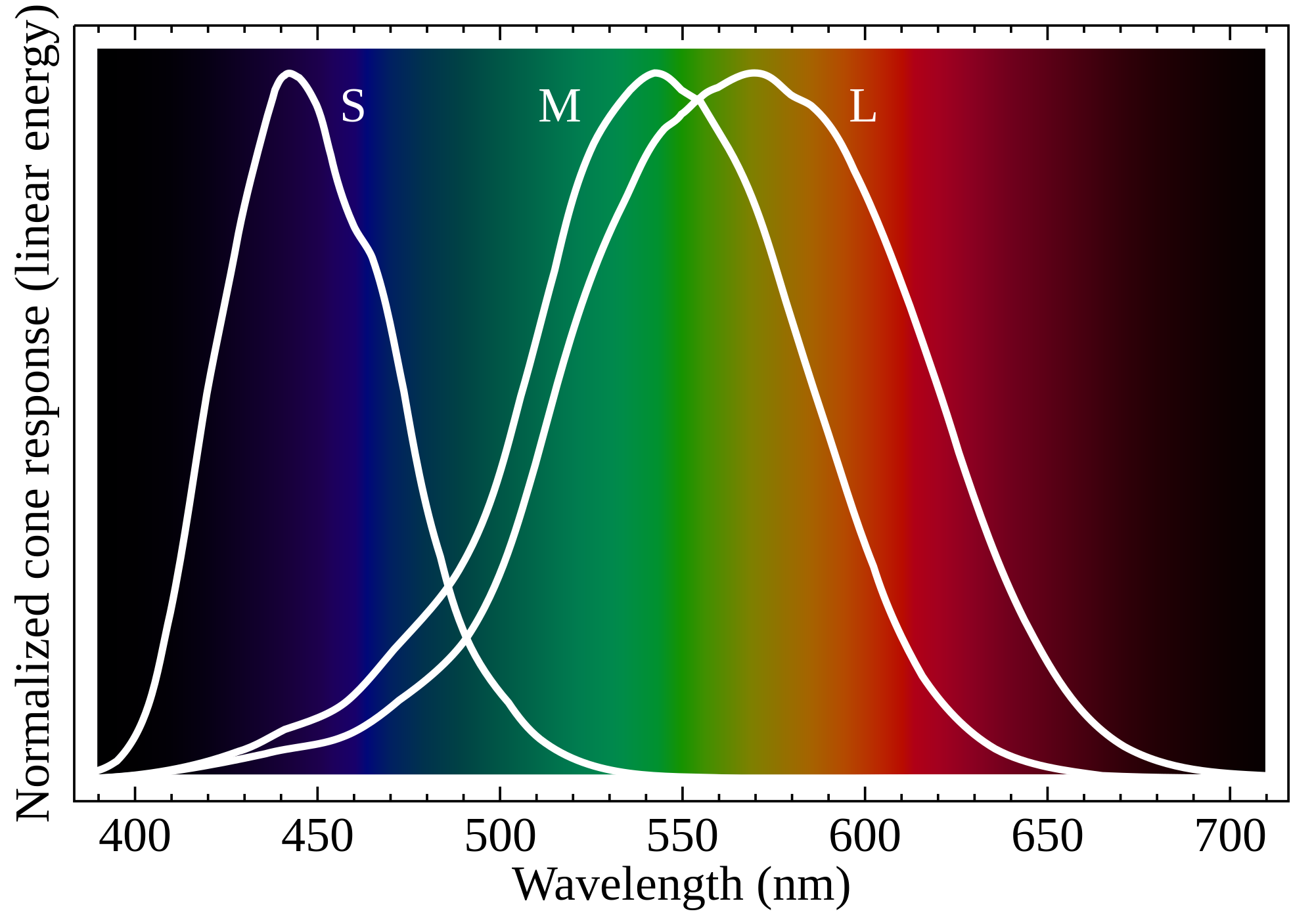
I'm kinda surprised that nobody has tried building a quantum dot display with more than three primaries yet, at least not that I've heard of. Like if you went hex with six primaries I think you should come very, very close to any point on the response curve. Maybe combine it with a hex grid instead of square pixels with every other triangle being the "new" primaries and the other three the old, something like this. That kind of Red-Orange-Yellow-Green-Turquoise-Blue display should kick ass. Now the obvious downside is that you'll only get half the intensity per channel, but then you can balance accuracy for intensity by either giving your intense pure red an extra boost in intensity with the orange channel or keep the red as it is. For blinding white or something like that you can still fire on 6/6 channels instead of 3/3.
-
Softpedia es soo woode (voice of jar jar)
Why does softpedia link to everything except the source?
https://www.cs.uic.edu/~s/musi...It's too easy to pick things that make no sense to you apart. I don't understand x, y and z and therefore I conclude in typical know it all academic think "This is ridiculous". The following is just conjecturbation and is likely to be totally wrong.
If your deriving a symmetric encryption key you never actually transmit perhaps some nerfing is intentional so the intended receiver has a prayer of expending energy to derive it. There could be a calculation embedding asymmetric keys is an unnecessary (attribution?) risk leaving crap like this where anyone with sufficient resources could plausibly decrypt a more appealing option.
The consequence of not using random IVs is situation dependent and can range from the safe default of very detrimental to beneficial given certain operating constraints.
Authentication is a double edged sword. If your adversaries don't know what key or data they are looking for providing a known authentication mechanism is an unnecessary gift.
-
Re:Steve Jobs already did it.
Back in the 90's UIC's MS/CS department had a computer lab with workstations running NeXTStep. The lab had mostly Intel-based pizza-boxes, but later on they purchased some HP-PA machines (models 715 and 815 IIRC). Some of the professors had a NeXTstation or NeXTcube (some with the NeXTdimension board) in their office. I really got a kick out of the magneto-optical drives.
I worked as an admin in the lab for a time and compiled a lot of open source code on those machines. GNU's autotools weren't used by a lot of projects, so I had to fix a lot of compile-time issues with header files and datatype names. Looking back, that was a pretty good learning experience for a newbie.
-
How tall is he?
This guy's Saul Weiner. That makes me wonder how big he is. Anyone know?
-
Re:Who believes this? Only everyone...
The way you refute a peer-reviewed study is with better peer-reviewed studies. A spam list of unreviewed opinions all written by the same handful of dissenters refutes nothing. Provide better data, or take your unfounded opinions and baseless accusations elsewhere.
The way you confirm a peer-reviewed study is with more peer-reviewed studies, conducted independently and using different lines of evidence, to see if they arrive at similar results. Like this one, this one, this one, this one, and this one, to cite a few.
-
Re:Speaking of "opaque" - Dice, WTF re: comment li
I didn't know that was a comment link. Maybe Dice ought to hire some of those "usability" experts advertised on their main site.
What's missing is the link BELOW the article summary that used to say "Read the XXX Comments." Right now there's some kind of crappy "Share" link that doesn't even provide direct access to social networks. Here's what it used to look like in the good old days:
-
Re: Single-year does not make a decadal trend.
I'm sorry, you're full of shit and don't have a clue what you're talking about. When you disagree with NASA and CERN and the fossil record you better be able to also drop an SUV on mars from a rocket powered skycrane and hold all the worlds antimatter.
The IPCC has not been right about anything, ever, and if you don't think 75% error is meaningful then 2+2=7 is for you.
You wouldn't happen to be the recipient of a climate grant would you?
"The problem is we don't know what the climate is doing. We thought we knew 20 years ago. That led to some alarmist books – mine included – because it looked clear-cut, but it hasn't happened,” Lovelock said.
“The climate is doing its usual tricks. There’s nothing much really happening yet. We were supposed to be halfway toward a frying world now,” he said.
“The world has not warmed up very much since the millennium. Twelve years is a reasonable time it (the temperature) has stayed almost constant, whereas it should have been rising -- carbon dioxide is rising, no question about that,” he added.
"'I made a mistake'As “an independent and a loner,” he said he did not mind saying “All right, I made a mistake.” He claimed a university or government scientist might fear an admission of a mistake would lead to the loss of funding."
Oh fuck. The F word. F-f-f-f-f-uding.
https://web.archive.org/web/20...
"Warming" -> http://www.nature.com/nclimate...
http://www.nature.com/nclimate...
http://www.climate.gov/news-fe...
http://www.nasa.gov/press/2014...
http://www.theregister.co.uk/2...
http://blog.nj.com/njv_paul_mu...
http://opinion.financialpost.c...
http://www.populartechnology.n...
http://tigger.uic.edu/~pdoran/...
http://www.climatechangedispat...
http://news.ku.dk/all_news/201...If you have some other explanations of all these or proof of a warming world this might be a good time to drag it out.
-
Re:unfair policy
What I find most amazing is this: 97% of the best climate scientists we have on earth have concluded that we have a problem.
This is wrong, you read the poll wrong (maybe this one?). Here is the part you misunderstood: 97% of climate scientists say man-made CO2 has an effect on the global temperature (and the rest probably clicked the wrong box on accident).
Do you understand that there is a difference between "having an effect" and "is a problem?" Because there is a huge difference, and the people answering the poll understood that there is a difference. Even scientists who are frequently labeled 'deniers' will answer yes to that poll, it's almost like asking a non-question. -
Let me save the editors the trouble then
https://www.google.com/search?...
All the Raspberry Pi in a gameboy box stories you could ever want.
You have to wonder what the progression of these will be
Raspberry Pi does Coleco Football
http://www.evl.uic.edu/aej/526...Raspberry PI does Merlin
http://upload.wikimedia.org/wi...Probably not this
http://retrothing.typepad.com/...Seeing as people are still selling and making new ones and I am sure the people doing so actually guard their rights.
-
Re:"Thus ends "Climategate." Hopefully."
OK, that was funny. But the 97% number is nonsense, just for the record. Skepticism about AGW catastrophism
It's ironic that you're the one complaining about nonsense. You are either conflating two different topics by accident or being downright deceptive.
Here's the 97% press release:
http://tigger.uic.edu/htbin/cg...
And it says more or less:
Survey: Scientists Agree Human-Induced Global Warming is Real
If you read the actual article, you will see that is has absoloutely nothing to do with "AGW catastrophism" as you put it. You have basically set up a straw man by adding "catastrophism" into the mix.
I would not be surprised if less than 97% of climatologists generally believe it will be a "catastrophe". But that doesn't change the fact that 97% of climatologists agree that the world is warming and we are the cause.
-
Re:"Thus ends "Climategate." Hopefully."
OK, that was funny. But the 97% number is nonsense, just for the record. Skepticism about AGW catastrophism is rampant among the world's scientists at large (physicists, biologists, etc.), and many climate scientists have been cautiously coming out of the closet and poking sticks at the shaky foundations as well.
[Citation Needed]
This is the original press release about the 97%. By the way, the correct citation is "In analyzing responses by sub-groups, Doran found that climatologists who are active in research showed the strongest consensus on the causes of global warming, with 97 percent agreeing humans play a role. "Basically the survey found that the experts in the field have 97% consensus. For overall numbers of scientists:
Two questions were key: have mean global temperatures risen compared to pre-1800s levels, and has human activity been a significant factor in changing mean global temperatures.
About 90 percent of the scientists agreed with the first question and 82 percent the second.Ordinary people hear "supercomputer driven model simulation" and they think "oooh, it must be really accurate and able to predict the future".
No I think computer models are really the only thing we have as we don't have a spare planet to experiment upon and god-like powers. But with all models, I don't assume that they are all 100% accurate. But I think they can be constructed to be close enough to determine a reasonable outcome.
Anybody who understands statistics and the banal realities of computation knows the good old GIGO principle. Not to mention the reality that nobody has ever successfully predicted long term climate changes, so throwing a supercomputer at an impossible problem doesn't magically add credibility. *sigh*
No one has ever said that these models are 100% for all future predictions. Like most of science, theories (and models) that best fit observable data are used. And like most of science these are tested. I don't know if this is some sort of delusion or lack of understanding of how science works. Just because a scientist proposes something or releases a paper, it is not automatically accepted without challenge. Data is challenged. Conclusions are challenged.
All science is challenged. Consensus is reached after enough data and evidence is presented that favors the conclusions. Einstein's General Theory of Relativity wasn't accepted because Einstein proposed it. It took a solar eclipse before many physicists began to accept that it might be the best theory. Now by today's standards, the results of solar eclipse experiment would not have been enough.
-
Re:Clutching at straws
So.......there have been attempts to identify consensus on climate change. A typical method is presented here, which finds that most scientists agree that the earth is getting warmer, and that humans have contributed, for example. That is one method of measuring consensus.
Do you notice they didn't ask whether the scientists are worried about a 'tipping point?' Looking at a Google search is not the same as showing that there is consensus. Is that the reason you think there is a consensus, counting Google search results? I hope not. -
Eat less
There has been some good research on intermittent fasting for weight loss and longevity. http://www.ahs.uic.edu/news/title,10771,en.html http://ajcn.nutrition.org/content/81/1/69.full
-
Re:Wait just a second
Jokes aside, UIC has a pretty good computer graphics department. Dr DeFanti helped the design the computer graphics model for Star Wars. The Death Star graphics? Yeah, that was him. He also helped develop the CAVE, one of the first immersive virtual reality environments.
-
Re:I think they mean..
However, there is an earlier survey that found that 96% of highly published climate scientists agree that a significant amount of global warming is caused by mankind.
-
Re:Biggest and probably dull too look at...
(More broadly, though, the point is largely valid. Reel-to-reel deserved to die, technologically; but damn did it look 'high tech' churning away in the background, now that everything fits in standard 72u racks, it's mostly just a 'Should we go for 'basic black, or spring for custom powdercoat and a cool cutout design for the doors?' game.
Of course, seeing as the CM-2 won 'coolest-looking computer of all time', with the CM-5 playing 'solid; but ever-so-slightly-disappointing-sequel', perhaps it's only fair for everyone else to just stop trying.
-
Re:Big deal? Not really.
No. Open access means open access. Free access without having to pay for access. Nothing more. I suggest the Wikipedia article for more info.
Some journals charge authors a fee to help cover publishing costs. Others (First Monday for example, one of the first and longest running open access journals) don't charge a fee at any stage of the game.
Academic institutions will often cover the cost of publishing for an author, but probably only if the journal is a reputable one.You are correct that being open access tells you nothing about the quality of the journal. First Monday is an excellent journal. But that wasn't my point. The point is that this journal is more interested in making money than being reputable, and hence charges a fee and publishes anything. Other journals both want to be reputable and make money, and so will charge a fee to publish and will only publish good papers. This fee will probably be covered by the authors institution.
-
Re:Keep some of your writings from this year...
THEN they play straw-man, citing a survey that asked scientists "Do you think human activity is a significant contributing factor in changing mean global temperatures?" What is wrong with that? What is wrong is the fact that a great many scientists believe that land-use changes has has MORE effect on climate than CO2. So this survey is completely useless in determining how many agree about CO2-based warming. [Jane Q. Public]
Could you please provide a citation documenting the claims made by these (unnamed) great many scientists you're talking about?
I have already pointed out that Doran is a straw-man argument, IF you are talking about CO2-based warming (what most people mean when they refer to AGW). The questions they asked do not specifically relate to CO2-based warming. Rather (example: "Do you think human activity is a significant contributing factor in changing mean global temperatures?"), it encompasses such things as land-use change, which many scientists consider to be a greater factor than CO2. [Jane Q. Public]
Here's a radiative forcings chart that actually does summarize research from many scientists:
- Notice that humans release four significant greenhouse gases, and that methane, nitrous oxide and halocarbons have forced the climate by about +1.0 W/m^2 since 1750. This is a large fraction of the roughly +1.6 W/m^2 due to CO2 alone, which is one reason why climatologists don't focus solely on CO2.
- Notice that land-use changes have produced an albedo effect that forces the climate by about -0.2 W/m^2. Clearing rainforests to plant endless fields of identical crops actually increases the albedo, reflecting more sunlight and producing a slight cooling effect.
- Notice that the error bars on land-use change albedo forcings actually extend to zero. Modern science can't reliably distinguish land-use change albedo forcings from "zero", which is one reason why the Level of Scientific Understanding (LOSU) is listed as medium-low. Compare these error bars to those the on greenhouse gas forcings which has a high LOSU.
again, Doran was not about just "CO2-based" warming either, which is what most people mean when they say or write "AGW". It includes other anthropogenic causes like land-use changes.
Yeah, ~88% is less than 90%. The higher percentages in the Doran survey already included all the climatologists who are active publishers on climate change. So agreement is only as "low" as ~88% when climatologists who don't publish regularly about climate change are included.
thanks to your reference, I have solid evidence that a good bit less than of 95% of "the experts" (less than 90% actually) support AGW theory -- and that is any AGW, not just CO2. [Jane Q. Public]
You seem to be implying that land-use changes can warm the global climate in ways that aren't related to CO2. As shown above, land-use changes actually cause a cooling albedo effect. But land-use changes actually do have a warming effect on the climate:
The pri
-
What "no true scotsman" really means
For example, their facetious narrowing of the problem domain to "95% of active climate researchers actively publishing climate papers". There's the "no true Scotsman" argument for you.
It sounds like you don't understand the "no true scotsman" fallacy, or what makes it fallacious. It is a fallacy because it is circular--i.e. in the statement "No true scotsman doesn't eat haggis," eating haggis defines one as being a scotsman. It purports to be a assertion about the real world that potentially could be true or false, but in fact it is a tautology that no real-world evidence can refute. The statement can be made non-fallacious by defining a true scotsman by an independent criterion that does not depend upon eating haggis. So, for example, "Nobody born in scotland does not eat haggis" is not an example of the fallacy, even though it is likely false.
So the study cited is not an example of the "no true scotsman" fallacy, because the criterion for being considered a climate scientist is independent of the answer to the survey question (as demonstrated by the fact that there was a very percentage of climate scientists who were not convinced of the reality of AGW; there can be no counterexamples at all to a no-true-scotsman assertion, because it is tautological)
THEN they play straw-man, citing a survey that asked scientists "Do you think human activity is a significant contributing factor in changing mean global temperatures?"
That seems to me a pretty good definition of anthropogenic global warming. If you want to move the goalposts, you should conduct your own survey.
If this is really substantially misleading, one would expect that several of the 75 (out of 77 surveyed) highly published climate scientists who answered "yes" to the question would have stood up to say, "I answered YES to the question, but I don't really think that anthropogenic global warming is a major problem." So where are they? Or is the conspiracy keeping them quiet?
Peiser did retract ONE specific criticism of Oreskes' paper. [abc.net.au] [pdf] But he has far more than just that one
Peiser was obliged to retract his major criticism because it was shown not to be true (which seems to be fairly typical of Peiser)--he falsely claimed to have replicated the study and gotten different results. If he said anything that actually was true and meaningful (which would be very out of character), what was it?
-
Re:You do not know what you are doing....
-
Should have linked Doran 2009
Sorry, wrong study. I should have linked Doran 2009. Skeptics have responded to these two studies by saying they are flawed (of course). If you are interested you should read the studies, spot check the references, read what skeptics and scientists have to say on the issue.
-
Re:GWDon't be a horse, then, and mention the real number... Of course, the real number is 97.4%, and still supports his point.
Anderegg, William R L; James W. Prall, Jacob Harold, and Stephen H. Schneider (2010). " Expert credibility in climate change". Proc. Natl. Acad. Sci. USA 107 (27)
Doran, Peter T.; Maggie Kendall Zimmerman (2009). "Examining the Scientific Consensus on Climate Change". EOS 90 (3): 22–23
-
Re:If It Is Fact ...
97-98% of active, publishing climatologists accept the consensus position. And that's what matters.
What sort of idiot would claim that you only need a background in STEM to be a climate expert? Climate science is an incredibly complex field, with certain subsets (such as dendrochronology) being about as nuanced as they come. You could understand, for example, the summaries of the papers with only a STEM background, but you're certainly in no position to critique the research itself.
-
Re:Relevant portion of one of the documents
WTF? You think there are only 77 active climatologists in the world?
The objective of our study presented here is to assess the scientific consensus on climate change through an unbiased survey of a large and broad group of Earth scientists. An invitation to participate in the survey was sent to 10,257 Earth scientists.
1. When compared with pre-1800s levels, do you think that mean global temperatures have generally risen, fallen, or remained relatively constant?
2. Do you think human activity is a significant contributing factor in changing mean global temperatures?
With 3146 individuals completing the survey, the participant response rate for the survey was 30.7%. This is a typical response rate for Web-based surveysKind of puts the notion of a 97% Scientific Consensus into a new light, Climatology has only been around for a decade or so as a science, where most other sciences a millennium or two. In the scheme of things science wise they are still well into the alchemy/astrology phase of their science.
-
Re:Skeptical != Scientific
Actually a survey of 3146 Earth Scientists resulted in 75 out of the 77 active climatologists saying Yes to "Do you think human activity is a significant contributing factor in changing mean global temperatures?"; the question didn't even say anything about warming or CO2!
-
Re:Isn't that anti-science?First let's compare your demand(!) for citations from me with your own utter lack of any any kind of scinetific refernce whatsoever.
Apparently I'm to be held to one standard and your're to be held to another.
`1, 2, 3, 4, 5 of the most debunked denier talking points all just trotted out in a few sentences.
Here's the thing- I don't care what you think or what any denier thinks. The rebutals to yoru non-scientific "points" which you scraped off of some denier's web site have been available to you for years now. The fact that you're still reciting them- Mann's hockey stick, little ice age, medeval warming period all this shit just means that you fail to look for AT ALL for disconfirmatory evidence. You're a true denier.
But it's important to rebut this crap if it comes up 10 times a hundred times or a thousand times, which i have done by now I think, because while there's always another denier who's not worth talkign to, there could be another reader for whom this is the first time they've heard these points.
Yeah you rolled those out bappity bappity bap with such authority! Damn you MUST know what you're talking about. Of course, like any good narcissist, seeming to know what yu're talking about is your first priority while doing the work to really understand what you're talking about is irrelevant.
First the 98%:
Yes, it's 97.4% of climatologists who are active publishers on climate change- the people for whom this is their life's work.
From EOS Vol 20, Number 3 Jan 2009:
http://tigger.uic.edu/~pdoran/012009_Doran_final.pdf
Most striking is the divide between expert climate scientists (97.4%) and the general public (58%). The paper concludes:
"It seems that the debate on the authenticity of global warming and the role played by human activity is largely nonexistent among those who understand the nuances and scientific basis of long-term climate processes. The challenge, rather, appears to be how to effectively communicate this fact to policy makers and to a public that continues to mistakenly perceive debate among scientists."
Now on to the denier talking points
1) MWP and Little Ice Age:
Yeah well it's sufficient to eliminate the denier hypothesis that thee reason temps are rising is we're coming out of the Little Ice Age (LIA) and MWP , which is done handily here:
http://iri.columbia.edu/~goddard/EESC_W4400/CC/jones_mann_2004.pdf
Comparison of empirical evidence with proxy-based reconstructions demonstrates that natural factors appear to explain relatively well the major surface temperature changes of the past millennium through the 19th century (including hemispheric means and some spatial patterns). Only anthropogenic forcing of climate, however, can explain the recent anomalous warming in the late 20th century.
and here http://iri.columbia.edu/~goddard/EESC_W4400/CC/jones_mann_2004.pdf
Considered alongside the empirical evidence, model predictions and a century of scientific research into the climate, recovery from the LIA is not a plausible theory to explain the observed evidence and rate of global climate change.
2) Hockey Stick:
Nope not broken in any significant way at all, says yet another investigation which yet agains clears him entirely, this time by the National Science Foundation (NSF):
From http://www.nsf.gov/oig/search/A09120086.pdf
Recent Studies Vindicating the Hockey Stick:
Temperatures of North Atlantic âoeare unprecedented over the past 2000 years and are presumably linked to the Arctic amplification of global warmingâ â" Science (20
-
Re:Isn't that anti-science?
An invitation to participate in t he survey was sent to 10,257 Earth scientists.
the survey was designed to take less than 2 minutes to complete, and it was administered by a professional online survey
site (http://www.questionpro.com) that allowed one-t ime participation by those who received the invitation.
This brief report addresses the two primary questions of the survey, which contained up to nine questions (the full study
is given by Kendall Zimmerman [2008]):
1. When compared with pre-1800s levels, do you think that mean global temperatures have generally risen, fallen, or
remained relatively constant?
2. Do you think human activity is a significant contributing factor in changing
mean global temperatures?
In our survey, the most specialized and knowledgeable respondents (with regard to climate
change) are those who listed climate science as their area of expertise and who
also have published more than 50% of
their recent peer-reviewed papers on the
subject of climate change (79 individuals in total). Of these specialists, 96.2%
(76 of 79) answered “risen” to question 1
and 97.4% (75 of 77) answered yes to question 2.
Examining the Scientific Consensus
on Climate ChangeJesus Fucking Christ that is 75 fucking people out of 77, 97.4% not a scientific consensus, here lets slice and dice the data a little different, only 3146 individuals out of 10,257 Earth scientists invited or 30.7% gave a big enough shit to answer a two minute online survey. No wonder the Warmistas never link to the original article.
-
Re:Same war, different day
Here's the original study.
http://tigger.uic.edu/~pdoran/012009_Doran_final.pdf
I think that if you take the time to read it, you'll find that yeah, most climatologist (and the scientific community in general) do think that not only is it happening, but that it's man made.
-
Re:Isn't that anti-science?
So, do you doubt the veracity of the poll (did you read the articles to find out who preformed it?) or do you doubt the ability of the news agencies cited to convey the information?
Here's another source, this one with a breakdown of the results in graph form:
http://scienceblogs.com/deltoid/2009/01/97_of_active_climatologists_ag.php
Here's the original paper:
-
Re:Sophie's choice
WTF? You think China has universal health care? You think they give out cancer treatment like candy? Where do you think said cancer treatment was developed and incubated? Jesus H. Christ you need to move to China
-
Re:Pron
Does anybody else see hiding this from the wife a problem? Give it to some porn websites and let them work out the details, and they'll have a commercially viable product in 6 months.
Except this technology exists since 1998. Pron industry had 13 years to take it for free, but now that MS claimed it to be their latest "innovation" you have to pay them rent for it every time you buy a non-Windows computer. (MS does not specify what patents it collects rent on, so this one might be among them).
-
Re:Did it "confirm" it was caused by man?
98% of all climate studies do not even attempt to address the cause, yet you somehow think otherwise and are pretending instead that 98% of all studies do attempt to address the cause.
We both pulled a figure out of our asses.. but my pull is actually approximately correct.
Actually, the 98% figure comes not from anyones ass but from the scientific literature. Both of the following two papers conclude that ~98% of active climatologists concur with the consensus around climate change (hence the term "consensus").
Doran, P. T. and M. K. Zimmerman (2009), Examining the Scientific Consensus on Climate Change, Eos Trans. AGU, 90(3), 22, doi:10.1029/2009EO030002.
Anderegg WRL,; Prall JW,; Harold J,; Schneider SH. (2010) Expert credibility in climate change. Proc Natl Acad Sci USA 107:12107–12109.
Why do you believe that your pull is more accurate than these studies?
-
Re:"These observations should dispel..."
No, there really is a consensus among climatologists. 0ver 97% of climatologists who are actively publishing on climate change and over 85% of climatologists in general agree that human influences are responsible for most of the global warming we are seeing (Doran 2009) [PDF].
-
"Science" at its worst
The research about predicting revolutions is awful. I don't understand how some people in social sciences still get to publish these results without even remotely trying to avoid confirmation bias.
If you read the research linked from the BBC story, you can see that they do indeed have some impressive-looking graphics that show how the media reporting changed prior to some revolutions. That's interesting, but it's completely and utterly useless without also taking random samples from other places and times and checking if the same changes don't happen when there's no revolution. If they do, the whole "finding" is almost useless: it's only slightly better than always predicting revolutions whenever you want to make a prediction.
-
Re:A little late
Name one useful prediction of AGW theory. Now tell me how many attempts have been made to falsify it. Hint: zero because such a test can't be devised and wouldn't be funded if it could. Such a test can't be devised because AGW makes no testable predictions
The science is settled. Bullshit, and anyone saying that can't be a scientist or care one whit about it. Science is always one result away from a revolution. One testable, repeatable result trumps any theory.
Sure, tomorrow we may find discover some object that is not affected by gravity, and have to switch to an "intelligent falling" theory. But it's not likely. So while there will almost invariably be some scientist, somewhere, willing to challenge any theory whatsoever (scientists being a contentious lot), some theories are about as close to settled as any science every gets. AGW certainly falls into that category, with over 95% of scientists actively publishing in the field agreeing that temperatures are rising as a result of human activity
-
Chemistry hijack
I mean, Ray Kurzweil believes in "alkalinized water" and dismisses just adding sodium bicarbonate, because the HNO3- molecule won't work as well as the HO- molecule... which entirely disregards that HNO3- interacts with H2O to make H2NO3 and HO-. http://glowing-health.com/alkaline-water/ray-kurzweil-alkaine-water.html
Sodium bicarbonate (aka baking soda) has a molecular formula of NaHCO3. There is no nitrogen in it, and it seems you merely need to s/N/C in your quote. Somewhat ironically given your particular typo, HNO3 is nitric acid, which is a very strong acid (pKa =~ -1.4, which implies that it will completely dissociate in water) and is most certainly not alkaline. Furthermore, note that HNO3 would have no charge as written, and NO3- (nitrate) would have a - charge for the polyatomic ion. However, your typo and the subject molecules are interesting from a biochemistry perspective.
Bicarbonate (HCO3-) is a weak acid/base and is amphiprotic and amphoteric. Many biological organisms, humans included, use bicarbonate as a buffer molecule to maintain blood pH within the very narrow pH band required for the organism's survival.
The rule of thumb for buffer solutions is that they are most effective within pH +/- 1 of the pKa of the relevant moiety. Of course, in biological systems, the buffer isn't "static" and the organism expends energy to maintain homeostasis. Here's an example of the blood pH bicarbonate buffer using the Hendersen-Hasselbach equation. You can see the blood pH (7.4) is outside the +/- 1 pH of the pKa of bicarbonate (~6.1), and therefore the dissociation ratio is 20:1. Obviously, this buffer solution wouldn't work well if the organism didn't constantly rebalance it.
Your body uses the lungs to maintain the buffer, and this is why your blood can become more alkaline if you hyperventilate (respiratory alkalosis).
Haha, how's that for an off-topic tangent? -
Re:And we know this because...?
but of course, the simple fact that there are 2 sides means there's no consensus
Your problem, here, is that this and the paragraph preceding it, can also be be said about creationism vs evolution. Substitute "educational establishment" for "IPCC" and "Richard Dawkins" for "Jouzel" (etc) and you've practically got a Ben Stein classic.
I thought I was quite clear that the consensus I was talking about was among climatologists, whose specialty it is to study these things. If there are 2 sides to this among actual climatologists (and I mean in appreciable numbers - not the kind of numbers that creationists also muster) then you have a point here. I'll wait for you to show this is the case. In the meantime, here is data (pdf) that suggests otherwise.
For safety, I'll reiterate that climatologists could all, certainly, be wrong. It's just that your burden of proof is quite high if you claim this is the case. It is often imagined that conjecturing a conspiracy to suppress dissent gets one off the burden-of-proof hook, but it doesn't.
Is there a link to the debate you mention, or is this something you experienced in person?
There's no clear consensus about the quantification
Please explain this (scroll down to "Climate Sensitivity" to see equations).
I lifted the above answer from the Skeptical Science website which gives a very detailed answer. You say that no quantification exists, but yet this is obviously quantification of the relationship between CO2 and temperature based on evidence. If you were aware of this, then you are obliged to explain why it doesn't count. If you are unaware of it, then I was right in assuming ignorance.
You get mad at me if I accuse you of either ignorance or deception. Please offer me another explanation for the pattern. I say "pattern" because from that same website there are thorougly researched answers to all the arguments you've raised including: it's the sun, there is no consensus, CO2 lags temp, hockey stick is broken, climate sensitivity is low, CO2 effect is weak, water vapor is more powerful, CO2 limits will harm the economy, no correlation between CO2 and temp, scientists can't even predict weather, and possibly some others I've missed. You raise each of these canards without the slightest indication of what was wrong with the scientific response to them. Either you were ignorant of the scientific responses, or you pretended they didn't exist. Hanlon's Razor compels me to assume the former.
-
Re:Climate Change Deniers
Menne et. al. uses unadjusted raw data. The differences in instruments you noted is one of the reasons temperature records are adjusted (normalized).
I would say that insisting that global warming can't be caused by CO2 is hubris. As I said, the radiative properties of CO2 are well known. We can measure the radiative emissions at the surface and on up to the top of the atmosphere and can see the signature of CO2 in how it changes as you go up. What is it that cancels out that effect?
Actually, that's *exactly* what most climate scientists
Any scientist who operated that way could expect their scientific reputations to be destroyed once the truth was discovered. Do you really think the more than 95% of climate scientists who accept the consensus of CO2 causing global warming would risk that? It's not impossible that they are wrong but it's not credible to believe that all of them would be doing it dishonestly. I'm not sure what is not falsifiable about climate theory. It may not happen as fast as you like but certainly the passage of time will show whether they are right or wrong.
Less than a year's worth of data,
March 2000 to February 2010 is 10 years of data. The satellite that collected the data was launched in December of 1999. Dessler didn't come to any conclusions about climate cycles, just that the net effect of clouds on the energy balance during that period appeared to be slightly positive. He also said they need more data for longer periods to improve the conclusions.
I'd say it's effectively infinite,
Got any hard evidence to back that up? The transfer of heat between the surface of the ocean and the depths isn't very fast. It takes about 1600 years for water that sinks in the North Atlantic to surface again in the North Pacific. Most of the ocean where there isn't significant upwelling or sinking doesn't effectively transfer much heat vertically. The surface will warm faster and it will take time (a long time in human time scales at least) for the heat to spread out in the depths. As I said, the lag time on temperatures because of oceanic buffering is 30-40 years, after that it will take thousands of years for the increased temperatures to spread out to the full depth of the oceans.
I'm not sure why we would assume that only above ground volcanoes can affect climate
Who is assuming anything? Volcanoes certainly can affect climate (Pinatubo) but there is no evidence of enough undersea volcanic activity to make a difference. I think you're assuming there is enough undersea activity to make a difference. Without some evidence that's just wishful thinking.
A 100% CO2 atmosphere
No, below about 5.2 atmospheres of pressure liquid CO2 can't exist at any temperature. Dry ice sublimates directly to the gaseous phase. Maybe a little of it could precipitate out as frost in Antarctica when it's really cold but they've never found any layers of CO2 in the ice down there so it doesn't happen much and doesn't remove CO2 from the atmosphere for any length of time.
Granted, but supersaturation of CO2 in water happens
Yep, that's what makes soda pop fizzy. The only place that happens in nature is some volcanic springs. Lake Nyos in Cameroon killed 1700 people when the CO2 in it's depths was released.
Neither of your solar prediction links makes any
-
Re:University of Illinois at Chicago
yup, this is a UIC project. This is the grad student who won the Image of Research prize: http://compbio.cs.uic.edu/~mayank/
-
University of Illinois at Chicago
The article didn't say who did the research, but I'm pretty sure that this was done by the CS department at the University of Illinois at Chicago (UIC). I've seen some "zebra barcode" images up on their campus. Here's the link to their "Images of Research" page (along with a picture of the zebras:
-
I have seen better.
This has resolution equivalent to two 4k screens and is LCD technology where that looks like projectors. http://www.evl.uic.edu/core.php?mod=4&type=4&indi=727
-
Uhhh, dupe?
Seems we discussed this the other day, you know where this guy gaming 4square with 9 lines of Perl included a link to what he diplomatically (IMHO) called "an impassioned article" in the NYT Fashion & Style section about people who (hmmmm, how to phrase this without being modded flamebait or troll....) are, uhhhhh, friggin morons!
Damn! I tried my best to not call them names, but I just couldn't help myself. We read the NYT article while eating dinner yesterday & we couldn't stop ridiculing the people in --or the author of-- the article. Oh well.
-
Re:More Info & Dashboard
I like how they added in the implication that this was referring to all skeptical research. Nice abuse of lack of context, there. Those were specific papers which were monstrously flawed. Valid skeptical research is in fact published. As this handy link from another post shows.
But you don't want to hear that. Obviously if only a few percent of climate researchers disagree with global warming, it's because the huge number that otherwise would have disagreed in published papers were run out of time.
You can try to read things into Climategate emails, or you can look at the actual reality of the climate science field.
Keep telling yourself there's no dissent allowed. That this contradicts reality must make it appealingly self-consistent within your worldview.
-
Re:More Info & Dashboard
Furthermore:
You mean the ones who keep shouting down anyone who dares question the science behind global warming, calling them mouth-breathing knuckle-draggers, even when some of those people doing the questioning are climate scientists? Yes, I agree. Reasonable voices are drowned out, on purpose.
Yes, about 3% of active, publishing climatologists disagree (Doran, 2009; EOS, Transactions, American Geophysical Union)
-
Re:Experts
I think we need more specific consequences. When the IPCC tried to come up with a list of specific consequences, the Doran survey indicates most scientists found at least one to disagree with.
Huh? Where does the Doran survey say that? As far as I can tell, the Doran survey ends with this conclusion:
It seems that the debate on the authenticity of global warming and the role played by human activity is largely nonexistent among those who understand the nuances and scientific basis of long term climate processes. The challenge, rather, appears to be how to effectively communicate this fact to policy makers and to a public that continues to mistakenly perceive debate among scientists.
Agreeing that too much CO2 is bad is one step, but considering the costs of reducing CO2 (possibly major economic damage) defining the magnitude of CO2's harm is very important. If we're doing it to avert widespread droughts/starvation/wars, cap and trade may be more palatable than if it turns out it's just to protect the habitat of a few species of tropical fish (hyperbole intended).
Sorry I meant to refer to the jamstec survey where most scientists said "at least some of the forecast consequences of this change are based on robust evidence." Thanks to you I looked up the 2007 report they're referring to. It does attempt to describe potential consequences though they are sorted into *medium **high and ***very high confidence of occurrence. So I still think I'm right in saying that that's where the debate exists. We agree that the more CO2 we output the more we raise the global temperature. Debate still seems to be out on what will happen in terms of e.g. crop yields or extinctions. It'd be worth going back to an agrarian lifestyle today to prevent humanity's extinction, is it worth it to prevent flooding for a few million people in 2080? (***very confident on the flooding by the way, scary stuff.) There are a lot of possible courses we could take, and a wide and disagreed-upon assortment of potential consequences.
-
Re:Experts
I think we need more specific consequences. When the IPCC tried to come up with a list of specific consequences, the Doran survey indicates most scientists found at least one to disagree with.
Huh? Where does the Doran survey say that? As far as I can tell, the Doran survey ends with this conclusion:
It seems that the debate on the authenticity of global warming and the role played by human activity is largely nonexistent among those who understand the nuances and scientific basis of long term climate processes. The challenge, rather, appears to be how to effectively communicate this fact to policy makers and to a public that continues to mistakenly perceive debate among scientists.
Agreeing that too much CO2 is bad is one step, but considering the costs of reducing CO2 (possibly major economic damage) defining the magnitude of CO2's harm is very important. If we're doing it to avert widespread droughts/starvation/wars, cap and trade may be more palatable than if it turns out it's just to protect the habitat of a few species of tropical fish (hyperbole intended).
-
Re:Experts
Notice that they're meteorologists. In other words, they study short term trends and don't have PhD-level understanding of ensemble averages and other techniques necessary to analyze long term trends. (Heck, they're TV personalities. They might not know more than how to wave their hands around a green screen.)
But sqrt(2) is right to say that most scientists agree that anthropogenic CO2 is causing a dangerous temperature increase. The percentage of scientists who agree with this statement increases with increasing relevance of the scientist's field.