Slashdot Mirror
Domain: usda.gov
Stories and comments across the archive that link to usda.gov.
Comments · 710
-
Re:What higher temperatures
Two days, again according to your own article.
It carried on a lot longer than that, according to LIVING HERE.
It's only a few days after the bomb cyclone we've started actually approaching average temperatures.
So how do we have more melting that normal with below average tertmpetures?
Again, you are totally ignoring the fact that the bomb cyclone dropped a lot more moisture across the region than it would normally see... there is a huge amount of snowpack left because it's also way above average. so right there cleanly disproves the theory that the floods are from record melting.. if anything we have had below average melting, against because of the temperatures.
You can dance around it all you like, but the fact is you and your scientifically, data starved ignorant friends are simply wrong about what is happening now, and you base your forecasts on this fundamentally mistaken view of the world... sad.
Funny how those rare events keep increasing in frequency.
You misspelled decreasing. Just like a climate alarmists to confuse weather for climate.
Pretty telling that I am the only one providing real data while you try to spread fear and panic by totally ignoring what the weather is actually doing.
I'll let you have the last response, since at this point everyone is onto your game of deception... everyone except for you it would seem.
-
Re: Headline inversion
Nothing sad or bad about controlled burns
https://www.fs.usda.gov/detail... -
Re:Panic! Or not?
Too bad most people eat animals raised on corn.
No they don't.
Beef cattle are grass fed for two thirds of their life, and only grain fed for the last third. The USDA tracks these things.
-
Re:LyingwoodCuckster here to obfuscate again, joy
Law requiring noxious weed control. Milkweed is a noxious weed. In this case, the Government requires elimination or at least strict control of milkweed, then decries the loss of Monarchs due to the control.
-
Re: Illiterate Republican stops reading at the tru
-
Re:You didn't RTFA
I'm not sure I completely follow. The article's source gets its "21 percent" figure from this report, which if I parsed it correctly counts the practice on a per-year basis. It also defines it:
Continuous No-till: All crops in rotation are produced with practices having STIR values <20.
Though low-till farming isn't as clearly defined, and the article seems to incorrectly bundle them together.
-
Food desert = no produce for 1.6 km
A food desert is a place where many people lack access to fresh produce within reasonable walking distance. The U.S. Department of Agriculture's Economic Research Service maintains a map of census tracts classified as food deserts.
-
Re:So What
McDonalds was everywhere.
If you're trying to say that home cooking and eating out did not change between 1960 and 2000, you're simply wrong.
https://america-loan-service.s...
also, ingredients in food changed dramatically, based on attempts to make food both cheaper and more addictive:
https://www.slickwellness.com/...
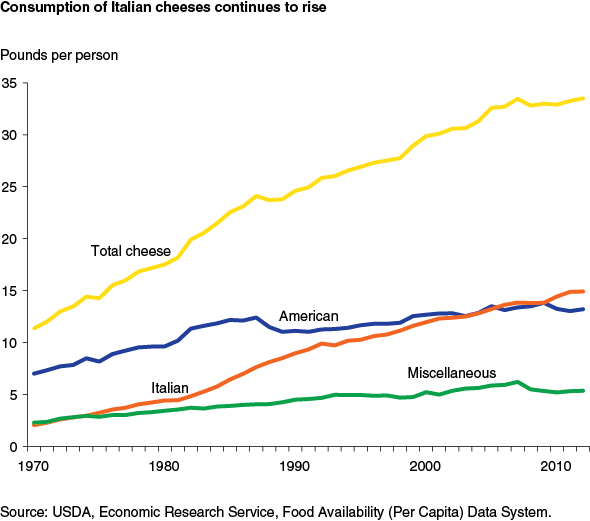
More cheeses eaten (just an example, you can try finding graphs for all kinds of high calorie junk food)
https://www.ers.usda.gov/webdo...
Was there a dramatic increase in plastics in the 80s ? Does increase in plastic cause people to eat more cheese ?
-
Genetic Modification Not Necessary
The Screwfly Solution has been proven to be quite effective, and doesn't require the introduction of genetically engineered insects into the wild.
-
Re: Has the rasionale changed?
They do set management fires, called controlled burns. They are typically done in the spring before everything dries out, so that they donâ(TM)t get out of control. They bulldoze firebreaks before setting the fire so the spread can be limited. https://www.fs.usda.gov/detail...
-
Re:The folks in the rural areas chose to live ther
USDA Rural development has given telecos $7,174,003,266 in subsidies and grants between 2009 and 2016.
If representatives allocated tax payer money, and telecos spent it. Then they are on the hook to follow through and do it. Doesn't matter if you personally don't like that people live far away from city centers.
-
Re:Nothing New News
This has been practiced by vector control authorities for decades in the U.S.
When it's out of the news for so long, a repeat of the past becomes novel for a new generation.
yep. And one of those is the screwworm that has been eradicated from the USA, Mexico, and Central America. (and re-eradicated after being reintroduced)
http://www.fao.org/docrep/U422...
https://www.aphis.usda.gov/aph... -
Re: Advice
"Also, consider this. Canada still imports 10% of its dairy from the US. The US, in contrast, caps imports of foreign dairy at 3%".
I trust you understand that Canada has one tenth the population of the US. So given your numbers, if canada sells 10 million liters of milk, 1 million comes from the US. The US, in this scenario, would sell 100 million liters of milk and 3% off that translates into 3 million liters of imported milk. Using absolute numbers instead of relative would indicate a trade deficit (1 million != 3 million)
Or, you could use actual numbers from the USDA. Total imports from Canada (not including dried milk) in 2017 were 598kg out of the 15,673,738kg of dairy imports. So using your methodology above, that would actually mean that Canada would buy 1 million kg of dairy products from the U.S. and in return the U.S. would buy 3815 kg of dairy products from Canada. When we look at the actual numbers, it does seem a little bit imbalanced doesn't it?
-
Re:people are starving
Because they know poor people are _fat_ on average.
Citation needed.
Turns out something like hunger is a complex subject, and isn't as clear cut. That's why several tiers of "food security" exist; to better understand the problem. If you can only afford things from the dollar menu at McD's three meals a day, that's not good food security. You might not be starving but your diet is garbage, and your health and quality of life will likely suffer for it.
If you are making a choice between paying your utility bills or going grocery shopping, you're in bad shape... and by that definition, that's about 6 million people in the US.
=Smidge= -
Re: Run, Tesla. Run!
None of it comes from the fossil sources that are adding new carbon to the environment. Therefore if all the cows vanished today, the amount of GHG in the atmosphere would not change.
That's less than two-thirds true. Most beef cattle are grass fed for 2/3rds of their life, then grain fed for the last third. The grain is grown with petroleum-based fertilizers. On the other hand, milk cows are fed almost exclusively on a complex mixture of silage and grains, which is largely petroleum-fertilized grain (using the whole plant, not just the seed). They include no more than 18% of all cattle in the US, but that still cuts in to the 2/3rds. The USDA tracks these things. (Big government at work, collecting and digesting valuable data and publishing it for only tax money, oh noes.)
-
Re:Local chain here...
Isn't all food organic
Not if you live in the US. It's a legal term. And the law is actually pretty good, though there have been problems with loopholes. For example, "organic" California grapes grown with fracking water, because the organic law doesn't specify water source. There are also serious questions about foreign-grown "organic" products. In some cases the US accepts whatever standard the foreign country uses. In other cases we have to trust regulating agents in those countries. But in general, organic produce grown in the US can probably be trusted to be free of non-natural pesticides, chemical fertilizers, glyphosate, etc.
https://www.ams.usda.gov/grade...
Whole Foods, however, is undermining the system. They've been selling "organic" grapes from companies using fracking water:
https://www.motherjones.com/fo...
They routinely label country of origin wrong. I've mentioned it to clerks numerous times. The clerks couldn't care less. Lately even price signs go missing. I wonder if that's an experiment, to see how many people will buy a product with no idea of the price.
WF drove out or bought up small natural foods stores, kept growing, and now they've become a monopoly whose intentions can't be trusted. That happened even before Amazon bought them. Maybe now there will be a niche for the comeback of locally owned natural food stores selling more locally grown produce.
-
Re:imho, what a waste of money
Lots of things are correlated, and correlation is not causation. I agree with you 100%: poverty, criminality and IQ are all correlated. I see poverty as the more likely causal factor among the three. For example, we know so much more about nutrition than we have in the past. Particularly, the importance of fats and the importance to limit simple carbs. That's a relatively recent phenomenon for that knowledge to be widespread (and it conforms to my personal observations, lest one complain that we're being played by the scientists like in the past when they pushed for high-carb, low-fat diets). In addition, I think there is a compelling argument to be made that economic conditions would predict crime from poverty, as much, if not more than vice versa.
Certainly crime predicts poverty. To some extent our way of life in the USA guarantees that. Having a criminal record hurts your job prospects, and even being arrested for the wrong thing will lose you many jobs. It sort of begs the question, though, doesn't it?
Poverty means living somewhere with a high unemployment, a lack of commerce, and, in cities, high property taxes, high cost of food, no ability to get food naturally. Poverty in rural areas is only 3.3% higher (as of 2016, per capita), and rural areas are significantly cheaper places to meet bare necessities than urban areas (that, I hope, needs source). I would think it's at least twice the price to meet basic needs in a city as in the country. Think rural West Virginia vs Chicago. In reality, it might be like 4x or worse, even in the ghetto. But, for even a 2x cost of living increase with no increase in the poverty line, rural poor only make up 3% more of their population as compared to urban poor (using the federal poverty line as a marker) is a pretty small amount. I'm suggesting that if you used a poverty measure that measured things like good schooling, good nutrition and other, more difficult, but not impossible to measure, we would find urban environments would, easily, have a higher poverty rate. I think that'd be useful research. Finally, if you're underwater in a mortgage and have no cash, you're not moving. This is more likely to be true if you are poor. Recent census data is consistent with that point and the broader point that using a fixed poverty line seems to hide the fact that being urban poor is often a much worse environment than being rural poor as officially identified. Which brings me to my next point.
I believe race is the root factor, but not in the way you're thinking. I don't know why I didn't make this point first, as I had trouble dancing around it in the last paragraph. Skipping the problem of institutionalized racism and going straight to historical racism only. Certainly, you won't argue against historical racism. Blacks have been historically discriminated against in this country from slavery until only a generation ago in some parts of the country (and, not even that in pockets). By the time society was open to giving blacks anything but a decent shake in life, they were already living in poverty in the crumbling cities. And, unlike in rural areas, nothing grows in the harsh concrete of an urban environment. After collapse of commerce leaving cities underfunded and without enough jobs, especially given that whites owned more than a proportional share of the businesses, it wasn't possible to just spin up commerce from there. People didn't have enough things of value to trade as there is far less natural resources per person. Even as the cities collapsed as the white majority left and took their businesses with them, it would have been hard to start a business in the collapsing city with a high competition for the limited resources and an unlikely shot at getting connections to somehow bring in outside resources (for example, getting a loan to start a grocery store) as the people w
-
Re: Fipronil
Horseshit is your claim that "California feeds most of the country".
California produces large amounts of LUXURY agricultural products - grapes (for wine), nuts, berries, and other non-staple goods. Even the quickest glance at the data makes that clear.California produces no significant quantity of corn, wheat, or soy. They produce no significant quantity of beef, pork, or poultry.
California DOES produce 80% of the nuts grown in the US, and more than half of all fruits. This is why the state was known as the Land of Fruits and Nuts, even before the Democrats took over. -
College students on SNAP
A few years ago it was reported that a high percentage of college students at Michigan State were on SNAP, kind of odd that they can afford/borrow tens of thousands of dollars for tuition & board, but need help buying food - perhaps they should borrow a bit more to sign up for the meal plan?
https://www.fns.usda.gov/snap/...
Apparently Michigan questioned the appropriateness of students collecting SNAP benefits and dropped 30,000 students from SNAP.
-
Re:China already losing, soybeans bought by Europe
From 2015-2016 (Jan-Apr 1 each year), the total exports of soybeans went down by 4 million. It's down 4 million again from 2017 to 2018, so there is no known effect showing that that tariffs have done anything to effect exports. https://apps.fas.usda.gov/esrq...
Also the pork tariffs are a joke because one of the largest pork exporters is a Chinese company. -
Evolution
GMO is not wide spread.
The USDA data says otherwise. So does data from the NIH. You might want to look into it. For many key crops the vast majority of acreage (80%+) is genetically engineered varieties.
Lol
It's called evolution. Do I really have to spell it out for you? 90+% of your genome is identical to dozens of other species and double digit percentages of it is identical to most species on earth. That's how evolution works. We have DNA from every species up the chain in our evolutionary tree, most of which are not human.
ALL DNA in a human is either human or from an RNA virus, as sure as hell you have no Dandoline or jelly fish DNA in your body
Wrong again my friend. A non-trivial percentage of your DNA is IDENTICAL to those species. And the origin of that DNA wasn't from humans.
-
Re: Idiots
Most of the underclass (the 'hicks' and 'rubes') live in the inner core cities.
Nope. Poverty is actually widespread in rural areas.
There really isn't the infrastructure 'out here' for the helpless ignorant to live out here. There are pockets of poverty out in the countryside, but mostly there are people who could be judged more self-sufficient than the typical urban dweller.
Is that what you tell yourself? Or do you just listen to the wrong people?
-
Anecdotes vs evidence
And US eggs are pasteurized and sanitatized (steril was the wrong word).
Most eggs sold in the US are washed but most are NOT pasteurized. According to the USDA less than 3% of eggs sold in the US are pasteurized though that number is rising.
So while a US egg lasts 5 weeks after packing (regs wise); UK eggs last 3 weeks. 4th if you refrigerate at home..
Citation needed. The times you quote are at best guidelines from egg producers and are not based in rigorous independent studies. Eggs can and do last a lot longer than 5 weeks after packing and they usually take a week or two to get to a store and get purchased. I routinely eat eggs that are older than 5 weeks which are perfectly good. I raise my own chickens so my information is from both first hand experience and from credible sources who have actually researched the issue.
Part of what you say is true
Far more than a part of what I say is true but thanks for the backhanded compliment/insult.
a US treated egg going through a UK supply chain probably won't make the one week journey to the store.
So what? It wouldn't be legal (or smart) to sell a US egg in the UK because of the handling differences. Once you wash it the clock starts ticking unless you immediately refrigerate it. You're making a strawman argument here.
Also, our washing may seem expensive to others around the world, but keep in mind that at the end of the day, the prices are about the same with UK eggs just a percent or three higher.
A few percent matters a lot. Margins in food production are thin to begin with so every little bit matters. Farmers and supermarkets live on just a few percent margin and modest differences in prices make a big difference in total sales. The reason you don't notice the price difference much is because US eggs are prohibited by regulation from competing with UK eggs and it's more complicated than just washing versus not because the supply chains are substantially different from beginning to end.
-
Re:For all the whiners
Another great example is Wayne National Forest in Ohio. Southeastern Ohio was completely destroyed by coal mining in the early twentieth century, and when the coal ran out the economy was left just as devastated as the land. FDR made the land a national forest as one of his New Deal plans, and bought the land off any residents who would sell, and hired those who stayed to plant trees. Today, only eighty some years later, the place looks like it been a forest for hundreds of years (and it's been this way for several decades).
It doesn't take long for mother nature to thrive, given a chance. If the Chinese remain committed to turning their environmental situation around, they certainly could. The commitment is the problem. Unfortunately, Wayne has been leased out by the federal government for fracking. Fortunately, Wayne has shown the ability to rebound from worse.
-
What can you do to help?
Since part of this is caused by an increase in agriculture, a big one is to eat less meat. This doesn't mean be a complete vegetarian, but just eat less meat and more non-meat options. The acreage used for meat as a food is much much higher than the same for most vegetarian options https://www.nrcs.usda.gov/Internet/FSE_DOCUMENTS/stelprdb1097070.pdf and this also helps shrink one's carbon footprint http://shrinkthatfootprint.com/food-carbon-footprint-diet. Given that many meat substitutes are cheap, this can pay off nicely. Moreover, in the US now there are many more genuinely tasty vegetarian options than there used to be both in terms of store-bought items and in terms of available high quality recipes. I remember when I was a little kid and we went to my vegetarian aunt's for Thanksgiving, and it was awful. The situation now is very different.
-
Re:Have we seen Peak Meat?
From your own link, the average farm in America spends $17,000 annually on energy for pumping water.
Actually, my link says the average farm in America that irrigates spent $17,238 in 2012 (though if you divide the $2.7 billion total pumping costs against the 229,237 farms that irrigate, that comes out to $11,778 by my calculator -- close enough for government work, I suppose).
There are just over 900 million acres of farmland in the U.S. That means the ~55 million acres that irrigate are ~6% of total farmland . The other 94% use only water from the sky.
Another way to look at it is that $2.7 billion total irrigation costs across 900 million total acres comes out to $3 per acre . Taking corn as an example, the national average yield of 175 bushels per acre at an exceptionally conservative spot price of $3/bushel (it was about twice that in the same time frame as the above irrigation numbers, and is still higher today) means your $3/acre irrigation expenses are just over one half of one percent of your $525/acre revenue.
Irrigation in the U.S. is minuscule any way you slice it. The only way to make it look even remotely scary is to throw out misleading numbers in a vacuum.
-
Re:Have we seen Peak Meat?
Moving water around takes energy, which mostly comes from fossil fuels. . . . Purifying water and disposing of waste water also takes a lot of energy.
The shock-and-awe water consumption numbers like the ones OP threw out are mostly water to grow the grass/grain the animals eat. Nearly all of that comes straight from the sky or from local wells, with no purification or disposal required.
-
Re:The 2 California's..
The rural half should keep Sacramento too. We'd have a rich half and a half that was like Nevada but with a significant agriculture industry (about 12% of the US's ag revenue). I'd be curious to see if the coast would still be so rich if not supported by the top agricultural state in the nation. (California is #1 at $46B, Iowa is #2 at $26B)
-
Re: Of course
-
Try this, it's good...
So for health reasons, I have had to change my diet. If you haven't tried this meat substitute, it is amazing....
and you can get them at Target.
Even fast food is becoming plant based. As meat prices go UP UP UP and fast food prices stay at $1.99, they need to use filler in the meat. That filler is SOY bean, which incidentally, had the largest crop ever last year. Also, don't fear the SOY, you won't grow breasts or start singing alto.
Eat less meat, more plants. You will feel better, look better, and cut your cancer risk.
-
Re:Not much of a paradox
I've seen, but cannot find now, that the US Department of Agriculture defined being "at risk of hunger" when the particular food you wanted was not immediately on hand. Best I could find was ranges of "food insecurity"
Specifically:
Food Security
High food security (old label=Food security): no reported indications of food-access problems or limitations.
Marginal food security (old label=Food security): one or two reported indications—typically of anxiety over food sufficiency or shortage of food in the house. Little or no indication of changes in diets or food intake.Food Insecurity
Low food security (old label=Food insecurity without hunger): reports of reduced quality, variety, or desirability of diet. Little or no indication of reduced food intake.
Very low food security (old label=Food insecurity with hunger): Reports of multiple indications of disrupted eating patterns and reduced food intake. -
Re:Fine
Really? The 2015 salmon fishery in California had a commercial value of $8.1 million. California's agriculture was around $46 billion in 2013 So AG is about 5700 times as large as the salmon fishery. Since half the surface water in California is used for Environmental purposes, and AG is only about 40%, then it would seem we could add about $46 billion in more AG by re-purposing that delta smelt flow...
-
Re:Thanks captain obvious?!
You're talking about simply outsourcing or switching over a significant chunk of the US economy.
Sourcing the oil we need is a national security nightmare. You're talking about decreasing our national independence.
Costs will rise with either outcome you suggested, and it will affect every breathing american.
To top it all off, we'd be doing this not out of necessity, we'd be doing this for no reason beyond "LOL, fuck you mexicans!" -
Food Pyramid
Now it cones out = we all need to watch our diet = with respect to who's guidance?
The USDA Food Pyramid?
The American Heart Association's Diet and Lifestyle Recommendations?
American College of Cardiology
The USDA food Pyramid was built as much as a marketing tool for the food industry as it is a nutrition guide.
You could try this Japanese Health and Nutrition information but there is no way to tell if it is actually better, or if the users that make that claim are suffering from confirmation bias. -
Re:What about agriculture subsidies?
That report is from the late 80's. It isn't a very good depiction of what's going on today. Industrial farming was very much in its formative years at that point. Agricultural commodity prices have continuously been on the decline. In response producers are constantly pushing yield to compensate, creating increasing gluts in the market driving the prices farther and farther down. Even with American "dumping" practices (USAID) and crops for fuel regimes these prices continue to fall and the farmers are giving up the business or on the hook with calorie companies who "invested" in their farms. The situation is much the same as with how Walmart get's small time suppliers on their opium, they expand production and end up not being able to afford to get off nor afford to stay on as they're squeezed on price.
-
Re:Low inflation is bogus; only electronics droppi
Meanwhile. a lot of ordinary people, especially those in minimum wage jobs, have extreme difficulty paying for basic necessities. Is there an inflation index for necessities, i.e. food/shelter/clothing and transportation?
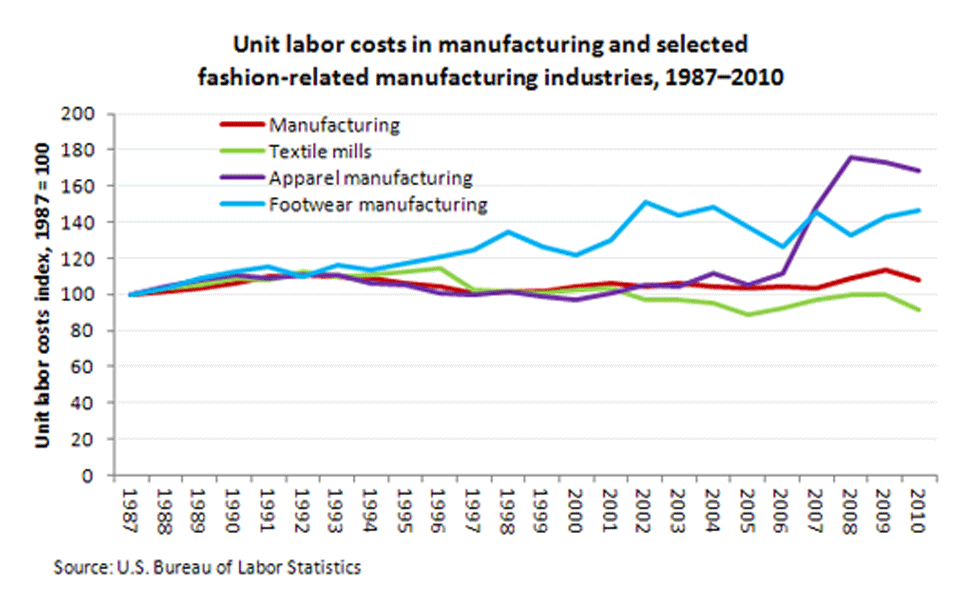
Sounds like a difficult figure to calculate, but you can look at percentage of spending. The lowest quartile spend ~35% of their income on food and that's relatively stable. In 1992 the AAA's driving cost gave a composite index of 38.8 cents/mile for 15k miles, which put into an inflation calculator is 67.9 cents in 2017 dollars while for 2017 it's 56.6 cents. Basic clothing I didn't really find any great statistics for and is hard to separate from design and fashion clothes but labor costs have been pretty flat from the 80s to 2010 which indicates prices on basic clothing wouldn't really get much better either. Price per square feet for a new home is also pretty flat in real dollars, even though the number of square feet per home and per person is growing.
In summary, living on minimum wage wasn't easy a few decades ago, it's still not easy now. It's hard to find some figure that's significantly worse though, though increasing disparity may in itself be a problem if you feel "everybody else" can afford to drink their coffee at Starbucks except you. That's what drives most people into financial disaster, if you accept the social stigma of being poor and just blatantly say you can't afford it you'll probably do okay. It's those who have to try pretending they have money when they don't who bury themselves in credit card debt and end up in a quagmire they never get out of. I have one buddy that is like that, he's made some life choices which has left him quite far behind us financially. And nobody's pushing him to spend, but he's constantly overextending himself.
-
Re:That is not what was said or what they are doin
They have a list of criteria. If you meet all of the criteria (and I'm sure pay some "small" administrative and logo licensing fees) then you get certified.
There's been occasional blowback because their criteria doesn't always match the intuitive sense of the word "organic" that has built up in the public conscience over the past couple of decades, particularly with respect to the list of allowed pesticides and other chemicals. You can read the regulations here if you want.
-
Re:IOT Cheese
I don't think it's healthy to eat mold, at least not in volume.
"Foods that are moldy may also have invisible bacteria growing along with the mold. Yes, some molds cause allergic reactions and respiratory problems. And a few molds, in the right conditions, produce "mycotoxins," poisonous substances that can make you sick."
-
Re:We need to get with the times.
Everyone who lacks B12 (the amino acid you're referring to) will suffer such consequences. 39% of the US population is B12 deficient (in the country with nearly the highest meat/dairy consumption per capita in the world), so eating animal products obviously isn't the answer. This isn't an argument against plant-based diets, it's an argument for B12 fortification in foods.
-
Re:But is it food.
You body produces 100% of the creatine you require. Your body makes Taurine too. It's synthesized from any complete protein, such as soy. Heme iron is simply one form of iron, and is not essential for survival. You get all the iron you need from a good plant-based diet. Docosahexaenoic acid (AKA DHA Omega 3), really? Flax seeds. Carnosine is produced from beta-Alanine, which has plenty of vegan sources although there is little science to suggest that it does you any good. Why worry about carnosine? Cobalmin (AKA B12)--well, meat eating obviously isn't a solution when 39% of all Americans are B12 deficient. Americans have nearly the highest per-capita consumption of animal products in world. Everyone should be supplementing B12.
There is no magical ingredient in animal products that you need to survive, which is why all of the major health organization of the world are now supporting plant-based diets as nutritionally adequate for all stages of human development. -
Re:But is it food.
Meat obviously isn't the solution, when 39% of all Americans are B12 deficient. Americans have nearly the highest per-capita consumption of animal products in world. Everyone should supplement B12.
We evolved to get all of the B12 we needed from fresh water but with the advent of water treatment, we lost that source. 1.2ml of water from certain ponds is enough to meet our daily requirements, and 1 liter from almost any fresh water source more than exceeds our needs. Don't drink pond water unless you enjoy dysentery though—vegans need to supplement B12, as do meat eaters. -
Re:But is it food.
Meat obviously isn't the solution, when 39% of all Americans are B12 deficient. Americans have nearly the highest per-capita consumption of animal products in world. Everyone should supplement B12.
We evolved to get all of the B12 we needed from fresh water but with the advent of water treatment, we lost that source. 1.2ml of water from certain ponds is enough to meet our daily requirements, and 1 liter from almost any fresh water source more than exceeds our needs. Don't drink pond water unless you enjoy dysentery though—vegans need to supplement B12, as do meat eaters. -
Re:Cars should not consume human food/drink
Food prices sky rocketed
I seriously, don't think you understand the sheer amount of corn that is grown in the US. To think that the small amount of ethanol that we produce actually affects the price of corn (and everything that relies on it) is seriously laughable. Business people are always looking for scapegoats to jack up the prices dude. That's like US economics 101. War in Iraq? Hell, raise the price of gasoline. Flood in Japan? Raise the price of Kraft cheese singles. Brexit? Might as well add $3 for everything made of cotton.
Poor people starved to death in the thousands
They got you hook, line, and sinker. The US alone has millions starving and the rationale for that is really complicated. However, people have pointed to the hungry in the US as proof for all kinds of things. Lack of religion in the the US, illegal immigration, terrorist, etc. So no one is surprised that someone decided to put the whole ethanol thing on the backs of the hungry as well.
Ethanol was a highly inefficiency gas
You'll get no argument from me here. Ethanol runs best in cars that are specifically made to run on that fuel. There's flex fuel cars that change the stroke of the engine to compensate for a higher mix of ethanol. They're alright, but an engine specifically made for the fuel would be better.
Don't get me wrong.
The ethanol industry aren't the most honest folks either. Someone decided that corn was the only supply of fuel when there's plenty of research that could have gone into producing fuel from Kudzu, a weed that no one really wants. That's just farmers wanting to make more and more money and in reality, whoever subsidizes their farm, is making an even bigger cut. These farmers usually just put into crap contracts that ensure they'll never become solvent in 100 years. Any new industry they try to expand into, the person with the funds eventually figures out how to get their cut before the farmer. So yeah, the ethanol folks aren't exactly hands clean either. But don't go buying that made up crap that ethanol is increasing your food prices. That's just bull they're using to charge you more for less food. Climate change thus far has had a way bigger impact than ethanol will ever have on the price of food. Even then, that plays only second to sheer greed and opportunity to jack up prices on unsuspecting dolts. -
Re: So What?
https://www.usda.gov/media/blo...
The National List of Allowed and Prohibited Substances
return arrow Back to Top
Â205.600 Evaluation criteria for allowed and prohibited substances, methods, and ingredients.The following criteria will be utilized in the evaluation of substances or ingredients for the organic production and handling sections of the National List:
(a) Synthetic and nonsynthetic substances considered for inclusion on or deletion from the National List of allowed and prohibited substances will be evaluated using the criteria specified in the Act (7 U.S.C. 6517 and 6518).
(b) In addition to the criteria set forth in the Act, any synthetic substance used as a processing aid or adjuvant will be evaluated against the following criteria:
(1) The substance cannot be produced from a natural source and there are no organic substitutes;
(2) The substance's manufacture, use, and disposal do not have adverse effects on the environment and are done in a manner compatible with organic handling;
(3) The nutritional quality of the food is maintained when the substance is used, and the substance, itself, or its breakdown products do not have an adverse effect on human health as defined by applicable Federal regulations;
(4) The substance's primary use is not as a preservative or to recreate or improve flavors, colors, textures, or nutritive value lost during processing, except where the replacement of nutrients is required by law;
(5) The substance is listed as generally recognized as safe (GRAS) by Food and Drug Administration (FDA) when used in accordance with FDA's good manufacturing practices (GMP) and contains no residues of heavy metals or other contaminants in excess of tolerances set by FDA; and
(6) The substance is essential for the handling of organically produced agricultural products.
(c) Nonsynthetics used in organic processing will be evaluated using the criteria specified in the Act (7 U.S.C. 6517 and 6518).
return arrow Back to Top
Â205.601 Synthetic substances allowed for use in organic crop production.Link to an amendment published at 82 FR 31243, July 6, 2017.
In accordance with restrictions specified in this section, the following synthetic substances may be used in organic crop production: Provided, That, use of such substances do not contribute to contamination of crops, soil, or water. Substances allowed by this section, except disinfectants and sanitizers in paragraph (a) and those substances in paragraphs (c), (j), (k), and (l) of this section, may only be used when the provisions set forth in Â205.206(a) through (d) prove insufficient to prevent or control the target pest.
(a) As algicide, disinfectants, and sanitizer, including irrigation system cleaning systems.
(1) Alcohols.
(i) Ethanol.
(ii) Isopropanol.
(2) Chlorine materialsâ"For pre-harvest use, residual chlorine levels in the water in direct crop contact or as water from cleaning irrigation systems applied to soil must not exceed the maximum residual disinfectant limit under the Safe Drinking Water Act, except that chlorine products may be used in edible sprout production according to EPA label directions.
(i) Calcium hypochlorite.
(ii) Chlorine dioxide.
(iii) Sodium hypochlorite.
(3) Copper sulfateâ"for use as an algicide in aquatic rice systems, is limited to one application per field during any 24-month period. Application rates are limited to those which do not increase baseline soil test values for copper over a timeframe agreed upon by the producer and accredited certifying agent.
(4) Hydrogen peroxide.
(5) Ozone gasâ"for use as an irrigation system cleaner only.
(6) Peracetic acidâ"for use in disinfecting equipment, seed, and asexually propagated planting material. Also permitted in hydrogen peroxide formulations as allowed
-
Re:The real question is was it a net positive?
That depends on how you define positive.
Some may not see biodiversity going down as positive.By protecting yield, intensification methods such as GMOs improve biodiversity by reducing the amount of land area required for agriculture, which leaves more land to the wild.
Some may not see glyphosate resistant weeds as positive.
Weeds adapt to every form of control. Pull them by hand and they break off at the stem and regrow. Roundup is one tool among many.
And some may not see family farms closing down or being transformed to agricultural factories as positive.
Family farms comprised 99% of U.S. farms in 2016, which is up from 97% in 2012.
-
Re: Isolation
You have obviously never priced out a power line. Last time I looked (almost 20 years ago), it was about 10k$US per pole.
Sounds like you're not especially informed then, and may even be confusing your particular situation with a general trend.
That's actual cost, rural electrification administration is useless, though they suck up about a billion/year, they haven't actually done anything in decades.
Except you know, provided funds for thousands of miles of power lines. Not to mention all the other work. They actually do fund homes, and libaries, schools, water and waste-water projects, even INTERNET service.
Heavens, it must give you the vapors.
-
Re: Isolation
You have obviously never priced out a power line. Last time I looked (almost 20 years ago), it was about 10k$US per pole.
Sounds like you're not especially informed then, and may even be confusing your particular situation with a general trend.
That's actual cost, rural electrification administration is useless, though they suck up about a billion/year, they haven't actually done anything in decades.
Except you know, provided funds for thousands of miles of power lines. Not to mention all the other work. They actually do fund homes, and libaries, schools, water and waste-water projects, even INTERNET service.
Heavens, it must give you the vapors.
-
Re: Isolation
You have obviously never priced out a power line. Last time I looked (almost 20 years ago), it was about 10k$US per pole.
Sounds like you're not especially informed then, and may even be confusing your particular situation with a general trend.
That's actual cost, rural electrification administration is useless, though they suck up about a billion/year, they haven't actually done anything in decades.
Except you know, provided funds for thousands of miles of power lines. Not to mention all the other work. They actually do fund homes, and libaries, schools, water and waste-water projects, even INTERNET service.
Heavens, it must give you the vapors.
-
Re: Isolation
You have obviously never priced out a power line. Last time I looked (almost 20 years ago), it was about 10k$US per pole.
Sounds like you're not especially informed then, and may even be confusing your particular situation with a general trend.
That's actual cost, rural electrification administration is useless, though they suck up about a billion/year, they haven't actually done anything in decades.
Except you know, provided funds for thousands of miles of power lines. Not to mention all the other work. They actually do fund homes, and libaries, schools, water and waste-water projects, even INTERNET service.
Heavens, it must give you the vapors.
-
Re:Isolation
We're still wasting a cool billion/year on rural electrification.
Actually, the requested fiscal year budget was six billion for rural electrification. And the value creation is much higher so waste is hard to argue. Do you have any specific sources for your assertions?
It hasn't wired a single new residence in 40 years.
The Rural Utilities Service doesn't wire residences, it provides funding to electrical cooperatives who provide service to residences, who have their home wired.
Did you think they were an electrician? Nope. Not a home builder either. For that, I believe you want Ben Carson and HUD. Maybe the Bureau of Indian Affairs, and the Base Housing authority.
All wasted money absorbed by rent seekers. It's never done.
Actually, that money put up over 19,000 miles of electric line, and lots of telecommunication work and more.
Really, if your intent is legitimate, there may be some grounds on which you can complain about the level of performance, you might have some useful critiques, if you ever bother to develop specifics, but your hyperbolic grandstanding ruins your case.
Lot of that going around.