Slashdot Mirror
Domain: warresisters.org
Stories and comments across the archive that link to warresisters.org.
Comments · 76
-
Re: Turs out the US of A is no different!
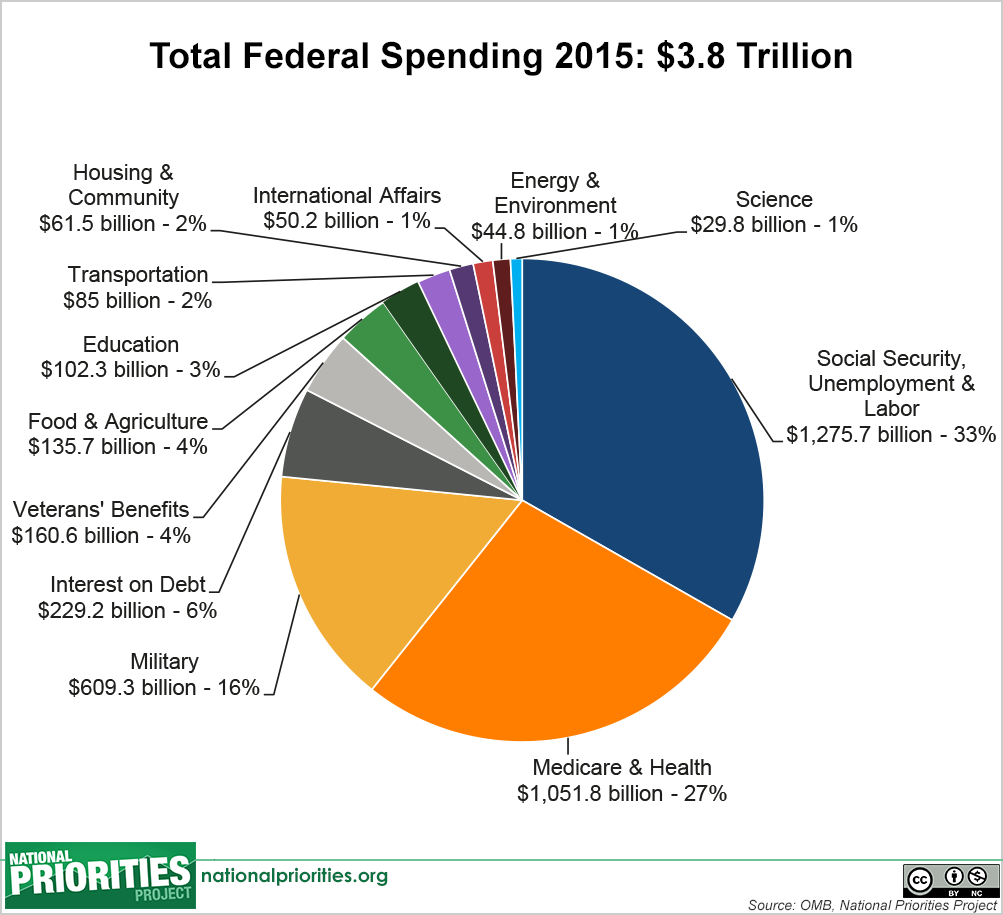
Actually, even the War Resisters League estimates only 45% goes to the military, past and present.
The next two biggest chunks are Medicare and Social Security
If you want to look at discretionary spending, this chart breaks it down, with each subitem sized in proportion to the total.
-
Re:Technology can NOT eliminate work.
Just off the top of my head, I'd guess that rather than specific spending items, a lot of "corporate welfare" consists of tax-free benefits or breaks that real people pay for but corporations get as "incentives." (Insert debate on taxing individual people vs. taxing corporation people here.)
Not in any way non-partisan, but the old-school peace group the War Resister's League (founded back in post-war 1923) likes to point out a variety of expenses that stem from military adventures: https://www.warresisters.org/f... They include past military expenses like servicing payments on the portion of the national debt racked up by borrowing to pay for wars, or medical expenses of veterans (those people we said we supported but often seem to forget about as they need care for the next forty years or so).
If you set aside Social Security, which is supposed to be a savings plan not a tax-funded social program, then the military portion of the discretionary budget is substantial. It should be added that the War Resistors go on to suggest that people simply stop paying for wars. Simple? Maybe not so much.
-
Re:Typical government efficiency...
You are quoting the heritage foundation, which has a specific agenda. If you don't know what it is then that is your problem.
How about I quote the war resisters league, where they claim 47% of the government spending is military related.
The difference between the two numbers is, what one considers military spending, and what considers government spending in general. For example, is the NSA's gigantic surveillance military spending (it is after all part of the "defense department")? How about the pension program for veterans?
A rational mind would say they both are part of the military, the second is simply part of the benefits program we give to our soldiers who risk their lives. A built in cost because at some point, someone said it was a damn good idea to take care of soldiers when they come home lest they become the troops for the next revolution.
So, the truth is probably somewhere in the middle, although aside from the removal of the social security program (which isn't directly part of your income taxes) which I think is a little disingenuous, I think the war resisters league gets it a little more accurate because they count things like the portion of NASA's budget used to launch military devices and similar things.
-
Re:Bad Press or Bad Behavior?
Perhaps you should familiarize yourself where tax dollars are being spent. We are not over spending on maintenance of government facilities (see the article), we are over spending by spending 20% of our budget on defense and even more out of budget. Instead of investing in infrastructure, a time proven way to stimulate long term growth, we are neglecting it and talking about cutting taxes when we are not taking in sufficient fund to pay the current budget.
As US citizens we live in one of the most affluent countries in the world and pay one of the smallest tax rates. While I disagree with how we spend some of the Federal budget I find it difficult to imagine how I am not getting far more than I pay for in taxes from my government. Living in a democracy requires that we compromise; that we accept that some things will be done that we disagree with; that we will not be happy with every decision our government makes. We, as citizens, have a duty to hold our elected officials accountable for their failing and to seek better representation when they do fail. We also have a duty to call out those within government who see it as a cash cow, as is the case with the GSA spending, as well as those outside government, as in the case of oil companies being given tax subsidies. Regardless of these few failings, hampering our government further will not lead to some magical land of plenty but to a cyberpunk dystopian brubdom.
-
Re:Military spending?
Defence spending might be bigger than you think: http://www.warresisters.org/pages/piechart.htm Still I agree, what's needed are spending cuts.
-
Re:Some speculations
Or the 54% I'm spending at the gun shop.
-
Horseshit and lies.
About half of the discretionary budget is spent on the military.
http://www.warresisters.org/files/FY2011piechart.pdf
The reason the United States is dying is because we aren't collecting enough taxes to pay for our infrastructure. We started two wars and then dropped taxes. That shit doesn't work.
When our way of life actually was in danger during WII, we immediately raised taxes to pay for the cost of saving our country, and those rates lasted throughout the 50s, which was one of our best economic periods in history. Our national debt dropped, and continued to do so through 1980. Then an actor named Ronald Reagan decided to hand the nation's wealth to the wealthy, and hope they wouldn't blow it all on coke and hookers and stupid investments. He was wrong. Then he passed deregulation that led to the S&L crisis, just like Clinton passed the regulation that would eventually lead to the derivatives crisis that's still boning our economy. Reagan also raised military spending but dropped taxes, and that shit didn't work back then either. Bush I and II continued the same idiot policies, and people complain that Obama hasn't fixed the economy yet. Well, when you've had some fucking frat brats with sledgehammers renting a place for the better part of 30 years, it tends to take more than 20 months to fix.
Anyway, Bush II got kicked out for doing the sensible thing and raising taxes to cover our debt. Clinton raised the top rate again to 39.6%, reduced military spending, and our national debt dropped. McCain even ran in 2000 on protecting Social Security to fulfill our promise to "the greatest generation" with the extra money we had lying around. But that sad sack of shit has sold out along with the rest of the Republican party, pandering to some illiterate backwoods fuckwits called "Evangelical Christians" who believe that Obama is a Nazi Socialist Muslim born in Kenya.
But you need a certain type of idiot to vote against their own interests and ignore common sense and hard data for thirty years running. They're the same idiots who give Jesus $5 hoping for a $10 return. They think the GOP will give them the same deal, and they don't know how fucking right they are.
-
Re:get off my iLawn!
They need to quit spending so fucking much money. Start by immediately STOP sending foreign aid. Take care of home first. Cut the bureaucracy....the federal govt should not be one of the best paying largest employers in the nation. Raise the age of SS. Means test medicare, etc....
You sound like some kind of talking points memo.. Take a look at the government spending. Oh and don't include SS, cause its technically not part of the main budget and pays for itself (repeat after me, SS is a Ponzi scheme and pays for itself). See whats left? Oh yah baby those new $140B carriers are sexy as is the $388B for the not yet 100% functional F35s we are buying, or the ~1T we spent in Iraq. I will give you a clue, its our "defense"/military industrial complex, whatever you wish to call it. The best part is that if you look at a site like warresisters you might get convinced that almost our entire federal budget problems have one solution. Strangely, just about no one in politics brings this up, ever wonder why?
Basically, just like your personal budget, if your spending all your income on a house, you should seriously consider downgrading it so you can afford food. Cutting how much water you drink, after you already stopped taking showers, and flushing the toilet isn't going to solve anything. The federal budget has a lot of very useful programs everyone fights about, that in the end don't mean a damn thing cause they are so tiny.
-
Re:Great
http://www.warresisters.org/pages/piechart.htm
The above link suggest 54% of the federal budget is military. Haven't done a lot of due diligence so I don't know how accurate their estimate is but based on a quick glance of the US Military budget wiki, the federal military budget is definitely more than 20%, and it's most likely between the two. You can decide for yourself where you think it falls. -
Re:Great
That "death and taxes" poster is great! May have to order one.
A simpler representation of the true size of the "defense" budget is prepared every year by the War Resister's League. Their 2009 version is online at:
-
Re:This is a STATE tax, not a federal tax
What's so hard? Total military personnel - 1.4 million. Total military spending 1.4 trillion. 1 million per soldier.
-
Re:This is a STATE tax, not a federal tax
Most taxes go to pay the salaries of government employees, who are certainly not poor.
The #1 use of your taxes is war and it's consequences, or here, or the interactive chart.
-
Re:Molestation charge
Megan's laws (I like to call them "The Ultimate ThinkOfTheChildren Acts") pretty much make it illegal for a male of any age to get within 20 yards of a female below 18, or have to wear a virtual scarlet letter for the rest of his life.
Yes. If you don't like such socially-conservative laws, don't support the GOP.
When you have trillions of dollars being spent-- none for inarguably constitutional uses such as defense-- and a big tax hike across the board, that's redistribution of wealth by definition.
None for defense? WTF? Have you not been paying attention? Direct federal spending on "defense" makes up 20% of the budget, not counting veteran's benefits, interest on the debt rung up from war and the arms race. Add those in and the spending on "defense" roughly doubles.
Our taxes are low, both by international standards and by the standards of American history. It's well past time to restore the aristocracy tax (a.k.a. the estate tax), and raise the top marginal rates back to the 50% that was there for most of the Reagan era -- or even the 90% that curbed the extremely rich during the Eisenhower administration.
The federal government inarguablely has the Constitutional power to "to pay the Debts and provide for the common Defence and general Welfare of the United States". Congress can buy us all ponies if it thinks it's in the general welfare. Our check on that is to elect a new Congress.
Capitalism is redistribution of wealth by definition: it takes the wealth created by labor and redirects a large part of it to bankers, landlords, and absentee investors.
-
My button story....
Supervisor said try this key in the fire pull station in room "x" that had a halon type fire suppression system. I asked what would happen if the alarm went off? Sup said there was a ~10 sec delay in which a press of the button above the pull station would stop the discharge. As you've already guessed, there was no delay --- instantly $20,000 of gas discharged into the room, half of which came from a nozzle aimed at my head (who thought of that layout?) while doors and vents slammed shut.
Fastest I've ever spent money with nothing to show for it. $72,000,000 an hour if the discharge lasted only a second. Of course that pales with the U.S. Federal government which spent $302,511,415.53 an hour during 2009 according to this quasi source.
note: sup actually took responsibility
-
Re:Not Quite
By far the largest and most bloated parts of the federal budget are the entitlements... Social Security, Medicare, etc.
It all depends on how you do the math. When you include pensions for past military the figure grows; actually paying off the interest on our war debt puts the military over 50%. The only way you get under 50% for military spending is if you put a bunch of stuff which should be considered military spending under other line items, like interest. How is the interest on debt militarily incurred not military spending?
-
Re:About time
US Constitution, Article 1, Section 8 includes:
"To raise and support Armies, but no Appropriation of Money to that Use shall be for a longer Term than two Years;"
Your "one of the few constitutional items the Feds actually spend money on" is unconstitutional.
Naturally, you also want to blame Clinton for Bush Sr.'s base closing imitative. Learn some history.
And for that huge social spending issue: http://www.warresisters.org/pages/piechart.htm -
Re:Military healthcare
Yes, ignorance it horrible. Try this on for size to learn why you're numbers are wrong.
http://www.warresisters.org/pages/piechart.htm
I served. The military is a fine establishment, being abused by the military industrial complex. Defense spending is an entitlement for them, they produce things we don't need, and all the cowards in office listen to all the cowards in the population who are so scared of their shadow they piss their pants when the step into the daylight (who are also usually boisterous wanna-be bullies who are too cowardly to do their own fighting). Stop drinking the kool-aid. -
Re:Military-Industrial Complex
You're going off of the '09 budget? Those numbers don't properly reflect military spending.
This one is skewed in the other direction, but probably closer to reality:
http://www.warresisters.org/pages/piechart.htm
Also, "it's not military, it's entitlement" is pretty binary thinking. The real problem is that the money taken in annually by the government is somewhere between $1.5-2T dollars. There are many thing contributing to this, military spending, shifting the tax burden onto the bankrupt or nearly bankrupt lower and middle classes, buying garbage assets from massive, bankrupt banks so that they can turn around and buy up smaller banks, etc, etc.
The debt is at about 90% of GDP and growing at a pants-filling 10% per year, with no end in sight. Military spending, "entitlement programs", taxation policy, DHS bullshit, everything should be on the table...but won't.
-
% GDP doesn't reflect how much real cost it is
As percent of GDP? What about as percent of total expenditure? Or percent of income generated by the state itself (taxes)?
Doesn't seem like such a low number then.
http://www.warresisters.org/pages/piechart.htm
http://upload.wikimedia.org/wikipedia/en/7/7a/U.S._Federal_Spending_-_FY_2007.pngEspecially considering a very large percent of that slice of the pie is actually spent on foreign invasion instead of just keeping up a military for protection.
-
Re:While off-point: Defense v. Entitlement
You may have read my comment too quickly, because I noted that most of entitlement spending is funded by specific taxes ("programs like Social Security are directly funded (for now) by specific taxes"). Look to the link for the chart "receipts." I suspect people would complain, for example, if you cancelled social security but kept on collecting social security taxes (42% of receipts). Big spending, sure, but big taxes, too. Also Social Security or Medicare are not what people are thinking about when they're ranting about people cheating the government.
As I indicated, defense spending is also larger that it appears in the graph because of hidden costs in other area of the budget. (I don't agree with these guys, so I didn't cite them, but some useful points are made here: http://www.warresisters.org/pages/piechart.htm ) I think we should factor in what we would gain if some of the people currently working in defense were in more constructive pursuits, for example building bridges in the US instead of blowing them up somewhere else. I'm not a utopian, we need a military, but the cost is staggering. Welfare is trivial by comparison and cheap political BS in terms of balancing the budget -- the few pundits who know anything also know they're lying. Although there are moral reasons to be cautious in giving out aid, you'll never balance the budget on the backs of the poor.
-
Re:Lol? Sif it will happen.
it's not the GOP that's trying to shove ACTA down our throats and the Mandatory Hospitalization Suppository up our ass
Yeah. They just suspended habeas corpus, cut taxes for the wealthy while leading the country to war, and reduced corporate income tax rates for every corporation, not just "Hollywood" and insurance companies. I can see how draconian copyright laws and mandating health insurance and requiring insurance companies to pay out - the same way we mandate car insurance - can really get on your nerves.
I hold no loyalty to any political party, and I don't delude myself with visions of (D) fixing all of the problems. As far as extricating themselves from corporate influence, the GOP has zero chance, and the Democrats maybe one in five.
For some odd reason it excludes Social Security
People pay into social security, and then get money out. It has not cost the Federal Government any money in it's history. The disaster scenario you keep hearing about is that if no changes are made to the retirement age, due to the improvements in life expectancy, Social Security would only fund 75% of what is promised in 2020 or sometime thereafter.
Our analysis is based on federal funds, which do not include trust funds -- such as Social Security -- that are raised separately from income taxes for specific purposes.
-
Re:Lol? Sif it will happen.
Most voters don't know what rule of law is either. Look how many of them think the Constitution is just a piece of paper, and therefore Parliament can do whatever it wants.
The Tea Partiers seem to be stirring up some interest. If they ever discover the real cause of their tax burden and the reality of effective commercial tax rates, I'm afraid their loving relationship with the GOP and it's corporate outlets will quickly deteriorate.
-
Re:Render unto Cesar.
I've seen this argument quite a lot lately, but one thing bothers me - if it irks you so much, why don't you start voting against taxes and let them go adrift? Be realistic - most of those dollars go to programs, like Medicare, Social Security, and welfare, that are championed by the coasties.
FALSE. Most of it goes to military spending and military pensions. Less than one third is spent on social services, which is not "most" no matter how you slice it. You are a liar.
-
Re:alternative
Sure. Lets start with the defense budget. Agreed?
-chirp- -chirp-
Amazing how quickly the anti-tax activists shut up when it comes to military spending. Where were all those tea-party protesters when we committed to spend a trillion dollars in two wars?
If there's a bi-partisan issue anywhere, this should be it. The left hates war. The right hates taxes. Can't we just work together and fix both of our problems?
-
Spent?
How do you "spend" Social Security? We pay into Social Security, and we get money back out. The question is what our tax dollars are spent on. Including it in a discretionary budget is dishonest at best. Plus, you're lumping in the VA and warfare interest with non-war budgetary items.
If you add the DoD, nuclear arms spending in the DoE, and funding provided to wage war in Iraq and Afghanistan, it's one trillion dollars per year, according to official government sources. Also according to official government sources, they can't account for about 25% of that. Donald Rumsfeld stated in 2001 that there was possibly 2.3 trillion dollars that they couldn't account for.
http://en.wikipedia.org/wiki/Military_budget_of_the_United_States
http://www.warresisters.org/federalpiechartdetails -
Re:Whaaambulance
I call bullshit:
Fact: Welfare Costs 1 Percent of the Federal Budget
Widespread misperception about the extent of welfare exacerbate the problems of poverty. The actual cost of welfare programs-about 1 percent of the federal budget and 2 percent of state budgets (McLaughlin, 1997)-is proportionally less than generally believed. During the 104th Congress, more than 93 percent of the budget reductions in welfare entitlements came from programs for low-income people (Center on Budget and Policy Priorities, 1996). Ironically, middle-class and wealthy Americans also receive "welfare" in the form of tax deductions for home mortgages, corporate and farm subsidies, capital gains tax limits, Social Security, Medicare, and a multitude of other tax benefits. Yet these types of assistance carry no stigma and are rarely considered "welfare" (Goodgame, 1993). Anti-welfare sentiment appears to be related to attitudes about class and widely shared and socially sanctioned stereotypes about the poor. Racism also fuels negative attitudes toward welfare programs (Quadagno, 1994).
source: http://www.apa.org/pi/wpo/myths.html
Find someone to pick on besides those that are scraping by. Keep in mind that the defense budget is 54% of the federal budget in the US. I'd much rather feed hungry people than shoot them.
-
Re:Sucker
Your numbers are wacked. Defense spending is 20% of the federal budget. Medicare/Medicaid/Social Security take up over 40% of the budget. http://en.wikipedia.org/wiki/United_States_federal_budget
Do you trust the government? If you do, those numbers are fine. If you don't, take a look at real numbers. Social Security is paid in and paid out, so that's irrelevant. When you add discretionary spending, military research in non-DoD branches, like nuclear weapons research in the DoE, the budget looks quite different.
How much did 9/11 cost this country? Hundreds of billions.
You're off by an order of magnitude, and that's only if the only thing that you value is money. According to all insurance claims, it's 9.3 billion. The highest estimates I've seen for total economic impact that never recovered is forty or fifty billion. If you have to pretend for your argument that the stock market didn't recover, well... let us know when you come back to reality.
Personally, I mourn the loss of the casualties of 9/11, Afghanistan, Iraq, of the right to an attorney, the right to be charged if I am held, the right to free association, and the right to be free of unreasonable searches and seizures much more than the money. And that figure is still a few trillion dollars less than the increase in war spending.
Bush prevented another attack during his Administration against all odds.
Yes, like the Chicago Seven:
An FBI informant infiltrated the group, the sources say, neutralizing the threat. They say it is not clear how much damage the group would have done on its own. They were making plans to purchase bomb-making materials, the officials add.
So, we stopped someone from possibly purchasing bomb making materials, possibly using that to make a bomb, and possibly using that to carry out an attack. Excuse me for saying so, but if this is making the front page, it looks like they are desperate to find anything that looks like a terrorist attack. If they could squeeze more political capital out of any foiled attack, they would do it.
The intelligence community failed to predict the collapse of the USSR, failed to prevent the WTC 93 attack, failed to prevent the Cole bombing, failed to prevent 9/11, and then claimed that Saddam had WMDs. What exactly have they done right in the past thirty years?
War costs will continue since Barry will be moving troops from Iraq to Afghanistan/Pakistan.
We owe it to the Afghanis. When their secular government requested help from the Russians, we spent hundreds of billions of dollars organizing bin Laden and all of the muslim extremists we could find in order to embarrass Moscow. Afghanistan was completely destroyed, and we left the foundation of the Taliban to do whatever they wanted with the ashes. We also owe the same to the Iraqis, but we should be providing logistical support to the democratic side so they have the freedom to form their own government, instead of being forced at gunpoint to accept ours.
Your Democratic Congress has approved bailouts since coming into power that have eclipsed the war costs.
Whoa, cowboy. Let's try that hard math again. The bailouts will top out at 1.2 trillion, and we currently spend 1 trillion every year. Not that I favor the bailouts, but your premise is provably false to begin with.
So, how's that Democratic Congress for the last 2 years been working out for you?
One the scale of idiocy and ignorance, I prefer the less idiotic and less ignorant. Clinton may have been a corrupt politician, but at least he knew not to shit where he ate, at least when it came to balancing the eco
-
Re:Yes.
I'd like to say "nothing", but the whole "taken away by force" part is, frankly, a lie you tell yourself. It's like you can't understand that there's a difference between being a part of a democracy and a slave.
How is it a lie? How can a US resident chose not to pay taxes without being imprisoned?
The slave thing is a pointless straw-man argument. Taxes are certainly a lesser evil than slavery, but they're still an evil. As for the idea that anything that the United States government decides is OK because we're a democracy, that's a like that you tell yourself.
And no, I'm not even saying that because taxes are evil in general there shouldn't be any. Taxes may be a reasonable trade-off in some specific case. But, based on this nice biased graph, I'm going to have to go ahead and say that at least the federal income tax is not only evil, it's a bad deal.
-
Re:"Cadaver" -- is the worst for McCain?
In 2007 — 7 years into the rule of "the current Republicans" — we were still spending more on Social Security alone (without Medicare, Medicad, transportation, etc.) than on the entire Defense (wars and all). 2006 is about same.
Firstly: Even the war on drugs?
Secondly: $40 billion out of a $2.8 trillion budget isn't much of a difference between social security and defense. Do you really think that justifies voting Republican over Democrat or vis versa?
Third: Our taxes don't really correlate to the budget the way you think. See here: http://www.warresisters.org/pages/piechart.htm
Ya know, I'd be perfectly happy to vote Republican if they were strong on defense at home where it counts, instead of mucking about the world wasting my money and getting foreigners pissed at me.
Hell, if I were smart I'd vote for Obama since the easiest way to cut the budget is to pull right out of Iraq (although I doubt he'll do that, even though he said he would). You can't cut off Social Security that drastically. Therefore, if someone is going to make a big difference in spending it will be a Democrat.
-
Re:Can't believe parent gets modded up...
Sorry about blaming you for the title.
I agree that Iraq has probably changed those numbers somewhat, but I'm also pretty sure that Iraq will be over soon, in fact it hardly ever qualified as a true war, but surely now is more accurately characterized as an occupation.
I'm all for reducing our military spending (even further) and especially making Europe, Japan, etc. more responsible for their own defense, but you also have to consider that such a move may actually make the world a more volatile place, not less. Even so, I'm tired of our always having to pay the cost of pacification.
Ironic that you consider the CBO partisan (of course one party or another always controls congress. But up against that you suggest an organization composed of avowed socialists and anarchists?...
http://www.warresisters.org/nva/nva0101-5.htm
Sorry, to me that goes beyond simple partisanship. Some of these organizations have direct ties to foreign interests.
While I often think many of the ideas expressed by Democrats are socialist in nature, I at least am fairly confident that they have the long term well-being of this country at heart. This is not rue of many organizations on all parts of the political spectrum. I always look to what the people who run these things have done in their lives (other than run sch organizations) and what the linkages between the organizations are. What you find by dong a simple "whois" can be downright scary.
-
Re:Can't believe parent gets modded up...
First of all, I never mentioned moderation. The OP did that.
Second, thank you for the graphs. They're interesting, but the document you cite is from 2002, before our disastrous expedition to Iraq. Also, I must consider both the FBO of 2002 and Perot both as partisan sources, however. In opposition stands this more recent chart, in which pink represents military spending. It paints a different picture. (It's terribly sad that I'm forced to lump the CBO into the "partisan" category.)
As for my sources: for an analysis of our agricultural subsidies, see "The Omnivore's Dilemma". (Though I'm sure there are more technical primary sources available.)
As for the argument that wealth concentration leads to power concentration, well, just look at Rome, pre-revolution France, and the gilded age in America.
-
Re:Cultural Differences
Social Security is self-funded and running at a surplus. As an investment vehicle, it has lower overhead that any popular privately managed service of the same investment type. Medicare is a separate tax and is self funding as well. I have no idea whether it's running at a surplus or a deficit, but I think it's pretty even either way. When you pull out the two entitlements that are identified separately on tax bills and are looking solely at what is strictly Income Tax, you will notice that it's mostly military. Just in my first google search on it I found http://www.warresisters.org/pages/piechart.htm which, though horribly biased, does have accurate numbers. Even if you leave in the programs you don't like, it's still 30% Medicare and about 20% each for SS and the military. And your implication is that killing innocent civilians in foreign countries is more a national priority than feeding and housing the needy here in the US. But that's apparently the core of the current "compassionate conservatism."
-
Re:exaflop, zettaflop, the yottaflop and the xeraf
Military taking the lead on computing as usual. Why is the military so much more progressive (with practical results) than any other institution of government?
Are you kidding? -
Re:why would you want a partner from a failed bid?
...wrong, huh?
How about Wrong and Wronger!
-
Re:mp3s1.2 trillion hours of MP3 songs the RIAA has been cheated out of at least $1.8e17 in revenue
To put that into perspective, that is $180,000 Trillion Dollars, or approximately 100 times larger than the annual budget of the United States ($2-3 Trillion) ref.
To put it in a different perspective, each of the Internet's approximately Three Billion users (based on estimates I have seen that ~50% of the world is connected) would only have to illegally download 400 songs to serve up that type of damage.
-
Re:Pork...Of course, the defense budget is a relatively small part of the budget, but he won't mention that, err
-
Re:Congress steals the PTO's money
According to http://www.warresisters.org/piechart.htm it's 54%. They went through and totaled the amounts for military spending that the presidential budget put in other departments. Then they include the 162 billion asked for by Bush just for the Wars in Iraq and Afghanistan (not included in his budget at all). Or for a fun representation you could check out http://www.truemajority.org/oreos/
btw we know you're a republican, you don't need to reinforce the idea by calling social programs entitlements. -
Re:In archaic terms...
the most appropriate synonym for "well-regulated" in the 17th and 18th centuries would be "effective" in the 21st century.
But that begs the question, maintain a militia effective against what? The answer of course is that it is intended to allow for a militia effective against a government that oversteps it's bounds. However in odrer to be effective against the current government, not only would the gun control laws against fully automatic adn assault rifles have to be revoked, but people/militias would have to be legally be allowed to keep and practice with things like rocket propelled grenades. But as the much lauded rarely seen American spirit of Independence has vanished from our cultural mindset, so has the idea that we should maintain the ability to over throw our own government. In short, the more people actually believe the lie "The pen is mightier. than the sword" the more they have forgotten "Power flows from the barrel of a gun". The people who are spending 15% of every one of your paychecks on a war machine want you to go on thinking that rallies and op-ed pieces are as effective as "a well regulated militia". Do you really think that if millions of Americans were actually empowered to forcibly protect their rights, that we submit to The Patriot Act, Patriot Act II, etc? -
Re:We are in effect training them how to fight us.
This has nothing to do with my basic point that we "are in effect training them how to fight us." The fact that we have brought in enough troops to do a part of the job in limited areas in Iraq is not overwhelming force or a set of concise goals that are achievable. The fact that we have created a cadre of radicalized violent professionals who have been trained in combat against US tactics who could now disperse to anywhere in the region or the world at the drop of a hat is a real threat, a far greater threat than a secular dictator who mistreated is people and waged war in the region. The greatest fear is that those trained, battle hardened, radicals will begin to train others using new technology, and no matter what this threat will not be rescinded by "victory" in Iraq.
As for a % of GDP spending who cares what we spent in the past? That is at worst a sunk cost. But remember in the 1940 we were in a world war and the income tax was ~70%. In the 1950's we had roughly half of all the cash on the planet (no wonder people miss the 1950's.) Now we are borrowing the money from the GCC and the Chinese. You can pull your numbers from a fairly conservative source so I can pull mine from a fairly liberal one. http://www.warresisters.org/piechart.htm numbers would indicate that total military spend including legacy costs is closer to 8.77% of GDP. That's a lot of fucking money and money we are borrowing to boot. And back to my point... we are spending it on training our enemies. -
Re:Well, he's over 40.
I just Googled for something like "US military spending percentage" and found this as one of the first few hits. I have no idea if it is accurate itself or not, but at least I didn't pull the figure out of my butt.
-
Re:In Defense of Bush (sorta)
Thanks for your explanation - I didn't know that human authority was sanctioned by God. Does this mean that anyone who rebels against human authority is committing a sin, or is it possible to commit a greater sin by not acting in the face of oppression?
This was a serious question for St. Thomas More, chancelor under King Henry VIII ("A man for all seasons" for the entertaining movie... but there are some much more accurate biographies out there.)
The view he took on this was rather that if a rebel was successful in his coup, and did not fall, then that was proof that God had overthrown the old kingship, and once he was established, a subject could rightfully support him. But if, later, he did fall, then that was proof that one had been wrong to support him, but that since that fact couldn't be known ahead of time, there was no grave sin attached to the support.
That's a little more than I can quite swallow, myself. My tendency in thought is rather that if one is going to be an active, faithful Christian, one is not going to actively rebel against the authorities. But that doesn't mean that some wicked person won't rebel. And God does, in the process of honoring the free will he gives us, allow wicked people to clash against each other and destroy each other. Sometimes good people get killed in the process, as well. But since the important period is the eternal life -- not this temporary phase of "growing up" into the full stature of Christ -- then that's not going to be of such worry for God. Rather, his worry is to pull as many people into the kingdom as possible, before they die. And that should be the Christian's worry, as well.
So then, the question of a sin, or a greater sin, becomes rather a question of "what actions will do the most to bring people into the kingdom of God?" As an added benefit, there will be the most true peace and the least oppression if people are in the kingdom of God rather than out of it, since it isn't possible to hate one's brother -- or even desire his goods -- if one is obeying God's commandments. Interestingly, the experience of some saints that were under the Nazis in Auschwitz (such as Macmillan Kolbe, for a Catholic, or the author's sister Betsy in "The Hiding Place" for an evangelical) was that bowing to that oppression, if done in charity, brings an end to the oppression. It brings the oppressor, often enough, into the kingdom of God, and halts the evil that was ongoing.
That shouldn't be a surprise, because evil is neither original nor definitive. Evil, rather, is a chosen lack of goodness, but it is nonetheless, a *lack* of goodness.
So then that then opens the door to valid questions such as "should I hide these Jews in a secret room in my house, from the Nazis?" or better, "Should I, as a non-Jewish Christian, take the Jewish star as a symbol of solidarity?". That's not as a rebellion -- rebellion was the assasination attempt against Hitler, for example. But it is rather a seizing hold of a greater authority ("Love your neighbor as yourself"). Note that the latter question of taking the Jewish star was said to have been taken by the Danish king -- it wasn't, according to This site. But the true story, as described on the website, was more realistic and just as real a question for the Danish people and the German Georg Duckwitz, under the authority of the Danish king and the attempted usurpation of authority by the Germans. Interestingly, it appears that Georg, although undermining his reich's desires, was acting fully within authority. So were the Danish citizens.
As far as sin goes, there are only three classes of sin for a Christian that I am aware of: sin, deadly sin, and unforgiveable sin. The unforgiveable sin is blasphemy against the Holy Spirit, and is a inherent rejection of forgiveness. The deadly sin is also called "mortal sin", and involves (a) a serious offense, such as those against the 10 commandments, (b) freely accepted by the wi -
Re:We have reduced miltary spending
as a percentage of GDP. And maybe that's why, after cutting 10 divisions during the Clinton years, we don't have enough troops to win a prolonged war.
Percentage of GDP is irrelevant. How does a bigger GDP imply we need a bigger military?
And we had enough troops to easily win the wars against the Taliban's Afghanistan and Saddam's Iraq. We don't have enough troops to turn either nation into a instant peaceful democracy, any more than we have enough gasoline to put out the latest forest fires - you can never have enough of a tool that does the opposite of your goal. Every day we occupy Iraq, we might as well be printing recruitment posters for Al Qaeda.
In the early 1960s the Department of Defense constituted 45 percent of federal spending, whereas this year it will constitute an estimated 17 percent, according to the Office of Management and Budget.
Except that that's wrong. When you add in war spending (not accounted for in the budget), veteran's health and retirement benefits, and interest on debt accrued for defense spending, annual military spending makes about about a trillion dollars.
Funny how all of you lefties want to cut the things the Constitution actually requires the government to do, not the preposterous entitlements that are not mentioned in the Constitution, and are bankrupting America.
Funny how all of you righties want to lump several very different things under the rubric of "entitlements: support to the elderly and disabled in the form of Social Security and Medicare; the veteran's and military benefits that should be rightly understood as part of defense spending; other federal retirement spending; and support to poor people. We can only meaningfully deal with reform when these are understood individually.
-
Re:The rich are disproportionately heavily taxed
In the US, roughly half of our taxes fund the military, if you count debt servicing on previous military buildups. I personally get very little use from the military, so I can only assume that most of that expenditure goes to protect the assets of the rich globally. If you want to seriously cut taxes, go after the military, which is largely a sinkhole for money, since most of its projects are of little use unless you're actively at war. Before you start saying that I use the Internet, I could have just as well gone with whatever network AOL or Compuserve came up with were they not forced to compete with a state funded existing network.
So there you have about 50% of the state expenditure. Of the rest of it, I'd say that the wealthy benefit heavily from the transportation infrastructure. The wealthy benefit heavily from water purification, and even when they don't seem to benefit directly from a service, if their workers are more productive and efficient, the wealthy ultimately benefit the most. Imagine if your workers were constantly out sick with dysentery or if they couldn't get to work because the roads washed out. Considering that 20% of the world's population doesn't have access to clean drinking water, this is a reasonable concern and service to provide. It's ethical as well, and you could argue that providing health care to a population ethically outweighs any small burden placed on the rich by taxation.
I could go on about the police, prisons, universities but it's not necessary, since it should be clear that most of the major projects that your taxes pay for were decided on after some consideration over centuries by those same wealthy individuals that pay the bulk of the taxes. The US tax system wasn't put in place by an invading force. It was established by our leaders, largely drawn from wealthy and important families, who distribute public goods according to their understanding of utility or political expedience.
Take a look at Mayor Bloomberg of New York. After spending his own personal fortune to get himself elected, was his first move to make taxation proportional to use of services? No. He did some modest property tax rebates and went after smoking. Otherwise he left the city more less unchanged from where it was before he took office. His big issue now is getting transfats out of restaurants, largely at the expense of small businesses to serve the public good. He's not stinging from some great taxation injustice. He's on top of the world, and his accountants worry about the taxes.
What fascinates me about libertarians is that they are rarely rich themselves and have little to gain from their positions, perhaps less so than wealthy liberals that promote social programs. They view the systems established by their wealthy and powerful forefathers as a communist conspiracy. The system we have is at best voluntary, and at worst, imposed by the wealthy and powerful for their benefit.
-
Re:And the hand-wringers say there is no reason
wtf? democrats? blaming democrats for lack of space funding? what a stupid and broad generalisation. maybe if we weren't spending billions on republican wars.
http://www.warresisters.org/piechart.htm
http://nationalpriorities.org/auxiliary/interactiv etaxchart/taxchart.html
http://www.federalbudget.com/
also, giving up screwing is a stupid thing to ask. birth control is your friend. -
Re:Free state health care rocks
Heh. You should check out the Federal pie chart. I think we put a fair amount of money into defense spending
-
Re:nothing to hear here, move along
And not to mention... that graph does indeed show that the actual debt, when corrected for inflation, declined during the clinton years... which means a net surplus for that time. Now, I'm not giving full credit to Clinton on this, a lot of it being a strong economy at the time (and therefore higher taxes) due in large to the dot.com era tech bubble. But then again, the econmy was pretty strong in the 80's under Reagan, and look what the debt did during that time.
Really makes sense considering that FULLY HALF of the current budget is in military related expenses. I mean... of course the united states has to spend more on its military than the rest of the world... combined. -
Re:There's a lot of potential
Score 5 insightful?!
At least 20% of the mods understood this as funny...it was supposed to be funny, right?
Aside from the point made in another reply re:congress can't touch social programs, do you want some intersting figures on just how much it costs to maintain a scattergun war machine: http://www.warresisters.org/piechart.htm -
MOD -1 WRONG
The cost of the Iraq War, along with all other DoD-related expenses (including funding the entire military) is small potatoes compared to spending on social programs.
Or, go to the source. HUD is $44b, health and human services is $697b, social security is $624b, military spending is $541b (DoD is $504b plus $37b for veterans' care).
So even by the official figures, it isn't "small potatoes", it's comparable to the entire social security or health budgets. And then there's the deficit interest payments...
Not that I'm against cutting corporate welfare. Far from it.
-
Re:Obvious.
"MRI, X-ray, CT"..machines. What do they cost? How many of them roughly speaking could you buy for 100 billion dollars and get installed and working? If the market demand was higher, say from this hundred billion dollar potential customer, would the prices drop? And what are their functional life spans? 5 years, 20 years? I don't know.
MRI and PET units cost between $1 million and $3 million, depending on features and resolution. They have lifespans of 5 to 10 years in many cases. X-ray units cost similar amounts, but generally last longer because they don't require quite the resolution for most things. CT scanners cost between $1 million and $5 million, and depending on the flux of technology, can last for three to ten years. All of these are hardware costs, and do not cover operating costs, which can be considerable, nor do they cover the costs of construction or the technician(s).
I picked 100 billion because that is one half of one year of the iraq war budget for the US.
You're off by a factor of at least two. I went looking for estimates, and one of the least optimistic I found suggested an annualized cost of about $100 billion if we remain through 2015 ($1.2 trillion over 12 years, including nearly $400 billion in debt interest).
What would that save the health care industry and do for sales of the machines and further R&D in those fields if they had that kind of loot available, with the caveat that it was to be used for the legal citizens here who had no health coverage at all, due to lack of funds and employment not providing any?
Less than you think, because the health care industry is mostly privatized, and virtually all of the research is done by companies like Toshiba Medical Systems and GE. In addition, the more someone else picks up the tab, the less likely someone is to pay for it themselves. If you start covering health insurance for those whose employers do not cover it, more employers will stop providing it, raising the cost of the program. Employers currently considering it will skip it to save costs -- and this includes places like state and local governments, who will gladly let the feds handle those costs to ease budget pressures.
My point is, the US has the money, more than enough, we just spend it elsewhere. How about if half of MS income (whatever, some big number) could be diverted by companies saving and using FOSS instead, companies and the government? That would be another huge chunk of available cash to spend on universal healthcare, without taking one penny from anyplace else.
It takes pennies from Microsoft, a company that employs 30,000 people in Washington state alone and which paid $4.3 billion in income taxes on $16.6 billion in profit for 2005. Monies spent on products bought from Microsoft do not just disappear into the bank accounts of Bill Gates; they are used to pay a lot of people, providing them with good salaries and benefits. They go into research programs, hardware purchases, and charitable foundations. They make a decent product, one that is relatively easily implemented en masse. (Full disclosure: I use Linux everyday on my notebook and on several servers. I fight to get FOSS products into my employer's network. But I am also a pragmatist that realizes that Microsoft does largely know what it's doing, even if innovation is stifled.)
Entertainments? How about we as the taxpayers slap a 5 buck a disk tax on entertainment disks? Money towards healthcare. If we have the money for frivolity, that means we should have the money for necessities as well.
You first, then. You stop going to the movies. Disconnect your cable or satellite. No more music CDs or concerts. No more ice cream, no more candy. Take only public transportation anywhere you go. Don't replace anything on your computer that doesn't outright break. Find the cheapest dial-up you can get and use that for internet. These are all 'frivolities -
Re:Blatant bribery
Those are all big problems that need to be fixed, and if you'll notice this "broadband for all" part is nearly a footnote on a rather big agenda. The problem with the country, more than anything, is military spending. If we would quit spending the ridiculous amounts we do on military hardware that we don't need, and quit getting ourselves involved in unnecessary and intractable conflicts, there's no reason to believe that we can't keep or even lower current tax levels, keep or even expand current social programs, expand our infrastructure and make it freely available to all (like universal wireless broadband), increase domestic security and even maintain a force capable of occasionally coming to the aid of our friends, and even send aid to other countries. All of which would make us economically stronger, foster the goodwill of other countries, increase our clout in the world, and make us both more capable of preventing an attack and less likely to be targets of attack.