Slashdot Mirror
Domain: washington.edu
Stories and comments across the archive that link to washington.edu.
Comments · 1,905
-
Re:".no" format?
Here is a link to one example of a set of instructional resources put out by one of the foremost research groups in Physics education. Note the emphasis is on developing reasoning skills and on student discovery, the antithesis of the "indoctrination" you advocate.
-
Re:Georgia Tech Biomedical Engineering
The University of Washington (my alma) has had a Bio Engineering Department since 1967. They have undergrad and grad programs.
-
Steam Powered Turing Machine
By far the coolest implementation of a turing machine is the one at the University of Washington. It's steam powered!
-
found the link...here's a talk given by a google employee at Univ. of Washington. he mentions the 20% deal - the talk was given Oct. '04, so i don't think it's outdated yet.
-
Re:The result will be
"i wonder which specific DNA sequence they use, since it should be present in all species and sufficiently divergent to discriminate between species."
True if they actually want to infer a phylogeny of all those species (the so-called Tree of Life). Choosing the adequate data is only one of the problems for those seeking to do this, among other you have huge computational problems (give use faster computers please!) as well as biological problems such as: is the history of life adequatly represented by a tree ? (if the answer is no, the computanional problems get worse since networks are much more complex than trees).
Also, incongruence can arise not only because different data sets are used, but also because different optimality criteria are used in phylogenetic reconstruction. Evolutionnary biologists have used and still use today a plethora of different such criteria as implemented in the many distance methods (clustering and least-squares), maximum parsimony methods, maximum likelihood methods and now bayesian methods (check out Joe Felsenstein's page to see some of the software available to phylogeneticists).
However the authors seems to only want to identify species. From their web site : "DNA-based systems promise to revolutionize the task of identification by providing reliable, inexpensive, and rapid diagnoses of species identiy".
Finally, remember that classification (puting organisms in russian dolls that are called species, genus, family, order, class and phylum) and phylogeny (infering the phyletic relationship between groups of living organisms, usually in the form of a branching diagram - i.e. what you refer to in your comment) are not the same thing. Classification tend to be based on phylogeny, but they need no be.
-
Re:There is hope yet
I am curious about the Burroughs machine mentioned in the interview. Can anyone give me an overview of it?
a. The Architecture of the Burroughs B5000 - 20 Years Later and Still Ahead of the Times?
b. Early Descriptor Architectures in Capability-Based Computer Systems (nice book -- great to see it available again) -
Re:I would like to see another question answered
Indeed, lichen is extremely hardy.
Certain types of the plant have been shown to be able to survive -100C ( 173 K) which is well within the range of Martian temperatures. However the reproduction and growth of lichen at that temperature is very limited.
But you have to start somewhere I guess. -
Re:There is one silly error in an otherwise great
BTW, for windows, there is a great tool called MacShift that will allow you to randomize your MAC address. Just make a shortcut and run it before you connect to any wireless network, and you'll have a different one each time. No tracing there.
-molo -
Re:it dosen't hold a candle...
The MST3K treatment is awesome
-
Concentrate on this cave?
Cave homes have a long history and are still being built. They have good temperature regulation, are quiet, and use up less arable land than a conventional house.
-
Re:Benchmarks?The compartmentalization you're talking about is actually in development now. See the Nooks project at http://nooks.cs.washington.edu/ they have code there that you can download for Linux, which allow your kernel to survive a driver crash.
I think it's really nice how Linux, by making the code accessible, allows smart people to improve it in ways that were not originally in the plan.
-
Re:HITL
-
better to search information, not pagesEnhancements to normal search engines are great and will always be important, but better is to go beyond that to searching, indexing and retrieving actual information. Services like AskJeeves and company originally promised true question answering and other, more experimental, projects like UW's Know-It-All promise to operate over information, not webpages.
Perhaps these are just very generalized search engine enhancement...but I think it's a new way of thinking that will become very important over the next decade as facilitating technologies mature.
-
Fake memories
Sometimes our brains can be tricked into remembering things that did not happen. Elizabeth Loftus had done much research in the area of misinformation effect, which actually has legal repercussions.
-
Re:Why not just tow the damn thing to an L point?
Why not launch Dick Cheney into orbit, puncture his giant skull and use his escaping ego as reaction mass to propel it? Surely someone at NASA has some rope and a rocket to get him up there, right?
m l -
Re:How to do pullupsFew references here: some stuff
-
"Behind the scenes" engineering presentation
Of related interest, UW Seattle had Jeff Dean of Google give a talk recently about Google's engineering setup, including the GFS and MapReduce: WMA and RM videos here.
-
Re:My stupid Seattle Coffee Shop story...
Come on, everything about Starbucks is just a bit creepy, the way they took the laid back Seattle coffee-house, encapsulated it into hyper-efficient soulless corporate package, and watched (with tight-lipped smiles) as the world collapsed quivering at their feet.
For a more journalistic take, I refer you to the famous Onion article Starbucks To Begin Sinister `Phase Two' Of Operation (weird URL because the original article isn't available anymore).
They're like McDonald's, not really where you wanted to go, but um, gee, soooo convenient (they even have a branch by my house, which is just about the least fashionable neighborhood ever). I go there too, but inevitably end up slightly creeped out by the way every branch is precisely the same as every other branch, and the way clerks respond to any question about their coffee with slightly irrelevant and clearly rote-memorized answers (ask for clarification, and watch them repeat word for word!).
Unfortunately for the forces of good, Starbucks has an almost irresistible feature: they're entirely non-smoking (I live in a place where "real" cafes are inevitably filled with cigarette smoke; man, isn't one drug at a time enough?!?). -
Wavelet transforms
Washington U has an interesting software project along similar lines. It can index thousands of pictures, and then recall them based on your crude drawings. Very cool and I think this tech is already appearing in one open source image management tool.
-
A Technical Look At Google
If you're looking for a technical look at Google's inner workings, I highly suggest you view this talk given by one of Google's Distinguished Engineers at the University of Washington. He talks about how Google stores all of its data (the Google File System), and how massive amounts of data are processed (MapReduce), among other things.
-
Re:wow
no one can predict mother nature.
See The Tsunami Warning System to understand what can be predicted. What's realy sad is Thailand is a Member State of the International Coordination Group for the Tsunami Warning System. -
Rosetta was developed on LinuxI'm one of the authors of the code they are running as the first application of the world grid. This is Rosetta, the protein structure prediction program. Rosetta was born on Linux. It can run on a mac too but not as well. There never was a version developed for Windows. But hand it to the the IBM folks to create a wrapper that lets it run as a grid "screen saver" scavenger application on windows. Pretty remarkable.
Of course the reason for this is obvious right? windows dominated the planet not only in installed systems but in installed systems with cycles to spare. i.e. desktops. So dont cry your eyes out over it not being linux compatible. The excess linux bandwidth after you subtract our the servers is not going to be a lot. Console yourself that the TCO of linux is really a lot less when you figure that linux computers are already too busy to be bothered with Grid computing.
Rosetta itself was written in fortran and only recently converted to C++. the C++ conversion was done using the incredibly well designed Objexx Library by stuart metzner and colleagues. This is a library that lets you write fortran code in C++. Before this people who tried to re-write this behemoth to C++ just died in the process. The objexx library let the whole thing be converted to C++ in one fell swoop. Now the program will slowly evolve from fortran style to C++ object orientation as it continues to grow. But in the meantime the code is productive. Nice Eh? The cool thing is that with a bit of optimization the code did not lose any appreciable speed in the conversion. So if you have legacy fortran you use for speed, consider converting it using Objexx. I was one of the people who argued for going to fortran95 not c++ because I feeared a speed loss; Iv'e become a convert
In any event the program is not like folding at home. That program tries to study in detail the picosecond evolution of single protien as it folds. Rosetta simply predicts the folded structure. Its actually quite fast at doing that. But it turns out it makes lots of different predictions. So you have to do it tens of thousands of times and then see which geometries of folded structures are favored statistically. Then you do the next protein. Eventually you work your way through the whole human genome.
also unlike folding at home the potential surface in rosetta is less physics based and more bayesian statistice. It has statistical potential for the probability of a peptide backbone structure occuring. And it has a probabilty for a sidechain amino acid sequence given a backbone structure. Multiply those together and bayes rule says the result is proportional to the probablity of a structrure given a sequence. You can read more about this here. Click on publications.
This statistical potential turns out to be so accurate that it can not only be used to predict the structure of proteins but it can be used in reverse to design a novel structured protein. Recently it was used to design a protein with a tolopology that had never previously existied in nature. This is rather an amazing results. Others had previously redesigned the sequences of existing topologies or perturbed those topologies or created some special case topologies. But Brian Kuklman in David Baker's lab actually started from a napkin sketch and designed a protein from scratch.
After you predict the structure of a protein, one thing you can do is ask if that structure is like another Protein you have seen before. You can compare the structure of a model to a real protein using a program known as MAMMOTH. While there are a variety of programs for comparing two proteins this one is particularly good for the case of comparing an inaccurate model to an experimentally known structure. If they match then you can assume the protiens may share a related function or evolutionary origin (or not!).
whihc brings us to what proteins are. Think of DNA as a disk drive that
-
Re:Keep Trying Harder...The number that is usually given is 10%. It's nonsense anyway.
-
Re:Quantum what?This assumes the Copenhagen/Conscious Observer interpretation of quantum physics. I tend to dislike these, and I especially dislike that people discuss things as if these are quantum mechanics. Quantum mechanics are the maths.
I like John G Cramer's or Feynman's Path Integrals.
There is an overview of various interpretations in Wikipedia.
Eivind.
-
Re:Darwinism Schwarwinism
Darwinian history of boygroups
Well, don't boy bands work on similar principles to reproductive success? I'd suggest a large proportion of purchasers of boy band singles and albums wanted to reproduce with them. So past sales must measure percieved "fitness"
What of the strange costumes in the '80s? Well, Zahavi's handicap principle surely comes into play here. Throw in some songbird research and you're done. -
Not bad!And to think that someone spent large sums of money and took many months to make things like this (and failed, ceding the business to competitors)!
Personally, I liked the Temple of the Monkey God.
-
Re: Water clearly visible on Mars?
Oh noes, there's water on Mars! Wait, that's not Mars, that's the field outside my house! NASA is using their probes to spy on me!! Good thing I've got my tin foil hat.
It has been known for a long time that water exists on Mars. Admittedly, this is primarily in the form of ice locked up in the polar caps, but measurements taken by the two Viking landers indicate that in some places, the temperature of Mars can reach as high as 27 degrees C. -
Example of using Technology for Language Learning
We just finished up our first quarter offering an Online Japanese Language Course at the University of Washington.
The prevalence of broadband has allowed us to use technologies such as video conferencing in our applications which I think really makes a difference for language learning (especially the oral communications focus the offered class has).
Take a look here to see the technologies we are using: http://www.tjp.washington.edu/bjo/ -
Re:So why blame the industrialists?
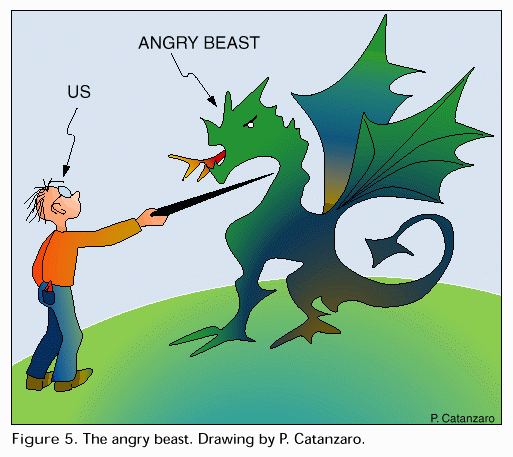
I think this image answers your questions. It's from an article about the Global Conveyor shutting down. For those who can't, for whatever reason, see the image, it's a picture of an angry beast being prodded by a boy, labelled 'us'.
-
Re:So why blame the industrialists?
I think this image answers your questions. It's from an article about the Global Conveyor shutting down. For those who can't, for whatever reason, see the image, it's a picture of an angry beast being prodded by a boy, labelled 'us'.
-
How will the books be scanned?
About two months ago, Jeff Dean (an employee of Google) gave a talk at the University of Washington about the inner workings of Google. One thing he mentioned was Google Print and how they scan books: they slice 'em up into individual pages, and then feed them through a scanner. This doesn't seem like an acceptable way to archive a library's collection. So, how are they scanning them in? Why not use this method for Google Print?
-
Re:Great
The parent poster was being facetious, but according to a presentation on sleep disorders that I saw recently for this class (sorry, no slides posted for the sleep lecture) insomnia is prevalent among professionals* because they are too good at occupying time with their own thoughts. From a system of schooling, and from the high pressure careers that result we become very adept at multitasking, and the brain itself becomes fond of churning out a continuous stream of thoughts. You may have noticed this yourself as your mind races through some current problem as you lie awake at midnight.
[* "professionals" implied physicians in this case, but this is just as relevant for programmers. And sorry for the "they"/"we" shift -- I'm assuming
The speaker is the medical director of the sleep program of a major regional hospital, which in itself is a high pressure position. Despite this he places a priority on getting 8.5 hours of sleep/night. Among the tidbits in his lecture was advice to train ourselves to turn off the chatter of the brain. This would be both to allow for restful and quick sleep and for safer driving, to mention another relevant example where having one's head filled with thoughts may not be ideal.
Given the above, it might not be so ridiculous that some might want to tune out without thinking when riding on the subway to or from work. On the other hand, I do hope that no one turns off their mental chatter while driving only to substitute watching TV on their cell phone... -
Re:Great
The parent poster was being facetious, but according to a presentation on sleep disorders that I saw recently for this class (sorry, no slides posted for the sleep lecture) insomnia is prevalent among professionals* because they are too good at occupying time with their own thoughts. From a system of schooling, and from the high pressure careers that result we become very adept at multitasking, and the brain itself becomes fond of churning out a continuous stream of thoughts. You may have noticed this yourself as your mind races through some current problem as you lie awake at midnight.
[* "professionals" implied physicians in this case, but this is just as relevant for programmers. And sorry for the "they"/"we" shift -- I'm assuming
The speaker is the medical director of the sleep program of a major regional hospital, which in itself is a high pressure position. Despite this he places a priority on getting 8.5 hours of sleep/night. Among the tidbits in his lecture was advice to train ourselves to turn off the chatter of the brain. This would be both to allow for restful and quick sleep and for safer driving, to mention another relevant example where having one's head filled with thoughts may not be ideal.
Given the above, it might not be so ridiculous that some might want to tune out without thinking when riding on the subway to or from work. On the other hand, I do hope that no one turns off their mental chatter while driving only to substitute watching TV on their cell phone... -
sp chkerwhen i can't spell something, i just type the word into google and press search and it spell checks it for me. autocomplete is nifty that it gives the # of results for each possibility
-a is for amazon, b is for best buy, and c is for cnn top 9 reasons to quit slashdot today
-
Re:help! This means you...
Greenland still has green parts. However, then as now, the largest part of the island is covered with glaciers. I sure hope you've got better evidence than that supporting your claim that there's been a bigger change between 1000 and 1350 AD than between 1750 and today.
-
Re:Global Warming on Mars
Same as today where the scientists are saying "It must be the humans!" because humans are Bad for the Earth(tm) when there is not near enough evidence to in any way conclusively state that.
I hate to feed the trolls, but...
It's well known, and not controversial, that CO2 traps heat.
It is well known, and not controversial, that atmospheric CO2 concentrations are increasing, thanks to us.
Arrhenius knew these things; he was the first to examine the impact of CO2 on global climate over 100 years ago.
Of course, there are a ton of other influences on global climate; the big question is what sort of negative feedback loops may exist, and how effective they might be at countering the forcing due to CO2 increases.
There is uncertainty because climate science is tough. You've got a combination of a ton of complicated physical, chemical, biological, etc., systems involved, and you can't do controlled experiments very easily (we're doing an interesting one now with CO2, but don't have a good control).
In addition to general warming, CO2 emissions pose other threats. There's the legitimate worry that warming will screw up oceanic circulation (this is the basic idea behind that movie that, um, took a little poetic license with the concept). Also, we're increasing atmospheric CO2 levels, so we're also increasing oceanic CO2 levels, and isn't it nice that CO2 + H2O => H2CO3 => H+ + HCO3-. That's right, we're acidifying the oceans, the effects of which aren't too well known. -
More options...
Repeat after me: E-mail clients on Linux are NOT a problem.
* Mutt (console based and unlike PINE its Free and better)
* Evolution (for GNOME)
* KMail (for KDE).
* Sylpheed (for GTK+).
* GNUMail (for GNUstep)
* More at Freshmeat.net > Communications
Perhaps redundant links here and there, but this is a good overal start. I excluded Thunderbird and Mozilla because those are heavily known already. Also, some of the above clients might run on other Unices, other OSes -- including MacOSX and Windows. -
Re:I think so.
Ok, instead of "Western Hemisphere" I will substitute the "Americas".
Are you really sure you want to say no humans started out here?Yes I do. The first humans arrived here by either crossing on land bridges during the Ice Age or by small craft along coast lines making longer trecks to cross the Bering Straight. Genetic mapping has been done to show that early American settlers (i.e. "Native Americans") are of central Asian descent.
Do you really want to say that humans were able to evolve in multiple parts of the world independently?
-
Re:Any other choice?Open Source other than Mozilla, all I can think of would be Pine.
For me, I'm still staying with Eudora, and only occasionally use Thunderbird when I want to send an HTML mail, and it's a bit too complex for Eudora, but not enough to use Dreamweaver and put it on a web site. Eudora is neither open source nor even free (there is a "sponsored" version with ads), and does not run on Linux. However, on Windows (or Mac), it's still the best I know: plain text mail storage, separation of atachments, regular expression searches, and the most powerful filtering I have seen (on any arbitrary header and/or the body, including with regex'es, and with several "actions" happening sequentially with filtered mails)The "Program for Internet News & Email" from University of Washington. Version 4.58
If you need a multi platform program, this one seems to cover them all. Amiga, BeOS, VMS, you name it... It looks like it even runs on a plain text terminal, so I could probably set it up to handle my mail on my 486 Linux firewall. Or maybe on my coffee machine? I'll have to look whether there is a pre-compiled version for La Pavoni (because the Pavoni's don't come with a compiler).
But even though I do like text terminals, shells and command lines, I don't think that is how I would like to manage my email. Not even to spare my eyes all the pictures and colors the HTML spam throws at them.
-
Re:Odds Are Against It
"*If* there were anything living on Mars in the first place, it would die long before we ever knew it got here."
That's a rather breathtaking generalization, even for Slashdot.
We're talking about a whole planet here with nearly as varied conditions for life as on Terra. Here is a mid-level overview of Mars Seasons, Weather, Exploration, Life. A cursory look at Atmospheric Temperature, Seasons and Pressures, reveals that Mars is remarkably similar to our own planet. If recent research has proved anything about life, it seems to be that given any kind of opportunity at all, life will flourish.
There is a small possibility that some of Mars' mantle may already have splashed onto our own planet. Can you say with any certainty that Martian microbes aren't already here? -
Re:Odds Are Against It
"*If* there were anything living on Mars in the first place, it would die long before we ever knew it got here."
That's a rather breathtaking generalization, even for Slashdot.
We're talking about a whole planet here with nearly as varied conditions for life as on Terra. Here is a mid-level overview of Mars Seasons, Weather, Exploration, Life. A cursory look at Atmospheric Temperature, Seasons and Pressures, reveals that Mars is remarkably similar to our own planet. If recent research has proved anything about life, it seems to be that given any kind of opportunity at all, life will flourish.
There is a small possibility that some of Mars' mantle may already have splashed onto our own planet. Can you say with any certainty that Martian microbes aren't already here? -
Are Holograms Really Necessary?Before reading to much into my subject line, I want to make it clear that I'd love to have fully immersive, true 3D imaging and video as much as anyone. But are holograms the best way to do it?
Holograms are synonymous with "real" 3D images. They've been around a long time because they don't rely on computer tech like almost everything in 3D imaging. They also provide a closed loop solution, they cover both image capture and display in a single medium, which has an elegant appeal to it.
The problem is theat they've been around such a long time and we haven't figure out a way to get around some very difficult limitations. The article points out that holographic video is years away at best. Live image capture will be very difficult. Meanwhile huge advances are being made in other 3D image captue methods. Real time surface capture is becoming a reality. Alternate the structured light patterns with natural light at about 120 FPS and you have full color 3D video. This requires a digital projector and digital video camera which are synchronized, a standard PC, and not much more. Other methods use laser, invisible infra red light patterns, and so on. Reasearch projects exist which seek to combine human 3D image capture and virtual reality display already exist. Holography was likely not even a consideration.
Holography is synonymous with real 3D in many people's minds, but there are many other ideas out there that could hold much more potential. Display is an issue, but even today's VR displays are likely better than any true holographic technology, and quickly improving.
-
Public counterexample
I live in Seattle. Just a wild guess... but I don't think these clocks are going to sell well here.
The University of Washington might disagree!
-
Scientific application; advice anyone?Does anyone out there have enough experience to compare these products to those offered by Lumileds? I actually use their Luxeon Star (and Star III) LEDs with narrow-band interference filters in a physics lab to drive optical atomic transitions in single trapped ions. I combine the light from a blue and orange LED with a dichroic mirror and then image the beams (roughly 1:1) using f/2 camera optics. Typically I can drive one (electric dipole) transition in 100ms and I won't spill the details about spot sizes, etc. unless anyone is interested.
What is important to me is- Fast turn on/turn off times. No more than 10ms.
- High total brightness, but particularly around the wavelengths 455nm and 615nm.
- Small source size, narrow emission cone since the light must be captured and imaged.
-
Re:Dude, where's my car?
This is actually part of a research project going on at the University of Washington Computer Science and Engineering department.
-
Operational in West Virginia since 1975A computer-controlled Personal Rapid Transit system with four stations has been running in Morgantown, West Virginia since 1975. It has true routing; you punch a destination and it takes you there, bypassing other stations. The cars seat 8 people.
Take a good look at that, and you'll see what the trackwork for a real system looks like. It does take a bit more room than the optimistic drawings of this new scheme. You need dual tracks, sidings, and turnaround loops.
-
a.k.a. Personal Rapid Transit (PRT)For the curious, some information on PRT from the University of Washington. It includes design ideas, prototypes, and places where PRT is being built. Enjoy!
-
PRTPRT (Personal Rapid Transit) offers many of the advantages of a car (direct, no-stop transport that isn't shared), but automated. It's basically a very small (up to 3 person) train on a small elevated track.
I can understand why people balk at public transportation -- there are a lot of problems with it. It's slow and it just doesn't scale; in "good" public transit places, it's only good because traffic and parking has crippled car use.
PRT can scale better than typical public transit, when you consider both the density of service, and total trip time. Hopefully a more technical-minded crowd can get over the naive idea that big trains can necessarily carry more people. If you just consider a track with one car per second (1 person per car) -- a very conservative density -- vs. a traditional train with five minute headways, the traditional train doesn't look so hot. Especially when you consider the effort in supporting a 40 ton car (that's just one traditional train car) vs. a 1 ton PRT car (and hopefully they could get that weight down considerably as technology improves); the PRT tracks should be way cheaper, and ultimately cheaper than roads. They couldn't actually replace roads, but they could make expansion unnecessary, or even make contraction of roads possible (e.g., removing lanes), and reduce the load on roads so they don't deteriorate as quickly.
PRT is meant to work with urban areas the way they are, not just the way we wish them to be. And the technology itself doesn't require any breakthroughs, even taking into account safety issues.
Anyway, I really hope something comes of it. Some links: SkyWeb, the PRT company that's furthest along; Citizens for PRT; Advanced Transit PRT Page for a bunch of links and academic studies about PRT.
-
Re:Forgive my ignorance...
The differences between the Human Proteome Folding (HPF) project and Folding@home have already been mentioned. The differences between HPF and the recently completed Distributed Folding (DF) project should also be mentioned. HPF and DF attempt to predict the 3-dimensional, or folded, structure of protein sequence data. Both projects are well suited to parallelization. DF used an in-house algorithm to predict the structures of small proteins (which may or may not be in the human genome) with known structures and of proteins with previously-unknown structures in the CASP5 and CASP6 structure prediction contests. HPF uses the Rosetta software package, developed by The Baker Laboratory at the University of Washington, to predict protein structures for proteins which occur in the human genome.
DF is currently redesigning its folding algorithm using the results from its first project, and may begin another project in the future. See my summary of DF for a quick history of the project.
-
Re:Forgive my ignorance...Dumb question from a bio neophyte, but wouldnt you already know the structure if you knew the sequence, since you would have an example of the protein, and the sequence supposedly more or less determines the structure?
No, going from sequence to structure is a big problem; see e.g. the CASP competition. The fundamental difficulty is that protein folding involves many complex interactions between amino acid side chains and solvent molecules, getting you into a world of nightmarish quantum chemistry where energy landscapes are rugged and rules are made to be broken.
In general there are two ways to approach structure prediction. The most reliable is homology modeling where you basically find a similar protein sequence (i.e. a close evolutionary relative) whose structure is known. Current protein database searches generally rely on probabilistic models borrowed from natural language processing and speech recognition, primarily hidden Markov models. Essentially, these models address the evolutionary process (which describes how different proteins are related), rather than the folding process (which describes how individual proteins fold).
If there aren't any similar proteins with known structure, you're into the domain of novel fold prediction, the second (harder) way to predict structure. The current best novel fold prediction methods begin by breaking the protein sequence into lots of tiny fragments (think words), then doing homology modeling on these fragments... e.g. the ROSETTA program from David Baker's group.
Simulating the full folding kinetics, as folding@home does, is even harder, and involves wading knee-deep into all that nightmarish quantum chemistry (or approximating it). Here you are interested in not only the final folded structure of the protein, but also its intermediate structures (hence the applicability of this approach to study of misfolding diseases, such as those involving prions).
Thank you DeepStream for pointing out the difference between folding@home and this ROSETTA-related project... teach me to respond without rtfa...