Slashdot Mirror
Domain: washingtonpost.com
Stories and comments across the archive that link to washingtonpost.com.
Stories · 2,444
-
White House Tape Recycling Possibly Erased Emails
Pojut points us to a Washington Post story which details the White House's admission that it routinely recycled backup tapes from 2001 to 2003, possibly destroying e-mail records from that time period. While the tapes are being analyzed to determine if any of the data can be recovered, the White House also indicated that some e-mail through 2005 may not have been preserved. We discussed the beginnings of this investigation a few months ago. From the Post: "During the period in question, the Bush presidency faced some of its biggest controversies, including the Iraq war, the leak of former CIA officer Valerie Plame Wilson's name and the CIA's destruction of interrogation videotapes. White House spokesman Tony Fratto said he has no reason to believe any e-mails were deliberately destroyed." -
Web Snapshots Are Nabbed for Commercial Uses
whoever57 writes "The Washington post has a story about Hollywood studios using photos grabbed off the web without permission. This particular story describes the case of a photo of a dog that was used by Fox. The photo had been uploaded to a personal blog and tagged 'all rights reserved.'" -
Anti-Missile Technology To Be Tested on Commercial Jets
Hugh Pickens writes "As many as three American Airlines passenger jets will be outfitted this spring with laser technology intended to protect planes from missile attacks. The tests, which could involve more than 1,000 flights, will determine how the technology holds up under the rigors of flight. The technology is intended to stop attacks by detecting heat from missiles, then responding in a fraction of a second by firing laser beams to jam the missiles' guidance systems. A Rand study in 2005 estimated it would cost about $11 billion to protect every US airliner from shoulder-fired missiles. Over 20 years, the cost to develop, procure and operate anti-missile systems could hit $40 billion." -
US Government To Release Electronic Passport
XueCast writes "The federal government has announced that they will release new electronic Passport cards in either April or May 2008. The cards could be read wirelessly from up to 20 feet away, which could reduce the waiting time at border checkpoints. Deputy Assistant Secretary Of State For Passport Services, Ann Barrett said, "As people are approaching a port of inspection, they can show the card to the reader, and by the time they get to the inspector, all the information will have been verified and they can be waved on through."" -
Wikia Search Engine to be Launched on January 7th
cagnol writes "The Washington Post reports that Jimmy Wales, the founder of online encyclopedia Wikipedia, has announced the launch of a new open-source search engine, Wikia Search, on January 7th, 2008. The project will allow the community to help rank search results, in a model close to Wikipedia. However the company is a for-profit organization. This new search is supposed to challenge Google and Yahoo." -
RIAA Now Filing Suits Against Consumers Who Rip CDs
mrneutron2003 writes "With this past week's announcement by Warner to release its entire catalog to Amazon in MP3 format with no Digital Rights Management, you would think that the organization that represents them, The RIAA, would begin changing its tune. Instead, they are pressing on in their campaign against consumers by suing individuals who merely rip CDs they've purchased legally. 'The industry's lawyer in the case, Ira Schwartz, argues in a brief filed earlier this month that the MP3 files Howell made on his computer from legally bought CDs are "unauthorized copies" of copyrighted recordings.'" -
Chinese Government Sued Over Dog Height Censorship
Googling Yourself writes "More than 30,000 censors are employed in China to monitor the Internet, so it was no surprise when censors deleted a posting by Chen Yuhua protesting Beijing municipal government's regulations barring any dog over 14 inches high and restricting each family to only one dog. The surprise (reports the Washington Post) was when Chen studied China's civil code and marched into court with a lawsuit, only the second time that a Chinese citizen has gone to court over party censorship. 'I was very careful to follow the correct procedure,' Chen said in an interview, while pointing at the official legal manual on his dining room table. On December 14 Chen was told by clerks that the district court, after referring to higher-level judges for advice, had decided to reject the case. The next step, Chen said, is an appeal to the Supreme Court." -
FBI Prepares Vast Database of Biometrics
MacRonin sends us to the Washington Post for a story about the FBI's plans for a large biometric identification database. The Post also has a chart detailing the characteristics of the different methods of identification. We discussed the ethics of a similar situation a few months ago. Quoting the Post: "Next month, the FBI intends to award a 10-year contract that would significantly expand the amount and kinds of biometric information it receives. And in the coming years, law enforcement authorities around the world will be able to rely on iris patterns, face-shape data, scars and perhaps even the unique ways people walk and talk, to solve crimes and identify criminals and terrorists. The FBI will also retain, upon request by employers, the fingerprints of employees who have undergone criminal background checks so the employers can be notified if employees have brushes with the law." -
FBI Prepares Vast Database of Biometrics
MacRonin sends us to the Washington Post for a story about the FBI's plans for a large biometric identification database. The Post also has a chart detailing the characteristics of the different methods of identification. We discussed the ethics of a similar situation a few months ago. Quoting the Post: "Next month, the FBI intends to award a 10-year contract that would significantly expand the amount and kinds of biometric information it receives. And in the coming years, law enforcement authorities around the world will be able to rely on iris patterns, face-shape data, scars and perhaps even the unique ways people walk and talk, to solve crimes and identify criminals and terrorists. The FBI will also retain, upon request by employers, the fingerprints of employees who have undergone criminal background checks so the employers can be notified if employees have brushes with the law." -
Why the Coming Data Flood Won't Drown the Internet
High Waters writes "Ars Technica examines predictions of an 'exaflood' of data that some alarmists believe will overwhelm the Internet. A closer look reveals that many of those raising the alarm about an exaflood are generally doing so to make the case against internet neutrality regulation. 'There's a reason that "exaflood" sounds scary. It's supposed to. Though Brett Swanson's Wall Street Journal piece tried to avoid alarmism, it did have an explicitly political point in mind: net neutrality is bad, and it could turn the coming exaflood into a real disaster'." -
Synthetic DNA About To Yield New Life Forms
mlimber sends along a Washington Post story about the immanence of completely artificial life: "The cobbling together of life from synthetic DNA, scientists and philosophers agree, will be a watershed event, blurring the line between biological and artificial — and forcing a rethinking of what it means for a thing to be alive... Some experts are worried that a few maverick companies are already gaining monopoly control over the core 'operating system' for artificial life and are poised to become the Microsofts of synthetic biology. That could stifle competition, they say, and place enormous power in a few people's hands." -
DoubleClick Goes MIA At FTC Chief's Old Law Firm
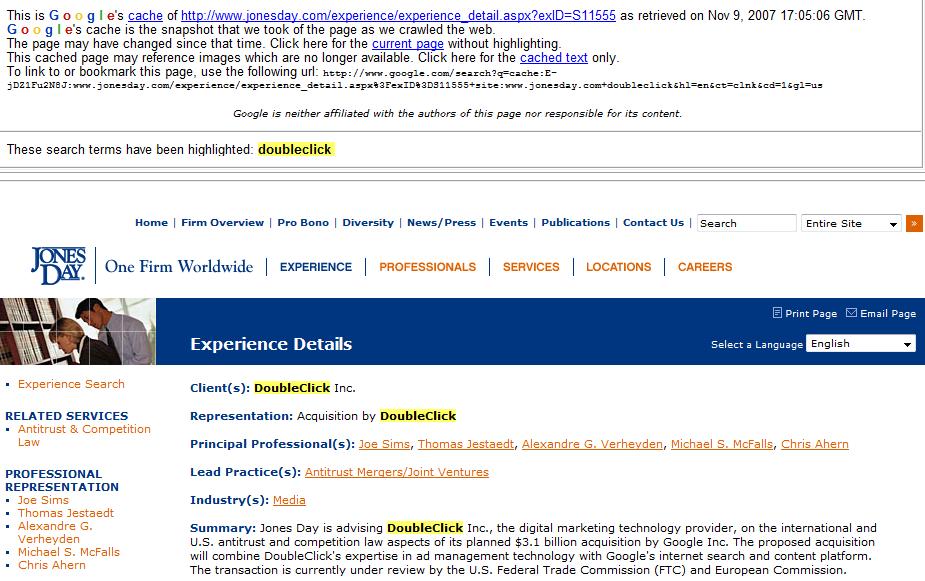
theodp writes "FTC Chairwoman Deborah Platt Majoras has refused to recuse herself from the agency's review of Google's $3.1B DoubleClick acquisition, despite her current and past ties to DoubleClick law firm Jones Day. EPIC and the Center for Digital Democracy, which had requested her recusal, are keeping up the pressure as DoubleClick-related pages and references have been disappearing from Jones Day's website. Although the statement issued by the Chairwoman suggests Jones Day's DoubleClick representation is limited to the European Commission, the Google cache of one MIA document boasts: 'Jones Day is advising DoubleClick Inc., the digital marketing technology provider, on the international and US antitrust and competition law aspects of its planned $3.1 billion acquisition by Google Inc.'" -
Diffing Guantanamo Bay SOP Manuals
James Hardine writes "The Washington Post is reporting that Wikileaks has released another manual for Camp Delta, Guantanamo Bay together with the US military's rendition operations manual. This release follows from the Wikileaks release of the 2003 SOP Manual as discussed on Slashdot last month. Wikileaks compares the two manuals (2003, 2004) and reveals damning changes in official US detainee policy in exquisite detail. Who knew that diff could be such a powerful political weapon?" -
Dinosaur Fossil Found With Preserved Soft Tissue
damn_registrars writes "A fossilized hadrosaur has been uncovered in South Dakota that has preserved soft tissue. This is described as a "mummified" dinosaur, and allows for a look at the skin and musculature of some parts of this animal. The find was reported by a 24 year old Yale graduate student of paleontology." -
All US Border Crossings Now Require A 'Terrorist Risk Profile'
conlaw writes with a somewhat intimidating Washington Post article. "The federal government disclosed details yesterday of a border-security program to screen all people who enter and leave the United States, create a terrorism risk profile of each individual and retain that information for up to 40 years ... The risk assessment is created by analysts at the National Targeting Center, a high-tech facility opened in November 2001 and now run by Customs and Border Protection. In a round-the-clock operation, targeters match names against terrorist watch lists and a host of other data to determine whether a person's background or behavior indicates a terrorist threat, a risk to border security or the potential for illegal activity. They also assess cargo." -
Publishers Seek Change in Search Result Content
explosivejared writes "The Washington Post is running a story on the fight between publishers and search engines over just what exactly is allowed to be shown by search results. From the article: 'The desire for greater control over how search engines index and display Web sites is driving an effort launched yesterday by leading news organizations and other publishers to revise a 13-year-old technology for restricting access. Currently, Google, Yahoo and other top search companies voluntarily respect a Web site's wishes as declared in a text file known as robots.txt, which a search engine's indexing software, called a crawler, knows to look for on a site ... [new] proposed extensions, known as Automated Content Access Protocol, partly grew out of those disputes. Leading the ACAP effort were groups representing publishers of newspapers, magazines, online databases, books and journals. The AP is one of dozens of organizations that have joined ACAP." -
The Device NASA Is Leaving Behind
iminplaya writes "After years of delays, NASA hopes to launch this week a European-built laboratory that will greatly expand the research capability of the international space station. Although some call it a milestone, the launch has focused new attention on the space agency's earlier decision to back out of plans to send up a different, $1.5 billion device — one that many scientists contend would produce far more significant knowledge. "...it would be a true international disgrace if this instrument ends up as a museum piece that never is used."" -
Firefox Susceptible To QuickTime Security Flaw
Hugh Pickens writes "Apple's QuickTime media player software contains a previously undocumented security weakness in the way QuickTime handles the RTSP media-streaming protocol. The vulnerability is present in QuickTime versions 4.0 through 7.3 (the latest version) on both Windows and Mac systems. Symantec has tested the publicly available exploit code and found that it failed to work properly against Internet Explorer 6/7 or Safari 3 Beta but the exploit works against Firefox if users have chosen QuickTime as the default player for multimedia formats. Firefox users are more susceptible to this attack because Firefox farms off the request directly to the QuickTime Player as a separate process outside of its control, while IE loads the QuickTime Player as an internal plugin and when the overflow occurs, standard buffer-overflow protection is triggered, shutting down the affected processes before any damage can occur." -
Feds Have Access To Cellphone Tracking On Request
Mike writes "According to a Washington Post article, federal officials are routinely asking and getting courts to order cellphone companies to furnish real-time tracking data on subscribers. The data is used to pinpoint the whereabouts of 'criminal suspects', according to judges and industry lawyers. In some cases, judges have granted the requests without even requiring the government to demonstrate probable cause that a crime is taking place or that the inquiry will yield evidence of a crime 'Privacy advocates fear such a practice may expose average Americans to a new level of government scrutiny of their daily lives. Such requests run counter to the Justice Department's internal recommendation that federal prosecutors seek warrants based on probable cause to obtain precise location data in private areas. The requests and orders are sealed at the government's request, so it is difficult to know how often the orders are issued or denied.'" -
MPAA College Toolkit Raises Privacy, Security Concerns
An anonymous reader writes "The Motion Picture Association of America last month sent letters to the presidents of 25 major universities (pdf), urging them to download and install a 'university toolkit' to help identify students who were downloading/sharing movie files. The Washington Post's Security Fix blog reports that any university that installs the software could be placing a virtual wiretap on their networks for the MPAA (and the rest of the world) to listen in on all of the school's traffic. From the story: 'The MPAA also claims that using the tool on a university network presents "no privacy issues — the content of traffic is never examined or displayed.' That statement, however, is misleading. Here's why: The toolkit sets up an Apache Web server on the user's machine. It also automatically configures all of the data and graphs gathered about activity on the local network to be displayed on a Web page, complete with ntop-generated graphics showing not only bandwidth usage generated by each user on the network, but also the Internet address of every Web site each user has visited. Unless a school using the tool has firewalls on the borders of its network designed to block unsolicited Internet traffic — and a great many universities do not — that Web server is going to be visible and accessible by anyone with a Web browser." -
MPAA College Toolkit Raises Privacy, Security Concerns
An anonymous reader writes "The Motion Picture Association of America last month sent letters to the presidents of 25 major universities (pdf), urging them to download and install a 'university toolkit' to help identify students who were downloading/sharing movie files. The Washington Post's Security Fix blog reports that any university that installs the software could be placing a virtual wiretap on their networks for the MPAA (and the rest of the world) to listen in on all of the school's traffic. From the story: 'The MPAA also claims that using the tool on a university network presents "no privacy issues — the content of traffic is never examined or displayed.' That statement, however, is misleading. Here's why: The toolkit sets up an Apache Web server on the user's machine. It also automatically configures all of the data and graphs gathered about activity on the local network to be displayed on a Web page, complete with ntop-generated graphics showing not only bandwidth usage generated by each user on the network, but also the Internet address of every Web site each user has visited. Unless a school using the tool has firewalls on the borders of its network designed to block unsolicited Internet traffic — and a great many universities do not — that Web server is going to be visible and accessible by anyone with a Web browser." -
Cannabis Compound Said To "Halt Cancer"
h.ross.perot informs us of research out of the California Pacific Medical Center Research Institute suggesting that a compound found in cannabis may stop breast cancer from metastasizing. Cannabidiol, or CBD, could develop into a non-toxic alternative to chemotherapy some years down the road, if animal and human trials bear out its effectiveness. The article notes that smoking cannabis will not deliver significant quantities of CBD. -
FBI Doesn't Tell Courts About Bogus Evidence
dprovine writes "According to a joint investigation by The Washington Post and 60 Minutes, a forensic test used by the FBI for decades is known to be invalid. The National Academy of Science issued a report in 2004 that FBI investigators had given "problematic" testimony to juries. The FBI later stopped using "bullet lead analysis", but sent a letter to law enforcement officials saying that they still fully supported the science behind it. Hundreds of criminal defendants — some already convicted in part on the testimony of FBI experts — were not informed about the problems with the evidence used against them in court." -
Russian Software Piracy Crackdown Restricts Free Speech
reporter writes "According to a report recently filed by the Washington Post, the Kremlin has finally begun to crackdown on software piracy ... with a twist. The Russian state agency is targetting political enemies with claims of piracy, including independent news media, political parties, and private advocacy groups. In particular, 'the newspaper Novaya Gazeta, one of the last outposts of critical journalism in Russia, suspended publication of its regional edition in the southern city of Samara on Monday after prosecutors opened a criminal case against its editor, alleging that his publication used unlicensed software.'" This doesn't even take into account our recent discussion of the Kremlin's grip on internet access in that country. -
FCC Moves To Regulate Cable TV Competition
explosivejared writes "The Federal Communications Commission is likely to impose a new regulation on the largely unregulated cable television industry, the first of what may be more to come. Under a proposed rule circulating at the FCC, cable companies such as Comcast and Time Warner Cable would have to slash the price they charge smaller television programmers to lease access on spare cable channels, a move the FCC says would open up cable viewers to a wider diversity of shows. In addition, the FCC is contemplating a national ownership cap that would prevent one company from having more than 30 percent of all cable subscribers." TechDirt has a jaundiced view of FCC chairman Martin's animus against the cablecos. -
Russian Phishers Moving to China?
Hugh Pickens writes "The Russian Business Network, an ISP and Web hosting provider based in St. Petersburg, whose client list amounts to a laundry list of organized cybercrime operations appears to have closed shop after a number of its main upstream Internet providers severed ties with the group. The disappearance of RBN comes less than a month after Brian Krebs of the Washington Post wrote a series of stories detailing the organization and history of the shadowy ISP. However, experts at anti-spam group Spamhaus say there are strong indications that a huge swath of Internet space recently established in China may soon emerge as the next incarnation of the Russian Business Network. In related news FBI Director Robert S. Mueller, III gave a speech on cybercrime earlier this week where he said that the FBI has 60 Legal Attaché offices around the world working with partners in Russia, Romania,Poland, Hungary, Italy, and Estonia, among others, to investigate international cyber threats." -
Russian Phishers Moving to China?
Hugh Pickens writes "The Russian Business Network, an ISP and Web hosting provider based in St. Petersburg, whose client list amounts to a laundry list of organized cybercrime operations appears to have closed shop after a number of its main upstream Internet providers severed ties with the group. The disappearance of RBN comes less than a month after Brian Krebs of the Washington Post wrote a series of stories detailing the organization and history of the shadowy ISP. However, experts at anti-spam group Spamhaus say there are strong indications that a huge swath of Internet space recently established in China may soon emerge as the next incarnation of the Russian Business Network. In related news FBI Director Robert S. Mueller, III gave a speech on cybercrime earlier this week where he said that the FBI has 60 Legal Attaché offices around the world working with partners in Russia, Romania,Poland, Hungary, Italy, and Estonia, among others, to investigate international cyber threats." -
Bill to Require Open Access to Scientific Papers
Ponca City, We Love You writes "Congress is expected to vote this week on a bill requiring investigators funded by the National Institutes of Health (NIH) to publish research papers only in journals that are made freely available within one year of publication. Until now, repeated efforts to legislate such a mandate have failed under pressure from the well-heeled journal publishing industry and some nonprofit scientific societies whose educational activities are supported by the profits from journals that they publish. Scientists assert that open access will speed innovation by making it easier for them to share and build on each other's findings. The measure is contained in a spending bill that boosts the biomedical agency's effective budget by 3.1%, to $29.8 billion in 2008. The open-access requirement in the bill would apply only during fiscal year 2008; it would need to be renewed in yearly spending bills in the future." -
House Narrowly Avoids Having to Debate Impeachment of Cheney
An anonymous reader writes "Representative Dennis Kucinich (D-OH) yesterday successfully moved articles of impeachment against Vice President Dick Cheney to the House Judiciary committee. 'Today's resolution from Kucinich (D-Ohio) was essentially the same as the legislation he introduced earlier this year, which included three articles of impeachment against Cheney based largely on allegations that he manipulated intelligence in the run-up to the Iraq war. The last article accuses Cheney of threatening "aggression" against Iran "absent any real threat."'" -
Highly Targeted Phishing From Salesforce.com Leak
An anonymous reader writes "Salesforce.com has finally acknowledged what security experts have suspected for weeks: that a Salesforce.com employee had his company credentials stolen in a phishing scam, and criminals have been using names and e-mail addresses from Salesforce's customer list to conduct other highly targeted phishing attacks, including the recent round of fake e-mails apparently from the Federal Trade Commission." In such hightly targeted attacks, the AV companies are at a loss — they have little chance of quickly developing signatures for threats that only reach a few thousand victims. -
Highly Targeted Phishing From Salesforce.com Leak
An anonymous reader writes "Salesforce.com has finally acknowledged what security experts have suspected for weeks: that a Salesforce.com employee had his company credentials stolen in a phishing scam, and criminals have been using names and e-mail addresses from Salesforce's customer list to conduct other highly targeted phishing attacks, including the recent round of fake e-mails apparently from the Federal Trade Commission." In such hightly targeted attacks, the AV companies are at a loss — they have little chance of quickly developing signatures for threats that only reach a few thousand victims. -
ICANN Punts on WHOIS Privacy Proposal
An anonymous reader writes "The Internet Corporation for Assigned Names and Numbers (ICANN) has essentially put off consideration of a proposal that would have dissolved a requirement that domain name registrars collect and display personal information about people who register Web site names. Privacy activists said the WHOIS database has become a data-mining dream for marketers and spammers, to say nothing of stalkers and harassers. Companies representing some of the world's biggest brand names appear to have prevailed, arguing that any change to the current system would interfere with law enforcement investigations and trademark disputes. In the end, ICANN voted 7-17 to table the issue in favor of further studies on the privacy impact of the WHOIS database." -
Call for a Presidential Debate on Science
Writer Matthew Chapman recently wrote a piece for the Washington Post calling for a science-only Presidential debate. While I wouldn't hold my breath waiting for the candidates to embrace such a potentially difficult series of questions, a bit more emphasis on modern science and technology certainly couldn't hurt. "None of the candidates should know in advance what questions they might face. Not knowing the questions in advance would force them to study as much science as possible, and this in itself would be a marvelous thing. However, a statement would be read at the start stating that no one expects politicians to understand every aspect of the many scientific disciplines. The debate's tone would try not to be adversarial, but cordial and educational. It could even be fun." -
The Kremlin Tightens Its Grip on the Internet
reporter writes "According to a report just published by "The Washington Post", the percentage of Russian adults having access to the Internet has risen from 8% in 2002 to 25% in 2007. This growth has attracted the attention of the Kremlin. Its allies are creating pro-Kremlin web sites and are purchasing web sites known for high-quality independent journalism. Pro-Kremlin bloggers have used their skills to bury news about anti-Kremlin demonstrations: at Russian news portals, web links to news about pro-Kremlin rallies consistently rank higher than web links to news about anti-Kremlin demonstrations. The most disturbing development is that the Kremlin intends to develop a Russian Internet which is separate from the global Internet. Russian officials are studying the techniques that the Chinese use to censor the Internet." -
eBay's Lobbying Efforts May Include the CIA
samuraiknight writes "The Washington Post reports that eBay was among eight entities that lobbied the CIA during the first six months of 2007, according to disclosure forms maintained by the Senate public records office. An eBay spokesman claims its listing was an error, but also notes that the company met with CIA officials in the second half of 2006 to discuss the amendments to the 1994 Communications and Law Enforcement Act (CALEA), which include a requirement that VoIP companies submit to government wiretaps. The article suggests that eBay and the CIA discussed the law's potential effects on Skype (owned by eBay), but does not elaborate further." -
Little Old Lady Hammers Comcast
WheezyJoe writes "The Washington Post reports that a little old lady took a hammer to Comcast. Apparently fed up with the lousy service she received from a botched Comcast installation of "triple-play", and a completely humiliating experience at a customer service center, 75-year-old Mona "The Hammer" Shaw took her claw hammer back to the customer service center and bludgeoned the office equipment into tiny plastic pieces." -
The Real Problem With the US Patent System
Pachooka-san writes "An article in the Washington Post touches on the 'real' patent problem — the quotas that Patent Examiners must meet. They have no effective quality standards, only production standards, so many applications get only cursory review just so the PE can keep up the grueling pace. The USPTO is the only government agency that can and does lay you off if your productivity drops below 85% of the standard for your civil service grade. A Primary PE has to process 5 new and 5 old applications every 2 weeks (that's 8 hours each, folks). The best part — that 28-box application mentioned in the article? — it gets the PE the same credit as the smallest application. How many of those 28 boxes do you think even got opened?" -
White House Wins On Spying, Telecom Immunity
EllisDees sends in a Washington Post report that Senate Republicans have outmaneuvered Democrats, who withdrew a more stringent version of legislation to control the government's domestic surveillance program. The legislation that will go forward includes a grant of legal immunity to telecommunications companies that have assisted the program. -
Profile of the Russian Business Network
The Washington Post has an article detailing what is known of the workings of the Russian Business Network, a shadowy entity based in St. Petersburg that hosts a good fraction of the world's spammers, identity thieves, bot herders, and phishers. RBN is not incorporated anywhere and may not technically even be violating Russian law. It provides "bulletproof hosting" for about $600 a month to a wide range of bad guys.The author of the Post story, Brian Krebs, supplements it with two blog posts. One provides more detail and back story including a look at one ISP's security admin who decided last summer to ban all RBN traffic from his network, with outstanding results. The other post maps some of the RBN's upstream suppliers and details the extent of the RBN's involvement in recent cyber-attacks: "Nearly every major advancement in computer viruses or worms over the past two years has emanated from or sent stolen consumer data back to servers" in the RBN. -
Profile of the Russian Business Network
The Washington Post has an article detailing what is known of the workings of the Russian Business Network, a shadowy entity based in St. Petersburg that hosts a good fraction of the world's spammers, identity thieves, bot herders, and phishers. RBN is not incorporated anywhere and may not technically even be violating Russian law. It provides "bulletproof hosting" for about $600 a month to a wide range of bad guys.The author of the Post story, Brian Krebs, supplements it with two blog posts. One provides more detail and back story including a look at one ISP's security admin who decided last summer to ban all RBN traffic from his network, with outstanding results. The other post maps some of the RBN's upstream suppliers and details the extent of the RBN's involvement in recent cyber-attacks: "Nearly every major advancement in computer viruses or worms over the past two years has emanated from or sent stolen consumer data back to servers" in the RBN. -
ICANN Mulling Multilingual URLs
griffjon writes "The Washington Post is reporting that ICANN is testing out fully multilingual domain names. These won't just be [non-western-language].com, but would have TLDs translated into other scripts, fixing annoyances for non-English speaking audiences. An example: 'Speakers of Hebrew, Arabic and any other language written from right to left must type half of the URL in one direction and the other half — the .com, .net or .org postscript — the opposite way.' Let's hope it goes better this time around: 'Next week's experiments use the domain name "example.test" translated into 11 languages. A previous model, however, used "hippopotamus" instead of "test." These plans went awry when an Israeli registrar realized the Hebrew word ICANN thought meant "hippopotamus" was an expletive and threatened to involve the Israeli government.'" -
Dragonfly-Sized Insect Spies Spotted, Denied
SRA8 sends in a Washington Post piece about work at various academic, government, and military labs on insect-sized flying spies. A number of people reported what appeared to be flying mechanical insects, larger than dragonflies, over an antiwar rally in Washington DC last month. The reporter got mostly no-comments from the agencies he called trying to pin down what it was they saw. Only the FBI said through a spokesman: "We don't have anything like that." The article describes work on insect cyborgs as well as purely mechanical flying spies, but quotes vice admiral Joe Dyer, former commander of the Naval Air Systems Command now at iRobot in Burlington, Mass., as follows: "I'll be seriously dead before that program deploys." The article also mentions an International Symposium on Flying Insects and Robots, held in Switzerland in August, at which Japanese researchers demonstrated radio-controlled fliers with four-inch wingspans that resemble hawk moths. -
D.C. Commuters to be Scanned With Infrared Cameras
owlgorithm writes "Washington, D.C. area commuters are going to be "scanned like groceries at the supermarket" in order to catch single-occupant vehicles who are illegally using carpool lanes. The article, from the Washington Post, says that infrared cameras capable of detecting human skin will be installed, rather than the visible-spectrum cameras in use today. So much for using dummies in the front seat." -
Cyber Crime A Distant #3 Priority for FBI
An anonymous reader writes "A reading of the Justice Department's 2008 budget justification to Congress for the FBI indicates the agency is dedicating about 5.5 percent of its field agents to combating cyber crime, the FBI's stated Number Three priority, The Washington Post reports. Take away the agents dedicated to catching child predators online — a program that accounts for the vast majority of the department's prosecutorial victories — and about 3.6 percent of the FBI's agents are dedicated to cyber crime, the report notes. From the story: 'If the FBI's third most-important priority claims just over 3.5 percent of its active agents, how many agents and FBI resources are dedicated to the remaining Top Ten priorities?'" -
MIT Hacks Harvard For Halo, Game Prompts Lots of Sick Days
yonari writes "Early on the morning before the Halo 3 release, John Harvard donned a Mjolnir helmet and a beaver emblem, and carried an assault rifle on his left shoulder, apparently acquired from the UNSC Engineering Division." The Washington Post also points out that a lot of folks took sick days on Tuesday as a consequence of the game's release. "Some local workers won't have to skip out on the office to play the game. At some companies that offer video games as a break room activity, Halo 3 was pre-ordered months ago. The Motley Fool, the Alexandria investment advisory firm, is expecting its copy of the game to arrive from Amazon.com soon. Same for Platinum Solutions, a Reston software consulting firm." -
Vonage Hit With $69.5M Judgement
andy1307 writes "The Washington Post is reporting that Net telephone company Vonage Holdings Corp. was ordered in federal court Tuesday to pay Sprint Nextel $69.5 million in damages for infringing on six telecommunications patents owned by competitor Sprint Nextel Corp. In addition to the damages, jurors awarded Sprint Nextel a 5 percent royalty from Vonage on future revenues. It was the second verdict against Vonage this year. A jury in Virginia determined in March that Vonage had violated three Verizon patents in building its Internet phone system. The jury awarded Verizon $58 million in damages plus 5.5 percent royalties on future revenues. Greg Gorbatenko, a telecommunications and media analyst for Jackson Securities, said the decision 'feels like a death knell' for Vonage because future revenue will likely dry up, preventing the company from investing in better technology or improving customer service." -
Unisys Investigated For Covering Up Cyber-Attacks
Stony Stevenson writes "Unisys, a major government IT contractor, is reportedly being investigated for failing to detect cyber-attacks, and then covering up its failings. Two US congressmen have called for an investigation into cyber-attacks aimed at the Department of Homeland Security, along with a contractor (that would be Unisys) charged with securing those networks. 'The House Committee on Homeland Security's investigations led them to believe the department is under attack by foreign powers, and could be at risk because of "incompetent and possibly illegal activity" by a US contractor. The congressmen didn't name the contractor in the letter. However, the Washington Post on Monday reported that the FBI is investigating Unisys, a major information technology firm with a $1.7 billion Department of Homeland Security contract, for allegedly failing to detect cyber break-ins traced to a Chinese-language Web site and then trying to cover up its deficiencies.'" Unisys denies it all. -
TransUnion to Offer Credit Freezes Nationwide
An anonymous reader writes "In a little-noticed press release issued Tuesday, credit reporting bureau TransUnion said it would begin offering credit freezes to all Americans, a change the belies the credit industry's oft-uttered claim that doing so would be too expensive and burdensome. The program takes effect Oct. 15, 2007, will cost $10 each to place and to remove, and request and must be filed by certified mail. As The Washington Post reports, the move comes as some 39 states and the District of Columbia have passed laws entitling their residents to credit freeze rights. The new right may have little benefit unless the other two major credit reporting bureaus follow suit, and both companies are staying mum about any plans to do so. In May, Slashdot examined a related story on the credit bureaus' traditional resistance to freeze laws." -
CastleCops.com Hit With Reputation-Based Attacks
An anonymous reader writes "The all-volunteer based online fraud fighting group CastleCops.com is currently the target of ongoing reputation-based attacks in which criminals use phished PayPal accounts to donate thousands of dollars to CastleCops from dozens of victims. This attack appears to be in response to a recent series of failed denial-of-service attacks against the CastleCops, Web site. From the story: 'A few donations were for as little as $1, while other fake donations ranged as high as $2,800. To the victims of the stolen PayPal accounts, it looks as if CastleCops is the one stealing their money, when in reality, it's the attackers. Also, the fraudulent activity seeks to ruin their relationship with PayPal.' In a comment left on Washingtonpost.com's Security Fix blog, CastleCops co-founder Paul Laudanksi says while the group's site remains under a heavy DDoS attack, it is currently down due to a hardware failure, not the attack itself." -
Sci-Fi Writer Considers BioShock's Artistic Merit
The LevelUp blog considers an article on the Washington Post site, where their tech columnist did a little experiment. He set Science Fiction author Michael Dirda down in front of Irrational's BioShock, and asked him to consider the game's artistic merit. N'Gai has himself some interesting commentary about the article, which raises a flurry of question on its own: "Dirda, to use his word, doesn't know the 'rhetoric' of video games. Me: I've spent so much time playing video games over the years that I'd forgotten people aren't born instinctively knowing how to 'circlestrafe' a monster ... 'I could lose myself in this, in some ways, easier than in a book,' he said. Dirda said the game showed him that video games 'obviously have artistic value' and will likely become more of a recognized art form. So: Is BioShock art? 'I would hesitate to go that far,' he said after a short pause."