Slashdot Mirror
Domain: wattsupwiththat.com
Stories and comments across the archive that link to wattsupwiththat.com.
Comments · 950
-
only one side only makes it to slashdot
-
Re:And now, on Slashdot
Actually, 5 million years ago, the continents were in about the same place. Even when the last of the dinosaurs were around, the land masses were very similar.
One of many sources -
Consistent pattern
1988 James Hansen New York will be Under Water in 20-30 years
https://www.salon.com/2001/10/...
1989 UN we have 12 years to save the planet
https://www.apnews.com/bd45c37...
1989 New York Times NOAA (No warming trend over the past 100 years )
https://www.nytimes.com/1989/0...
2000 Snowfalls are a thing of the past
https://wattsupwiththat.com/wp...
2005 UN we will have 50 million climate refugees by 2010
http://www.spiegel.de/internat...
2009 James Hansen, Obama Has 4 years to save the planet
https://www.theguardian.com/en...
2018 UN Only 12 years left to save the planet
https://www.cnn.com/2018/10/07...
2019 Greenland Glacier Reverses Decline.
-
Re:Oceans are becoming less alkaline, not acidic.
such as ocean acidification
Ocean water does not become "acidic", it simply is less alkaline (huge, huge distinction).
Not a distinction at all. Decreasing the pH of a solution makes it more acidic, regardless of whether it's on the alkaline or acid side of the centerpoint of the range. Likewise, increasing its pH makes it more alkaline, regardless of its current position. If you prefer "de-alkalinization" to "acidification", or "de-acification" to "alkalinization" the words are synonyms, so pick whatever you want.
This is just ordinary chemistry terminology that you should have learned in high school.
-
Re:Oceans are becoming less alkaline, not acidic.
such as ocean acidification
Ocean water does not become "acidic", it simply is less alkaline (huge, huge distinction).
Wait a minute?!?
I'm confused why this post isn't modded way up, I mean wayyyy up there.
This is SuperKendall, so where are all the mod points?
Come on guys! -
Oceans are becoming less alkaline, not acidic.
such as ocean acidification
Ocean water does not become "acidic", it simply is less alkaline (huge, huge distinction).
-
Illiterate is a sad way to go through life
And your point with that is...what, that Germany developed identically to the rest of Europe in the time period in question
No my point is that you are a liar who is more than capable of blathering on no matter what is put before you
https://wattsupwiththat.com/20...
Gee amazing how the more " RENEWABLES " a country has the more expensive its power has become.
And yes when I think of France a country that had the lowest energy prices in Europe abundant natural resources and renewables come to mind
BTW your religious bias is showing.
-
Re:The trend itself was pre-industrial
Yes, you do need to do an experiment. As it turns out, the effect of increasing CO2 concentration in the atmosphere is not linear.
The first 100ppm or so do have a large effect (versus 0ppm), but much beyond where we are now (~400ppm), it becomes negligible. -
Re:good
Nuclear is about 4% of world energy consumption. Don't know if the tech has evolved sufficiently yet to replace renewables.
-
Re:good
Renewables are about 4% of world energy consumption. Don't know if the tech has evolved sufficiently yet to replace nuclear.
-
Floating islands
This is an old post describing how coral atolls float and effectively keep pace with the rise and fall of sea level.
https://wattsupwiththat.com/20...
And there have been numerous recent reports showing that island (e.g. Tuvalu) is indeed growing.
https://wattsupwiththat.com/20...
From Nature communications:
Patterns of island change and persistence offer alternate adaptation pathways for atoll nationsPaul S. Kench, Murray R. Ford & Susan D. Owen
Abstract
Sea-level rise and climatic change threaten the existence of atoll nations. Inundation and erosion are expected to render islands uninhabitable over the next century, forcing human migration. Here we present analysis of shoreline change in all 101 islands in the Pacific atoll nation of Tuvalu. Using remotely sensed data, change is analysed over the past four decades, a period when local sea level has risen at twice the global average (~3.90±0.4mm.yr1). Results highlight a net increase in land area in Tuvalu of 73.5ha (2.9%), despite sea-level rise, and land area increase in eight of nine atolls. Island change has lacked uniformity with 74% increasing and 27% decreasing in size. Results challenge perceptions of island loss, showing islands are dynamic features that will persist as sites for habitation over the next century, presenting alternate opportunities for adaptation that embrace the heterogeneity of island types and their dynamics. -
Floating islands
This is an old post describing how coral atolls float and effectively keep pace with the rise and fall of sea level.
https://wattsupwiththat.com/20...
And there have been numerous recent reports showing that island (e.g. Tuvalu) is indeed growing.
https://wattsupwiththat.com/20...
From Nature communications:
Patterns of island change and persistence offer alternate adaptation pathways for atoll nationsPaul S. Kench, Murray R. Ford & Susan D. Owen
Abstract
Sea-level rise and climatic change threaten the existence of atoll nations. Inundation and erosion are expected to render islands uninhabitable over the next century, forcing human migration. Here we present analysis of shoreline change in all 101 islands in the Pacific atoll nation of Tuvalu. Using remotely sensed data, change is analysed over the past four decades, a period when local sea level has risen at twice the global average (~3.90±0.4mm.yr1). Results highlight a net increase in land area in Tuvalu of 73.5ha (2.9%), despite sea-level rise, and land area increase in eight of nine atolls. Island change has lacked uniformity with 74% increasing and 27% decreasing in size. Results challenge perceptions of island loss, showing islands are dynamic features that will persist as sites for habitation over the next century, presenting alternate opportunities for adaptation that embrace the heterogeneity of island types and their dynamics. -
Re:Nothing stays the same
Of course the climate is changing. Has been for millions of year.
Yes, but the current rate of change is unprecedented, and can not be explained by natural phenomena.
Check the graphs, one from "pre-big CO2" time and one firmly in that time. Both show the same temperature increases. One was essentially natural, one is supposedly man-made. Why are they the same?
-
Re:It's Called Science
The issue is that the models do NOT agree with the data, and that becomes problematic because the future catastrophes that are predicted (and used as justification for the latest and greatest round of taxation/regulation) rely upon the models, not the data.
So if the data doesn't show anything scary (in fact, we've had the exact same climate change in 1895 to 1943 as we saw in 1957 to 2005), then why the concern? Because the faulty models say their should be a concern. But since the models don't match reality - which do we believe? Data or models? Like the GP - I'll take the empirical evidence, thank you (and in fact, I'll take the unadulterated data that is tweaked to show a heating trend when there was, per the original data, a cooling trend).
-
Re:Thin end of the wedge
Science never predicted global cooling. Do not confuse science fact with Internet mythology.
Plenty of scientific people and papers talked about the threat of global cooling, back in the 1960s and early 1970s. Do not confuse climate change propaganda with historical facts.
-
Re:The scientific method
Inefficient? Yes, but somehow the world hasn't come up with a better way yet. We can't even get decent peer review in many cases because there's simply no money/glory in reviewing other people's work. The peer review system has mostly been broken for a long time because of that simple fact.
https://www.ncbi.nlm.nih.gov/p...
https://www.wired.com/2014/12/...
https://wattsupwiththat.com/20... -
Re:Stop lying
You are wrong. The models do not match the data. So which do you believe - the satellite and radiosonde data or the models?
Or maybe you like HadCRUT 4 instead, even though it is riddled with errors?
Or the ERSST data that's been edited to create a rise where there originally wasn't one?
Which set of data, for which model, do you think is valid? Let's run that model from, say, 1980 until now and see how accurate it is.
-
Re:Stop lying
You are wrong. The models do not match the data. So which do you believe - the satellite and radiosonde data or the models?
Or maybe you like HadCRUT 4 instead, even though it is riddled with errors?
Or the ERSST data that's been edited to create a rise where there originally wasn't one?
Which set of data, for which model, do you think is valid? Let's run that model from, say, 1980 until now and see how accurate it is.
-
Re:I can hear the conservatives now...
Take a look at the temp records and you'll see it was pretty flat from ~2001 to ~2014 as well. And if you look at the graph at the bottom of the post you'll see GISS data showing the warming from 1970 to 2000 was not unique (same thing happened ~1915 to ~1945). And that GISS' own data shows essentially no trend from ~1990 to the present. And the models show poor correlation with the early rise - and the current pause.
-
Re:Slower change
Certainly changed just as fast 100 years ago.
-
Re:Whatever
It is of no concern to anyone. What I'm concerned about is that soon there'll be no outdoor ice anywhere on Earth.
Chicken Little called. He wants his OMFG! THE SKY IS FALLING (AGAIN! AND AGAIN!!!) meme back.
And that's exactly why no one takes the fucking alarmists seriously any more.
They've been "Chicken Littles" for the past 30 fucking years. Literally.
The ever-receding "deadlines":
1982, 20 years: "Mostafa Tolba, executive director of the UN Environment Program (UNEP), warned on May 11, 1982, that the “world faces an ecological disaster as final as nuclear war within a couple of decades unless governments act now.”"
1989 - 10 years: "Noel Brown, the then-director of the New York office of UNEP was warning of a “10-year window of opportunity to solve” global warming. According to the Herald, “A senior U.N. environmental official says entire nations could be wiped off the face of the Earth by rising sea levels if the global warming trend is not reversed by the year 2000."
2007, 5 years: "Rajendra Pachauri, then the chief of the UN IPPC, declared 2012 the climate deadline by which it was imperative to act: “If there’s no action before 2012, that’s too late. What we do in the next two to three years will determine our future. This is the defining moment.”"
The warmists have blown their credibility. DEAL WITH IT.
-
Re:It's cooling anywayBecause it's true. NASA shows that solar output is steadily declining:
“We see a cooling trend,” says Martin Mlynczak of NASA’s Langley Research Center. “High above Earth’s surface, near the edge of space, our atmosphere is losing heat energy. If current trends continue, it could soon set a Space Age record for cold.”
That's at least what NASA sees happening...
-
Re:It's cooling anyway
Local minimums tend to last 5 years but long term trends oscillate over the course of multiple decades to a century or two. NASA is showing the cooling trend coming, with the last 6 cycles showing the downward trend in solar output.
-
Re:Scared monopolists looking for subsidies
That's not the case, at least in the UK. Nuclear provides more power than solar and on AND offshore wind combined, in the UK.
-
Re:Um... huh?
If the rest of the EU is like the UK, nuclear produces more power than solar and wind combined. And ends up being lower cost over 60 years, too...
-
Re:Fake news! Says noted ecologist.
The reefs are doing fine, and they always were.
https://wattsupwiththat.com/20...
Also in that article we find that the polar bears are doing well, CO2 emissions will not lead to a climate catastrophe, pesticides are not poisoning you from fresh fruits and veggies, GMOs are good for you, farmed fish are good for the environment and nutritious, nuclear power is our future, there is no floating plastic island the size of Texas (or of New Hampshire), CO2 is not turning the oceans to acid, and climate change is not killing the trees.
Has anyone noticed that there's no pictures of the plastic floating out at sea? Certainly something that big is visible from space. Or maybe there's some kind of tour one could take to see this plastic, kind of like people going out to see whales.
Getting back on topic, shouldn't there be pictures of the damage to the coral reef? They claim they've documented this. I assume they have before and after photos. I'd like to see those photos. I realize that a lot of this stuff is out at sea where it's difficult for people to see for themselves but someone certainly has taken photos by now. In the past such equipment might have been exceedingly expensive but now a waterproof cameras are sold as child's toys, are a feature of most every cell phone, and if someone wants to get real deep in the water then they might have to spend a few dollars more. For the most part the ability to document this in a way for all to see is quite inexpensive and should be available to even a hobbyist.
In other words, photos or it didn't happen.
How does a post giving the opinion of someone with a doctorate in ecology get moderated down? This is relevant information, is it not?
This is good news, isn't it? We should be pleased with ourselves for treating the planet so well.
-
Fake news! Says noted ecologist.
The reefs are doing fine, and they always were.
https://wattsupwiththat.com/20...
Also in that article we find that the polar bears are doing well, CO2 emissions will not lead to a climate catastrophe, pesticides are not poisoning you from fresh fruits and veggies, GMOs are good for you, farmed fish are good for the environment and nutritious, nuclear power is our future, there is no floating plastic island the size of Texas (or of New Hampshire), CO2 is not turning the oceans to acid, and climate change is not killing the trees.
Has anyone noticed that there's no pictures of the plastic floating out at sea? Certainly something that big is visible from space. Or maybe there's some kind of tour one could take to see this plastic, kind of like people going out to see whales.
Getting back on topic, shouldn't there be pictures of the damage to the coral reef? They claim they've documented this. I assume they have before and after photos. I'd like to see those photos. I realize that a lot of this stuff is out at sea where it's difficult for people to see for themselves but someone certainly has taken photos by now. In the past such equipment might have been exceedingly expensive but now a waterproof cameras are sold as child's toys, are a feature of most every cell phone, and if someone wants to get real deep in the water then they might have to spend a few dollars more. For the most part the ability to document this in a way for all to see is quite inexpensive and should be available to even a hobbyist.
In other words, photos or it didn't happen.
-
Re:Give me a break
So the refrain we hear about renewables being cost effective really isn't true, then? They are more expensive to deploy as well as being more expensive to run?
-
Here's a list of failed predictions by scientists
https://wattsupwiththat.com/20...
How many failed predictions will it take to weaken your faith in the alarmist scientists?
-
Re:Just in the nick of time.
Miami averages a couple meters above Sealevel. Oceans aren't going to rise three meters+ in 15 years. Not even with worst-case sealevel rise. Hell, we won't see that much sealevel rise this century, much less in the next 15 years (again, worst case).
A good deal of Miami Beach is below storm surge levels last seen in 1984. Parts of it are below ordinary daily high tide. What the NOAA calls technically "mean higher high water". This being Slashdot, we should use the technical term. It's the higher of the two high tides per day, colloquially understood as "high tide". There's a road in Miami Beach that's literally built below the daily high tide mark. It floods every day when the tide comes in.
-
Re:Science has a pretty good record
List from 2014, looks like list that was on Drudge.
Doesn't matter, you all will look at list and decide failed predictions listed don't matter and keep on screaming to believe liars.
Not worth debating anti-science AGW alarmists anymore, they are morons and everyone including themselves knows it.
-
Another Factor...
-
Re:Thus countering...
At an 800,000 year scale, a "sudden" change takes thousands of years. We have reduced that to decades
Citation needed. Because the fact is we have no data supporting that claim. We can only see the past in resolution of hundreds or thousands of years, and we DO have data showing the same kind of "sudden" changes happening now as have happened just 80 years ago (check this graph, for instance).
If we had 1000s of years to slowly migrate our populations around, we wouldn't even notice, and the same is largely true of the rest of nature.
Thankfully, our ability to migrate and mitigate has increased 100 times what it was, just 100 years ago. 100 years ago, airplane travel was non-existent, the car was a novel thing, and coal boats were still slowly replacing sailing ships. Life has changed in 100 years, and IF we needed to relocate a few million people in 100 years, it would be trivial to do so. Not that we need to, however; Holgate's 2007 paper shows a slowing sea level rise, and Frederikse's 2018 paper confirms Holgate's conclusions. It's not even staying linear in increase, it's slowing down.
-
Re: Don't confuse bleaching with dying
The "anthropocene" does not exist, it is not a valid, scientific name. Any "scholarly work" that refers to it is showing its politics right front-and-center.
Additionally, looking at the linked paper, we see they determined the temperature for each reef via looking at the MAXIMUM (not mean, not median, the maximum) temperature recorded for the 1 deg Lat x 1 deg Long box that is centered on the reef - whether or not that corresponded to the "peak" of bleaching.
Additionally, they did NOT include control reefs that have not " warmed more than average" - meaning you do not know if this is from warming or not. All in all, pretty shoddy, politically driven work.
-
Re:more doomsday garbage
So tell us, which one of your doomsday scenarios have come truth yet? Ice Caps should have been melted like two times over, a couple of cities are supposed to be under water by now, and little baby seals should be clubbing themselves due to going nuts from all the extra heat they have to experience.
If you believe those were actual scientific predictions you're just listening to hyperbolic rants from climate science deniers, not any actual scientific predictions.
The real predictions of climate change alarmists have proven wrong again and again. The evidence shows convincingly that yours is the side of the debate reliably proven to get the facts wrong.
-
Success rate of Environmentalists Predictions
-
Another Alarmist Prediction
Another prediction that will be added to the list of Failed predictions
And of course the "solution" is more taxes, more restrictions, more government control.
These people don't even try to had their radical Envirowacko agenda anymore.
-
Re:Fake newshttps://wattsupwiththat.com/20...
How Al was wrong...Read it and weep. Oh I know what's coming next... But you cannot believe everything you read on the internet.... Careful, because I can say that too..
-
Check the sources of the measurements
At least for the Los Angeles area those sources are pretty darn poor...
-
Re: Climate change
The problem is that the data doesn't match the models, and it's those models that say it is supposed to be 2 deg C warmer. The data doesn't support the models' claims. Science says that when data and theory/model conflict, the theory/model is wrong.
Additionally, the theory is that a warming world should have more and stronger hurricanes, yet the trendline since 1992 is down and this year is forecast to be lower still. More data and theory conflicting...
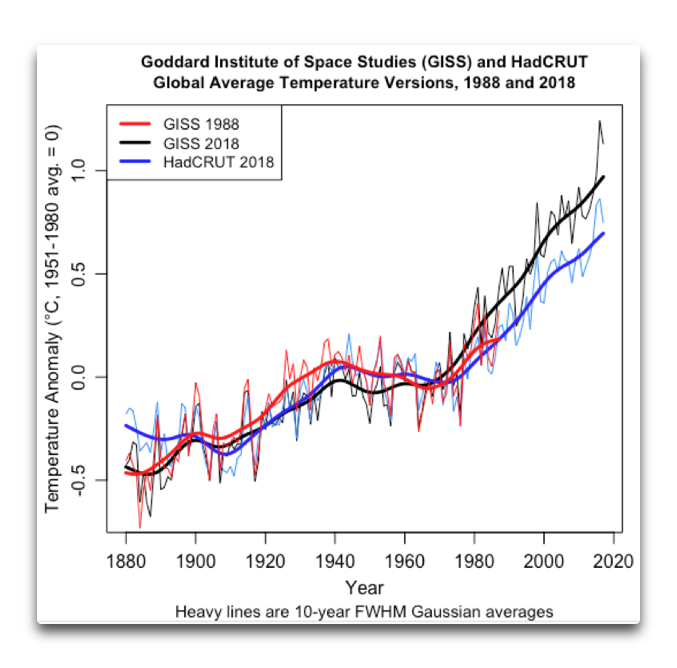
Furthermore, look at the GISS temperature record from 1988 and from 2018. You'll see that it's been adjusted to eliminate the peak in 1940, and the cooling from 1940 to 1970. When you can adjust away the past, then you can dictate the present. But it's not quite honest now, is it?
Lastly, look at HadCRUT4 from 1895 to 1943, and then again from 1957 to 2005. They are essentially the same - yet the former (1895 to 1943) is supposed to be not affected by the sudden rise in CO2. If we had the same type of climate change with and without the impact of CO2, then what does that say about the impact of CO2?
-
Re: Climate change
The problem is that the data doesn't match the models, and it's those models that say it is supposed to be 2 deg C warmer. The data doesn't support the models' claims. Science says that when data and theory/model conflict, the theory/model is wrong.
Additionally, the theory is that a warming world should have more and stronger hurricanes, yet the trendline since 1992 is down and this year is forecast to be lower still. More data and theory conflicting...
Furthermore, look at the GISS temperature record from 1988 and from 2018. You'll see that it's been adjusted to eliminate the peak in 1940, and the cooling from 1940 to 1970. When you can adjust away the past, then you can dictate the present. But it's not quite honest now, is it?
Lastly, look at HadCRUT4 from 1895 to 1943, and then again from 1957 to 2005. They are essentially the same - yet the former (1895 to 1943) is supposed to be not affected by the sudden rise in CO2. If we had the same type of climate change with and without the impact of CO2, then what does that say about the impact of CO2?
-
Re: Climate change
The problem is that the data doesn't match the models, and it's those models that say it is supposed to be 2 deg C warmer. The data doesn't support the models' claims. Science says that when data and theory/model conflict, the theory/model is wrong.
Additionally, the theory is that a warming world should have more and stronger hurricanes, yet the trendline since 1992 is down and this year is forecast to be lower still. More data and theory conflicting...
Furthermore, look at the GISS temperature record from 1988 and from 2018. You'll see that it's been adjusted to eliminate the peak in 1940, and the cooling from 1940 to 1970. When you can adjust away the past, then you can dictate the present. But it's not quite honest now, is it?
Lastly, look at HadCRUT4 from 1895 to 1943, and then again from 1957 to 2005. They are essentially the same - yet the former (1895 to 1943) is supposed to be not affected by the sudden rise in CO2. If we had the same type of climate change with and without the impact of CO2, then what does that say about the impact of CO2?
-
Re:NO NUKES
Summary of the Forbes story and another report with the same conclusion. Check the graphs in the second link, especially. The data seems quite clear - the more renewables a nation deploys (particularly wind and solar), the more it pays for electricity.
-
Re:Try to focus.
Sophistries and boundful words. And nothing value is gained. You state nothing, because you say nothing. What were those subsidies? Why do you ignore the power output? What do you mean "no one regrets"? Why is there a strong correlation between increasing percent of renewable electric generation and price of electricity?
-
Re:Move along nothing to see here...Here is an interesting one...
The Holocene climatic optimum was a period 8–5 kyr ago when annual mean surface temperatures in Greenland were 2–3C warmer than present-day values... For all the simulated icesheet histories, the ice sheet is approaching a steady state at the end of the 20th century
. So it was considerably warmer back in the time of the Pharaohs, and at least the Greenland ice sheet is approaching a stead state of size at this time. That would imply that things have changed significantly - cooler - over the last 5 to 8K years, no?
There is also this little bit of data which is what led Phil Jones, Director of the CRU of East Anglia and a primary contributor to the IPCC, to agree that:
according to the global temperature record used by the IPCC, the rates of global warming from 1860-1880, 1910-1940 and 1975-1998 were identical
. So if the heating over those periods - two well before the rapid rise in CO2 - are the same as the "big trigger" that caused the whole IPCC/global warming issue in the first place, then how do we know that it's because of CO2?
-
Re:Separating human activity from natural causes
Apparently, the current anthropogenic sea rise is indistinguishable from noise. That would mean it would be normal occurrence, regardless of what we believe...
-
Re:Wait a second.. Nature isn't in a vacuum? NO WA
No, just that when folks talk about sea level rise killing the reef, it's best to put the current change in perspective. When the authors talk about:
Rising sea levels—like those we see today—killed off the coral twice between 13,000 and 17,000 years ago
and then you look at the historical record, a scientist (someone skeptical of a claim without data) should go "huh?" We've seen massive sea level changes in the past, compared to what is happening now, and the reef survived.
When you look at what has actually happened in the past, it's kind of humbling that for all our faults, we result in nothing different than noise in the system.
-
Re:Ocean acidification
The official model says we're acidifying (well, actually neutralizing, given the pH is over 8) the ocean, but the model doesn't match the actual measured data.
-
Re:Good
Why, because you want our power costs to skyrocket like other countries who have done a big wind + solar push? More renewables = higher electricity costs...
-
Re: Anti-LGBT ??
True, but what that means is that other folks should always be looking for other theories that might better fit the data. Unfortunately, most of the folks on the other side seem to think that "unsettled" means "I can ignore this because it is inconvenient," which is not the same thing.
No, not at all. That's the strawman constructed and attacked. Go check out Watts Up With That, and you'll find 99.9% of the posters acknowledge some warming, but are skeptical that it is all man-made and it all comes from CO2. Rather, the appearance of trends as I linked tend to show a high likelihood that much of the warming is natural. So perhaps we need to re-think our priorities and budgetary allocations based upon data, rather than models that simply do not match the real world.
The problem is that their alternative explanations only fit the data over a very short period of time [skepticalscience.com], geologically speaking. These theories have been debunked repeatedly by trivial comparison with the actual data.
Actually, no. Not a single IPCC model accounts for the rise of temperature from 1890 to 1940, then the plunge from 1945 to 1975, let alone the general pause in the 2000s. However, there are models that correlate nicely with the past and also have predicted - more reliably than the IPCC models - the current 2000s. They come from geologists, though, not from climatologists. In fact, looking at past inter-glacial periods, we see a continual cyclic pattern of ever-increasing temperatures until the entire system "flips" into deep cooling. In other words - what we see today, is not unprecedented.
That said, there's a lot we don't know. It is possible (nay, almost certain) that we will eventually hit an equilibrium point at which more plants are growing, and the temperature change levels off.
When it levels off, that's when it starts falling. A few hundred million years says that's the way it happens. Typically glaciated over most of the Northern hemisphere, with occasional blips of warmth - like we have now.
The big unanswered questions are how many major cities will be underwater when it does, whether we will have enough arable land to feed the earth's population as temperatures and rain patterns shift, and whether the cost of reducing our greehouse gas emissions exceeds the cost of dealing with the effects of climate change over the long term. And *that* is where there is a lot of room for speculation, debate, etc.
Sea levels historically happened 4X faster than now, food production is skyrocketing, and there still isn't any real effect from increasing CO2.
Rather than sweat over something that has NOT been shown to be a cause of disaster (CO2 increases driving climate change), I fully agree with Bjorn Lomborg that we should look to spend our money on real, defined, understood problems.