Slashdot Mirror
Domain: williams.edu
Stories and comments across the archive that link to williams.edu.
Comments · 98
-
Re:Free to use bikes in Helsinki
There already are free bike programs in the US-- Williams College for instance. I think some cities have them too, but I could be wrong.
-
For more on this topic please read...
an account of an innuendo-laced mathematical experience
-
Dune had these
Granted, theirs used force fields, but the characters in Dune used oil lenses in their telescopic devices.
-
no scarcity in the spectrum
I would like to draw your attention to the work of Yochai Benkler http://www.benkler.org/.
He argues that there is no scarcity in the radio spectrum, and government regulation or market allocation is essentially outdated by the arrival of smart radios.
"The current legal framework for radio transmission relies on administrative licensing of broadcasters. The emerging regulatory alternative replaces licensing with an exhaustive system of property rights in the radio frequency spectrum. This article analyzes a third alternative: egulating wireless transmissions as a public commons, as we today regulate our highway system and our computer networks. The choice we make among these alternatives will determine the path of development of our wireless communications infrastructure.
Its social, political, and cultural implications are likely to be profound."
the article quoted is Overcoming Agoraphobia: Building the Commons of the Digitally Networked Environment http://www.benkler.org/agoraphobia.pdf
in that article he argues for treating the spectrum as a commons: "Our capacity to think about the truly central questions concerning regulation of wireless communications is obscured by the language we use to discuss the problem. When we speak of regulating wireless communications, we speak of managing a resource, the spectrum. Generally, we use market-based solutions for resource management, and therefore when posed with such a problem look for something to which we can affix property rights to be traded in the market. But there is no such thing as spectrum. There is no ether out there, no finite physical resource that needs to be allocated. There are simply people communicating with each other, transmitting and receiving messages with equipment that uses electromagnetic waves to encode meaningful communications and send them over varying distances without using a wire. Spectrum management means regulating how these people use their equipment. Spectrum allocation, whether it be done by licensing or auctioning, is the practice whereby government solves this coordination problem by threatening most people in society that it will tear down their antennas and confiscate their transmitters if they try to communicate with each other using wireless communications equipment without permission."
As for assigning private rights to commons there is a big problem. Once You start to dismantle the commons, You bump into BIG problems, like in the case of any cultural expression.
another very good article an that question: Michael F. Brown: Can Culture Be Copyrighted? http://www.williams.edu/AnthSoc/brown-ca98.pdf
or to put it in an other way: just because all images in this picture are private property, should we think this form of expression (by Banksy) is illegal without the IP owners consent: http://mokk.bme.hu/~bodo/banksy/banksy3.jpg? -
Re:DisappointedIt would appear that a large fraction of US voters trust one or the other, believe that the speeches will actually correlate with future performance, and generally trust their gut feelings about the candidates' "character" and "values."
Large, but not all of us. I trust Kerry about as far as the Secret Service guarding him would let me kick him, and think he's lying through his hat making promises to get himself elected.
On the other hand, that latter is a plus in my book. I think he'll flip flop to whatever makes sense to him at the time he decides, rather than sticking blindly to campaign promises and policies with disregard to evolving situations. Bush, in my opinion, has been a Geopolitical, Environmental, and Fiscal disaster. And to seal my vote, the libertarians nominated a nut job so far out that I can't support him in good concience-- ruining my previous perfect Libertarian voting record.
Kerry sucks. But we're still (barely) at the "Ballot Box" stage to defend liberty, and so he's the lizard I'm voting for.
-
Wrong device
No, it's called "carbonite".
-
Re:He was 84, not 78
And speaking of COBOL....
what better time for a Real Programmers list?
http://www.cs.williams.edu/~terescoj/humor/realpro g.html -
Re:A consideration.
The guy who wrote the first review you mentioned tried doing a diff between an mp3 and the source wav file in an attempt to figure out what lossy means! yikes.
-
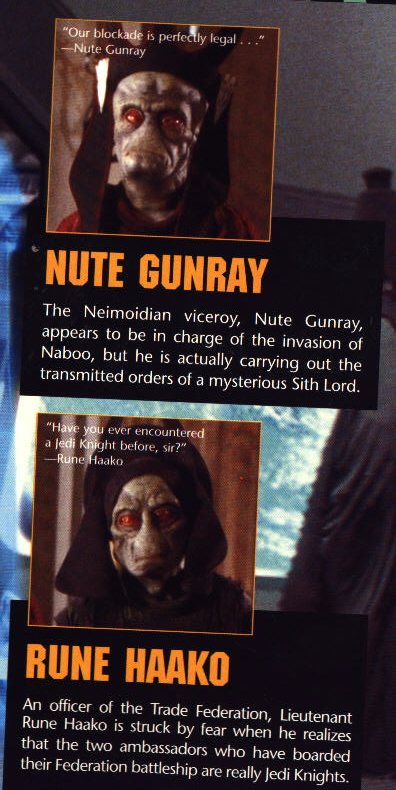
Nothing japanse about trade federation"The scheming Trade Federation guys with their ornate robes, towering hats, SLANTED EYES and choppy, guttural voices weren't Japanese stereotypes?"
Did you even see the movie?
Please see this picture, and this one
The eyes were not slanted.This image especially shows the large, round liquid eyes.
Nute's rather tall. Even without the hat. Not exactly a Japanese stereotype.
The trade federation guys had smooth, oily voices. Remember how one sand "Imperial SEHHHnate"? Hardly choppy and gutteral.
Knobbly brows, jutting chins: how is this a Japanese physical stereotype?
Finally, see this one of the other guy, Rune Haako, with his Sleestak-like bugeyes. Have you actually seen a Japanese person? -
Re: Yet another nail into Big Bang's heart...
> Well, the BB story has gone along for so much time... some new data whacks it, ok... small nudge and it's consistent.
Can you give an example?
*laugh* I'll bite
* The "flat universe" case gives a Hubble constant of 65 km/s/Mpc (megaparsec). This amounts to an age of the universe of ~10 billion years. This is one of the "age paradoxes" that have led to some of the more interesting revisions and proposed revisions.
* The temperature of the cosmic background radiation was a retrodiction, not a prediction. Alpher and Herman got the closest, with a prediction of 5 Kelvins, but what you don't often hear is that the prediction was later adjusted to 28 Kelvins.
* Inflation theory was introduced by Linde in the mid 80's to help solve the "bubble" problem by having a massive FTL expansion in space for 10^-30 s, and co-opted to help squeeze in some extra universe age. The theory, as it got refined, placed more constraints on the universe (e.g. it has to be flat, not open or closed, for inflation theory to work), and gives us our "refined" universe age of 13.7 billion years
* The age problem, in light of recent Hubble observations, has caused a few new proposals to sprout. The "cosmological constant" as a repulsive force has sprouted up on a few a occasions. It has been proposed in the past year that the universe may have decelerated in the past and is now accelerating.
There's a lot more, and I can get you sources
The Big Bang model makes no predictions whatsoever about the existence of any hypothetical particles, let alone a "nasty slew."
I think what he's referring to is the tack a number of scientists have gone off on in the search for enough dark energy to make the universe "flat" or "closed", and they have invoked a nasty number of theoretical particles. He might also be referring to the slew of theoretical particles some scientists are hypothesizing to explain how galaxies managed to form so soon after the big bang (with quotes like "The majority, perhaps a sea of "non-baryonic," exotic particles, is likely to have played the key role in assembling the first galaxy-sized masses." from NASA's Origins page).
I love quantum physics, myself. It makes some pretty interesting (and good!) predictions, but (as you say), the Big Bang Theory doesn't 'predict' them per se.
Personally, I find it strange that the particles from quantum physics and its forces have been been apportioned a timeline in Big Bang Theory for times of creation and symmetry-breaking. I've seen some folks imply that the two line up well, and by implication that the successes of quantum physics should prop up the Big Bang Theory as well. However, Big Bang Theory just apportions particles a time closer to t=0, the more MeV they require to manufacture in a cyclotron, so it's a lot more 'arbitrary' than would be implied. What it means for me is that quantum physics cannot 'falsify' BBT, by definition.
H, He, and Li concentrations
These are also numbers that have "floated" with time, and the baryonic numbers have been kept consistent with observations. Observed deuterium levels are ten times below BBT predictions, and distant young stars have proved out to have much too much boron and beryllium (which are not in BBT nucleosynthesis as a general rule) in them.
Hubble expansion
Most cosmologists selectively quote Hubble from around 1929. If you read some of his later work, you'll find more of an emphasis on the "apparent velocities" from the redshift not being actual velocities. He had a graph from one of his presentations in the early 1940s showing how luminosities would have to decl
-
Damn...
I thought it was for this Mandrake. You ruined my life!
-
Voluntary confessions
People who voluntarily confess generally can be considered 100% guilty.
That is a dangerous assumption. There have been a number of cases of so called voluntary confessions which turned out to be (usually police-)induced false confessions; this makes one wonder how many cases of false confessions were never revealed to be so. One example is discussed here. Also see here for more pointers.
-
Re:There's an executable...
Darn, I thought there'd be no need to preview! The executable link.
-
Re:Worms?
-
Other sites
There are more pictures at Benjamin Chaffin's page.
There is more information on the games and rules at Sven's page, that includes a comparison of Chaffin's notation to Gardner's and a comparison of Worms to the Game of Life. -
Re:Tie fighters
see this link why the auther made the analogy to star wars.
Wiktor -
Spam?
-
Children
This sounds more like a child than a government. The logic appears to be, "It's mine because I want it."
And notice how often they say "illegal." Three times in the first paragraph.
This is incoherent because I'm outraged. All I can think of is these words, and the lizards. Outraging the citizens is not a good way to maintain a stable government.
Of course, don't be too surprised if you meet this page trying to follow any of these links. It's theirs, because they want it. -
Flaming UPSen a reality
Just to add to the list of horror stories that are piling up here:
This happened when I was back in college. It wasn't my UPS (heck, it wasn't even my dorm), but I knew several of the people involved. Now, whenever I smell something funny around my computer, I'm always careful to check it out. Nothing like a lead-acid battery fire to really ruin your day...
-
Re:Double-edged sword of nature
Viewing the eclipse is dangerous. Here is a dated article about the solar eclipse, most relevant is the material towards the bottom of the page on how to build A Projection Camera or a Solar Filter to view the eclipse safely. Furthermore there are other methods discussed above on viewing the eclipse safety. It also states the Sun causes the eye damage and emits the radiation, not the eclipse.
This article would seem to indicate that the sun does not emit more radiation as eluded to by other posts during the eclipse, but rather it is dangerous because you can look at it longer. If you stare at the normal sun your eyes start to hurt from the brightness, and you either close them or turn away after a short time. During the eclipse it isn't as bright so you can keep looking and the normal radiation emitted by the sun is exposed to your eyes for longer. This is from the black part that your eyes can fixate at. This is also the partial eclipse when part of the sun is still exposed.
Additionally the topic of eclipses was discussed not too long ago on slashdot here And there are comments on the same thing of the eclipse burning the retina and so fourth. Consensus seems to be that the sun is no more dangerous during the partial eclipse, but we just look at it more than usual because it is an eclipse. -
Re:Linux 3.0
It would be odd to have Linux 95..
We did, a few months before Windows 95 came out. Read the release announcement for kernel 1.2.0. Funny stuff.
-
Re:This is why the rest of the world hates us.
-
Re:Undergraduate Student Project
When was the last time that a Senior at a US university produced a result of this calibre? Answer: Never been done.
I don't know why I let myself be suckered by such obvious bait.
There is a lot of extraordinary undergraduate research being done in the United States. For two obvious examples, look at the work done by the students of Feank Morgan and at Harvery Mudd College
Matthew Kudzin
-
Re:Moderation
"And exercise too, but do something fun. I don't know how people can ride stationary bikes or run on treadmills for an hour every day. The boredom kills me. I play racquetball and other active sports."
I've set a personal goal (not to lose weight mind you) of running a marathon before I reach 30. I've been looking for ideas to make the training more interesting, and so far, I've found orienteering as something that I think I'd like to try in my area.
You're right: people need to live more active lives, which doesn't mean a quick fix at the gym. A radical way of becoming healthier is selling the motor car, but this doesn't seem to appeal to many Americans -
When UPSes go bad.
Lead-acid batteries. Sparking UPSes. Fun. (and in case you don't trust me, it's also http://wso.williams.edu/~aramos/upsfire/ )
--pi -
Re:Meaning of ":ephpod?"
Ha.
An Eph is the mascot of Williams College. Joe, the author of this software, went there. Still doesn't explain what an Eph is, but this page tries to. -
Re:Meaning of ":ephpod?"
Ha.
An Eph is the mascot of Williams College. Joe, the author of this software, went there. Still doesn't explain what an Eph is, but this page tries to. -
Go To College
Let me start by saying that I had an overwhelmingly positive college experience. I knew I was a computer geek before I went, and I figured I'd major in CS and become a programmer.
I went to a small liberal arts college with a great CS program. But also important was the fact that there was a student-run web group that had just gotten off the ground (this was 1996, mind you). It was a student club -- none of us were paid for the work that we did, but we maintained several Linux machines for students to serve web pages from (at this time, the college did not provide web space for students, and most students could not set up their own web servers.
I learned a heck of a lot from that club, both from trying things out on my own, but also from being around other people who knew more/different things than I did. I have since applied that knowledge in sysadmin and programming jobs.
All this would seem to indicate that you don't really need classes to get good at being a sysadmin. However, I found classes helpful (and relevant). You'll need to be a good programmer to be a good sysadmin (at least on Unix, anyway -- can't speak to Windows since I don't use it). More importantly, many employers want to see a college degree. It's not 1999 anymore, and you can't just wander into a startup and demand a job because you know a little bash scripting
College is practically a prerequisite for most high-paying jobs now, and even when the economy wasn't soft college was considered important by many employers (at least, all the ones I interviewed with).
So, my feeling is that college is both important to employers, and also a great opportunity to grow and learn from other people like yourself. Yes, it costs money (sometimes a lot of money), but the experience is well worth it. Plus, if you can find a more sysadmin-related group at your school (as I did), the experience can be much more valuable than any certification course you can take. Even if there's no ad-hoc group, you could always look for employment in the college itself (running a public lab, for instance), which both looks good on the resume and gives you valuable experience.
-
Go To College
Let me start by saying that I had an overwhelmingly positive college experience. I knew I was a computer geek before I went, and I figured I'd major in CS and become a programmer.
I went to a small liberal arts college with a great CS program. But also important was the fact that there was a student-run web group that had just gotten off the ground (this was 1996, mind you). It was a student club -- none of us were paid for the work that we did, but we maintained several Linux machines for students to serve web pages from (at this time, the college did not provide web space for students, and most students could not set up their own web servers.
I learned a heck of a lot from that club, both from trying things out on my own, but also from being around other people who knew more/different things than I did. I have since applied that knowledge in sysadmin and programming jobs.
All this would seem to indicate that you don't really need classes to get good at being a sysadmin. However, I found classes helpful (and relevant). You'll need to be a good programmer to be a good sysadmin (at least on Unix, anyway -- can't speak to Windows since I don't use it). More importantly, many employers want to see a college degree. It's not 1999 anymore, and you can't just wander into a startup and demand a job because you know a little bash scripting
College is practically a prerequisite for most high-paying jobs now, and even when the economy wasn't soft college was considered important by many employers (at least, all the ones I interviewed with).
So, my feeling is that college is both important to employers, and also a great opportunity to grow and learn from other people like yourself. Yes, it costs money (sometimes a lot of money), but the experience is well worth it. Plus, if you can find a more sysadmin-related group at your school (as I did), the experience can be much more valuable than any certification course you can take. Even if there's no ad-hoc group, you could always look for employment in the college itself (running a public lab, for instance), which both looks good on the resume and gives you valuable experience.
-
Go To College
Let me start by saying that I had an overwhelmingly positive college experience. I knew I was a computer geek before I went, and I figured I'd major in CS and become a programmer.
I went to a small liberal arts college with a great CS program. But also important was the fact that there was a student-run web group that had just gotten off the ground (this was 1996, mind you). It was a student club -- none of us were paid for the work that we did, but we maintained several Linux machines for students to serve web pages from (at this time, the college did not provide web space for students, and most students could not set up their own web servers.
I learned a heck of a lot from that club, both from trying things out on my own, but also from being around other people who knew more/different things than I did. I have since applied that knowledge in sysadmin and programming jobs.
All this would seem to indicate that you don't really need classes to get good at being a sysadmin. However, I found classes helpful (and relevant). You'll need to be a good programmer to be a good sysadmin (at least on Unix, anyway -- can't speak to Windows since I don't use it). More importantly, many employers want to see a college degree. It's not 1999 anymore, and you can't just wander into a startup and demand a job because you know a little bash scripting
College is practically a prerequisite for most high-paying jobs now, and even when the economy wasn't soft college was considered important by many employers (at least, all the ones I interviewed with).
So, my feeling is that college is both important to employers, and also a great opportunity to grow and learn from other people like yourself. Yes, it costs money (sometimes a lot of money), but the experience is well worth it. Plus, if you can find a more sysadmin-related group at your school (as I did), the experience can be much more valuable than any certification course you can take. Even if there's no ad-hoc group, you could always look for employment in the college itself (running a public lab, for instance), which both looks good on the resume and gives you valuable experience.
-
Re:The Best? Hardly!I love my iPod as well, but unless you are a full-time Mac user, it is a pain in the ass to get music onto it.
The current crop of Windows-based iPod software is just NOT up to the job. XPlay will lock up your iPod regularly and corrupt its table-of-contents, forcing you to do a full reset and lose everything on the disk. I was unable to get EphPod to work at all on my Windows 2000 box. I got a setup screen to configure it, and the application appeared in the taskbar when I started it, but no user interface ever showed up. I had to kill it with the Task Manager to get rid of it.
The only realistic option is using a Macintosh for managing your MP3 collection, and if you have your files stored on a network server as I do, this can be problematic as well.
Under MacOS X, you can mount SMB servers and browse them in the finder as you'd expect. You can even drag an MP3 folder from a network drive directly into iTunes or into your iPod. Oops, that doesn't work!. You get a mysterious error -39 when you try this.
All of your MP3s need to live locally on your Mac's filesystems before iTunes will let you add them to your Collection or copy them to your iPod. Couple this with the woeful SMB performance under OSX, and feeding your iPod becomes a painful experience of copying and syncing.
Once you have the music (or audiobooks, or contacts or whatever) on the unit, though, its a true joy to use. I love the iPod, I just detest the software surrounding it.
-
Just playing devils advocate...
...But are all of these better on net balance?
I know most are, but speaking about the light bulbs, does it take 8 times the energy to produce a compact flourescent bulb than a normal carbon filament or whatever they are? If so, your energy savings could be negated...
If you sell your car and buy a new one, isn't the balance of energy consumption MORE than it was before you bought the car, no matter how efficient the new car is, because someone else is driving the old one around?
I agree with your ideas and actually like them, but after reading the "Recycling is Garbage" article, I like to double-check these ideas. -
Re:Effect on topo mapsOn the contrary, there are several reasons:
Weight: a significant factor while backpacking. I prefer technology that lightens my pack rather than adds to it.
Practice: Important since the compass and topo should always be carried as a backup system.
Fun: In my youth I engaged in orienteering as an enjoyable way to train for backcountry expeditions. Though they may have incorporated the GPS into these competitions, in some ways it still feels like "cheating" when I use them.
Cost: A quality GPS, one that is accessible in deep canyons and such that block Line of Sight was still a few hundred bones last time I checked. Since an altimeter/compass/topo combination is extremely effective, the expenditure is not obligatory.
-
Re:Future tense
"Kids Passport? *shiver*."
"Children's ice cream, Mandrake. Children's ice cream". -Major Jack D. Ripper
(http://wso.williams.edu/~mhacker/strangelove3.h tm l) -
EphPodThere is another way to connect the iPod to a Windows machine. Its called EphPod and you can get it from here.
You need MacDrive or MacOpener to be installed too but if it allows me to copy MP3's from an iPod to the PC (which neither XPlay or iTunes allow you to do) then its going to be a winner.
ps. Yes I know why they've done it but its something I (and probably others) would find useful whatever your moral standing.
-
quite a change since Tron
When I was in college I interned briefly (more of a class really) at Kliezer Walzack (sp?) Construction Company (I think they are www.kwcc.com).
it was a husband and wife team and they did some micheal jackson vids, judge dread, the spiderman ride at universal and I think Honey I blew up the Kids... all bad films, but cool special effects. At the time, Jeff Lew was there - he is a huge name in the character animation field.
anyway, Jeff (Klisier - again I don't know how to spell it) was one of the owners and his first real film was Tron. According to him, they'd program all the efffects, then never really see them until the process of putting the data to film was complete, then the film would be mailed back to them, they'd watch it, and then make corrections. It was amazing how well and how fast they did it all considering that was the case.
eveyrthing is now net based, so this isn't as big a deal - a much bigger deal that the whole movie is done this way - but as far as adding in digital efects, they've been doing it for awhile now (Sending the stuff over the net that is). -
Re:so...
my mom used to yell at me for sharing with myself.
seriously though, there are any number of clients now to any number of services, all free, that I can get just about anything I want from it. granted, anything I want is pretty minor. I don't look for entire programs and such. but one can find plenty of porn, and plenty of music.
with LimeWire, the only thing two problems I ever had (other than the older client crashing all the time) were 1) I wanted a song that was obscure ('speeding motorcycle' sung by what sounded to be a drunken retarded person into a radio statio via a long distance phone call from a pay phone - hard to find, but a great song - still can't get it, I know they played it on the radio station back in college), and 2)... I'm not sure I recall what 2 was... oh yeah (stream of consciousness post) it is annoying when they are behind firewalls and you can't get to the stuff - but those are easy enough to see which are which, they usually have IP addresses similar to my own machines which sit behind a linksys router.
yeah. so there. -
LaTeXActually, LaTeX does have a WYSIWYG editor - LyX, available from http://www.lyx.org. This also has a KDE version, KLyX ( ftp://ftp.kde.org/pub/kde/unstable/apps/office/).
There are LaTeX processors for most platforms. A quick Google search can be rather useful.
As for viewing LaTeX files, you can convert them to many popular formats - HTML, postscript, PDF, RTF, DOC... - or use a browser plugin. IBM's TechExplorer (http://www.software.ibm.com/network/techexplorer
/ ) allows you to view TeX, LaTeX and MathML documents in IE or Netscape.LaTeX is much more flexible than any other format I've tried so far. It can do books, articles, reports, and slides - and these are all standard packages. The Comprehensive TeX Archive Network is to LaTeX as CPAN is to Perl - an immensely useful repository of cool stuff. =)
It's not too hard to learn, either. You can pick up the Not-So Short Guide to LaTeX (http://wso.williams.edu/how/lshort2e) or any of the other tutorials on the Net.
LaTeX is beautiful. I haven't had to use anything else for my papers ever since I discovered the joys of LaTeX. <g>
-
How will this trek ship do in ST. WARS EP II?Since the new enterprice is more low tech it will have less change angainst a pre-sequel falcon ship
however since star wars is already in its second prequel mr lucas can still improve its ship desing so it makes a change agianst the enterpice.
news:alt.discussions.starwars.vs.startrek
-
Shape of the universeA hundred years ago, an unexplained force seemed to be affecting the orbit of Mercury, causing a wobble in its orbit that should not have existed in a Newtonian framework. Then in 1915, Albert Einstein developed the theory of General Relativity, describing the complex curvatures of our universe that could explain Mercury's path around the Sun.
While this news report is very likely just a measurement error, we must be reminded that the last time we discovered an error in a celestial body's trajectory we reinvented the notion of the universe.
One of the big open questions of the day is: What is the shape of the universe? Euclidean, hyperbolic, a torus--we aren't sure. It is thought that each of these geometries would profoundly affect an object moving across the universe in a different way. These NASA probes could in a sense be the moving laboratory that we need to understand what exactly our universe looks like.
Robert
-
Re:So they upgraded their Word?
If you go to the Alcatel site http://www.alcatel.com/consumer/dsl/security.htm you see that the original Alcatel
If Alcatel had not modified their
Bobby
http://wso.williams.edu/~rmcgehee -
Links
-
It looks like they're finally listeningBack when the College Board made the original move from pascal to C++, people complained: why move to C++ when alternatives like java existed? People even went so far as to articulate their complaints in protest letters like this from 1996. This quote is particularly telling:
Will Java be the solution to all of our problems? It's probably too early to tell right now, but I suspect it will be pretty obvious within the next 12 months, and it looks now like Java is going to be a winner. If this happens, very few schools will be teaching C++ in introductory courses by 1999, when the new ETS exam is first given.
Which is exactly what happened. Whether it's in brick/mortar colleges or upstart online learning programs, java is eating C++'s lunch, for better or worse. And the results are reflected in the workplace. A quick search on monster.com shows well more than a thousand jobs with java, and such jobs tend to pay more, as anyone who's been looking, lately. I'm glad to see the College Board listen to the best educational interests of our children. -
karmawhoring-dont /. their servers here is the...release
Cipher Solved, But Mystery RemainsWilliams College Professor Shawn Rosenheim announced yesterday that the Edgar Allan Poe Cryptographic Challenge contest has a winner. After over 150 years, Gil Broza of Toronto has solved the second of two mysterious ciphers left by Poe for future readers.
Poe was fascinated by cryptography, which he often treated in his journalism and fiction. His most famous story - ?The Gold-Bug? - centers on the solution to a cipher, which turns out to be a map to hidden pirate treasure, and he concealed anagrams and hidden messages in many of his poems. In 1839 Poe even conducted his own cryptographic challenge. Writing in Alexander's Weekly Messenger, Poe challenged his readers to submit their cryptographs to him, asserting that he would solve them all. A year later Poe wrote an article for Graham's Magazine entitled ?A Few Words on Secret Writing?. In it, he offered to give a free subscription to the magazine to anyone who would send him a cipher he could not crack.
Poe ended the contest six months later, claiming to have solved all of the 100 legitimate ciphers sent to him, and complaining that cracking ciphers consumed time he should have spent writing fiction - a luxury Poe could ill afford. He concluded by publishing two ciphers ostensibly sent in by ?Mr. W. B. Tyler,? praising their author as ?a gentleman whose abilities we highly respect? and challenging readers to solve them.
There the ciphers remained, apparently forgotten, until 1985, when Professor Louis Renza of Dartmouth College suggested that Tyler was actually a double for Poe himself. Renza sees Poe's fiction ?as containing not readily apparent anagrams as well as thinly disguised allegories of his process of composing his tales -- often the very tale one is reading.? He felt Poe's cryptography articles shared this approach. In addition, a search of the major city directories of the time failed to locate a W. B. Tyler. That absence was, Renza admits, ?thin evidence, to be sure, but enough for me to venture my guess.?
Renza?s theory was later elaborated by Rosenheim in his book The Cryptographic Imagination: Secret Writing from Edgar Poe to the Internet (Johns Hopkins, 1997). In it, Rosenheim musters considerable circumstantial evidence which points to the likelihood that the ciphers were placed in the magazine by Poe as a final challenge to his readers. Tyler?s letter to Poe, Rosenheim notes, sounds exactly like Poe?s prose, and it praises Poe extravagantly. Tyler also claims that cryptography gives him ?a history of my mental existence, to which I may turn, and in imagination, retrace former pleasures, and again live through by-gone scenes-secure in the conviction that the magic scroll has a tale for my eyes alone. Who has not longed for such a confidante?? (Secret Writing, December, 1841)
The appeal of the ?magic scroll? has to do with the preservation of the past, fixed by its encoding. Cryptography provides Tyler and Poe with a way to preserve the self (as writing) from the destructions of time.Tyler?s ?who has not longed for such a confidante?? also echoes ?The Murders in the Rue Morgue,? where the narrator ?confides? to Dupin that his company seems ?a treasure beyond price.? And Tyler?s claim that the cryptograph will not ?betray its mission, even if intercepted?or if stolen from its violated depository? (SW, 141), directly recalls the violated crypts and tombs of ?Ligeia,? ?Ulalume,? ?The Fall of the House of Usher,? and other Poe texts. Poe is even known to have written to himself, publishing several anonymous reviews of his own writing, and acknowledging in Graham?s Magazine that some readers harbored a suspicion that his amazing decryptions were the result of ?our writing ciphers to ourselves.?
Spurred to action by Rosenheim?s work, in 1992 Professor Terence Whalen solved the first of Tyler's cryptographs -- a monoalphabetic substitution cipher. Decrypted, it read:
The soul secure in her existence smiles at the drawn dagger and defies its point. The stars shall fade away, the sun himself grow dim with age and nature sink in years, but thou shall flourish in immortal youth, unhurt amid the war of elements, the wreck of matter and the crush of worlds.
At first Whalen believed he had uncovered an original Poe text, even though a number of features, such as the heavy use of alliteration, were unlike Poe. As it turns out, the lines come from the 1713 play Cato, by the English essayist Joseph Addison. But that does not rule out Poe as the originator of the cryptograph, who may have selected Addison?s text because its themes of apocalyptic collapse and the soul?s immortality were also central to his own poetry and prose, which often treat ciphers as a kind of vault or crypt protected from time
Whalen?s solution did not answer the question of who created the cipher. Hoping to discover the answer, Rosenheim established a $2500 prize, supported by Williams College, for the solution of the second cipher. As he explains, ?The contest was an avenue of last resort. Because the second cipher uses six separate alphabets to encode its text, it?s several orders of magnitude harder than the first. I tried to solve it myself and failed. I also sent it to various cryptographers, from the editor of The Cryptogram magazine to professionals at Bell Labs, but no one was able to help me.?
So things would probably have remained, except that in 1998, Jim Moore, a software designer specializing in encryption, heard of the contest and offered to build a website to promote it (a site hosted through Bokler Software Corporation -- www.bokler.com). In the next two years, Rosenheim and Moore fielded hundreds of inquiries from would-be sleuths in America, Europe, and South America. Most wrote once and were never heard of again. Then, in July, Gil Broza, a software engineer living in Toronto, submitted what turned out to be the correct decryption. Tyler's cryptograph proved to be a polyalphabetic substitution cipher using several different symbols for each English letter. The number of different symbols is greater as the plaintext letter is more frequent in English text, for instance 'z' is encrypted by two symbols and 'e' by 14. Given the brevity of the cipher, this meant that there was almost no information about letter frequencies, which cryptographers count as their most potent tool for decryption.In addition, Broza?s solution revealed that the original cipher had over two dozen mistakes introduced by the typesetters or the encipherer. Many of these were trivial(such as ?warb? for ?warm,? ?shaye? for ?share,? ?langomr? for ?langour?), but even after Broza corrected obvious errors, the final plaintext is sometimes garbled:
It was early spring, warm and sultry glowed the afternoon. The very breezes seemed to share the delicious langour of universal nature, are laden the various and mingled perfumes of the rose and the -essaerne (?), the woodbine and its wildflower. They slowly wafted their fragrant offering to the open window where sat the lovers. The ardent sun shoot fell upon her blushing face and its gentle beauty was more like the creation of romance or the fair inspiration of a dream than the actual reality on earth. Tenderly her lover gazed upon her as the clusterous ringlets were edged (?) by amorous and sportive zephyrs and when he perceived (?) the rude intrusion of the sunlight he sprang to draw the curtain but softly she stayed him. ?No, no, dear Charles,? she softly said, ?much rather you?ld I have a little sun than no air at all.?
So who composed the ciphers? Rosenheim believes it was still probably Poe. ?The text is clearly not by Poe, but from some unidentified novel or story of the period. But like the first cipher text, its themes (enclosure, the dangers of exposure, immortality) are absolutely typical of Poe's writing. Plus there?s the case of Poe?s misleading comments about the ciphers.? In 1842 Poe wrote to a Mr. Bolton, who was attempting to solve Tyler?s ciphers ?It is unnecessary to trouble yourself with the cipher printed in our Dec. number - it is insoluble for the reason that it is merely type in pi or something near it. Being absent from the office for a short time, I did not see a proof, and the compositors have made a complete medley. It has not even a remote resemblance to the MS.? (http://www.eapoe.org/works/essays/gm41sw03.htm).
& nbsp;But as Broza?s solutions shows, the cipher is not hash, but English prose. The second cipher?s many errors, the judges agreed, stem from the difficulties of distinguishing between the different typestyles and their inversions and reversals. William Lenhart, Professor of Computer Science and Mathematics at Williams College, tested a range of alternative solutions, hoping to improve on the spelling and grammar of the plaintext, but found only trivial misidentifications by Broza.
In the end, as Jeffery Kurz writes, ?If the text turns out to be by Poe, it would fit into his grand scheme of speaking from the dead and be the final message from one of the greatest authors in American literature, a writer obsessed with the macabre and the transcendent power of words? (March 8, 2000, Salon.com).
And if not? That, Rosenheim suggests, may be an equally interesting prospect. ?One of the central themes of The Cryptographic Imagination is the difficulty of knowing who speaks in a written text. However much we like to fancy ourselves unique individuals, writing is a slippery, transpersonal medium. Think about the continuing arguments about whether Shakespeare was a middle-class boy from Stratford, or Francis Bacon. Better yet, think about the difficulty even serious scholars have in identifying the provenance of newly discovered poems - often, they simply can?t tell if they?re by Shakespeare - arguably the greatest and most distinctive English dramatist - or not.?
Thus, Rosenheim insists, there is something mysterious even in the decrypted cipher - not only because we do not know who enciphered it, but because it reminds us of the uncanny and limited immortality writing sometimes affords. As Poe wrote in his obituary for Margaret Fuller, ?The soul is a cypher, in the sense of a cryptograph; and the shorter a cryptograph is, the more difficult there is in its comprehension.? Or as Poe put it, in ?Shadow -- A Parable?:
Ye who read are still among the living; but I who write shall have long since gone my way into the region of shadows. For indeed strange things shall happen, and secret things be known, and many centuries shall pass away, ere these memorials be seen of men. And, when seen, there will be some to disbelieve, and some to doubt, and yet a few who will find much to ponder upon in the characters here graven with a stylus of iron.
How the cypher was brokenBy Gil Broza
Note: see the pdf file for additional details
The first task at hand was to determine the language and encryption method. The cypher solved by Whalen being in English, and either presumed author (Poe or Tyler) being an English speaker provided good grounds for assuming the cypher was in English. Further corroboration for that was provided by the distribution of word lengths, which quite resembles modern English but is even more likely older English. Assuming that the running text was indeed broken down at word boundaries - that is, its separation to letter sequences was not intended to mislead cryptanalysis- the repetition of several words, even with minor modifications, led me to believe the method was that of simple polyalphabetic substitution. Repetitions may also occur when using methods such as Vigenère, but the fact that the distances between repetitions had no common denominator ruled these methods out. Letter frequencies, the almost total absence of patterns, and Tyler?s bragging about the cypher?s resilience (which was obviously to be taken with a grain of salt, judging from the already solved cypher) all contributed to the impression that he simply tried to obliterate letter frequency by using numerous substitutions for frequent letters. This indeed turned out to be the case: he used more than 14 different letters for ?e? but only two for ?z?.The fact that several cypher-words were repeated with changes in their characters? orientation or size (e.g. ?DNB?, ?JCP?) made me think that character inversion was just a smokescreen, but pursuing this direction proved futile. The same happened when I tried breaking the cypher with its words reversed, following the Whalen cypher precedent. The more I worked on it, the more my belief grew stronger that even though the cypher may well be simple polyalphabetic substitution, its author obviously took pains to do a good job on it, taking care to spread the use of each cypher-letter uniformly throughout the text. In fact, I am sure that had Tyler not used character inversion ?to make assurance doubly sure? - thus employing only half as many cypher-letters - the cypher would have been broken by now. Substituting some repetitive short cypher-words for likely English words (such as ?the?, ?and?, ?not?) yielded nothing, as the low letter frequency and lack of patterns would not allow me to validate these substitutions.
At this point I began to believe that I should try to use the computer to break the cypher. Since there were around 140 different cypher-letters, half of which were obviously difficult to manipulate in ASCII, I employed a transcription of two characters for every cypher-letter, the first indicating its orientation and the second its identity and case. There were some multi-word patterns: groups of non-consecutive cypher-words that shared several characters. I wrote a program, ?Matches?, that tried to match these patterns against wordlists. The output for a multi-word pattern typically amounted to hundreds or thousands of word groups that matched the patterns. These lists were mostly useless due to their sheer size, but they did help in some cases, such as identifying broken repetitions and ruling out certain substitutions. I also wrote a second program, ?Patterns?, to help me identify those multi-word patterns that shared the most letters, and as such provided enough constraints against the wordlists. But the more I used the program the more it became clear that solution did not lie in these programs because the outputs I got were, for the most part, meaningless. The wordlists I found on the Internet were either too comprehensive, providing too many far-fetched words, or too small to reflect common use of the English language (e.g. missing conjugations). Any good yields turned out to be incorrect substitutions. Much of this work I had to revisit once I found that not only I had several mistakes when transcribing the cypher to a file, the cypher I had downloaded from the contest?s website differed in at least nine cypher-letters from the one actually published by Poe, a blurred scan of which was provided on the website of the Poe Society of Baltimore. Apparently, the contest?s website used a tome from the turn of the century that contained a manually copied version of the cypher.
Not wanting to believe that the cypher was a hoax, my only conclusion from the above results was that the cypher simply contained too many errors to allow successful pattern-matching against lists of correctly spelt words. I tried another approach with the computer?s aid: looking for on-line texts containing word sequences that had the same lengths of words as some sequences in the cypher. My primary focus was on the sequence ?XQCMKUYWEKa gs B?, or word lengths 11-2-1, which has a rather low probability of appearing in English texts. I searched the Internet for texts by Joseph Addison - the author of Whalen?s plaintext - and other poets and writers predating Poe, but found nothing. Fortunately, I abandoned this search early, since it would have yielded nothing, as the text I finally deciphered was nowhere to be found on the Internet.
By now, almost seven weeks after first tackling the cypher, I was on the brink of giving up. But I decided to give it a final chance before saving it aside for next year. I determined to try substituting ALL repeating three-letter words with ?the?, ?and?, ?not? and follow each direction, letting my imagination roam freely. As I was certain there were many errors, I decided not to back down on any approach. I was almost certain that ?AmL? stood for ?the?, since it appears once after a long word, and once after a long word and a two-letter word, which must be a preposition. With these three plaintext letters I now had the following three patterns: ?1?2e???, ?e?3? and ?132?, which seemed promising enough. ?Matches? provided over 3500 word groups, many of which were likely, but when correlating them with other occurrences of these characters a specific one caught my attention: ?ardent?, ?eye?, ?and? (one character in ?132? had to be in error because they contradict, but I tried both.) This was the crux of the solution: I now had a word that looked like ???ter???n?, which had to be ?afternoon?. I also had two words, ?th??? and ???re?, which seemed plausible parts of words in English. Substituting the remaining letters in ?afternoon? provided the word ?of? before the second appearance of ?the?, and I was quite certain now that I was on the right track. Other patterns that now had at least one plaintext letter could be re-scrutinized; thus I had a sure substitution with ?KJ? ?JERK? = ?no? ?open?. The five-letter word starting with ?ea? had to be ?early? or ?earth?. The penultimate plaintext letter ?n? in some words indicated ?ing?. All this time I was trying likely guesses as well as wild ones, since most substitutions had at least one occurrence that didn?t look promising, due to errors. At several points during the deciphering procedure I was stymied by grave errors in the cypher, as well as by bad substitutions on my part, the most amazing of which was that the ?ardent eye? turned out to be an ?ardent sun?, with the latter word also misspelt ?zun??
The Winner: Gil Broza was born in 1973 in Israel. He has been interested in languages and mathematics since early age, and has been solving cryptograms in crossword magazines since age 13. He holds a B.Sc. in mathematics and computer sciences and an M.Sc. in computational linguistics from the Hebrew University in Jerusalem. He has been working as a software engineer in the last seven years. In 1999 he moved with his wife Ronit to Toronto, Canada. His personal interest in Poe?s writing was first sparked in high school while studying ?Annabel Lee? and ?The Raven?. It wasn?t until finishing David Kahn?s The Codebreakers and looking for cryptographic challenges on the Internet that he discovered the Poe contest, which had already been running for two years. This provided the perfect opportunity to engage in a real, historically valuable cryptanalytic challenge. The Judges: William Lenhart is chair of the Computer Science Department, and Professor of Computer Science and Mathematics at Williams College. The recipient of both Sloan and NSF grants, he has authored or coauthored numerous papers in Graph Theory, Graph Drawing, Computational Geometry, and Combinatorial Algorithms.
Webmaster:Steven Rachman is Associate Professor of English and Director of the American Studies Program at Michigan State University. He is the coeditor of The American Face of Edgar Allan Poe (Johns Hopkins, 1996), as well as of a forthcoming study of Herman Melville and illness.
Shawn Rosenheim teaches literature and film at Williams College, where he also directs the Center for Technology in the Arts and Humanities. He is the author of The Cryptographic Imagination: Secret Writing from Edgar Poe to the Internet (Johns Hopkins, 1997). He may be reached at Shawn.Rosenheim@williams.edu.
James Moore has held a keen interest in mathematics since an early age, and in its applications to cryptography and security for the majority of his career. He is a founding partner of Bokler Software Corp., developers of cryptographic software libraries.
For Further Information:
James Moore - Bokler Software Corp.
e-mail: poe.challenge@bokler.com
Telephone: (256) 539-9901Shawn Rosenheim - Williams College
e-mail: Shawn.Rosenheim@williams.eduGil Broza
e-mail: gilza@backweb.com -
Here's the announcement...In case their server 'fall down go boom', here's the text of the announcement:
Cipher Solved, But Mystery RemainsWilliams College Professor Shawn Rosenheim announced yesterday that the Edgar Allan Poe Cryptographic Challenge contest has a winner. After over 150 years, Gil Broza of Toronto has solved the second of two mysterious ciphers left by Poe for future readers.
Poe was fascinated by cryptography, which he often treated in his journalism and fiction. His most famous story - "The Gold-Bug" - centers on the solution to a cipher, which turns out to be a map to hidden pirate treasure, and he concealed anagrams and hidden messages in many of his poems. In 1839 Poe even conducted his own cryptographic challenge. Writing in Alexander's Weekly Messenger, Poe challenged his readers to submit their cryptographs to him, asserting that he would solve them all. A year later Poe wrote an article for Graham's Magazine entitled "A Few Words on Secret Writing". In it, he offered to give a free subscription to the magazine to anyone who would send him a cipher he could not crack.
Poe ended the contest six months later, claiming to have solved all of the 100 legitimate ciphers sent to him, and complaining that cracking ciphers consumed time he should have spent writing fiction - a luxury Poe could ill afford. He concluded by publishing two ciphers ostensibly sent in by "Mr. W. B. Tyler," praising their author as "a gentleman whose abilities we highly respect" and challenging readers to solve them.
There the ciphers remained, apparently forgotten, until 1985, when Professor Louis Renza of Dartmouth College suggested that Tyler was actually a double for Poe himself. Renza sees Poe's fiction "as containing not readily apparent anagrams as well as thinly disguised allegories of his process of composing his tales -- often the very tale one is reading." He felt Poe's cryptography articles shared this approach. In addition, a search of the major city directories of the time failed to locate a W. B. Tyler. That absence was, Renza admits, "thin evidence, to be sure, but enough for me to venture my guess."
Renza's theory was later elaborated by Rosenheim in his book The Cryptographic Imagination: Secret Writing from Edgar Poe to the Internet (Johns Hopkins, 1997). In it, Rosenheim musters considerable circumstantial evidence which points to the likelihood that the ciphers were placed in the magazine by Poe as a final challenge to his readers. Tyler's letter to Poe, Rosenheim notes, sounds exactly like Poe's prose, and it praises Poe extravagantly. Tyler also claims that cryptography gives him "a history of my mental existence, to which I may turn, and in imagination, retrace former pleasures, and again live through by-gone scenes--secure in the conviction that the magic scroll has a tale for my eyes alone. Who has not longed for such a confidante?" (Secret Writing, December, 1841)
The appeal of the "magic scroll" has to do with the preservation of the past, fixed by its encoding. Cryptography provides Tyler and Poe with a way to preserve the self (as writing) from the destructions of time.Tyler's "who has not longed for such a confidante?" also echoes "The Murders in the Rue Morgue," where the narrator "confides" to Dupin that his company seems "a treasure beyond price." And Tyler's claim that the cryptograph will not "betray its mission, even if intercepted...or if stolen from its violated depository" (SW, 141), directly recalls the violated crypts and tombs of "Ligeia," "Ulalume," "The Fall of the House of Usher," and other Poe texts. Poe is even known to have written to himself, publishing several anonymous reviews of his own writing, and acknowledging in Graham's Magazine that some readers harbored a suspicion that his amazing decryptions were the result of "our writing ciphers to ourselves."
Spurred to action by Rosenheim's work, in 1992 Professor Terence Whalen solved the first of Tyler's cryptographs -- a monoalphabetic substitution cipher. Decrypted, it read:
The soul secure in her existence smiles at the drawn dagger and defies its point. The stars shall fade away, the sun himself grow dim with age and nature sink in years, but thou shall flourish in immortal youth, unhurt amid the war of elements, the wreck of matter and the crush of worlds.
At first Whalen believed he had uncovered an original Poe text, even though a number of features, such as the heavy use of alliteration, were unlike Poe. As it turns out, the lines come from the 1713 play Cato, by the English essayist Joseph Addison. But that does not rule out Poe as the originator of the cryptograph, who may have selected Addison's text because its themes of apocalyptic collapse and the soul's immortality were also central to his own poetry and prose, which often treat ciphers as a kind of vault or crypt protected from time
Whalen's solution did not answer the question of who created the cipher. Hoping to discover the answer, Rosenheim established a $2500 prize, supported by Williams College, for the solution of the second cipher. As he explains, "The contest was an avenue of last resort. Because the second cipher uses six separate alphabets to encode its text, it's several orders of magnitude harder than the first. I tried to solve it myself and failed. I also sent it to various cryptographers, from the editor of The Cryptogram magazine to professionals at Bell Labs, but no one was able to help me."
So things would probably have remained, except that in 1998, Jim Moore, a software designer specializing in encryption, heard of the contest and offered to build a website to promote it (a site hosted through Bokler Software Corporation -- www.bokler.com). In the next two years, Rosenheim and Moore fielded hundreds of inquiries from would-be sleuths in America, Europe, and South America. Most wrote once and were never heard of again. Then, in July, Gil Broza, a software engineer living in Toronto, submitted what turned out to be the correct decryption. Tyler's cryptograph proved to be a polyalphabetic substitution cipher using several different symbols for each English letter. The number of different symbols is greater as the plaintext letter is more frequent in English text, for instance 'z' is encrypted by two symbols and 'e' by 14. Given the brevity of the cipher, this meant that there was almost no information about letter frequencies, which cryptographers count as their most potent tool for decryption.In addition, Broza's solution revealed that the original cipher had over two dozen mistakes introduced by the typesetters or the encipherer. Many of these were trivial(such as "warb" for "warm," "shaye" for "share," "langomr" for "langour"), but even after Broza corrected obvious errors, the final plaintext is sometimes garbled:
It was early spring, warm and sultry glowed the afternoon. The very breezes seemed to share the delicious langour of universal nature, are laden the various and mingled perfumes of the rose and the -essaerne (?), the woodbine and its wildflower. They slowly wafted their fragrant offering to the open window where sat the lovers. The ardent sun shoot fell upon her blushing face and its gentle beauty was more like the creation of romance or the fair inspiration of a dream than the actual reality on earth. Tenderly her lover gazed upon her as the clusterous ringlets were edged (?) by amorous and sportive zephyrs and when he perceived (?) the rude intrusion of the sunlight he sprang to draw the curtain but softly she stayed him. "No, no, dear Charles," she softly said, "much rather you'ld I have a little sun than no air at all."
So who composed the ciphers? Rosenheim believes it was still probably Poe. "The text is clearly not by Poe, but from some unidentified novel or story of the period. But like the first cipher text, its themes (enclosure, the dangers of exposure, immortality) are absolutely typical of Poe's writing. Plus there's the case of Poe's misleading comments about the ciphers." In 1842 Poe wrote to a Mr. Bolton, who was attempting to solve Tyler's ciphers "It is unnecessary to trouble yourself with the cipher printed in our Dec. number - it is insoluble for the reason that it is merely type in pi or something near it. Being absent from the office for a short time, I did not see a proof, and the compositors have made a complete medley. It has not even a remote resemblance to the MS." (http://www.eapoe.org/works/essays/gm41sw03.htm).
& nbsp;But as Broza's solutions shows, the cipher is not hash, but English prose. The second cipher's many errors, the judges agreed, stem from the difficulties of distinguishing between the different typestyles and their inversions and reversals. William Lenhart, Professor of Computer Science and Mathematics at Williams College, tested a range of alternative solutions, hoping to improve on the spelling and grammar of the plaintext, but found only trivial misidentifications by Broza.
In the end, as Jeffery Kurz writes, "If the text turns out to be by Poe, it would fit into his grand scheme of speaking from the dead and be the final message from one of the greatest authors in American literature, a writer obsessed with the macabre and the transcendent power of words" (March 8, 2000, Salon.com).
And if not? That, Rosenheim suggests, may be an equally interesting prospect. "One of the central themes of The Cryptographic Imagination is the difficulty of knowing who speaks in a written text. However much we like to fancy ourselves unique individuals, writing is a slippery, transpersonal medium. Think about the continuing arguments about whether Shakespeare was a middle-class boy from Stratford, or Francis Bacon. Better yet, think about the difficulty even serious scholars have in identifying the provenance of newly discovered poems - often, they simply can't tell if they're by Shakespeare - arguably the greatest and most distinctive English dramatist - or not."
Thus, Rosenheim insists, there is something mysterious even in the decrypted cipher - not only because we do not know who enciphered it, but because it reminds us of the uncanny and limited immortality writing sometimes affords. As Poe wrote in his obituary for Margaret Fuller, "The soul is a cypher, in the sense of a cryptograph; and the shorter a cryptograph is, the more difficult there is in its comprehension." Or as Poe put it, in "Shadow -- A Parable":
Ye who read are still among the living; but I who write shall have long since gone my way into the region of shadows. For indeed strange things shall happen, and secret things be known, and many centuries shall pass away, ere these memorials be seen of men. And, when seen, there will be some to disbelieve, and some to doubt, and yet a few who will find much to ponder upon in the characters here graven with a stylus of iron.
How the cypher was brokenBy Gil Broza
Note: see the pdf file for additional details
The first task at hand was to determine the language and encryption method. The cypher solved by Whalen being in English, and either presumed author (Poe or Tyler) being an English speaker provided good grounds for assuming the cypher was in English. Further corroboration for that was provided by the distribution of word lengths, which quite resembles modern English but is even more likely older English. Assuming that the running text was indeed broken down at word boundaries - that is, its separation to letter sequences was not intended to mislead cryptanalysis- the repetition of several words, even with minor modifications, led me to believe the method was that of simple polyalphabetic substitution. Repetitions may also occur when using methods such as Vigenère, but the fact that the distances between repetitions had no common denominator ruled these methods out. Letter frequencies, the almost total absence of patterns, and Tyler's bragging about the cypher's resilience (which was obviously to be taken with a grain of salt, judging from the already solved cypher) all contributed to the impression that he simply tried to obliterate letter frequency by using numerous substitutions for frequent letters. This indeed turned out to be the case: he used more than 14 different letters for 'e' but only two for 'z'.The fact that several cypher-words were repeated with changes in their characters' orientation or size (e.g. 'DNB', 'JCP') made me think that character inversion was just a smokescreen, but pursuing this direction proved futile. The same happened when I tried breaking the cypher with its words reversed, following the Whalen cypher precedent. The more I worked on it, the more my belief grew stronger that even though the cypher may well be simple polyalphabetic substitution, its author obviously took pains to do a good job on it, taking care to spread the use of each cypher-letter uniformly throughout the text. In fact, I am sure that had Tyler not used character inversion "to make assurance doubly sure" - thus employing only half as many cypher-letters - the cypher would have been broken by now. Substituting some repetitive short cypher-words for likely English words (such as 'the', 'and', 'not') yielded nothing, as the low letter frequency and lack of patterns would not allow me to validate these substitutions.
At this point I began to believe that I should try to use the computer to break the cypher. Since there were around 140 different cypher-letters, half of which were obviously difficult to manipulate in ASCII, I employed a transcription of two characters for every cypher-letter, the first indicating its orientation and the second its identity and case. There were some multi-word patterns: groups of non-consecutive cypher-words that shared several characters. I wrote a program, "Matches", that tried to match these patterns against wordlists. The output for a multi-word pattern typically amounted to hundreds or thousands of word groups that matched the patterns. These lists were mostly useless due to their sheer size, but they did help in some cases, such as identifying broken repetitions and ruling out certain substitutions. I also wrote a second program, "Patterns", to help me identify those multi-word patterns that shared the most letters, and as such provided enough constraints against the wordlists. But the more I used the program the more it became clear that solution did not lie in these programs because the outputs I got were, for the most part, meaningless. The wordlists I found on the Internet were either too comprehensive, providing too many far-fetched words, or too small to reflect common use of the English language (e.g. missing conjugations). Any good yields turned out to be incorrect substitutions. Much of this work I had to revisit once I found that not only I had several mistakes when transcribing the cypher to a file, the cypher I had downloaded from the contest's website differed in at least nine cypher-letters from the one actually published by Poe, a blurred scan of which was provided on the website of the Poe Society of Baltimore. Apparently, the contest's website used a tome from the turn of the century that contained a manually copied version of the cypher.
Not wanting to believe that the cypher was a hoax, my only conclusion from the above results was that the cypher simply contained too many errors to allow successful pattern-matching against lists of correctly spelt words. I tried another approach with the computer's aid: looking for on-line texts containing word sequences that had the same lengths of words as some sequences in the cypher. My primary focus was on the sequence 'XQCMKUYWEKa gs B', or word lengths 11-2-1, which has a rather low probability of appearing in English texts. I searched the Internet for texts by Joseph Addison - the author of Whalen's plaintext - and other poets and writers predating Poe, but found nothing. Fortunately, I abandoned this search early, since it would have yielded nothing, as the text I finally deciphered was nowhere to be found on the Internet.
By now, almost seven weeks after first tackling the cypher, I was on the brink of giving up. But I decided to give it a final chance before saving it aside for next year. I determined to try substituting ALL repeating three-letter words with 'the', 'and', 'not' and follow each direction, letting my imagination roam freely. As I was certain there were many errors, I decided not to back down on any approach. I was almost certain that 'AmL' stood for 'the', since it appears once after a long word, and once after a long word and a two-letter word, which must be a preposition. With these three plaintext letters I now had the following three patterns: '1?2e??', 'e?3' and '132', which seemed promising enough. "Matches" provided over 3500 word groups, many of which were likely, but when correlating them with other occurrences of these characters a specific one caught my attention: 'ardent', 'eye', 'and' (one character in '132' had to be in error because they contradict, but I tried both.) This was the crux of the solution: I now had a word that looked like '??ter???n', which had to be 'afternoon'. I also had two words, 'th??' and '??re', which seemed plausible parts of words in English. Substituting the remaining letters in 'afternoon' provided the word 'of' before the second appearance of 'the', and I was quite certain now that I was on the right track. Other patterns that now had at least one plaintext letter could be re-scrutinized; thus I had a sure substitution with 'KJ' 'JERK' = 'no' 'open'. The five-letter word starting with 'ea' had to be 'early' or 'earth'. The penultimate plaintext letter 'n' in some words indicated 'ing'. All this time I was trying likely guesses as well as wild ones, since most substitutions had at least one occurrence that didn't look promising, due to errors. At several points during the deciphering procedure I was stymied by grave errors in the cypher, as well as by bad substitutions on my part, the most amazing of which was that the 'ardent eye' turned out to be an 'ardent sun', with the latter word also misspelt 'zun'...
The Winner: Gil Broza was born in 1973 in Israel. He has been interested in languages and mathematics since early age, and has been solving cryptograms in crossword magazines since age 13. He holds a B.Sc. in mathematics and computer sciences and an M.Sc. in computational linguistics from the Hebrew University in Jerusalem. He has been working as a software engineer in the last seven years. In 1999 he moved with his wife Ronit to Toronto, Canada. His personal interest in Poe's writing was first sparked in high school while studying "Annabel Lee" and "The Raven". It wasn't until finishing David Kahn's The Codebreakers and looking for cryptographic challenges on the Internet that he discovered the Poe contest, which had already been running for two years. This provided the perfect opportunity to engage in a real, historically valuable cryptanalytic challenge. The Judges: William Lenhart is chair of the Computer Science Department, and Professor of Computer Science and Mathematics at Williams College. The recipient of both Sloan and NSF grants, he has authored or coauthored numerous papers in Graph Theory, Graph Drawing, Computational Geometry, and Combinatorial Algorithms.
Webmaster:Steven Rachman is Associate Professor of English and Director of the American Studies Program at Michigan State University. He is the coeditor of The American Face of Edgar Allan Poe (Johns Hopkins, 1996), as well as of a forthcoming study of Herman Melville and illness.
Shawn Rosenheim teaches literature and film at Williams College, where he also directs the Center for Technology in the Arts and Humanities. He is the author of The Cryptographic Imagination: Secret Writing from Edgar Poe to the Internet (Johns Hopkins, 1997). He may be reached at Shawn.Rosenheim@williams.edu.
James Moore has held a keen interest in mathematics since an early age, and in its applications to cryptography and security for the majority of his career. He is a founding partner of Bokler Software Corp., developers of cryptographic software libraries.
For Further Information:
James Moore - Bokler Software Corp.
e-mail: poe.challenge@bokler.com
Telephone: (256) 539-9901Shawn Rosenheim - Williams College
e-mail: Shawn.Rosenheim@williams.eduGil Broza
e-mail: gilza@backweb.com -
library implicationsI wonder what this technology would mean for a Williams. We have a free text-book library for financial aid students called the "1914 library." A bunch of alumns donated some $$ to establish a library in memory of their classmates who died in the Great War.
The scheme is this: you get a voucher each semester to use at the book store. The only catch is that the book that you bought with the voucher has to be returned to the library when the class finishes. You can also check out books for the semester from the libraries collection (that other students bought with vouchers/donated).
Thanks to the 1914, I've been able to get away with under $100 in books almost every semester here.
If Williams implemented a system like this, all of us financial aid students would be screwed.
Will libraries be obselete in a few decades/years? Storing all of our information electronically combined with the new legislation coming out of DC makes it almost impossible for libraries to do their jobs without paying big bucks per-view of the material to the publication companies.
For example, my high school library had to implement quotas for how much information you could get off of UMI's ProQuest system (publications on CD-ROM). They had to pay UMI royalties for each view of the information so there was a limit to how many articles that a single student could retrieve.
It seems like libraries might be forced to degrade their services across the board if companies like this have their way.
-
Re:I've been waiting all day for this to get posteOf course, none of the ideas are Sweeney's as he makes clear on the Unreal Technology page in his update called Engine R&D Notes posted on Nov 30, 1999, at 3:20 AM.
The closest thing to what is being described in terms of a non-experimental/non-academic language seems to me to be either Haskell or BETA. Haskell is free and available for Linux, Beta is also free and comes with an extensive development environment (called Mjølner) and it is also available for Linux (yay!). Both of these langauges are very interesting.
Most of the other systems that implement new ideas are experimental and not available AFAIK, but papers describing them are available.
Some good papers to look at are:
- Kim Bruce's Papers: pretty much everything he lists under research is related to this thread.
- Luca Cardelli's Papers: most of the stuff that relates is under Types and Semantics, but the other catagories have worthwhile stuff too.
- Phillip Wadler has so many fascinating papers on so many interesting topics that I'm just gonna link to his main page... what else can I do?
These are good starting points. For more places to look see my list of language bookmarks , especially under people & projects (or specific languages).
- Kim Bruce's Papers: pretty much everything he lists under research is related to this thread.
-
Re:Some Thoughts> in C++ and other OO languages functions can be virtulized (without you realizing it)
Um, not if you're even a semi-decent C++ programmer. One of the problems with from a flexibility POV is that C++ doesn't make virtual functions unless you tell it to... this is precisely to avoid the "extra layers of indirection" if you're not using them.
The single level of indirection (due to the vtable lookup) is there with C or C++ if you're using polymorphism. The cost is minimal unless it causes a cache miss.
> using all your latest multiple inheritance, operator overloading etc. my be easier to develop and debug
Or it might not since C++ has such a bad version of parametric polymorphism.
> all that extra function call overhead and indiretion
Templates and operator overloading don't have any overhead... (well, templates have space overhead which can lead to extra cache misses, etc...)
BTW: Kim Bruce's work on statically typing and avoiding dynamic type-checks is worth looking at in this regard.